



Abstract
This article discusses the UNESCO concept of learning city in relation to the peculiarities of the African city. After reviewing earlier theoretical frameworks recommended for the promotion of learning city projects within sub-Saharan Africa, the article comes to the conclusion that those earlier theoretical frameworks are prescriptive. Upon further analysis of the peculiarities of the African city, the article opines that only within a reflexive theoretical framework that is supported by traditional African pedagogies would a learning city project in sub-Saharan Africa succeed.
Keywords
Introduction
When ancient Greek philosophers decided to organise the pieces of knowledge that humankind had gathered up to their own period many centuries before our current era, apart from identifying episteme (scientific knowledge), techne (technical knowledge) and phronesis (practical wisdom), they classified the human being as ‘animal’, the other classes being the worlds of vegetable and mineral (Ancient and Mystical Order Rosae Crucis, 2001; Lohmann, 2019). However, in order to differentiate humankind from a common animal, the human being was later designated as a ‘superior animal’. This later declassification of the human being was the result of the discovery of certain characteristics (e.g. capacity for imagination, introspection, reasoning, etc.) that were possessed by the human species but were not found in common animals. These rare capacities, apart from assisting human beings in the achievement of a number of feats over the millennia, have been applied to the creation of cities. Indeed, Kotkin (2006) affirms that the capacity to create cities is one genius that sets the human being apart from all created beings. In his words, Humankind’s greatest creation has always been its cities. They represent the ultimate handiwork of our imagination as a species…. (Kotkin, 2006 p.xx). The appearance and growth of cities themselves were a consequence of the growth in human population. Before 1804, human population on earth was below one billion inhabitants (United Nations, 2012) and it took the earth about two hundred thousand (200,000) years to reach this target (United Nations, 2012). However, within a short span of two hundred (200) years (1804–2004), the world population quickly climbed to seven billion inhabitants thereby fuelling the emergence of large agglomerations of human beings that rapidly transited to becoming cities. Cities are complex human habitats whose establishment and continued existence necessitate painstaking planning involving not only the provision but also the maintenance and continuous upgrading of both basic and essential amenities. Under the pressure of rapid world population growth, the period 1804 and 2004 witnessed an exponential growth in cities around the globe. As human living spaces necessitating not only complex human-to-human interactions, but also interactions with the wild and built environments, cities have, of late, begun to exhibit phenomena that need to be learnt about with a view to bringing them under control and preventing their overwhelming and ultimately harming human existence.
The understanding having been reached in many regions of the world that learning about city life has become unavoidable, a number of initiatives have begun to be taken to enhance both the safety and wellbeing of city dwellers. Two of these initiatives include the floating in 1992 of the OECD-sponsored International Association of Educating Cities (IAEC) (Kearns and Ishumi, 2012) and the establishment in 2013 of the UNESCO Global Network of Learning Cities (UNGNLC) (UIL, 2013). Since the establishment of these bodies, a variety of learning city models have been used to promote learning city projects in many parts of the world. The ambition of the current article is to present the peculiarities of the African city and to evolve a theory that may best advance learning within it.
The learning city concept
The work of the Organisation for Economic Cooperation and Development (OECD) within the realm of adult learning and education that was begun in the second half of the 20th century bore the seed of learning city as an educational concept. Specifically, the second conference of OECD regarding adult learning and education that held in Gothenburg in 1992, established the International Association of Educating Cities with a view to promoting learning within the cities of Europe (Kearns & Ishumi 2012, p. 122). Beyond the initial dearth of basic amenity challenges thrown up by accelerating world population growth, the 20th century birthed a multiplicity of other challenges whose solution searches overstretched the coping capacities of governments the world over. Not only were these other challenges numerous, they rolled in, at a dizzying pace. These challenges included but were not limited to a growing level of both unemployment and underemployment, erratic weather patterns, intergenerational dislocations and disruptions occasioned by high technologies rollout (Benavot and Lockhart, 2016; Thompson, 1981).
As a result of their multiplicity and impact on individual life and particularly because these challenges’ disruptive effects were most strongly felt within large human agglomerations such as cities and conurbations, education and learning that prepared individuals to confront them with illumined understanding was prioritised over municipal authorities’ actions that were likely to be sluggish and less effective. Hence, the decision of OECD countries to float in 1992, an association (e.g. The International Association of Educating Cities), whose role it was to promote learning within cities with a view to eradicating or alleviating the effects of the challenges highlighted earlier.
However, if the first effort at initiating learning city projects was begun in 1992, the first attempt at rolling out learning city discussions and projects among several societies across numerous regions of the world will come only in 2013 through a UNESCO initiative. At the end of the First UNESCO International Conference on Learning Cities, a statement known as The Beijing Declaration on Building Learning Cities will be issued that will justify the rollout of learning city projects at that period in human history with the identification of five social issues engendered by the growth of cities in the 20th century. These issues will include cities’ difficulties in achieving social inclusion, the problems of migrating new technologies in support of cities’ development, the sluggishness in mainstreaming knowledge economy strategies into cities’ economic processes, faulty management of cultural diversity and the challenges of promoting environment sustainable practices within cities (UIL, 2013). ➢ Social inclusion
Social inclusion speaks to deliberate and concerted efforts at leaving no-one behind in the business of educational provision. It implies that no social group and indeed no-one within society is left out in cities’ processes of providing learning opportunities to dwellers on any grounds whatsoever. Specifically, none is to be denied learning on the basis of their race, gender, faith, sexual orientation, disability, political opinion or skin colour and/or on the basis of any other alibi that the human mind may fashion with the passing of time. ➢ New technologies
Apart from creating new job opportunities, new technologies enable cities to operate in much smarter ways than hitherto. While many cities are desirous of becoming smart, few are actually striving in this endeavour around the world. Even fewer African cities have yet to embark on this endeavour. Yet, as the world travels deeper into the 21st century, technologies will come to play an even more important role not only in the services delivered by city councils but also in human interrelations and education. Learning city projects are positioned to facilitate the fulfilment of these kinds of goal within the context of city life. ➢Knowledge economy strategies
Knowledge economy suggests that, the economy of any place grows and serves the people purposefully and well only when majority of workers show willingness to improve their own knowledge regarding the needs of their society and when these workers deliberately improve their own skills towards achieving the necessary societal improvement (Drucker, 1969). The learning city philosophy aims to assist in the actualisation of this type of objective. ➢Management of cultural diversity
As earlier stated, cities everywhere are inhabited by a large variety of social groups. These varying groups usually function within defined cultural parameters. With some of the groups, the borders of these cultural terrains are rigid while with others, the cultural norms are allowed to shift fairly tolerably within negotiable boundaries. It behooves both city dwellers and administrators to work for the integration of all cultures within city life without necessarily alienating any culture clusters. The process of integrating all cultures within city life is a process of give and take wherein all cultures usually give away a bit of themselves in order to create a city culture that is different from all individual extant culture sources but which contains a reasonable amount of all cultures. Learning city is a tool with which an objective such as this may be achieved. ➢Environment sustainable practices
One glaring challenge confronting most cities is the difficulty in maintaining the environment in a sustainable way. The bigger the city, the more challenging is the maintenance of its environs. If many cities can coerce the financial cooperation of some city dwellers through legislation, it is not every time that they are able to obtain the psychological and willing cooperation of city dwellers in other areas aiming at promoting environmental sustainability. Learning city projects are designed to facilitate understanding and acceptance of the need for environment sustainability practices.
A decade having now elapsed since the adoption of the Beijing Declaration on Building Learning Cities, the evolution of the implementation of learning city projects is here highlighted through the examination of the typologies of learning city models that have so far been actualised in a number of the regions of the world.
Evolution of the concept and practice of Learning City
An examination of the manner in which learning city projects have so far evolved across the world reveals that about nine main conceptions and implementation strategies have so far been deployed in actualising the dream of building learning cities.
First, learning city has been conceived as a learning initiative whose objective is to popularise a basic level of education throughout the city. Consequently, having taken the position that the formal school system has been sufficiently provided for, in education, most learning city projects have so far focused on out-of-school populations which they have managed to provide with city-wide learning webs that facilitate self-study or lightly supported learning in diploma issuing further education and in liberal education. The diploma options obtainable through these projects usually cover basic curricula contents in a large variety of knowledge areas including health, the sciences (pure and applied), social sciences and the humanities. The typologies of liberal education offered include learning about politics, the environment, history, culture, healthy diets and archeological findings relating to the learners’ cities in most cases and elsewhere to a lesser extent (Biao, Esaete, and Oonyu, 2013).
Second, learning city has been viewed as an entrepreneurial learning programme whose goal is to equip city dwellers with entrepreneurial knowledge and skills that they may exploit with a view to sustaining their life and existence within the city. Consequently, a large variety of entrepreneurship initiatives (e.g. restaurant, grocery sale, eco-friendly cleaning equipment sale, etc.) and globally competitive economic activities such as international trading have been encouraged in cities of the world shortly before but particularly during the last decade (Longworth, 1999; Walters, 2006).
Third, learning city has been perceived as an instrument for social interaction and even for socialisation. In this respect, learning city projects have been used to pool city dwellers towards varying beneficial poles of social activities existing within different parts of the cities with a view to bringing like minds in touch with one another or with the aim of drawing large numbers of people out of a state of anomie (Emile Durkheim as cited in Nickerson, 2022; Otautahi, 2022).
Fourth, learning city has been regarded as an educational process for creating ecologically friendly living environments. Consequently, learning city projects have been employed to promote EcCoWell programmes. EcCoWell programmes are a multi-dimentional learning programme emphasising heath, community building and cultural advancement (Osborne et al., 2013).
Fifth, arising from the recent Covid-19 pandemic, many learning city projects are currently emphasising health issues in relation to how general society’s hygiene may be improved. This typology of learning city approaches health education with a sense of inclusion by involving formal, non-formal and informal education sectors, all in the bid to forestall the next pandemic (Osborne & Hermandez-Mendoza, 2021).
Six, Active citizenship is a process through which ordinary citizens either individually or in groups participate in discourses, actions and policy formulations aimed at the governance of their living space (Municipality of Larissa, 2022). Of recent, learning city has come to be conceived as a process through which city dwellers may be equipped with the enabling knowledge and skills for becoming active citizens within their living space. It was the case in the Greek city of Larisa in the year 2022 as well as in other cities around the world.
Seven, in tune with the UNESCO Institute for Lifelong learning (UIL) 2022-29 Medium Term Strategy that prioritises the promotion of lifelong learning, Africa and issues regarding women (UIL, 2023), a number of nations have now mainstreamed gender issues into their own learning city projects. Women making up about half the world’s population (United Nations, 2019), it is now accepted that neglecting women’s participation in world affairs can only lead to about half the success achievable by the world. Hence, the recent global interest in attending to women issues with a view to upscaling the performance and quality of world achievements.
Eight, learning city has equally been conceptualised as a learning process that ultimately balances power relations between the marginalised and the powerful within societies. As such, in the Middle East but also in India, learning city projects are being deployed to leverage equilibrated power relations between Israeli and Arabs and between menfolk and women folk through the raising of awareness regarding equality-based societies (Inbari, 2018; Manor et al., 2002; Nemeth et al., 2020).
Nine, learning city has been intellectualised as a process for building a global partnership within lifelong learning networks. For example, not only have the Chinese cities of Beijing and Shanghai set up a collaboration among a number of learning city projects run by them, they have equally instituted an intra-city collaboration wherein districts and neighbourhoods imbedded within a same city run collaborative learning city projects (Kearns, 2015).
But what is the historiography of the human space known as city? In other words, what is the underlying philosophy of the city and how did the concept of city or urban space grow?
Historiography of the city concept and the special situation of the African city
The city or urban space has always been a planned space (Hall, 1992; Morris, 2013). In other words, a ruler, a wealthy person or a person with sufficient authority has always given directives for a city to start off. So has it been during the most ancient times, during the Greco-Roman period and throughout the middle ages. And so it is, in our days. However, while cities have always existed, the dynamics of both city planning and city administration have shifted with the times. City planning may be examined within three temporal-spatial frames, namely, ancient, modern and post-modern periods. That which differentiates these frames is the emphasis that is laid on a particular characteristic of the city. In ancient times, cities prioritised human psycho-physical comfort (Hall, 1992). Modern city planning is driven by industrial and economic considerations (Campbell, 2018) while post-modernist town planning tends to harmonise both psycho-physical and economic factors (Campbell, 2018). In a strictly professional sense, the knowledge domain of city planning has developed numerous modern and post-modern theories over time. A few of these theories include the garden city movement (rural-urban factors mix), concentric zone model (placement of functional concentric zones), multiple nuclei model (no, to a single central business district), community development (interests of local residents taken on board), right to the city (emphasis on co-creation) and bid-rent (payable land rents by bidders) (Urban Design Laboratory, 2023) to cite but a few.
The modern theories of city planning were at their embryonic stage of development when Europe decided to colonise Africa in the 19th century. As such, while these theories had earlier on, begun to be applied for the purpose of building European cities, Africa was identified as a new laboratory for testing these same theories at the onset of colonialism (Njoh, 2009). Whereas, at the outset of colonialism, European colonisers tended to build their own settlements on elevated land patches away from indigenous towns in Africa, they ultimately began using modern European planning schemes to modify former African cities, most of which were constructed using indigenous planning schemes that were unlike those of Europe (Homes, 1997). Thus, were birthed the first set of modern African cities and thus were made most modern African cities which until the departure of the coloniser in the 1960s, were neither strictly African nor European but a mixture of both planning schemes.
By the time the world woke up to the business of learning city at the end of the 20th century and the beginning of the 21st century, the cities of the North had begun attending to the challenges brought on them by industrialisation and excessive consumerism. However, sub-Saharan African cities are still struggling to understand and reconcile the fundamentals of urbanisation in modern times. Literature holds that economic growth, heightened GDP rate and moderate population growth tend to trail urbanisation (Collier, 2017; Fox, 2011; Organisation for Economic Cooperation & Development, 2020).Yet, throughout the 1990s, sub-Saharan African cities performed poorly in these indicators in relation to other regions of the world. For example, while the level of urbanisation in Africa was about 15% during this period, it was about 17%, 34% and 49% in East Asia Pacific, South Asia, Middle East and North Africa and in Latin America and the Caribbean respectively (Fox, 2011). Additionally, whereas Africa’s GDP growth rate and population growth rate were about 0.60% and 2.70% respectively, during this period, they were about 5% and 1.60%, 2.50% and 2.0%, and 2.0% and 2.0% in East Asia Pacific, South Asia, and in Latin America and the Caribbean respectively (Fox, 2011).
The sources of these urbanisation-related difficulties in Africa are multiple. For one thing, the model of urbanisation that produces the indicators mentioned above is the industry-based model of urbanisation which sub-Saharan Africa did not benefit from. In the case of Africa, the coloniser ordered the transformation of indigenous African cities into modern cities by adding modern equipment, space and outlook in parts of the old cities in such a manner that even after political independence, aspects of the ancient African cities could still be perceived within the modern cities (Biao et al., 2013). Additionally, the transformation of these cities was carried out with minimal involvement of the colonised in the process. Consequently, Africans were not able to own both the transformation and the process of it, as they could not even master the knowledge base of the models (modern theory and post-modernist theories) and the components (economic and demographic factors) of urbanisation before political independence occurred after the middle of the 20th century (Biao et al., 2013).
Consequently, for Africa to intelligibly and sensibly deploy learning city projects that may beneficially attend to its own urban challenges, it must seek to understand and reconcile first, its own unique kind of urbanisation which in the main is made up of the colonizer-induced urbanisation and the post-independence urbanisation processes and policies. While it is acknowledged that Africa is currently impacted by the nefarious environmental consequences of the kind of urbanisation that has gone on, in the North for many centuries (e.g. since the First Industrial Revolution of the 18th century), Africa must seek understanding of the nature of its own past urbanisation trajectory, examine the effects of other forms of urbanisation on its current level of wellness and determine its own future urbanisation pathway. The examination of the unique situation of sub-Saharan African cities must be considered carefully and the selection of the components with which a special theory of learning city for Africa is to be built must be done with great introspection if the learning city phenomenon must truly serve the interests of Africa within the global community. The examination of African urbanisation may well begin with relevant current information concerning African cities.
First, a note is to be made of the fact that there is hardly a space that could be referred to as city in sub-Saharan Africa. One is not unmindful of the fact that a number of spaces are referred to as cities within the sub-continent and that even Lagos, Kinshasa, Luanda and Dar-es-Salaam are known as mega cities (World Urbanisation Prospects, 2018). However, United Cities and Local Governments of Africa (UCLG Africa) (2022) prefers that the terminology intermediary cities (i-cities) should be applied to the majority of the spaces currently referred to as cities within sub-Saharan Africa. Intermediary cities are urban spaces that are home to between fifty thousand (50,000) and one million (1,000,000) dwellers who serve as conduit for basic facilities and services between important rural and urban areas (UCLG Africa, 2022). Whereas it is true that there exist a few urban spaces that hold more than a million people in Africa, these spaces are usually made up of numerous informal settlements lacking in crucial city-like amenities and displaying a number of break-down in basic infrastructures (Minyoi, 2019). Effectively, therefore, the majority of African cities are, generally speaking, agglomerations of i-cities that connect African rural areas to urban spaces.
Second, livelihoods and the ability to eke out a survival sustenance occupy a central place within African cities. In other words, about half of African city dwellers are persons that live from hand to mouth. They are usually poor people who live on daily wages and/or within a solid and safe social capital network. This is no surprise as the concept of a socio-economic structure such as this is a carry-over from ancient African cities’ style of life. Within ancient African cities, social living and economic activities went hand in hand. Social life included the idea of dignity of labour and production and economic activities were embarked upon for the purpose of supporting society and all approved social endeavours within it. Consequently, both social endeavours and economic activities were located within the ideal of communalism. In the opinions of Michalopoulos and Papaioannou (2013) and Rodney (1983), communalism implies that all goods and services generated within a society are to be enjoyed by all people living within the said society and the manner of distributing such goods and services are guided by compassion and loosely controlled rules of inter-social class interactions.
Third, the realities that African cities are at best i-cities and that there is an attempt on the part of Africans to practice the doctrine of communalism within cities are all, a transgression of what life should be in a modern city wherein orthogonalism of domain and physical landscaping and orderly behaviour in accordance with metropolitan laws are the norm. From this twin situation arises the fourth issue in African urbanisation. And this fourth issue concerns the socio-psychological confusion within which the average African city dweller is left to wallow without recourse to any official support. S/he has no means of catering to his/her needs without carrying out daily menial work. Yet, municipal authorities will keep harassing him/her with regulations forbidding street trading, loitering, gardening in particular fertile spaces. Indeed, s/he would be asked to pay taxes for struggling to survive within a city where s/he seems not to be welcomed. If s/he fails to produce the required taxes, the police would brutalise him/her. There obviously is no semblance of communalism in this manner of treatment. Yet, nobody seems ready to explain a thing to him/her. Why is s/he harassed this much? But s/he has been told that s/he is a citizen of that space called country and the city in which s/he resides is the Capital City or an important town in that country which s/he has been told s/he is a citizen of! While s/he is right to ask all these questions, unfortunately, even the municipal authorities are not able to satisfactorily provide answers to his/her many queries. This is because some superior authorities have directed the municipal authorities to do these things to him/her and the superior authorities themselves are reacting to some international approaches to urbanisation which they hardly understand. Aside the fact that their respective countries hardly possess adequate personnel in town planning and administration, these superior authorities are not aware of the need for some amount of learning and education that may assist city dwellers to understand government municipal policies. Under these circumstances therefore, the psychological disorientation of the African city dweller can be understood.
However, Hart (1973) has since put a scientific name to what the urban poor do to eke out a survival and solder soul and body together within the African city space. The totality of the activities of the urban poor, he refers to, as informal income activities or informal sector of the economy. The informal economy has been analysed to fall into three categories, namely, the dualist view (informal economy is separate from the formal economy); the structuralist view (informal economy is subordinated to the formal economy) and the legalist view (informal economy as a parasite on formal economy) (Chen et al., 2006; Chen, 2007). Be it as it may, the end of the 20th century has brought a concerted effort at prevailing on developing economies to make a large allowance for the informal economy as a high percentage of their citizens rely on the informal economy and national economies themselves do ultimately benefit from informal economy (Roy, 2005). While there is an encouraging trend that a few developing economies including African countries are disposed to acquiescing to this request and prayer, Molebatsi (2019 p. 34), submits that in most of the cases, Governments in Africa (sic) waver between hostility and tacit recognition of the informal sector. Yet, the discussion of informal economy cannot be divorced from the promotion of the learning city concept in Africa.
Fifth, the domain of city planning and administration has become a little more complex in the 21st century. In addition to the basic disciplinary knowledge required, the emerging challenges of climate change and sustainable development are currently mainstreamed into the training of town planners. Further to this effort, regions are currently adding their own peculiar and unique challenges to the curricula of town planning and administration. At independence in the 1960s, Africa could only boast of a negligible pool of trained town planners. This in itself is to be considered a blessing in disguise as town planning endeavour in sub-Saharan Africa has not fully gone the way of the North with its own climate unfriendly consequences. However, town planning and administration training curricula are still hesitant in reflecting a full range of the sub-continent’s issues including those discussed in this article. For example, the themes of informality, access to land, climate change, collaboration between planners, communities, civil society and other interested parties and mismatch between spatial planning and infrastructure planning that were agreed to be included in the African town planning curricula by the Association of African Planning Schools (AAPS) in 2012, are yet to be operational in the African Planning Curricula (Minyoi, 2019 p.20). The study of these and other relevant themes has the potential of making both the planning of African cities and living within urban areas, more functional and less stressful within the context of Africa.
Sixth, as it is, the field of town planning in Africa is currently dominated by the Western theory of city planning and administration (Molebatsi, 2016). The ability to institute reforms in planning curricula that can mainstream thoughts, approaches and concepts that take cognisance of African realities would ultimately facilitate the emergence of a Southern theory of town planning and administration that will be more beneficial to sub-Saharan Africa in that such a Southern theory of town planning would strengthen the nexus between town planning and learning city activities in the South and in Africa. However, the focus of this article is not on the theory of town planning but on the theory of learning city.
A theory of African learning city
Learning City aims to facilitate learning throughout life, promote inclusive learning, advance learning in the workplace and enhance the use of technologies in learning (UIL, 2015). The main system of education within pre-colonial sub-Saharan Africa is lifelong learning in nature. As a consequence of current deficit of modern education in Africa wherein only 42% and 30% of school age youths are enrolled in basic education and upper secondary education respectively (The World Bank, 2020) and where the population of out-of-school is growing (UNESCO Institute for Statistics, 2022), African traditional education (African lifelong learning) remains in practice within many regions, communities and cities of post-colonial Africa. Notwithstanding this weakness within the supply of modern education in the sub-continent, a negligible amount of modern lifelong learning does go on within Africa which addresses the issues of workplace learning and the use of technologies (UNESCO Institute for Statistics, 2018).
While about 300 learning cities existed across the world in 2022 (UIL, 2023), sub-Saharan African cities made up only a negligible percentage of this number. Most of the few existing learning city projects within sub-Saharan Africa currently deal in basic literacy and in assisting city dwellers to keep government regulations regarding the use of public spaces within the city. The use of city public spaces (streets, sidewalks, parks, gardens and markets) has remained particularly contentious over the years as the city poor have frequently run foul of the law and have had to pay for these infractions in varying uncomfortable ways. Consequently, much has so far been written with a view to proffering remedies that have the potential of reducing conflicts between the city poor and city law enforcement officers in Africa (e.g. Batisani and Ranko, 2012; Hart, 1973; International Science Council, 2018; Molebatsi, 2019; Roy, 2005). Additionally, and more importantly, learning city strategies have been specifically discussed with a view to suggesting ways of improving living within African cities through learning (e.g. Biao, 2013; Biao, 2022; Biao et al., 2013). Regarding learning city strategies so far proposed, the objective has been to assist the city dweller to understand, accept and operate within the frame of whatever it is, that municipal authorities present as norms and culture of an African city. In other words, these strategies aim to transform and re-orientate African city dwellers’ perception of a city life in a way as to tally with the official view of life within an African city.
Thus, Biao et al. (2013) proposed that city dwellers should be taken through both a process of transformative learning as proposed by Mezirow (2012) and a modified Freire’s (1970) conscientisation journey. Mezirow’s three steps (disorienting dilemma, self-examination and assessment of assumptions) leading to learning begin in front of a big screen of a fait-accompli (the official view of what an African city is) and the transformation (learning) expected of the city dweller is the adjustment of his/her expectations under the influences of self-examination, and assessment of assumptions to fit into that fait-accompli. In other words, having found himself within the African city and having survived thus far, the only option left to the city dweller is to learn to cope more with any further difficulties, returning to the rural area not usually a contemplatable option. Although, returning to the rural area may be considered one form of learning derivable from Mezirow’s process of transformative learning, such a return negates all the expectations of the city dweller. Where, it is opted for (returning to the rural area), such a learning may be classified as lower or second-rate learning that benefits the city dweller little indeed. Therefore, the only viable option that Mezirow’s transformative learning theory seems to leave the African city dweller with, is a prescriptive or adaptive strategy that aims ultimately to lead the city dweller to accept the official view of an African city and to adjust as much as s/he can, to fit into all the constraints and difficulties that this official view may portend.
In the case of the modified Freire’s conscientisation theory, four major steps are proposed by Biao et al. (2013). These include i) Conscientisation of city dwellers by the city council, ii) Rural-urban interlinkage strategies, iii) Post-conscientisation activities and iv) City dwellers-government participatory management of cities. The whole proposal revolves around ‘conscientisation’ that speaks to creating awareness around what an African city is. This awareness is to be brought to city dwellers by municipal authorities. In other words, that which must be accepted by city dwellers as African city is brought to them by municipal authorities in an undiluted fashion and through the official lens. Therefore, even the modified Freire’s theory leaves the African city dweller no option but to learn from, accept and comply with the official version of African city.
Effectively, therefore, Mezirow’s and Freire’s theories as earlier proposed in facilitating the promotion of learning city projects within the African space, are prescriptive and consequently assist only in adapting to whatever the official view of a city is. Yet, it is this official view of the African city that has been so hurting to the African city dweller all these decades. Since the city dweller in Africa cannot be done away with, using a magic wand and since African municipal authorities would be happier running less contentious city spaces, a departure from the current norm of tension-soaked cities is desirable. To attain this desirable status, a multi-pronged knowledge is needed to shift current practices. City spaces ultimately existing for the use of those who live in them, the knowledge of the nature of the people and services available in them is needed as a first step. Secondly, the appropriateness and helpfulness of both the people and services available within the city are to be determined and third, the orientation that the city ought to adopt going forward is to be sought.
The process leading to the attainment of the three-step knowledge identified here is nothing but a process of learning and education that begins with cognition (awareness), extends into a kind of motivation to learn and reflection on the learning to come and ends up in reflexivity. In other words, to attain a desirous status, the African city must begin with an awareness of the need for a special kind of learning (learning city), acquire a motivation to go through the said learning, reflect on the learning that is to be had and engage into reflexive action. All learning begins from being cognisant (aware) of the need for it (Charlton, 2000; Freud, 1926). Among adults, this awareness is usually brought about by a series of stimuli such as challenges or sheer desire to have a different experience which in turn, lead the potential learner to the stage known as motivation to learn (Knowles, 1984; Skinner, 1957; Vygotsky, 1978). This motivation to learn which may be intrinsic (internally generated) or extrinsic (externally instigated), usually leads to a phase of reflection which permits the potential learner to scan the forthcoming learning experience in a greater detail (e.g. theme(s), methods of learning, benefits to learner, etc.) (Jarvis, 1995; Merriam and Caffarela, 1999). Then comes a fourth phase (reflexivity) which, although important, is often neglected and even side-lined in many learning processes.
Reflexivity is both a process and outcome of learning wherein learners serve as motivated participants in the process of learning, contribute to the threads of discussions and own the outcome of learning. Reflexivity often seeks to bring about changes that are both desirous and advantageous to the learner. While the final changes birthed by the process of learning are adopted and adapted to, by learners, these changes are more importantly owned by the latter as a creation of theirs (Edwardset al., 2002). Reflexivity therefore, ……engenders the potential for individuals and communities to (en)counter the trajectories of their lives and to enhance their capabilities; not simply to adapt to the (dis)locations of the contemporary condition, but also to engage with them (Edwards et al., 2002 p.533).
Be it as it may, the four phases of this theory (cognition, motivation to learn, reflection and reflexivity) may apply to learning city projects everywhere. However, in the specific case of sub-Saharan Africa, the implementation of each of these phases is better driven by African traditional pedagogies. African traditional pedagogies are made up of both learning curricula and teaching-learning techniques that are immersed into traditional knowledge systems and technologies of public communication. These knowledge systems constitute in themselves, an instructional frame of reference in the education of whole communities. Specifically, these knowledge systems and technologies are made up of proverbs, myths, folklores, plays, interdependent assignments or work strategies that encourage inclusion and life-death continuum as a virtual reference library (Avoseh, 2012; Ogunyemi and Henning, 2020; Omolewa, 2007). The rationale for adopting African traditional pedagogies is located in the fact that large and small stretches of African cities are occupied by ethnic clusters who are either semi-illiterate (poorly able to read, write and enumerate in the official language of their country) or illiterate (unable to read, write and enumerate in the official language of their country). Additionally, the employment of African traditional pedagogies has the potential of mainstreaming the already familiar pieces of knowledge regarding ancient African cities and thereby further ease the necessary bridge building for purpose of transiting from ancient city knowing to modern city learning, current African cities, being made up of a mixture of ancient city and modern city features.
Consequently, viewed holistically, the proposed learning city theory for sub-Saharan Africa looks as represented diagrammatically.
Figure 1 shows the four main phases of the learning city theory (cognition, motivation to learn, reflection and reflexivity), each of which generates a special kind of learning. First, through an initial discussion with both city dwellers and administrators to be initiated by the learning city specialist, awareness of the city as it is, is brought to the fore (cognition). Second, the examination of the city status and the discussion surrounding the desirability of that status generates a motivation to know more about this city that may not have been scrutinised in the past (motivation to learn). Third, justifications for bringing about changes to the city that would be advantageous to both city dwellers and administrators are advanced (reflection). Fourth, the change choices made are clearly spelt out and decision to own the recommended changes is made evident by all parties (reflexivity). The proposed African learning city theory.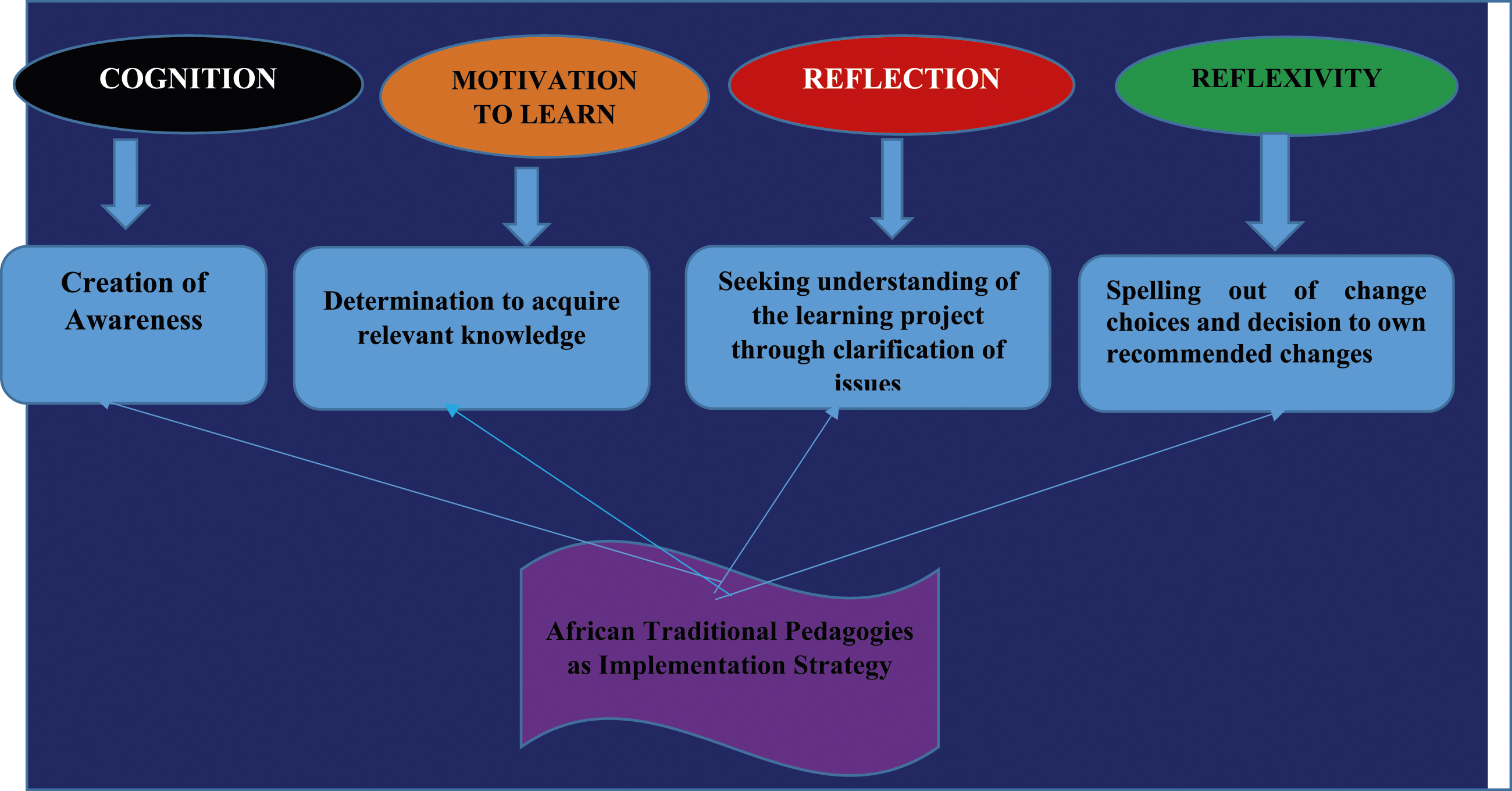
For purpose of specificity, this diagram equally comports an implementation strategy section that indicates the kind of pedagogies (African Traditional Pedagogies) that need to be operationalised in order to make sense of the African Learning City Theory. Finally, while the reflexivity section does suggest that final change choices and decision to own outcome of the learning endeavour fall due at this last stage, it is neither practical nor natural to have all participants key in, to these requirements by the time the active aspect of the African learning city process comes to an end. Consequently, a further period (preferably between the end of the first active aspect and the next) should be allowed for persons that may not have embraced all the changes enunciated and/or owned the whole outcome by the end of the active aspect of the learning city project. That which is important is that a substantial number of people should have signed on to the conclusions of the learning city activity by the time the activity came to an active end.
Conclusion
Basically, the raison-d’être of this article is the denouncing of earlier Mezirow’s and Freire’s theories as adaptive rather than reflexive strategies for promoting learning city projects in Africa. While these theories (Mezirow’s and Freire’s) may have been found to be effective in creating awareness around learning and motivating for learning, they fail to …engender the potential for individuals and communities to (en)counter the trajectories of their lives and to enhance their capabilities… In other words, they do not allow enough individual and community participation in the process of creating an inclusive African city that is capable of lifting the current burdens of African city dwellers.
Furthermore, in addition to advancing a greater reflexivity (individual and community involvement in the creation of a city), the new African learning city theory advocates the support of learning city processes with African traditional pedagogies for practical purposes. If the recommendations of the new African Learning City Theory were to be followed, the recent efforts of the UNESCO Institute for Lifelong Learning (UIL) aimed at boosting learning city projects around the world and especially within Africa would not have been in vain. UIL’s efforts would have found compatibility with an approach that is indigenous and therefore relevant for unlocking where success has been hiding.
Supplemental Material
Supplemental Material - Towards a theory of African learning city
Supplemental Material for Towards a theory of African learning city by Idowu Biao and Ditiro Tsimane in Journal of Adult and Continuing Education
Footnotes
Declaration of conflicting interests
The author(s) declared no potential conflicts of interest with respect to the research, authorship, and/or publication of this article.
Funding
The author(s) received no financial support for the research, authorship, and/or publication of this article.

Supplemental Material
Supplemental material for this article is available online.
References
Supplementary Material
Please find the following supplemental material available below.
For Open Access articles published under a Creative Commons License, all supplemental material carries the same license as the article it is associated with.
For non-Open Access articles published, all supplemental material carries a non-exclusive license, and permission requests for re-use of supplemental material or any part of supplemental material shall be sent directly to the copyright owner as specified in the copyright notice associated with the article.
