




Abstract
This article explores the perspectives of immigrant student-parents who pursued post-secondary education at one community college in the Lower Mainland of British Columbia, Canada. Drawing from interviews with 10 women who had immigrated to Canada as adults, this analysis focuses on the experiences and pathways of the immigrant student-mothers into career preparation programs at the college. The accounts of these women illuminate tensions among the multiple identities that they navigated in the process of making a new life in Canada. Key themes I explore from their accounts include narratives of job downgrading and underemployment; the gendered complexity of navigating post-migration employment and child-rearing; and the emotional weight of navigating multiple identities as college students. Ultimately, this analysis highlights the emotional labor undertaken by immigrant mothers in a larger system of inequities in immigration, employment, and education.
Community colleges in Canada and the US offer a range of short-term, sub-baccalaureate certificates, diplomas, and degrees, and serve as major providers of occupational programs to adults at various stages in their educational and work lives (Skolnik, 2021). Although community colleges across the Canada and the US do not constitute a monolithic institution—indeed, they vary across states and provinces—they do reflect some core commitments that distinguish them from other post-secondary organizations (Levin, 2017). These commitments include (a) increased access to post-secondary education for traditionally underrepresented students, (b) strong orientation to the local community, and (c) comprehensive curricular offerings aimed at an array of constituents and missions (Bailey and Morest, 2006; Levin, 2017).
The degree to which these principles are realized for a diverse student population—or whether colleges are even designed to realize them—has been an ongoing point of contention among scholars (Bailey et al., 2015; Dougherty, 1994; Grubb et al., 1999; Levin, 2007). In line with the commitment to widening post-secondary participation, enrollment at community colleges includes a range of students who diverge from the student privileged by traditional higher education norms, policies, and practices. This includes students who might be deemed “beyond the margins” of what is considered nontraditional, such as adult immigrants, the working poor, and welfare recipients (Levin, 2007, p. 30). Nevertheless, community colleges are sites where students from historically underserved groups must navigate discourses and structural arrangements that privilege a “traditional” student ideal (Deil-Amen, 2015; Sallee & Cox, 2019).
One of the core assumptions about the traditional or ideal post-secondary student revolves around the construct of an individual who is committed to full-time study. As Lynch (2010) pointed out, the foundation of neoliberal restructuring of higher education has reified a culture of “carelessness,” which separates scholarly work from emotions, and positions students as autonomous, strictly “rational” individuals, rather than as members of families with caregiving responsibilities. This culture of carelessness perpetuates the construction of the normative student as one who has no social commitments that interfere with academic work. It also frames the purpose of post-secondary study as pursuing an individual-level investment in marketable skills.
Studies of student-parents, and in particular, student-mothers, have highlighted the extent to which post-secondary policies and physical spaces reflect this culture of carelessness, particularly at the university level (e.g., Hook et al., 2022; Moreau, 2016; Moreau & Kerner, 2015). At community colleges in the US and Canada, researchers have also documented the absence of resources or supports for student-parents, as well as the distinctly careless orientation of most college policies and practices (Bonnycastle & Prentice, 2011; Cox & Sallee, 2018; Duquaine-Watson, 2007). Even the most basic of supports—affordable and accessible childcare—is a scarce resource (see, for example, (Sallee & Cox, 2019).
And yet, community college students, even more so than university students, face competing caregiving responsibilities. For example, although student-parents, including immigrant student-parents, are enrolled at every level of post-secondary education in Canada, they compose the greatest proportion of the student population at two-year colleges (van Rhijn et al., 2011). Estimates of the percentage of college students with dependent children range from 17% (Lero et al., 2007) to 22% (Holmes, 2005). Thus, examining the experiences of student-parents at the community college level offers the opportunity to better understand how to promote authentic access to educational opportunity for historically underrepresented students.
In this paper, I explore the experiences of a particular subset of student-parents: a group of student-mothers who immigrated to Canada as adults and were pursuing post-secondary education as part of a post-migration career trajectory. This group of 10 women participated in a larger case study of student-parents at a community college in the Lower Mainland of British Columbia. For these immigrant student-parents, their experiences as students were inextricably linked to their identities as adult immigrants and as mothers, leading me to ask this question as I undertook my analysis: How did these women’s identities as immigrants and parents shape their post-secondary trajectories and experiences?
In what follows, I offer an analysis of these women’s experiences, building on existing research about immigrants to Canada as well as the extant scholarship on student-parents in post-secondary education. In doing so, I highlight the tensions between these women’s multiple social identities and the normative student identity constructed by post-secondary policies and practices. Ultimately, this analysis illuminates the emotional costs and identity work involved in pursuing post-secondary education for students who are on the margins.
Immigrating to Canada: The Broader Context
The point system at the heart of the Canadian immigration system offers an increased chance of success to individuals with higher levels of education and professional employment (Houle & Yssaad, 2010). This suggests to prospective immigrants that once in Canada, their educational and professional credentials will be valued (Pastrana, 2020). The reality, however, is that gaining recognition for foreign academic credentials and work experience is not a smooth process for new immigrants. Houle and Yssaad’s (2010) analysis of the Longitudinal Survey of Immigrants to Canada (LSIC) revealed that within the first 4 years of immigration, fewer than one-third of new immigrants in 2000/2001 had gained recognition for their academic credentials—and for that group, over half received that recognition from educational institutions, not from employers. Within the same four-year period, 40% of new immigrants had their work experience accepted by an employer (Houle & Yssaad, 2010). Other analyses confirm that 4 years after arrival to Canada, immigrants were employed in jobs with significantly lower status than the ones they held before migrating; the majority had not gained entry into their pre-migration profession (Adamuti-Trache, 2011; Adamuti‐Trache et al., 2013). Indeed, new immigrants are less likely to engage in work requiring a university degree than either native Canadians or more established immigrants (Houle & Yssaad, 2010). Yssaad and Fields’s (2018) analysis of the immigrant labor market indicated lower employment of immigrants with university credentials than for Canadian peers, particularly for recent immigrants, as well as lower earnings for those immigrants in relation to their Canadian counterparts.
Barriers to Professional Employment
Research exploring the specific barriers that highly educated immigrants face in finding work once arriving in Canada highlights the fact that they must contend with requirements that devalue foreign academic credentials and foreign work experience (e g., Creese & Wiebe, 2012; see also Liu-Farrer et al., 2021). Being able to work as a doctor in British Columbia, for example, requires taking the Medical Council of Canada’s written exam in order to qualify for a limited number of hospital residencies required for full licensure. The competition for spots is fierce; consequently, proof of language proficiency and medical knowledge enables only a minimal percentage of qualified applicants to move through the process. The shortage of physicians in British Columbia means that there is work available, but doctors with degrees and experience outside of Canada and the US are largely unable to access that work (Culbert, 2021; Bauder, 2003)
Other professions, such as engineering and law, maintain analogous regulations that undermine foreign skilled workers’ employment opportunities, leading Bauder (2003) to assert that deskilling and non-recognition of foreign credentials is an intentional process by which Professional associations and the state actively exclude immigrant labour from the most highly desired occupations in order to reserve these occupations for Canadian-born and Canadian-educated workers (p. 699).
Even in less regulated fields, such as computer and information technology, the preference for Canadian experience represents a significant gatekeeping strategy (Bauder, 2003; Pastrana, 2020).
The disadvantages facing highly skilled immigrants who seek employment in Canada are compounded for women and visible minorities. For instance, data from the 2006 Census indicated that immigrants were less likely to capitalize on their foreign work experience if they were female and a member of a visible minority group (Houle & Yssaad, 2010). Similarly, Yssad and Fields (2018) acknowledged that immigrant “women are more likely to face persistent challenges becoming employed” (p. 13). In the specific case of immigrant physicians, Culbert (2021) reported that graduates of European medical schools are more likely to earn residencies than immigrants with credentials from other countries.
The Role of Language Proficiency
The extent to which language proficiency plays a role in immigrants’ underemployment is not clear. In 2011, about 92% of immigrant women reported being able to converse in at least one of Canada’s official languages (Hudon, 2015). It is certainly possible that informal assessments of their language proficiency offer an ostensible justification for discrimination against women and visible minorities. Sinacore et al.'s (2009) phenomenological study of Jews who migrated to Quebec revealed that language challenges were also accompanied by discrimination related to cultural/ethnic affiliations and religious practices. Participants attributed underemployment to multiple factors, including inability to access the hidden job market.
Broadly speaking, research on language learning and proficiency among immigrants underscores the integral links among (a) language use, (b) access to material resources and opportunities, and (c) identity formation (Cervatiuc, 2009; Norton, 2013; Man, 2004; Qin & Blachford, 2017; Waterhouse, 2011). An important implication of this line of scholarship is that literacy and language learning experiences are shaped by structures of inequality. Norton (2013), for example, noted that in the Canadian context, language learners of European descent faced less racism than language learners from other racial/ethnic backgrounds. Similarly, in a study of Chinese immigrants to Canada, Qin and Blachford (2017) illustrate the difficulties that participants faced as they attempted to integrate into Canadian society, despite their proficiency in the English language. Ultimately, the participants in this study suggested that dispositions and attitudes—aspects of their identity—proved more consequential for their success than their proficiency in English.
In a study of highly skilled, middle-class Chinese immigrant women, Man (2004) found that many of the women entered as dependents of their husbands, rather than as skilled workers in their own right. Once in Canada, these women took on the unpaid caring work in the home, and participated in the workforce through part-time and precarious employment. Some participants found that these responsibilities prevented them from enrolling in English language classes; but Man also noted that the existing courses were “often inadequate for meeting the employment needs of these professional and highly skilled women” (p. 145). Thus, the women in Man’s study had access to few, if any, opportunities to develop the kind of language fluency or cultural knowledge required for employment in their professional fields.
In sum, opportunity structures, including immigration policies, gatekeeping by professional associations, discrimination towards racialized women, and the availability and nature of educational offerings (including English as an additional language), all form the backdrop for immigrants’ ability to navigate new professional and personal lives once they arrive in Canada. Furthermore, these broader contexts shape the shifting identities that immigrants construct as they take on new roles in a new country.
Conceptual Framework
As suggested in the preceding section, the concept of identity formation as taken up by language learning scholars offers a useful framework for exploring immigrant student-parents’ experiences. Norton (2013), for example, in her research on language learning and identity of Canadian immigrants, articulated one of the central tenets of her theorizing: “Identity, practices, and resources are mutually constitutive” (p. 2). She explains that differential access to resources—both material and symbolic—shapes the practices that learners engage in, whether at home, in schools, or at workplaces. Identities are both “produced and negotiated” through these practices, reflecting the role of broader socio-political structures. Thus, for adult immigrants, identity construction is complicated by the policies and ideologies that shape immigrants’ integration into a host country, as well as the discourses around additional language acquisition (Cervatiuc, 2009; Söhn, 2013; Waterhouse, 2011). These material and ideological contexts form the backdrop for discourses around “good” English language speakers, the ideal immigrant/citizen and the ideal post-secondary student (Man, 2004; Qin & Blachford, 2017; Söhn, 2016). Such discourses shape how immigrants are viewed by others, as well as how they view themselves.
Scholars who have delved into issues of identity as they emerge in the processes of schooling begin with the premise that “individuals construct their identities in relation to others, and in particular, to understandings of ‘the other’” (Reay, 2010, para 1). In the field of second-language acquisition, understandings of “the other” include the communities that individuals aspire to join as they develop greater fluency (or imagined communities, as in Kanno & Norton, 2003). Another important “other” in educational contexts is the ideal student, a construct that is informed by institutional norms and practices, as well as individual students’ understandings (e.g., Deil-Amen, 2015; Youdell, 2006).
This approach to identity formation aligns with an intersectional framing, which recognizes that individuals’ understandings of who they are and where they belong form in relation to multiple, and contradictory social divisions (Anthias, 2013). Such a framing affords the opportunity to explore “the multiple social structures and processes that intertwine to produce specific social positions and identities” (Anthias, 2012, p. 106). These include processes tied to practices of class, gender, and race, as well as relations of power that are produced across other constellations of social and institutional locations (see, for example, Anthias, 2002; Collins, 2001).
In the context of post-secondary education, researchers have explored how various “nontraditional” students develop identities in relation to the gendered, classed, and racialized constructions of the ideal student. Lucey et al. (2003), for example, delved into the psychological costs for working-class women who pursued post-secondary education, noting the significance of conscious desires and unconscious emotions as the women navigated “uneasy” hybrids of classed, gendered, and racialized/ethnic subjectivities. Applying a psychoanalytic frame, Lucey et al. draw attention to psychic defenses that enabled the women in the study to submerge difficult emotions and, in turn, manage their hybrid identities.
In a study of mature, working-class women pursuing post-secondary education, Reay (2003) articulated one of the fundamental bases for difficult emotions: the typical framing of social mobility through education as an individual project. Noting the emotional costs involved for the study participants, Reay asserts: These costs, of guilt, anxieties and feelings of personal inadequacy, bear down more powerfully on such groups for whom the pursuit of individual self-interest is not normative, and were particularly evident in the narratives of mature women students who were parents (p. 306).
Indeed, this construct—the individual, and by extension, careless (dependent-free) student—generates identity conflicts for student-parents in general, and in particular for student-mothers, who are subject to a fiercely competing ideology about what constitutes good mothering (Brooks, 2015; Estes, 2011; Hook, 2016; Moreau & Kerner, 2015; Moreau, 2016). The emotional costs for student-mothers include fears that they are no longer good mothers, and guilt over neglecting their caregiving responsibilities (Mannay & Morgan, 2013). For racialized women, the conflict can be exacerbated. In Estes’ (2011) study of student-parents at an American university, for example, the black women in the study encountered messages that they were not expected to succeed, either as students or as parents. Estes goes on to describe several strategies that student-parents relied on to manage the role conflicts, echoing other scholars’ insights about the mental and emotional energy required to maintain hybrid identities.
In summary, this framework draws attention to the multiple social identities that students navigate in relation to the normative post-secondary student, the ideal as constructed by institutional policies and practices, and as understood by the students themselves. In doing so, it highlights the complex emotional work involved in pursuing post-secondary education, while also underscoring the agency involved in negotiating these discourses and processes.
Methods
The data for this analysis derive from a larger interpretive, qualitative study (Denzin & Lincoln, 1998) of student-parents at one college in the Lower Mainland of British Columbia, referred to throughout this paper with the pseudonym British Columbia Community College (BCCC). Designed to explore the experiences of student-parents as they pursued post-secondary education, the study incorporated one-on-one, in-person, qualitative interviews (Roulston, 2010) with students who were caring for at least one dependent child. Ten of the students in the sample had immigrated to Canada as adults, and the interviews with these ten women form the basis for this paper.
Research Site and Participants
British Columbia Community College offers over 120 certificates and diplomas in programs lasting anywhere from 5 weeks to 2 years. While some students enroll in its university-transfer program, the majority of students enroll in career-technical education and developmental coursework. The college prides itself on offering post-secondary access to a diverse population of students and touts the value of its programs in creating employment opportunities for its graduates. One message aimed at prospective students proclaims: At [BCCC], you’re more than a student; you’re a future professional. Our priority is that you graduate with the skills that B.C. employers want and need.
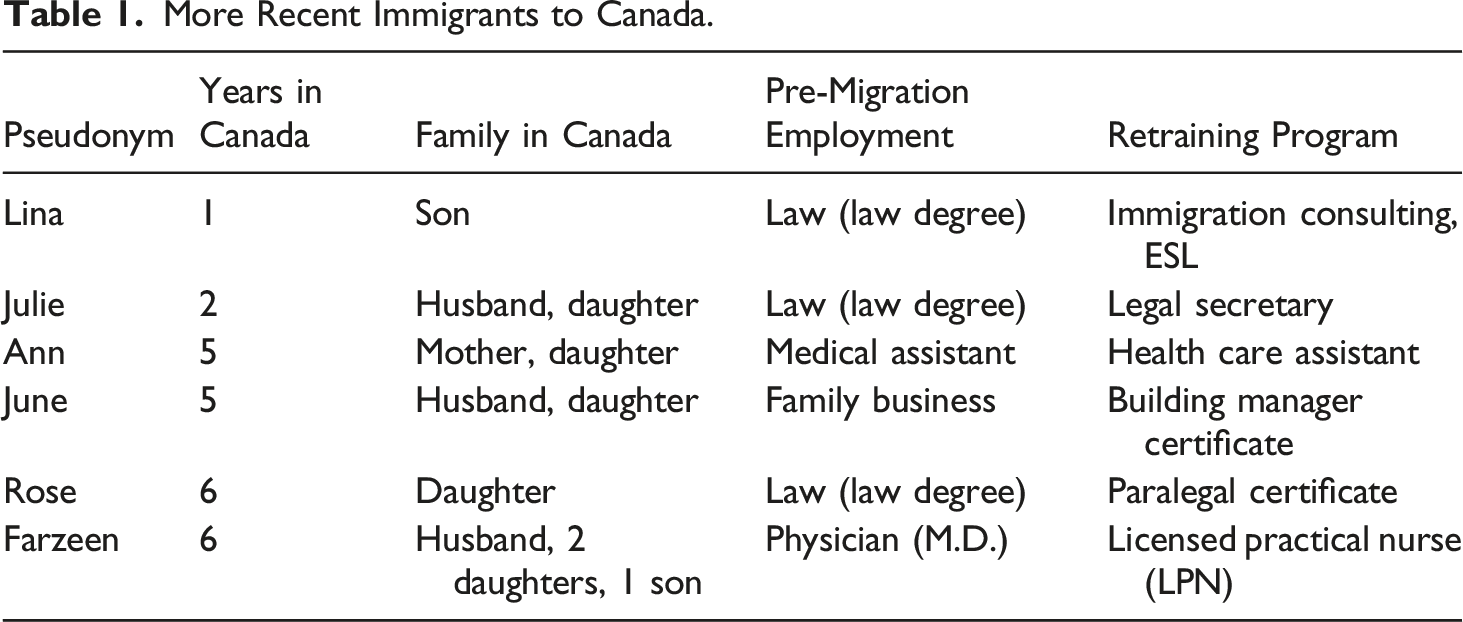
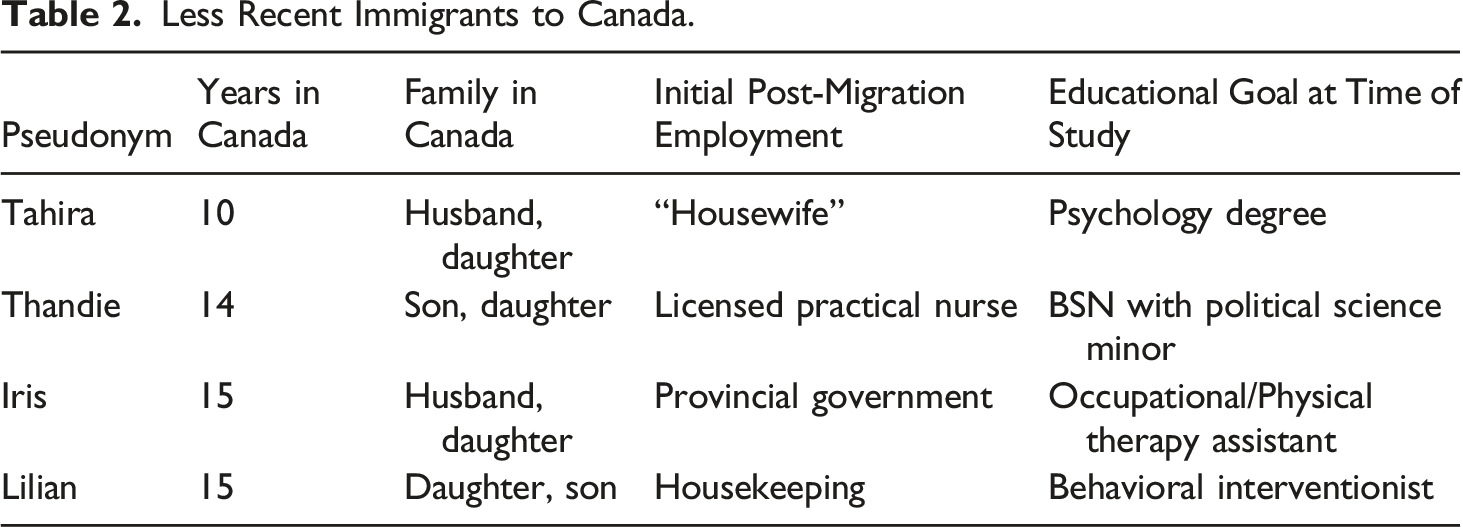
I recruited 20 student-parents from BCCC to participate in interviews about their experiences trying to balance their academic and parenting responsibilities. Among the student-parents who agreed to participate in the study were 10 women who had immigrated to Canada as adults, anywhere from one to 15 years earlier. All 10 women were visible minorities. Four women had migrated from China; the others from Bangladesh, England, Guatemala, India, Iran, and Zimbabwe. Two had immigrated to Canada as political refugees. Five of the women were solo parenting at the time of the study, while the other five had assistance from spouses. Most of these women were raising either one or two children over 5 years of age. The exceptions were Thandie and Nancy, each of whom had a two-year old child, and Farzeen, who had three children, two older daughters (ages 18 and 23) as well as a younger son (age 6).
More Recent Immigrants to Canada.
Less Recent Immigrants to Canada.
Data Collection and Analysis
During one-on-one interviews lasting 60–90 minutes, I explored how these student-parents came to enroll at BCCC and their experiences trying to balance their work, school, and parenting responsibilities. I conducted all the interviews in English. In exploring the pathways that the immigrant students-mothers had taken into BCCC, the conversations delved into the students’ prior education, both in their home countries and in Canada, their immigration journeys, and their career goals. As a result, these interviews provided rich details about their immediate experiences as student-parents at BCCC, as well as the wider contexts shaping their complicated educational trajectories. I audio-recorded and transcribed each interview, then used the transcripts to craft several interim research documents. These included (a) a summary of the immigration narrative that each woman shared; (b) a matrix of key information about each participant, including pre-migration education and work, educational and career goals, and various demographic data; and (c) a cross-case analysis of the emotion-laden junctures in each interview. In undertaking cross-case analysis, I began by reviewing episodes when participants expressed their emotions in visible and audible ways during the interviews (as documented by audio-recording and/or my interview notes). Marking these emotional junctures, then tracing the conversations that surfaced these emotions, I attended to participants’ meaning-making around their experiences of immigration, education, and parenting.
Positionality Statement
At the time of this study, I had recently immigrated to Canada from the U.S. As a white Settler of European descent, I recognize the privileges I maintain by virtue of my skin color as well as my minimally accented English. I was acutely aware during the interviews that these were not privileges shared by the immigrant women in this study. Additionally, although our shared gender identification offered some basis for connection, the participants who asked about my family were surprised to hear that I had no children of my own. Given these contrasts between my positionality and that of the study participants, I was curious as to how the participants spoke of their own identities across the intersections of multiple and complex social locations. This shaped the follow-up questions I asked the women during interviews and formed the basis for the analysis below.
Findings
On the whole, the trajectories of these women revealed significant disjunctures between their pre-migration employment and their post-migration employment. For most, forging a viable career in Canada involved a significant departure from their prior professional path. Especially for the solo parents, or women whose spouses were struggling to find steady work, enrollment in a relatively short practical educational program offered the promise of immediate employment, even if that work was only partially connected to their prior education and professional experiences. Thandie, for instance, enrolled in a Licensed Practical Nursing (LPN) program once she settled in Canada, moving away from the human rights activism she practiced pre-migration. June initially thought that earning a realtor’s license would enable her to supplement her husband’s income while also caring for their daughter, but she found that the expenses outweighed the benefits of that particular kind of part-time work. At the time of the study, June was enrolled in a building manager certificate program. Although offered part-time in the form of four courses that could be taken over 2–3 years, June enrolled in all four courses during the same term, in order to expedite her time to degree completion and, in turn, employment.
In contrast, the women who had immigrated more than 10 years earlier had begun to pursue longer, more circuitous routes towards more fulfilling career goals. Thandie, for example, was completing the requirements for entry into a Bachelor of Science in Nursing (BSN) program. By completing the BSN with political science “on the side,” Thandie envisioned working in public health for a non-governmental organization.
Like Thandie, Iris, who had migrated 15 years earlier from England, was also pursuing a program of study for personal fulfillment. When she first arrived in Canada, she secured employment with the provincial government, where she met her husband-to-be. Once they had their first child, she and husband relied primarily on his income, so that Iris could be “a hands-on mum.” Iris supplemented their income with part-time work, but also thought about ways to move into a career that would “feed her soul.” She explained her choice, telling me “I could have gone back and settled into a nice cushy government job,” but instead, she found her way to the occupational/physical therapy assistant program at BCCC, a two-year, full-time program which would enable Iris to become a rehab assistant.
Across these women’s accounts of their immigration and educational trajectories—regardless of the time since arriving in Canada—I discerned several dominant themes. These included narratives of job downgrading and underemployment; the gendered complexity of navigating post-migration employment and child-rearing; and the emotional weight of navigating multiple identities as post-secondary students.
“All This Professionalism Is Getting Wasted”
A noteworthy pattern among the women who had immigrated more recently (within the past 6 years) was the extent to which BCCC programs served as the site of deskilling. This group included multiple women with law degrees (Lina, Julie, Rose), and a medical doctor (Farzeen), all of whom discovered after settlement that their academic credentials and professional work experience were undervalued in Canada. Tahira, who had migrated a decade earlier, had also faced the same challenge, finding that her experience as a high-level accounts manager did not translate into the Canadian context. The difficulty in finding professional employment also held true for Julie, Farzeen, and Tahira’s husbands, each of whom worked as highly educated engineers before migration. In each of these three cases, immigration involved a longer-than-anticipated period of unemployment for the husbands, and in turn, a greater drain on financial resources. Each family was then faced with decisions about earning enough income without incurring undue added expenses, while caring for children in a metropolitan region with limited access to affordable childcare (Spicer & Kreda, 2011).
Farzeen and her husband, for instance, had migrated from Iran. Although highly educated, both struggled to find steady employment. Farzeen, who had been a family doctor in Iran, realized that the path towards earning one of the residency spots in BC for international medical graduates was both unlikely and expensive. Consequently, she and her husband decided that one of them would return to school as a full-time student while the other would stay at home caring for their young son. That she was the one who would return to school was an easy choice, Farzeen explained, because she would be able to find secure employment faster in health care than her husband would be able to with his mechanical engineering background. After finding out that the waitlist for the RN program at BCCC was 3 years, she enrolled in the Licensed Practical Nurse (LPN) program, which only had an 8-month waiting list. Completing the 16-month LPN program would lead to immediate employment; additionally, it would bridge into the RN program. Thus, Farzeen found herself retraining as an LPN after practicing medicine as a physician for nearly 17 years.
If it were not for the strict attendance policy, Farzeen told me, she might not attend the classes oriented toward “the theory,” which she already understood thoroughly. The practical components of the program—specifically, tasks that she did not undertake as a practicing physician—composed about one-third of the curriculum. This was what she needed to learn, in what was essentially a process of downgrading her skills. Furthermore, she told me, she was not unique among her classmates in this regard.
Tahira, too, commented on the number of highly skilled immigrants, including doctors, in lower status occupational programs. She spoke of her own prior career wistfully. Educated with an undergraduate degree in economics and a Master of Business Administration, Tahira had worked as an account manager of a multi-national company before immigrating to Canada. Describing this work, she told me “I had a very glamorous--I mean a very professional career back home,” but once she and her family settled in Canada, “I turned into a housewife.” When I asked whether she aimed to get back into the business world, she explained that her age foreclosed that possibility. She wouldn’t mind starting at a much lower management position, but, she added, “even that is not possible for me.” For herself, as well as the many well-educated immigrants, she had observed at BCCC, she asserted, “all this professionalism is getting wasted.”
The three women who had practiced law before migrating to Canada were also all enrolled in programs that would prepare them for lower status employment. Julie had initially hoped that she would be able to continue her career as a lawyer, but realized that the route (including passing bar exams) was uncertain and time-consuming. Instead, she told me, gaining paid work more quickly and augmenting her husband’s salary would be a better way of providing for their daughter and saving for their own retirement. She had considered retraining options that she knew were popular among Chinese immigrants, such as accounting and medical or dental assisting, but admitted that she might not be well-suited for such work. With guidance from an advisor at BCCC, Julie first enrolled in EAL offerings, and at the time of the interview, had started the legal secretary program, with hopes of ultimately completing the paralegal program. She admitted that she did not always understand 100% of what was said in class, so she identified her biggest problem as the language, then the second biggest problem as the typing speed (“not very fast”). Lina first considered a paralegal program at BCCC, then decided to enroll in a relatively expensive diploma program in immigration counseling at a for-profit college while she took the low-cost EAL classes at BCCC. Unlike the programs at BCCC aimed at immigrants, Lina’s immigration counseling course was populated with students who had grown up in Canada. As a result, she noted, she found that her unfamiliarity with Canada and her concomitant lack of “professional knowledge” worked against her.
These accounts highlight contradictory aspects of the educational space afforded by BCCC for immigrant women. On one hand, the advising and program offerings that these women found at BCCC proved relatively inexpensive and led to clear employment pathways for immigrants, including those with less proficiency in English. On the other hand, these employment pathways were predicated on deskilling and underemployment for the highly educated women in this study. The waiting lists for seats in these programs suggest the important role that BCCC plays in the process of retraining professionals for lower status employment opportunities.
“If You Marry a Chicken …”
For the five women who immigrated to Canada with spouses (Julie, Farzeen, Tahira, June, Rose), all of whom were highly skilled professionals in their own right, their husband’s employment trajectory often took precedence, shaping the possibilities for these women as they managed unanticipated struggles once settled in Canada.
Julie, who had worked as a lawyer in China, migrated to Canada with her husband, a computer engineer, and their four-year old daughter. Despite preparing for the move for 4 years, once the family arrived in Canada, her husband was unable to find a job for the first year. During that time, Julie enrolled in English language courses, then completed the college preparatory English course at BCCC, in order to enter the legal secretary training program. After completing this program, she explained, she would be able to transition into a paralegal program.
Julie’s story touched on multiple stressors, including the drain on the family’s savings for the year that her husband was unable to find work, as well as the loss of the support system of their own parents, who seemed so far away, back in China. When I commented on Julie’s courage in pursuing this path, she corrected me immediately, noting that the move had been her husband’s idea, that he was “the brave one.” She elaborated, explaining that in most Chinese families, the man is more powerful. As a woman, “if you marry a chicken, then you follow the chicken; if you marry a dog, then you follow the dog.” Her role was to make the best of the situation and support the family by making a better life for their daughter.
Julie was unique in describing herself as subordinate to her husband. Yet, even when the decision to immigrate appeared to be more of a joint spousal decision, the wife’s participation in paid work typically played a supplemental, not primary role, echoing findings from Man's (2004) study of highly skilled immigrant women and the subordinate status of spouses in the Canadian immigration process. Tahira and her husband, for instance, had migrated from Bangladesh 10 years earlier with their 7-year old daughter. Tahira’s husband worked internationally for 8 years before finding work in Canada, so Tahira raised their daughter with intermittent visits from her husband. At times, Tahira took on part-time work, but found that the cost of transportation undercut the net income. Only once the family was reunited was Tahira able to pursue further education, starting with coursework in English as an additional language.
Taking a subordinate economic role took a particular toll on Rose, who migrated to Canada from India with her husband, who had secured an IT job prior to the move. After the birth of their daughter, the marriage deteriorated, and Rose found herself raising her daughter as a single mother with few resources and no other family. Armed with her law degree from India and prior work experience with firms in the UK, she visited a number of law firms, offering to volunteer. After volunteering as a legal secretary at one law firm for 3 months, the firm offered her permanent work. While working full-time, Rose started taking courses at BCCC for a paralegal certification. This coursework allowed her to take on more responsibilities at work, but after 4 years of employment, she had still not received a pay raise. This posed a dilemma for Rose. The law firm had offered her employment when she was desperate and indigent, and she felt a deep sense of loyalty and appreciation. However, raising her daughter and continuing her education was proving increasingly expensive. She still dreamed about being able to eventually write her law exams, but that goal seemed ever more unattainable with each passing year.
For these women, migrating to Canada with their spouses halted their prior professional trajectory, and exerted pressure on them to find employment options that would generate income while they also took primary responsibility for raising young children. With the exception of Farzeen, these families managed the move to Canada by prioritizing the husband’s professional employment in order to provide the primary income. Thus, none of the husbands had proceeded down the deskilling path that these women did.
Complex and Conflicting Identities: Immigrant, Mother, and Student
The accounts that each of these immigrant student-mothers shared with me were weighted with emotion. Each interview touched on sensitive aspects of their immigration and educational pathways, identifying various vulnerabilities and risks heightened by their desires to provide the best opportunities for their children. Multiple points of tension emerged in these conversations, as each potential benefit of their efforts to provide for their families was accompanied by complex feelings of loss, disappointment, guilt, fear. As Tahira noted, even the initial decision to immigrate generated tensions around desire and loss: “The immigrants who are leaving behind their dear ones and trying to adjust in a new country, trying to assimilate to … a very new culture; it takes a toll--a great toll--on us.”
For each juncture in their trajectories, the women in this study shared conflicting emotions that hinted at even more complex identity work. Julie, for instance, when sharing her disappointment in realizing that she would not be able to pursue her pre-migration career, told me, “Yes, at first when I arrived here, I just want to continue my career. But … for me, actually I am middle aged, so--not very young.”
Julie was not the only study participant who called explicit attention to her age, describing herself as no longer young. Across these conversations, I understood the references to age to be intertwined with their identities as mothers—being younger was not simply a matter of age, but also a time of fewer caregiving obligations. Thus, wistful references to pre-migration careers might have also been accompanied by a twinge of guilt for remembering her child-free life with such fondness.
While expressing disappointment over her truncated career, Julie nonetheless also conveyed her appreciation for the mere existence of BCCC’s legal assistant program. Her sense was that legal assistant training worked much differently in China, and if there were college- or university-based programs, she hadn’t heard of them. She concluded her contrast between legal education in China and Canada by summarizing: “So this program--I think is better than in China. … It is more professional than in China.” Although Julie was engaged in a deskilling training program, she was nevertheless sincerely grateful.
Motherhood certainly complicated the settlement process for these women. In contrast to Lina’s life in China, where she earned a high salary, Lina noted the financial uncertainties of her current situation: not knowing when she would be able to secure a “good job” and the need to spend her savings carefully. At the same time, she confessed, “I’m not a good student,” explaining that she had limited time to study, and often did not start her homework until after 10 p.m.. And yet, she noted, “I also need more time to play with my son,” suggesting that she was failing to meet expectations of a “good” student or a “good” mother. At this point in the interview, we both felt the weight of this stress and guilt, and Lina quipped, “not a good story,” then laughed, in order to lighten the mood. She then continued, So, I think during this period, I try my best to study harder and make progress and pass the exam and get the license. Then after this period, I can have more time to play with my child.
Ann, who like Lina, was a single mother at the time of her interview, expressed some of the same core fears about her ability to provide adequately for her child. Difficult--just thinking about how can I raise her by myself. I need work. I need a really good pay work [Laughs].
At the same time, Ann also articulated her hopefulness for the future: “Any way [my daughter] grows up here, she will have a greater opportunity to be successful than me.” Ann also articulated her strategy of positive thinking: “Yeah, I’m thinking, if you think everything is difficult, then everything is difficult.”
Farzeen also tempered her worries with hope. She, like several others (Tahira and Thandie) expressed frustration with inefficiencies and lost opportunities for highly educated and motivated immigrant women. In Farzeen’s case, she described an alternative pathway that would integrate foreign-trained doctors into the Canadian health care system, in a way that would benefit all parties. But at the same time, she expressed appreciation for her good fortune in settling in Canada. It works for my family--for my daughters—very good. … You know that there are some issues in my own country. I’m very happy for them.
Overall, then, she concluded, “I’m not pessimistic.” And yet, significantly, before she described herself as “not pessimistic,” she thought aloud about the relevant adjectives, musing, “Hmm—optimistic. And the opposite is? {pause} pessimistic. I’m not pessimistic.” In other words, Farzeen felt “not pessimistic,” but not actually optimistic.
Thus, Farzeen offered pointed critiques, but also conveyed acceptance and a willingness to adjust or make due for the good of her family. Ultimately, she could see how Canadian institutions were not designed to support her goals, but she could still make use of BCCC to accomplish a compromise. I heard this tension across other women’s accounts as well, as in Tahira’s assertation, “I’m not a real student. I mean, I cannot devote all my time for studying.” Articulations of this gap—between their approach to school and the “careless” ideal—were accompanied by references to their culture’s commitment to family as justification. Tahira, for example, originally from Bangladesh, explained, “our culture is more family-focused.” Similarly, Lina, who told me “I’m not a good student,” she also reminded me, “most of the Chinese only have one child, so the child is quite important.” Such comments illustrated an understanding that their level of family commitment distinguished them from “good” students; but also perhaps, from Canadians more broadly, in a society where the careless individual is consistently advantaged.
Discussion and Conclusion
The upheaval and emotional stress of migrating to Canada and caring for children were compounded for most of these women when they found their prior education and professional experiences discounted and dismissed. Tahira described this settlement experience succinctly as “a real emotional crisis” for the entire family. These accounts offer depth and nuance to the statistical analyses of highly skilled immigrants’ employment trajectories (e.g., Adamuti-Trache, 2011; Yssaad & Fields, 2018). Moreover, these women’s experiences also highlight the inadequacy of research that follows individual immigrants’ educational and employment trajectories without attending to family relationships and caregiving responsibilities (see also Anthias, 2012).
Within the broader context of immigrants’ settlement experiences, BCCC served as a site where highly educated immigrants could participate in deskilling for more immediate employment, as well as the launching point for more fulfilling career paths after establishing themselves in Canada. In nearly every instance, these women were making the best of difficult situations they had not anticipated, with high levels of pressure to provide well for their children. The level of pressure raised the stakes of spending too much time or money pursuing professional employment commensurate with their skills and experience. When viewing the obstacles to employment with this pressure in mind, these women saw the benefit to their families of short-term training for less desirable jobs.
These women understood that they did not match the normative post-secondary student; they described their childcaring commitments as in conflict with being a “good student.” This conflict is both a consistent theme of the student-parent literature and a reflection of the careless student norm pervading post-secondary education (e.g., Estes, 2011; Hook, 2016; Sallee & Cox, 2019). Interestingly, however, their identities as immigrants allowed them more space to reject that particular ideal student norm, and many explicitly attributed their commitment to family over school to their cultural background. Because these women understood the careless climate of BCCC as a reflection of Canadian culture, their identities as members of cultural communities outside of Canada worked to their advantage in navigating the student-parent identity conflict. From Norton’s (2013) perspective on identity formation, these women were able to “reframe their relationship with others” and claim a more powerful identity (p. 3). In other words, drawing strength from their transnational identities created spaces for resisting messages that caregiving and academic responsibilities are incompatible, in a complex negotiation of their multiple, intersectional identities.
Ulimately, at the same time that they made use of educational programming that was not necessarily well-suited to their desired professional trajectories, these women conveyed their commitment to make it work on behalf of their family. Narratives weighted with emotions of disappointment, loss, desire, and sadness were also lightened by joy, gratitude, and optimism. Given the strength and courage that these women displayed as they worked towards providing for their families, it is worth considering whether it is possible to re-configure post-secondary programming in ways that capitalize on immigrant students’ skills and experiences, minimize the amount of deskilling required to enter local labor markets, and temper the student-parent identity conflict. At the same time, it is important to keep in mind that the complex interactions among identity, practices, and resources at the college level are embedded in broader structures of inequality in this particular Canadian context.
Footnotes
Declaration of Conflicting Interests
The author(s) declared no potential conflicts of interest with respect to the research, authorship, and/or publication of this article.
Funding
The author(s) disclosed receipt of the following financial support for the research, authorship, and/or publication of this article: this work was supported by Simon Fraser University (President's Research Grant).
