



Abstract
This contribution examines individual benefits of continuing higher education courses provided by a business school. Lifelong learning is important when it comes to keeping up with changing professional requirements and conditions. Adult education and training courses in the form of continuing higher education offer an organized and systematic possibility to further develop oneself. However, empirical evidence on the benefits to graduates is sparse. This article aims to expand the state of knowledge through a Swiss case. Using univariate and multivariate analyses of survey data (n = 1615), benefits contributing to the satisfaction with practice oriented, non-formal education for working professionals are examined. The analyses focus on satisfaction with one of three types of continuing education programs as a measure for the overall benefit to the graduates. The findings provide important indications for the design of continuing education programs in the context of professional higher education. They reveal that subjectively, monetary benefits as well as increases in personal competence are secondary to the overall benefit accrued through the completion of courses. Instead, career development and the enhancement of specific professional competence significantly contribute to the satisfaction of professionals completing continuing higher education.
Keywords
Introduction and Context
The economic and technological conditions resulting from the ongoing digitization mean that professionals have to reorient or strengthen their careers on a recurring basis. Knowledge, competencies, and qualifications need to be renewed, deepened, or expanded. Thus, lifelong learning is becoming increasingly important and “a mantra within educational policies” (Crossouard & Aynsley, 2010, p. 679). It can be realized in the form of informal learning activities, but also by taking advantage of formal and non-formal educational opportunities.
In Switzerland, the country context of this contribution, the attendance of vocationally oriented continuing education courses has steadily increased in recent years (Federal Statistical Office [FSO], 2017, p. 16). Among people with a tertiary education, 82% of continuing education serves professional purposes and 75% of continuing education activities are supported by the employer (FSO, 2017, p. 13). This is a common pattern in European countries, where pure individual investment in job-related non-formal education is rare (Kaufmann, 2015). According to the Continuing Education Report of the Swiss Federation (FSO, 2017), higher education (HE) graduates in Switzerland engage in continuing education particularly frequently. In 2016, for example, 81% of people with a tertiary degree residing in Switzerland reported that they had participated in a non-formal or informal continuing education activity within the previous 12 months. More recent data for the same group shows that in the years 2010–2019, between 37.6 and 39.7% participated in non-formal continuing education before this number went down to 32.6% in 2020 (FSO, 2021a), presumably due to the Covid-19 pandemic (FSO, 2021b). 16% of Swiss residents with a tertiary degree completed at least one continuing education course lasting more than 40 hours in 2021. This includes the numerous and varied courses offered by the eight public universities of applied sciences (UASs) in Switzerland. As one of three types of higher education institutions (HEIs), they shape the market for continuing education. Their courses mainly address HE graduates who want to use knowledge in an applied way and expand their competences for professional purposes. In particular, the state-recognized degrees “Certificate of Advanced Studies” (CAS), “Diploma of Advanced Studies” (DAS), and “Master of Advanced Studies” (MAS), which will jointly be examined in more detail in this paper, enjoy great popularity and are mostly obtained through study programs for working professionals. These degrees require the attainment of a minimum of 10, 30, and 60 ECTS 1 credits. Further there are specific admission requirements (Eurydice, 2018), usually an HE degree and several years of professional experience. The typical student has completed an apprenticeship along with a vocational baccalaureate before graduating from a UAS and working in the private or public sector. The apprenticeship dominates the post compulsory education in Switzerland and about two thirds of youths or 60,000 persons complete one each year (FSO, 2022). In combination with the roughly 14,000 vocational baccalaureates obtained annually (FSO, 2022), a fairly large pool of potential candidates for CASs, DASs, and MASs exists. For example, in 2016, over 2500 students graduated with an MAS from UASs in Switzerland (FSO, 2017). In comparison, 20,200 students graduated with a bachelor’s or master’s degree from the same type of HE institution in that year (FSO, 2021c). Even though MASs, which include MBAs, DASs, and CASs are offered by accredited institutions and are chronologically and hierarchically structured, they are not classified as formal education, but rather as non-formal education. This classification follows Coombs and Ahmed (1974) who define non-formal education as organized and systematic educational activity outside the formal education frameworks and providing specific subgroups with selected types of learning. In this paper, these courses are subsumed under the term “continuing higher education” (CHE) as suggested by Teichler and Hanft (2009).
Despite the size of the continuing education phenomenon, little is known empirically about the motivation of continuing education students in higher education, be it in the Swiss or global context. Evidence on the non-monetary benefits of continuing education and training (CET) is generally rarely provided (Field, 2011) and only a few research contributions have specifically dealt with the benefits generated by vocationally oriented continuing education provided by HEIs. This may be at least partially due the lack of a standardized measurement or survey instrument (Swiss Coordination Centre for Research in Education [SCCRE], 2018). This situation led the authors to develop their own measuring instrument and to regularly survey satisfaction with the three types of continuing education programs described above at their UAS. Assuming that the overarching benefit of continuing education is reflected in the satisfaction with continuing education programs, the question arises as to how the satisfaction can be influenced. What must HEIs pay attention to in the development and implementation of their programs, if graduates are to obtain high satisfaction levels with CHE? Findings in this regard can be useful for HEI development in the area of continuing education, enable comparisons with other professional adult and continuing education, and allow for objectively comprehensible communication to prospective students.
High levels of satisfaction in continuing HE are important from the points of view of the providing HEIs as well as the students. For the latter, in addition to the time burden that a continuing education program entails, the financial investment must be worthwhile. In Switzerland, the tuition fees to be paid range from approximately CHF 8000 to CHF 35,000, depending on the title being pursued. Furthermore, students are confronted with opportunity costs of completing a CAS, DAS, or MAS. For UASs, a favorable cost-benefit analysis of their continuing education programs by students is important, not least because in Switzerland the financing mechanisms for continuing education work differently than for bachelor’s and master’s degree programs. The former is not subsidized by the state and must be self-supporting. Continuing education courses that generate only a low level of satisfaction have an impact on the reputation of the providers and may also negatively influence the demand for their other programs.
Based on the results of a recurring survey of graduates of the Lucerne Business School, the extent to which an increase in income (H1), positive career development (H2), improvements in specific professional competence (H3) as well as personal competence (H4) affect the level of satisfaction with continuing education programs is examined through univariate comparisons and a multivariate regression analysis. Satisfaction is thereby interpreted as the individual overall benefit that the completed course generates for the participants.
In the following, this contribution explains the theoretical framework and the development of the hypotheses. It then proceeds with the description of the data and sample used in the analysis. The subsequent section details the measurement instrument and operationalization of the constructs. This is followed by the presentation of the results of the analyses. The discussion of the results, along with the limitations and the conclusion are presented in the last two sections.
Theory and Hypotheses
Aside from the notion that benefits from adult education, including CHE, can be realized on at least three levels—individual, social, or economic (Schuller et al., 2004)—they can be categorized as soft and hard outcomes. While non-directly and subjectively measurable outcomes such as changes in interpersonal, personal, organizational, and analytical skills fall into the soft category, hard outcomes are objectively measurable and are represented by professional skills and qualifications (Panitsides, 2013). According to the “three capitals approach” developed by Schuller et al. (2004), all of these outcomes fall under one of three types of capital. This approach is based on human capital theory, which interprets learning activities as an investment by students to build up their personal assets from which benefits or returns are expected, and Bourdieu’s (1986) view that participation in the educational system also forms social capital through networks and group. Schuller et al. (2004) propose that adult learners do not only build up social and human capital but also “identity capital” as their concepts of who they are get enriched through their experience of HE. The measurement of the benefits in this study relies on this distinction, as described in the following sections.
In terms of the economics of education, the individual motivation to participate in CHE is mainly explained by monetary approaches. In particular, the private or individual return to education, an econometric determination of how strongly an additional year of education is reflected in the income of participants is an important and widely used indicator. A positive relationship between continuing education and income is well supported by the literature in the international context (e.g., Field, 2011; Ruhose et al., 2019) as well as the Swiss context (e.g., Rudin, 2012; Swiss Coordination Centre for Research in Education [SCCRE], 2018; Strahm, 2015). Additional education results in greater human, social and identity capital in the form of learning outcomes regarding knowledge and skills, which positively influence labor productivity and subsequently lead to higher income. Increases in personal income are thus perceived as a key measure of educational benefit and represent one of the decisive factors for individual educational choices (Harmon, 2011). HEIs are known to promote the value of MBA programs through the expectation of increased pay after graduation (Gander, 2015). Accordingly, an increase in income that occurs during or after completing a CHE program should have a positive impact on satisfaction with continuing education. It is therefore hypothesized:
An increase in income has a positive influence on satisfaction with CHE.
In addition to monetary benefits, non-monetary benefits of education are also described in educational research. They are often described at the societal level as so-called “spillover effects” (e.g., in Mingat & Tan, 1996), and include, for example, slower population growth or a reduction in crime rates. However, these types of benefits are not appropriate for a study at the individual level. To date, there has been little research on individual non-monetary educational benefits for tertiary education in general. Anecdotal evidence can be found qualitatively among heads of study programs or graduates, but robust quantitative data are lacking. For continuing education in general, the 2014 Education Report Switzerland (SCCRE, 2014) cites productivity gains, increased competitiveness, improved labor market opportunities, greater job security, personal development, and emancipation as examples of individual non-monetary benefits.
Continuing education may be sought because the career is stagnating, a new professional direction is to be taken, or a promotion is desired. A strong influence on the satisfaction with the continuing education program and the associated human and social capital benefits it provides should be found in the improved employability (Boarini & Strauss, 2010) and resulting career steps of the graduates. These include, among other things, to what degree a previously envisaged professional development has been achieved, that more demanding tasks have been taken on (Blundell et al., 2000), or that graduates receive greater recognition in their professional context (Savage & Norton, 2012). In addition, opportunities for social networking with similar minded and engaged persons are a known effect of CET (Ruhose et al., 2019) that might also positively influence career advancement. For this reason, the following hypothesis is formulated:
Career advancement has a positive impact on satisfaction with CHE.
Attending a continuing education course expresses a desire for an increase in professional skills and/or knowledge. Students specifically further their education in an area in which they still lack knowledge or in which they would like to deepen their knowledge. The increase in professional competence and the transfer of the accrued knowledge to professional settings can be expressed through the acquired expertise, but also through an improvement in the quality of work as well as through increased productivity. Relying on the three capitals approach, Jamieson et al. (2009) have shown that human capital benefits in the form of skills and competencies gained are important in the context of adult learning in HE. Swain and Hammond (2011) reported benefits in human capital, including a sense of improved work performance as the second most important positive outcome for part-time adult learners. It is therefore concluded:
An increase in professional competence has a positive impact on satisfaction with CHE.
In addition to professional competences, attending continuing education can also improve identity capital in the form of personal competence. On the one hand, course achievements include personal coaching, presentations, opining, and discussions, and thus provide an opportunity for improving one’s own demeanor (SCCRE, 2014) in professional as well as other social settings, and increasing general self-confidence (Knasel et al., 2000; Swain & Hammond, 2011). On the other hand, here is also a known positive effect of adult education on self-efficacy (Preston & Hammond, 2002; Hammond & Feinstein, 2005) a concept describing people’s beliefs in their capabilities to learn or perform specific tasks (Bandura, 1977). A strong professional foundation, which may result from CHE, should contribute to graduates feeling more confident regarding their professional skills and better prepared for professional challenges, which can be interpreted as improved self-efficacy. Therefore, the following is hypothesized:
An increase in personal competence has a positive influence on satisfaction with CHE.
Data and Sample
The data used for the analysis in this paper were collected through an annual survey that started in 2017 and includes 5 years of data collection in total. All participants completed a CAS, DAS, MAS, or an Executive Master of Business Administration (EMBA), which is equivalent to an MAS. All continuing education programs were provided by the Lucerne Business School and range from banking and finance to corporate communication, event management, and business economics and management. Each year, all the graduates from three years previous, that provided an address after graduation, were asked to participate in the survey. This resulted in a list-based sample that should provide good generalizability since this approach permits measurement of the sources of nonresponse.
The graduates of the years 2014 and 2015 (n = 1789 graduates) were contacted by letter and received an enclosed paper questionnaire. The letter indicated that the questionnaire could also be completed online and provided the link to do so. In addition, both cohorts received a reminder email with the link to the online questionnaire two and four weeks later. Thus, the former continuing education study participants had the option of completing the survey either on paper or electronically. Beginning with the graduates of the year 2016, participants were only contacted by email, totaling in 3049 invitations to participate in the online survey. Again, two reminders were sent to this group of graduates, the timeframe being three weeks.
Overall, the response rate was 33.4%. For the first two groups of graduates a combined response rate of 38.6% was achieved, while the three subsequent surveys resulted in a combined response rate of 30.3%. The difference between the response rates may be due to the different ways of contacting the participants or may have been caused by having a higher proportion of CAS students in the three later years. The shorter period of continuing education could lead to a lower level of attachment to the UAS and thus a lower propensity to respond to the request to participate. Another reason for the lower response rate in the online-only surveys might be that respondents were concerned about the privacy of the information they provide online (Hildén, 2017). All invitations to participate in the survey were sent as joint emails from the respective course directors and the head of continuing education of the business school in order to take advantage of the fact that respondents prefer completing electronic surveys received from authority figures compared to people they do not know personally or professionally (Saleh & Bista, 2017; Trespalacios & Perkins, 2016). In general, however, both responses and the combined response are relatively high, given that no incentives were provided for the voluntary participation in the surveys.
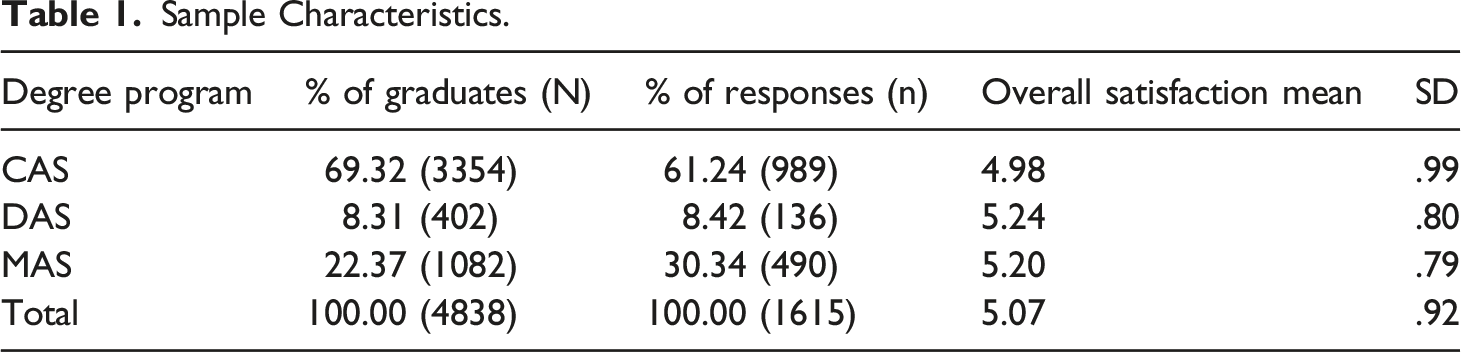
Sample Characteristics.
Ethical issues regarding the study and data collection were considered and addressed by ensuring that participation in the survey was voluntary and anonymous. Further, all data collected is strictly confidential and cannot be linked to other data. Finally, the informed consent of the participants was achieved by informing them about the purpose of the survey and the functions of the people responsible for the data collection before they declined or agreed to participate
Measurement Instrument and Operationalization of the Constructs
Constructs for Non-Monetary Benefits.
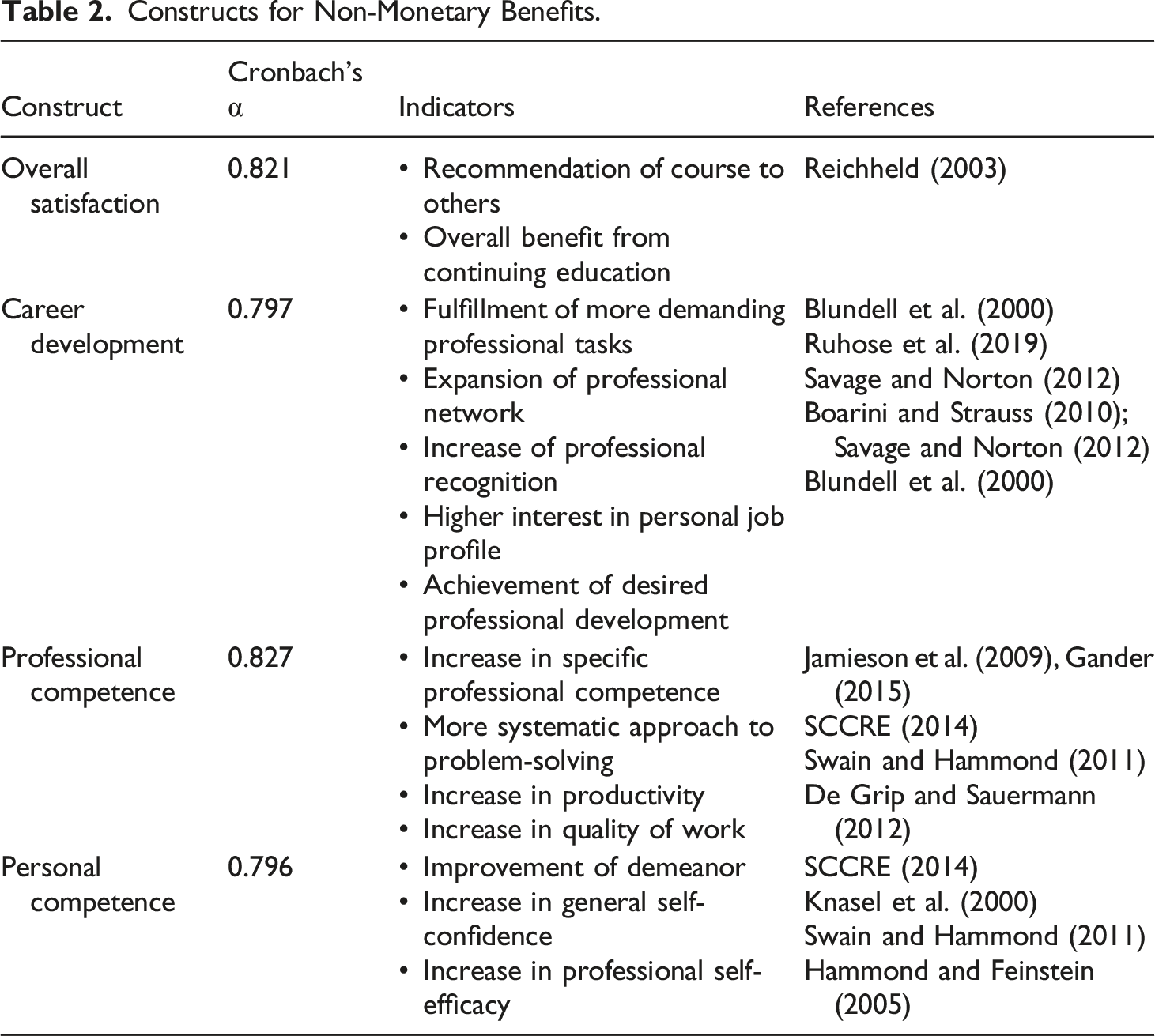
As the dependent construct, the satisfaction of former students with the completed educational program, which is equated to the measure of the overall benefit from continuing education, is defined. It is composed, on the one hand of the question whether the graduates have benefited retrospectively from their continuing education and, on the other hand, whether they would recommend their studies to someone with a comparable professional career. The latter question borrows from Fred Reichheld’s Net Promoter Score (Reichheld, 2003), also known as promoter surplus. This is often used in market research to determine whether a customer would recommend a company or brand to a friend. Only customers who derive a high benefit from the product or service and are satisfied are likely to recommend it to others.
Three independent constructs measure the individual benefits regarding various aspects that are influenced by completing a CAS, DAS, or MAS. The questions for these constructs were worded in such a way that they suggested a causal relationship between the completed CHE program and the indicator. Career development is intended to capture successful advancement along a career path through five indicators. While one measures a perceived increase in the interest in the job profile of participants, the other four are dedicated to whether participants think that thanks to the completion of a CHE course they fulfill more demanding tasks, achieved a desired professional development, and receive more recognition in professional contexts. Professional competence is a construct that describes the ability of professionals to perform typical job tasks. This naturally includes the increase of the respective professional competence. But also, a more systematic approach to solving problems and the increase of work quality and productivity contribute to this construct. The last construct to be defined is personal competence. It is intended to measure to what degree graduates feel strengthened in adequately asserting themselves in their working environment. This includes improvements to one’s demeanor as well as increases in self-confidence and self-efficacy. Overall, all defined constructs have α-values between .79 and .83 and thus have a good reliability level according to Nunnally (1978) (α > .70).
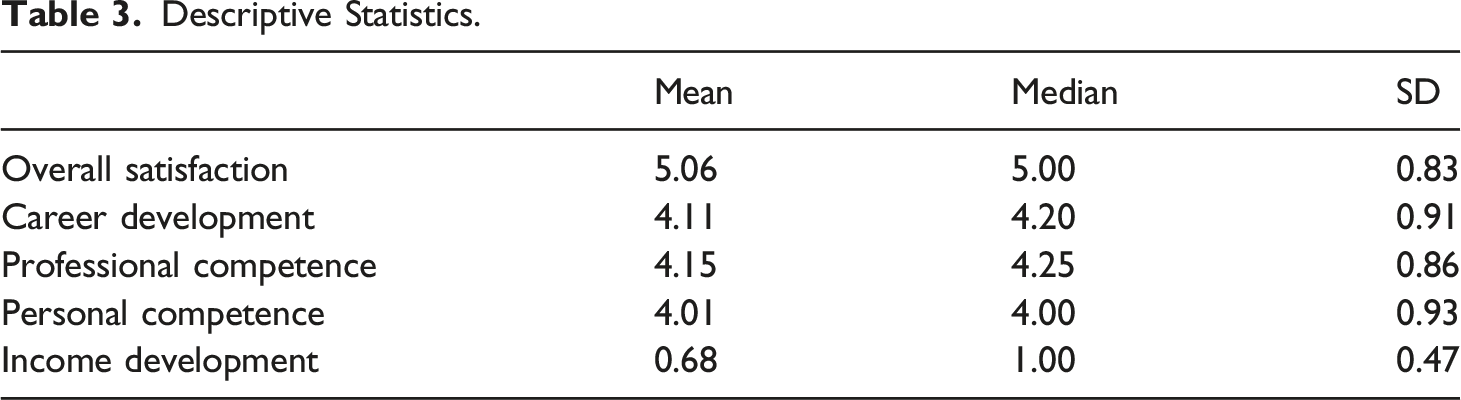
The measurement for the monetary benefit or income development is based on the calculation of the income situation three years after graduation. Participants were asked to report the gross annual wages in full-time employment for the time before the start of the training and the survey. In order not to contradict the prerequisites for the following analyses, the income development was coded into a binary variable (1 = increase, 0 = no increase).
Results
Descriptive Statistics.
Univariate Analysis
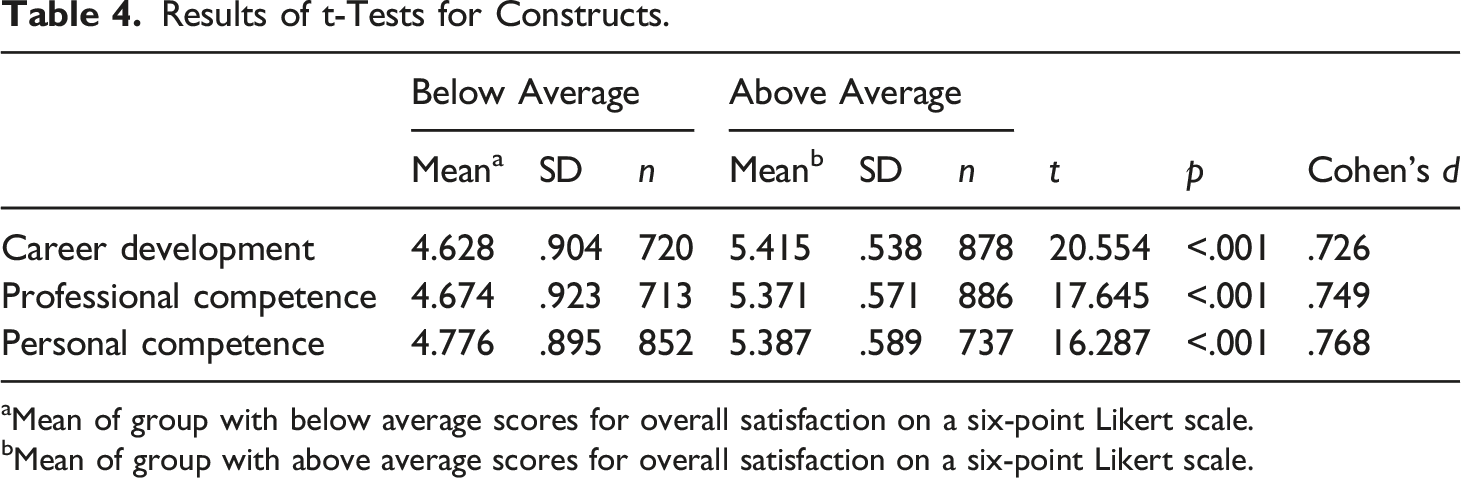
Results of t-Tests for Constructs.
aMean of group with below average scores for overall satisfaction on a six-point Likert scale.
bMean of group with above average scores for overall satisfaction on a six-point Likert scale.
In the next step of the analysis, the influence of the constructs for non-monetary benefits on the overall satisfaction is examined. For this purpose, the graduates are divided into two groups based on the mean value of each construct and the group with the values above the mean is compared to the group with value below the mean, for example, graduates who were able to increase their professional competence below average with those who were able to increase it above average. Here, the univariate analysis supports hypotheses H2 to H4, as shown in Table 4. All participants with above average values for career advancement, professional competence, and increasing personal competence have a significantly higher overall satisfaction with continuing education than their peers with below average values. The effect sizes of the mean comparisons (Cohen’s d) are all above .7, therefore indicating strong effects (Cohen, 1992).
Multivariate Analysis
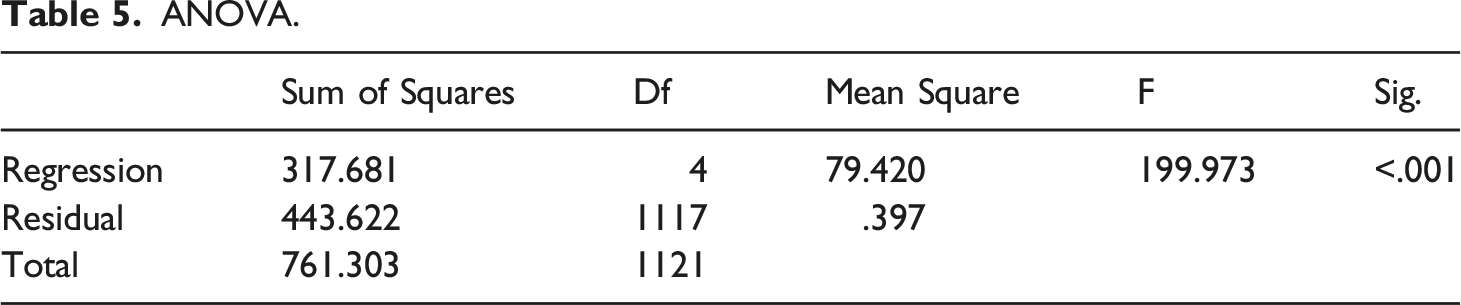
For the multivariate analysis, a linear regression is run. In doing so, the extent to which the construct for overall satisfaction is explained by the income development and the other three constructs capturing non-monetary benefits. The following regression equation is applicable
ANOVA.
Estimates of Regression Coefficients Explaining Overall Satisfaction.
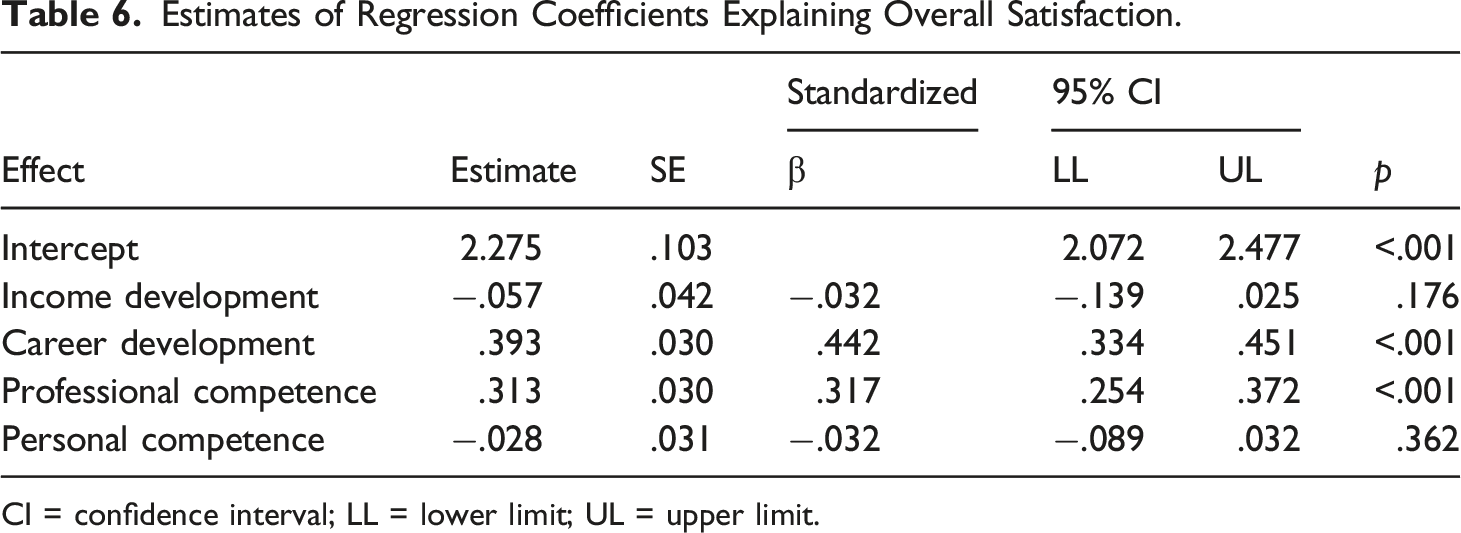
CI = confidence interval; LL = lower limit; UL = upper limit.
Overall, only H2 and H3 are both supported by the univariate and multivariate analyses. Positive career development and an increase in professional competence have a statistically significant positive effect on the overall satisfaction with the completed CHE program. In the cases of income development and personal competence, only a univariate positive association with satisfaction (H1 and H4) can be proven since multivariate analysis does not confirm this.
Discussion and Limitations
Somewhat surprisingly, H1 must be rejected, as the regression analyses fails to find a significant impact of a positive income development on the overall satisfaction. Previous research suggests that an increase in the return to human capital in the form of a higher income should be more important in the individual assessment of learning outcomes. A possible explanation for this might be found in the importance of the intrinsic motivation of CHE students. While not a uniform concept or measure, it essentially describes that the reward is innate in the activity itself as opposed to external results or consequences of the action (Deci, 1975). Students may be more motivated by the more interesting job-related tasks studies in CHE entail than by a higher income. Further research could lead to a clearer picture in this respect.
In contrast to H1, H2, and H3 are supported by both analyses as expected by the literature presented above. Advancing one’s career is a clear benefit of CHE and has the largest impact on overall satisfaction. This can intuitively be explained through improved human capital in the form of specific competence paving the way for promotions or helping in securing a more desirable job. Also, increasing social capital through networking opportunities offered by studies involving other students with similar interests and professional backgrounds could result in favorable career steps. The positive and significant impact of increased professional competence thanks to CHE on the overall satisfaction is also easily explainable by the fact that all analyzed programs are for experienced professionals that want to expand their knowledge and skills in their fields. It is interesting, that an increase in professional competence has a noticeably lower impact on overall satisfaction than career advancement. Whether this difference is also reflected in the motivations of students to complete professionally oriented CHE is an interesting question for further research.
The study presents an ambiguous picture regarding the effect of personal competence on the overall satisfaction (H4). A significant impact can be found through the univariate analysis. Graduates who reported an above average improvement of identity capital in the form of personal competence are more satisfied with courses. However, in interaction with other variables, this result cannot be confirmed. One reason for this could be that Swiss CHE is designed for mature students with an HE degree and relevant work experience. Personal competence could therefore already be well developed and increases due to continuing education are identifiable but remain too marginal to influence overall satisfaction.
Several limitations have to be considered when interpreting and generalizing the findings of this study. First, all variables rely on self-reported data. As such, they carry the risk of a bias regarding social desirability (Podsakoff et al., 2003) and self-enhancement (John & Robins, 1994). However, this should be mitigated as research has shown, that online self-report surveys can increase honesty levels (Wood & Griffiths, 2007) and that problems with social desirability significantly diminish, when responses are anonymous (Richman et al., 1999; Wood et al., 2004).
With regard to the population of CHE graduates, the sample of the study has an overrepresentation of MAS students and an underrepresentation of CAS students. While the effect on the overall representativeness is likely to be weak, it is possible that the findings are influenced by it. As shown in Table 1, the more comprehensive MAS result in higher levels of overall satisfaction than the other types of courses represented in the sample.
A further limitation is the fact that the data was collected three years after graduation from the CHE courses. The data therefore does not represent benefits immediately upon graduation, which may influence the results. The study’s findings should be interpreted as medium term benefits of CHE.
Finally, the study results are based on a survey of continuing education students at a business school located in central Switzerland, who have specific needs in a Swiss work environment. This country-specific sample with a distinct disciplinary mix limits general statements about adult education or specifically CHE that are different in terms of orientation and discipline. Nonetheless, the results can provide initial indications for the design of continuing education programs, which can also provide added value for other types and locations of HEIs.
The authors would also like to make it explicit that they are employed by the case study institution. However, the latter did not instruct them to write this contribution and it is the result of the authors’ own research interest. The fact that both authors are not active in the provision of CHE further minimizes any potential for a conflict of interest.
Conclusion
This paper contributes to the literature on CET by describing what benefits contribute to the overall satisfaction of vocationally oriented CHE courses through the Swiss case. Advancing on the career path is a major benefit of CHE and significantly influences satisfaction. Therefore, ample room or even support regarding networking and career development should be part of course designs. The other important benefit of CHE is the deepening and expansion of professional competence. New skills and knowledge can improve problem-solving, work quality, and productivity. Therefore, this should also be the focus for learning content in continuing education courses. According to our analysis, benefits in the form of improved personal competence, which may also be focused on in continuing education courses, do not contribute significantly to the satisfaction of graduates.
Rather surprising is the finding that no positive association can be identified between an increase in income and the satisfaction with continuing education (H1) through the regression analysis. This may be related to the fact that students have a high intrinsic motivation and are more motivated by the increasingly interesting tasks and positions facilitated by a CHE degree than higher income.
In terms of the three capitals approach, continuing education at business schools in the subject areas of banking and finance, corporate communication, event management, and business economics and management should avoid trying to expand identity capital as this has a non-significant effect on the overall satisfaction of studying professionals. Instead, the focus of CHE should be on expanding social and human capital in order to generate lasting benefits for students.
Footnotes
Declaration of Conflicting Interests
The author(s) declared no potential conflicts of interest with respect to the research, authorship, and/or publication of this article.
Funding
The author(s) received no financial support for the research, authorship, and/or publication of this article.
