



Abstract
This article interprets how five left-leaning parties in Sweden and Spain intend to politically socialise their members through the use of educational activities. By applying a framing perspective on interviews with leading party representatives from the five parties, the analysis theoretically illuminates how educational activities can be a tool for mobilisation. While the interviewed party representatives stress that educating their members has several functions for a party, three salient frames about party education are identified in the interview data as follows: education as (i) movement building, (ii) training members and leaders and (iii) deliberative reflection. Categorising the different ways that in which education is understood shows how different political motives are integrated into parties’ education. Hence, the findings emphasise the intermediating role that education plays between a party organisation and its members in left parties.
Introduction
When asked about the organisation of political education in his party, the Swedish Social Democratic representative in charge of those educational activities declared: ‘I think it is a matter of survival for every decent movement to have education’ (Interview, Swedish social democrats). Taking the party representative’s strong statement into consideration, it is rather surprising that the role of education in parties has received sparse scholarly attention (Nordvall & Pastuhov, 2020). Seeing that the party representative did not actually voice the word party but instead emphasised his party’s connection with a broader political movement, it is not unforeseen that the adjacent topic of the role of education in movements has been studied to a far greater extent (Ambjörnsson, 1993; Finger, 1989; Jansson, 2013; Hall, Clover, Crowther & Scandrett 2013). Notably, Ambjörnsson (1993) and Jansson (2013) have showed how the Swedish labour movement in the beginning of the 20th century established a new workers’ mentality by implementing norms and attitudes in labour organisations’ education.
Having the intersection between a political movement and its educational efforts as a rallying point, this article aspires to shift focus from the role that education has played in the wider labour movement between a movement and its organisations, to how this intermediating role comes about within left-leaning parties. To investigate how parties intend to socialise members through education, this study will examine education within parties with roots in the labour movement in Sweden and Spain. Both of these countries have had rather successful left parties, even at times of general setback for the left in Europe (Birnbaum, 2010; Bailey, 2016). At the same time, Sweden has been characterised as a consensus-oriented society with social democratic dominance in workers’ organisations (Jämte et al. 2020). Spain on the other hand has been portrayed as a conflict-oriented society marked by civil war and dictatorship, where the left has been more diverse and fragmented (Otero-Urtaza 2011). As the countries have five left parties in their national parliaments: the Swedish Social Democratic Party (SAP), the Swedish Left Party (V), the Spanish Social Democratic Party (PSOE), the Spanish United Left (IU) and Spanish Podemos (P), while also having rather different conditions for party organisation, studying narratives about education offers a unique opportunity to analyse how different parties with roots in the labour movement work with education. These five chosen parties organise educational activities that target sympathisers, new members, practiced members and public officials and provide courses with contents ranging from theory and municipality knowledge to public speaking and communication skills (Arriaza Hult, 2020, 2022; Bladh, 2022; Nordvall & Pastuhov, 2020). Seeing that the topic of party education has passed by surprisingly unexplored, an initial step in mapping the organisation of internal educational structures is to interview individuals that hold responsibility for education in the parties. Having interviewed the ones with most insight of the educational structures in each party, these party representatives’ answers are analysed according to a framing perspective, which is a theoretical framework that analyses how meaning is logically constructed and delivered to a specific audience with the aim to mobilise support. By applying a framing perspective on education in political parties, the aim of this study is to provide a theoretical interpretation that emphasises how parties intend to politically socialise their members through the use of educational activities. Hopefully, this will contribute to uncovering the inner workings of a party and provide valuable insights into other discussions that are important for European left-leaning parties with roots in the labour movement.
Background of the political context and the parties’ education
As most studies on political party education tend to investigate one party or one national context, this article with its cross-country sampling offers far reaching insight into how political party education is understood in different party contexts. By doing so, the study’s comparative element helps to interpret the processes involved in framing education and to find patterns in the gathered empirical material. Therefore, this background aims to present a broad picture of the political context for the five parties in Sweden and Spain and their organisation of education.
The Swedish parties
The Swedish government is, at the time of writing, governed by the Social Democratic Party. The Left Party is in opposition and held 8% of votes in the national election of 2018. In the same election the Social Democrats were supported by 27% voters, and is still the largest political party in Sweden, although they have witnessed a steep decline in members and voters since the 1990s (Persson, 2014). It is noteworthy that since 1932 the Social Democratic Party has been in government, except for 17 years of non-socialist governments (1976–1982, 1991–1994 and 2006–2014).
To understand both the Swedish Social Democratic Party and the Left Party,Linderborg (2001) argues that it is important to return to the conflict between the left’s reformist and revolutionary branches in Swedish political history. The Social Democratic Party was founded in 1889. The Left Party was founded in 1917 after a youth organisation and some leading intellectuals in the workers’ movement broke out of the social democratic party organisation. Several authors (Linderborg, 2001; Blombäck, 2015; Östberg, 2008) emphasise how the Left Party has been influential in Swedish politics without ever being in a governing position. Linderborg (2001), who argues that social democracy has used historiography as one of their most important ideological resources, stresses that the social democratic party could build the story about themselves as reasonable reformists in contrast to the revolutionaries. These are akin to findings from Linderborg and Blombäck (2001) who have argued that the Left Party and other left-wing movements in Sweden have been forced to acknowledge and adapt to the attitude the Social Democratic Party take towards them.
Even though Sweden is often characterised as a Nordic welfare society with universal healthcare, education and other welfare services for its citizens (Kioupkiolis, 2016), several authors (Lindbom, 2001; Belfrage, 2017; Belfrage & Kallifatides, 2018) have remarked that ever since the 1980s, different Swedish governments have wandered to the right. Since the 1990s, Sweden is among the OECD countries with the most rapidly growing income inequality; however, the country is still among the most equal countries in the OECD due to historically low levels of income inequality (Cohen & Ladaique, 2018). Regardless of the discussions about the erosion of the welfare state, Oscarsson and Holmberg (2016) claim that since the 1880s, Swedish politics have been influenced by a clear left–right conflict concentrated around the question of economic policy. Oscarsson and Holmberg (2016) in an analysis observed that Swedish voting behaviour historically has been strongly ideologically connected to a traditional left–right dimension. Interestingly, new studies analysing the most recent Swedish elections note a shift according to the GAL/TAN scale, whereby voters emphasise questions that better fit the authoritarian and libertarian dimension than what is included along a traditional left–right dimension (Elgenius & Wennerhag, 2018).
The Spanish parties
The Spanish government is, at the time of writing, governed by the Social Democratic Party, the United Left and Podemos. Podemos and the United Left have even put together their election platforms and have gone to the election with the same alternative ‘Unidas Podemos’ since the national election of 2016. To understand how this has come about and to understand the new Spanish political landscape, it is important to return to the financial crisis 2007/2008. The financial crisis that erupted in a housing bubble in Spain created discontent with the political situation and with the existing political parties that were seen as responsible for the crisis. Some of the now biggest parties in Spain are parties that were founded after the economic crisis by protest movements. This has led to difficulties in forming political alliances and for any party to form a government. The fact that Spain has held four elections in 5 years between 2015 and 2019 is evidence of this (Rodon, 2020). For example, Podemos was founded in 2014 in the wake of the protest movement. Podemos has been identified as a left-wing populist party (Zarzalejos, 2016; de Nadal 2021; Sola & Rendueles, 2018). Gidron and Bonikowski (2013) in a conceptual understanding of populism identifies it as an ideology, a discursive logic or a strategy to gain political power that clearly articulates a political enemy. Podemos has been interpreted as using populism as a populist strategy and discursive logic to clearly point out a political narrative where ‘the elite’ is identified as an antagonist (de Nadal 2021; Sola & Rendueles, 2018). Podemos cooperate with the labour parties PSOE and IU and have clearly left-leaning politics, whereby scrutinising the party together with other labour-oriented parties offers a unique opportunity to understand party education in different types of parties.
To understand Spain’s established parties that lost support during the economic crisis, it is crucial to trace them back to the country’s civil war between 1936 and 1939. The amassed left fought on the same side during the civil war, and scholars such as Aguilar and Humlebaek (2002) stress that both the reformist and revolutionary movements have formulated their identity in relation to the civil war. The Spanish left has been characterised as united and fragmented at the same time (Otero-Urtaza 2011). However, studies on Spanish voter behaviour suggest that voters to a higher degree than in other western European countries vote based on their ideological identity rather than their economic situation (Fraile & Lewis-Beck, 2012), which also highlights the importance of political identity in Spain. In 1978, three years after Franco’s death, Spain held its first national election in 1982. The political coalition UCD (including the Social Democratic Party (PSOE)), standing for ‘Democratic Centre Union’, won the election and governed the transition period. Since the Social democratic Party joined the centre coalition under the transition period, the gap between them and the Communist Party increased, which instead formed alliances with other left parties and formed the United Left in 1986.
Just like the Swedish social democratic party, PSOE has been accused of wandering to the right on the political scale by academic commentators (McNeill, 2005; Kennedy, 2014; Manwaring & Kennedy, 2018). However, according to Hutter et al. (2018), the left-leaning parties in Spain and other southern European countries did not politicise in a cultural-identarian manner in relation to the GAL/TAN scale but acted in opposition to austerity and undemocratic processes by using the traditional left–right dimension.
Overview of the organisation of education in the five selected parties
The parties’ organisation and intra-party education.
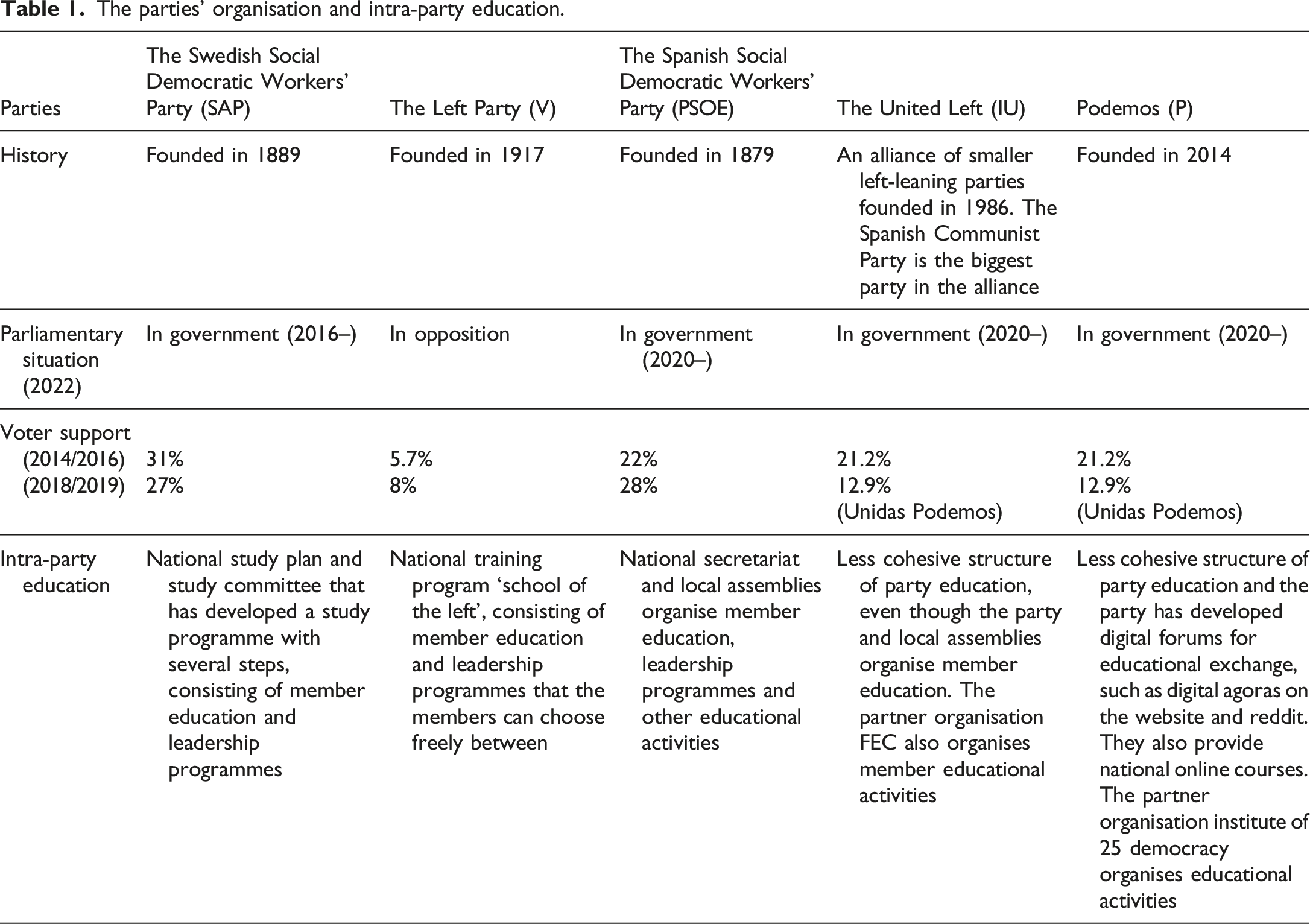
The parties organise similar types of educational activities and provide several types of different courses. The two Swedish parties under scrutiny have national study committees and study plans, whereas the three Spanish parties in general have a more flexible structure of party education compared to the Swedish parties, where national secretariat or local assemblies or partner organisations can take responsibility for educating members or adherents. Seeing that the parties have internal structures for providing educational activities for their members, engages an inquiry of how these educational activities can be understood.
Previous research on party education
In general, parties’ internal education has received sparse attention within the fields of education and political science (Nordvall & Pastuhov, 2020). However, there are studies that have specifically scrutinised party education in Swedish and Spanish parties. In the Swedish context, Nordvall and Pastuhov (2020) have studied training activities in the Social Democratic Party and the Left Party; and their thematic analysis identifies four categories for party education: ideological training, training skilled members and leaders, training for a social infrastructure, and training for internal positioning and distinction. By highlighting these different knowledge-oriented roles and relationship-oriented roles, they conclude that self-organised studies play a significant role in representative democracy in Sweden today. In the Spanish context, Andrade Blanco (2005; 2012) has contributed to the understanding of parties’ education by emphasising intra-party structures during the transition to democracy in the Spanish social democratic party and the Spanish Communist Party. He notes that educational activities have played a role in forming the members’ views along party lines when adapting to the new political reality of democracy. Therefore, the research body on party education in Sweden and Spain implies that party educational activities are meaningful for the parties’ organisation, and have significance for democratic participation.
When taking an extended view beyond the Swedish and Spanish contexts and situating party education in the field of adult education, there are research topics that intersect with parties’ education. Closely interrelated to party education is the topic of social movement learning (SML) (e.g., Finger, 1989; Hall, Clover, Crowther & Scandrett 2013) which examines informal settings for educational initiatives that in different ways have political implications. Similar to Nordvall and Pastuhov’s findings about the Swedish parties (2020), Holst’s study (Holst, 2009) for example, shows that learning in social movements fulfils different purposes and could be divided into different types of training. He makes a distinction between theoretical and practical training to emphasise the variety of learning that exists in movements. Boughton (1997) has studied the Communist Party in Australia in terms of seeing their history as an educational body and by scrutinising their educational work between 1920 and 1991. He argues that the party’s training has been the single source of education for many working-class people. By seeing party training as adult education, he stresses the educational value that the party schools have had for certain individuals and communities.
Within political science there are several studies that examine the purpose of parties’ education. Sirivunnabood (2016) has compared intra-party education in two Thai parties. Her findings suggest that educational activities have several purposes, such as socialising members, fostering future leaders and mobilising members. But she also emphasises the relationship between the purpose and the organisation of studies; leading party figures decide the purpose of education, which determines how members become socialised into the parties. Gökçe et al. (2015) have studied Turkish parties and discuss the outcomes of parties’ education. They see that even when the main purpose is to educate leaders, the effects of education filter down to other members and involve them in the parties’ work, which they claim can have positive effects for the parties in general, in terms of participation and creating strong bonds between the members and the party.
Thus, by analysing the purpose and organisation of parties’ training, the mentioned studies have contributed to understanding how and why parties structure their education in certain ways. The present study builds on this knowledge but digs deeper into how party representatives formulate the use of party education by searching for frames in the interview data.
Framing perspective
The analytical objective of this study is to provide a theoretical interpretation that illuminates how parties intend to socialise members into the party collectives through party education by applying a framing perspective on interview data with party representatives. The framing perspective is a theoretical perspective that aims to distinguish how meaning is logically constructed and transferred to a specific audience to mobilise support (Snow et al. 1986, 2018; Snow & Benford, 1988). Snow and Benford (1988), Benford and Snow (2000) argue that by framing the social reality in certain narratives, movements create frames ‘to mobilize potential adherents and constituents, to garner bystander support, and to demobilize antagonists’. (pp. 198). Political actors engage in framing (a process) to construct certain narratives that are identified as frames (the product). For example, Benford (1993) in a study about the nuclear disarmament movement in the 1980s shows that the framing of the nuclear question was categorised into the three frames as follows: (1) the severity of the problem, (2) the sense of urgency and (3) the efficiency and propriety of taking action. Benford’s (1997) study illustrates how the framing perspective identifies and differentiates the underlying mental constructs that permeates a specific question. Accordingly, using a framing perspective to understand party education contrives to identify how meaning is constructed about party education and identify if there are conflicting views within these mental constructs. To identify how frames are composed, Snow and Benford (1988), Benford and Snow (2000) have developed three core framing tasks that analyses the content within a frame: diagnostic framing (the problem identification and identifying causal relationships (what is the problem and the solution)), prognostic framing (identification of strategies, tactics and goals) and motivational framing (motivations and reasons why something is needed, a mix of logical and emotional arguments with the objective to make a convincing case for why a collective is needed to fix a problem). Since the intention with framing content in certain ways is to mobilise support, the framing perspective distinguishes between different sorts of mobilisation: consensus mobilisation (to make people agree with opinions and support a cause), mobilisation potential (to create the potential of mobilising a large number of people that support a cause) and action mobilisation (to mobilise those who are active and performs the political work).
When applying the framing perspective on the context of party education, the analysis explores the motivations behind education by identifying the problems and solutions that the education is supposed to fix (diagnostic framing), how the education should be organised (prognostic framing), the logical or emotional motivations that are nurtured in the educational situations (motivational framing) and what kind of mobilisation that is supposed to be achieved (mobilisation). By identifying and deconstructing how party representatives responsible for organising the educational activities deliberate on member education, the analysis studies the interview data to find frames and interpret the congruous construction of frames (the core framing tasks and aim with mobilisation). Thus, the framing perspective contrives to theoretically discuss how parties can mobilise their members by framing what education is.
Method and material
Since the study aims to theoretically discuss party education through a framing perspective, the analysis scrutinises interviews with the party representatives in charge of party education. These representatives are interviewed in their capacities as spokespersons for the five sampled parties and in their role of having insight and influence over how the parties structure education. Considering that the purpose with the interviews is to distinguish how the need for and organisation of party education is framed in the party organisations, the party representatives that hold responsibility for the organisation of education are considered being able to answer these questions more thoroughly than for example a member or a study leader, even though members and study leaders may have profound knowledge about the outcomes of the educational activities. Planning for the interviews started with developing an outline regarding how party education was organised by collecting course material and study plans, analysing how content was framed in study material and by making observations at both party meetings and planned party educational activities. When identifying the individuals that held key positions in the organisation of party education, these were contacted via email and asked to participate in the research project. The interviews were carried out in Stockholm, Madrid and through Zoom between the years 2019 and 2021. The interviews draw from a semi-structured qualitative form (Kvale, 2008) to give space for the interviewees to express how meaning is framed in shifting and varied forms. The interview guides were similar in both national contexts and were generated in Swedish and Spanish as those are the first languages of the interviewees. All interviews were between 20 and 60 minutes with an average around 40–50 minutes, depending on how much they elaborated their answers on their understanding of party education. The quotations used in the study have been translated to English by the author after the interviews were transcribed verbatim. In relation to this particular study, one ethical concern is the interviewees’ anonymity as they hold positions that are publicly known. The study, which is linked to a wider research project on education in political parties, has undergone ethical vetting by the Ethical Review Board (EPN) and been approved, whereby to be respectful of the interviewees’ anonymity, I have chosen to not give information about their age, gender or other characteristics. As the interviewees are interviewed in the role of representatives for their parties and not as private individuals, they are not asked questions that should in any way be sensitive for them as individuals.
The analysis of the data started with identifying salient frames about how the interviewees expressed their understanding of party education. As the object is to theoretically illuminate how party education is framed, the empirical material was combined in order to identify frames that were visible in all five parties. Three salient frames were identified in the interview data: education as (i) movement building, (ii) training members and leaders and (iii) deliberative reflection. To reveal the mental infrastructure behind, between and within the frames, they are deconstructed into Benford and Snow’s (2000) core framings tasks: diagnostic, prognostic and motivational framing, and aim with mobilisation, which are shown in the tables that are visible under each category.
Frames of party education
The following findings’ section is categorised into three sub-sections which correspond with the frames that were identified when coding the interview data: education as (i) movement building, (ii) training members and leaders and (iii) deliberative reflection.
Education as movement building
The party representatives in all five parties emphasised, in different ways and with different words, that party education has the function of creating a movement with engaged members and sympathisers. As an illustration, the Swedish Social Democratic Party representative alleges:
But my ambition and my idea has been that we should be a popular movement that is in some way in people’s hearts or people’s vicinity and then we need members who are educated, who can contribute with ideas to the organisation (Interview, Swedish Social Democratic Party). The frame of education as movement building.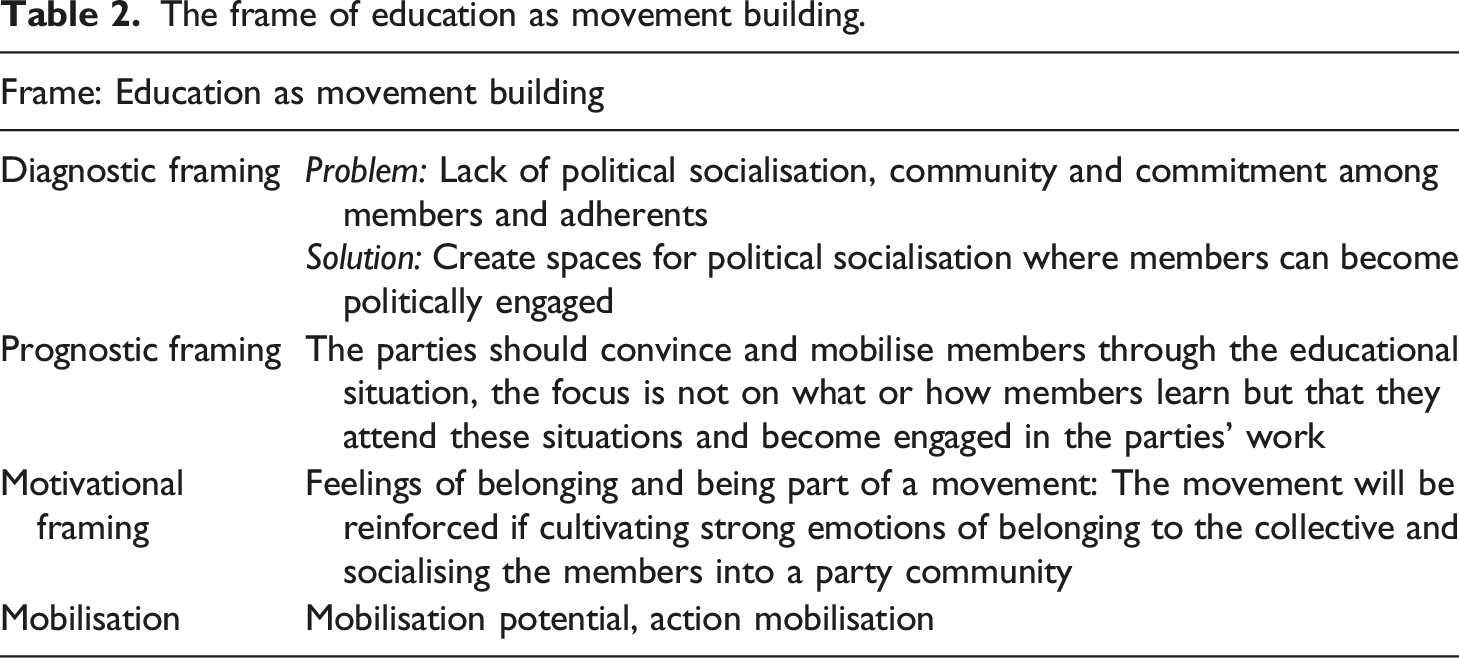
As the analysed parties stress that educational activities function as movement building, there is a vagueness regarding what is educational activities and what are other types of political meetings. For example, the party representative from Podemos explained the strategy with providing party weekend schools as, ‘Knowing whom you want to address and in what way, politically socialising people who, for example, have not yet had mobilisation. That is our school.’ (Interview, Podemos). Another notable example is that the Spanish social democratic party representative proclaimed, ‘If you open education up to society, you transmit your ideas and you get a better society’ (Interview, Spanish social democrats). Thus, it is implied that the parties see the purpose of education as politically socialising members, rather than focusing on educational aspects of what and why members have the need or right to learn specific knowledges. Seeing that the party representatives have an understanding of education as a strategy to reach a broader movement could be read as being analogous to what has been found when studying the use of education in the labour movement previously (Ambjörnsson, 1993; Jansson, 2013). Initiating a feeling of belonging and collectiveness in education intends to create more engagement. The feeling of belonging creates a party identity that contributes to both reinforcing a movement and to attracting the individuals that will become future leaders.
Another aspect that fits within the boundaries of this frame is the emphasis on networking and forming relationships have been highlighted by Nordvall and Pastuhov (2020) in their study of the Social Democratic Party and the Left party in Sweden. Attending party education becomes a way for members to build relationships and get to know other politically interested people. As an example, the party representative from the United Left also highlights that education forms a political movement and creates spaces for meetings between members: ‘From my point of view, it is being part of a political movement. It is not only ideology, but it is also a political culture that has to do with learning democratic methods, with respecting decisions, learning feminism’ (Interview, United Left). Something additional to the actual knowledge that is transferred in the party schools is stressed. It is the community that is a practical experience, a feeling of being part of the collective and learning how things are done. Vaguely it is implied that education helps the party to create a community with the same references and frameworks; however, there is also an underlying assumption that the feeling of engagement creates more engagement. Social movement researchers (Yang, 2007; Flam, 2007, 2015; Goodwin et al., 2000) have studied the important role of emotional attachment in mobilisation. (Denzin, 1984), who was early to adopt the notion of emotions in social movement mobilisation, wrote in 1984 that emotion is an experience that ‘is felt in and runs through a body, and, in the process of being lived, plunges the person and his associates into a wholly new and transformed reality – the reality of a world that is being constituted by the emotional experience’ (p.66). Denzin thus identifies what happens when an individual feels strongly and shows how this can even reshape their understanding of reality and make them act for a political cause.
Thus, in the first identified frame, party education is supposed to give the members social knowledge and socialise them into the parties. The commitment and community that can be created in the educational situation links the members to the parties and contribute to activating them. Within this frame, party education is seen as a tool to teach members to manoeuvre within the political culture that exists in the party while also initiating feelings of belonging to the collective.
Education as training members and leaders
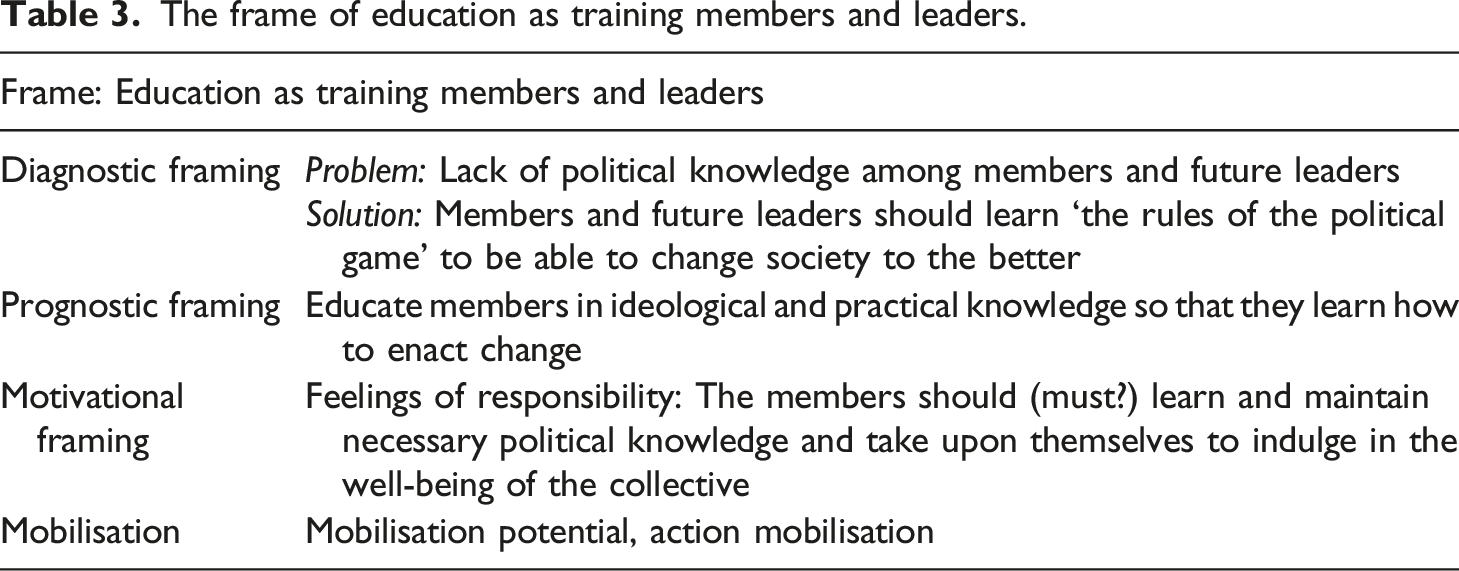
Similar to the frame of cultivating the idea of a movement around the party, is the frame of teaching members and future leaders ideological and practical knowledge. This frame also relates to arguments for making individuals engaged and giving them tools to mobilise and be active in the party movement. The reason for separating this frame from the former is the difference that is veiled behind the motivation for why the members need training. In the former frame, the relation to a broad political movement is crucial for the parties to mobilise their members. In the present frame the interviewees do not stress the feelings of being part of something but instead highlight the usefulness of instrumental practical knowledges. What should be learned is already decided on beforehand. For example, the party representative from the Left Party says: ‘It is difficult to summarise exactly one purpose [with education], but the purpose is to give members tools and knowledge to be active and to contribute’ (Interview, the Left Party). Party education is described as giving tools to members so they can participate in party work, but the members should not only participate, they should also contribute to their party.
The frame of education as training members and leaders.
The party representatives imply that they have a way of doings things that has resulted in a design for educating members and future leaders. Gökçe et al. (2015) found in their study on party education in Turkish parties that even if intra-party education has the purpose of educating future leaders, the organisation of educational activities can have positive effects on general member participation. When educational activities are open for anyone’s participation, the knowledge is passed to the member base and not just the individuals who become leaders. Similar to what Gökçe et al. (2015) claims about the Turkish parties’ education, the Swedish and Spanish party representatives make a difference between education for leaders and for members. Podemos, which is a new party that has caught the eye of news media and academia (Sola & Rendueles 201; Kioupkiolis & Pérez, 2019) has done a number of being something different from the old established parties. The party’s rapid journey from the streets to national, regional and local governments also entailed the challenge of finding people to represent the party and to train them in certain skills. To confront some of these problems and to set common norms and frameworks, they offer a digital course for public officers on their website to make the courses easy to access (Arriaza Hult, 2022). The United Left which goes to election together with Podemos could perhaps be assumed to have similar courses for public officers; their party representative, however, expresses self-criticism about the party’s political education. The party representative emphasises that there are no structures for technical training, and even though IU’s members are theoretically skilled, it becomes difficult for them to enter the political world. The difference in how the parties structure their education and how they target members and future leaders could be explained by Andrade Blanco’s (2012) study of the intra-party movement of PSOE and PCE (the Spanish communist party that is now part of IU) during the transition to democracy in Spain. He suggests that because the two parties took different roles in the democratic system, they adopted different approaches to the socialisation of members into the parties. The differences between how PSOE and PCE (IU) frame the training of members and leaders presumably relates to their experience in government: the Spanish social democrats are and have been in a governing position for long periods of time, which make them perceive the need to educate people to fill important leading positions, more crucially than what the other parties in opposition have needed to do.
Hence, in the second frame, party education is understood as an instrument for giving the members the competences that are considered useful for performing political work. Making a distinction between training for ordinary members and individuals with potential to take on leading roles, puts the focus on the individual member and her training, and therefore, in some ways clashes with the emphasis on collectiveness that was deeply rooted in the logic of the first frame.
Education as deliberative reflection
Another frame that the party representatives highlighted in the interviews is that of education as a space for deliberative reflection. Deliberative reflection is a reflective process where participants use previous knowledge to address a situation, and are able to shift between various perspectives and theories depending on the context (Nelson & Sadler, 2013). (Della Porta, 2005) has discussed the notion of deliberative democracy in Italian social movements and saw that activists stressed values as inclusiveness, subjectivity and diversity to open up for the multiple identities that already exist in a movement and open up for plurality in democratic decisions. Therefore, in the context of party education, using this frame stresses how education creates space for reflecting together with and learning from other individuals. For example, the party representative from the Left Party declares: Education is not just about daily politics or debates on TV, but it is the exchange between members and the intellectual work around politics and around system criticism, there education has a very great significance, I think, for many (Interview, the Left Party).
The frame of education as deliberative reflection.
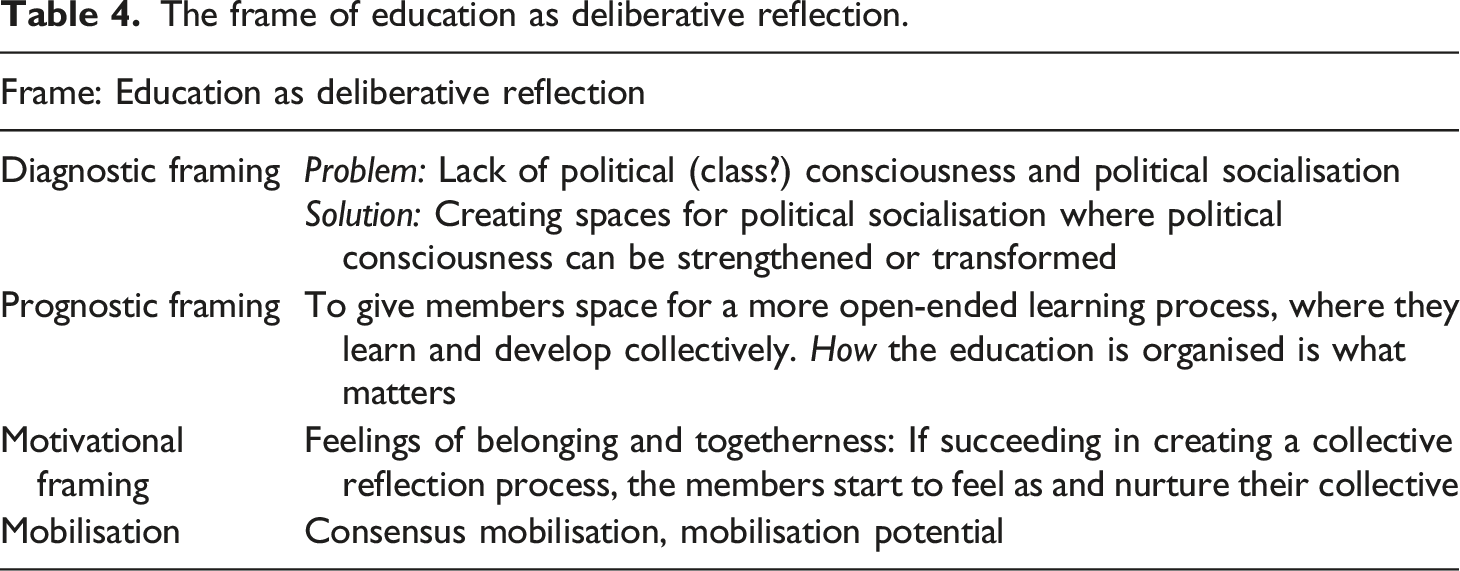
Within this understanding of education, the educational methods are emphasised; they are strategically chosen for ideological purposes and for being mindful of what is happening in the moment. The representatives see the need to be present in the moment and ask questions and formulate what has been done, in order to understand truly what is happening in the collective situation. For example, the party representative from Podemos explains: ‘There is also a very introspective, excessively introspective part of the organisation of thinking to yourself: What are we? What are we doing? What can we expect?’ (Interview, Podemos). The party representatives attribute meaning to the meeting between people and the exchange that happened there and then. Even if the social dimension and the meeting between people can be linked to the frame of education as movement building, here, education is understood as giving meaning to the individuals that are present in the educational situation. The political education and the meeting place that it offers gives a chance for those attending to discuss political questions in a way that is difficult for them to do elsewhere in their lives. This relates to Boughton’s (1997) study about the Australian Communist Party’s educational body, where he found that the party’s training had a profound impact on many working people since it was the only place where they could deliberate and exchange ideas with others with similar conditions. Thus, when highlighting the need for discussion and reflection similar to how Boughton emphasises that education has a value in itself, all interviewees make the assumption that education has great significance for the members, and that it gives them something other than just practical political knowledge.
The third frame stresses a somewhat free and undecided exchange between members that is difficult to control and that happens in the educational situation. There is a link between political and popular education methods that allow the members to share their experiences and create collective learning processes (Wiggins, 2011). The exchange and the space for reflection thus have an intrinsic value, and are not only used to give the members specific knowledge; the educational situation can develop in many different ways, but its purpose is also to politically socialise the members.
Concluding discussion
This study identifies and dismantles frames about party education in five left-leaning parties. The research design, which combined empirical data to identify frames that were present in all five parties’ sense-making about their education, contributes to a theoretical discussion about how educational activities can be used to socialise members into parties. By using a framing perspective and taking inspiration from analytical tools from social movement theory and applying it to parties, the findings open up new questions and dimensions regarding the intersection between parties’ mobilising work and their education. When studying the educational situation apart from the circumstances that divide the parties, the study demonstrates that parties see their training as essential for their party organisation and for keeping a close connection to their members.
If relating the interviewee’s answers to previous research about party education, parts of the findings reassert what others have found when studying parties’ training efforts. For example, the three identified frames have similarities with Nordvall and Pastuhov’s (2020) knowledge or relationship-oriented roles, Bladh’s (2022) party functions and Sirvinabood’s (2016) purposes with party education. However, applying the framing perspective on party education gives tools to analyse the intentions behind the categorisations. The reason for highlighting the three frames in the first place was the sense that the interviewees themselves distinguished between the frames as if they fulfilled different purposes for the parties. The party representatives even explicitly said that their training had several objectives at the same time. When then dismantling the frames into the core framing tasks and stating the underlying diagnostics, prognostics, motivations, and mobilisation efforts, the frames could be interpreted as holding opposing views of how and why a party should make use of party education. For example, the frames both suggest that party education has the objective of socialising members and leaders from the top-down and of letting the movement unfold from the bottom-up. In both cases, educating party members becomes part of prognostics, a tool, a strategy to put the identified solution in order, but that can be used in different ways depending on what has been identified as a problem and as a solution in the diagnostic framing. Differentiating between the frames shows the ways in which parties can mobilise their members, if the aim is to mobilise support (consensus mobilisation), if it is to create the potential for mobilisation (mobilisation potential) or to make members active in the party’s work (action mobilisation). Nevertheless, the three frames indicate different political motives that are important for left parties, such as creating a strong movement, workers taking action and responsibility for social change, as well as education as a tool to reach equality.
In conclusion, the findings suggest that intra-party education is framed as having the potential to play a crucial role in parties’ mobilising work, as education provides circumstances and conditions that fixate meaning so that it leads to action. Focusing on the educational situation can thus not only help us understand parties’ education but can further extend our knowledge about parties’ inner lives more generally. As political parties are crucial entities in understanding the new political realities that transpire, future research should continue to study the use of party education. Some of the questions that have been raised by this study are: How can a feeling of belonging be created through parties’ educational activities? How is a party’s collective identity implemented through party education? How do members understand their participation in party education? Those and several other research questions could construct new important knowledge that would help us to understand better how parties mobilise their members through education.
Footnotes
Declaration of conflicting interests
The author(s) declared no potential conflicts of interest with respect to the research, authorship, and/or publication of this article.
Funding
The author(s) received no financial support for the research, authorship, and/or publication of this article.
