



Abstract
This article presents research conducted with six French physicians who have been trained in complementary and alternative medicines. The perceived effects of this body-mind training, (i.e. ‘Awakening the Sensible Being’), are addressed in the thesis being posited. These ‘Awakening the Sensible Being’ practices help develop a quality of presence to self and to others, which are desirable qualities for health care professionals. An investigation was conducted using two types of interviews: comprehensive and explicitation. The two paths of analysis are introduced, as well as the results achieved, which are linked to the personal sphere of the participants. The participants reported having experienced some identity transformations which led them to place more emphasis on their inner rather than their external reference points. They also reported feeling more centred and healthier.
Keywords
The framework of this research encompasses education and, more specifically, the unconventional training pursued by practicing physicians. It also involves health as it allows us to question the repercussions of a mind-body learning approach on the physicians’ health. This research directly addresses the interrelation between research, training and practice.
Research’s background
Transformations of the medical field
The 20th century was marked by two medical trends: a global vision of the person including their environment, attitudes and emotions and the biomedical scientific trend involved in the treatment of symptoms (Gilbert, 2003). The Flexner Report published in 1910 transformed the medical training by focusing on science and objectivity. Ten years after, the number of medical schools in the US declined from 147 to 85 and kept decreasing (Duffin, 2011).
At the end of the 1990s, studies showed a significant increase in popularity for complementary and alternative medicines (CAM) among Canadian and American populations (Kaptchuk & Eisenberg, 2001; Romanow, 2002). We can presume that consulting CAM practitioners would allow patients to better satisfy their personal care needs within a significant relationship, which they probably could not have with their physician (Kaptchuk & Eisenberg, 2001; Park, 2002; Rakel, 2007). Furthermore, some research report that the quality of communication between the physician and the patient has an impact on the latter (Laidlaw et al., 2001; Rosser & Kasperski, 2001). A new concept was born from this keen interest: an integrative medicine combining compelling CAM with conventional medicines (National Center for Complementary & Alternative Medicine, 2011). 1 Prevention also occupies a prominent position in this medicine and the attention is focused on health supported by the potential healing of the body, within a therapeutic relation where the patient becomes an active partner in the equation. Based on the health and not the pathology, this paradigmatic position offers a new vision of the human being and health, encouraging a reflection on the training of future physicians.
To access to the wholeness of a person, physicians need to be in relation with themselves in order to better contact the entirety of the patient (Newman, 1997). Upon the admission process, medicine students are always in the need to perform and compete (Maranda et al., 2006). While establishing their professional identity, fear, vulnerability or even imperfection cannot find their place. Those competitive principles often lead to the rejection of a part of themselves and their humanity. However, Shapiro (2008) argues in favour of an ethical renewal based on accepting imperfection. Future physicians need to learn to welcome and access their own resistance to the body vulnerability.
This new posture requires physicians to be open to their inner and emotional world, in order to tame their vulnerability, their uncertainties and their imperfections, which are their subjective and human portion. McNaughton and LeBlanc (2012) discuss the problematic intersection between the objective and the subjective of the medical world: “Within the health professions, emotion sits uneasily at the intersection between objective scientific fact and subjective humanistic values as a site of productive contestation” (p. 70). Would it not be in the interest of the medical world to renew its approach to different notions, including objectivity, subjectivity, inner life, emotion and health?
Educational transformation: Towards an inclusion of subjectivity
The concept of integrative health applies to the different dimensions of human beings (physical, psychic, social and spiritual) for the optimisation of their health (Rakel, 2007) and calls for a new definition of health as an integral transformative education in which diverse human dimensions (body, vital, heart, mind and spirit) can modify our perceptions of the world and the world itself (Ferrer et al., 2005). The world then stops being sensed as having an independently objective nature and becomes a relational and intersubjective reality that unfolds in a multiplicity of conceptual and transconceptual ways, partly depending on the human approaches and ways of knowing involved in the act of apprehension. (p. 325)
Problematic
Medicine training programs including CAM were developed with the purpose of better accompany patients in their quest for health. Indeed, students are then led to better understand the different approaches patients can use, while being concerned about their safety. According to Lie et al. (2008), it seems that the intentions behind the practice of future physicians are more orientated towards using a combination of approaches to halt the disease rather than investing in the health in general as promoted by integrative medicine.
Yet, training intended to include more specifically mind-body approaches 2 lets students be more aware of themselves, while providing them with the opportunity to acquire enhanced abilities to manage their stress. It seems that these mind-body interventions enhance the students’ well-being (Saunders et al., 2007), in addition to making them more sensible to themselves and others (Elder et al., 2007; Saunders et al., 2007). Therefore, these mind-body approaches directly affect the quality of the therapeutic link, while developing, in the medicine students, a new ability to take care of themselves. It is difficult to identify the metrics of success of the interventions as research are heterogenous. But it appears that learning from experience is more likely to have an impact on the physicians’ behaviour towards themselves and others (Elder et al., 2007; Saunders et al., 2007).
At the moment, many studies are looking at the high level of exhaustion among medicine students (Ishak et al., 2013; Llera & Durante, 2014) and the best ways to resolve this problematic. It seems the mind-body approaches could be a path worth exploring. These experiential approaches could pave the way to new notions of health and allow future physicians to take care of themselves, while taking care of the patients in their entirety through a new ability to establish a therapeutic, nourishing and humanising relationship with them.
However, no research has been conducted among medicine students learning Awakening the Sensible Being (ASB), as no program provided this type of training within a faculty of medicine, some research on ASB support this type of research project. Bois (2007) noticed a change in the depiction related to ideas, values, self-image and the perceptive relation with oneself. In a therapeutic context, Duprat (2009) and Duval (2010) mentionned a transformation in the relationship of the participants with their body, while Courraud (2012) notes a similar change among physiotherapists who have followed ASB training specializing in fasciatherapy DBM® (Danis Bois Method). Duval (2010), Laemmlin-Cencig (2007) and Large (2009) observed in the participants of their respective study a greater ability to engage with their life and health and be autonomous. Large (2009) also noted the construction of a specific quality of presence, which is an enviable quality for the relational profession that is medicine.
Research’s objectives
To our knowledge, no research has been conducted to better understand the impacts of a mind-body training, which is ASB among physicians. Following their ASB training, we wanted to identify and describe, where relevant, the transformations reported by physicians, pertaining to the personal sphere: regarding (1) their relationship to the body; (2) their own health and (3) the quality of their presence to themselves.
Practical background and interpretative referents
ASB includes a therapeutic component through fasciatherapy and a pedagogical component through somatic psychoeducation. These practices are based on four intervention tools (Bois, 2007): manual therapy (fasciatherapy DBM®), sensory gymnastic, sensory introspection recently called the Full-Presence Meditation® (Bois & Eschalier, 2019) and verbal interviews regarding the bodily experience.
These interventions rely on an important player: the inner movement. According to practitioners-researchers, it is the vital force of the body. The intervention framework of this practice is said to be “extra daily”, outside the life habits of a person. ASB is presented in detail in two articles where the following concepts are defined: the four intervention tools, inner movement, category of perception, body and attention status, as well as the wheel for growing in conscious awareness: Lachance, Emond and Vignit (2019) and Lachance et al. (2016).
Methodology
In line with our objectives, the chosen layout is an investigation from interviews conducted with physicians trained in ASB. Two types of interviews were conducted: comprehensive interview (Kaufmann, 2011) and explicitation interview (Vermersch, 2010). The comprehensive interview is based on the interactionist position seeking to capture the complexity of the diversity of transactions, whether it is the transaction itself, between self and other, and finally, between those engaged in the situation framework and the environments external to them (Charmillot & Dayer, 2007). For its part, the explicitation interview is based on the phenomenological position. It is defined by a way of observing the world where we try to understand how it is seen by someone’s consciousness (Giorgi, 1997).
Following a pre-exploratory interview with physicians trained more than 10 years ago, we have specified the conditions for participating in the research. Physicians had to: (1) be involved in a medical practice; (2) be following a training or have completed the entire ASB training and (3) have followed their ASB training less than seven years from the date of the interview. Semi-structured interviews between 90 and 105 minutes were conducted with six French physicians (five women and one man) who were trained in ASB between 2005 and 2012 (500 hours over four years). We identified them with pseudonyms: Suzanne, Marie-Hélène, Nathalie, Isabelle, Philippe and Eva. Participants are presented in detail in the article by Lachance et al.(2016). Data was collected in 2012 and 2013. An account of the training and professional activity of each individual was produced to gain insight on their journey and to be able to impute the changes to the ASB training.
Raw material analysis was made from many approaches in order to strengthen it. Instead of doing a triangulation of the research methodology, a triangulation was made in two analytical methods, among others, to verify the consistency of the results.
Our first method was designed from the thematic analysis and the analysis with conceptualising categories in order to lead to a grounded theory. This theory is an analytical process in six steps: codification, categorisation, establishing a relation, integration, modelisation and finally, theorisation (Paillé, 1994). The grounded theory analysis process can be compared to the process of assembling a puzzle, with the exception that we do not know ahead of time what the image will look like. Therein lies the significant level of difficulty. The quality of the process is directly linked to the observed rigor in the first two steps, which could be the puzzle pieces identification and then the predominant colour identification of each piece, and which could enable the subsequent establishment of a relation, an integration, a modelisation, and to eventually attain a final image of the theorisation.
The second method involves creating a list of the 26 phenomena present in the majority of interviews following discussions with our executive team.
Results
We are presenting the grounded theory resulting from a thorough analysis of interviews done with six physicians, substantiated with verbatim excerpts. The next three sections introduce the research results regarding the personal sphere. The first one describes the changes reported by physicians in regard to their body, presence and health. The second groups together the improvements experienced by participants, that allowed them a greater freedom of being. Finally, the third attempts to describe the identity change 3 experienced after the training process.
Presence to the body, the starting point towards awareness
Results lead us to notice that the ASB training had an impact on the relationship participants maintain with their body (Lachance et al., 2016). The five participants reported a proximity change reflected by a greater attention and an improved ability to listen to their body. Nathalie shared her gain of body unity: “My head could be all speed and my body all sluggish, and after, it was the opposite. I felt unmanageable, it was complicated. This training really created this unity”.
By experiencing the four tools, ASB enabled the six group members to enhance their quality of presence to themselves. Eva shares her experience: “The fact that you know how to come into relation with yourself, while being neutral, more present to yourself”. This presence enrichment, more significant among the five participants, is becoming apparent through awareness regarding their lifestyle. Becoming aware is the starting point and an opportunity to act differently while enabling them to reduce their state of discomfort or by creating behaviours that produce comfort. Therefore, participants become aware and regain power over their life and health through more coherent actions. Here are the words of Eva regarding her experience in manual therapy, which she links to her way of expressing herself. I became aware there was a deficiency in my way of touching, so there was a lot of neutrality and the active portion was holding back a bit, not enough at the same level as the neutrality. […] You see, I told you I had an ease for listening, but for example, not for speaking up, to say what I think, to express myself, it was not really developed in myself. I think that the two are actually linked in a strong way.
Following their transformation, participants accessed a quality of “savoir-être” from which a quality of connection to self and to others emerged. We defined “savoir-être”: a state of serenity, calm and trust from where thoughts and actions emerge. The six participants establish a quality of reflection with themselves, between their inner-body perceptions, their emotions, their reasoning and their behaviours, to find a greater coherence. This increased ability of coherence is an indicator of health in their life in general (Duke Center for Integrated Medicine & Servan-Schreiber, 2007). An enhanced proximity to the body (physical) settles an inner dialogue inside the person regarding what they go through internally and emotionally (non-physical). ASB seems to allow this type of interaction between the physical and the non-physical in a more conscious way. The dynamic of these two realities influence the health condition of the person (Rakel, 2007).
The six participants integrated, each in their own way, a higher level of health. Suzanne integrated better the concept of health for her own life by listening to her impulses, including leaving her husband and becoming a gynaecologist. Marie-Hélène renewed her relation to her existence: her relation to the aging process is healthier. She allowed herself to invest in her desires, like dancing. Nathalie is soothed since she experienced a better balance between her body and her mind. Isabelle has a greater proximity to her body: she can make more appropriate choices for her health. Philippe feels a greater level of health with the fasciatherapy DBM® sessions. Finally, Eva has more perceptive pointers with respect to what is good for her, including the need for her body and mind to be in tune. She can then make more suitable choices for her health. Marie-Hélène and Nathalie also reported an improvement in their energy and a greater autonomy in caring for their body. It appears that health is linked to an ability: to be in relation with oneself, to look at reality as it is and to overcome the barriers to what we can become.
Improvements of internal states with emotional content, towards a greater freedom of being
During the transformation process of the six participants, we observed them surpassing their limits in many ways. For some, it was of emotional nature and for others, of behavioural nature. Indeed, participants surpassed internal and emotional conditions to overcome a barrier to their growth in order to unlock other opportunities to live in their lives (for example, without the influence of fear or panic). Some participants managed to overcome a blockage. For example, Marie-Hélène said: I was unable to let myself be touched, it was painful to be treated and to be touched. I was really struggling with that. For me, this was my first barrier. […] But, it was related to my life, to my story, obviously, to my personal story and beyond that, to my family’s story. Although, over the course of these rare treatments, something still happened that allowed me to overcome it. A trauma that could have been, how can I say, a traumatic tone that was awoken during a treatment and which was able to evolve and dissolve and blend in and is no longer traumatic like it was.
Surpassed limits following ASB training.
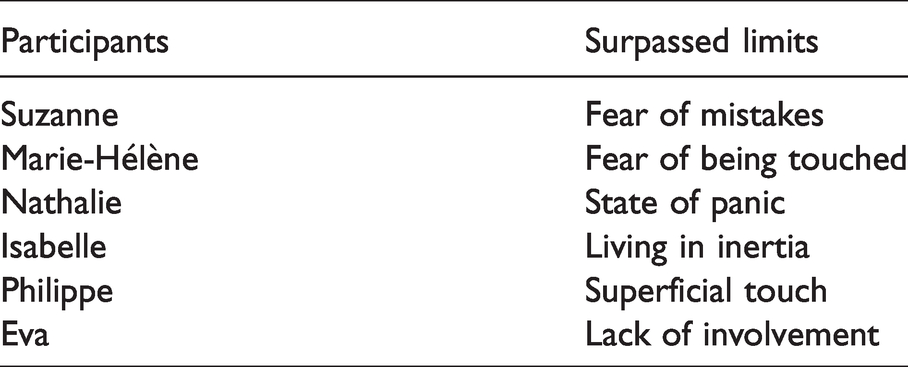
It appears there are two types of self-improvements. To begin, a first improvement of the bodily experience allows a modification of the inner referents and produces an identity change, then, following this transformation, a cascading process begins: awareness, new choices and action. These new choices often bring a second nature to the self-improvements, relating to the lifestyles in place. For example, in Nathalie’s case, she surpassed some of her own limits directly with the help of ASB (manual therapy). To tell myself “I will trust him, I will see what happens”, instead of remaining in my state of panic. We’ll see, maybe something will happen. It was important to have this capacity to open up to something new. Instead of holding on to the same patterns, I panic. I keep panicking and then maybe I will resent him, or I will resent myself. I am not well, but let’s wait and see what will come out of this. There is a notion of distance that I can accept a lot more today. That a person is not always close, sometimes, we are closer, it’s good, sometimes it’s even symbiotic. Then after, we pull away a bit, it moves. Now, I accept this state of distance, of closeness. It is a big change.
Suzanne, for example, overcame a fear of mistakes which held her back from her life and always positioned her to endure events by fear of making choices. For example, the choice of becoming a gynaecologist and to invest her own dynamic in her profession by giving her advice to colleagues. The training allowed her to regain confidence in herself, while allowing her to make choices without this fear of mistakes. The whole group made self-improvements. However, Philippe noticed a difficulty regarding his ability to make movement like we taught him. He says it refers to a rebellious part of himself.
Identity change
The wheel for growing in consciousness depicts the potential of transformative experience at a macro level produced by ASB. According to our participants, the extended ASB experience forms a closer bond between a person and their self and, at the same time, creates paradoxically a feeling of setbacks. 4 The individual gets closer to their body, their intimate experience and their way of living their life. They are better informed on their life. The experience becomes an inner reference to be better inform of oneself, of the surges that carry and suit it. When they listen to their inner life, people become more centered and auto-governed.
We developed a graphic (Figure 1) based on the different categories coming from our first analysis. It depicts the possible transformation process at a micro level, which allows us to understand what the person is going through during the self-centering process through bodily experience.
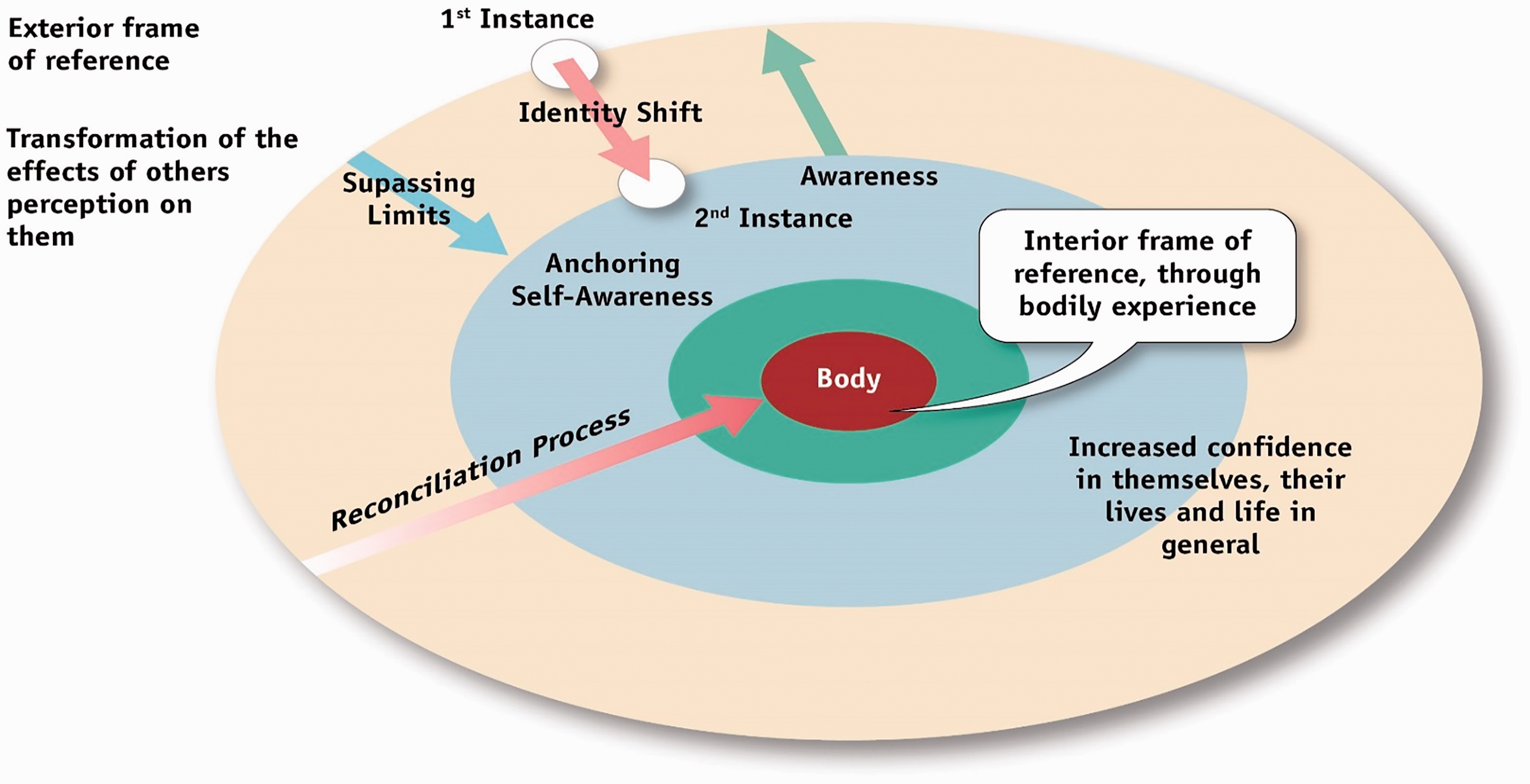
The self-centring process through bodily experience.
Simultaneously, the bodily experience through ASB highlights, in retrospective, the distance established by participants with themselves before the ASB experience. This obvious gap allows them to step back, not only in regard to their previous inner and emotional condition, but also in regard to their life in general. They become aware of the external parameters that had precedence over their lives. External parameters carrying inconsistencies reflect the inner inconsistencies which existed within the person before the bonding process with the body. Previously, the gap was not perceived, but inner and emotional conditions indicated a discomfort. Following the bodily experience, a change happened in the importance given to the participants’ internal and external referents. This change highlighted two types of gap: a gap reduction and a gap expansion, depending on the anchor point at the beginning. Before the bodily experience, there was a gap regarding their corporal depth (they were stuck in their way of being in their life). The self-proximity movement reduces the gap towards their centre, therefore creating a step back regarding their previous way of being (Figure 1). The process of embodying the internal movement into the body material seems to be creating a centripetal attraction and it allows the person to live a self-experience which is more centered and carries information for a more consistent life.
The inner connection through bodily experience appears to be the first step revealing the external and internal inconsistencies. Being self-aware, through the bodily experience which creates a proximity to self, highlights the weight, the limits and the impact of the opinion of others on the participants’ lives. Outside their usual markers, and safe from their personal issues, the new experience allows them to be informed on their way of living and experiencing their lives. Indeed, the extra-daily conditions generate an increase in the level of attention of the person and therefore heighten their capacity of perception. This enriched perception is an opportunity to establish a new relationship with the body. This new relation with the body seems to be the foundation of growth and enhancement of the presence to self which amplifies the awareness capacity. Therefore, the person experiences something new internally.
The new experience reveals in itself, and in contrast, the previous inner operations of the person. The new, for example, the enriched relation with the body, allows to see the ancient poorer methods of relation with the body, a bit as if the quality of the relation with the body was creating a more lucid window of self-perception and an anchor in a condition of corporal confidence which will have to be integrated into the life of the person afterward.
The knowledge by contrast was already addressed by Piaget (1974) and Bois (2007) in their respective perspectives. The perceptive enrichment of the relationship to the body leads the person to notice the poor perception of their body. The affirmative (in our case, enriching the relation with the body) occurs in the experience, and its absence in the previous moment is its negative (Piaget, 1974). A previously unnoticed negative is revealed through the apparition of the perceptive enrichment. As explained by Bois (2007), the student “is placed in a new space of awareness, of feelings and reflections, which give them access to a new vision of their previous operating mode” (p. 278).
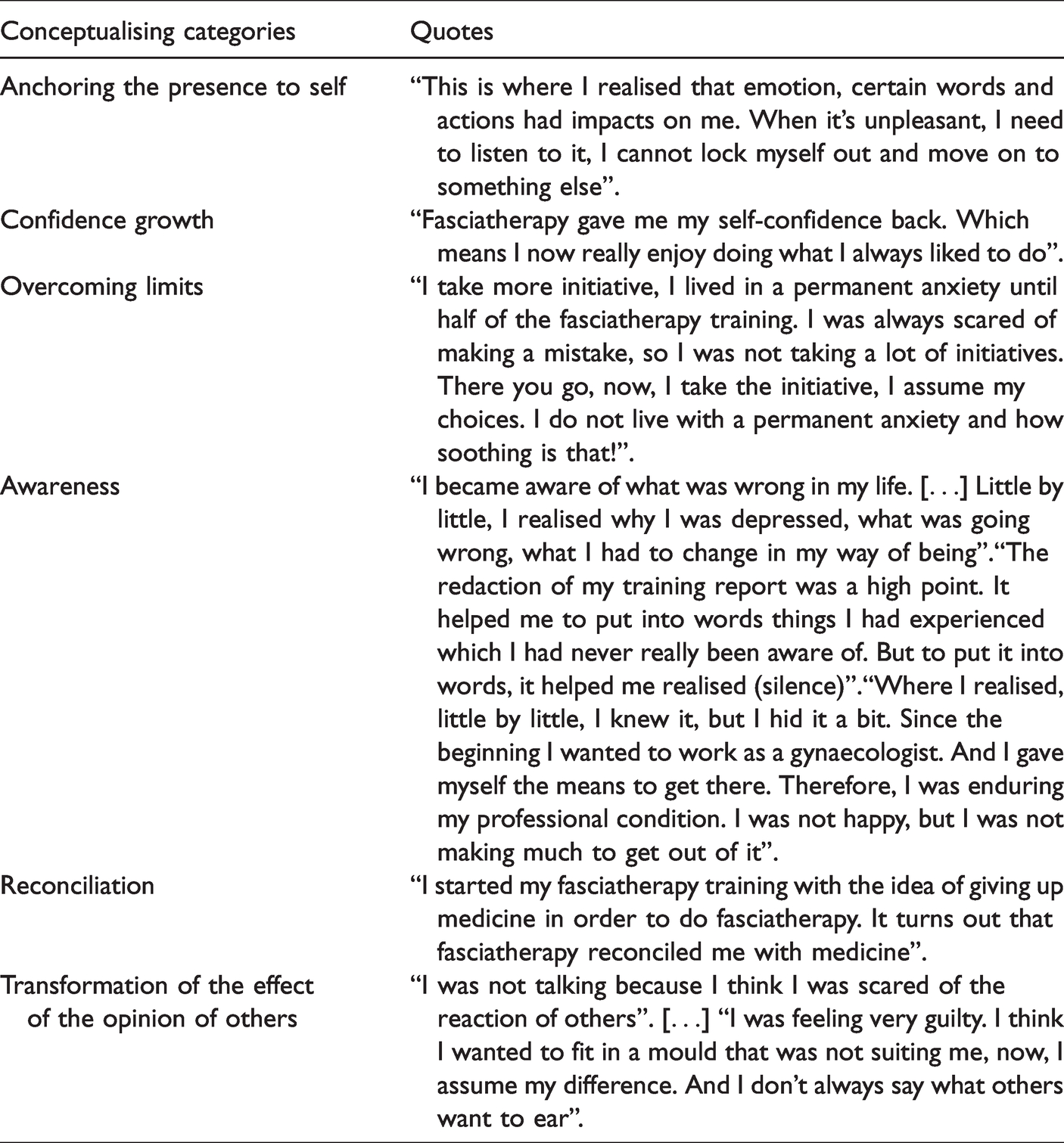
Previous analysis had already led us to observe that participants were centring on themselves and Suzanne, Marie-Hélène, Nathalie and Isabelle were achieving a reconciliation. Figure 1 was created from the list of inferred phenomena following the participants’ statements. It shows the centering of the person within the bodily experience. It describes the identity change from moment 1 (prior to the training) to moment 2 (following the training of variable duration) that participants seem to go through on contact with this physical method. Identity, in terms of inner referents, has shifted and is more centered on deep internal corporal referents. 5 Inner referents become deeper and get embodied throughout the sensitive experience and the person witnesses the gap of their previous construction through the external or internal referents in the periphery. Table 2 depicts the categories included in Figure 1 for Suzanne.
Conceptualising categories—Suzanne.
There is a feeling of being closer to yourself. At the same time, participants have more hindsight and comprehension regarding their behaviour constructed from a certain distancing of themselves. The inner identity change is a mechanism that enables awareness as people have shifted, they stepped back. They identify less to the initial position (distant from themselves) which built their way of being in the world to survive their journey, therefore with a certain distance. Fear or panic has less control, participants do not identity as much on this basis and they realise that they are not only fear or panic, they can be and something else, from another deeper space, anchored in the quality and stability of the relation with the body.
A trusting relation allows to be more aware and open to new things. Isabelle: “More confidence in my life and in life”. Confidence seems to be a preliminary ingredient in the identity change. And maybe the relation change regarding confidence is already an identity change for the person.
This transformation process transpires as a way of unwinding the unconscious knots people built themselves on as per a particular articulation between their interiority and their exteriority in a survival burst. It is possible to recenter yourself as you get in touch with your unprecedented corporal experience and you make the choice to prioritise the internal referents opposed to the external referents and thus choosing a more human life consistent with yourself. A process to recover one’s power over their life and the capacity to create well-being and health.
Discussion
The research’s results lead us to realise that when physicians open up to their inner and emotional world, beneficial effects occur upstream from the therapeutic relation. As a matter of fact, they are better informed on themselves as suggested by other studies on mind-body interventions conducted among medicine students and physicians: improvements in their attention to bodily sensations (Irving et al., 2014), increase of the level of attention towards oneself, in a more global way (Hewson et al., 2006), they know themselves betters (Elder et al., 2007) and they learn to listen to their own body (Saunders et al., 2007). The obtained results highlight the transformation experienced by physicians. Each in their own way, participants go through emotional regulations, as equally suggested by other studies on mind-body interventions: transformation of the way they deal with their emotions (Motz et al., 2012), they are more aware of themselves in regard to the cognitive and emotional level along with a greater ability to regulate their feelings (Irving et al., 2014).
In addition to being more informed and aware of their conditions, participants shared that they are navigating towards more comfortable conditions in their lives. Other studies also point in the direction of advantages in terms of well-being for physicians or medicine students (Hassed et al., 2009; Saunders et al., 2007). Outside personal issues, ASB experience allows participants to meet their self. The body can then express itself and be heard by the one who inhabits it, which makes the release from inner spaces of imprisonment possible. Freiler (2008) mentions that embodied awareness helps to better listen to the messages of the body and to establish a dialogue.
An identity transformation arises from an internal meeting with themselves. Participants build themselves from the inside and feel freer in their way of being, less bounded by their story and their past experiences. In the context of transformative education, McWhinney and Markos (2003) talk of a self-transformation under the form of a renaissance, a sequence of death and rebirth process in response to internal and external changes, from which occurs a new worldview. Tisdell (2008) also discusses the emergence of a new perspective of the world through spiritual experiences from which arises the identity development. She talks of a better integrated sense of identity, a feeling of wholeness. Michelson (1998) argues in favour of the body, not only as a source of biases and distortions, “bodies and feelings speak truths about the world” (p. 227), but as a source of contribution for the improvement of the individual self.
It appears that the ASB experience provided our participants with a connection between their body and their mind. Many participants noticed the beneficial effect of tuning the body and the mind. Our results seem to be supported by research in other areas of this interrelation. Recent research on genomic tend to establish a link between the ability to give meaning your life (spiritual health), the fact of being happy in your life (psychological health) and biological health (Fredrickson et al., 2013). As a matter of fact, the importance of giving a meaning to your life is supported by the biological effects produced at the gene regulation level (Fredrickson et al., 2013). These results argue in favour of considering health in a broader meaning while including the person’s internal and spiritual health. The movement of educational transformation requires the inclusion of the different dimensions of human beings and many link it to deep transformations (Dencev & Collister, 2010), inner life (Morgan, 2012), unexplored potential and spiritual life (Ferrer et al., 2005; Osterhold et al., 2007). Embodied knowing and learning spirituality are both part of our research and are seen as the new and recent theory building in adult learning (Merriam, 2017).
Recent research on cognitive sciences showed that the emotional condition of a person produces impacts on the development of cognitive processes such as attention, perception, memory and decision making (McNaughton & LeBlanc, 2012). It seems that health-related occupations do not sufficiently take into account the effects emotions have on reasoning: In the health professions, these concepts have not been well integrated into our understanding of competency. Attempts at understanding motor skill acquisition, clinical-reasoning and decision-making skills, transfer of knowledge and team performance are very much grounded in a purely cognitive approach, with virtually no discussion of the role of feelings and moods on these processes (McNaughton & LeBlanc, 2012, p. 82).
These mind-body interventions can be pedagogical avenues to teach future physicians or health professionals to take care of themselves and therefore to live in a preventive movement regarding their own health. This type of mind-body intervention appears to support the well-being and comfort of medicine students and physicians and, by extension, have an effect on the therapeutic relation. This qualitative research is developing the beginning of a modelisation of the transformation process and the path to well-being of physicians.
Conclusion
ABS learning appears to lead to a more consistent, conscious and healthy life. Indeed, the process allows participants to be closer to their bodily sensations and their inner condition, while gradually establishing well-being conditions. A quality of “savoir-être” appears to be the foundation of a healthy life. A personal identity built from inner bodily referents provides them with a greater freedom in their way of being in their life and allows them to be well as well as better informed about themselves, upstream of their professional role. For physicians, this construction of themselves acts as a shield against burnout. A longitudinal research involving more participants would allow to go further in the modelisation.
The Flexner Report (1910) created a before/after in the medical education by excluding all non-scientific approaches of that time. In 2019, the Academic Consortium for Integrative Medicine & Health has more than 70 medical academic institutions involved in programs from integrative health, including complementary methods.
Ferrer et al. (2005) and Osterhold et al. (2007) also argue for a transformation of the education applying to the different dimensions of the human being (body, vital, heart, mind and spirit) and more holistic ways of knowing. This new type of education will “reconnect education with its root meaning and, therefore, with transformative healing and spiritual growth, both of which involve a movement toward human wholeness” (Ferrer et al., 2005, p. 325). In our study, inwardness is the place of emergence of the transformation and, as mentioned by Morgan (2012), “the interior is fundamental to ‘perspective transformation’” and Clark and Wilson (1991) “describe as the core of transformative education”. According to Sodhi and Cohen’s (2012) paying attention to our sensorial information body is pertinent for the social practice. Our research proposes another step in helping physicians develop an educational process for the perception of one’s own body.
Our research has several limitations. Only one interview has been conducted for each participant, and after the training period. The interview was the only technic used to collect information. Our research results cannot be generalised. However, they can be transferred depending on the level of similarities with ASB and the research context.
Footnotes
Declaration of conflicting interests
The author(s) declared no potential conflicts of interest with respect to the research, authorship, and/or publication of this article.
Funding
The author(s) received no financial support for the research, authorship, and/or publication of this article.
