



Abstract
Despite concerted efforts to improve educational practices through reform, classroom implementation remains a persistent challenge. This theoretical article draws on recent work in cultural sociology to offer a fresh perspective on this problem. It introduces a framework that differentiates between declarative, procedural, and public forms of culture, highlighting their unique mechanisms of internalization and enactment. This multidimensional understanding of culture reveals the cognitive challenges inherent in translating reform principles into classroom practices. More specifically, the article contends that the common assumptions of convertibility and transferability between these forms of culture underlie the limited success of many reform initiatives. By attending to the cognitive dimensions of cultural dynamics, the proposed framework opens new avenues for understanding and addressing the difficulties of educational change. This article concluded with an agenda for future research to test and refine the framework.
Research on how teachers implement school reform efforts regularly implies a direct relationship between the discursively articulated values and beliefs of teachers on the one hand and their behaviors (and change in those behaviors) on the other (e.g. Spillane et al., 2016, 2018; Stosich, 2016). This assumption suggests that acquiring cultural knowledge in one setting (e.g. learning about a reform in professional development) can directly lead to a change in cultural practice in another (e.g. the classroom). During actual change efforts, however, teachers and administrators often agree on the benefits of new practices, and yet, despite their seemingly best intentions, they fail to implement them (e.g. Diehl, 2019, 2021). This review argues that research on the sociology of culture can help us better understand this puzzle.
More specifically, recent work suggests that the public culture, like the vocabularies, models, and practices related to school reform efforts, is acquired, encoded, and used by individuals in two distinct forms of personal culture – declarative and procedural (Lizardo, 2017; Patterson, 2014). Instead of assuming a strong coupling between these two forms of personal culture where the possession of one assumes the possession of the other, their relationships become a critical theoretical and empirical issue. Moreover, the complex relationship between personal declarative and procedural culture can help us understand why school reforms often fail even when those involved want them to succeed.
Forms of culture: Declarative, procedural, and public
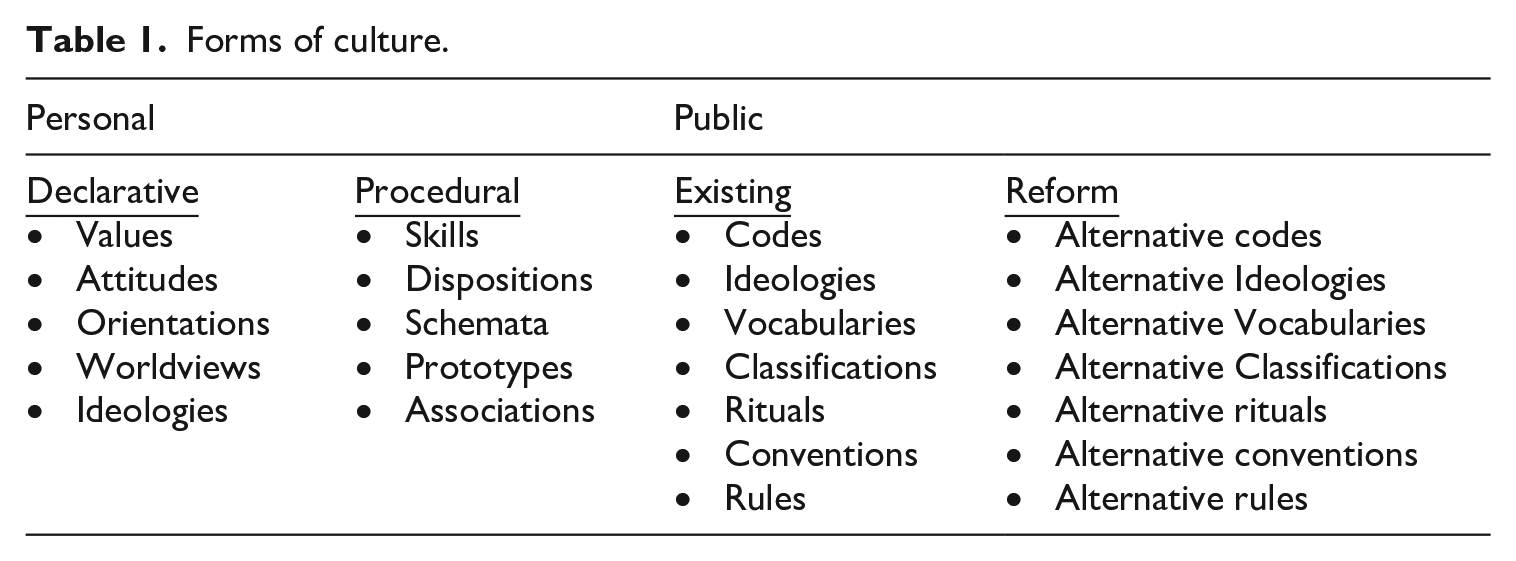
As alluded to above, the sociology of culture makes two critical distinctions between forms of culture (Lizardo, 2017; Patterson, 2014). The first is between two forms of personal culture: declarative and procedural. The second is between personal and public forms of culture. To these distinctions, I add another, this one between reform-related and existing forms of public culture (see Table 1 for a summary of these distinctions).
Forms of culture.
Declarative versus procedural culture
The first distinction in contemporary literature is between two forms of personal culture – declarative and procedural (Lizardo, 2017). Personal declarative culture refers to semantic memory, general ‘know-that’ knowledge about the world stored in a conceptual, symbolic, and decontextualized form, and episodic memory, ‘the capacity to re-experience an event in the context in which it originally occurred’ (Squire, 2004: 174). Personal declarative culture is generally stored as explicitly, symbolically mediated values, attitudes, orientations, worldviews, ideologies, and propositions about the world. Moreover, people are often consciously aware of the contents of personal declarative culture, meaning that they not only ‘know’ it but ‘know that they know it’. When teachers engage in reflective discussion and decision-making related to their experiences, practice, and attitude, they draw on culture in its declarative form.
Personal procedural culture, in contrast, refers to actors’ unreflective, perceptual-sensory knowledge utilized in every day, habituated forms of action (Patterson, 2014). This form of culture is stored in procedural memory in the form of skills, dispositions, schemata, prototypes, and associations, that is, people’s ‘know-how’ knowledge of how to engage in particular types of situated actions. Unlike declarative culture, which is generally accessible and manipulable, people often cannot describe or are even aware of the procedural skills they possess (Carden and Wood, 2018). From this perspective, teachers’ actions are shaped not by the representational beliefs they ‘possess’ but rather by their ‘acquired predispositions to ways or modes of response’ to particular social contexts (Dewey, 1922: 32).
Notably, the personal declarative and procedural culture internalized by teachers may be only weakly coupled. People can frequently do things without being able to describe what exactly they are doing entirely. Think of an athlete who cannot explain why they took their actions during the unfolding game. Conversely, people can also often describe how to do things without being able to do them. Think here of coaches who can explain to athletes how to do physical actions they cannot do themselves.
Personal versus public culture
The second important distinction in the sociology of culture literature is at a higher analytical level and is between personal and public forms of culture (Lizardo, 2017). While personal culture, in either declarative or procedural form, is internalized, public culture is symbolically encoded outside the individual and externalized in different forms like public symbols, discourses, and institutions (Strauss and Quinn, 1997). Such externalization could align with personal declarative culture through shared symbols, beliefs, ideologies, and narratives. It could also align with personal procedural culture in shared forms of action like routines and practices (Schein, 1990).
Cerulo (2018) offered a helpful illustration of the relationship between personal declarative, personal procedural, and public forms of culture. Drawing on the classic example of riding a bicycle (Polanyi, 1962), procedural culture at the personal level entails the tacit knowledge of how to ride a bike, declarative culture at the personal level entails the ability to describe how to do so, and ‘public culture provides knowledge on what a bike is; when, where, and why one uses it; and whether it is valued in one’s community’ (Cerulo, 2018: 364).
Here, we can extend existing work on culture and cognition and distinguish between an institution’s existing public culture and the new public culture introduced by reform efforts. One way to conceptualize school reform itself is as an effort to replace or augment a school’s existing public culture with a new reform-related public culture that teachers ideally acquire in both declarative and procedural forms (though, as I argue below, research has tended to focus more on teachers’ acquisition of declarative compared to procedural culture). To understand how teachers take up the new public culture associated with a particular reform, we need to understand two general mechanisms: 1) how people acquire new declarative and/or procedural culture associated with new public culture and 2) how they use (or fail to use) this new culture in either declarative or procedural form.
The dual-process model of cultural acquisition and use
Current research in culture and cognition points to a dual-process model of enculturation in which declarative and procedural forms of culture are stored in distinct and dissociable memory systems rather than encoded in a common format (Lizardo et al., 2016; Smith and DeCoster, 2000). This lack of common format means that the content of public culture acquired declaratively cannot be turned directly into and used as personal procedural culture and vice versa.
Cultural acquisition
First, the acquisition of declarative culture typically occurs through learning processes in the form of explicit, symbolically mediated information. This acquisition does not necessarily require multiple or ongoing exposures. New cultural knowledge might be explicitly encoded into declarative memory after a single exposure (Hendricks et al., 2013). At the same time, however, people know numerous conflicted cultural codes they can use for justification in different settings (Swidler, 1986; Winchester and Green, 2019). The more codes stored in semantic memory, potentially the weaker the relationship is between talk and action (Harding, 2007). For example, throughout their careers, teachers may pick up a good deal of declarative content about teachings and schools that are not internally consistent (e.g. teachers may hold inconsistent beliefs about the value of both teacher- and student-centered pedagogies). Moreover, beyond being inconsistent, that content may not be strongly related to their actual procedural practices (e.g. a teacher may express commitment to student-centered learning but still maintain tightly controlled classroom routines).
In contrast, the acquisition of procedural culture operates through a different, slower cognitive pathway. Rather than symbolic communication, procedural culture is implicitly internalized through associative learning and repeated experiences via ongoing engagements with local environments (Lizardo et al., 2016; Reber, 1989). Also, unlike declarative culture, procedural culture retains little detail of the situation in which exposure occurs, instead drawing on general associative features (i.e. what was common across episodes). Procedural culture is less flexible than declarative culture because it is situation-specific, not subject to reflection, and challenging to adapt or change. Learning procedural culture entails durable cognitive modification in the form of cognitive-emotive associations, bodily comportments, and perceptual and motor skills. These can occur without actors experiencing changes in their conscious cultural representations or translations into explicitly formulated rules. In other words, it is possible to become profoundly modified by our experiences without picking up any explicit cultural content from them (Bourdieu, 1990).
Cultural use
The dual-pathway model further posits that because forms of culture are acquired and encoded in memory differently, they will be situationally activated and used differently. First, because personal declarative culture is encoded ‘as (relatively) context-free representations, [it] can also be used for ‘“offline” processes of reasoning, planning, imagining, anticipating, remembering, justifying, and narrating outside the action contexts under which it was initially acquired’ (Lizardo, 2017: 93). Declarative culture is also not necessarily activated by the current situation and may even entail suppressing proximal stimuli in the current context.
Personal procedural culture, in contrast, is activated tacitly and habitually as actors deploy existing habits developed in situations structurally like their current one (Bargh and Chartrand, 1999). As such, activating procedural culture does not typically entail high levels of attention or motivation. Instead, research shows that the activation and use of personal culture is not generally a matter of intention but rather is the product of an interaction between personal culture, stimulus, and social context (Andersen et al., 2007).
Weak-coupling between forms of culture
One result of declarative and procedural culture being acquired, stored, and used through different cognitive pathways is that they may only be weakly coupled within people. It is often the case that people have internalized both declarative and procedural aspects of public culture. This is not because the two forms share a common code, however, but because of overlap in internalization processes that create redundant coding where declarative and procedural forms of culture are ‘each linked via analytically separable pathways to corresponding public cultural forms’ (Lizardo, 2017: 88).
Framework for the study of culture in reform
Based on the above discussion, Figure 1, an extension of Lizardo’s (2017) ‘cultural triangle’ (p. 94), highlights three sets of relationships important for unpacking the dynamics of cultural change in schools. The first, relationship (a), highlights how a teacher’s declarative culture mediates the relationship between existing and reform-related public culture. The second, relationship (b), is the same but for personal procedural culture. The last, relationship (c), refers to the intra-individual relationship between declarative and procedural forms of personal culture. The following section focuses on how these relationships have been discussed in the current educational literature, even if using a different language than that found in research on culture and cognition.
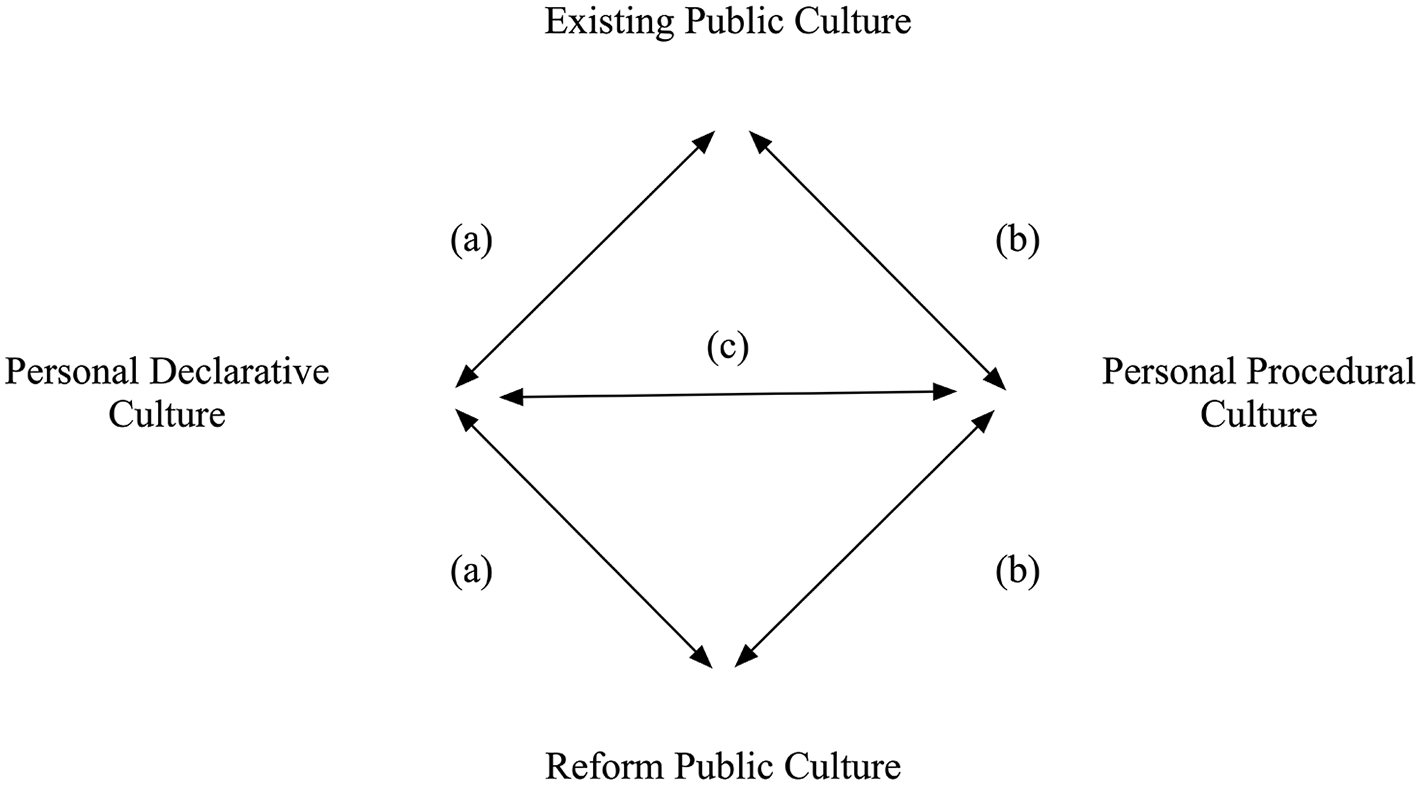
Relationships between forms of culture.
Current theory on culture and cognition in schools
This section discusses two strands of literature relevant to the relationship between forms of culture and teacher implementation of school reform: the sociology of schools and teacher learning. Work on the sociology of schools generally focuses on (a) and (b) in Figure 1 – the relationships between new public culture in the form of exogenous policy messages and teacher beliefs and practices, as well as how the formal and informal nature of the school mediates those relationships. Work on teacher learning, in contrast, has increasingly focused on relationship (c) to understand the potential incongruence between what teachers say and believe on the one hand and what they do on the other.
The sociology of schools
While not using this language, work on the sociology of schools frequently examines the organizational, social, and institutional dimensions of schools that shape teachers’ engagement with new public culture associated with reforms. There are two relevant strands of this work. The first focuses on teacher sensemaking, how ‘teachers draw on their prior experiences, beliefs. . .to interpret and construct meaning of a new idea’ (Patrick and Joshi, 2019: 156). Here, individual cognitive frameworks are central to explaining change in teacher practice and behavior (e.g. Kim et al., 2013; Spillane, 1999, 2000; Tschannen-Moran et al., 1998). This line of research tends to treat teacher interpretation and understanding as the product of idiosyncratic histories and biographies, though hints of a more structuralist brand of mentalism, in which internalized cognitive frameworks are somehow related to macro-structural worldviews or ideologies, can often be seen (though this intuition is rarely pursued in any systematic fashion, however, and instead is typically left as an unexamined residual category). Change efforts may be thwarted, then, if teachers’ cognitive frameworks lead them to interpret desirable aspects of a reform negatively, such as seeing increased enthusiastic student participation in a lesson as chaos rather than engagement.
The second strand of research in the sociology of schools argues that there is also a social, intersubjective component to how new reform culture is filtered through teachers’ mental frameworks (e.g. Coburn, 2001; März and Kelchtermans, 2013). The assumption in this strand of work is that the social organization of the school mediates the relationship between policy messages and teacher beliefs and practices. This includes both the formal structures of a school, like routines and curriculum, and the informal structures of a school, like social networks, which influence teacher beliefs, knowledge, and practices (e.g. Hopkins and Spillane, 2015; Siciliano, 2016; Spillane et al., 2018). Thus, researchers add an interactional gloss to the more individualistic perspective described above by arguing that new public culture is not only refracted by the minds of individuals but also by social processes like negotiation and reflective discourse. Failure to change teacher practices from this second perspective results from problematic individual mental frameworks and organizational barriers that prevent the level of reflection or deliberation necessary to change them. These organizational barriers include a lack of resources and social support as well as conflicting and burdensome time demands (Horn and Little, 2010).
In summary, both strands of work focus on relationship (a) and, to a lesser degree, (b), in terms of how teachers experience new public culture. This work does not, however, typically distinguish between the internalization of declarative and procedural culture. This under-theorization of the relationship between forms of personal culture can be seen in how the literature sometimes discusses beliefs and practices in a way that implies a causal relationship in which declarative culture directly influences procedural culture (e.g. ‘beliefs shape teachers’ instructional practice’: Spillane et al., 2018: 532). Given the assumption of causality between teacher beliefs and practices, one implication from this research is that to change teacher practice, reformers must first change their beliefs about teaching. However, research in teacher learning and change has begun to call this relationship into question.
Teacher learning
In contrast to the work on the sociology of schools discussed above, research on teacher learning and change focuses more on relationship (c) of Figure 1 (e.g. Fives and Buehl, 2012). Work on teacher learning can be conceptualized here as the study of ‘the provision of activities designed to advance the knowledge, skills, and understanding of teachers in ways that lead to changes in their thinking and classroom behavior’ (Fenstermacher and Berliner, 1983: 4). While much of the literature on the sociology of schools assumes a causal connection between declarative and procedural culture, work on teacher change has increasingly demonstrated a more complicated relationship (Skott, 2009). More specifically, while some research does find that teacher beliefs influence their practice, other work concludes that practice influences beliefs, that there is no discernable relationship between the two, or that there is a complicated reciprocal relationship that is shaped by other personal and social factors (Borg, 2017).
This literature offers several possible answers to why there is sometimes a lack of congruence between teachers’ beliefs and their practices. One set of explanations is related to internal factors, including the teacher’s experience level, lags created when either beliefs or practices change faster than the other, or a developmental trajectory related to beginning teaching (Fives and Buehl, 2012). The type and function of a belief may also impact its relationship with practice. Some beliefs, for example, are more related to specific classroom practices, while others are broader. Some beliefs are more central to a teacher’s identity, and some are related to ideas about practices (Buehl and Beck, 2015).
The second set of explanations related to external factors and how situational constraints may prevent teachers from putting their beliefs into practice (Borg, 2003; Fang, 1996). This is one possible reason why some research has found a stronger relationship between stated beliefs and planned aspects of teaching (e.g. choice of activities, lesson plans) than more contingent aspects of teacher practice like lesson plan implementation (Uzuntiryaki et al., 2010). In general, however, the importance of external context, including classroom, school, and policy contexts, is acknowledged in this literature but is not studied as systematically as in the literature on the social organization of schools.
Related, a small body of research on teacher cognition has examined the relationship between declarative and procedural knowledge in the context of both teacher knowledge and teacher beliefs (e.g. Blömeke et al., 2015; Fives and Buehl, 2012). First, while work on teacher knowledge acknowledges that there are both declarative and procedural aspects of teacher knowledge, research has historically focused more on declarative knowledge studies through paper-and-pencil tests (König et al., 2014). Given, however, interest in how teachers, especially those in training, apply declarative knowledge learned in courses or professional development training to practical situations in the classroom, there has been a growing emphasis on studying situation-specific skills (i.e. procedural culture). However, studying context-dependent procedural culture is much more complicated than declarative culture (König et al., 2021).
Research on how teachers activate what they have learned in situation-specific ways in their classrooms is still in its early stages. Much of the work in this area theorizes that there is a continuum between declarative and procedural culture, with the former being transformed into the latter through practice and experience (e.g. Blömeke et al., 2015; Kersting et al., 2012; Meschede et al., 2017). The actual empirical results of this work are more consistent, however, with a dual-process framework where declarative culture and procedural culture are qualitatively distinct. For example, work on teacher competence has found that the skill of noticing (i.e. identifying meaningful aspects of the situation) is not correlated with measures of declarative culture. In contrast, the skill of interpreting and analyzing the situation is associated with declarative culture (Kersting, 2008; Kersting et al., 2012; König et al., 2014). Rather than suggesting that declarative and procedural culture are acquired the same way, these findings are consistent with a model in which noticing, as a skill related to procedural culture, and interpreting, as a skill related to personal declarative culture, are activated through different, uncorrelated, neural systems.
In summary, the strength of the literature on teacher learning is that it offers several possible answers to why there is sometimes a lack of congruence between teachers’ beliefs and their practices. It typically does not distinguish, however, between the different processes through which declarative and procedural culture are activated and used, seeing them instead as existing on an unimodal continuum. In their own ways, the sociology of schools and teacher learning both rely on what Roediger (1980) calls the ‘incorporation-encoding-retrieval’ model of learning and memory. This model assumes that cultural information, regardless of its form, is encoded in memory in a universal format and can be activated by the individual when needed in the form of either discourse or behavior.
Implications of the framework for the study of forms of culture in reform
Based on the discussion above, this section outlines some implications of the framework in Figure 1 for research on the implementation of school reform. More specifically, it discusses two common problematic assumptions in the literature about how teachers acquire and use new public culture related to school reforms. The first assumption is convertibility – that public culture acquired in declarative form can be internally changed into procedural culture. The second is transferability – that culture acquired in one setting can be straightforwardly used in a different kind of situation. I discuss both assumptions and their implications for research below.
Acquisition of reform culture and the assumption of convertibility
First, incorporating the distinction between how declarative and procedural forms of cultures are acquired has important implications for how we think about teacher learning in school reform. As discussed above, public culture internalized in explicit declarative form (e.g. new curriculum or pedagogy, theories of instruction) and procedural form (e.g. the embodied skills of classroom teaching) are not internalized and stored through the same cognitive pathways. In contrast, the educational research discussed in the previous section that emphasizes relationship (a) of Figure 1 frequently posits that reform failure results from inadequate or incomplete teacher acquisition of new reform-related declarative culture. This is because, I argue, it assumes that culture internalized in declarative form can be internally converted into procedural form.
This assumption of convertibility can be found in several current strands of school reform-related research. A prominent example is the literature on teacher collaboration and learning communities as vehicles for implementing school reform efforts (Hargreaves, 2021). For example, Horn and Little (2010) identified two ways teachers make their classroom practice visible to their peers: by providing a ‘replay’ of actual classroom behaviors or by ‘rehearsing’ what they and students generally do or might do. Rather than assuming a direct relationship between replaying or rehearsal among teachers on the one hand and classroom practice on the other, our understanding of culture and cognition makes this an empirical question. Moreover, the reflection and deliberation involved in replaying and rehearsing are themselves particular kinds of practices, and the procedural skills needed for them are not necessarily the same as the ones required for the classroom.
The assumption of convertibility is also found in work emphasizing the importance of teacher ‘buy-in’ for reform success (Turnbull, 2002). However, work on multiple forms of culture alerts us to the limitation of a view of buy-in that only focuses on declarative culture. It could be argued that a teacher who fundamentally alters their practice in the direction of a reform but declaratively insists they have not changed should still be counted as buying in, even if they have done so without acquiring a new declared culture to describe their changed behavior. Inversely, this work also alerts researchers that while survey and interview responses can capture teachers’ internalization of new declarative reform-related culture, there may be a weak relationship between the practices they discursively endorse and their ability to carry them out. This can lead to frustration from ‘understanding’ a change, buying into its desirability, and intending to enact it but lacking the ability to carry it out. 1 Lizardo (2017) called the state of being able to plan or intend to take a line of action but lacking the procedural know-how to carry it out an ‘enculturation gap’ (p. 105). Current research may underestimate the degree to which teacher declarative resistance to reform may be the result of the frustration of not knowing how to enact a new practice rather than declarative resistance being the cause of not enacting the practice. 2
This assumption of convertibility persists because individuals commonly do possess declarative culture and procedural culture related to the same domain of life. Teachers, for example, may be able to both talk about their classroom practices and enact them, but the abilities to declaratively ‘describe’ and procedurally ‘do’ were not learned in the same way. Declarative culture related to teaching comes from teacher education, professional development, and collegial conversations. Procedural culture, in contrast, is acquired through practice. Rather than incorrectly assuming that exposure to new public culture in declarative form can be converted into personal procedural culture, the variable nature of the relationship between forms of culture should be a central area of research on reform. An important empirical question is in what kinds of professional development or other learning environments do teachers acquire both declarative and procedural culture related to new reform culture. And how is acquiring overlapping forms of culture related to pedagogical change?
Use of new reform culture and the assumption of transferability
While the assumption of convertibility relates to how culture is acquired, the assumption of transferability concerns how it is used in practice. Specifically, transferability is the assumption that culture acquired in one setting (e.g. professional development) can be transferred straightforwardly to a different type of situation (e.g. the classroom). However, research shows that teachers’ attempts to implement new reform-related practices or routines are shaped not only by their personal culture but also by the nature of the situation (Feldon, 2007). Putting newly acquired reform culture into practice is challenging because, once faced with the contingencies of actual interaction, people often fall back on dispositional responses related to old procedural culture even when they have reflectively decided to do otherwise.
Attempts to change practices are thus frustrated because even when teachers successfully acquire new declarative culture, their behavior in the classroom will be shaped by the alignment between their existing procedural dispositions and the cultural affordances of the situation – external cues about what behavior is required, prohibited, permitted, or expected. Cultural use results from an interaction between internal cues in the form of personal culture and external cues in the form of norms, conventions, and practices. While the use of affordances may involve declarative culture, most of the time, behavior involves ‘exploiting (non-semantic) information for affordances, rather than (semantic) information about affordances’ (Ramstead et al., 2016: 10). Part of the challenge of school reform is that classrooms contain cultural affordances designed to solicit particular patterns of interaction from participants, like teacher-centered control. These patterns, however, may be precisely the ones that the reform tries to alter by conveying declarative culture about alternatives.
The assumption of transferability can also be seen in the literature on teacher reflection (Marcos and Tillema, 2006). 3 Providing teachers with more opportunities to reflect should not be confused with giving them more agency or autonomy over their practice because they may lack the material, social, or dispositional means to achieve goals they have reflectively decided upon (Lahire, 2003: 337). For example, Doyle and Redwine (1974) found that even when teachers planned to alter how they taught a lesson, their preexisting procedural culture took over once they were engaged in teaching. They taught the lesson much the way they had before because change is hampered by how ‘the complexities of classroom life. . .constrain teachers’ abilities to attend to their beliefs’ (Fang, 1996: 53). Along these lines, Jorgensen et al. (2010) identified four areas of inconsistency between teachers’ beliefs and practices (i.e. inclusiveness, importance of culture, group work, connectedness of ideas, and multiple pathways) and two other areas where they were consistent (i.e. intellectual quality, learning environment). Understanding when teachers’ personal declarative culture and procedural culture are coupled in the classroom is an important empirical issue that future research on forms of culture can help address. 4
Reform efforts that rely primarily on changing teachers’ declarative culture are, therefore, bound to be limited in their effectiveness because they fundamentally misidentify the primary driver of behavior in the classroom. Rather than assuming a process of transferability, then, we should ‘treat it as a problem to be settled by empirical research aiming to systematically compare social dispositions activated according to specific contexts’ (Lahire, 2003: 332). This would make the variable nature of how forms of culture are used by teachers a central area of research on reform. Such a research agenda would include studying under what conditions and through what mechanisms are declarative and procedural culture redundantly coded.
Conclusion
In this article, I have proposed a conceptual framework for understanding the complex dynamics of school reform that draws on insights from the sociology of culture. By differentiating between declarative, procedural, and public forms of culture, as well as their unique pathways of acquisition and use, the framework illuminates the often-overlooked cognitive dimensions of educational change. More specifically, I have argued that the assumption of a straightforward relationship between teachers’ acquisition of reform-related knowledge and changes in their classroom practices neglects the crucial distinction between declarative and procedural culture. Declarative knowledge of reform principles does not directly translate into the procedural skills needed for enactment.
Instead, the article highlights the tensions and interplay between teachers’ existing procedural repertoires and the new cultural forms introduced by reform efforts. By attending to these dynamics, the article’s framework moves beyond the rationalist models of cultural change that currently dominate the literature. It offers a more nuanced understanding of why reforms often fail to take hold, even when teachers express commitment to their principles. Changing practices requires more than shifting beliefs and values; it involves effortfully restructuring embodied habits and skills.
Several avenues for future research emerge from this conceptual framework. First, empirical studies could investigate the conditions and processes that shape the relationship between teachers’ declarative and procedural cultures during reform implementation. Under what circumstances do these two forms of culture converge or diverge? What factors might facilitate or hinder their alignment? Mixed-methods studies that combine surveys of teachers’ beliefs with observations of professional development, teacher collaboration, and classroom practices could provide valuable insights into these dynamics.
Second, fine-grained ethnographic research could shed light on how the situated contexts of classrooms shape the activation of reform-related skills. How do cultural affordances and constraints of specific classroom environments interact with teachers’ procedural repertoires? How do students’ expectations and responses influence teachers’ enactment of new practices? Detailed case studies that attend to the microdynamics of classroom interactions would be particularly illuminating here.
Third, intervention studies could test professional development designs that explicitly aim to bridge the declarative-procedural divide. Rather than focusing solely on transmitting reform principles, these interventions could incorporate elements like coaching, video analysis, and rehearsal that are grounded in the specific contexts of teachers’ practice. Researchers could examine the impact of these designs on both teachers’ expressed beliefs and their observable classroom behaviors, as well as on student learning outcomes.
Fourth, longitudinal studies could trace teachers’ trajectories of cultural change over time. How do declarative and procedural cultures evolve in relation to each other throughout the reform process? Are there key inflection points or recursive patterns in these trajectories? Designing studies that follow teachers over multiple years and reform cycles could provide a richer understanding of the temporal dynamics of cultural change.
Finally, comparative research could explore how variations in organizational and policy contexts shape the interplay of forms of culture in reform efforts. How do factors like school leadership, collaborative structures, accountability pressures, and resource allocation influence the alignment of declarative and procedural cultures? Cross-case analyses that situate reform dynamics within broader institutional frameworks could yield valuable insights.
Pursuing these lines of research would help elaborate and refine the framework I have proposed while generating actionable knowledge for educators and policymakers. By providing a more nuanced understanding of the cultural and cognitive dimensions of reform, such research could inform the design of more effective change strategies that are attuned to the complex realities of classrooms and schools. Echoing Patterson (2014), I take the overarching lesson of the sociology of culture for the study of school reform that ‘[n]ot recognizing the cognitive and cultural nature of institutions results in neglect of the most common reason for institutional failure – that they have not been learned or cannot be enacted even when declaratively known’ (p. 15).
Footnotes
Acknowledgements
The author would like to thank the anonymous reviewers as well as audiences at the American Educational Research Association and American Sociological Association annual meetings for invaluable feedback.
Declaration of conflicting interests
The author(s) declared no potential conflicts of interest with respect to the research, authorship, and/or publication of this article.
Funding
The author(s) received no financial support for the research, authorship, and/or publication of this article.
