



Abstract
Empirical educational research nearly universally tacitly assumes that people attend college only in order to improve their likely earnings. Thus, it ignores the immense cultural importance ascribed to education (and particularly higher education) in modern culture, or at least proceeds as if this cultural valorization is irrelevant to individuals’ educational decision-making. I first review how an economistic model of action informs all dominant theories of educational decision-making, and then suggest how institutional theory can provide a richer account of the college transition. Drawing on in-depth interviews with first-time, first-year community college students, I illustrate this approach through a ‘thick description’ of individuals’ emerging educational orientations. I find that attending college reflects both instrumental goals and moralized conceptions of educational attainment. The decision to attend community college was informed by conceptions of college costs, a limited understanding of grant aid, and loan aversion. And I identify three educational dispositions among entering community college students which map onto institutionalized organizational pathways through the community college itself.
College-going is today an option taken up by a large share of the human population. In the fall of 2019, over 19 million people were enrolled in postsecondary institutions in the United States. While in both raw numbers and in per capita enrollment, this is short of 2011’s high-water mark, the long-term trend is unmistakably toward more prevalent participation. Today, American postsecondary educational (PSE) enrollment per capita (5.9%) is more than three times higher than it was in the late 1950s (1.9% in 1957; National Center for Education Statistics, (NCES), 2021a). Worldwide, the trend is even more clear. Raw PSE enrollment globally rose from 32.6 million in 1979 to 214 million in 2015 – an increase of more than 550% during a time in which global population doubled (Calderon, 2018).
Overwhelmingly, researchers account for higher educational participation exclusively through reference to individual economic self-interest. A mountain of empirical evidence documents sizable individual-level economic returns to a college degree (Hout, 2012; Psacharopoulos and Patrinos, 2018). In the United States, the college wage premium grew rapidly over the last quarter of the twentieth century, contributing mightily to rising inequality (Autor and Dorn, 2013; Goldin and Katz, 2008). The logic appears ironclad: since college raises earnings (and now more than ever), and since individuals seek higher earnings, individuals attend college for its economic benefits. This logic underwrites the overwhelming majority of empirical research on college-going, regardless of discipline, to such a degree that how and why individuals orient themselves toward this or that educational goal are questions rarely asked.
But assuming that educational goals flow unproblematically from individual self-interest neglects the institutional and structural environment within which aspirations, dispositions, and identities are forged. Today, a massive organizational infrastructure exists to promote a ‘college-going culture’ in nearly every high school in the United States. And by the time they reach high school, most individuals have been told for years by most moral authorities – parents, family members, teachers, respected community members – that they ought to go to college. This is because in modern societies ‘college’ is freighted with immense moral and cultural importance (Baker, 2014; Monaghan, 2022a). Education is a nearly unmitigated good in modern world culture and is thus central not just to determining one’s socioeconomic position but also to constructing one’s social agency and moral identity (Monaghan, 2022b; Nielsen, 2015). Therefore, being college-bound – or not, or to what degree – is about more than one’s likely earning potential; it speaks at minimum to matters of character and identity, ambition and worth (Silva and Snellman, 2018). In making educational ‘decisions’, individuals are choosing important elements of social and moral identity.
From this perspective, we should expect a diversity of dispositions and orientations in relation to postsecondary participation, but researchers have traditionally investigated only the poles of the college aspiration spectrum. To one side are most privileged students, for whom college-going is and always has been taken for granted as inevitable (Grodsky and Riegle-Crumb, 2010). To the other are those who rule out college as ‘not for the likes of us’ (Bourdieu, 1984; Willis, 1978). What we understand far less well are the orientations of those falling between these extremes – those closer to the margin of attendance. What, for instance, is the meaning and content of postsecondary aspiration among those whose success in college is uncertain or even unlikely given their prior academic attainments?
I broach these matters drawing on in-depth interviews with direct-enrolling first-time freshmen at a community college 1 in a large U.S. city. Community college students are an ideal population for this investigation because of these colleges’ institutionalized service to individuals ‘on the margin of school and work’ (Kane and Rouse, 1999). I problematize the received model of educational decision-making as solely the rational pursuit of material advancement through a ‘thick description’ of subjects’ college transitions.
My chief findings are three. First, I find that respondents’ overall orientation to college involves but is not limited to the desire for upward mobility and economic security. Respondents’ college-going also reflects the symbolic value of college-going as a moral achievement, which can therefore reflect positively on families and inspire siblings. It is also caught up with the valorization of and desire for meaningful work and for a social identity realizable through such work – that is, a ‘career’ rather than a ‘job’ – which are accessible only to those with a college degree. Second, I find that the decision to attend community college must be understood with reference to the context within which it occurs. Crucially this context involves how subjects tacitly understand the opportunity structure relevant to them, and how they implicitly conceive of themselves in relation to the structures that determine these opportunities. Third, I find that ‘motivations’ for attending college are, even in this small and restricted sample, heterogeneous but structured. One cannot understand these motivations without grasping the interplay of three elements: the cultural meanings of higher education, self-understandings, and the temporal life course. That is, motivations toward education are a function of individuals’ emerging understandings of themselves, which are in turn constituted through the choice of an institutionalized life-course trajectory in relation to education. The ‘meaning’ of their chosen trajectory (and therefore their emerging identity) reflects the significance and value of higher education within the broader culture.
Theory and prior research
Educational aspirations and motivations in social theory
Social science has, for the most part, considered educational motivation 2 to be unidimensional. The study of educational aspirations began in the 1960s with the concurrent development of human capital theory in economics (Becker, 1964; Schultz, 1961) and status attainment research in sociology (Blau and Duncan, 1967; Sewell et al., 1969). Both traditions presume that people seek education to boost their earning power and/or social position, and implicitly consider those motivations to be obvious and universal. High educational aspirations are rational, normal, and socially preferable; individuals deviate from them either through rational assessment of their (limited) ability, their (inexplicable and detrimental) preferences, or the (unfortunate) influence of others on their perceptions and inclinations.
In human capital theory, educational investments increase productivity and thus earnings. Individuals uniformly wish to maximize utility, and so ceteris paribus should uniformly wish to maximize education. Individuals vary by ability, which determines the slope of the impact of educational investments on earnings as well as the ‘cost’ (in terms of effort) of these investments (Becker, 1964). It is assumed that individuals accurately grasp their own abilities, which are taken to be objective, and have perfect information about the world. Educational decisions are rational algorithms, uniform across persons, which aggregate and compare (lifetime) costs and benefits of mutually exclusive courses of action (Paulsen, 2001; Tan, 2014). What is determinative is the objective structure of opportunities in relation to an actor’s (fixed, objective) ability. Additional empirical heterogeneity is explained through the concept of preferences. Across individuals, what maximizes utility can vary; for example, people differentially value leisure relative to income or present relative to future earnings. Preferences principally explain residuals and are little theorized (Dietrich and List, 2013). But they are implicitly morally ranked, with the preference for leisure (versus income) or present (versus future) wages considered less socially desirable and employed to explain worse individual outcomes.
Status attainment research presumes that individuals seek to maximize their social position, and recognizes that this is empirically most probable through educational attainment. In contrast to the human capital frame, the status attainment literature takes as its starting point the strong, positive empirical correlation between individual’s adult status and that of their natal family – a relationship partially mediated by education (Blau and Duncan, 1967). To explain this finding, status attainment researchers introduced the concept of educational aspirations, which are influenced by cognitive ability, cumulative school experiences, and social-psychological factors such as self-assessment and self-concept (Sewell et al., 1969). Relevant cognitions and motivations are ‘developed in structured situations’, in interaction with ‘significant others’, which not only include parents, teachers, and other moral authorities but also peers (Haller and Portes, 1973). These others shape ideas about what is desirable and feasible both in general and for the individual in question. As with human capital theory, desiring maximal educational achievement conditional on ability is implicitly considered normal and ideal, though sometimes unfortunately deflected by social influences. Status attainment effectively offers a social account of human capital theory’s ‘preferences’.
These paradigms were challenged by the various versions of conflict theory that emerged in the 1970s. (Bourdieu and Passeron, 1977; Bowles and Gintis, 1976; Collins, 1971). Conflict theories redefined status attainment as social reproduction, focusing on and seeking to explain why so little mobility occurred through the school system. They shifted focus from individuals to macro-structures and introduced the crucial component of class struggle into educational research. The school system was held to present (limited) opportunities for mobility for subordinate-class individuals, but to mainly act as a bulwark for the collective dominance of the class in power. But the presumption that individuals seek to maximize attained status, and that this motivation explains educational participation, remained unchanged though was often theoretically subordinated to the maximization by classes or occupational groups of collective interests.
Bourdieu’s conflict theory, currently highly influential in both sociology and education, retains a strong theoretical interest in the social production of educational aspirations (Bourdieu, 1984, 1998; Bourdieu and Passeron, 1977). It imports from status attainment the notion that aspirations and estimations of ability are internalized through early socialization experiences, but alters it in four ways. First, it replaces status attainment’s conception of a continuously graded social background producing individually differentiated impacts with a Marxian-derived categorical conception of social classes impacting class members more or less homogenously. Second, socialization is replaced by the development of habitus, the internalization of objective external reality in the form of schemes of perception and dispositions for action. One’s habitus is a function of one’s location in social space and is similar within class groupings defined largely by occupation. Third, the external environment becomes endowed with agency, transformed from the implicitly objective and free market into a ‘field’ characterized by class-biased unwritten rules and weightings of diverse capitals. Fourth, Bourdieu (1998, Ch. 4) holds that modern society supports differentiated and semi-autonomous ‘games’ (‘universes’ or fields) that value and generate differentiated ‘capitals’ and for which actors are differentially prepared and inclined to compete.
But for all this added nuance, Bourdieu has simply subdivided the narrow theoretical rooms of conflict theory. Bourdieu has expanded the number of games, diversified the prizes, and explained play as a matter of intuition rather than deliberation, but actors are still uniformly struggling for advantage. The ‘moral’ is but a form of symbolic capital, and moral orientations are distinction strategies (Halewood, 2023; Pellandini-Simányi, 2014; Sayer, 1999). This framework extends to educational orientations. Education is a field that values and awards cultural capital. Individuals learn, in practical terms, the objective likelihood of school success (e.g., ascending to a prestigious university) for someone in their social position, and develop aspirations and put forth effort proportionate to this expectation. Working-class youth, with devalued cultural capital, disqualify themselves from what they were already disqualified (see also MacLeod, 1987).
Alone among originators of conflict theory in education, Willis (1978) breaks partially with the implicit assumption of homogeneous motivations in his explanation of why (some) working-class youths actively undermine their chances at upward mobility through schooling. He postulates that these youth do so partly through an intuitive class solidarity, partly because they prize and identify with a masculine honor realized in hard manual labor, and partly because they adopt a class-based valorization of ‘practical’ know-how over intellectual learning. That is, Willis opened up the possibility of investigating qualitative differentiation in both aspirations and motivations, but this was little followed up.
For both Bourdieu and Willis, the focus is on explaining why some do and others do not aspire to postsecondary education. Since postsecondary aspirations are self-explanatory, the analytical problem is explaining absence of aspiration. As Willis (1978) famously put it, ‘the difficult thing to explain about how middle-class kids get middle class jobs is why others let them. The difficult thing to explain about how working-class kids get working-class jobs is why they let themselves’ (p. 1). That those who aspire to higher education may differ in either strength or nature of aspiration or, qualitatively, in motivation, is left unexplored.
The period since the 1970s, has witnessed the expansion of a vast middle-ground of students between those with presumed collegiate futures and those who self-disqualify. Nonetheless, most research continues to implicitly presume homogeneous aspiration and motivation toward college enrollment and success; the ideal-typical subject wants to achieve in school, wants to go to the best college they can, and plans to graduate – all primarily to realize returns on the labor market. Empirical research therefore focuses on the (re)production of inequalities in resources necessary for success – for example, academic preparation, financing, and information (Deil-Amen and López Turley, 2007; Goldrick-Rab, 2007; Louie, 2007). Explicit investigations of educational aspirations typically focus on success stories: privileged students who reproduce their status (the production of inevitability) (Khan, 2011) or those from disadvantaged backgrounds who beat the odds (the production of exceptionality) (Griffin et al., 2012).
Empirical typologies of college students
By contrast, the ‘college student typology’ tradition brings the heterogeneous orientations of college-goers front and center. Beginning in the 1960s, education scholars sensed that not all college students were attending for the same reasons and formulated various typologies to make sense of this differentiation. The earliest, that of Clark and Trow (1966), cross-classed students according to identification with (a) ideas (taken to be the stock-in-trade of higher education) and (b) their specific college. Four groups resulted: Academic students who identified with both ideas and their college, collegiate students who identified with their college but not ideas, non-conformist students who identified with ideas but not their college, and vocational students who identified with neither.
While Clark and Trow deduced their typology from theory, subsequent typologies were generated empirically through batteries of questions about values and activities. Most expanded the number of categories. Astin (1993), for instance, identified seven categories: scholar, leader, hedonist, status-striver, artist, and unconnected. Kuh et al. (2000) found 10: intellectual, grind, scientist, collegiate, recreator, socializer, conventional, individualist, disengaged, artist, and disengaged. In their review article, Hu et al. (2011) noted strong similarities across these typologies: all include one or more ‘academic’ categories, one or more ‘college social environment’ categories, one or more ‘careerist’ categories, and a set of ‘non-conformist’ groupings including political activists, artists, and ‘disengaged’ students. It is notable that all typologies were developed with data from prototypical undergraduates: full-time residential students, mostly between 18 and 23, at four-year colleges. The connection between student ‘types’ and educational motivations is not always the focus of these studies but is nonetheless implicit. Given varying orientations to college while there, one can infer differences in why individuals attend (initially or why they continue).
Subsequent scholars have explicitly investigated motivations for attending college. Seminal in this regard has been the Student Motivation for Attending University Scale of Cote and Levine (1997). Cote and Levine identify five principal ‘motivations’: careerism-materialism regards college as a means to a desirable and remunerative career, personal-intellectual development perceives college as a time of personal growth and change through exposure to knowledge and perspectives, humanitarianism conceives of college as providing the tools to make a positive impact on the world, expectation-driven attendance is undertaken to satisfy parents and others, and default attendance sees college as simply better than the alternatives. Additions and modifications have been proposed by Henderson-King and colleagues (Henderson-King and Mitchell, 2011; Henderson-King and Smith, 2006; Krypel and Henderson-King, 2010; see also Phinney et al., 2006). In an advance over typological research, this literature permits individual students to express multiple motivations rather than being sorted into discreet groups.
This literature is highly empirical; little attempt is made to explain regularities in orientations and motivations across individuals or even across typologies. I suggest that student motivations map clearly to previously established student ‘types’, and that both can be fruitfully explored using institutional theory.
An institutional theory of educational orientations
In what follows, I present the beginnings of an institutionalist account of college-going ‘decisions’, ‘goals’, and ‘motivations’. Sociological institutionalism departs from much social theory through conceiving of actors as embedded in and constructed by their wider institutional 3 environments (Meyer and Jepperson, 2000). This cultural environment contains models of reality itself and of what constitutes it, such as the ‘rational actorhood’, ‘personhood’, and ‘individuality’ through which subjectivities, interests and selves are constructed (Meyer et al., 1994). The cultural environment is most powerful through establishing both the (institutionalized) entities presumed to exist, as well as their attributes and relations, and the unexamined assumptions about what is valuable, admirable, and righteous (Meyer, 1983; Monaghan, 2022b). It is in and through this environment that individuals are constituted as decision-making agents with a given set of differentially probable, and differentially valuable, opportunities (Meyer, 2010).
Institutionalism has been widely applied to the study of education. For the purposes of this analysis, three insights are essential. First, institutionalists give great importance to the worldwide expansion of education (Boli et al., 1985; Meyer et al., 1992). Over the past 200 years, formal education has changed from an elite experience to a universal human right recognized nearly everywhere, as globally an increasing share of people devote an increasing number of years to formal schooling (Baker, 2014). Second, institutionalists note that schooling is amazingly isomorphic globally – in terms of curriculum, organizational structure and central processes (Benavot et al., 1991; Frank and Meyer, 2020). For instance, the meaning of ‘grades’, ‘classes’, and ‘subjects’ are standardized worldwide. Third, institutionalists note the profound legitimacy of education in modern culture (Baker, 2014; Meyer, 1977). Education is conceived of the primary mechanism for the development of cognitive capacity, which is the premier human capacity in modern societies. It is also the system of universal knowledge creation, certification, categorization, and is deeply linked to sacred conceptions of individuality and personhood.
This deep cultural legitimacy informs education’s crucial role in the modern life course, in the constitution of the self, and in the legitimation of social stratification. Over the course of the twentieth century, as the life course became increasingly standardized, education was the central fulcrum around which this standardization coalesced (Pallas, 1993). Education is institutionalized as forming the rationalized bridge from natal family to the labor market, as converting ascribed into achieved individual identity through exposure to universalized knowledge and standardized performance evaluations signaling cognitive skill (Meyer, 1987). As such, education is increasingly held to be essential to the realization of fully developed agentic personhood (Mirowsky and Ross, 2007). It is in part through the educational system that one discovers and actively molds one’s identity. And because it is linked to the development of highly valued cognitive skill, education is established (e.g. through human capital theory) as providing the legitimate basis for stratification (Baker, 2011; Baker et al., 2012). That is, the fundamental ideology of status attainment in modern culture is that of school-based meritocracy.
Education, therefore, has a wide set of institutionalized meanings in modern cultures, which are reflected in both organizational structures and practices and in student orientations and ‘motivations for attendance’. One can re-read empirical typologies in the light of this insight. All influential typologies include one or more ‘academic’ category, one or more ‘college social environment’ category, one or more ‘careerist’ category, and a set of ‘non-conformist’ groupings including political activists, artists, and ‘disengaged’ students. It is the institutional structuring of the four-year university that renders these categories necessary. The central institutional mission of the university has to do with knowledge: its creation, classification, and adjudication (Frank and Meyer, 2020). And so, some organizational clients organize their participation and identities in relation to this. The university has institutionalized linkages to the labor force and earnings-boosting, and students organize themselves in relation to this logic as well. Residential colleges have cultivated vibrant social scenes and sports in order to increase loyalty and involvement, and this presents a third organizational locus around which students can and do organize themselves. The university has discursive and organizational linkages with societal individualization and creativity, as well as with universalistic moral valuations (particularly those emphasizing equality), creating space for students to organize as ‘creatives’ and ‘activists’. Finally, a residual category of the ‘disengaged’ reflects those who organize themselves incongruently to institutionally available opportunities, and who largely leave college quickly.
Institutional structuring of this sort might play a causal role in structuring qualitative differentiation among organizational clients. On a most basic level, if an organization (here, the community college) presents differentiated legitimate pathways to clients, and these pathways are broadly known, clients may pre-emptively mold themselves in a manner congruent with their intended pathway. Anticipatory socialization could provide one such mechanism, and sorting and molding by preparatory institutions and personnel may provide another. Such processes may work dynamically with Boudieusian habitus to produce differentiated dispositions fitted to existing organizational possibilities. The institutionalized organizational structure thus generates the categories into which potential clients probabilistically sort as well as the characteristics of those likely to enter these categories. As structured progression through time leads possibility and probability to narrow to reality, individual clients come to grasp their subjectivity and identity in an increasingly typed form that reinterprets the past in terms of the present (and intended future).
Contributions of this study
Below, I build upon and depart from prior research in two ways. First, my focus is on community college students. Nearly all prior research seeking to grasp orientations to college-going has studied four-year residential college-goers exclusively. Such students are a privileged minority within the entire population of postsecondary students (Deil-Amen, 2011). Studies focusing on such students may not generalize to the ‘marginalized majority’ of college students. Community colleges enroll 32% of both all undergraduates and first-time college-goers (NCES, 2021b). Moreover, they enroll larger shares of first-generation college students, minoritized students, and those who previously struggled in school than do more selective institutions. This study thus contributes to grasping the academic orientations of non-elite students.
Second, I employ a phenomenological and institutionalist approach to grasping academic orientations. Prior research has either deduced why students attend college from common-sense and theory (e.g. economic models), or developed typologies empirically from survey responses. In contrast, I seek to understand in detail, drawing on in-depth interviews, how students make sense of their evolving relationship to education by drawing on tacit models and common-sense logics available in the cultural environment. That my interviews took place during the first year in higher education facilitates this, because respondents had just completed the transition from high school to college. Unlike prior transitions (e.g. from middle to high school), this transition is only partially organizationally facilitated; it requires active participation on the part of students and families. It is an ‘unsettled time’ in the life-course (albeit institutionalized as such), and thus a time in which individuals are more likely to reflect upon and engage with the set of socially established meanings of different educational paths, and the significance of these choices for their emerging identity (Swidler, 1986). I engage with how respondents grasped available options at the close of high school, how they understood themselves in relation to prior academic experiences, how they projected themselves into an adult identity in the world, and how they grasped the cultural meaning of their proposed trajectory.
Data and methods
These data for this article were gathered for a mixed-methods study of a recently launched Promise program 4 at a large public two-year college I am calling Midwest Community College (MCC). 5 MCC is the sole public two-year college serving the central city and inner suburbs of a major metropolitan area in the United States Midwest. I draw principally on in-depth interviews with 35 direct-enrolling first-time freshmen.
Using a list provided by MCC, I and a research team contacted by email all 1040 students who had applied to the Promise program and enrolled the subsequent fall semester. The contact email explained that the researchers wished to learn about respondents’ experiences leading to their enrollment at MCC in the context of an educational life-history interview. We scheduled interviews with those who responded on a rolling basis until we reached 35 interviewed respondents. Because of its small-size nonrandom sampling procedure, findings can only be transferred beyond the sample with caution.
Initial interviews took place toward the end of respondents’ first semester at MCC (late November through early December), and follow-up interviews took place at the end of the spring semester (late April through early May). 6 I conducted all interviews, which took between 45 minutes and an hour and a half each. Respondents were compensated US$20 per interview for their time. Email communications stressed that interviewees could choose an interview site convenient and comfortable for them. Most interviews took place at one or another of MCC’s campuses, while others took place at public establishments off-campus. Interviews were audio-recorded and transcribed.
To enhance respondents’ comfort and willingness to answer questions freely, I emphasized my independence from MCC and the confidentiality of participation. Social distance between myself and interviewees was typically large. I am a highly educated, middle-class white male while the modal respondent was an 18-year-old first-year freshman at a community college, and a woman of color living in or near poverty. To minimize the impact of this distance, I dressed and spoke casually, expressed deference and gratitude to the interviewees for their participation, and emphasized their right to refuse to answer any question or to stop the interview at any time.
The goal of the research was to explore respondents’ educational life-histories in broad social context. The protocol included questions about family and neighborhood, K-12 school experiences, the decision to attend college and college choice, and experiences in higher education. Particularly relevant for this study were questions about how students understood college in general while in high school, the value given to education by their families, and their reasons for choosing to attend college and specifically MCC. In keeping with a phenomenological approach, I asked open-ended questions and probed to further elucidate respondents’ understandings of their contexts and courses of action (Seidman, 2006).
In Table 1, I provide descriptive statistics for my interview sample and, to give a sense of social context, for all first-time freshmen at MCC appear. The interview sample is majority female and about three-quarters are students of color. Roughly half of respondents hailed from the central city of the college’s catchment district. I did not directly measure socioeconomic status (e.g. Pell eligibility) for interviewees, but interviews suggest that the majority were poor or near-poor. Compared with the population entering cohort from which they were drawn, interview subjects differed principally in terms of age. Necessarily, all interview subjects were recent on-time high school graduates, whereas 21% of entering freshmen were older than 23.
Descriptive statistics for interview sample and for all entering freshmen at MCC.
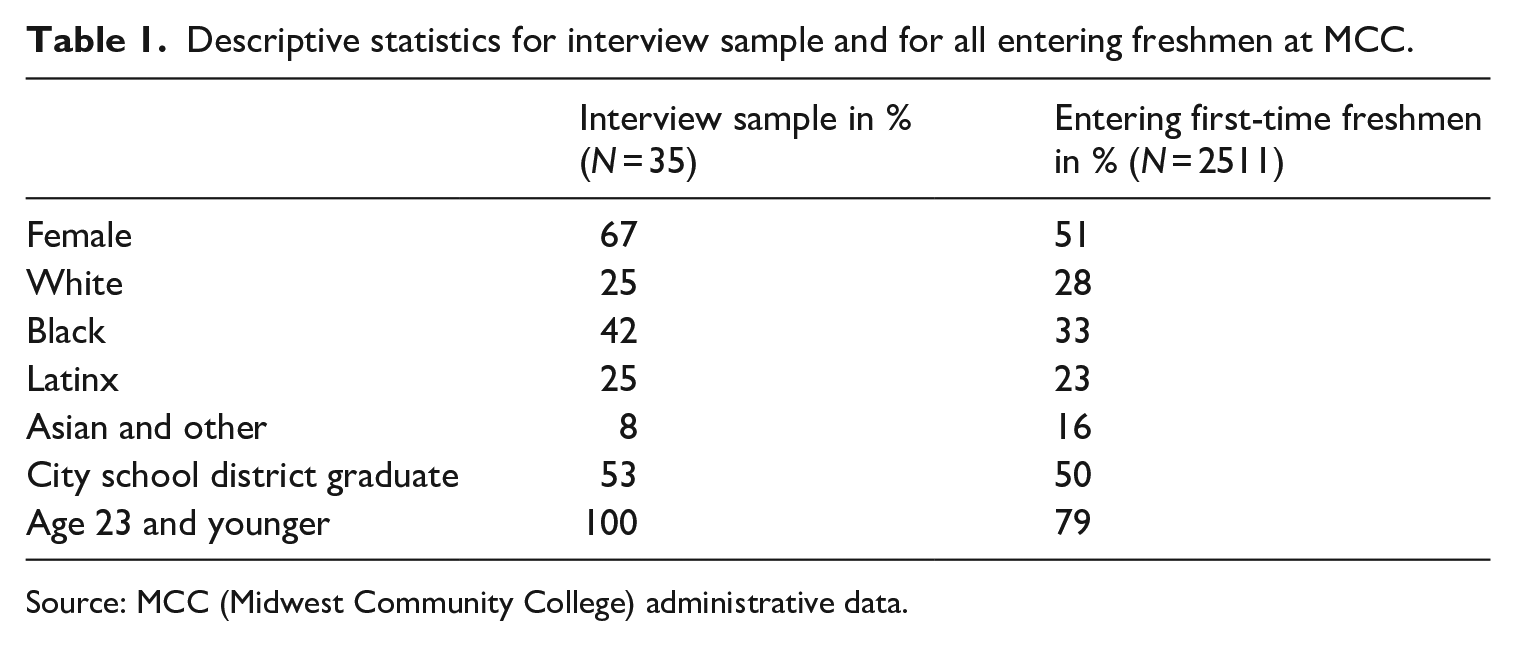
Source: MCC (Midwest Community College) administrative data.
Influenced by the thematic analysis of Braun and Clarke (2021) and the flexible coding of Deterding and Waters (2021), I analyzed data through a two-round coding process using the Dedoose QDA package. In the first round, I employed structural coding to identify sections of text that dealt with specific research questions or matters of interest. I extracted text that corresponded to a number of such codes: for example, ‘college knowledge’, ‘family views on education’, and ‘choosing community college’. I re-read these sets of text and wrote extensive memos in which I worked through emergent themes. In the second round, I employed pattern coding (Saldaña, 2016) in order to derive a more synthetic understanding of extracted materials.
The clearest threat to validity in retrospective interviews is the reconstruction of past actions and understandings under the biasing pressure of present conditions (Jerolmack and Khan, 2014). I do not pretend to have a solution to this matter, and a full discussion of it requires considerably more space than is allowable here. However, my aim is to grasp the pool of understandings available in the broader culture insofar as they are drawn upon and articulated by respondents. Therefore, the specific ‘accuracy’ of retrospection is of lesser importance. It matters less what respondents thought at the time than how they can and do represent their thoughts to themselves and to a stranger (i.e. in an interview context). I contend that during interviews, respondents answer questions by drawing upon logics, normative judgments, and conceptions of the self and of other institutions that are legitimated (i.e. institutionalized) within the broader cultural environment.
Findings
Opting for postsecondary education
The respondents in this sample reported several reasons for continuing schooling after high school. Instrumental motivations were very common, and for some students they were the exclusive reasons for attending. I will discuss such heterogeneity below. For now, I want to describe both the shared, taken-for-granted frame through which students expressed their college orientation, as well as the fuller array of meanings that college attendance takes in this sample as a whole.
One aspect of the shared frame has to do with students’ understanding of labor market options for those who do not continue schooling. Most respondents portrayed alternatives to postsecondary education in bleak terms. The commonest image that respondents summoned to understand life without more education was ‘working at McDonalds’. One discussed ‘people who dropped out of high school or college’ who ‘have been working at McDonald’s for 10 years and they’re getting minimum wage and trying to feed a family of 10’. Another, describing high school classmates: ‘some people would say, well, I have a job at McDonald’s so I don’t really need to go to college’. Another said ‘I knew . . . I needed to go to college to get a better career’, because the alternative was ‘McDonald’s or Walmart or something like that’. Another said of herself and her peers, ‘we compared the (alternatives) as going to college and getting a degree to working at McDonald’s for the rest of your life’. ‘McDonalds’ is clearly shorthand for any highly undesirable, low-wage, low-prestige service work.
Respondents referred to criminality as the other possible path for those who did not go to college. This was never discussed as a relevant option for them personally. Instead, respondents referenced criminality to denigrate the aspirations of former peers – an instance of ‘defensive othering’ (Schwalbe et al., 2000). One said that in his high school, ‘a lot of people didn’t even want to go to college. It was like, “Oh, college, I’m not going, I’m going to just be a drug dealer or something”’. Another concurs: ‘Like mainly all the dudes was talking about doing stupid stuff with their lives, like selling drugs, you know. That type of stuff is not going to get you anywhere’.
What is interesting is that many respondents had parents who had at best a high school degree, and not all of them felt their families to be destitute. But most had parents that at least encouraged college-going for upward mobility. That ‘not college’ is equated with either service work or criminality, both of which respondents held in contempt, suggests that they had internalized the conviction that to not continue in education was to fail in a general sense.
Beyond this, there were three broad motivations undergirding students’ decision to attend college. The first corresponds most precisely to the assumptions of dominant theory. That is, students discussed college as a means to an economic end: a job that paid well enough to provide some security and independence, and that they would not hate going to everyday. For instance, one respondent said that she was looking forward to ‘knowing what to do and just having a pretty good career . . . Being like financially stable’. Getting a better-paying job would permit her to move out of her parents’ house, which she should do because ‘I feel like I’m pretty old’ (i.e. to still be living there). That is, she needed enough income to attain full adulthood (independence). She had originally been interested in art, but she gave up on pursuing this as a career as impractical, and she instead picked something that she believed would provide security: I didn’t really look into (becoming a) dental assistant until I got my braces. And that’s when I realized that taking care of your teeth was really expensive. Because my mom had to pay a lot for her teeth. And, I don’t know, I just noticed how expensive it is, and like how we should really take care of our teeth. So, I don’t know, I just want to help people out.
Note that despite a mostly instrumental orientation, NB does express her choices partly in terms of moral significance.
The second broad motivation has to do with the social honor accorded to postsecondary achievement. However, this does not mean that respondents were themselves oriented toward attainment of that prestige. It was more common for their relationship to educational honor to be mediated through some form of familial moral obligation. Some respondents felt the need to attend college to make their family proud. Others talked about the need to role model for their younger siblings.
For instance, an immigrant from a Middle Eastern country, discussed college explicitly in terms of its prestige value in the eyes of others. ‘In our country, if you just attend college for one year or two years, people will keep laughing’, she explained. Attaining a short degree means to this generalized other that ‘you are not good student or whatever . . . it’s kind of shame for me too because like it’s just one year’. However, she discussed this always in the context of what her family expected of her, and the honor she sought to preserve or extend was not her own but that of her family. Similarly, another respondent discussed her parents’ messaging around college in terms of what it meant for the family.
‘[My father] just feels that since I’m the oldest child, that I should go to college. And just conquer my dreams, since I have my siblings looking up to me. And I’ll be the first one [in my family] to actually go to college and finish’.
Her father has raised her to see herself as a role model for her younger siblings, and so her achievement is also to inspire theirs. It is relevant that familial goals are made to align with individual self-actualization: her family’s wish is for her to ‘conquer [her] dreams’. What is left unspoken is the presumption that the respondent’s self-actualization can and will occur in a socially sanctioned manner, and that means college completion.
Rhetoric like ‘achieving my dreams’ reflects the third significance of college-going in this sample: college as a means to self-expression and/or moral purpose. In these interviews, this theme typically occurred also with reference to field or occupational choice. That is, respondents discussed college as a means to obtain meaningful occupations.
Sometimes this meant a job with moral significance. For instance, one interviewee said that he was attending college in order to become a police officer, which for him meant ‘helping people and throwing bad people in jail’. It is significant that he was the child of an often-arrested abusive alcoholic father, and that the police were the means of ejecting this man from his house. More commonly, respondents sought a field and a job that aligned with their sense of self. One respondent, for instance, chose to study music because: ‘It’s my passion. Like, I started playing instruments since fifth grade. I liked singing even though I really couldn’t sing. I cannot sing but it’s like it is a passion of mine. I just want to do it and be happy in it’. When asked if studying music changed his feelings toward it, he said: ‘I like it more . . . It makes me want to learn more. It makes me want to try and like develop it, develop my own skill or meaning of the work’.
College is caught up with the idea of meaningful work, because it is the means through which one attains a career rather than just a set of jobs. Careers involve honorable, noble, or desirable public identity. They are pursued with enthusiasm, proudly occupied, and a source of purpose and well as pleasure. Jobs, on the contrary, are held out of necessity, and provide little honor or purpose. Meaningful work is not simply a mark of status distinction or privilege. It involves a moralization of class itself, and this in turn reflects the legitimacy of education as a means of selection. The opportunity to do meaningful, expressive or morally valuable work is reserved to those who have proved their merit through academic attainment.
Opting for community college
To grasp why respondents chose to enroll at community college, one must grasp how they understood the possibilities available to them. Respondents took it as given that they had limited options, mostly for economic reasons, and there are three elements that framed this view. First, respondents’ grasp of how much college costs was unclear, but they knew it to be ‘expensive’. Second, they had a hazy understanding of the financial aid system. Many were unaware of grant aid and were aware of but averse to ‘student loans’. Third, as summarized above, they spoke in broad but clearly negative terms about options available to those who don’t enroll in any postsecondary education. These elements merged to render attendance at the local community college the reasonable decision for them.
Respondents portrayed the knowledge they had, while still in high school, of how much college would cost as very vague. For instance, when asked about the cost of college, one student said she knew ‘it was, like, a lot (of money)’, which ‘you can kind of tell . . . because some people don’t go to college because of the money’. Another said that ‘growing up, you hear that college is so expensive. I heard all of my teachers saying they’re still paying off their loans’. Although some students had family members – siblings or parents – who had recently enrolled, this typically did not supply more precise practical information regarding costs. The only respondent who knew how much their sibling paid was an undocumented student whose sister had unwittingly taken on tremendous debt when she enrolled at a nearby private college. Others did not know how much their family members spent.
Respondents had been aware that there is some variance in costs between colleges. Most commonly, they reported knowing that community colleges were ‘the cheap option’ for getting an education. Surprisingly, most did not appear to differentiate between the cost of public or private four-year colleges. For instance, one respondent said that they knew that community college was ‘about $5,000 a year’ and that ‘other schools’ were ‘$10 K and up’. Another described being shocked to learn how expensive a private art school would be. ‘I knew that art schools didn’t have different tuition prices for people who were from out-of-state, but I didn’t know that the reason was because they were private institutions’, she explained. ‘And because of that, the prices are higher than like a regular university’.
Understandings of financial aid, and particularly grant aid, 7 varied among those interviewed. A number of respondents said that they did not know that grant aid existed at all until partway through their senior year of high school. ‘I did not know that it (grant aid) was a thing’, said one respondent. Another student said they had believed that everyone who attended college was either wealthy or had won ‘scholarships’. Indeed, respondents were much more aware of the existence of ‘scholarships’ (i.e. awarded to individuals based on merit) than they were of need-based grant entitlements. Some seem to have not much considered the matter until their high schools began telling them about financial aid. Most respondents said they learned about financial aid through group events at school – in-class presentations by school counselors or assemblies for all twelfth graders – and it is difficult to tell how much they took away from these sessions.
Interviewees very commonly referred to the entire process and institution of financial aid abstractly as ‘FAFSA’ (or ‘FASFA’). One reported that ‘I knew what (the FAFSA) was. I didn’t understand why it was necessary to like have it. I didn’t know everybody had to fill it out or what it was for’. As senior year progressed, respondents reported coming to understand that the FAFSA was a form that they ‘had to’ or should complete, and that it would or should or might result in them getting money for college. Respondents often were not sure why they had to report their parents’ financial information on the FAFSA.
Respondents may have been unfamiliar with the concept of grant aid, but they were aware of student loans. And they (mostly) knew they did not want them. Moderate to severe debt aversion was near-universal among this sample. ‘I’ve heard about too many people who are grown and on their own and still paying student loans’, said one student. ‘That’s not something I want to have over my head’. Said another: ‘I really didn’t want to take any loans out or anything’. And a third: ‘Loans to me were kind of like my worst enemy. It was just kind of like I do not want to take out loans at all’.
In discussing their reluctance to take out student loans, some respondents referred to parents’ or siblings’ struggles with debt, student or otherwise. Others said that they were explicitly warned away from student loans by parents or school personnel. One said he was told by his school counselor ‘not to apply for loans because you have to pay that back’. Another said that, among her teachers, ‘if they did do loans they said they wouldn’t recommend doing loans’. But direct experience or dissuasion did not appear to have been necessary. Instead, students began with a reluctance to take out loans, and had to be talked into considering them. They seemed to take for granted that borrowing was at best unwise, at worst highly dangerous.
At the heart of this matter was a fear of drowning in unmanageable debt. This student’s discussion is instructive: I was against loans. I didn’t want to take out any loans because I know what that does . . . Because when you take out loans, you have to pay it back, with sometimes interest. And then, you know, if I just take out a loan and then if I’m not making enough money as I thought I would be making in a couple of years, how would I be able to pay that? And like, the loan will increase more, you know?
Another student concurred: ‘It’s scary, taking out money. And then paying back money. And being afraid you might have not – like, you don’t have enough money to pay that and it keeps growing’. It is often argued that the money one makes with a college degree will allow one to easily pay off their loan (Oreopoulos and Petronijevic, 2013). What is clear, though, is that these students do not trust that this will be the case, at least not for them.
Given that students understood college to be expensive, did not know much about grant aid, and did not want to take out loans, it is reasonable to ask why they would be college-bound. The answer lies their taken-for-granted understandings of a likely future should they not pursue education beyond high school, as well as the economic and moral significances of college, which were discussed above.
It is often assumed that students choose community college in part because of its proximity to home and because they have academic records precluding attendance elsewhere. These were minor notes in this sample. A few respondents discussed worrying about leaving behind protective social networks. And some explicitly mentioned believing that they could not attend a four-year college because their grades or test scores were too low. These matters were only raised by some of the minority of respondents who aspired to a four-year degree (discussed at length below). Most respondents reported a neutral-to-negative attitude toward the experience of ‘school’ and took for granted that their choices were financially constrained. A relatively short program near home for as little as possible was precisely what they desired, and what community college provides.
Variance in educational orientations
Despite sharing a conception of the economic context relevant to college, respondents’ overall orientations to college varied in several ways. First, some identified strongly with education and becoming educated, while for others school was something to be endured. Second, while all respondents conceived of college as ultimately a means to a career, they varied in how directly and exclusively they saw this relationship. Finally, respondents varied considerably in how solid their plans were as they approached the end of high school, and in the means available to them to make the decision regarding what to do after. Broadly, respondents expressed three ideal-typical ‘orientations’. These orientations are not ‘types’, and individual respondents’ remarks did not always fit one or another orientation exclusively. I think of these orientations as emergent nodes of meaning around which respondents probabilistically cluster in multidimensional space.
Drifters
What characterizes this orientation is having entered one’s senior year with largely unformed conceptions of what to do after high school. Many admitted to being jolted into awareness of the immanence of this transition. ‘I really just didn’t get that I wasn’t going to be in high school forever’, one said. ‘When senior year hit, I’m like, “Oh, my gosh. I’m going to be leaving in months. Like, this is it. Like I have to figure out what I’m going to do with my life”’.
Drifters had gone through high school earning middling to poor grades. School was something that was happening to them rather than something that resonated with and helped form their developing identity. Some said that they did not like school and that they struggled to pass required courses. ‘I didn't want to go to college’, reported one student. ‘I'm like, no more school!’. Others portrayed themselves as ‘lazy students’ who earned poor grades because they did not try. Some reported skipping school regularly either to work or socialize with friends. Most had families that encouraged education, but only a few had caretakers who had attended any college. Most, but not all, came from families in which economic hardship was periodic to constant.
While one member of this group consciously weighed continuing education versus entering the labor force, most believed they would attend ‘college’ or at least strongly preferred this. But ‘college’ was largely a concept without content; a few referred explicitly to images of ‘college’ garnered from television or movies. More importantly, they suggested very little personal investment in or enthusiasm for the prospect of college.
They took for granted that the choice of career came prior to and dictated the choice of educational path, indicating an implicit and presumed vocational understanding of what higher education is for. However, these youth had no strong ideas about what sort of a career to choose, and did not know how to begin finding one. Many believed they should not ask for help from teachers or counselors until they had determined their career path. Some turned to parents for guidance, many of whom urged high-status careers (engineering, medicine) to which respondents did not believe they were suited. Most next turned inward, scouring their interests or preferences (i.e. ‘finding my passion’) for clues about what they should do. This led some to arrive at choices such as music or video game production.
Over the course of senior year, some perennially postponed decisions. Others engaged in hasty and arbitrary plan-formation. Some applied to one or to a few four-year colleges but seemed to choose these schools nearly at random or at the urging of counselors. They frequently did not remember to which college they had applied and did not know whether they had been accepted.
Many of these respondents describe being strongly encouraged or ‘pushed’ to apply to their local community college by personnel from their high schools. This college had just launched a ‘free college’ program, and there was a strong effort to get as many students to apply as possible. For some, this prompted enrollment. ‘When I heard about (the Promise), I’m like this would be a great opportunity for me to go to school and I wouldn’t have to pay as much’, said one. Others were ambivalent. ‘I didn’t want to (apply to community college) at first’, another respondent related. ‘But (my counselor) was just like, “No, do it, like hurry up and just get it in. So just in case you don’t have any other (option), this will be your plan B”’.
Indeed, for most of these respondents, community college was latched onto as a lifeline. It was a way to make some decision, any decision, about what would happen next. Rarely were these respondents excited about or convinced by the decision; they were more relieved than anything. Community college saved them from doing ‘nothing’, that is, from failure. ‘Honestly, had I not gone to MCC, I don’t even know what I’d do’, said one. MCC requires students to select a program at entry, and most of these students either did so with little thought or temporarily chose the liberal arts transfer track. None appeared confident that their choice of program would lead to a well-paying job.
Tradespeople
Those in the ‘tradespeople’ orientation described a workmanlike relationship with academics in high school. None expressed an intrinsic love of learning (except one student, and only in regard to technical classes), and a few said they disliked school. For most, school was something that had to be done and should be done with as quickly as possible. But they did not report struggling, and most reported receiving at least average grades. School was something to be endured, but unlike drifters, they seemed confident that they could endure it. The modal tradesperson came from a relatively stable blue-collar household, though some hailed from chronically struggling families.
For tradespeople, the key decision to make before leaving high school was choosing an occupation. Most considered occupations they were aware of through personal experience, family-member experience, or family-member suggestion. These were then pruned either intuitively by checking against ‘real interest’ or through institutional exclusion (i.e. applying to and being rejected from a program). Respondents varied in the timing of their decision; some had made or significantly narrowed down their choices prior to senior year, while others did not choose until the end of that year. The number of occupations students considered varied from only one, to a small number in a single field (e.g. two to four healthcare occupations), to six or eight across fields.
The occupations considered by tradespeople were universally, though not always exclusively, attainable through one- or two-year programs. Therefore, these students included community college in consideration early, and many were further inclined to them for reasons of cost. Although a couple applied to four-year schools, all chose schools based on programs rather than college level or prestige. In fact, many considered colleges interchangeable, cost aside, so long as they had the desired program. A few explicitly ruled out any career that would require more than two years. ‘I didn’t really want to go through another four years’, one respondent explained. ‘Once I got into high school, I didn’t really like school anymore’.
At the same time, only one of these respondents seriously considered not obtaining any further schooling after high school. In an in-class assignment, which asked him to choose an occupation for his future, he had arbitrarily chosen ‘electrician’. Then he decided to research the matter and became increasingly convinced it was a good idea. However, this did not mean he had decided to go to college. ‘My whole thing was I’m not trying to be in debt. So, I wasn’t going to college’. Moreover, he had not really decided on anything. ‘I didn’t know what I was going to do. I wasn’t giving it a thought . . . So I had to really sit down and think like, “What do I want to do with myself?”’. But then he heard about a new community college Promise program, and this crystalized his plans: ‘When they said you can go to school for free, my mind was made’.
For the others in this group, community college was already their most probable option. The more set they were on a trade, and the less they deemed it important which specific college to attend, the more the local community college was their default choice.
Four-year aspirants
This final orientation characterizes students who had, prior to their senior year, acquired a relatively stable self-projection toward a four-year college. This does not mean that they had any particular four-year college in mind, nor even that they had more than rudimentary knowledge of what was possible. But in contrast to ‘tradespeople’, these respondents’ commitment was to the level of college they wanted to attend. Some respondents desired a specific career (e.g. teaching) that required a bachelor’s degree, but most did not.
In contrast to drifters, four-year aspirants’ commitment to college was linked to their self-identity and assumed with enthusiasm. In addition, ‘college’ was for these students an entity with more definite features: a ‘real college’ was a four-year bachelor’s granting institution. This meant prestige, understood as some degree of selectivity. For many respondents, it also meant a ‘real college experience’: on-campus residence. As one respondent explained: ‘you grow up, like, “I can’t wait to go to college so I can be on my own and meet new people.” That was my idea of college: just freedom’.
Overall, these students reported the highest grades in this sample (though some reported low GPAs), and only members of this group (but not all) spoke of learning as intrinsically enjoyable. This group mostly (but not uniformly) hailed from slightly better-off backgrounds than did previously discussed respondents; a greater proportion had parents who had attended college or who held at least stable blue-collar jobs. And it was most common for members of this group to portray college as a parental ‘expectation’ rather than a desire. Among those from less-resourced families, involvement in a college-oriented program (e.g. a ‘pre-college’ summer program, or College Possible) was common.
All but two of these students applied to a four-year school, and many were accepted, but of course none enrolled directly in a four-year. A few portrayed community college as a rational economic choice. As one put it, ‘it doesn’t really make a difference’ where one completes their general education credits and starting at a community college would minimize debt. But more commonly students were diverted into a community college because they lacked one or another resource necessary for direct four-year attendance. Two were undocumented immigrants unaware of their ineligibility for financial aid until partway through their senior year. Two had set their sights on private art schools but were stopped cold when they learned what tuition would be, unwilling to take on the necessary debt. Some had restricted applications to a few somewhat selective colleges and were not accepted. One reported that parents would not let her attend the out-of-state four-year to which she had applied and been accepted because she lacked family nearby. Another described being inexplicably paralyzed at the stage of paying their application fee and never submitting it. By the time of interview, a few had downgraded their expectations to learning a trade (including both undocumented respondents). The others still intended, eventually, to transfer to a four-year.
Community college was not the first choice of any of these students. One recalled thinking, ‘Community college, why would I want to go there? They don’t have any dorms’. As with the drifters, many applied to community college during mass-enrollment events at their schools related to the new Promise program. One describes her experience: ‘I remember a man came and talked to us about it, but I really didn’t pay no attention. I’m not going to MCC! . . . My teachers, my counselor was like, well, just apply, just in case. And, I said, “okay, whatever. I’ll do it”’.
As preferred options proved unreachable or unrealistic, they had their existing acceptance at community college to fall back upon. Others, at some point during their senior year, decided to begin their path to a bachelor’s degree at a community college. The new Promise program was influential for some: ‘It seemed like a great deal . . . I’d be kind of stupid not to take this opportunity’.
One student had intended to attend art school and become a professional artist. However, during her senior year, she learned how much attending such a school would cost. She realized ‘this isn’t really the best plan, especially the background that my family is from and our financial situation’. That is, art school isn’t for kids ‘like her’, and so ‘it’s just kind of time to pull myself up by the bootstraps and do something that’s practical instead of following my dreams or my passions’. This eventually led her to pursue nursing. But she was still planning on going to a four-year college until she heard about the Promise.
Discussion and conclusion
Knowledge and decision contexts
To understand a student’s educational decisions, it is necessary first to grasp the cognitive context of their decision-making. This involves not only that of which the individual is aware (and unaware), but also that which they take for granted. For example, most affluent students take for granted that they will go to college immediately at the conclusion of high school and that college costs will be paid; thus, they focus on what school to attend. Students in this study had a very different taken-for-granted decision context. They ‘knew’ that ‘college’ was ‘expensive’ relative to available family resources. They had little clear awareness of need-based grants, and they were highly averse to loans, and so ‘aid’ was not a factor in their implicit cost calculus. Given limited parent hey expected to meet college costs largely on their own. This complex of assumptions, together with the assumption that some more school was necessary to prevent overly limited prospects, formed the (largely unexamined) background against which these youths’ college choice was made. Prior research suggests that such understandings are not confined to these interviewees (Bell et al., 2009; De La Rosa, 2006; Evans et al., 2019; Grodsky and Jones, 2007).
We find ourselves quite far removed from the crystalline purity of rational-actor theory. There is not a single algorithm of calculations that individuals universally apply when deciding whether or not to attend college (or, really, anything else). Instead, individuals make decisions within a context of assumptions regarding the domain in question. Such cognitive decision-contexts cannot be deduced rationally, as in the work of the educational economist. They seem to vary non-randomly in the population, with elements probabilistically shared within social networks (because acquired in and reinforced through such networks) and linked to household and network resources. But they also are likely to involve commonalities within very large populations because some elements are institutionalized at the highest level and/or reflect intuitive awareness of social structures. Ultimately, such decision-contexts must be recovered empirically.
Aspirations, motivations, and institutions
Educational orientations, or dispositions, are more complex than is typically allowed in three ways. First, aspirations (what is desired) are inextricably bound up with motivations (reasons for these desires). This is because the ‘what’ (e.g. a degree) that is desired is grasped at baseline as having a meaning and a content (e.g. monetary, moral, and/or intellectual), and it is this content that is desired as part-and-parcel of the ‘thing’. Second, educational orientations cannot be understood without taking into account conceptions of the self on the part of the individual in question. In modern societies, education is exceedingly important to both personal and public identity. It is conceived of as developing and improving one’s capacities and confirming/creating moral worth and agency. Increasingly, full citizenship and adulthood is only realizable through the completion of bachelor’s level education. None of this is a matter of individual predilection; it is institutionalized deeply in modern societies though rarely discussed explicitly. Therefore, one’s orientation to education is an orientation to an institutionalized conception of the developing self; one chooses a (social) self in choosing educationally. Finally, educational orientations are inherently temporally structured relative to an institutionalized, structured life course. One’s orientation is at the same time a trajectory, and it is an orientation toward one or another established, institutionalized trajectory. Here, ‘drifters’ stand out as not fully successfully orienting to a given educational trajectory.
Orientations are ‘structured’ (i.e. non-idiosyncratic), and are to some degree capturable through typologies, because the social space in which they form is itself institutionally structured. ‘Education’ and ‘college’ have significances institutionalized at a very high level (most likely the world-cultural environment), and these inform both the structuration of educational organizations and the orientations of prospective clients toward them. For instance, higher education is bound up with conceptions of universally valid, legitimate knowledge, as well as in conceptions of equal human personhood (in that all humans are held to be equally entitled to and capable of benefiting from education), economic opportunity and growth, proper personal development and agency, and other cultural conceptions. Higher educational organizations strive to reflect these validated conceptions in their organizational practice; indeed, their legitimacy depends upon their so doing. And so, spaces and pathways (niches) are opened within these organizations for individuals with orientations to education adapted to these conceptions.
In this case, that community colleges are access institutions and that they have occupational and transfer pathways are all well known by both likely clients and those who influence them (parents, school counselors). On the basis of academic performance and other factors, as well as the structuring of the higher educational sector, students are roughly sorted into likely educational trajectories/identities by educational personnel, parents and other significant others, and themselves. Those who come to be classed and to class themselves as ‘potential community college students’ in turn subdivide along existing institutionalized lines into ‘transfer path’ student and ‘occupational path’ students. ‘Transfer path’ students will tend to share aspirations and motivations drawn from the range typical to four-year college students, but perhaps in attenuated form. Occupational students will be a version of ‘careerist’ students at four-year colleges but adapted to a ‘trade’ trajectory. ‘Access students’ are a third institutionalized student type – an ‘in-itself’ rather than ‘for-itself’ category – which is institutionally provided for within the community college. Indeed, community colleges are the default option for students who have developed and evince an underspecified orientation to ‘postsecondary education’ generally.
Thus, students who matriculate at community college vary considerably in terms of educational orientations – both what they desire (aspirations) and why they desire it (motivations). They also differ in how concrete their aspirations are. I broadly chunked students into three groups: ‘drifters’ with underspecified aspirations/motivations, ‘tradespeople’ with clear aspirations toward a two-year credential, and ‘four-year aspirants’ with clear orientations toward a bachelor’s degree. These are ideal types; individual respondents approximated them to a greater or lesser degree, and some made statements placing themselves at the boundary of two orientations (usually drifter/tradesperson). What they aspired to was bound up in both their developing self-perceptions and overall relationship to education, which were in turn intimately interrelated. The ideal-typical four-year aspirant had a self-identity as someone who appreciated learning for its own sake, wanted to perform (and in fact performed) reasonably well in school, and would matriculate eventually to a ‘real college’ to have the ‘full college experience’. The tradesperson had a practical orientation toward schooling as a means to an end (career), performed tolerably well but set no stock in excelling, and would attain a credential enabling them to begin a practical career quickly. The drifter, finally, had a troubled relationship with schooling marked by struggle and not-infrequent failure. They understood that they needed to go to ‘college’ to have a reasonably decent future, but this understanding was profoundly under-elaborated and they had very little idea of how to proceed in making it more concrete. Community colleges present ‘pathways’ for each of these student-types, complete with organizational infrastructure (developmental classes for drifters, applied degrees for tradespeople, transfer classes for aspirants).
Limitations and further research
Given its basis in a nonrepresentative small-N sample, this research is necessarily exploratory. My goal was to work through the matter of educational orientations at the sub-baccalaureate level inductively and phenomenologically. That is, I sought to understand how respondents presented their own understanding of their educational decision-making. In doing so, what stood out as most salient was what respondents took for granted; conscious deliberation was sensible only against this background. In terms of financial considerations, this background was largely shared. Differentiation occurred in relationship to more specified educational goals and aspirations. Only in the process of data analysis did the relationship between emergent differentiation and institutionalized pathway become apparent. Of course, this may be an artifact of interpretation, given that I knew what community college pathways exist prior to data analysis. But it is also possible that my preconceptions in interpreting the data are informed by precisely the same institutionalized patterns that informed respondents’ self-presentations. Indeed, that emergent student ‘types’ would be completely orthogonal to the structuration of the higher educational field itself is at best difficult to imagine; mutual adaptation between dispositions and fields is the rule rather than the exception in social life.
Future research should explore the development of student orientations over time. A longitudinal in-depth interview panel would be ideal for such a task. In addition, more research is needed on the development of educational orientations among those probabilistically headed to but not ‘destined’ for higher education. The overwhelming majority of ethnographic and interview-based research on developing educational orientations focuses on either those who reject college-going as ‘not for the likes of us’ or on those for whom college-going is assumed. The vast middle is where I situated this study, and it requires more attention.
Footnotes
Acknowledgements
I would like to thank Sara Goldrick-Rab for the opportunity to pursue this research, the administration at ‘Midwest Community College’ for access and assistance, and to all of the respondents in this study for their time and honesty.
Declaration of conflicting interests
The author(s) declared no potential conflicts of interest with respect to the research, authorship, and/or publication of this article.
Funding
The author(s) received no financial support for the research, authorship, and/or publication of this article.
