




Abstract
My contribution to this special issue engages with Michael Sandel’s The Tyranny of Meritocracy and its significance to the academic conversation about meritocracy and its discontents. Specifically, I highlight Sandel’s diagnosis of the rise of populism and his proposed remedy for the ‘tyranny of merit’. First, building on Menno ter Braak’s writings on the rise of fascism, I explore the sources of ressentiment in contemporary societies as stemming not from disillusionment with meritocracy but from the broken promise of liberalism and democracy more generally. Second, I consider Sandel’s proposals to reform elite university admissions and to ‘recognize work’, explore their wider applicability, and reflect on their limitations to meaningfully change how success and failure is socially experienced and morally understood.
Introduction
Meritocracy, properly understood, is a roadmap to inequality, not equality. Merit is a term coined to legitimate disparities as the deserved outcome of a fair process. In aristocratic times, the hereditary nobility was content with being in charge. They even had some noblesse oblige to spare for the less fortunate of birth. Meritocrats, in contrast, have no such patience.
Those who struggle in today’s meritocracies are ‘failures’, responsible for their own misery. Whereas those who struggled in aristocratic times had plenty of reason to feel aggrieved, meritocracy’s losers have no recourse but to own their failure. That is a particularly hard pill to swallow given that undeserved differences at birth – race, gender, class – significantly shape people’s chances of climbing the social ladder, as documented in countless scientific studies (Breen and Jonsson, 2005; Bukodi et al., 2020; Duncan and Murnane, 2011; McCall and Percheski, 2010).
These important lessons, taught to us by Michael Young’s (1958) The Rise of the Meritocracy, unfortunately have been lost to many (Mijs, 2016; Mijs and Savage, 2020). Sandel’s (2020) The Tyranny of Merit helps us find them again. The book affirms Young’s philosophical critiques of merit as a principle of justice and connects them to a sociological analysis of today’s populist moment. As Sandel (2020: 30) poignantly puts it, ‘for Young, meritocracy was not an ideal to aim for but a recipe for social discord’.
Young’s dystopian novel introducing ‘meritocracy’ ends abruptly as popular backlash results in the death of the fictional author pondering all the public consternation. Like the sudden death of Young’s fictional meritocracy, Sandel (2020) argues that the contemporary United States and United Kingdom are facing an undoing of their own making: Four decades of market-driven globalization have hollowed out public discourse, disempowered ordinary citizens, and prompted a populist backlash that seeks to clothe the naked public square with an intolerant, vengeful nationalism. (p. 31)
My contribution to this special issue will focus on two matters: Sandel’s diagnosis of the rise of populism and the proposed remedy for the ‘tyranny of merit’. First, building on Menno ter Braak’s writings on the rise of fascism, I will explore the sources of ressentiment (‘resentment left lingering, and thus internalized’ (van Krieken, 2019: 92)) in contemporary societies as stemming from liberalism and democracy more generally. Specifically, I ask whether the rise of populist parties and politicians in recent decades reflects the ‘prejudice of credentialism’, as Sandel argues, or, rather, ressentiment stemming from a more general tension between the promise of equality central to liberal democracy and the failure to live up to it in practice.
Second, I consider Sandel’s proposals to reform elite university admissions and to ‘recognize work’, explore their wider applicability, and reflect on their limitations to meaningfully change how success and failure is socially experienced and morally understood. My core question concerns the (im)possibility of increasing awareness of structural inequalities and softening evaluations of worth, while keeping intact the social stratification process.
Roots of ressentiment
In the aftermath of the Donald Trump election and Brexit vote – often taken together as if they were a single transatlantic event – scholars have scrambled to make sense of the upheaval. What most diagnoses share is an account of people left behind by global markets, losing out in the rat race for ever more prestigious educational credentials, and distrustful of a professional and political elite governing ‘in the best of their interest’.
Where explanations diverge is in identifying the roots of these sentiments, as stemming from racial animus (Bobo, 2017), status threat (Mutz, 2018), nationalism (Bonikowski, 2017), economic deprivation (Lamont et al., 2017; Morgan and Lee, 2018), or the culture of neoliberalism more generally (Lamont, 2019). Sandel’s emphasis on globalization and nationalism reflects a mixture of these explanations.
Before exploring our current populist predicament, it may be worth asking what it shares with other social upheavals. I believe we may find important clues in the writings of Dutch philosopher and historian, Menno ter Braak, whose life tragically ended at age 38 when Nazi Germany invaded his country. Writing just 2 years before the invasion, ter Braak (1937) considered the roots of national socialism and fascism in Europe. For ter Braak, fascism, for all that sets it apart, shares a key feature with liberalism, socialism, and democracy. Each of these ideologies takes opposition to inequality and offers a promise of equality, however, differently defined. But the promise of a state governed by the people or an ethnically homogeneous nation, just like the promise of fraternité, liberté, and equalité, can only be theoretical.
Liberalism, socialism, and democracy’s promises fall apart in the face of social inequality. Even in today’s liberal democratic social order, people in all practical senses of the term are not each other’s equals, socially nor economically, do not have an equal shot at success, and in politics, rarely have an equal voice in important matters (Bartels, 2010; Cagé, 2020; Lupu and Warner, 2021; Schakel et al., 2020). As ter Braak argued, these ideologies proffer the right to everything, but all too often leave people empty-handed.
This broken promise of equality – an unfulfillable promise, as I have argued elsewhere (Mijs, 2016) – is the source of what ter Braak called ressentiment, a combustible collective resentment. To ter Braak, the public’s hate is primary. Its scapegoats (be it commies, Muslims, George Soros, or the Dems) are secondary. Its justification, moreover, is entirely tertiary. What constrains this resentment in ‘settled times’ are our democratic institutions: free press and open debate, independent scientific inquiry, the rule of law (Bonikowski, 2016). When those institutions become corrupted by cronyism or outright authoritarian interventions, the public’s ressentiment is unleashed. A hatred, as ter Braak saw it, of everyone by everyone (van Krieken, 2019).
What then sets apart our current populist predicament? I am not sure the sentiment itself – the ressentiment – is much differently experienced or expressed. What has changed in recent decades are the stakes of losing out; the consequences of the cracked American Dream. As inequality has surged, the cliffs are ever deeper and the peaks are ever higher (for a review, see Breen and Jonsson, 2005; DiPrete and Eirich, 2006; Dwyer, 2018; Killewald et al., 2017; Neckerman and Torche, 2007; Sandefur, 2008). As marketization strengthens the links between earnings on the one side and safety, health, and dignity on the other, the broken promise of meritocracy amounts to a shattering of hope, heart, and health (Case and Deaton, 2020; Lamont, 2019; Muller et al., 2018).
Solidarity through separation
It would be understandable, then, if people would have lost faith in meritocracy – especially, as Sandel suggests, the working classes whose incomes have stagnated and whose chances of upward mobility are waning. But have they? To address this empirical question, I analyzed data from the International Social Survey Program (ISSP Research Group, 2014), a widely used source of research on public beliefs about inequality. Compared to other data, the ISSP allows for the analysis of an especially long period of time. Combining surveys from the 1980s, 1990s, 2000s and 2010s, we can see how people born in different time-periods have made sense of the causes of inequality across 5-year cohorts indicating the year that respondents came of age (for methodological details, see Mijs, 2018, 2021).
Figure 1 visualizes the long trend in public perceptions that success in life reflects hard work, rather than a person’s family background, gender, or color of skin. The graph breaks down the trend for working class and middle class people in the United States and the United Kingdom. Note that the rise of economic inequality in both countries, starting in the 1980s, has gone together with a strengthening of belief in meritocracy across the board. Belief in meritocracy is strongest in the United States, but Britons are quickly catching up. Approximately 95% of Americans now believe that success reflects hard work alone, as compared to about 90% of respondents in the United Kingdom (cf. Mijs, 2018). Moreover, on both sides of the Atlantic, working-class people are as much invested in meritocracy, if not more, as the middle classes. They may be disillusioned with how things turned out for them, but they cling to the meritocratic promise – perhaps tomorrow will bring the just rewards for all their hard work.
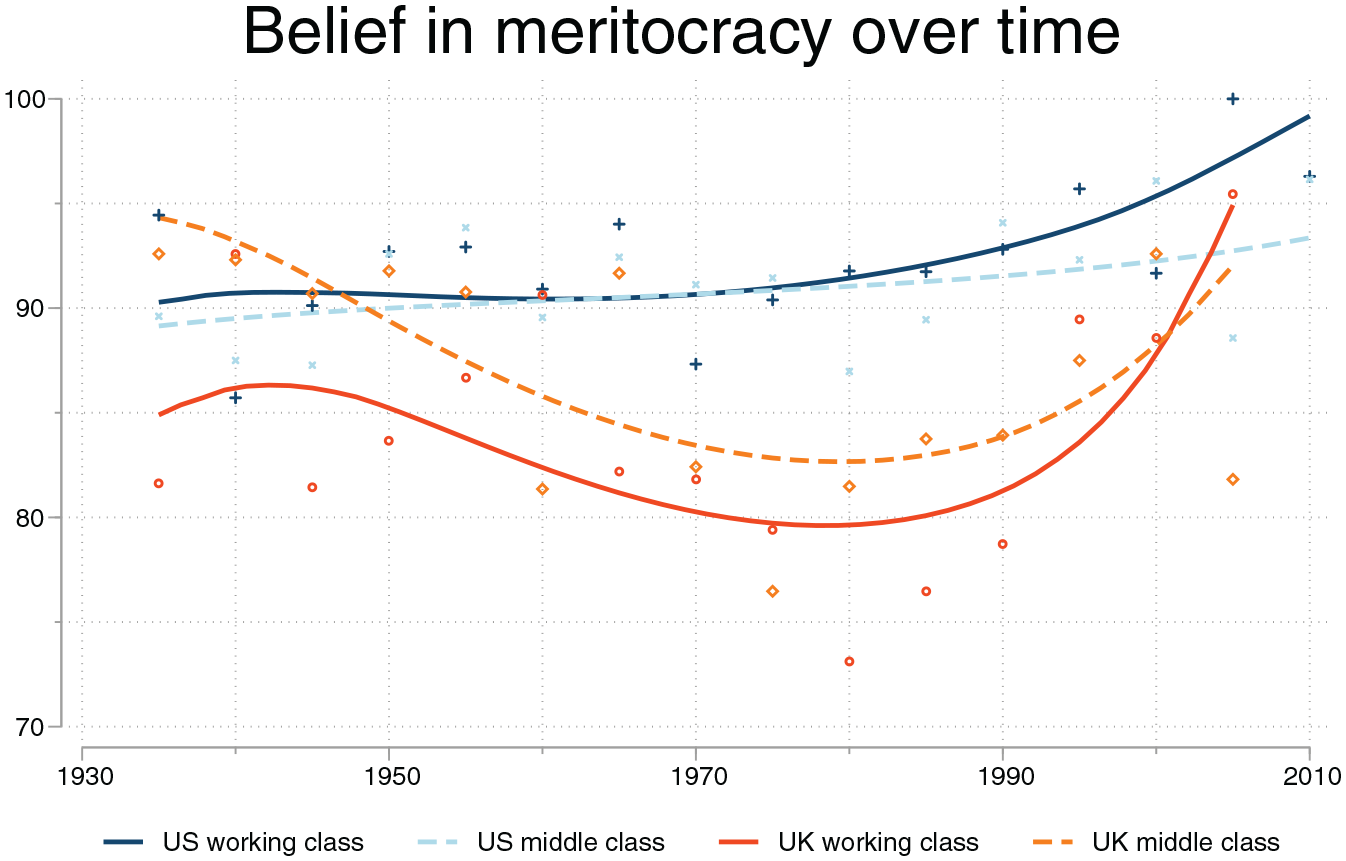
Trend in meritocratic beliefs in the United States and the United Kingdom, 1930–2010.
To understand people’s unabated faith in meritocracy, I would argue, we should situate their perceptions, explanations, and attitudes about inequality in the social settings they inhabit (cf. Bottero, 2019; Dawtry et al., 2019; Mijs, 2021). What may have kept so many people from realizing that meritocracy is bust, are the increasing levels of socioeconomic separation and segregation that have accompanied the rise of inequality. As economic inequality has grown since the 1980s, the United States has seen a simultaneous increase in class segregation in residential neighborhoods (Reardon and Bischoff, 2011), schools (Owens, 2016), workplaces (Kalleberg, 2011), friendship networks (Smith et al., 2014), and romantic relationships (Schwartz, 2013). Less research has been done in the UK context, but similarities abound (for a review, see Bottero, 2007).
As a consequence, while inequality has risen, people at either end of the social ladder need not see much inequality in their day-to-day lives, other than ephemeral encounters with the homeless and social media exposure to the omnipresent rich and glamorous. In fact, we have good evidence to suggest that people today see less economic disparities among their neighbors, classmates, colleagues, and friends than they would have 40 years ago (for a review, see Mijs and Roe, 2021). The socio-economically segregated nature of unequal societies like the United States may be key to understanding why so many people underestimate the extent of inequality and overestimate its meritocratic nature (Alesina et al., 2018; Mijs, 2018, 2021; Norton and Ariely, 2011).
When the working and middle class become disconnected, neither can see the full extent of inequality that separates them, nor the non-meritocratic forces that help or hinder their climb up the social ladder. As most people around us share the same structural advantages or disadvantages, it is impossible to fully appreciate their weight: common obstacles become normalized and fade out of view, while the structurally advantaged fail to feel the following wind of their privilege (cf. Friedman and Laurison, 2019). If we want to maintain the metaphor of the ‘social ladder’, we would do well to recognize two things. One, the rungs on the ladder are unevenly spaced – or missing altogether – depending on the lottery of birth. Some of us have an easy climb ahead, while others face a nigh impossible ascent. Two, whereas the analyst can compare these ladders, people see only the ladder they are on. Those who have successfully scaled their own ladder may believe that same ladder is waiting for everyone else to climb. It is not.
Sandel aptly summarizes the US’ Covid-19 response as a call for ‘solidarity through separation’. That simile, I believe, captures something profound about our modern times, specifically the challenge of caring for others with whom we are not connected. The segregated nature of contemporary inequality compounds and complicates the issue: it is exceedingly difficult to have empathy for those we do not share the same spaces with; the ‘other’ we do not know or understand.
This is not to say that people in positions of privilege do not care about poverty and deprivation. They may even spend a considerable share of their income helping those in need, through taxation and voluntary donation. But it is a lot more compelling to care for those you know – be it family, friends, or familiar faces in the social spaces we occupy (our neighborhoods, schools, and workplaces). Similarly, it is a lot easier to constrain one’s caring and limit one’s solidarity, when it concerns the disconnected other. The social and spatial divide in today’s society may fuel discontent. But, simultaneously, it makes it harder for people to recognize meritocracy’s broken promise and to develop cross-class solidarity to confront it.
As Sandel (2020) acknowledges on the last page of the book: ‘[Democracy] require that citizens from different walks of life encounter one another in common spaces and public places’ (p. 227). Segregation, then, may be the most formidable obstacle to common life and the common good.
Tackling tyranny
At the heart of the ‘populist discontent’, according to Sandel, are two things: a technocratic conception of the public good and a meritocratic definition of winners and losers. Sandel laments letting markets decide the winnings of hard work and talent – and equating those winnings with worth. This, he argues, has widened economic fault lines and narrowed conceptions of worth (cf. Lamont, 2019; Mijs et al., 2016). It has imbued meritocracy’s winners with hubris, humiliated the losers, and hollowed out the common ground where solidarity once grew.
I share many of Sandel’s intuitions. I also subscribe to the notion that ‘fixing’ the meritocracy is not going to produce a fairer society, nor will it produce a more benevolent elite. However, I am less sure that redistributing wealth and income more fairly across our society ‘reflects a defect in the technocratic approach to governing’ (Sandel, 2020: 31). Instead, Sandel argues, ‘we need to find our way to a morally more robust public discourse, one that takes seriously the corrosive effect of meritocratic striving on the social bonds that constitute our common life’ (Sandel, 2020). I am not entirely convinced of the incompatibility of the two. Nor am I sure that starting with the immaterial (common good) is the best way to reshape the material (equality).
I take inspiration from Ibram X. Kendi’s (2019) How to Be an Antiracist. Kendi argues that inequitable policies and practices do not need follow from racism. Often, it is the other way around: racism follows from inequitable policies and practices. Racism, thus understood, is an ex-post rationalization of inequity. I believe Kendi’s analysis may hold true for meritocratic rationalizations of economic inequities as well. That is, for starters, our efforts as scholars and commentators may be best spent not on changing hearts and minds but on conceiving of policies and practices that make a material impact in people’s lives by reducing inequalities. Changing practices and policies may be the clearest path to attitudinal change – not the other way around. Kendi illustrates his perspective by reference to the widespread contemporary support for intermarriage and racially integrated schools, not before but years after court rulings instituted such policies and practices. Just like tackling essentialist, racist, beliefs is most effectively pursued through policies and practices that redress racial inequities, individualizing meritocratic rationalizations of economic disparities may be best addressed by tackling those inequalities heads-on. In short: create a more equitable society and people may well come to like it (see Hedegaard and Larsen, 2019).
Poison ivy
Sandel’s critique of meritocracy and his analysis of the populist sentiment leads him to propose changes concerning ‘two domains most central to the meritocratic conception of success: education and work’ (Sandel, 2020: 155). Focusing first on selective universities, Sandel (2020) laments the ‘debilitating cycle of sorting and striving’ and suggests that we consider replacing university admissions with a merit-based lottery in which all applicants, over a certain threshold of suitability, enter a lottery that produces ‘winners’ by merit of being deserving but, mainly, by being lucky (p. 184). I am sympathetic to his proposal of a lottery, a version of which has been in practice in my home country – The Netherlands – for decades. His other suggestion is to ‘[dismantle] the hierarchy of esteem that accords greater honor and prestige to students enrolled in brand-name colleges and universities than to those in community colleges or in technical and vocational training programs’ (Sandel, 2020: 191).
Sandel’s proposed changes to university education are a good application of Kendi’s perspective. But would they be sufficient to reduce inequalities and effect belief change? Why not open the Ivy League to twice, triple, or tenfold the number of students currently admitted? Boasting about increasing levels of selectivity, the leaders of institutions like Harvard readily acknowledge they could admit many more qualified candidates. The arbitrarily low number of admissions to selective institutions serves mainly to inflate the value of their credential. Following a market logic, the surest way to uphold the value of an Ivy League credential is to push up demand while limiting its supply. That logic, however, counts only for the few students who get the chance to attend these institutions. Harvard’s societal value would increase many times over, were it to take and educate more students and share its wealth. The best way to make college education revolve around skills, trades, bildung, and citizenship instead of credentials, surely, is to limit the value of the latter so that we can better appreciate the former.
Sandel’s proposals for the domain of work revolve around ‘the dignity of work’ (Sandel, 2020: 208) and ‘contributive justice’, namely ‘the fundamental need is to be needed by those with whom we share a common life’ (Sandel, 2020: 212). Again, I share Sandel’s intuition, but I am not sure I share his emphasis on the immaterial. Yes, the feeling of being needed bolsters our dignity and sense of worth. But I would argue, we also need ‘need’, as a guiding principle for the allocation of scarce goods (cf. Mijs, 2016). Some people, by no fault of their own, require the community’s care, help, and support and need more resources than others. To be needed may be a luxury some people cannot afford.
It is hard to imagine changing evaluations of worth, while keeping intact the social stratification process that digs deep fault lines across our society. Following Kendi (2019), can we really expect moral evaluations of ‘winners’ and ‘losers’ to soften when the stakes remain this high? Do self-respect, dignity, and purpose not follow also from material security, from living on an equal footing and being able to consume at par with the rest of society? I venture that most people would be better off, materially and immaterially, if their earnings were disconnected from their safety, shelter, and dignity, and their capability to provide the best possible future for their children (cf. Bell, 1972). We would all be better off if we’d be more connected, socially as well as in our relations of production and consumption. Inhabiting common spaces may be the surest way of working toward the common good.
Footnotes
Funding
The author disclosed receipt of the following financial support for the research, authorship, and/or publication of this article: The author received funding through a Veni grant from the Nederlandse Organisatie voor Wetenschappelijk Onderzoek (NWO), grant no. VI.Veni.201S.003.