



Abstract
The question of ‘developmental appropriateness’ in education can be both empowering and inhibiting. When are students ‘ready’ to talk about social injustices and systemic inequalities? How might educators introduce social inequities using developmental findings about reasoning? This article presents social domain theory as a lens through which educators can approach critical consciousness education with young children. An overview of Freire’s critical consciousness construct is presented, including educational interventions, methods, and approaches that support critical consciousness. An overview of social domain theory is also presented. Social domain theory is a developmental theory of sociomoral reasoning that describes three domains of social knowledge that develop independently, and get applied/coordinated/prioritized differently in context by individuals. This theory, and the research stemming from it, has shown that there are developmental transition points during which children come to view their previous logic as inadequate, and are likely to shift their understandings of moral, conventional, and personal issues. A parallel is drawn between these transition points and the process of wrestling with and overturning ‘contradictions’ in critical consciousness education. Contradictions are theorized as dehumanizing power dynamics that show up in students’ everyday circumstances. This article provides tables outlining example contradictions for young children, key domain–related reasoning shifts for young children, and examples for how to create lesson plans that take these two factors into account. Finally, we propose a method of facilitating self-assessment of critical consciousness with young children. Self-reflection questions are provided for teachers and students.
Keywords
According to Kelly and Brooks (2009), concepts of developmental appropriateness and childhood innocence mediate the way that beginning teachers take up social justice topics and approaches in the classroom with young children. The question of ‘developmental appropriateness’ in education can be both empowering and inhibiting. This article reexamines the concept of a critical consciousness (CC) (or conscientizaçao) through a lens of social domain theory (SDT) – a developmental framework for social reasoning – in order to provide insight into how educators might approach CC development with young children.
The concept of a CC comes from the work of Paulo Freire, a Brazilian educator, scholar, and activist, who advocated that literacy education could be a tool of liberation for people living under authoritarian regimes. His framework has evolved into modern-day critical pedagogy which is used by social justice educators in classrooms around the world. According to Freire (1996 [1970]: 1973), a CC is an ability to perceive one’s own social reality in a new way, identify power structures and dehumanizing contradictions that uphold unjust conditions, and then take collective political action to change these circumstances.
It is worthwhile to consider how CC has been operationalized and for whom it has been deemed a relevant educational goal. Researchers have shown that CC (defined as critical reflection, critical action, and political agency) is associated with academic achievement for students of color (El-Amin et al., 2017; Seider et al., 2020). CC has also been shown to increase black students’ resistance toward racism and racial trauma (Mosley et al., 2021; Watts et al., 2011). However, as Diemer (2020) pointed out, who CC is for is being reconsidered and challenged. Godfrey and Burson (2018) for example, highlight that everyone has intersecting identities, some that are endowed with more social privilege and others with less. Just because someone’s racial identity carries privilege does not mean they do not experience oppression due to other interacting dimensions of their identities. Diemer (2020: 2) raises the following questions: Is it that CC is more relevant for someone, the more their social identities engender more marginalization (as evidenced in Diemer et al., 2010)? Do more privileged people (e.g., White people) truly develop CC, if they critique and challenge how other people are oppressed in a way that perpetuates their own privilege, instead of critiquing and challenging the social systems that constrain them (a core idea in CC theory)?
We agree that CC development will look different for each person, depending on their social positionality and the different identities they embody. As such, we interpret CC as something relevant to everyone. Houser and Overton (2001) describe CC as becoming aware of one’s own socialization process. Similarly, Ira Shor (1992: 129) writes, The desocialized thinking called critical consciousness refers to the way we see ourselves in relation to knowledge and power in society, to the way we use and study language, and to the way we act in school and daily life to reproduce or to transform our conditions.
This ‘desocialized’ way of thinking is also relevant to students who have experienced privilege because of a certain aspect of their identity.
As will be explained next, most CC research has been conducted with adolescents, since they are at an age to enact some political agency. However, young children are keenly aware of social differences, identity, and inequality. Rather than using age as a justification to shy away from introducing critical issues in the classroom like racism and sexism, SDT provides a tool for taking advantage of young children’s naturally occurring observations about inequality and facilitating age-appropriate discussions and activities that lay the groundwork for a CC. Darder (2014: 77) wrote in her book Freire and Education, ‘Instead, [conscientizaçao] is born of our human capacity to discern critically the complexities and contradictions of our human condition and enter into a dynamic process of social change’. SDT sheds light on this ‘human capacity to discern critically’, through years of research into children’s judgments and decisions about complex situations. If educators, school leaders, and educational researchers do not attend to development intentionally, teachers risk making unintentional assumptions about what they believe is ‘developmentally appropriate’ for students without these assumptions being rooted in research. Although the ‘action’ component of CC may take place on a smaller scale in early elementary education, children can still experience leading a movement for change – even if it is within their own classroom.
In this article, we aim to explore how educators can promote the development of CC in young children. We provide (1) an overview of CC as a construct and its current applications with young children, (2) an outline of SDT as a framework for creating a developmental curriculum, (3) alignment between ‘contradictions’ and reasoning transformations in these two theories, and (4) a proposal for a self-assessment system of CC in the classroom.
Critical pedagogy: A framework for liberatory education
CC development is supported through critical pedagogy. The roots of critical pedagogy can be traced back to the work of Paulo Freire, a Brazilian scholar, educator, and activist. He viewed education, and literacy in particular, as a mode of liberation. In his view, literacy was a tool that enabled not only access to texts, but access to a new way of viewing the world and one’s own circumstances in the world. Through learning to ‘read the word and the world’ (Freire and Macedo, 1987), Freire argued that people could learn to exercise analytical problem-solving skills and social organizing skills to take action in their communities toward achieving more equitable, just conditions. Freire (1996 [1970]: 33) states in his book Pedagogy of the Oppressed, Making oppression and its causes objects of reflection by the oppressed, and from that reflection will come their necessary engagement in the struggle for their liberation . . . The pedagogy of the oppressed is an instrument for their critical discovery that both they and their oppressors are manifestations of dehumanization. Liberation is thus a childbirth, and a painful one.
From Freire’s (1996 [1970]: 36) perspective, the way to break through forces of oppression is to engage in a cycle of praxis (defined in the next section) and thereby cultivate CC. A CC is the ability to perceive the root causes of oppression at work in one’s own lived reality; recognize one’s own personal circumstances as connected to larger social, historical movements and struggles; evaluate facts and new information to reach conclusions; and take collective action to work toward justice in one’s community. The willingness to evaluate new facts and engage in dialogue with people who have new ideas and perspectives is a skill that can be fostered in kindergarten and in college. An ‘awakening’ of CC describes a type of critical reasoning transformation – drawing new conclusions about familiar situations that have to do with power, inequality, and justice. We will discuss reasoning transformations that align with the development of CC in depth.
Educational practices to support development of CC
Educators practicing critical pedagogy work with their students to challenge the assumption that schools function as sites of social and economic mobility. Instead, they suggest that schooling must be analyzed as a cultural and historical process in which students are positioned within asymmetrical relations of power on the basis of race, class, ability, sexuality, and gender groupings (Duncan-Andrade and Morrell, 2008: 24). Through engagement in critical pedagogy, educators work with students to disclose and challenge the role schools play in reproducing inequities (Duncan-Andrade and Morrell, 2008: 24). Freire was adamant that people do not just grow into a CC, but that critical education is essential to transforming the way people think about their social worlds. Components of this critical education process entail working within a cycle of praxis – inquiry, action, and reflection – and integrating students’ lived experiences with oppression into the curriculum. According to Duncan-Andrade and Morrell, praxis has five stages: (1) identify a problem, (2) analyze the problem, (3) create a plan of action to address the problem, (4) implement the plan of action, and (5) analyze and evaluate the action. The process is intended to be cyclical and incorporates critical reflection in generating nuanced solutions to complex social problems (Duncan-Andrade and Morrell, 2008). Furthermore, the cycle of praxis embeds collective action in the pedagogical process.
Freire (1996 [1970]) also redefined the teacher–student dichotomy and criticized what he called ‘banking education’ where teachers unilaterally decide what content will be taught and consumed by students. Instead, he suggested problem-posing education. Problem-posing education emphasizes the student–teacher relationship as being one of reciprocal exchanges; teachers must see themselves in a partnership with their students. In this model of education, teachers and students are both subjects in the process of gaining a critical understanding of reality. Students’ own experiences with discrimination, prejudice, racism, transphobia, sexism, classism, and other forms of oppression become content worth investigating within the classroom.
CC with young children
Most literature and scholarship on CC with youth pertains to older youth, who may have access to various means of taking political action (engaging on social media, attending protests, fundraising, etc.). Heberle et al. (2020), in their comprehensive meta-analysis of 67 studies of CC in adolescents and children published between 1998 and 2019, highlight the dearth of literature examining the nature and function of CC across the age span, including questions of how CC manifests and develops during childhood. In addition, Kelly and Brooks (2009) found that elementary teachers may avoid issues of social justice, structural inequality, and oppression because they think the topics are inappropriate for their age group of students.
Developmental research, however, tells us that children are aware of social differences. Although societal forces like racism, sexism, and ableism are abstract and may not take on meaning until children are older, young children do understand relationships in which power is unevenly distributed and they make decisions based on these identifications. For example, Mistry et al. (2017) wrote that young children attend to wealth-based cues, such as having fancy clothing or not having a house. As children get older (7–11 years), they begin to attribute wealth to causes like working hard and competence and may gradually adopt class-based stereotypes. Research shows that infants can distinguish between faces from different racial groups (Kelly et al., 2005), but racial ingroup preferences do not emerge until around age 6 (Dunham and Emory, 2014). In a summary of similar developmental findings, Dunham and Emory (2014) wrote, Infants and children under age 3 show social preferences for gender (LaFreniere et al., 1984), age (Shutts et al., 2010), and linguistic (Kinzler et al., 2007) ingroups, but it is not until a few years later that preference for other culturally salient social categories such as race, ethnicity, and nationality emerge.
In their article, ‘It’s Never Too Young to Talk About Race and Gender’, Brown and Anderson (2019) explain that adults (researchers, parents, and teachers) often shy away from discussing race and gender because they believe these discussions will lead children to perceive racial differences. But the reality is, that children already perceive them. They write, The goal for young children is to develop identity ‘literacy’ (see Anderson and Stevenson, 2019). This means that conversations should enhance children’s ability to recognize and interpret a racial or gender encounter, help them reappraise the biased narrative, and to help them know how to effectively cope with or resolve with experience. (Brown and Anderson, 2019: 2)
Developmental researchers have also meticulously documented developmental trends in children’s prejudicial attitudes and ingroup preferences from an SDT perspective. Around age 9, and increasing as children get older, students use more conventional and personal justifications for rejecting stereotypes, and rely more on group functioning as a reason for excluding peers who are different than them as opposed to primarily on moral reasons of fairness (Rutland et al., 2010). These developmental findings suggest that systemic issues, like racism, are relevant for young children.
Several organizations have provided models for how to introduce topics like race, racism, and exclusion with young children. Sesame Street, for example, launched a racial justice initiative in 2020. This initiative includes videos with popular characters like Elmo discussing skin color and the meaning of ‘melanin’ in a way that is understandable to young children. There are also videos on how to stand up to racism, and songs about working together to make the world a better place. The organization Black Lives Matter at School hosts an online resource library complete with lesson plans for elementary school children on what it means to be an activist, as well as a children’s version of the Black Lives Matter guiding principles. Lesson plans emphasize engaging children in discussion about how we are similar and different, and what ‘justice’ means (https://www.blacklivesmatteratschool.com/curriculum.html). Finally, Learning For Justice (formerly Teaching Tolerance) has created a set of Social Justice Standards (https://www.learningforjustice.org/sites/default/files/2017-06/TT_Social_Justice_Standards_0.pdf) that outline by grade level, ways to work toward new understandings of BIG concepts: identity, diversity, justice, and action, with students as young as kindergarten.
These resources hinge on the premise that children are ready to wrestle with tough questions about why the world is the way it is. Houser and Overton (2001) wrote about the potential for developing children’s CC in Grade 1. Their focus was on the ability of children to develop a sense of choice and freedom in the classroom and examine their own process of socialization. They wrote, Finally, we believe it is possible for educators, even in the earliest of grades, to help students begin to develop a different kind of consciousness – a critical consciousness for a freedom of choice. Indeed, we do not believe our society can continue to survive, much less improve, without such a consciousness. (Houser and Overton, 2001: 608)
These authors advocated that young children can develop the ability to critically reflect on their circumstances, as well as their behaviors toward others. Their recommendations include a series of questions that would engage young students in fostering greater self-awareness (e.g. ‘What sort of person am I? What makes me special? What kind of person would I like to become? What can I do to become that kind of person?’) and greater awareness of self-in-community (e.g. ‘What sort of community are we? What kind of community would we like to become? How can we become that kind of community? Must we all be the same in order to be accepted?’) (Houser and Overton, 2001: 610). After engaging in these conversations, they suggest refocusing the conversation on social issues that students need to problematize and resolve.
We find these lesson resources and questioning heuristics extremely helpful in our theorization of this topic. In the next section, we introduce a developmental framework of children’s sociomoral reasoning that provides justification and a blueprint for designing materials that tackle complex issues with young children.
SDT: A developmental theory of sociomoral reasoning
SDT research has shown that a child’s experiences in the social world lead to the development of distinct domains of knowledge (see Smetana et al., 2014, for a review). Researchers who work within the SDT framework have shown that children interpret (not explicitly, but implicitly according to criteria) social actions within three domains of social knowledge: the moral, social conventional, and personal/psychological. Children’s reasoning in each domain changes with time and with direct experiences that expand their understandings of what it means for an action to be right or wrong. These distinct conceptual frameworks help us make social judgments and decisions throughout the course of our lives. As children encounter difficult decisions and complex, multidomain scenarios, they coordinate and prioritize the concerns from multiple domains to reach a decision, resolution, or judgment.
What are these implicit criteria by which children and adults make domain distinctions? Moral actions have inherently harmful or helpful consequences (i.e. harm inflicted upon another person) that are independent of social regulations or the expectations and orders of authorities (Turiel, 1983: 79). Judgments about actions in the moral domain do not depend on a rule to determine whether the act is right or wrong. For example, children from all over the world view unprovoked moral harm to be wrong, regardless of whether harm is sanctioned by authority. These actions generally relate to real-world issues of fairness, harm, welfare, and rights. Children’s understandings of these issues emerge from being able to feel pain and hurt, and generalizing those feelings to others’ responses when they are harmed. Over time, these understandings evolve and become more complex.
Social conventional actions are defined as behavioral uniformities that coordinate interactions between individuals within broader social systems (Turiel, 1983: 34). Social conventions represent knowledge that is shared by individuals in a particular society or social group, and provide guidelines for what individuals can expect from one another in different situations (Turiel, 1983: 35). Social actions in the conventional domain do depend on rules and norms for them to be right or wrong. Children understand that if a rule was changed – for example, raising one’s hand in class was no longer required – then talking without raising one’s hand would no longer be wrong. Children’s understanding of social conventions and their usefulness to one’s everyday life changes over time; children move through phases in which the need to follow conventions is questioned, followed by an appreciation that conventions facilitate societal organization.
Recently, Dahl and Waltzer (2020) extended what we know about the conventional domain of reasoning and showed that children and adults agree that conventions are alterable – unless those conventions are altered in a way that affects others or themselves in negative ways. Conventions, therefore, are very rarely completely arbitrary decisions – they are arbitrary within a certain set of constraints. The example these authors give is two sports teams, one wearing a red uniform and the other a blue uniform. The color of each team is an arbitrary convention – teams could switch colors, and no one would be harmed. However, if both teams wore the same color, the game would be chaotic and potentially dangerous. Study participants reflected this distinction in their responses. This study shows that although people view conventional actions and events to be alterable by rules and authority, they will not endorse conventions that organize social groups in ways that may cause harm to others or themselves.
The personal/psychological domain refers to an individual’s concepts of people as psychological systems, including their preferences and lifestyle choices. Children’s concepts of the person, personality, the self, and identity fall under this category (Nucci, 1981). As children grow older, they begin to claim more social actions as falling under their own personal jurisdiction. These actions are perceived to be outside of moral and conventional obligations, and only depend on one’s own preference or self-concept to be ‘right’. Understandings in this domain move through dramatic changes in particular during adolescence, when young people develop an inner sense of identity that consists of more than just personality traits and favorite activities (Smetana, 2002). One conclusion to draw from SDT’s body of research is that there are different ways for an action to be right: something can be morally right in terms of fairness and harm, something can be conventionally right in terms of norms and rules, and something can be personally right, as in just ‘right for me’. As we move through life and encounter complex situations and decisions, we apply our social understandings in order to judge what is right.
Over the past 50 years, researchers have identified developmental trends within each domain of reasoning (see the following for detailed developmental trajectories: Nucci, 2009; Nucci and Ilten-Gee, 2021; Turiel, 1983). Some examples of these developmental trends are provided in the next section. Trends within each domain are nonlinear, meaning they do not simply increase in ‘sophistication’, but instead may resemble a bouncing back and forth between affirmation and negation, as in the social conventional domain. SDT researchers do not claim that these trends and transition points are global stages of reasoning. Instead, within each domain of social knowledge, understandings develop differently and get applied, coordinated, and prioritized uniquely in each new context. Instead of thinking of social and moral development as a series of graduations to more sophisticated ways of thinking, SDT is interested in examining all of the factors that might influence complex moral decisions, and how individuals weight those factors against one another.
Domain coordination
Most social actions require us to draw on multiple domains of social reasoning to make decisions or judgments. For example, a 17-year-old trying to decide whether to go to college might be weighing personal factors (wanting to keep working at the local YMCA, wanting to stay close to current friend group), conventional factors (what is the norm in my family, what is expected by parents/guardians), and moral factors (the financial burden placed on self/guardians, one’s rights and what one believes is fair). If any of these domain concerns are at odds with each other, this young person will have to either prioritize one of these concerns or coordinate multiple concerns to come to a resolution. The level of complexity at which a young person is reasoning within each separate domain will impact how they coordinate between domains. Nucci et al. (2017) provide an extensive look at the developmental changes in how children and teenagers coordinate personal and moral concerns over time. They found that in situations of indirect harm, for example, picking up and keeping a $10 bill that falls out of the pocket of someone in front of you, children in middle school were much more likely to view the decision as an issue of personal choice (‘finders, keepers!’) than elementary and high-school-aged youth who viewed it as an issue of moral harm. Middle-school-aged children are expanding their ideas of what falls under the jurisdiction of the personal domain, and as a result, perceive some issues, that children and adolescents in different age groups might consider moral obligations, to be issues of personal choice. This is an example of how development within individual domains affects cross-domain coordination.
SDT outlines a framework for the development of social reasoning that highlights a person’s inherent ability to critique the status quo when it is unfair (e.g. Wainryb et al., 2008; Wainryb and Turiel, 1994), and advances evidence-based claims that regardless of religion, country, gender, and so on, we all understand moral issues pertaining to harm, welfare, and fairness in a fundamentally different way than we understand issues of social convention and personal choice/psychological issues (e.g. Kuyel and Cesur, 2013; Srinivasan et al., 2019). This knowledge has implications for teaching about oppression and social inequalities. Whereas children may coordinate and prioritize domain-related concerns differently from one another in complex situations, they are not conflating conventions with morality.
Educational practices that build on SDT findings
Research has been conducted on educational practices and psychological interventions that take this developmental knowledge into account and aim to stimulate children’s reasoning within, and support them in intentionally coordinating concerns from multiple, competing domains. Nucci and colleagues have worked to implement domain-based reasoning into classroom discussions (Midgette et al., 2018; Nucci et al., 2015). This group has worked with teachers to develop lessons that take into account the domain(s) of specific academic content, create a set of questions or dilemmas that attend to developmentally relevant domain conflicts, and then facilitate small group peer discussions that challenge students to work together through dialogue and coordinate competing concerns to find a resolution. This approach to moral education, called domain-based moral education, intends to help teachers take developmental knowledge into account, attend to the domains of their existing academic content, and facilitate transactive peer discourse (Berkowitz and Gibbs, 1983). Transactive discourse is believed to be one mechanism by which we update our reasoning to incorporate other ideas, new facts, and novel perspectives. Reasoning and discussion are at the center of this developmental approach to moral education (Nucci, 2016).
The ultimate goal of this pedagogical framework is to help students intentionally coordinate between domains to make judgments – especially by applying moral understandings of harm, welfare, and fairness to evaluate social conventions and norms. Other goals include fostering students’ abilities to participate in responsive discourse with peers, evaluate facts and new information, and view themselves as moral agents in the world that work toward justice. Our current work acknowledges that students’ own lived experiences with systems of oppression must also form the basis for domain-related discourse and activities in the classroom. What we are doing now is developing the educational applications of SDT to incorporate the concept of CC.
How is the development of CC and sociomoral reasoning measured?
Although CC is discussed at length in the work of Freire and other critical theorists, scales to measure this construct are limited in scope. Diemer (2006) and colleagues (Diemer et al., 2016, 2017) have constructed and validated a multiple-choice measure aimed at capturing an individual’s level of CC. The most recent version is a 22-item scale, the outcomes of which have been associated with a positive impact on young people’s sociopolitical and academic development (Diemer et al., 2010; El-Amin et al., 2017). Although such a scale is a helpful starting point in unpacking how an individual reasons about social issues that are rooted in broader systems, the format and fixed nature of this scale fail to capture the complexity of reasoning that one engages in when evaluating a moral dilemma or engaging in political action. Respondents are asked to evaluate their level of agreement with statements that aim to measure critical reflection and critical action, the two components that the authors argue comprise CC. An example of an item on the scale that measures critical reflection is, ‘Poor people have fewer chances to get ahead’ (Diemer et al., 2017). A Likert-scale response option alone is problematic as this fails to decipher whether respondents have a deeper understanding of the structures that oppress those from lower socioeconomic class backgrounds, or whether they hold a belief that those who are poor are lazy, unintelligent, or have intrinsic traits that limit their success. Such scales fail to unpack how these beliefs manifest in different contexts.
These types of scales frame CC as a set of specific informational assumptions to be adopted wholesale – and propose that there are ‘right answers’ for how to be critical of society’s systems. The implication of this type of scale is that researchers and instructors know what oppression looks like and can define it for students. However, complex forms of oppression related to intersectionality, technology, and growing up may be invisible to people in power. Although there may be some truths that critical pedagogues take as givens, such as the existence of power differentials in society, and the differences between interpersonal and institutional racism, a CC according to Freire is about adapting to new information and posing questions, not regurgitating unnuanced blanket statements. Both critical pedagogy and SDT stem from constructivist roots (Nucci and Ilten-Gee, 2021) and emphasize the process of inquiry over arriving at a foregone moral conclusion. Finally, these scales are generally written for high school students (between 13 and 19 years old) and administered to adolescents or undergraduates, since younger children are believed to be limited in their ability to take political action.
Qualitative studies have added depth and contextual nuance to how CC is measured and conceptualized. Heberle et al. (2020) synthesized qualitative studies that evaluated students’ CC development and highlighted how, in these studies, codes for reflection, motivation, and action were generally specific to the participants in the study and reflected their lived experiences – often in the specific context in which the study took place. These studies contribute to the development of quantitative measures by broadening theory through capturing details of CC and its subdomains within specific settings.
SDT research typically analyzes context-based dilemmas through interviews or short-answer surveys. Researchers focus on how individuals weigh multiple factors in these problems and how to glimpse age-related shifts in these reasoning processes. Typically, domain theorists interview their study participants about hypothetical dilemmas that pose competing domain concerns to analyze participants’ reasoning strategies and judgments. For example, students may be asked to reflect on whether it would be alright or not alright to break a social convention for the sake of fairness, before and after a classroom intervention in which this conflict was taken up. Researchers would compare the domain reasoning in the pre- and post-reflections. This methodology provides more depth and nuance to an individual’s reasoning than the Likert scales. However, using hypothetical scenarios is still one level removed from understanding how students are reasoning about their own societies and the complex moral dilemmas that they face daily. Researchers have also combined discourse analysis with short-answer reasoning responses to analyze classroom conversations about complex moral dilemmas (Midgette et al., 2018; Nucci et al., 2015). However, researchers in this field acknowledge the need for new research methods that can measure micro-changes in students’ context-specific judgments (Ilten-Gee and Nucci, 2018). As we bring these frameworks together, we envision future studies where CC scales, qualitative coding schemes, and domain reasoning interviews are used in tandem, for example, to understand changes in how young people are understanding critical issues.
Forging new connections: Alignment between frameworks
Nucci and Ilten-Gee (2021) outlined key overlaps between critical pedagogy and domain-based moral education, including common roots in constructivism, a focus on dissecting informational assumptions, the strategy of dialogue as critical to the classroom, and the goal of fostering reasoning transformations (e.g. CC). In what follows, we explore in greater detail the ways in which classroom practices emerging from these two paradigms might align to promote reasoning transformations. Specifically, we will focus on Freire’s conceptualization of ‘contradictions’ and myths, and how these concepts invoke domain-related reasoning shifts.
The idea of contradictions is at the heart of developing a CC as envisioned by Freire. In Pedagogy of the Oppressed, we glean that contradictions are harmful and dehumanizing dichotomies or relationships, sustained by oppressive logic and myths. For instance, Freire describes how within the banking model of education, students are locked into a teacher–student contradiction that is dehumanizing. In his descriptions of banking education, teachers do not enable students to upend the status quo, but instead teach with the purpose of maintaining the existing power relations between classes, genders, and races. According to Freire, it is in perceiving this power dynamic, and the contradiction presented to students’ humanity, that students begin to critically reflect and advocate for change. Disrupting the teacher–student contradiction would entail forging a new relationship in which both teachers and students co-investigate and learn from each other.
Freire (1973) wrote that perceiving and wrestling with these contradictory power dynamics are at the heart of social change over time. ‘Contradictions increase between the ways of being, understanding, behaving, and valuing which belong to yesterday and other ways of perceiving and valuing which announce the future’ (Freire, 1973: 6). He describes the tension that arises when the logic and reasoning that sufficed in the past is no longer adequate to justify maintaining the current system or values. Contradictions, therefore, revolve around relationships that represent an imbalance of power – a forced polarization between differences. They are propped up by logic that has perhaps become so mainstream – it is difficult to perceive and articulate. Unraveling this logic and, subsequently, challenging systemic power disparities are the project of fostering a CC. Crawford-Lange (1981: 258), who researched critical pedagogy in second language classes, provided this example: ‘As used by Freire, “contradiction” signifies conflict between counteractive social phenomena. For example, a contradiction in the economic system exists where grocery prices rise the day welfare checks are distributed’. This example reinforces the idea that contradictions are upheld by systemic dehumanizing practices that maintain the distance between the powerful and powerless.
Freire calls on educators to engage students in analyzing their immediate situations and the embedded contradictions in these situations that dehumanize people, and challenge students to work toward resolutions. When these contradictions become visible for students and can be used as a lens through which to view society and their immediate surroundings, it signifies a step toward CC.
These CC ‘breakthroughs’, as Darder (2014) refers to them, are similar to critical reasoning transformations sought after in domain-based moral education contexts. Through deliberations and dialogue over moral and social dilemmas, students may become aware of new perspectives, new lines of argument, or new justifications that may influence their judgments of right or wrong. They may have viewed an issue as strictly conventional (alterable by consensus), for example, but after talking with peers, they may become aware of the moral dimensions of this issue or conflict, recognizing new elements of harm and unfairness they did not see before. Their decisions and evaluations moving forward now have the potential to become more nuanced and complex, and they may intentionally coordinate between domains, or prioritize one domain over the other in order to reach resolutions.
In addition, throughout children’s sociomoral development, there are times of transition – shifts in domain-related reasoning when children no longer accept previous logic and draw new conclusions about their worlds. Around age 8–9, for example, children begin to notice exceptions to rules (e.g. Bedtime is at 8:00 p.m., but my sister doesn’t have to follow that rule). Their previous logic which dictated that rules should always be followed is no longer adequate to make sense of their world. These naturally occurring developmental shifts in reasoning tell us that children are primed to rethink and reevaluate complex situations in their lives, and given the tools and space, can start wrestling with these basic contradictions that exist in society. These developmental shifts lead children to notice contradictions in their lives.
As children’s domain-based understandings evolve, their conflicts take on new character. Researchers who study children’s prejudice and intergroup attitudes explain, Our perspective addresses the apparent contradiction between the early onset of both prejudice and morality in childhood by showing that children simultaneously develop the ability to reason about the social world while considering notions of group identity, social-conventional norms, and morality (Hitti et al., 2013; Killen et al., 2013). (Rutland and Killen, 2015)
As children’s understandings of fairness and harm are becoming more nuanced, they are simultaneously becoming inundated with dominant social norms that may encourage segregation and exclusion on the basis of race, gender, class, disability, sexuality, and so on. The use of contradiction in this quote implies the process of internal wrestling and domain coordination that happens within each of us as we become more knowledgeable about the social world. At various moments during childhood, children may reevaluate who to include in their friend group, whether they are treating their friends fairly, and what behaviors are harmful to their peers because they have become aware of contradictions between their behavior and their new moral understandings and values. These critical reasoning transformations are similar to perceiving and disrupting contradictions in the Freirean sense, but also distinct. For Freire, contradictions are embedded in societal institutions – they are red flags to be identified in the environment around us as we reexamine our social position and power in relation to others.
The goal of addressing both types of contradictions is to help students arrive at new and more complicated ways to ‘read’ their worlds and their own positions in society, as well as their own behaviors, decisions, and judgments. Critical pedagogy argues it is up to educators to tease out the contradictions in students’ immediate situations, frame them in the context of a problem, and facilitate dialogic activity. It would go against the constructivist principles of both critical pedagogy and domain-based moral education for teachers to simply tell students how to think about these societal contradictions. Freire (1996 [1970]: 114) says this would be akin to propaganda. Instead, presenting students with opportunities to engage in dialogue and inquiry around the power relations they notice, presenting multiple perspectives, and posing thoughtful questions and problems can surface these contradictions.
So, how does systemic inequality and power and oppression show up in the lives of young children? Based on research about children’s attentiveness to social identity cues and differences in wealth, age, gender, and race, we can imagine hypothetical contradictions that young children may encounter in their lived experiences. Table 1 offers some examples (taken from a US context). All of these imbalanced power dynamics hint at the supremacy of the status quo. While children may have noticed them in an interpersonal context, they may not have identified larger patterns, and they may view the power relations in conventional terms: ‘that’s just the way things are’. All of these contradictions are designed to polarize and separate groups of people, and maintained through systemic practices and harmful ideologies, such as ‘English is more valuable than other languages’, or ‘Some people deserve jobs and healthy eating options, but others don’t’.
Examples of contradictions relevant to young children’s lived experiences.
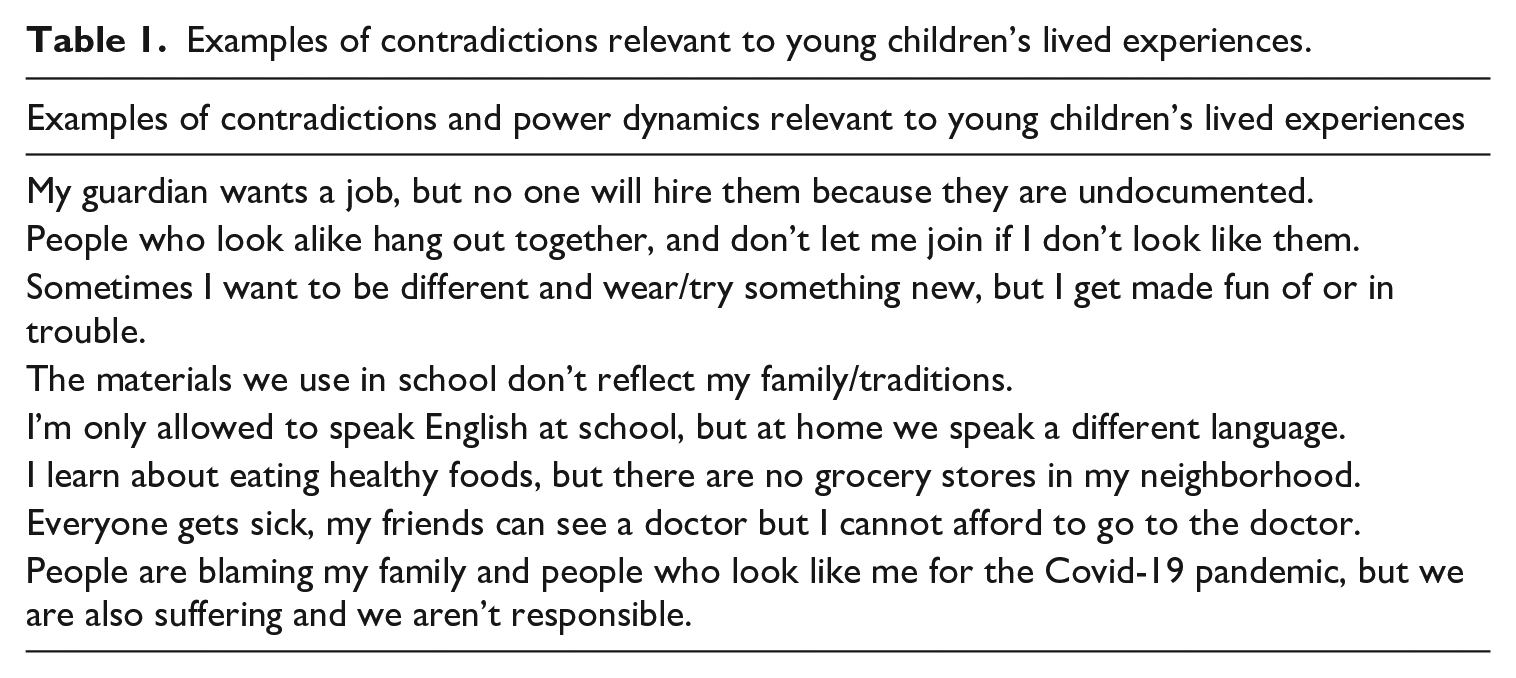
These examples should look different for every context and group of students, depending on the sociopolitical circumstances and identities of the children. These examples are interpersonal but have political implications. However, students might also bring into class explicitly political concerns such as ‘I think what happened to George Floyd was wrong, but the media keeps calling him a criminal’. Critical pedagogy suggests that when contradictions are observed, they should be incorporated into class content and create the foundation of a problem-posing curriculum (we will discuss practices to support this in a later section in this article). While young students may notice and bring up the contradictions in Table 1, they may not recognize the oppressive logic that sustains them. On the contrary, they may unknowingly ascribe to this logic. Often, these contradictions are rooted in histories of oppression, racism, sexism, ableism, and so on. Even if these concepts or terms do not resonate with young children, as Table 2 demonstrates, children’s understandings of harm, fairness, identity, rules are constantly evolving and becoming more nuanced.
Domain-specific reasoning shifts from kindergarten to Grades 5–6 and suggestions for teachers.
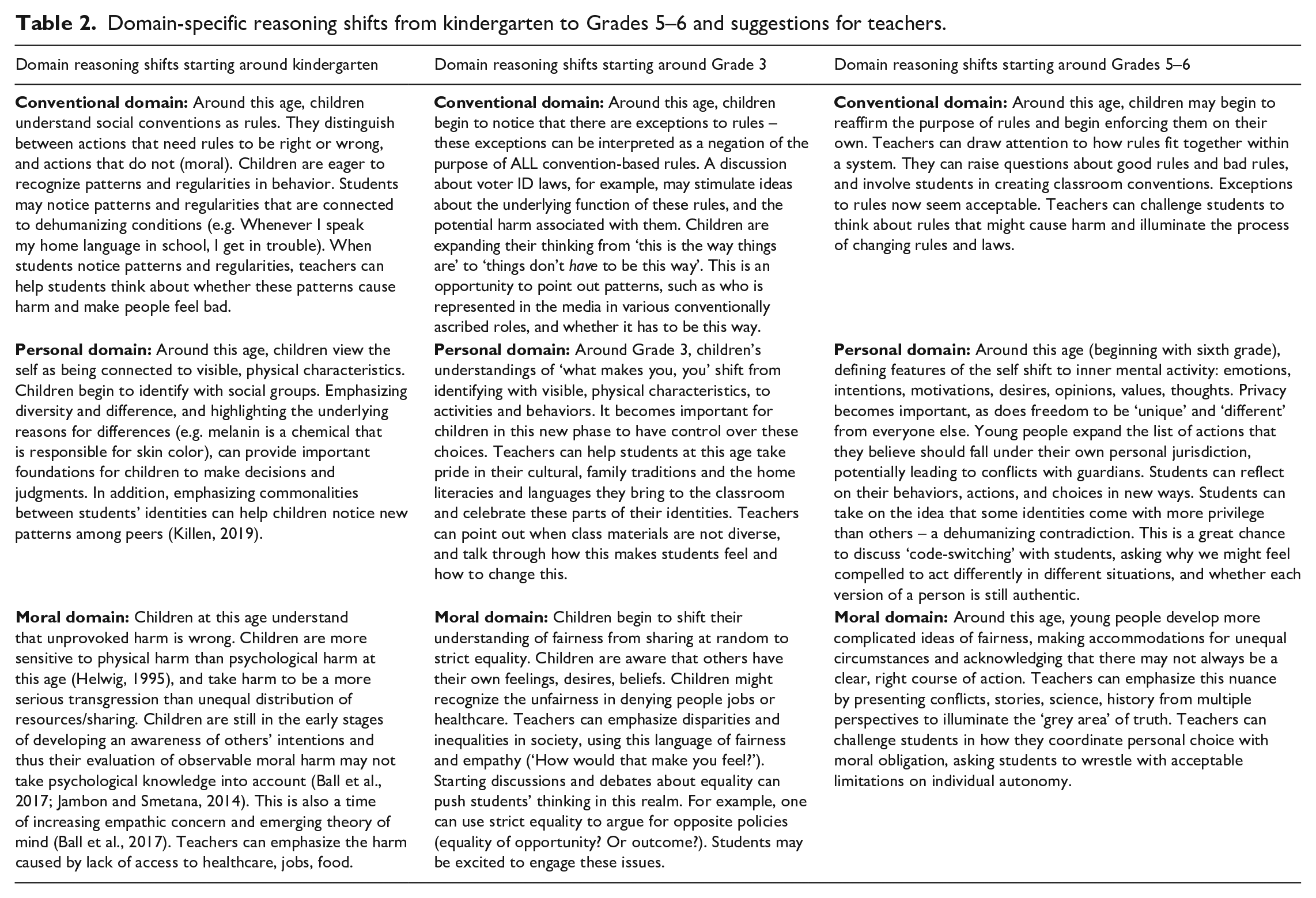
Table 2 provides three age-related shifts in domain-specific reasoning that may influence how children approach these power relationships and contradictions. Since the focus of this article is on young children, the table stops at Grades 5–6. The intention of this chart is to give educators a starting point for understanding how they might frame discussions with their students, as well as moral, conventional, and personal reasoning tools students have at their disposal to make sense of complicated moral situations in their lives. Table 2 is adapted from Nucci (2009) and Turiel (1983) and offers ideas for how to connect to societal contradictions.
Applying developmental knowledge to contradictions in students’ lives
With this developmental information in hand, the task then becomes how to use these domain-related shifts to unpack the contradictions that students bring to class. How can educators help children recognize and challenge contradictions through their curriculum and classroom practices? How can they engage young students in dialogue, action, and reflection about complex power dynamics in their lives? With regards to integrating domain-related reasoning, Nucci and Ilten-Gee (2021) have outlined steps for educators as they begin lesson planning: (1) generate reflection and construction of knowledge; (2) employ age/developmentally appropriate activities, terms, and discourse; (3) employ domain concordant issues, terms, and discourse; and (4) embrace a bidirectional relationship between curriculum and students’ own personal experiences, feelings, and sense of self. The bidirectional relationship in Step D refers to the critical pedagogy principle of involving students in the creation of curriculum and embracing students’ personal experiences with systemic power relations in the classroom. To facilitate this bidirectional relationship, teachers can ask themselves: are any of my students directly affected by this issue? What are the direct and indirect connections between my students’ lives and this lesson content? Without tokenizing or alienating individual students, how can I lift up, acknowledge, and make space for these experiences as relevant and important?
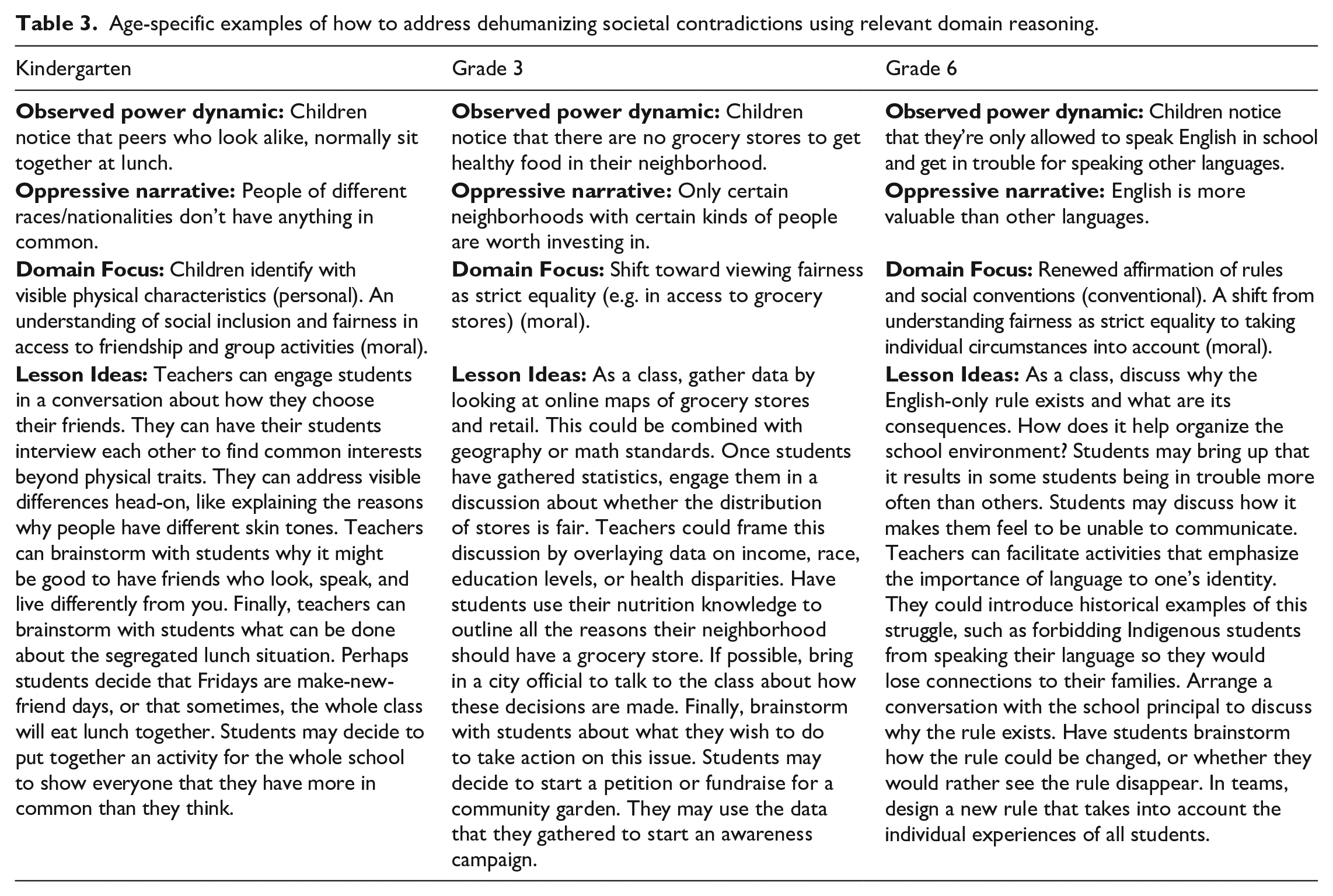
In Table 3, we expand upon the idea of this bidirectional relationship, by providing examples of contradictions relevant to young children, aligned with relevant domain reasoning and sample lessons. Table 3 is designed to assist educators in visualizing the integration of these two theories: SDT and critical pedagogy, and the insight they offer toward fostering CC with young children. Domain theory provides a window into students’ social reasoning tools and assets, while critical pedagogy urges us to seize upon the power relationships that children notice in their lives and help them illuminate embedded oppressive narratives. Each set of lesson ideas attempts to follow the cycle of praxis, culminating in generating collective action. For young children, this can be at the school or even classroom level.
Age-specific examples of how to address dehumanizing societal contradictions using relevant domain reasoning.
Capturing change in students’ CC
Teachers executing units like the ones above may wonder how to capture students’ progress and evaluate students’ skills and knowledge. We are not suggesting that the developmental trends outlined in Table 2 of this article be transformed into grading rubrics or evaluative assessments. Instead, these developmental trends and transition points should serve as gauges for teachers to situate their student community within this moral/social reasoning continuum. For example, through classroom discussions, written reflections, and informal conversations, teachers may sense that their student community as a whole is moving toward an understanding of societies as systems, or toward equity as a conception of fairness. The developmental trends are a tool for teachers’ self-reflection that can inform teachers whether their pedagogy is effective. Similarly, in terms of CC, we do not encourage teachers to measure students’ interpretations of critical issues against an ‘enlightened’ point of view. This would go against the principles of critical pedagogy, in which teachers are problem-posers and learners themselves. Instead, students should be active in determining growth and new reasoning. In this section, we propose some strategies for facilitating informal self-assessments of students’ CC development, as well as how teachers might use students’ self-assessments to reflexively examine their own practice.
We draw inspiration from Freedman et al. (2016) who studied high school students and their development toward becoming ‘ethical civic actors’. In this study, Freedman et al. presented students with a ‘critical incident’ from their society at the end of their 10th-grade year and the end of their 12th-grade year. They explain, In the USA, that incident was Trayvon Martin’s killing. We developed a set of prompts to help us understand the students’ knowledge about, understandings of, and responses to the incidents. These interviews shed a clear light on students’ reasoning about issues of division, in the USA particularly about their reasoning related to divisions of race. (Freedman et al., 2016: 122)
This strategy of soliciting reasoning from students through interviews is similar to the domain-based moral education strategy of providing students with moral dilemmas related to the academic content before and after the content is taught. Comparing argumentation and themes across students’ reflections over time can provide insight into students’ reasoning transformations.
Our recommendations below draw on literature that has documented key characteristics of successful classroom-based interventions for CC development in elementary school. Classroom environments that support open dialogue and norms for critiquing statements that reify bias (e.g. Cervantes-Soon, 2012; Godfrey and Grayman, 2014; Pérez-Gualdrón and Helms, 2017), and strong relationships between students and teachers have been shown to be essential components of lessons to support CC. In addition, a developmentally appropriate amount of structure to introduce social justice issues (Heberle et al., 2020) can enhance the quality of lessons and student outcomes. The proposed strategies attempt to integrate classroom structures and opportunities for open dialogue in an effort to support these findings.
Identifying and selecting focal critical issues/incidents
Similar to the Freedman et al. (2016) study, we suggest that teachers help students identify critical issues or incidents that they will return to over the course of the school year. One of these issues could be sociopolitical in nature, and one could be interpersonal since both types of issues can involve contradictions and require domain reasoning. Prior to the start of a new school year, teachers can meet with grade-level colleagues and members from the broader school community (i.e. parents, school leaders and staff, community leaders, and other key stakeholders) to discuss what issues or incidents are most critical and pressing in their school contexts. Teachers can consider sociopolitical issues at two levels: (a) within school community, referring to the network of relationships, systems, and policies that pertain to the given school and (b) in the broader school community referring to the surrounding neighborhood, city, or even state-/national-level concerns. The purpose of this meeting is to listen, look for themes, and identify concerns that are impacting students in their lives within and outside of school boundaries. For example, there could be concerns about access to food or safe transportation for students, or lack of jobs in the neighborhood. Partnering with community members in this way will not only add richness to the discussions and knowledge that teachers bring into their classrooms to facilitate CC development but can also increase buy-in from community members to support these efforts at home or in extracurricular capacities to promote critical action.
When the school year begins, teachers can have the same type of meeting with their students, encouraging them to bring forward critical issues or incidents that are affecting their lives. This is an opportunity for students to express contradictions they have noticed or reflect on how they are being affected by larger political events. Teachers might start this discussion by asking students to brainstorm things in their lives that seem unfair, things that seem really important, or things that they don’t understand. For example, when Anti-Asian hate crimes escalated during the Covid-19 pandemic, students may have expressed that their family members were afraid to leave the house and how that fear was making them feel. If students do not have ideas during this meeting, teachers can put forward some of the issues from the community meeting to generate discussion. Students can do the same thing with interpersonal issues/conflicts/incidents pertaining to tensions in students’ engagement with others at school. For example, perhaps students feel that there is social exclusion on the playground, or hurtful teasing within the student body.
Around 6 weeks into the school year, we suggest that teachers have students choose a focal sociopolitical and interpersonal issue to return to throughout the year. Depending on the dynamics of the class, teachers could ask students to come to a consensus, or each select issues that are important to them. After consolidating the core issues, teachers can introduce a protocol for a weekly circle check-in process. During this time, the entire class can come together to begin the discussion of these issues. Teachers can introduce readings, media clips, or other content to help facilitate these discussions in line with best practices for CC development in elementary school (see Cervantes-Soon, 2012; Pérez-Gualdrón and Helms, 2017; Silva, 2012; Tsurusaki et al., 2013). Toward the beginning of the school year, teachers can have students write, draw, voice memo, and blog about their opinions and beliefs about these focal issues. With young children who are still learning to write, teachers could ask students to respond to questions through drawing, acting out skits, creating puppet shows, or dictating to an adult who transcribes. Dramatic reflections could be videotaped and watched later for self-assessments. This activity will serve as the initial reflection data point for teachers and students.
At the mid-point of the school year, teachers can help students develop plans for critical action on the sociopolitical and interpersonal issues (either individually or in groups). Leading up to this step, teachers may encourage students to conduct research on various action options. Research with younger students may include bringing in parents and community members to share experiences, having students interview older siblings, showing video clips, reading stories from multiple perspectives, and so on. For example, with the issue of anti-Asian hate, students might listen to stories from community members and watch Sesame Street’s video ‘Standing up to racism’ (https://www.youtube.com/watch?v=TGJXR-EVYVs). This research might lead to action plans that involve making anti-racist videos of their own and decorating the neighborhood with anti-racism artwork. These reflections can serve as the second longitudinal data point for teachers and students.
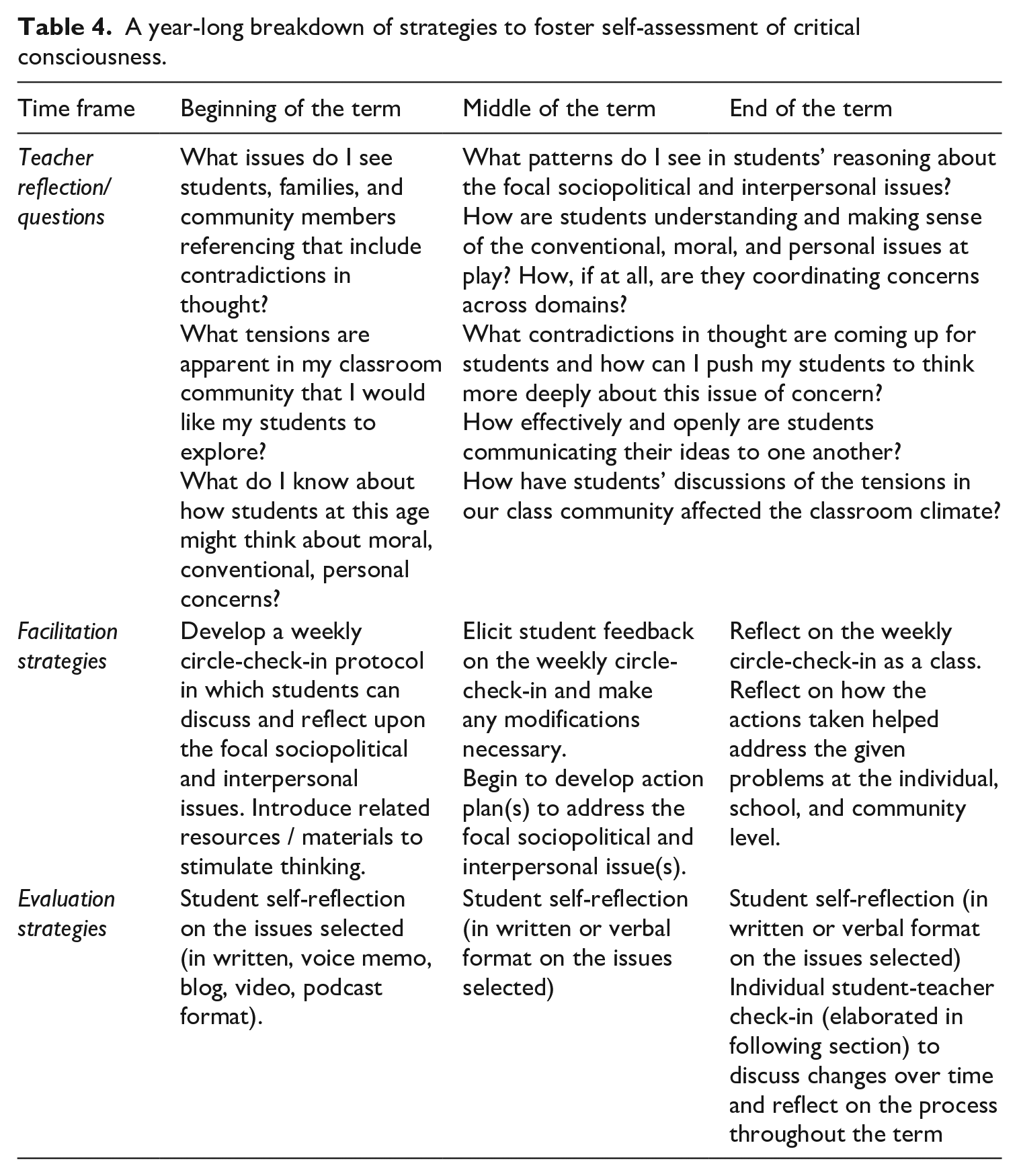
Between the middle and end of the school year, we recommend that teachers help students implement their plans of critical action. These plans should be student-driven and manageable given the resources available. The purpose of developing and trying out this plan is to help students move from abstract engagement with issues of concern to direct exposure to the issue. Teachers could provide an opportunity for students to share their action plans and their reflections on the results with one another, and possibly with the broader school community. After this plan has been implemented, students can engage in final reflections that incorporate takeaways from their efforts to make change. These final reflections on the sociopolitical and interpersonal issues will serve as the final data point for teachers and students. Table 4 is intended as a tool to help educators integrate critical consciousness and domain theory reasoning throughout the school year. It provides an overview of teacher reflection questions as well as evaluation and facilitation strategies that may guide this process.
A year-long breakdown of strategies to foster self-assessment of critical consciousness.
End-of-year self-assessments
At the end of the year, teachers can facilitate student self-evaluations using the three reflections from different points of the year. This could happen during one-on-one conferences, small group conferences, portfolios, and so on. With all three reflections in front of them (beginning of the year, midway through, and end of year), students can analyze their own thinking in a critical way, and ask themselves the following questions: ‘How have my ideas changed? What is included in reflection 3 that is NOT included in reflection 1?’ (see Table 5 for more questions). In this way, students get the chance to determine for themselves whether they feel that their ideas have grown or shifted, and what experiences were most meaningful in this journey.
Guiding questions for student reflections throughout the year and end-of-year conferences.
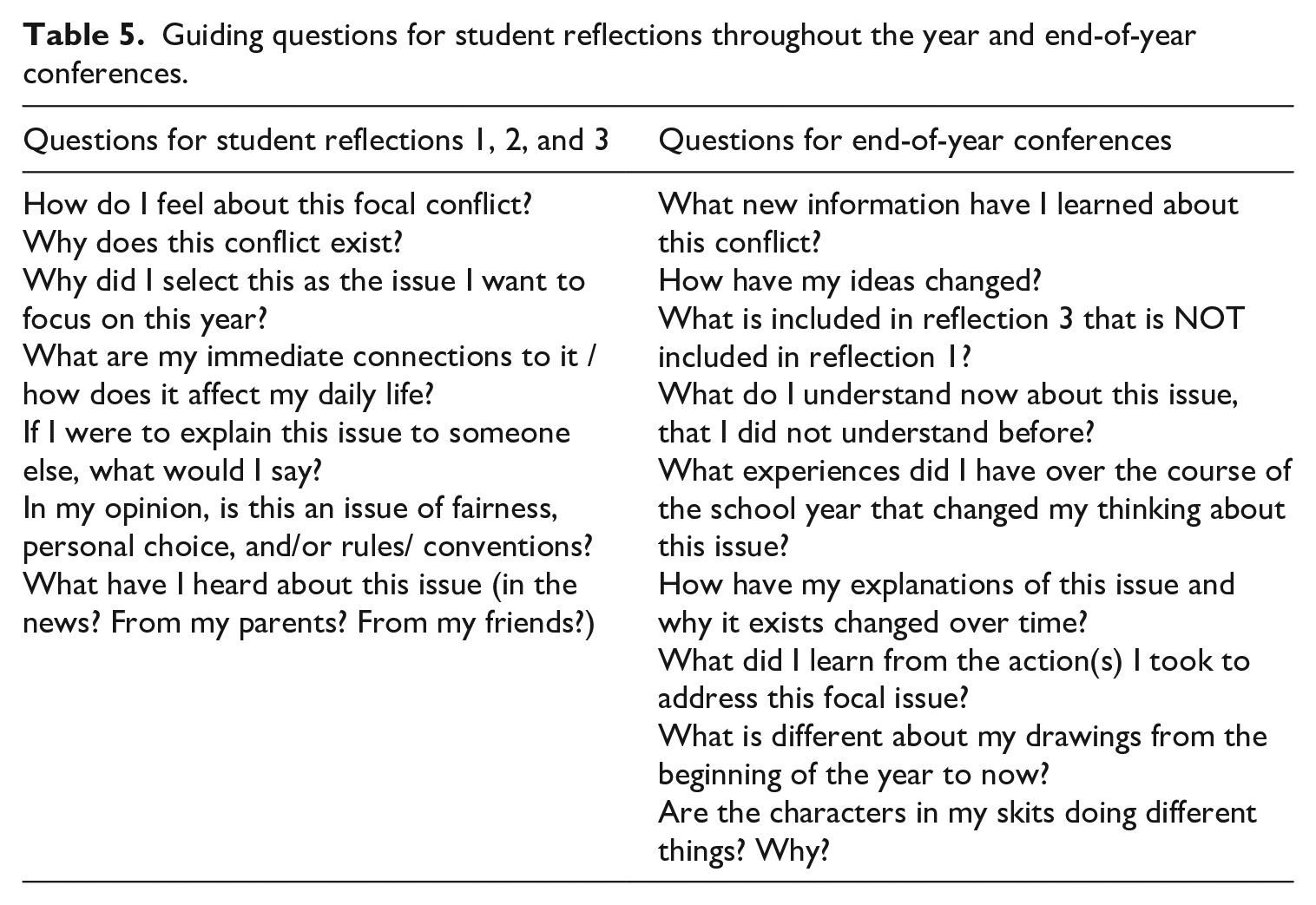
With young children, this process may entail examining drawings, re-watching taped skits, or listening to reflections that they dictated to teachers. Teachers might prompt students by saying, ‘In your first skit, why did your character act that way?’ or, ‘Your drawing from the end of the year shows people being nice to each other. Why did you draw this?’ or, ‘This drawing shows people being mean to each other. Why do you think this person made that choice?’ In the case of anti-Asian hate, these prompts could illuminate how children are understanding ideas like racism, stereotypes, and harm, and where they are placing blame. Teachers can also prompt students during these conferences, to notice domain reasoning shifts. For example, I notice from your reflection at the beginning of the year, that you were really concerned about school safety because you felt like others were not following the rules. But when I look at your end of year reflection, I notice that rules are less important to you than whether people get hurt. That’s a really interesting change! Can you tell me about that?
Once these conferences are concluded, teachers may then have an overview of students’ shifts in reasoning that they can use to evaluate their own pedagogy. Teachers can consider the following questions: (1) how many of their students noticed significant shifts or changes in their thinking with regards to these issues? and (2) in what direction where these observed changes? For example, did students’ interpretations of the focal issues move toward taking into account societal root causes of oppression? Teachers may then decide to intensify their approach, include more diverse perspectives, or focus on fundamental reflection skills with students. These questions may also allow teachers to distinguish between students who did not engage with the material and those who did.
In terms of the student self-reflection activities that happen 3 times throughout the year, multimodal formats are encouraged – students’ understandings can be articulated through group activities (class skits, debates, creating films/ podcasts, letters, op-eds, etc.). Changing up the format of reflections can keep this activity from seeming repetitive and instead help elicit different reasoning each time (Ilten-Gee, 2020). However, each student’s journey will be unique. If students are facing painful truths about historical trauma, family history, loss, or missing information when they engage with the focal sociopolitical or interpersonal issues, they will be navigating emotional hurdles as they investigate, discuss, and act. Engaging in political action can often be a healing and empowering way to confront trauma (Ginwright, 2018).
Conclusion
Fostering CC is an educational goal that grounds both educators and students in critiquing the status quo, challenging oppression and injustice, and engaging in inquiry and dialogue. This process entails embracing the contradictions that students notice and bring into class, and sometimes prompting students to think about existing contradictions in their community or in their peer relationships. Once these contradictions have been perceived, investigated, and deliberated over, students may reason about power dynamics in their lives differently.
In this article, we have referred to these context-specific changes or updates in thinking as reasoning shifts or transformations. SDT offers a framework and a guide for attending to age-based shifts in students’ reasoning within and across three domains: moral, conventional, and personal. These shifts are a sign that children are likely to update and reconstruct their reasoning on key issues – educators can make sure that issues related to students’ own lived realities get the necessary attention and time required for students to do this hard work. Awareness of these age-related shifts can also provide educators with insight into how reasoning transformations may be fostered with young children, who may not be aware of how societies function or how various forms of oppression operate interpersonally and structurally. Knowing that Grade 3 students begin to be hyper-sensitive to fairness as strict equality, for example, may provide educators with pedagogical pathways to access the contradictions and sociopolitical issues affecting them. Teachers may also be able to anticipate when certain arguments will be challenging for students to accept or understand, given domain reasoning trends. Research tells us that even young children are aware of social differences in wealth, gender, and race. Instead of shying away from topics like inequality, injustice, and prejudice, educators can use knowledge about children’s moral, conventional, and personal understandings to lean into their observations and start important conversations.
In addition to outlining the alignment between two types of reasoning transformations, we have suggested strategies for educators to assess and evaluate change over time with their students. These strategies draw on methods from domain-based moral education and narrative methodologies (Freedman et al., 2016). These are not meant to be academic assessments that indicate success or failure, but instead qualitative and collaborative measures to reflect on how students’ thinking has changed over time. We suggest using focal critical issues that are sociopolitical and interpersonal in nature and offering three opportunities over the course of the school year for students to elaborate/create/reflect on these issues. Throughout the school year, educators can continue to introduce news articles, media, texts, artwork that introduces new perspectives on these issues, and lead students to conduct their own investigations into these issues. This can include creating critical action plans – either in small groups or individually.
At the end of the year, students have the opportunity to compare their thinking across reflections 1, 2, and 3 on these two focal issues, and consider the following questions: what new ideas have I adopted? How has my reasoning changed? With very young children, this may be as simple as noticing that in their first reflection, they only considered the impact of the issue on themselves, but at the end of the year, they included the impacts on other people. These self-assessments, we propose, can be powerful moments in which students acknowledge their own CC development.
In true problem-posing education, teachers are also students and learners in the classroom, and therefore it may be exciting for teachers to also conduct self-reflections on how their thinking about the focal issues has changed over the course of the school year. After soliciting guest speakers, conducting research, reading, and researching these issues, perhaps teachers will notice micro-changes in their reasoning as well. Sharing this information would be a powerful model for students. It is our hope that these ideas and strategies can contribute to the future of CC education with young children.
Footnotes
Acknowledgements
Thanks to Larry Nucci at the University of California, Berkeley for support on this article.
Funding
The author(s) received no financial support for the research, authorship, and/or publication of this article.
