




Abstract
There has been a growing literature among philosophers of education on how to frame questions of moral controversy in the classroom. Through the application of hard moral cases that may be said to leave one ‘morally dumbfounded’, I take up Michael Hand’s influential epistemic criterion and attempt to show why its monistic approach is too limited in its ability to capture the complexity of such moral dilemmas. Rather, I argue that the classroom requires a pluralist moral framework, as exemplified by the Moral Foundations Theory, developed by Jonathan Haidt. Not only does Moral Foundations Theory consider the liberal ethic of autonomy, it also extends consideration to the ethics of community and divinity, which is crucial for meeting the broader aims of moral and religious education, such as developing reason, identity and cultural understanding.
Keywords
Epigraph
A person’s entire life must not be conducted on the basis of exclusive reliance upon a single trait. Whatever its ontological status may be, a moral sense is part of the standard equipment of the human mind. It’s the only mind we’ve got, and we have no choice but to take its intuitions seriously.
Introduction
In the best tradition of the Talmud, it may be said that ‘hard cases make good law’. Infamous for its theoretical legal dilemmas, the Talmud is replete with strange and bizarre problems that are taken just as seriously as practical law. As Adin Steinsaltz (2010), a leading Talmudic authority, puts it:
The Talmud . . . relates to questions that are extremely unlikely to arise in everyday life and to some that may not be totally unrealistic but appear absurd because details of infinitesimal importance are discussed with a gravity out of all proportion to their significance. (p. 267)
Although the questions posed may be insoluble, ‘in seeking an answer the scholar presents a certain case, a model, with whose aid he tries to clarify the nature of the problem’ (Steinsaltz, 2010: 267). The use of extreme cases, according to Chagit Blass (2019, Email correspondence with the author), helps clarify the legal framework to the discussion at hand, as ‘hard cases are an opportunity to crystalise the law. Getting it right is the challenge, and the Talmudic sages understood this’.
In this vein, this article seeks to take up Michael Hand’s (2007) influential championing of the epistemic criterion ‘for distinguishing the moral questions we should teach as controversial issues from those we should not’ and show, through the use of hard moral dilemmas, that the criterion falls short. 1 Although necessary to help consider questions of moral controversy, the epistemic criterion is ultimately deficient, with its monistic understanding of moral dilemmas too narrow. Rather, this article will promote Jonathan Haidt’s pluralist ‘Moral Foundations Theory’ (MFT) as a more helpful method to teach issues of moral controversy in the classroom on grounds of both principle and practice. 2
Applying the epistemic criterion: Homosexual acts
Hand defended the epistemic criterion of controversiality that Robert Dearden (1981) defined as follows: ‘a matter is controversial if contrary views can be held on it without those views being contrary to reason’ (p. 38). The criterion would thus decide whether a topic is taught directively or nondirectively: in promoting rationality, the teacher presents ‘students with the evidence adduced in support of a claim, helping them to evaluate it, and encouraging them to accept the claim if, and only if, the evidence is epistemically adequate’ (Hand, 2008: 218). For Hand (2008), this approach towards teaching matters of controversy is underpinned by his view that ‘the central aim of education is to equip students with a capacity for, and inclination to, rational thought and action’ (p. 218). For it is ‘engagement in practical and theoretical reasoning [that] is both intrinsically rewarding and the most effective means of securing a wide range of individual and social goods’.
In his call for a ‘rational moral education’, Hand (2018a) posits that the resulting moral standards will be taught differently ‘depending on whether they are justified, unjustified or of uncertain justificatory status’ (p. 91). Against this theoretical backdrop, Hand (2007, 2018a) sought to apply the epistemic criterion to the morality of homosexual acts. In weighing up the arguments within the epistemic framework, Hand (2007) concluded that, ‘the only view that enjoys rational support is the view that homosexual acts are morally legitimate. We ought, therefore, to be unapologetic in our commitment to promoting this view in the moral education of children and young people’ (pp. 84–85). The moral legitimacy of homosexual acts is not contrary to reason as nearly all the goods available to heterosexual couples having sex are available to gay couples too. Of course, reproduction is unavailable but that doesn’t diminish the moral importance of values such as companionship, mutual support, intimacy and communication (Hand, 2007: 76). Corvino is cited for noting that many heterosexual couples still engage in sex even if they don’t want children, because of the benefits mentioned. As Corvino (Hand, 2007) puts it: ‘if these reasons are good enough for most heterosexual couples, then they should be good enough for Tommy and Jim’ (p. 77).
On the flipside, Hand forensically considers three moral arguments against homosexual acts and finds them all ‘contrary to reason’. First, the appeal to scriptural authority which prohibits homosexual sex, forces one to accept that biblical injunctions are ‘self-evidently not morally sound’, including the permissibility of purchasing slaves and the subordination of women (Hand, 2007: 77). Moreover, the divine source for such texts is also rationally indefensible as ‘the wealth of biblical criticism and scholarship . . . shows the books of the Bible to be documents of their time’ (Hand, 2007: 78). In turn, Hand (2007) writes, ‘The Bible cannot but be seen as a human composition, rooted in and responsive to particular historical contexts and shot through with moral and political assumptions that we do not share and cannot justify’ (p. 78).
Second, Hand (2007) brings natural law’s ‘perverted faculty’ argument that ‘it is morally wrong to put our organs or body-parts to uses that frustrate or disregard their biological functions’ (p. 78). Hand quickly dispenses with this argument with the point that we use many of our body parts for many different functions. Aquinas’s teleological argument that misuse of the sexual organs is singularly problematic due to the discharging and wasting of semen is undermined by the body’s replenishing of semen after each emission. The prohibition of homosexual and masturbatory acts due to a concern for the ‘preservation of the species’ is simply not a serious concern.
Third, Hand rejects natural law’s argument from ‘basic goods’ as it falsely assumes that only a procreative relationship, that is, marital relationship between a man and woman, may realise such valued ends. Yet it is clear that a relationship that brings love, friendship, pleasure or enjoyment, such as a homosexual relationship, would also fulfil important human goods. Moreover, the objection to having sex for pleasure due to instrumentalising the body, would also render eating for pleasure as immoral, ‘nicely illustrat[ing] the folly of putting moral weight on the ill-formed notion of actions that instrumentalise the body’ (Hand, 2007: 84).
Hand (2007) concludes triumphantly:
Since all three of the established arguments for the moral illegitimacy of homosexual acts quickly buckle under the pressure of rational examination, we may say with some confidence that homosexuality does not satisfy the epistemic criterion of controversiality. (p. 84)
Therefore, ‘[w]hen moral educators tackle the topic, their teaching should be directive’ (Hand, 2018a: 110). On the grounds that Hand has laid out for us, he is justified to reach the conclusion he does. And yet through the employment of other moral dilemmas, it will be shown that Hand’s use of the epistemic criterion for controversiality falls short.
Going fishing
Raymond Carver’s classic short story, So Much Water So Close to Home, deftly leaves the reader conflicted about the moral impropriety of Stuart and his friends. ‘Tell me what I did wrong and I’ll listen!’ Stuart challenges Claire, his wife, who narrates the tale. Claire responds simply, ‘You know’. Stuart says, ‘What do I know, Claire? Tell me what I’m supposed to know. I don’t know anything except one thing . . . She was dead . . . And I’m as sorry as anyone else. But she was dead’. For Claire, her husband’s moral failure is self-evident, replying, ‘That’s the point’ (p. 273).
Stuart and his three friends are working men who ‘play poker and bowl and fish’ (p. 274). And every spring and early summer they go out on a road trip together to fish ‘before visiting relatives can get in the way’. Claire tells us, ‘They are decent men, family men, men who take care of their jobs. They have sons and daughters who go to school with our son, Dean’. Notwithstanding Claire’s suspicion of the men and potential involvement in the crime, let us take Stuart and his friends at their word. In Carver’s characteristic terse narrative, we are told:
Last Friday these family men left for the Naches River. They parked the car in the mountains and hiked to where they wanted to fish. They carried their bedrolls, their food, their playing cards, their whiskey. They saw the girl before they set up camp. Mel Dorn found her. No clothes on her at all. She was wedged into some branches that stuck out over the water. He called the others and they came to look. They talked about what to do. One of the men – my Stuart didn’t say which – said they should start back at once. The others stirred the sand with their shoes, said they didn’t feel inclined that way. They pleaded fatigue, the late hour, the fact that the girl wasn’t going anywhere. (Carver, 2009: 274)
After tying the girl down with a cord looped around a tree, they spent the following day fishing, cooking, eating and drinking. It was only on the next morning, as they set out to return home that,
They drove until they got to a telephone. It was Stuart who made the call while the others stood around in the sun and listened. He gave the sheriff their names. They had nothing to hide. They weren’t ashamed. They said they’d wait until someone could come for better directions and take down their statements. (Carver, 2009: 275)
Stuart remains defiant even as the local press take up the case and condemn the men’s scandalous behaviour. Dramatised in two critically acclaimed films, first as a segment in Robert Altman’s Short Cuts (1993) and then as a full-length drama in Ray Lawrence’s Jindabyne (2006), the viewer may well find it easier to condemn the men’s behaviour than reason what exactly they have done wrong. This phenomenon is known as ‘moral dumbfounding’ (Haidt et al., 2000), whereby moral intuitions lack reasoning. Grounded in the thinking of David Hume, it is posited that judgement precedes reasoning, and that our ‘gut feeling’ or what Hume and Adam Smith called an ‘innate moral sense’, lead us to intuitively evaluate moral questions. As Hume (1969) famously claimed, ‘reason is, and ought only to be the slave of the passions, and can never pretend to any other office than to serve and obey them’ (p. 462).
In turn, let us try and isolate their deeds from the myriad of unknowns resulting from their behaviour. For example, assume that for the couple of days that they have left the girl’s body, no material difference resulted in the subsequent police investigation and their ability to catch the culprit. Perhaps her loved ones benefitted from the hope that she might still be alive after having gone missing. Perhaps they didn’t yet know she had gone missing until the police reported it. Carver’s pithy telling of the tale allows us to home in on the specific acts of the men involved without recourse to the consequences. Let’s take Stuart’s challenge seriously: what did they do that was morally wrong?
For Claire and most readers of the story, it is obvious and self-evident. Yet epistemically, in Hand’s terms, one would be hard-pressed to justify these intuitions on rational grounds. On the one hand, these hard-working men have been looking forward to this trip all year round. It’s time for them to recharge their batteries and enjoy their bonding union. They have travelled a long distance and there won’t be another chance to take their well-earned break until the following year. As Stuart reasons, ‘She was dead’. Yes, that was upsetting but there was nothing they could do. In utilitarian terms, there seemed little upside in forsaking their holiday as they would call ahead anyway on their way home. In liberal terms, their fishing didn’t harm the girl and so they were well within their rights to carry on.
On the other hand, Claire is surely right when she says intuitively, ‘You know’. It’s clear what they have done wrong – although not within the narrow epistemic criterion Hand champions. His systematic reasoning is a classic demonstration of the cognitive–developmental tradition typical of Western societies, characterised by a focus on the reasoning processes present in moral judgements (Jensen, 2011). This style of thinking (Shweder, 1997: 143) hinges on the ‘ethic of autonomy’, a harm-rights-and-justice code, with an emphasis on ‘the individual’s claim to self-interest and non-interference’. Such an ethic helps justify Stuart’s defence: they hadn’t harmed the girl but were simply free individuals who wanted to fish together. Rather, we need to look to other ‘moral languages’ (Shweder, 1997: 143) to fully articulate Claire’s (and perhaps our own) repugnance at their inaction. One is called the ‘ethic of community’, which relies on concepts such as duty, respect and loyalty, that aims to preserve institutions and social order. The other is called the ‘ethic of divinity’, which relies on concepts such as purity, sanctity and sin, that ‘protects the divinity inherent in each person against the degradation of hedonistic selfishness’ (Graham et al., 2013: 59).
It is only an appeal to a plurality of ideals that include sanctity and degradation, so instinctive in moral communities that we can articulate why their behaviour elicits such disgust. There is a real sense in which they desecrated the body and dignity of this young woman by their mundane routine that Carver describes so cuttingly:
That night they cooked fish, cooked potatoes, drank coffee, drank whiskey, then took their cooking things and eating things back down to the river and washed them where the girl was. They played some cards later on. Maybe they played until they couldn’t see them anymore. Vern Williams went to sleep. But the others told stories. Gordon Johnson said the trout they’d caught were hard because of the terrible coldness of the water. (Carver, 2009: 274–275)
The ethic of divinity captures how these men’s hedonistic selfishness degraded the dead girl’s dignity. The radical Biblical notion, for example, that all humans are created in the ‘image of God’ (Genesis 1:26) lends the body dignity even after death. In contrast, we wouldn’t flinch if they had come across a dead dog and decided to continue their fishing trip. There would have been no story to tell. To be sure, Kant (2005) as the father of secular human rights, offers the most important conception of human dignity in Western thought through his second formulation of the categorical principle:
Now I say that the human being and in general every rational being exists as an end in itself, not merely as a means to be used by this or that will at his discretion; instead he must in all his actions, whether directed to himself or also to other rational beings, always be regarded at the same time as an end. (p. 105)
Kant (2017) recognised the difficulty of grounding the rights of the dead as representing ‘a phenomenon as strange as it is undeniable’ (p. 83), with modern scholars conflicting on how to justify such a duty in Kantian terms. Indeed, the elaborate and sometimes tortuous arguments that commentators on Kant bring to justify a duty towards the dead hardly marries with the universal intuitive moral sense that the dead deserve dignity (Brown cited in Pinker, 2002: Appendix). While it may be argued that Kant would extend dignity to the dead person based on his neo-Platonic concept of ‘homo noumenon’ (see, for example, Rosen, 2012: 145; Wisnewski, 2009: 56), Liosi (2018) restricts the Kantian duty to the dead as falling on relatives, friends and the relevant local authorities. Wisnewski offers a reductio argument that denying any duties towards the dead commits one to an untenable view, including reneging on promises made to a loved one once they have died. Yet as Wisnewski (2009) readily admits, even if a Kantian duty towards the dead can be justified it is only on a case-by-case basis that can attempt to answer exactly what rights are owed to the dead (p. 66). Although such epistemic reasoning may in the end justify our duty towards treating the dead body with dignity, such arguments surely don’t get to grips with the universal sense, as expressed by Claire in Carver’s story, that such a duty – even towards strangers – seems self-evident. All of this lends weight to Haidt’s (2001) intuitionist model that many engage in moral rationalisation rather than moral reasoning, as people begin with the moral conclusion only to subsequently rummage around for a rational explanation.
Shweder’s discovery of ‘moral languages’ beyond the narrow ‘ethic of autonomy’, as championed by Hand, gives voice to what is so intuitive to most moral communities that grant importance to concepts like purity, sanctity and sin. Insofar as Hand’s narrow conception of ethics relies on concepts such as harm, rights and justice, it remains difficult to reason what Stuart and his friends have done wrong. Based on his rational moral education model, Hand’s view of reason would prevent us from objecting to the behaviour of Stuart and his friends, leading him to call on teachers to assign their decision to carry on fishing as ‘justified’, which would be patently absurd. It is only by extending our moral understanding to the ethics of divinity and community, that we can now articulate our intuitive repugnance at their insensitivity and, at the very least, class their behaviour as of ‘uncertain justificatory status’ if not outright ‘unjustified’ as per Hand’s (2018a: 91) categories.
In demonstrating that Hand’s narrow epistemic criterion falls short, the more comprehensive MFT deals with its deficiencies in two crucial ways. First, it recognises the necessity of intuition – as characterised by Haidt’s (2012) ‘elephant’ or Daniel Kahneman’s (2011) ‘System 1’ – to provide the ‘natural complements and correctives’ to the ‘analysing spirit’ in moral decision-making (Mill, 1873). Although intuitions come first in MFT, Haidt (2012) accepts that ‘[i]ntuitions can be shaped by reasoning’ (p. 83). As Michael Huemer (2005), an ethical intuitionist, explained:
Reasoning sometimes changes how things seem to us. But there is also a way things seem to us prior to reasoning; otherwise, reasoning could not get started. The way things seem prior to reasoning we may call an ‘initial appearance’. An initial, intellectual appearance is an ‘intuition’. (p. 102)
The antecedent for this approach may be found in WD Ross’s ‘rationalist intuitionism’, which recognises our intuitive ability to apprehend self-evident moral facts, giving rise to what Ross called prima facie duties, that can then be tested and confirmed ‘on the basis of further reflection or deeper consideration’ (Simpson, n.d.). As Simpson (n.d.) describes it, these duties, borne out of our moral intuition, ‘then serve as a foundation or touchstone for further moral inquiry’. Thus, our intuitive propositions are prima facie justified, Huemer (2005) wrote, ‘unless countervailing evidence should arise that is strong enough to defeat the initial presumption in their favour’ (p. 105). Ethical intuitionism, therefore, needn’t simply collapse into the behavioural criterion as it remains loyal to the epistemic criterion’s requirement ‘that views be judged by the evidence or arguments in their support’ (Hand, 2008: 217). Rather, it argues, very much on epistemic grounds within moral psychology, that the rightful place of intuition within our moral architecture be recognised. 3
Second, in contrast to the narrow monism of the epistemic criterion, MFT appreciates that a plurality of moral foundations offer a more credible narrative of ethical behaviour (Figure 1). 4 Although MFT’s pluralism falls into the inevitable trap of being more ‘muddled’ than moral monism, the latter model, as Carver’s story demonstrates, is inadequate in getting to grips with human morality in all its ‘messiness and complexity’ (Graham et al., 2013: 104).
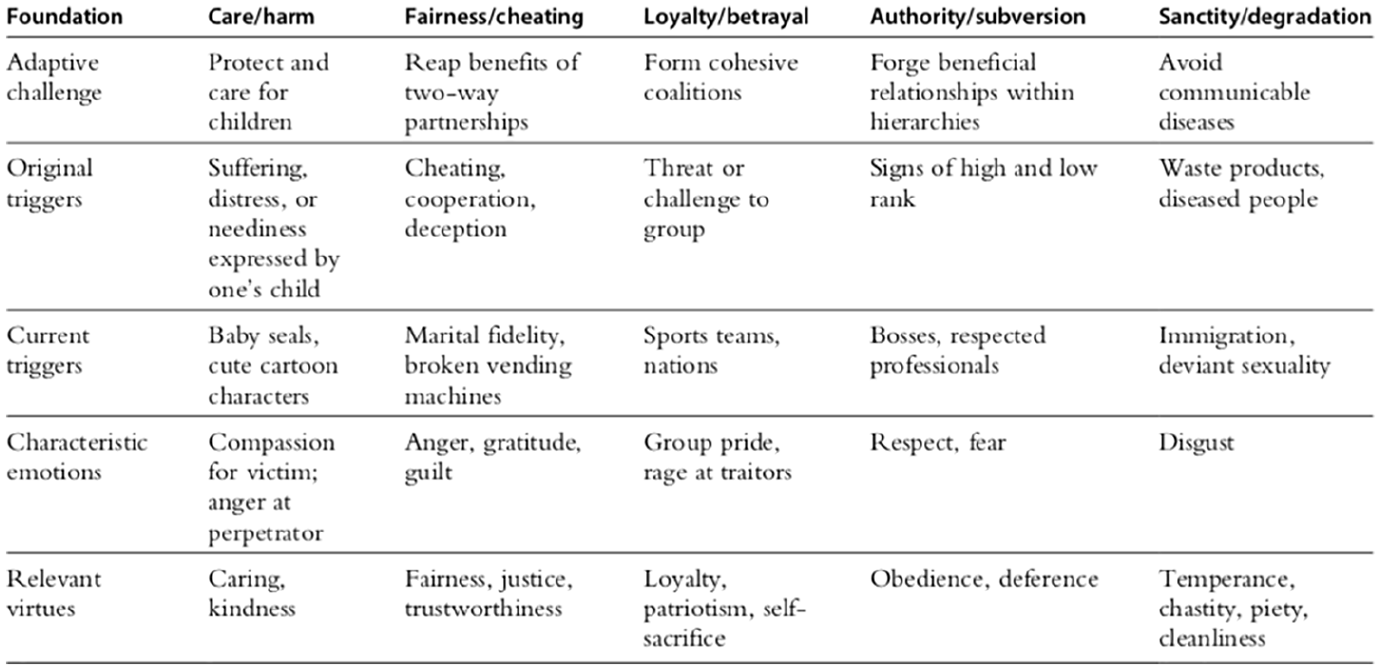
The original five foundations of intuitive ethics.
Sibling romance
A more direct challenge to the defence of homosexuality within the epistemic criterion comes in the form of the following hard case of Julie and Mark’s night of romance:
Julie and Mark are brother and sister. They are traveling together in France on summer vacation from college. One night they are staying alone in a cabin near the beach. They decide that it would be interesting and fun if they tried making love. At the very least it would be a new experience for each of them. Julie was already taking birth control pills, but Mark uses a condom too, just to be safe. They both enjoy making love, but they decide not to do it again. They keep that night as a special secret, which makes them feel even closer to each other. What do you think about that? Was it OK for them to make love? (Haidt, 2001: 814)
Intuitively, most people meet this tale with disgust. Haidt (2001) offers a typically Humean response: when encountering incest, ‘one feels a quick flash of revulsion . . . and one knows intuitively that something is wrong’ (p. 814). Yet finding arguments grounded in reason is not at all easy:
Most people who hear the above story immediately say that it was wrong for the siblings to make love, and they then begin searching for reasons. They point out the dangers of inbreeding, only to remember that Julie and Mark used two forms of birth control. They argue that Julie and Mark will be hurt, perhaps emotionally, even though the story makes it clear that no harm befell them. Eventually, many people say something like, ‘I don’t know, I can’t explain it, I just know it’s wrong’. (Haidt, 2001: 814)
Again, considering the case at hand within Hand’s narrow epistemic criterion leaves us ‘morally dumbfounded’. If we return to each of Hand’s arguments demonstrating that ‘homosexuality does not satisfy the epistemic criterion of controversiality’, one comes to the inescapable conclusion that on such grounds Mark and Julie’s lovemaking is equally uncontroversial and should thus be taught as a morally justifiable act. Hand may well seek consistency and defend the teaching of Mark and Julie’s incestuous encounter in a directive manner. If so, perhaps we may apply his own observation that his defence of the epistemic criterion ‘nicely illustrates the folly’ of reducing moral actions to narrow epistemic considerations.
Briefly applying Hand’s logic to the case at hand, we will recall that any argument from scriptural authority is for Hand inherently undermined by the Bible’s other untenable restrictions. For Hand, Leviticus 18 and 20, where the prohibitions on both incest and homosexuality appear, are simply a product of their time. Equally, natural law’s ‘perverted faculty’ and ‘basic good’ arguments are also unreasonable when considering Mark and Julie’s relationship. Arguments that the incestuous encounter undermined family relationships and led to a threat of genetic abnormalities were neutralised by the unitive result of the experience and their use of contraception, respectively. Rather, basic goods, such as bringing them closer together and enjoying the experience, resulted from their sexual encounter, just as it may in a healthy heterosexual or homosexual relationship.
To be sure, utilitarians and libertarians have defended the legal right of consenting siblings to engage in incestuous relationships. David Archard (1998) may be taken at his word when he defended homosexuality on libertarian grounds: ‘anything sexually goes so long as it is in private, between consenting adults, and harms no-one else’ (p. 448). Yet this rationale is stretched to the limit by the Julie and Mark scenario let alone cases like Armin Meiwes, known as the ‘Cannibal of Rotenburg’ (see, for example, Sandel, 2009: 73–74). That singular case left Germany in somewhat of a legal and moral quandary over which law to try him under. If Archard and other libertarians are right, then banning consensual cannibalism is unjust and both politically and epistemically uncontroversial. As for incest, it is indeed legal among consenting adults in a number of countries such as France, Spain and Belgium. At a narrower level, there may well be rational grounds to restrict incest, including where children are involved, or in relationships between parents and their adult children due to unequal power arrangements. Yet ethicists such as Peter Singer (2016: 135–138) call for the debate to be opened up to legalising adult incest and overcoming the incest taboo, especially where effective contraception is present.
And yet it would seem unconscionable that teachers would approach the moral question of Mark and Julie’s actions as uncontroversial, that is, in a directive manner.
5
With ‘incest, prevention or avoidance’ a human universal (Brown cited in Pinker, 2002: Appendix), most people would still maintain that there is something morally wrong or, at the very least, treat the case as morally controversial. That Hand’s highly systematic reasoning would lead us to teach the Julie and Mark story as morally justifiable in a directive manner demonstrates that his epistemic framework is simply too narrow to fully deal with the moral implications of the dilemma. His reliance on libertarian and utilitarian reasoning, which give primacy to autonomy and pleasure, lacks awareness of notions of sanctity and degradation, important for all moral communities. The sense of ‘disgust’ many feel when hearing the Julie and Mark story is not simply an overhang of evolutionary necessity but also a warning against our own excesses:
Repugnance, here as elsewhere, revolts against the excesses of human wilfulness, warning us not to transgress what is unspeakably profound. Indeed, in this age in which everything is held to be permissible so long as it is freely done, in which our given human nature no longer commands respect, in which our bodies are regarded as mere instruments of our autonomous rational wills, repugnance may be the only voice left that speaks up to defend the central core of our humanity. Shallow are the souls that have forgotten how to shudder. (Kass, 1997: 20)
Of course, the line of demarcation is unclear. Repugnance evolves and what was morally taboo for one age becomes standard practice for the next. Yet that is why such hard cases call for a more pluralist response that can weigh up a range of core human ethical values through our complementary ability to think and feel. We must therefore recognise the interplay of intuition and reason to take full account of human sentiment in the decision-making process. While the former affords the necessary ‘heuristics’ to help provide an a priori framework for life, the latter provides the equally necessary critical reflection to help ensure that we don’t blindly follow our intuitions into barbarism (Jacobs, 2017: 86). It is therefore valid, when teaching about the morally hard case of Mark and Julie, to take into account our intuitive sense that Mark and Julie behaved unethically. Yet intuitionists (Huemer, 2005: 106) do not claim infallibility and the irrelevance of argument but rather posit that credible intuitions, especially when widely shared across societies, provide prima facie justified moral beliefs to start from. This does not preclude us to then turn to moral reasoning ‘to expand, refine, and even revise our moral beliefs’ (Huemer, 2005: 106). Yet even here Haidt (2012) is right to warn that we need to be more ‘humble about the abilities of individuals, and more attuned to the contexts and social systems that enable people to think and act well’ (p. 107).
The religious ethic and ‘epistemic imperialism’
Hand’s lack of sensitivity for the ‘ethic of community’ and ‘ethic of divinity’ is highlighted by his attack on the argument from scriptural authority. This is deflating particularly because many children in the classroom will belong to families and communities who take scriptures seriously both in terms of beliefs and practices, thus serving to alienate a significant proportion of students. For Wittgenstein (1938) such misinterpretation stems from people playing a different ‘language game’, revealing an enormous gulf in a priori worldviews.
6
A salient example is the religious mandate in Judaism and Islam for boys to be circumcised. This near-universal practice among Muslim and Jewish families to circumcise their sons would hardly pass Hand’s epistemic criterion. In line with his ‘ethic of autonomy’, Humanists UK (2019) campaign for ritual circumcision, or genital mutilation as they refer to it, to be outlawed until a boy is of a suitable age to decide for himself:
We support the bodily integrity of all people as an inalienable human right and want to promote respect for the autonomous choices of individuals wherever possible. We do not support non-medically necessary procedures to remove parts of the genitals of boys and girls and want to see all laws allowing such procedures repealed and the procedures themselves outlawed when conducted without consent. . . . In the case of male circumcision, we campaign for the law to recognise every boy’s human right to make an uncoerced decision about major elective surgeries, such as penile circumcision, upon reaching an appropriate age of maturity.
Again, within the narrow confines of the epistemic criterion, Humanists UK’s arguments would certainly lead teachers to teach male circumcision in a directive manner. The appeals to human autonomy, unnecessary medical risk-taking and the mutilation of a young boy’s genitals are overwhelming. The moral foundations of Care and Liberty are under direct attack through the act of male circumcision. Yet Jews and Muslims share a different ‘language game’: whereas the ‘ethic of autonomy’ sees circumcision as an attack on the individual’s right to informed consent, the ‘ethic of community’ and ‘ethic of divinity’ see circumcision as a covenant between the child and his people and with God, respectively. This most ancient of rituals, dating back some 4000 years since Abraham, the father of monotheism, is so ingrained within these faiths that it would be difficult to think of a more notable marker of identity. For Jewish and Muslim males, there is perhaps no greater taboo than being uncircumcised. As Appiah (2007: 51-52) observes, taboos are unlike moral values in three ways: first, they don’t apply to everybody, and so act to preserve identity and form habits and feelings; second, a person who breaks a taboo is polluted even if done by accident and so needs ritual cleansing, unlike a person who breaks a moral law who is treated more leniently if she didn’t mean to do it; third, taboos are about how a person should keep themselves ritually clean, rather than about how to treat other people.
Hand’s epistemic criterion thus smacks of ‘epistemic imperialism’ (Alston, 1991), whereby the interpolation of his WEIRD (Western, Educated, Industrialised, Rich, and Democratic) reasoning style and even moral reasoning (Henrich et al., 2010) when applied to ancient religious ritual leads to absurd misunderstandings. What the epistemic criterion fails to comprehend, MFT, through the values of Loyalty, Authority and Sanctity, captures. This is not to say that circumcision is now uncontroversially good, as MFT recognises a clash between different moral foundations. However, teaching about ritual circumcision must necessarily expand its considerations beyond the epistemic criterion for a more substantial understanding of the ritual.
In practical terms, to teach as-settled that ritual male circumcision is immoral, would certainly alienate Muslim and Jewish boys and their families, while decreasing the sense of tolerance and understanding for the other. Hand (2008) does accept that there may be ‘insurmountable barriers to its [i.e. epistemic criterion’s] implementation’ (p. 228) and brings the example of teaching the theory of evolution in schools serving creationist communities. Yet in reality, any major issue which sees a clash between religious and liberal sensitivities, such as circumcision or ritual slaughter, will go the same way. Rather, MFT will ensure that such apologetics aren’t needed, as one recognises the full plurality and complexity of such moral questions.
A pluralist MFT for the classroom
To be clear, I haven’t sought to reject Hand’s monistic epistemic criterion outright but rather to argue for the need broaden the range of considerations relevant to deciding whether a moral judgement is justified or not. 7 Hand’s (2008) reasoning is driven by his ‘central aim of education’ which is ‘to equip students with a capacity for, and inclination to, rational thought and action’ (p. 218). This underlying assumption highlights why his approach to matters of controversy is too restrictive as he fails to consider other central aims to religious education or social, moral, social and cultural debates. 8 Rather, a pluralist moral outlook is required to appreciate the nuance and subtleties of peoples’ differing beliefs and practices that topics of controversy require us to engage with. For example, Mary Earl frames religious education through three ‘lenses’ or modes of interpretation, discerning that ‘seeing is affected by the ordinary cultures in which we grow up’:
Cultural understanding to help us ‘understand how beliefs and practices form traditions and how there can be continuity and change within those traditions’
Identity formation ‘cherishes the “I” at the centre by seeing it in relationship, always, with the other, with the environment, and with ideas about the existence (or not) of the divine’
Issues of proof, truth and evidence ‘tell us what has formed the creeds, texts, ethical practices and philosophies which believers of any kind adhere to. It also, as school students grow older, helps them to see how difference and diversity often arise around foundational truth, proof and evidence issues – and how scholars deal with this developing discourse’. (Earl, 2016: 11)
This three-pronged approach broadens school students’ exposure to meaning in terms of culture, identity, and belief and practice (Earl, 2016: 13). Thus, although the pursuit of ‘rational thought and action’ as advocated by Hand is indeed central, it must go hand in hand with educational values of empathy, tolerance and respect. In an increasingly globalised world, with ever growing fissures in society along cultural, religious and ethnic lines, the need for cultural understanding has never been greater in order to help foster ‘tolerance, respect and, eventually recognise the “otherness” of the other’ (Earl, 2016: 13). To close off debate based on a narrow WEIRD worldview will only be counter-productive in this endeavour. Moreover, the ‘solitarist’ approach belies the complexity of our own plural identity (Sen, 2006: xii) and it is in the classroom that students should have the space to freely explore such identities to understand the other and themselves.
It is important to note that the adoption of ‘plural’ values is not a ‘free for all’ of relativistic values, as feared under the behavioural criterion, but may rather be grounded within the plurality of MFT and its consideration of the ethics of autonomy, community and divinity. Extolling the value of ‘a plurality of ideals’, Isaiah Berlin (2003) explained why they are objective and why they are crucial for human understanding:
I came to the conclusion that there is a plurality of ideals, as there is a plurality of cultures and of temperaments . . . I think these values are objective – that is to say, their nature, the pursuit of them, is part of what it is to be a human being, and this is an objective given . . . I can enter into a value system which is not my own, but which is nevertheless something I can conceive of men pursuing while remaining human, while remaining creatures with whom I can communicate, with whom I have some common values – for all human beings must have some common values or they cease to be human, and also some different values else they cease to differ, as in fact they do. That is why pluralism is not relativism – the multiple values are objective, part of the essence of humanity rather than arbitrary creations of men’s subjective fancies. (p. 489)
Berlin’s search for common values gets to the heart of what it means to be human and the idea of human nature. As EO Wilson (1999) has observed, ethicists who use pure reasoning to reach moral truths are the secular counterparts to religious transcendentalists who use sacred texts to find their moral truths (p. 271). To brush aside human nature, as expressed through one’s intuitions, in the belief that moral reasoning transcends human nature, is a secular form of transcendentalism. As Haidt (2012) put it, ‘the worship of reason . . . is a delusion. It is an example of faith in something that does not exist’ (p. 107). Rather, as Hume (1993: 114) warned, the ‘moral science’ must begin with careful inquiry into what humans are really like, which means appealing to one’s sentiments rather than one’s reasoning when it comes to moral truths: ‘Morals and criticism are not so properly objects of the understanding as of taste and sentiment. Beauty, whether moral or natural, is felt, more properly than perceived’. Only a pluralist ethic can take these diverse human values into full account.
With an eye on Hand’s analysis of homosexuality as a controversial issue, let us now note the contrast in Justice Kennedy’s eloquent judgement that he wrote for the Supreme Court’s landmark decision to legalise gay marriage in America:
No union is more profound than marriage, for it embodies the highest ideals of love, fidelity, devotion, sacrifice, and family. In forming a marital union, two people become something greater than once they were. As some of the petitioners in these cases demonstrate, marriage embodies a love that may endure even past death. It would misunderstand these men and women to say they disrespect the idea of marriage. Their plea is that they do respect it, respect it so deeply that they seek to find its fulfilment for themselves. Their hope is not to be condemned to live in loneliness, excluded from one of civilization’s oldest institutions. They ask for equal dignity in the eyes of the law. The Constitution grants them that right. (Supreme Court of the United States, 2014)
Kennedy grounded the institution of marriage within the ethics of autonomy, community and even divinity, through terms such as devotion, sacrifice and family. His celebrated judgement, which appealed to all six of the moral foundations, not only focused on the Western values of liberty and equality but also showcased the wider virtues of marriage, recognising its central and sacred feature across all civilisations. Referring to the ‘the transcendent importance of marriage’ which ‘promised nobility and dignity’ (Supreme Court of the United States, 2014), Justice Kennedy wrote that:
through its enduring bond, two persons together can find other freedoms, such as expression, intimacy, and spirituality. This is true for all persons, whatever their sexual orientation. There is dignity in the bond between two men or two women who seek to marry and in their autonomy to make such profound choices. (Supreme Court of the United States, 2014)
And yet, the US Supreme Court always publishes the dissenting opinion. Simply because justices may lose the argument, doesn’t mean their argument doesn’t deserve to be heard. Thus the Talmudic (tractate Eruvin 13b) dictum ‘these [views] and these [opposing views] are the words of the living God’ – underlies the respect and tolerance we must have for those whom we may disagree. Recording their reasoning and insisting that their approach also be studied, even though rejected legally, is a key epistemic virtue. Indeed, the Talmud goes as far as to say that the halakha, the Jewish legal outcome, was in accordance to the House of Hillel precisely because of their commitment to this legal principle of respect for the opposing view:
Since, however, ‘both [opposing viewpoints] are the words of the living God’ what was it that entitled the House of Hillel to have the halakha fixed in agreement with their rulings? Because they were kindly and modest, they studied their own rulings and those of the House of Shammai [the opposition], and were even so humble as to mention the actions of the House of Shammai before theirs. (tractate Eruvin 13b)
Of course, the law – religious or secular – must reach a legal ruling for society and the state to function. Yet even in law this doesn’t preclude the necessary respect of dissenting views, both because of the inherent qualities of tolerance, which enhances societal cohesion, and as a display of humility: the zeitgeist may change. As Bertrand Russell (1951) memorably taught: ‘Do not fear to be eccentric in opinion, for every opinion now accepted was once eccentric’. The corollary of this is that what may be orthodoxy today may well become obsolete tomorrow. For the twelfth–thirteenth-century Talmudic commentator, Samson of Sens (tractate Eduyot 1:4), this was the key reason for the Talmud teaching the dissenting opinion, for although their rationale may not be accepted in one generation, things may change for the next. Underlying this rationale is the liberal tradition that the ‘silencing of discussion is an assumption of infallibility’ (Mill, 1992: 19). As we are all fallible, none of us have the authority ‘to decide the question for all mankind, and exclude every other person from the means of judging’ (Mill, 1992: 19).
If this is apparent in the law, then it is even more important in the realm of education. Barack Obama (2006) explained the application of ‘public reason’ as follows:
Democracy demands that the religiously motivated translate their concerns into universal, rather than religion-specific, values. It requires that their proposals be subject to argument, and amenable to reason. I may be opposed to abortion for religious reasons, but if I seek to pass a law banning the practice, I cannot simply point to the teachings of my church or evoke God’s will. I have to explain why abortion violates some principle that is accessible to people of all faiths, including those with no faith at all.
Yet even John Rawls (2005: 254) offered a restrictive character of this notion of public reason. He proposed the following test to decide whether a political or moral argument would meet the standard required of public reason: ‘how would our argument strike us presented in the form of a supreme court opinion?’ The example of the Supreme Court is instructive: Rawls (2001) limits the idea of public reason to what he calls the realm of ‘public political forum’, which is divided into three parts: the discourse of judges in their decisions, the discourse of government officials, and the discourse of candidates for public office (p. 133). As Sandel (2005) comments:
The limits of public reason do not apply, Rawls allows, to our personal deliberations about political questions, or to the discussions we may have as members of associations such as churches and universities, where ‘religious, philosophical and moral considerations’ may play a role. (p. 240)
Rawls (2001: 134) made a distinction between the three-part ‘public political forum’ and what he called ‘background culture’, which is ‘the culture of civil society’. For Rawls (2001), ‘[t]he idea of public reason does not apply to the background culture with its many forms of non-public reason nor to media of any kind’ (p. 134). Tellingly, Rawls (2001: 134) noted that rejection of the idea of public reason often stemmed from those who fail to make this distinction. Rawls (2001) went on to spell out what this ‘background culture’ would include:
. . . the culture of churches and associations of all kinds, and institutions of learning at all levels [emphasis mine], especially universities and professional school, scientific and other societies. (p. 134)
To support this distinction, he cited David Hollenbach:
Conversation and argument about the common good . . . will develop freely in those components of civil society that are the primary bearers of cultural meaning and value – universities, religious communities, the world of arts, and serious journalism . . . In short, it occurs wherever education about and serious inquiry into the meaning of the good life takes place. (Rawls, 2001: 135)
Indeed, Mill (1992) argued that ‘however true [one’s opinion] . . . may be, if it is not fully, frequently, and fearlessly discussed, it will be held as a dead dogma, not a living truth’ (p. 35). Of course, Hand and others may counter that teaching a controversial matter in a directive manner doesn’t preclude the students learning and discussing other viewpoints. Yet teaching any moral topic as-settled inherently undermines the other side(s), considering the power imbalance between teacher and student. The bias in such an approach, similar to what Kelly (1986) called the ‘exclusive partiality’ teaching style, calls on teachers to intentionally endeavour to persuade students into accepting a favoured position on the issue. 9
On a pragmatic level, Appiah (2007: 77) traces the growing acceptance of homosexuality in Europe and North America, noting that reason had very little to do with it after all. Rather, the ‘perspectival shift’ occurred as ‘[t]he increasing presence of “openly gay” people in social life and in the media has changed our habits’. By meeting and becoming more familiar with homosexuals, more people thought less in terms of ‘the private activity of gay sex’, and ‘started thinking about the public category of gay people’. Quite simply, Appiah (2007) concludes, ‘people got used to lesbian and gay people’ (p. 78). This is precisely why controversial issues call for a pluralist ethic which MFT provides. As Appiah (2007) puts it:
I am urging that we should learn about people in other places, take an interest in their civilisations, their arguments, their errors, their achievements, not because that will bring us to agreement, but because it will help us get used to one another. If that is the aim, then the fact that we have all these opportunities for disagreement about values need not put us off. Understanding one another may be hard; it can certainly be interesting. But it doesn’t require that we come to agreement. (p. 78)
Conclusion
It is in this spirit of understanding and empathy that Stonewall, the LGBT-rights charity, has ‘welcomed the proposal to study two religions’, in the new Religious Studies GCSE curriculum, ‘which they noted should ‘help students better understand different philosophical and ethical arguments and their impact and influence in the modern world’’ (cited in Department for Education, 2015: 8). Moreover, at A Level, students that take the Oxford, Cambridge and RSA (OCR, 2018) course in Religious Studies, for example,
explore how attitudes to pre- and extra-marital sex and homosexuality have influenced and been influenced by developments in religious beliefs, and also how the four normative theories they previously studied [i.e. Natural Moral Law, Situation Ethics, Kantian ethics, and Utilitarianism] can be applied to these areas. (p. 17)
Although traditional approaches towards Natural Law and even Kantian ethics would fall short of Hand’s epistemic criterion, their place in the curriculum is undoubtedly important to help meet the three key aims outlined by Earl (2016: 11): cultural understanding, identity formation, and issues of proof, truth and evidence, not least because of their huge impact on global thought throughout the centuries. With students required by the OCR (2018) Specification to ‘have the opportunity to discuss issues related to ideas about sexual ethics and changing attitudes towards it’ (p. 27) learners debate the role of religious beliefs and practices in the area of sexual ethics, the usefulness of normative ethical theories regarding sexual ethics, and whether sexual ethics should be a matter that is private or personal or subject to societal norms and legislation. Rather than marginalise homosexual students, such an open forum led to feedback (Department for Education, 2015: 8) which suggested that ‘a number of teachers’ found that ‘their LGBT students particularly liked topics about sexuality and sexual ethics’, with the only fear expressed would be the inability to learn about non-religious worldviews, such as Humanism, within such debates. Thus, learning a plurality of views would help students not only sharpen their own views on the matter of controversy but also better understand other cultural viewpoints, even if they may disagree with them.
Footnotes
Acknowledgements
The author is grateful to the editor and two anonymous reviewers for their helpful comments on the manuscript. Many thanks to Dr Chagit Blass for her illuminating thoughts on Talmudic law.
Funding
The author(s) disclosed receipt of the following financial support for the research, authorship and/or publication of this article: The author’s work is supported by ESRC Award ES/J500033/1 from the Faculty of Education and Pembroke College, University of Cambridge.
