



Abstract
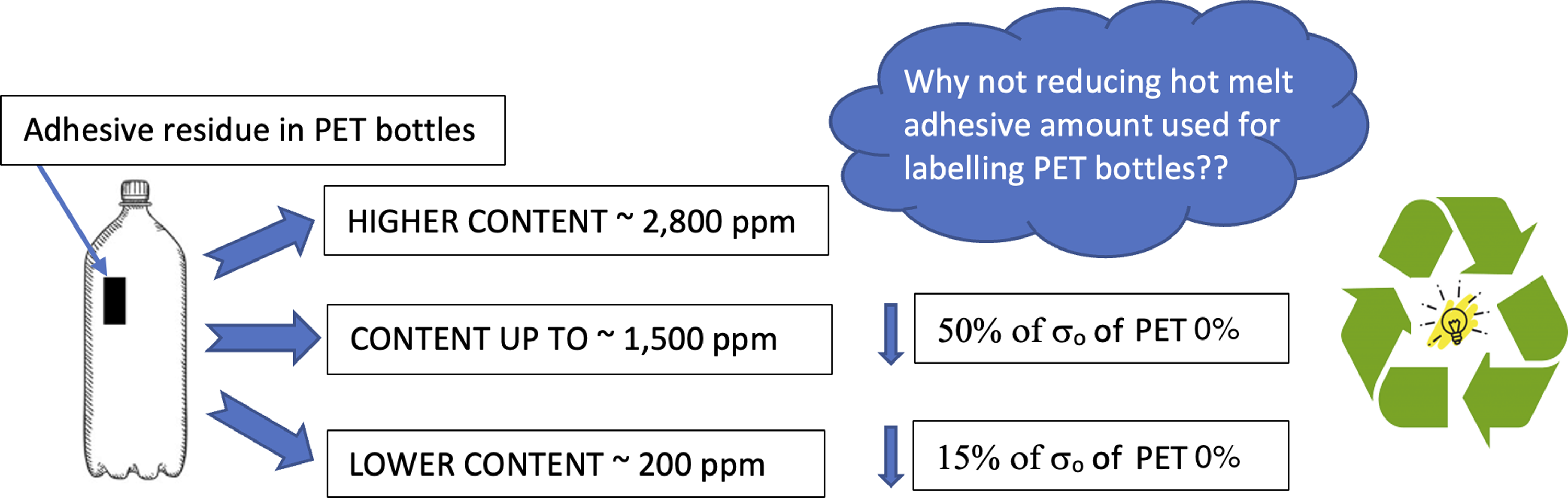
Although the consequences of adhesive residues from post-consumer Poly(ethylene terephthalate) (PET) beverage bottles on the performance of recycled products are known, the quantitative effects of these adhesives are not well-stablished in the literature. Therefore, these residues were determined by gravimetry, and the adhesive content range from 200 to 2800 ppm in post-consumer PET bottles, depending on the drink filled. Through FTIR analysis, it was determined that the adhesives for bottles labelling are composed by poly(ethylene-co-vinyl acetate) (EVA). Based on these results, recycled PET with 0, 200, 700, 1500 and 3000 ppm of hot-melt EVA were processed in an internal mixer connected to a torque rheometer at 265°C for 10 min. Tensile tests indicate that 200 ppm of adhesive reduced PET tensile strength by 15%. Furthermore, when about 1500 ppm of adhesive is present, PET mechanical properties are reduced by 50%. Therefore, it is of utmost importance to warn the PET bottle production chain to reduce adhesive content used in labelling so that it should not exceed 200 ppm, if a high quality recycled PET is desirable.
Get full access to this article
View all access options for this article.