



Abstract
We propose there may be a risk of both formal (police) and informal (parents and teachers) detection for group crimes, and that this risk may be conditional on the age composition of the accomplices. Using a crossnational data set on self-reported delinquency, we investigate patterns of detection across 11 crime types. Our findings confirm the presence of a formal group hazard and reveal that informal detection is both more and less likely than solo crime depending on the offense type. This study expands our conception of the group hazard hypothesis and calls attention to the possible consequences of differential detection of delinquency.
Scholars highlight the group nature of crime, particularly among juveniles (Reiss and Farrington, 1991; Warr, 2002), though some question whether it reflects measurement bias. Both Hindelang (1971, 1976) and Erickson (1971) argued that a ‘group hazard’ exists, whereby crimes committed in groups are more likely to be detected by police and end up in official records. The suggestion is that police may believe group behavior signals violence and unpredictability, warranting particular scrutiny (Hindelang, 1976; Morash, 1984). Overall, research on the group hazard is limited in scope, which is unfortunate given its potential impact. As Hindelang (1976) argued, it can shed insight on whether, and under what conditions, official statistics provide a distorted sense of group crime (Lantz, 2020). Moreover, being ‘detected’ by law enforcement carries notable consequences for youth. Research documents that having the formal label of delinquent/criminal is associated with more offending in adulthood, even when accounting for prior delinquency (Bernburg and Krohn, 2003; Bernburg et al., 2006; Cauffman et al., 2021). This dovetails nicely with research suggesting individuals who co-offend tend to be more embedded in the criminal milieu and have more persistent criminal careers (Andersen, 2019; Lantz and Hutchinson, 2015). It is possible that the group hazard heightens the probability of labeling for youth who offend in groups, thereby increasing the risk of continued offending (Bernburg et al., 2006).
The extent to which the group hazard is specific to law enforcement or instead reflects a more general social response to the context of offending is unclear. This limits our general understanding and also raises the possibility of a complementary process of differential informal labeling of group offenders by agents of informal social control (e.g., teachers, parents). Given that informal deviant labels can also reduce prosocial opportunities, alter interpersonal relationships and redefine one's self-concept in negative ways (Lemert, 1967; Rowan et al., 2023; Wiley et al., 2013), this is worthy of inquiry. Scholarship thus far has not expanded to informal domains, with the exception of one descriptive piece (Enzmann, 2012). Thus, we aim to extend inquiries of the group hazard hypothesis by estimating whether group and solo incidents of delinquency have differential rates of detection by agents of formal (e.g., police) and informal (e.g., teachers, parents) social control.
The (formal) group hazard hypothesis
In summarizing prior research using official records, Erickson (1971) observed that between 70 and 80 percent of (male) delinquency involved more than one offender. In the 1970s, scholars raised the possibility of a ‘group hazard’, such that group crime is more likely to be detected by law enforcement than is solo crime. As an initial commentary on this question, Erickson (1971) sampled males who were on probation, institutionalized or enrolled in high school, and Hindelang (1971) sampled males enrolled in high school. Both researchers found group crime occurred frequently, though it was less dominant than prior work using official records had documented, leading them to support the group hazard hypothesis and subsequently caution researchers about using official data in estimating the prevalence of group crime. More recent work suggests group hazards can apply to an array of police interactions (e.g., frisk, search, arrest, use of force; Cooley et al., 2020) and that the hazard varies in systematic ways across crime types (Lantz, 2020).
The mechanism underlying the group hazard hypothesis goes unaddressed in most work (e.g., Erickson, 1973; Feyerherm, 1980), but Hindelang (1976) framed it as agents of the criminal justice system using the group nature of crime to inform their choice to take official action. Police attention and the discretion to intervene with suspected offenders involves the consideration of a constellation of factors in the face of limited time and information (Bolger, 2015). In the context of the operational constraints, cognitive shortcuts used by police to make decisions have been linked to stereotypes or other assumed patterns of behavior associated with minority, lower socio-economic, male individuals (Alpert et al., 2005; Kahn et al., 2017; Pickett, 2018). There are reasons to expect that the presence of multiple suspected offenders may also affect an officer's perception of threat. Skolnick (1966: 45) argued that police identify ‘symbolic assailants’ that ‘use gesture, language, and attire that the policeman has come to recognize as a prelude to violence’. If the presence of multiple persons is perceived as being more risky or violent, the likelihood of intervention by police may be greater. Morash (1984) argued that police, via on-the-job socialization, learn a ‘theory’ of what cues are suggestive of criminal activity or dangerousness, which then prompts suspicion and intervention. Morash (1984: 99) observed that ‘youths’ peer group characteristics also can serve as cues that members are delinquent by suggesting that members are a threat and increase members’ visibility to the police. In short, when youth are in groups, it is a signal to police that they may be engaged in delinquency and, as such, they are more likely to pay attention and intervene. Given evidence that incidents involving multiple offenders result in more serious bodily harm (Lantz, 2020), experience may generate schemas that become activated when officers interact with groups (e.g., Good and Brophy, 1990; Rubinstein, 1973).
Hindelang (1976) offered empirical commentary on this argument in his survey of 69 sheriffs’ deputies from an agency in the metropolitan Southwest. Deputies reported they were more likely to arrest a juvenile suspected of delinquency when they were subject to verbal abuse; importantly, nearly all deputies (96%) thought such abuse was more likely when youth offended in groups rather than alone. The deputies also believed that juveniles were generally more likely to engage in delinquency in groups. Ultimately, this means that the group hazard could emerge from how formal justice actors perceive threats. It is reminiscent of Erickson's (1962 : 308) argument that ‘it is the audience which eventually determines whether or not an episode of behavior or any class of episodes is labeled deviant’, with youth offending in groups being more likely to be noticed and defined as deviant.
The formal group hazard may also stem from accomplices informing on one another to the police. One of the uncertainties of group crime is that accomplices who feel they will accrue an advantage from ‘snitching’ could introduce vulnerabilities that would not exist in a solo crime (McCarthy et al., 1998). This perspective depends not on the discretion or actions of police per se (or other formal social agents), but instead on the idea that group crimes carry the risk of betrayal after the fact. Snitching may be more likely with certain crimes (e.g., violent, those with tougher sanctions), as the possibility of greater punishment may incentivize informing on others to hopefully gain some kind of favor (Lantz, 2020). For instance, Alarid et al. (2009) observed in interviews with convicted robbers that their accomplices’ actions, including snitching, contributed to a subject's arrest after the robbery was committed. The extent to which this actually feeds into a potential group hazard is unclear, but given that both game theory and prior scholarship invoke snitching as an important risk of co-offending (McCarthy et al., 1998), it certainly deserves acknowledgement.
From a logical standpoint, it is also possible that group crime is simply more visible. Solo offenders arguably have the ability to be more discrete (e.g., one person breaking into a car can more easily hide from unexpected traffic or pedestrians), raising the chance that group crime is more noticeable, which raises the risk of detection. If this visibility brings police attention, the odds of detaining any single offender in a group may be higher than with a solo crime, thereby feeding back to the risk of snitching and more offenders being detected by official means.
An ‘informal’ group hazard?
If being ‘detected’ runs the risk of accruing deviant labels, then scholars should consider whether group offending carries a hazard for both formal and informal detection. After all, informal antisocial labels also produce meaningful negative outcomes that can extend into later life (Lee et al., 2017; Triplett and Jarjoura, 1994). Further, understanding whether a group hazard applies for both formal and informal agents of social control moves the discussion beyond a caution of relying on official records in estimating group crime rates to one that considers whether differential detection is a more general social phenomena. In short, it broadens the ‘group hazard’ question to one of social responses to crime across various agents of social control.
Thus far, research on the group hazard has almost exclusively focused on formal detection, with one notable exception. Although it does not frame the investigation from a group hazard perspective, Enzmann (2012) provided a detailed description of several social responses to offending as documented in the Second International Self-Reported Delinquency Study (ISRD-2; Enzmann et al., 2015), including reporting victimizations to police, punishment and detection of offending. The data allowed Enzmann to document the likelihood that offenses were detected formally by police and informally by parents across a variety of factors, including whether it was a group or solo offense. When looking at assault, vandalism and shoplifting, he found that youth who reported participating in a group offense were more likely to be detected by police than were those who offended alone. However, parental detection was in the opposite direction: youth who engaged in solo offenses were approximately twice as likely to be detected than were those who participated in group offenses (see Figure 6.12 in Enzmann, 2012). This is a curious finding as it stands in contrast to another related study. Using the NCVS, Lantz and Wenger (2024) investigated whether people are more likely to report criminal incidents to the police if there were multiple offenders, arguing that a group of offenders may be perceived as more dangerous by victims. They found that events involving more than one offender are more than 70% more likely to be reported to the police compared to incidents involving a single offender. Of course detection and reporting to the police are different matters, but this divergence suggests additional work on informal detection may be clarifying.
When considering whether an informal group hazard should exist from a theoretical perspective, it is decidedly less clear than in the formal detection space. If one appeals to Sampson and Groves’ (1989) extension of social disorganization theory, it raises the possibility that communities may view (deviant) teenage peer groups as dangerous. 1 In their theory, there is a recognition of the perceived importance of teenage peer groups in the idea that they can be a manifestation of incivility in neighborhoods and contribute to negative consequences for individuals navigating these spaces (Blasko et al., 2015; Taylor et al., 2011; Wilson, 1968). Still, the focus is not on whether individuals are more likely to observe or intervene with problematic teen group behavior relative to individual problem behavior. Moreover, one should also recognize that hanging out in peer groups is normative part of adolescence (Warr, 2002) and that informal agents of social control may be likely to simply excuse the presence of groups as a normative aspect of social routines among adolescents. Thus, the extent to which informal agents may frame groups as more dangerous or unpredictable is unclear, given the expectation that socializing in groups is an expected part of youth development.
Turning to the other potential sources of a group hazard, one might argue that the perceived stakes of being detected informally are lower and therefore the likelihood of snitching would be diminished. After all, the criminal justice system carries the risk of serious formal sanctions that can dramatically disrupt multiple life domains for youth. Again, however, an alternate view is also quite possible. After all, informal social consequences such as school-based punishment (e.g., detention, suspension), the removal of privileges by parents and/or suffering parental or teacher disapproval, can also be very salient for youth. To be sure, work on decision-making notes that anticipated informal social costs can affect the choice to offend more than the perceived risk of arrest (Grasmick and Bursik, 1990), and if informing on accomplices offers the chance to reduce those costs, it could be enticing. Regarding the other avenues of detection, it may indeed be the case that group crime is simply more visible for informal actors as with formal agents of social control, but the possibility remains that parents and teacher may simply excuse the presence of groups as a normative social part of adolescence. In short, the extent to which an ‘informal’ group hazard may exist is unclear and warrants additional attention.
Current study and hypotheses
This study seeks to expand our understanding by investigating whether group crimes have a higher likelihood of detection among agents of both formal and informal social control. In doing so, it adds to Enzmann's (2012) earlier study by leveraging the same ISCD-2 data and expanding the analysis in several ways. To start, like Enzmann, we recognize that aggregate analyses pooling all offending together may mask important differences. Indeed, it is well documented that the rate of co-offending differs across crime types (Reiss and Farrington, 1991), with recent research indicating that the group hazard likewise varies across crime types (Lantz, 2020). This variation may be due to the notion that snitching may be more likely when severe sanctions are possible (e.g., with more serious crimes; Lantz, 2020) or that certain behaviors may intersect with the group condition to amplify police suspicion (Skolnick, 1966). Moreover, the extent to which informal actors (e.g., parents, teachers) may be apt to view youth groups as dangerous or a normative part of adolescence may depend upon the behavior under consideration, as may the tendency to ‘snitch’ in informal domains. Although Enzmann (2012) considered three crime types, we leverage the data to investigate formal and informal group hazards across eleven crime types, offering a broader view of this social response to offending.
Next, we also consider whether the age of accomplices impacts the group hazard, given that it may be an important moderator. Using NIBRS data, Lantz (2020) found that there was an amplified risk of arrest for offending groups compared to solo offenders, but this was only true for juveniles and not for older offenders. Lantz instead suggested that adult offending groups may generally be ‘protected’ against the group hazard (though there was heterogeneity across offense types). At the same time, however, group incidents that involve a mix of adolescents and adults may be more hazardous. According to Lofland (1968), efforts to control deviance through arrest or other forms of social control will be selectively focused on those individuals perceived to be a serious threat to the physical or material well-being of others. Although Lofland (1968) attributed greater potential harm to the presence of older youth, this was due to his view that older youth are less likely to be perceived as immature and generally are larger in stature. It would follow that adults who are both legally more culpable and physically developed could be perceived as equally if not more threatening. For instance, Lantz (2021) found with NIBRS that incidents involving young adult co-offenders were more likely to result in serious injury to the victim than those involving juveniles. Further, though adult accomplices may offer several benefits to young offenders (e.g., relatively more expertise and experience), they may also pose greater risks of betrayal. Adult offenders may have enough experience to understand that informing on someone else to the police could benefit them in tangible ways. In fact, snitching on someone who is a minor may be preferred by adult offenders due to the less severe consequences of a minor being held criminally responsible. Somewhat related, Lantz and Wenger (2024) found in the NCVS that incidents involving more than one juvenile offender were more likely to be reported to police than those with solo juvenile offenders, but that group incidents involving adult offenders were more likely to be reported to police than were group incidents involving only youth. If one interprets the tendency to report as an indication of how serious individuals consider a situation to be, it would suggest that offending groups of youth are deemed relatively less serious than mixed groups including adults. Given the limited and mixed empirical indications on this front, we believe incorporating a focus on the age composition of the co-offending group could provide important insights on the group hazard hypothesis regarding both formal and informal agents of social control.
Finally, we expand on Enzmann's (2012) initial inquiry by specifying regression models that account for a host of covariates, as well as expanding our definition of informal detection. The descriptive patterns Enzmann discusses offer important insight, but it is unclear whether such patterns hold up when controlling for factors that may be related to co-offending and detection. Shifting to this multivariate approach simply provides a firmer base from which to draw inferences. Further, when considering the group/solo crime distinction, Enzmann compared police and parental detection. The data have information on another agent of informal social control—teachers—which we include in our analysis to more broadly speak to the informal group hazard.
In the end, these approaches allow us to test several hypotheses. First, given prior work and theory, we hypothesize that group offenses are more likely to be detected by police than are solo offenses (formal detection; Hypothesis 1). We also anticipate that this pattern will differ across crime types (Hypothesis 2). Despite the limited and somewhat mixed evidence on the age composition of the accomplice group, on balance, we believe that youth who have adult accomplices are more likely to be formally detected than are those with (only) fellow youth as accomplices (Hypothesis 3). Regarding detection by informal agents of social control, we offered reason to question whether group crimes have a higher likelihood of detection than solo crime (Hypothesis 4), or perhaps have a lower likelihood of detection than solo crime (Hypothesis 5). The aforementioned discussion raises the possibility that different crime types will also be differentially detected by parents and teachers (Hypothesis 6). Finally, given that having adult accomplices may challenge the ability of parents and teachers to dismiss group behavior as a normal part of adolescence, we believe that youth with adult accomplices will be more likely to be informally detected as compared to those who offend with (only) fellow youth (Hypothesis 7).
Data and methods
Sample
The current study uses data from ISRD-2 (2005–2007), accessed via the Inter-university Consortium for Political and Social Research [distributor], 2015-01-09. https://doi.org/10.3886/ICPSR34658.v2 (Enzmann et al., 2015). This survey of nearly 73,000 students in 7th through 12th grade focuses on exploring correlates of delinquency and victimization. The survey sites selected in each of the 31 countries were based on a two-tiered process. First, researchers selected cities/towns that were considered ‘typical’ for each country with the goal of having five sites per country based on size, degree of urbanization and demographic and economic factors. The second stage involved a stratified random selection of seventh to 12th grade students from public, private, vocational, technical and academic schools in each site. The overall response rate was approximately 74% (Junger-Tas and Marshall, 2012). More study details are available at: https://www.icpsr.umich.edu/web/NACJD/studies/34658/datadocumentation.
Measures
Group offending
Our unit of analysis is the incident given that we are interested in whether criminal events involving a group of offenders are more likely to be detected than events involving one person. Respondents were asked to report whether they have engaged in 18 offenses, including illicit substance use, property crimes, violent crimes and internet-based crimes; we excluded hacking and downloading music or movies as the detection mechanisms for these online behaviors are likely distinct from in-person offenses. Group fighting was excluded as this behavior involves co-offending by definition. We exclude items on hard liquor and beer/wine because the social meaning/deviance of this behavior can vary meaningfully across social contexts. Additionally, weapon offenses and two items related to hard drug use (i.e., heroin, coke, LSD) were excluded due to the substantial amount of missing data. This results in the inclusion of 11 total offenses: using marijuana, selling drugs, assault, snatching property off of someone, robbery, shoplifting, motor vehicle theft, theft of items from a vehicle, stealing a bike or scooter, vandalism and burglary.
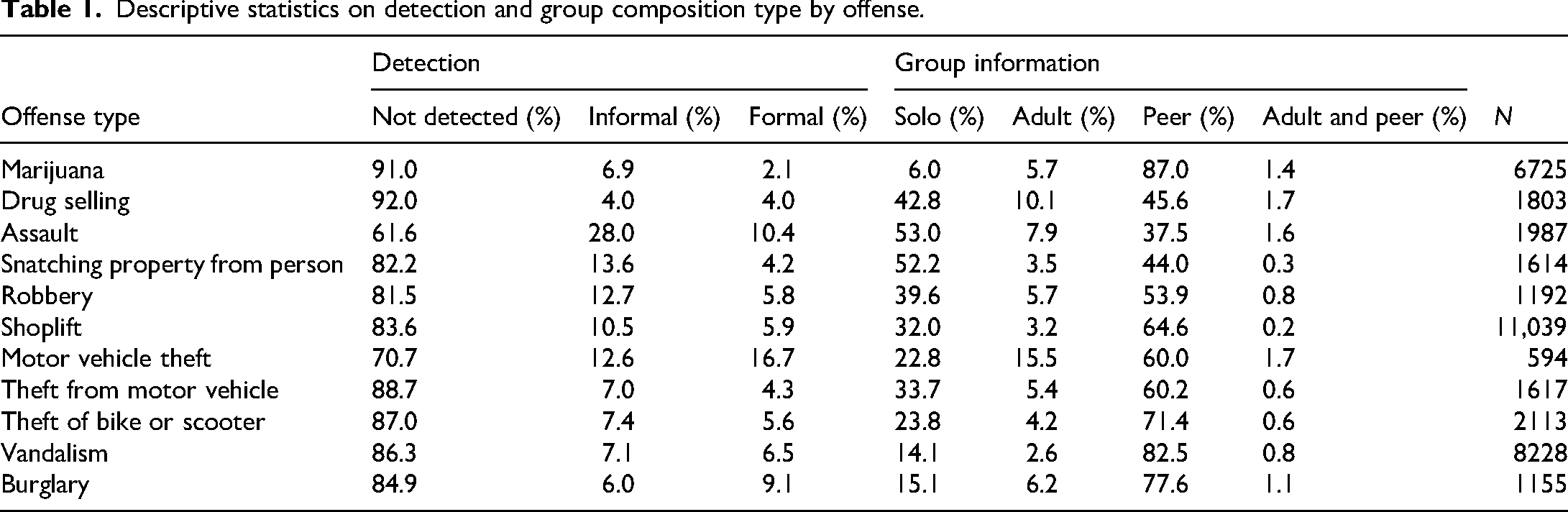
For each crime type category, respondents who indicated they had engaged in that offense were asked, ‘The last time, did you do it alone or with others’ and could select more than one option from the following: ‘Alone; with other kids; with adults’ (note that respondents were able to select both accomplice types). Asking about the most recent offense carries the advantage that detection rates are independent from offending (Enzmann, 2012). But, it also carries the disadvantage that subjects may report on the most memorable offense rather than the most recent, and offenses may be more memorable when they are committed with others and/or detected. Table 1 provides a description of the level of group involvement and co-offending partner type for each offense type.
Descriptive statistics on detection and group composition type by offense.
Offense detection (group hazard)
The ISRD-2 assess detection by asking respondents who reported engaging in an offense whether, ‘The last time [they engaged in X offense], were you found out?’. Subjects could answer with the following options: ‘No; by my parents; by the police; by a teacher; by someone else’. 2 Formal detection included instances where offenses were ‘found out’ by the police. Detection of offenses by parents or teachers was combined to reflect informal detection. It is unclear who falls under the category of ‘someone else’ as it is possible that both more formal sources of control (i.e., security guards) and informal sources (i.e., other peers) could be included in this category. Therefore, our measures of detection do not account for being found out by ‘someone else’. For each crime category, we use a categorical indicator for the type of detection across offenses that an individual engaged in (0 = no detection, 1 = informal detection, 2 = formal detection).
Covariates
We account for several factors that may be related to both group offending and the likelihood of potential detection. 3 Prior work has indicated that individuals who are more impulsive have an increased likelihood of coming into contact with law enforcement (Beaver et al., 2009); thus we anticipate that lower self-control may be associated with higher levels of detection. We account for low self-control using participants’ responses to 12 of the original 24-item index of self-control created by Grasmick et al. (1993). Respondents were asked to report how strongly they agreed or disagreed with each statement (e.g., I act on the spur of the moment without stopping to think). A mean score of these items was generated to produce a measure of self-control such that higher values correspond to lower levels of self-control (α = .83, factor loadings range from .40 to .68). 4
Victimization has been linked to greater involvement in group offending (Charette and Papachristos, 2017), which may contribute to greater rates of being known to agents of social control (e.g., higher levels of victimization are likely to be positively associated with detection). We include a summary score of victimization across four deviant behaviors (e.g., robbery, assault, theft and bullying) over the last 12 months. Next, given the variation in geographic context, as well as evidence to suggest a relationship between neighborhood context and youth co-offending (Rowan, 2023), we account for neighborhood disorganization. Five items that capture the degree to which respondents agree with statements that describe their neighborhood (e.g., There is a lot of crime in my neighborhood) were used to generate an average disorganization score (α = .82, factor loadings range from .48 to .79). Given the prior literature connecting social disorganization to police presence and collective efficacy, both of which can relate to detection, we believe accounting for this control is important. Respondent attitudes towards violence were also included as a covariate to account for overall support for violent acts, which may be indicative of a willingness to participate in behavior that is more likely to come to the attention of formal and informal sources of detection (Lantz, 2021). A mean score of four items that capture the degree to which respondents agree with statements of violent behavior done by young people was generated (α = .72; factor loadings range from .50 to .71; e.g., a bit of violence is part of the fun).
Youth who are more highly attached to their family may be more likely to be informally detected due to time spent with parents (Costello and Laub, 2020). The average of two items was used to generate an overall family bonding score with higher scores indicating greater family bonding (e.g., how well they usually get along with the man and woman that they live with) (
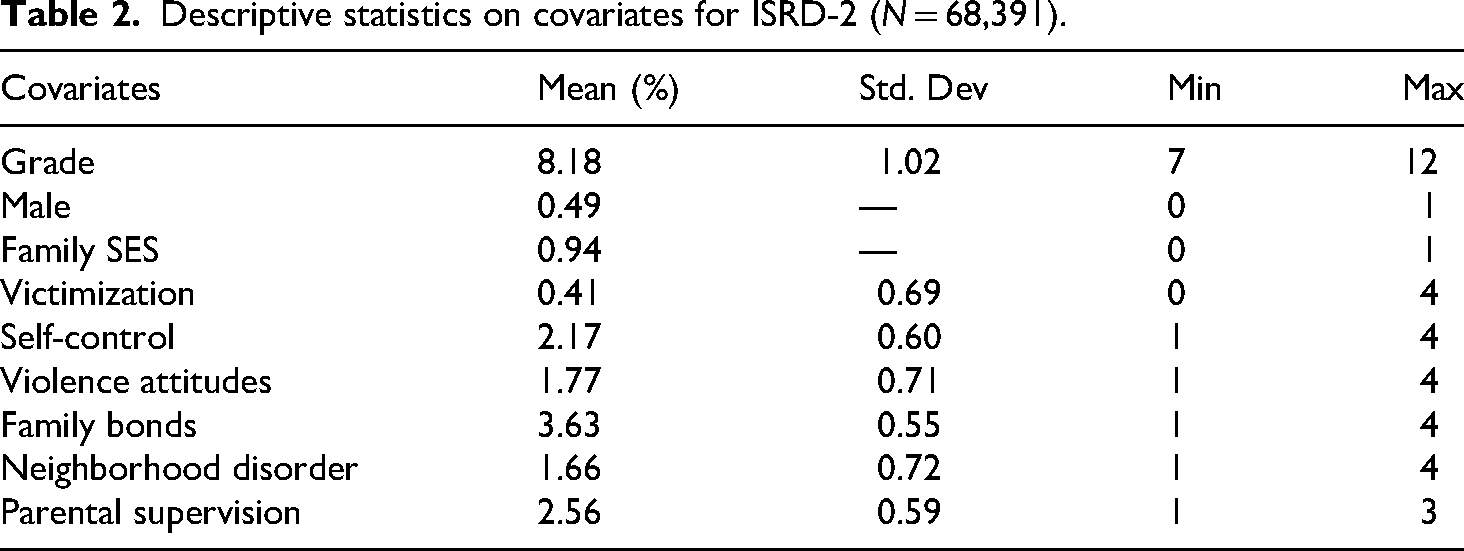
Given the relationship demographic factors have with offending, police attention and sanctions by agents of social control (Tapp and Davis, 2024), we account for age, gender and socioeconomic status (SES). We include a measure indicating the grade-level of respondents as a proxy for the age of youth. We also account for the gender of respondents (female = 0, male = 1) and include a categorical indicator of parental employment to serve as a proxy for SES (0 = both parents do not have stable employment, 1 = at least one parent has stable employment). 5 For all analytic models, we use list-wise deletion to handle missing data, which ranged from less than 1% to 8% across cases. Table 2 presents descriptive statistics on the covariates for the ISRD-2.
Descriptive statistics on covariates for ISRD-2 (N = 68,391).
Analytic strategy
First, we evaluate the extent to which there is a group hazard of detection across crime types by regressing detection type (i.e., not detected, informally detected and formally detected) on a dichotomous indicator of whether the incident involved co-offenders. Second, we explore whether the group hazard varies by accomplice age by including a variable that distinguishes adult-only co-offending, youth-only co-offending and a combination of adult and peer co-offending (all compared to solo offending). Our main outcome of interest, the source of detection, is a nominal outcome and youth are nested within both country and school. To account for these complexities, we use generalized structural equation modeling to estimate multinomial logistic models across crime types that regress detection type on co-offending partner type, relevant covariates and random country effects (Rabe-Hesketh et al., 2004). Due to the hierarchical nature of the modeling strategy and our primary interest in level-one effects (i.e., individual involvement in group offending), all variables were group-mean centered to capture only within-cluster variation and remove between-cluster variation (Enders and Tofigh, 2007).
Results
Coefficients in our analytic models are converted to relative-risk ratios and should be interpreted as the probability of the outcome in each group (i.e., informal detection, formal detection) relative to the outcome of the referent category (i.e., no detection). Relative-risk ratios greater than one indicate the probability of the outcome for the comparison group relative to the probability of the referent category increases as a predictor increases (Long and Freese, 2014). Given the primary focus on formal detection in the conceptualization of group hazard, we first present the main models examining formal group hazard first and then follow with informal group hazard. Next, similar models are presented that focus on detection type by age of co-offenders. We further estimate the average marginal effects for the main independent variables that were statistically significant in the models in order to assess the magnitude of the effects. Finally, all models were run with the aforementioned covariates, but they are not part of the tables given space constraints.
Table 3 presents the results examining the formal group hazard for all crime types presented as relative-risk ratios and average marginal effects. Results suggest mixed support for Hypothesis 1. Using marijuana, engaging in robbery, engaging in motor vehicle theft and burglary were no more likely to be detected when committed in a group than when committed alone. For most other crime types, however, incidents involving co-offenders were significantly more likely to be detected by police. Average marginal effect analyses indicated that engaging in co-offenses increased the likelihood of formal detection by police from three percentage points (selling drugs) to seven percentage points (theft from vehicle, bike and scooter theft). Though such differences are small, when combined with the fact that some crime types displayed no group hazard, this offers some degree of support for the notion that different crime types will have different formal detection risks (Hypothesis 2).
Formal detection regressed on group offending (versus offending alone) by crime type.
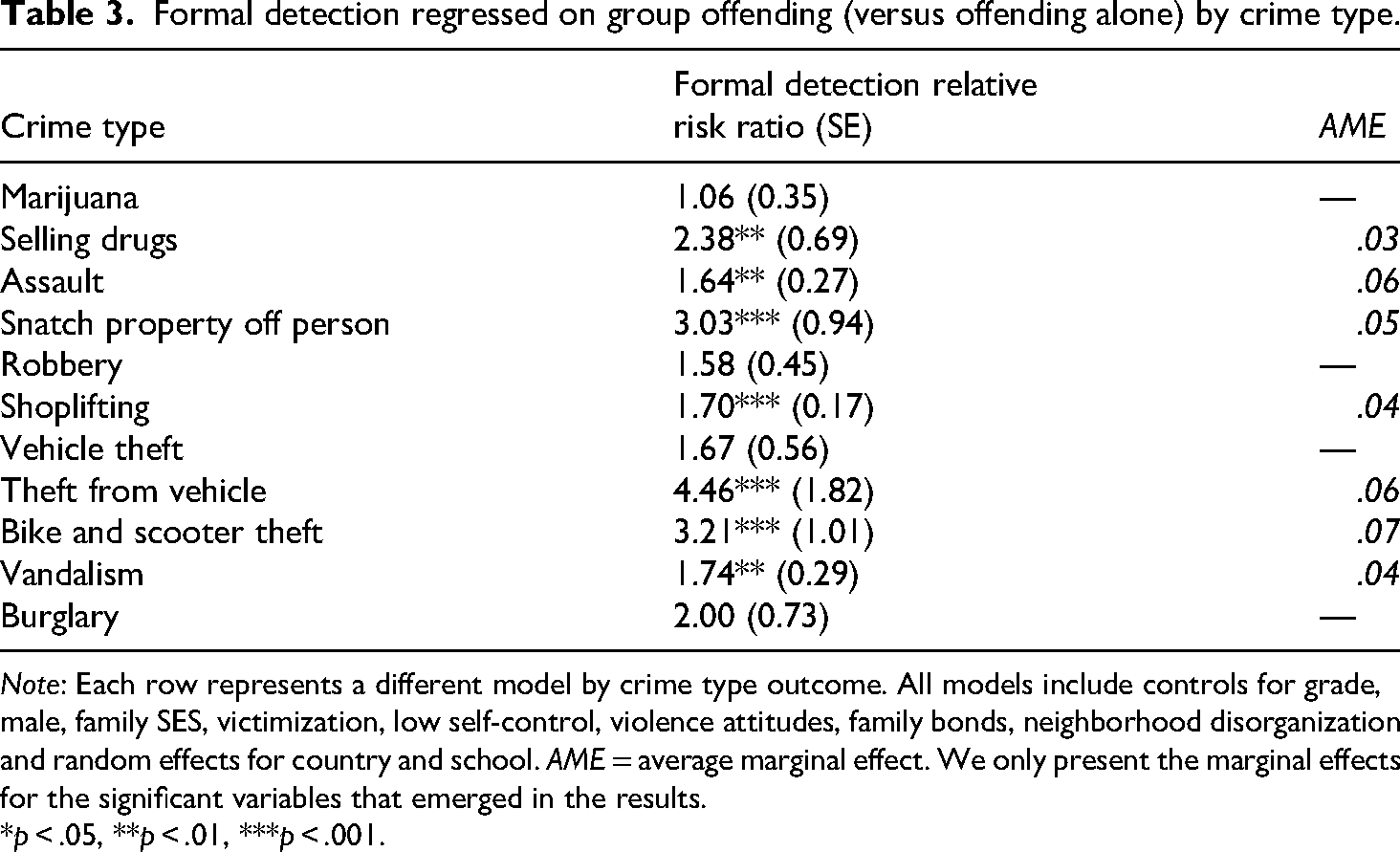
Note: Each row represents a different model by crime type outcome. All models include controls for grade, male, family SES, victimization, low self-control, violence attitudes, family bonds, neighborhood disorganization and random effects for country and school. AME = average marginal effect. We only present the marginal effects for the significant variables that emerged in the results.
*p < .05, **p < .01, ***p < .001.
Table 4 presents the models testing whether there is an informal group hazard across all crime types. Results reveal partial support for both Hypothesis 4 and Hypothesis 5, indicating that youth who engaged in marijuana use, assault, robbery, shoplifting and vandalism with accomplices had a significantly lower relative-risk of being informally detected than youth who engaged in these offenses alone. For other offense types (snatching property off person, vehicle theft, theft from a vehicle, bike and scooter theft and burglary) there were no significant increases or decreases in detection associated with offending in groups. In contrast, selling drugs with others led to a significant increase in informal detection. Therefore, consistent with Hypothesis 6, informal detection varied across crime types. Among those offenses for which offending in groups decreased the risk of detection, the average marginal effect analyses indicated reductions in informal detection ranging from five (robbery) to 14 percentage points (assault).
Informal detection regressed on group offending (versus offending alone) by crime type.
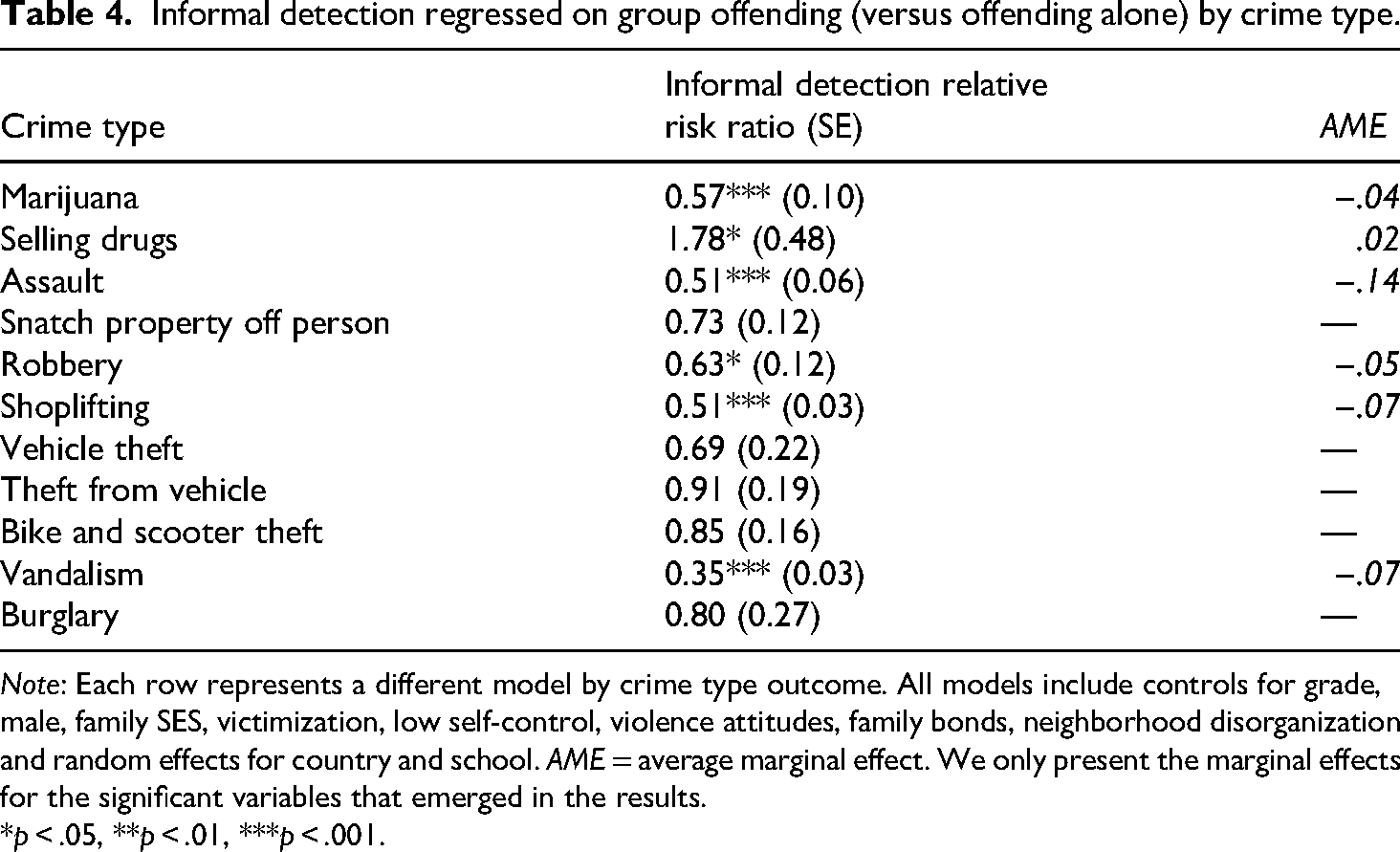
Note: Each row represents a different model by crime type outcome. All models include controls for grade, male, family SES, victimization, low self-control, violence attitudes, family bonds, neighborhood disorganization and random effects for country and school. AME = average marginal effect. We only present the marginal effects for the significant variables that emerged in the results.
*p < .05, **p < .01, ***p < .001.
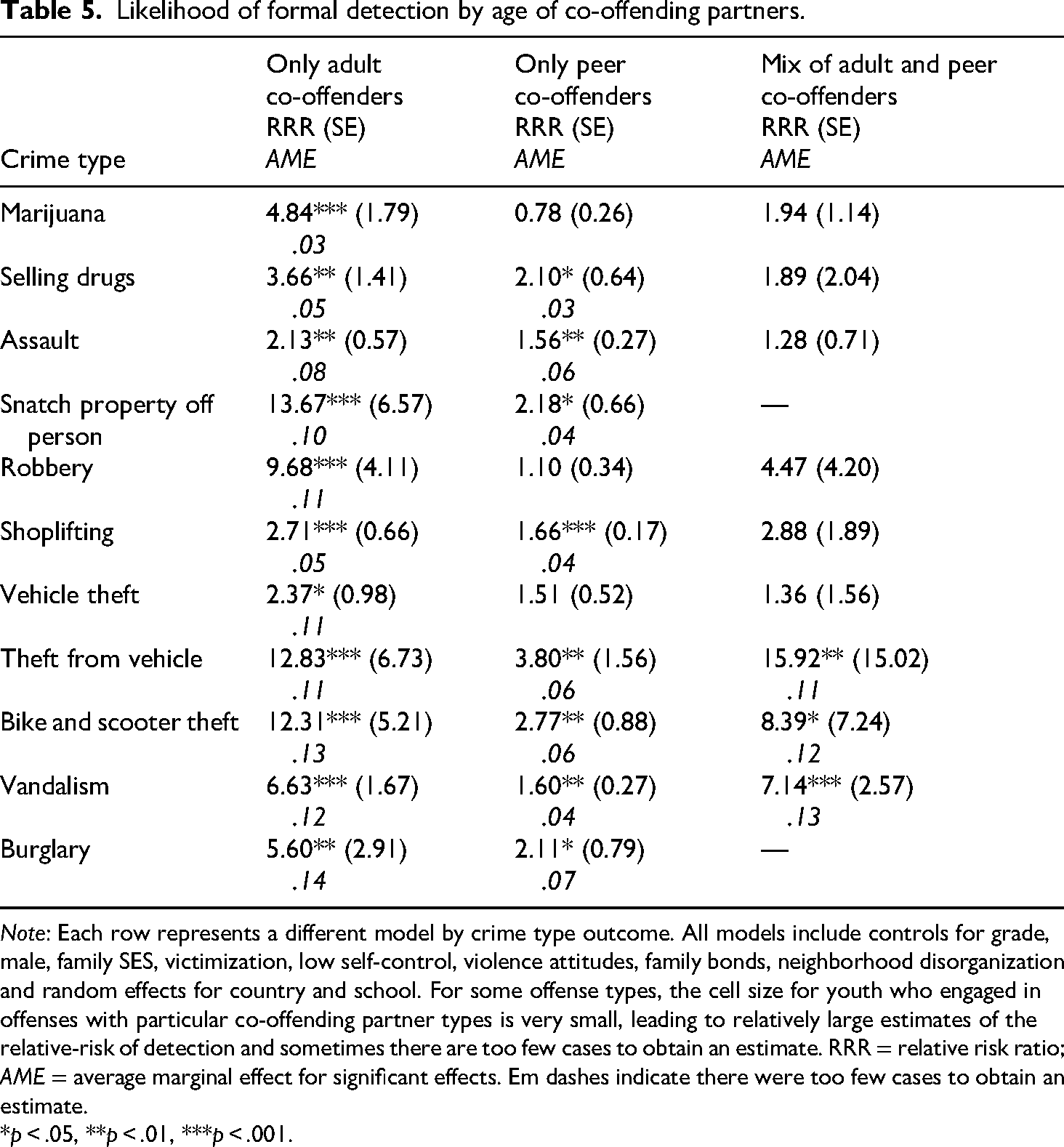
Table 5 presents the results for the formal group hazard effect by the age composition of co-offenders, as well as the average marginal effects for relationships that were statistically significant. For all crime types, youth who offend with only adults are at a heightened risk of formal detection compared to when they offend alone. This is the only co-offender age category for which we see a consistent, nearly universal pattern, therefore providing support for Hypothesis 3. Compared to the models in Table 3, which considered the general group hazard across all co-offender age profiles, the effects in these models are notably stronger in magnitude. For example, snatching property off of persons with adult co-offenders increases the probability of formal detection by ten percentage points (see Table 5) compared to five percentage points for engaging in this offense with others regardless of partner type (see Table 3).
Likelihood of formal detection by age of co-offending partners.
Note: Each row represents a different model by crime type outcome. All models include controls for grade, male, family SES, victimization, low self-control, violence attitudes, family bonds, neighborhood disorganization and random effects for country and school. For some offense types, the cell size for youth who engaged in offenses with particular co-offending partner types is very small, leading to relatively large estimates of the relative-risk of detection and sometimes there are too few cases to obtain an estimate. RRR = relative risk ratio; AME = average marginal effect for significant effects. Em dashes indicate there were too few cases to obtain an estimate.
*p < .05, **p < .01, ***p < .001.
Turning to incidents in which respondents offended with fellow youth, more than half of the crime types demonstrate a formal group hazard effect, whereas the rest suggest a null relationship. For selling drugs, assault, snatching property off a person, shoplifting, theft from a vehicle, bike and scooter theft, vandalism and burglary, there is an amplified risk of detection by police if adolescents offend with fellow youth as opposed to alone. For example, engaging in bike and scooter theft with fellow youth increases the probability of formal detection by six percentage points. Finally, when adolescents offend with a mix of youth/adult co-offenders, there is an increased risk of formal detection for instances of theft from a vehicle, bike and scooter theft and vandalism. For example, engaging in bike and scooter theft with a mix of youth/adult co-offenders increases the probability of formal detection by 12 percentage points. Notably, under no condition did offending with others of any age reduce the likelihood of formal detection compared to offending alone.
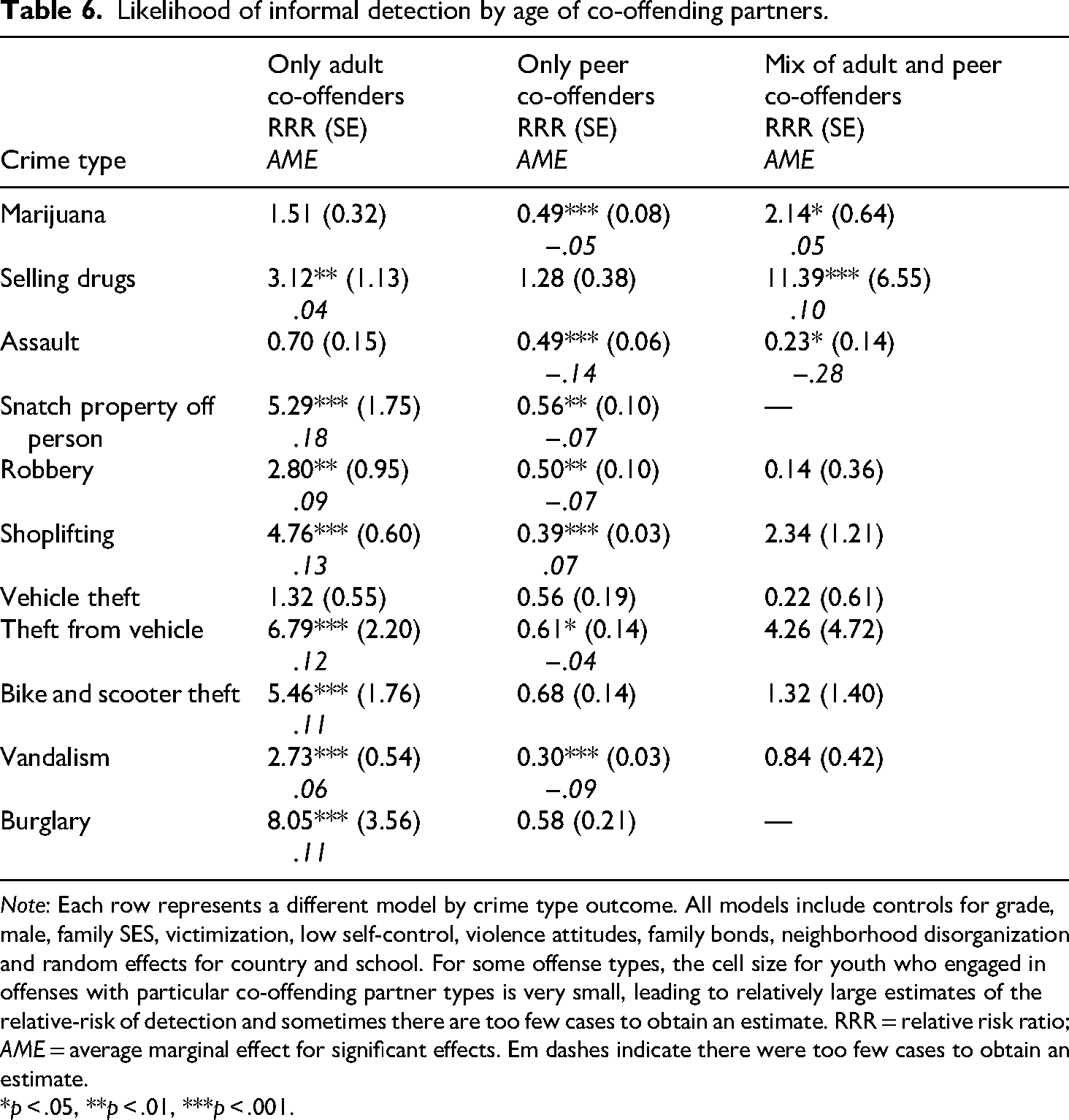
Table 6 presents the results for the informal group hazard effect by age composition of co-offenders, as well as the average marginal effects for statistically significant relationships. In support of Hypothesis 7, the models reveal that youth who engaged in group offenses with adults for selling drugs, snatching property off a person, robbery, shoplifting, theft of property from a vehicle, theft of a bike or scooter, vandalism and burglary, all had a significantly higher relative-risk of informal detection compared to youth who engaged in each of these offense types alone. Indeed, there was a lack of an informal group hazard when offending with adults only for marijuana, assault and vehicle theft. In terms of the magnitude of these hazard effects, the increase in the probability of informal detection ranges from four percentage points (selling drugs) to 18 percentage points (snatching property off person) (see Table 6). Accounting for the age of accomplices therefore reveals a detection pattern that diverges from Enzmann's (2012) descriptive findings and our own prior models in Table 4, as it uncovers conditions when youth are actually more likely to be informally detected when offending in a group as opposed to offending alone.
Likelihood of informal detection by age of co-offending partners.
Note: Each row represents a different model by crime type outcome. All models include controls for grade, male, family SES, victimization, low self-control, violence attitudes, family bonds, neighborhood disorganization and random effects for country and school. For some offense types, the cell size for youth who engaged in offenses with particular co-offending partner types is very small, leading to relatively large estimates of the relative-risk of detection and sometimes there are too few cases to obtain an estimate. RRR = relative risk ratio; AME = average marginal effect for significant effects. Em dashes indicate there were too few cases to obtain an estimate.
*p < .05, **p < .01, ***p < .001.
Turning to incidents in which adolescents co-offend with fellow youth, for all offenses other than selling drugs, vehicle theft, bike/scooter theft and burglary, the risk of informal detection was lower if adolescents offended with fellow youth than if they offended alone. For example, shoplifting with fellow youth reduced the probability of informal detection by seven percentage points compared to shoplifting alone. Respondents who co-offended with a mix of adults and youth were more likely to be informally detected than those who offended alone for marijuana and selling drugs. For example, when youth engage in selling drugs with a mix of adults and youth they are 10 percentage points more likely to be informally detected as compared to offending alone. A negative relationship with informal detection was only observed for assault, such that youth who engaged in assault with a mix of adults and youth were 27 percentage points less likely to be informally detected.
Although our tables focus on the main effects of interest, it is important to note that several patterns with covariates emerged across the models. For a majority of offense types, older youth were significantly less likely to be informally detected. Perhaps unsurprisingly, for most offenses youth who reported greater levels of parental supervision were significantly more likely to be informally detected. Youth who reported greater levels of victimization were significantly more likely to be informally detected for assault, shoplifting and stealing a bike or scooter. In terms of formal detection, the only covariate to consistently emerge as significant was levels of neighborhood disorganization. Finally, for the majority of offense types, youth who resided in neighborhoods with higher levels of disorganization were significantly more likely to be formally detected by police. 6
Discussion
The group hazard hypothesis states that group crimes are more vulnerable to detection by law enforcement than are solo crimes ( Erickson, 1971; Hindelang, 1971). Building on theory and prior work, we questioned whether a group hazard also exists for informal actors like parents and teachers. Using a cross-national dataset, we confirmed the presence of a group hazard for being detected by police across drug sales, various property crimes and several violent crimes. Given that empirical work on the group hazard is mostly clustered around US datasets, replicating its presence here is important as it appears to be a generalizable observation that engaging in co-offenses increases the risk of formal detection by police. Our extension to the risk of ‘informal’ detection revealed more complex findings. We documented that some group crimes were more likely to be detected by agents of informal social control than were solo crimes, but we also observed conditions where offending with accomplices reduced the risk of informal detection (see also Enzmann, 2012). Importantly, our analyses also suggested that one should be careful about making inferences without accounting for the age composition of the co-offending group. With only one exception, having only adult accomplices increases the likelihood of detection by agents of both formal and informal social control. The (1) consistency of this pattern, (2) the fact that the detection effects tended to be of higher magnitude than in the initial aggregate analyses and (3) the fact that in some cases ‘mixed’ accomplice groups where the delinquent act involved at least one adult accomplice also amplified detection risks, all point to the idea that adult accomplices are ‘risky’ for adolescents.
Though speculative, it is possible that this reflects Lofland's (1968) argument that youth can be seen as immature and less physically imposing, whereas older groups can be perceived as more threatening. When youth are in groups with adults, this may raise interest both among formal and informal agents of social control, as it is more challenging to dismiss such activity as a case of youth just ‘hanging out’, prompting greater suspicion and intervention. Further, for youth who engage in group offenses with adults, the greater awareness by adult offenders of criminal justice procedures may also put youth at risk for being ‘snitched’ on. In contrast, we observed numerous instances of a reduced likelihood of detection among informal agents of social control when adolescents co-offended only with fellow youth. Though police often see teenage groups as a signal of illegal activity (Hindelang, 1976; Morash, 1984), informal actors may view them as reflective of normative adolescent social activity that does not warrant suspicion. It is also possible that any motivation among those who engage in delinquency to snitch on accomplices is altered when the offending group is all youth. Warr (2002) argues that the salience of loyalty during adolescence serves as a compliance-generating mechanism that strengthens peer influence. Thus, there may be greater resistance towards snitching amongst youth who engage in crime with their same-aged peers. Or, it may simply be the case that groups of youth are better at eluding the supervision of parents and teachers (Enzmann, 2012). Regardless of the reason why certain group behaviors are less likely to be detected, it is clear that considering the age composition of the co-offending group is critical, as it reveals consistent reductions in informal detection along with a pattern of similar hazards between informal and formal detection when adult accomplices are present. Moving forward, it is therefore important that scholars view the detection hazard of group crime as dependent on the social context of the offending group (Lantz, 2020).
We believe this study provides an important expansion of the group hazard literature by offering insight into both formal and informal detection, but we also acknowledge important data limitations. First, our data contain information from more than 30 countries. This allowed enough data to estimate our models of interest and, because almost all co-offending work uses data from North America or Western Europe, it offers important insight for the discipline. But, it also means that we aggregated across cultural contexts for which there are meaningful differences in the social desirability of and supervision by social control agents over various crimes. As we note, this is why we excluded drinking wine and beer from our analyses, but this heterogeneity could well extend to other crime types. In light of Enzmann's (2012) observation with the same data that the amount of formal and informal detection varies by country, one should be careful to not assume the results observed here apply to each individual country. Moreover, one should not even assume that results per country are representative of the general population. Though data collection tried to sample multiple ‘typical’ towns/cities within each country, no claim can be made about being generally representative. Thus, even in the context viewing cross-national data as an overall benefit, one should appropriately bound the results.
Second, subjects were only asked to report co-offending information for their most recent offense (within multiple crime categories), which is similar to co-offending measures in some other datasets (e.g., Rowan et al., 2018). Focusing on the most recent incident allows for independence from offending frequency, but it also raises the risk that subjects report the most salient event rather than the most recent. As mentioned earlier, it may be that offenses committed with others and/or those that results in detection are more memorable and were therefore more likely to be reported. Next, the age composition of the co-offending group is based on the respondents’ report rather than an officially-confirmed source and therefore reflects the respondents’ beliefs about their accomplices’ ages. Given age was measured as general categories (fellow youth, adults), this may be less concerning than if we were studying more narrow age bands, but it still warrants acknowledgment. Finally, it would have been beneficial to have more covariates that accounted for characteristics of the incident. The hazardous nature of group offending may be linked to features of the environment that facilitate the convergence of group interactions and cross-age socialization (Harding, 2009; Rowan, Appleby and McGloin, 2022). The ‘magnetic’ nature of places that attract group interaction and offending likely also contributes to the presence of agents of social control (Bichler et al., 2014).
In conclusion, we provide cross-national evidence of the existence of a group hazard for both formal and informal detection, notably when youth offend with adults. The findings reaffirm concerns raised by early evidence from self-report data that group offending may be overstated in official data; they also document that offending with fellow youth reduces the likelihood of being detected by parents and teachers. Taken together, these findings demonstrate the variability in the consequences for delinquent youth based on the social circumstances of their offense and raise questions about how these risk and protective effects may impact adolescents’ decision-making about taking on accomplices (McCarthy et al., 1998).
Footnotes

Ethical considerations
The Second International Self-Reported Delinquency Study (ISRD-2) is a publicly available dataset, which does not allow for identification of the participants. As such, the present study was not required to be reviewed by an Institutional Review Board.
Consent to participate
Not applicable.
Consent for publication
Not applicable.
Funding
The authors received no financial support for the research, authorship and/or publication of this article.
Declaration of conflicting interests
The authors declared no potential conflicts of interest with respect to the research, authorship and/or publication of this article.