



Abstract
The intimate presence of state power and the resentments and reactions produced by involuntary confinement mean that the conditions of imprisonment produce and expose various forms of resistance. The literature in this area has tended to focus on highly visible and spectacular episodes of resistance, or on acts that are subtle, disguised, or clandestine. This article seeks to theorise what we call ‘soft resistance’, practices that are expressed in plain sight, and whose intent is to mock, derail or push back against the authorities, but which – crucially – do not breach official rules. Examples include legal challenge and complaints, the use of ‘paperwork’, mockery and disengagement. We argue that soft resistance corresponds with, and exploits the terms of, soft forms of penal power.
Ian was serving a sentence in a medium-security prison. He explained that, when he and other prisoners wanted to get back onto their unit at lunchtime, they had to wait at a locked gate while trying to get the attention of staff, who were normally located in the wing office. Often, Ian said, staff were aware that prisoners were waiting, but took their time to let them in: ‘what they’d prefer is for us to be at the gate […] waiting and waiting, and then eventually when they feel like it, they come’. Many prisoners became impatient, rattling the gate and shouting, which tended only to cause further delays. Ian had developed a different strategy. On approaching the gate, he made eye contact to ensure staff were aware of his presence, but remained quiet. Then, he lay down on the grass adjacent to the gate, at which point, he said, staff appeared almost immediately: It really winds them up. They actually rush out: ‘What are you doing?’ They realise what I’m doing. It's like, ‘no, he's not going to be lying on the grass in the sun’, and they come out and open the gate really quickly.
Officers would tell him that lying on the grass was a breach of the rules, but Ian would politely challenge this, asking them to show him where in the rulebook his waiting horizontally or accessing the grass was proscribed: ‘What rule is that, then? Show me what rule it is’. There was no such rule, and so although Ian felt completely dependent on staff in his everyday existence, his actions – as well as reducing his waiting time – gave him a sense of power and achievement.
Ian's tactics represented a particular mode of resistance that we wish to theorise in the article that follows. As such, we want to highlight some of the key features of these resistant tactics: they are intentional, a considered attempt to push back against the power and logic of the prison system. Notably too, they are not in any way concealed; indeed, they are recognised by the authorities as to some degree resistant. Yet, since they do not breach any institutional rules – that is, are non-violent and are not in a straightforward way ‘oppositional’ – they can evade sanction. In this respect, they draw on and flaunt a close understanding of the terms and nature of penal power, turning its rules and ambiguities against itself. Indeed, our argument is that they should be theorised in relation to what Crewe (2011b) has called ‘soft power’, and are therefore best conceptualised as soft resistance.
Resistance in prisons
The intimate presence of state power and the resentments and reactions produced by involuntary confinement mean that the conditions of imprisonment produce and expose various forms of resistance. In Northern Ireland, for example, the imprisonment of highly politicised prisoner groups, embedded in organised networks beyond the prison, has produced a range of explicit and deliberately communicative resistant acts: protests and refusals (e.g. to work or be locked in cells), riots, escapes, and the murder of prison personnel (see McEvoy 2001; O’Donnell 2023). Elsewhere, in prisons characterised by abusive treatment and staff brutality, resistance has often been expressed through violent and collective disorder (e.g. Carrabine, 2004; Scraton et al., 1991).
Yet these forms of ‘concerted, coordinated’ and collective pushback against the authorities (O’Donnell, 2023: 37) represent only a fraction of resistant practices in prisons, and the study of prisoner resistance – often shaped by Foucault's (1977) emphasis on relatively mundane acts – has moved well beyond these highly visible and spectacular manifestations. As in studies of ‘everyday resistance’ more generally (see, e.g. Johansson and Vinthagen, 2019), most recent accounts of resistance in penal contexts have focused on forms that are concealed or are neither formally organised nor articulated in political terms. Thus, the term resistance has been used to conceptualise a range of practices including verbal and written assertions of personal identity (Bandyopadhyay, 2010; Bosworth, 2017; Bosworth and Carrabine, 2001; Stanford 2004), engagement in prison education (Key and May, 2019), and prisoners’ daily practices of customising personal space or food production (Ugelvik, 2014). Such actions may not alter the fabric of power, but are considered resistant because of the meanings they are given by their protagonists or the ways they defy institutional narratives and assumptions.
As accounts of prisoner resistance have broadened their focus, the matter of what does and does not constitute resistance has become more complex and disputed (Ortner, 1995). Rubin (2015) considers the term ‘resistance’ to have been overused in analyses of imprisonment, encompassing what she instead calls ‘frictions’ – reactive behaviours that result from the pressures and restrictions of institutional life but have no consciously disruptive or political intent. Rule violations, she argues, may simply reflect prisoners’ attempts to make life bearable, or meet their physical and social needs, rather than have any subversive purpose. Ugelvik (2014) advocates for a broader definition, arguing, like the anthropologist James Scott, that resistant conduct does not need to achieve change so much as ‘deny or mitigate’ claims by others (Scott, 1985: 301; 1990). In this formulation, resistance can entail refusing to be fully subjectified as ‘a prisoner’, or protecting personal identity against institutional assumptions, for example, through proving oneself to be principled or autonomous (Ugelvik, 2014).
In an extensive overview of the literature (beyond the context of imprisonment), Hollander and Einwohner (2004) have set out a typology of resistance, organised around variation in intent and recognition on the part of both the target and other external observers, including onlookers, the wider public, and academic researchers themselves – see Table 1.
Types of resistance.
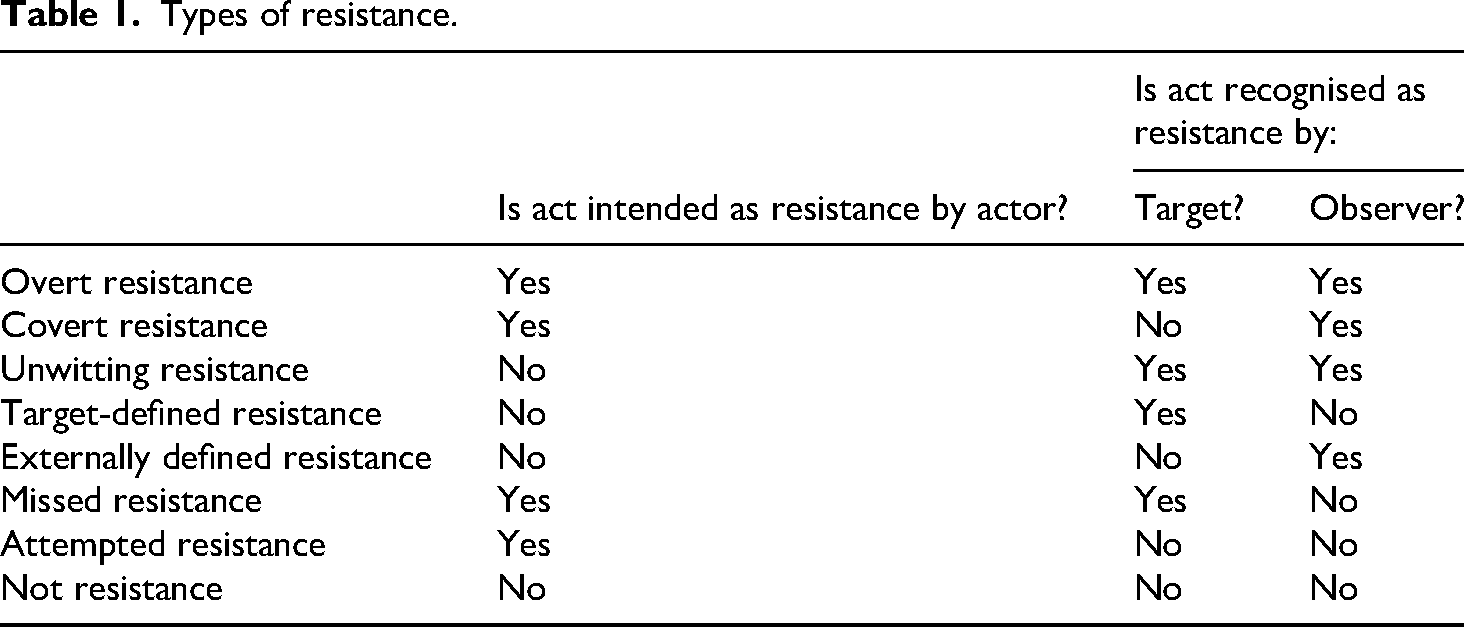
As they note: Some resistance is intended to be recognized, while other resistance is purposefully concealed or obfuscated. Resisters may try to hide either the act itself […] or the intent behind it. (Hollander and Einwohner, 2004: 540)
In their brief summary of forms of overt resistance, Holland and Einwohner identify ‘collective acts such as social movements and revolutions as well as individual acts of refusal’, for example, women resisting domestic work or ‘fighting back physically against sexual assault’ (2004: 545). Acts of this kind are liable to provoke punishment not just because they are unhidden, but because their oppositional intent is expressed through actions, norms and mechanisms that their targets do not approve of. In prisons, for example, to smash up a cell or assault a member of staff is an offence against prison rules, while an insult directed at an officer, even if it does not lead to a disciplinary charge, clearly constitutes a form of dissent. Rubin (2017) asserts that such breaches of what is allowed or expected are the essence of friction (and presumably resistance too): ‘However else we may define friction, a violation of the prison regime's rules or goals is a necessary component’ (p. 654, italics added).
Yet some forms of resistance might be overt without contravening either the rulebook or the principles of the authorities. In prison studies, the best-known example is provided by Thomas Mathiesen in his (1965) text The Defences of the Weak. Mathiesen did not himself use the term resistance, but his idea of censoriousness – defined as ‘criticism of those in power for not following, in their behaviour, principles that are established as correct within the social system in question’ (p. 23) – is often used as a counterpoint to forms of institutional challenge that are either collectively anchored or are evidently oppositional. Based on research in a preventive detention institution in Norway, Mathiesen found that, rather than opposing institutional rules and authority directly, inmates made claims of justice and injustice within the normative framework of the authorities. That is, instead of challenging the basis of the rules, censoriousness entailed pointing an accusatory finger at the officials for failing to uphold their own standards. Such accusations were therefore embedded in some degree of ‘consensus between inmate and staff regarding basic principles’ (p. 12) and broader institutional and societal norms.
Legal action represents another clear example of a challenge undertaken within, rather than against, dominant discourse. Calavita and Jenness (2015) note that prisons are ‘conspicuously legal’ contexts (see also Durand, 2025). Not only do ‘explicit rules govern every aspect of behaviour’ (p. 55), but the law also ‘provides prisoners with a mechanism of redress’ (p. 55). While Calavita and Jenness barely use the term ‘resistance’ to describe appeals to law and justice, like Mathiesen, they suggest that these appeals might be characterised as ‘agentic’ and ‘empowering’ modes of resistance ‘in an otherwise hopelessly asymmetrical context’ (p. 178). Although prisoners in their study expressed concerns that peaceful forms of protest, including the use of claims and complaints, might result in staff retaliation (such as being transferred to another establishment, vindictively searched, or removed from a work placement), even among participants who were wary of ‘trouble’, the majority ‘had at some point filed a grievance’ (p. 67). Conversely, in a recent study of ‘adversarial legalism’ in prisons in France, Durand (2025) argues that ‘the threat of legal action is far more pervasive than its actual occurrence’ (p. 21), but that fear of legal action among prison officials ‘has become a structuring element in [prison officers’] professional culture’ (p. 16).
Notably, prison officials in Calavita and Jenness's study ‘praised the grievance process as an important prisoner right [yet] were openly hostile to those who exercise that right’ (p. 4), describing them as entitled narcissists, manipulators, and ‘whiners’ (see also Durand, 2025). This orientation speaks to two issues of relevance to this article. The first is that forms of resistance are always shaped by the nature of penal and institutional power. Here, we mean more than just that, to use Foucault's heavily trodden phrase, ‘Where there is power, there is resistance, and yet, or rather consequently, this resistance is never in a position of exteriority in relation to power’ (1978: 95). Rather, we support Rubin's more concrete argument that friction (and resistance) are directly shaped by penal structures, in particular by providing the resources for resistant practices (e.g. pipes through which prisoners might communicate or materials that can be used as part of escape attempts), and, through the nature of the regime, by ‘forming the contours of the thing against which prisoners are reacting’ (Rubin, 2017: 655).
Rubin's argument is that friction represents ‘a mirror or inverse of the prison regime’ (2017: 646), or ‘a (photo) negative of the power regime it engages’ (p. 655). While this phrasing is ambiguous, in that it might imply that resistance is in all senses the opposite of power, it underlines what is only implicit or is under-theorised in some studies of prisoner resistance: that is, that it is formed within a particular context of power and penality (see also Johansson and Vinthagen, 2019). An alternative reading is consistent with Foucault's idea of ‘reversed discourses’, in which subalterns contest power not by presenting alternative ‘categories and vocabularies’ (Baaz et al., 2016, p. 147), but by repeating or re-purposing dominant discourse (Baaz et al., 2016). In this guise, resistance is ‘parasitic’ on dominant discourse (p. 147).
Such points resonate with Liebling, Williams and Lieber's (2020) account of the new ‘mind games’ that characterise staff–prisoner relationships in high-security prisons in England & Wales. Building on an earlier analysis by McDermott and King, 1988, they explain how, in the intervening decades, both the ‘action’ and the ‘odds’ have changed, reflecting the reconfiguration of power and social dynamics. Here – like Rowe, in her analysis of agency and power dynamics in women's prisons (2016) – they draw on de Certeau (1984) to emphasise the ‘tactics’ through which prisoners evade and appropriate the ‘dominant order’ to achieve their own ends. De Certeau's point is that, while the ‘grid of discipline’ (p. xiv) cannot be escaped, it can be evaded and repurposed (what he calls ‘antidiscipline’) through forms of opportunism, including deception, ‘poaching’, and exploiting ‘cracks in the surveillance of the proprietary powers’ (de Certeau, 1984: 37). Such tactics represent subversion ‘from within’, (p. 32). They occur not through the rejection or transformation of dominant ideology, but a more subtle use of the resources on hand in the environment to serve the ‘rules, customs or convictions’ of the subordinate. The system's power is, in this way, turned against itself (Rowe 2016). Tactics, then, are ‘at once in tension with, inextricable from, and indeed sustained by, institutional power’ (Rowe, 2016: 337).
For our purposes, the most salient examples in Liebling et al.'s account are those that involve ‘scoring points with a pen’ (p. 1655), ‘knowledge games’ (p. 1656), and ‘battle[s] of paperwork’ (p. 1657). Such practices include prisoners deploying their awareness of prison rules or their religious rights, submitting complaints, or engaging in court proceedings. As Liebling et al. note, such acts take place within a more bureaucratic climate. Meanwhile, unlike the more clandestine tactics that De Certeau outlines, it is notable that they are enacted in the open. Our analysis seeks to theorise both of these matters more directly.
The second issue derives from the first. Challenges to power that work within the dominant discourse are likely to place the authorities in a rather conflicted position. Even when frustrated by such assertions, they can hardly complain about prisoners holding them to their own standards, or making use of channels that they have themselves made available. Laursen (2017) identifies this bind in her analysis of prisoners’ use of humour within offending behaviour courses. Through jokes about the content and exercises of such programmes, 1 prisoners were able to disrupt and derail course delivery, and sidestep the demands of cognitive self-change, while avoiding serious repercussions. Course instructors were left rather helpless by the fact that, to discipline a prisoner for doing something that could be explained as merely a joke, or could not be straightforwardly identified as refractory, would be difficult or would seem petty; and by the fact that, even when prisoners were undermining courses through ridicule or mockery, they were technically compliant with requirements.
Importantly, Laursen notes that prisoners’ use of humour involved a ‘meta-commentary on the simplicity and class bias of the course content’ (p. 1342), and its ‘embedded normativity’ (p. 1349) (italics in original). Code-switching between their own street-based, subcultural capital and codes of pro-social respectability, they exposed and exploited the assumptions built into the course about who they were and ought to be. Doing so not only represented a rejection of the way that the course positioned them as criminal and cognitively deficient. It also demonstrated a sophisticated understanding of the operation of power. We will return to this point later.
Laursen explicitly labels practices of this kind ‘soft resistance’ (2017: 1342), for two reasons. First, they are non-violent, ambiguous, and do not seek to radically undermine the prison. Second, they are a response to, and in certain ways a reflection of, what Crewe (2011a, 2011b) has labelled ‘soft power’. Here, Crewe emphasises the shift in many prisons in England & Wales from threat, coercion and direct control to more subtle, indirect and psychological mechanisms of power, including those that cultivate in prisoners forms of self-control and self-government. Soft power is enacted through specialist (mainly psychological and risk-based) knowledge, cognitive-behavioural interventions, and the increasing bureaucratisation of penal institutions, which make power feel less tangible, oppressive, or negotiable. It is significant, then, that, as Laursen notes, soft resistance is ‘difficult for those who are subject to it to handle precisely because its form is ambiguous, non-coercive and multi-faceted’ (p. 1342).
This article builds on this earlier work in order to describe and conceptualise a distinctive, but little theorised mode in prisons of what Hollander and Einwohner (2004) call ‘overt resistance’ resistance that is expressed in plain sight, and whose intent is to mock, derail or push back against the authorities, but which – crucially – does not breach official rules. Our argument is not that these forms of resistance are the most prominent or even highly widespread. Nor are we suggesting that they are entirely novel – indeed, some are rather familiar. Instead, and in light of the fact that they have not to this point been well theorised, we want to illustrate the ways in which they are connected to contemporary forms of penal power.
Methods
In this article, we draw on material from several different research projects conducted over a number of years in different jurisdictions. The first was a comparative sub-study of penal practices and prisoner experiences in the most restrictive (or ‘deepest’) parts of two penal systems (see Crewe et al., 2023b). Alongside 220 hours of observation and informal discussion, interviews were conducted with 55 prisoners overall, in the Close Supervision Centres (also known as the ‘CSC system’) within England & Wales and in two units holding prisoners serving indeterminate forvaring sentences in Norway. The second project also formed part of the COMPEN research programme (see Crewe et al., 2023a) and involved ethnographic studies of penal power and social relations in women's prisons, and among men convicted of sexual offences, again in both England & Wales and Norway. Participants in these studies were serving sentences with a range of lengths, from a matter of weeks to many years. The total number of interviews for this sub-study was 154, and involved extended periods of participant observation. The third study is the second author's research into forvaring sentences in Herstedvester prison in Denmark. Like the ‘deep-end’ study described above, the aim of this project was to explore the punishment of the men within the penal system considered to be the most difficult and dangerous to manage. Interviews were conducted with 33 long-sentenced men, supplemented by semi-ethnographic fieldwork on prison wings, in workshops, educational and sports facilities, and during social evenings and concerts in the prison. The fourth study is the second author's PhD project, conducted between 2013 and 2016, based on 150 hours of semi-ethnographic fieldwork and 11 open-ended interviews in two high-security prisons and an open facility in Denmark, exploring the logic of prison-based offender behaviour programmes, with men who were still on remand and some whose sentences ranged from months to five years. In all four studies, interviews were recorded, transcribed and coded thematically, with the data analysed in light of broader observational insight. Each involved normal considerations of risk and ethics, such as the anonymisation of participants and commitments to confidentiality within the standard terms set out by prison gatekeepers.
None of these four studies was focused specifically on the topic of resistance, but all were concerned with matters of power and agency, and therefore gave rise to discussions of challenges to authority, expressions of selfhood, attempts to defend against institutional demands, and other such matters. While, as we note above, the soft forms of resistance that we analyse below were by no means the most common, in all four studies we were struck by their subversive complexity, the strength of feeling with which prison staff expressed frustration about the individuals who engaged in them, and the self-awareness with which prisoners described such practices. That is, as we detail further below, prisoners’ accounts of soft resistance were often highly self-conscious, incorporating their own interpretation of the dynamics of penal power. Often, these accounts were accompanied by laughter – a kind of acknowledgement of their strategic mischievousness. Conversely, some of the prisoners who engaged most intensively in practices of soft resistance were not easy research participants, typically because they were rather intense or were so censorious that they could be difficult to keep on topic. Often, such prisoners – far more often men than women – brought to the interviews piles of legal, policy or personal documents which they wanted to show us as a way of corroborating their grievances (see also Durand, 2025).
This intensity and insistence were relevant to aspects of the studies beyond data collection, in that they produced the potential for resistance to enter the wider sphere of academic and political practice. For example, when negotiating approval and access for the deep-end study in England & Wales, the first author was warned that he should be particularly careful in undertaking the study because of the advanced litigiousness of some of his likely participants. In Denmark, journal articles, newspaper articles and podcasts produced by the second author were deployed by some of her participants against the Danish state, as part of their attempts to argue that the forvaring sentence was illegitimate. Doing so without her knowledge or explicit consent was not problematic as such, but felt unnerving and ethically challenging in numerous ways (see Laursen forthcoming; and Sparks, 2002 for a similar ethical dilemma).
Soft resistance
Legal challenge and complaints
The clearest examples of soft resistance involved the use of the law and other official channels and procedures of redress and complaint. Prisoners who engaged in such practices were generally mature and highly literate. Often, they had educated themselves in prison law during long sentences, and were keen to assert that they were operating within a framework of rights and legality. Zac, for example regularly took the prison system to court, arguing that he was ‘doing it to enforce my rights. I give them the opportunity to deal with me in accordance with the rules’. Likewise, Alfred made sure to have his indeterminate sentence reviewed by a court at every opportunity because ‘then I have a lawyer’. Like Zac and Alfred, many others had learnt the rules and regulations inside out, and (as well as appealing to bodies beyond the prison system), deployed their knowledge against staff but in ways that they characterised as ‘pro-social’. Riley narrated his regular use of complaints in terms of ‘legitimate expectations’, and was keen to assert that he was neither trying to manipulate the system nor obtain personal advantage: ‘I don’t want nothing that I’m not entitled to [or] nothing more than any other prisoner’.
Such men were very conscious of their own practices and of the ways that they were harnessing bureaucratic and legal mechanisms to assert themselves against the system. Some portrayed this as a form of ‘organisational violence’, 2 that is, a method of attack and disruption that works through administrative rather than physical challenge: ‘you slow the system down, and you stop the system through litigation, through paperwork, through all the appropriate channels’ (see Liebling et al., 2020). Generally, though, they disputed that their acts had resistant intent, preferring to present them as defensive manoeuvres that held the prison system to account: in Joseph's words, ‘to get the system to work properly, or to be providing what it's supposed to be providing’, or, as Zac put it, to expose ‘a bad system’ and ‘keep them honest’. Often, these motivations reflected a broader commitment to justice, fairness and the rule of law. Joseph explained that, when he won cases in court, he took pleasure not from the financial compensation that resulted, nor from the victory in itself, but from ‘the feeling of receiving justice’: ‘I didn’t care about the money. It was about getting it documented that [the authorities] weren’t following the rules’. Men like Joseph were committed to the law on principle, almost regardless of its content, and sometimes regarded lawfulness and morality as virtually congruent. In this respect, their mode of censure had a much more abstract quality than the more tactical use of censoriousness that Mathiesen (1965) described.
More often, prisoners used complaint mechanisms pragmatically, as a way to circumvent direct confrontation or bypass frontline staff without being hidden, as such. For example: I went down to take toilet roll from the office, and [an officer said] ‘You people use too much toilet roll, you know. You can live without toilet roll’. And that's it, I said nothing to him. I walked off. And I put a complaint. And I explained everything. I done a discrimination complaint first, and, same weekend, [and] he knows because front of him I pick up the forms. (Hussein)
Paperwork
A second form of soft resistance – again, practised mainly by men serving long sentences – involved the assiduous documentation of interactions and exchanges with the authorities (see Durand, 2025). Here, prisoners drew on the modes of informational and bureaucratic practice that they felt the system used against them to defend themselves against the incursions of institutional power. Jude had ‘learnt to make sure that there's always a paper trail’. Lars kept hold of any written material that he thought might prove useful in challenging institutional reports: I store all of the communication. Absolutely everything. Even short messages, I store. I put everything in binders I have in my cell. I don't trust them, because they twist everything we say and do.
Through this attention to paperwork, prisoners counter-acted penal power by deploying its own techniques. To quote Riley, ‘you have to fight the pen with the pen’ (see also Crewe, 2011a; Liebling et al., 2020). In the knowledge that a highly bureaucratised system functioned through recorded material, some prisoners took minutes of the meetings they attended with prison psychologists or ensured that agreements made with prison managers were specified in writing. Others constructed their own files in which, with their eye on parole hearings in the future, they documented evidence of personal change. In a form of epistemic resistance, some prisoners disputed the ways that they had been described on file and insisted on the amendment or removal of unsubstantiated institutional claims and labels. Doing so reflected their awareness of the importance and adhesiveness of institutional labels, and their attempt to re-colonise – rather than avoid or overturn – this form of institutional discourse (Crewe, 2011a, 2011b).
Likewise, in a highly bureaucratic system – where what mattered was what was recorded, even if based on superficial evaluations – some prisoners recognised the potential to exploit a distinction between formal and substantive compliance. In the following quotation, Brad describes how he harnessed the prioritisation of ‘box-ticking’ for his own ends, flaunting his non-compliance at the same time as fulfilling shallow institutional requirements: They know I’m playing games, I admit it, of course I’m playing games, but at the same time I’m progressing. The thing is, they cannot deny I’m progressing if I’m progressing. Ticking boxes.
Mockery
A third mode of soft resistance involved undermining power, through mockery or by exposing the faults and shortcomings of the system and its representatives. In all manner of ways, prisoners of all kinds – that is, not just those on longer sentences – sought to highlight irrationality or hypocrisy, or ridicule figures of authority. Gracie asked officers to explain complex prison rules, knowing that they would not be able to: I just find it fun, so I go to them ‘what's PSI 072011?’;
3
Like ‘oh I don’t know’. But they should know this, this is the rules thing. So I just kind of have a little laugh and then they say ‘all right, we’ve had enough of you now’. There is a bathroom scale that we can use to weigh ourselves if we want to. And then suddenly one day, they had taken it into the office. So we said, ‘Could we get it back out here so we can weigh ourselves on it?’ ‘No. Now it's going to stay in [the office] so [we] have more control over it’. ‘Control over what we weigh?’ ‘Yes, maybe some people have problems with their weight, so for general reasons we are going to keep the scale in here. To be able to see whether people are weighing themselves too much’. It didn’t sit well in my mind, so I got a bit focused on that. […] For two weeks I went into the office [every day] and weighed myself.
Other examples involved a similar kind of boldness. Malin described a situation in which an officer, about to open her cell door, had asked her ‘where do you live?’. She had responded by saying ‘I don’t live here’, adding: ‘you are never getting me to say that I live here, because it is not home for me’. Her correction was technically correct and was sufficiently polite not to feel confrontational to the officer, but it skirted the edges of defiance. In other situations, prisoners flaunted their knowledge or power, but did so with enough skill and compliance to evade sanction or repercussions. Agnes, on seeing that some officers were playing games on their phones during working hours,
4
informed them that they were not supposed to do so, while at the same time telling them that she was not personally bothered that they did: They sit there and play a game on their mobile which they’re actually not allowed to do during working hours and – I just: ‘Are you sitting there pushing (buttons) on your phone? What are you playing now? You know that you’re not allowed to play during working hours by the way?’. […] Then I say: ‘But it doesn’t matter to me. But just so you know that I know’.
Such exchanges did not appeal to the rules, so much as render them visible and make them available as part of a meta-commentary on penal dynamics (see Laursen, 2017). In each case, while these challenges were rather brazen, they could not be considered threatening or non-compliant – indeed this was part of what made them tactically effective. In Ian's case, for example, while officers could have given him a direct order to get up from the grass, doing so would have made them look petty or incapable of using their authority more skilfully. Here, then, we find an important distinction between tone, which is deliberately (almost provocatively) polite, 5 and intent which is somewhat (but not too) hostile.
Disengagement
A third set of examples involves forms of ‘doing nothing’ or opting out in a way that undermines institutional objectives, in particular the tendency of soft power to demand active engagement with, rather than sheer obedience to, the institutional regime (Crewe, 2011). Owen described his choice to be held in solitary confinement, despite attempts to persuade him to return to a normal wing, as a ‘passive way of fighting back’. Harris – being held at the terminus point of the system – described being unfettered by institutional power: When I was on basic [incentive scheme],
5
it felt really good because I thought, ‘I’m in the deep end of the CSC system, I’m on basic, there's nothing more the Prison Service can do to me now’ […]
Tell me more about why that's a good feeling?
Why? Because… it just felt liberating, it just felt, you know, there's nothing.
Other prisoners likewise did not try to violate or destabilise the system, but disengaged themselves from the incentives that were meant to motivate their compliance. For example, when he did not experience the progression he had expected after six years in custody, Alfred ‘did whatever I wanted to’ such as feeding the ducklings, tending to his vegetables, and collecting mushrooms in the prison. While he believed that officers disliked these practices, if he stayed within the rules ‘90% of the time’ he felt that their annoyance would not lead to any kind of punishment. These prisoners made no effort to reduce their risk in order to progress, or deliberately embraced an ascetic existence (foregoing television, e.g.) as a way of frustrating efforts by the system to incentivise and subjectify them in ways that were institutionally desirable. In this way, they made themselves ‘un-grippable’ (see Crewe and Ievins, 2021).
Ironically, in systems whose intentions were sometimes benign, resistance could take shape in the refusal to accept services or support. Some prisoners preferred to engage in forms of self-denial rather than leave themselves vulnerable to rule ambiguity or the kind of self-incrimination that could result from getting too close to prison staff. To avoid any sense of obligation or lack of clarity, Rico insisted on taking nothing more from staff than his basic entitlements. Joseph declined to fraternise with officers because he recognised that their desire to do so merged relational humanity with information-gathering – a central component of the dynamics of soft power (Crewe, 2011). Such actions seemed in some senses counter-productive, but in a context where penal power was perceived as all-encompassing, they exposed prisoners to less risk. Susan, for example, explained that she stayed in her cell (‘I don’t even go for exercise’) to avoid the hazards of visibility: No one can say I did this, nobody can say I did that. Stay behind my door. I have a routine. I get up. I clean my floors, watch a bit of TV, listen to music, read my magazines. […] I don't care if I don’t have any money. In my room I feel content. […] When you’re out of your room, they can goad you. (Susan)
Soft resistance as tactical warfare
Just as Mathiesen (1965) regarded censoriousness as a ‘defence of the weak’, and De Certeau (1984: 37) considered the use of tactics ‘an art of the weak’, ‘within enemy territory’, so too we think that soft resistance generally derives from a position of relative powerlessness. Many prisoners asserted that the power of the pen was the only power available to them. Daniel, for example, said ‘what little of it you’ve got, that's the power you’ve got’; while Carlton complained that, in his attempts to challenge authority, there was ‘no equality of arms’. Specifically, though, the terminology that our interviewees used suggested a form of asymmetric warfare against a more powerful but less agile opposition. Zac, who had taught himself law within prison, observed that ‘It's like David and Goliath’, with his advantage the surfeit of time. Joseph described his use of the law as ‘the only thing I have’, against a large but slow ‘animal’. Given his position of relative weakness, he explained, he had to ‘skilfully manoeuvre a set of circumstances to an advantage’, by ‘turning it on them’ (see also McDermott and King 1988: 372), and engaging smartly and sporadically: They’ve got a loaded hand. It's like a game of trumps. […] I’ve got a hand of 3's and they’ve got a hand of everything else, but the thing is every so often they have to play a 2, and when they do I’m playing my 3, and so I have to make them play a 2 and that's how it works, so I have…the only thing I have is law and the right of law and the legal system, the judicial system, and the prison's own system, and the Prison and Probation Ombudsman.
7
The most instructive depiction was provided by Henry, who characterised his prolific letter-writing (to official bodies and reform groups) as ‘a war of attrition’: The only weapon I’ve got is to wage a guerrilla campaign. There is no open battlefield for me to charge into. Even if there was, I haven’t got the ammunition to do that, but what I can do is snipe from a safe position of either lying on the grass or writing a letter to somebody who might write to somebody important on my behalf.
Here, Zac was referring in particular to prison officers, and the ways that soft resistance had the potential to disorientate and humiliate them, by drawing them onto terrain on which they were uncomfortable but from which they could not easily withdraw precisely because of the bureaucratic milieu in which they operated (see also Symkovych 2020: 209). Moreover, as noted above, one of the consequences of soft resistance is to illuminate the mechanics of power, and this could mean exposing the inefficiency of frontline staff. Alternatively, through appeal above their heads, it could reveal their relative powerlessness within the apparatus of authority and undermine their sense of authority. As Ievins (2023) notes in her study of a prison holding men convicted of sexual offences, prisoners’ use of complaints produced in officers the same feelings of psychological insecurity – and of power operating ‘behind their back’ – that prisoners themselves often associate with psychological and bureaucratic forms of power. To put this in Durand's (2025) terms, it represents a direct challenge to staff authority, perhaps ‘more disturbing than threats of physical violence’ (p. 14), because it challenges the normal power asymmetry between prisoners and frontline staff, and drags officers into battles they feel ill-equipped to fight.
Humiliation may also result from laying bare officers’ tendency to know the rules and regulations much less well than highly-informed prisoners. Here, then, it is frontline staff rather than prisoners who experience ‘mind games’, or the ‘fog of uncertainty’ that Crewe (2011a: 514) identifies with increasingly complex prison and sentencing regimes. Indeed, officers often express more antipathy towards such men than they do towards prisoners who are violent (see also Durand, 2025). In the CSC system, for example, the individuals whom officers found most aggravating and difficult to manage were not those who represented an overt threat, but men who, by brandishing their intelligence and engaging in constant but ostensibly polite challenge, got ‘inside your head’ psychologically. Such prisoners drew on forms of knowledge that eluded the normal locus and language of officers’ authority. Joseph claimed that his mastery of the rulebook (being ‘shithot with paperwork’) meant that ‘a lot of them don’t want to bother me […] they stay away from me’. Ian described his perception that staff were left bewildered by his tactical intelligence: They say, ′well, why's he doing that? He's got around us, he's managed to defeat us, somehow. How did he do that?′ Because normally, I’m lying on the grass in the sun, and if they come and open the door, I’ve won, because they’ve had to open the door and let me on. There is [law] books out there but it's really complicated, everything in it, there's loads of long words in it and really complicated and something that you’d be able to put down in a paragraph they’ve most probably spread it over four or five pages, made it really difficult to even understand. I’m coming to the age now where I’m not getting so angry all the time, I’m not shouting at people, I’m just literally being able to go through proper documents, which is helping me in so many ways because if I go through all the paperwork they can’t… they don’t have anything to say against an argument, where before they would have. Using a pen is the best weapon. Writing a complaint to the region, which goes onwards from there. But again, somewhere in the system it quickly gets clogged up. If you want to take it further to court, it means you need to have the money and the means to take it to court. If you don’t have money, then it won’t turn into anything. So you’re in a pretty weak position, no matter how you look at it. (Gregor). You have got to protect yourself, and it's the same thing of what might happen in society outside: if you sue the police outside, then you should be aware that the tyres are proper on your car and that you ain’t got no broken headlights and that you ain’t got nothing that they can nick you for because they might stop you all the time and check. So you have to be an upright citizen outside if you’re going to take on the establishment.
Conclusion
In prisons, as in most contexts or communities where there are significant inequalities in power, there are good reasons for the powerless either to conceal their resistance or engage in public critique with considerable caution. As Ugelvik (2014) reports, in his study of Oslo prison in Norway, ‘explicit criticism is tolerated as long as it is formulated in a well-intended, constructive manner, and (usually) as long as it results in the […] dissatisfied person having to give up in the end’ (p. 150). The ‘smart’ prisoner resists in ways that are either hidden or do not provoke reprisals (Ugelvik, 2014). We have sought in this article to describe forms of resistance that are neither clandestine nor meek, nor are the destructive outbursts or co-ordinated rebellions associated with more open rebellion. In this regard, our analysis supplements Hollander and Einwohner's (2004) account of overt resistance, at least in terms of how resistance in prisons has generally been conceptualised. What we call ‘soft resistance’ is in no way disguised and is explicitly challenging – indeed, it almost advertises its oppositional nature. Yet it is non-violent, and avoids the kind of direct inter-personal confrontation that can be judged as hostile or insubordinate. Thus, while, as Liebling et al. (2020: 1655) note, in some senses, writing is ‘the new “violence”’, the fact that it is not actual violence is very significant. 9 It takes advantage of institutional rules and mechanisms, openly using them against the authorities without constituting any kind of infraction. While in some respects it is similar to well-established forms of censoriousness, complaining and ‘wind-ups’, it operates at a level that is more knowing and deliberate, often illuminating, mocking or referencing power as part of a meta-commentary on institutional dynamics.
Soft resistance is not the dominant mode of resistance within prisons, nor are all (perhaps any) of its forms entirely novel. Its complexity and the risks of it backfiring mean that it is an approach that is most commonly used by prisoners who are relatively mature, intelligent and self-aware. Some of its forms – including the use of law and forms of paperwork – are best suited to individuals who are serving long sentences, who have the time to build up relevant knowledge, tools (e.g. documentation) and tactical awareness, or who can see the benefits of what can be a protracted form of attrition. Other forms, including the use of mockery and disengagement from institutional mechanisms of compliance, are open to prisoners serving shorter sentences. We also suspect that these practices are most commonplace in the kinds of bureaucratic, regulated prison systems found in the Global North. 10
In this respect, it is important to acknowledge limits to the applicability of our analysis. Indeed, these limits are shaped in part by the very fact that soft resistance corresponds with the nature of ‘soft power’ itself, reflecting and exploiting the organisation and techniques of bureaucratic, legalistic and rule-bound organisations. In this respect, we might expect to find it primarily in prisons and jurisdictions where the authorities are committed, at least in principle, to conforming to their own rules, and where the system is informed by legal and psychological discourse. We would also expect it to be exhibited by only a fraction of the prison population: those who are shrewd and resourceful, able to ‘read’ the situation and deploy these resistant practices in ways that do not antagonise the authorities unduly and thereby produce negative counter-effects.
Soft resistance might backfire, fall flat or fail entirely. Since it targets the mechanics and operation of power rather than individuals per se, the consequences of failure are often rather subtle (certainly compared to more violent forms of resistance). Sometimes a seemingly innocuous joke or action might lead to a prisoner being targeted or simply ignored, for example, when a cognitive behavioural instructor regains control of a derailed role-play. In other cases, soft resistance escalates when individuals become persistent complainants whose actions are aimed primarily at annoying and entangling the authorities, rather than achieving a specific end. Dynamics of this kind can become a distinctive kind of battle of honour, locking prisoners and the authorities into a spiral of bureaucratic hostility. Often, however, soft resistance just falls flat, without any obvious negative consequences, in part because it operates within the folds of acceptable practice.
Such matters merit more research, as do other questions: when is soft resistance a collective rather than individual practice, for example, when prisoners engage in a class action lawsuit? To what extent is it learnt, or something that individuals choose to adopt following periods of using riskier or less effective modes of resistance? In The Defences of the Weak, Mathiesen (1965) used the term ‘illegitimate patriarchalism’ and the associated metaphor of a child's perception of the father imposing his ‘personal (and often arbitrary) will’ (p. 101), to characterise institutional dynamics. In such circumstances, appealing to the system by drawing on its own norms was, he argued, akin to the way a child might reproach a parent for failing to keep a promise. This moralism was precisely what made censoriousness so potent and difficult to dismiss. Soft resistance is not always based on principle, but, even when pursued instrumentally, it is sufficiently anchored in defensible norms and practices to represent an effective challenge to penal power, worthy of further study.
Footnotes
Acknowledgements
Many thanks to the colleagues who contributed to the projects on which this article draws, specifically Alice Ievins, Kristian Mjåland and Anna Schliehe, and to the two reviewers whose comments were very productive.

Ethical considerations
Ethical clearance for the studies on which this article draws was obtained from the Research Ethics Committee of the Institute of Criminology, University of Cambridge, on 18 December 2015, and from the European Research Council and the Ethics Committee at the Faculty of Humanities, University of Copenhagen.
Consent to participate
Consent was obtained from all research participants via written consent forms, accompanied by detailed information sheets.
Consent for publication
Consent for participants’ contributions to feature in publications was obtained via written consent forms, accompanied by detailed information sheets.
Author contributions
Ben Crewe: data collection, analysis, conceptualisation and writing. Julie Laursen: data collection, analysis, conceptualisation and writing.
Funding
The authors disclosed receipt of the following financial support for the research, authorship, and/or publication of this article: This work was supported by the European Research Council (Grant No. 648691), the Danish Council for Independent Research (Social Sciences grant number 12–125308), Marie Skłodowska-Curie (Grant No. 890596) and Carlsberg Foundation Reintegration Fellowships (Grant No. CF19-0099).
Declaration of conflicting interest
The authors declared no potential conflicts of interest with respect to the research, authorship, and/or publication of this article.