




Abstract
Crime motivated by hate toward social groups and identities is a major social problem. Due to the rise of interethnic, ideological, and religious tensions, the criminal policy relevance of this crime has increased. One compelling question for hate crime researchers has been whether hate crime is different from general crime. In this study, we draw on the most recent available comparative European dataset, the third sweep of the International Self-Report Delinquency Study (N = 34,871), to explore the extent and correlates of hate crime offending across sampled urban youth populations from 17 European countries. We find that 2.5% of 12–16-year-olds reported involvement in a hate crime. Country rates range from 0.7% to 6.5%, with the lowest figures observed in Western Europe and the highest figures observed in Southeast Europe. The individual-level risk factors of hate crimes tend to be the same as in other offending, thus supporting general rather than specific causation. However, some evidence suggests that some risk factors were particularly strongly associated with committing hate-motivated crimes: disorder in neighborhood, risky routines, discriminatory attitudes, low self-control and propensity to feel shame, lifetime delinquency, male gender, and hate crime victimization. Country-level differences in the studied individual-level risk factors only partly explained the differences between urban youth populations in the prevalence of hate crime, thus indicating national-level contextual effects that should be further explored in future research. As our data are based on city-level samples rather than full national populations, these findings should be interpreted as reflecting differences between urban areas in different countries rather than nationwide patterns.
Introduction
Crime motivated by hate toward social groups and identities is a major social problem. Bias-motivated violence against minoritized groups has existed for many decades, but the term hate crime did not emerge until the 1980s in the United States and gained prominence internationally after a wave of antiforeigner violence occurred in Northern Europe (Green et al., 2001: 480). Since then, the study of hate crime has become a central focus for many (e.g., Díaz-Faes and Pereda, 2022; Schweppe and Perry, 2021). Due to the recent rise of interethnic, ideological, and religious tensions (see, e.g., Kaakinen et al., 2018), the criminal policy relevance of hate crime has increased.
Hate crimes have negative consequences on several levels. Victims may experience more symptoms of depression, anxiety, and stress than in nonhate crimes (Craig, 2002; Díaz-Faes and Pereda, 2022). Hate crime has also been associated with higher suicide rates of the targeted groups at the neighborhood level (Duncan and Hatzenbuehler, 2014). Hate crimes have negative consequences for communities by creating a climate of fear and changes in routine activities (Perry and Alvi, 2012). Hate crimes also tend to spread, as they easily lead to reprisals (Craig, 2002; Fischer et al., 2018). Studies have reported victim–offender overlap in the context of hate crime (Ellonen et al., 2021; Lantz et al., 2024), suggesting that hate crimes can be linked to cycles of conflict between individuals or groups. Hate crime can also serve as displaced retaliation to prior terrorist incidents elsewhere, thereby reflecting the impact of broader national and global conflicts (Deloughery et al., 2012).
One compelling question for hate crime researchers has been whether hate crime is different from general crime. Some criminologists believe that criminological theories should be general and cover all forms of crime (Tittle, 2016: 7; Wikström, 2014). Do we need specific theories of hate crime offending? Are there factors that distinguish bias-motivated offenders from other criminal offenders? The literature review below shows that many studies draw from general criminological theories and concepts. Still, only a handful of them explicitly focus on the questions of whether biased offenders are different from conventional offenders and whether the same theoretical models may be used to explain general and hate crime offending (Díaz-Faes and Pereda, 2022; Gladfelter et al., 2017; Grattet, 2009; Green et al., 2001; Messner et al., 2004; Van Kesteren, 2016). Generally, studies suggest considerable differences but also similarities, thus leaving the question of the generality of hate crime offending an important empirical question.
A growing amount of evidence supports the cross-national generality of crime theories (e.g., Botchkovar et al., 2009; Gottfredson and Hirschi, 2019; Vazsonyi et al., 2021) but also suggests that theory testing demands refinement and specification in other cultural contexts (Agnew, 2015; Messner, 2021). Hate crime has been internationally recognized as an important area for research and policy development (Perry, 2015), but there is still a paucity of cross-national research that directly tests the generalizability of its correlates (individual as well as macro-level) across countries. A notable exception is Piatkowska and Hovermann's (2018) analysis of the impact of macrolevel indicators on hate crime across 44 regions in seven European nations. Considerable comparative research examines auxiliary concepts such as anti-immigrant sentiment, radicalization, and extremism (e.g., Anderson et al., 2020; Gorodzeisky and Semyonov, 2019), but to the best of our knowledge, there are no studies that explore individual risk factors for hate crime offending using a large cross-national sample.
Hate crimes vary between national and cultural contexts that highlight how hate crimes are connected to intergroup relations (i.e., majority–minority group conflicts; Garland and Chakraborti, 2012). Macrolevel historical–cultural explanations of hate crime are crucial for understanding hate crime perpetration and its social significance (Sheppard et al., 2023). International organizations such as the Organization for Security and Co-operation in Europe gather global hate crime data, offering insights into biased crime prevalence and targeted groups worldwide. While limited, these data highlight significant differences among countries and regions regarding targeted racial, ethnic, or religious groups and the extent of biased behavior.
However, cultural differences and varying national hate crime laws (Chakraborti and Garland, 2009) result in variations among countries in how hate crimes are reflected in official statistics. Therefore, there is a clear need to use survey-based analyses of hate crime, avoiding legalistic definitions, to make international comparisons. Surveys capture the motivational and behavioral aspects of hate crimes and thus provide consistent measurements across the national contexts needed for a cross-national exploration of this phenomenon. There are some national hate crime victimization surveys (e.g., https://bjs.ojp.gov/topics/crime/hate-crime; Lantz et al., 2024; https://www.osce.org/mission-to-skopje/560271), but no surveys exist that capture both hate crime victimization and offending. Given that a significant proportion of hate crimes are conducted by juveniles (Craig, 2002; Piatkowska and Hövermann, 2018; Steinberg et al., 2003), more research on young hate crime offenders is needed.
In this article, we use the third sweep of the International Self-Report Delinquency Study (ISRD3) to describe the prevalence and risk factors of hate crime offending among European urban youth populations in 17 countries. Our analysis focuses on relatively severe physical forms of hate crimes, including group fights, weapon carrying, assault, and property destruction. The ISRD3 offers distinct advantages for this purpose. It is a standardized survey with a behavioral definition of hate crime that insures consistency across national legal definitions. Its large sample size facilitates the quantitative analysis of a relatively rare phenomenon, avoiding dependency on varying detection rates and official statistics. Additionally, it includes data on both hate and non-hate offenses, enabling comparison between hate crime and general offending, to explore the ‘generality’ of hate crime offending. Lastly, it allows for a comparison of the prevalence of hate crime offending between European countries (while controlling for individual risk factors), presenting a first step toward a more systematic cross-national analysis of hate crime offending.
Theories of hate crime
The literature relevant to biased crime is extensive. While the discussion about the proper legalistic definition of hate crime continues to occupy many, even more challenging is the conceptual debate about the boundaries and definition of biased crime. Perry's (2001) influential structured action theory of biased crime as ‘doing difference’ deserves mentioning here because it emphasizes the crucial role of sociocultural context: ‘Hate crime, then, is nested in a web of everyday practices that are used to marginalize and disempower targeted communities’ (Schweppe and Perry, 2021: 506). The emerging field of hate studies theorizes about a continuum of ‘targeted forms of hostility’ from microaggressions, hate speech, hate crime, terrorism, and genocide (Schweppe and Perry, 2021). Furthermore, researchers on hate crime often draw their theoretical insights from studies on right-wing extremism and hate groups, but we must keep in mind that these may have different generative processes. Recognizing the complexities of the large body of writing related to hate crime, our review concentrates on those theories of hate crime that draw directly from the criminological perspectives that are most frequently used in analyses of juvenile offending: strain theory, social learning theory, self-control theory, and social disorganization theories.
Strain and deprivation
The theoretical framework of relative deprivation and frustration-aggression supported by Hovland and Sear (1940) was one of the first explanations for hate crime (Díaz-Faes and Pereda, 2022: 944). Merton's (1938) concept of anomie has become a leading frame in the analysis of various forms of hate crime (Walters, 2011) and racist extremism (Blazak, 2024). Strain theory sees the commission of hate crimes as a signal to outside groups that are perceived as a threat to the achievement of culturally accepted goals (Hall, 2015; Sheppard et al., 2023).
Historically, perceptions of relative deprivation or a sense of impending economic hardship have been viewed as potent explanatory factors for hate crimes. However, the evidence on the poverty–hate crime link is limited and partially contradictory (Craig, 2002; Hall, 2015; Walters, 2011). Several studies suggest that there is no association between economic factors and hate crime offending or bigotry (Green et al., 1999a; Green et al., 1999b). Van Kesteren (2016) found no independent association between socioeconomic factors and experiences of hate crime victimization in Europe. Research on right-wing extremism in Germany has found strong correlations between unemployment and extremism (Falk et al., 2011). A more recent study on anti-gay hate crime in New York City (Mills, 2021) found that more disadvantaged communities tend to report more hate crime, supporting strain theory. In a qualitative study, the interviewed extremists were not characterized by absolute poverty or relative deprivation (Pisoiu, 2014), but this study focused on individuals who had gained relatively prominent positions among right-wing and jihadist movements. Over a decade ago, Chakraborti and Garland (2012) concluded that we still lack sufficient research on how economic marginalization impacts the likelihood of committing hate crimes and that ambiguity persists today.
On the other hand, general strain theory (GST; Agnew, 1992), with its much broader definition of strain, has shown its usefulness in explaining hate crimes among youth in Finland (Näsi et al., 2016). Recent analysis of an internet survey on propensity to support far-right ideology found support for the role of economic hardship and negative life events, as suggested by GST (Skoczylis and Andrews, 2022). It should be noted that Agnew (2010) himself has made a strong case that GST may be applied to terrorism.
Social learning, moral attitudes, and emotions
According to social learning theory (Akers, 1973), socially acquired values and attitudes explain involvement in criminal behavior. As applied to hate crime, this theory suggests that socially learned prejudices explain variations in the risk of committing hate crime (Craig, 2002; Díaz-Faes and Pereda, 2022; Lantz et al., 2024). A recent article on the growth of right-wing extremism in Canada through the lens of structured action theory shows how broader social, cultural, and political patterns create ‘permission to hate’ (Perry and Scrivens, 2018), highlighting the crucial importance of the context in which individuals learn acquiring particular definitions of the situation supportive of hate crime. Mills et al. (2021) found an integrated social control–social learning model useful in explaining radicalization and extremist violence. In the study of hate crime and extremism, an emerging problem is the ubiquitous nature of learning sources; the internet and social media are ever-present and provide ongoing access to like-minded peers (see, e.g., Kaakinen et al., 2020; Williams, 2021).
The role of moral emotions, particularly shame, remains unexplored in hate crime offending. In addition to learned values and attitudes, criminal behavior is influenced by moral emotions, such as shame (Svensson et al., 2013; Tangney et al., 2007). Although shame originates from breaching shared moral norms, individuals vary in their experiences across situations. Those prone to shame are more deterred by it (Wikström, 2014). Diaz-Feas and Pereda (2022, 946) concluded their review of bias-motivated violent offending by stating that (Wikstrom's) situational action theory and its moral background offer a good explanation for the perpetration of discriminatory violence in specific cultural contexts, ‘given the key role of stereotypes, prejudice, and attitudes’.
Social control, self-control, and specialization
Walters (2011) argued that economic strain theories cannot adequately explain hate crime offending and suggested that Gottfredson and Hirschi's (1990) general theory of crime (also known as self-control theory) should be used in the study of individual-level predictors of hate crime propensity. Since, according to the general theory of crime, most crimes are the result of poor self-control, hate crimes should accordingly be committed mostly by such persons. Walters (2011) found that self-control was able to explain thrill-seeking and defensive hate crimes but not retaliatory or mission-driven types (also Sheppard et al., 2023). In a nationally representative study of 15–16-year-old Finnish students, self-control was found to be an important factor correlated with self-reported hate crime offending, together with elements of GST and social control theory (Näsi et al., 2016; see also Sheppard et al., 2023).
Consistent with the general theory of crime, various studies have shown that hate crime offenders do not specialize but engage in a wide range of criminal behaviors (Messner et al., 2004; Roxell, 2011; Walters, 2011). Messner et al. (2004), for example, tested two theoretical models—specialization and versatile offender—to determine whether prejudice (specialization) or criminality (versatility) were more important and found support for the versatility hypothesis. In addition, similar to other crimes, hate crimes are often driven by excitement and thrill seeking (McDevitt et al., 2002). These findings are also consistent with the general theory of crime and point to the need to study whether hate crime offending shares risk factors with other crimes.
Neighborhood disorganization
Social disorganization theory (Shaw and McKay, 1942), with its emphasis on communities and neighborhoods, is the most frequently used macro-level delinquency theory in the United States. In socially disorganized communities, deviant behavior proliferates due to the inadequate reinforcement of prosocial norms and ineffective crime responses (Kornhauser, 1974). Over the last two decades, hate crime research in the United States has focused on communities and found that neighborhood disorder is linked to heightened hate crime rates (Gladfelter et al., 2017; Grattet, 2009; Green et al., 1998; McNeeley and Overstreet, 2018; Mills, 2021). Lyons (2007) suggested that the impact of neighborhood disorder on hate crime varies according to the social group targeted. For example, disorganized areas see more anti-White hate crimes, while organized ones have more anti-Black incidents. These findings are consistent with those of other studies (Gladfelter et al., 2017; Grattet, 2009). In general, hate crimes against minorities often occur in neighborhoods with clear ethnic majorities and growing minority populations. However, these research results are mainly from the United States and may not apply universally (Benier et al., 2016).
Hate crimes also reflect cultural tensions (Van Kesteren, 2016) and intergroup conflicts (Craig, 2002). The ‘defended neighborhoods’ perspective (Grattet, 2009) suggests that these tensions stem from majority groups defending against perceived minority invasions. Green et al. (1999a) found that hate crime perpetrators feared social change more than economic hardship, aligning with GST, which sees noneconomic frustrations as crime risk factors.
Current study
As this brief review of hate crime theorizing suggests, general criminological theories have proved to be fruitful sources for explaining bias-motivated offending, but there remains a need for further examination of the ‘generality’ of hate crimes. The present study also responds to calls by prior researchers to move beyond definitional discussions (Roxell, 2011: 202) and from predominant victim focus to analysis of hate crime offending among adolescents (see, e.g., Hall, 2015; Roxell, 2011). This study further responds to the need to examine cross-national differences in hate crime using comparable individual-level data (e.g., Sheppard et al., 2023). Our analysis focuses on relatively severe physical forms of hate crimes, such as group fights, weapon carrying, assault, and property destruction. In contrast, we do not examine hate-motivated online harassment or online hate, which may be more prevalent among young people.
To our knowledge, the ISRD3 is the only broad and comparative international youth offending and victimization survey to incorporate measures on hate crime perpetration. In addition, ISRD3 contains a wide range of measures on criminologically relevant and theory-based risk factors. We use these valuable data to describe the prevalence of self-reported hate crime offending in school-based city samples of European youth in 17 countries and to compare the individual risk factors associated with hate crime versus nonhate crime offending.
Methods
Data
In our analyses, we used the ISRD3–35 dataset as a single sample representing European youths. The ISRD3 is an internationally comparative delinquency survey project targeting youths from Grades 7 to 9 in more than 30 countries (see, e.g., Enzmann et al., 2018). The survey covers a wide range of crime victimization experiences and offending behaviors, along with criminologically relevant correlates and background factors. The data were collected through schools and during school hours. The project will use city samples from one or more cities in each country. These are sampled urban youth populations from the countries and do not represent all adolescents nationally but only those in the selected cities. In all participating countries, the implementation adhered to the ISRD3 protocol (Enzmann et al., 2018). The samples were based on random sampling of school classes in the selected research cities (although random sampling of schools was used in some countries). In Austria and Switzerland, national samples were used. We used the ISRD3–34 version, which became available to the participating researchers in the autumn of 2022.
Follow-up questions on hate offending were present only in the online version of the questionnaire. Therefore, this analysis excludes all ISRD3 countries that used the paper and pencil version of the questionnaire. For the United Kingdom and Germany, it should be noted that the national data collectors used both paper and pencil and online data collection, and this analysis only draws on online parts of those samples. The final sample included 34,871 respondents from 17 European countries and 803 schools.
Measures
Measurement of hate crime
The standard ISRD3 online questionnaire incorporated follow-up questions on four types of offending: property destruction, weapon carrying, group fight, and assault. The question sequence logic was the same for all four. For instance, the respondents who admitted to group fights (had ever participated in fights in public places) were asked follow-up questions at the end of the questionnaire, starting with: ‘You said earlier that you have taken part in a group fight in a football stadium, on the street, or another public place. The following questions are about the last time you did this.’
Regarding hate crimes, the respondents were asked whether they had chosen the target based on the victim's group identity. The term hate, or any emotionally charged language, was deliberately avoided. Following conventional usage, we define hate crimes as offenses intentionally targeting specific social groups (see Table 1). The weapon carrying question also included follow-ups about motivation. Instances in which a weapon was carried without intent to harm others (e.g., for reasons related to a hunting or sports hobby) were excluded.
Primary offending questions and follow-ups on biased offense targeting, ISRD3.
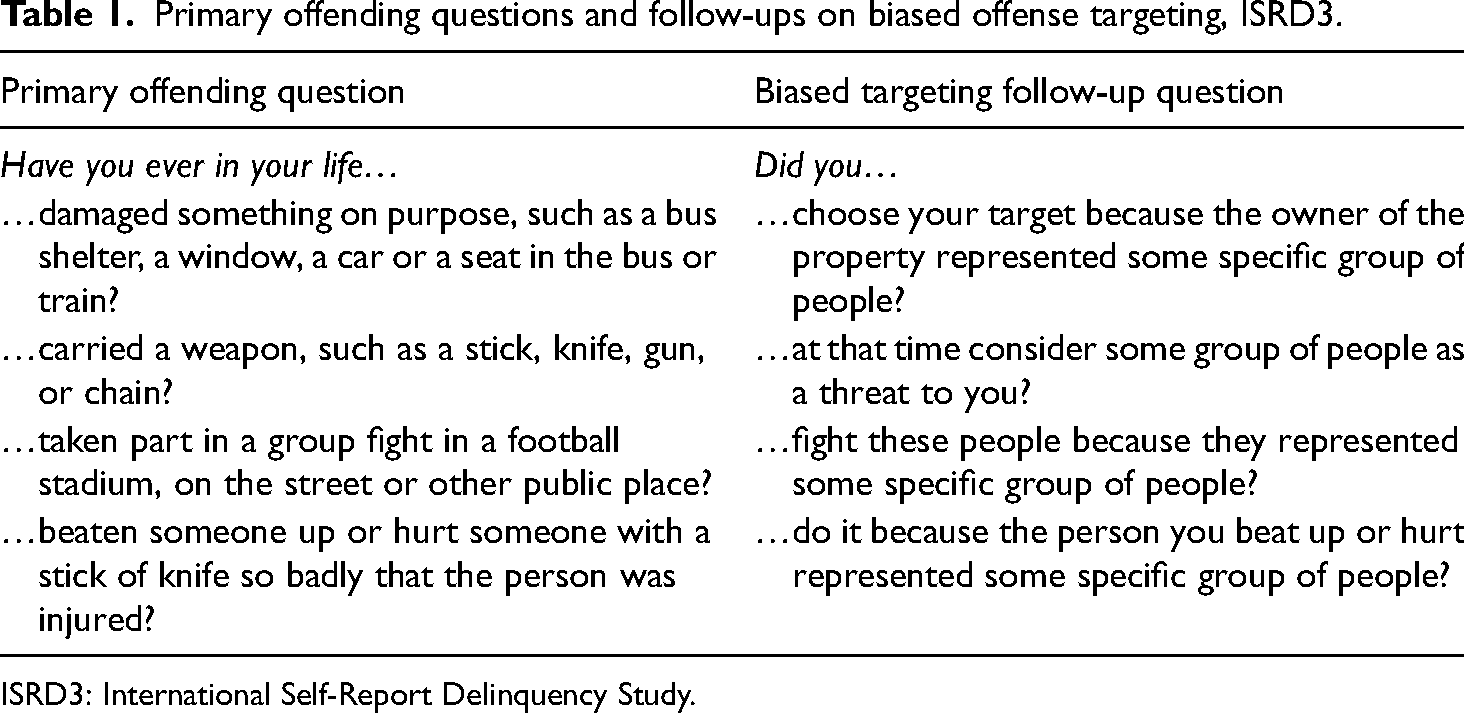
ISRD3: International Self-Report Delinquency Study.
The response options for the hate crime follow-ups included the following categories: ‘no’, ‘immigrants’, ‘people from specific ethnic or national background’, ‘people who speak a language other than my own’, ‘people who have a religion other than my own’, ‘people who have different values and opinions than I’, and ‘sexual minorities’. The respondents could tick several alternatives.
For the analysis, ‘hate crime offenders’ are those whose most recent actions were property destruction, weapon carrying, group fight, or assault targeted at an identity group. ‘Other offenders’ committed at least one of the trigger offenses without identity-based victim selection, while ‘nonoffenders’ had not committed any of them. Nonresponses were coded as missing.
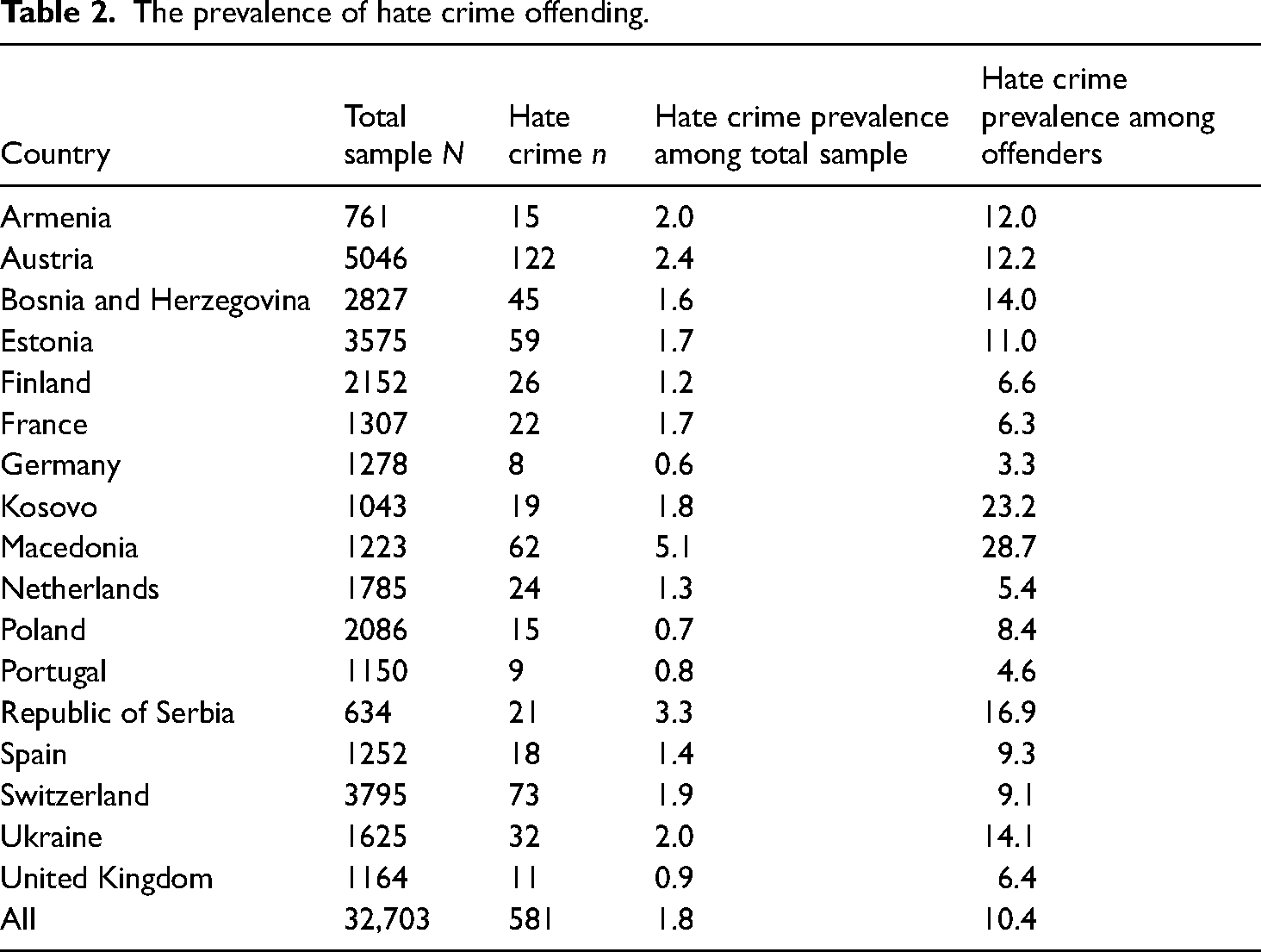
Although the questionnaire covered 13 offenses, only the four trigger offenses were used to classify respondents. As a result, some non-offenders may have committed other crimes. Our analysis focuses on serious physical hate crimes while excluding, for example, online harassment and cyberbullying, which may be more common. Additionally, our measure is conservative, as it omits individuals whose earlier offenses were hate-motivated but whose most recent ones were not. Conversely, measuring hate crime by the most recent offense may include individuals with a history of nonbias offending. Prevalence rates by sampled urban youth populations from all countries and overall are reported in Table 2.
The prevalence of hate crime offending.
Independent variables
In this article, one of our aims is to explore whether variables derived from standard criminological theories are predictors of hate-based victim targeting, as well as of nonbiased motivated offending.
Social strain was measured using three variables. Structural strain was captured by parental employment (0 = both working, 1 = at least one unemployed). Subjective strain was measured by a question asking whether the respondent's family was better off or worse off than other families (scale from 1 = much better off to 7 = much worse off). Family situational strain was measured with a sum variable based on the types of strain: death of a parent, divorce/separation of parents, parental alcohol problems, fights between parents, and serious conflicts between parents (scale 0–6).
Self-control was measured using attitude-based and behavioral measures (see, e.g., Tittle et al., 2003). Attitude-based measurement was conducted using an adapted nine-item version of the Grasmick–Tittle Scale (Grasmick et al., 1993; Marshall and Enzmann, 2012). The adapted version included the dimensions of impulsivity (e.g., ‘I act on the spur of the moment without stopping to think’), risk-taking tendency (e.g., ‘I like to test myself every now and then by doing something a little risky’), and self-centeredness (‘If things I do upset people, it's their problem not mine’) with three items per dimension. Items were summed to a composite variable with a Cronbach's alpha of 0.85 (scale 9–36).
Behavioral measurement of self-control (see, e.g., Hirschi and Gottfredson, 1993; Tittle et al., 2003) was based on the lifetime variety of nonviolent offenses (i.e., self-reported, analogous behaviors; Tittle et al., 2003) (scale 0–9). Only offenses not used as hate crime triggers were included in this measure. Thus, this measure mostly reflects participation in theft offenses.
Perceived neighborhood disorder was captured by a sum variable with five items on perceived crime, drug selling, fighting, abandoned buildings, and graffiti in the neighborhood. The Cronbach's alpha for the measure was 0.86 (scale 5–20).
Social control was measured by a sum variable consisting of five parental supervision-related items, such as ‘If I have been out, my parents ask me what I did, where I went, and who I spent time with’ and ‘If I go out in the evening my parents tell me when I have to be back home by’. The response scale for the items ranged from 1 (never) to 5 (almost always). The Cronbach's alpha for the measure was 0.68 (scale 5–25).
Shame propensity was measured using nine questions. This indicator captures how ‘shamed’ the respondent would feel if he/she was caught shoplifting or physically hurting another person or were arrested by the police for committing a crime and his/her best friend, teacher, or parents found out about it. The Cronbach's alpha for the nine-item measure was 0.89 (scale 9–27).
Routine activities were measured with an item on unsupervised leisure. The respondents were asked how many times a week they usually went out in the evening. This information was coded into a three-level categorical variable (scale 0–7).
Antidiscrimination attitude was measured by a single item asking the respondent to say how wrong he/she considers it to be to ‘knowingly insult someone because of his/her religion, skin color, or ethnic background’ (1 = not wrong at all, 2 = a little wrong, 3 = wrong, and 4 = very wrong).
Hate crime victimization was measured by asking the respondents whether someone had ever threatened them ‘with violence or committed physical violence against you because of your religion, the language you speak, the color of your skin, your social or ethnic background, or for similar reasons?’ (0 = no, 1 = yes).
We used gender, age, and immigrant background (0 = no immigrant background, 1 = second-generation immigrant, 2 = first-generation immigrant) as individual-level control variables in the main theoretical analysis. As a school-level control, we used the aggregated percentage of students with immigrant backgrounds (0 ≤ 15%, 1 = 15–50%, and 2 ≥ 50%) within the school.
For descriptive and multivariate modeling purposes, all (quasi-)continuous variables were transformed into the percent of maximum possible (POMP) scores (Cohen et al., 1999), with lower and upper bounds of 0 and 100. Descriptive statistics of all the independent variables (before standardizing) are presented in Appendix I.
Analysis
In our analyses, we use multilevel (i.e., mixed effect) multinomial and logistic regression modeling to study the risk factors of hate crime offending. We use multilevel multinomial logistic regression to explore the risk factors associated with hate offending and other (nonhate) offending so that both offender types are compared with nonoffenders. In addition to identifying risk factors, the aim of this analysis is to analyze the prevalence of hate crime offending in different European countries while accounting for the studied individual-level factors. Another aim was to specify the risk factors of hate offending and to examine whether hate offending and other (nonhate) offending share the same risk factors. To explore whether some of the shared risk factors may be particularly salient for hate crime, we additionally use multilevel logistic regression within the offender subsample. In that analysis, we ask whether the same factors are related to hate crime when hate offenders are compared with other offenders who have reported one of the four trigger offenses (destruction of property, gang fight, weapon carrying, and/or assault).
Multilevel models were conducted as generalized structural equation models using the GSEM package in Stata 15 statistical software (StataCorp, 2017). To analyze country differences in hate crime offending and to adjust for nation-level variation in our sample designs, we exclude all nation-specific factors by using country dummies in our models (not reported in multilevel regression tables). North Macedonia was treated as a reference country due to its highest hate crime prevalence. In addition, our models adjusted for the clustered error structure at the country level. To further account for the nested structure of our data and the variance associated with school level, our models included random intercepts for schools. Random effects were estimated as unobserved latent variables in the generalized structural equations. For the multilevel multinomial logistic regression analyses, random intercepts were constrained to be equal between the hate offender and other offender models. As recommended by Gelman (2008), (quasi-)continuous variables in our models (transformed into POMP scores; Cohen et al., 1999) have been rescaled to z-values divided by 2 to enable a better comparison of the effect sizes of these variables to the effect sizes of dichotomous variables.
For our models, we report relative risk ratios (RRRs) for the multinomial models and odds ratios (ORs) for the binary logistic regression models, along with the corresponding significance level. For the random part of our models, we report standard deviations for the random intercepts. After the multilevel models, we calculate the prevalence rates of hate crimes among offenders for each country, which are adjusted for the included individual-level variables (Figure 1). Adjusted prevalence rates are based on predicted hate crime offending prevalence while keeping the individual-level variables fixed in their mean values (the logistic model in Table 3). Adjusted prevalence rates were calculated as population average marginal effects (AMEs) (see Figure 1). These AME coefficients can be interpreted as the probability of hate crime offending expressed in percentages; they are reported in Appendix II.
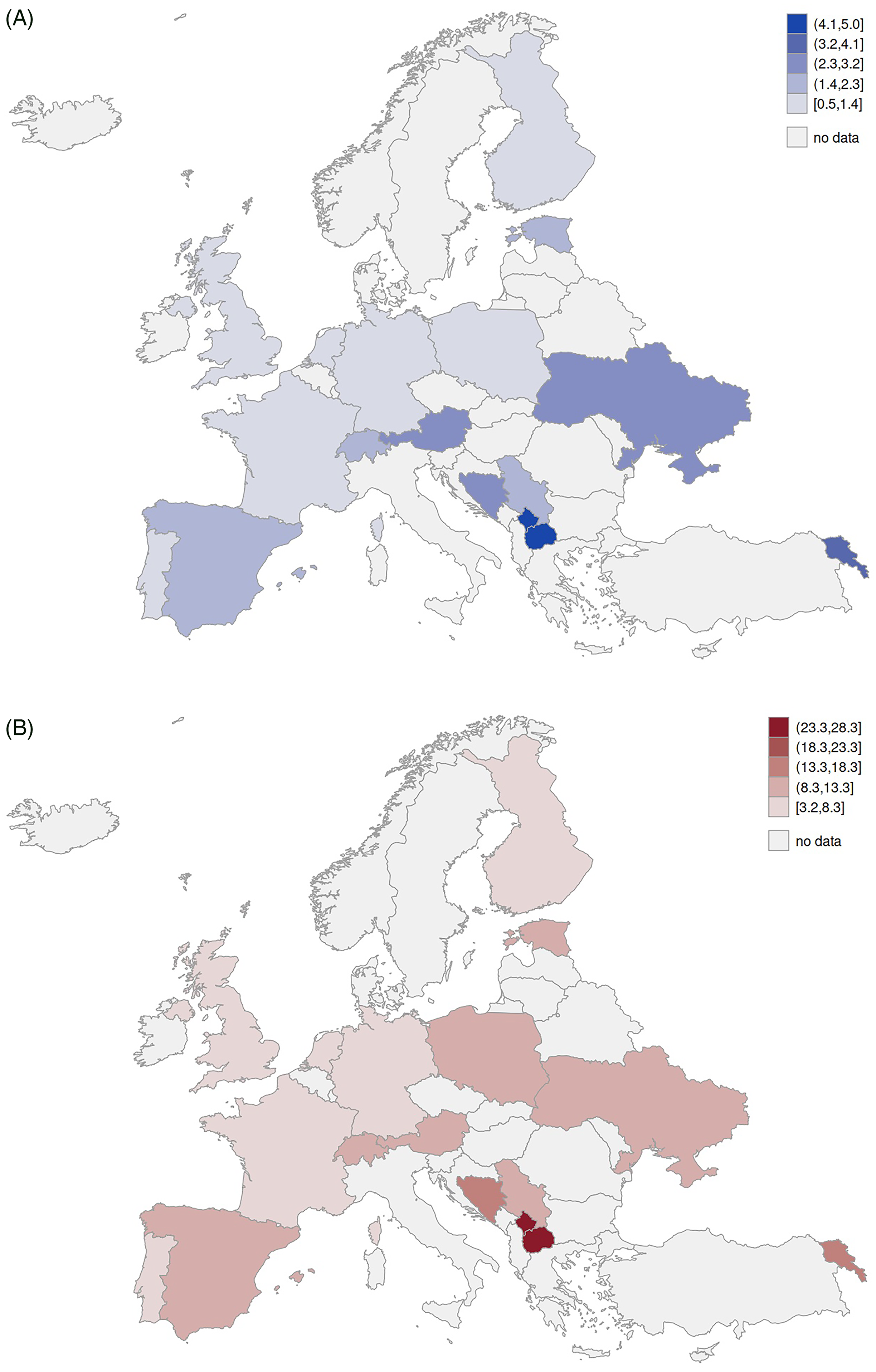
Prevalence (%) of hate crime offending among 12–16 year olds in 17 European countries adjusted for the individual level variables included in our multivariate models. Panel A: prevalence of hate crime offending among adolescents. Panel B: prevalence of hate crime offending among adolescent crime offenders.
Multilevel multinomial and logistic regression models.
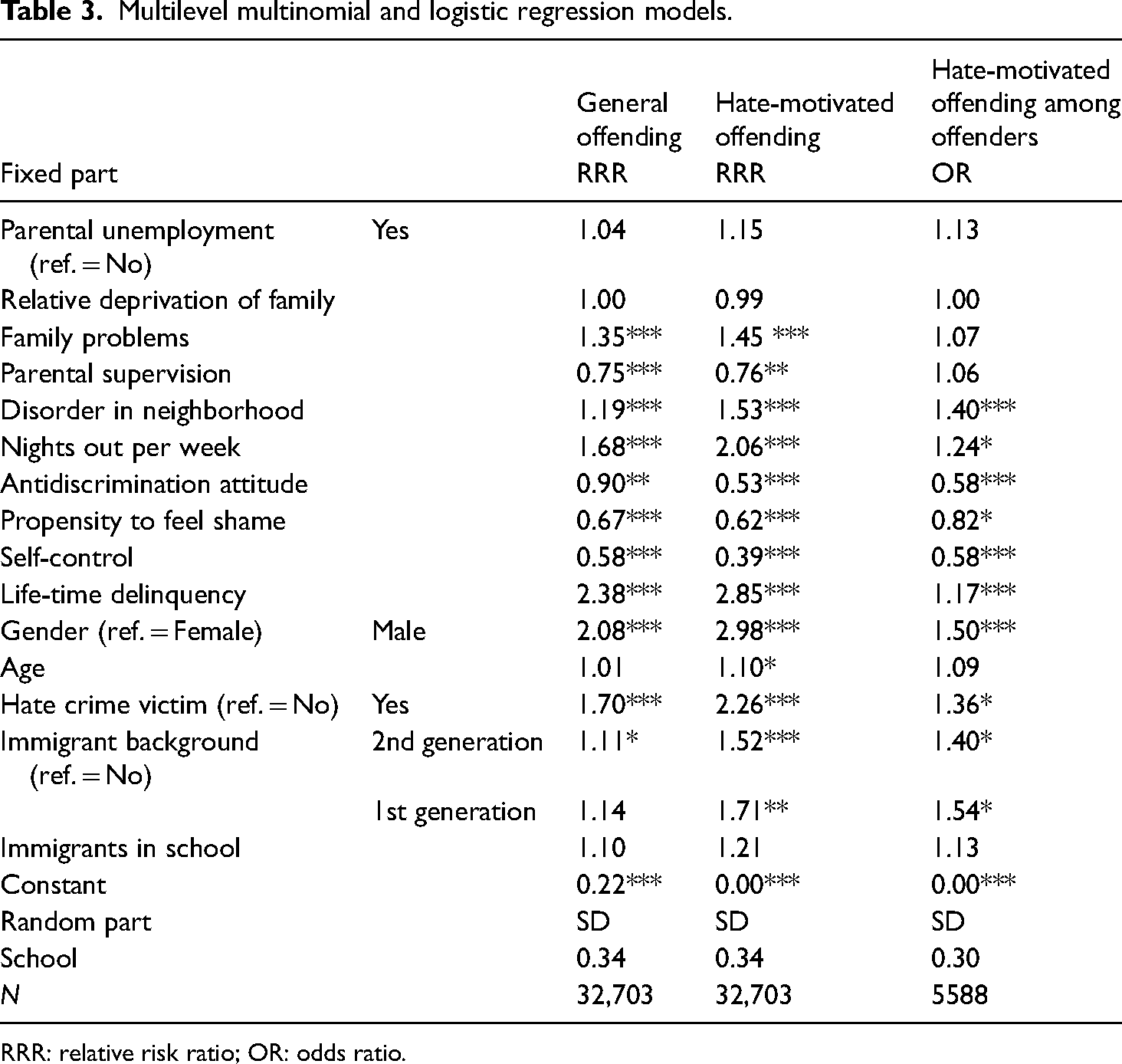
RRR: relative risk ratio; OR: odds ratio.
Results
Prevalence of hate crime offending among European youths
The overall prevalence of hate crime in the current dataset was 1.8% (see Table 2). The prevalence also varied among urban youth samples from different countries. As shown in Table 2, the highest prevalence was found in North Macedonia (5.1%), while the lowest readings were observed in Germany (0.6%). Among self-reported offenders (i.e., youth who had committed at least one of the four trigger offenses), the prevalence of hate crimes was 10.4%. North Macedonia (28.7%) and Kosovo (23.2%) manifested thehighest percentages, followed by the Republic of Serbia (16.9%), Ukraine (14.1%), and Bosnia and Herzegovina (14.0%) On the other hand, Western European samples appeared to form a cluster of low hate crime motivations. That is, respondents in Germany (3.3%), Portugal (4.6%), the Netherlands (5.4%), France (6.3%),the United Kingdom (6.4%), and Finland (6.6%) showed the lowest hate crime motivation among those who reported involvement in one of the four studied offenses.
Risk factors for hate crime offending
As shown in Table 3, family situational strain was positively associated with hate crime offending (RRR = 1.45, p < .001) and nonhate offending (RRR = 1.35, p < .001). Relative deprivation of the family (or structural strain) or parental unemployment did not statistically significantly predict hate offending or nonhate offending.
Parental supervision was negatively correlated with the likelihood of hate crime offending (RRR = 0.76, p = .007) and nonhate motivated offending (RRR = 0.75, p < .001). Social disorganization as measured by perceived public disorder was a robust risk factor for more likely hate offending (RRR = 1.53, p < .001) and nonhate offending (RRR = 1.19, p = .001). Regarding the leisure time routine activities, the number of nights spent out per week was positively correlated with hate crime (RRR = 2.06, p < .001) and nonhate crime (RRR = 1.68, p < .001).
Antidiscrimination attitude was negatively correlated with a lower likelihood of hate crime offending (RRR = 0.53, p < .001) and nonhate offending (RRR = 0.90, p = .005). Shame propensity was associated with lower odds of hate offending (RRR = 0.62, p < .001) and nonhate offending (RRR = 0.67, p < .001). Attitudinal self-control was negatively associated with hate crime offending (RRR = 0.39, p < .001) as well as nonhate offending (RRR = 0.58, p < .001). In addition, the number of committed nonviolent offenses was positively correlated with hate offending (RRR = 2.85, p < .001) as well as nonhate offending (RRR = 2.38, p < .001). Individuals who had been hate crime victims themselves were more likely to be hate crime offenders (RRR = 2.26, p < .001) as well as nonhate offenders (RRR = 1.70, p < .001) than those without hate crime victimization experience.
Regarding background variables used as controls, males were more likely hate offenders (RRR = 2.98, p < .001) and nonhate offenders (RRR = 2.08, p < .001) than females. In addition, age was positively correlated with the likelihood of hate offending (RRR = 1.10, p = .050). When compared to respondents without an immigration background, second-generation immigrants were more likely to be hate offenders (RRR = 1.52, p = .001) and nonhate offenders (RRR = 1.11, p = .036). First-generation immigrants were also more likely to be hate offenders (RRR = 1.71, p = .002). Interestingly, the proportion of immigrants in school was not associated with hate crime offending or nonhate offending.
When analyzing hate-motivated offending among offenders (Table 3), perceived neighborhood disorder (OR = 1.40, p = .001) and the number of nights spent out per week (OR = 1.24, p = .016) were positively correlated with the likelihood of hate-motivated offending. In addition, antidiscrimination attitude (OR = 0.58, p < .001) and propensity to feel shame (OR = 0.82, p = .045) were associated with a reduced likelihood of hate crime offending.
and individuals with first Attitudinal and behavioral self-control appear to be robust predictors of hate crime offending. Among respondents who reported offending, attitudinal self-control (OR = 0.58, p < .001) and the number of committed nonviolent offenses (OR = 1.17, p < .001) were correlated with hate crime offending. Hate crime offending was also more likely among hate crime victims (OR = 1.36, p = .018), males (OR = 1.50, p < .001), and individuals with second- (OR = 1.40, p = .013) and first-generation immigration backgrounds (OR = 1.54, p = .015).
Adjusted country differences in hate crime offending
To further explore differences in hate crime offending between urban youth populations in 17 European countries, we present the prevalence estimates adjusted for the measured individual-level predictors in Figure 1. The map of countries shown in Figure 1 presents the adjusted hate crime prevalence among adolescents and separately for crime offenders, reflecting the country sample variation in hate crime offending that is independent from the studied individual-level risk factors (see also Appendix II).
According to Figure 1, there are clear international patterns in the prevalence of hate crime offending, with the highest rate in Southeast Europe and the lowest rate in Northern and Western Europe. However, we must keep in mind that our findings reflect comparisons between urban youth populations from these countries (i.e., selected cities) rather than national youth populations. The prevalence of hate crime appears to vary with a distinct pattern across Europe. Countries manifesting a high prevalence of hate crime tend to be in Southeast Europe (i.e., the Balkans and Ukraine), while Western and Northern Europe seems to have lower levels of hate crime among youth. Figure 1 might suggest that youth hate crime offending is related to ethnic, national, and cultural conflicts (e.g., Spain) or proximity to conflict areas. After accounting for individual-level factors, the difference in hate crime offending remained statistically significant between North Macedonia (the reference country with the highest prevalence) and all other countries, except Armenia (OR = 0.97, p = .932) and Kosovo (OR = 0.93, p = .826).
The prevalence of hate crime offending is partly explained by the between-country variation in individual-level risk factors (see Appendix II). Macedonia has the highest hate crime prevalence both before (5.1%) and after adjusting (5.0%) for individual-level risk factors. However, the prevalence of hate crime offending was 1.8% for Serbia after adjusting for the individual-level risk factors, while it was 3.3% before adjustment (the second highest). This suggests that the relatively high hate crime prevalence among Serbian adolescents is partly explained by accumulated risk factors. On the other hand, the prevalence of hate crime offending was the second highest (4.8%) in Kosovo after adjusting for individual-level factors (1.8% before). This, in turn, suggests that the prevalence of hate crimes is higher than expected based on individual-level risk factors in Kosovo, indicating a contextual effect. Similar adjustment effects can be observed in the prevalence of hate crimes among offenders (see Figure 1 and Appendix II).
Discussion
This article set out to describe the prevalence of hate crime offending among European youths to explore whether the same correlates apply to hate crime offending and nonbiased offending and to examine the importance of the national context. Using a large cross-national urban city sample of youth, we found that 1.8% of the overall sample reported hate crime offending and 10.4% of the self-reported offenders had committed a hate crime. Consistent with expectations, hate crime offending shares many of the risk factors with general offending. In our analyses, we did not find any risk factors (apart from age and first-generation immigrant status) that were associated with hate-motivated crime but not with other types of crime. However, some factors studied were particularly strongly associated with hate crimes. Finally, the data suggest that not all differences between youth samples from the countries may be explained by individual-level factors. We discuss these findings below.
Strain and deprivation. Consistent with prior research (Craig, 2002; Green et al., 1999b; Hall, 2015), we find that neither hate crime nor general offending is associated with our measures of structural strain or relative deprivation. Although economic strain did not predict youth general or hate offending, general strain, as predicted by GST (Agnew, 2015), appears to be a relevant factor for both hate crime and general offending, particularly for youth coming from families with multiple problems, such as parental strife, illness, and alcoholism. However, family strain did not predict hate crime among offenders and, thus, did not appear as a hate crime-specific factor.
Immigrant status represents a socially vulnerable position and a potential source of strain. Second-generation immigrants showed a heightened risk of hate crime perpetration and nonhate-motivated offending when compared to those without an immigration background. First-generation immigrants showed a heightened risk for hate crime but not nonhate-motivated offending. In addition, immigration background predicted an increased likelihood of hate-based targeting among offenders. It is noteworthy that hate crime victimization predicted an increased likelihood of hate-based offending among both the total and offender populations, aligning with previous research on intergroup conflicts (Chakraborti and Garland, 2012; Craig, 2002; Díaz-Faes and Perreda, 2022; Ellonen et al., 2021). It is also possible that intergroup conflicts explain the elevated risk of hate crimes among immigrant-background youth.
Social learning, attitudes, and moral emotions. Both moral beliefs about discrimination and feelings of shame can be seen as capturing social learning contexts (see, e.g., Andrews and Bonta, 2010; Svensson et al., 2013). Not surprisingly, an antidiscrimination attitude was related to hate-based offending, both among the total population and offenders. These findings support earlier studies reporting discriminatory attitudes and hate-based offending (Craig, 2002; Díaz-Faes and Perreda, 2022; Green et al., 1999a; Lantz et al., 2024). We found that shame propensity was associated with decreased odds of both hate crimes and general offending. Shame was also a hate crime-specific risk factor among the sample of offenders. Anticipated shame is also relevant to the social control perspective (Svensson et al., 2013). Thus, the results support both the social learning and social control perspectives.
Neighborhood disorganization. Perceived neighborhood disorganization was associated with hate crime, supporting previous findings (Gladfelter et al., 2017; Grattet, 2009; McNeeley and Overstreet, 2018), as well as with an increased likelihood of perpetrating crime in general (Kornhauser, 1974; Lyons, 2007). Interestingly, this factor appears to be associated with hate crime perpetration, even among the offender population. This suggests that perceived neighborhood issues may motivate crimes against groups blamed for these problems (see, e.g., Craig, 2002).
Social control, self-control, and specialization. Our findings confirm the important role of low self-control, not only as a predictor of general offending but also as a predictor of hate crime. Even among the offender population, hate crime offenders are more likely to have lower levels of self-control (as measured by attitude and behavior measures). This finding suggests that hate-motivated offending is not always rationally contemplated but may reflect a more general tendency toward impulsive and criminal behavior. In line with this, earlier research has suggested that a search for excitement and thrills is also a significant factor in crime with biased motivation (McDevitt et al., 2002).
Social control measured by parental supervision was shown to be related to general offending and hate crimes among the total sample. This finding is in line with previous results linking hate crimes with lower levels of parental control (e.g., Näsi et al., 2016). However, in the offender population, the perpetrators of hate crimes did not differ from other offenders in terms of parental control. Finally, unstructured leisure time, reflecting routine activities theory, was a statistically significant predictor of general crime and hate crime and predicted hate crime among offenders.
Overall, hate crimes seem to be driven by the same factors as other (violent) crimes, with the addition of bias-specific factors. Hence, consistent with earlier research (Díaz-Faes and Pereda, 2022; Gladfelter et al., 2017; Grattet, 2009; Green et al., 2001; Messner et al., 2004; Van Kesteren, 2016), our analyses mostly favor the generality thesis of hate crime offending. In the European urban youth populations we studied, hate offenders appeared motivated by mechanisms similar to those of other offenders, but they seemed to exhibit more extreme manifestations of shared risk factors. However, the selected offenses represent only a subset of all hate crimes and do not account for other potentially significant forms, such as hate-motivated bullying or online harassment, which could reveal different dynamics.
We found differences in the prevalence of hate crime among the urban youth populations in the 17 studied European countries, after controlling for differences in individual-level risk factors. We did not include national-level indicators in this analysis, so we can only speculate about the nature of these contextual effects. Our results imply that youth hate crime is more common in regions with ethnic, national, and cultural tensions or near conflict zones. Previous research highlights higher hate crime rates in areas with hostile social climates (Piatkowska and Hövermann, 2018).
Finally, our findings diverged from prior research about ethnic diversity's role in hate crime (see Gladfelter et al., 2017; Grattet, 2009; Lyons, 2007), as we found no association between school-level immigrant proportion and hate crime offending. However, given earlier studies’ focus on the United States, the results may reflect national differences in the significance of ethnic diversity (Benier et al., 2016). In addition, school-level diversity might be less influential than neighborhood diversity in fueling intergroup conflicts. It is also noteworthy that our study operationalized hate crime broadly, encompassing bias against various social groups, including immigrants, ethnic and religious groups, opinion-based groups, and sexual minorities (Chakraborti and Garland, 2012). Our operationalization also covered offenses committed between majority–minority, minority–majority, or minority–minority groups (see Chakraborti and Garland, 2012). It is possible that the impact of ethnic diversity on hate crime varies between different social groups or between majority and minority groups; thus, more international research is warranted. It is also possible that school-level diversity is a more significant factor in other hate-motivated offenses than those examined in this study.
Contributions and limitations
The ISRD3–35 dataset allows for the exploration of bias-motivated adolescent offending and cross-national comparisons between samples of urban youth populations (i.e., city samples). We document significant country-level differences in self-reported hate crimes and regional patterns. However, the results do not represent young people nationally in these countries but only those in the selected cities included in the study. We also demonstrate the utility of analyzing self-reported foreground factors in identifying hate-motivated offending. Our results suggest that various theoretical perspectives explaining general delinquency—such as strain, social learning, self-control, social disorganization, social bonding, and routine activity—also predict hate crimes. We also identify disorder in neighborhood, risk routines, antidiscrimination attitudes, shame propensity, self-control, lifetime delinquency, and hate crime victimization to be particularly strongly associated with hate crime, as they distinguish hate crime offenders from other offenders (within the offender population). With these results, we contribute to the debate on the universality of crime and advance theoretical understanding (cf. Tittle, 2016). However, causal inferences cannot be drawn due to the observational and cross-sectional nature of our study, and assumed mechanisms require further validation beyond our current analyses.
The limitations of self-report surveys on sensitive topics have been well documented (e.g., Kivivuori, 2014), and the ISRD3 survey is no exception (e.g., Enzmann et al., 2018). Despite its large scale, the sample is still too small to exclusively study hate-motivated offenders. The ISRD3 is a school-based survey, with varying response rates, with a few exceptions (Austria and Switzerland), conducted in two cities across Europe and other parts of the world. Thus, the estimates of prevalence should be approached with caution since these samples are not representative of the youth population in the included countries.
Furthermore, our analyses are restricted to youth admitting to one or more of the four ‘trigger offenses’ (property destruction, group fights, weapon carrying, and assault). While the selected acts cover different forms of hate crime, the indicators used do not include forms such as threats, harassment, bullying, or cyberbullying, which are relevant in the context of hate crime. We also do not capture the most severe forms of hate crimes, such as lethal violence. Future research with a broader range of acts could illuminate the potential similarities and differences between hate-motivated and other types of crime.
Policy implications
This study did not seek to identify causes of hate crime but examined risk factors typical of hate crime offenders, highlighting relevant youth groups for interventions to target. As these risk factors largely overlap with other (violent) crimes, effective general crime prevention will also likely aid hate crime prevention. Our findings suggest that hate crime interventions should specifically focus on youth experiencing neighborhood disorder, engaging in risky routines, holding discriminatory attitudes, exhibiting low self-control and deficient moral emotions, having a delinquent history, and experiencing hate crime victimization.
In conclusion, biased crime is a complex problem that cannot be solved easily. For instance, the finding (Lantz et al., 2024) that hate crime victimization is linked to more discriminatory attitudes suggests the importance of retaliatory violence that may uniquely affect hate crime offending. At the very least, we could aim to interrupt the escalation of youth hate crimes by investing in targeted education programs in immigration-rich schools.
Footnotes
Declaration of Conflicting Interests
The author(s) declared no potential conflicts of interest with respect to the research, authorship, and/or publication of this article.
Funding
The author(s) disclosed receipt of the following financial support for the research, authorship, and/or publication of this article: Kulttuurin ja Yhteiskunnan Tutkimuksen Toimikunta (Grant No. 342741/2021).

Appendix I. Descriptive statistics of the independent variables.
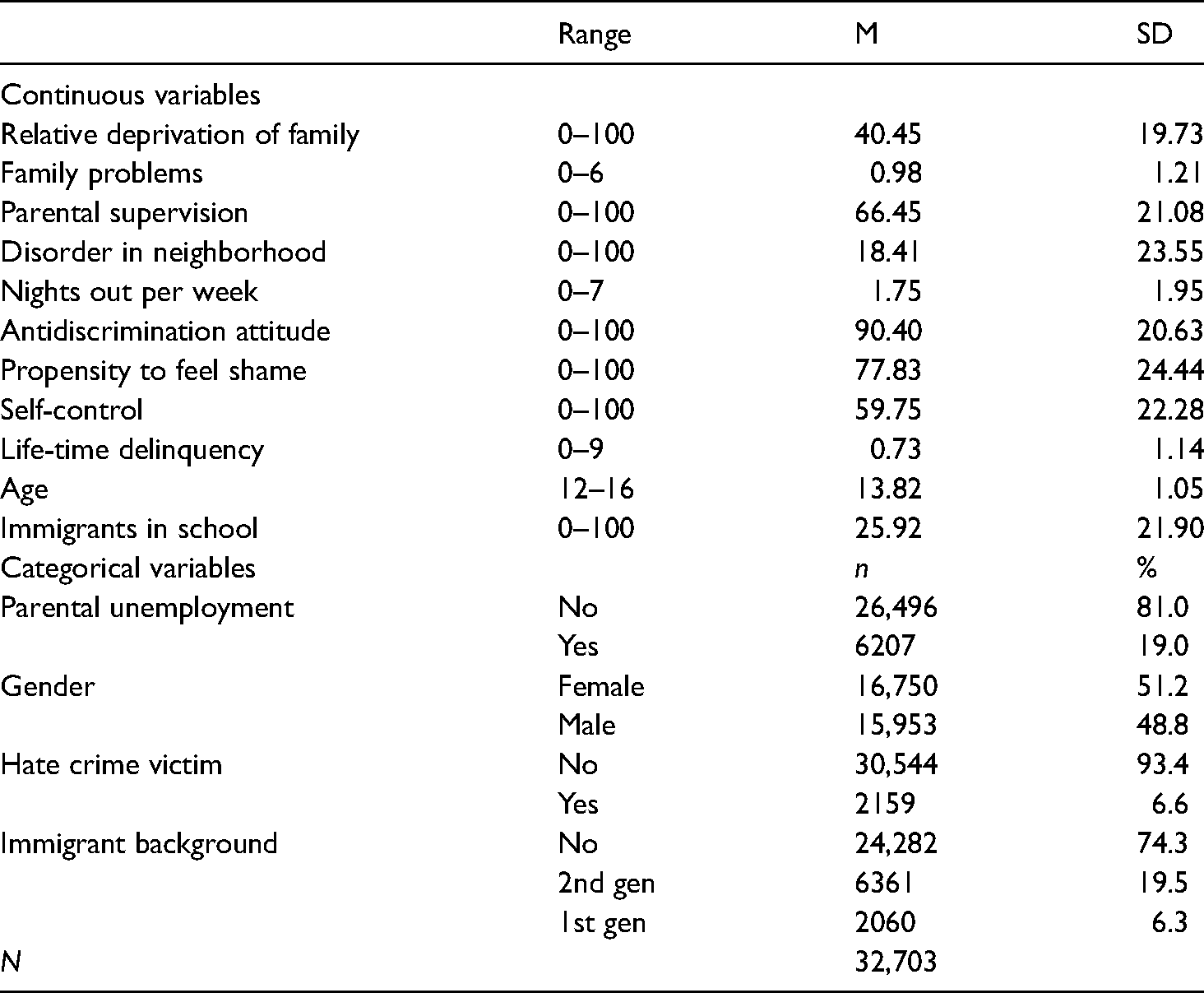
| Range | M | SD | |
|---|---|---|---|
| Continuous variables | |||
| Relative deprivation of family | 0–100 | 40.45 | 19.73 |
| Family problems | 0–6 | 0.98 | 1.21 |
| Parental supervision | 0–100 | 66.45 | 21.08 |
| Disorder in neighborhood | 0–100 | 18.41 | 23.55 |
| Nights out per week | 0–7 | 1.75 | 1.95 |
| Antidiscrimination attitude | 0–100 | 90.40 | 20.63 |
| Propensity to feel shame | 0–100 | 77.83 | 24.44 |
| Self-control | 0–100 | 59.75 | 22.28 |
| Life-time delinquency | 0–9 | 0.73 | 1.14 |
| Age | 12–16 | 13.82 | 1.05 |
| Immigrants in school | 0–100 | 25.92 | 21.90 |
| Categorical variables | n | % | |
| Parental unemployment | No | 26,496 | 81.0 |
| Yes | 6207 | 19.0 | |
| Gender | Female | 16,750 | 51.2 |
| Male | 15,953 | 48.8 | |
| Hate crime victim | No | 30,544 | 93.4 |
| Yes | 2159 | 6.6 | |
| Immigrant background | No | 24,282 | 74.3 |
| 2nd gen | 6361 | 19.5 | |
| 1st gen | 2060 | 6.3 | |
| N | 32,703 |
Appendix II. Prevalence of hate crime offending for each country adjusted for measured individual level variables (calculated as average marginal effects).
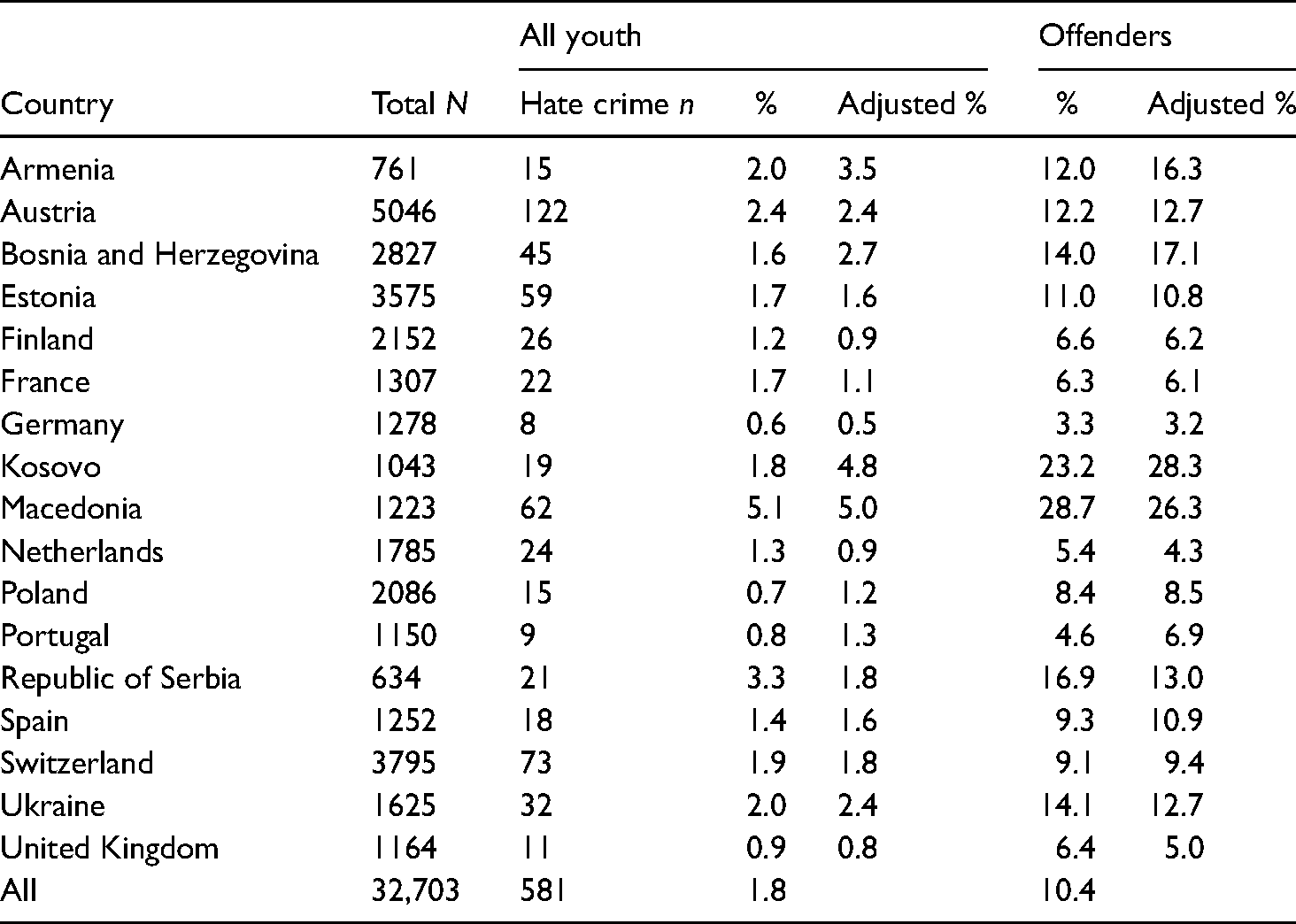
| All youth | Offenders | |||||
|---|---|---|---|---|---|---|
| Country | Total N | Hate crime n | % | Adjusted % | % | Adjusted % |
| Armenia | 761 | 15 | 2.0 | 3.5 | 12.0 | 16.3 |
| Austria | 5046 | 122 | 2.4 | 2.4 | 12.2 | 12.7 |
| Bosnia and Herzegovina | 2827 | 45 | 1.6 | 2.7 | 14.0 | 17.1 |
| Estonia | 3575 | 59 | 1.7 | 1.6 | 11.0 | 10.8 |
| Finland | 2152 | 26 | 1.2 | 0.9 | 6.6 | 6.2 |
| France | 1307 | 22 | 1.7 | 1.1 | 6.3 | 6.1 |
| Germany | 1278 | 8 | 0.6 | 0.5 | 3.3 | 3.2 |
| Kosovo | 1043 | 19 | 1.8 | 4.8 | 23.2 | 28.3 |
| Macedonia | 1223 | 62 | 5.1 | 5.0 | 28.7 | 26.3 |
| Netherlands | 1785 | 24 | 1.3 | 0.9 | 5.4 | 4.3 |
| Poland | 2086 | 15 | 0.7 | 1.2 | 8.4 | 8.5 |
| Portugal | 1150 | 9 | 0.8 | 1.3 | 4.6 | 6.9 |
| Republic of Serbia | 634 | 21 | 3.3 | 1.8 | 16.9 | 13.0 |
| Spain | 1252 | 18 | 1.4 | 1.6 | 9.3 | 10.9 |
| Switzerland | 3795 | 73 | 1.9 | 1.8 | 9.1 | 9.4 |
| Ukraine | 1625 | 32 | 2.0 | 2.4 | 14.1 | 12.7 |
| United Kingdom | 1164 | 11 | 0.9 | 0.8 | 6.4 | 5.0 |
| All | 32,703 | 581 | 1.8 | 10.4 | ||