



Abstract
This article demonstrates that under the same regulations, some social groups are more vulnerable to deportation than others. It analyses the case of the deportation of EU citizens from the UK before the abandonment of the principle of EU free movement. My analysis of the law–practice continuum includes law-on-the-books (UK legislation) and law-in-action (primary research among deportees, EU migrants, and experts; and the analysis of internet forums, statistics, policy papers and documents obtained through Freedom of Information Requests). Before Brexit, the UK introduced laws, policies, and practices that made possible the deportation of large numbers of EU citizens. Central and Eastern European EU (CEEU) citizens (especially racialised, low- or no-income and working-class men, including Roma people) were disproportionately more likely to be targeted for deportation than citizens of countries that had been members of the EU prior to 2004. This article finds that UK law and practice mobilised crimmigration against CEEU migrants, with criminal and immigration legislation converging to facilitate their expulsion. I describe how the illegalisation and criminalisation of (1) CEEU citizens who had contact with criminal justice system (including prisoners) and (2) CEEU citizen rough sleepers contributed to their deportability. The UK deportation regime took active steps to deport these groups (including by creating the ‘abuse/misuse’-of-right policy targeting rough sleepers); the treatment they received from the UK criminal justice system (high sentencing, lack of free legal aid in deportation cases) heightened their deportability. The article concludes that this differentiated deportability of CEEU nationals can be viewed as prefiguring post-Brexit deportation policy in the UK.
The Titan Airways special flight
On 30 April 2020, during the first COVID-19-related national lockdown in the UK, a chartered Titan Airways flight left Stansted Airport with 33 deportees and the same number of Home Office (HO) escorts on board (Taylor, 2020). One passenger had tested positive for COVID-19 after showing symptoms in detention, but had been put on the flight nonetheless; others had not been tested at all. The small size of the plane made it impossible to maintain sufficient distance between passengers to prevent the spread of the potentially deadly virus. The flight's destination was Poland, despite Polish borders having been closed 47 days earlier. The charter flight landed as Poland was preparing to mark the 16th anniversary of EU accession – in much quieter fashion than in previous years, given that most of the population were isolated at home. Five of the deportees were detained by Polish police on arrival as they had arrest warrants outstanding. The remaining 27 men and women were allowed to go home to begin a compulsory 14-day period of self-isolation – assuming, of course, they still had a place in Poland to call ‘home’. In the second and third quarters of 2020, a further 18 charter flights departed the UK only to European countries, carrying 510 deportees (489 men and 21 women) (No-Deportations, 2021). These special flights shed light on the UK's deportation regime, how it targeted EU citizens and the disposability of the lives of deportees.
Introduction
This article traces the genealogy of the deportation regime that led to the large-scale removal of Central and Eastern European EU (CEEU) citizens from the UK, including expulsions such as the Titan Airways special flight. I will argue that the HO disproportionately targeted CEEU citizens for deportation during the 2010s. These practices were a continuation of deportations taking place before the EU accession of Central and Eastern European countries in 2004 and 2007. I will analyse immigration control along a law–practice continuum, showing how UK policymakers, bureaucrats, and other actors spearheaded by the UK HO undermined EU free-movement principles by introducing laws, policies, and practices intended to that facilitated more EU deportations from the UK.
Both law-on-the-books and law-in-action made the deportation of EU citizens easier than stipulated in the Citizens’ Directive, 1 which regulates freedom of movement within the European Union as well as the limits to it. In the terms of the Directive, restrictions on the right to entry can be imposed only where an individual represents a ‘genuine, present and sufficiently serious threat affecting one of the fundamental interests of society’ (European Parliament and the Council, 2004: Art. 27, 2). Additionally, EU citizens enjoy some protection from deportation on the basis of long residence in a member state (the longer they reside there, the more serious the grounds of public policy or public security justifying their removal need to be 2 ). As will be explained below, however, the UK removed the sentencing thresholds, making deportation attempts widely possible for people who had contact with the criminal justice system.
Media and political discourses built a fertile ground for EU deportations. In the pre-Brexit UK, the deportation of EU citizens was framed as morally justified. The HO, facing public outcry over the Windrush scandal, 3 explicitly argued that deportations to the EU were more common than the deportations to Commonwealth countries. In November 2020, 4 on the eve of a scheduled deportation flight to Jamaica that had become the subject of protests by anti-deportation campaigners, the HO issued a statement noting that over the previous 2 years, there had been far fewer deportations of Jamaicans than of EU citizens, and that the former had targeted serious offenders only: ‘In the year ending June 2019 there were 7895 enforced returns, of which 3498 were to EU countries and 55 were to Jamaica’ (Home Office News Team, 2020). Given that the deportation of EU citizens targeted mainly white people from countries that had not been British colonies, such policies could less straightforwardly be characterised as racist and postcolonial than the deportation of Black and Brown people. Yet, as I will argue in this article, the practice of disproportionately targeting CEEU nationals for deportation was also subtly underpinned by racialisation. CEEU deportations, therefore, can be seen as a lesser-known element of hostile environment 5 policy.
The proportion of EU citizens among all deportees grew year on year in the run-up to Brexit (Brandariz, 2021: 19), and CEEU nationals were disproportionally represented among EU citizens deported from the UK. In 2019, 3498 EU citizens were deported from the UK; the highest number of EU citizens were deported in 2017 (4914 people). By comparison, in 2019, a very similar number of ‘third-country nationals’ (3863) were deported from the UK (Home Office, 2020). Deportations did not affect all EU citizens equally, however. The differentiated deportability of EU citizens reproduced an existing divide between ‘new’ and ‘old’ EU member states. In 2019, citizens of countries that had been members of the EU prior to 2004 made up 45% of the EU-citizen population in the UK; however, only 14% of EU citizens who were forcibly removed came from these countries. 6 Citizens of EU8 (the Czech Republic, Estonia, Hungary, Latvia, Lithuania, Poland, Slovakia, and Slovenia) and EU2 (Romania and Bulgaria) countries represented 54% of EU citizens in the UK but accounted for 86% of enforced returns. Romanians, Poles, and Lithuanians accounted for 69% of EU ‘enforced returns’ in 2019 (Home Office, 2020). This was not simply a result of the UK having large Romanian, Lithuanian, and Polish communities. Indeed Romanians, Poles, and Lithuanians accounted for only 39% of EU citizens in the UK in 2019 (Office for National Statistics, 2021). In this article, I will explain how UK law and practice made possible the deportation of these EU citizens in particular.
The literature on the deportation of EU citizens from the UK has been scarce, with some important exceptions. Agnieszka Martynowicz (2014) has studied law-on-the-books and the practice of deporting foreign national offenders (FNOs) from the UK; she has also conducted empirical research with deportable Polish prisoners in Northern Ireland (2016). Jean Demars (2017) has tracked the origins and development of UK policies that led to deportations of EU street-homeless people, while Matthew Evans (2020) has explained why they were legally faulty. More recently, together with Benjamin Morgan I have traced the process of deporting homeless EU citizens from the streets of London (Radziwinowiczówna and Morgan, 2023). Our (Radziwinowiczówna and Galasińska, 2021) analysis of discourse in UK right-wing newspapers showed that it aimed to influence public opinion and erode popular sympathy for CEEU offenders and street-homeless people.
In the 2010s, the UK's criminal justice system was being increasingly mobilised for the purposes of immigration control (Kaufman, 2015). In a seminal paper, Juliet Stumpf (2006) coined the term ‘crimmigration law’ to name the convergence of criminal and immigration law. The UK authorities also expanded the range of criminal convictions that could lead to deportation (Franko, 2020) and introduced special policies targeting rough sleeping. The UK was the only EU member state to identify street homelessness as an abuse of freedom of movement, making rough sleeping a basis for administrative removals of the least advantaged EU citizens (Radziwinowiczówna and Morgan, 2023).
Stumpf (2006) proposes a membership theory according to which governments differentiate between citizens and non-citizens, excluding the latter through the use of crimmigration. In practice, however, crimmigration is not deployed against all non-citizens equally (Brouwer et al., 2018). This article complements existing crimmigration literature showing how governments mobilise crimmigration in a differentiated fashion; while ‘bona fide travellers’ do not attract the attention of immigration authorities, ‘crimmigrant others’ (Aas, 2011) find themselves policed. The novelty of this article lies in my presentation of the case of a group of people (CEEU nationals) who on the books enjoyed the same rights as other EU citizens but were nonetheless disproportionately targeted by crimmigration measures. At an empirical level, I contribute to the existing literature by presenting the perspectives of people who are subject to crimmigration rather than those who enable ethno-racial profiling (Brouwer et al., 2018).
The last decade has seen an explosion in the literature explaining how Central and Eastern Europeans have been subject to racialisation in the UK (Lewicki, 2023). In their groundbreaking article on racism against Central and Eastern Europeans, Jon Fox, Laura Moroşanu, and Eszter Szilassy argue that ‘“race” is not an essential trait of the migrants but the ongoing contingent outcome of […] dynamic processes of racialization’ enacted through immigration policy and discourse (Fox et al., 2012: 692). The authors link crimmigration processes to racialisation, with criminality being ascribed to CEEU nationals ‘as part of their innate character’ (Fox et al., 2012: 688). My own research (Radziwinowiczówna and Galasińska, 2021) confirms that the media in the UK used racist framing to create an ideology of deportability for the CEEU people. Much recent scholarship has focussed on Central and Eastern Europeans’ everyday experience of racism in British society (Narkowicz, 2023; Rzepnikowska, 2019). I seek to contribute to the literature by explaining how CEEU nationals have also experienced systemic and largely unaccounted-for forms of institutional racism (Miles, 1989) that contributed to their physical exclusion from the UK. As I will explain, however, for some of the UK's most opaque deportation policies there is not enough data to determine if they were racially underpinned. I will demonstrate, however, that CEEU deportations owed to side effect discrimination (Feagin and Eckberg, 1980) – they often would not have happened if it was not for deportees’ precarious economic status.
The study of legal practices that criminalise a group in order to deport their members has led me to a concept I call ‘differentiated deportability’. By differentiated deportability I mean the unequal likelihood of being deported in a given national context. As I explain in the next section, differentiated deportability needs to be researched using middle-range, or context-specific, approaches (Merton, 1968). I argue that the UK's deportation regime was grounded in differentiated deportability, primarily targeting as it did low-income working-class men from Central and Eastern Europe. This represented the continuation of a longue durée process: UK immigration policies disproportionally targeted CEEU citizens before the formal announcement of the hostile environment policy (Fox et al., 2012). Their treatment as a target of immigration raids, detention and deportation is rooted in the times before their countries of citizenship became EU member states. Shortly after they acquired the status of ‘EU citizens’ and when the number of their deportations dramatically dropped, they were again re-bordered (De Genova, 2019), when their deportation numbers began to grow again. In 2015, CEEU deportations reached the pre-accession high and continued to rise. They are also likely to remain highly deportable under the UK's post-Brexit migration regime (Radziwinowiczówna and Lewis, 2023).
In this article, I define ‘deportation’ as any non-voluntary expulsion from a territory of a state that is organised by the authorities of that state. The HO's definition of ‘deportation’ is narrower, as it is limited to removals deemed ‘conducive to the public good’, as in the case of those with a criminal conviction (Walsh, 2019: 2). The HO distinguishes the deportation of FNOs from the ‘administrative removal’ of migrants identified as having no legal right to live in the country. My broader conception of deportation therefore encompasses both what UK HO defines as ‘deportation’ as well as ‘administrative removals’.
My argument evolves over five sections. In the next section, I present the theoretical framework for my discussion of differentiated deportability. In the third section of the article, I explain my methods of data collection and analysis. In a fourth section, I explain how law-on-the-books and law-in-action produced the deportability of CEEU citizens who had contact with criminal justice system and of rough sleepers through their criminalisation and illegalisation. In a coda, I advocate for radical change to put an end to a systemic production of deportability among marginalised and racialised groups.
The institutionalisation of differentiated deportability
Contrary to theories that view deportation as either reaffirming state sovereignty (De Genova, 2010) or managing the global labour force (Golash-Boza, 2015), the middle-range (Merton, 1968) approach to deportations proposed in this article is context-specific, accommodating as it does the specificity both of the deporting state and the population being targeted for deportation (nationality, ethnicity, race, gender, and age). The middle-range approach to deportations also enquires into the context of institutions involved in deportations: the motivations of the deporting state, the role of supranational organisations (in this case, the EU) and the role of local and municipal actors and interests. The middle-range approach allows us to examine discrete parts of the UK's immigration apparatus, such as the regime that led to the deportation of CEEU citizens.
Deportation is a practice of population management (Radziwinowiczówna and Morgan, 2023; Walters, 2002). It relies on the kind of differentiated deportability that illegalises individuals who possess characteristics considered to be ‘undesirable’ and who are perceived as posing a threat to the ‘host’ community, either in terms of its system of values (Anderson, 2013), economic stability, its health security or ‘racial hygiene’.
The literature offers a repertoire of socio-demographic characteristics that may differentiate deportability. Further research has demonstrated that men, in general, are more likely to be deported than women (Sohn et al., 2023). Race is an important factor determining deportability (de Noronha, 2020; Ngai, 2004). Working-class migrants (Brouwer et al., 2018) are especially deportable (Anderson, 2013; Golash-Boza, 2015). Disability remains under-researched, but non-citizens with learning disabilities or experiencing mental health difficulties may be targeted for deportation on the basis of criminal convictions (Taylor, 2022) or homelessness (Morgan, 2021). The intersection of these characteristics increases deportability. For instance, Tanya Golash-Boza and Pierrette Hondagneu-Sotelo (2013) have described the US deportation system as a gendered racial removal program because it primarily targets young working-class Latino men.
Deportability is differentiated not only by socio-economic and demographic characteristics; certain activities can also be ‘triggers’ for deportation. Most importantly, criminal convictions render non-citizens deportable. Less well documented, however, are activities that are not illegal for citizens but which are illegalised in the case of unwanted migrants. As I will explain below, rough sleeping was effectively criminalised for EU citizens in the run-up to Brexit.
Method
This article analyses primary and secondary data using interpretive policy analysis. Such an approach allows for the study of EU deportations from the perspective of both law-on-the-books and law-in-action (Yanow, 2000). Building on Dvora Yanow's contribution to interpretive scholarship – ‘how does a policy mean’ (Yanow, 1995) – my research question was: how was the deportation of CEEU nationals institutionalised in a UK context?
In the UK, official deportation statistics are scarce and they lack important data such as the reason for deportation. The HO's and its private contractors’ practices surrounding deportations are often unofficial. In order to track the institutionalisation of CEEU deportations in the UK context, I combined qualitative data of various types to assure data triangulation. Wherever accessible, I used available statistics, HO documents, and my own communication with state authorities to achieve triangulation of perspectives. My analysis of law-on-the-books included legislation, policy papers, and secondary research. My analysis of law-in-action, meanwhile, has been informed by available statistics and primary research among experts and Polish migrants, as well as the analysis of internet forums and Freedom of Information requests made to the HO, Polish consulates, and authorities in Poland.
To access the accounts of deported and deportable people, their families and individuals with knowledge of the UK deportation regime, I conducted transnational, multi-sited research both in the UK and in Poland – the country of origin of the largest group of EU citizens in the UK and (during the 2010s as well as today) in the top two EU countries 7 in terms of the number of deportees received from the UK. I conducted semi-structured interviews with four individuals who had been deported to Poland; one person with experience of immigration detention who had not in the end been deported; 21 Polish migrants to the UK, including the wives of deportees; and 20 individuals supporting vulnerable CEEU nationals in the UK. Among those supporting vulnerable CEEU nationals were immigration advisors and solicitors, local council employees, and volunteers in non-profit organisations.
Migrant research participants were recruited through snowball sampling, paying attention to equal gender proportions among the participants. Recruitment of people with detention and deportation experience was challenging, as they are a small, stigmatised and not interconnected population (Klaus et al., 2024). I approached and invited to participate in the research all the people with deportation and detention experience I was aware of after contacting civil society organisations, posting on social media, and even putting announcements on the streets of Warsaw. I followed them to four locations in Poland, where they resided following their deportation.
My multi-sited fieldwork focussed on London, West Yorkshire, and West Midlands, giving an insight into the state of play in various parts of England. All of the regions chosen for my research have received large numbers of EU migrants from Central and Eastern Europe; all have large Polish communities. London was selected for its high number of CEEU rough sleepers as well as its history of HO operations targeting this group. West Midlands and West Yorkshire were chosen on the basis of personal connections facilitating access to people affected by deportation. Both West Midlands and Yorkshire and the Humber, moreover, had a strong ‘leave’ vote in the Brexit referendum in June 2016, indicating that both regions might be an unwelcoming environment for EU nationals.
In order to access more data on the experience of deportations of the Polish citizens, I analysed the Legal Forum discussion site (https://forumprawne.org/wielka-brytania/), where Polish migrants and their families post requests for free advice in legal cases. As the forum covers a vast range of topics, I searched all the available posts by the keywords ‘deportation’, ‘removal’, ‘throw out’ (of the country) and ‘immigration’ in order to access the content of interest to this research.
Another source of data was freedom of information requests. I have analysed documents previously obtained by my colleague Benjamin Morgan and Jean Demars during their research on the origins of rough sleeping policy in the UK. I have also obtained data from the Polish government about deportation flights to Poland.
I combined all the qualitative data in an ATLAS.ti project and analysed it using flexible coding (Deterding and Waters, 2021). In order to consolidate the multidimensional data, I created notes about emergent themes around the institutionalisation of CEEU deportations. Note creation was an open-ended process; I developed the notes throughout the process of coding and analysis. Whenever new intriguing findings emerged, I involved them in my interview guidelines and consulted my informants about them upon my subsequent fieldwork.
As ethical challenges are part and parcel of research on deportations (Radziwinowiczówna, 2024), thoughtful preparation of research design was of utmost importance. My research was approved by the Ethics Committees at the University of Warsaw under the approval number CMR/EC/X/2022 and the University of Wolverhampton under the approval number 2018/19: 14. ‘The implementation of ethical safeguards is situated, partial and sometimes compromised in the field’ (Armstrong et al., 2014: 207) and research ethics was at the core of data collection, analysis and dissemination. Informed consent was sought from all participants; they were informed at first contact and throughout their participation in the data collection process that they had the right to withdraw from the research for whatever reason and whenever they wished. Recorded oral rather than written consent was sought from deported participants, given their previous experience of being interrogated by the police and the HO. While disseminating research findings, I paid special attention to anonymising data from research participants with deportation experience. I changed the names of all research participants and use pseudonyms in research outputs, including this article. I do not publish open access transcripts of interviews with people who had experience of deportation, as their identification on the basis of their characteristics and trajectories would be possible in spite of the pseudonymisation.
As quantitative data on the analysed topic are scarce, the findings of my research have certain limitations. Qualitative data do not permit for control of selection effects and identification of clear-cut causalities. However, using multidimensional data coming from various sources, I aim to explain some of the practices experienced by Central and Eastern European EU citizens detained and deported from the UK. While my research among migrants focussed on the Polish citizens, my interviews with the individuals supporting vulnerable CEEU nationals in the UK as well as secondary data did not focus on any national group in particular and permitted for comparative analysis.
The differentiated deportability of CEEU citizens
In the following two subsections, I explain how the deportation of CEEU nationals was made possible through regulations (law-on-the-books) and practice (law-in-action). I argue that their deportations were a practice of population management that excluded poorer Europeans. I focus on deportations of two populations: convicts and rough sleepers (see Figure 1).
People who had contact with criminal justice system
Before Brexit, most deportations of EU nationals convicted of criminal offences were pursued under the Immigration (European Economic Area) Regulations 2006 with reference to the ground of public security (Martynowicz, 2017). Over the last decade, the UK has moved towards the removal of minimum thresholds for deportation. On the books, since January 2014, EU citizens could be considered for deportation if they had received a single custodial sentence of at least 24 months, unless they had been convicted of sexual, violent, and drug-related convictions, in which case the deportation threshold was reduced to 12 months. Since 1 April 2015, the cases of people with three minor convictions in 3 years must be referred to Immigration Enforcement (the department of the HO responsible for deportations). Additionally, anyone 17 or older convicted of an offence punishable with imprisonment and recommended for deportation by a judge was liable for deportation (Immigration Act, 1971: 3.6). The UK Borders Act 2007 empowers the Secretary of State to make an automatic deportation order against any non-UK citizen sentenced to at least 12 months in prison for a serious offence (UK Borders Act, 2007: sec. 32), though an exception listed in the same Act (UK Borders Act, 2007: sec. 33(4)) dictated that the removal of an FNO must not breach their rights under EU treaties (particularly the 2004 Citizens’ Directive).
The removal of deportation thresholds has led the HO to attempt deporting people convicted of minor offences, some of them with ties to the UK. During the course of my research, I encountered a case in which the HO has sought to deport a Polish man sentenced to just 2 months in prison after being convicted of petty theft. One Polish woman deported on the Titan Airways special flight mentioned at the beginning of this article had lived and worked in the UK for 10 years; she had been convicted of a minor offence and left an 11-year-old son in the UK (Taylor, 2020).
Additionally, as HO caseworker guidance explained, EU citizens could be deported on the grounds of public security or public policy even in the absence of convictions (The Immigration [European Economic Area] Regulations, 2006: regulation 27(5)(f)). Indeed, the HO often considered for deportation EU citizens who have never been convicted of a crime, as an immigration lawyer told me: Immigration lawyer: It's enough to have a few offenses: drunk driving, regardless of whether it ends with a sentence or not, driving without insurance, something else. Things that are difficult to prove for which you haven’t even been charged.
People with convictions who could not be deported were removed under other immigration regulations since May 2013 (Martynowicz, 2017: 107). This legal change was another example of conflation of criminal and immigration law in the management of an unwanted population of offenders.
If a non-UK national issued with ‘a notice to a person liable to removal’ challenges that notice, it is incumbent on the HO to demonstrate in the First-Tier Immigration Tribunal that they continue to present a threat. Yet many vulnerable people (especially those without a support network and legal representation) simply accept their deportation at this initial stage. Where an appeal does go to the First-Tier Immigration Tribunal, the assessment made by the court of the threat posed to the host country by an EU citizen had to be future-oriented; a person could not be deported just for having a criminal record.
There is evidence to substantiate the supposition that CEEU citizens convicted of criminal offences were more likely to be deported than other EU citizens with convictions. As already noted, in 2019 Romanians, Poles, and Lithuanians made up 69% of EU ‘enforced returns’ (Home Office, 2020). In the same year, these nationalities made up 50% of EU nationals serving prison sentences in the UK (Ministry of Justice and HM Prison Service, 2020: table 1.7). Although the HO does not publish separate statistics on the reasons for FNOs’ deportation (Walsh, 2019), we can assume that CEEU nationals have been overrepresented, given that rough sleepers – another group previously targeted – were not being deported in large numbers in 2019. According to an immigration barrister I interviewed, the UK criminal justice system systemically disadvantaged CEEU nationals: ‘Poles get higher sentences than the citizens of other European Union countries. In turn, EU citizens get higher sentences for the same [offences] as British citizens’. By a similar token, deportation orders were not made equally against all EU FNOs; CEEU citizens with similar sentences were more likely to be deported than other EU citizens with criminal convictions (Wawrzyńczak-Szymczyk, 2018).
Structural characteristics of CEEU citizens coupled with prison staff practices have contributed to this increased deportability. Class played a crucial role, given the practical unavailability 8 of legal aid in EU deportation cases (Nancheva, 2024) and the high costs of retaining a private immigration lawyer. People whose accounts I have analysed have experienced legal aid cuts 9 in the UK. One Legal Forum user, not eligible for a free solicitor under legal aid, could not afford to pay privately for a lawyer: ‘I had a solicitor who charged me £600 for a letter to HO. It didn’t work out and he was going to charge me £1500 pounds plus VAT to do my appeal’. He was deported to Poland in 2015. Another man, deported twice in 2003 and 2006, observed that already by 2006 it had become more difficult to get free legal representation in immigration cases. When I interviewed him, he interpreted it in the light of upcoming Brexit: ‘England had been heading out of the EU for a long time and step by step everything was getting more restricted, from the most basic procedures to deportations’. Having family in the UK was an important factor in determining outcomes; wives and mothers typically sought out legal representation for their imprisoned partners and sons, often paying with borrowed money.
Those who could not afford legal representation struggled to understand legal proceedings (this is a particular problem given the low level of English of many FNOs in UK prisons, Martynowicz, 2024). This often owed to ‘complexities of immigration law and individual immigration status of at least some of the prisoners, late decision-making by immigration authorities, the service of questionnaires and deportation decisions in English only’ (Martynowicz, 2017: 100). EU deportations therefore took place on a fundamentally structurally unequal basis; denied affordable legal representation and lacking a basic understanding of their rights, even individuals given short prison sentences or no prison sentence at all often refrained from challenging HO deportation notices or appealing against their deportation orders.
In 2006, the UK embarked on a restructuring of its prison system which led to the creation of prisons exclusively reserved for foreign nationals. These have become key sites of immigration control (Kaufman, 2013; Pakes and Holt, 2017). Certain practices prevalent in prisons increased the deportability of non-citizens. Detainees with poor English and no legal representation were easily misled to unwarily signing their deportation documents. Despite it being against the law, Her Majesty's Prison and Probation Services staff regularly involved themselves in HO deportation procedures, including by handing HO documents to sign. It has also been established (Wawrzyńczak-Szymczyk, 2018) that some prison officers have colluded with the HO in deliberately misinforming foreign prisoners about their rights. In some cases, prisoners have been convinced to sign their deportation orders and agree to deportation on the basis that they will be later able to return to the UK. In fact, signing a deportation order not only implies a re-entry ban, but also cancels a person's right of appeal against deportation. One prisoner so deceived was Daria's partner (and the father of her son), who had been sentenced to a year for petty theft: Daria: [In prison] they gave him the contract, so that he can go to Poland and be free and [they told him] that he's not allowed to return for a year […] A year ago [in 2018] he tried to cross the border and they detained him on the border and this is when he [found out] that he had a life-long ban from entering Britain.
Prison officers also misinformed prisoners about the Early Removal Scheme, telling them that if they agreed to participate, they would not be barred from re-entry to the UK. An immigration barrister remembered one prisoner who had been tricked by prison officers into accepting Early Removal: ‘They told him to agree to deportation, 10 that when 100% of the sentence is completed, he will be able to come back […] It's a recurring practice’. The experience of Legal Forum users confirms this observation. One Polish man, sentenced to a year in prison for fraud, was released early and sent back to Poland in 2014. He found out about his re-entry ban only when he was refused entry upon his return to the UK in 2016.
EU citizens were also being considered for deportation in cases where UK authorities were aware of overseas convictions, regardless of when the offence was committed. During my fieldwork, I encountered the case of a Polish entrepreneur in England who had had a deportation order made against him when the HO discovered that he had previously been convicted of a murder. Although the man had not acquired any criminal record during more than 10 years in the UK, he was nonetheless deported as the court found him a ‘genuine, present and sufficiently serious threat affecting one of the fundamental interests of society’. Similarly, an adviser supporting EU Settlement Scheme (EUSS) applicants told me about an attempt to deport a CEEU citizen who had served a 7-year sentence in his country of origin before migrating to the UK. He had lived in the UK for 15 years and had no criminal record there. He revealed his overseas criminal record in his EUSS application. EUSS advisor: I think it's really unfair. How can you decide that this person is suddenly unsafe for the society if they didn’t even get a fine here! He's had a good reputation for the last fifteen years.
Given that those being deported were people with relatively minor convictions or who had already served their sentences in their home country, such deportations did not really make the UK ‘safer’. They did, however, make it possible for the HO to deport thousands of EU citizens. Many of those deported came from CEEU countries, had no money to hire immigration lawyers (or did not feel empowered to do so), and/or lacked a support network in the UK. As this section has demonstrated, EU deportations before Brexit often had more to do with the criminalisation of poor migrants than protecting the UK's public policy and security (as dictated by the Citizens’ Directive).
Rough sleepers
CEEU rough sleepers were another group targeted for deportation by the HO. Initially, they were targeted indirectly on the basis of non-exercise of treaty rights. 11 After 2010, however, the UK HO developed operations specifically targeting rough sleepers for deportation (Radziwinowiczówna and Morgan, 2023); these led in 2016 to nationwide policies that identified rough sleeping as an abuse of treaty rights (Demars, 2017). Below I present a short overview of development and demise of those policies that had no similarities 12 in other EU member states.
The first policies aimed at the ‘administrative removal’ of homeless EU citizens were developed in London around 2010. These policies were tested in the borough of Westminster through the HO's Operation Ark (2010–2011), which led to the deportation of over 70 rough sleepers. The legal basis for the removal of rough sleepers in this case was non-exercise of treaty rights. In 2013, during the countdown to the end of labour-market restrictions for Romanian and Bulgarian citizens (imposed following the accession of those countries to the EU in 2007), the Metropolitan Police, along with partners including the HO, conducted Operation Chefornak. This operation was openly racist, targeting as it did Roma EU citizens sleeping rough in popular tourist areas of Westminster; Operation Chefornak was justified by reference to the association of Roma migrants with ‘anti-social behaviour’ and low-level crime. Finally, in 2015, Operation Adoze was launched to pilot the interpretation of rough sleeping as an ‘abuse’ of EU freedom-of-movement rights. Operation Adoze took place in Westminster in November and December 2015 and involved HO teams working with homeless charities and council officials (on this partnership, see Radziwinowiczówna and Morgan, 2023); Operation Adoze resulted in the removal of 127 people before being extended to neighbouring boroughs.
In 2016, the rough sleeping policy was formalised nationwide, when EU street homelessness was defined as an ‘abuse’ of EU freedom-of-movement rights in amended HO guidance for caseworkers on their power to issue EU citizens with removal notices. In 2017, this policy was updated slightly, with the word ‘abuse’ replaced by ‘misuse’. As Demars (2017: 2) explains, ‘th[e policy] granted Immigration Officers power to arrest, detain, remove and ban EEA [European Economic Area] nationals sleeping rough in the UK without warrant, whether or not they were exercising Treaty Rights’. Immigration Enforcement's practice of deporting rough sleepers thus became an official policy and the disjunction between law-on-the-books and law-in-action disappeared. Crimmigration was mobilised against racialised EU migrants; sleeping rough was effectively criminalised for CEEU nationals, who could face deportation for sleeping on the streets. The policy was quashed in December 2017, when the UK's High Court ruled it unlawful in case of the R (Gureckis) v Secretary of State for the Home Department. Following the court judgement, the HO removed references to homelessness from its guidance to caseworkers (Webb, 2017).
It is not possible to isolate homeless EU citizens in the HO's deportation statistics, as the department does not publish the reasons behind deportations. The HO told the media, however, that between June 2016 and May 2017 alone, nearly 700 homeless EU citizens were deported (Evans, 2020). In 2018 (after the ‘abuse-of-right’ policy was found unlawful), the number of EU deportations fell by about a quarter (1131 people in total) (Home Office, 2020). Although the end of the ‘abuse/misuse-of-right’ policy led to a reduction in the scale of EU rough sleeper deportations, it did not put an end to the deportation of homeless EU citizens. Rough sleepers have continued to be ‘administratively removed’ on the grounds of non-exercise of treaty rights and criminalised and deported as offenders.
The deportation of CEEU rough sleepers was made possible as a result of disciplinary practices instituted by the HO with the aim of criminalising street homelessness among this group. Individuals targeted for deportation on the basis of non-exercise of treaty rights had to report to the HO every 2 weeks and prove they were working or looking for a job. Mariola: For more than half a year we reported to the Home Office and signed. And I was ill, I had heart arrhythmia and I was taken to the hospital. I left after a week and a half with pills. I went to the Home Office to sign, and the officer saw my pills. And he says, ‘Medication, is this yours?’ I say, ‘yes’. ‘Show me’. And he took that medication, all the pills and he says he's going to see the senior officer to check what the pills were. I waited for six hours, and the officer comes back. You know, I though they will let me go, but they say no, I will be deported. They see me with medication, pills, and they decide I do not qualify for work. And I must be deported.
In 2014, Mariola was detained for 4 months at Yarl's Wood Immigration Removal Centre, where she received a removal decision. With support from a drop-in centre she had attended before being detained as well as a fellow detainee with legal training, she successfully appealed her deportation. However, upon her release from immigration detention, Mariola's passport was not returned to her: Mariola: When I was leaving [detention], they took my passport and National Insurance Number card. I didn’t have my passport for four years. I couldn’t get a job, couldn’t travel to Poland.
The confiscation of identity documents, corroborated by other research (Corporate Watch, 2017; Demars, 2017; Hasselberg, 2016) and by press in the UK (Kane, 2016), is another HO practice aimed at the de-facto illegalisation of migrants. The confiscation of IDs made it impossible for rough sleepers to work legally or cross borders. Mariola was anxious about returning to the HO to ask them to return her documents as she was afraid she would be detained again. She tried once, a year after leaving detention, and was told her passport would be sent to her by post. Mariola waited another 3 years. The HO never told her they had lost her documents. Only in 2018, worried about securing her status before Brexit, did she ask the drop-in centre that was supporting her for financial assistance to obtain a new passport. At this point, she discovered that the HO had notified the Polish consulate about the loss of her ID.
Before the introduction of the abuse/misuse-of-right policy rough sleepers were also policed for so-called anti-social behaviour and low-level crime and deported. In 2014, three homeless Polish men living in the centre of West Bromwich in the West Midlands were deported. Local Polish-language online media covered the story (‘Three Poles from West Bromwich deported to Poland for anti-social behaviour against shopkeepers and residents’) and the Polish community gossiped about the fate of the deportees. Six years later, my interviewees still remembered the story: Mariusz: There was a lot of Polish dossers at the entrance of grocery stores. There was a lot of them. They disappeared, which means they were deported. Lilia: Our West Brom stars, Mr Mietek, Mr Wiesio
13
and other homeless men who asked for change every day, they were deported. One of these gentlemen got drunk and ran around with a bag full of puke and threatened that if they did not give him money, he would do something to them there. That's why they deported them, because the police were already involved. When the police became interested in them, they deported them, because these apparently were not the first incidents […] Unfortunately, they threw them out, because there was nobody who had their back, who would put them up. They didn’t have anybody.
Activists, charity workers and volunteers usually lost track of CEEU rough sleepers after deportation. However, one case worker in London accidentally discovered what had happened to her former client upon his return to Poland: Aniela: Usually we just don’t know. They just disappear […] But there was one case of the service user who was deported, and when I went on my holidays to Poland, I flew to Warsaw and I saw him in Warsaw. Sitting at the bus stop, really, you know, in bad state. So, I just thought, that you know, they move people just to get rid of a problem, they deport them to the countries they came from, but there is no organised plan to support them, what to do next. Like they are just pushed away from here and they are just left. So that was really upsetting to see. Because here he was, you know, looking much better, much healthier. At least they had the drop-in here, with eating and shower, and clothes and things and… And there, maybe not. (Interview in English)
Conclusions
This article has analysed lesser-known dimensions of the UK's ‘hostile environment’ and the anti-immigrant policies that preceded it – extension of the deportation regime to target a specific population of EU citizens. The UK's construction of the deportability of CEEU nationals took place through the criminalisation of activities such as rough sleeping and ‘anti-social behaviour’, as well as by making minor criminal convictions a reason for deportation. Contacts with the authorities also triggered deportation procedures for non-exercise of treaty rights for those who could not demonstrate they worked. Prisons, including foreign nationals’ prisons, and rough sleepers’ encampments became key crimmigration loci. Official and unofficial practices within the HO and Her Majesty's Prison and Probation Service facilitated deportations. These included: the confiscation of documents; the unavailability of free legal advice and representation in deportation cases; the absence of interpreters in prisons and immigration detention (Martynowicz, 2024); and the systemic misleading of prisoners and detainees into accepting deportation orders, including by failing to inform them about re-entry ban.
UK deportation policy and practice alike implied different outcomes for citizens of older and newer member states. Why was differentiated deportability applied to CEEU nationals, and to Poles, Romanians, and Lithuanians in particular? For one thing, large numbers of people from these countries moved to the UK upon EU expansion; they were therefore a highly visible group, especially when sleeping on the streets. Perceived as poor, as addicts or as criminals, CEEU nationals were deemed as undeserving of a space in the UK's community of value (Anderson, 2013). The UK media also contributed to this negative framing of CEEU nationals (Fox et al., 2012); tabloid newspapers in particular advocated for the deportation of the ‘vile Eastern European’ (Radziwinowiczówna and Galasińska, 2021), providing fertile ground for the mobilisation of crimmigration against this group. On the books, deportation can play a securitising role; in practice in the UK it has served an economic and biopolitical function, resulting in the disproportionate targeting of offenders and rough sleepers for deportation. Doubly punished by being imprisoned and deported, illegalised CEEU migrants could not count on receiving support in the countries to which they were sent back.
The rough sleeping policy was openly racist. One of the HO operations targeted Roma people and was based on the cooperation with the Romanian embassy (Radziwinowiczówna and Morgan, 2023). Misuse/abuse-of-right policy was developed to facilitate deportations of low-income CEEUs. Negatively racialised because of their class and visibility of their poverty, CEEU citizens were more often deported and had their EU freedom of movement rights curtailed. As for deportations of convicts, however, it is impossible to determine how intentionally the unofficial practices of the HO and HM Prison and Probation Service targeted CEEU nationals. What is certain, however, is that structural discrimination has contributed to the overrepresentation of the CEEU nationals among the deported EU people who had contact with the criminal justice system. Misleading people into deportation is effective in criminal justice systems that limit access to interpreters and legal aid. Even if there had been no political interest to deport Central and Eastern European EU convicts, their deportations at least would have been side-effect discrimination. However, given that on the eve of the EU membership referendum they had been vilified by the media and faced increasingly negative public opinion, it is likely their deportation was of political interest.
Deportation practices targeting CEEU nationals had significant implications well beyond the UK's pre-Brexit immigration-enforcement regime. They served to consolidate the stratification of EU citizenship, and thereby helped to perpetuate enduring discrimination against Eastern Europeans. They contributed to the momentum of the Brexit campaign, nurturing xenophobic sentiments. Finally, the differentiated deportability of CEEU citizens analysed in this article prefigured post-Brexit policy and practice. For instance, in 2020 new provisions to Immigration Rules made rough sleeping a basis for refusal or cancellation of permission to be in the UK (Morgan, 2021), effectively criminalising street homelessness for non-UK nationals. As has already been signalled, EU citizens had to declare convictions (including spent and overseas) upon applying for immigration status necessary to continue their residence in the UK post-Brexit (Radziwinowiczówna and Lewis, 2023).
Such grim conclusions prompt the question of what can be done to bring about change. In the UK, where treaties no longer apply, the HO and other agencies involved in deportations must cease discriminatory practices and be subjected to independent monitoring. Good quality free immigration advice and representation are needed to eliminate economic inequalities in the sphere of deportations. Charities helping vulnerable EU citizens should encourage their clients to challenge deportation orders and support their cases (my research suggests that small gestures like sending postcards, calling detainees, or visiting them in detention can help convince the HO that a detainee has a support network in the UK, thus discouraging the department from pursuing deportation). Within the EU, the role of deportations must be re-thought: we need to ask whether they really play a securitising role or rather border and exclude less advantaged Europeans, particularly those from the ‘new’ member states.
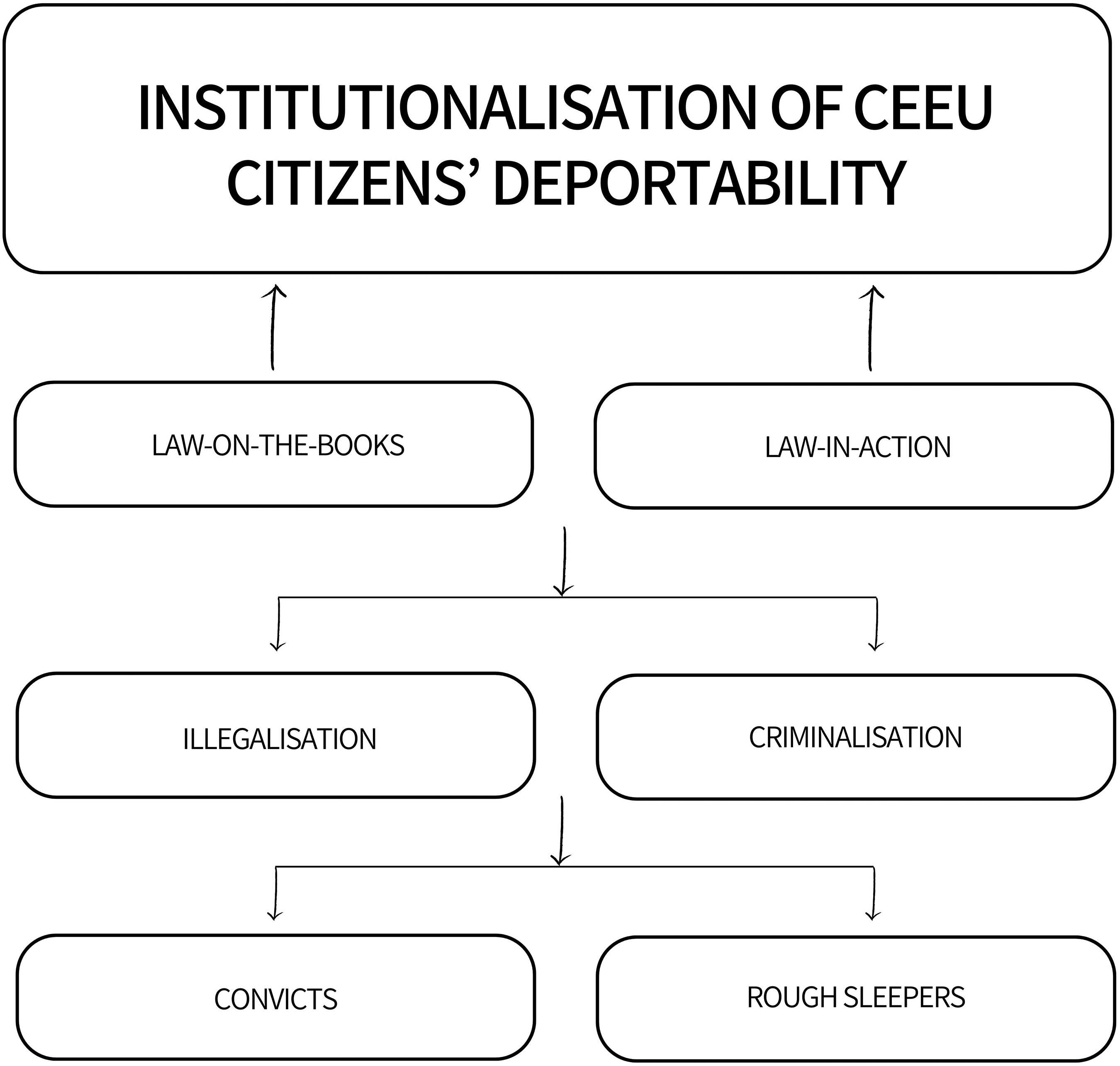
Processes that led to deportations of the two most deportable groups: CEEU convicts and rough sleepers.
Footnotes
Acknowledgements
I am grateful to the participants in my research. I am also indebted to Sylwia Wawrzyńczak-Szymczyk for sharing her professional expertise on EU deportations from the UK. I am very grateful to Benjamin Morgan and Katarzyna Makowska, who worked at the Public Interest Law Centre at the time of my research, for sharing their deep knowledge on the topic. I highly appreciate the helpful comments of two anonymous reviewers. Big thanks to Michaela Benson, Zuzanna Brunarska, Ewa Cichocka, Aleksandra Galasińska and Agnieszka Martynowicz for their invaluable comments on earlier drafts of this article. I am also indebted to the organisers of two seminars at which an earlier version of this article was discussed: Rebecca Murray and Aneta Piekut from the University of Sheffield and Kamila Fiałkowska from the University of Warsaw.
Declaration of conflicting interests
The author declared no potential conflicts of interest with respect to the research, authorship, and/or publication of this article.
Funding
The author disclosed receipt of the following financial support for the research, authorship, and/or publication of this article: This research was funded in whole by the National Science Centre Sonata Program under Grant Agreement No. 2020/39/D/HS5/02319. For the purpose of Open Access, the author has applied a CC-BY public copyright licence to any Author Accepted Manuscript (AAM) version arising from this submission.
