



Abstract
Firearm violence is a serious issue in Europe, yet the validity of existing theoretical approaches to weapon use in violent encounters have not been explicitly tested in the European context. This study tested existing hypotheses on weapon use and lethality – the Adversary Effects Hypothesis, the Physical Strength Hypothesis, and the Social Distance Hypothesis – using homicide data from the Netherlands, where detailed data on weapon use in homicide are available. Based on these hypotheses, we expected victim characteristics and the social distance between the victim and perpetrator to affect the modus operandi. However, our results do not align with these expectations when situational control variables are included. We conclude that existing studies on weapon lethality have a limited generalizability due to their assumption of free weapon choice. This is only met in contexts in which legal availability of firearms is high, which is not the case in the Netherlands. In addition, the hypotheses focus too narrowly on victim characteristics, without accounting for the situational factors influencing violent encounters. Based on these insights, we provide suggestions for theoretical and empirical improvements on firearm violence research.
Keywords
Introduction
Some weapons are more lethal than other weapons, independent from the intent of the perpetrator. To this day, medical and criminological studies on the lethality of assault show that injuries caused by gunshot wounds result in a higher mortality than other weapons, such as knives (Christensen et al., 2008; Harris et al., 2002; Libby, 2009; Saltzman et al., 1992; Zimring, 1968). Furthermore, firearms can inflict potentially lethal wounds over a long distance, such as in drive-by shootings, and on several victims in a short period of time compared to other weapons (Altheimer and Boswell, 2012).
Some studies have addressed weapon lethality in relation to levels of violence, such as the question whether widespread availability of firearms correlates with high homicide rates, also known as the Weapon Lethality Hypothesis (Braga et al., 2021; Krüsselmann et al., 2021). Other studies focus on the impact of weapon lethality on the nature of violence, such as the perpetrator's decision-making before and during a violent encounter. Presuming that the difference in lethality across weapons is known to the perpetrator, to what extent does that affect the perpetrator's choice for a weapon? Although weapon use has been the subject of a series of criminological studies (Fox and Allen, 2014; Pelletier and Pizarro, 2019; Pizarro et al., 2021), research connecting weapon lethality to weapon choice is rare. Yet, from the few studies that have been done, a number of hypotheses have emerged that put forward the idea that certain characteristics of the victim of a violent encounter can lead the perpetrator to implicitly or explicitly choose a firearm – as the most lethal option – over a knife or other weapon (Felson and Hullenaar, 2021; Felson and Painter-Davies, 2012; Felson and Pare, 2010; Heide, 1993; Rennison et al., 2010).
These hypotheses – the Adversary Effects Hypothesis, the Physical Strength Hypothesis, and the Social Distance Hypothesis – are central to this study, which tests their validity on Dutch homicide cases. The first reason for using the Dutch context is the availability of disaggregated and detailed homicide data through the Dutch Homicide Monitor. Secondly, findings from the Dutch context may also be applicable to other West European countries given the comparability in homicide and weapon use (Liem et al., 2013; Suonpää et al., 2024). Finally, and most importantly, the weapon lethality hypotheses have been developed and empirically tested mainly in the context of the US (Brennan and Moore, 2009), where the legal availability of firearms is high compared to other global regions (Karp, 2018). So far, the generalizability of these hypotheses remains untested in other contexts, such as in Western Europe, in which the most lethal type of weapon, a firearm, is generally not legally accessible to most citizens.
In addition, this study addresses the validity of these hypotheses in light of other theoretical and empirical research on violence. Through various lenses, all three of the hypotheses central to this study focus specifically on characteristics related to the victim. However, theoretical and empirical research suggests that violent encounters do not take place in a vacuum and that situational factors, such as the direct surroundings in which violence takes place, or structural ones may impact how violence is carried out (Pridemore, 2002; Wikström and Treiber, 2015). Therefore, this study critically tests whether the emphasis on victim characteristics in the explanation for weapon use is warranted.
Overall, this research has two goals: to test the validity of the weapon lethality hypotheses on Dutch homicide cases and discuss the lessons that can be drawn for the theoretical development of weapon-related violence in Europe. To address these goals, two main questions will be answered: (1) To what extent do victim and situational factors differ between homicides committed with firearms and homicides committed with other weapons? (2) Which factors related to the victim and situational context of a homicide are linked to the type of weapon used? In answering these two questions, this study provides an indication whether existing theoretical approaches can and should shape future European research on weapon-related violence.
Weapon lethality and perpetrator's weapon use
Before discussing in detail the aforementioned weapon lethality hypotheses, it is important to understand their underlying theoretical paradigms to highlight their similarities and differences. Some of the hypotheses directly or indirectly rest on the assumption that perpetrators make a rational choice for a specific weapon. Rational Choice Theory states that perpetrators only commit a crime if the perceived benefits outweigh the perceived costs of a crime, such as retaliation or imprisonment (Cornish and Clarke, 2014). Yet, the rationality behind a decision to engage in a crime is individually based and bounded by several factors, such as previous experiences, self-control, or other individual characteristics of the potential perpetrator. Furthermore, Cornish and Clarke (2014) state that some choices are not made after extensive planning or elaboration about options, but in a very short time – even just seconds – during the crime itself. Thus, weapon choice may refer to an explicit, conscious decision prior to engaging in a violent encounter and momentary impulses based on contextual factors. Due to these ambiguous meanings of the word ‘choice’ and the difficulty of empirically measuring intentions or considerations made by perpetrators (Phillips and Maume, 2007; Wells and Horney, 2002), some studies prefer to focus on ‘weapon use’ instead.
Adversary effects hypothesis
Leaning on the premise of rational choice and the social interactionist approach, the Adversary Effects Hypothesis, established by Felson and colleagues (Felson and Hullenaar, 2021; Felson and Painter-Davies, 2012; Felson and Pare, 2010) rests on the assumption that the perpetrator considers characteristics of the adversary as a risk to successful commission of a (violent) crime when determining targets, the intent to kill, the use of allies and – most important in the context of this study – the use of weapons. In other words, weapon use should be more likely in lethal or non-lethal assaults in which the perpetrator deems weapon use to be essential for a successful attack. Firearms in particular are regarded as more lethal than other weapons, and may thus be used in specific types of assaults, for example, assaults in which the perpetrator wants to avoid any physical confrontation with the victim.
Empirically, this hypothesis has been directly assessed in a handful of studies carried out by the researchers who initially coined the said hypothesis (Felson and Hullenaar, 2021; Felson and Painter-Davies, 2012; Felson and Pare, 2010). In these studies, gender and race have been brought forward as potential factors influencing weapon use by the perpetrators (Felson and Painter-Davis, 2012). Both male and female perpetrators were, respectively, 2.5 and almost two times more likely to use a firearm when confronted with a male victim than no weapon at all (Felson and Hullenaar, 2021). The importance of the victim's gender is also found in other studies that did not directly test the Adversary Effects Hypothesis (Fox and Allen, 2014; Libby, 2009). With regard to race, Felson and Painter-Davies (2012) found that the likelihood of a homicide perpetrator using a weapon, and specifically a firearm, was higher when the victim was black compared to when the victim was white, which is supported in other US-based studies (Libby, 2009; Pelletier and Pizarro, 2019).
Other studies have – without an explicit link to the Adversary Effects Hypothesis – brought forward other victim-related factors that may influence weapon choice. US studies with varying local samples noted an effect of the victim's age on weapon use, although results differ with some studies reporting that older victims are more likely to be killed with a firearm in particular (Allen and Fox, 2013; Libby, 2009; Mize et al., 2011), while another study reports a higher likelihood of knives or blunt objects in homicides with older victims (Pelletier and Pizarro, 2019). Finally, a victim's criminal or violent history may lead the perpetrator to use a weapon with a high likelihood of lethality in fear of retaliation. For example, Pelletier and Pizarro (2019) found that homicide victims with a history of drug dealing or gang membership were 97% more likely to use a firearm.
Physical strength hypothesis
Closely related to the Adversary Effects Hypothesis is the Physical Strength Hypothesis, as developed by Heide (1993). Instead of arguing that retaliation is the main motivation for choosing a weapon with high lethality, the Physical Strength Hypothesis states that physical superiority of the victim in contrast to the perpetrator necessitates a weapon that can equalize or turn the power imbalance in favour of the perpetrator (Heide, 1993). In her seminal study of American parricides, Heide (1993) found that (step)fathers were more likely to be killed with a firearm than (step)mothers. At the same time, juvenile perpetrators were more likely than adult perpetrators to kill their (step)parents with a firearm. She argued that younger perpetrators might not have the necessary physical strength to kill a parent with a knife, a blunt object or no weapon at all. Several studies have found support that physical strength (im)balance – typically measured in age and gender differences between victim(s) and perpetrator(s) – impacts weapon use in the context of not just domestic violence (Heide and Petee, 2007) but also sexually motivated homicides (Chan and Beauregard, 2016; Chan et al., 2019).
Social distance hypothesis
A third perspective that can be used to better understand weapon use is the Social Distance Hypothesis, which states that weapon use is influenced by the relationship between victim and perpetrator (Black, 2004; Cooney, 2009; Rennison et al., 2010). Specifically, violent encounters involve more lethal weapons among perpetrators and victims with a higher social distance, i.e., who are (1) less acquainted (relational distance) and (2) less familiar with their ideas and forms of expression (cultural distance). The Social Distance Hypothesis was first coined by Rennison et al. (2010), who synthesized previous work by Black (2004) and Cooney (2009) that focused on retaliatory and predatory violence, respectively. According to the Social Distance Hypothesis, higher relational distance between victims and perpetrators is associated with more lethal weapons. The hypothesis itself is rarely directly assessed in empirical studies, yet the victim-perpetrator social or cultural relationship has been the focus in studies on weapon use. US studies found that stranger homicides are more likely to involve a firearm than homicides between family members or (ex)intimate partners (Fox and Allen, 2014; Pelletier and Pizarro, 2019). On the other hand, the few non-US studies that investigate the relationship between weapon use and victim–perpetrator relationship show different results; for example, the use of neither firearms nor knives was a significant predictor of victim–perpetrator relationship in Taiwan (Cao et al., 2008). The second premise, cultural distance – usually measured through similarities in race between victim and perpetrator (Jacques and Rennison, 2013) – is rarely discussed in relation to weapon use and lethality (Black, 2004; Rennsion et al., 2010). Rennison et al. (2010) found that violence between a victim and perpetrator of different ethnicities or races was more likely to involve a more lethal weapon, when comparing weapons such as knives and firearms. Yet, whether this hypothesis can be supported with other proxies than race remains largely untested. Other proxies than race have so far not been included. Thus, overall, empirical support for both elements of the Social Distance Hypothesis remains inconclusive.
Situational factors influencing weapon use in homicide
The previously discussed hypotheses are the only theoretical approaches that specifically address weapon use in violent encounters. All three put emphasis on the importance of victim characteristics as explanations for weapon use in violent encounters. Yet, criminological research on violence has affirmed both theoretically and empirically the importance of situational and contextual factors (Pridemore, 2002; Wikström and Treiber, 2009, 2015). For firearm violence in particular, empirical studies have found several situational characteristics, such as the type of location, time of day, and substance use, that are associated with the use of a firearm, which that have not been considered in the previously discussed hypotheses. Specifically, violent lethal encounters in public locations increased the likelihood of weapon use generally (Libby, 2009), and firearms in particular (Pizarro et al., 2019). In addition, daytime as opposed to nighttime increased the likelihood of firearm use, whereas intoxication decreased it (Libby, 2009).
With the insights from these empirical studies, one may question the somewhat isolated focus on victim characteristics as the sole explanatory factor for weapon use as presented in the previous hypotheses. Yet, to date, no studies have both empirically and theoretically brought individual victim and perpetrator and situational characteristics together to explain weapon use.
Hypotheses
Together, these approaches lead to the following testable hypotheses:
The more ‘adverse’ characteristics of the victim, the more lethal the weapon (related to Adversary Effects Hypothesis).
Male victims are more likely to be killed with a firearm than female victims. Non-elderly victims are more likely to be killed with a firearm than elderly victims. Victims with a criminal/violent history are more likely to be killed with a firearm than victims without a criminal history. Victims who are older than the perpetrator are more likely to be killed with a firearm than younger victims. The higher the physical superiority of the victim in contrast to the perpetrator, the more lethal the weapon (related to Physical Strength Hypothesis).
Male victims are more likely to be killed with a firearm than female victims. Victims who are older than the perpetrator are more likely to be killed with a firearm than victims younger than the perpetrator. The higher the social distance between perpetrator and victim, the more lethal the weapon (related to Social Distance Hypothesis).
Relational distance: Victims who are strangers to the perpetrator are more likely to be killed with a firearm than victims who are acquainted to or have a familial/intimate relationship to the perpetrator. Cultural distance: Victims with a different ethnicity than the perpetrator are more likely to be killed with a firearm than victims with a close cultural distance to the perpetrator. Situational factors influence weapon use in homicide.
Homicides committed in public places have a higher likelihood to be committed with a knife or blunt object and less likely to be committed with a firearm than homicides committed in non-public locations. Victims under the influence of alcohol or drugs are less likely to be killed with a firearm than victims not under the influence. Homicides committed during the day are less likely to involve a knife or blunt object, but more likely to involve a firearm than homicides committed during nighttime. Homicides with multiple victims are more likely to be committed with a firearm than homicides with a single victim. Situational variables impact the importance of victim characteristics as sole explanators for weapon use.
Methodology
Data
To test the hypotheses derived from the literature on weapon lethality, we make use of the Dutch Homicide Monitor. This dataset is administered by the authors and based on a validated instrument for homicide data collection, the European Homicide Monitor (Granath et al., 2011; Liem et al., 2013). Homicides are defined as intentional killings, which include cases that fall under the Dutch legal codes of murder, manslaughter, and infanticide. Assaults leading to death and legitimate killings, for example, through police force, are excluded. Detailed case, victim, and perpetrator information was collected from several sources, including publicly accessible news articles and court decisions, non-public court files, police data, and forensic reports. The Dutch Homicide Monitor currently incorporates all homicide cases that took place in the Netherlands between 1992 and 2021. For this analysis, we included homicides committed between 2000 and 2020, due to completeness and richness of the data for these years. In these years, 3412 homicide cases have been registered; however, for 303 homicide cases, the modus operandi was unknown. Furthermore, in an additional 834 cases, modus operandi other than firearms, knives, blunt objects, or physical violence had been used and therefore excluded for the purpose of this study. As a result, the analysis is based on 2275 homicide cases.
Study context
In the Netherlands between 2000 and 2020 on average 148 cases of homicide took place annually, with an average 157 victims per year. With a population of around 17.5 million, the average homicide rate for these years is 0.9 per 100,000 population. In the most recent years the homicide rate has been stable at around 0.6 per 100,000 population. Most common are homicides in the domestic sphere (40%), between (ex-)partners or other types of family members, followed by homicides in the criminal milieu (17%) and dispute homicides (16%). Robbery homicides (8%) and sexual homicides (2%) are less common. Around half of Dutch homicides (51%) involve male victims who are killed by male perpetrators; a quarter (27%) involve female victims killed by male perpetrators (Dutch Homicide Monitor, 2023).
Sharp objects, such as knives, are the modus operandi used in 35% of homicides for which the cause of death could be determined. Firearms are used in a third (33%) of all homicides between 2000 and 2022. Physical violence, through hitting, kicking or asphyxiation, caused the victim's death in around 18% of homicides. The use of blunt objects (5%) is less common.
It is noteworthy that firearms are used in a third of all homicides, although firearm ownership by civilians is heavily regulated in the Netherlands. In principle, as constituted in regulations by the European Union (Directive 2021/555/EC) and national laws, civilians are not allowed to own firearms, with exceptions for specifically authorized collectors, firearm dealers, sport shooters, or hunters. Moreover, in the Netherlands, legally acquiring a firearm is subject to a lengthy procedure, including security screenings, which can take several months or up to a year. For 2017, the Small Arms Survey (Karp, 2018) reported a little over 200,000 legally registered firearms in the Netherlands. In addition, however, around 230,000 illegally owned and thus unregulated firearms are estimated to circulate in the country. Taken together, one can estimate that there are three firearms for every 100 citizens in the Netherlands. This estimation is low, compared to other non-European countries, with 120 firearms in the US, 10 in South Africa, and 5 in India, as well as other European countries, with an estimated 23 firearms per 100 citizens in Sweden and 14 firearms in Croatia and Italy (Karp, 2018).
Variables/operationalizations
Modus operandi. Following the World Health Organization's International Classification of Diseases, Tenth Revision (ICD-10) categorization of causes of death through assault, the Dutch Homicide Monitor differentiates between hands-on physical violence (e.g., hitting, kicking and strangulation), blunt objects (e.g., baseball bats, hammers), sharp objects (e.g., knives, spears), and firearms (handguns, long guns). Due to the relatively rare use of blunt objects and physical force in Dutch homicides, multivariate analyses using these four categories of weapons were unreliable due to low numbers. In the end, we merged the modi operandi into a binary variable: firearms and other weapons, including physical force.
Homicide victim and perpetrator. A victim is defined as any lethal victim of a homicide case. Other individuals who sustained non-lethal injuries during the same violent incident are not counted as homicide victims in this study. Homicide cases with multiple victims thus refer to incidents in which two or more individuals were lethally injured. Although some homicide cases (N = 111, 4.9%) included multiple lethal victims, the following analyses are case-based analyses and therefore only include information from the main victim and perpetrator of each case, as defined in the coding manual of the Dutch (and European) Homicide Monitor.
Adversary effects: Victim variables. Potential victim characteristics that could influence the use of homicide weapon due to its lethality found in previous studies are the gender, age, age difference between victim and perpetrator, and the violent or criminal history of the victim. Gender is a dichotomous variable, differentiating between male and female (reference category) victims, based on the gender assigned at birth. Age is divided into four categories: child (0–14), young adult (15–29), adult (30–64, reference category), and elderly victims (65+; reference category). Using these categories, age difference alludes to whether the victim is younger than, the same age as, or older than the perpetrator (reference category). A victim's criminal history is coded as a binary variable (yes/no). No criminal history (reference category) includes unknown cases, meaning that no indication of a criminal history was found.
Social distance variables. Social distance is the combination between relational and cultural distance between victim and perpetrator. Relational distance is measured by the relationship between victim and perpetrator. The Dutch Homicide Monitor differentiates between 33 types of relationships. In this study, we collated those types and differentiate between intimate relations ((ex-)intimate partners, family), acquaintances (e.g., neighbours, friends, work relationships), and strangers (reference category), following previously used definitions in homicide research (Bijleveld & Smit, 2006; Getoš Kalac, 2021; Häkkänen-Nyholm et al., 2009). In previous US-based studies, cultural distance has been measured using race as an indicator (Rennison et al., 2010; Zimmerman et al., 2021). However, such a differentiation does not fit the cultural constellation of the Netherlands (Statistics Netherlands, 2021). Instead, we follow previous work (Bijleveld and Smit, 2006; Liem et al., 2019) which used the individual's (parents’) country of birth as a measurement for ethnicity. This results in a dichotomous variable, distinguishing individuals born in the same continent from individuals born in different continents.
Situational variables. The number of victims, the degree to which the crime scene is public, the time of the day, and the victim's substance use, among other variables, have been identified as potential situational factors that influence the perpetrator's weapon use. The Dutch Homicide Monitor recognizes 12 types of crime scenes, which have been collated into a dichotomous variable for the sake of this research. Public crime scenes include public streets, forests, bars, restaurants, public transportation, and workplaces. Private crime scenes (reference category) include private homes of victims, perpetrators or other individuals, hotels, and institutions. The time of day is a dichotomous variable: daytime (reference category) lasts from 6 am to 6 pm and nighttime from 6 pm to 6 am. Substance use by the victim is a dichotomous variable (yes/no). Substance use by the victim (reference category) means that there are confirmed or unconfirmed indications that the victim could have been under the influence of alcohol and/or drugs or is addicted to alcohol and/or drugs.
Analyses
To address the first and second research question, descriptive statistics and bivariate tests of significance in the form of chi-square tests are conducted. Multivariate analyses in the form of binary logistic regression follow, as all conditions for this type of analysis have been met. The first model (N = 2232) includes the relevant variables related to victim characteristics to test the Adversary Effects hypothesis. Model 2 (N = 1925) tests the association between weapon use and victim characteristics related to the Physical Strength Hypothesis. Model 3 (N = 1175) addresses the Social Distance Hypothesis. Model 4 (N = 1900) combines the closely related variables associated with the Adversary Effects and Physical Strength hypotheses. Combining both assumptions into one model aids in understanding the possible distinction or conceptual overlap of those two hypotheses. Finally, Model 5 (N = 673) combines the victim-related variables associated with the Adversary Effects, Physical Strength, and Social Distance hypotheses with situational factors found relevant in previous empirical studies. Incorporating relevant variables from each hypothesis with situational variables allows not only an evaluation of the explanatory strength for each individual hypothesis, but also an overall evaluation of the importance of victim characteristics in explaining weapon use in homicide.
Results
Descriptive statistics
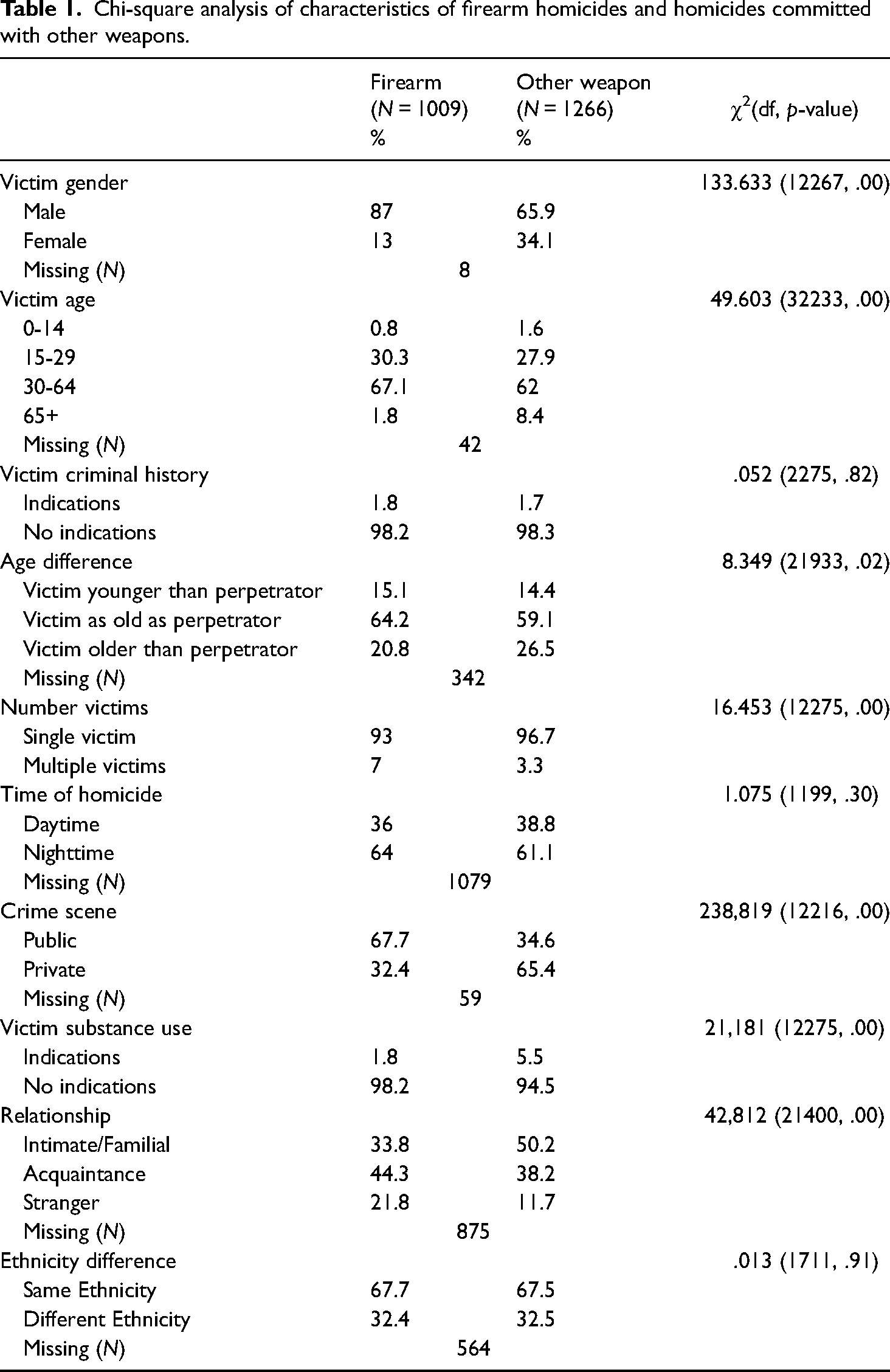
Descriptive statistics and results of chi-square analyses comparing homicides committed with firearms and other weapons are displayed in Table 1. Firearm homicides involved significantly more male victims, χ2(12267) = 133, 633, p = .00, and victims below the age of 65, χ2(32233) = 49, 603, p = .00, compared to other homicides. Relatedly, victims of firearm homicides tended to be younger than or the same age as the perpetrator, whereas homicides committed with other weapons involved more victims that were older than the perpetrator, χ2(21933) = 8349, p = .02. Furthermore, for homicides committed with firearms, there were fewer indications that the victim had been under the influence of alcohol or drugs during the crime, χ2(12275) = 21, 181, p = .00. Victims of firearm homicides tended to be an acquaintance or stranger rather than an intimate partner or family member of the perpetrator more often compared to homicides committed with other weapons or physical force, χ2(21400) = 42, 812, p = .00. Finally, firearm homicides occurred more often in public spaces, χ2(12216) = 238, 810, p = .00, and involved multiple lethal victims more often, χ2(12275) = 16, 453, p = .00. No statistically significant differences between firearm homicides and homicides committed with other weapons are found for the victim's criminal history, ethnic differences between victim and perpetrator, and the time of day in which the homicide was committed.
Chi-square analysis of characteristics of firearm homicides and homicides committed with other weapons.
Regression analyses
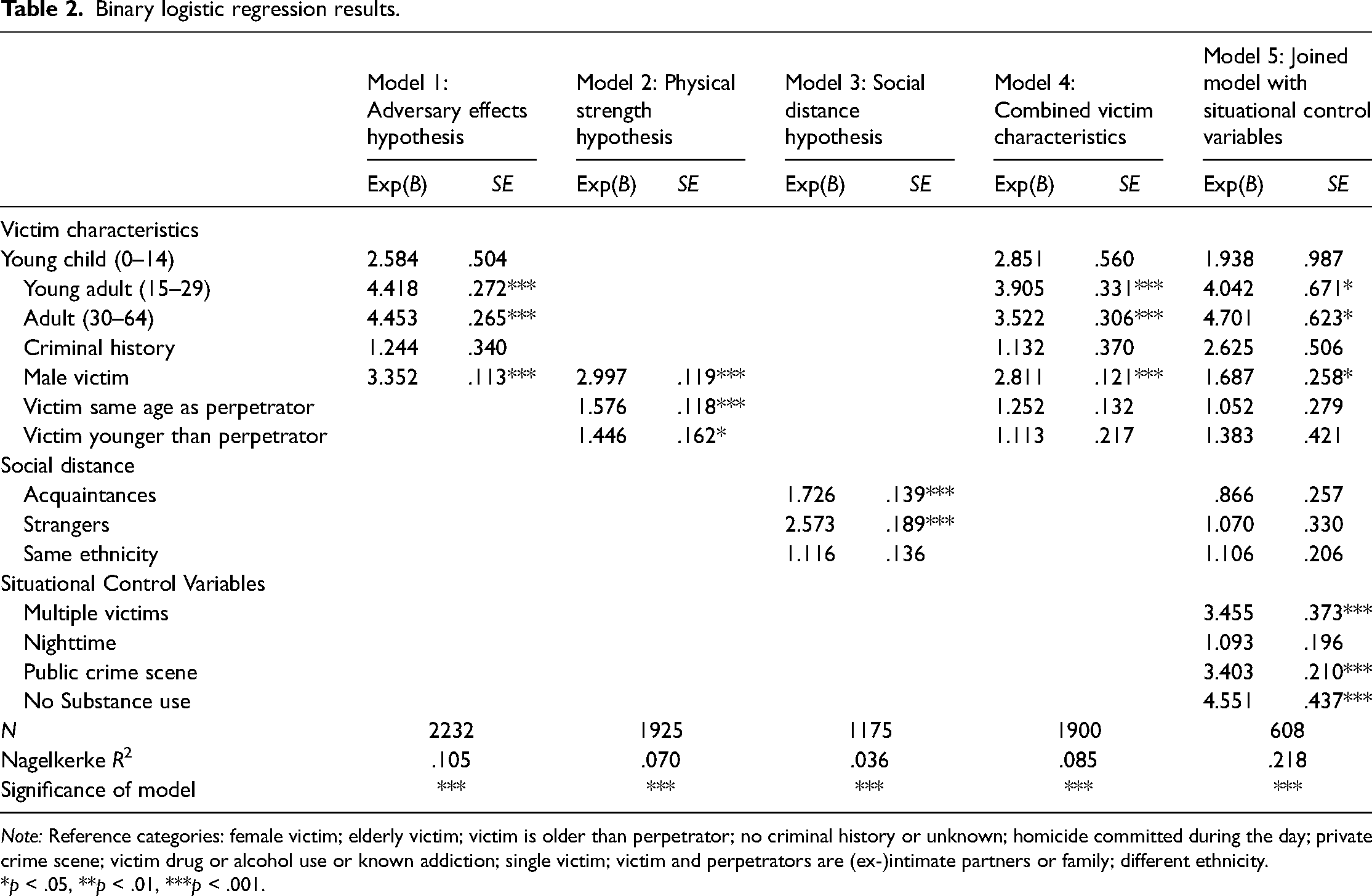
Table 2 presents the results of the binary logistic regression analyses. Model 1 tests the predicting effect of victim characteristics on the weapon use of the perpetrator, as considered in the Adversary Effects hypothesis. The results reveal that the victimβs gender and age have a significant effect on the likelihood of a firearm being used as a modus operandi. Compared to when the victim was female, the likelihood of a firearm being used increased by 3.352 when the victim was male (β = 1.210, p = .000). The victim being a young adult (β = 1.486, p = .000) or adult (β = 1.494, p = .000) also increased the likelihood of a firearm as modus operandi by 4.418 and 4.453 times, respectively. The victim being a young child (β = 0.949, p = .060) or having a criminal history (β = 0.218, p = .521) had no statistically significant predicting power for the modus operandi. The results are mostly in line with hypothesis 1a – the victim's gender was confirmed as a significant predictor of firearm use – and hypothesis 1b – younger adults and adults are more likely than elderly victims to be killed with a firearm. Yet, compared to elderly victims, very young children were not significantly more likely to be killed with a firearm. In addition, the results contrast with hypothesis 1c, as the criminal history of the victim had no predicting effect on the weapon used. The overall predictive power of the model is significant, with around 10.5% of weapon use explained by the included variables, χ2(5) = p = .00, Nagelkerke R2 = .105(5) = (21933) = 8349.
Binary logistic regression results.
Note: Reference categories: female victim; elderly victim; victim is older than perpetrator; no criminal history or unknown; homicide committed during the day; private crime scene; victim drug or alcohol use or known addiction; single victim; victim and perpetrators are (ex-)intimate partners or family; different ethnicity.
*p < .05, **p < .01, ***p < .001.
Model 2 includes the relevant victim-related variables associated with the Physical Strength Hypothesis: victim gender and age difference between victim and perpetrator. All included variables have a statistically significant association with weapon use. The victim being male increased the odds of firearm use 2.997 times (β = 1.098, p = .00), whilst the victim being younger or around the same age as the perpetrator increased the odds of firearm use 1.576 and 1.446 times, respectively (β = 0.455, p = .00; β = 0.369, p = .023). Overall, then, the assumptions of the Physical Strength Hypothesis represented in hypotheses 2a and 2b are supported. The model overall explains 7% of weapon use in Dutch homicides, χ2(3) = p = .00, Nagelkerke R2 = .070 (3) = (21933) = 8349.
Model 3 addresses the Social Distance Hypothesis by testing the effect of the relationship between victim and perpetrator and their cultural distance in terms of difference in ethnicity on the use of a particular weapon. The results show that the victim being an acquaintance to the perpetrator increased the likelihood of a firearm as modus operandi by 1.726 times (β = 0.546, p = .000); the victim being a stranger by 2.573 times (β = 0.945, p = .000) compared to the victim being an (ex-)intimate partner of family member. These findings are in line with hypothesis 4a that social distance between victim and perpetrator increases the chances a more lethal weapon was used. However, ethnic differences between victim and perpetrator had no statistically significant predictive power (β = 0.110, p = .420), which is in contrast with hypothesis 4b that cultural distance increases the chances a more lethal weapon was used. The predictive power of these variables combined is statistically significant, but low relationship and ethnic differences explain about 3.6% of the variance in weapon use in Dutch homicides, χ2 (3) = p = .00, Nagelkerke R2 = .036 (3) = (21933) = 8349.
Model 4 combines victim-related variables of the Adversary Effects- and Physical Strength hypotheses, with the victim's gender being the overlapping variable between both approaches. In the combined model, the significant variables from Model 1 remained significant: male victims are 2.811 times more likely to be killed with a firearm (β = 1.033, p = .00), as are young adults and adults, 3.905 and 3.522 times, respectively (β = 1.362, p = .00; β = 1.259, p = .00). The victim being a young child and having a criminal history remained insignificant. Interestingly, the age difference between victim and perpetrator predicted by the Physical Strength Hypothesis is rendered insignificant in the combined model (β = 0.225, p = .088 for same age; β = 0.107, p = .622 for younger vctim). The combined model explains 8.5% of weapon use in Dutch homicides, χ2 (7) = p = .00, Nagelkerke R2 = .085 (7) = (21933) = 8349, which is lower than the explanatory power of the variables included in Model 1 alone, but higher than the power of Model 2.
Finally, Model 5 combines all victim-focused variables from Models 1–3 with the situational variables. Compared to the combined Model 4 (the combined Adversary Effects and Physical Strength hypotheses) no indicative changes are observed: the victim being male (β = 0.523, p = .043), a young adult (β = 1.397, p = .037) or an adult (β = 1.548, p = .013) all increased the likelihood of firearm use by 1.687, 4.042 and 4.701 times, respectively. At the same time, the victim being a child (β = 0.662, p = .503), having a criminal history (β = 0.965, p = .056), and being the same age (β = 0.051, p = .856) or younger (β = 0.324, p = .442) as the perpetrator had no significant effects. The variables related to the Social Distance Hypothesis become insignificant in this final model: neither the relationship between the victim and perpetrator (β = 0.144, p = .576 for acquaintances; β = 0.068, p = .838 for strangers) nor the cultural distance (β = 0.100, p = .627) have predictive power for weapon use. On the other hand, three of the four situational variables have significant associations with weapon use: the presence of multiple victims (β = 1.240, p = .00), violent encounters in public spaces (β = 1.225, p = .00), and no indications of substance (ab)use of the victim (β = 1.515, p = .00) all increased the likelihood of firearm use by 3.455, 3.403 and 4.551 times, respectively, thereby confirming hypotheses 4a, 4b, and 4d. The time of the day, on the other hand, had no significant association (β = 0.089, p = .651) with weapon use, against the expectations expressed in hypothesis 4c. Overall, the final model including situational variables has the highest explanatory power, accounting for almost 22% of weapon use in Dutch homicides, χ2 (14) = p = .00, Nagelkerke R2 = .218 (14) = (21933) = 8349.
Discussion
The first goal of this study was to test the validity of the Adversary Effects Hypothesis, the Physical Strength Hypothesis, and the Social Distance Hypothesis on Dutch homicide cases. We tested the validity of each hypothesis individually and evaluated whether the focus on victim characteristics as predictors of weapon use across the hypotheses is sufficient by testing them in a combined model with situational factors. Our findings underline the importance of situational factors in explaining weapon use: in the combined model, victim age and gender remain significant victim characteristics, yet all other victim-focused variables are statistically insignificant. On the other hand, multiple victims, public crime scenes, and no indications of victim substance use appear as significant predictors for firearm use. Thus, when combined, situational characteristics have a stronger explanatory power than victim characteristics.
This is also somewhat reflected in the individual models for each hypothesis, which provide varying support: according to the Adversary Effects Hypothesis, the victim being male, at a young age, and having a criminal history should lead the perpetrator to use a more lethal weapon – a firearm – out of fear of retaliation and to increase the perpetrator's coercive power. In our study, the victim's gender and age had the expected effect, yet their criminal history was no significant predictor for firearm use. When measured independently from other factors, our findings support the Physical Strength Hypothesis, which assumes that the victim's physical superiority – measured through gender and age difference to the perpetrator – are predictive of firearm use. And finally, the Social Distance Hypothesis is partially supported through our findings, as greater relational distance to the victim increased the likelihood of firearm use in homicide, yet cultural distance between victim and perpetrator had no predicting effect. In addition to testing each hypothesis separately, we also combined the victim-focused Adversary Effects and Physical Strength hypotheses in a model. When combined, the age and gender of the victim remain significant predictors of firearm use, yet age difference between victim and perpetrator loses statistical significance. This finding indicates that it is not the age difference but rather the victim's age independent from the perpetrator's that matters in weapon use.
The question arises why were none of the hypotheses related to weapon lethality fully supported by our Dutch homicide data, in particular when situational factors are considered? We hypothesize that there are two reasons: First, we propose that the two main assumptions underlying the Adversary Effects Hypothesis, the Physical Strength Hypothesis, and Social Distance Hypothesis are not met. The first assumption at the heart of these hypotheses, particularly the Adversary Effects Hypothesis and the Physical Strength Hypothesis, is the rational choice paradigm. Both hypotheses assume that the perpetrator makes a rational choice for a more or less lethal weapon, based on the physical or otherwise coercive power of the victim. Previous studies have indeed suggested a correlation between premeditation and planning of a violent crime and weapon use: Pizarro et al. (2021) found that premeditation of a violent crime in New Jersey, US, increased the likelihood of firearm use compared to other weapons by 4.75, when controlling for characteristics of perpetrators and their relationship to the victim. However, research also suggests that many homicides are committed in the heat of the moment, driven by emotions such as anger, jealousy, or fear rather than through instrumental calculations and extensive planning (Adjorlolo and Chan, 2017; Thijssen and de Ruijter, 2011). Thus, the rationality behind weapon use in lethal violent encounters may be bounded by other situational factors, such as the perpetrator's self-control, or the presence of third parties (Pelletier and Pizarro, 2019). Indeed, in the final model of our analyses, situational factors rather than victim characteristics remain significant and strong predictors of firearm use compared to other weapons.
The second assumption that all of the tested hypotheses rest upon is weapon choice. However, restricted access to specific weapons may be a confounding factor affecting the generalizability of the hypotheses. On a macro level, the general availability of specific weapons to potential perpetrators needs to be considered: in the US, where all hypotheses were developed, even the most lethal type of weapon – a firearm – is not heavily regulated and accessible to the general public (Bureau of Alcohol, Tobacco, Firearms and Explosives, 2023). As mentioned previously, it is estimated that there are 120 firearms for every 100 citizens in the US (Karp, 2018). In other societal contexts, such as the Netherlands, firearms are more heavily regulated than in the US and only legally accessible to a small and specific population. Here, it is estimated that there are three firearms for every 100 Dutch citizens (Karp, 2018). Thus, it can be assumed that the weapon choice of Dutch homicide perpetrators is fundamentally more restricted, which violates the basic assumption of the hypotheses tested in this study and may explain the deviation from our results to previous empirical studies. Without the ability for further testing, our study suggests that the generalizability of the Adversary Effects Hypothesis, the Physical Strength Hypothesis, and the Social Distance Hypothesis, and therefore common explanations for firearm use in homicides, is limited as their underlying assumption of weapon choice is dependent upon societal context.
A second explanation for why the tested hypotheses do not find support in our data lies in their narrow focus on victim characteristics, which does not align with dominant theories on violence that highlight the relevance of a multitude of individual, situational, and structural factors (Pridemore, 2002; Sampson and Lauritsen, 1994). The inclusion of situational control variables and subsequent loss of significance of several victim-related variables in our findings reinforces the notion that violent encounters are complex and do not occur in a vacuum between individuals. The hypotheses tested in this study, however, do not account for such factors in explaining weapon use. Empirically, situational or structural factors have not been included as potential mediating variables in the few existing assessments of these hypotheses. Theoretically, the hypotheses lack integration into broader theories on violence, or violent crime in particular. In their current forms, they seem disconnected – a patchwork of theoretical ideas that follow the same underlying question of how weapon lethality impacts weapon use but do not seem to be integrated with each other, nor with other dominant theories on violence. As such, the hypotheses may be able to explain weapon use in certain contexts, such as parricides in the case of the Physical Strength Hypothesis, but combined are not sufficient to comprehensively address the question.
These conclusions beg the question: do we need a new theory of firearm violence in Europe if existing ones cannot accurately and comprehensively capture the phenomenon of weapon use across geographical contexts? A critical evaluation of the current diffused theoretical and empirical landscape would suggest that adding theories would only extend and disperse the field further, rather than solve the main problems with existing approaches. Empirically, current hypotheses lack empirical validation. Almost all the hypotheses presented in this article here have exclusively been tested by the researchers who also coined said hypotheses and who used the same or similar empirical data to empirically support their ideas across several studies (see, e.g., Felson and Hullenaar, 2021; Felson and Painter-Davies, 2012; Felson and Pare, 2010). Although this fact does not diminish the potential of each of these hypotheses, it demands more scrutiny to establish validity, reliability, and a broader overall scientific credibility. An obstacle to extensive empirical validation is the lack of availability of detailed data on violent assaults and weapon use. A new theoretical approach targeted towards the European context would most likely suffer from similar problems, given the existing gaps of knowledge on firearm or otherwise weapon-related violence in Europe (Duquet and vanden Auweele, 2021).
A first step to enhance current theoretical ideas related to weapon lethality is to integrate existing approaches (of which some are presented in this study) into theoretically and empirically well-established theories on violence that incorporate individual, situational, and structural factors in their explanation for the occurrence of violence. Some of these theories already show overlap with the ideas presented in this study's central hypotheses; for example, Situational Action Theory (Wikström, 2014; Wikström and Treiber, 2009) emphasizes the role of environmental influences, and individual perceptions of action alternatives in a given environment in shaping criminal or specifically violent behaviour. The idea that one's actions are guided by one's perception of the given setting aligns closely with the ideas of the hypotheses discussed in this study that weapon use is a reaction to being confronted with a certain opponent. Yet, where these hypotheses focus only on one factor in the environment, the opponent Situational Action Theory allows for a broader interpretation of the environment, that includes other situational factors, such as the geographical place. Whilst Situational Action Theory in itself may be too broad to understand weapon use in violent encounters in particular, given that it focuses on (violent and non-violent) criminal behaviour in general, it could offer a theoretical backdrop to some of the hypotheses on weapon use. A theoretical and empirical exploration whether weapon lethality hypotheses can be integrated with the Situational Action Theory in particular would have gone beyond the scope of this present study, but could be a starting point to move theoretical firearm violence research further.
Overall, we believe that the integration of specific firearm hypotheses with broader violence theories and their associated paradigms could offer new theoretical avenues. For firearm violence in particular, an integration would strengthen the theoretical foundation of empirical research and make explicit the underlying assumptions and paradigms that empirical research is built on. However, violence research in itself may also benefit from such an integration. In their current state, most dominant violence theories focus on factors of (violent) crime causation, providing an abundance of macro-, meso-, and micro-level factors, from structural societal to individual biological factors (Eisner, 2009; Piquero, 2015). Yet, what is commonly neglected in these approaches to violence is the question how violence is produced (Obert et al., 2019), which in return is provided by the specific firearm hypotheses presented in this study. An integration would expand violence theories beyond the why of violence to the how.
In order to realize these theoretical explorations, European research also needs to address the existing empirical gaps. Disaggregated and detailed data on violent encounters, including reliable information on the modus operandi, are necessary to enhance weapon-related research in Europe. Few instruments already exist that address parts of these needs. The European Homicide Monitor is an established instrument across several European countries for the collection of such data on lethal violence, yet given the relatively low number of homicides in most European countries, any analysis using homicide data only captures the minority of weapon-related assaults (Krüsselmann, 2023). On the other hand, firearm-specific databases, such as SEESAC's Armed Violence Monitoring Platform (SEESAC, 2023) or the Dutch Firearm Violence Monitor (2022) capture both lethal and non-lethal assaults, but do not allow for comparisons across different types of weapons. Ideally, a comprehensive account of weapon use in violent encounters would include detailed data that captures individual, situational, and structural factors for both lethal and non-lethal incidents to inform theoretical innovations in the field.
Limitations
This is the first study to test the applicability of common hypotheses related to weapon lethality in a different societal context. Despite these first steps, several shortcomings need to be addressed in future studies. First, firearm homicides, as shown here and in a previous study (Krüsselmann et al., 2023), are more likely to take place in public and urban areas, involving younger male, non-European victims and perpetrators, fitting with the profile of organized crime activities. This distinct nature of Dutch firearm homicides provides two challenges to the validity and generalizability of this study's findings. First, it becomes difficult to disentangle the unique contributions of individual victim- or situational variables as they often co-occur together in criminal milieu homicides. As such, it may be questioned whether those individual characteristics truly have predictive power over weapon use, or whether they correlate with involvement in criminal networks, and it is this involvement which is causally linked to weapon use. Another challenge relates to the generalizability of our empirical findings. Specifically, we may question whether the limited extent to which the hypotheses can be applied is due to the hypotheses’ shortcomings or to the uniqueness of our sample of Dutch firearm homicides. A similar study done in European countries where firearm homicides do not have a distinct nature – such as Finland or Switzerland (Krüsselmann et al., 2023) – may provide more insights and validate our findings further.
Second, the sample used to assess the influence of weapon lethality on a perpetrator's weapon use only analysed cases in which the violent encounter ended in the death of the victim. However, researchers have previously stated that the higher weapon lethality of firearms may also deter the perpetrator from engaging in a violent encounter all together, seeing the risk that the use of such a weapon could bring (Kleck and McElrath, 1991; Phillips and Maume, 2007). To fully understand the effect of weapon lethality on the perpetrator's choice of a weapon and subsequent behaviour, non-lethal assaults, and threats committed with weapons that did not escalate to violence need to be considered and compared to the homicide sample. Such a comparison could disentangle the complicated nature between weapon lethality and violent encounters better. Equally detailed data on non-lethal assaults and threats with weapons are not available in the Netherlands, or elsewhere yet.
In addition, research has indicated that not only the type of weapon overall, but even the type of firearm and associated calibre size impact the lethality of violent encounters, with higher calibre weapons having a higher lethality (Braga and Cook, 2018; Libby and Corzine, 2007). To unveil the relation between calibre size and lethality and other more detailed layers of weapon use and lethality, reliable and complete data on firearms are necessary. Such data are unavailable in the Netherlands, due to the lack of a national registration point of legal and illegal firearms. Instead, such information is dispersed over several sources, such as the National Police and forensic institutes.
Finally, some limitations of this study relate to the data availability and variable construction. The dependent variable – the weapon used – is coded as a binary variable, indicating whether a firearm or other weapon was used. However, such a binary variable may not reflect the continuum of weapon lethality. Ideally, this research would have followed previous studies (Rennison et al., 2010) in disaggregating the type of weapon further, to see whether, for example, similar differences exist between knives and the next less lethal weapon – a blunt object. Yet, running multinominal regression with modus operandi disaggregated into the continuum ‘firearms, sharp objects, blunt objects, physical violence' yielded unreliable results, due to the small number of homicides, in particular homicides committed with blunt objects and physical force. Thus, a bivariate distinction into firearms and other weapons is deemed more reliable in the context of this study.
Missing data also provided another challenge. Specifically, missing information about the modus operandi is one of the reasons that affected the low number of homicide cases eligible for this study to begin with. It also impacted specific variables, in particular variables about the victim's country of birth, substance use, and criminal history. Although the Dutch Homicide Monitor handles strict definitions, to overcome the problem of missing data we interpreted missing information as no indications for the presence of substance use and criminal history. This may have resulted in an overestimation of cases labelled with no indications. Regardless of this interpretation, missing data resulted in a relatively low number of included homicides for each model, but in particular in the combined model, as the analysis excludes any cases in which information is missing. This may have resulted in the exclusion of specific types of homicides in which case and victim information may remain unknown to our data sources, such as homicides involving unidentified victims, or homicides in which the perpetrator and certain situational characteristics remain unknown.
Conclusion
Despite these shortcomings, this research adds to the empirical and theoretical literature on weapon lethality. We found that common hypotheses explaining the use of firearms in relation to their lethality have a limited generalizability outside a US context due to their assumption of free weapon choice, which is only met in societal contexts in which legal firearm availability is high. In addition, we argue that the hypotheses are too narrowly focused on victim-related factors and as such do not align with dominant theories on violence emphasizing the importance of situational factors. We suggest that future (European) empirical and theoretical work on weapon lethality should more rigorously empirically test for the underlying assumptions of the current hypotheses and embed their research into broader violence theories. However, such an approach requires detailed, reliable, and comparable data on armed violent crimes, which is relatively rare in criminological studies, in Europe and elsewhere (Hellenbach et al., 2017; Liem et al., 2013; Strom and Smith, 2017). In addition, future research could benefit from qualitative approaches to understanding weapon use in homicides or other crimes. Previous qualitative studies have proven insightful to understanding the complex nature of weapon use and the intent of perpetrators (Phillips and Maume, 2007; Wells and Horney, 2002). Some studies have highlighted factors related to cultural learning of weapon use, for example how offenders were introduced to or incentivized to use a certain type of weapon by parental figures or peers (Marano, 2015; Wilkinson et al., 2009). Such an approach may complement the rational choice approach by the Adversary Effects and Physical Strength hypotheses and aid the integration of single hypotheses into broader theories. In addition, through interviews with perpetrators the rationality or randomness of weapon use and other contributing situational factors can be explored further and with more detail.
