



Abstract
Building legitimacy in a coercive prison environment presents a significant challenge for prison workers. Drawing on data from a survey of 465 Slovenian prison workers collected in 2016 and 2022, this study aims to test the stability of prison workers’ sense of self-legitimacy, as prior research strongly suggests that the nature of such legitimacy is fundamentally unstable. Multivariate analyses showed that relationships with prisoners and the internalisation of subcultural norms influenced the self-legitimacy of prison workers in both periods studied. Relationships with colleagues, satisfaction with pay, and with workplace conditions also influenced prison workers’ self-legitimacy in 2016, and education and years of service proved salient in 2022. Results indicate that traditional ‘core variables’ (relationships with colleagues, supervisors’ procedural justice, and audience legitimacy) used to explore legitimacy in criminal justice have limited influence on prison workers’ self-legitimacy. Significant differences were also found in prison workers’ perceptions of self-legitimacy, audience legitimacy, and prison staff subculture in different time periods. Overall, the findings reported here suggest that the self-legitimacy of prison workers is relatively unstable over time. The implications of these findings for both theory and practice are explored.
Introduction
Trinkner and Reisig (2022) have argued that sustaining a stable system of rules and social order in a society with minimum use of coercion is challenging in any setting. Such a task is certainly even more difficult in the prison context wherein those with power/authority are often faced with a hostile population; order maintenance under such conditions calls for the use of appropriate professional skills (Sparks and Bottoms, 1995). Jackson et al. (2010) have argued in this regard that the proper functioning of a prison facility is based on the sustained maintenance of a stable environment found acceptable to prisoners and the prison staff alike. Maintaining order is essential in every prison, but if a major goal of imprisonment is not solely the incapacitation of offenders but also their re-socialisation, the traditional strict coercive control practices of prisons of the past are inadequate for the task. Prison conditions under which the prisoners are subordinated to a great many established rules and are ever-fearful of sanctions and ubiquitous oversight should (and perhaps must) be replaced with alternative strategies where authority derives from the legitimacy of prison power holders’ position. The ability of legitimacy (i.e. legitimate authority) to promote compliant behaviour can be seen as the principal cornerstone of any regulatory organisation, including prisons (Tyler and Trinkner, 2018).
The work of the prison workforce in ‘modern’ prison systems which have taken on a rehabilitative role can be described as a form of ongoing peacekeeping, based quite heavily on institutional legitimacy, effective communication, and the building of trusting relationships (Liebling, 2011; Schultz, 2023). From this perspective, it is indeed essential how prison workers decide to exert their authority over prisoners. It is well established in the research literature that actions based on consent reproduce and reinforce the legitimacy of the established ‘social arrangement’ (Bottoms and Tankebe, 2012; Wooldredge and Steiner, 2016). Lukes (2005) perceptively highlighted the dual tracks available to those in authority seeking to inculcate legitimacy. The bearers of power who hold authority can produce legitimacy through the perceived fairness of the decisions they make about how their power is being used, or they can alternatively generate animus and disaffection through an overemphasis upon a need to observe compliance with their dictates. Ultimately, legitimacy is gained through the recognition of authority by the governed, and it is more likely to be sustained when the fairness track is taken.
Bottoms and Tankebe (2012) have argued that legitimacy should be understood as being fundamentally dialogical and relational in character. Building a prison staff's legitimacy in relation to prisoners is possible when prison workers come to believe in the legitimacy of their own power. This sense of self-legitimacy reflects the confidence of powerholders in the prison setting of the rightfulness of their own authority and position in a system reflecting basic fairness (Bottoms and Tankebe, 2013; Tankebe, 2019). Hacin and Meško (2024) have argued that the self-legitimacy of prison workers in modern correctional facilities is based on confidence in their ability to use the powers entrusted to them legally and with consistency in service to the humanistic values of their society. Tankebe (2014) has argued that an individual's perception of his or her own legitimacy consists of an ongoing process of construction, validation, and resistance to a myopic image of power-holding. In other words, powerholders seek confirmation through a process of reflection (‘internal conversation’) on the question of whether the authority they exercise is morally justified (Akoensi and Tankebe, 2020; Archer, 2003; Bottoms and Tankebe, 2013).
A positive perception of self-legitimacy affects prison workers’ effectiveness in work and sense of professionalism as a part of society's overall public safety system. It has been shown to be associated with greater enthusiasm for implementing daily work tasks, developing more constructive relationships among prison workers and prisoners, and supporting rehabilitative treatment programmes (Meško et al., 2014). In this regard, Symkovych (2018) has noted with insight that the loss of self-legitimacy among prison workers could lead to faltering staff authority and correctional institution disorder. Debbaut and De Kimpe (2023) have correctly noted the likely necessity of a ‘balanced’ self-legitimacy, as both excessive and insufficient self-legitimacy might lead to abuse of authority or failure to take timely coercive action when it is called for. The danger of under- and over-confidence is ever-present (Bottoms and Tankebe, 2013). The former can be seen in prison workers’ reluctance to use coercive authority as it would damage their self-image (Gilbert, 1997). The overconfidence in entrusted powers deriving from a special position held in prison can lead to prison workers’ excessive use of force (i.e. maltreatment of prisoners). Hacin and Meško's (2020) empirical findings that prison workers with a positive perception of their legitimacy express a greater willingness to use force upon prisoners support these warnings about the need for a balanced sense of self-legitimacy among the prison staff in contemporary prison settings.
Bottoms and Tankebe (2021) have argued that the fundamentally dialogical nature of legitimacy means that it is affected greatly by social contexts – that is, the specific features of the places and times in which they occur. It can be argued that the dialogical nature of legitimacy in the prison context is more profound in comparison with police legitimacy because interactions between ‘parties’ (i.e. prison workers and prisoners) are more frequent and intense than is the case in policing. In such interpersonal interactions, prison workers constantly seek confirmation of their status of legitimate authority (Bottoms and Tankebe, 2012; Liebling, 2011). Prior empirical research in this area has documented quite thoroughly the differences in perceptions of legitimacy and self-legitimacy in prisons in different countries and prison regimes (e.g. Akoensi and Tankebe, 2020; Brunton-Smith and McCarthy, 2016; Hacin and Meško, 2020). However, the potential effects of time remain seriously understudied. Theoretical assumptions on the unstable nature of legitimacy and self-legitimacy (Tankebe, 2019) demand more thorough empirical testing in the prison context. Previous (pilot) research confirms the dynamic nature of self-legitimacy and its consequences for practice in the prison environment (Hacin et al., 2019), but that research features serious limitations such as the samples being gathered in different periods not being fully comparable and representative. Self-legitimacy derives from an individual's ability to implement entrusted power, consequently, the question arises as to what are the consequences of self-legitimacy when new contextual challenges arise over time? Namely, what happens when an increasing number of uncooperative drug abusers, serious overcrowding, and an increasing proportion of foreign prisoners come to characterise the workplace setting for prison staff? Prisons tend to be rather conservative organisations where changes are generally viewed as undesirable. How is self-legitimacy manifesting itself in a setting wherein new problems have arisen for effective prison management?
The current study represents the first comparative research of self-legitimacy and its correlates based on a national sample of prison workers, with an emphasis on the empirical examination of theoretical assumptions pertaining to the unstable nature of legitimacy (Tankebe, 2019). In contrast to the viewpoint of Bottoms and Tankebe (2021) that factors influencing legitimacy vary significantly across different social contexts, Brown and Reisig (2019) have argued that the social–psychological benefits of legitimacy transcend situations, time and space. While the empirical results of studies focusing predominately on police legitimacy (e.g. Jackson et al., 2012) remain uncertain on the question of contextual effects, the current study adds important new empirical evidence to the fund of existing knowledge in two noteworthy ways. First, it tests the effects of time on prison workers’ self-legitimacy and its consequences. Second, the study is conducted in a (former socialist) Slovenian prison environment that differs significantly from the prisons where studies on legitimacy and self-legitimacy have taken place up to now (e.g. Akoensi, 2016; Brunton-Smith and McCarthy, 2016).
It is clearly important to test the scope of generalisation on self-legitimacy in varying sociocultural contexts. Additionally, because most measures of self-legitimacy and its correlates in the prison environment present modified variables first used to measure police self-legitimacy (Tankebe and Meško, 2015), the present study presents an opportunity to test more thoroughly their suitability in the contemporary prison context. Recent studies (e.g. Akoensi and Tankebe, 2020; Hacin and Meško, 2024) have found that traditional ‘core variables’ (i.e. supervisors’ procedural justice, relations with colleagues and audience legitimacy) are not particularly well suited to the measurement of prison workers’ self-legitimacy.
This paper proceeds as follows. First, a theoretical framework of self-legitimacy and its correlates in the prison context is delineated, followed by a description of the characteristics of the Slovenian prison system, focusing on prison workers. In the second part of the paper, the methods employed for testing theoretical assumptions are described, and the results of statistical analyses are presented. Lastly, the findings and their implications for both theory and practice are discussed.
Self-legitimacy and its correlates
Whereas legitimacy and self-legitimacy lead to the same outcome (i.e. prisoners’ willing compliance), the factors that shape both differ. Barker (2001) has opined that three types of audiences influence prison powerholders’ legitimacy: (1) staff, (2) mighty citizens, and (3) ordinary citizens. His model reflects the assumption that correctional staff working well in coordination with organizational powerholders has the greatest influence on their self-legitimacy. Applying this model to the modern prison context, Akoensi and Tankebe (2020) have argued that prison interpersonal interactions among supervisors, colleagues, and clientele (i.e. prisoners) reflect a continuous cue-trading process (feedback) the pattern of which either confirms or calls into question staff legitimacy. It should be noted that empirical evidence on self-legitimacy in the prison environment has tended to highlight valued relationships among prison staff colleagues as a significant antecedent of self-legitimacy (e.g. Akoensi, 2016; Meško et al., 2017). Those findings confirm the importance of bonding relationships between prison workers that develop to help them cope with the demanding working environment of the prison. Almost universally the case, prison workers tend to become a closely knit, mutually supporting social group of rather conservative and cynical individuals dealing with similar problems – ever-anxious for institutional support and confirmation of the value of their work from the broader society beyond the walls of the prison (Stern, 1993).
Supervisors (i.e. leadership) present ‘mighty citizens’ in prisons in Barker's model. The influence of supervisors as an antecedent of prison workers’ self-legitimacy can be explained in the context of organisational justice comprising the different types of fairness/justice experienced by prison rank-and-file workers within their own specific organisational setting. Four types of fairness stand out: (1) distributive justice (perceptions of fairness in relation to the distribution of outcomes), (2) procedural justice (the assessment of the quality of decision-making, fairness, and honesty in the procedures), (3) interactional justice (comprising interpersonal justice reflecting in politeness, dignity, and respect), and (4) informational justice focusing on the truthfulness and adequacy of information/explanations provided to employees (Colquitt et al., 2005; Hamm et al., 2022). Lambert (2003) has argued convincingly that organisational justice not only provides a much-needed framework for understanding prison workers’ perception of workplace justice, but it is also an important component influencing the experience of working in a prison setting. Feelings of being deeply misunderstood, being underappreciated, and experiencing resentment commonly occur among prison workers in relation to their supervisors. Often rank-and-file employees come to believe that their prison managers are lacking in genuine understanding of their work and regard for the well-being of line prison officers/workers. Under the best of circumstances, supervisors’ exhibiting honest, reliable and effective leadership combined with fair treatment can go a long way towards bolstering prison workers’ self-identity and sense of respected moral station in society (Butler et al., 2019; Crewe et al., 2011; Liebling, 2011). As Nelson and Appel (2022) have argued, enlightened prison management can have a major impact on the workplace attitudes and well-being of prison staff.
Finally, Barker (2001) argued that ordinary citizens have the least influence on the legitimacy of prison powerholders. However, due to the everyday interactions taking place between prison staff and prisoners, who represent the ‘ordinary citizens’ in the prison environment, their influence on self-legitimacy may be more significant than suggested in the Barker model. For correctional workers ‘audience legitimacy’ displayed by wilfully compliant prisoners is highly valued (Akoensi, 2016; Akoensi and Tankebe, 2020). In general, empirical research suggests that prison workers who believe that prisoners hold favourable views about them tend to rate their own self-legitimacy highly (Hacin et al., 2019).
Recent empirical evidence (e.g. Akoensi and Tankebe, 2020; Hacin and Meško, 2024) has raised some concerns regarding the overall suitability of the Barker model applied in the prison context. The influence of management/supervisor relations on rank-and-file prison officers/workers’ self-legitimacy was rather limited in data they have collected; the percentage of variance in self-legitimacy in multivariate predictive models was low. In contrast, the statistical effect of relationships between power-holders and their clientele (i.e. prison workers and prisoners) on self-legitimacy was marked, as were the strength of the prison staff subculture and level of stress (in the form of dissatisfaction with pay) (Hacin and Meško, 2020). Gilbert (1997) argued that the most important product of prison staff's work is neither security nor control, but rather the character of interpersonal interactions taking place between them and prisoners. These interactions unavoidably lead to the formulation of relations between prison workers and prisoners that present the heart of the prison system (Liebling et al., 1999). Such relations are constructed based on a complex mix of predictable motives. Prisoners seek some measure of individualism in the depersonalised prison setting, and some degree of permissiveness allows trust between prison workers and prisoners to develop to the benefit of prison workers ever in the need of knowing what information and rumours are circulating among the incarcerated population (Genders and Player, 1995).
Crewe (2011) has written on the issue of prisoners’ instrumental motives in developing relationships with prison staff, most of which are not genuine but merely exploitative in intent. While a significant proportion of prisoners are engaged in establishing relationships with prison staff solely out of a desire to gain undue benefits for themselves, some are guided by laudable reasons and reflect an awareness that establishing good relations with prison staff is inherently good for everyone. As Trulson and Marquart (2009) have pointed out, everyone benefits when prison workers develop productive relationships with prisoners.
Liebling (2011) has delineated the problem of ‘good’ in contrast to ‘right’ relationships between prison workers and prisoners with uncommon clarity. Good relations do not necessarily adhere to professional standards of proper ethical behaviour. Such improper relationships are manifested in relations being too ‘close’ (e.g. romance, inconsistency in rule enforcement, and collusion in illegal activities), minimal contact between prison workers and prisoners by persistent mutual avoidance, and playing the ‘treatment game’. Petrovec and Meško (2006) have characterized the treatment game as involving everyone pretending to be something different than they are, with prison staff pretending not to be in control and prisoners behaving in a way that will satisfy prison workers but not truly engage them in the educational and rehabilitative opportunities offered in a modern prison setting. Liebling (2011) has argued, accordingly, that relationships between prison workers and prisoners should lie somewhere between formal and informal, close and aloof, warm and embracing and distant and cool. In general, relationships with proper boundaries do assist prison workers in conducting their work, resulting in improved information flow and the maintenance of a supportive prison climate featuring humane treatment of prisoners, dynamic security, and the effective mediation of prisoner aggressiveness. All of these workplace conditions have a positive influence on correctional officer self-legitimacy (Hacin and Meško, 2020; Liebling, 2011; Liebling and Price, 2001).
Clements et al. (2020) have argued that prison workers are inclined to experience uncommonly high levels of work-related stress. Prison workers are continuously faced with intrinsically stressful and emotionally demanding work in the form of safeguarding and resocialising offenders. Finney et al. (2013) have documented the widespread presence of heavy workloads and inadequate resources, lack of autonomy and support in carrying out workplace duties, and ongoing exposure to aggression and violence as stressors influencing many prison workers’ psychological and physical health and organisational commitment (Kinman et al., 2016; Kunst, 2011; Neveu, 2007). Burnout and voluntary separation are serious problems for many prisons, and the ongoing costs of stress are manifest in feelings of ineffectiveness and frustration among prison workers. Sadly, feelings of ineffectiveness and frustration are associated with the mistreatment of prisoners and excessively punitive views toward prisoners (Lambert et al., 2010). The cumulative effects of stress and emotional burnout due to inadequately addressed workplace conditions are perhaps best seen in the average prison workers’ dissatisfaction with the workplace and flagging commitment to their prison organisations (Walters, 2020). In addition to stress, Hacin and Meško (2020) identified the negative influence of prison workers’ dissatisfaction with pay on self-legitimacy, as inadequate compensation conveys a message to them that their position in society (and within the prison system) is viewed as neither important nor prestigious.
Due to the harsh working environment generally prevailing in corrections, a group-specific form of behaviour often develops among prison workers. Correctional workers often develop specific beliefs and behaviours which arise from their shared camaraderie, often leading to the formation of a prison staff subculture (Liebling and Price, 2001). Kauffmann (1988) long ago articulated the core elements of this subculture, one often involving unconditional assistance to fellow prison workers in distress, not involving oneself in the smuggling of contraband, refusing to inform on the misconduct of colleagues, maintaining group solidarity, unfailingly supporting the actions of prison workers in front of prisoners, and expressing limited sympathy with prisoners as the fundamental norms of the prison staff subculture. Internalising these norms influences identification with a prison workers’ workgroup and an individual's perception of self-legitimacy (Hacin and Meško, 2020).
The Slovenian prison system and prison staff
Snacken and van Zyl Smit (2013) have argued that the European Court of Human Rights, the European Committee for the Prevention of Torture and Inhuman or Degrading Treatment or Punishment, and the recommendations of the Committee of Ministers are the primary instruments for the development in penology and penal policy in all European countries. While Slovenian penology and penal practice have emphasised the respect of human rights and resocialisation of prisoners for the past 60 years, the intensified development of common penological and human rights standards began only after gaining independence in 1991. Nevertheless, Slovenian penology and penal practice were highly developed even in the socialist era, and to a certain level comparable to democratic European countries as various treatment programmes were implemented and prison population rates were the lowest among the socialist countries (Flander et al., 2022). In regard to prison staff, the role of the Council of Europe should be highlighted, as it has regulated the selection and training of prison workers, and treatment of prisoners in the European Prison Rules (revised and amended in 2020) and Recommendation No. R (97) 12 on recruitment, selection, and training of prison staff. Adherence to these rules and recommendations, as well as rigid standards set in national legislation combined with comprehensive training (especially for prison officers), has ensured a high level of professionalisation of prison workers in Slovenia (Meško et al., 2022).
All penal cultures are local and present a reflection of relations between different spheres of policy, society, economy, and punishment (Flander et al., 2022; Tonry, 2007). Slovenian society can be categorised as a social democracy with a strong multi-party parliamentary political system (i.e. regime type: social democratic corporatism that in certain segments resemble Scandinavian countries; see Cavadino and Dignan, 2006), characterised by a welfare state (expenditures on social protection are above the average of European Union countries; Eurostat, 2024), limited income differentials and social exclusion, and treatment-oriented penal ideology focused on the inclusionary mode of punishment (e.g. 70% of all convictions are conditional; Plesničar and Drobnjak, 2019). The strong social element of Slovenian society is seen in characteristics of the prison system, which can be described as an exceptional case of prisons in a former socialist society, where low prison population rates (65 prisoners per 100,000 inhabitants in 2022) and treatment orientation resemble those in the Scandinavian countries (Flander and Meško, 2016; Ministrstvo za pravosodje, Uprava Republike Slovenije za izvrševanje kazenskih sankcij, 2023). The emphasis on the resocialisation of prisoners is clearly seen in the prison organisation, characterised by the use of small prisons (and a correctional home) and many correctional departments located in 14 different locations across Slovenia, a large number of prisoners in open and semi-open regimes (approximately a third of the entire prison population), and the composition of the prison staff.
Prison staff, following the treatment-oriented penology of today, place a great emphasis on the engagement of treatment workers (e.g. pedagogues, social workers, psychologists, individuals responsible for workshops and vocational training, etc.) in their work. The average proportion of all prison workers in such positions is 18%, one of the highest in Europe (Aebi et al., 2022). In addition, the work tasks of prison officers, representing 60% of all prison staff, besides providing safety and security in prisons, also comprise certain aspects of treatment programs. In general, prisoners tend to favour them as they are generally available to them and perceive them as more trustworthy individuals than the treatment staff who are often perceived as manipulators with benefits (Hacin and Meško, 2020).
The homogeneity of the Slovenian population (in 2022, 9% of residents were foreign-born; mostly from former Yugoslav Republics) is reflected in the structure of the prison staff, as all of whom are either of Slovene origin or belong to one of the ethnicities of former Yugoslavia who enjoy Slovenian citizenship. Hungarian and Italian ethnic minorities are officially recognized in Slovenia, presenting <1% of the population (Statistični urad Republike Slovenije, 2023). Knowledge of the Italian language is mandatory for prison staff only in the Koper prison located close to the Italian border, while no such requirement is made for prison staff in the Murska Sobota prison located in the eastern part of the country close to where the Hungarian ethnic minority reside.
Prison work in Slovenian prisons is somewhat unique due to the small size of the prison system. The different prison regimes (especially closed and semi-open regimes) are often located within the same institution; for example, the lone prison for women features all three regimes in the same location. Similarly, different types of prisoners such as convicted prisoners and remand prisoners are frequently jointly housed (but separated within an institution). Consequently, the primary focus of all prison workers is on the treatment of prisoners, although the intensity of treatment varies between regimes in line with the dictates of a progressive penological system; prisoners in open and semi-open regimes have already ‘proved’ themselves to be trustworthy and are granted more freedom and responsibilities. The traditionally low ratio between the number of prisoners to prison staff has been maintained by adding additional prison workers as the number of prisoners has risen over the course of the last two decades (40% increase in the prison population) (Hacin et al., 2022).
As demonstrated in Figure 1, priority has been given to employing additional custodial staff as safety and security in prisons present the precondition for implementing treatment programmes. Due to budgetary constraints, sadly the number of treatment staff has not grown apace and the number of workshop staff has decreased. Not employing additional treatment and workshop staff has negatively affected the overall quality of implementing treatment programmes, as the individual treatment worker is responsible for a larger number of prisoners. In addition, since 2018 the Slovenian prison system has experienced an increased rate of foreign prisoners (mostly non-European, whose cultural, language, and everyday habits are not known by the prison staff), rising to approximately 30% of all prisoners in 2022. This presents an additional strain on the traditional treatment orientation long associated with Slovenian penological practice (Meško et al., 2022). While literacy and other specialised programs have long been implemented for prisoners of Roma ethnicity, prison workers were for the first time faced with the management of foreign prisoners for whom the majority of prison staff have no basic knowledge of the languages widely found in Slovenia (e.g. Slovene, Italian, Croatian, Serbian, Bosnian, English, and German). Lack of language facility has precluded the inclusion of many contemporary prisoners in the treatment process during their imprisonment. Prison workers’ inability to perform their traditional tasks has occasioned considerable frustration and loss of efficacy, negatively affecting their self-image and self-legitimacy. The increased focus on security, as the treatment of more than a quarter of the prison population has been largely impossible, is in contrast with Slovene orientation towards resocialisation, and may influence an increase in prison workers’ punitivity (especially with prison officers who are traditionally embroiled in role conflict; Thomas, 1972).
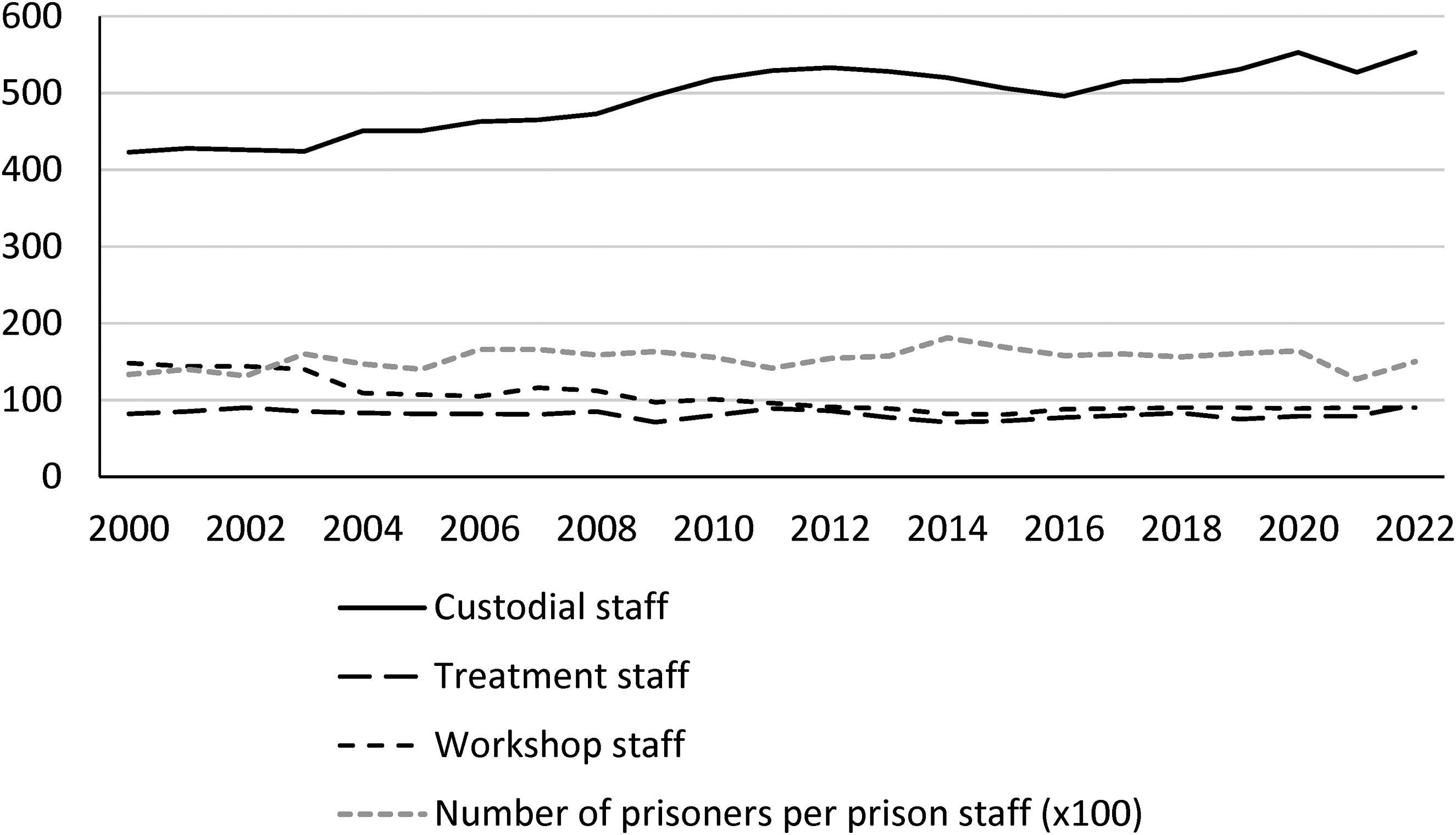
Prison workers in Slovenia. Note: Groups of prison staff are defined as in the Council of Europe Annual Penal Statistics reports (SPACE I). Prisoners consist of the total number of imprisoned persons, including pre-trial detainees. The number of prisoners per prison staff has been multiplied by 100 to fit to scale. Source: Hacin et al., 2022.
Methods
The two-stage study reported here took place in all Slovenian prisons and a correctional home in 2016 and 2022. The initial research model was designed as a comparative (longitudinal study), which would be periodically implemented to measure legitimacy, self-legitimacy, and quality of relationships in Slovenian prisons. The idea was that the study would be conducted every five years, following a similar pattern as studies on the social climate in Slovenian prisons that have been implemented since 1980 (e.g. Brinc, 2011). However, due to the COVID-19 restrictions, the second round of the study was implemented with a one-year delay.
Survey development and procedure
The survey instrument presents a questionnaire first developed and used to measure police self-legitimacy (Tankebe and Meško, 2015) and later modified to measure the self-legitimacy of prison staff (Hacin and Meško, 2020; Meško et al., 2014). Parts of the questionnaire included in this study comprise questions on self-legitimacy, relationships with colleagues, supervisors’ procedural justice, audience legitimacy, relationships with prisoners, stress, satisfaction with pay, prison staff subculture, and demographic characteristics of prison workers. All parts of the questionnaire were pre-tested in the prison environment (e.g. Hacin and Meško, 2020; Meško et al., 2014). In both 2016 and 2022, prior consent from the Slovenian Prison Administration was obtained based on the examination and approval of the research plan and survey instrument by a team of experts. Among the expert team were practitioners from the judicial police (i.e. prison officers’ service) and treatment service as well as senior management at the General Directorate of the Slovenian Prison Administration. In both periods, the authors contacted all directors of prisons, including the correctional home, and heads of all departments, and set up dates for the surveying process. All prison workers were informed about the study by the management before the actual implementation of the fieldwork. In both periods, all prison workers were approached by the first author who personally invited them to participate in the study.
Surveying began with the introduction of the study and the making of assurances of confidentiality, followed by the distribution of the questionnaire to individuals who decided to participate (paper and pencil method). Participation in the study was voluntary and anonymous. The most common method of surveying was a simultaneous survey of a gathering of prison workers who assembled in common areas; however, some surveying of individual prison workers in their offices or workstations also took place. Finally, questionnaires were distributed to a small number of prison workers, together with a return envelope, in which they inserted the completed questionnaire, sealed it, and left it at a prior-agreed upon place where it was picked up. The latter method was used only with prison workers (<10%) who, due to their work obligations, were not able to participate ‘immediately’. As surveying in individual institutions lasted at least two days, the filled-in questionnaires were picked up the next day. Prison workers’ responses were entered into a dataset and analysed with the SPSS statistical program.
Participants
In total, 565 prison workers (243 in 2016 and 322 in 2022, representing 28.8% and 35.2% of all prison workers) from all Slovenian prisons and a correctional home participated in the survey. Only fully completed questionnaires were included in the sample (198 from 2016 and 267 from 2022, presenting 81.5% and 82.9% of all survey participants). Characteristics of the two samples are outlined in Table 1, and the characteristics of sampled prison workers in both periods reflect the overall composition of prison staff in Slovenia, particularly with respect to gender, work position, and physical place of employment (i.e. different prisons and departments) (Ministrstvo za pravosodje, Uprava za izvrševanje kazenskih sankcij, 2017, 2023).
Sample characteristics.
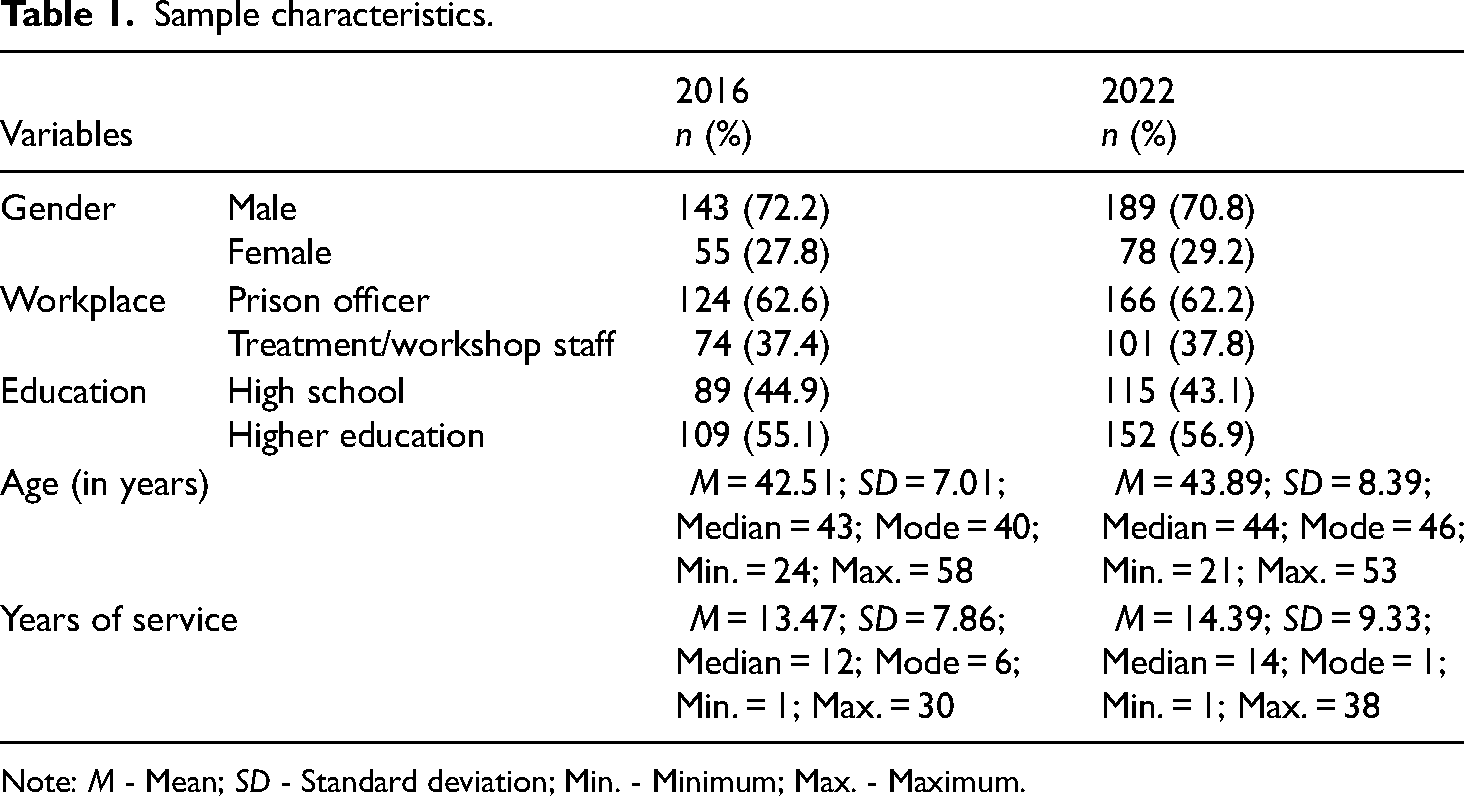
Note: M - Mean; SD - Standard deviation; Min. - Minimum; Max. - Maximum.
Measures
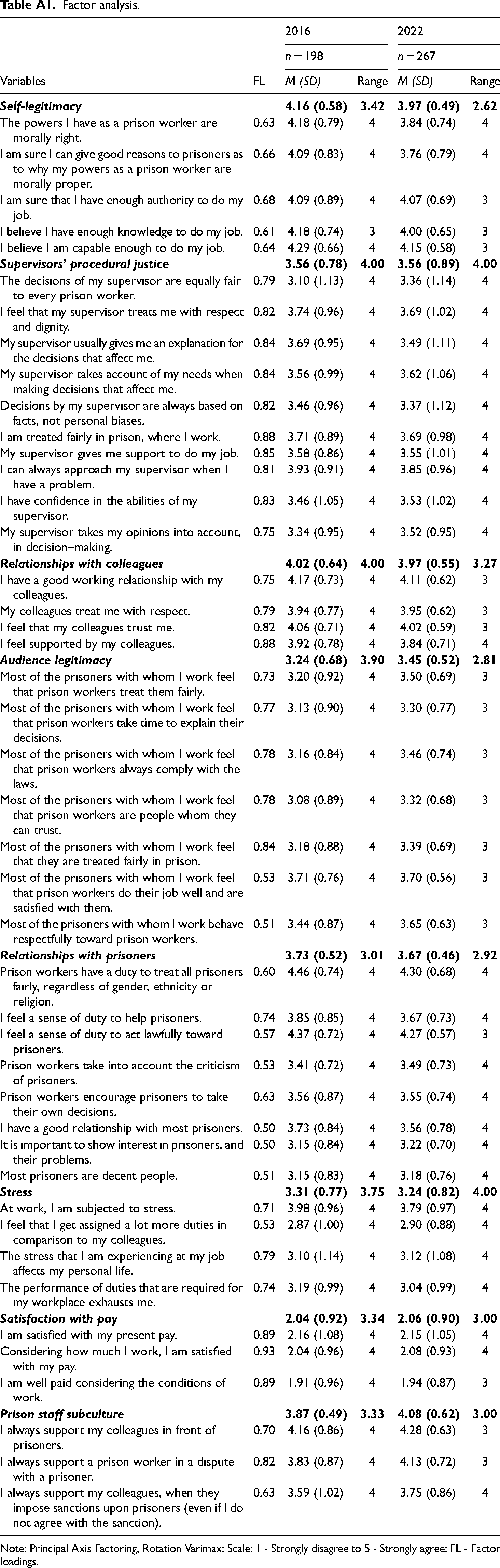
The following section describes variables included in a factor analysis performed on the data collected. Factors were operationalised from 44 variables reflecting prison workers’ perceptions of the measured variables rather than the actual measure of observed variables. All variables included in the factor analyses featured a 5-point Likert-type response ranging from ‘strongly disagree’ (coded 1) to ‘strongly agree’ (coded 5). Drawing on findings of previous studies on prison workers’ self-legitimacy (e.g. Akoensi and Tankebe, 2020; Hacin and Meško, 2020; Meško et al., 2017), modified factors were formed. A principal axis analysis with varimax rotation was used. The eight factors emerging from the factor analysis process (weighted averages of factors are reported; see Table A1 in the Appendix) were as follows: (1) Self-legitimacy (five variables included; Cronbach's α = 0.78, Kaiser–Meyer–Okin [KMO] measure of sampling adequacy = 0.69; var. = 41.47%); (2) supervisors’ procedural justice (10 variables included; Cronbach's α = 0.95, KMO = 0.95; var. = 67.46%); (3) relationships with colleagues (four variables included; Cronbach's α = 0.89, KMO = 0.81; var. = 65.82%); (4) audience legitimacy (seven variables included; Cronbach's α = 0.87, KMO = 0.89; var. = 50.14%); (5) relationships with prisoners (eight variables included; Cronbach's α = 0.79, KMO = 0.81; var. = 33,11%); (6) stress (four variables included; Cronbach's α = 0.78, KMO = 0.78; var. = 48.55%); (7) satisfaction with pay (three variables included; Cronbach's α = 0.93, KMO = 0.76; var. = 82.03%); and (8) prison staff subculture (three variables included; Cronbach's α = 0.78, KMO = 0.67; var. = 57.46%). The factor analysis process is a common data-reduction technique employed to identify latent variables among a large number of individual attitude/belief measures (Field, 2009). The factor analysis in this case produced a relatively small number of latent variables, greatly simplifying the task of multivariate analysis interpretation to follow. In addition to these eight factors, five socio-economic variables were included in the subsequent multivariate regression analyses undertaken to control for spuriousness. Age and years of service were measured in years. Three binary-coded variables (1 = yes, 0 = no) were also employed: gender (male), education (high school), and work position (prison officer). The normality assumption of the dependent variable self-legitimacy was tested graphically (histogram, Q–Q and P–P plots [residuals]). The observed variable, as well as residuals, were normally distributed.
Results
First, a Pearson's correlation analysis was conducted to establish initial bivariate associations between the substantive research variables (Table 2). Supervisors’ procedural justice (r = 0.26; p < .01), Relationships with colleagues (r = 0.37; p < .01), Audience legitimacy (r = 0.24; p < .01), Relationships with prisoners (r = 0.39; p < .01), and Prison staff subculture (r = 0.15; p < .01) were all positively correlated with self-legitimacy of prison workers. Results of the correlation test rule out threats of multicollinearity, as all correlations were lower than 0.80 (Field, 2009), and further diagnostic tests confirmed the initial assessment; the variance inflation factor for variables was less than 2.50.
Correlation matrix for key variables.
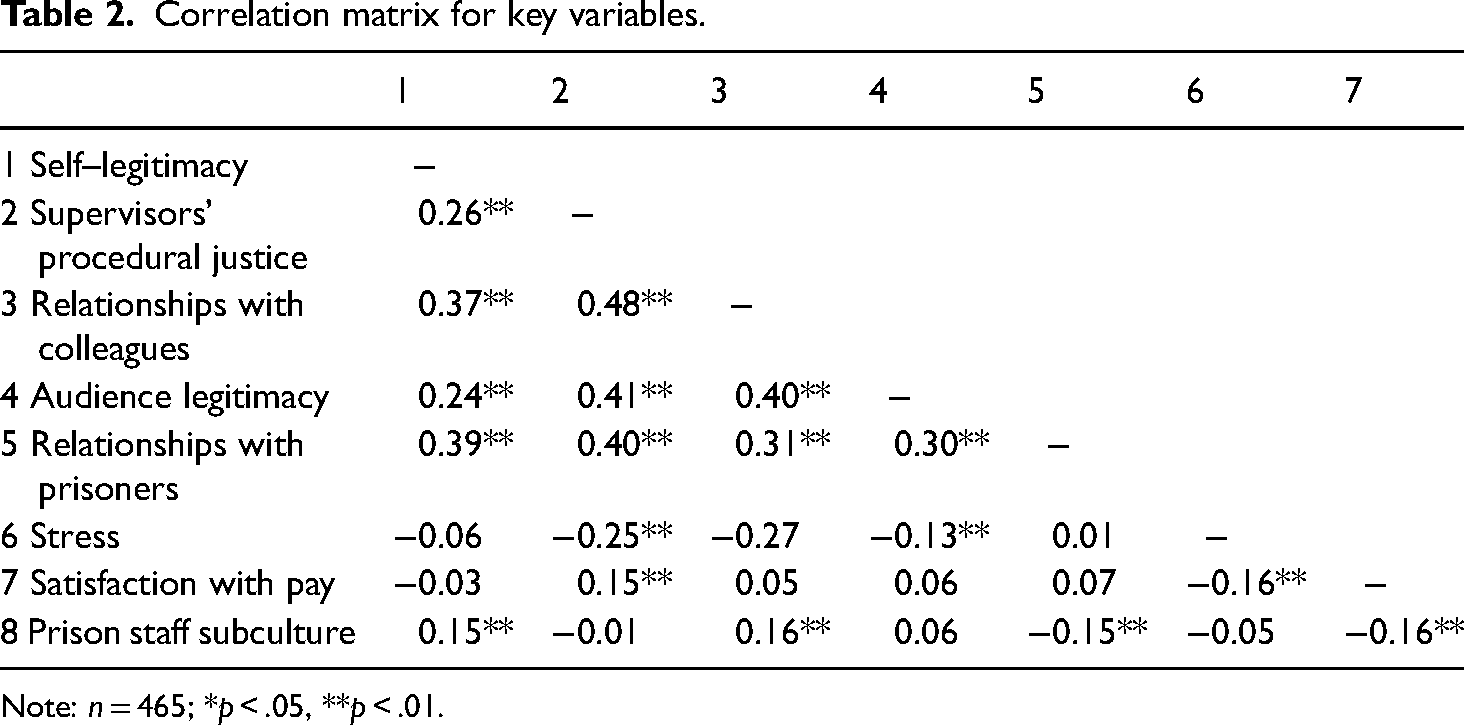
Note: n = 465; *p < .05, **p < .01.
Multiple regression analysis with robust standard errors was employed to tackle the problem of the nested nature of the data by year of surveying (Table 3). Model 1 considers the influence of demographic variables in combination with “core variables” used for explaining self-legitimacy: relationships with colleagues, supervisors’ procedural justice, and audience legitimacy (see Meško et al., 2014). Model 2 introduced prison workers’ relationships with prisoners, stress, satisfaction with pay, and prison staff subculture (see Hacin and Meško, 2020).
Ordinary least squares regression analysis predicting self-legitimacy of prison workers in 2016 and 2022.
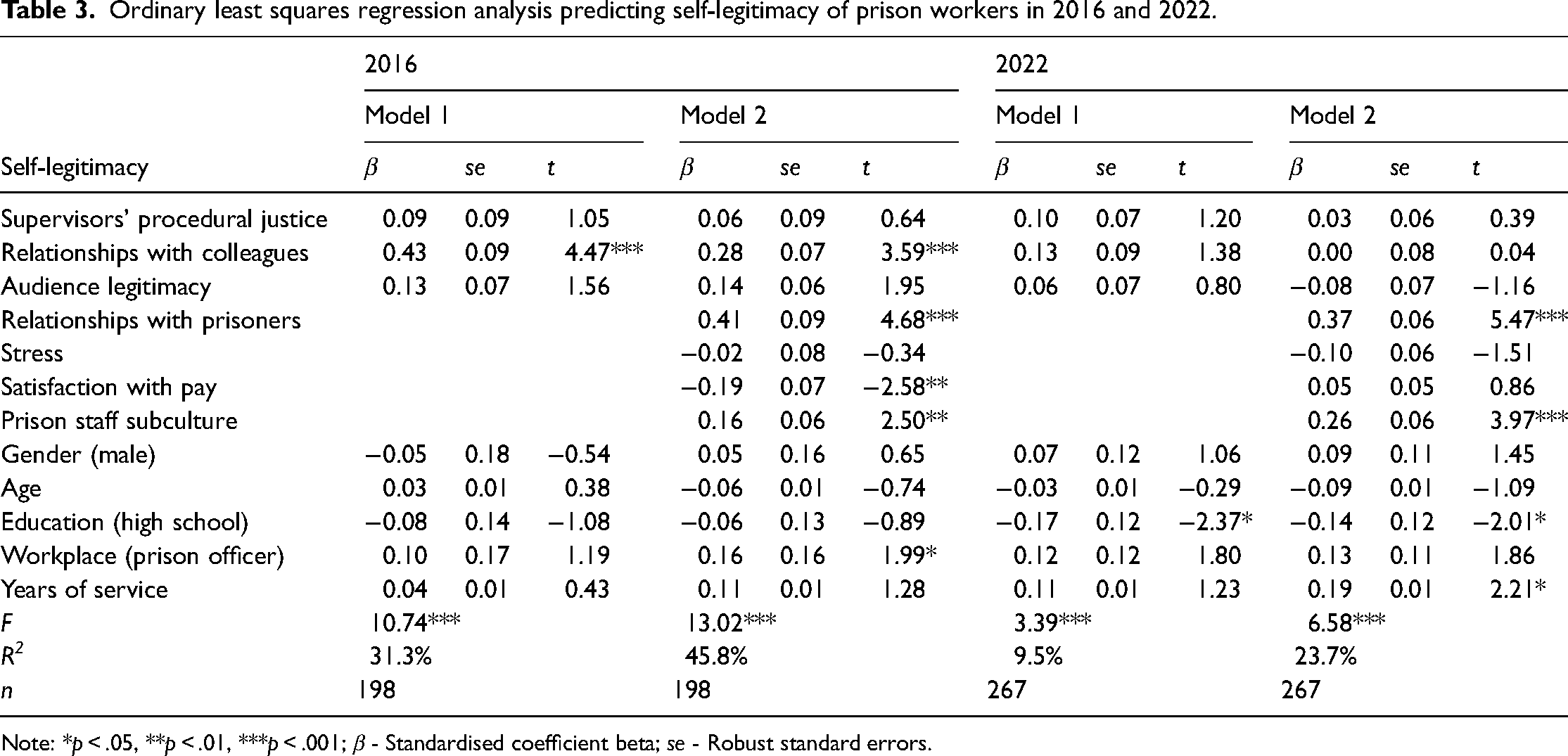
Note: *p < .05, **p < .01, ***p < .001; β - Standardised coefficient beta; se - Robust standard errors.
Prison workers’ perception of their own legitimacy in 2016 was influenced by: (1) Relationships with prisoners (β = 0.41; p < .001), (2) Relationships with colleagues (β = 0.43; p < .001/β = 0.28; p < .001), (3) Satisfaction with pay (β = −0.19; p < .01), (4) Prison staff subculture (β = 0.16; p < .01), and (5) Stress (β = 0.16; p < .05). The strongest correlation was identified between the self-legitimacy of prison workers and their relationships with prisoners and colleagues. As suggested by Hacin and Meško (2020), good relationships, especially between prisoners and prison staff, present the basis of legitimacy in the prison context. Among the “core variables” that traditionally correlate with self-legitimacy (Akoensi and Tankebe, 2020; Tankebe and Meško, 2015), only relationships with colleagues affected prison workers’ perception of their own legitimacy. Dissatisfaction with pay has a negative impact on the self-legitimacy of prison workers, as the amount of pay signals their inherent value in/for the organisation [and society]. The internalisation of subcultural norms, and especially the feeling of unconditional reliance on colleagues, affect prison workers’ confidence and perception of their own legitimacy. As pointed out in previous studies (Hacin and Meško, 2017), prison officers perceive self-legitimacy more positively than other prison workers. Overall, the model explained 31.3% (Model 1) and 45.8% (Model 2) of the variance in the perception of self-legitimacy of the prison workers sampled.
Self-legitimacy of prison workers in 2022 was influenced by: (1) Relationships with prisoners (β = 0.37; p < .001), (2) Prison staff subculture (β = 0.26; p < .001), (3) Years of service (β = 0.19; p < .05), and (4) Education (β = −0.17; p < .05/β = −0.14; p < .05). Similarly to 2016, relationships with prisoners had the most significant influence on the self-legitimacy of prison workers in 2022. Prison staff-prisoners relationships can be understood as the foundation of legitimacy in the prison context (Liebling, 2011; Hacin and Meško, 2020). Once again, the internalisation of subcultural norms and reliance on colleagues influence prison workers’ perception of their own legitimacy. In contrast to 2016, more educated prison workers with years of experience perceived self-legitimacy more positively. Overall, the model explained 9.5% (Model 1) and 23.7% (Model 2) of the variance in the perception of self-legitimacy of prison workers sampled. Due to differences in factors influencing the self-legitimacy of prison workers in different time periods, a follow-up discriminant analysis was conducted.
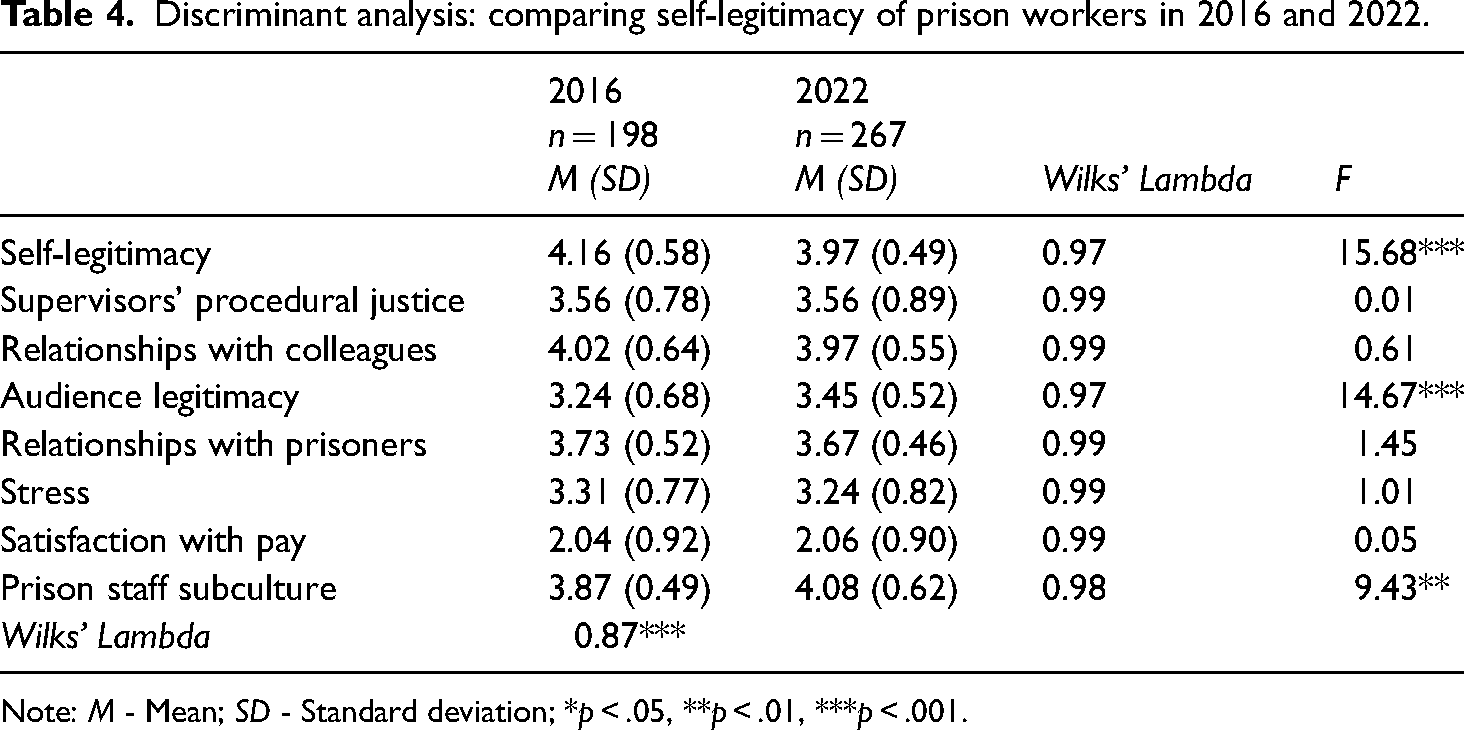
In Table 4, the results of the discriminant analysis are presented, which was employed to assess the extent of separation of respondent groups (Field, 2009). Specifically, the multivariate test of differences between prison workers’ perception of their own legitimacy in 2016 and 2022 was conducted. Wilks’ Lambda (0.87; p < .001) revealed statistically significant differences between prison workers’ perceptions in the two observed periods. The results indicated that the following variables affect differentiation between groups: Self-legitimacy (F = 15.68; p < .001), Audience legitimacy (F = 14.67; p < .001), and Prison staff subculture (F = 9.43; p < .01). A comparison of prison workers in 2016 and 2022 shows that prison workers in 2016 perceived their own legitimacy more positively. Contrary to 2016, prison workers in 2022 perceived Audience legitimacy and Prison staff subculture more positively. As the nature of the data (cross-sectional rather than panel) prevents casual claims for changes in prison workers’ perceptions, one can assume that wider changes in the Slovenian prison system in the observed periods (e.g., changes in the structure of the prison population) affected prison workers’ views on the legitimacy of their own position. Classification of prison workers’ responses shows that 68.2% of originally grouped respondents were correctly classified.
Discriminant analysis: comparing self-legitimacy of prison workers in 2016 and 2022.
Note: M - Mean; SD - Standard deviation; *p < .05, **p < .01, ***p < .001.
Discussion
Bosworth (1996) opined that the problem of order in prisons arises from the lack (deficit) of legitimacy. The traditional approaches for establishing order in prisons, based on coercive means have been largely replaced [in most modern prisons] by alternative strategies characterised by a humane and respectful treatment of prisoners. Introducing new approaches significantly affected prison workers’ role in prison and their self-image. The current study has aimed to advance our collective knowledge of the changing nature of (self-)legitimacy in prisons by analysing prison workers’ perception of their own legitimacy in Slovenian prisons in two time periods.
It would appear from our data that the self-legitimacy of prison staff, and its correlates, are relatively unstable over time. Our findings support Bottoms and Tankebe's (2021) arguments on the dependence of the dialogical nature of legitimacy in the place and time in which they occur. The results challenge the invariance thesis of legitimacy (Brown and Reisig, 2019), as noteworthy differences in prison workers’ perceptions of self-legitimacy were identified. In general, the perception of prison workers’ own legitimacy was lower in 2022 than in 2016. While the cross-sectional nature of the samples precludes causality claims, it can be assumed, as the samples are nevertheless representative, that wider changes in the prison system in recent years such as increases in the number of foreign prisoners, overcrowding, lack of new treatment staff resulting in widespread burnout affected custodial staff perceptions of the legitimacy of their positions.
As Lambert et al. (2010) have argued, the predictable results of correctional staff overwork are depersonalisation, feelings of ineffectiveness, as well as increased punitivity in attitudes toward prisoners. Changes in the Slovenian prison system clearly have had a negative impact on prison workers’ self-legitimacy. Their self-confidence to implement entrusted authority to maximise the resocialisation of prisoners has taken a serious blow (Hacin and Meško, 2024). This would also explain the greater internalisation of the subcultural norms emphasising unconditional reliance on other prison workers, as when “things get tough” prison workers look for support from their colleagues. Future research is needed to determine if the setbacks noted in 2022 have been reversed. The relatively high values of self-legitimacy documented in both periods provide reason for hope. It is possible that prison workers simply adapted to the new reality in their prisons, and while implementing their everyday tasks they became more realistic about their abilities to help prisoners in the new circumstances. In other words, they trimmed back the initiative to facilitate resocialisation, which often demands going above and beyond their work requirements, moderately lowered expectations of themselves, and resigned themselves to conducting only those security and order maintenance tasks required of them by their position.
In both periods, relationships with prisoners were identified as the strongest antecedent of prison workers’ self-legitimacy. This finding suggests that the theoretical assumptions of Barker's (2001) three types of audiences influencing power-holders’ legitimacy, or more specifically their strength to influence power-holders’ legitimacy, should be reconsidered when applied in the prison context. In an inherently coercive prison environment, “ordinary citizens” (i.e., prisoners) are in daily interactions with prison workers, who are not some distant authority but actual power-holders who are responsible for their well-being on a daily basis. Brinc (2011) argued that relationships between prison workers and prisoners influence the lives of all the people involved, and consequently affect the overall social climate in prisons. Despite mixed empirical evidence on prison staff-prisoners relationships as an antecedent of self-legitimacy (e.g., Akoensi and Tankebe, 2020; Hacin and Meško, 2024), Woolf's (1991) argument that prison workers must seek legitimacy from prisoners most likely holds true. In reality, relationships between prison workers and prisoners are ever in flux and can be easily disrupted by traumatic events; however, as Liebling et al. (1999) opined the relationships between prison workers and prisoners lay at the heart of the prison system and the operation of penal institutions. The question arises as to why in certain prison systems staff-prisoner relationships correlate with prison workers’ self-legitimacy and in others they do not. The principal characteristics of the Slovenian prison system (e.g., small prisons, the openness of the regimes, inclination towards resocialisation, etc.) provide institutional support for the development of “balanced” relationships between prison workers and prisoners (Brinc, 2011). In such a system, prison workers are aware that prison order is more easily maintained through the establishment of respectful relations with prisoners than by frequent use of coercive means (e.g., orders, threats, and use of force); resort to the latter tends to take a “toll” on the legitimacy of their position and authority (Hacin and Meško, 2024). The findings reported here confirmed these assumptions as relationships with prisoners in both the 2016 and 2022 periods were valued relatively highly by prison workers, indicating their awareness of their importance.
The findings reported here also indicated very limited correlations between “traditional core variables” (relationships with colleagues, supervisors’ procedural justice, and audience legitimacy) and prison workers’ self-legitimacy (especially in 2022). It seems that the traditional model for measuring self-legitimacy, primarily developed to measure police officers’ self-legitimacy based on the “triad of recognition” (Tankebe, 2019), is not best suited for use in the Slovenian prison environment. It must be emphasised that the model should not be discarded from use in the Slovenian cultural environment, as studies on Slovenian police officers (Hacin and Meško, 2022) strongly confirmed its applicability. Further research and empirical tests are indeed called for moving ahead. However, it should be noted that the proposed model may not be the best fit for the prison environment in general. For example, in Akoensi and Tankebe's (2020) study on a sample of prison officers in Ghana it was found that while relationships with colleagues and supervisors’ procedural justice both influenced self-legitimacy, the percentage of variance explained was rather low. The need for the introduction of new variables in self-legitimacy studies in the prison environment is clear.
The contributions of this study to the existing knowledge can be summarised in the following principal points. First, the study confirmed the unstable nature of self-legitimacy and its correlates in the prison context, and it provided much-needed empirical evidence on the dependence of the dialogical nature of self-legitimacy on time and space. However, the findings reported here call for additional [qualitative] research to determine why the observed changes occurred. Second, the two-stage comparative study provided empirical support for the prison staff-prisoners relationships as an important antecedent of self-legitimacy. Future studies should test the applicability of these concepts in different social and cultural environments and should attempt modifications in the measure's operationalisation. Finally, the study showed that antecedents of police self-legitimacy cannot be simply applied in its modified form to the prison environment. New variables should be introduced to legitimacy studies in prisons, measures which would provide a deeper understanding of legitimacy and self-legitimacy in a coercive prison environment. As Trinkner and Reisig (2022) wrote: ‘The field will only benefit if this creativity is leveraged to an even greater extent moving forward.'
Limitations
The study reported upon here is not without limitations. First, as in all empirical studies involving survey respondents, there is the always present problem of subject candour and sincerity. It is possible that prison workers provided socially desirable answers in the process of surveying due to the fear of disclosure and possible consequences that might follow. Confidentiality and anonymity were ensured to them before surveying to mitigate such behaviour, but some level of trepidation likely remained present. Second, a possibility of bias exists as data are cross-sectional and capture views of prison workers in a single country. As prior studies have shown (e.g., Akoensi and Tankebe, 2020; Reisig and Meško, 2009), legitimacy and its correlates in the prison environment can vary across cultural environments. A comparative study should be implemented in the future, which would not only compare the correlates of self-legitimacy in prison systems in different countries but also combine quantitative with qualitative research to gain an in-depth insight into the nature of self-legitimacy. A combination of “core variables” and prison workers’ relationships, stress, and prison staff subculture was tested solely in the Slovenian prison system; while instructive, additional testing in other cultural settings is called for moving forward. As argued by Bottoms and Tankebe (2021), the relative importance of factors influencing legitimacy varies in different social contexts needs to be demonstrated in multiple cultural settings. In addition, future comparative research should acknowledge and operationalise the specificity of cultural, legal, and socioeconomic characteristics of different countries reflected in the organisation and conditions in their prisons, within which the self-legitimacy of prison workers would be explored with field-tested survey instruments. Due to the configuration of the Slovenian prison system, the important variable of prison regime (level of active supervision) could not be operationalised and included in the analyses. As prison regimes influence prisoners’ perception of prison staff's legitimacy (Brunton-Smith and McCarthy, 2016; Hacin, 2018), it can be assumed that the same is true for prison workers’ self-legitimacy. Future research should address this issue by introducing questions (variables) that would tackle the problem of differentiation in levels of supervision. Finally, when interpreting the findings, the issue of causality must be mentioned, as the comparison of results is limited by the cross-sectional nature of the samples gathered in 2016 and 2022. While samples of prison workers in both periods were random and representative, the exact same prison workers were not sampled in both periods and the traceability of respondents was not possible. Future research on the question of period effects should include provision for a panel study design in which pre- and post-study phase participants are identifiable, and individuals who change (positively and negatively) can be interviewed in a qualitative exploration of their reasons for enhancing or diminishing their sense of self-legitimacy over the study period. Such designs must include appropriate provisions for voluntary participation and the maintenance of confidentiality consistent with institutional review board protections for human subject research.
Footnotes
Acknowledgement
The paper benefitted immensely from invaluable comments from Nicholas P. Lovrich.
Declaration of conflicting interests
The authors affirm that their paper is in full compliance with ethical standards. They declare that no potential conflicts of interest are obtained with respect to the research, authorship, and/or separate publication of this article.
Funding
The authors disclose receipt of the following financial support for the field research, authorship and/or publication of this article: the Slovenian Research Agency under Grant (J5-5548 (A)) entitled ‘Legitimacy and legality of policing, criminal justice and the execution of penal sanctions' and the Slovenian Prison Administration under Grant (C2031–22–090000) entitled ‘Research on professional competencies of prison workers and relations in prisons.'

Appendix
Factor analysis.
| Variables | FL | 2016 | 2022 | ||
|---|---|---|---|---|---|
| n = 198 | n = 267 | ||||
| M (SD) | Range | M (SD) | Range | ||
|
|
|
|
|
|
|
| The powers I have as a prison worker are morally right. | 0.63 | 4.18 (0.79) | 4 | 3.84 (0.74) | 4 |
| I am sure I can give good reasons to prisoners as to why my powers as a prison worker are morally proper. | 0.66 | 4.09 (0.83) | 4 | 3.76 (0.79) | 4 |
| I am sure that I have enough authority to do my job. | 0.68 | 4.09 (0.89) | 4 | 4.07 (0.69) | 3 |
| I believe I have enough knowledge to do my job. | 0.61 | 4.18 (0.74) | 3 | 4.00 (0.65) | 3 |
| I believe I am capable enough to do my job. | 0.64 | 4.29 (0.66) | 4 | 4.15 (0.58) | 3 |
|
|
|
|
|
|
|
| The decisions of my supervisor are equally fair to every prison worker. | 0.79 | 3.10 (1.13) | 4 | 3.36 (1.14) | 4 |
| I feel that my supervisor treats me with respect and dignity. | 0.82 | 3.74 (0.96) | 4 | 3.69 (1.02) | 4 |
| My supervisor usually gives me an explanation for the decisions that affect me. | 0.84 | 3.69 (0.95) | 4 | 3.49 (1.11) | 4 |
| My supervisor takes account of my needs when making decisions that affect me. | 0.84 | 3.56 (0.99) | 4 | 3.62 (1.06) | 4 |
| Decisions by my supervisor are always based on facts, not personal biases. | 0.82 | 3.46 (0.96) | 4 | 3.37 (1.12) | 4 |
| I am treated fairly in prison, where I work. | 0.88 | 3.71 (0.89) | 4 | 3.69 (0.98) | 4 |
| My supervisor gives me support to do my job. | 0.85 | 3.58 (0.86) | 4 | 3.55 (1.01) | 4 |
| I can always approach my supervisor when I have a problem. | 0.81 | 3.93 (0.91) | 4 | 3.85 (0.96) | 4 |
| I have confidence in the abilities of my supervisor. | 0.83 | 3.46 (1.05) | 4 | 3.53 (1.02) | 4 |
| My supervisor takes my opinions into account, in decision–making. | 0.75 | 3.34 (0.95) | 4 | 3.52 (0.95) | 4 |
|
|
|
|
|
|
|
| I have a good working relationship with my colleagues. | 0.75 | 4.17 (0.73) | 4 | 4.11 (0.62) | 3 |
| My colleagues treat me with respect. | 0.79 | 3.94 (0.77) | 4 | 3.95 (0.62) | 3 |
| I feel that my colleagues trust me. | 0.82 | 4.06 (0.71) | 4 | 4.02 (0.59) | 3 |
| I feel supported by my colleagues. | 0.88 | 3.92 (0.78) | 4 | 3.84 (0.71) | 4 |
|
|
|
|
|
|
|
| Most of the prisoners with whom I work feel that prison workers treat them fairly. | 0.73 | 3.20 (0.92) | 4 | 3.50 (0.69) | 3 |
| Most of the prisoners with whom I work feel that prison workers take time to explain their decisions. | 0.77 | 3.13 (0.90) | 4 | 3.30 (0.77) | 3 |
| Most of the prisoners with whom I work feel that prison workers always comply with the laws. | 0.78 | 3.16 (0.84) | 4 | 3.46 (0.74) | 3 |
| Most of the prisoners with whom I work feel that prison workers are people whom they can trust. | 0.78 | 3.08 (0.89) | 4 | 3.32 (0.68) | 3 |
| Most of the prisoners with whom I work feel that they are treated fairly in prison. | 0.84 | 3.18 (0.88) | 4 | 3.39 (0.69) | 3 |
| Most of the prisoners with whom I work feel that prison workers do their job well and are satisfied with them. | 0.53 | 3.71 (0.76) | 4 | 3.70 (0.56) | 3 |
| Most of the prisoners with whom I work behave respectfully toward prison workers. | 0.51 | 3.44 (0.87) | 4 | 3.65 (0.63) | 3 |
|
|
|
|
|
|
|
| Prison workers have a duty to treat all prisoners fairly, regardless of gender, ethnicity or religion. | 0.60 | 4.46 (0.74) | 4 | 4.30 (0.68) | 4 |
| I feel a sense of duty to help prisoners. | 0.74 | 3.85 (0.85) | 4 | 3.67 (0.73) | 4 |
| I feel a sense of duty to act lawfully toward prisoners. | 0.57 | 4.37 (0.72) | 4 | 4.27 (0.57) | 3 |
| Prison workers take into account the criticism of prisoners. | 0.53 | 3.41 (0.72) | 4 | 3.49 (0.73) | 4 |
| Prison workers encourage prisoners to take their own decisions. | 0.63 | 3.56 (0.87) | 4 | 3.55 (0.74) | 4 |
| I have a good relationship with most prisoners. | 0.50 | 3.73 (0.84) | 4 | 3.56 (0.78) | 4 |
| It is important to show interest in prisoners, and their problems. | 0.50 | 3.15 (0.84) | 4 | 3.22 (0.70) | 4 |
| Most prisoners are decent people. | 0.51 | 3.15 (0.83) | 4 | 3.18 (0.76) | 4 |
|
|
|
|
|
|
|
| At work, I am subjected to stress. | 0.71 | 3.98 (0.96) | 4 | 3.79 (0.97) | 4 |
| I feel that I get assigned a lot more duties in comparison to my colleagues. | 0.53 | 2.87 (1.00) | 4 | 2.90 (0.88) | 4 |
| The stress that I am experiencing at my job affects my personal life. | 0.79 | 3.10 (1.14) | 4 | 3.12 (1.08) | 4 |
| The performance of duties that are required for my workplace exhausts me. | 0.74 | 3.19 (0.99) | 4 | 3.04 (0.99) | 4 |
|
|
|
|
|
|
|
| I am satisfied with my present pay. | 0.89 | 2.16 (1.08) | 4 | 2.15 (1.05) | 4 |
| Considering how much I work, I am satisfied with my pay. | 0.93 | 2.04 (0.96) | 4 | 2.08 (0.93) | 4 |
| I am well paid considering the conditions of work. | 0.89 | 1.91 (0.96) | 4 | 1.94 (0.87) | 3 |
|
|
|
|
|
|
|
| I always support my colleagues in front of prisoners. | 0.70 | 4.16 (0.86) | 4 | 4.28 (0.63) | 3 |
| I always support a prison worker in a dispute with a prisoner. | 0.82 | 3.83 (0.87) | 4 | 4.13 (0.72) | 3 |
| I always support my colleagues, when they impose sanctions upon prisoners (even if I do not agree with the sanction). | 0.63 | 3.59 (1.02) | 4 | 3.75 (0.86) | 4 |
Note: Principal Axis Factoring, Rotation Varimax; Scale: 1 - Strongly disagree to 5 - Strongly agree; FL - Factor loadings.