



Abstract
This article complements existing victimological studies on religion by investigating whether religion promotes or reduces fear of crime in Germany. According to the generalized insecurity approach and the theory of social production functions, religion and fear of crime are linked via secularization-induced diffuse insecurities. It is expected that different facets of religion are tied to fearing crime in different ways because the projection of secularization-induced diffuse insecurities occurs only among those individuals whose religious capital is devaluated. Empirical analyses of data from the 2021 German General Social Survey reveal that some religious minority groups are particularly likely to fear crime, religious belief is positively related to fearing crime, and religious behavior is negatively associated with fearing crime. Additionally, religion can promote fear of crime equally in East and West Germany. In conclusion, the study emphasizes the significance of religion in relation to the fear of crime and underscores the benefits of a general theoretical approach.
Introduction
Since the recognition of fear of crime as a relevant social problem (Doran and Burgess, 2012), several often-complementary theoretical explanations have been put forward, and thus, a variety of individual- and contextual-level predictors have been considered to explain the fear of crime (Ferraro, 1995; Rader, 2017). Among these predictors, gender, age, and victimization status figure prominently, as do ethnic heterogeneity of the community, neighborhood disorder, and media coverage. However, in the literature on fear of crime, few studies have addressed the role of another powerful force that can play both protective and detrimental roles in people's lives: religion (e.g., Pearce et al., 2019; Smith, 2003). Given the relevance of religion for crime-related attitudes and behaviors (e.g., Adamczyk et al., 2017; Montagnet, 2023), the lack of studies exploring the role of religion in the fear of crime is somewhat surprising. Therefore, the purpose of this article is to contribute to the open question of whether religion promotes or reduces the fear of crime. While few existing studies on the topic (e.g., Matthews et al., 2011; Schwadel and Anderson, 2022) have provided important insights into the relationship between religion and fear of crime, they lack a general theoretical idea that can explain empirical findings. This study not only empirically examines the link between various dimensions of religion and fear of crime, but also introduces a theoretical approach that guides the empirical analysis.
When theoretically linking religion and fear of crime, I build on an idea proposed by Furstenberg (1971) and Lotz (1979): fear of crime stems from opposition to ongoing social change. Therefore, I draw on insights from a theoretical perspective called the generalized insecurity approach (Gerber et al., 2010; Hirtenlehner and Farrall, 2013), which is specially designed to explain the fear of crime. Beyond that, my argumentation is integrated into a general theoretical framework called the theory of social production functions (Lindenberg, 1989, 1990), which indicates the conditions under which it is or is not functional to fear crime. By embedding my reasoning in such a general theoretical approach, this research adheres to a broader logic that extends beyond the specific scenario under analysis.
Germany is a relevant context for this contribution because fear of crime has recently been a frequent topic in the media. Since media often exaggerates the frequency and severity of crime (Warr, 2000), it has the potential to induce fear (Heath and Gilbert, 1996). In Germany, for instance, sensational media coverage took place after the sexual assaults of women in Cologne on New Year's Eve in 2015 (DW, 2020) and after the violent attacks on police officers, firefighters, and rescue forces in Berlin on New Year's Eve in 2022 (DW, 2023).
Although religion and fear of crime are frequently researched as individual topics, there is a lack of research on the influence of religion on fear of crime. Studying fear of crime addresses an important societal issue because the consequences of fearing crime are far-reaching. They range from negative effects on people's mental and physical health (Stafford et al., 2007) to various constrained behaviors, such as avoidance, protective, and weapons behaviors (Rader and Haynes, 2014). Despite increasing secularization, religion is still a meaningful aspect of many people's lives. Remaining religious in a predominantly secular society means that one's own religion may become particularly influential. Religion is a multifaceted concept, but three aspects are often distinguished (Stark and Glock, 1968): belonging (religious affiliation), believing (religious beliefs), and behaving (religious participation). Therefore, distinct hypotheses must be derived and empirically examined for all associations between the three aspects of religion and fear of crime.
The current study complements existing victimological analyses of religion in at least three ways. First, it does so by rigorously deriving testable hypotheses from theory (Gërxhani et al., 2022; Manzo, 2021). Second, it explores a new country, as previous studies have been limited to the United States (Matthews et al., 2011; Schwadel and Anderson, 2022). Third, it builds on a long tradition of research on the paradoxical effects of religion, initiated by Allport (1954) and Adorno et al. (1950).
In the following, I briefly recapitulate the current state of research on the relationship between religion and fear of crime. Subsequently, I present my theoretical argumentation, which draws on the generalized insecurity approach and the theory of social production functions. Thereafter, I explain the databases, operationalization of all variables, and analytical strategy. I then present descriptive results, followed by findings from multivariate analyses. Finally, findings and implications are discussed.
Religion and fear of crime
Previous research has produced a variety of conceptualizations of attitudes toward crime. 1 Fear of crime was originally thought of as unidimensional and was therefore often measured by one of two so-called standard operationalizations: ‘How safe do you feel or would you feel being out alone in your neighborhood at night?' or ‘Is there any place right around here—that is, within a mile—where you would be afraid to walk alone at night?' (e.g., LaGrange and Ferraro, 1989). Due to valid criticism that these questions might measure a broad range of fears, including some not necessarily related to crime, a conceptual differentiation followed. Since then, fear of crime has been considered a multidimensional construct, and various components have been differentiated (Gabriel and Greve, 2003): affective (fear of personal victimization), cognitive (risk assessment of becoming a victim of crime), and conative (behavioral measures taken to reduce potential victimization). Because of this inconsistent use of concepts, the results of previous studies on fear of crime must be interpreted according to the concept used in each case (for a recent review of literature on fear of crime, see Hart et al., 2022). The present study focuses on the affective component, which can be considered the core component.
Most previous literature that touches on fear of crime neglects religious effects or considers religion one of many control variables (e.g., Lotz, 1979; O'Mahony and Quinn, 1999; Shechory-Bitton and Cohen-Louck, 2018). However, several recent studies examining religion and various crime-related topics in the United States show that religion can play an important role.
Based on the National Longitudinal Study of Adolescent to Adult Health, a study by Montagnet (2023) examines the effects of religion on adolescents’ delinquency. She applies a multidimensional religious measure, including an index of religious salience, participation in (private and public) religious activities, and frequency of attending religious services. Her longitudinal analysis reveals that the religiosity–delinquency link is offense-specific. Religiosity is not associated with violent delinquency, its relationship with nonviolent delinquency is inconsistent, and it is a protective factor when it comes to substance use. In their cross-sectional study on how being religious affects punitiveness, Seto and Said (2022) use data from the Chapman Survey on American Fears. They differentiate between two religious measures (affiliation and fundamentalism) and provide evidence that mainline Protestants and Catholics tend to be more punitive than their nonreligious counterparts. Fundamentalism is also related to higher punitiveness. Johnson and colleagues (2018) investigated religious effects on students’ perceptions of criminal justice effectiveness. Employing a cross-sectional analysis, they distinguish between three religious measures (affiliation, local membership, and subjective religiosity), and they point to the paradoxical way religion shapes such perceptions. While religious affiliation is not associated with perceived effectiveness of police and courts, local membership is related to both, and subjective religiosity is (marginally) positively related to perceived court effectiveness. In his study, which was based on data from the General Social Survey, Yamane (2016) addresses cross-sectional religious effects on adult handgun ownership. By differentiating between three religious measures (affiliation, theological conservatism, and religious involvement), he points out that being an Evangelical Protestant and theological conservatism are positively associated with handgun ownership, but religious involvement is negatively associated with it. Taken together, these studies provide evidence of paradoxical religious effects on crime-related issues—depending on the respective religious measure, it can play protective or detrimental roles. Research that explicitly addresses religious effects on fear of crime is rare. Only two studies (Matthews et al., 2011; Schwadel and Anderson, 2022), both of which were conducted in the United States, empirically investigate the link between religion and fear of crime.
Matthews et al. (2011) base their work on a relatively small sample (N = 380) drawn from an area in the state of Georgia with about 650,000 people (West Georgia Area Survey). They theoretically link religion and (an affective component of) fear of crime via generalized trust (i.e., trust in unknown others): religion promotes generalized trust, which in turn limits fear of crime. Nonetheless, the authors explicitly refrain from hypothesizing whether religion and fear of crime are positively or negatively related (Matthews et al., 2011: 488). Their findings point to offense-specific fear and mixed religious effects. People's religious affiliation is not decisive when it comes to explaining fears of property crime and violent crime. While the frequency of attending religious services is negatively linked to the fear of property crime, it is unrelated to the fear of violent crime.
Schwadel and Anderson (2022) use a representative sample (N = 10,676) of the American adult population (General Social Survey). The authors argue for both a positive and a negative relationship between religion and fear of crime (captured by one of the two standard operationalizations). Drawing on attachment theory (Kirkpatrick, 1992), they posit that religious people value security, which makes them more fearful of crime. Additionally, informed by terror management theory (Vail et al., 2010), they contend that religion has a buffering function against fear of crime. The results indicate that various facets of religion (e.g., affiliation, attendance, prayer, biblical literalism) are (mostly positively) related to fear of crime. However, these religious effects are mainly attributable to the born-again Christian identity. Furthermore, religious switching, namely from unaffiliated to affiliated, is associated with greater fear of crime.
Although these two studies provide valuable insights into whether religion promotes or reduces fear of crime, they lack a general theoretical approach from which testable theories can be derived.
Theory and hypotheses
There are plenty of approaches to explaining fear of crime (for a comprehensive review, see Hale, 1996). They can be grouped into three main perspectives that operate at different levels of analysis (Boers, 2003; Gerber et al., 2010). According to the (micro-level) ‘victimization perspective', fear of crime is largely the result of personal experience with crime; people who have already been victims of crime are more afraid of becoming victims again. The (meso-level) ‘social control perspective' emphasizes that fear of crime is a product of neighborhood characteristics that people associate with crime. Fear of crime is induced by signs of social disorganization in the immediate environment. These signs indicate that the community's ability to regulate people's behavior is impaired. In the (macro-level) ‘social problem perspective', fear of crime is either understood as a phenomenon shaped by dramatization of crime in the arenas of media and politics or it is conceived of as the result of general anxieties and uncertainties in times of social change.
The theoretical approach underpinning the subsequent empirical analysis aligns with the last of the three perspectives, dating back to the 1970s (Furstenberg, 1971; Lotz, 1979) and posits that fear of crime results from resistance to social change. Since then, numerous criminological studies (e.g., Gadd and Jefferson, 2009; Girling et al., 2000; Hollway and Jefferson, 1997; Jackson, 2004; Sessar, 2010) have agreed with this assumption. Proponents of the so-called generalized insecurity approach (Gerber et al., 2010; Hirtenlehner and Farrall, 2013) concur that social transformation presents a breeding ground for fear of crime. After applying this theory to the relationship between religion and fear of crime, the theory of social production functions (Lindenberg, 1989, 1990) serves as a more general theoretical perspective to convey the broader logic beyond the analyzed scenario.
Religion, social change, and fear of crime
The generalized insecurity approach (Gerber et al., 2010; Hirtenlehner and Farrall, 2013) is grounded in the notion that fear of crime (specifically, its affective component) stems from more abstract insecurities about ongoing social change. It suggests that fear of crime is not merely a specific reaction to objective risks of crime but rather a projection of more diffuse fears. The roots of this assumption had previously been formulated in the works of famous social theorists, such as Giddens’ (1990) ‘The consequences of modernity', Beck's (1992) ‘Risk society', and Bauman's (2006) ‘Liquid fear': all three authors describe the life of individuals in today's societies as being characterized by various risks and insecurities that previous generations did not face. The loss of what was taken for granted affects all areas of life and intensifies individuals’ everyday worries and fears. In this way, worries and fears are also decoupled from their actual causes, which explains why people may fear crime even if they have a relatively low risk of becoming victims. Thus, fear of crime is understood as a by-product of social change, rendering it not clearly distinguishable from other insecurities.
For religious individuals, a certain aspect of social change should be of particular importance—secularization. Processes of secularization (i.e., the loss of importance of religion in societies), which started in the late 1960s in Germany and continue until today (Pollack and Pickel, 2007), constitute the breeding ground upon which religious individuals’ fear of crime can flourish. Being religious and living in an increasingly secular society can provoke subliminal fears projected onto crime and criminals. Fearing crime is certainly just one of many consequences that secularization can have for perceptions of religious individuals (e.g., secularization is also consequential for anti-immigrant attitudes and inter-ethnic contact of religious individuals, see Steinmann, 2020, 2023). A society's transformation from being overwhelmingly religious to largely secular implies that most people increasingly agree with more rational interpretations of the world (Berger, 1967). On the contrary, religious individuals still rely on transcendent explanations to make sense of the world. For them, secularization entails navigating the contradiction between a largely secularized environment and the significance of their own religiosity (Stolz et al., 2016). Since secularization is a rather diffuse process that is difficult to pinpoint, religious individuals project their fears onto a more specific social problem (e.g., crime). In this way, their insecurities become nameable, processable, and sometimes even manageable. Thus, projecting secularization-induced diffuse insecurities onto the topic of crime offers a clear benefit for religious individuals—it serves as a strategy to overcome their insecurities about ongoing social change. Employing the generalized insecurity approach (Gerber et al., 2010; Hirtenlehner and Farrall, 2013) has the advantage that two widely shared insights of research on fear of crime are taken into consideration: Fear of crime (in particular, its affective component) is a projection of more diffuse fears (Gray et al., 2008), and fear of crime holds a social meaning (Jackson, 2004). Despite these advantages, based on the above-presented theory, specifying the (potentially) paradoxical religious effects on fear of crime is not possible. Thus, the theory of social production functions (Lindenberg, 1989, 1990) was subsequently applied to clarify the conditions under which it is or is not functional for religious individuals to fear crime.
Toward a more general theoretical explanation
Building on the idea that religion and fear of crime are linked via secularization-induced diffuse insecurities and considering insights from the theory of social production functions (Lindenberg, 1989, 1990), differentiated hypotheses can be formulated for each facet of religion. The main argument to be unfolded hereafter consists of three parts. First, with the decline of religion in today's societies, individuals’ religious capital 2 is devaluated. Second, not all individual manifestations of religion are equally affected by secularization. Third, religious belonging, belief, and behavior all have specific effects on fear of crime. The core of the theoretical argumentation is depicted in Figure 1.
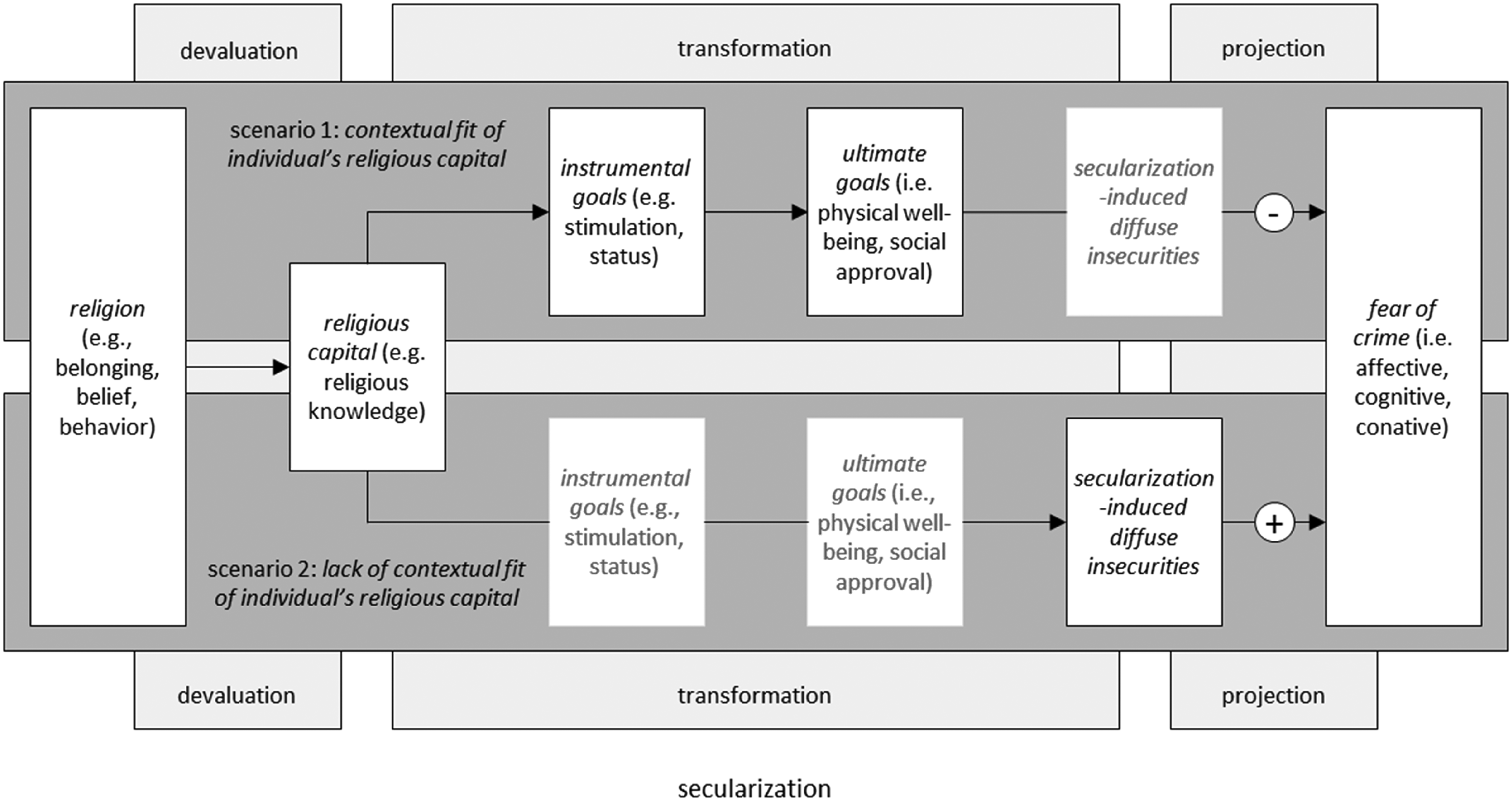
A general theoretical explanation linking religion and fear of crime.
The theory of social production functions (Lindenberg, 1989, 1990) builds on an idea that was originally formulated in economics. Here, economic production functions are used to construct a functional relationship between produced goods and their production factors. Whether the production of goods is successful does not depend solely on a company's production factors but also on the conditions over which a company has no influence (Becker, 1976). Similarly, individual action, driven by the pursuit of utility production, always takes place under specific social conditions. Whether individuals can realize their goals depends not only on the capital they utilize but also on society and its evaluation of this capital as valuable or unvaluable (Lindenberg, 1989, 1990). 3
At the core of the theory of social production functions is the notion that people strive for two ultimate goals (also called fundamental human needs): physical well-being and social approval. However, these two (higher-order) goals cannot be reached directly. Instead, they must be established via instrumental goals (also called second-level needs). There are five instrumental goals—stimulation and comfort are useful for achieving physical well-being, while status, behavioral confirmation, and affection are helpful for gaining social approval. For example, stimulation is characterized by arousal-producing activities, and status refers to the control of scarce resources. Instrumental goals are generated by individual resources (Ormel et al., 1999), which may include religious capital. Resources are often multifunctional, meaning that they can be used to achieve not one but several instrumental goals (Lindenberg, 1996). For instance, religious capital (e.g., in the form of relationships with fellow believers) may generate arousal during religious services (i.e., stimulation) and it (e.g., in the form of religious knowledge) may enable control over scarce resources (i.e., status).
Social production functions formulate the relation between the two ultimate goals and instrumental goals within a given context. In essence, they indicate what and how much individuals must invest for goals to be successfully realized under specific social conditions. Thus, individuals do not have complete freedom to choose their resources; rather, they must adhere to context-specific standards (Lindenberg, 1989). The question for individuals is always which context-dependent resources they should invest in to generate instrumental goals and maximize physical well-being and social approval. In contexts where the five instrumental goals cannot be sufficiently realized through religious capital (e.g., religious capital does not generate arousal during religious services or does not bring control over scarce resources), there is also an insufficient transformation of religious capital into physical well-being and social approval. It follows that individual resources alone are not sufficient to realize the two ultimate goals—the specific context co-determines whether the transformation of resources is successful. If an individual's religious capital cannot be transformed into instrumental goals (e.g., status or stimulation) in a specific context (e.g., labor market or family), then there is an insufficient contextual fit of the individual's religious resources.
Different social groups are endowed with different resources. Even if religious individuals do not only possess religious capital, it should still be a decisive factor in determining the group's opportunities for action. As previously discussed, the value attributed to a type of capital in a society determines the benefits individuals can derive from investing in that capital. Importantly, this value is not static—it can change through social transformation (Esser, 1996; Lindenberg, 1990). Secularization is a process that has a substantial influence on the value of religious capital. The diminishing significance of religion in today's societies causes individual religious capital to be devalued, which in turn means it cannot be transformed as efficiently into physical well-being and social approval. Different types of capital and group-specific social production functions are thus in competition with each other. While the utility production of one group (e.g., nonreligious) increases because of social change (e.g., secularization), the utility production of another group (e.g., religious) decreases. In addition, capital is generally not easily exchangeable (Ormel et al., 1999). The decision to invest in a certain type of capital cannot simply be reversed—it has lasting consequences for an individual's life and the likelihood that they realize the two ultimate goals. Thus, an investment in religious capital may not pay off under the conditions of secularization because religious individuals may struggle to achieve physical well-being and social approval.
Under the conditions of secularization, transforming religious capital becomes more challenging. The question arises whether secular capital could act as a substitute in this case. While substituting instrumental goals is possible (Ormel et al., 1999), it is not readily possible for individual capital, as it often becomes an integral part of an individual—the habitus (Bourdieu, 1986). As an individual's degree of religiosity increases, the alternative utility production of their secular capital decreases. Thus, for a highly religious individual, a devaluation of religious capital means questioning the person as a whole—such a devaluation cannot be easily offset by secular capital.
Secularization does not affect all individual manifestations of religion equally. As pointed out previously, resources can be valued very differently depending on the specific context. Accordingly, religious capital should be devalued in the presence of (nonreligious) out-group members but appreciated in the presence of (religious) in-group members. In essence, religious capital is devalued in secularizing contexts but valued in religious ones. Thus, whether secularization is consequential for an individual depends on how well his or her religious capital fits into the context. For all three common facets of religion—belonging, believing, and behaving (Stark and Glock, 1968)—it is necessary to assess independently whether being religious in a particular facet is associated with a contextual fit of an individual's religious capital.
Belonging: For simplicity, members of mainline denominations and members of other denominations are distinguished from individuals with no religious affiliation. While secularization devalues religious capital overall, its consequences vary for religious groups. Members of mainline denominations form a religious majority in Germany—despite secularization, they still represent a fairly large group (Müller and Pollack, 2022: 20.7 million Protestants and 22.6 million Catholics in 2021). Given their substantial size, there should often be a contextual fit of religious majority members’ religious capital across all contexts. The situation differs for members of other denominations, which are part of the religious minority in Germany—they are relatively small in number (Müller and Pollack, 2022; e.g., 1.8 million members of the Protestant free church and about 5.5 million Muslims in 2021). Due to their smaller group size, religious minority members’ religious capital is less likely to fit the context. Hence, secularization-induced devaluation of religious capital is not as severe for members of mainline denominations as it is for members of other denominations.
Belief: Currently, religious believers constitute a minority, with approximately 10% describing themselves as religious or very religious in East Germany and about 20% in West Germany (Pickel, 2017). The social recognition of their religious capital is often limited, making it less useful. The more devout individuals are in their beliefs, the lower the contextual fit of their religious capital. Consequently, the devaluation of religious capital induced by secularization is severe for religious believers.
Behavior: Those who participate in religious activities are also a minority at present, with over 70% reporting rare or no attendance at religious services in East Germany and over 50% in West Germany (Pickel, 2017). However, frequent participation in religious contexts allows the use of religious capital in those contexts. There, religious capital is socially recognized by (religious) in-group members and can thus be applied. The more individuals participate in religious activities, the higher the contextual fit of their religious capital. Therefore, religious participation protects religious capital from devaluation due to secularization.
Finally, for each facet of religion, specific effects on fear of crime can be formulated. The theory of social production functions (Lindenberg, 1989, 1990) suggests that the formerly dominant social production function of religious individuals is losing relevance (benefits of religious capital decrease due to secularization processes). Religious individuals’ relative disadvantage unleashed by social change means that their entire being is called into question. To better fulfill the two ultimate goals—physical well-being and social approval—a redefinition of the dominant social production function would have to take place. This is comparable to a return of religion on the societal level, in other words, a process of desecularization. Since a redefinition of the dominant social production function is currently unlikely, the effects of secularization are prominent. The generalized insecurity approach (Gerber et al., 2010; Hirtenlehner and Farrall, 2013) indicates that religious people project secularization-induced diffuse insecurities onto the topic of crime, leading them to report a greater fear of crime. However, religion only promotes fear of crime when there is no contextual fit for the individual's religious capital. Conversely, when there is a contextual fit for the individual's religious capital, religion may actually reduce the fear of crime. In summary, the following three hypotheses are deduced: Members of other denominations are more likely to fear crime than members of mainline denominations and those unaffiliated with a religion. Religious belief is positively associated with fear of crime. Religious behavior is negatively associated with fear of crime.
The unique situation of East and West Germany considerably differing in their degrees of secularization allows us to study the main argument—that secularization constitutes the breeding ground upon which religious individuals' fear of crime can flourish—from an alternative perspective. As previously emphasized, the argument revolves around (ongoing) social change; it is not about (static) social order. Thus, for religious individuals, it is more relevant if they live in a secularizing country rather than an already secularized one. A fortunate aspect of the present study is that processes of secularization are largely complete in East Germany, while they are still ongoing in West Germany (Pollack, 2008). This East–West difference can be traced back to the historical 40-year separation of the two German states and the politically enforced secularization that occurred in East Germany during that period (Stolz et al., 2020). Analyzing the link between religion and fear of crime separately for East and West Germany offers the possibility to scrutinize the assumed effect of secularization. If secularization is the driving force of fear of crime among religious individuals, the argument should predominantly hold for West Germany and to a lesser extent for East Germany. This aligns with prior research emphasizing the context specificity of religious effects on attitudes and behaviors in general (for a general argument, see Siegers, 2019; for an application to the German context, see Steinmann, 2020). Finally, an additional hypothesis concerning the East–West difference is derived: Religious effects that promote fear of crime should be stronger in West Germany than in East Germany.
Data and methods
The question of whether religion promotes or reduces fear of crime is examined with the 2021 German General Social Survey (GGSS). The survey's target population is a representative cross-section of persons over 17 years of age in Germany. This survey wave is particularly suited to answering the research question because of its focus on deviant behavior and sanctions. The GGSS is a cross-sectional survey that has usually been conducted every 2 years, since 1980 in West Germany and since 1991 in East Germany. Its main purpose is to gather data on a broad spectrum of attitudes and practices of the German population (Siegers et al., 2019). Owing to the COVID-19 pandemic, the GGSS originally planned for 2020 was postponed by 1 year and was conducted for the first time in a mixed-mode design. Participants could choose between a paper- (3605 respondents) and a web-based (1737 respondents) self-administered questionnaire (GESIS, 2022).
Measures
The dependent variable is a mean index derived from six items indicating respondents’ reported fear of crime (translated question wording: ‘For each of the following situations, please indicate the extent to which it makes you feel worried. To what extent do you feel worried…?'). The index is representative of a wide range of (classic and newer) fears, including ‘being beaten and injured', ‘being burgled', ‘being attacked and robbed', ‘being sexually harassed', ‘becoming a victim of a terrorist attack', ‘becoming a victim of fraud', and ‘your personal data being stolen on the internet'. Respondents were asked to rate each fear on a scale from 1 (‘not at all worried') to 4 (‘very worried').
This measure of fear of crime satisfies the four criteria established by Ferraro and LaGrange (2000: 81–82, see also Ferraro, 1995). These criteria stipulate that measures should (1) address the affective rather than the cognitive element of fear of crime, (2) explicitly refer to crime, (3) be offense-specific, and (4) refer to everyday situations rather than hypothetical ones. As this is the first time the GGSS has captured fear of crime in this way, a principal component analysis was carried out to examine the underlying factorial structure of the six items measuring fear of crime. Following the Kaiser–Guttman criterion (Kaiser, 1991), retaining the factors with eigenvalues equal to or higher than 1, the analysis using varimax rotation confirmed the hypothesized one-dimensional factor structure (eigenvalue of 4.1). The factor accounted for 67.9% of the total variance. The factor loadings ranged from 0.704 to 0.900. 4 The reliability coefficient of the constructed scale was good (α = 0.89).
To acknowledge the multifaceted nature of religion (Stark and Glock, 1968), the study employs three measures of religion (belonging, belief, and behavior) as the main independent variables. Religious belonging was measured by differentiating between members of mainline denominations (1 ‘Protestant church', 3 ‘Catholic church'), members of other denominations (2 ‘Protestant free church', 4 ‘another Christian denomination', 5 ‘another non-Christian denomination') and those without religious affiliation (0 ‘no religious denomination'). Religious belief was captured with a measure of subjective religiosity. Respondents were asked to answer on a 10-point scale (from 1 ‘not religious' to 10 ‘religious'). Religious behavior was measured by respondents’ frequency of worship attendance on a 6-point scale ranging from ‘never' (1) to ‘more than once a week' (6). Both dimensions of religion (belief and behavior) were queried from all respondents, irrespective of whether they reported religious belonging.
To identify the effects of interest (different facets of religion on fear of crime), a carefully chosen set of control variables has been incorporated into the analysis. This decision is made against the backdrop of the ongoing debate surrounding the criteria for distinguishing ‘good' and ‘bad' controls (Cinelli et al., 2022; Kohler et al., 2023). In general, control variables were included if they were confounders, as evidenced by previous research (e.g., Ruiter and van Tubergen, 2009, for religion, and Hale, 1996, for fear of crime), 5 and excluded if identified as colliders or mediators. The selected control variables include age (in years), gender, migration status, education, location in East vs. West Germany, number of children in the household, rural or urban location, and whether respondents were victims of a crime in the past 3 years. 6
Sample, missing data, and weights
A total of 5342 respondents were surveyed. Due to a questionnaire split where aspects of religious belief and victim of crime were not captured for 1750 respondents, the final sample consisted of 3592 individuals. Young et al. (2011) advise using multiple imputations when 5–15% of the observations have missing values. If all respondents containing missing values were removed, this would lead to a loss of 414 cases (about 11.5% of the sample). Thus, to keep the original sample size and leave standard errors unbiased (Rubin, 1987), using all variables of the present study, multiple imputations by chained equations (MICE) were applied (Royston and White, 2011). The MICE procedure involves running multiple regression models, accounting for the variable types, to model missing data as a function of all other variables. The procedure is an iterative one and ideally leads to a convergence of the regression coefficients (Azur et al., 2011). To increase the robustness of the imputations, 25 imputed datasets were generated. Respondents from East Germany were oversampled compared to those from West Germany. To provide representative results, a person-related East–West weight was used. All analyses were carried out with the statistical software Stata (version 14.2).
Results
In a first step, various characteristics of the group under study are described. Table 1 presents descriptive statistics for all variables. 7 With regard to fear of crime, on average, respondents report being ‘somewhat worried', scoring nearly a two on a scale ranging from one to four. The belonging dimension indicates that secularization processes are well-advanced. Individuals with no religious affiliation form the largest group (37%), followed by members of the two mainline denominations (Protestant church: 26%, Catholic church: 29%). Members of other denominations constitute a comparatively small part of the population (about 2% each: Protestant free church, another Christian denomination, and another non-Christian denomination). As religious belief and behavior are possible regardless of belonging, both facets of religion are presented across all respondents. For the belief dimension, the respondents gave an average of four on a 10-point scale. The behavior dimension indicates that, on average, respondents attend religious services ‘rarely', scoring almost two on a 6-point scale. Although the descriptive statistics and previous studies (Pollack and Pickel, 2007) indicate that secularization in Germany is rather widespread, there are still a lot of people who report being religious in at least one of the three facets of religion. Furthermore, the results reveal differences between the East and the West. Fear of crime is reported slightly more often in East Germany than in West Germany (2.02 vs. 1.90). Finally, each facet of religion indicates the well-known finding (Meulemann, 2019) that secularization processes are more developed in the East than in West Germany. The religious heterogeneity within and between East and West Germany allows investigation of whether religious belonging, belief, and behavior are positively or negatively related to fear of crime. 8
Distribution of model variables.
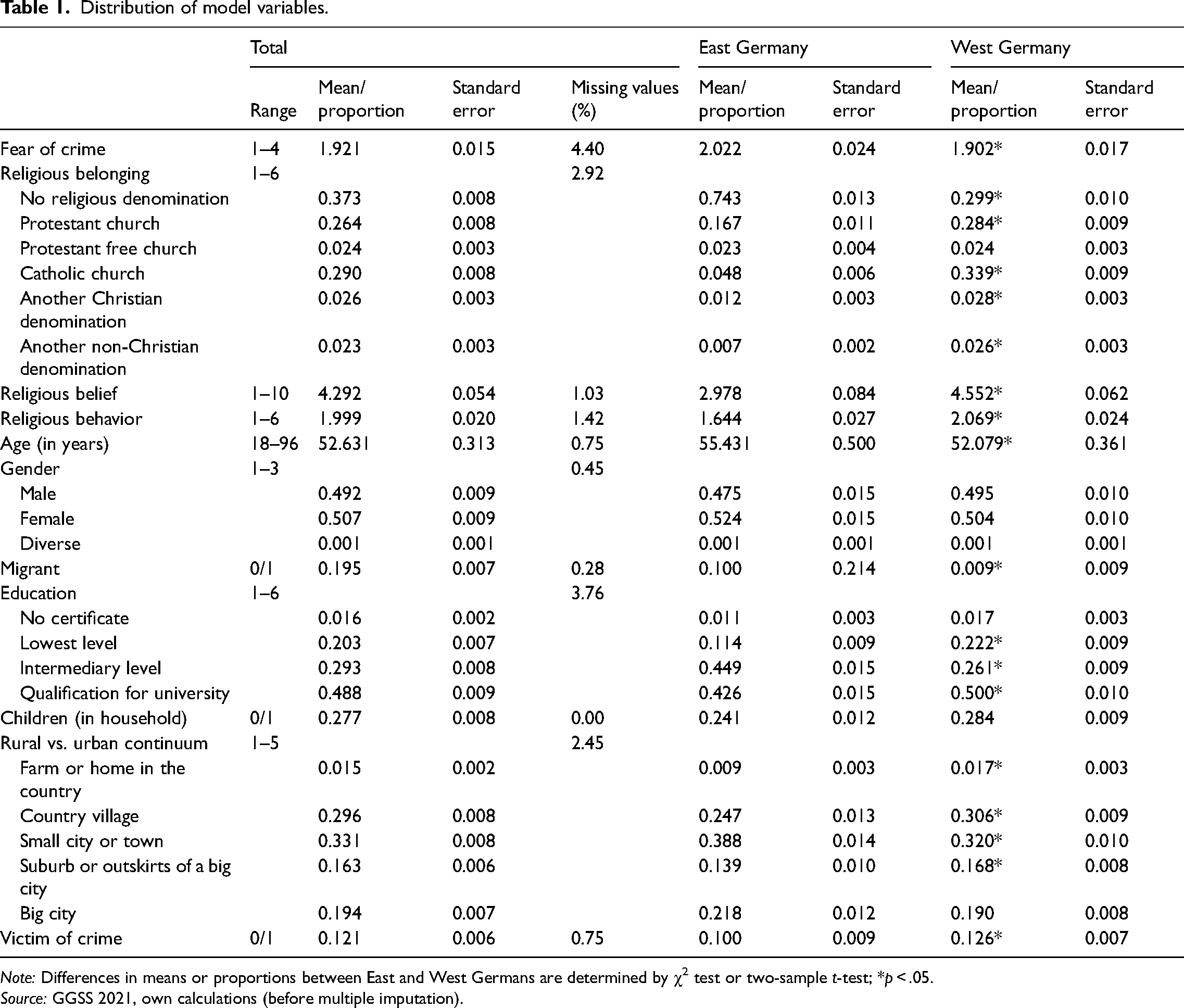
Note: Differences in means or proportions between East and West Germans are determined by χ2 test or two-sample t-test; *p < .05.
Source: GGSS 2021, own calculations (before multiple imputation).
The second step consists of the multivariate analysis. 9 All main effects are displayed in Figure 2. In general, they affirm the theoretically expected relationships. Concerning religious belonging, members of mainline denominations and the unaffiliated do not differ in their fear of crime (Protestant church: b = 0.044, p = .280, CI [−0.036, 0.124], β = 0.024; Catholic church: b = 0.075, p = .085, CI [−0.011, 0.162], β = 0.042). In contrast, members of other denominations are more likely to fear crime compared to the unaffiliated (Protestant free church: b = 0.184, p = .085, CI [−0.026, 0.393], β = 0.035; another Christian denomination: b = 0.226, p = .044, CI [−0.007, 0.446], β = 0.045; another non-Christian denomination: b = 0.331, p = .008, CI [0.086, 0.576], β = 0.062). Thus, the effects for members of another Christian denomination and other non-Christian religious denominations are not only notably strong, but they are the only ones that reach conventional levels of statistical significance. Changes in reference category (from unaffiliated to Protestant church or Catholic church) confirm the previous finding. 10 Members of other denominations more often fear crime compared to members of mainline denominations. However, the effect is only statistically significant for members of other non-Christian religious denominations. Because fear of crime is not exceptionally high among all religious minority groups, the results only partially support the first hypothesis (H1). Nevertheless, the findings tend to support the idea that the consequences of secularization for individuals depend on how well their religious capital fits into the context. The lack of contextual fit of religious minorities’ religious capital translates into greater fear of crime. Religious belief is positively and statistically significantly associated with fearing crime (b = 0.020, p = .007, CI [0.006, 0.033], β = 0.074). Thus, the findings confirm the second hypothesis (H2). The devaluation of religious capital induced by secularization is severe for religious believers. The lack of contextual fit of their religious capital leads to increased fear of crime. On the contrary, religious behavior is negatively and statistically significantly related to fear of crime (b = −0.050, p = .006, CI [−0.086, −0.015], β = −0.070). Thus, the findings are in line with the third hypothesis (H3). Religious participation protects religious capital against devaluation due to secularization, and the contextual fit of religious participants’ religious capital results in lower fear of crime.
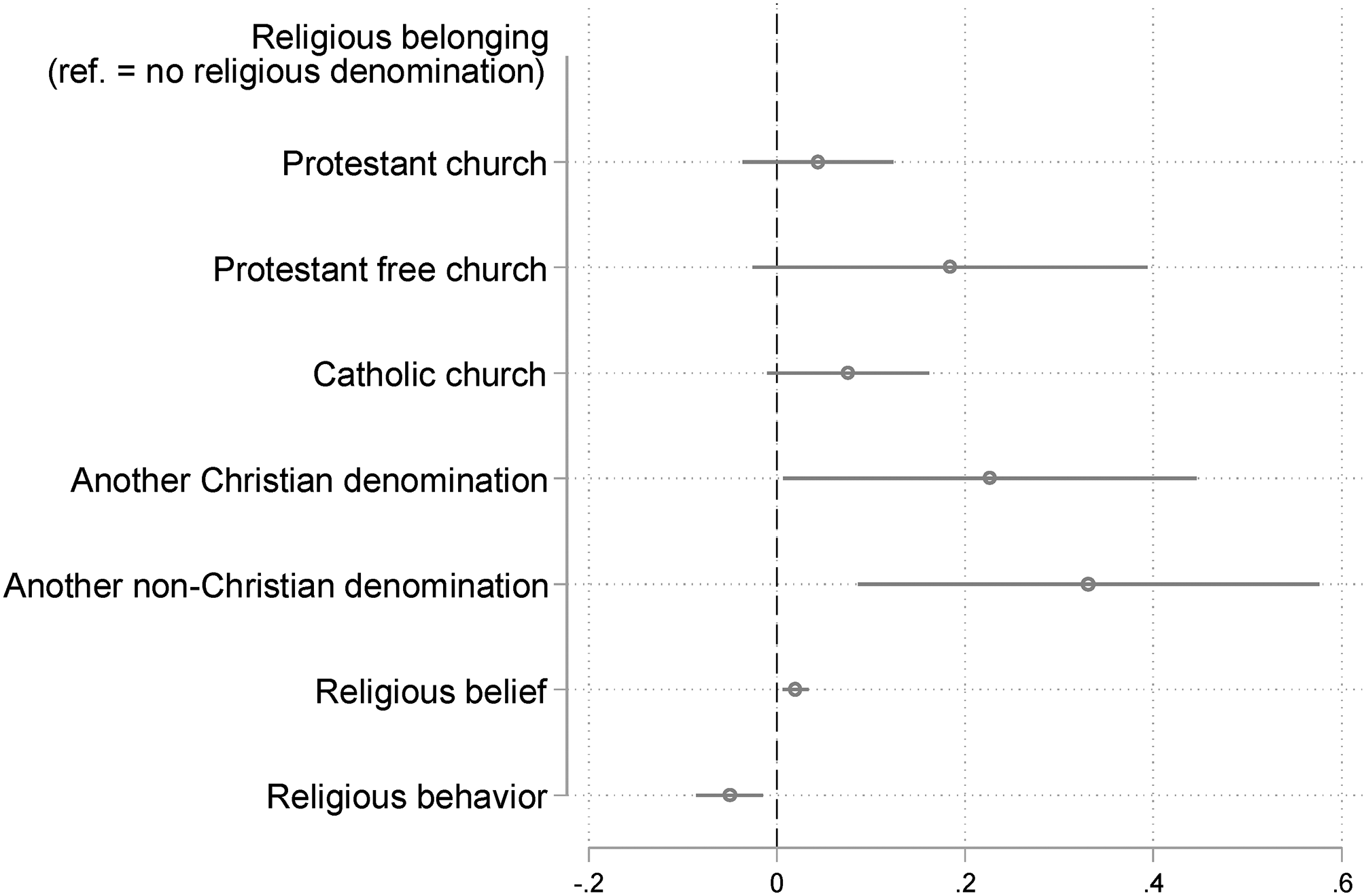
Effects of religion (belonging, belief, behavior) on fear of crime.
In sum, religion exhibits both effects—depending on the respective facet, it can either promote or reduce fear of crime in Germany. To provide a clearer understanding of these religious effects, Figure 3 shows the predicted values of reporting fear of crime for four exemplary cases. These respondents differ in their individual manifestations of religion, but all control variables were held constant at their respective means. 11 First, two extreme cases are presented. Unaffiliated individuals who frequently attend religious services but whose subjective religiosity is low (i.e., behaving without believing) score 1.60 on the fear-of-crime scale. Conversely, members of another non-Christian denomination who report high subjective religiosity but whose frequency of attending religious services is low (i.e., believing without behaving) attain 2.31 on the fear-of-crime scale. Given the rarity of these extreme cases, two in-between cases are displayed. Members of the Protestant church who behave religiously without believing score 1.82 on the fear-of-crime scale. Members of the Catholic church who believe without behaving religiously attain a score of 2.00 on the fear-of-crime scale. Initially, the distinctions in fear of crime among the four cases may not appear substantial. Considering that gender differences (comparing males and females: 0.22), probably the most discussed predictor of fear of crime (e.g., Johansson and Haandrikman, 2021; LaGrange and Ferraro, 1989; Schafer et al., 2006), are comparable to religious differences (comparing the two in-between cases: 0.18), it becomes evident that religion plays a noteworthy role in shaping fear of crime.
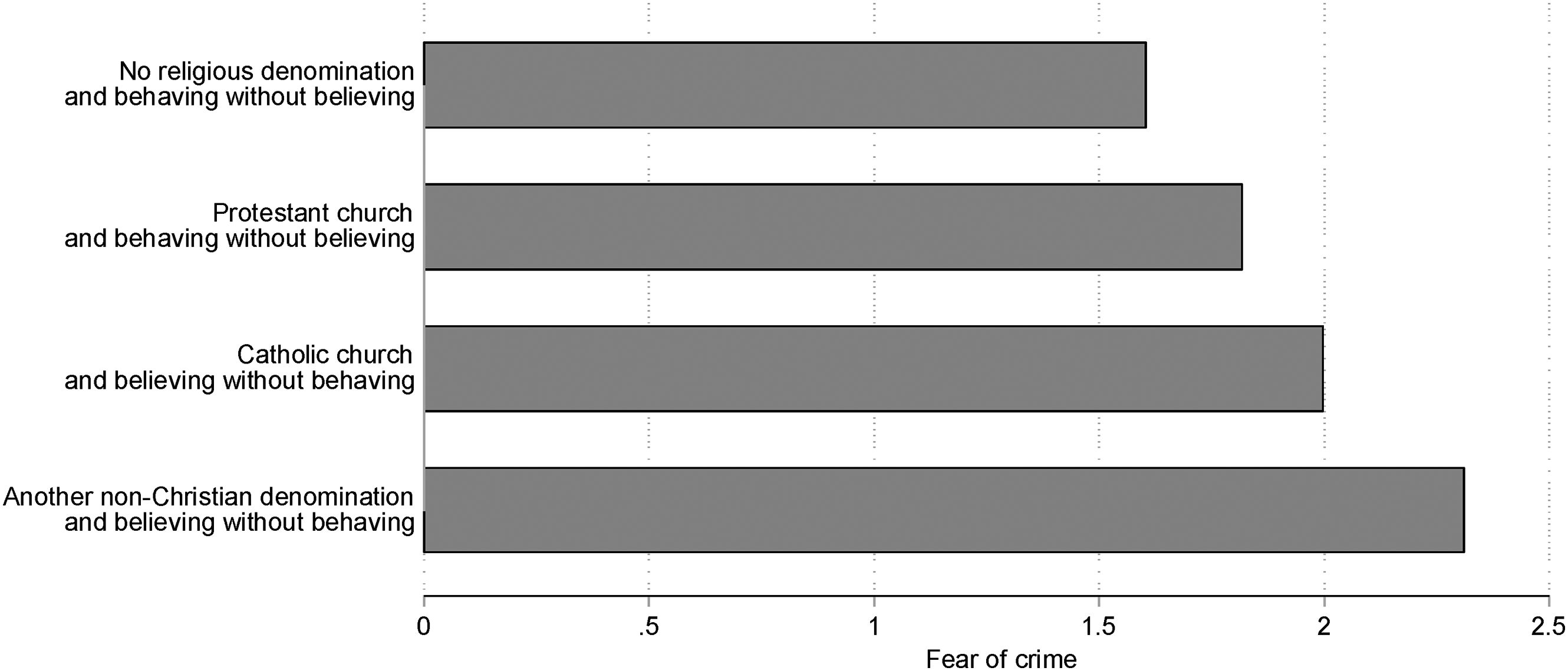
Predicted values for fear of crime (four exemplary cases).
Lastly, an exploration into a potential East–West difference regarding the association between religion and fear of crime is conducted. Figure 4 displays religious effects on fear of crime interacted with East and West Germany. 12 Although religious effects promoting fear of crime are stronger in West Germany than in East Germany, no interaction effect is proven to be statistically significant. Fearing crime is not exceptionally more frequent among all religious minority groups in West Germany than it is in East Germany (Protestant free church: b = 0.100, p = .283, CI [−0.083, 0.283], β = 0.053; another Christian denomination: b = 0.083, p = .812, CI [−0.602, 0.768], β = 0.016; another non-Christian denomination: b = 0.114, p = .777, CI [−0.677, 0.906], β = 0.021). Additionally, the link between religious belief and fear of crime is not particularly strong in West Germany compared to East Germany (b = 0.003, p = .834, CI [−0.028, 0.035], β = 0.013). Therefore, the findings contradict the fourth hypothesis (H4). Religious effects promoting fear of crime are not notably stronger in West Germany than in East Germany.
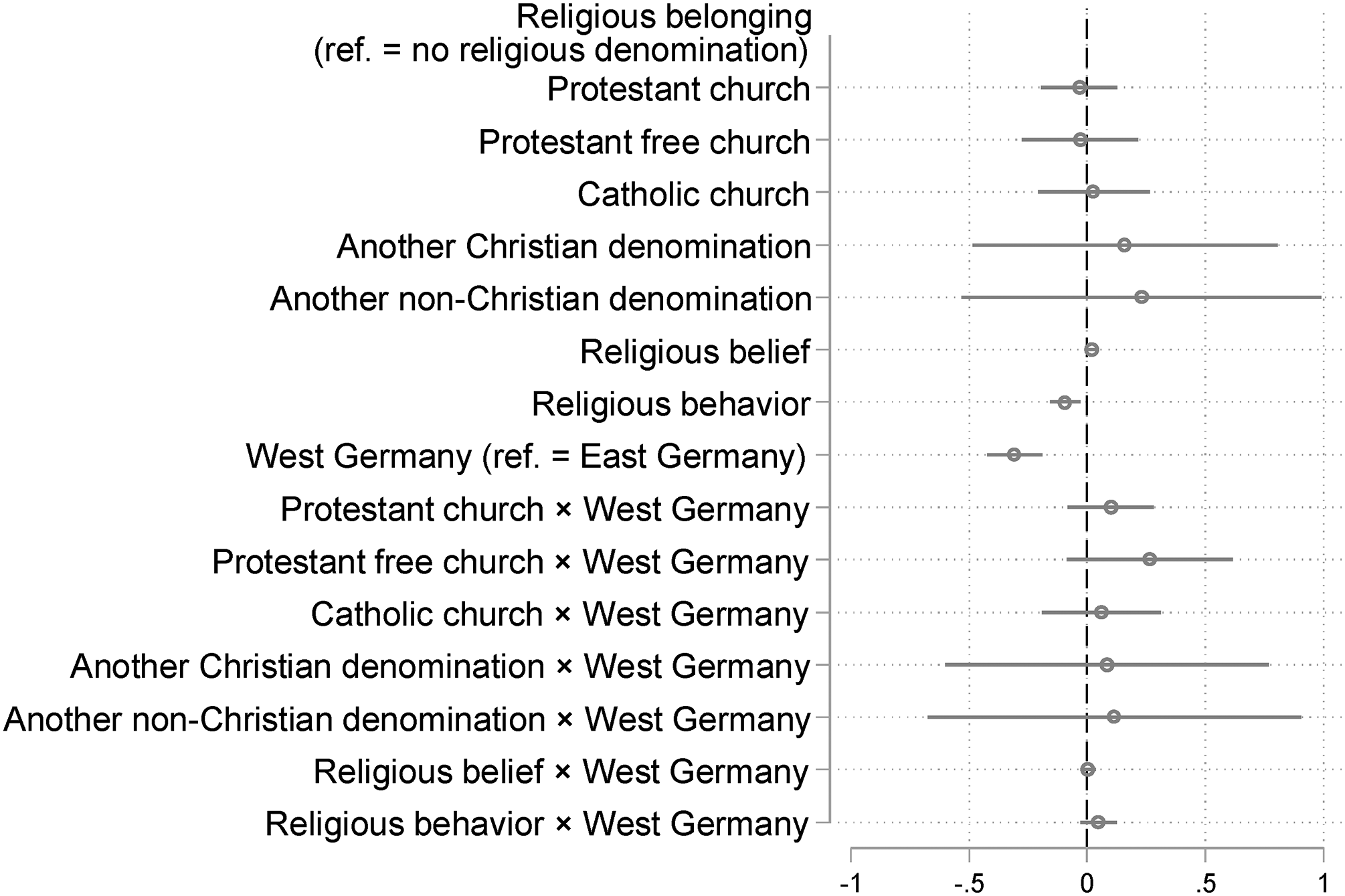
Effects of religion (belonging, belief, behavior) on fear of crime (by East and West Germany).
Discussion and conclusion
This article delves into the role of religion in elucidating fear of crime, a topic that has received limited attention in previous studies (e.g., Matthews et al., 2011; Schwadel and Anderson, 2022), contributing to the open question of whether religion promotes or reduces fear of crime. The generalized insecurity approach (Gerber et al., 2010; Hirtenlehner and Farrall, 2013) and the theory of social production functions (Lindenberg, 1989, 1990) were used to formulate specific hypotheses for different facets of religion. In alignment with theoretical expectations, the empirical analysis yielded evidence that (1) certain religious minority groups are particularly likely to fear crime, (2) religious belief is positively linked to fear of crime, and (3) religious behavior is associated with less fear of crime. In contrast to theoretical expectations was the finding that (4) religious effects promoting fear of crime were equally strong in East and West Germany.
The observed religious effects on fear of crime may appear paradoxical at first glance, but this apparent contradiction dissipates with proper theoretical elaboration. Insights from the generalized insecurity approach (Gerber et al., 2010; Hirtenlehner and Farrall, 2013) and argumentative embedding in the theory of social production functions (Lindenberg, 1989, 1990) clarify the paradoxical findings. Different facets of religion are linked differently to fearing crime because the projection of secularization-induced abstract insecurities only takes place for those individuals whose religious capital is devaluated. Such a devaluation prevents the transformation of religious capital into instrumental and ultimate goals. Not being able to achieve physical well-being and social approval to a satisfactory degree makes it necessary to project the resulting diffuse insecurities onto a more specific social problem. Thus, for religious individuals whose religious capital is affected by secularization-induced devaluation, it may be functional to fear crime.
The findings of this study align with a longstanding tradition of research on the paradoxical effects of religion (Adorno et al., 1950; Allport, 1954). In criminological research and beyond, uniform religious effects could rarely be identified. Examples of paradoxical findings include religious effects on crime-related attitudes and behaviors (e.g., Adamczyk et al., 2017; Montagnet, 2023), extreme right-wing attitudes (e.g., Rebenstorf, 2018; Schneider et al., 2021), voting for populist right-wing parties (e.g., Siegers and Jedinger, 2021; Steinmann, 2022), and anti-immigrant attitudes (e.g., Siegers, 2021; Steinmann, 2023).
Religious effects on fear of crime showed no context specificity. The question arises as to the reasons for this lack of difference between East and West Germany. Two potential answers to this question are briefly discussed. (1) The assumption that secularization in East Germany is largely complete may be inaccurate. Despite substantial progress, there is still further potential for a decline in religion in East Germany (Meulemann, 2019). If secularization is currently ongoing in East and West Germany, then religious effects on fear of crime should be the same in both states. (2) Social change and social order might both have consequences for religious individuals’ fear of crime. In contrast to what was expected, a lack of contextual fit of an individual's religious capital might occur not only in a secularizing country but also in a secular one. In the latter case, secularization continues to have an effect even after its completion. Such an aftereffect is not uncommon. For instance, it has been shown that past processes of nation-building influence contemporary anti-immigrant attitudes (Hiers et al., 2017).
The present study is also subject to limitations, particularly with respect to data. (1) With the data at hand, it is impossible to test the presented theoretical argument in its entirety. This would require not only assessing respondents’ religious capital but also surveying them to determine whether they realize their (instrumental and ultimate) goals with the help of such capital. (2) Facets of religion beyond the common dimensions (belonging, belief, behavior) cannot be considered. Because of this, different understandings of religion might be crucial when explaining fear of crime. Religious capital related to trans-religious orientations (EKD, 2022) or inclusive religious claims (Steinmann, 2022) is probably valued not only by religious individuals but also by secular ones. Such understandings of religion are thus associated with a higher contextual fit of religious capital. (3) Of all three facets of fear of crime, affective, cognitive, and conative (Gabriel and Greve, 2003), only the first could be addressed. (4) The data does not allow for a more detailed differentiation between religious groups. For example, the group of non-Christian religious denominations, which shows the strongest effect on fear of crime, should be further dissected. Members of this religious minority, which mainly consists of Muslims, are usually feared the most (Zaatut and Jacobsen, 2023). Thus, studying fear of crime among the feared is particularly promising.
Despite these limitations, this article complements existing victimological analyses of religion and underscores the significance of situating the analyzed scenario within a broader theoretical framework.
Footnotes
Acknowledgements
The author thanks Arne Dreißigacker and Antonia Hock for their helpful comments and suggestions on earlier versions of this article. The article also benefited from discussions at the Conference of the Academy of Sociology (AS) 2023 in Bern and at the Annual Conference of the European Society of Criminology (ESC) 2023 in Florence.
Declaration of conflicting interests
The author declared no potential conflicts of interest with respect to the research, authorship, and/or publication of this article.
Funding
The author received no financial support for the research, authorship, and/or publication of this article.

Notes
Appendix
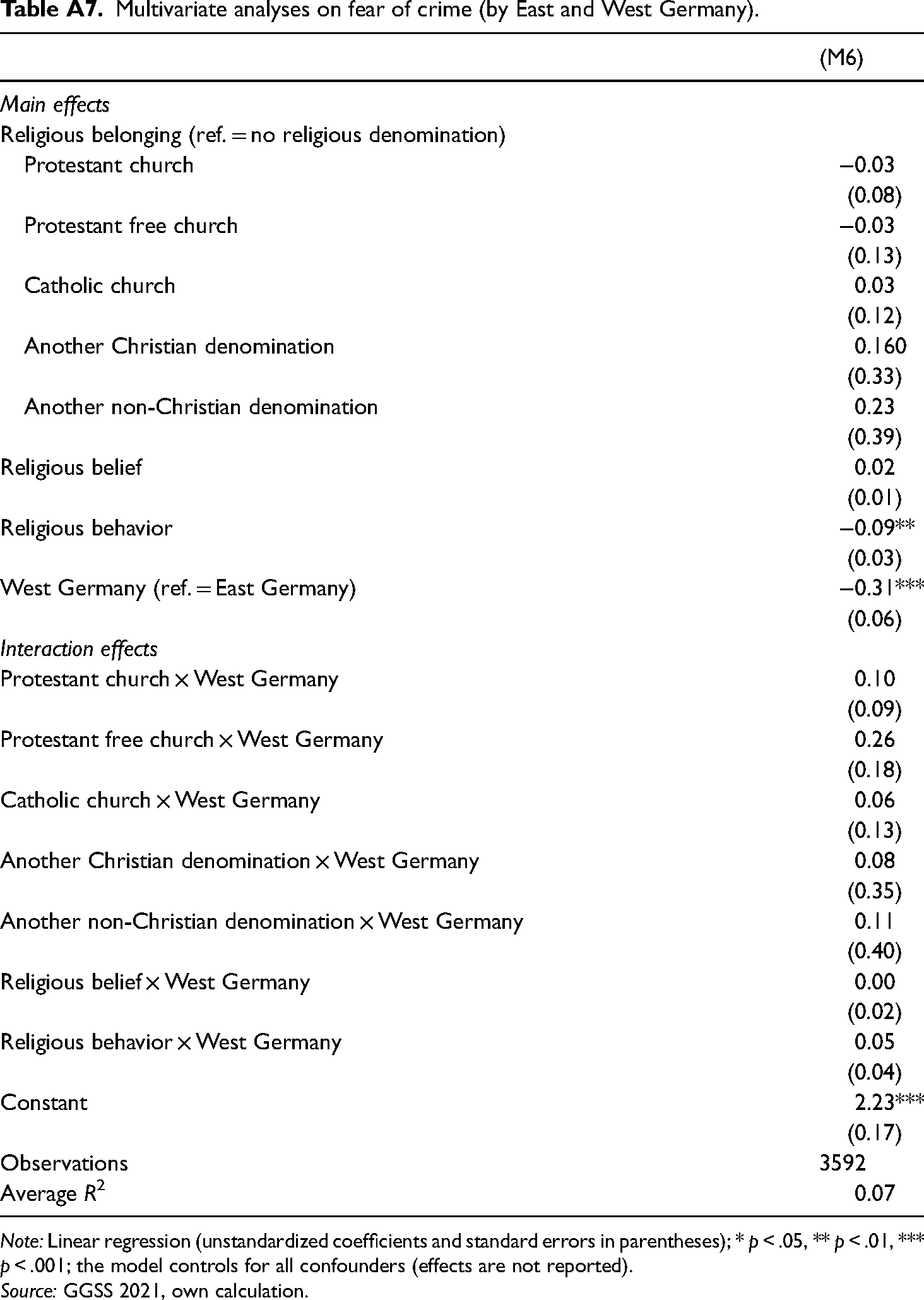
Multivariate analyses on fear of crime (by East and West Germany).
| (M6) | |
|---|---|
| Main effects | |
| Religious belonging (ref. = no religious denomination) | |
| Protestant church | −0.03 |
| (0.08) | |
| Protestant free church | −0.03 |
| (0.13) | |
| Catholic church | 0.03 |
| (0.12) | |
| Another Christian denomination | 0.160 |
| (0.33) | |
| Another non-Christian denomination | 0.23 |
| (0.39) | |
| Religious belief | 0.02 |
| (0.01) | |
| Religious behavior | −0.09** |
| (0.03) | |
| West Germany (ref. = East Germany) | −0.31*** |
| (0.06) | |
| Interaction effects | |
| Protestant church × West Germany | 0.10 |
| (0.09) | |
| Protestant free church × West Germany | 0.26 |
| (0.18) | |
| Catholic church × West Germany | 0.06 |
| (0.13) | |
| Another Christian denomination × West Germany | 0.08 |
| (0.35) | |
| Another non-Christian denomination × West Germany | 0.11 |
| (0.40) | |
| Religious belief × West Germany | 0.00 |
| (0.02) | |
| Religious behavior × West Germany | 0.05 |
| (0.04) | |
| Constant | 2.23*** |
| (0.17) | |
| Observations | 3592 |
| Average R2 | 0.07 |
Note: Linear regression (unstandardized coefficients and standard errors in parentheses); * p < .05, ** p < .01, *** p < .001; the model controls for all confounders (effects are not reported).
Source: GGSS 2021, own calculation.