



Abstract
Homicide statistics are often used as an indicator for violent crime more generally. In this work, we evaluate the empirical support for this convention in a Western European context, specifically the Netherlands. Using data from Statistics Netherlands (CBS) and from the Dutch Homicide Monitor, we compare homicide rates to rates of other violent crimes between 2010 and 2020. Results show that homicide and violent crimes are related in a general sense, but it is difficult to say what those relationships look like concretely. In other words, there is an empirical relationship between homicide and the overarching concept of violent crime, but relationships between homicide and individual violent crimes vary considerably. Based on these findings, we advise that researchers tread carefully when using homicide as an indicator of violent crime.
Homicides are frequently used as an indicator of crime more generally, particularly violent crime. For example, in cross-national studies, homicide rates have been widely employed to indicate crime levels in each of the countries under study (Nivette, 2011). This is mostly because, compared to other types of crimes, homicides tend to be more precisely registered and homicide data is usually more complete (Oberwittler, 2019; Smit et al., 2012). The reason for better registration of homicide statistics relative to other crimes is quite simple: homicides leave a body behind and as such it is less likely that this type of event will remain unreported (Liem, 2022; Ouimet and Montmagny-Grenier, 2014). Furthermore, compared to other crimes, data relating to homicide is less subject to police practices and reporting errors than other crimes, such as sexual crimes or assault (Gove et al., 1985; O'Brien, 1996). For these reasons, data regarding homicide is considered the most reliable type of crime data (Pridemore, 2005), and thus is often used as a proxy for violence and crime in general (Andersson and Kazemian, 2018; Fox and Zawitz, 2000). Although the necessity of using homicide as an indicator for crime is widely accepted for the practical reasons outlined above, the validity of this notion has often not been studied empirically. This study aims to fill this gap by empirically assessing the validity of using homicide as an indicator of other crimes, specifically violent crimes.
On a conceptual level, the practice of using homicide as a proxy of other crimes relies on the idea that homicide and other crimes are all different manifestations of the same phenomenon: crime. Indeed, the idea of all types of crimes (including homicide) being linked is central to many criminological theories (Aebi and Linde, 2010; Skott, 2018). Theories such as strain/anomie perspectives, social learning theory or control theory aim to explain homicide, robbery, assault and sexual violence as forms of crime that can all (to a large extent) be understood using the same principles (Liem, 2022). In this view, homicides could be considered as ‘the end result of lesser forms of crime’ (Ouimet and Montmagny-Grenier, 2014: 224). Indeed, many scholars have advanced the idea that homicide and other violent crimes – such as assault, robbery, rape – differ from each other only in terms of outcome with one being lethal and the other non-lethal. According to Levi (1980) homicide is a mechanism for conflict resolution and thus in its essence does not differ from other violent acts, such as assaults. Luckenbill (1977) concludes that most criminal homicides were the result of smaller (in terms of gravity) but more frequent forms of violence and that they are the result of similar circumstances. Thus, homicides are violent acts that differ from assaults only because they end lethally (Harris et al., 2002; Levi, 1980). Likewise Suonpää (2021: 1) writes that ‘all violence is non-lethal until the victim dies’ conveying that homicide and other violent events are intrinsically linked and differentiated only by the final effect on the victim.
As a metaphor for the relationship between homicide and other crimes the image of an iceberg is often used (Suonpää et al., 2018). In this metaphor, all types of crime are part of the same entity – the iceberg itself (Liem, 2022). The crimes are differentiated by their ‘positions’ on the iceberg. Homicide is represented as the tip of this iceberg that sticks out above the water, as the most extreme, least frequent and most visible type of crime. Other crimes are more common and often remain unreported – in the metaphor they are represented as the bulk of the iceberg that remains invisible below the waterline. In the iceberg image, then, different ‘positions’ on the iceberg indicate different levels of intensity and frequency: at the top are the most intense but rarer crime of homicide; other violent crimes, such as assault, robbery and rape, are just below the summit; and at the very bottom are petty crimes or those that do limited physical harm (e.g. property crime).
Such understandings of the relationship between homicide and other forms of crime are conceptually and theoretically appealing. Yet, the empirical evidence for such a link is far from clear (Suonpää, 2021). In the literature that does exist, a central observation is that results vary widely (van Breen et al., 2023). Homicide often shows a strong degree of association with robbery, and to a lesser degree with assault, although the strength of the association varies greatly from one study to another (see, e.g. Berg, 2019; Harris et al., 2002; O’Brien, 2003). Similarly, the relationship between homicide and rape changes quite significantly by study, with some studies showing a significant strong relationship (Barber, 2006; Barber, 2000; Moore and Bergner, 2016), while others show only a moderate to low association (e.g. Stretesky et al., 2004). The previous research that is most directly relevant to the current work is a cross-national study by van Wilsem (2004), who compares self-reported victimisation rates for various crimes to homicide rates in 27 countries, finding that a country's rate of homicide correlates significantly with self-reported victimisation rates for other violent crimes. For a full review of this literature, please see van Breen et al. (2023). For the purposes of the current work, it is worth noting that many studies have considered various crimes alongside each other, but there are only a few previous studies that have formally compared homicide to other crimes, or systematically tested empirical links between them. Thus there are only a few studies that can comment on the suitability of using homicide as an indicator of crime. As is often the case, there are even fewer that have done so from a European perspective (with van Wilsem 2004 as a notable exception). It is to this issue we hope to contribute in the current work.
The current study
In this study, we examine empirical relationships between homicide and violent crime to provide insight into one of the core questions of criminological work: Can homicide be used as an indicator of violent crime? We answer this question using data from the Netherlands. We focus on the relationship between homicide and violent crime, for several reasons. First, when considering links between homicide and other crimes, we considered it beneficial to start with a strong test of this notion. Given that the strongest conceptual links exist between homicide and violent crime (as outlined above), we suggest it makes sense to start there in our empirical assessment of the issue. Relatedly, much of the previous research discussed above focuses on violent crime, particularly robbery, assault, rape and sexual assault. These are crimes that follow Eisner's (2009) definition of interpersonal violence: those crimes that result in bodily injury of another person – it is these crimes we include in our analysis. In the context of the Dutch Criminal justice system, we also include a crime type labelled as ‘public violence against people’, which is conceptually related to assault. We analyse the relationship of each of these five crimes with homicide. Given the literature reviewed above, there is reason to expect that the empirical relationships between homicide and other crimes will be modest. However, we did not raise concrete hypotheses for each of the individual relationships, and as such this work is exploratory in nature.
Importantly, we consider violent crime both in a strict sense and in a broader, more abstract sense. That is, we aim to evaluate the relationship of homicide with specific violent crimes, but also the relationship between homicide and ‘violent crime’ as a higher-level concept. To capture violent crime as a higher-level concept, we take two steps. First, we create a compound variable, which we label violent crime, which is an aggregate of all the individual violent crimes described above. We then evaluate the relationship between this compound and homicide rates. Second, we also compare homicide rates to several ‘violence-adjacent’ crimes, crimes that do not necessarily involve direct interpersonal violence, but are associated with it. For example, firearm crime and drug-related crime have strong links with violent criminal milieus, particularly in the Netherlands (Krüsselmann et al., 2023). The inclusion of these crimes, then, allows us to capture the concept of ‘violent crime’ somewhat more holistically, by incorporating the ‘grey area’ of what constitutes violent crime. Specifically, we include rates of firearm crime, arson, ‘public violence against goods and objects’ (vandalism), and drug-related crime.
Implications
Through this study, we intend to gain insight into whether it is justified to use homicide data as an indicator of violent crime. We believe answering this question will have relevant implications for a wide range of criminological questions, given that the link between homicide and other forms of violent crime is a (sometimes implicit) part of many criminological theories. Further, we believe this work will have policy implications – refining the crime indicators used for policy making and policing and thereby (ultimately) contributing to more effective policy.
Methods
Study context
We base our study on data from the Netherlands. The Netherlands has one of the lowest homicide rates in the world, approximately 0.7 homicides per 100,000 of the population in 2020 (Aarten and Liem, 2023). For the past two decades, homicide rates in the Netherlands have steadily declined, including in the period between 2010 and 2020 on which we focus here. Similarly, crime in general has been in decline since the beginning of the new century (Aarten and Liem, 2023). According to UNODC data, in 2019 the rate of serious assault in the Netherlands (per 100,000 of the population) was 28.22, 50.50 for robbery, and 25.12 for sexual violence (UNODC, 2022). Benefits of focusing on the Netherlands include the fact that details on all homicide cases since 1992 are captured in the Dutch Homicide Monitor, a database that is able to overcome a range of shortcomings presented by vital statistics (see Granath et al., 2011). Further, the ‘landscape’ of crime and violence in the Netherlands is broadly similar to that in other Western European countries (see e.g. Suonpää et al., 2022). As such, findings in the Netherlands are informative in understanding patterns of crime and violence in (Western) Europe more generally.
Data structure
In this study we focus on a period of 11 years, specifically the timeframe 2010 to 2020, for both practical and conceptual reasons. In the first place, detailed crime data is publicly available for this time period. Further, between 2010 and 2020 there have not been major changes in the way crime is classified and registered by the Dutch Police, which ensures consistency in the data.
To ensure a sufficient number of observations, data covering these 11 years were disaggregated by the 12 Dutch provinces, resulting in 132 observations (11 years x 12 provinces) for each of the variables. Smaller units were not feasible given the low absolute number of homicides.
Variables
All the variables outlined below are expressed per 100,000 of the population. To calculate these rates we access population statistics from Statistics Netherlands (CBS), which offers an open data portal where such information is publicly available.
Homicide
Homicide data is drawn from the Dutch Homicide Monitor (DHM). The DHM is a database that gathers information about every homicide in the Netherlands, and codes these events on 80 variables. The DHM considers homicide as an intentional criminal act resulting in the death of (at least) one individual. This covers all murder and manslaughter cases, while attempted homicides, suicides, abortion, euthanasia and lethal cases of police violence are not included (Granath et al., 2011; Liem et al., 2019). The DHM triangulates data from several separate data sources including police data, data from the public prosecutor, and criminal justice case files.
We used the absolute values from the DHM and calculated rates per 100,000 inhabitants. For each year, we divide homicide numbers by the total population, and multiply the result by 100,000.
Independent variables: Other violent crimes
The violent crimes that we include here (alongside homicide) are robbery, assault, rape, sexual assault and ‘public violence against persons’. We also include ‘public violence against goods’ (vandalism), arson, firearm crimes and drug-related crimes. As outlined above, these are crimes that are not necessarily violent, but we consider them relevant to include because they are ‘violence-adjacent’ allowing us to capture the concept of violent crime more holistically. Data were taken from Statistics Netherlands. The variables reflect the number of cases registered by police as falling under a certain article of the Dutch penal code. Further details are given in the Appendix. For each of these variables, we calculated rates per 100,000 for each year, by dividing crime events by the total population, and multiplying the result by 100,000.
Analytical strategy
All analyses are conducted using SPSS. In order to assess whether rates of homicides relate to rates of other violent crimes, we employed a three-step strategy. First, we visualise trends over time for the different crime types between 2010 and 2020. Using a simple line graph, we display how the rates of violent crime have changed from their baseline in 2010. Subsequently, we analyse cross-sectional relationships between homicide and each of the other violent crimes using Pearson's correlations. The third stage of the analysis aims to examine predictive relationships between homicide and other crimes. We take those crimes that the correlations showed to be related to homicide, and examine whether they can predict homicide rates. Specifically, we use multi-level mixed regression models. The multilevel component is included to take account of the fact that our observations are not independent, but ordered in a year-by-year series. Therefore, these models include the year the observation was taken from as a repeated factor at level 1. In this stage of the analysis, we are interested in the specificity (vs generality) of the relationships between homicide and violent crime identified in the previous steps. We create two multi-level mixed regression models. The first model captures violent crime in a very specific sense by creating a model in which all the predictors that are significantly related to homicide in earlier steps are entered simultaneously. Each parameter in this model reflects the relationship between homicide and the indicator in question when the others are held constant. The second model captures the relationships between homicide and violent crime in a very general sense, through the creation of a compound variable. To create the compound variable, we convert rates of the relevant crimes to z-scores, which expresses the rates in terms of its standard deviation from the mean, ensuring that all variables are expressed on a comparable scale (see e.g. Walters, 2011). We then average the z-scores to create the compound and examine whether this compound can predict homicide rates. The comparison between these models will inform us on whether the relationships between homicide and the various violent crimes reflects a general association, or more narrow, specific associations.
As outlined above, these models include the year the observation was taken from as a repeated factor at level 1. Preliminary analysis confirmed that this autoregressive effect reached significance for both models – the one comparing homicide and the compound variable (Wald's Z = 8.06, p <.001), and for the one comparing homicide with the single violent crimes (Wald's Z = 7.81, p < .001). In line with this, in the models discussed below we include this yearly structure in the model specifications. Evaluation of the model assumptions indicated no cause for concern, suggesting that this model can be reasonably applied to this data.
Results
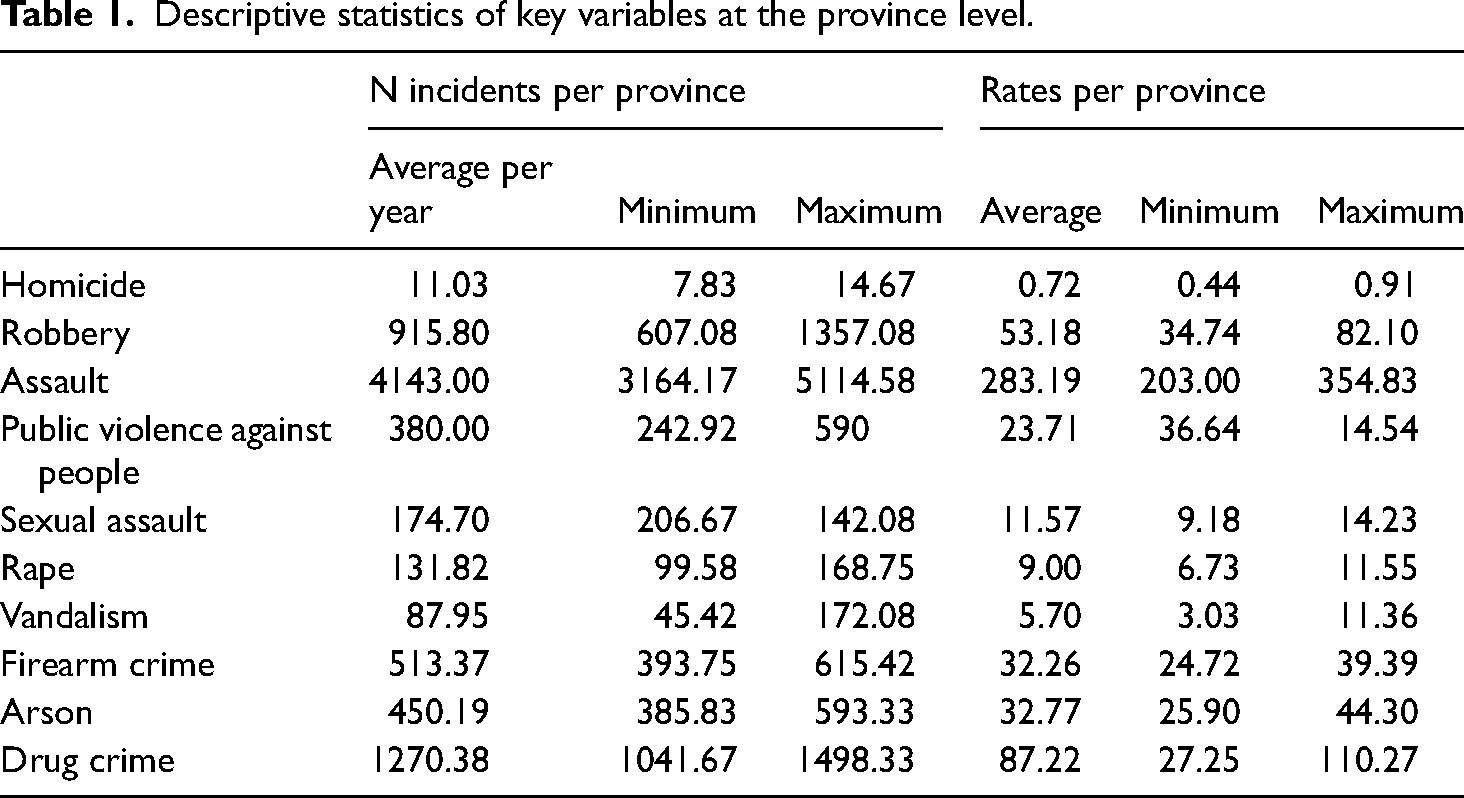
Table 1 shows descriptive statistics for all variables. We begin the analysis by examining trends in the violent crimes over the 11 years (see Figure 1). First, there was an anomalous rise in homicide cases in 2017, which represented approximately a 50% increase compared to 2016. This observation interrupts a continuous downwards trend since 2010. More generally with regards to the comparisons between trends, most of the crimes show a similar decline over the 11 years. The exceptions to this are rape and firearm crimes, which show an increase. Rates of rape increased during the time period, exceeding by 2020 its 2010 levels by almost 20%. The increase in rates of firearm crime occurs from 2017 onwards, though it has not yet reached its 2010 levels.
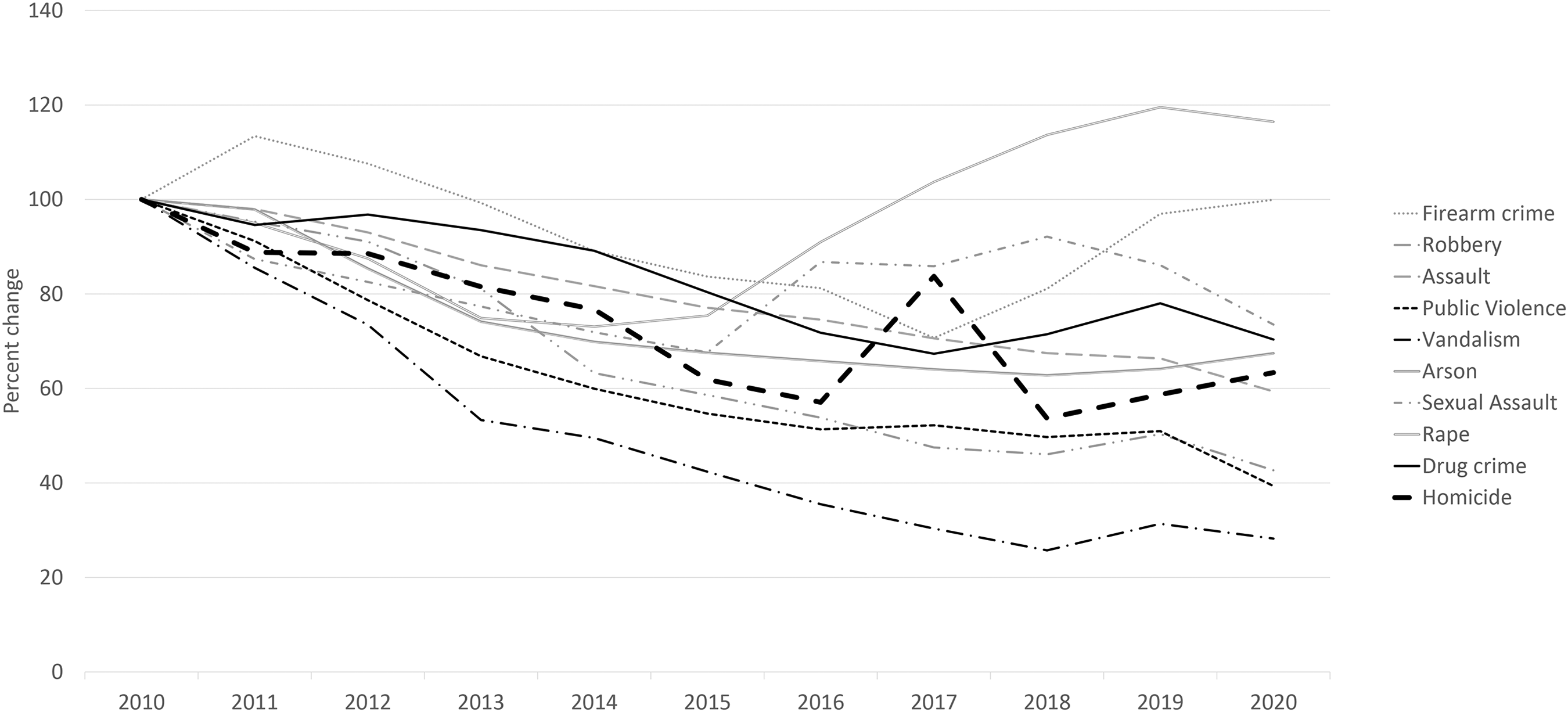
Relative change (in percentage) of homicide rates and rates of other violent crimes in the Netherlands, 2010–2020 (index 2010 = 100%).
Descriptive statistics of key variables at the province level.
We then turn to the correlations between homicide and the other crimes (see Table 2). Robbery shows the strongest correlation with homicide, r = .52, such that provinces with higher rates of homicide also tend to have higher rates of robbery. ‘Public violence against people’ and assault are correlated similarly with homicide, both at r = .39. On the other hand, correlations between homicide and both sexual assault and rape do not reach significance. The four ‘violent-adjacent’ crimes also correlated significantly with homicide. Firearm crime (r = .43), drug crimes (r = .44) and vandalism (r = .33) each show a medium size correlation with homicide rates, while arson shows a weaker (though still significant) correlation with homicide, r = .19.
Correlations of homicide rates with rates of other violent crimes across provinces of the Netherlands 2010–2020.
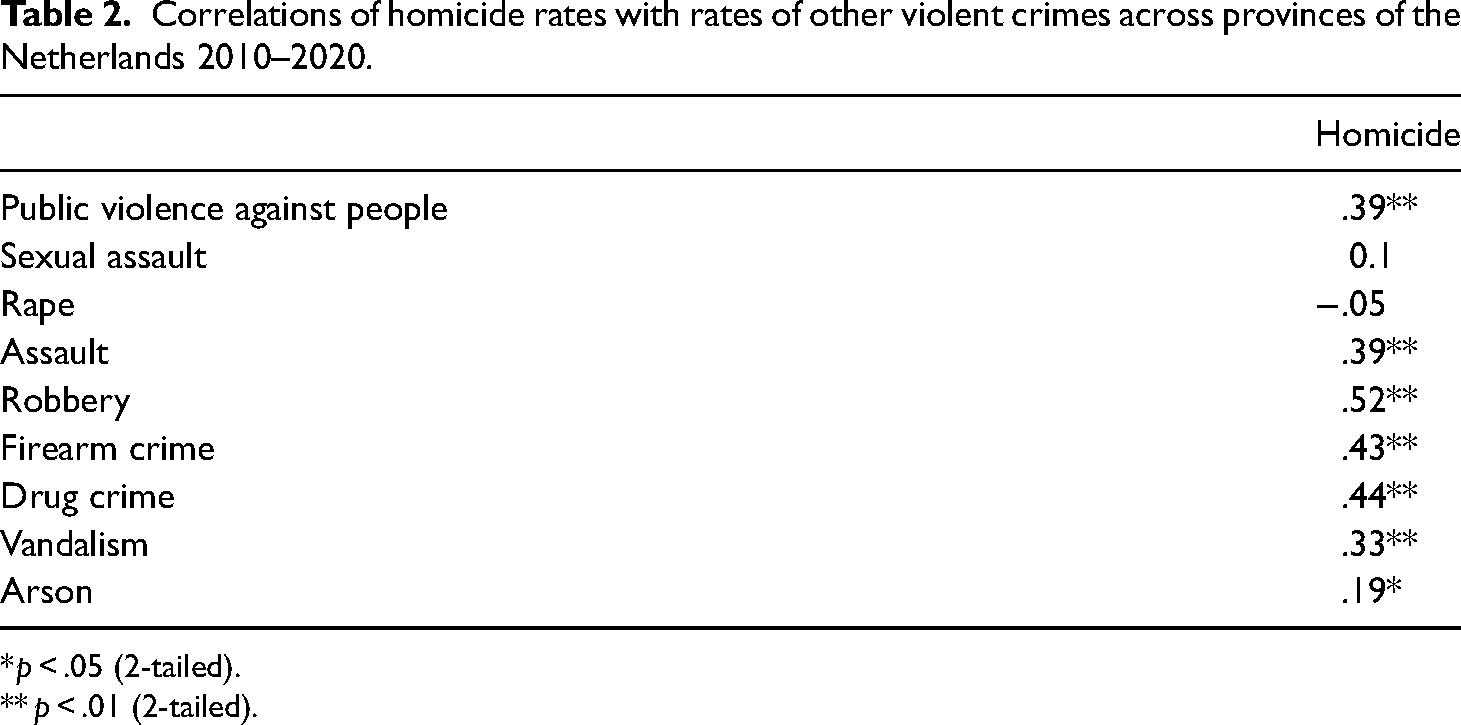
p < .05 (2-tailed).
p < .01 (2-tailed).
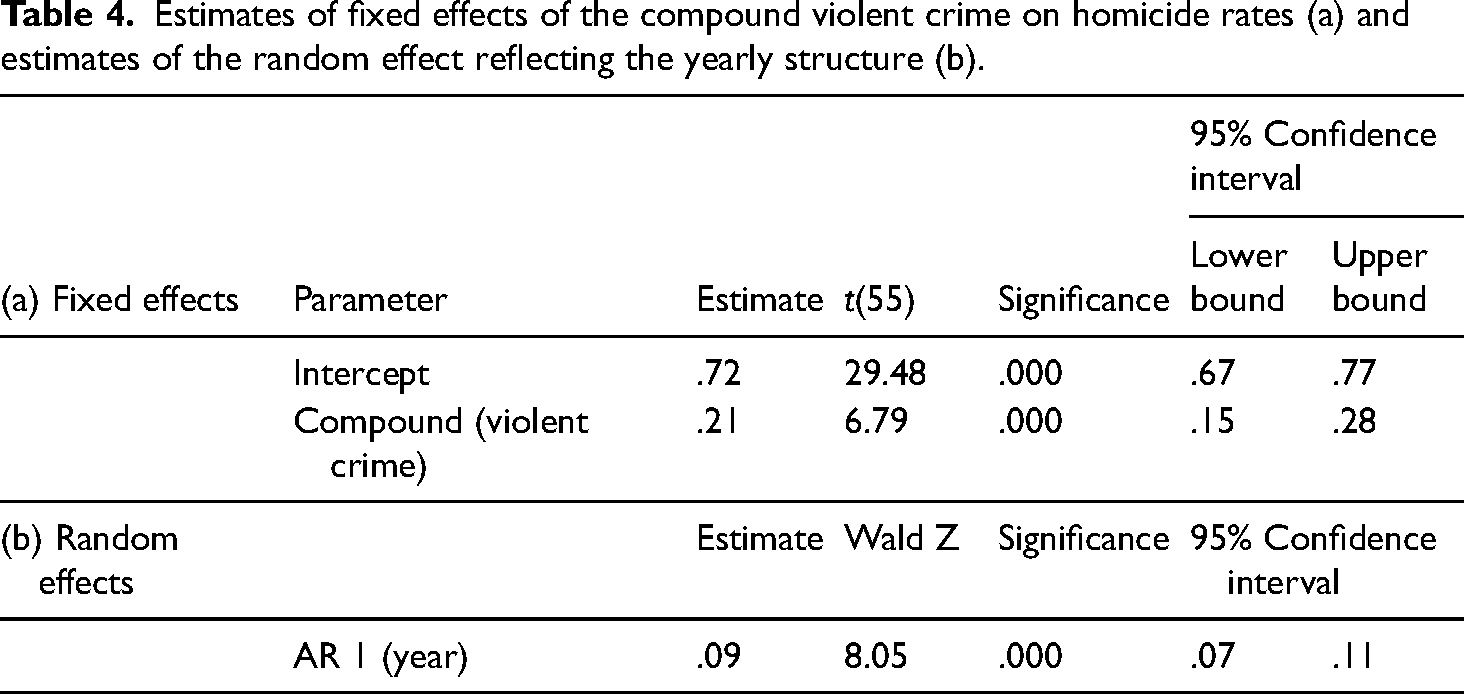
The final stage of the analysis examines whether other violent crimes can predict rates of homicide. We create two regression models (see details under Analytical strategy section). The first of these models examines whether homicide can be predicted by violent crime in a general sense, through the creation of a compound variable that takes together all variables that were shown to be significantly associated with homicide. The second model includes these same crimes, but now enters them simultaneously as individual predictors. In this model, we examine whether homicide can be predicted from specific violent crimes, when the others are held constant, and their shared variance is taken out of the equation. Results showed that none of the individual crimes had a significant relationship with homicide, t < 1.85, all p > .068 (see Table 3). However, when testing the effect of the compound on homicide rates (see Table 4), the compound reached significance, such that provinces with higher yearly rates of violent crime also reported higher rates of homicide, B = .21, t(55) = 6.79, p < .001.
Estimates of fixed effects of the other violent crimes on homicide rates (a) and estimates of the random effect reflecting the yearly structure (b).
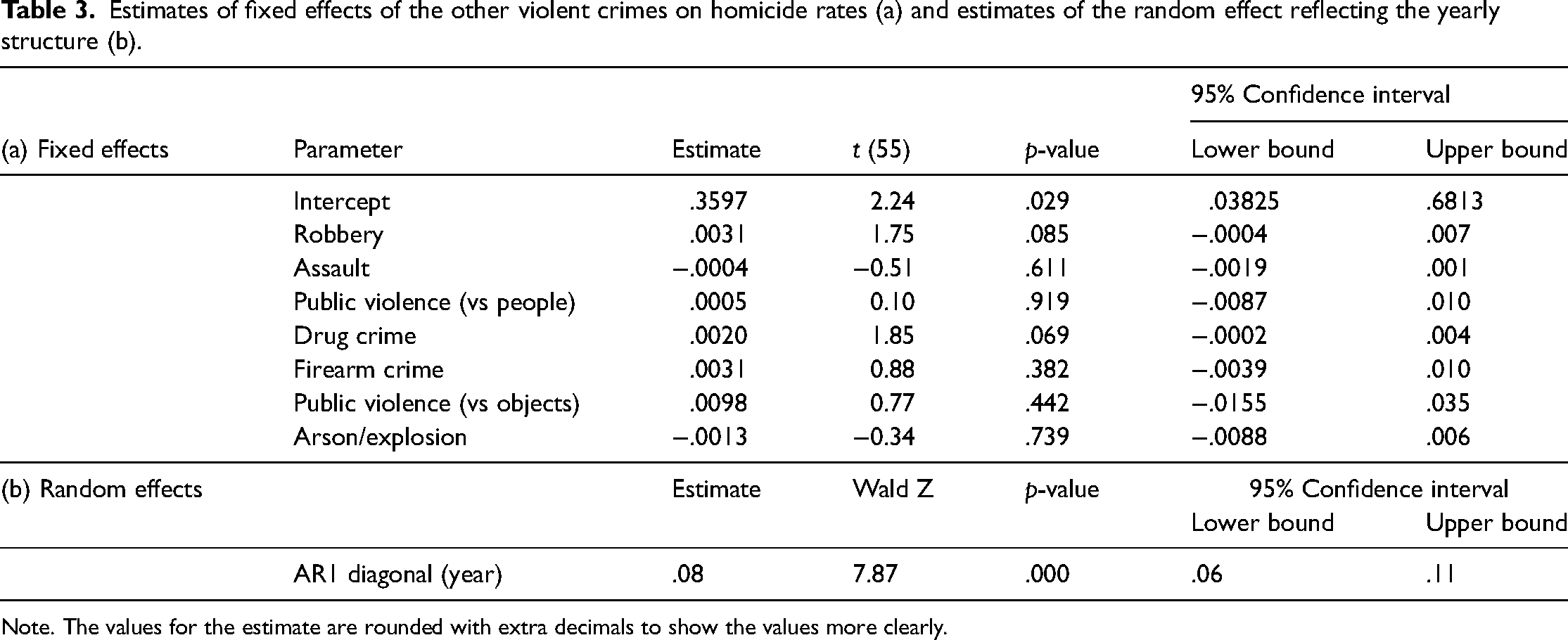
Note. The values for the estimate are rounded with extra decimals to show the values more clearly.
Estimates of fixed effects of the compound violent crime on homicide rates (a) and estimates of the random effect reflecting the yearly structure (b).
Discussion
The results of this study paint a relatively complex picture regarding the relationship between homicide and violent crime. First, when looking at the trends of the different violent crimes over time, most of the crime types declined (see also Aebi and Linde, 2010) – a trend similar to the crime drop observed in most of the Western world since the second half of the 1990s to these days (Blumstein, 2006; Suonpää et al., 2022; Weiss et al., 2016). However, in spite of this general similarity, the various individual violent crimes dropped at quite different rates; and in fact, rates of rape increased over the timeframe. In terms of the correlations, rates of homicide correlate positively with most of the violent crimes, notably robbery, assault, public violence against persons. Homicide also correlates with the violent-adjacent crimes, such as vandalism, arson and explosion, firearm crime and drug-related crime. The strength of these correlations, however, varies substantially. The strongest correlation was observed between homicide and robbery at r = .52 (see also Berg, 2019; O’Brien, 2003), but the correlation was much lower with, for instance arson at r = .19, and there was no correlation at all with the sexual violence variables. The final stage of the analysis then showed that the relationships observed were stronger when violent crime was assessed in a more general sense (in the analysis using the compound), and less clear when relationships were more specific. The correlations between homicide and the other violent crimes that were observed in the earlier stages of the analysis were moderate-to-strong, but these were reduced to non-significance in a more stringent model that examines unique components of those relationships, and takes into account the yearly data structure.
Overall, then, the results of this study support the notion that homicide and other violent crimes are empirically related, but this relationship comes across most clearly in a general sense. Homicide is more strongly related to the overarching concept of ‘violent crime’ than to the individual crimes. In other words, we can say that ‘homicide and violent crime are related’, but beyond such general statements it is difficult to say how exactly they are related, or how strong those relationships are. Based on these findings, we advise that researchers tread carefully when using homicide rates as an indicator of violent crime. If they do wish to do so, we recommend that they make explicit how they view the relationship between homicide and violent crime, and discuss empirical evidence that supports their reasoning. If such empirical evidence is not available, we recommend researchers conduct pilot work to examine whether the assumed relationship between homicide and violent crime is empirically justifiable in the context in which they want to work. Often, the reason that homicide is used as a proxy is precisely because reliable data for ‘other crimes’ is not available, which would preclude pilot work. In such cases, we recommend that those researchers maintain the focus on homicide data without extrapolating to broader claims about violent crime.
Aside from this overall conclusion, there are several other elements of the results that are worthy of some additional discussion. For instance, it is worth noting that homicide did not correlate with rape or sexual assault in any of the stages of the analysis (in line with Skott, 2018; but in contrast to Barber, 2006; Moore and Bergner, 2016). Thus, homicide seems to be a particularly poor predictor of sexual violence, as neither of the three elements of our analysis (trends, correlations and predictive relationships), showed evidence of empirical links. There are likely to be several reasons for this. First, in terms of data quality, police recording of sexual violence is often patchy (e.g. Shaw et al., 2017). Second, sexual violence also showed different time trends than the other violent crimes. This may result from the fact that in recent years, sexual violence has become a public priority in many European countries, particularly after the #MeToo movement in 2017. Such public interest often produces subsequent increases in reported crimes, as awareness grows (Gruszczyńska and Heiskanen, 2018). Third, there are more conceptual differences between homicide and sexual violence too. In the Netherlands, homicide is commonly associated with altercations and organised (drug-related) crime (Aarten and Liem, 2023), while sexual violence tends to occur in domestic settings (Zijlstra et al., 2017). The correlation between homicide and arson was also noticeably low; this may be explained by a lack of overlap between homicide offender populations and fire setting populations, as a substantial proportion of the latter may not be driven by violent or aggressive impulses, but instead by a “cry for help” (Dalhuisen et al., 2017).
Finally, we would like to briefly reflect on the unique context of the Netherlands in relation to organised crime and illegal drugs markets. As seen in our results, firearm crime and drug crime displayed among the highest correlations with homicide. This could reflect the growing importance of the Netherlands as one of the world's most important hubs for the trafficking of illegal drugs, in particular cocaine (UNODC and EUROPOL, 2021). More generally, we believe that this finding corroborates our central interpretation above, namely that homicide correlates with violent crime in a broad sense – here we see relatively strong relationships with events that fall outside of a strict definition of violent crime.
In terms of alternative explanations for these findings, the main reason to use homicide as an indicator of violent crime relates to the notion that statistics for non-lethal crimes tend to be of lower quality than statistics for homicide. Therefore, we might suggest that the absence of clear relationships between homicide and the other violent crimes is due to low data quality, and if data were of better quality relationships might come across more clearly. However, poor data quality can just as easily lead to over-estimation of relationships, and as such relationships might also be weaker than those outlined here. This issue of data quality goes very much to the core of this manuscript, which has argued that, while homicide and other violent crime are considered to be clearly related in a conceptual sense, their empirical relationships must be treated cautiously.
Strengths and limitations
This study is among the first to directly compare homicide and other violent crimes in order to empirically assess whether homicide can be used as an indicator of other violent crimes, using data from a western European country, the Netherlands. In this sense, this work complements our understanding of this issue from a non-US perspective, which is where most of the (still few) studies of this type come from, thus expanding the existing literature from a Western European perspective.
This study is, however, not without limitations. As explained in the methods section, data on violent crime other than homicide is publicly available only from 2010 onwards, resulting in the timeframe used −11 years – being quite short. Another relevant limitation of the current study is the low number and low variance for some of the variables, in particular homicide, but also rape and sexual assault. This issue lowers the variance in those variables, and prevents us from conducting more detailed analyses such as by smaller geographical regions or by subtypes of homicide. A methodological strength of this study lies in the data source used for homicide statistics, the Dutch Homicide Monitor, which provides high-quality data on homicides, given that it triangulates data from several sources. Importantly, the DHM is part of the larger European Homicide Monitor, which allows for cross-national comparisons as it uses a set of standardised variables. A worthwhile next step, then, would be to examine the relationship between homicide and other violent crime in a multi-country setup that includes a larger and more diverse set of homicides. Specifically, when more homicides are included we might also be able to study subtypes and compare these to other violent crimes within the same domain (i.e. intimate partner homicides and intimate partner violence, drug-related homicides and drug crimes, etc.). This would deepen our conceptual understanding of the relationship between homicide and other violent crimes, as well as and further the empirical evidence regarding the possibility to use homicide as a proxy for other crimes.
Conclusion
In this study, we assessed whether homicide rates can serve as an indicator of violent crime more generally. We used data from the Netherlands for the period 2010 to 2020 and looked for correlations, trends, and predictive relationships between homicide and other forms of violent crime. Similar to previous studies in other contexts, we found evidence that most of violent crimes correlate with homicide, but there was substantial variation in the size of the correlations. Further, none of the violent crimes rates can predict rates of homicide on their own. Violent crimes show predictive power only when grouped into a compound variable. Hence, we suggest that researchers should tread carefully when using homicide as an indicator of violent crime.
Supplemental Material
sj-docx-1-euc-10.1177_14773708231211170 - Supplemental material for Old habits die hard: Assessing the validity of using homicide as an indicator of other violent crimes
Supplemental material, sj-docx-1-euc-10.1177_14773708231211170 for Old habits die hard: Assessing the validity of using homicide as an indicator of other violent crimes by Jolien van Breen, Arnaldo Rabolini and Marieke Liem in European Journal of Criminology
Footnotes
Funding
The author(s) disclosed receipt of the following financial support for the research, authorship, and/or publication of this article: This work was supported by the Social Resilience and Security interdisciplinary programme at Leiden University.

Supplemental material
Supplemental material for this article is available online.
Appendix
References
Supplementary Material
Please find the following supplemental material available below.
For Open Access articles published under a Creative Commons License, all supplemental material carries the same license as the article it is associated with.
For non-Open Access articles published, all supplemental material carries a non-exclusive license, and permission requests for re-use of supplemental material or any part of supplemental material shall be sent directly to the copyright owner as specified in the copyright notice associated with the article.
