




Abstract
Evidence that violent victimization is associated with an array of negative outcomes over the life-course is mounting. While its links to poor health have been extensively documented, socio-economic outcomes have been left relatively unexplored. In this study, Swedish population register data are utilized to examine the relationship between violent victimization and labour market exclusion, placing particular focus on the moderating role of offending and gender differences in this dynamic. Using data on 12 complete successive cohorts born 1975 to 1986, violent victimization is observed in young adulthood (age 20–24) using patient register data, and is measured as interpersonal violence resulting in hospital admission. Labour market exclusion is operationalized as being not in employment education or training and is observed at age 25 and 30. Linear probability models are estimated for men and women, respectively. The findings suggest that women who have been victims of violent crime face elevated risks of labour exclusion, in both the short and the long run, and regardless of criminal offending. Men, on the other hand, display no excess risk of labour market exclusion in the absence of violent offending. For the group of male violent offenders, however, victimization adds to the risk of labour market exclusion. Implications of the findings are discussed.
Keywords
Introduction
Violent victimization is increasingly highlighted as an urgent concern (WHO, 2013), and in particular, domestic violence against women has been described as a serious violation of human rights (European Commission, 2021). Evidence that violent victimization is associated with an array of adverse outcomes over the life-course is mounting, especially in terms of health outcomes (Janssen et al., 2021; Mahuteau and Zhu, 2016; Schaefer et al., 2017; Turanovic and Pratt, 2015). While some previous research has demonstrated that violent victimization is associated with elevated risks of low income, sick leave and welfare receipt (Bindler and Ketel, 2019; Ornstein, 2017) and poor educational and occupational attainment (Macmillan, 2000; Turanovic, 2019), labour market outcomes among victims of violent crime have received relatively scant attention, particularly in the context of young adulthood. This is important not least because young adults outside the labour market display heightened risks of further labour market exclusion that persist well into their thirties (Bäckman and Nilsson, 2016). Labour market exclusion is key to a successful transition to adulthood and closely linked to other important areas, such as poverty risks (Halleröd and Ekbrand, 2015) and bleak housing prospects (Gousia et al., 2020). Heterogeneity in the impact of victimization is another largely overlooked issue in victimology research, something researchers have recently begun to call attention to (Lauritsen and Rezey, 2018). In particular, there is a lack of knowledge about which groups of victims fare worse in terms of labour market exclusion.
The present study addresses this knowledge gap by revisiting the well-documented victim–offender overlap, a phenomenon implying that victimization and offending are intertwined, that is, victims often also being offenders and vice-versa (Jennings et al., 2012), as well as addressing gender-specific dynamics, among Swedish young adults. The victim–offender overlap has been found to be robust over time, cross-nationally and in different age groups (Berg and Mulford, 2017; Lauritsen and Laub, 2007), but it has scarcely been studied beyond efforts to explain its existence. The salience of the victim–offender overlap and the gendered features of violence make these aspects particularly important to consider. This study aims to add knowledge about the relationship between victimization and labour market exclusion among young adults. It asks (a) if offending in general, and violent offending in particular, moderates the association and (b) if these patterns are gendered or can be described as a general process. Two opposing hypotheses are examined drawing on theories of cumulative (dis)advantage (Merton, 1973) and disadvantage saturation (Hannon, 2003). With reference to the former, victimization and offending are theorized to reinforce each other in a cumulative fashion, and offending is expected to compound the association between violent victimization and labour market exclusion. The latter perspective, on the other hand, predicts that offending mitigates the association between violent victimization and labour market exclusion because of a saturation of adversity and a desensitization to violence whereupon the experience of violent victimization is hypothesized to be less detrimental.
Young individuals are overrepresented in both crime and violent victimization. International comparisons of violent crime statistics are inherently uncertain due to the diversity in definitions, different approaches in crime surveying and in registration of offences. In attempts that have been made, Sweden, the context of this study, ranks low in terms of self-reported violence as compared to, for example, the US and the UK (Van Wilsem, 2004). Between 2006 and 2019 the average yearly rate of 20- to 24-year-olds reporting exposure to assault was 8.4%. This can be compared to 3.5% among 25- to 44-year-olds. The age pattern is the same for exposure to sexual violence, but while men are overrepresented in assault statistics, women report substantially higher prevalence of exposure to sexual violence (Lifvin et al., 2020). In official patient registers, only collecting data on violence severe enough to involve a hospital visit, the numbers are naturally lower. Rates have been fairly stable over time and about 0.1% of youths below 25 receive in-patient care for injuries (Folkhälsomyndigheten, 2014). The corresponding number among 25- to 44-year-olds is about 0.04%.
In recent decades, social policy and social work has directed attention to violence as a dimension of social exclusion and Swedish authorities have been given an enhanced responsibility to support crime victims. In 1994, the Crime Victim Compensation and Support Authority was founded, with the task to promote the rights of crime victims (Brottsoffermyndigheten, 2021) and in 2001 a crime victim paragraph was added to the social services act (Socialstyrelsen, 2012), stating that social services should act to provide support to all victims of crime. Such institutionalized support systems, along with a largely subsidized and highly accessible educational system and good opportunities for re-entering education after disruptions (Bäckman et al., 2015), suggest that Sweden is a conservative test case.
The present study contributes new knowledge that goes beyond the average victimization outcome. The objective of the study is thus not primarily to determine a causal link between violent victimization and labour market exclusion, but rather to identify groups of victims that are particularly vulnerable or resilient in terms of labour market exclusion. Such evidence could be of interest to both policy makers and professionals and imperative to the planning of support measures. Drawing on comprehensive longitudinal register data, 12 successive cohorts of young adults born between 1975 and 1986 are observed during their first years of adulthood (age 20–24). Utilizing official patient registers and focusing on violence severe enough to cause hospital admission, the study includes socially vulnerable populations, a selected group that is notoriously difficult to reach and notably underrepresented in survey studies (Aaltonen et al., 2012), which largely dominate the research field. In addition, data allowed for long-term follow-up of labour market exclusion, operationalized as being not in employment education or training (NEET), as well as extensive control for background factors, and parental resources.
Theoretical background
The rich body of literature on violent victimization is dominated by survey studies, relying on self-reported victimization, with a few recent exceptions (Bindler and Ketel, 2019; Ornstein, 2017). Documented consequences of victimization represent a multitude of problems (see Bindler et al., 2020) and broadly entail health costs (Janssen et al., 2021; Mahuteau and Zhu, 2016; Schaefer et al., 2017; Stapinski et al., 2014); criminal offending (Averdijk et al., 2016; Farrell and Zimmerman, 2018); and economic consequences and poor labour market outcomes (Bindler and Ketel, 2019; Ornstein, 2017).
The perhaps most well-researched area within violent victimization literature is intimate partner violence. An extensive body of research in this field has documented elevated risks of poor mental health, most notably depression, anxiety and posttraumatic stress disorder, among both male and female victims (see Lagdon et al., 2014). In addition, studies including victimization experiences outside intimate relationships have reported outcomes such as lowered general trust and avoidance behaviour, (Janssen et al., 2021), low self-esteem and substance use problems (Turanovic and Pratt, 2015), as well as victimization as an escalation point triggering additional adverse experiences (Bindler and Ketel, 2019). Fear, loss of control, and social isolation are psychological mechanisms of note, not least when the violence is severe, or when there are elements of dominance or other features of psychological violence involved (Coker et al., 2000; Dutton et al., 1999).
The psychological toll of violent victimization has been reported to interfere with individuals’ normal activities (Coker et al., 2002) and is believed to be a key mechanism linking victimization events also to poor labour market outcomes. For example, Ornstein (2017), utilizing Swedish register data, reports large and persistent effects of violent victimization on absence from work due to sick-leave. She also reports effects on earnings, work status, and disposable income. Similarly, Bindler and Ketel (2019) used data on victimization from Dutch police records and concluded that exposure to victimization increases the extent of benefit receipt and decreases earnings, with long-term implications.
Research addressing the victim–offender overlap has primarily been dedicated to explain its existence (Jennings et al., 2012). This has been theorized and analysed in terms of population heterogeneity, that is, that the same characteristics that put individuals at risk of offending put them at risk of victimization (Lauritsen and Laub, 2007), or in terms of a dynamic causal relationship (Ousey et al., 2011; Walters, 2020). The former assumes no causal link between offending and victimization, but rather that the association is due to a common cause (Ousey et al., 2011). Per contra, the dynamic causal perspective, relating to General Strain Theory (GST) (Agnew, 1992), posits that victimization increases the risk for subsequent criminal offending, and the other way around. For example, research has found that experiences of victimization alter youths’ views of the costs and benefits of violence, increasing the risks of subsequent offending (Averdijk et al., 2016; Farrell and Zimmerman, 2018). According to this stream of research, violence begets violence by inducing mal-adaptive coping strategies that are risky, for example, substance use, delinquency and retaliation, which may offer short-term gratification but often increase problems in the longer run and may carry with it further victimization (Turanovic and Pratt, 2013, 2014) in a cycle of violence (Widom, 1989). A related branch of research has given subcultural accounts of this vicious cycle (Bernard, 1990; Kennedy and Baron, 1993) where a ‘code of the street’ (Anderson, 1998, 1999) embodies a set of informal rules governing interaction. Such codes include violent retaliation in response to actual or perceived infractions, in order to not display weakness to others. This can be described as an adaptive strategy in contexts where the threat of victimization is rife (Anderson, 1998, 1999).
Cumulative or saturated disadvantage?
GST (Agnew, 1992) has commonly been drawn upon to explain the presence of a victim–offender overlap, and it can also be utilized to formulate hypotheses on how the overlap links to labour market exclusion. According to GST, stressful experiences such as violent victimization increase the likelihood for a range of negative emotions, which generate a pressure for corrective behaviour and will increase the probability of negative outcomes (Agnew, 1992). This may thus be regarded as a Matthew effect (Merton, 1973) where strain and disadvantage reinforce violence and the other way around, through a process where scarcity in resources and disadvantage cumulate over time (DiPrete and Eirich, 2006; Sampson and Laub, 1997). With reference to a cumulative disadvantage perspective, the association between violent victimization and labour market exclusion is expected to be stronger for criminal offenders than non-offenders because young offenders are more disposed to maladjusted coping strategies and have less resources to cope with difficult experiences, increasing the pressures for corrective behaviours and linking to labour market exclusion through disruptions in processes of education, professional performance and skill development. For example, the impact of both physical and sexual victimization on psychological distress has been found to be amplified by experiences of other stressors later in life in a cumulative fashion (Nurius et al., 2015), and the effects of violent crime on well-being have been found to be larger for individuals who already were in the lower end of the well-being distribution (Mahuteau and Zhu, 2016). Pearlin (2010) describes this process as stress proliferation, a vicious cycle where some people’s lives become ‘mired in clusters of stressors, some of which may persist and contribute to cumulative adversity’ (p. 210). Being both a victim and an offender may also entail being seen as a non-ideal victim (Christie, 1986), and in some instances imply that you are not eligible for criminal injury compensation (Criminal Injuries Compensation Act, 2014). This clash between victimhood and perpetration may involve disincentives to seek help as well as difficulties in terms of receiving support to cope with the experience (Miers, 2000).
On the other hand, in contexts of criminal offending, experiences of violent victimization may be more accepted or normalized, and young individuals who are themselves perpetrators of violent crime may be more desensitized to violence, which is therefore a less negatively valued stimuli (Ng-Mak et al., 2002; Wright and Fagan, 2013). Thus, if the disjunction between individuals’ expectations and events they experience is smaller, the event can be expected to be less detrimental. This mechanism can be discerned in interview studies with criminals (Heber, 2012), suggesting that victimhood is not a viable strategy to cope with victimization because it poses a challenge to the role as a criminal. Instead, victimization is discounted because violence is seen as something that you have to tolerate. With reference to this, offending can be hypothesized to attenuate the association between violent victimization and labour market exclusion, criminal offenders, and in particular violent offenders, suffering smaller negative returns to victimization. This hypothesis is in line with a disadvantage saturation argument (Hannon, 2003), predicting less severe consequences among already disadvantaged youths, the extra strain of victimization adding little in terms of adverse development. Turanovic (2019) reports on this mechanism in a study estimating the heterogeneous effects of adolescent violent victimization on, inter alia, educational attainment, by grouping the sample into three strata based on their propensity to be victimized. Results show that effects of victimization on violent offending, subsequent victimization, depressive symptoms and low educational attainment in early adulthood were larger for those with the lowest risk of being victimized, supporting a disadvantage saturation hypothesis. While the study takes great complexity in background factors into account, offering valuable insights, the lumping of risk into strata based on a summary score also disguises what particular factors are of importance to understand differential responses to victimization. This is addressed in the present study, specifically focusing on how the dynamics of victimization may differ between offenders and non-offenders as well as between young men and women.
Gender differences?
Some previous research has addressed gender differences in consequences of violent victimization, generally reporting larger effect sizes for women, on earnings reduction, sick leave uptake (Ornstein, 2017) and days of benefit receipt (Bindler and Ketel, 2019). Gender differences may be expected for a number of reasons. First and foremost, men and women differ in the types of violence they experience, in the relationship to the perpetrator and the contexts in which victimization occurs. For example, women more often suffer from sexual assault, intimate partner violence and repeated violence (Lifvin et al., 2020). Domestic violence, which often entails elements of control, have been found to be particularly traumatic (Johnson, 2010). Therefore, such experiences are expected to impact on the everyday life to a greater extent than, for example, night life violence or victimization by someone at the fringe of your network, and to be more disruptive in the process of labour market establishment. Theoretically, men and women may also respond differently to exposure to violence. Research has underscored that violent victimization more often result in internalizing problems for female victims, such as drug-use and poor mental wellbeing, whereas men more often respond with externalizing and aggressive behaviour (Keenan and Shaw, 1997; Pinchevsky et al., 2013).
Hypotheses
Based on the rich literature on links between violent victimization and a range of adverse outcomes, a positive main association between victimization and labour market exclusion is expected to be found, for both men and women (hypothesis 1a), but, in line with the theorizing on gender, it is expected to be stronger for women (hypothesis 1b).
According to the discussion on cumulative disadvantage, violent victimization and offending can be seen as additional strain, and criminal offending is expected to compound the association between violent victimization and labour market exclusion for both men and women (hypothesis 2a), particularly in case of violent offending (hypothesis 2b). With reference to the disadvantage saturation perspective, an opposing hypothesis is suggested, where a weaker association between violent victimization and labour market exclusion is expected for both male and female criminal offenders (hypothesis 3a) and for violent offenders in particular (hypothesis 3b).
Data and method
Study population
This study utilizes full population Swedish register data, enabling longitudinal analysis of several cohorts. Data were drawn from a number of national administrative registers: the National Board of Health and Welfare's patient register; the Swedish National Council for Crime Prevention's data on criminal convictions; Statistics Sweden's (SCB, by Swedish acronym) Longitudinal Integration Database for Health Insurance and Labour Market Studies; student registers from the National Agency for Education; and SCB's Geography and Domestic Residential Mobility Database. Information on sex, year of birth and country of birth was retrieved from the Total Population Register. Data were linked through a personal 10-digit identification number, which was then replaced by a random reference number.
Twelve complete cohorts of young adults, born between 1975 and 1986, were included in the study population (N = 1,258,152). Violent victimization was observed from the year the individuals turned 20 until the year they turned 24, which for the 1975 cohort means an observation window between 1995 and 1999 and for the 1986 cohort between 2006 and 2010. The rationale for selecting this observation window is that it represents a period when most young individuals are leaving or have recently left school, and the parental responsibility of financial maintenance cease. Thus, at this stage, youths are expected to find their own means of subsistence, whereupon exposure to stressors may have an immediate impact on labour market outcomes.
The inclusion criterion was defined to include all individuals in the 1975–1986 cohorts who resided in Sweden at least once between age 20 and 24. These cohorts were drawn in order to obtain as large sample as possible, while at the same time ensuring that data were available for an extensive time period to be able to control for background characteristics as well as enabling long-time follow-up. Data allowed controlling for childhood variables going back up to 10 years and parental characteristics for up to 20 years and to follow up the outcome after six years (at age 30).
Outcome
The dependent variable measures labour market exclusion as a dichotomous variable (0/1) and is operationalized as Not in Employment, Education or Training (NEET), drawing on an income maintenance model for Social Exclusion and Labour Market Attachment (SELMA) (Bäckman et al., 2015). In accordance with the SELMA model, NEET is defined as having a labour market income below 0.5 price base amounts (PBA) and not being enrolled in any type of education. PBA is established annually and is based on changes in the general price level. For comparison, the 0.5 threshold can be juxtaposed to an annual, full-time, low-pay income in Sweden, which is roughly seven times this (3.5 PBA). Labour market income does not include unemployment benefits, student allowances or pensions. Income from parental leave, work-related social insurance benefits such as sickness benefits and family allowances are included. This operationalization of labour market exclusion has been found to be a useful indicator of exclusion, capturing long-term labour market risk (Bäckman and Nilsson, 2016). Labour market exclusion was observed at age 25, an age when a vast majority of Swedish youths have attained a stable position in the labour market (Kahlmeter, 2020). To assess how persistent the association is, the outcome was also measured at age 30.
Violent victimization and victim–offender overlap
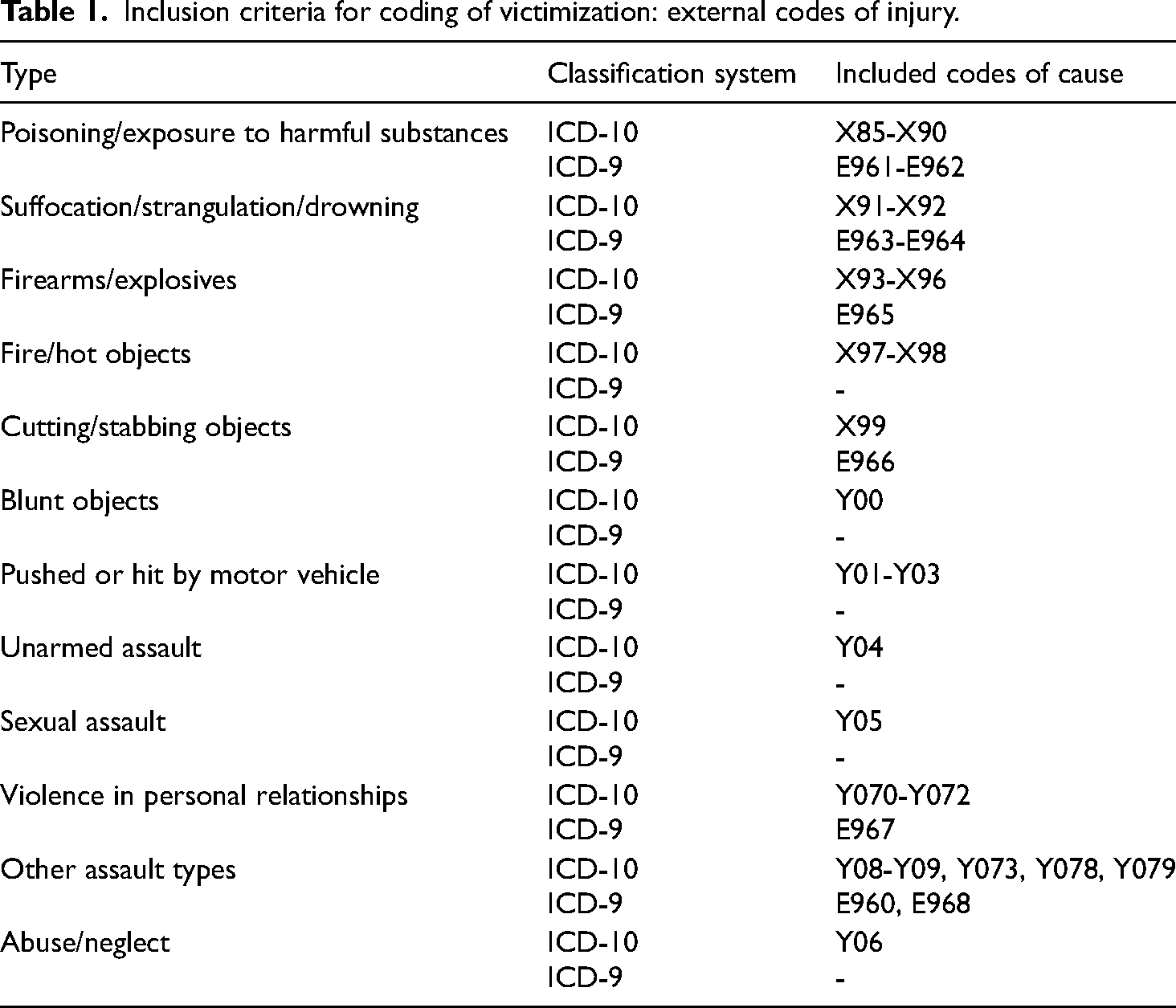
The independent variable, severe violent victimization, refers to interpersonal violence that has led to hospital admission upon which the physician coded the external cause of the injury as assault (0/1). The definition of violent victimization is based on the International Statistical Classification of Diseases and Related Health Problems, Ninth Revision (ICD-9) for events before 1997 and Tenth Revision (ICD-10) as from 1997 (World Health Organization [WHO], 2021), and is thus operationalized as violence leading to an injury that necessitated hospital care. Types of external code of cause that were coded as exposure to violent victimization are reported in Table 1.
Inclusion criteria for coding of victimization: external codes of injury.
The victim–offender overlap is operationalized as having been both victimized and having at least one criminal conviction in the official records during the observed time period. The criminal offence variable was bisected into the categories non-violent crime and violent crime (e.g. assault, homicide, robbery and sexual crime) (see Sivertsson et al., 2021).
Control variables
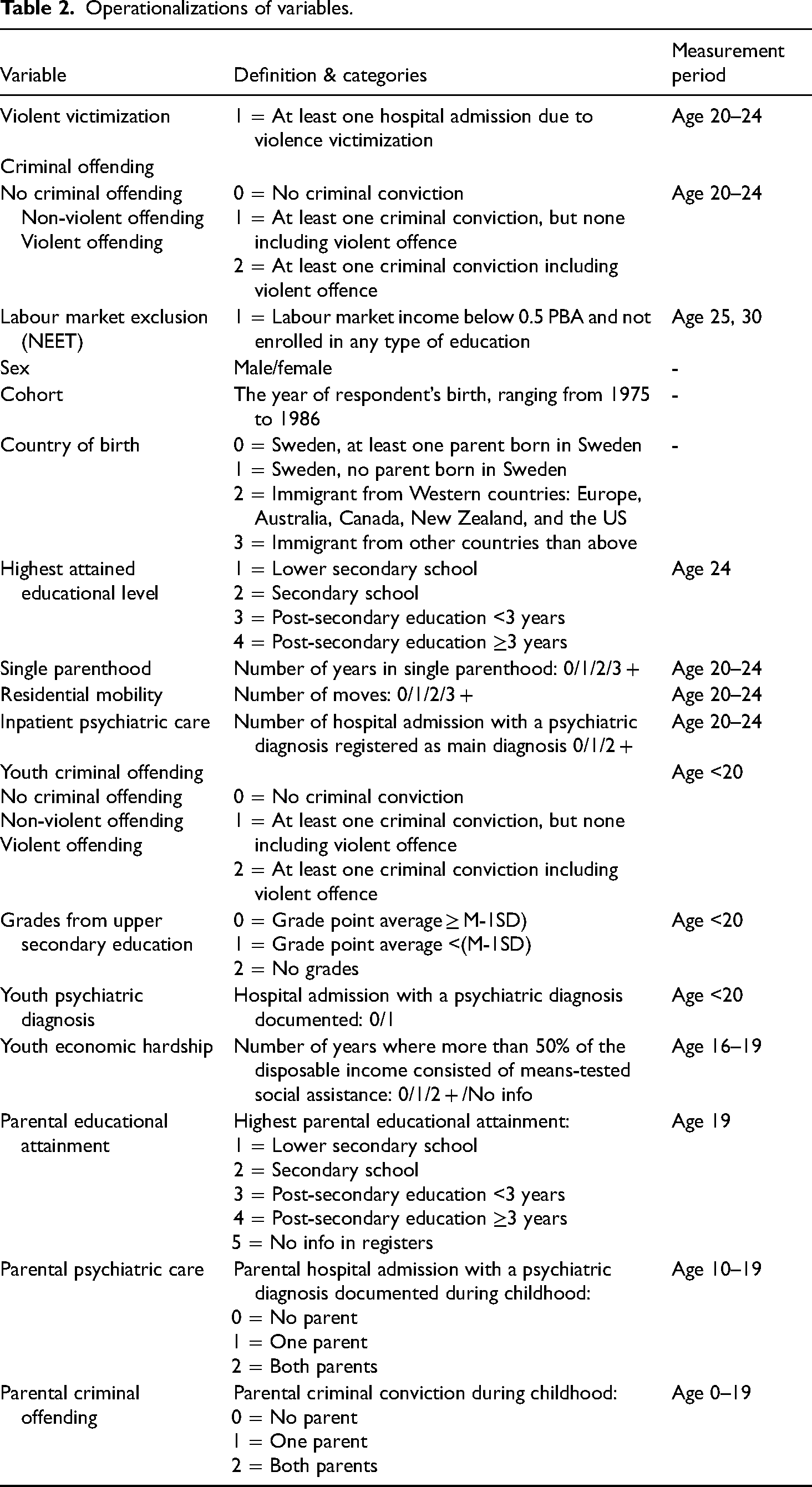
A wide array of observed background variables, guided by previous research, was included to control for confounding. Variables were selected to cover: (a) relevant demographic factors such as gender and country of birth; (b) childhood risk factors such as youth criminal offending and mental health problems (Lauritsen and Rezey, 2018); (c) parental characteristics known to be associated with risk, for example, economic hardship, parental criminal offending and parental educational attainment (Corak, 2013; Harrell et al., 2014; Lauritsen and Rezey, 2018) and (d) early adulthood conditions directly linked to victimization risks and labour market establishment, for example, educational attainment, criminal offending and mental health problems (Lauritsen and Laub, 2007; Silver, 2002). All included variables and their operationalization are presented in Table 2.
Operationalizations of variables.
Analytical strategy
Data were analysed in several steps with gradual elaboration. First, descriptive analyses were employed by means of two-way tables, comparing background factors between victims of violence and non-victims. A number of linear probability models (LPM) were then estimated to assess (a) the crude association between violent victimization in young adulthood and labour market exclusion at age 25, (b) the association adjusted for criminal offending, (c) the association adjusted for heterogeneity in the other observed variables and (d) if the association differs between groups of non-offenders, offenders and violent offenders. In a final step, the recovery effect was assessed by estimating the association between violent victimization in young adulthood and labour market exclusion at age 30, omitting individuals who were first victimized during the follow-up period (age 25–30). Throughout the analyses, males and females were analysed separately because type of violence differs greatly by gender. While separating data by different characteristics of the violence was not possible, separating the analyses by sex is believed to capture contextual differences in the victimization event (Lifvin et al., 2020).
With a binary dependent variable, and because of the inherent problem of rescaling bias in non-linear models (Karlson et al., 2012), LPM models were employed, allowing comparison of parameters across different models (Breen et al., 2018), as well as comparisons of coefficients across groups, at least in terms of the direction of the LPM coefficient (Holm et al., 2015), which was of prime interest for the present study. While LPM have these advantages and ease interpretation, there are some drawbacks, such as heteroscedastic error term, predicted probabilities that may be out of range, and miss-specified functional form (Mood, 2010). To adjust for heteroscedasticity, robust standard errors were used consistently. However, because data represent the full population of the observed cohorts, and thus do not involve sampling errors, the interpretation of significance levels is not clear-cut. Instead, significance levels can be interpreted as indicators of the uncertainty of the estimated parameters, with respect to the underlying data generating mechanism (cf. Korpi, 2009). Since the independent variables of interest are nominal or ordinal, miss-specification of functional form is likely not an issue. There were a number of probabilities out of range, whereupon the regressions were re-run excluding these observations, which returned essentially identical estimates.
The LPM coefficient denotes the absolute difference in the probability that labour market exclusion = 1, between non-victims and victims of violence, while controlling for key individual-level risk factors. List-wise deletion was applied to missing values for the variables measured in young adulthood. In total, 81,339 cases were omitted due to missing values, corresponding to around 6%. 1 For the childhood variables, missing values were consistently included as a category since omitting them would entail excluding a large portion of immigrants and substantially skewing the sample. A few cases (<0.05%) with missing basic information such as sex or country of birth were, however, omitted. All analyses were performed using Stata 17/SE version.
Results
Descriptive results
Table 3 provides descriptive information of the variables used in the analyses, by sex and victimhood. The victim–offender overlap is highly gendered, being considerably larger among young men than among young women, but still tangible among women. Around 43% of the victimized men also had been convicted of a criminal offence in young adulthood, whereas for women the overlap is a little less than 23%. The risk of labour market exclusion differs slightly, but not much, between non-victimized men and women, whereas the risk is substantially higher for women with experience of violent victimization.
Descriptive statistics of study population by gender and violent-victimization status (column %). (N = 1,258,152; n, men = 641,593; n, women = 616,559).
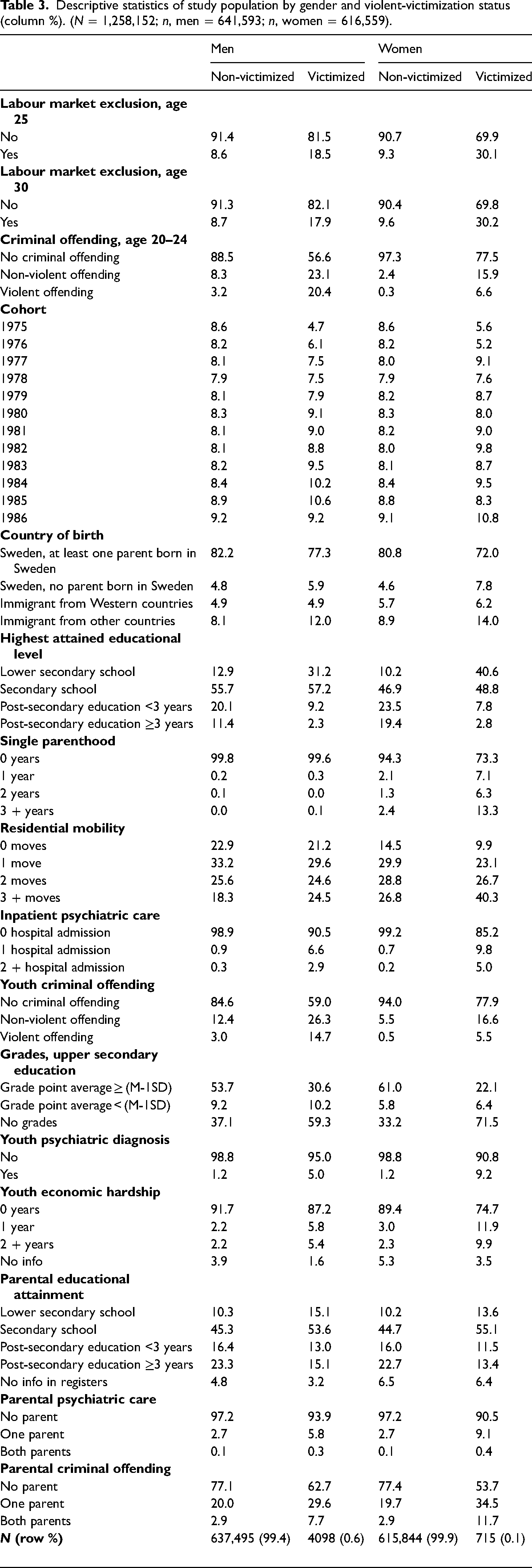
The group of women exposed to violent victimization are particularly disadvantaged, compared to both victimized men and non-victimized women. They come from families who have spent more time in economic hardship and they have, to a larger extent, at least one parent who has been convicted of a criminal offence. Victimized women have more often not reached beyond lower secondary school in their educational level and they spend substantially more time as single parents, compared to both victimized men and non-victimized women.
Among victimized women, 15% received inpatient psychiatric care at least once in young adulthood, compared to 9% of the victimized men and less than 1% of the non-victimized women. Young female victims of violent crime also experience residential instability to a great extent, 40% of the women moving three times or more between the age of 20 and 24. The corresponding figure among victimized men and non-victimized women is around a quarter. Men, on the other hand, display a higher degree of youth criminal offending.
Heterogeneity in labour market outcomes
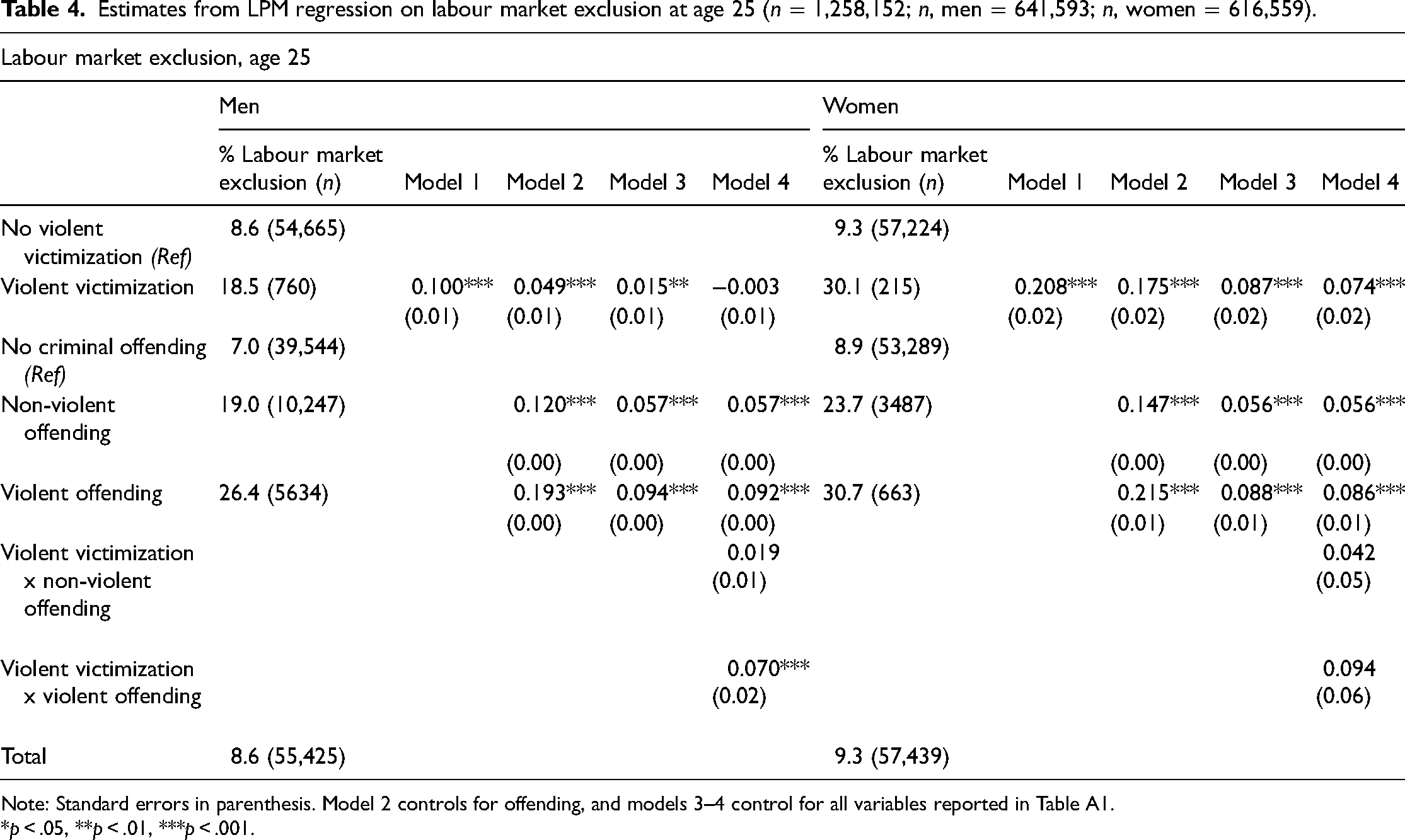
Table 4 reports on the results from the LPM regressions on labour market exclusion at age 25, for men on the left-hand side of the table and for women on the right-hand side. The table depicts crude associations in model 1, followed by associations adjusted for criminal offending (model 2), the fully adjusted main associations between victimization and labour market exclusion (model 3) and the interaction with offending (model 4). The interaction terms are also depicted in Figure 1. The crude associations display elevated risks for both men and women. The risk difference between victims and non-victims is around 10 percentage points for men and around 21 percentage points for women. For men, the risk difference is, however, substantially reduced when controlling for criminal offending and essentially obliterated in the full model (see Table A1 in supplementary appendix for all control variables). For women on the other hand, the association is not weakened to the same extent when controlling for criminal offending and there remain a difference of about nine percentage points in the risk of labour market exclusion, when all controls are included. Thus, hypothesis 1a, maintaining that there is a positive association between victimization and labour market exclusion, gains support, but in particular hypothesis 1b, that the association is stronger for women, is vindicated.
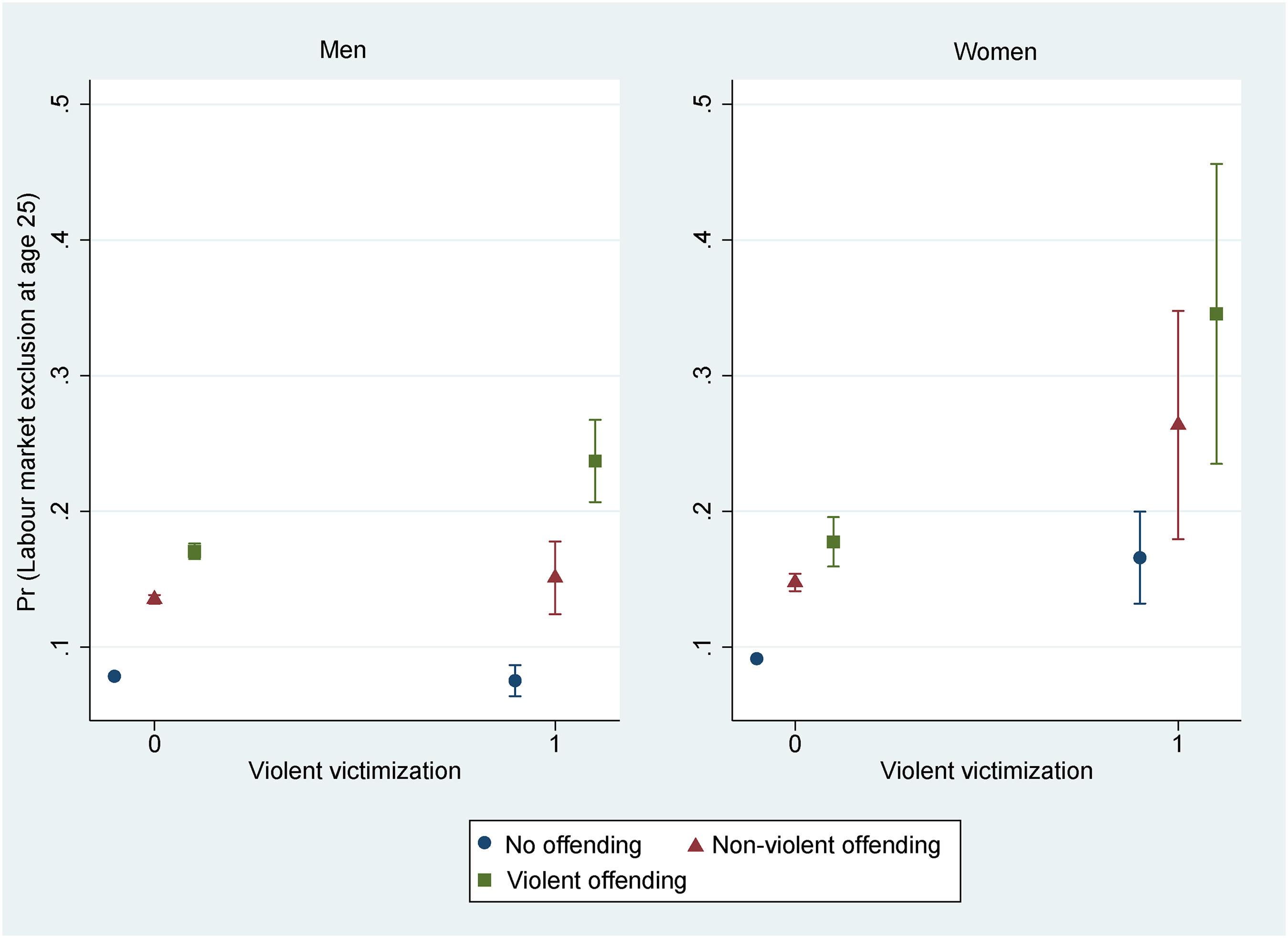
Marginal effects of the victim–offender overlap on the probability of labour market exclusion at age 25, by gender. Note: The model controls for all variables reported in Table A1.
Estimates from LPM regression on labour market exclusion at age 25 (n = 1,258,152; n, men = 641,593; n, women = 616,559).
Note: Standard errors in parenthesis. Model 2 controls for offending, and models 3–4 control for all variables reported in Table A1.
*p < .05, **p < .01, ***p < .001.
The inclusion of an interaction term between victimization and offending suggests that men with violent offences and experiences of victimization display elevated risks of labour market exclusion, while there is a nil-association for non-offenders and offenders of other types of offence, which is depicted in Figure 1. This vindicates the hypothesis that violent offending compounds the association between violent victimization and labour market exclusion. This, however, does not seem to apply to other types of criminal offending (hypothesis 2a). For women, the pattern is similar, the association being somewhat amplified by violent offending. The group of female violent offenders is, however, very small, implying uncertainty about the precision of the estimates. Notably, however, victimized women display elevated risks of labour market exclusion, also in the absence of criminal offending.
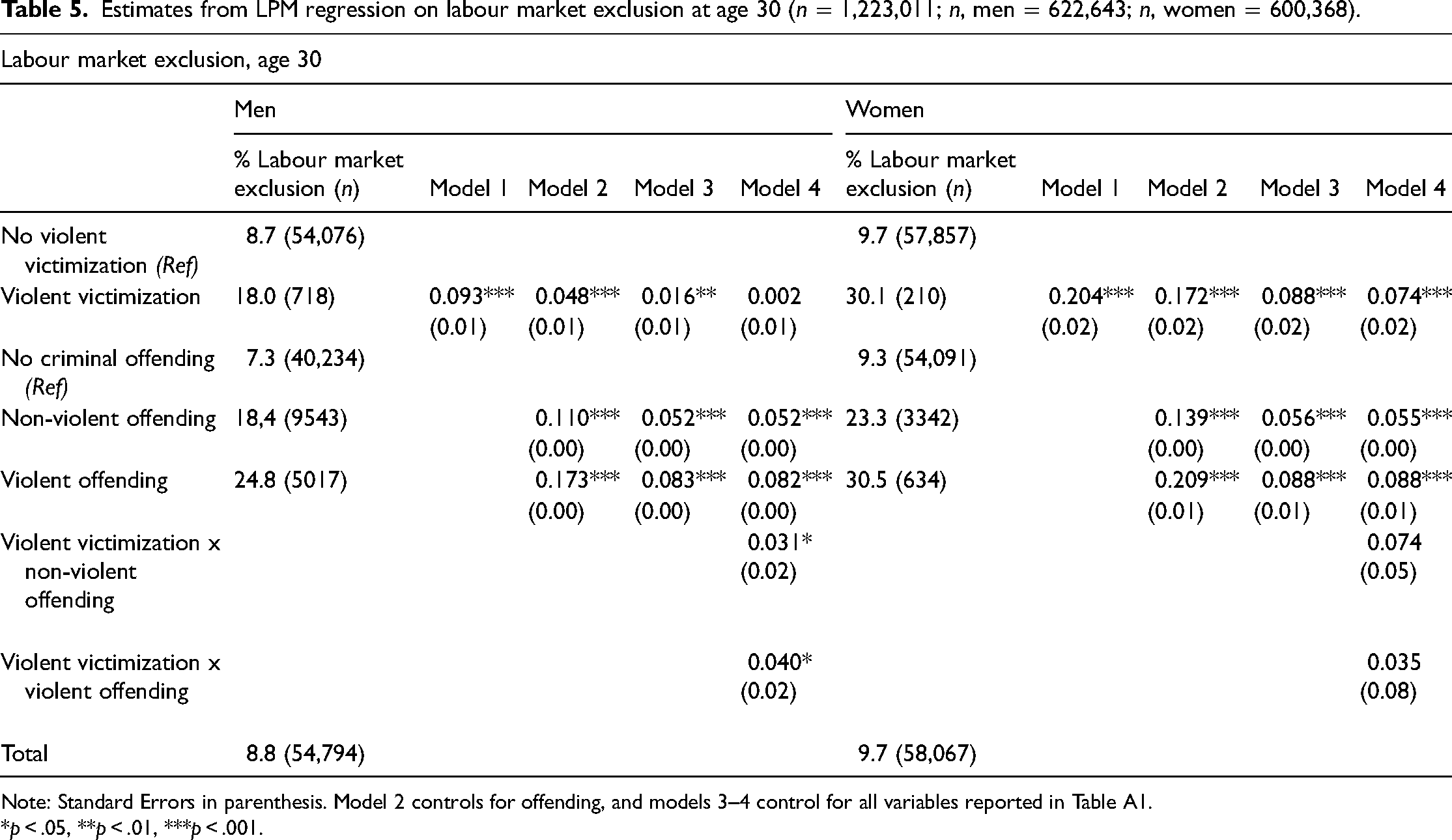
Table 5 follows the same structure as Table 4, but reports coefficients from the LPM regressions on labour market exclusion at age 30.
Estimates from LPM regression on labour market exclusion at age 30 (n = 1,223,011; n, men = 622,643; n, women = 600,368).
Note: Standard Errors in parenthesis. Model 2 controls for offending, and models 3–4 control for all variables reported in Table A1.
*p < .05, **p < .01, ***p < .001.
In Figure 2, the long-term interaction effects are depicted, for men and women respectively. For women, the coefficients are essentially identical to the short-term outcome. For men, there is still a nil-association for non-offenders whereas the interaction term is statistically significant for both violent and non-violent offending. This suggests that the hampered labour market establishment for these groups of victims of violent crime cannot be reduced to transient setbacks.
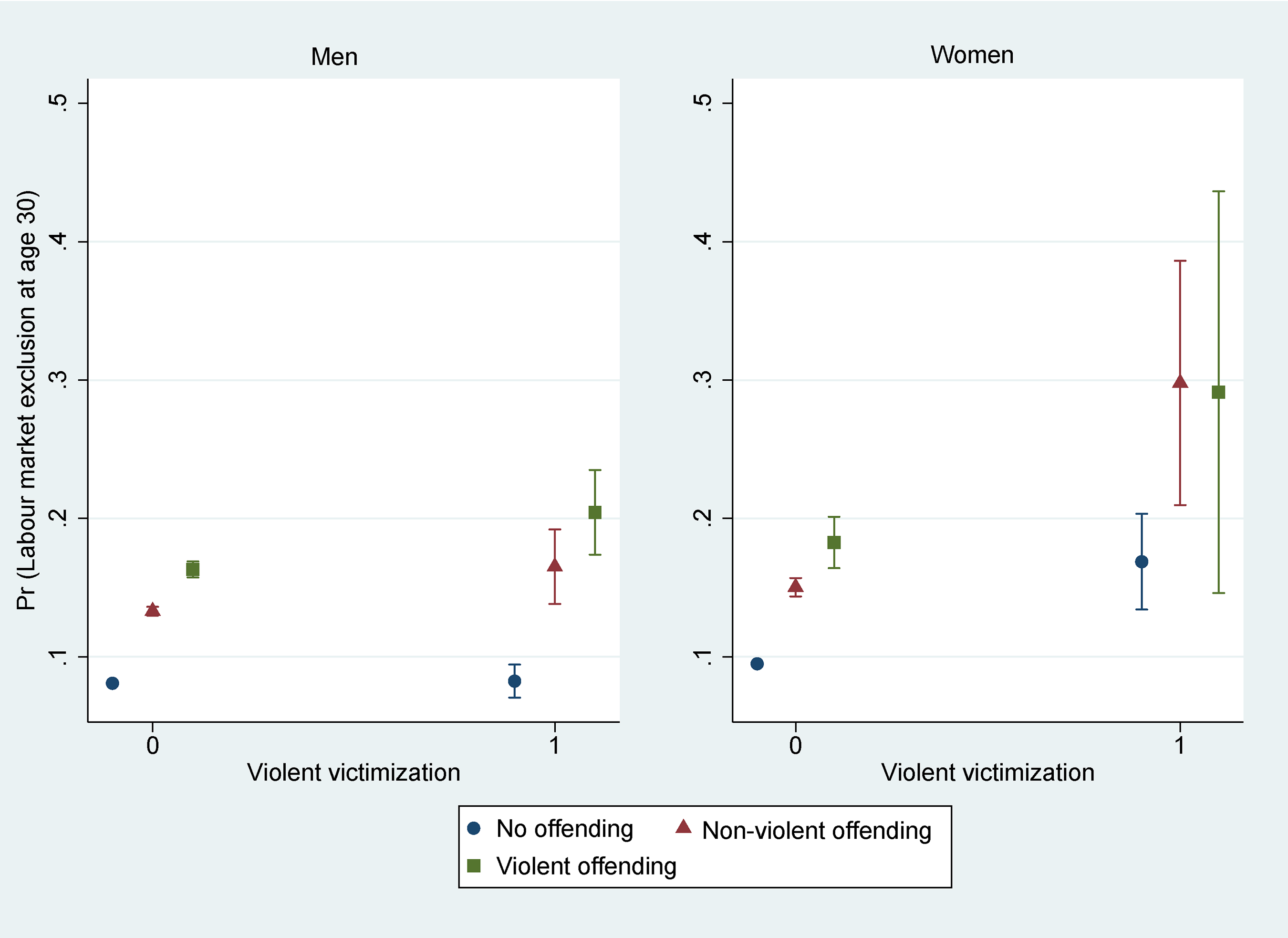
Marginal effects of the victim–offender overlap on the probability of labour market exclusion at age 30, by gender. Note: The model controls for all variables reported in Table A1.
Discussion
This study examined the relationship between violent victimization in early adulthood and labour market exclusion, whether the association was compounded or attenuated by criminal offending and if these dynamics were gendered. Opposing hypotheses were proposed, relating to the theoretical perspectives of cumulative disadvantage and disadvantage saturation. Overall, the findings show gender-differences, the victim–offender overlap being substantially larger among men, but manifest also among women. For men, when controlling for other important background factors, there was no association between violent victimization and labour market exclusion, in the absence of violent offending. Experiences of violent offending were, however, found to compound the association, both in the short and long term. This implies that, for men, the links between violent victimization and labour market exclusion can be described as patterns of cumulative disadvantage (Sampson and Laub, 1997) where criminal offending play a central part in a negative spiral of exclusion. Such patterns of violent experiences and disadvantage accumulation have also found support in other studies (Mahuteau and Zhu, 2016; Nurius et al., 2015).
Women exposed to violent victimization displayed elevated risks of labour market exclusion that remained after adjustment for heterogeneity, and were not weakened by the age of 30, also in absence of criminal offending. This suggests that offending does not drive the long-term elevated risks of negative labour market trajectories in the group of victimized women. Notably, none of the analyses support the hypothesis that offenders, and in particularly violent offenders, would be desensitized to violence and thereby less affected by violent victimization. Thus, the disadvantage saturation hypothesis receives no empirical support in the present study, contrasting some previous findings (Turanovic, 2019; Wright and Fagan, 2013). These studies were, however, conducted in the US context and observed other outcomes.
The different findings for men and women may partly reflect differences in the experience of violent victimization, as previously discussed. While the present study has not been able to separate between such differences in the victimization event, separating the analyses by sex is believed to, at least partly, be a proxy for this. There is also evidence from other studies suggesting that female offenders are a particularly vulnerable group (Estrada and Nilsson, 2012). It should, however, be noted that since the group of women with violent offences is very small there is not enough power to draw strong conclusions on victim-offender mechanisms from these data. Noteworthy is also that, while the study finds no evidence that violent victimization impacts on labour market exclusion among male non-offenders, victimization may still affect other important domains of life for this group.
Register data are an eminent and rare source of information but they also come with challenges. Exploiting patient register data entail selection on both type of victimization (by definition, violent threats and other types of victimization do not appear in the data) and severity of the assault (the assault will have to have led to an injury severe enough for hospital admission). This may have some drawbacks. For example, it may generate larger effect estimates than a sample that also considers less severe physical injuries, and fail to recognize serious consequences of violence not resulting in as severe physical harm. Relating to this, there was not enough power to adequately assess the influence of repeat victimization. Moreover, aspects of violence that are non-physical, such as control, more often experienced by women, are not captured in the data, leading to a likely underrepresentation of female victims in the sample. Another possible source of selection bias is a potential reluctance among, for example, offenders to seek medical help, to avoid authority involvement. It is also of note that while the study controls for a wide range of background factors, showing severe adversity among victimized women in particular, it cannot be ruled out that there still exists unobserved heterogeneity between victimized men and women, which may partly drive the observed effect differences.
Despite these challenges, register data suffer less from systematic non-response in groups with high risk of victimization than self-report surveys, which much of previous research has relied on, and thus include vulnerable populations otherwise largely absent in victimization data. In fact, it has been found that measures that are too inclusive may conceal relevant social differentials (Aaltonen et al., 2012). The selection on severity ensures that fairly equal events are compared. The rich data also allowed for extensive controls, reducing the risk for omitted variable bias. Still, it is possible that the observed variables do not adequately adjust for the complexity of young victims’ lives. One factor that data did not allow to adjust for is early adolescent exposure to violence, which may propel youths into adverse trajectories at an early stage. However, if such early experiences drive the observed association, this does not invalidate the conclusions, but rather strengthens the case for cumulative disadvantage. However, establishing a causal link was not the prime objective of this study, because the prevention of violent victimization is something that would generally be recommended, regardless. The main contribution was instead to disentangle the victim–offender overlap in terms of heterogeneity in labour market outcomes and chisel out in which groups of victims the disposition for labour market exclusion is most prominent.
The observed gender differences and the moderating role of offending have implications for research since it seems that the association between violent victimization and labour market exclusion is not best described as following a general pattern. Thus, studies failing to recognize the victim–offender overlap may draw erroneous conclusions about the impact of violent victimization, particularly regarding men. The observed interaction effects may be due to greater disruptions in processes of education or skill development among violent offenders and among women. However, the observed group-differences may also reflect disparity in the type of violence that the groups face. Future research should further scrutinize if heterogeneity in labour market outcomes is mainly driven by different reactions to the violence and the ability to cope, or by variation in the characteristics of the victimization events. In particular, the long-term links between psychological dimensions of violence and labour market loss is a largely under-researched area. It was also beyond the scope of this study to fully capture the complexity of what happens between the two measurement points of ages 25 and 30. Attempts to identify mediating factors that may amplify adverse labour market trajectories or support breakage of the same, could be important avenues for future research, in order to add nuance to the long-term links between violence and labour market outcomes.
Only in recent years has social policy and social work in Sweden directed attention to violence as a dimension of social exclusion and, for example, incorporated questions regarding violence in the assessment of individuals’ need for support. This study shows that the need to respond to violence is indisputable, not only to support individuals to cope in the wake of violent victimization, but also to preclude adverse labour market trajectories. Efforts aimed at victims of violent crime need to be long-term and go beyond the immediate aftermath, to be coherent and consider the need for support in a larger sense than physical and psychological recovery. In particular, women who are exposed to violence are a vulnerable group at risk of long-term social exclusion, but attention also needs to be paid to the fact that men convicted of violent crimes, to a large extent, also have been victims of violence. Social services and probation authorities should be vigilant about victimization experiences and routinely survey young offenders about victimization as a part of case processing, since victim-offenders also is a group displaying particularly high risks of exclusion.
Supplemental Material
sj-pdf-1-euc-10.1177_14773708221128517 - Supplemental material for Severe violent victimization and labour market exclusion: The significance of the victim–offender overlap
Supplemental material, sj-pdf-1-euc-10.1177_14773708221128517 for Severe violent victimization and labour market exclusion: The significance of the victim–offender overlap by Anna Kahlmeter in European Journal of Criminology
Footnotes
Acknowledgements
The author wishes to thank colleagues at the Swedish Institute for Social Research (SOFI), and the Department of Criminology, Stockholm University, for helpful comments. A special thank you to Olof Bäckman, Susanne Alm and Lars Brännström. Anonymous reviewers are also gratefully acknowledged for valuable comments on earlier drafts.
Declaration of conflicting interests
The author declared no potential conflicts of interest with respect to the research, authorship and/or publication of this article.
Ethical approval
The project was approved by the ethics committee in the Stockholm region (no. 2016/46-31/5).
Funding
The author disclosed receipt of the following financial support for the research, authorship and/or publication of this article: This work was supported by the Vetenskapsrådet (Grant No. 2015-01201).

Supplemental material
Supplemental material for this article is available online.
Notes
References
Supplementary Material
Please find the following supplemental material available below.
For Open Access articles published under a Creative Commons License, all supplemental material carries the same license as the article it is associated with.
For non-Open Access articles published, all supplemental material carries a non-exclusive license, and permission requests for re-use of supplemental material or any part of supplemental material shall be sent directly to the copyright owner as specified in the copyright notice associated with the article.
