



Abstract
The majority of differential deterrability research has investigated whether people differ in the extent to which a perceived threat of sanctions deters them from committing a crime. Less is known about the differential influence of criminal justice intervention on sanction threat perceptions. According to deterrence theory, however, for justice intervention to successfully deter crime, a process of perceptual updating is required. In the current study, we used panel data from German adolescents to supplement the research on differential updating. We applied fixed effects regressions to analyze whether people with weaker or stronger morals update their perceptions of detection risk differently following experiences of police detection. Our findings suggest that they do: risk perceptions increased more in adolescents with weak morals than in adolescents with strong morals when they experienced a higher certainty of detection (a higher detection rate). Combined with previous findings on differential deterrence (by personal morality), our results indicate that deterrence processes may—for individuals with weak morals—play a more critical role in the prevention of crime than previous nondifferential research has suggested.
Keywords
Introduction
The main claim of perceptual deterrence theory is that individual sanction threat perceptions (i.e., perceptions of the certainty, severity and celerity of punishment) deter potential offenders from committing crime (see Paternoster, 2018). Confronted with overall rather meager support for this claim (see Kleck and Sever, 2017; Pratt et al., 2006), perceptual deterrence research has focused more and more on the concept of differential deterrability, which suggests that the likelihood of deterrence differs across situations and individuals (Loughran et al., 2018; Piquero et al., 2011). Most of this research has investigated whether individuals vary in their likelihood of being deterred from criminal behavior by their perceptions of the certainty of arrest or detection 1 (referred to as risk perceptions in the following). For this purpose, the research has analyzed potential moderators of the deterrence process, including delinquent peer associations, emotional and pharmacological arousal, prosocial bonds, and self-control abilities (for reviews, see Hirtenlehner, 2020; Loughran et al., 2018; Piquero et al., 2011).
Much differential deterrability research has also concentrated on personal morals or morality (views of what behavior is right or wrong, or good or bad) 2 as a moderator of deterrence effects. The interest in morality may have originated from Parson’s (1937/1968) early interpretation of Émile Durkheim's work that personal morals may make deterrence considerations irrelevant in some circumstances, operating as a sort of filtering mechanism. Some form of moral filtering thesis was then introduced into criminology by various scholars (e.g., Grasmick and Green, 1981; Paternoster and Simpson, 1996; Toby, 1964; Wikström et al., 2012; Wright et al., 2004). Generally, these scholars assume that strong personal morals decrease the likelihood that an individual sees crime as an alternative in the first place. If people, however, do not see crime as a viable alternative, they have no need to weigh the pros and cons of committing such behavior, making deterrence considerations irrelevant. Individuals with weaker morals, in contrast, should see crime much more often as a potent action alternative and within their deliberations on such behavior deterrence processes should thus play a more prominent role. In line with this reasoning, a number of empirical studies have found that sanction threat perceptions deter crime only or especially among individuals with weak morals. Those with stronger morals, in contrast, generally commit fewer crimes and are typically affected less or not at all by their perceptions of sanction threat (e.g., Bachman et al., 1992; Hirtenlehner and Reinecke, 2018; Kroneberg et al., 2010; Paternoster and Simpson, 1996; Svensson, 2015).
However, even if sanction threat perceptions affect individuals with weaker morals, this does not provide sufficient evidence to conclude that these individuals can be deterred from further crimes through criminal justice interventions. This is because perceptual deterrence theory encompasses two processes or linkages (Paternoster, 2018; Pogarsky et al., 2004; see Figure 1), both of which are required to deter criminal behavior. Justice intervention can prevent crime only if it, first, alters the perceptions of sanction threat (perceptual linkage), which, second, deter people from committing crimes (behavioral linkage).
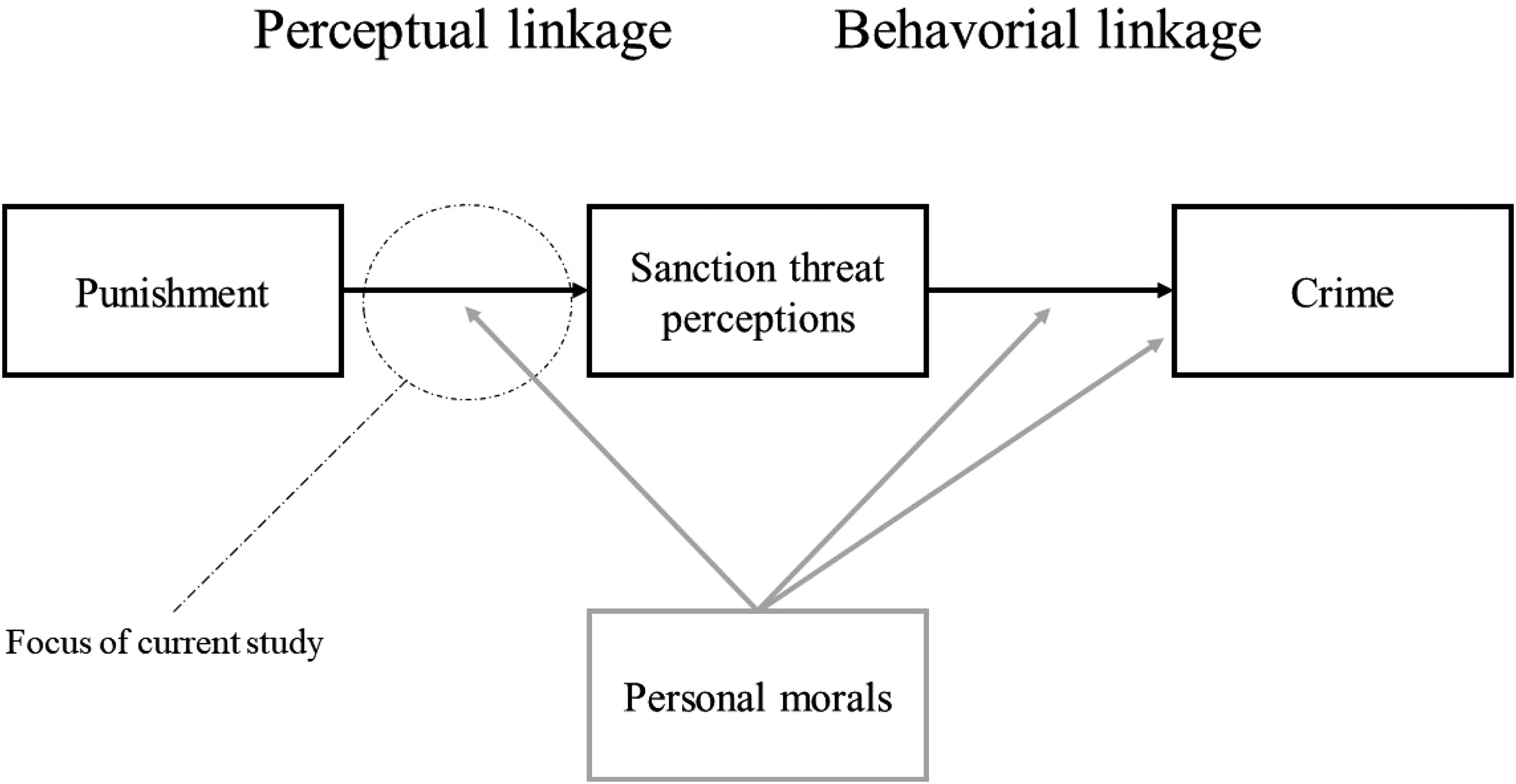
Differential deterrability by personal morals in perceptual deterrence theory.
The perceptual linkage is, relative to the behavioral linkage, less studied in the differential deterrability literature (Loughran et al., 2018). The studies that investigated whether individuals vary in how they update their risk perceptions after being arrested or detected by the police concentrated mainly on individuals’ self-control abilities and criminal history as potential moderators of the updating process (e.g., Pogarsky et al., 2004, 2005; Schulz, 2014; Thomas et al., 2013). Personal morality as a moderating force, in contrast, has rarely been the subject of perceptual updating research. To date, only Pogarsky et al. (2005) have studied whether updating differs between individuals who vary in their morals, producing mixed evidence of such differential learning. It thus remains questionable whether those with weak personal morals are especially deterrable from crime through justice intervention, even if the available evidence on the behavioral linkage is promising in this regard.
To help answering this question, the current study explores whether individuals with different morals update their risk perceptions differently after being detected by the police. For this purpose, the article first provides a brief theoretical background on how people update their risk perceptions in general according to the Bayesian updating model. It then derives two hypotheses on how people may update their risk perceptions differently depending on their morals. The article finally evaluates the validity of the hypotheses empirically using panel data from German adolescents.
Risk perception updating in the Bayesian updating model
In line with a number of criminological studies we will discuss the perceptual updating process against the background of the Bayesian updating model (e.g., Anwar and Loughran, 2011; Lochner, 2007; Matsueda et al., 2006). In its simplest form, this model assumes that individuals form their risk perceptions based on two kinds of information (see Anwar and Loughran, 2011). First, they bring with themselves a baseline (or initial) risk perception that is informed in some part by prior life experiences. Second, they accumulate new information on the risk of detection that they then process to update this prior risk perception. According to the Bayesian updating model, crucial information for the updating is the ratio of the number of personal detections to crimes. This ratio provides a signal of how likely an individual was detected within a specific period. 3 This signal is also called the experienced certainty of arrest or detection by some authors (e.g., Matsueda et al., 2006; Schulz, 2014) and is argued to be the most straightforward predictor of how individuals update their prior risk perception and form a new one (Horney and Marshall, 1992; for some critique, see Kleck and Sever, 2017). The Bayesian updating model generally assumes that the higher the detection-crime ratio of an individual, the higher their subsequent risk perception will be. In line with this Bayesian updating specification, the following sections will discuss how the experienced detection certainty (the detection signal) may have a differential impact on risk perceptions depending on a person's morals.
Personal morals and differential updating of risk perceptions
From the criminological literature, we derive two opposing predictions on how personal morals may moderate the updating process: first, that those with weak morals update more strongly after detection experiences and, second, that those with strong morals update more strongly after detection experiences. 4 These opposing predictions can each be derived from various perspectives, which offer different explanations for the respective differential learning. The current study tests the two predictions as our main hypotheses, yet it cannot empirically entangle which explanation is valid.
Individuals with weaker morals update more strongly
The first prediction is that individuals with weak moral opposition to delinquency (i.e., weak personal morals) will update their risk perception more strongly after detection experiences. This prediction can be derived primarily from three perspectives. 5 According to the first perspective (the nonmarket perspective), personal morality is indeed a driving factor behind differential updating. This perspective assumes that individuals with strong moral opposition toward particular criminal behaviors are not ‘in the market’ (Etzioni, 1988) for such behavior and simply do not commit it because they see it as morally wrong (see Grasmick and Green, 1981; Paternoster and Simpson, 1996; Toby, 1964; Wikström et al., 2012; Wright et al., 2004). 6 For these conformity-committed individuals, instrumental calculations should play no (or a lesser) role in their decisions to act (or not to act) and cost–benefit-related information about the nonmarket behavior should be largely irrelevant. They consequently have no incentive to invest energy to update their perceptions of these benefits and costs (Apel, 2013). As a result, they should be unlikely to process (benefit-and-cost-related) information from criminal and detection experiences to update their risk perceptions (Pogarsky et al., 2005). 7 Individuals with weak morals, in contrast, should have a stronger incentive to learn from detection experiences as they contemplate about committing crime (and its consequences) more often.
From a second perspective (the spuriousness perspective), other indicators of criminal propensity may explain why individuals with weaker morals may update their perceptions more strongly. According to this perspective, some elements of Gottfredson and Hirschi’s (1990) concept of self-control (i.e., the tendency to consider long-term rather than short-term behavioral consequences) 8 are linked to the differential updating process and may render morality a spurious moderator. The thesis is that a stronger perceptual updating by individuals with weak morals may be a symptom of them having weak self-control abilities and thus giving more weight to the immediate consequences of crime. This argument can be derived from the literature as follows: first, self-control abilities and personal morals are highly correlated and those with weaker morals tend to have lower self-control abilities (e.g., Antonaccio and Tittle, 2008; Svensson, 2015; Wikström et al., 2012). Second, people with low self-control abilities tend to give special weight to immediate behavioral consequences. Since detection experiences can be seen as immediate responses to crime, they may make a larger impression on those present-oriented individuals than on individuals who have higher self-control and weigh long-term consequences more heavily (see Schulz, 2014). Detection thus may lead those with lower self-control abilities (who tend to have weaker personal morals) to update their risk perceptions more likely than their counterparts with higher self-control abilities (stronger personal morals). However, the empirical evidence for this thesis is sparse. Schulz (2014) studied impulsiveness and risk-affinity as indicators of low self-control capability. She found no indication that more impulsive and risk-affine juvenile offenders updated their risk perceptions more strongly after detection experiences. Thomas et al. (2013), similarly, found no evidence that future orientation (indexing high self-control ability) moderated the perceptual updating process. 9
The third perspective (the Bayesian updating perspective) assumes that a stronger updating by individuals with weaker morals can be explained with (an extension of) the Bayesian updating model. According to this perspective, a stronger perceptual updating of individuals with weak morals could be a consequence of them committing more (recent) crimes and thus processing more reliable information in their updating process. This argument can be derived from the literature as follows: First, individuals with weak morals commit more crimes than their counterparts with stronger morals (e.g., Antonaccio and Tittle, 2008; Brauer and Tittle, 2016; Gallupe and Baron, 2014; Wikström and Butterworth, 2006). Second, the Bayesian updating model assumes that the number of recent crimes a person has committed (which should be larger for those with weak morals) increases the impact of the detection ratio on risk perceptions (Anwar and Loughran, 2011). The number of crimes should be decisive for the updating because the detection signal should provide more reliable information the more crimes it is based on. 10 The thesis that those who commit more recent crimes update more strongly as they are exposed to a more informative signal was—to our knowledge—so far studied empirically only by Anwar and Loughran (2011). They found support for the Bayesian updating model: when the juvenile offenders in their sample committed more recent crimes, they updated their perceptions more strongly when confronted with a higher detection signal.
Despite their different explanations, all three aforementioned perspectives (the nonmarket perspective, spuriousness perspective, and Bayesian updating perspective) give rise to the first hypothesis:
Individuals with stronger morals update more strongly
The second prediction is that individuals with strong moral opposition to delinquency (i.e., strong personal morals) will update their risk perception more strongly after detection experiences. This prediction can also be derived from the spuriousness and the Bayesian updating perspectives, which again assume that the level of self-control abilities or criminal activity can explain (at least part of) the differential updating process. This time, however, the theoretical arguments indicate that self-control abilities and (here: past) criminal activity have the opposite moderating effect on perceptual updating as suggested above.
According to the spuriousness perspective, a stronger perceptual updating by individuals with strong morals may be a symptom of them having strong self-control abilities and thus having a stronger tendency to process information on the consequences of behavior. This argument can be derived from the literature as follows: First, as mentioned before, self-control abilities and personal morals are highly correlated and those with strong morals tend to have higher self-control abilities (e.g., Antonaccio and Tittle, 2008; Svensson, 2015; Wikström et al., 2012). Second, Schulz (2014) indicates that people with higher self-control abilities might be more likely to generally reflect on behavioral consequences, might do so more thoroughly, and might be more responsive to these consequences. As a result of these increased reflections, they may learn more from the consequences of crime than individuals with lower self-control abilities who tend to reflect less on their experiences and are also deemed ‘less responsive to anxiety- or punishment-related stimuli' (Schulz, 2014, pp. 220–221; see also Thomas et al., 2013). Detection experiences thus may lead individuals with higher self-control abilities (who tend to have stronger personal morals) to be more likely to update their risk perceptions than individuals who are characterized by lower self-control capability. The empirical literature on this latter thesis is, again, small and produced rather mixed evidence. The findings of Schulz (2014) indicate that risk-averse individuals (indicator of high self-control abilities) may indeed update their risk perceptions more strongly after detection, while impulsiveness had no moderating effect. Thomas et al. (2013), as mentioned above, found no moderation effect of future orientation (indexing high self-control abilities).
According to the Bayesian updating perspective, on the other hand, a stronger perceptual updating by individuals with stronger morals may be a consequence of them having committed less (past) crimes and thus being characterized by a less stable baseline risk perception that is more malleable by new criminal and detection information. This argument can be derived from the literature as follows. First, individuals with strong morals commit less (past) crimes than their counterparts with weaker morals (e.g., Antonaccio and Tittle, 2008; Brauer and Tittle, 2016; Gallupe and Baron, 2014; Wikström and Butterworth, 2006). Second, the Bayesian updating model suggests that the lower the number of past crimes a person has committed the more influential new detection and criminal experiences should be for the perceptual updating (Anwar and Loughran, 2011). That is because the prior (or baseline) risk perception is much less informed by past experiences and thus more malleable by new ones. Assuming that people with stronger morals have committed less crimes in the more distant past than individuals with weaker morals, they may thus be more susceptible to new (more recent) criminal and detection information. The only study that empirically investigated this moderation of the effect of the detection signal on risk perceptions by past criminal activity was conducted by Anwar and Loughran (2011). 11 Their results do not offer direct evidence that individuals with more past criminal experiences updated their risk perceptions differently from individuals with less experience in criminal activity. 12
Both the spuriousness perspective and the Bayesian updating perspective give rise to our second hypothesis:
The empirical evidence
Empirical research on the two hypotheses is scarce. As reported above, so far only Pogarsky et al. (2005) have conducted an empirical investigation of whether personal morality moderates the updating process. For this purpose, they analyzed differential changes in perceptions of the risk of arrest for theft or assault in a nationally representative sample of juveniles in the United States. In line with hypothesis H1, their results indicate that an increase in the number of arrests was more strongly associated with an increase in risk perceptions among those with weak moral opposition to delinquency than among those with strong morals. However, their moderation estimates were relatively uncertain and, as a result, statistically insignificant. This estimation uncertainty can be attributed to their relatively small database (approx. 1725 observations). The current study strives to overcome this statistical power issue by using a larger data pool (see methods section). Since these data were collected from German adolescents, our study also examines whether the results of Pogarsky and colleagues translate to another national context.
Methods
Data
The data for our analysis stems from the panel study Crime in the modern City (CrimoC; Boers et al., 2010). In its initial wave in 2002, CrimoC tried to sample all seventh graders in Duisburg, an industrial city in the west of Germany. With 3411 on average 13-year-old juveniles, 61% of the student population participated in the first-panel wave. These participants were asked to complete self-administered questionnaires on a regular basis—first annually, later biennially—up to the year 2020, encompassing a range of topics including delinquent behavior, routine activities, and normative attitudes.
For our analysis, we used only data from panel waves 2 to 5 (i.e., during the respondents’ adolescent years) and included only observations from participants that met two conditions. First, the juveniles had to have participated in at least two of the four-panel waves. Second, all data had to be complete for each observation to be included in the analysis. Furthermore, the analysis sample includes only observations in which individuals had reported at least one criminal offense. This offender-only stratification has been used more often recently to study the perceptual effects of arrests or detections (e.g., Anwar and Loughran, 2011; Schulz, 2014). Due to these selection criteria, our final analysis sample consists of 2231 observations from 1385 adolescents. If not otherwise mentioned, we included the relevant measures as time-variant concepts in our analyses (for more information on the measures and descriptive statistics, see online supplemental material, Table S1).
Measures
Perceptions of detection risk
Our dependent variable measures individual perceptions (assessments) of the risk of detection when committing crimes. 13 More specifically, the juveniles were asked how likely they thought it would be for them to get caught if they committed the following types of delinquency: assault, bicycle theft, burglary, extortion, provocation or intimidation, shoplifting, car theft, and vandalism. The response categories were (0) very unlikely, (1) unlikely, (2) neither/nor, (3) likely, and (4) very likely. To generate a score of the general perception of detection risk, we calculated a mean score across the eight offenses (range: 0–4).
Self-reported criminal offending
Juveniles were asked whether and how frequently they had been involved in various delinquent behaviors during the last year. We used frequency reports on the commission of assault, shoplifting, graffitiing, scratching, and (other forms of) vandalism to generate a criminal offending variable. 14 To calculate such a variable, we first summed up the reported frequencies of the different criminal offenses. As the sum score is highly skewed to the right, we categorized it to diminish the effects of outliers (for a similar approach, see Matsueda et al., 2006; Schulz, 2014). The resulting ordinal variable has the following categories: (0) 1–2 offenses, (1) 3–9 offenses, and (2) 10 or more offenses. 15
Detection-crime ratio
In line with previous research and the Bayesian updating model, we included detection information as our key independent variable by calculating a detection-crime ratio (e.g., Anwar and Loughran, 2011; Matsueda et al., 2006; Schulz, 2014; Thomas et al., 2013). A detection-crime ratio is argued to be more closely related to the perceived detection risk than the pure number of times a juvenile was detected for committing a crime (Horney and Marshall, 1992). In addition to the self-reported offending information on the five crimes mentioned above, we therefore also relied on reports on the number of crimes the police were aware of. We summed up the crime (Cf) and detection (Df) frequencies and finally generated a detection-crime ratio for each respondent by dividing the total number of police detections by the total number of crimes: DCR = Sum(Df)/Sum(Cf).
Personal morals
Our personal morals scale is based on the juveniles’ reports on whether they approved or disapproved of eight different delinquent behaviors (assault, bicycle theft, burglary, car theft, extortion, provocation/intimidation, shoplifting, vandalism). The participants could respond that they thought committing the offense in question was (−2) completely harmless, (−1) relatively harmless, (0) neither/nor, (1) relatively bad, or (2) very bad. We then generated a general personal morals score (range: −2 to 2) by taking the mean across the different criminal behaviors and over the multiple panel waves. We thus followed previous research by including our moderator as a time-invariant variable (e.g., Schulz, 2014; Thomas et al., 2013; van Veen and Sattler, 2018). Our main reason for including personal morals as a time-invariant variable is that we could not determine a causal time order between risk perceptions and time-variant measures of personal morals. Our analysis, thus, implicitly assumes that personal morality is, as a result of previous socialization processes, relatively stable over time and between people. Calculated correlation coefficients between morality indicators of adjacent panel waves (range: 0.49–0.56) bolster our stability assumption to some extent, as do standardized stability estimates (range: 0.48–0.65) from structural equation models reported in a previous CrimoC publication (Seddig, 2014).
Other covariates
Our selection of other covariates was based on Stafford and Warr’s (1993) reconceptualized deterrence theory, in which they suggest that risk perceptions are learned not only through personal but also through vicarious experiences. In particular, we included the following variables that provide information on the latter type of experiences: First, we considered data on juveniles’ exposure to a deviant peer group. This peer group measure is ordinal and consists of the following categories: (0) spending no or little time with a peer group, (1) spending a large amount of time in low-deviant peer group activities, (2) spending a large amount of time in medium-deviant peer group activities, and (3) spending a large amount of time in high-deviant peer group activities. Second, we assessed the individuals’ perceptions of neighborhood disorder. The perceived disorder variable is continuous, ranging from −2 to 2, with higher values indicating that a person perceived more disorder. Finally, we used reports about how often the respondents watched crime movies to assess the influence of media consumption on risk perceptions. More precisely, the respondents could indicate that they (0) never, (1) rarely, (2) sometimes, (3) often, or (4) very often watched crime movies.
Analytical procedure
To study the updating processes outlined in our hypotheses, we relied on a series of fixed effects regression models (Allison, 2009). These models allow the updating process to be modeled in an intraindividual way by focusing on how individual risk perceptions change over time on average. Since learning or updating processes operate within individuals over time, capitalizing on intraindividual variation seems more appropriate than resorting to perceptual variation between individuals. Furthermore, beyond being an intuitive choice for studying learning processes, fixed effects models have the advantage of automatically accounting for all of the respondents’ (unobserved) heterogeneity due to time-invariant factors by estimating pure within-effects (Wooldridge, 2010).
We specified our fixed effects regression models in such a way that differences from the within-person mean of general risk perceptions

The third and final models (Model 3) allow for an assessment of our hypotheses by including an interaction term between the personal morals score and the detection-crime ratio. Although we treat the information on personal morals as a time-invariant factor, which is automatically eliminated in fixed effects models, unit-level differences can nonetheless be considered in these models via interaction terms. It is thus possible to examine the extent to which individuals with weaker morals adjust their risk perception differently than individuals with stronger morals after experiences of detection (see Schulz, 2014 for a similar approach but with self-control indicators as moderators).
Results
This section presents the results of our fixed effects models (see Table 1). 18 As outlined above, Model 1 predicts the intraindividual changes in risk perceptions using only the detection-crime ratio as a predictor. The estimate of the ratio variable indicates that the higher the individual's experienced certainty (or rate) of detection, the higher their subsequent perceived risk of getting caught (β = 0.31 [0.02–0.60]). More precisely, when a person's detection certainty increased by 0.1, or 10 percentage points (e.g., they were detected in 2 out of 10 instead of 1 out of 10 crimes), their risk perceptions rose on average by just 0.03 units.
Modeling the updating process: changes in general risk perceptions.
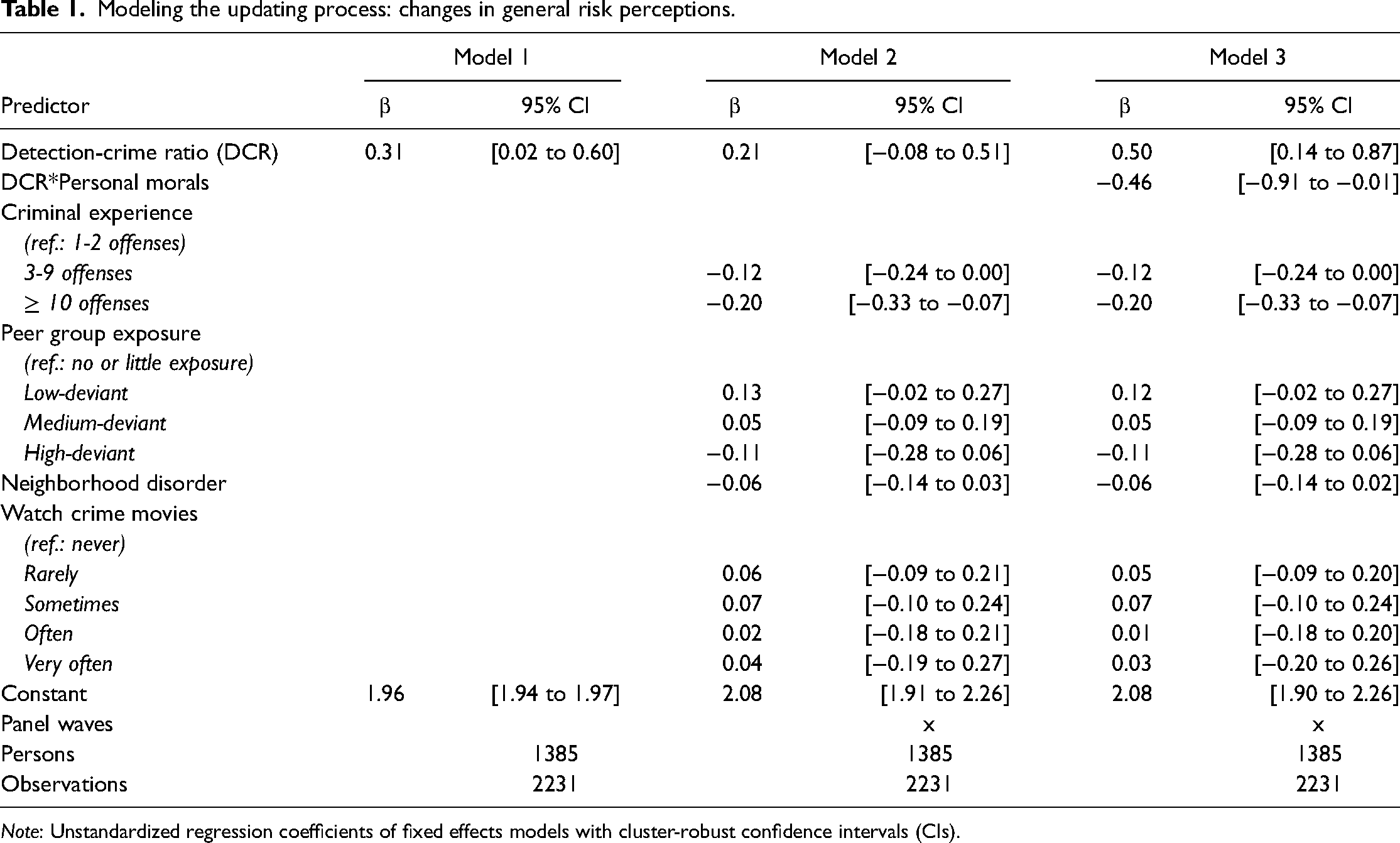
Note: Unstandardized regression coefficients of fixed effects models with cluster-robust confidence intervals (CIs).
In Model 2, which encompasses the other covariates in addition to the detection-crime ratio, the effect estimate of the detection certainty decreases and loses its statistical significance. However, the direction of the estimate remains the same (β = 0.21 [−0.08 to 0.51]). It indicates that a person's general risk perception increased on average by 0.02 units when their experienced detection rate rose by 10 percentage points.
Beyond this small, nonsignificant effect of the experienced detection certainty, our model estimated a more precise influence of criminal offending on risk perceptions. If the adolescents committed crimes repeatedly instead of only once or twice in a given period, they reported reduced risk perceptions (3–9 offenses: β = −0.12 [−0.24 to 0.00]; ≥10 offenses: β = −0.20 [−0.33 to −0.07]). Like in previous research, the commission of more crimes thus was related to somewhat lower risk perceptions (e.g., Hirtenlehner and Wikström, 2017; Kaiser et al., 2022; Matsueda et al., 2006; Schulz, 2014). For all other covariates that include vicarious information about criminal experience, the model instead estimates small and statistically insignificant effects. This lack of impact is also consistent with previous research, which suggests that vicarious information is less relevant for updating risk perceptions among individuals who havepersonal experiences of committing crimes in a given period (which all individuals in our offender-only sample have; Paternoster and Piquero, 1995; Pogarsky et al., 2004; van Veen and Sattler, 2018).
Model 3 includes personal morals as a moderator of the updating process and thus produces some estimates for assessing our hypotheses. Although the effect estimates of all other covariates remain basically the same in this model specification, the inclusion of the personal morals variable as a moderator affects the relationship between the detection-crime ratio and the risk perceptions. To present the results of this moderation more intuitively, we used the regression estimates to compute average marginal effects (AMEs) across the dimension of personal morals (see Figure 2 and Table 2). 19 The AME estimates are consistent with hypothesis H1 and the direction of the differential effects reported by Pogarsky et al. (2005). They indicate that only those with weak morals showed a substantial increase in risk perceptions after experiencing a somewhat higher detection certainty (e.g., AMEPMorals=−2.0 = 1.42 [0.25 to 2.60]). More precisely, when the detection ratio of an individual with a personal morals score of −2.0 (i.e., with very weak morals) increased by 10 percentage points, their risk perceptions rose by 0.14 units on average. The risk perceptions of individuals with stronger morals, in contrast, were not substantially (and only insignificantly) affected by an increased detection certainty (e.g., AMEPMorals=1.0 = 0.04 [−0.31 to 0.39]). However, as a note of caution: The interaction effect between personal morals and the detection-crime ratio was estimated relatively imprecisely. The actual strength of the moderation in the juvenile population thus remains relatively uncertain (β = AMEPMorals – AMEPMorals+1 = −0.46 [−0.91 to −0.01]).
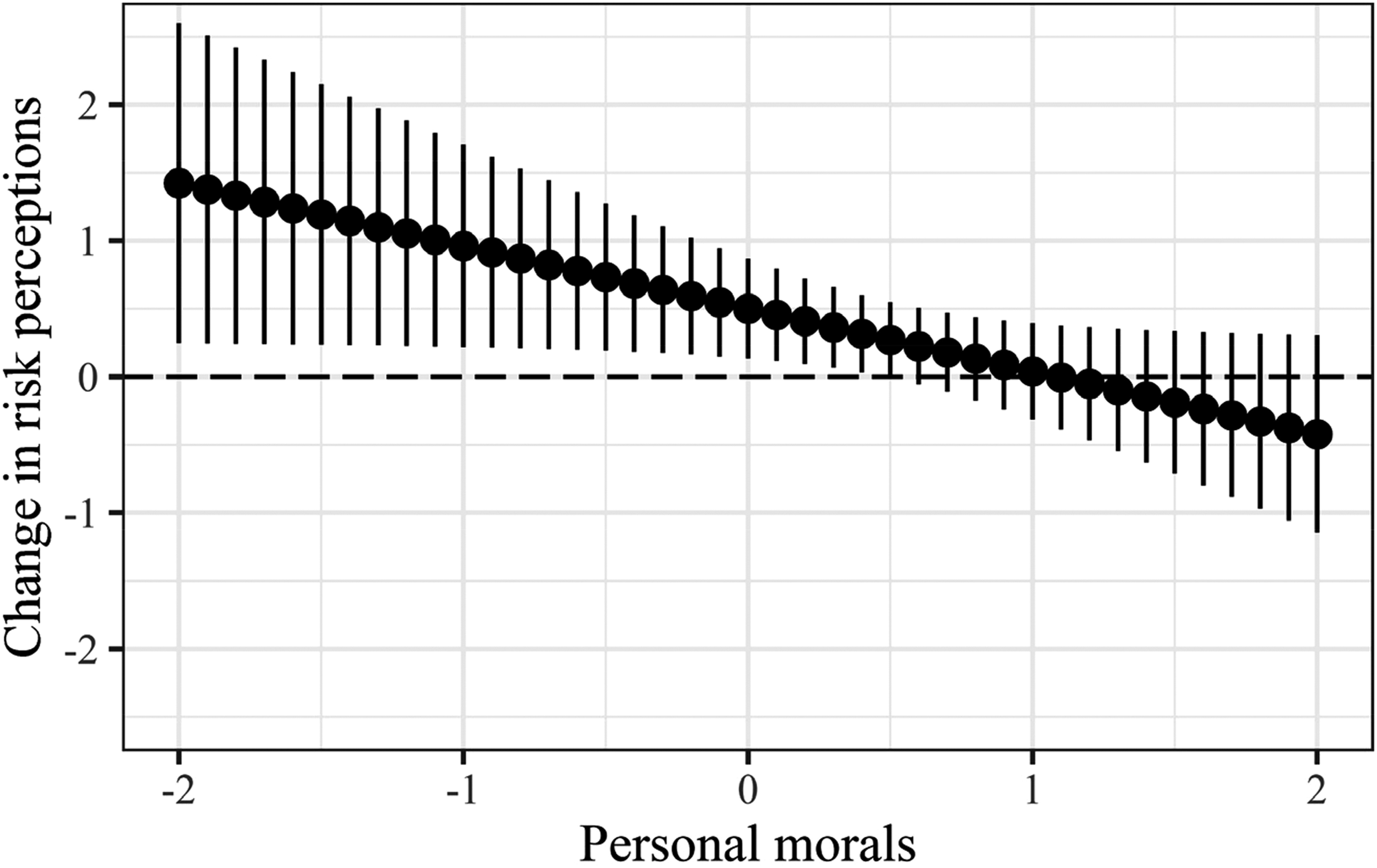
Average marginal effects of the detection-crime ratio on risk perceptions by personal morals.
Average marginal effects of the detection-crime ratio on risk perceptions by personal morals.
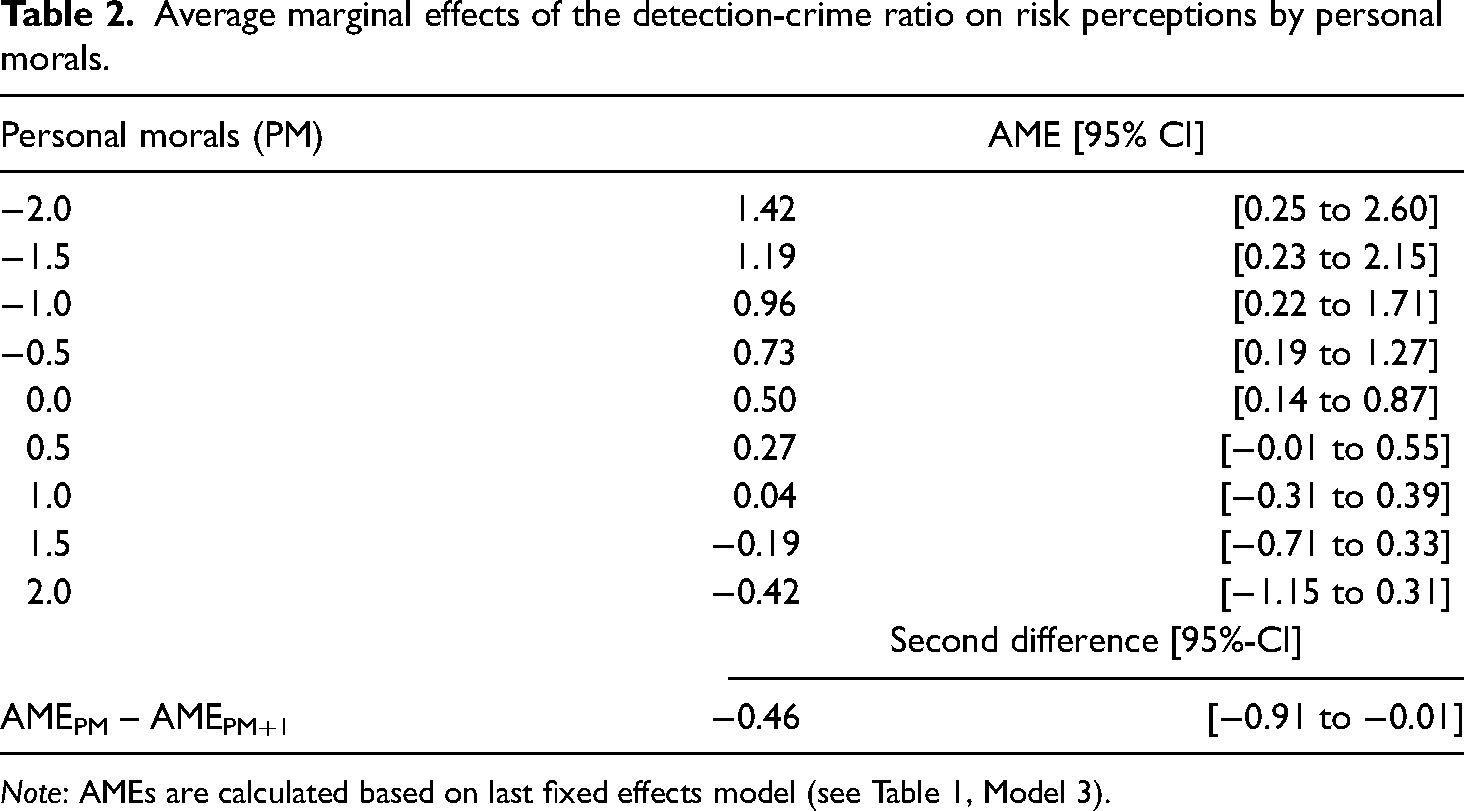
Note: AMEs are calculated based on last fixed effects model (see Table 1, Model 3).
Discussion
The current study supplements the relatively small body of research investigating the differential updating of risk perceptions. It revisits the question of whether people learn differently from police detection depending on their personal morals. Studying this question with a sample of German juveniles, our longitudinal models produced two main findings.
The first finding suggests that when juveniles experienced a higher certainty (rate) of police detection, their general perception of the risk of getting caught increased somewhat on average. This result is in line with aspects of perceptual deterrence theory and particularly Bayesian updating models, and also consistent with previous empirical research (e.g., Anwar and Loughran, 2011; Horney and Marshall, 1992; Matsueda et al., 2006). People seem to be rational in the sense that they update their risk perceptions when confronted with relevant experiential information. However, the average updating effects found in the current and in previous studies are typically relatively small. Combined with the modest evidence of behavioral linkage (see Figure 1; for a review, see Paternoster, 2018), this low explanatory power casts severe doubts on whether (specific) deterrence is an appropriate goal of criminal justice intervention (for critical perspectives, see Kleck and Sever, 2017; Pratt and Turanovic, 2018).
Confronted with this outlook, some scholars suggest that deterrence may only work for some people or in some situations and highlight the need to study processes of differential deterrability (e.g., Hirtenlehner, 2020; Loughran et al., 2018; Piquero et al., 2011). The second finding of the current study bolsters their claims. It suggests, in line with hypothesis H1, that the relationship between experienced detection certainty and risk perceptions varies by personal morality. According to our estimates, only individuals with weak morals updated their risk perceptions substantially after having experienced an increased detection rate. Risk perceptions of individuals with stronger morals, in contrast, were relatively unaffected by detection experiences. Combined with previous findings that risk perceptions deter criminal behavior only (or primarily) among individuals with weaker morals (e.g., Hirtenlehner and Reinecke, 2018; Kroneberg et al., 2010; Svensson, 2015), this result has interesting implications for deterrence research. It suggests that justice intervention may have more power to deter people from committing crimes than indicated by nondifferential analysis, but that this power applies only or primarily to a subset of individuals. More precisely, in line with the reasoning of Pogarsky et al. (2005), substantial deterrence processes may be restricted to those with weak morals who are generally more likely to contemplate committing crimes. These individuals may not only be the ones that are more deterrable from committing a crime by their risk perceptions but also adjust these latter perceptions more substantially when confronted with detection experiences.
Our theoretical section suggests that there are at least three perspectives that could explain this differential updating finding. First, it could be that individuals with strong morals do not have any incentives to learn from the consequences of crime because they generally do not deliberate about the costs and benefits of behavior they see as morally wrong (the nonmarket perspective). Second, it could be that individuals with weaker morals possess on average less self-control abilities and thus tend to give more weight to immediate consequences (e.g., detection or arrest) that loom following a particular behavior (the spuriousness perspective). Third, it could be that individuals with weaker morals commit on average more crimes and update their risk perceptions more strongly because their detection signal is based on more information and thus more reliable (the Bayesian updating perspective). While the first two explanations are in line with the idea that people may update their risk perceptions differently due to some personal characteristics (personal morals, self-control abilities), the latter conforms with the idea that the finding of differential updating can be explained by different input (number of crimes) into a rational learning process. Unfortunately, due to limitations in statistical power our study cannot entangle the different explanations empirically. To conduct an informative test of them, future research must be based on larger samples including at best many offenders, much variation on the detection-crime ratio, and various measures that tap into different aspects of criminal propensity and criminal history.
Beyond replicating and further exploring the differential updating process, future research should also tackle some of the other issues not fully addressed in the current paper. First, it should investigate the updating process in an offense-specific manner. Most studies on deterrence (including the current one) examine the impact of the total number of arrests or the general arrest-crime ratio on (general or offense-specific) risk perceptions (e.g., Pogarsky et al., 2004, 2005; Schulz, 2014). They conduct this “global” analysis because arrests are a rare phenomenon (see Kaiser et al., 2022; Lochner, 2007), and the power to analyze their effects can be increased by aggregating arrests across different offense types. 20 A problem with this aggregation is, however, that deterrence theory and the underlying rational choice theories assume that deterrence processes operate (primarily) in an offense-specific manner (Anwar and Loughran, 2011; Paternoster, 1989; but see Stafford and Warr, 1993). Future research should thus be conducted with larger (stratified) samples to enable offense-specific analyses. Such analyses may, at least according to deterrence theory, find even stronger evidence for perceptual deterrence effects among those with weak morals than the global effects reported in the current and previous studies. 21
Second, a “dirty little secret” of deterrence theory is that research typically only explains a small fraction of the variation in sanction threat perceptions (Paternoster, 2010, p. 808). This observation also applies to the current study: Our fixed effects models account only for up to 5.5 percent (Model 3) of the intraindividual perceptual variation. This low explanatory power results from the fact that the current and most previous studies restrict their pool of independent variables to experiential determinants. They include only covariates with information about personal or vicarious experiences with criminal behavior and its consequences (including punishment). And even among those experiential determinants, they typically lack some relevant measures, such as indicators on the arrests or detections of relevant others (e.g., peers; see Matsueda et al., 2006; Pogarsky et al., 2004). Moreover, experts have highlighted that most updating models do not account for mental shortcuts (cognitive heuristics) that people use to form their risk perceptions (e.g., Kreager and Matsueda, 2014; Pickett and Roche, 2016; Piquero et al., 2011). Recent research, however, has shown that such shortcuts may play a crucial role in how individuals assess their detection risk (Pogarsky et al., 2017; Thomas et al., 2018). Future research should consider these cognitive heuristics in updating models and explore how they relate to differential experiential learning.
Finally, the current and most previous studies focused either on the perceptual or the behavioral linkage. Therefore, they could not assess the hypothesis of perceptual deterrence theory that getting caught should indirectly lead to less criminal behavior via a change in sanction threat perceptions (see Figure 1). This lack of a complete analysis is particularly true for research on the moderation of the deterrence process by personal morals. So far, one line of research has investigated whether people with different morals update their risk perceptions differently after arrest (the current study, see also Pogarsky et al., 2005). The other line analyzed whether the impact of sanction threat perceptions on criminal behavior varies by personal morality (e.g., Hirtenlehner and Reinecke, 2018; Kroneberg et al., 2010; Svensson, 2015). Although both lines of research have produced promising findings, suggesting that personal morality may indeed moderate the deterrence process, no study to date has investigated the moderation of the perceptual and behavioral processes simultaneously. Only such a complete analysis can ultimately show that deterrence is, for those with weak morals, a more critical process than indicated by previous nondifferential research.
Supplemental Material
sj-docx-1-euc-10.1177_14773708221128515 - Supplemental material for Differential updating and morality: Is the way offenders learn from police detection associated with their personal morals?
Supplemental material, sj-docx-1-euc-10.1177_14773708221128515 for Differential updating and morality: Is the way offenders learn from police detection associated with their personal morals? by Florian Kaiser, Björn Huss and Marcus Schaerff in European Journal of Criminology
Footnotes
Funding
The author(s) disclosed receipt of the following financial support for the research, authorship, and/or publication of this article: This work was supported by the study Crime in the modern City (CrimoC), which was fully funded by the German Research Foundation (Deutsche Forschungsgemeinschaft; DFG; grant number BO 1234/8-10).

Supplemental material
Supplemental material for this article is available online.
Notes
References
Supplementary Material
Please find the following supplemental material available below.
For Open Access articles published under a Creative Commons License, all supplemental material carries the same license as the article it is associated with.
For non-Open Access articles published, all supplemental material carries a non-exclusive license, and permission requests for re-use of supplemental material or any part of supplemental material shall be sent directly to the copyright owner as specified in the copyright notice associated with the article.
