




Abstract
This article contributes to the debate in terrorism research on how unique terrorist suspects (i.e. individuals suspected of crimes with terrorist intent) actually are and whether or not specific theories are necessary to explain their behavior. Our study compares terrorist suspects from the Netherlands with their siblings and nonterrorist suspects to find out whether and how terrorist suspects are unique. Inspired by criminological theories involving social bonds, regression analyses were conducted utilizing registry data on household compositions, socio-economic status (SES), and criminal histories. A key finding is that terrorist suspects seem to have more in common with other suspects than with their siblings; besides prior criminal involvement, no significant differences were found between terrorist suspects and other suspects. Terrorist suspects were significantly less often married, had a lower SES, and were more often previously suspected of crimes as compared to their siblings. Particularly, lacking employment is a differentiating factor for terrorist suspects and siblings. Our findings stress the necessity to investigate in-depth under what circumstances and how a disadvantaged background (e.g. lack of social bonds, criminal history) can lead to becoming a terrorist suspect.
In March 2016, Belgium was confronted with a terrorist attack at Brussels-Zaventem Airport. One of the terrorists involved in the bomb attack was Najim Laachraoui. Najim was the brother of Mourad Laachraoui, who competed for Belgium at Taekwondo matches and who would be part of the Olympic team in Rio de Janeiro later that year. 1 Whereas one brother turned to ideologically motivated violence in his home country, the other represented that same country in an international sports competition. Their divergent pathways beg the question to what extent terrorists might differ from their siblings. Although there are also examples of siblings who carried out terrorist attacks together (e.g. the Boston marathon bombers), analyzing cases like the Laachraoui brothers could bring us closer to answering the question to what extent terrorists are different or unique from relatively similar individuals.
The question of ‘uniqueness’ fits into criminological debates about the differences between terrorism and crime (e.g. LaFree and Dugan, 2004; LaFree et al., 2018). Until recently, researchers rarely incorporated insights from criminology when studying individual-level extremism or terrorism (LaFree et al., 2018), classifying crime and terrorism as separate phenomena. While terrorism and common crime clearly differ in important respects, such as terrorism being about the furtherance of a political cause rather than more individualistic motives (e.g. economic profit), LaFree and Dugan (2004) point at many similarities. Furthermore, they argue that important conceptual and methodological distinctions resemble the well-known tension that exists between general criminology and specialized areas of study (e.g. youth-gang activity). Scholars increasingly use criminological theories and insights to study extremism and terrorism on the individual level (e.g. Becker, 2019; LaFree et al., 2018; Pritchett and Moeller, 2021). Hence, comparing terrorist and regular offenders might be essential for better understanding the similarities and differences between terrorists and common offenders.
In the present study, we compare terrorist suspects (i.e. individuals suspected of crimes with terrorist intent) from the Netherlands with their siblings and with nonterrorist suspects of crime to examine whether and how terrorist suspects are unique in terms of background factors. Registry data provide us with information about their household composition, socio-economic background, and criminal history. We investigate whether a lack of social bonds (e.g. unemployment, living alone) and having a criminal past are significantly more common among terrorist suspects than among comparison groups. First, we review literature on the uniqueness of terrorists and the utilization of comparison groups in terrorism research. Second, we discuss our theoretical framework, followed by a description of the data and methodology. Finally, we present our findings, discuss implications, and consider future areas for study.
How unique are terrorist suspects?
Within most (jihadi) terrorism research, an underlying assumption is that radicals are in some way special: some commit violent radical acts that are typified as aberrant or shocking, and from that, it is conjectured that these individuals are in some way abnormal or unlike the mainstream (Pisoiu, 2013). Although this categorization has changed over time (from abnormal to normal and back; Gill et al., 2020), it has implications for how we see radicals, and in the case of violent or deviant radicals, how we deal with this type of offenders. For example, out of fear of prisoner radicalization, governments worldwide have implemented a range of measures to contain the spread of extremist ideologies in prisons (e.g. isolate violent extremists from other prisoners or disperse them across different prisons) (Basra and Neumann, 2020; Veldhuis, 2015). Notably, however, research that confirms the special status of violent or deviant radicals is lacking, partly due to the research field being hampered by several limitations (e.g. scarce availability of primary sources) that complicate investigating their uniqueness. 2
Although it is complex to deal with these limitations, researchers seem to agree that there are ways forward. One suggestion is to increase the use of comparison or control groups (e.g. Freilich et al., 2015; Pisoiu, 2013; Schuurman, 2020; Victoroff, 2005, 2016). In their systematic review of studies between 1990 and 2015 examining factors associated with terrorism, Desmarais et al. (2017) found that, out of the 205 articles meeting their inclusion criteria, 50 articles described empirical findings, 24 articles reported inferential statistics of which only six studies compared characteristics of known terrorists to nonterrorists. Their findings reveal a gap regarding the use of comparison groups. This is problematic because, in the absence of comparison groups, it is difficult, if not impossible, to uncover whether and how terrorists differ from nonterrorists (Victoroff, 2005). Furthermore, generalizing findings from research designs that lack adequate comparison groups likely overpredict violent extremism (Clemmow et al., 2020). By utilizing comparison groups, researchers can be more confident about their findings and potential for shaping terrorism prevention policies (e.g. help to reduce the number of false positives detected by counter terrorism practitioners) (Freilich et al., 2015), and help with conceptualizing the different forms of terrorist involvement (Schuurman, 2020).
Comparison groups in terrorism research
Studies that did include nonterrorist comparison groups have produced interesting insights (e.g. Altunbas and Thornton, 2011; Baele, 2017; Berrebi, 2003; Dhumad et al., 2020; Gottschalk and Gottschalk, 2004; Horgan et al., 2016; Kavanagh, 2011; Krueger, 2008; Krueger and Malečková, 2003; Lankford, 2013; Lee, 2011; Silver et al., 2019; Smith, 2008). Below we discuss six studies meeting the following criteria: they should be quantitative scholarly contributions discussing factors associated with terrorism on the individual level of analysis, and they should examine European or North American terrorist(s) (suspects) as prime subjects (instead of extremists or nationalists, for instance) compared to nonterrorist samples. 3 Before focusing on studies with comparison groups of siblings or nonterrorist offenders/suspects, we first discuss contributions using other comparison groups.
Socio-economic and psychological factors
While exploring the literature, we notice that comparative research mainly examines socio-economic and psychological factors. In terms of socio-economic factors, Altunbas and Thornton (2011) compared 77 homegrown Islamic terrorists in the UK (convicted between 2001 and 2009) to a representative sample of UK Muslims (n=1363). In their comparison, they found, next to other predictors, employment status (i.e., not having been employed recently) to be a predictor of involvement in terrorist activity. Furthermore, Krueger (2008) compared characteristics of 63 alleged homegrown Islamic terrorists in the US to a representative sample of 1050 Muslim Americans. He concluded that the alleged terrorists have an average level of education and, interestingly, that better-educated terrorists were operationally more proficient (i.e. more successful in executing their terrorist plan).
Besides studies examining socio-economic variables, some scholars conducted comparisons to investigate the relevance of psychological factors. For example, comparative research into lone-actor terrorists’ writings revealed that, compared to other control groups such as nonviolent, radical activists, lone-actor terrorists are characterized by a specific combination of high anger and high-cognitive complexity (Baele, 2017). Other (noncomparative) studies also demonstrated that involvement in terrorism can be a result of, or lead to, mental health problems, although scholars rightly acknowledge the complexity of establishing causal relationships in this regard (e.g. Gill et al., 2020; Weenink, 2019).
Nonterrorist suspects and siblings
In our efforts to identify comparative studies, we also searched for quantitative studies that included nonterrorist suspects or offenders and/or siblings of terrorists. Besides theoretical papers (e.g. LaFree and Dugan, 2004), there are empirical contributions that discuss the similarities and differences between terrorists and nonterrorist offenders (Horgan et al., 2016; Lankford, 2013). Horgan et al. (2016) compared demographic (including socio-economic status (SES)), psychological, and offense-related behavioral factors across and between 115 solo mass murderers and 71 lone actor terrorists. Besides significant differences in their behavior (e.g. degree of interacting with co-conspirators), their findings suggested little distinction in terms of socio-demographic profiles. Similarly, a comparative analysis of suicide terrorists and rampage, workplace, and school shooters who attempted suicide showed that distinctions between these two groups of individuals (N = 81) were mostly superficial (Lankford, 2013). Prior to their offenses, individuals from both groups often experienced similar personal problems, including family problems, social marginalization, problems at work or school, and precipitating crisis events.
Regarding sibling studies, a study was conducted by Rodermond and Weerman (2021). Via bivariate analyses, the authors showed that terrorist suspects are less often employed, have less often finished higher education, have a lower income, and live less often with a partner (and children) compared to their most similar (in terms of age and sex) sibling. Moreover, terrorist suspects were more likely to have a criminal background. Besides this study, we were unable to find other published research on terrorism using siblings as a comparison group. 4
In short, sibling comparisons are scarcely the subject of terrorism studies. Furthermore, differences between terrorists and nonterrorist offenders are primarily absent or superficial in terms of socio-demographic profiles and experienced problems. However, due to the limited number of studies, more research seems imperative. Especially, a criminological perspective may provide us with a better understanding of factors and processes that potentially increase the risk of terrorist involvement. Therefore, in recent years, terrorism scholars have urged researchers to apply a criminological lens when researching terrorists, extremists, and radicalization (e.g. Freilich and LaFree, 2015; LaFree et al., 2018).
Theoretical framework: Lack of social bonds
In response to the call mentioned above, our study includes a criminological perspective to investigate what factors are uniquely associated with the risk of becoming a terrorist suspect. Our central focus is the social control theory of Hirschi (1969) and the theoretical advancements made by life-course criminologists (Sampson and Laub, 1993). Control theory scholars presuppose that the impetus to offend is omnipresent but that people can be shielded from deviance when having bonds that connect them to conventional society (Hirschi, 1969). Hirschi (1969) asserts that deviation from conforming behavior is more likely to occur when these bonds—in the form of bonds to prosocial values (e.g. prosocial towards society’s values and norms), prosocial people (e.g. parents), and prosocial institutions (e.g. employment)—are weakened or absent. Building upon Hirschi’s theory, Sampson and Laub (1993) emphasize in their age-graded theory of informal social control the importance of life-course events, or ‘turning points’ that can redirect or alter behavioral trajectories in life. They postulate that, despite ‘early differences in childhood experiences and delinquency, adult social bonds to work and family are significantly related to changes in adult crime’ (Laub et al., 2018: 2). Thus, a lack of social bonds can play an important role in the road to deviant (radical) behavior and make someone more vulnerable to radicalization. Accordingly, having (strong) social bonds can potentially function as a ‘shield’ from behaving in a radical deviant manner.
Within criminological research, the connection between weak social bonds and crime has been well established. For example, scholars identified a robust relationship between marital status and crime and have presented extensive evidence that stable employment is particularly important in forming prosocial bonds (LaFree et al., 2018). Regarding terrorism research and socio-economic indicators, the consensus among academics was that research does not support the widespread opinion that terrorism is related to or the result of a lack of education or poverty (Freilich et al., 2015), as also an earlier mentioned contribution illustrates (Krueger, 2008). Recently, however, several studies showed that having a low SES is relatively common among terrorists (e.g. Ljujic et al., 2017; Weenink, 2019), and becoming unemployed increases the risk of becoming a terrorist suspect (Thijs et al., 2018). Furthermore, (stable) employment could function as a protective factor against extremism and violent radicalization (e.g. LaFree et al., 2018; Lösel et al., 2018). Hence, findings in this regard are mixed.
Regarding household composition, contrasting results are found regarding the effect of marriage. From a social control perspective, one would expect a protective effect from marriage, at least to the extent that the marriage is of quality and with a pro-social partner. However, analogous to the potential adverse effect of marrying a criminal partner, terrorism scholars have argued that a marriage with a radical partner could function as a catalyst in the radicalization process (e.g. Groen and Kranenberg, 2006). Furthermore, it was found that jihadi inspired terrorist offenders reported high levels of marriage (e.g. Bakker, 2006; Sageman, 2008), whereas other scholars found that the typical terrorist/extremist offender is unmarried (e.g. Berrebi, 2003). One of the few quantitative empirical studies examining the influence of marriage did not find an effect of marital status (Wolfowicz et al., 2020). Additionally, family bonds, in terms of positive parenting and nonviolent significant others, can function as protective factors (Lösel et al., 2018), whereas radicalized family members could be a risk factor (LaFree et al., 2018).
Finally, having a criminal history is one of the strongest predictors of future criminal activity and, therefore, important to include as a background characteristic (LaFree et al., 2018). Additionally, previous terrorism research reveals a connection between prior criminal acts and terrorist involvement (e.g. Basra and Neumann, 2016; LaFree et al., 2018; Wolfowicz et al., 2020), thus suggesting it to be a risk factor for becoming a terrorist suspect.
The present study
The present study aims to contribute to terrorism research by comparing terrorist suspects with individuals who are similar in specific regards. First, we select nonterrorist suspects as a comparison group, since they are suspected of (violent or nonviolent) criminal behavior like the prime subjects. By selecting nonterrorist suspects with the same age, sex, and migration background, we ensure that the associations found in this study are not confounded by these characteristics. There are, however, also various unmeasured potential confounders on which we could not match. Therefore, we selected siblings of the terrorist suspects as a second comparison group. By comparing terrorist suspects with their (nonterrorist) siblings, we automatically control for all confounding factors shared within these pairs of siblings, including genetic and shared environmental factors (e.g. parenting practices). As a consequence, these sibling comparisons will give a better estimate of the effects on terrorist offending than comparisons between unrelated individuals.
On the basis of registry data, we measure what factors increase or decrease the likelihood of becoming terrorist suspects as compared to comparison groups. As such, we do not examine (different phases of) radicalization processes that might have proceeded the terrorist suspicions but we test some of the factors considered important for offending within criminology: household composition, socio-economic factors, and criminal history. Hence, we aim to answer the following question: what factors (household composition, SES, and previous crime) are specific for terrorist suspects in the Netherlands?
Data and methods
Sample
To answer the above-mentioned research question, we used several data sources. First, we obtained pseudonymized information 5 provided by the Public Prosecution Service (PPS) on all terrorist suspects in the Netherlands since implementing the Terrorist Act in 2004. The dataset includes suspects of ‘crimes with terrorist intent’ in the Netherlands. The definition for ‘crimes with terrorist intent’ is derived from the Dutch penal code. It reads as follows: ‘Crimes with terrorist intent aim to bring fear into the population or part of the population of a nation, or force a government or international organization to perform unlawfully, not to perform, or submit to something, or heavily destroy or derail the fundamental political, constitutional, economic or social structures of a nation or international organization.’ 6 , 7
Equal to other data sources, utilizing PPS data has both benefits and limitations. It offers valuable but sparse information on the terrorist suspects. For instance, ideally, we would have had more detailed information about the terrorist suspects, such as the ideological affiliation 8 (e.g. jihadi inspired, far-right), roles (e.g. recruiters, foreign fighters), and the degree to which they are part of an extremist network (i.e. lone actors vs terrorist groups) allowing us to be more thorough in our assessment of what factors/characteristics are particular for which type of terrorist suspect. Although we lack this information and acknowledge that there is variation within the terrorist suspect group, we believe that the use of the PPS dataset and the possibility to quantitatively examine risk and protective factors for becoming a terrorist suspect provide us with new insights into what makes terrorist suspects unique.
The dataset stretches from 2004 to 2018 and includes information on suspicion and prosecution. However, via additional judicial information 9 we found that the first suspicion of a terrorist crime stems from 2002, which subsequently marks the starting year of the dataset. We received information up until December 2018. To be included in the terrorist suspect list, there had to be ‘serious indications’ of a terrorist offense, and the case had to be sent to the public prosecutor. Individuals with less serious indications of terrorist involvement (e.g. individuals who were arrested by the police but were cleared before a case was sent to the public prosecutor) are not in the dataset.
Importantly, our sample includes both convicts and suspects, since: (I) the indictment includes concrete suspicions about actions with terrorist intent, compared to less specific suspicions for other types of offenders, (II) building a court case (i.e. gathering enough evidence) can be more challenging in terrorist suspect cases (e.g. due to crimes being committed in a foreign country, establishing proof of committing the act with terrorist purpose, et cetera), and (III) the often long duration of the court cases dealing with terrorist suspects, leads to cases still being in progress during our research.
A second step in creating our dataset was to complement the PPS information with data at the individual level on life circumstances such as household composition, SES, and criminal history. Statistics Netherlands provided the data via a protected server, where we could connect the terrorist suspects’ data via a unique, anonymized personal identification number to the necessary data. 10
Initially, the PPS dataset held 490 records, of which 386 records could be combined with data from Statistics Netherlands. Within the 386 records, we discovered 368 unique records, meaning that they represent a unique person. Seventeen terrorist suspects had more than one record (minimum 2, maximum 3). Finally, based on additional judicial data we received 11 , we were able to find the date of (allegedly) committing their terrorist crime (from now on referred to as their focal terrorist suspicion) for 349 persons within our dataset who subsequently constitute the basis of our analyses.
The terrorist sample is dominated by men (87.7 percent). Based on the judicial data, the average age when suspected of a terrorist crime is 29.45 years (S.D.: 11.04), with a range of 13–80 years; most individuals are between 18 and 35 years old. Regarding the judicial procedure, 43.2 percent of the cases led to a court ruling 12 , 23.5 percent led to a technical judgement or dismissal, 6.3 percent was ongoing at the time of receiving the data, and 26.9 percent of the data on the judicial procedure was missing. The majority (68.2 percent) has been in contact with law enforcement because of offenses and/or misdemeanors prior to their focal terrorist suspicion, of which a 39.5 percent was accused of violent and 42.1 percent of property crimes. Moreover, of the 203 suspects with detention information (146 suspects had missing data on this variable), 57.1 percent spent time in prison prior to their focal terrorist suspicion.
Comparison groups
Besides studying characteristics of the terrorist population, we also created two comparison groups. For both groups, one-to-one matching was used to create the best possible match for each terrorist suspect. The groups were created with data from Statistics Netherlands. The first comparison group consists of siblings of the terrorist suspects. We first checked if a terrorist suspect had full (similar) siblings (or half-siblings, in case there were no full siblings). Subsequently, we checked whether we could match the terrorist suspect with a sibling of the same sex, followed by picking the sibling closest in age to the terrorist suspect. 13 When terrorist suspects had no siblings or when no siblings could be identified due to missing data on the identity of their parents, they were excluded from this comparison. If there were more terrorist suspects within the same family, they were matched with multiple nonterrorist siblings in the same way as the rest. Consequently, we matched 263 terrorist suspects with their most similar brother or sister, of which 225 were full siblings and 38 were half-siblings. The mean age of the sibling group was 29.02 (S.D.: 11.04, range 12–77) compared to the mean age of 28.20 (S.D.: 10.18, range 14–80) for the terrorist group. There are more women within the sibling group than within the terrorist suspect group (27.8 percent vs 14.5 percent), which is the result of some male suspects being matched with a female sibling when no male siblings were present.
The second comparison group comprises suspects of nonterrorist offenses, ranging from petty crimes like stealing and swindling to dealing drugs and murder. In order to create a comparison group with similar background characteristics, we matched violent terrorist suspects from a specific year with violent nonterrorist suspects from the same year. Subsequently we did the same for nonviolent terrorist suspects that were matched with nonviolent nonterrorist suspects. 14 Matching was based on a terrorist suspect’s sex, age, and migration background. 15 We could match 349 terrorist suspects with nonterrorist suspects, of which 57 were violent terrorist suspects and 292 were nonviolent terrorist suspects. 16
Variables
We constructed a dichotomous dependent variable to assess whether an individual belonged to a comparison group or the terrorist suspect group. Information for the majority of independent dynamic variables was collected for the period 2001, one year before the first suspicion with terrorist intent in our dataset, until 2018. 17 Based on data on a monthly level, dichotomous variables were constructed to indicate the situation at 1 month and at 12 months before the terrorist crime was committed in order to avoid confusing cause and effect. The variable household recorded the household composition of the terrorist suspects and consisted out of five categories: living at the parental home, living alone, being married, other 18 , or unknown. We employed two variables to examine SES; (1) social benefits recorded whether an individual received social benefits in the year and month prior to committing the terrorist crime, (2) employment measured whether an individual was employed in the year and month prior. Finally, we constructed the variable crime, which measured whether an individual was suspected of a criminal offense. Information on crime was solely available yearly, which means we can only report one year prior rather than one month prior. For instance, if a person was suspected of a terrorist offense in 2005, we measured whether that person was suspected of a criminal offense in 2004.
For the comparison groups, we measured the same variables at the same time points (i.e. 12 months and 1 month prior (and the crime variable one year prior) to the focal terrorist offense of the terrorist suspect we matched them with).
Analyses
First, we provide an overview of descriptive statistics. Via the Fisher’s exact test (two-tailed), we performed bivariate comparisons to test whether terrorist suspects and comparison groups are significantly distinct on the included indicators.
Based on the type of comparison group, we assessed which statistical models were best suited to answer our research question. For comparing the terrorist suspects with nonterrorist suspects, we used logistic regression models (nonterrorist suspects coded as 0 and terrorist suspects as 1) to investigate which factors increase or decrease the likelihood of becoming a terrorist suspect compared to a nonterrorist suspect. The models generate odds ratios (OR) (exponentiated regression coefficients), the corresponding standard deviations (SE), and the statistical significance (in asterisks).
For comparing terrorist suspects with their nonterrorist siblings, we applied discordant sibling models. Using fixed effects (FE) models, within-family comparisons were made to examine the relationships between the independent variables and being a terrorist suspect (siblings coded as 0 and terrorist suspects as 1). The discordant sibling models allowed us to control for all (unmeasured) familial factors that are shared between siblings, including genetic and shared environmental influences (D'Onofrio et al., 2013). That is, provided that siblings share all sorts of family characteristics that are often unobserved, discordant sibling models offer a better estimate of the effects on terrorist offending.
For both types of analyses—discordant sibling and logistic regression models—we report the OR. The OR indicates that individuals have an increased (OR higher than 1) or decreased odds (OR lower than 1) of becoming a terrorist suspect in the months in which they have a higher score on an independent variable.
We report the situation 1 month and 12 months prior to the focal terrorist suspicion for the descriptive analyses. We report the same measurement moments for the multivariable analyses and report on the whole year prior (12 months in total, averaged). For instance, if a person married half a year prior to the focal terrorist suspicion, a score of 0.5 is given to the variable Married. Data preparation and analyses were performed in Stata version 16.1.
Results
Compared to nonterrorist suspects
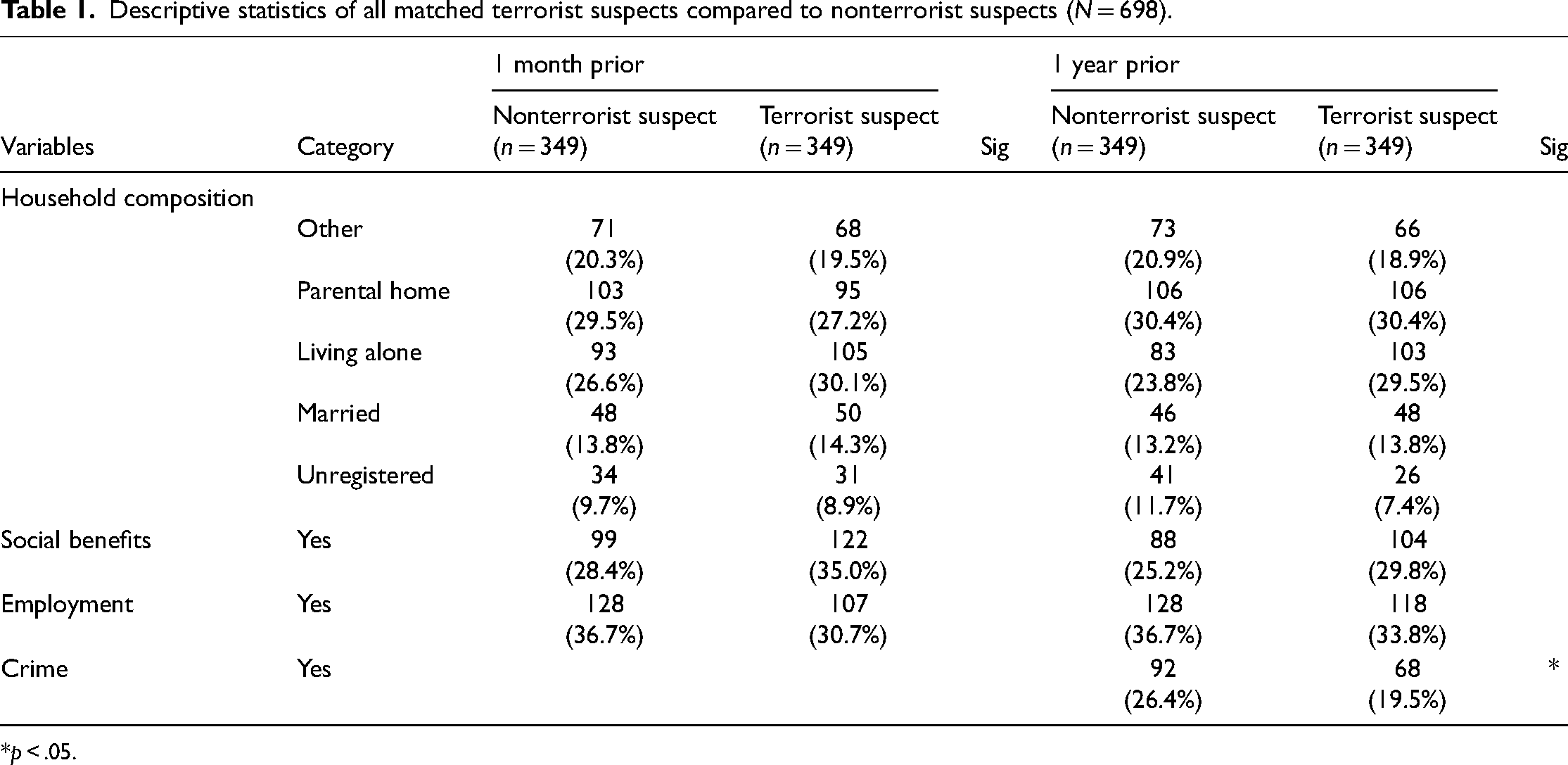
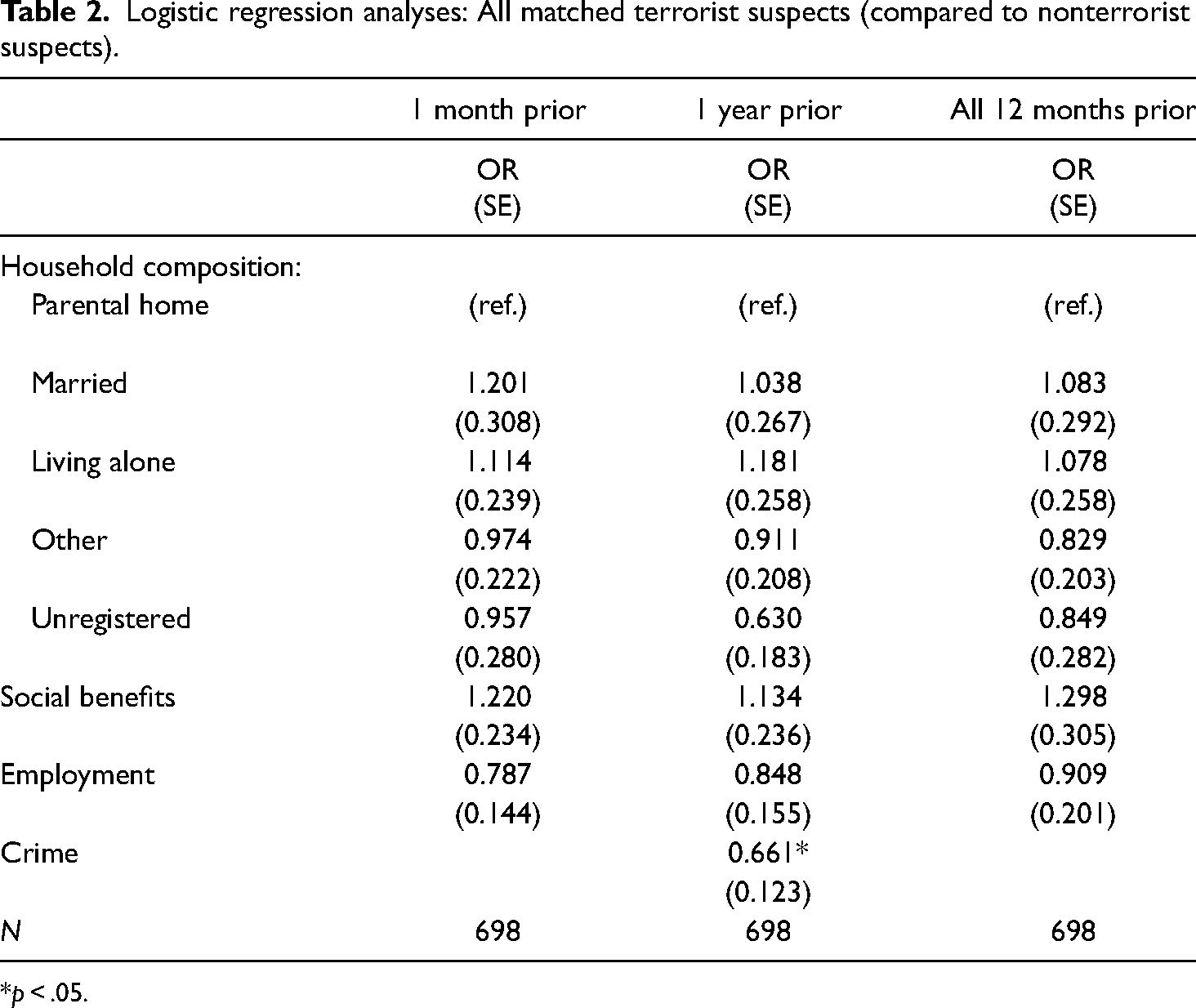
In Table 1, we observe that none of the variables besides the crime variable shows a significant association within the nonterrorist suspect comparison. The crime variable indicates that the nonterrorist suspect group is more often suspected of at least one offense in the year prior to the focal crime than the terrorist suspect group (26.4 percent vs 19.5 percent; p < .05). In Table 2, the logistic regression models demonstrate similar results. The second model shows that the odds of becoming a terrorist suspect were 1.5 times (1/0.661 = 1.5) lower when sample members were suspected of a crime in the year prior to the focal terrorist suspicion. In short, we find primarily similarities between both groups.
Descriptive statistics of all matched terrorist suspects compared to nonterrorist suspects (N = 698).
*p < .05.
Logistic regression analyses: All matched terrorist suspects (compared to nonterrorist suspects).
*p < .05.
Compared to siblings
Unlike the comparison with nonterrorist suspects, who were only matched on age, sex, and migration background, the discordant sibling design gives a better estimate of the effect on terrorism offending as it also controls for unmeasured familial confounders.
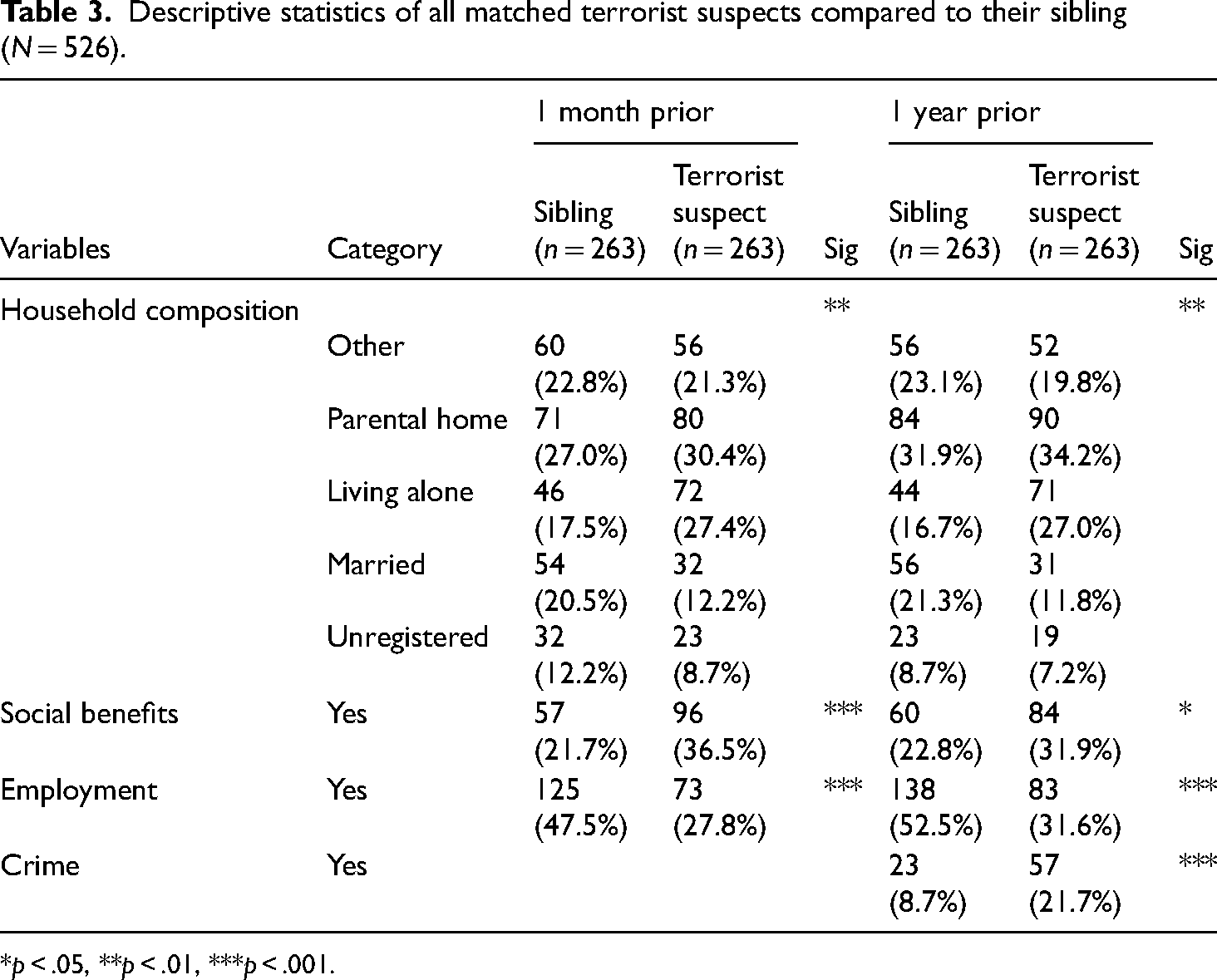
In comparing terrorist suspects to their nonterrorist siblings, Table 3 shows the bivariate analyses and demonstrates that all variables included in our analyses show a significant association for both measurements (1 month and 1 year prior to the focal terrorist suspicion). Within the comparison of the household composition (p < .01), most notable is that, compared to their matched sibling, terrorist suspects lived more often alone (1 month: 17.5 percent vs 27.4 percent; 1 year: 16.7 percent vs 27.0 percent) and were less often married (1 month: 20.5 percent vs 12.2 percent; 1 year: 21.3 percent vs 11.8 percent). Regarding SES, we discover that terrorist suspects received more regularly social benefits (1 month: 21.7 percent vs 36.5 percent; p < .001; 1 year: 22.8 percent vs 31.9 percent; p < .05) and were less often employed (1 month: 47.5 percent vs 27.8 percent; p < .001; 1 year: 52.5 percent vs 31.6 percent; p < .001) than their siblings. Finally, compared to their matched sibling, terrorist suspects were more likely to be suspected of a criminal offense (1 year: 8.7 percent vs 21.7 percent; p < .001).
Descriptive statistics of all matched terrorist suspects compared to their sibling (N = 526).
*p < .05, **p < .01, ***p < .001.
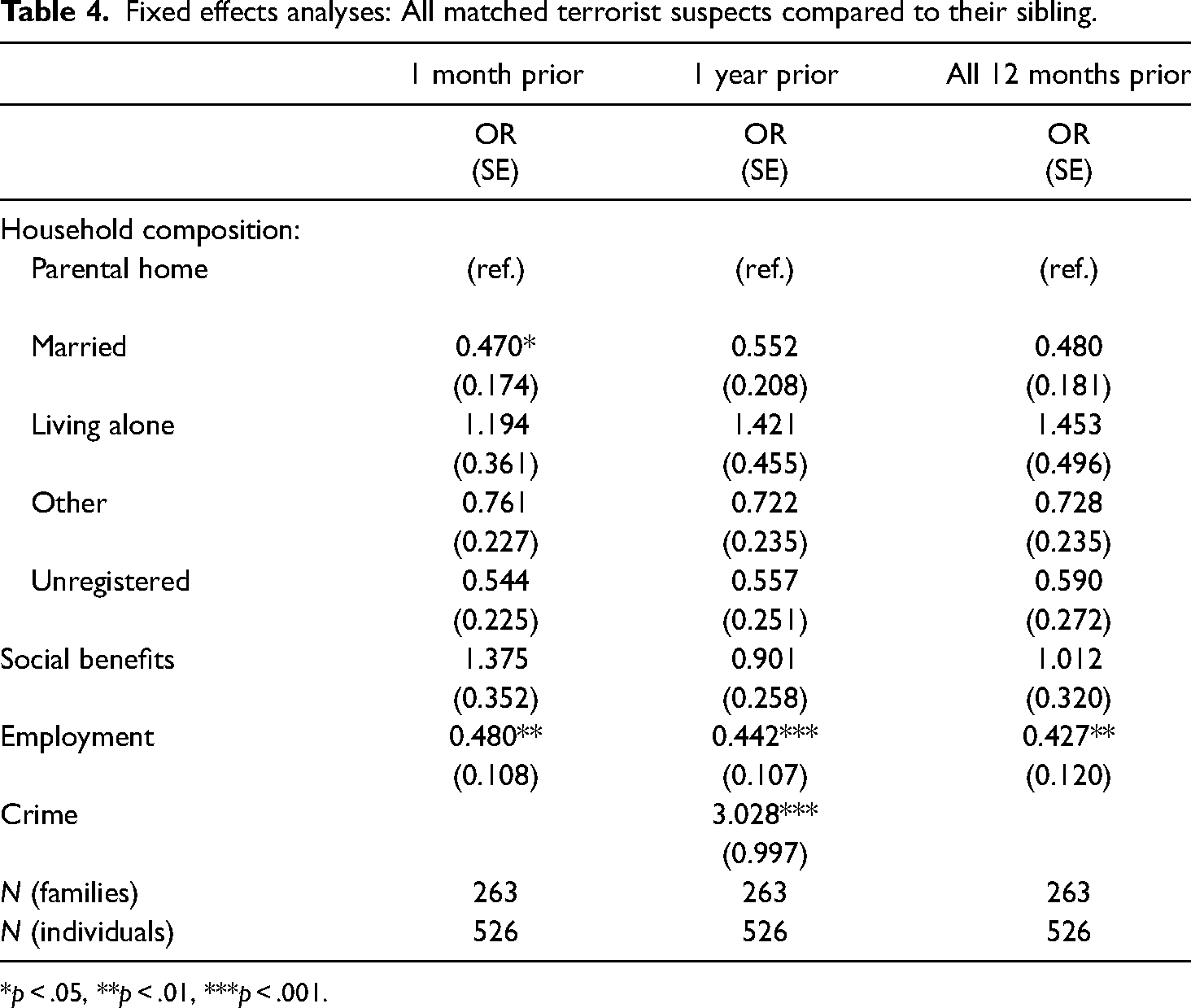
In Table 4, we present the multivariate findings of the discordant sibling models. In these models, the siblings within the same family are compared to each other rather than comparing the group of terrorist suspects to the group of siblings. Hence, we find different results. First, we notice that those who were married 1 month prior to the focal terrorist suspicion were significantly less likely to be a terrorist suspect than those who lived at their parents’ home (OR = 0.470; p < .05). Thus, terrorist suspects more often lived at their parents’ homes while their siblings were more often married. Second, for all included measurement moments, those with employment were significantly less likely to be a terrorist suspect (1 month: OR = 0.480; p < .01; 1 year: OR = 0.442; p < .001; all 12 months: OR = 0.427; p < .01). Thus, terrorist suspects were more often without employment while their siblings were employed. Lastly, in the year prior to the focal terrorist suspicion, those suspected of an offense were significantly more likely to be a terrorist suspect than their sibling (OR = 3.028; p < .001).
Fixed effects analyses: All matched terrorist suspects compared to their sibling.
*p < .05, **p < .01, ***p < .001.
Discussion
Our aim was to investigate whether, and if so how, terrorist suspects differ from individuals who are comparable in terms of background factors. Guided by social control theories, we utilized registry data and two matched comparison groups of siblings and nonterrorist suspects to examine potential factors of relevance, including household composition, socio-economic background, and criminal history.
Consistent with research by Horgan et al. (2016) and Lankford (2013), our findings indicate there is little to distinguish terrorist suspects from other suspects in terms of household composition and SES (the latter measured via employment and receiving social benefits). Only the crime variable showed a significant difference, indicating that terrorist suspects are less likely to be suspected of an offense in the year prior to the focal terrorist suspicion than nonterrorist suspects. However, since most of the terrorist suspects included had, at any point, been in contact with law enforcement prior to their focal terrorist suspicion (68.2 percent), it seems likely that these terrorist suspects could be typified as ‘regular’ suspects (i.e. having a history of nonterrorist suspicions) who ended up as terrorist suspects. Therefore, giving terrorist suspects a priori a special status, that is, being ‘unlike mainstream’ suspects, appears somewhat misguided.
While studies in other domains demonstrate that protective factors can play a significant role in reducing the risk of violent outcomes, thus far, most terrorism research tends to focus on risk factors rather than protective factors (Desmarais et al., 2017). In our study, we aimed to investigate both. Although our earlier review of studies demonstrated mixed results in terms of the relevance of socio-economic variables, we consistently found that a lack of employment increased the likelihood of becoming a terrorist suspect in the sibling comparison. Our findings confirm previous research claiming that (stable) employment functions as a protective factor against extremism and violent radicalization (e.g. LaFree et al., 2018; Lösel et al., 2018). Also, in terms of comparative studies, our results match the findings of Altunbas and Thornton (2011) who emphasized the importance of unemployment as a predictor of involvement in terrorist activity.
Furthermore, we found a significant negative effect for marriage (in the sibling comparison, one month prior), suggesting that being married functions as a protective factor, similar to other more general criminological research (e.g. Sampson et al., 2006). This finding could indicate that terrorist suspects might lack a form of intimate or formal attachment. However, other forms of romantic relationships (e.g. unregistered partnerships; not included in our research) could potentially still have either a positive or negative effect on becoming a terrorist suspect. Future research should therefore include informal types of romantic relationships.
Like earlier studies showing a connection between prior criminal acts and terrorist involvement (e.g. Basra and Neumann, 2016; LaFree et al., 2018; Wolfowicz et al., 2020), the sample members in our study who were suspected of crime in the year prior to the focal terrorist suspicion had a higher probability of becoming a terrorist suspect compared to their sibling. Despite assumed shared genetic and environmental influences (e.g. the same upbringing, neighborhood influences) that we controlled for, the sibling group was significantly less likely to have a criminal history compared to the terrorist suspects.
Nevertheless, although we controlled for familial influences, important confounders may still exist. Since we know that there are also environmental influences outside of the familial environment that we cannot control for, we can only partly control for genetic influences since siblings only share 50 percent of their genes. Moreover, we included both full and half-siblings of which the latter being less likely to share familial influences with the terrorist suspect they were matched with. We may expect that having specific individual traits, such as negative emotionality, low constraint, and cognitive inflexibility (e.g. Gottschalk and Gottschalk, 2004; Victoroff, 2005), and personal experiences leading to grievances that were not shared by the matched sibling (e.g. losing a loved one, direct experiences with discrimination; e.g. Kruglanski et al., 2014), could explain why those with a criminal background are more drawn to terrorism than their matched sibling. Future research should examine differences in the life course of terrorist suspects and their siblings to explore the role of both individual traits and personal experiences that lead to grievances. A way forward is using crime sequence analysis (Keatley et al., 2021) or life history interviews (Simi et al., 2016) to investigate their pathways in more depth.
Finally, based on the results regarding their backgrounds, our findings match the idea of a new crime-terror nexus. Nonterrorist and terrorist suspects have a similar socio-demographic background, which supports the idea that terrorist suspects are recruited from the same milieus as individuals suspected of other types of crime. According to Basra and Neumann (2016), several key dynamics are of importance regarding the crime-terror nexus: jihadism can affect the radicalization process of a person previously suspected of crime in terms of offering redemption from past sins, or it can legitimize crime (see also: de Graaf, 2021); prisons provide an environment for radicalization and networking amongst criminals and extremists; criminals develop skills that can be useful for them as extremists (such as access to weapons and the familiarity with violence), and white-collar and petty crime is often used to finance extremism. For the (jihadi-inspired) terrorist suspects with a criminal history in our dataset, these dynamics could have played a role in becoming a terrorist suspect.
Yet, interestingly, terrorist suspects significantly differ from their siblings in terms of criminal background. This suggests that—assuming both the terrorist suspect and sibling grew up in a shared socio-demographic environment—researchers should focus their attention on a more thorough investigation of the lack of social bonds experienced by the terrorist suspects, their earlier criminal behavior, and the interrelationship between the two. Subsequently, future qualitative research into the criminal careers of terrorist suspects should pinpoint what factors and processes cause changes in offending behavior.
A last important point to address is the composition of our sample. We used a sample of both suspects and convicts rather than a sample of solely convicts. Importantly, this could raise questions, since some of these individuals might later be acquitted. This argument dates back to the debate between Sutherland (1945) and Tappan (1947). Tappan argued that only the courts could rule if someone is guilty or not. Conversely, Sutherland claimed that criminal activities should be examined close to the source, otherwise some criminal activities, like white-collar crime, can rarely be the subject of criminological research. The same holds for terrorism cases: it is complex to build a court case (e.g. gathering evidence, establishing terrorist intent; e.g. Cupido, 2021) and the authorities try to intervene as early as possible, before intentions materialize into terrorist actions (Openbaar Ministerie, 2019). Therefore, it is important to include all cases referred to the PPS, after extensive investigation by the police and/or intelligence agencies. This provides a better understanding of individuals linked to crimes with terrorist intent than waiting for a final judgment (which often takes several years) and analyzing (irrevocable) convicts only. Notably, our dataset thus included ‘suspects’ and these individuals should not be viewed as ‘(irrevocable) convicts.’
Limitations
An important limitation is that, generally, data on terrorism collected by governmental institutions are affected by political and legal considerations (LaFree and Dugan, 2004), which leads to a bias as cases are primarily selected for criminal prosecution. Therefore, the data we utilized, which we obtained from the Dutch PPS, reflect both empirical realities and Dutch political priorities and considerations over the researched period (e.g. focus on jihadi-inspired extremism rather than other forms of extremism). Moreover, only Dutch cases were included in our study. As such, the results may not be generalizable to the entire terrorist suspect group.
Another limitation is that, although the discordant sibling models give a better estimation of causality and make it possible to control for shared environments and partly for genetic factors, it remains an assumption that a terrorist suspect and sibling actually share(d) their environment (especially regarding the half-sibling comparisons). Moreover, a potential bias may exist in the sibling comparison since there are more women in the sibling group (27.8 percent against 14.5 percent for the terrorist suspect group). Finally, all unmeasured potential confounders that are not shared between sibling pairs are not controlled for (e.g. peer pressure, grievances, mental illnesses); results should therefore not be interpreted as causal effects.
Finally, using registry data limited us to data that have been officially registered. Consequently, we possibly underestimated criminal involvement prior to the focal terrorist suspicion and missed data on unofficial employment (i.e. illegal work), unregistered relationships (e.g. other types of romantic involvement rather than marriage), and other potentially relevant information (e.g. experiencing grievances, social network). Furthermore, we lacked information on terrorist suspect categorizations (e.g. ideological background, roles), whereas differences in this regard exist (e.g. Knight et al., 2017; Perliger et al., 2016), making it a heterogeneous group. Future research should test whether our findings also apply to specific types or groups of terrorist suspects.
Conclusion
Notwithstanding the limitations, our study is one of the first to include two relatively similar comparison groups to quantitatively examine, via registry data, potential risk and protective factors for becoming a terrorist suspect. Briefly, terrorist suspects are not entirely unique. Based on the examined background factors, they seem to resemble nonterrorist suspects more so than their siblings.
Our research underlines the necessity to investigate underlying mechanisms (e.g. the motivational and circumstantial aspects) of becoming a terrorist suspect. The lack of social bonds we found could be the result of (a series of) unintentional events (e.g. losing employment, being unable to find a partner) and/or it could be the result of a conscious desire to no longer be part of society, thereby breaking ties with conventional society. More in-depth comparative analyses are essential to understand what led terrorist suspects' pathways in a different direction than that of their sibling(s) or nonterrorist suspects.
Footnotes
Acknowledgements
The authors would like to convey their appreciation to the reviewers for their valuable comments and to the Dutch Public Prosecution Service, Statistics Netherlands, and the Research and Documentation Centre of the Dutch Ministry of Justice and Security (WODC) for supplying the necessary data.
Funding
The authors disclosed receipt of the following financial support for the research, authorship, and/or publication of this article: This work was supported by the Dutch Research Council (NWO) Research Talent grant [406.18.527].
