



Abstract
The severity, certainty and celerity (swiftness) of punishment are theorised to influence offending through deterrence. Yet celerity is rarely included in empirical studies of criminal activity and the three deterrence factors have never been analysed in one empirical model. We address this gap with an analysis using unique panel data of recorded theft, burglary and violence against the person for 41 Police Force Areas in England and Wales using variables that capture these three theorised factors of deterrence. We find that the three factors affect crime in different ways. Increased detection by the police (certainty) is associated with reduced theft and burglary but not violence. We find that variation in the celerity of sanction has a significant impact on theft offences but not on burglary or violence offences. Increased average prison sentences (severity) reduce burglary only. We account for these results in terms of data challenges and the likely different motivations underlying violent and acquisitive crime.
Introduction
The classical theory of deterrence developed from the work of three modern philosophers: Hobbes (1651), Beccaria (1872) and Bentham (1789). They believed that if punishment is severe, certain and swift, a rational individual will weigh potential gains and losses before engaging in illegal activity and will be discouraged from breaking the law if the loss is greater than the gain. Severity of punishment is believed to be one of the key elements implemented by the criminal law to encourage citizens to obey the law. Certainty of that punishment implies that the sanction is more likely to be implemented against the offender if the crime is committed. Further, it has been proposed that the punishment must be swift in order to deter the crime. Classical deterrence theory consists of these three key components, the so-called “3 Cs” (Severity, Certainty and Celerity) of punishment. Of the three components of the deterrence theory, severity has often been measured by length of prison sentence and certainty by detection rates or arrest rates (for the relevant papers in this area please see the section Previous Research). Curiously, celerity, as a component of deterrence, has been rarely tested empirically. Yet policymakers commonly assume that access to speedy justice is crucial both for reducing crime and satisfying the interests of victims.
For example, in the United Kingdom, New Labour governments, following Tony Blair's slogan, ‘tough on crime, tough on the causes of crime’, made access to swift criminal justice a key policy priority (Morgan, 2008). One influential government strategy document promised that ‘cases that need the court process will be dealt with fairly but as quickly as possible’ while introducing wider use of ‘summary’ procedures including dealing with cases just a day after initial charge (Home Office, 2004, 2006). Using remarkably similar language and rationale, the Coalition Government (2010–2015) following New Labour proclaimed: ‘Justice needs to be swift if it is to be effective. Offenders need to be made to face the consequences of their actions quickly, using effective, locally-based solutions’ (Ministry of Justice, 2012). This aim to streamline the process of bringing offenders to justice has continued under contemporary Conservative governments (HM Treasury, 2015).
The importance of detection rates, severity of sentences and swiftness of the justice system together with socio-economic determinants of crime are all widely discussed by the public, politicians and academics. There is, however, significant disagreement about the major driving forces for criminal behaviour and what constitutes effective crime reduction approaches. Some believe law enforcement plays a major role while others focus on root causes such as socio-economic conditions and the prevalence of moral norms relating to common criminal acts (Agnew, 2015; Cook and Zarkin, 1985; Engelen et al., 2016; Wikström et al., 2011). Even among scholars who see a substantial role for law enforcement and criminal justice sanctions, there is debate about the relative importance of different factors associated with various sentencing approaches. The conditions under which heavier punishment (e.g. lengthy prison sentences and heavier fines) can be traded against lower probabilities of detection are discussed in some early influential papers (Becker, 1968; Posner, 1985; Wolpin, 1978), with Zedlewski (1985) advocating greater use of prisons. More efficient policing in terms of detection and conviction are the focus of others (Tonry and Farrington, 2005; Von Hirsch et al., 1999) while shortening times between offender processing and better reoffending management are highlighted by other scholars (Sherman, 2011).
While these three factors influencing deterrence have been analysed separately and, in some cases, certainty and severity together, to the best of our knowledge Mourtgos and Adams (2020) is the only other empirical model that analyses all the three factors together. Their analysis differs in some ways from our work; it uses data for the state of Florida in the US, looks at a shorter time span (5 years) and their celerity variable is different, looking at whether prosecutions were declined or took over a year (rather than days waiting from offence to completion of court proceedings as we do). Furthermore, the focus of their paper is the impact that the prosecutor has on the three factors with its attendant impact on crime. In this analysis, we contribute to the small existing literature on this by analysing the effect of severity, certainty and celerity in one model.
We use unique panel data which include the information on three factors: (a) Severity, as measured by the average length of sentence (in months), (b) Certainty, as measured by detection rates and (c) Celerity, as measured by the average length of time between offence and conviction received (in days) from the United Kingdom's Ministry of Justice. Celerity and severity data were obtained through a Freedom of Information request. Our dependent variables are crime rates for burglary, theft and violence against the person and we also control for other factors that could have an effect on crime rates such as proportion of young people in the local population, lower quartile earnings and population density.
We use data from 41 Police Force Areas (PFAs) in England and Wales covering the period 1994–2008. 1 This date range is chosen as it is the longest series of comparable data that can include all three deterrence variables with consistent recorded crime definitions in England and Wales. We use a fixed effects model which eliminates unobserved area-specific time-invariant effects and an Instrumental Variable approach (IV) fixed effects model to overcome the potential issue of endogeneity of the detection rate. We find that police detection consistently reduces acquisitive crime, but that increased severity only effects burglary, not theft. The effect of celerity has a significant effect on theft. None of our deterrence measures have a significant impact on violent crime. This suggests variations in deterrence as part of criminal justice activity explain some of the prevalence of acquisitive crime, but less so for violent offences.
Theory
Severity, certainty and celerity feature in theories of the three major modern proponents of deterrence (Beccaria, 1872: 30; Bentham, 1789: 4; Hobbes, 1651: 3). Nevertheless, the celerity aspect of deterrence lost its place amongst the ‘three Cs’ when the theory was imported into contemporary economic theory (Nagin, 2013). Becker (1968) first applied formal economic analysis to crime in his famous crime and punishment model. In his model, the cost of the criminal act includes the probability of getting caught and the severity of the punishment. He proposed that an individual chooses an illegal activity over a legal one if his or her utility from illegal activity exceeds the utility from the legal one:





Previous research
There have been wide-ranging empirical studies that leverage Becker's theoretical framework for analysing crime rates. Certainty of punishment has been the most explored area and there is now a relatively strong consensus that increasing the likelihood of apprehension reduces crime based on most empirical studies (Bailey et al., 1974; Bandyopadhyay et al., 2015; Han et al., 2013; Killias et al., 2009; Machin and Meghir, 2004; Saridakis and Spengler, 2012; Von Hirsch et al., 1999; Witt et al., 1999).
The role of sanction severity is more contested and variable. Several panel studies have been used to explore the effects of incarceration as a proxy for sanction severity on crime rates (Durlauf and Nagin, 2010). Some studies suggest that prison population growth had a small deterrent effect (Levitt and Kessler, 1999; Spelman, 2008, 2013) but the impact of incarceration also has observed criminogenic effects (Vieraitis et al., 2007). Spengler (2006) compared justice systems in German states and found that higher conviction rates were associated with lower crime rates but not the form, or severity, of sanction. In England and Wales, on the other hand, Bell et al. (2014) exploited an exogenous shift in sentencing following the 2011 London riots to show that more severe sanctions reduce subsequent crime. Consistent with this, Bhuller et al. (2020) found that prison when combined with employment programmes were crime reducing. Abramovaite et al. (2019) found mixed results for the use of prison sentences, finding that alternatives to incarceration were more effective for acquisitive crime but that prison sentences were effective for violent crime.
The impact of severe sanctions appears less promising when we consider studies focused on individual offenders. A common finding is that use of incarceration is often counter-productive for desistence as the experience of prison can reinforce deviant identities, undermine supportive family relationships, and prevent integration into the labour market (Cid, 2009; Cullen et al., 2011; Drago et al., 2011; Gendreau et al., 1999; Marsh et al., 2009; Marsh and Fox, 2008; Nieuwbeerta et al., 2009; Smith et al., 2002; Wodahl et al., 2015). Due to ethical constraints, randomised controlled trials are seldom able to compare variations in criminal sanctions but when conducted they similarly suggest short periods of custody produce slightly higher reoffending than community sentences (Killias and Villetaz, 2008). On the other hand, Drago et al. (2009) and Drago and Galbiati (2012), using variation in sentencing produced through a mass pardon for prisoners, found that prospective sanctions appeared to reduce recidivism both for released offenders and offending among their associates.
While the evidence for the effect of certainty is strong, and the impact of severity is ambiguous, the evidence on celerity is ‘scant’ (Nagin and Pogarsky, 2001: 865; Pauwels et al., 2011; Schoepfer et al., 2007: 160). This is despite time preference exerting a critical influence, at least, on the way that offenders weight severity in terms of length of prison sentences (Lee and McCrary, 2005). A cross-sectional analysis explored the hypothesis that delayed executions for homicide in the United States blunt the deterrent effect of the death penalty but found no significant effects (Bailey, 1980). A somewhat dated review of the evidence, of mostly laboratory experimental studies, found celerity to contribute to deterrence but not when intervening variables were included (Clark, 1988).
More recent experimental studies, which asked volunteers (students in higher education) about crime and punishment scenarios, focussed on decisions to engage in drink driving (Loughran et al., 2012; Nagin and Pogarsky, 2001). These studies suggest that celerity does influence potential offenders, in some cases in ways that parallel certainty and they do so more consistently than severity (Yu et al., 2006). However, another study of a random sample of drink driving cases processed in New York state found no effect of celerity (Yu, 1994). A more recent study using arrest data from Dallas, Texas found that celerity of arrest was associated with significantly less recidivism (Zettler et al., 2015), although the impact of celerity diminished after 30 days. To the best of our knowledge, no study before the present one has integrated measures of celerity of conviction with measures of certainty and severity, which this study does using a panel data analysis.
Data description
To conduct our analysis, we use data from 41 Police Force Areas (PFAs) in England and Wales covering the period 1994–2008. The dependent variables are crime rates for burglary, theft, and violence against the person which are expressed as number of offences per 1000 people in each PFA yearly. The first two offence types are categorised as property or economic crimes while the last one is a non-economic crime. 2 The crime rate data are available from Criminal Statistics and Crime in England and Wales published by the Home Office. Table 1 reports descriptive statistics for all crime types averaged over the 1994–2008 period.
Descriptive statistics of dependent variable.
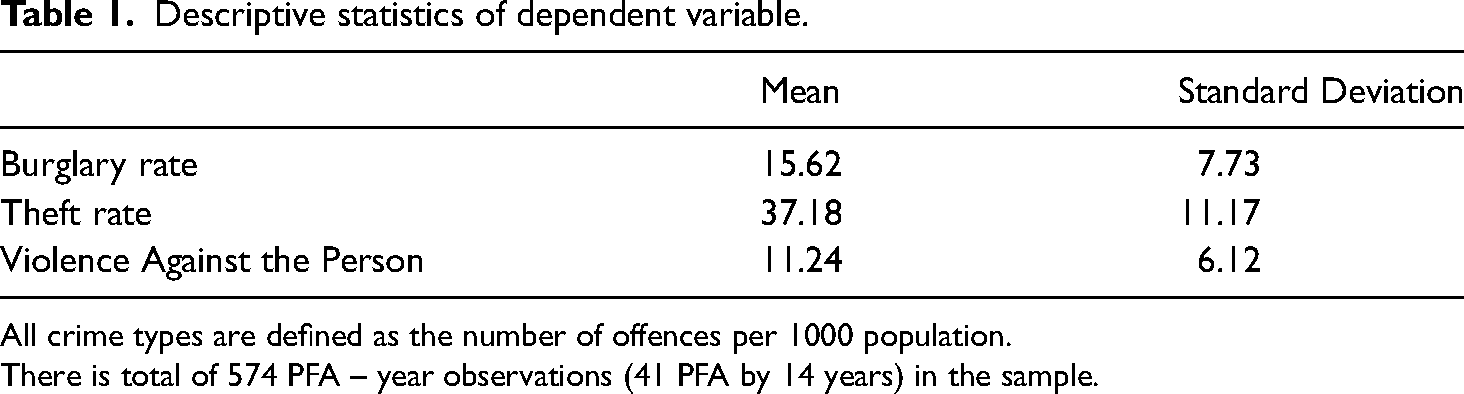
All crime types are defined as the number of offences per 1000 population.
There is total of 574 PFA – year observations (41 PFA by 14 years) in the sample.
For explanatory variables, we use detection rate to represent the certainty of punishment. The lower the detection rate, the lower is the certainty of punishment. Detection rates are available for all three crime types we are analysing and are obtained from the Home Office. Previous research leads us to expect a negative relationship between detection rates and crime rates (Abramovaite et al., 2019; Han et al., 2013; Von Hirsch et al., 1999). If detection rates increase, the expected gain from the criminal activity decreases as probability of getting caught goes up.
We use average sentence to reflect the severity of the punishment which is measured by the average time (given in months) offenders were sentenced to custody. This does not show the typical amount of time actually spent in the prison but it reflects the relative severity of the punishment in our analysis (Millie et al., 2003: 374; Padfield, 2012: 34; Padfield and Maruna, 2006). As with detection, average sentence data are available on all crime types and is available yearly at the PFA level which was obtained from the Ministry of Justice through a Freedom of Information request
We use the number of days on average an offender had to wait from offence to completion of court proceedings (acquittal or sentencing) as our variable representing the swiftness of the justice system. We call it the waiting time variable. It is available yearly at the PFA level and was also obtained from the Ministry of Justice through a Freedom of Information request detailing how many days on average offenders had to wait from offence to completion stage of proceeding.
We include several socio-economic variables as controls which are widely used in the literature because of their tendency to influence crime rates. Youth is the proportion of people aged 15 to 24 of the whole population in each PFA. Data are available from the Office for National Statistics at the local authority level and have been aggregated to PFAs according to each PFA's geographic boundaries. This was obtained by aggregating two age groups of people aged 15 to 19 and 20 to 24. We include proportion of youth in the population because of their disproportionate engagement with the criminal justice system. Youth Justice Statistics by the Ministry of Justice reports that in 2012–2013 there were 1.07 million arrests for notifiable offences in England and Wales, of which 126,809 were of people aged 10–18 years. That accounted for 11.8% of all the arrests while all 10–17 year-olds account for 10.5% of the total population of people liable for criminal responsibility in England and Wales. Young adults aged 18–25 make up 10% of total population but account for a third of those sent to prison each year (Prison Reform Trust, 2011, p. 45).
We use 25th percentile (lower quartile) of the wage distribution (Q25) to account for income inequality across England and Wales. These data are available yearly at the PFA level from the Annual Survey of Hours and Earnings. It can be argued that the increase in the lower quartile earnings could affect crime rates negatively due to less economic incentive to commit a crime with increases in income (Machin and Meghir, 2004). 3
Population density is the population per square kilometre. Data are available from Criminal Statistics and Crime in England and Wales published by the Home Office annually at the PFA level. The effect of the population density on crime could be ambiguous. More densely populated areas could have higher crime rates due to more opportunities for crime to take place (more people, more vehicles, more goods to be stolen). However, with more people being around, an offender might be more easily deterred by witnesses and a faster police response.
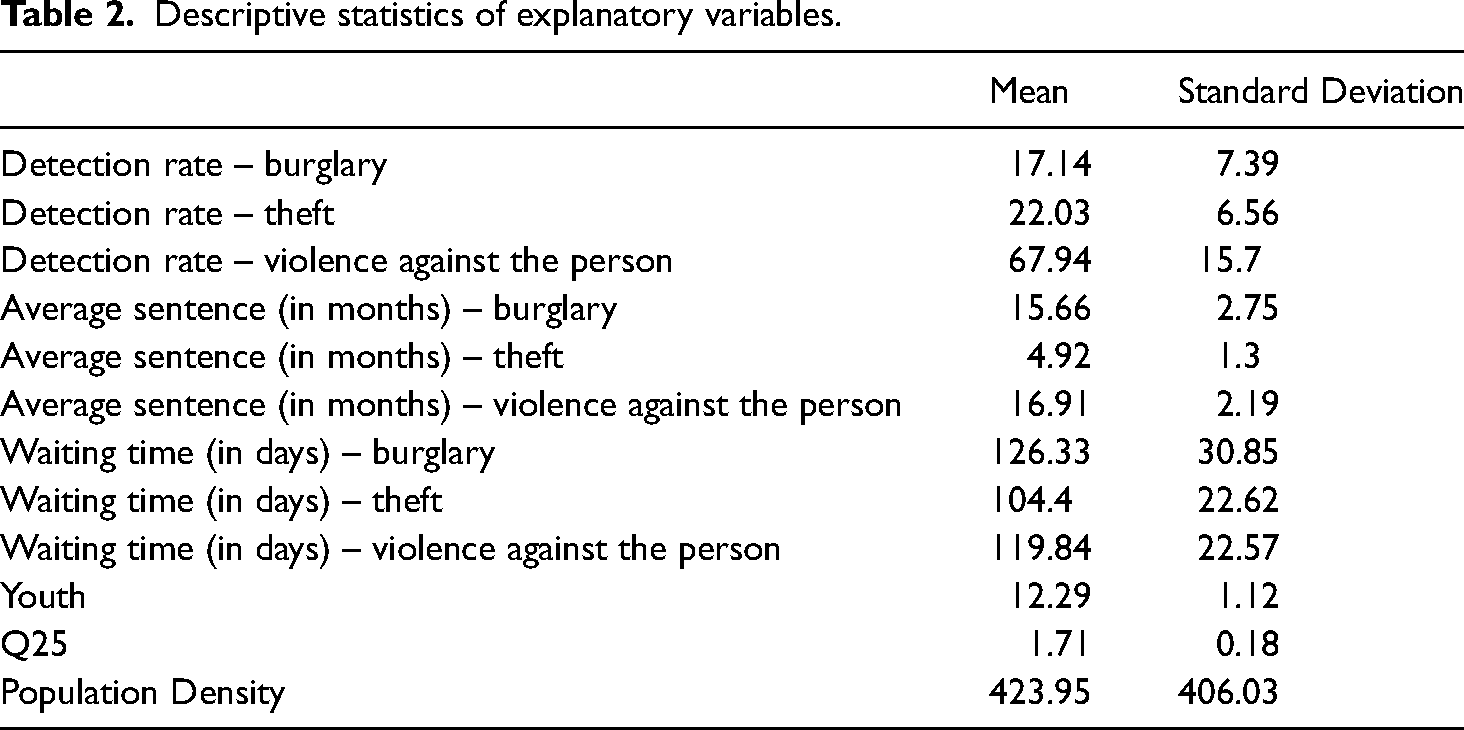
Descriptive statistics for all explanatory variables averaged for 1994–2008 period, are reported in Table 2 below.
Descriptive statistics of explanatory variables.
Our approach uses aggregate data to extrapolate from Becker’s (1968) economic model of crime which describes individual behaviour. Individuals are considered as rational decision makers who engage in criminal behaviour based on expected returns and costs from such activities. While individual-level data is preferable to aggregate data, it is often both difficult and expensive to obtain such individual level data. An ideal individual-level data set would need to cover a representative sample of the population of the area under study as well as a sufficient number of individuals so that the results would be statistically meaningful and generalizable.
There are primarily two ways such individual level data is collected. First, from social surveys focusing on individuals’ self-reported crime. Here biases can creep into the responses due to survey design leading to incorrect conclusions about the relationship between crime and criminal justice/socio-economic variables. Self-reported crime might not include more serious offences for which people are liable to be arrested; surveys truncate the response categories for the frequency of offences thereby masking the fact that often a relatively small number of participants commit a disproportionate number of serious offenses) (Pepper and Petrie, 2003). Secondly, one can collect data from criminal justice agencies only on individuals who were caught committing crimes. However, the costs of collecting such individual level data is usually prohibitive. This data would need to be joined with other administrative data to identify socio-economic indicators that impact crime for those individuals. Additional complexity arises with attempts to track a panel of sampled individuals over time across several decades – such panel data typically provides researchers with better capability to separate causation from correlation in non-experimental data sets.
Absence of reliable datasets of individuals’ criminal activities over time is one of the primary reasons for the popularity of using aggregate level data to validate the theoretical predictions generated by individual-level crime behaviour models. However, we are cognizant of potential misspecification biases. Aggregate-level studies assume a degree of homogeneity of population living within the aggregated units, for example a police force area. They implicitly assume that there is a non-zero crime rate probability for most individuals living in the PFA that is they are responsive to changes that are posited in the Becker model to affect individual behaviour. As Trumbull (1989) points out, a PFA's crime rate can be thought of as an aggregation of three distinct individual types: (1) those who would never commit crimes and whose behaviour is not affected by criminal justice variables; (2) those who are indifferent between committing crimes or not and hence enter or exit crime with changes in the criminal justice variables and (3) individuals who are beyond the point of indifference but whose frequency or type of crime is affected by changes in the criminal justice variables. If all individuals in the PFA were homogeneous and of type (3) there would be no aggregation bias. However, as long as type (3) are in the majority in the geographic region, aggregation bias would be minimal. Furthermore, certain variables like detection rate in our study are available at an aggregate level (e.g. PFA) and, therefore, it is more logical to examine the relationship at an aggregate level as opposed to individual level (Jacob, 2016). Aggregate data does not identify individual deterrence just as individual data does not pick up generalised deterrence, and we can think of these as complementary. Hence, while not without biases, we believe that the bias generated from aggregate data will not affect the direction of our results.
Econometric specification
We start our analysis by examining a linear relationship between crime rate and the three deterrence factors: Detection, which is used for Certainty; Average Sentence, which reflects Severity; and Waiting Time, which is used for the Celerity variable and various socio-economic variables. Our proposed empirical model is:
For detection, average sentence and waiting time variables, we use lagged values. There are two reasons why we do so. Firstly, theoretically, the offender's perception of risk and punishment (how likely they are to be caught, how swiftly they would be sentenced and how long they would spend in prison) will not adapt instantly to reality but gradually. Secondly, there is some time delay from when convictions happen and when the crime is committed.
Our goal is to obtain unbiased effects of the three C parameters – {β1, β2, β3}. There are two key econometric challenges to this task – (a) the potential correlation between each of the C variables and αi, the unobserved PFA characteristics; and (b) the potential correlation between detection rate and the error term (ε i,t .) due to detection rate possibly being a function of crime rate (‘reverse causality’).
Our first estimation uses a fixed effects model which takes care of the first challenge by eliminating unobserved area-specific time-invariant effects. However, there might also be a problem with the endogeneity of detection rate caused by reverse causality where detection rate could be a function of crime and that would lead to a correlation between detection and ε i,t . In other words, whilst detection rate could affect crime rate, crime rates can also influence detection rates – if crime rates go up, then fewer resources would be spent per crime investigation which in turn can lead to lower detection rates. To address this second challenge, we employ an Instrumental Variable approach (IV) fixed effects model in our second estimation. Finding a suitable instrument which correlated with detection but did not directly affect crime rates, can help us overcome potentially inconsistent estimates. Additionally, we use lags of these variables by one period (one year) which reduce the problem with potential reverse causality. To instrument the first lag of detection we use second lag of detection for each crime type plus lagged police expenditure.4 Police expenditure is a suitable instrument because, in England and Wales, this is determined by a Police Allocation Formula5,6 which is not directly determined by crime rates reported in each PFA but is based on various socio-economic variables that helps to predict the workload for the forces. Thus, unlike many other countries, police expenditure is not directly influenced by crime rates. In order to test for instrument validity and strength, we perform appropriate tests. Firstly, to test for the validity we check if the instruments pass Sargan's and Basmann's tests. Secondly, to check whether instruments are weak we check if they pass Stock and Yogo tests. All instruments passed both tests, therefore, our chosen instruments are valid and are not weak.
We believe that our measure of severity and celerity is exogenous in nature. For severity, local courts in England and Wales have traditionally had significant discretion when sentencing (Brownlee and Joanes, 1993; Pina-Sánchez et al., 2017; Tombs and Jagger, 2006, p. 806). For celerity, there is significant variation in average investigation and hearing times between different offences and importantly for guilty plea and not guilty plea trials which would affect waiting times. Furthermore, the biggest single reason accountable for a trial being recorded as ineffective (which means a delay and rescheduling for a future date) has been identified as court administration, as well as witness and defendant absences (Rossetti, 2015) all of which suggest a fair amount of exogenous variation.
Results and discussion
The empirical results are provided in the tables below. Table 3 gives results from the fixed effect model and Table 4 gives results using the Instrumental Variable Approach.
Fixed effects/ fixed time effects.
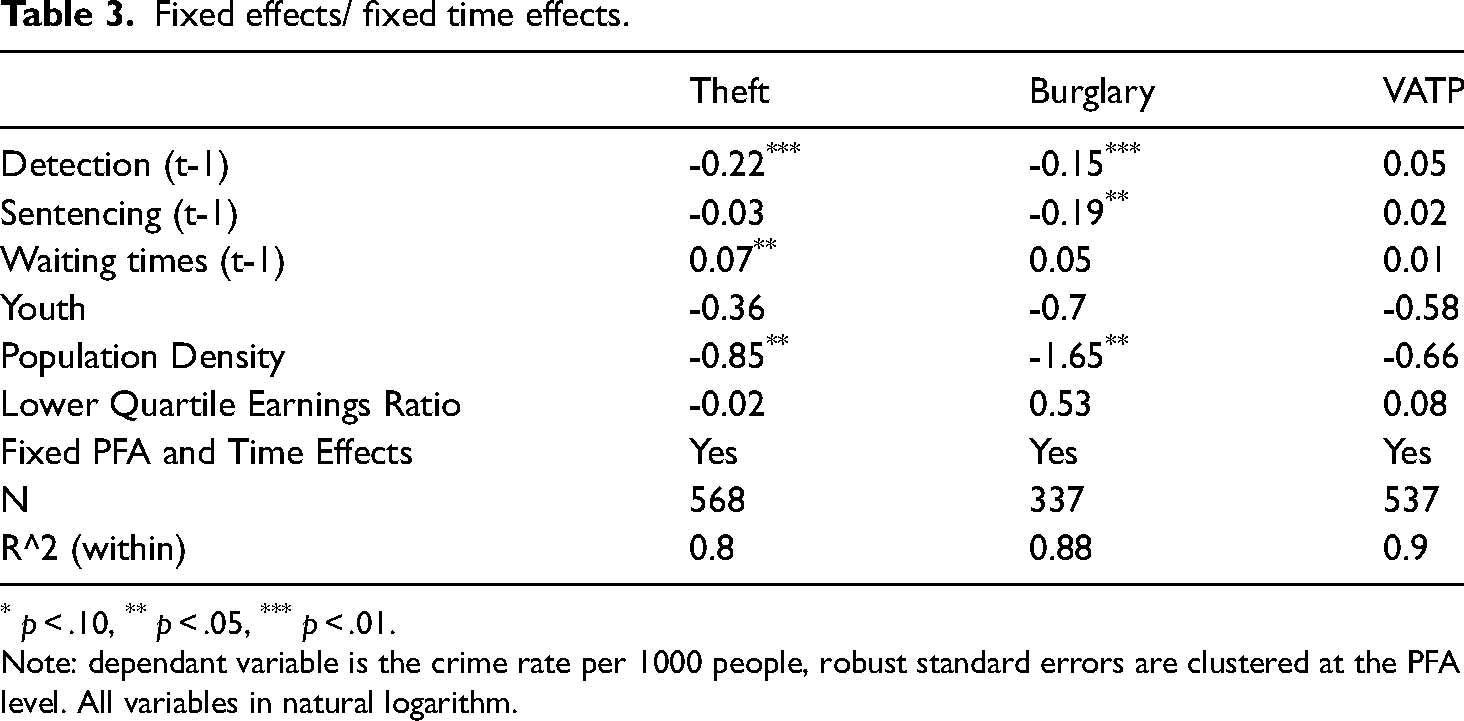
* p < .10, ** p < .05, *** p < .01.
Note: dependant variable is the crime rate per 1000 people, robust standard errors are clustered at the PFA level. All variables in natural logarithm.
IV/ fixed time effects.
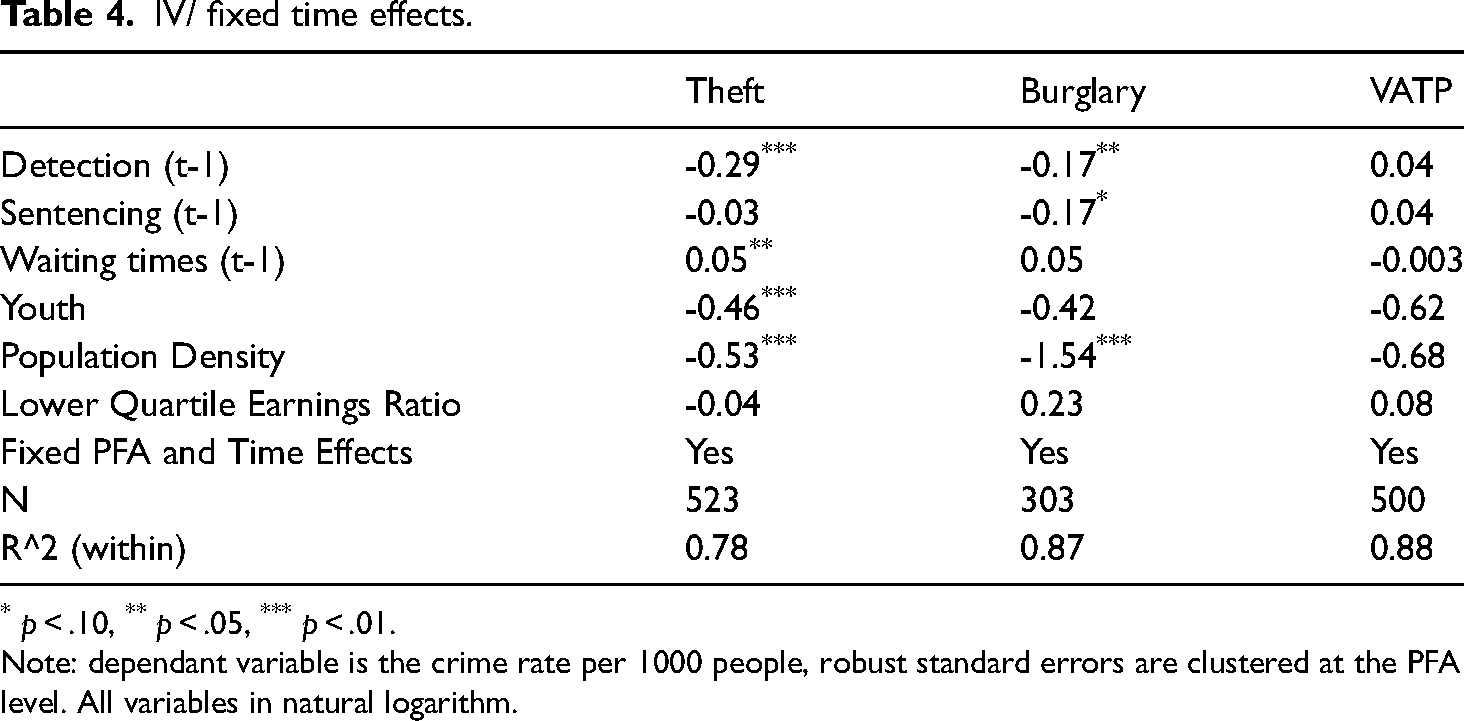
* p < .10, ** p < .05, *** p < .01.
Note: dependant variable is the crime rate per 1000 people, robust standard errors are clustered at the PFA level. All variables in natural logarithm.
For the fixed effects model, the lagged detection rate is statistically significant and consistently negative at the 1% level for theft and burglary but not violence. Lagged sentencing coefficients are significant for theft and burglary (which combined accounts for more than half of total crimes between 1994 to 2008 in England and Wales) and a 1% increase would reduce theft and burglary by 0.22% and 0.15% respectively. Lagged waiting time coefficients are significant and positive for theft, but insignificant for burglary and violence against the person. A 1% increase in waiting time would increase theft by 0.07%. This suggests, at least within the range of observable practice in England and Wales, that marginal changes in celerity of sanction can impact relatively high-volume acquisitive crime but not more serious offences. The socio-economic variables, apart from the impact of population density on burglary and theft, are insignificant. We now turn to the IV model.
The results using the instrumental variable model are similar in magnitude to the fixed effects model. Lagged detection rate is still statistically significant at 1% level for theft and burglary offences but not violence. Lagged sentencing remains statistically significant for burglary not theft or violence. The effects of waiting times remain the same and there is no significant effect on burglary or violence, but it is significant at the 10% level for theft. For socioeconomic variables population density has a significant and negative coefficient for burglary and theft rates at the 1% significance level. The presence of more youth is associated with a statistically significant reduction in theft. Thus, our findings using Instrumental Variable approach are close to the ones in the fixed effects model.
It is worth noting that as we are looking for significant effects against three dependent variables from three independent variables (essentially nine possible results) which raises the multiple comparisons problem (i.e. an inflated possibility of Type I errors). There are two common approaches to account for family-wise error rate: Bonferroni correction and Benjamini-Hochberg procedure. We have used the Benjamini-Hochberg procedure as it is shown to be less sensitive than the Bonferroni procedure to a researcher's decision about what is a “family” of tests. Based on Colquhoun (2014) we have assumed a false discovery rate of 15% for the Benjamini-Hochberg procedure. Our conclusions from the FE-IV results did not change even after we adjusted for the p-values using the Benjamini-Hochberg procedure.
Our interpretation of celerity on crime rates is that the impact of a longer wait for a sanction reduces deterrence at some margins for acquisitive crime, but not typically for violent crimes. Acquisitive crime is more likely to be committed with economic gain in mind and thus might be more amenable to discouragement through the prospect of penalties (Steele, 2015). Violent crime, by contrast, is more likely to be motivated by emotion and sensation-seeking rather than rational reflection and so is possibly not as responsive to harsher sanctions (Hayward, 2007: 237; Van Gelder, 2013). Moreover, the fact that average sentence length is insignificant for theft suggests that there could be more scope for reducing less serious offences through faster apprehension of offenders rather than using more punitive sanctions.
This plausible interpretation, however, needs to be considered against the emerging empirical literature on deterrence that considers all three measures. Our findings align with Mourtgos and Adams (2020) in highlighting the significance of celerity but depart from their results in terms of variation in offence types. Their results, based on county-level prosecution data in Florida from 2009–2013, finds that celerity (as measured by prosecution within one year) is associated with reductions in all subsequent types of crime events, including violence. Their measure for certainty (declined prosecutions) is statistically significant for most crime types, in line with the consensus in the literature, while their severity measure (reduced sanctions through plea agreements) does not produce statistically significant results which reflects the ambiguous connection between severity and crime reduction found in the literature (and our results). What explains the difference in our results on celerity and crime types? Mourtgos and Adams (2020) note that the strong relationship celerity has with crime reduction is non-linear, with diminishing marginal effects on crime as the proportion of cases dealt with promptly increases. It could be that within the range of our data for England and Wales, the waiting time for convictions for violence is generally beyond the point where an increase in celerity has an observable effect.
What are the practical implications of our results? Mourtgos and Adams (2020) focus on the role of prosecutorial policy in determining criminal justice outcomes. This is particularly salient in Florida (and most of the US) where there are directly elected prosecutors that are afforded substantial discretion in setting policy and how to handle individual cases. In England and Wales, however, neither judges nor prosecutors are directly elected and policy about when and how to prosecute is determined using government guidelines. Variation in celerity, therefore, is imposed by resource constraints on police, the Crown Prosecution Service, court staff, judges, magistrates and defense solicitors (Dehaghani and Newman, 2021; Godfrey et al., 2021). Our results have potentially important implications for the effectiveness of criminal justice, especially in England and Wales where reduced funding for criminal courts combined with the disruption of the COVID-19 pandemic have substantially lengthened waiting times for proceedings (Davies, 2021; Godfrey et al., 2021). Our findings suggest that disinvestment in the court system resulting in longer waiting times, besides delaying justice, could noticeably increase acquisitive crime in the future.
Conclusion
There is increasing scope for quantitative analysis to inform debates about crime prevention. This study provides an econometric analysis that enriches understanding of how the justice system affects different crime rates. In line with previous research, we find that detection plays a consistent role in reducing acquisitive crime, but that severity of sanctions is ambiguous. By contrast, for celerity, we find a significant relationship with theft (the most commonly committed crime in our sample), but not increased severity.
One possible extrapolation from Becker’s (1968) model is that increased severity should have the same impact as increased certainty, implying that costly enforcement of the law could be reduced in favour of higher penalties. However, the impact of increased severity is ambiguous according to our results, reducing burglaries but not theft or violence. It is possible that these elements of deterrence cannot be conceptually separated from each other and that their impacts need to be considered as one package (Howe and Brandau, 1988; Mendes, 2004; Mendes and McDonald, 2001). Some of these differences could reflect the variable impact of specific and general deterrence, and in particular, the difference between the experience of punishment and the future prospect of it. Lastly, it is important to keep in mind that criminals may be boundedly rational (i.e. human information-processing limitations place constraints on decision processes, see Johnson and Payne, 2014) and in particular may therefore react less to changes in length of punishment which is faced in the future rather than the immediate certainty of detection. Walters (2015) analyses such a framework that suggest that while there is a rational element in most crimes, criminals may react more to proximal rather than distal relationships which is why ‘get tough in crime’ policies do not often work in practice. This may explain for instance why sentencing length may matter less than certainty of detection suggestion that while deterrence can be achieved, it does not quite follow the strictly rational choice model postulated by Becker.
Footnotes
Declaration of conflicting interests
The author(s) declared no potential conflicts of interest with respect to the research, authorship, and/or publication of this article.
Funding
The author(s) disclosed receipt of the following financial support for the research, authorship, and/or publication of this article: This work was supported by the Economic and Social Research Council (grant number ES/J500057/1).
