



Abstract
This country survey examines the core Irish criminal justice institutions; basic trends in crime and punishment over the last 50 years; and critical junctures in the debate over law and order in recent decades. Using an earlier country survey by O’Donnell (2005a) as a baseline, it charts the significant growth of the discipline of criminology within Ireland. The article argues that Irish criminal justice retains a distinctively local flavour and highlights the promise of Irish criminology in many key areas of contemporary interest.
Introduction
Writing in this journal in 2005, O’Donnell (2005a: 99) delivered a bleak (though accurate) assessment of criminology as ‘Ireland's absentee discipline’. Nearly two decades later, the Republic of Ireland plays host to a range of undergraduate and postgraduate criminology programmes, a state apparatus that actively engages with research, and a thriving criminological community. The aim of this article is to chart the ‘rise and rise’ (Lynch et al., 2020: 1) of Irish criminology since the publication of the last country survey in 2005 as well as the reform that has been visited upon many of its key criminal justice institutions. The central argument is that, while in this important sense criminology and criminal justice in Ireland has come closer to the international norm, Irish criminal justice retains a distinctively local flavour. To this end, the article first provides a brief description of some of the core criminal justice institutions, with a particular emphasis on recent policy reforms, before examining some basic trends in crime and punishment over the last 50 years or so. Following a more detailed analysis of Irish penal policy, the final section draws on O’Donnell’s (2005a ) baseline assessment to map the recent growth of Irish criminology and identify some key research themes that ‘re-imagine’ the work of criminology from an Irish perspective.
Background
The island of Ireland is home to two jurisdictionsdating from the 1920s when the country was divided into the Republic of Ireland and Northern Ireland. 1 Given that Northern Ireland is a separate jurisdiction, with different criminological traditions and influences (Hamilton and Healy, 2016), this survey concerns itself solely with crime, criminal justice and criminology as it has developed in the Republic. As will become apparent, however, in a very real sense the thirty year conflict that unfolded in Northern Ireland between 1969 and 1998 has strongly influenced the way in which criminal justice was and is done in the Republic as well as in Northern Ireland (ibid).
In terms of political arrangements, Ireland has a bicameral parliamentary system with 166 members directly elected by the people to Dáil Éireann at least once every five years and an upper house (Seanad Éireann) consisting of 60 senators who are not directly elected. The head of state is the President who is elected by the people for a seven-year term. The proportionately larger number of elected representatives compared, for example, to the UK with 650 Members of Parliament (MPs) for a population of 67 million, has meant that politicians in Ireland are closer to their constituents than elsewhere. Combined with the vagaries of an electoral system that places parliamentarians (including Ministers) in competition with their party colleagues (as well as the opposition) this has been argued to encourage a clientelist form of politics and weaker bureaucracy that may have inhibited the ability of the system to deliver change (O’Donnell, 2011).
Criminal Justice Institutions
While Ireland derives its common law tradition from Britain it also shares features of the American model, such as the provision in the Irish Constitution to strike laws down as unconstitutional, with occasional dramatic repercussions for the criminal justice system. 2 The Constitution provides the broad frame for the hierarchy of criminal courts in Ireland including: District Courts in which minor cases (up to 12 months imprisonment) are tried; Circuit Courts where more serious (indictable) cases are heard before a judge and jury; and the Central Criminal Court which deals only with cases of murder, rape, and aggravated sexual assault, and is presided over by a judge and jury. Unlike in Britain there is no lay involvement in the administration of justice. A continued source of controversy is the juryless Special Criminal Court which was temporarily established in 1972 to deal with subversive crime connected to the conflict in Northern Ireland, but has since been repurposed for the trial of organised crime offences and certain republican splinter groups (Coen, 2021). Judges in Ireland are appointed by the President on the nomination of the government. The government is assisted in this task by a Judicial Appointments Advisory Board (JAAB) which prepares a list of suitable candidates. New legislation published by the government in 2020 aims at reforming this process, mainly through increased lay involvement, but has attracted criticism for the broad discretion retained by the government on appointments (European Commission, 2021). Irish judges have historically resisted attempts to constrain their discretion in making sentencing decisions, preferring what has been termed an unstructured or ‘instinctive synthesis’ approach (Maguire, 2016). Despite this, following the Judicial Council Act 2019, a Judicial Sentencing Guidelines Committee was established with a mandate to draft sentencing guidelines, an event that may well have been foreshadowed by the development from 2014 of sentencing guidelines by the Court of Criminal Appeal itself (O’Malley, 2014). As part of the same judicial reform, since 2020 every new judge is required to undergo formal training in ethics and unconscious bias.
A key piece in the infrastructure of the new Irish state, and somewhat unique in its history and function, An Garda Síochána, operates as a national police force with responsibility for national security and regulatory functions as well as domestic policing (Manning, 2012). The Irish police have continually enjoyed very high levels of public support and surveys report levels of satisfaction in excess of 90% (Hamilton and Black, 2019). Perhaps paradoxically, these ‘strikingly high’ levels of support have persisted in the absence of robust accountability bodies and in the face of a system of policing characterised by a high degree of informalism and discretion (Hamilton and Black, 2021; Mulcahy, 2016). The problematic nature of Irish ‘cop culture’ has been highlighted in a number of reports into Garda misconduct including the Morris Tribunal, the Barr Tribunal and the Charleton Commission. The most recent scandal, concerning the treatment of a whistleblower within the organisation, convulsed the force and resulted in the resignation of a slew of Ministers and high-ranking officials. The report of the Commission on the Future of Policing in Ireland (2018), another fallout from the scandal, has proposed sweeping new reforms including a new independent complaints body, the Policing and Community Safety Commission, which will supersede the current Policing Authority and the Garda Inspectorate. Another somewhat unusual feature of the Irish police is the fact that they conduct most District Court prosecutions, although change may be coming in this area in line with the Commission on the Future of Policing (2018: 29) recommendations. More broadly, prosecution decisions are taken by the office of the Director of Public Prosecutions (DPP), which is an independent body established in 1975. The DPP enjoys a discretion in deciding when to prosecute based on two principal factors: the strength of the evidence and the public interest. Her level of discretion is particularly striking in decision-making around so-called ‘hybrid offences’ (which may be tried with or without a jury), even more so where trial on indictment is directed as an alternative to a plea of guilty at summary level (Hamilton, 2007). Her discretion is also virtually unlimited in making a decision to transfer a case to the Special Criminal Court. While no inspectorate of prosecution exists, the DPP has moved towards greater transparency in recent years and, since the passing of legislation giving effect to the 2012 Victims Directive, victims now receive (on request) a summary of reasons for a decision not to prosecute.
There are currently 12 prisons in Ireland consisting of 10 traditional ‘closed’ institutions and two open centres which operate with minimal security. There are no security categories although one high security prison in the town of Portlaoise holds those involved in dissident republican groups and certain high-risk ‘gangland’ figures. As will be discussed further below, Ireland has consistently been ranked as a country with a low-moderate use of imprisonment. At the end of 2020 there were 3,665 prisoners in the system with a prison population rate of 73 (World Prison Brief, nd). Like the Gardaí, the penal system has been the subject of sustained and unprecedented critique in recent years, with a string of reports into its operation dating from the Thornton Hall Review Group in 2011 to the implementation reports of the Strategic Review Group on Penal Policy (PPRG) (Thornton Hall Project Review Group, 2011; PPRG, 2014; Houses of the Oireachtas, 2013, 2018). Strikingly, all of these reports recommended a reduction in the prison population and expansion of alternatives to custody (Rogan, 2016). Oversight of the system is also provided by an Inspector of Prisons whose office was placed on a statutory basis in 2007. One important deficit in the accountability structures for Irish prisons has been the absence of an adequate complaints system for prisoners. Following a 2016 recommendation from the Inspector of Prisons, the Office of the Ombudsman will be given a role in managing prisoner complaints, although at the time of writing this had not yet occurred.
In contrast to many other western jurisdictions where probation has come under intense scrutiny in recent years, the Probation Service in the Republic of Ireland has attracted little sustained attention and continues to operate within the framework set out by the Probation of Offenders Act 1907. Indeed, Healy (2015) has argued that for most of its history the story of probation in the Republic of Ireland has been one of continuity rather than change. Despite this, the emphasis on increasing the use of ‘effective’ and ‘credible’ community sanctions in the PPRG and other reports appears to signal an increased focus on this area in the future (Carr, 2016). New legislation, intended to replace the 1907 Act and strengthen the use of community sanctions in Ireland, has been approved by government since 2014 but remains at an early stage of development. The new bill also proposes a system for the inspection of probation services. Another point of divergence from international trends can be located in the field of youth justice. While other jurisdictions have pursued policies which have sought to ‘responsibilise’ young offenders (and their parents) and have resulted in higher custody rates and greater coercion in the community, the Republic of Ireland may be said to have pursued a very different path through its continued commitment to diversion and restorative justice (Convery and Seymour, 2016; Hamilton et al., 2016).
Trends in crime and punishment
Trends in recorded crime in Ireland have tended to lag behind those in other western jurisdictions, with steep rises in crime not evident until 1965 and from a much lower base. Similarly, the post-1990s decreases in crime witnessed in other developed countries did not take effect until several years later. The country's low imprisonment rate can be regarded as another point of divergence from the increases witnessed in some western jurisdictions in the decades spanning the 1970s to the early 2000s, despite doubts as to whether it can be sustained. The section below provides further detail on these trends.
Crime
Understanding of the criminal justice system in Ireland has been frustrated by a lack of good quality data, so that ‘any conclusions are weighed down with more than the usual number of caveats’ (O’Donnell, 2005a: 100). A complicating factor in this regard is a number of changes in the way that the recorded crime statistics have been compiled, creating breaks in the data series. In 2000, for example, the traditional distinction between indictable and non-indictable offences (meaning offences that can and cannot be tried by a jury) was replaced with ‘headline’ and ‘non-headline’ offences. The year before the introduction of a new computer system, Police Using Leading Systems Effectively (PULSE), for recording crime meant that the report for 1999 only included indictable offences for the first nine months of the year (Kilcommins et al., 2004). Finally, in 2006 the Central Statistics Office (CSO) took over responsibility for the publication of crime statistics from An Garda Síochána and in 2008 published the crime figures according to a new scheme called the Irish Crime Classification System (ICCS). The ICCS moves the focus away from an overall crime figure and presents crime statistics in 16 groups with a total figure provided for each group (O’Donnell, 2011). Crucially, it includes a range of less serious offences that were not included in the previous reports. These interruptions in the way in which crime has been recorded mean that data from earlier periods (particularly pre-2008) are not directly comparable with more recent data published under the ICCS.
In light of these limitations Figures 1 and 2 show crime trends in Ireland over a fifty year period (from 1969 to 2019, the most recent available), broken down into indictable/headline crimes (1969–2007) and recorded crime under the ICCS (2008–2019). It will be seen that the level of indictable crime has increased considerably since the late 1960s but from a very low baseline (Brewer et al., 1997a; Parsons, 2016). Crime levels spiked in 1983 and 1995, both years that recorded peaks in the number of people charged with non-indictable drug offences (Parsons, 2016). From 1996, however, recorded crime entered a period of sharp decline before rising again in the early 2000s, in all likelihood as a result of computerisation and other changes to the crime recording system mentioned above. ICCS recorded crime suggests that crime has decreased between 2008 and 2016, with a slight increase in subsequent years (Figure 2). This decrease in crime is supported by domestic victimisation surveys that suggest a reduction in victimisation rates in recent years. As can be seen in Table 1 the proportion of households stating that they had been victims of crime in 2015 was at its lowest level since the Crime and Victimisation survey began in 1998.
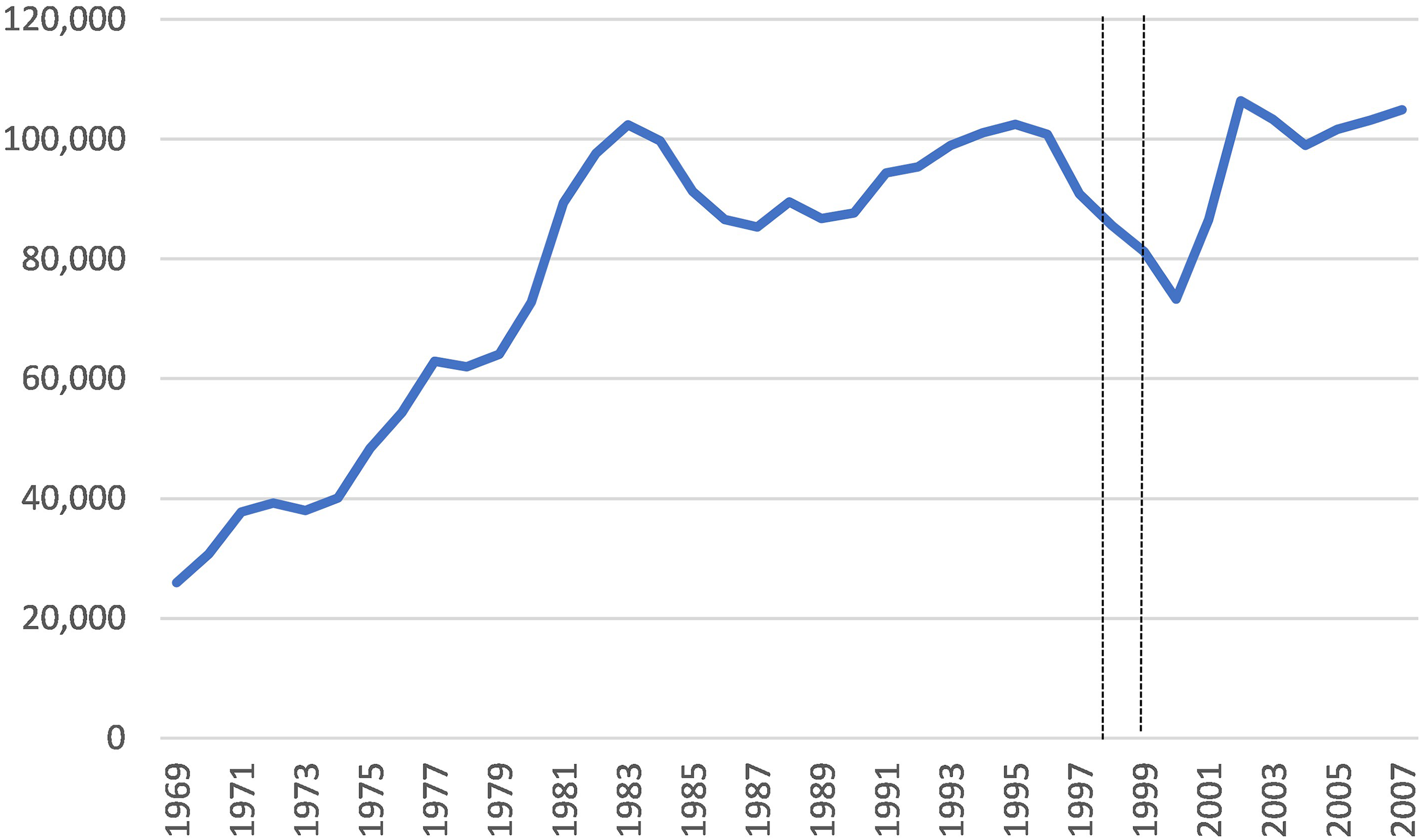
Indictable/headline crime in Ireland 1969–2007.
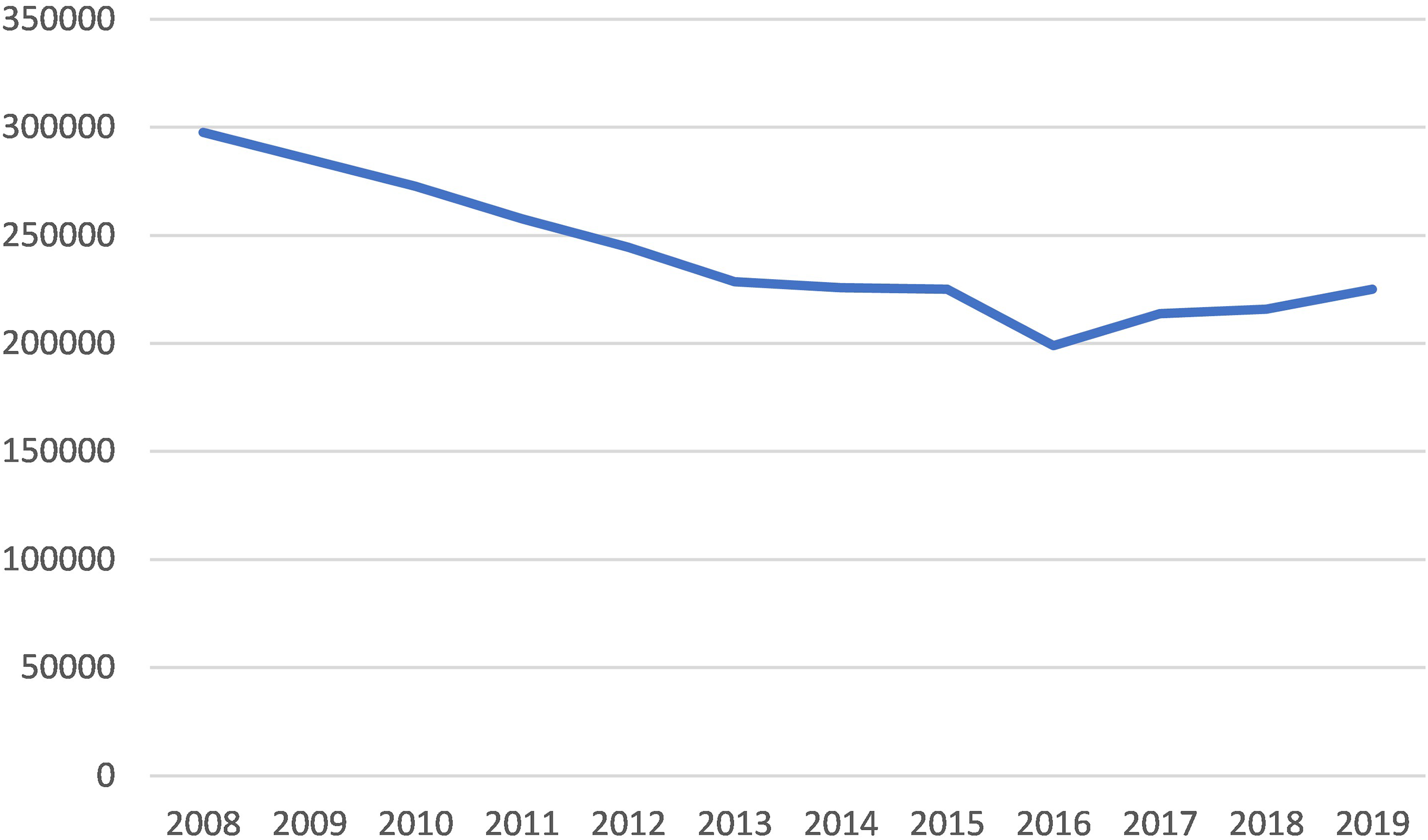
Recorded crime in Ireland 2008–2019.
Victimisation, quarterly national household survey.
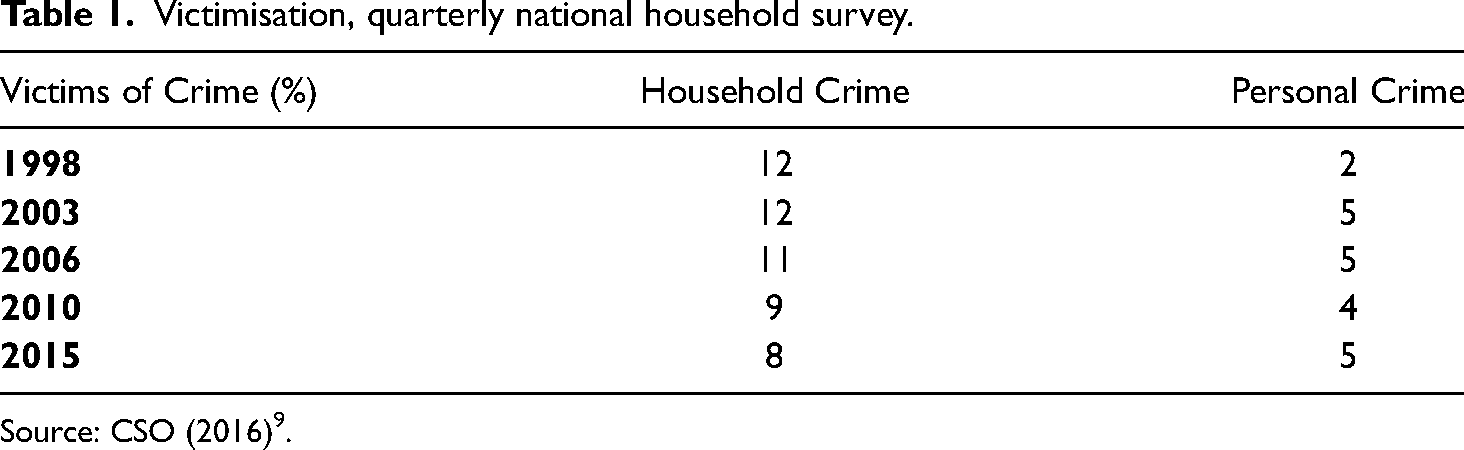
Source: CSO (2016) 9 .
While Ireland has traditionally been regarded as a low crime country (Adler, 1983), recent international comparisons of both police-recorded crime and crime victimisation surveys suggest it is mid rather than low ranking. Parsons (2016) observes that in the 2010 and 2014 edition of the European Sourcebook Ireland was higher than the mean for all crime types except robbery. Similarly, in the 2004/05 sweep of the International Crime Victimisation Survey (ICVS), Ireland was considerably above the average of all ICVS countries for all of the crime types considered (assaults, robbery, burglary, theft of a car, thefts of personal property) (van Dijk et al., 2007). Indeed, among the 18 member states of the European Union (EU), the ICVS authors identify Ireland as one of five countries where levels of crime were most elevated (the others being the United Kingdom, Estonia, the Netherlands and Denmark). Reporting rates were also below the average of all ICVS countries for assaults, robberies and other thefts of personal property (ibid).
Turning now to the composition of crime in Ireland, offences appear to be primarily against property rather than people (Brewer et al., 1997a). In 2000, for example, the combined groups of larceny, burglary and robbery made up 88% of the total number of headline offences. While this figure has decreased to 42% in 2019 (see Figure 3), this is largely a function of the change to the ICCS system and the inclusion of a range of less serious offences such as public disorder related offences (Parsons, 2016). That said, it should be noted that the drop in the overall level of crime in the mid-late 1990s masked significant increases in violent crime, sex and drug-related offences (Hourigan et al., 2018). Indeed, by 2001 Ireland had one of the highest rates of drug consumption per person in Europe and prevalence rates for cocaine, amphetamines and opiate use remain high compared to other European countries (Kilcommins et al., 2004; European Monitoring Centre for Drugs and Drug Addiction (EMCDDA), 2019). This leads on to an issue that has attracted much attention domestically, namely, the growth of organised criminal gangs in urban areas such as Dublin and Limerick and their role in propagating violence as a means of controlling people and drug markets (Campbell, 2010; Hamilton, 2018). This problem has been exacerbated by the existence since the signing of the 1998 Good Friday Agreement of violent dissident Republican (VDR) groups who have continued, both north and south of the border, the Republican tradition of organised criminality (Hourigan et al., 2018). While violent organised crime is notoriously difficult to identify and measure, it is worth noting a steady increase in the number of homicides using firearms since the 1970s, rising to one in three of all homicides between 2003 and 2013 (Dooley, 1995; Skedd, 2016). This has occurred against the backdrop of a declining homicide rate, which has been falling since 2007.
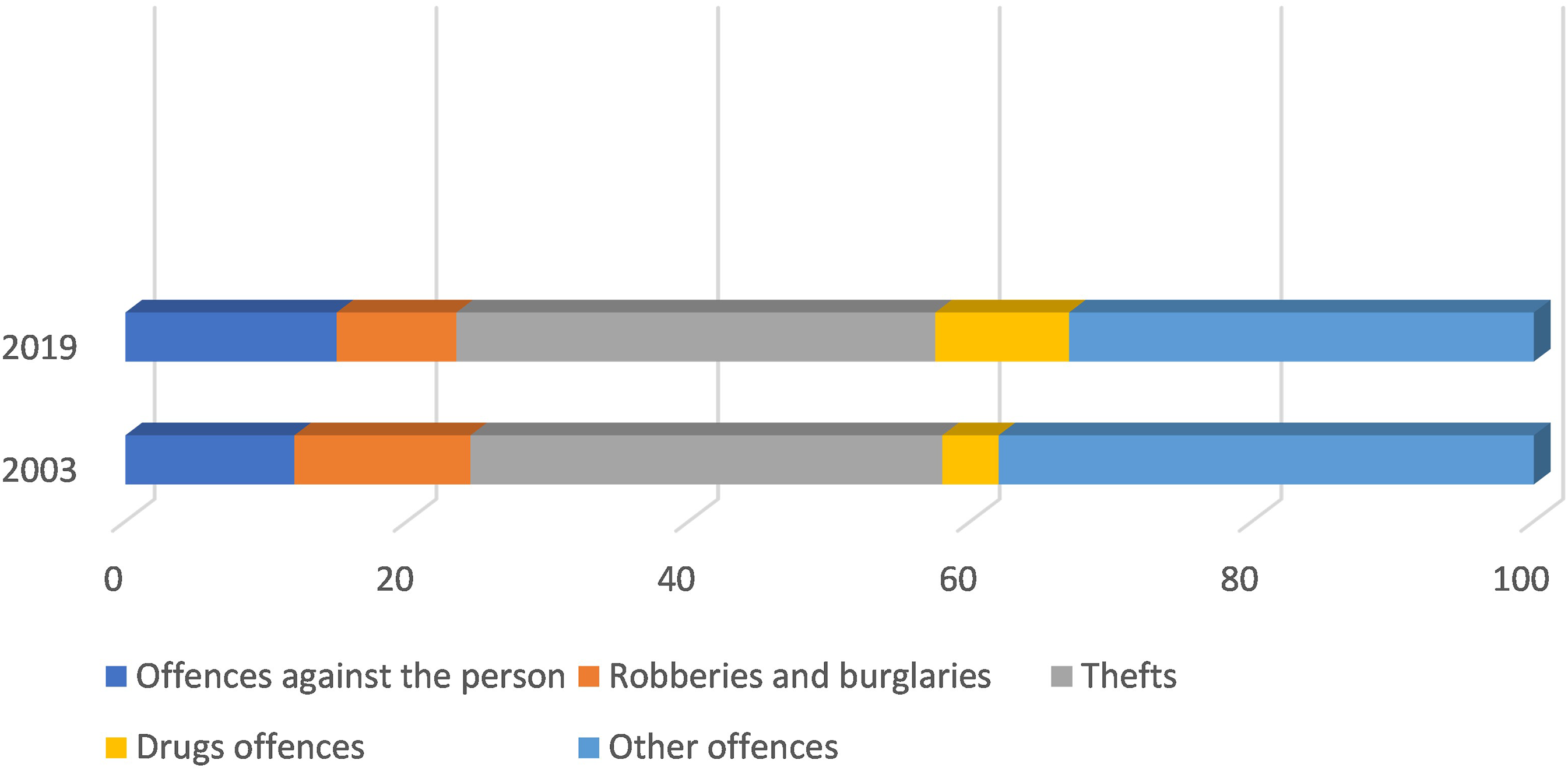
Composition of ICCS-recorded crime in 2003–2019.
Punishment
In comparative terms, Ireland's imprisonment rate of 73 per 100,000 in 2020 is low. As can be seen from Figure 4 our detention rate is much closer to that of the Nordic countries such as Finland (75) than countries using imprisonment more heavily such as the UK (130). However, this does not provide a complete picture of the use of imprisonment in Ireland for a number of reasons. First, when the rate of prison entry or ‘flow’ of prisoners through the system is examined, rather than the number of prisoners detained on any given day, Ireland appears at the higher end of the scale. In a recent report by the Council of Europe, Ireland's rate of entries stood at 356.3, the fourth highest in the EU (Aebi et al., 2019: 31). The disparity between the detention and prison entry rates can be explained by the heavy reliance on short sentences of imprisonment in Ireland. According to the same report Ireland's average term of imprisonment was 2.9 months, one of the shortest in Europe (ibid: 33). This is a problem that persists in Ireland despite the recent enactment of legislation requiring judges to consider community service in lieu of prison sentences of less than 12 months and to curb the use of imprisonment for fine default. The second point to note in contextualising the use of imprisonment in Ireland is that the imprisonment rate has significantly increased in recent decades, albeit from a low base. Indeed, in the period from 1997 to 2002 alone, imprisonment rates increased by 35% (see Figure 5). While it is difficult to know the precise drivers of these ebbs and flows in Irish penal policy, Hamilton (2014a; b) has pointed to the dramatic increase in numbers receiving longer sentences (two years or more) as a factor in this explaining the upsurge in the mid-1990s (see also, O’Donnell, 2005b). Conversely, the recent downturn in imprisonment rates does not appear to be driven by shorter sentence lengths, but rather to be related to significant declines in committals under sentence and the use of custodial remand (O’Donnell, 2017). The lack of clarity around drivers has led to uncertainty over whether the current decline in imprisonment will be sustained, particularly given the susceptibility of penal policy to domestic events, to which we now turn (O’Donnell, 2020a).
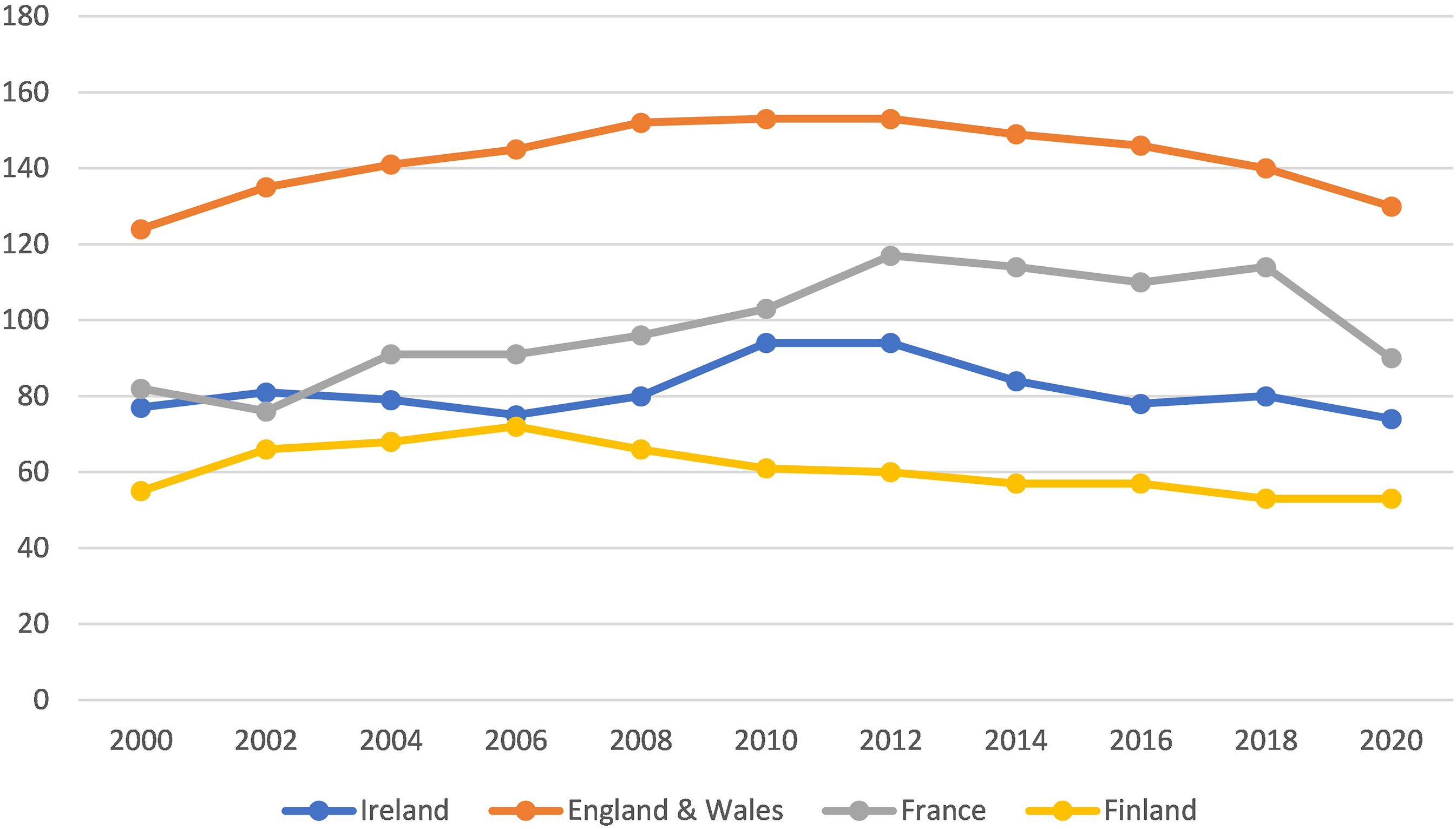
Imprisonment rates in selected European countries 2000–2020. Source: World Prison Brief, Aebi et al. (2019) 8 .
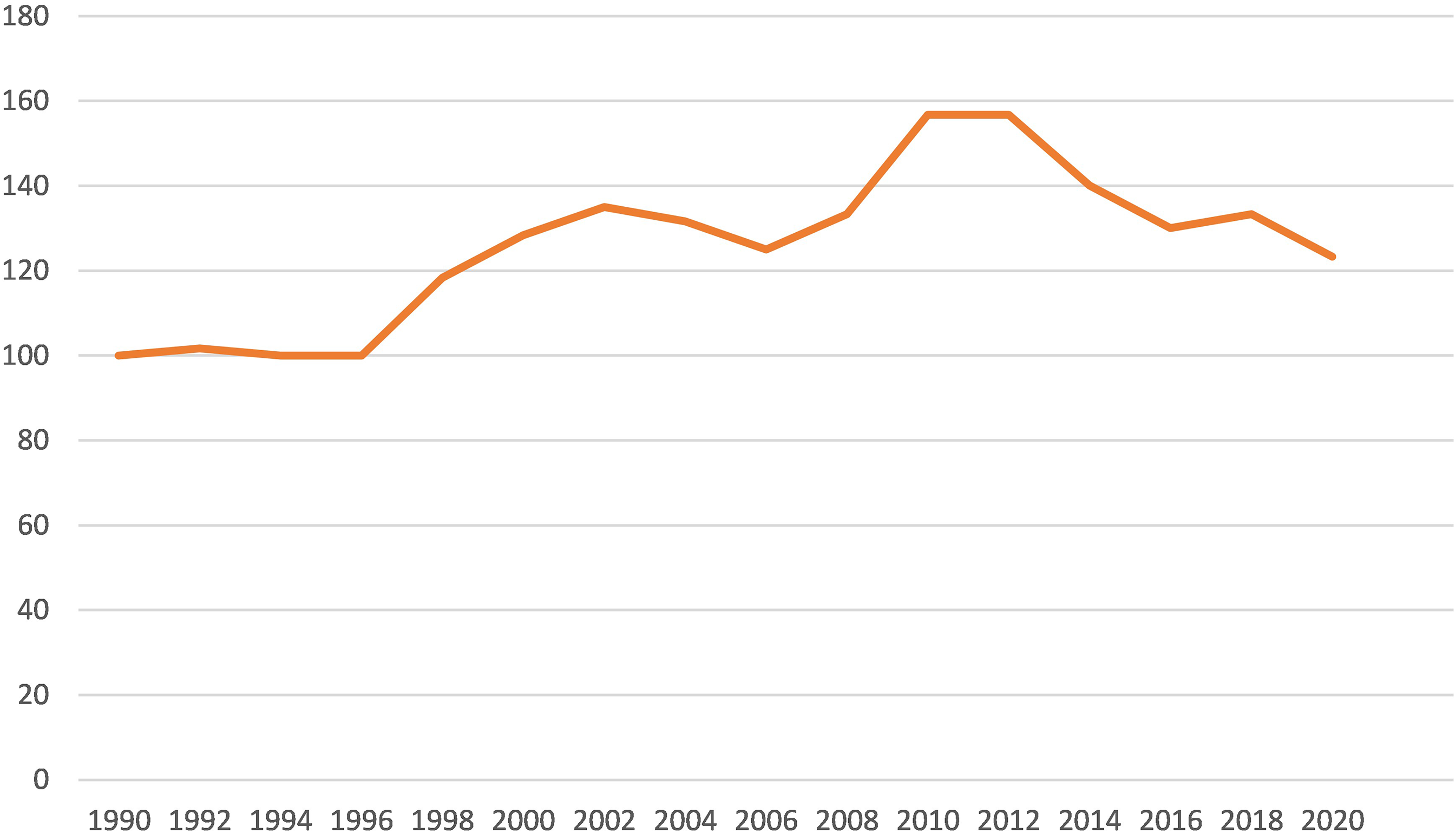
Imprisonment rates in Ireland 1990–2020 using 1990 as an index year.
The political landscape: Crime crises, economics and ‘policy windows’
The distinctive features of Irish criminal justice and crime trends identified above find a resonance in the Irish political landscape where the Irish penal story does more to deny than to confirm any ‘flattening’ of national or local differences due to globalisation (Muncie, 2011). Indeed, the Irish case demonstrates that even in today's globalised society distinctive local conditions and reactions to exogenous shocks continue to exert a crucial effect on policy outcomes. Thus, it was the homegrown problem of organised crime in 1996 that was the catalyst for Ireland's ‘punitive moment’ (Brangan, 2022) in the late 1990s, spurred on by a buoyant economy, and it was the leftward shift in Irish politics precipitated by the 2008 economic and political crisis that heralded a new, more progressive penal policy.
Penal policy before 1996
The historically low crime rates discussed above meant that Ireland made a relatively ‘late entry’ as a crime conscious society (Rottman, 1984). Even with the emergence of the heroin epidemic in Dublin in the 1980s crime did not significantly feature in the seven general elections from 1977 to 1992 with economic issues such as unemployment and forced emigration dominating party manifestos (Hamilton, 2014a). In marked contrast to other jurisdictions where the issue of crime became highly politicised in the 1980s, Kilcommins et al. (2004: 136) found that ‘in every general election between 1981 and 1992, the problem of crime was a low priority for voters’. That said, there were distinct signs in the 1990s that things were beginning to change. Increased attention to crime issues in the Dáil, 3 the increasing pace (and complexity) of legislation in criminal justice matters, and the production of policy papers such as The Management of Offenders: A Five Year Plan all point to the increased political salience of crime in the 1990s, thereby setting the stage for the events of the summer of 1996 (Hamilton, 2014a).
1996–2006
The Summer of 1996 can be regarded as something of a watershed in Irish criminal justice policy. In June 1996 investigative journalist, Veronica Guerin, was shot in broad daylight by a group of major Dublin criminals who had been linked to illegal drugs trafficking. Three weeks earlier on the 7th June policeman Jerry McCabe had been shot by the Irish Republican Army (IRA) during a robbery in Adare. The reaction to these two murders was swift and unambiguous with a special sitting of the Dail and a £54 million ‘anti-crime package’ providing for more gardaí, prison spaces and several radical reforms of criminal procedure. Among these changes was the creation of the Criminal Assets Bureau utilising an ‘unquestionably draconian’ (King, 2017: 16) non-conviction based asset forfeiture model that is regularly used as an exemplar of best practice in other jurisdictions. All told, the killings became ‘defining moments in the debate about law and order in Ireland’ and crime control was catapulted to the forefront of national priorities (O’Donnell and O'Sullivan, 2003: 48). In 1997, an election year, 41 per cent of people polled indicated that ‘crime, law and order or justice’ should be the main issue on which the parties should fight the campaign. A further 88% felt that the government was losing the fight against crime. Having fought the 1997 on a law and order platform, the new Minister for Justice, John O’Donoghue, delivered on his promises. Between 1996 and 2000, the Garda and Prison Votes were increased by 42 and 43% respectively (O’Donnell and O'Sullivan, 2003) and in 1999 legislation was enacted providing for a presumptive minimum sentence of 10 years for the offence of trafficking drugs worth over £10,000 (€13,000). In a dramatic policy change, the number of additional prison places required was also revised upwards by a factor of ten in the space of three years, from 210 in 1994 to 2000 in 1997 (O’Donnell, 2011).
The tone of the debate on criminal justice changed again with the accession of Progressive Democrat 4 Michael McDowell to the role of justice Minister in 2002. The announcement in August 2004 that two new ‘superprisons’ were to be built in Cork and Dublin together with the publication of a controversial Criminal Justice Bill in 2004 made clear McDowell's intentions to initiate change. Some of these policies clearly owed their origins to Anglo-American legislation such as the provisions to allow for the electronic tagging of offenders and anti-social behaviour orders, while others appeared as a response to domestic crises over organised crime. Overall, it is fair to say that the political climate further hardened during the period 1996–2006; a product of two conservative Ministers for Justice, a number of ‘crime crises’ and opposition parties that now appeared more willing to play the ‘crime card’. The lack of sustained attention to the crime issue, however, was not suggestive of dramatic transformations in penal policy of the sort that Garland (2001) and Simon (2007) describe. Moreover, as is often the case in Irish criminal justice, a number of contradictory currents can be detected. During this same period, a drug court and several restorative justice projects were established and a Children Act introduced which is widely regarded as progressive in nature.
2007 to 2021
In the years following Michael McDowell's resignation in 2007, policymaking processes appeared to move away from the ‘bullish’ approach to prison policy of the 1990s and early 2000s (Rogan, 2013: 12). Decision making in the area was also less ad hoc with an emerging ‘focus on developing a long-term and strategic direction for the penal system in the Republic’ (Rogan, 2016: 444). Much of this can be attributed to the tumultuous 2011 election, which saw Fianna Fáil, long the dominant party in Ireland's political landscape, 5 severely punished by the electorate for their poor handling of the economic crisis, and a concomitant increase in the proportion of the vote going to left learning parties. While these parties did not form a new government, leading to charges of ‘electoral change’ but ‘political continuity’ (Little, 2011), the strong signal sent by the electorate in 2011 ensured that reform remained high on the political agenda. Indeed, Rogan argues that this leftward shift in the political complexion of the opposition provided critical ‘political cover for policymakers to say tough things about the prison system’ (2016: 445).
Much of this ‘tough talk’ emanated from the new Minister for Justice, Alan Shatter, who assumed the portfolio following the election. While Shatter himself belonged to Fine Gael, sometimes described as the traditional party of ‘law and order’ in Ireland (O’Donnell and O'Sullivan, 2003), he was also an energetic reformer who very much sided with the liberal rather than the conservative wing of his party (McGee, 2014). Shatter, as Minister, established three commissions: a strategic review group of penal policy, a review group examining the question of mental health and the criminal justice system, and a review group to examine the plans for Thornton Hall (the ‘superprison’ proposed by McDowell which was never built). The commitment to penal reductionism evident in these reports, and decline in imprisonment rates between 2011 and 2016 (O’Donnell, 2017), stands in stark contrast to the failure of the promised new direction in penal policy in the United Kingdom (UK) in the post-recessionary period (Cavadino, 2013). While Kenneth Clarke's cost-cutting reforms of the prison system in the UK found themselves ‘stymied by political forces, the media and populist punitiveness’ (ibid: 5), they were largely met in Ireland with a surprising degree of consensus (Rogan, 2013: 13). The comparison points up the singular nature of Irish politics as they have unfolded in recent years and, more broadly, to the difficulty in assuming economics is as powerful a force determining government policy as is often assumed.
Criminology in Ireland
The above discussion begs questions about the relationship between policy/practice and the academic study of criminology in Ireland. Absent the strong criminological tradition that exists in other small jurisdictions in Europe (e.g. Belgium, Switzerland, and the Netherlands), Irish criminology has developed at a much slower pace and with a lesser emphasis on quantitative data, statistical modelling and aetiological explanation (Tonry, 2016). Moreover, unlike England and Scotland, where state funding supported research institutes and the work of pioneering scholars, the discipline has emerged largely independently of the state (Bowling and Ross, 2006; McAra, 2008). Indeed, the country's failure to embrace criminology as a standalone discipline (at a time when it was ‘booming’ elsewhere (Bosworth and Hoyle, 2011) can be viewed as perhaps one of its greatest departures from international trends (Hamilton and Healy, 2016). In his 2005 article O’Donnell (2005a, 2005b: 99) described criminology in the Republic of Ireland as an ‘absentee discipline’ on the basis that: (i) there was only one dedicated academic post in the field; (ii) the quality of criminal justice data was poor; (iii) state support for criminological research was scarce; (iv) there were no specialist journals or societies; and (v) indigenous scholarship barely made ripples in national or international debates. Applying those indicators today it is clear that Irish criminology has, in many regards, long thrown off its Cinderella status.
Significant cause for optimism can be found in the proliferation of posts in criminology, the first of O’Donnell's criteria. Criminology formalised as a field of academic study in 2000 when the first Institute of Criminology was established at University College Dublin (UCD), though this contained only a single dedicated academic position (O’Donnell and O'Sullivan, 2003). From this low base, Hamilton and Healy (2016) estimate some years ago that there are approximately eighty academics actively engaged in criminological research on the island (i.e. including Northern Ireland). Moreover, a much larger number of dedicated lecturing posts in criminology now exist, across a range of higher educational institutions such as Maynooth University, the Technological University of Dublin and University College Cork. The opening up of these positions in recent years marks an important milestone for a field whose graduates very often had to leave the island to pursue careers in criminology in various UK institutions (and indeed many still do). To a significant degree the increased number of faculty has been led by the high demand for the subject among students, with Lynch et al. (2020) counting 54 honours degree programmes with a criminological component, and between 900 and 1000 students enrolling each year on these programmes. That said, large student numbers can also act as a pull on the time available for research and there remains a need to balance the needs of an ever increasing student population with opportunities for research (O’Donnell, 2020b).
The quality of criminal justice data has also seen significant improvement in recent years, although important gaps in knowledge remain, combined with concerns about the reliability and validity of the data. As noted above, the CSO assumed responsibility for the compilation of criminal justice statistics from 2005 and has published crime statistics according to a new classification system since the third quarter of 2006. While this has brought greater levels of transparency, particularly around technical detail, a number of problems have been identified in recent years in relation to PULSE data (Garda Inspectorate, 2014; CSO, 2015). The net result has been that since 2017 the quarterly crime statistics have been published ‘Under Reservation’ indicating that the quality of these statistics do not meet the standards required of official statistics published by the CSO.
Related to this is the third criterion regarding state support for criminological research which, as noted, has historically been found wanting in Ireland. In sharp contrast to the ‘Platonic guardians’ (Loader, 2006) who acquired ascendancy in post WW2 Britain, the Department of Justice has traditionally been ‘sceptical of, if not hostile to, researchers’ (O’Donnell, 2020a). As in other areas of Irish criminal justice, however, recent critical scrutiny of organisational cultures in the Department of Justice has resulted in a new receptiveness to change and openness to evidence-based policy (Hamilton, 2019). At least partly in response to the publication of a highly critical report into the performance and management of the Department of Justice (Toland, 2014), the Department has launched an ambitious new Data and Research Strategy which aims to embed within the Department and the wider Justice sector a strong culture of research, analysis and evaluation (Department of Justice, 2018). As stated by a former Secretary General this will involve the Department building its internal capacity in these areas, but also partnering with stakeholders in academia and civil society (O’Driscoll, 2019). One of the key outputs of the Strategy is a rolling research programme with ring-fenced funding and regular calls for tender on priority thematic areas. Three years into the Strategy, areas of focus have tended to mirror those in other jurisdictions, namely, evaluations (community safety partnerships, multi-agency offender management programmes) and evidence reviews (cybercrime, public confidence, victims’ experiences of the justice system). Research tenders have also been issued by other, recently established, accountability or oversight bodies such as the Policing Authority and the Sentencing Guidelines Information Committee, joining more established funding streams from the Irish Research Council and European funding bodies. Such developments are likely to be welcomed by Irish criminologists, who, despite leanings towards social and critical theory, appear to share a consensus about the importance of criminology having a policy impact (Griffin, 2020; Lynch et al., 2020: 5; Rogan, 2020).
Perhaps the area where innovation has been least apparent is in relation to O’Donnell's penultimate criterion, what may be termed the disciplinary ‘infrastructure’ in Ireland (Hamilton, 2020). It is still the case that there is no Irish Society of Criminology and no journal with which it is formally associated, resulting in many Irish criminologists becoming members of the British Society of Criminology (BSC) or European Society of Criminology (ESC). That is not to say that national fora do not exist for Irish criminologists to meet and exchange ideas. The Association for Criminal Justice Research and Development (ACJRD), in existence since 1996, organises regular events with a particular focus on facilitating exchange between academics and criminal justice professionals in a more informal setting. Likewise, an informal cross-border network of criminologists has also grown up around the holding of the annual North-South Criminology Conference, last hosted very successfully in University College Cork in 2019 (Hamilton and Healy, 2016).
Despite the existence of this vibrant and engaged criminological community, Irish scholarship has not always featured strongly in international debates, the last of O’Donnell's indices. Lending weight to claims of a ‘theory’ as well as data ‘deficit’ in the Irish criminological landscape (Maruna, 2007: 981), a review of publications in this journal between 2004 and 2012 found that there were no contributions by Irish authors (Smith, 2013, cited in Lynch et al., 2020). While Ireland may not be unusual in this regard (a tally reveals that during the same period 11 EU countries had three or fewer articles), O’Donnell’s (2005a, 2005b) arguments continue to find a resonance in the relative paucity of work with a clear policy focus that is not jurisdiction specific. On research that draws on the Irish case to make broader theoretical points, however, the field is much stronger, with Irish criminologists offering vital perspectives in several areas of importance as indicated below. Indeed, perhaps testament to the original and highly innovative work that is being is done in this area, both the 2020 BSC Book prize and Brian Williams prize were won by Irish criminologists and graduates of the Technological University of Dublin's (TUD's) pioneering Masters programme in criminology which commenced in 2006. 6 In an effort to delineate a little more clearly areas where Irish criminology has made its mark internationally, the following section offers up some areas where Irish criminology can be said to have pushed at the boundaries of the discipline.
The Challenge of Irish Criminology to criminological research
Challenging and Reconceptualising Penality
A particularly active area of criminological research in Ireland is prisons and penal policy, with a large body of critical work applying Garland's (2001) ‘culture of control’ thesis to the Irish context. 7 While the research differs in focus, it coheres around the idea of ‘Hibernian exceptionalism’ to broader punitive trends, ranging from the continued emphasis on rehabilitation (Healy and O'Donnell, 2005), to the ‘individuated’ nature of sentencing practices (Vaughan and Kilcommins, 2008), to the humanitarianism that continues to characterise the penal system (O’Donnell and Jewkes, 2011) (see also Campbell, 2008; Rogan, 2011). A seminal text in this regard is Crime, Punishment and the Search for Order in Ireland, written by Kilcommins et al. (2004), which takes Garland's thesis as its analytical frame. Through meticulous historical analysis, the book highlights the critical differences between Ireland and jurisdictions such as the UK and the United State (US), including the more ‘diluted and distinct’ culture of control evident in contemporary policy and practice. These studies are important in the challenge that they present to universalistic claims of punitiveness, not simply because they advance arguments of the ‘it hasn’t happened here’ variety (Hallsworth and Lea, 2008), but also because they illustrate the complexities thatoften inhere in the penal field. Griffin and O’Donnell’s (2012: 625) account of parole in the Republic of Ireland, for example, does well to remind us that flexible and informal criminal justice systems such as Ireland's may also play host to inflationary penal practices.
Beyond the use of the Irish experience to interrogate international theories, an important sub-strand of this research concentrates on the meaning and conceptualisation of punishment while challenging the use of imprisonment rates as a proxy for penal harshness. Prime among these is the work of O'Sullivan and O’Donnell (2007, 2012) on historical levels of ‘coercive confinement’ in the Republic of Ireland. Their detailed examination of the rapid decline in the numbers detained in a range of institutions ‒ psychiatric hospitals, mother and baby homes, Magdalene homes, reformatory and industrial schools as well as prisons and borstals in the latter decades of the twentieth century – provides an important new perspective on the meaning of punishment and exclusion. Indeed, the significant downsizing over this period of the ‘captive’ population (eight times higher in 1951 than in 2002) turns on its head Garland's arguments about the emergence of a late modern ‘culture of control’. The argument also holds much contemporary relevance given criminology's historical neglect of new forms of confinement such as detention and deportation centres (Aas and Bosworth, 2013), as well as its relative inattention to the ‘various forms of confinement around the world which do not “meet the standards” of imprisonment as seen through the prism of western theory’ (Aas, 2012: 13).
In similar vein is comparative work conducted by Hamilton (2014a, 2014b) which argues for a more holistic understanding of punishment than is usually implied by the use of a single measure, namely, imprisonment rates. The advantage of such a ‘multidimensional’ approach, as Hamilton (2014b) contends, is not only a better reflection of the offender's journey through the criminal justice system, but the recognition that it affords distinct ‘crime control signatures’ and the fact that different dependant variables may be more or less relevant in different societies. Hamilton’s (2014a, b) research compared Ireland with New Zealand where the ‘get tough’ movement has concentrated on the ‘back end’ of the system, (i.e. on the use of imprisonment) with little attention given to ‘front-end’ reforms, (i.e, increases in police powers and erosions in the rights of defendants). Conversely, and perhaps unsurprisingly in a country accustomed to wide ranging police powers in countering terrorism, the Republic of Ireland has maintained relatively low rates of imprisonment in international terms, while the rights enjoyed by suspects have been increasingly curtailed. The issue therefore holds great importance for comparative criminology in particular in preventing comparison (on unidimensional measures) of the most punitive aspects of one system with the least punitive aspects of another system.
Southern theory and critical decolonial criminology
Following on this first ‘wave’ of criminological scholarship in Ireland, more recent writing has brought critique and fresh perspectives to these more established accounts of crime and punishment in Ireland. Brangan (2021, 2022), for example, has taken issue with the framing of Irish penal policy as a series of ‘absences’ or periods of ‘neglect’ (Behan, 2018; Kilcommins et al., 2004; O’Donnell, 2008), arguing that the problem is one of ‘visibility rather than absence’. On this view, Hibernian exceptionalism actually represents a wrong turn in the depiction of Irish penal policy, built as it is on a reading of Irish penal history ‘from the centre’. Adopting a post-colonial or southern perspective, Brangan (2021) has suggested that the ‘recovery’ of Ireland's penal culture, including revealing its aims and ambitions, may provide us with new, progressive ways to imagine our future. Drawing on her research into Irish penal culture in the 1970s, Brangan points to a distinctively Irish approach whose aims are driven by ‘humanitarian values, a deep scepticism of the prison and a belief that the community, and not the prison, was a superior form of social control and reintegration’ (Brangan, 2021). In her view, this form of ‘pastoral penality’ saw experts in the system acting as shepherds seeking to strengthen prisoners’ familial and social bonds and their moral connections to ‘the flock’, rather than treating their individual transgressions or recovering them from criminality. Other writing in this vein has similarly rejected arguments that Ireland is in some sense playing ‘catch up’ with other western jurisdictions (Healy and Kennefick, 2019: 14) and instead sought to establish how express and taken-for-granted perceptions and beliefs (including beliefs about gender) shaped a distinctively Irish penal system (Black, 2018; Fischer, 2016; see also Hamilton, 2013). The post-colonial as a relatively new frame of analysis has also stimulated debate on the intersections between transitional justice and post-colonial legacies in Ireland, including the ability of transitional justice to adequately make amends for the harms of colonialism (see, e.g., Rolston and Ní Aoláin, 2018).
Preventing Violent Extremism (PVE) and Desistance
In a very real sense, the influence of the conflict in Northern Ireland extended beyond the Northern Irish criminal justice system and into crime control in the Republic. Irish academics have written at some length about the ‘chilling effect’ of political violence on media reporting south of the border (Black, 2016); a closed and secretive civil service culture, partly driven by fear (Rogan, 2016); and a preference for strong ‘front-end’ crime control measures as administered by the police (Hamilton, 2014a, 2016). Given high levels of political unrest on the island, Ireland has very often been held up as a a ‘testing ground’ for the extension of authoritarian powers through the use of repressive technologies and policies soon to be transplanted elsewhere and thus a country from which ‘negative’ criminological lessons can be drawn, (Hillyard, 1985). A more sanguine assessment could also highlight the positive lessons of conflict and its resolution, (such as innovative developments in policing, see Mulcahy, 2005), including the degree to which the political context provides ‘space’ or a ‘camouflage’ for innovation and resistance within criminal justice (Carr, 2015). One example of the unique approach taken by both the prison and probation services in the Republic of Ireland during the conflict is in relation to the manner in which radicalisation into violent extremism was responded to, namely, by purposefully placing themselves apart from the security driven framework within the field (O’Donnell, 2011). As Lynch (2017: 86) has argued, in Ireland ‘[t]he issue of radical ideology was and is tangential to the treatment of individuals by the criminal justice system in Northern Ireland and the Republic of Ireland both pre- and post-sentencing. There is no suggestion that there should be any effort to de-radicalise these individuals’. Indeed, despite a Europe-wide shift towards a Countering Violent Extremism/Preventing Violent Extremism strategy that seeks to reduce radicalisation, this approach still dominates the prison and probation service response to political violence. Such an approach is reflective of the broader Irish perspective that views terrorism and political violence not as a pathology, whose aetiology must be ‘discovered’, but as part of the fabric of society, to be understood in relation to a country's history, culture and politics (Lynch et al., 2020). It also stands in stark contrast to the contemporary approach to radicalisation to violent extremism that has been severely criticised for its preoccupation with risk and blurring of the lines between ‘deradicalisation’ and ‘desistance/disengagement’ (Braddock, 2018; Horgan and Braddock, 2010). Indeed, as Maruna (2020) points out, in Ireland we are a ‘desisting nation’, with many individuals released from prison after the signing of the Good Friday Agreement apparently disengaging from terrorism without deradicalising.
Restorative Justice
Linked with the idea of conflict providing ‘space’ for innovation, the very strong tradition of restorative justice in Northern Ireland, both in grassroots efforts to control crime (McEvoy and Erikkson, 2006) and in the youth justice field, has exerted a magnetic pull on developments in the Republic (Marder, 2019). Pilot projects using restorative processes have been used in the Irish criminal justice system since the late 1990s but the ‘institutionalisation’ of the concept has gathered pace in recent years with the passage of the Children Act 2001, a National Commission on Restorative Justice in 2007, and the launch of the new Restorative Justice and Victim Services Unit within probation (O’Dwyer and Payne, 2016). In particular, and perhaps unsurprisingly given the succession of revelations about sexual crime perpetrated in the Church institutions and in communities, Ireland has been at the forefront of research on the use of restorative justice in cases of sexual violence (Joyce and Keenan, 2013; Keenan and Zinsstag, 2022). Marder (2019) argues that the potential for restorative justice to become the ‘default’ response to offending in Ireland is great, building on elements of Irish criminal justice culture that are sympathetic to a restorative approach, such as the (postcolonial) tendency towards informal and individualised justice (Hamilton, 2019). Maruna (2020) similarly strikes an optimistic note about the future of restorative justice in Ireland, arguing that this is an area where Ireland, together with other small countries such as New Zealand, are leading the way. This is arguably borne out by the rise of a focus on victimology within certain criminology departments such as the Centre for Crime, Justice and Victim Studies in the University of Limerick.
Emerging ideas
In addition to the above, more established research areas, the growth of the discipline in Ireland has seen the social scientific lens belatedly brought to bear on several previously neglected areas of Irish social life, such as the role played by the Catholic Church in the emergence and concealment of child sexual abuse (Keenan, 2012, 2016) and the growth of organised crime groups in Ireland's marginalised communities. Hourigan's (2011, 2016) pioneering work on organised crime in the mid-West region in Ireland, for example, identifies close kinship and family ties as a key locus of identity for marginalised young people and thus a way in which young people in disadvantaged communities can be drawn into criminality. As she writes, the degree to which Irish organised crime shares such ‘amoral familialism’ with other organised crime groups, such as those in Italy, Asia and Africa, clearly merits further research (Hourigan et al., 2018). Other fruitful areas for research concern the extent to which historical distrust of the state and the police has facilitated ‘feuding’ and ‘faction-fighting’ between Irish criminal gangs and the complex relationships that exist between gangs, dissident paramilitary groups and the state. In Ireland, as elsewhere, the plurality of actors involved in policing ‘from below’ as well as ‘from above’, and the manner in which they are accommodated by the state, may well provide valuable lessons for theory construction more broadly.
Conclusion
While now the subject of much critique, ‘Hibernian exceptionalism’ does appear a particularly apposite lens through which to consider crime, justice and criminology in Ireland. In many ways, divergence rather than convergence continues to characterise Irish criminal justice, whether through its clientelist political system; high levels of public confidence in the police; low rates of imprisonment; or progressive youth justice system. In similar vein, penal policy, while far from insulated from external factors, appears to be strongly influenced by local political dynamics. This aligns Ireland with a number of small jurisdictions in Europe - Slovenia, Scotland, Sweden, Finland, Norway, Denmark, – that have carved out a distinctive path in criminal justice policy, with many of them located (rather interestingly) in the North Atlantic (Brangan, 2020; Flander and Mesko, 2016; McAra, 2005; Pratt and Eriksson, 2013). What continues to set Ireland apart, however, is its relatively unique position as a post-colonial jurisdiction within Western Europe, something that cannot be disregarded in understanding the distinctiveness of Irish criminal justice culture (see, e.g., Hamilton and Black, 2021 on post-colonialism and policing).
As Brangan (2020) and other authors have argued, however, there remain dangers in such a ‘reading from the centre’, not least the risk that Ireland, together with other ‘exceptional states’, will be further peripheralised as outside the mainstream. Despite the significant growth of criminology in Ireland since the 2005 country survey, therefore, the intention is not simply to show how Ireland has fallen into line with developments internationally. Rather it is to highlight the beginnings of new approaches to justice that ‘re-imagine’ the work of criminology from an Irish perspective (Maruna and McEvoy, 2016). As illustrated above, Irish criminology, forged in the crucible of political conflict, holds much promise in many key areas of contemporary criminology, whether (among other things) ‘recovering’ humanitarian values, revisiting the reach and nature of punishment, or decoupling desistance from deradicalisation. The next chapter in the history of Irish criminology will no doubt have much to tell.1
Footnotes
Acknowledgements
The author would like to thank Dr Lynsey Black, Dr Orla Lynch and Dr Ian Marder, as well as the anonymous reviewers, for their helpful comments on an earlier draft of this article. All errors remain the author's own.
Funding
The author(s) received no financial support for the research, authorship, and/or publication of this article.
Declaration of conflicting interests
The author(s) declared no potential conflicts of interest with respect to the research, authorship, and/or publication of this article.
