



Abstract
The current study investigates the association between physical child maltreatment and juvenile delinquent behavior in the context of the Situational Action Theory (SAT) (Wikström, 2006, 2017, 2020). Self-control, morality and exposure to criminogenic settings are proposed as possible mechanisms explaining the association between physical child maltreatment and adolescent offending. The hypotheses are tested in a subsample of the third wave of the International Self-Report Delinquency Study (ISRD3), a large international non-clinical study on delinquency and victimization among adolescents. The final sample consists of N = 24,956 adolescents aged 12–16 years from nine West European countries. While controlling for dependence due to nested data and several covariates, the models are tested for overall offending and separately for violent and property offending. Results confirm that physical child maltreatment is associated with the main concepts of SAT (lower self-control; lower morality; and more exposure to criminogenic environments), which in turn are associated with juvenile delinquency. The models show partial mediation for overall offending, property offending and violent offending. The findings provide support for the theoretical prowess of SAT and its main concepts: self-control, morality and exposure to criminogenic settings as mediators in the well-established physical child maltreatment/delinquency link. These findings are consistent with the ‘cycle of violence’ perspective and contribute to the theoretical clarification of the mechanisms involved in the child maltreatment/delinquency link. The findings fail to confirm a ‘crime-specific propensity’. The article concludes with a discussion of implications for prevention.
Introduction
There is solid evidence that physical child maltreatment results in a wide range of problems that last into adulthood and include internalizing (e.g., depression, anxiety, posttraumatic stress symptoms) and externalizing problems (behavior problems, aggression and delinquent behavior) (e.g., Adams, 2006; Edwards et al., 2003; Norman et al., 2012; Smith and Thornberry, 1995). Child maltreatment refers to ‘actual or potential harm to the child’s health, development or dignity in the context of a relationship of responsibility, trust or power’ (World Health Organization, 2014: 82) and consists of several forms. Physical maltreatment 1 of children by parents and caretakers can be either direct or indirect. Direct maltreatment refers to the child actually being hit, slapped, kicked or punched, whereas the witnessing of violence between family members is considered as a form of indirect maltreatment. The effects of indirect violence (witnessing violence) may be as severe as the effects of direct experiencing violence (e.g., Kitzmann et al., 2003). One of the most frequently studied negative effects of parental child maltreatment is the increased chance that the child will get involved in delinquent and violent behavior at a later age (Braga et al., 2017), often captured by the concept of ‘the cycle of violence’ (Widom, 1989). This association has been confirmed in a wide range of studies and meta-analyses using both prospective and retrospective designs (e.g., Braga et al., 2017; Farrington et al., 2017; Fitton et al., 2018). Many studies have tried to better understand the association between child maltreatment and delinquent outcomes in youth, but the exact mechanisms remain unclear. Therefore, there is a need to explain this frequently confirmed relationship between child maltreatment and delinquent behavior.
Theories linking child maltreatment and later delinquent and/or aggressive behavior have drawn from mainstream criminological theories such as social learning theory (Bandura, 1977), social control theory (Hirschi, 1969) and General Strain Theory (Agnew, 1985, 1992). All are examples of theories designed to explain the causes and correlates of delinquent behavior. A relative newcomer in the development of delinquency theories is the Situational Action Theory (SAT; e.g., Wikström, 2004, 2009, 2014). SAT combines individual and environmental perspectives as a framework for explaining delinquent behavior. The main concepts in SAT are personal characteristics (i.e., self-control and morality, which are key factors of crime propensity) and environmental characteristics (i.e., criminogenic exposure). In SAT, delinquent behavior is the outcome of a perception–choice process consisting of the interaction between criminal propensity and exposure to criminogenic environments. The individual and social factors that shape or influence propensity and criminogenic exposure (the ‘causes of causes’ according to SAT) remain a relatively unexplored terrain in need of further study (Wikström, 2014; see Schepers, 2017, for an example). We aim to explore how child maltreatment is related to delinquency via the main SAT concepts (crime propensity and exposure). A true test of the hypotheses that child maltreatment is a ‘cause’ (or antecedent) of crime propensity or criminogenic exposure requires a longitudinal design, whereas our current data are cross-sectional, which will be described in the next section. Therefore, the theoretical model that we aim to test in this study must be viewed as a heuristic aid rather than a true causal model. For that reason, we are hesitant to use causal terminology in this article. This article addresses the need for theory testing and the need to look beyond risk factors of delinquency (Wikström and Treiber, 2017) by integrating the key concepts of SAT as a framework to better understand the well-studied association between child maltreatment and adolescent delinquency.
Maltreatment–juvenile delinquency link
For decades, scholars have focused on the association between childhood maltreatment and antisocial or delinquent behavior in adolescence and adulthood and findings seem to confirm this relationship. Despite large variations in research designs, methodologies, populations and conceptualizations (Maas et al., 2008; Malvaso et al., 2015), most studies show evidence for an increase of general delinquent behavior (Farrington et al., 2017; Park et al., 2012; Smith and Thornberry, 1995; Wilson et al., 2009) and violent delinquent behavior (Braga et al., 2017; Fitton et al., 2018; Kokkalera et al., 2018; Maas et al., 2008; Manzoni and Schwarzenegger, 2019; Steketee et al., 2019) in juveniles with a history of child maltreatment. Studies generally show a modest relationship. It must be noted, however, that the majority of children exposed to parental violence do not show antisocial or delinquent behavior. Meta-analytic evidence demonstrates that effect sizes are largely dependent on the research design – cross-sectional studies show larger effect sizes (d = .88) than prospective designs (d = .31). The same goes for the type of exposure to violence (direct exposure, d = .61; witnessing of violence, d = .15) (Wilson et al., 2009). According to Savage et al. (2014), the impact of physical maltreatment does not seem to be specific for violent behavior. However, in a meta-analysis of 33 prospective longitudinal studies, Braga and colleagues (2017) showed that physical abuse is more strongly associated with violent outcomes than with general antisocial acts. As other scholars found effects of child maltreatment on property crime, but not on violent crime (Cronley et al., 2015), there is mixed evidence for the effect of child maltreatment on a specific type of offense. For this reason, we will distinguish between general offenses, violent offenses and property offenses in the current study.
Situational Action Theory
SAT was developed to address common shortcomings in criminological theories and builds upon – and intends to integrate within the context of a (situational) action theory based framework – key relevant main insights from disparate criminological theory and research as well as relevant theory and research from social and behavioral sciences more generally. In SAT, criminal behavior is considered a moral action and is defined as ‘acts that break rules of conduct stated in law’. According to SAT, criminal acts are situational and are established by a perception–choice process that connects personal characteristics to the characteristics of the environment (Wikström, 2017). Basically, criminal involvement depends on who a person is (is a person prone to criminal behavior?) and where this person is situated (does an environment elicit crime?). The personal characteristics for offending are identified as one’s crime propensity, the tendency of a person to see and choose crime as an action alternative in particular circumstances, depending on an individual’s personal morals and the ability to exercise self-control (Wikström and Treiber, 2017). Personal morals refer to a person’s moral rules regarding what is wrong or right to do in certain circumstances and determine the kind of action alternatives an individual considers in a certain situation: when an individual does not consider crime as an action alternative, it is not likely for this person to get involved in crime. Furthermore, self-control determines how well a person can direct action in accordance with their personal morals when experiencing motivations that are conflicting with his or her own morality.
Besides the crime propensity of a person, human behavior is dependent on the criminogeneity of a setting or environment, which is the extent to which offending or criminal acts are encouraged (e.g., low supervision by authorities or parents), determined by its moral norms and rule enforcement. SAT specifies that the immediate cause is shaped by the interaction between the crime propensity and exposure to settings with criminogenic features in a perception–choice process also shaped by habits and deliberation. To be more specific, individuals with high propensity to crime are more likely to get involved in criminal behavior when in a criminogenic setting (because people are less resistant to settings’ criminogenic inducement). Similarly, a low crime propensity would not result in criminal behavior (crime is not regarded as an action alternative), even when an environment is highly criminogenic.
Wikström refers to the psychosocial processes of moral education and cognitive nurturing that shape criminal propensity, and the socioecological processes of social- and self-selection that drive stability and change in criminogenic exposure (Wikström, 2014, 2020). Factors influencing or shaping these social- and self-selection processes should be analyzed as ‘the causes of causes of crime’ because they affect the perception–choice process causing crime (Wikström, 2014). These are ‘lifelong processes (causal chains) in which current states (propensities, exposure) are a result of past developments (influences) at the same time as they set the stage for future developments (influences)’ (Wikström, 2020: 195). Moral education refers to the continuous learning and evaluation process by which people come to adopt, modify and change value-based and emotionally grounded rules of conduct about what is the right or wrong thing to do or not to do in particular circumstances. A central mechanism of moral education is observation of others’ actions and their consequences. Child maltreatment might change the moral norms of a child (Toth et al., 2000; Wang et al., 2017), because violence or norm-breaking behavior is regarded as an adequate way of dealing with problems.
Furthermore, child maltreatment reflects poor cognitive nurturing (the second component of the psychosocial processes important for shaping propensity), likely affecting neurocognitive functioning and resulting in a lower ability to exercise self-control and inhibitory control on both the behavioral and the emotional level (Cowell et al., 2015; Lovallo, 2013; Pears et al., 2010; Stevens et al., 2016; Walters, 2018). Finally, child maltreatment might influence self-selection processes and affect the exposure to criminogenic environments because children and adolescents with a negative situation at home might avoid being at home and spend more time with (delinquent) peers in environments with lower supervision by parents or authorities (Pels et al., 2011) and show more risky behaviors such as school absenteeism (Hagborg et al., 2018; Slade and Wissow, 2007).
The potential impact of child maltreatment on propensity and criminogenic exposure is captured very well in the statement that ‘experiences of being a victim of crime, or witnessing a crime event, (or repeated such experiences) may also have some significant influences on a person’s future law-relevant personal morals (i.e. increase or decrease their crime propensity) and tendency to seek out or avoid criminogenic settings (e.g. avoiding certain places through increased fear of victimisation)’ (Wikström, 2020: 198). From the theoretical framework of SAT, child maltreatment is a likely factor preceding delinquent involvement by (1) influencing crime propensity (through lowering self-control and teaching pro-violent norms) and (2) exposure to criminogenic environments (through abused children’s tendency to want to avoid spending time at home). Although the link between child maltreatment and, respectively, children’s low self-control, positive evaluations of pro-violent norms and higher exposure to criminogenic environments has been established in several studies, to our knowledge no prior studies have evaluated these factors simultaneously in the theoretical framework of SAT in the context of child maltreatment.
Current study
The aim of the current study is to contribute to the theoretical understanding of the relationship between physical child maltreatment and juvenile delinquency from the perspective of SAT. The indirect effect of child maltreatment on juvenile delinquency via self-control, morality and the exposure to criminogenic environments will be assessed in a large international sample of students aged 12 to 16 years. Self-control and morality will be treated as separate mediators to investigate the influence of child maltreatment on both dimensions of crime propensity. It is hypothesized that the positive direct association between physical child maltreatment and adolescent delinquency is mediated by self-control, morality and the exposure to criminogenic environments, regardless of the type of offense. More specifically, we expect that parental maltreatment is associated with lower levels of self-control and morality and higher levels of exposure to criminogenic environments, which in turn are associated with higher levels of juvenile delinquency. Furthermore, Wikström argues that people’s crime propensity may vary depending on the crime in question (e.g., some people may be prone to theft but not to rape) and the criminogeneity of a setting may vary depending on the crime in question (Wikström, 2014). For example, children whose moral education includes apparent positive evaluation of violent behavior by parents may be more inclined toward violent delinquency rather than property delinquency; violence might be regarded as an action alternative, whereas theft is not an option. The current study allows us to explore this claim that people may vary in their crime-specific propensities (Wikström, 2020: 194) as a result of child maltreatment by distinguishing between violent and property offenses. The model will be tested for (1) the total offenses, (2) violent offenses and (3) property offenses.
Method
Data
The International Self-Report Delinquency Study (ISRD3) is an international, collaborative, school-based, self-report survey study on youth delinquency and victimization among 12–16 year olds (grade 7 to 9). The current study uses the data of the third wave of the study (ISRD3). The majority of included modules of questions used in this wave were validated and translated during the second wave of the ISRD study (Junger-Tas et al., 2012). Data collection took place in the years 2012–18. In total, 35 countries participated in the third wave of the ISRD3 study. For the current study, the nine West European countries were selected because they are relatively comparable in terms of wealth, culture and justice systems (see Table 1 for the included countries). This resulted in a total sample size of N = 26,687 (50.3 percent boys, Mage = 13.91, SD = 1.13). For specific information about the methodology of the ISRD3 study, see Enzmann et al. (2018).
Number of participants by country.
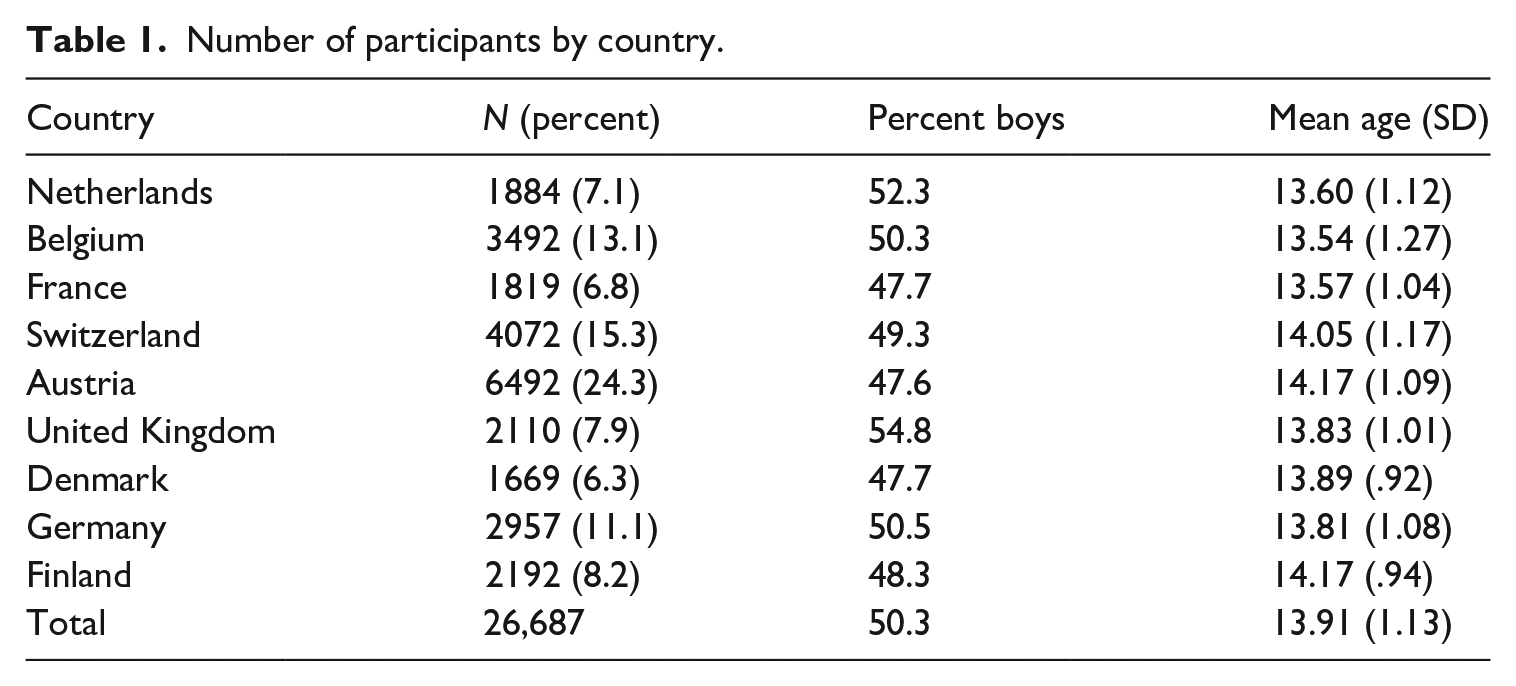
The sampling design differed somewhat between countries (Enzmann et al., 2018). For most participating countries, samples were derived from classes in schools of two medium-sized or large cities. Some countries (Belgium, Switzerland and Austria) opted for broader or national sampling methods. The samples are representative of 7th to 9th grade students in the particular cities or regions in which the data were collected, rather than the whole population of young people in that particular country. After obtaining consent by students and their parents, students completed the standardized questionnaire under the supervision of a research assistant or a teacher in a classroom setting (see the Appendix for the selected items). The main mode of questionnaire administration was online, but in three countries (France, the UK and Germany) both online and paper-and-pencil questionnaires were used, and in Belgium all data were collected through paper-and pencil questionnaires. Surveys were completed in the main language of a particular country.
Measures
Child maltreatment
Direct child maltreatment is based on two questions ‘Has your (step)mother or (step)father ever: hit, slapped, or shoved you?’ and ‘Has your (step)mother or (step)father ever: hit you with an object, punched, or kicked you forcefully or beat you up?’ Both questions could be answered ‘yes’ or ‘no’. Positive responses to the second question receive a double weight because of its severity. The highest possible score is used, ranging from 0 to 2, an ordinal indication of the severity of direct physical child maltreatment. The witnessing of inter-parental violence is based on two questions (‘Have you ever experienced 1. Physical fights between your parents? 2. Repeated serious conflicts between your parents?’), which could be answered ‘yes’ or ‘no’. An ordinal indication of the severity of the inter-parental violence is created by creating a sum score of both questions, ranging from 0 to 2.
A measure of total child maltreatment is created by adding the scores for direct and indirect exposure to parental violence (Cronbach’s α = .59), which results in a total score ranging from 0 to 4. For descriptive purposes, these scores are transformed into percent of maximum possible scores (POMP scores), resulting in a range of 0 to 100, with 100 representing the maximum score of total child maltreatment.
Self-reported juvenile delinquency
An index score for self-reported delinquency is created based on the 12-month prevalence rates of 12 different offenses (Cronbach’s α = .76), ranging from stealing and vandalism to assault. This measurement of delinquency, used in the ISRD3 study, has been validated before (Zhang et al., 2000). The 12 different offenses are divided into two categories: violent offenses (consisting of four items measuring group fights, carrying a weapon, robbery and assault) and property offenses (consisting of seven items measuring vandalism, shoplifting, burglary and stealing from someone or a vehicle). Examples of violent offenses are: ‘Have you ever taken part in a group fight in a football stadium, on the street, or in other public places?’ and ‘Have you ever beaten someone up or hurt someone with a stick or knife so badly that the person was injured?’ Examples of property offenses are ‘Have you ever stolen something from a shop or department store?’ and ‘Have you ever stolen something from a person without force or threat?’ The item ‘Have you ever sold any drugs or helped someone selling drugs’ does not match the two categories and is included only in the score for total offenses. Students were asked whether they had committed each offense over the last year (coded as 0 = no, 1 = yes). We created three variety scores: general delinquency (0–12), violent offenses (0–4) and property offenses (0–7). These three index scores are a representation of the variety of different offenses committed in the previous year, as recommended by Sweeten (2012).
Self-control
The ability to exercise self-control is measured with six items (Cronbach’s α = .82) derived from the widely used self-control scale of Grasmick and colleagues (1993), capturing the dimensions Impulsivity (three items) and Risk seeking (three items). Items could be scored on a four-point Likert scale ranging from 1 (agree fully) to 4 (disagree fully). Examples of items used are: ‘I act on the spur of the moment without stopping to think’ and ‘I like to test myself every now and then by doing something a little risky’. Mean scores are created and z-standardized for analyses: high levels reflect a higher ability to exercise of self-control.
Morality
Morality was measured using seven items (Cronbach’s α = .78) asking participants how wrong they think certain acts are on a four-point Likert scale ranging from 1 (not wrong at all) to 4 (very wrong). These items are derived from PADS+ (e.g., Wikström et al., 2012: 132–5). Examples of items are: ‘Purposely damage or destroy property that does not belong to you’ and ‘Hit someone with the idea of hurting that person’. Mean scores are created and z-standardized for analyses: higher values reflect a higher morality (that means personal moral norms are in line with the law).
Exposure to criminogenic environments
A composite index of five life-style risks (Cronbach’s α = .57) is created as a measure of the exposure to criminogenic environments or peers. These risks were: truancy last year (0: no; 2: yes), going out at night (0: never; 1: 1–2 times per week; 2: 3+ times per week), hanging out in public just for fun (0: never; 1: sometimes; 2: often), spending most of leisure time (0: with family; 1: alone; 2: with friends) and having at least one friend involved in illegal activities (0: no; 2: yes). Scores on these items are summed and z-standardized for the analyses.
Control variables
Several background variables are taken into account as control variables. Gender (0: female; 1: male), grade, which serves as a proxy for age (grade 7 to grade 9), migrant status (0: native; 1: first- and second-generation migrant) and an indication of response integrity (openness) are included because the underreporting of deviant behavior in self-report surveys might lead to underestimations of the effect (Laajasalo et al., 2014). Openness – the willingness of the participant to be open about deviant behavior – was based on the direct question: ‘Imagine you had used cannabis (marijuana/hash), would you have said so in this questionnaire?’ This question could be scored on a four-point scale ranging from 1 (probably not) to 4 (probably yes); see Enzmann et al. (2018) for additional background about the openness question.
Analytic strategy
Owing to the hierarchical nature of our data – with participants (level 1), nested in classes (level 2), schools (level 3), cities (level 4) and countries (level 5) – the mediating effects of self-control, morality and exposure to criminogenic environments in the association between exposure to child maltreatment and juvenile offending are analyzed using multilevel structural equation modeling in Mplus (Muthén and Muthén, 1998–2012, version 7.11). To ascertain the number of levels we need to include in the analysis, it is determined on which of the five levels our analysis variables have non-negligible amounts of variance. Owing to the large sample size, this is not based on significance alone. We also calculate intra-class correlations (ICCs) for each level (i.e., the percentage of variance on each level) for each of our analysis variables, where ICCs smaller than .01 (indicating that less than 1 percent of the total variance in a variable is on that level) are used as a cut-off for including a level in our analyses. Results show that our measures of juvenile offending (total offenses, and violent and property offenses separately) and the mediators self-control and morality have non-negligible amounts of variance on the individual, class, and school levels. For exposure to criminogenic environments and child maltreatment, the amount of variance on the city level (level 4) are also non-negligible. However, because Mplus can be used to analyze a maximum of three levels, exposure to criminogenic environments and child maltreatment are group centered using the level 4 means in order to remove all variance above the third level and not bias our results. Of our control variables (gender, migrant status, openness, and grade), migrant and gender are level 1 variables (because they explicitly measure characteristics of individuals), and grade is a level 2 variable (it measures a characteristic of the classes). Grade varies only on level 2 in our dataset. Our last control variable, openness, has substantial variance on the individual, class and school level, just like juvenile offending and the mediators self-control and morality.
Multilevel mediation models are fitted for total offenses and for violent and property offenses separately (controlling for gender, grade, migrant status and openness). Only results on the individual level are interpreted and presented, because we do not have hypotheses about higher levels. Full information maximum likelihood is used to account for missing data and a robust maximum likelihood estimator is used to correct for the non-normality of the variables. Due to missing information about school IDs, the final sample consists of N = 24,956 students.
Results
Descriptive statistics
In Table 2, the descriptive statistics and correlations of the variables included in the analyses are summarized. Every grade contained roughly one-third of the adolescents. Approximately 11 percent of the adolescents in the total sample are non-native to the country they currently live in, and 39 percent identified themselves as migrant, either first or second generation. Almost 18 percent of the children indicate that they are living with one parent only, or in another situation (e.g., with other family). The other 82 percent of the adolescents are living with both parents. Concerning the economic situation of their family of origin, 89 percent of the adolescents report that their father is employed and 77 percent report that their mother is employed; 8.6 percent of the children indicated that both parents are unemployed or that their family is dependent on social welfare benefits.
Univariate descriptive statistics for the study variables.
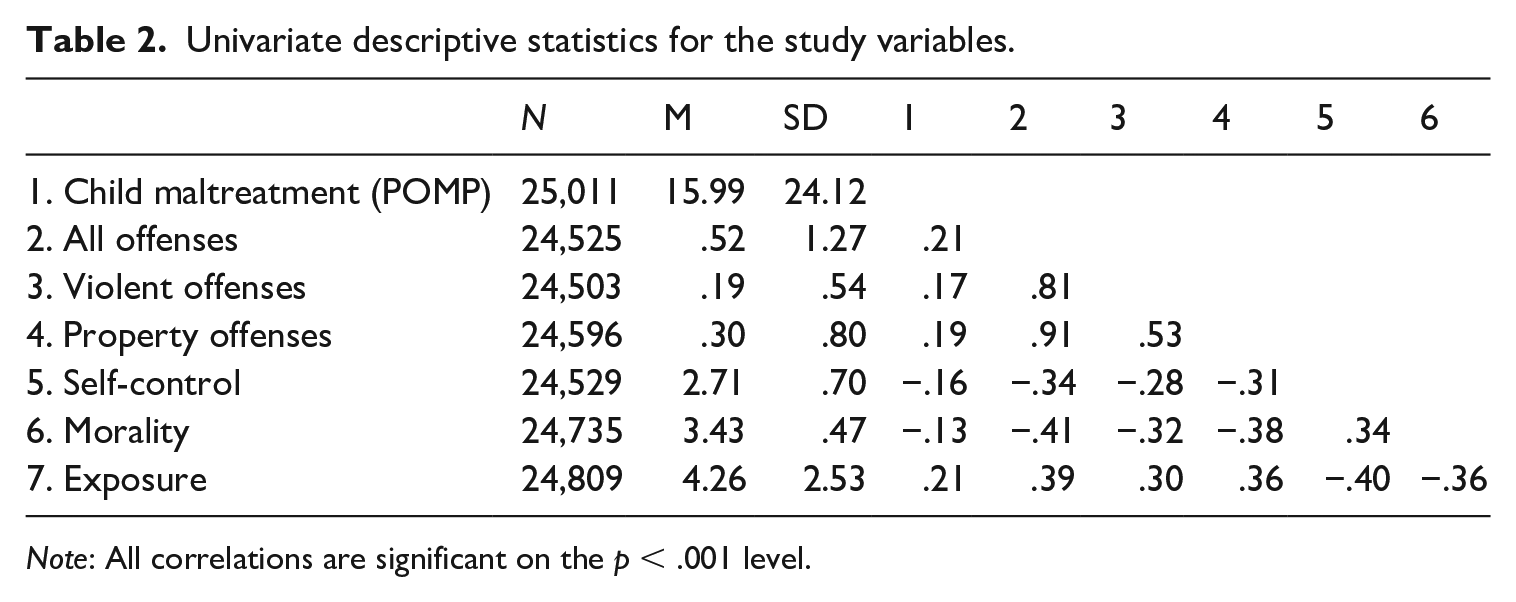
Note: All correlations are significant on the p < .001 level.
The data show that 39 percent of the adolescents had experienced child maltreatment, either direct or indirect, in their life. For indirect maltreatment, 16 percent of the adolescents report having witnessed physical violence or repeated conflicts between their parents (7 percent both forms) in their life. Furthermore, 21 percent of the adolescents report having directly experienced child maltreatment, and 6 percent of the students had experienced both forms. Based on the delinquency index, 25 percent of the adolescents across all countries have committed at least one of the offenses in the last 12 months (13 percent for violent offenses and 18 percent for property offenses).
Mediation analyses
The results of the model for the total of offenses are summarized in Figure 1. Child maltreatment is significantly related to the total of offenses (b = .137, p < .001, 95% CI = [.117, .156], β = .102), to violent offenses (b = .047, p < .001, 95% CI = [.038, .056], β = .082) and to property offenses (b = .077, p < .001, 95% CI = [.065, .090], β = .092). For all types of offenses, the results show significant specific indirect effects for all three mediators, indicating that self-control, morality and the exposure to criminogenic environments are significant mediators in the direct association between child maltreatment and each category of offenses (see Table 3). For all models, the direct effects remain significant, indicating partial mediation. The model explains 26.7 percent of the total variance in the total of offenses on the individual level (21.2 percent class level); this was 17.9 percent on the individual level (12.6 percent class level) for violent offenses. Almost 22 percent of the variance in property offenses could be explained from this model on the individual level, and 18.4 percent on the class level.
Total, direct and indirect effects for all offenses, for violent offenses and for property offenses.
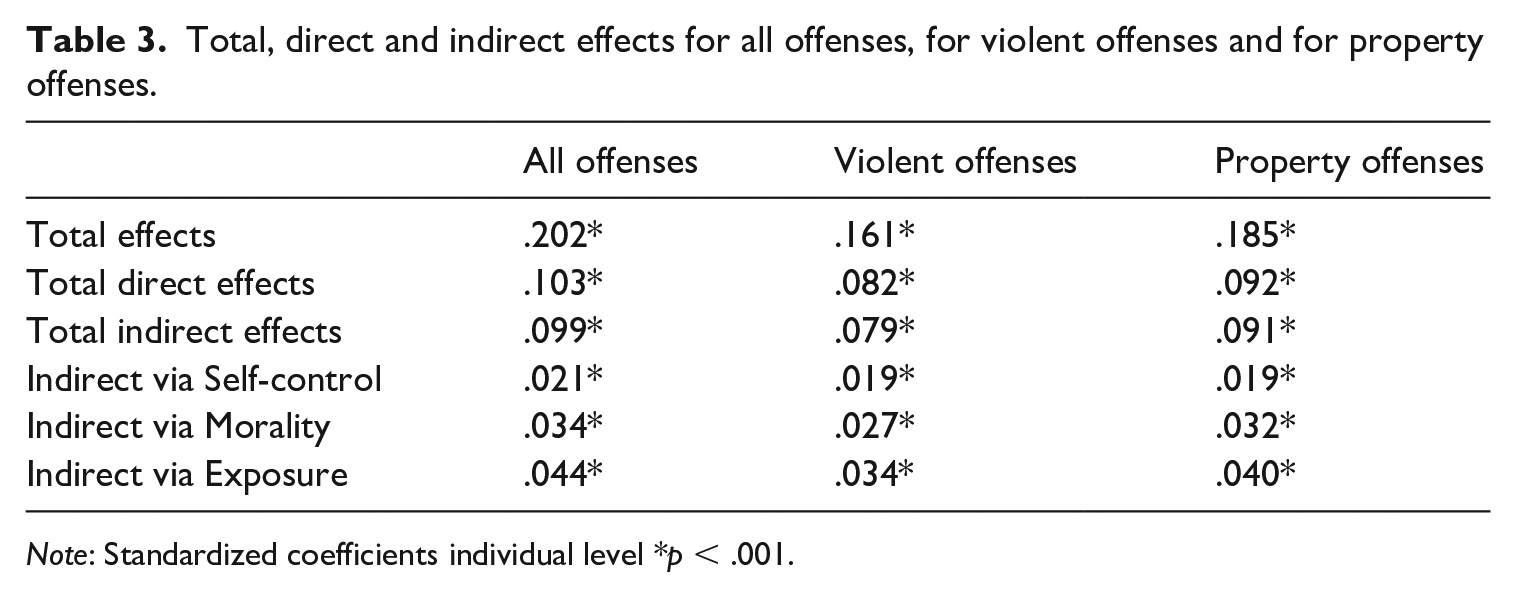
Note: Standardized coefficients individual level *p < .001.
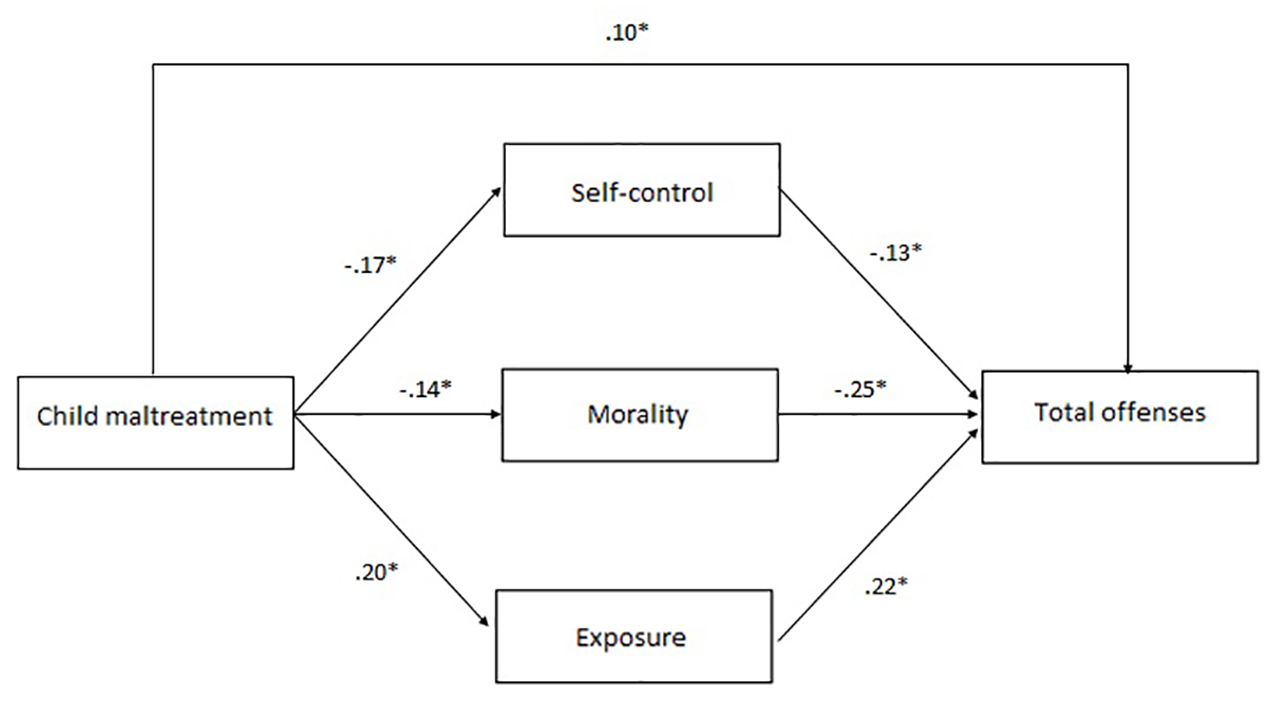
Model summary: Total offenses.
As expected, higher levels of child maltreatment are associated with lower levels of self-control (b = −.124, p < .001, 95% CI = [−.134, −.113], β = −.167), morality (b = −.068, p < .001, 95% CI = [−.075, −.061], β = −.139) and higher levels of exposure to criminogenic environments (b = .527, p < .001, 95% CI = [.493, .562], β = .204). In turn, lower levels of self-control (b = −.228, p < .001, 95% CI = [−.257, −.198], β = −.127) and morality (b = −.676, p < .001, 95% CI = [−.748, −.605], β = −.247), and higher levels of the exposure to criminogenic environments (b = .111, p < .001, 95% CI = [.103, .119], β = .215), are associated with a higher level of offending (see Figure 1). The models of violent offenses and property offenses separately are displayed in Figure 2, showing the same results as for the total offenses.
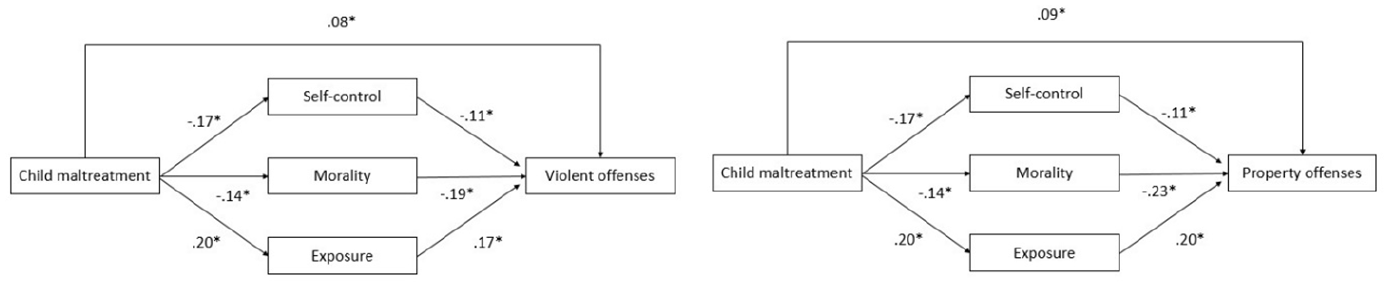
Model summary: Violent and property offenses
Discussion
The current study aimed to illustrate how Wikström’s Situational Action Theory may be used to explore the individual and social processes involved in the well-studied association between child maltreatment and adolescent delinquency (e.g., Braga et al., 2017). We hypothesized that child maltreatment would affect the psychosocial processes related to crime propensity and the socioecological processes related to exposure to criminogenic settings. In line with previous studies, the results indicate that physical child maltreatment is associated with general juvenile delinquency (Farrington et al., 2017; Park et al., 2012; Smith and Thornberry, 1995; Wilson et al., 2009) and violent delinquency (Braga et al., 2017; Fitton et al., 2018; Maas et al., 2008; Kokkalera et al., 2018; Manzoni and Schwarzenegger, 2019). In the current study, physical maltreatment also relates to property offenses. Thus, our results indicate that the impact of physical child maltreatment does not differ for the broad categories of property and violent crimes, which is in line with the study of Savage et al. (2014). Interesting to note is that the SAT model appears to work equally well for the broad categories of violent and property offenses. However, we need to add immediately that we did not directly test SAT’s ability to specify particular action alternatives. Indeed, SAT speculates on a detailed level about specific types of delinquency (e.g., residential burglary vs. shoplifting, or rape vs. hitting), whereas our study employs two broad categories of offenses.
Our results show that the link between maltreatment and delinquent behavior can be partly explained by the SAT concepts. This is consistent with other studies that show that adolescents with a background of child maltreatment tend to have lower levels of self-control (Cowell et al., 2015; Lovallo, 2013; Pears et al., 2010; Stevens et al., 2016; Walters, 2018) and moral norms that are less in line with the law (Toth et al., 2000; Wang et al., 2017), and they spend more time in criminogenic environments with low (parental) supervision and delinquent peers (Hagborg et al., 2018; Pels et al., 2011; Slade and Wissow, 2007). Lower levels of self-control and morality and higher levels of exposure to criminogenic environments are in turn associated with juvenile delinquent behavior, as proposed by SAT (Wikström, 2004, 2010, 2014). The current study underlines the possible impact of maltreatment on the psychosocial processes shaping criminal propensity and the socioecological processes changing criminogenic exposure (Wikström, 2014, 2020), thus underlining maltreatment as one of ‘the causes of causes of crime’. Furthermore, when testing the model separately for violent and property offenses, the direct and indirect pathways hold and the same conclusions could be drawn, indicating that physical child maltreatment does not elicit crime-specific propensities.
The models do not show full mediation, suggesting that the theoretical concepts of SAT do not fully explain the association between maltreatment and delinquency. Using a similar design, Janssen and colleagues (2016) showed that the effects of parenting on delinquency were fully mediated by self-control, juvenile attitudes toward delinquency and time spent in criminogenic settings. Their study focused on more positive aspects of parenting: the quality of the parent–adolescent relationship, limit-setting and monitoring. In the context of child maltreatment, other underlying factors might play a role in explaining delinquent behavior. From the perspective of child maltreatment or domestic violence, trauma has been mentioned as an important factor that could explain this relationship. Trauma is often a consequence of maltreatment (e.g., Lindert et al., 2014), can be transmitted over generations (Lünnemann et al., 2019) and has indeed been related to criminal involvement (e.g., Wolf and Shi, 2010). Trauma was not included in the current study, but would be a valuable addition in future studies in order to examine the relative contribution of trauma in relation to the other mechanisms as proposed by SAT. Of course, it is very possible that the finding of partial rather than full mediation is related to the particular way in which the key concepts of SAT have been operationalized in our study. Furthermore, although the measurement validity of the responses of the sample employed has been examined and supported in other analyses (e.g., Enzmann et al., 2018; see also our comments in the last section of the article), it is also possible that potentially biased responses may be reflected in the findings.
Understanding the mechanisms linking maltreatment to delinquency helps in developing interventions aimed at preventing delinquency in juveniles and the intergenerational transmission of violence in families. Interventions for delinquent youths are frequently aimed at the prevention of recidivism, with little attention to co-occurring victimization as a result of child maltreatment. At the same time, child maltreatment intervention programs are frequently aimed at parent–child interaction and less on the risks for delinquency. The current study underlines the importance of the integration of both intervention systems and stresses that workers should keep paying attention to the fact that many of the adolescents ending up in the juvenile correction system have a history of abuse. For example, schools could implement aspects of both cognitive nurturing and moral education in their curricula and create an environment in which high-risk students practice their executive capabilities and get instructed about law-related moral norms, observe them and stimulate the continuous evaluation and re-evaluation of experiences and circumstances in relation to current existing personal morals and previous experiences. Furthermore, prosocial after-school activities could be offered by schools, which might prevent high-risk children from hanging around in environments that create the opportunity of crime (Wikström and Treiber, 2017).
Strengths, limitations and future research directions
The large sample of the ISRD3 that is used to test the current hypotheses allows us to test theoretical models and cross-national comparisons because of the same sampling plan and design across the countries involved. However, some limitations of the study must be mentioned.
First, the cross-sectional nature of the data makes it impossible to draw causal conclusions. To test Wikström’s assumption of ‘the causes of the causes of crime’, prospective, longitudinal studies should be implemented to assess causality and analyze the temporal order of the separate components in the model.
A second limitation is that the data are limited to self-report measures of use of child maltreatment and delinquency, which raises problems with memory recall and the willingness to report about sensitive topics like this. Although we controlled for the latter problem by including a question measuring social desirability in the analyses, there remain considerable concerns about the validity of self-report measures of sensitive matters such as delinquency and parental use of violence (see, e.g., Enzmann et al., 2018). Nonetheless, there is considerable evidence to suggest that self-report surveys provide reasonable data, in particular if they are used for theory-testing purposes (e.g., Elliott, 2017; Junger-Tas and Haen Marshall, 1999). The ISRD3 study has taken the validity of the self-report data very seriously as key questionnaire items used are taken from existing and validating scales, sampling and data collection followed well-specified protocols, and cleaning and merging into an international dataset were done meticulously (e.g., Enzmann et al., 2018; Haen Marshall and Enzmann, 2012). Therefore, the data used are generally considered to be among the most methodologically reliable and sophisticated international self-report surveys of youth currently available (Gottfredson, 2018: viii).
We have already alluded to the possibility that our operationalizations of the main concepts of SAT are not robust and valid indicators as intended by Wikström and colleagues. The measure of self-control we used is not situational and is instead measured as a trait, and implemented as a proxy for situational self-control. However, we aimed to examine if and how child maltreatment is associated with the key concepts of SAT and the spatio-temporal convergence is not our main interest. For this reason, and because it would complexify the model interpretation, the interaction between crime propensity and criminogenic exposure was not included.
Finally, the measure of exposure to child maltreatment is based on four questions (which has consequences for reliability) and could have been more specific. The concept is operationalized as the lifetime prevalence and does not take into account age at onset or the chronicity and duration of the violence, which could be important for later crime involvement. Some studies suggest that physical maltreatment is associated with juvenile violent behavior independently of the severity, duration or nature of the violence (Gershoff and Grogan-Kaylor, 2016; Maas et al, 2008; Mersky et al., 2012); others showed that the timing of child maltreatment does play a role. Maltreatment occurring in childhood showed only a weak effect on antisocial behavior, whereas maltreatment that occurred in adolescence or both in adolescence and in childhood predicted delinquency in youths (Ireland et al., 2002; Stewart et al., 2008).
Because the current model has been confirmed in a subsample of nine West European countries that are relatively comparable in terms of culture and wealth, it would be interesting to test this model in different countries to see whether this model may be universally applied and is – as is claimed by Wikström – a truly general theory of crime. Child maltreatment is a universal problem, and ought to be eliminated out of respect for the Convention on the Rights of the Child and the 2030 UN Sustainable Development Sustainable Development Goal 16 target 16.2 (‘end abuse and violence against children’). In this article, we hope to have contributed to a better understanding of the mediating factors that link maltreatment to delinquent behavior. SAT provides a useful conceptual framework and its assumptions about the dynamics involved in shaping the perception–choice process may be used to explain the relationship between child maltreatment and adolescent crime involvement.
Footnotes
Appendix
Acknowledgements
In a project of this scale, thanks are due to too many people to list individually. We are very grateful to all staff and students in all the schools that agreed to take part in ISRD3. We would also like to thank all those funders that contributed toward the costs of ISRD3 across the world.
Declaration of Conflicting Interests
The authors declared no potential conflicts of interest with respect to the research, authorship, and/or publication of this article.
Funding
The author(s) disclosed receipt of the following financial support for the research, authorship, and/or publication of this article: Collection of the data used was made possible through the following grants, including those made under the Open Research Area (ORA) program: Finland: Ministry of Justice, Finland – Grant No. OM7/014/2013; Germany: German Research Foundation (DFG) – Grant No. EN 490/1–1; Netherlands: Netherlands Organization for Scientific Research (NWO) – Grant No. 464-13115; Switzerland: Swiss National Science Foundation (SNF) – Grant Nos. 100015_138401/1 and 10001A_162816; Jacobs Foundation – Grant No.2012-1026, Swiss Federal Office of Migration; United Kingdom: Economic and Social Research Council (ESRC) – Grant No. ES/L016656/1.
