




Abstract
This study makes use of a dataset recently collected among young people in Stockholm, Sweden (N = 1122), to investigate the impact of fear on young people’s mobility and precautionary behaviour, after controlling for previous victimization as well as situational characteristics of daily trips. Geographical Information Systems (GIS) and logistic regression models underlie the methodology of the study. Previous victimization, especially for sexual crimes, triggers precautionary behaviour among young people using trains and the metro. Signs of poorly maintained transit environments also affect young riders’ mobility patterns, as they state that they avoid particular stations or routes at particular times. Informed by principles of environmental criminology and the theory of fear of crime, the implications of the findings for both theory and practice are discussed.
Introduction
I avoid a few bus lines, pick bus stops and don’t wear jewellery.
I pay attention to how I dress and try to travel during daytime only, or with another person.
I always keep an eye on my belongings, holding my mobile phone in my hand just in case, and don’t wear headphones when I travel in the evening.
As the above quotes from a sample of university students indicate, if young people do not feel safe, they manage risks by taking precautionary measures to carry on with their daily lives. These Swedish students are no exception. Scholars around the world have expressed worry about how perceptions of poor safety are debilitating, especially among young people (Gekoski et al., 2015; Loukaitou-Sideris, 2008; Natarajan, 2016; Natarajan et al., 2017; Smith, 2008). Young people’s mobility may be impaired by fear, yet they are the ones mostly using public transportation during night-time. This is particularly true for women, who normally use more public transportation than men do (Kunieda and Gauthier, 2007; Larsson and Jalakas, 2008) and have their life opportunities diminished when they have to do ‘safety work’ (Gray, 2018; Whitzman, 2007) before leaving their homes or commuting to college, work or recreation. The #MeToo movement has brought attention to sexual harassment in public spaces and transit environments as a particular hindrance to women’s mobility (Ceccato and Loukaitou-Sideris, 2020; Chowdhury and Van Wee, 2020; Orozco-Fontalvo et al., 2019), yet little is known about the impact of fear on young people’s precautionary behaviour. In addition, despite the occurrence and scale of sexual violence on public transport worldwide, the issue has been relatively ignored by research (Gekoski et al., 2015). So far, research into precautionary behaviour has been mostly limited to studies examining whether those most afraid of crime or most recently victimized are most likely to take precautions (Felson and Clarke, 2010). These authors suggest that the reason for this neglect is that, when we think about the causes and the control of crime, criminologists have focused on offenders and not enough on the situations in which they operate.
This article aims at contributing to this research field by investigating the nature of the precautionary measures taken by young people while in transit, in particular when they avoid certain places and/or certain times. We achieve this goal by assessing the impact of declared levels of fear, controlling for previous victimization, in particular sexual harassment, and factors that indicate the situational conditions at the stations and bus stops. The word precaution here ‘implies that efforts can be made in advance to thwart danger’ and ‘does not include purely unplanned efforts’ (Felson and Clarke, 2010: 107). The study makes use of a dataset recently collected among university students in Stockholm, Sweden (N = 1122), combined with secondary data using Geographical Information Systems (GIS) and analysed using logistic regression models. Informed by principles of environmental criminology and the theory of fear of crime, the implications of the findings for both theory and practice are discussed.
We start this article with the literature on fear of crime in transit environments and environmental criminology, then frame the current study and research questions. We follow this with the results and a discussion. The article ends with conclusions and recommendations for research and policy.
Fear in transit environments: Brief literature review
Young riders who report being fearful are the most likely to change and adapt how they move and travel (Foster et al., 2014; García-Carpintero et al., 2020; Wiebe et al., 2014). If fear is a reflection of everyday life experiences, what are those experiences in transit environments? ‘Fear’ is ‘an emotion, a feeling of alarm or dread caused by awareness or expectation of danger’, according to Warr (2000: 453), and ‘fear of crime’ is defined by Ferraro (1995: 23) as ‘an emotional reaction of dread or anxiety to crime or symbols that a person associates with crime’. Thus, an increase in crime would hypothetically affect perceived safety. However, such a causal relationship is rarely confirmed by empirical studies, because the fear of crime refers to the fear of being a victim of crime as opposed to the actual probability of being a victim of crime (Hale, 1996). It is more important to think about the meaning and impact of fear of crime that can lead us to a ‘sense that one must always be on guard, vigilant and alert’ (Gordon and Riger, 1989: 2). Such feelings have the power to modify our behaviour and possibly restrict people’s activities in everyday life (Jackson and Gray, 2010). With young people in particular, previous research has shown that perceptions of safety vary significantly during night-time and daytime and along a journey, the highest being in a car, and the lowest on foot or on the metro (for example, Wiebe et al., 2014). Based on fear of crime theory and principles of environmental criminology, we discuss below potential mechanisms linking the impact of fear on people’s mobility.
Although there is a long tradition in the methodological work in fear of crime that recognizes various dimensions of the concept of ‘fear’,’ suggesting that there are cognitive (for example, risk perception) and emotional (for example, being afraid) components, in this study we adopt the concept of ‘safety perceptions’ as a general term that indicates ‘declared perceived safety’. Thus, perceived safety can be high (when an individual feels safe) or low (when an individual is in fear, feels unsafe).
Factors affecting safety perceptions
Individual factors play an important role in defining risk of victimization as well as perceptions of risk and overall safety perceptions. Gender and age are perhaps the strongest ones. The individual dimension of fear is often related to the vulnerability hypothesis; that is, those perceiving themselves as vulnerable are likely to be more fearful. Traditionally, women are portrayed as being more fearful (in particular in public places) than men about their personal safety (Box et al., 1988; Koskela, 1999; Loukaitou-Sideris, 2004). This applies similarly to the elderly and the disabled (Iudici et al., 2017; Killias and Clerici, 2000; Yin, 1980), those who belong to the lesbian, gay, bisexual, transgender, queer or intersex (LGBTQI) community, those with disabilities and those who are economically disadvantaged (Box et al., 1988; Garofalo and Laub, 1979; Pain and Smith, 2008).
Fear of ‘stranger danger’ in public spaces has been much more engrained from childhood in women than in men. Therefore it is no surprise when women declare that they feel more fearful than men do when on the move (Whitzman, 2007). Sandercock (2005) argues that expressions of fear are actually expressions of fear of difference. This leads us to consider the notion of familiarity. As the frequency of use of public transportation increases, fear should supposedly decrease, because transit environments should feel under control and familiar. Valentine (1990) suggests that, in the absence of prior experience or familiarity with a particular place, judgement is likely to be based on preconceived ideas about similar settings.
Among the individual factors, prior victimization (or awareness of others’ victimization) is often considered one determinant of a person’s fear. Despite conflicting research findings, international evidence suggests that previous victimization continues to be an important determinant of fear of crime and overall safety perceptions (Hale, 1996; Hirtenlehner and Farrall, 2014; Otis, 2007). Levels of fear may also be dependent on types of crime (for example, LaGrange et al., 1992) and, in particular for young women, previous literature confirmed that women’s higher fear of crime compared with men’s can largely be explained by women’s fear of rape, the so-called ‘shadow of sexual assault hypothesis’ (Mellgren and Ivert, 2019).
Witnessing other people’s victimization (particularly a family member or friend) is suggested to be a predictor of an individual’s level of personal safety (for a review, see, for example, Skogan, 1987). For women in particular, sexual harassment and other forms of sexual violence in public spaces are everyday occurrences (Gekoski et al., 2015; Natarajan, 2016) that affect women’s perceptions of safety while in transit. Longer trips would increase the chances for victimization and decrease safety perceptions.
Fear of crime can also be a result of what one sees and perceives with one’s other senses, meaning that fear is a function of an individual’s emotional reactions to a place at a particular moment in time and/or memories and associations that a particular setting brings to the surface. Therefore, if one is exposed to certain criminogenic places, such as around bars or transport nodes, this may also lead to greater levels of fear (or ‘lower declared safety perceptions’, here considered synonymously). The mechanisms linking visible dilapidation to fear of a place can be linked to Wilson and Kelling’s broken window syndrome (Wilson and Kelling, 1982), which suggests that unrepaired damage to property encourages further vandalism and other types of crime. They indicate that acts of vandalism and public disorder function as symbols of the extent to which an area is in decline. Conversely, transit environments, stations and surrounding areas that are well maintained convey the message that ‘someone is in control’ and positively affect riders’ safety perceptions of these places. Signs of disorder, such as litter, vandalism and loitering, and poor surveillance are thought to trigger fear of crime (Lewis and Maxfield, 1980) and are indicators of more serious crimes.
Fear and its impact on mobility
Individuals who feel anxiety when waiting at a bus stop after dark may avoid such spots in the future, restricting their own mobility (Bromley et al., 2000). In some cases, individuals’ fears are not solely manifested in a restricted use of public space (for example by avoiding certain places) but in extreme cases may also lead to self-confinement, making them ‘prisoners in their own homes’ (Henderson and Bialeschki, 1993: 45). This is a clear example of what Jackson and Gray (2010) refer to as ‘dysfunctional fear’, whereby anxiety impairs an individual’s agency and reduces quality of life. The authors suggest the concepts of functional and dysfunctional fear to interpret the impact of fear on a person’s life. In some cases, precautionary actions can be perceived positively because they are in fact ‘functional’ (Gray et al., 2011). In that case, fear becomes the main motivation for one to take action, because it supports activities that make it more difficult for crime and victimization to occur, such as participating in night patrols or neighbourhood watch schemes. More commonly, we associate fear of crime with changes that limit one’s activities when specific places or areas are perceived as unsafe. Jackson and Gouseti (2012) indicate four main categories of behavioural responses to fear of crime: avoidance behaviour, protective behaviour, behavioural and lifestyle adjustments, and participation in relevant collective activities.
Avoidance behaviour involves minimizing one’s contact with certain types of people, routine activities or places. If young riders feel unsafe to travel by bus at certain times, they may take an earlier bus or choose another route.
Protective behaviour constitutes activities that are thought to prevent crime (putting up fences) as well as wider activities of self-protection and safety improvement (travelling in groups, for example).
Behavioural and lifestyle adjustments involve a withdrawal from activities that are considered to be dangerous, such as taking public transportation at night.
Collective activities include participation in groups, such as neighbourhood watch programmes, that are intended to reduce crime opportunities and/or increase safety perceptions.
The attractiveness of the environment highly affects individuals’ mobility. Some activities will take place only because they are necessary. Pleasant and safe environments invite people to stay beyond what is necessary and to perform optional activities. As suggested by Gehl (1987), whereas necessary activities take place regardless of the quality of the physical environment, optional activities depend to a significant degree on what the place has to offer and how it makes people behave and feel about it. We hypothesize that young riders’ safety perceptions of a particular place shape their behaviour beyond that place. If they feel dysfunctional fear towards a particular place, they will most likely take precautionary measures. If they must carry out necessary activities in these fearful places, they will most likely avoid them at particular times.
For the purposes of this case study, we followed the recent strand of Western research on transit safety and set out to investigate the following research questions.
The case study and research design
Stockholm as study area
More than 800,000 riders travel by public transport each day in Stockholm, the capital of Sweden. Stockholm County has 268 train stations (metro, light rail, commuter train) and 6587 bus stops (TSL, 2017). The Stockholm Metro consists of three lines, and the three suburban rail systems consist of eight lines. Safety concerns are one cause of dissatisfaction, often related to events of public disorder, drugs and alcohol. The largest share of reported incidents is composed of public disorder events (unlawful activities or anti-social behaviour). The majority of the crimes that occur in metro stations are acts of violence, such as fights (about 40 percent), vandalism, public disorder and threats, followed by other types of violence, then property crimes (Ceccato and Attig, 2020). Young riders are overrepresented among victims of sexual crime (Gekoski et al., 2015). This may explain why younger riders (16–24 years old) declare feeling less satisfied than older passengers, despite the fact that the great majority of riders (80 percent) state that they are satisfied with public transport in general. Another possible reason is that young riders use public transport more at night-time, and are therefore perhaps confronted more often with situations that elicit some level of fear, and therefore they are less satisfied than older passengers. Women tend to use public transport more than men, and young adults (16–24 years old) use public transport to a significantly higher degree than middle-aged people (40–64 years old), with a weekday average of 44 minutes spent commuting on public transport.
This study is based on a dataset combining several data sources: responses from a survey of university students, crime rates by zones and data associated with transport nodes, as reported in Table 3 in the Appendix.
The survey with university students
The web-based platform Crowdsignal (https://crowdsignal.com/) was used to administer a questionnaire, consisting of 52 questions, which was first approved by the Swedish Ethical Review Authority in April 2018. The invitation to fill out the online questionnaire, including a link to the questionnaire, was emailed to students at the main campus of Stockholm’s largest technical university – with 13,323 students at the time of the questionnaire (KTH, 2019), of whom 34 percent were female and 66 percent were male. The university is located fairly centrally in the city, less than 10 minutes by metro from the central station (where all the metro lines meet), and with access to several bus lines and a light rail line. In the first part of the questionnaire, respondents were asked about trips by public transportation, including questions on travel frequency, perceived safety and various concerns related to travelling by public transportation. The survey also contained questions about previous victimization by different types of crime in public transportation (with a focus on sexual violence) and about perceived safety. In the final part of the questionnaire, respondents were asked about individual characteristics (age, gender and place of birth), reporting practices, and what they would like to be improved in the public transportation system. The sample consisted of 1122 university students who responded to the questionnaire, of whom 43 percent identified as female, 52 percent as male, and 3 percent as ‘other’. In terms of sexual orientation, a small portion of these declared being LGBTQI. The great majority of the respondents were between 18 and 29 years old and born in Sweden, but 16 percent of the respondents were older than 29 (composed of post-graduates), and 21 percent of the respondents were born outside Sweden. The majority (64 percent) of surveyed students used the metro on at least four days per week, and 32 percent used buses on at least four days per week.
Methods
Precautionary measures taken by the students constitute our dependent variables in the modelling using logistic regression (1 = they take precautionary measures, 0 = otherwise), as illustrated in Figure 1. We use the response to the question ‘Do you feel the need for precautionary behaviour on public transportation?’, here including rail-bound (metro and trains) and bus systems. In this study, we focus on these two types of precautionary measures, because they were the most common expressions of fear declared by the young riders: time and space avoidance, such as avoiding taking the bus at certain times of the day or avoiding certain routes. Respondents also indicated a number of other precautions, such as ‘dressing in a certain way’, ‘always travelling with someone else’, ‘avoiding wearing jewellery’. For details, see Ceccato et al. (2020).
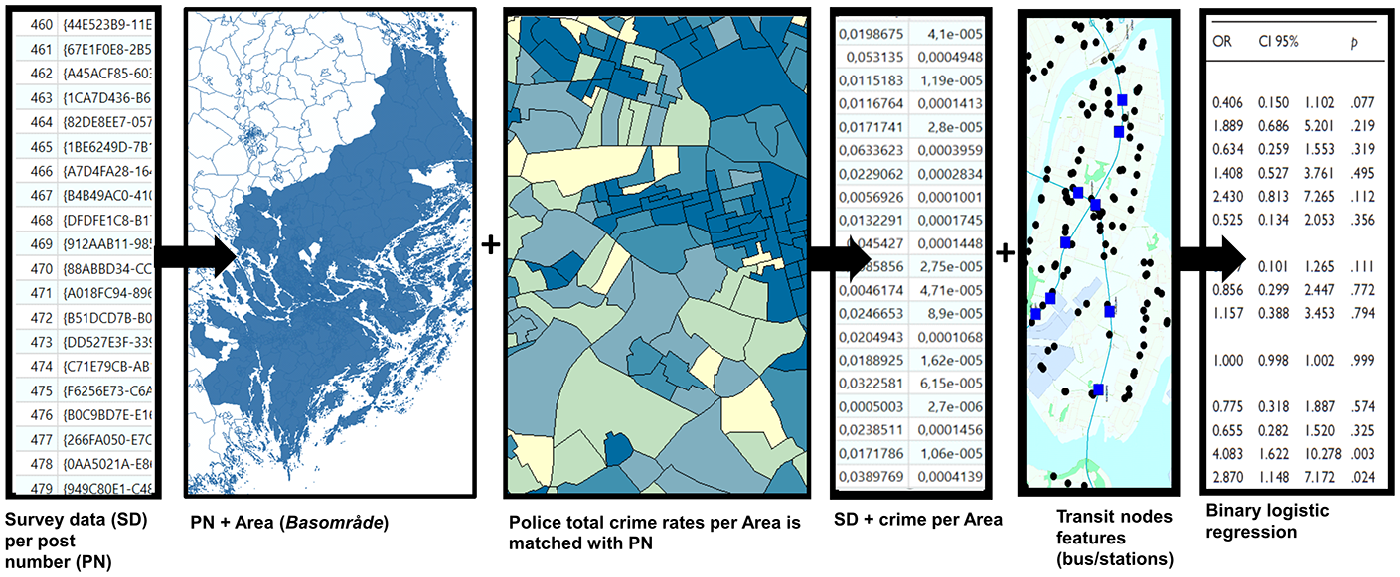
The database of the study.
Safety perception/fear is measured here as young riders’ declared perceived safety during a trip and feeling safe on the way to/from a bus stop or station using a five-point Likert scale. Previous victimization is measured here as having been a victim of violent and/or property crime along the trip, with a particular focus on sexual harassment/crime (being aware of someone close who has been a victim of crime was also included). The use of the umbrella term ‘sexual harassment’ in this study covers a variety of sexual behaviours, including nonverbal sexual violence/abuse, such as stalking, exhibitionism, showing sexually explicit pictures or making sexual gestures; verbal sexual violence/abuse, such as sexual comments, jeering or taunting, and asking questions about sexual activity; and, finally, physical sexual violence/abuse, which may involve behaviours such as touching, kissing and rape. Finally, the situational conditions are indicated by the criminogenic conditions of the environment along the trip (for example, crime rate in the neighbourhood), as well as the management conditions of transportation nodes (for example, illumination, drunk people). However, note that the survey questions did not record specific information on the safety conditions of where people spend time during the day.
Since we want to investigate whether criminogenic environments (where respondents live) influence young people’s perceived safety on their way from home to the station or bus stop, we used GIS to combine the survey addresses of each respondent to total crime rates by area using postal codes as keys. After matching postal codes with areas (basområde), crime rates were transferred back to the survey/respondent and used in the regression model together with other variables to ‘explain’ the variation in safety perception. The data from the survey were transferred from the web-based platform Crowdsignal, via Excel, to the statistical software packages SPSS and SAS, in which the analyses were carried out (SAS, 2017; SPSS, 2018). Missing values were excluded from the analysis listwise, and no imputations were done.
Descriptive statistics were used to characterize the data and in order to test for differences between different variables (statistical comparisons were performed using the Student’s t-test for uncorrelated means). In order to evaluate the hypotheses in contingency tables, the chi-square test was utilized or, in the case of small expected frequencies, Fisher’s Exact Test. The Pearson correlation coefficient was used in order to test the independence between variables. Significant results are discussed in the next section.
Binary logistic regression was used to further explore the relationships between precautionary measures and individual characteristics, victimization, safety perceptions and situational conditions. The 5 percent level of significance was considered and in the case of a statistically significant result the probability value (p-value) has been provided. Findings are reported in the next section by transportation mode, total precautionary measures and space-time avoidance along the trip.
Results
Characterization of young riders’ victimization and safety in transit
Victimization of young riders by transportation mode
Results from the survey among university students in Stockholm show that 26 percent have been the victim of property crimes or violence in public transportation, and 45 percent of the respondents have experienced some kind of sexual violence in connection with a trip by public transport, but the extent varies based on the studied part of the trip. The highest risk seems to be inside the train or bus. Of those who have experienced sexual violence, 88 percent have experienced it inside a train or a bus, 60 percent at a station and 55 percent on the way to or from a station (note that respondents were able to select more than one alternative). There is a clear difference between buses and trains, with 43 percent of the respondents stating that they have experienced sexual harassment in connection with a trip by train, compared with 25 percent for buses. The types of sexual victimization also vary along the trip and by transportation mode (Figure 2). For instance, verbal harassment such as the use of obscene language is more common in rail-bound transportation and whistling is common at the station, whereas physical harassment, such as groping, is much more common on board, during the trip while inside a crowded bus or train. It is not only the transit environment that influences victimization; individual factors such as gender are also important: 61 percent of the female respondents have been victimized, compared with 27 percent of the male respondents.
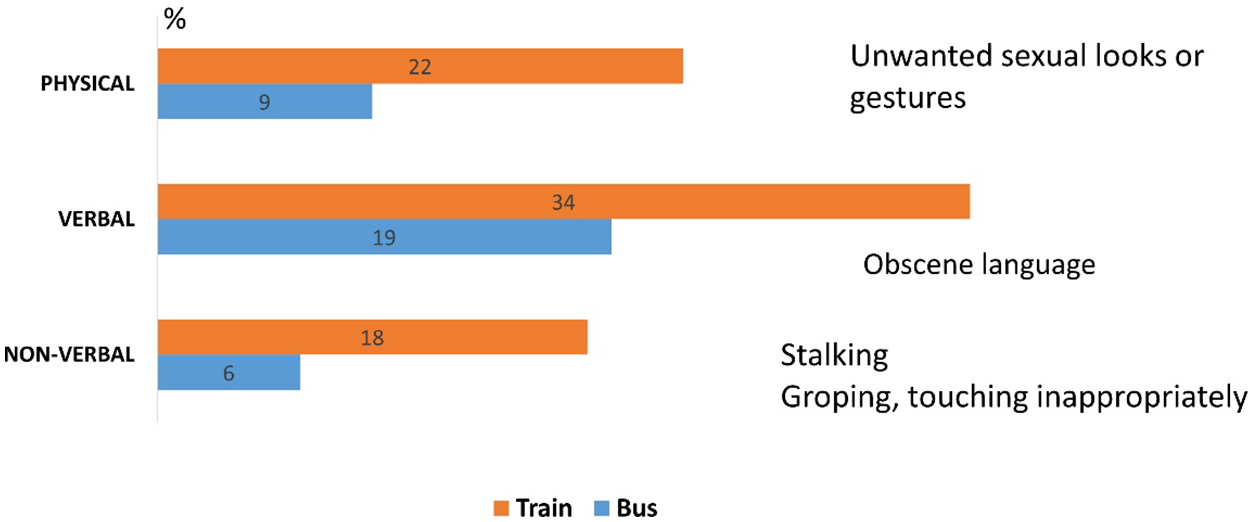
Types of sexual victimization along the trip by transportation mode.
Patterns of perceived safety
Most respondents reported always feeling safe in transit during daytime. Interestingly, they feel much safer on buses (76 percent of the respondents) than they do on the metro and trains (57 percent of the respondents) during daytime. During night-time, 32 percent of the respondents feel safe on the bus, compared with 24 percent on the train. However, there were statistically significant gender differences: a smaller share of female students (44 percent) than male students (69 percent) declared that they always feel safe using rail transit during daytime. As regards bus travel, 22 percent of respondents stated that they never or seldom feel safe on the bus in the evening or night-time, whereas only 2 percent declared that they feel unsafe during the day. In addition, there are differences in safety perceptions among young riders along the trip. For instance, higher levels of perceived safety were found at train stations (25 percent during night-time and 4 percent during daytime). Around 58 percent reported always feeling safe on the train during daytime, compared with 24 percent who felt safe during the evening or night. Our findings show that those who feel less safe are actually young riders born in Sweden (41 percent, compared with 29 percent of those born abroad). It is important to note that the sample is composed mostly of native Swedes, therefore affecting the results.
Characterization of situational conditions at transport nodes
Previous research has found that certain environmental characteristics of transport nodes affect crime and/or safety perceptions, so we asked the students which issues they considered important problems on the bus and at the bus stops (or on the train and on the train platforms they use). The most common problematic safety issues were the presence of drunk people, followed by begging and vandalism, followed by sexual harassment. Although women point out problematic issues in transit environments more frequently than men do, similar problems are identified by both men and women in both rail-bound and bus environments (Table 1).
Which of the following issues do you consider an important problem on the bus and at the bus stops (or on the train and on the train platforms) you use?

Young people’s precautionary behaviour
We use the response to the following question: ‘Do you feel the need to take precautionary measures on public transportation?’ Of the total sample, 36 percent of the students state that they take precautionary measures when travelling by train, but less when they travel by bus. There is, however, a significant difference based on gender, with 50 percent of the female respondents taking precautionary measures, compared with 24 percent of the males. Buses are perceived as being safer than trains, and that influences the use of precautionary measures. Travelling by bus, 29 percent of the women and 14 percent of the men take precautions.
Place avoidance, such as avoiding certain stations or routes, is among the most common precautions, but it is also common to dress in a certain way. Only travelling during daytime as well as avoiding carrying a wallet or handbag are also fairly common precautionary measures. The respondents were presented with a few more alternatives for buses than for trains, because the prerequisites are different. To choose a seat close to the driver is not possible on a train, but on a bus it is one of the most common precautions, indicating that the driver offers social control that makes the travellers feel safer (Figure 3).
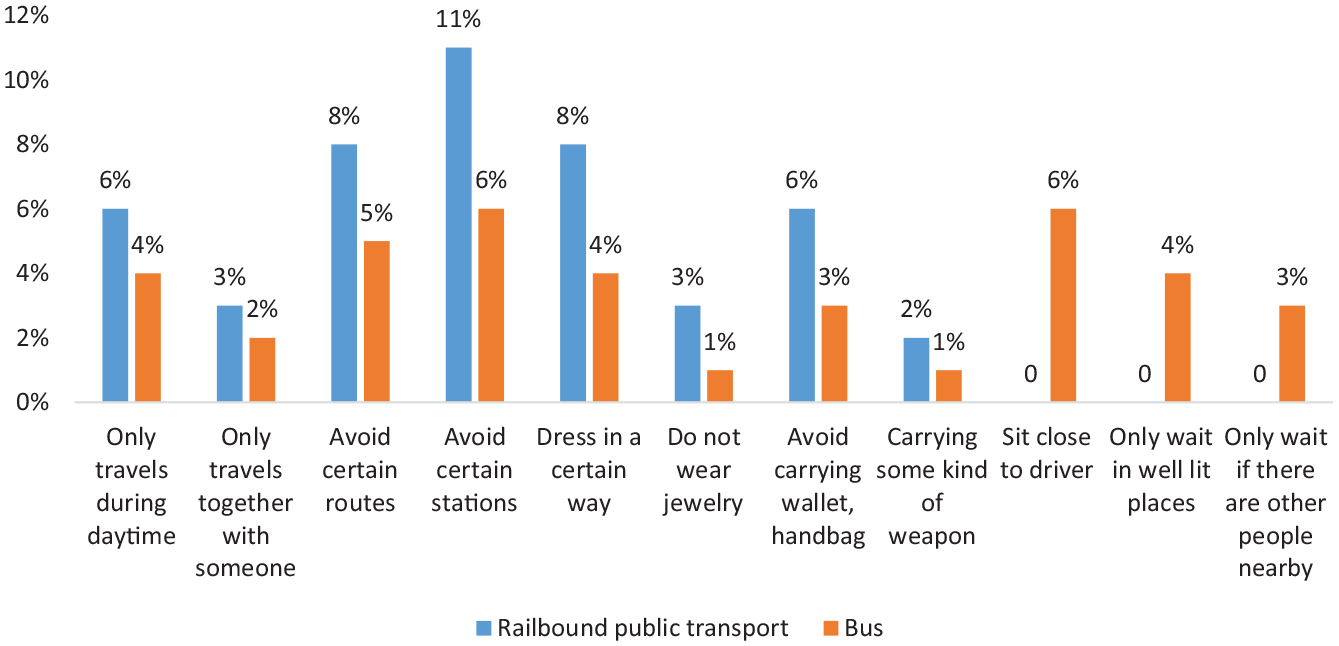
Respondents’ precautionary measures by transportation mode.
The most common precautions are to avoid certain stations and stops (either completely or at least at certain times), to avoid certain routes (place avoidance) or to dress in a certain way. Common strategies are avoiding certain lines or travelling only during the day. For buses, travellers also suggest sitting close to the driver as a precautionary measure. During bus journeys, it is most common that riders sit near the bus driver or that they wait for the bus where the illumination is good. A common comment is also that riders need to be vigilant, alert and prepared. Many indicate that they use their mobile phone, but also carry a kind of ‘weapon’ (for example, pepper spray) in case something should happen. Young riders also declare that they avoid staring at people or they try to look in a different direction so that no one will try to make contact. There are indications of gender differences in precautionary behaviours taken by the students: male students often ready themselves for robbery, for example, by holding the bag in a particular way, whereas female students want to be noticed in a particular environment, so they sit close to the bus driver or avoid dark spots.
Modelling young riders’ precautionary behaviour: Metro and bus systems
Precautionary measures taken by the students constituted our dependent variables in the modelling using logistic regression (1 = they take precautionary measures, 0 = otherwise). We investigated the impact of poor perceived safety on young people’s precautionary behaviour and, in particular, we control for previous victimization and other individual and situational factors. We also discuss whether such an effect is specific to the crime and/or transport mode by testing the effect by types of crime and/or bus/rail-bound trips.
Model results show that both victimization and safety perceptions have independent impacts on young riders’ decisions to take precautionary measures on rail-bound and bus trips (Table 2). Being sexually harassed or being a victim of a violent act in the metro system or in buses make a young traveller more prone to take precautionary measures. Respondents who have experienced violence or property crimes or sexual violence are 1.7 times more likely to declare that they take precautionary measures when travelling by metro (p = .041 and p = .007) but for buses the likelihood is smaller or non-significant.
Results of the logistic regression (dependent variable Y = respondents adopting precautionary measures by mode and type).

Results for metro users indicate that precautionary measures taken by young riders are affected by previous experience of sexual transit crime as well as violent and property crime but are not influenced by the knowledge of victimization of someone close. For buses, the results are similar but not the same. Those who take precautionary measures on buses are those who have been sexually victimized in the past three years on public transportation (after controlling for victimization of other types of serious crimes and other individual and contextual factors, such as young riders’ gender and frequency of use of public transportation). However, young riders’ behaviour is influenced by neighbourhood conditions on the way to/from the metro stations and bus stops. This effect is not present when we assess the relationship between crime rates in the area and young riders’ decision to take precautionary measures.
Poor perceived safety on the way to the metro as well as at the station or during the trip increases the odds of taking precautionary measures. Respondents who state that they feel unsafe during the trip are 2.6 times more likely to declare that they take precautionary measures when travelling by metro (p < .001). Respondents who state that they feel unsafe on the way to or from the station are 2.1 times more likely to declare that they take precautionary measures when travelling by metro (p = .002) and 2.5 times more likely to declare that they take precautionary measures when travelling by bus (p = .003).
The respondents’ own capacity to exercise guardianship as well as other factors (formal and informal social control) influence the odds of students taking precautionary measures. Respondents who complain about isolated stations or want increased illumination or increased surveillance are almost two times more likely to declare that they take precautionary measures when travelling by bus (p = .009, p = .009 and p = .006) or when travelling by metro (p < .001). For trips by metro, drunk people are also a safety issue. Respondents who are concerned about drunk people in transport nodes or on the way to them are 2.8 times more likely to declare that they take precautionary measures (p < .001).
Young people’s precautionary behaviour: Focus on time and place avoidance
Previous victimization (especially sexual victimization) impacts on respondents’ overall precautionary behaviour for users of the metro or trains but surprisingly not for those taking buses. More interestingly, residing in a high-crime area does not lead to more precautionary behaviour by respondents, after controlling for personal victimization and poor safety perceptions (this is perhaps because we took the place of residence into account in our operationalization of this measure, and not their overall mobility). The factors that most affect respondents’ precautionary behaviour are situational, especially for rail. For instance, respondents who complained about drunk people are twice as likely to declare that they change their behaviour by avoiding certain places or certain times when they take rail-bound transport (p = .013) and four times more likely to declare that they use time and/or place avoidance as a precautionary measure when they travel by bus (p = .003). Young riders from the sample who want increased surveillance in transit environments are almost three times more likely to declare that they use time and/or place avoidance as a precautionary measure when they travel by bus (p = .024), but that factor is not significant for trips by metro. Among all the individual factors, only perceived safety is significant for rail-bound travel: those who avoid certain times and/or places are often those who felt unsafe on the way to/from the train or metro station. Gender, ethnic background, length of the trip or frequency of use of public transportation – these factors tested individually do not affect a respondent’s decision to take precautionary measures.
Discussion of results
The findings discussed in the previous section help us respond to the research questions in this study. Firstly, victimization of young riders varies by gender, crime type, transportation mode, hour of the day and stage of the journey. Female students are more often victimized, especially by sexual crime, and therefore describe being more fearful than males. Nearly half of the students in the sample had been sexually harassed in the past three years while in transit, compared with a quarter of stating that they had been victimized by crime. As expected, feelings of safety corresponded to rates of victimization, with students who expressed high victimization also indicating higher levels of fear. Despite a clear link between victimization from sexual harassment and safety perceptions, a word of caution is needed here. Previous studies show ambiguous links between victimization and fear of crime (Cates et al., 2003; Garofalo and Laub, 1979), indicating that its effect on people’s behaviour and attitudes may be moderated by other factors. Experiencing or witnessing other people’s victimization, for instance, may also affect an individual’s level of personal safety (for a review, see, for example, Skogan, 1987), which may be the case in highly criminogenic contexts. These factors are important because they may lead young riders to change their behaviour by, for instance, dressing in a different way, carrying a gun, being alert when using public transportation or avoiding places or routes.
Secondly, young riders’ victimization happens more often on trains and in the metro system than on buses, and more often during the trip than at the station or on the way to it. This affects their safety (during the trip and on the way from and to the station) and may explain why students take precautionary measures during rail-bound trips more often than on bus trips. These findings constitute evidence that transit safety is affected by the whole journey and might be more constant by transportation mode than previously expected (for example, Loukaitou-Sideris et al., 2002). Research suggests that the differential levels of victimization and fear by mode within the same city may relate to the types of areas (inner-city – outskirts) and/or neighbourhoods (deprived – wealthy) that particular transportation systems are serving but also to differential levels of surveillance and investment in security technologies that may characterize different transit systems within a city.
Thirdly, safety concerns triggered by particular transit environments lead students to exercise precautionary behaviour. Of the total sample, 36 percent of the students (more often women) state that they take precautionary measures when travelling on public transportation, more often by train/metro than by bus, and more often during the evenings and night-time than during the day. The most common precautionary measures taken by young riders along the trip involve a range of behaviours, described by Jackson and Gouseti (2012) as behavioural responses to fear of crime, namely, avoidance behaviour, protective behaviour and behavioural and lifestyle adjustments. In this sample of students, avoidance behaviour (space and time) is most common, but protective behaviour and those that express lifestyle adjustments are also evident. Although the results indicate gender differences with regard to behavioural responses to fear of crime, the overarching evidence is that fear impairs mobility, in particular for young women, findings that are corroborated by previous research in Sweden and elsewhere. These findings call for an approach to women’s safety that goes beyond transport nodes and focuses on a multi-temporal ‘whole journey’ perspective, examining different transit environments, during different hours of the day, weekdays and seasons. It is particularly important to take these environmental and seasonal factors into account in the transportation policies in countries of Northern Europe, where long and dark winters pose extra challenges for the mobility of riders of all ages.
Fourthly, fear (poor safety perceptions) affects young people’s precautionary behaviour, after controlling for previous victimization and other individual characteristics and situational conditions of transit environments. Respondents declare that they are more cautious when riding rail-bound public transportation than buses. What is more surprising from our modelling results is that variables that indicate the situational conditions of transport nodes (poor maintenance of the stations, poor formal and informal social control) are more consistently associated with respondents’ decisions to take precautionary measures than are the variables that characterize the respondents, such as gender and ethnicity. This means that what makes people take precautionary measures is the situation, not their characteristics as individuals. For example, poor surveillance in transit environments is related to higher levels of precautionary measures. In the same study area, Yates and Ceccato (2020) also found that those who avoided certain places were those who had poor social contacts in their neighbourhood.
Lastly, with regard to the consequences of fear, women differ from men in the way they are affected by it. For some people, worrying about crime can be a problem-solving activity and provide a sense of agency, whereas for others it can be something that damages their well-being (Jackson and Gouseti, 2014) if they are led to abandon transit completely or at certain times (time and/or place avoidance). Such barriers to movement can be so serious in certain circumstances that they can limit women’s life opportunities (Whitzman, 2007). Other precautions, such as dressing in a certain way or carrying some form of a deterrent to possible attacks, may be perceived as a nuisance but are part of what Gray (2018) calls ‘women’s safety work’.
This study makes several important theoretical contributions related to the nature of precautionary measures taken by young people while in transit. We found that situational conditions are important for explaining precautionary behaviour. However, the mechanisms linking precautionary measures to these transit settings are not yet well understood. For instance, in the case of space and time avoidance, Wilson and Kelling’s broken window syndrome (Wilson and Kelling, 1982) indicates that ‘the social and physical disorder gives signs that nobody is in control of the area’, and this possibly leads students to be extra alert and to avoid such areas or to take other precautionary measures in these transit environments which is a topic that can be further investigated in future studies.
The second theoretical contribution can be interpreted through the lens of Situational Action Theory, which suggests that a place (a station) ‘may become criminogenic when activities and users encourage behavioural norms that conflict with the law, and/or they are ineffective at enforcing the law’. This means that crime depends on the moral norms of a particular place, which in turn ‘depend on what kinds of activities take place within them and what kinds of people tend to be present, both of which are likely to vary by time of day, week and/or year’ (Wikström and Treiber, 2017: 82). For instance, the presence of drug dealing creates a ‘moral norm’ for a place that signals that criminal acts are morally acceptable, which is likely to lead students to be extra cautious in such a place, or at least during some periods of the day. An important point/question here is whether formal and informal social control are present in the form of security guards and other transit riders.
In another vein of thought, principles of Crime Prevention by Design (CPTED) can be helpful in guiding the design of transportation nodes by promoting visibility and clear lines of sight (through the absence of nooks and corners, visible ticket booths, overpass walkways and separation of passenger flows) and facilitating informal social control by other riders (Gaylord and Galliher, 1991; Loukaitou-Sideris et al., 2002; Myhre and Rosso, 1996). Precautionary measures would not be felt necessary by students in transport nodes that are perceived to be well guarded and safe.
Conclusions and research recommendations
This article explored the use of precautionary behaviour by young riders (namely a sample of university students in Stockholm, Sweden) when using bus and rail-bound public transportation. Results show that, although students may sometimes be victimized by crime on public transport, sexual harassment is a more common event among female students, a nuisance that affects how they feel about these environments and leads them to take more precautionary measures than their male counterparts. Place and time avoidance are common individual precautionary strategies, used much more for rail-bound transportation than for buses. Other precautions, such as dressing in a certain way or carrying some form of deterrent to possible attacks, may be perceived as a nuisance. These precautions, nonetheless, also place constraints on the behaviour of female students. The psychological and/or situational mechanisms that lead to one or another behaviour in the context of transit environments (in the bus/train carriage, at the bus stop/station and during the walk to the transit stop) has to be further investigated in future research in different country contexts. For example, in Scandinavian countries, having well-lit paths leading to bus stops and train stations is more fundamental to young riders’ safety because of the long dark winters than it is perhaps in tropical countries, where it may be more important to strengthen social control in transport nodes and on the way to them.
Our findings show that students’ safety concerns triggered by particular transit environments (for example, a station) lead them to take precautionary measures such as avoiding these settings. These precautionary strategies are expressions of dysfunctional fear that limits students’ mobility and can be particularly debilitating for ‘captive riders’ who have no other choice than to use public transportation. This is problematic because students are dependent on public transportation, and they may use it at unusual times – some may live far away from the university. Therefore, it is essential to provide them with a safe environment during their commute to university. A relatively simple measure is ‘on-demand stops’, especially at night, which has been tried in several cities in Europe and elsewhere; passengers disembark from the bus at a place closer to their destination than the bus stop, thus helping to reduce the risk of stalking or assaults. Technological solutions such as installing real-time digital tables, the use of CCTVs outside stations and apps could help students feel safer at particular hotspots of sexual victimization. Good planning of the location of bus stops or train stations is also fundamental, in well-guarded streets and pedestrian walkways (well-lit, well-maintained routes on the way to/from transport bus stops/stations).
Another solution, suggested by Felson and Clarke (2010), is that organizations responsible for safety and mobility services should promote precautionary behaviour in a more coordinated way, instead of relying on each individual’s precautionary strategies, which are often uncoordinated and may be less effective. Moreover, we echo Newton et al. (2020) in suggesting that we need to know the extent to which public transportation users employ precautionary behaviour exclusively in public transit environments, and to what extent this mirrors their behaviour outside of the transit system. In other words, do they generally use precautions in their life as part of their ‘safety work’ and carry these into the transit system, or do they add unique precautionary behaviours on public transit that they do not use elsewhere?
These findings should be placed in the context of the limitations of the study. This a cross-sectional study, which means that questions about safety perceptions, victimization and precautionary measures are asked all at the same time, which is problematic because this could raise some questions about ‘causality’ between the independent and dependent variables. On a more theoretical level, this can also lead to problems such as those suggested by Jackson (2004), that fear of crime questions not only tap into specific experiences of fear or worry about crime but also function to some extent as ‘a sponge’ for broader and more abstract societal anxieties. Another limitation is that the sample was restricted to university students and does not reflect the general population. In addition, we assumed in this study that students residing in a neighbourhood with higher crime rates would have their overall safety depreciated more than those living in other types of area, even when they use public transportation elsewhere in the city. Data permitting, future studies should also take into account information about where people spend time. A further issue was the classification of precautionary behaviours, which were limited to a number of behaviours that could be further extended in future research. There are precautionary measures that can empower individuals and improve their agency, rather than being only debilitating. For instance, a recent body of research shows that feminist self-defence has positive consequences for women, including increased self-esteem, capability, assertiveness, physical skills and, crucially, reduction of women’s fear of crime (Kelly and Sharp-Jeffs, 2016). Yet, little is known about other types of precautionary measures in transit environment contexts. Another aspect that demands further research is the actual impact of this precautionary behaviour on the quality of life of young people, for instance. Although this study has shown evidence that precautionary measures take place as a result of a number of factors, we are unsure how much of these measures affect young people. A possibility is that young people simply avoid certain times or routes routinely, without questioning them or having the feeling that they ‘impair their mobility’, because such precautions are normalized in society.
Despite these limitations, this article has contributed to a better understanding of the impact of fear on young people’s precautionary behaviour in a Scandinavian capital. Unlike previous research, which has tended to concentrate solely on bivariate relationships between safety and precautionary behaviour, this article has attempted to explore its determinants by including multiple individual and situational factors. Throughout the results, situational factors emerge as significant in explaining the variation of students’ precautionary behaviour – a finding that demands tailored actions by transport operators and organizations delivering safety services.
Footnotes
Appendix
Description of the dataset.

| Variables | Description | Type | Data Source | Date |
|---|---|---|---|---|
| Dependent variables | Taking precautionary measures by mode Avoiding place (bus stops, routes) by mode Avoiding time (evenings, nights) by mode |
1/0 | The survey with university students | 2018 |
| Independent variables
Individual factors |
Female | 1/0 | The survey with university students | 2018 |
| Born abroad | ||||
| Long trips | ||||
| Feels unsafe during trip | ||||
| Feels unsafe on the way to/from station | ||||
| Frequent user | ||||
| Violent/property crime | ||||
| Sexual violence | ||||
| Aware someone close has been a victim | ||||
| Situational factors | Area’s crime rate | Rate | Police statistics Police headquarters | 2017 |
| Isolated station | 1/0 | The survey with university students | 2018 | |
| Increased illumination | ||||
| Drunk people | ||||
| Increased surveillance | ||||
| Geographical data |
GIS layers of postal code units (survey addresses) and basområde (crime data) | Shape file | Stockholm region | 2017 |
Acknowledgements
We are grateful for Anastasia Koktsidou’s kind assistance in creating the questionnaire in the web-based platform. We also thank all researchers involved in the global study ‘Transit safety among college students: An international study’ for refining the questions used in this analysis. We are indebted to all KTH students who took time to respond in the summer of 2018, and we greatly appreciate the comments from the participants of the conference ‘Crime and fear in public places’ that took place at KTH Royal Institute of Technology Stockholm in Stockholm, Sweden, 17–18 October 2018 as well as those from unanimous referees and editors of this journal. Thanks!
Funding
The author(s) disclosed receipt of the following financial support for the research, authorship, and/or publication of this article: This work has been partially supported by Safeplaces network (Säkraplatser Nätverk,  ), whose main goal is to improve the knowledge base on situational crime prevention among local actors in Sweden and which is funded by and the Royal Institute of Technology (KTH).