




Abstract
What is European criminology about? Through topic modelling, we investigate the content of 11,724 presentations held at the annual conferences of the European Society of Criminology, the largest and most influential professional association in Europe for those who are actively engaged in research, teaching, and/or practice in criminology, from 2001 to 2019. We extract 50 topics and identify the top contributing institutions and countries based on first author institutional affiliation. In addition, we determine the most and least influential topics in European criminology. We further explore how the prominence of topics has evolved over time and identify five topics that are increasingly being addressed and three topics that have gradually declined in interest – hot and cold topics, respectively. The results are discussed in light of previous research on European criminology and current debates on its epistemology.
Introduction
What is European criminology? Many scholars have argued what European criminology is, could be or should be (Body-Gendrot et al., 2014; Haen-Marshall, 2001; McAra, 2019; Tonry, 2015; Vander Beken, 2019). None have questioned the need for a European criminology and many have argued its necessity (Haen-Marshall, 2001; Schneider, 2001; Tham, 2001). Ultimately, this question drove the foundation of the European Society of Criminology and led to the inception of the European Journal of Criminology. In turn, this boosted the epistemological debate on European criminology and nurtured the development of the discipline (Smith, 2014).
European criminology has been described as ‘a patchwork quilt, with national orientations and language divisions’ (Baars-Schuyt, 2001: 312) that warrants special attention as a separate and special category of criminology relative to US criminology (Tham, 2001). Initially, the debate surrounding the development of a distinct European criminology had a strong emancipatory character. European criminology was to oppose the dominance of US-centred concerns and intellectual agendas in criminology. It was also to do justice to the long-standing and excellent criminological activity in Europe and the variety of politics, culture, and social and economic conditions in European countries (Knepper, 2018; Schneider, 2001). The editorial note of the inaugural issue of the European Journal of Criminology identified three factors driving the development of criminology in Europe: the rising profile of crime control, criminal justice and security in European politics; the heightened awareness of human rights issues; and the growing communication between countries across the wider Europe (Smith, 2004). It made the journal opt for an editorial policy to look for ‘contributions from the widest possible range of European countries, both within and beyond the European Union. Submissions from outside Europe will also be considered if they touch on issues of universal significance or specific European concerns’ (Smith, 2004: 14). Notwithstanding the predominant theoretical nature of the epistemological debate on what European criminology is, this ‘sense of European criminological community’ (Ruggiero et al., 1998: 2) has spurred a variety of interesting research activities, publications (see, for example, Body-Gendrot et al., 2014; Smith, 2004) and data collection efforts of all sorts but of which the European Sourcebook of Crime and Criminal Justice Statistics (Killias and Rau, 2000) is probably the most well-known.
Few researchers have taken the efforts a step further to answer the question of what exactly constitutes European criminology and characterizes its research. To date, only a handful of researchers have tried to establish the state of affairs of European criminology, explore the practice of doing European criminology, and map what is addressed in European criminological research. At the beginning of the 21st century, Baars-Schuyt (2001) produced an overview of criminology in Europe. Based on a questionnaire posted to scholars in 34 European countries, a report on university Institutions of Criminology, an Internet search on selected keywords, and background material available in the library of the WODC (Research and Documentation Centre), she identified possibilities for growth, for communication and for European cooperation. However, she concludes that lack of data ultimately prevented her from drawing conclusions about the state of criminology in Europe (Baars-Schuyt, 2001: 312).
Other scholars have focused their attention on the content of and citations in the European Journal of Criminology, the official journal of the European Society of Criminology, to make sense of European criminology. Using a variety of analytical approaches, these authors offer an overview of the breadth and width as well as the scholarly influence of European criminology. A number of studies are worth mentioning.
The work done by Smith (2014) is of particular interest for this study. Adhering to the idea that criminology is an enterprise and thus that European criminology is defined by what those who label themselves as European criminologists do, the founding editor of the European Journal of Criminology assessed the state of affairs of European criminology by reflecting on nine years of publication practices in the journal. Smith (2014) analysed the content of the 215 journal articles published in the first nine volumes of the European Journal of Criminology, covering a period between January 2004 and December 2012. He found great specialization in a wide variety of themes. Smith’s (2014) thematic analysis showed that youth offending research was the most commonly addressed theme by publications in the European Journal of Criminology. By comparison, research on serious crime, people with long-term criminal careers, organized crime, terrorism and transnational crime saw little or no interest in the journal. His assessment of the analytical and theoretical approaches adopted in research reported in the journal showed that purely theoretical approaches are rare.
Although empirical approaches are mainly quantitative and Smith (2014: 16) observed a ‘tendency to follow an outdated US model of statistical analysis of rather narrow and weak sources of survey data’. He reflects on the potential problems of the dominance of quantitative research methods, because the first nine volumes of the European Journal of Criminology saw few qualitative research articles published, and he argues that the qualitative methods used in most of these articles are unsophisticated. Although a majority of articles addressed policy implications of the research in one way or another, these discussions were found to lack depth and breadth as well as practical applicability. Finally, Smith (2014: 16–17) identifies several avenues along which European criminology could be developed. More research could address the effectiveness of crime prevention programmes or interventions to reduce future offending. Future research endeavours could also engage more with serious organized crime, criminal careers, terrorism and transnational crime. Based on his analysis, he advocates a widening and deepening of European criminology in the second decade of the 21st century. European criminology will increasingly be practised in a wider range of countries, and European criminologists will engage with a greater variety of subjects and apply novel research methods. At the same time, Smith (2014: 20) anticipates a deepening of European criminology through a closer engagement between humanistic and scientific approaches.
Citation analysis can, in addition to content analysis, provide further insights into what European criminology is because it is a way to measure scholarly influence (Cohn and Iratzoqui, 2015). At first glance, it is primarily European criminologists who exert scholarly influence on the content of the European Journal of Criminology, at least in terms of publication authorship: the vast majority of articles published in the European Journal of Criminology were authored by scholars affiliated with European institutions (Cohn and Iratzoqui, 2015; Farrington et al., 2019). Compared with other criminology journals, authors and members of the editorial board of the European Journal of Criminology are generally not from the Anglosphere (Faraldo-Cabana and Lamela, 2019). However, in terms of scholarly influence as measured via raw citations counts and rankings, Cohn and Iratzoqui (2015) paint a different picture. It is US scholars, based on institutional affiliation, who are among the most cited scholars in the European Journal of Criminology. In fact, Cohn and Iratzoqui (2015) find that 8 of the 10 most cited scholars were affiliated with a US institution, arguing that frequent citation of US-based scholars in the European Journal of Criminology is an indication of their exerting scholarly influence on the development of European criminology. Moreover, Cohn and Iratzoqui (2015) find high concordance rates between the European Journal of Criminology and journals in which US scholars commonly tend to publish, such as Criminology.
Notwithstanding the efforts taken by previous scholars to better understand European criminology, there is still much to be learned in terms of the intellectual grounding of European criminology and its evolution. Similarly to how Calhoun (2007) argued the importance of studying the growth and development of US sociology, we argue the need to explore how European criminology has grown and changed over time. Indeed, ‘if science aspires to transcend the limits of surface observation and prejudice, historical understanding of the conditions and trajectories of scientific work can be as valuable as theoretical frameworks and research methods’ (Calhoun, 2007: 38). We argue that it is vital to understand how European criminology has developed over time. Not only does engaging with how a discipline evolves allow us to identify, shape and maintain its identity but it is also instructive for training and teaching the discipline to future generations as well as informing current disciplinary practice (Dayé, 2018). Furthermore, it allows us to reflect on the discipline’s status in contemporary society. However, before one can engage in a discussion of the epistemology of European criminology, we believe that is crucial to gain insight into what that identity could be by exploring how its defined by those who practise European criminology.
In this article, we take another approach to trying to determine what European criminology is. Extant research has analysed the output of or citations in the European Journal of Criminology. Although insightful, content and content-creators were analysed separately and for only a limited number of contributions in one specific outlet. In this way, previous analyses have presented a partial image of the status of European criminology. To contribute to the literature, we address this limitation by analysing the themes presented at the annual conferences of European criminology’s leading professional association: the European Society of Criminology. Founded in 2000, the European Society of Criminology is the largest professional association in Europe for criminologists and brings together in Europe all those who are actively engaged in research, teaching and/or practice in criminology. The Society aims to serve as a forum for disseminating criminological knowledge at a European level. Its annual conferences, in addition to its associated academic journal, the European Journal of Criminology, are its most important instrument to achieve this aim. To achieve this aim, we apply topic modelling, an analytical technique that is well suited for automated analysis of large text corpora. We extract and classify topics in accepted abstracts and detect how the prevalence of various topics in European criminology changed over time. Not only does this allow us to identify how scholars who participate in the European Society of Criminology define European criminology through their praxis, but studying the temporal evolutions in topics can also be a way to detect paradigm shifts and how scholars redefine European criminology, as evidenced by the emergence and disappearance of topics.
Data and methods
Data
The data used in this study consist of all abstracts accepted for presentation at the annual conferences of the European Society of Criminology held from 2001 to 2019. Conference presentations are one of the most important ways in which scholars contribute to advancing their discipline and advocate for their science within a particular discipline. At conferences, scholars will present their most-cutting edge research available and therefore conference presentations give an insight into a discipline’s state of affairs (APA Science Student Council, 2007). Abstracts provide concise information on the topic addressed by those presentations and are also the only part of the underlying research presented at a conference that is published in conference proceedings or books of abstracts. The use of abstracts to study academic contributions to a particular journal or field is in line with previous research (for example, Daenekindt and Huisman, 2020; Griffiths and Steyvers, 2004).
With the exception of the 2004 Amsterdam and the 2010 Liège conferences, all abstracts accepted for presentation are archived in annual books of abstracts, which are available for download from the European Society of Criminology’s website. 2 The abstracts of the 2019 Ghent conference were made available to us by the local organizers of the conference and the book of abstracts is available online through the 2019 conference local website. 3 Abstracts were manually extracted from the books of abstracts and organized in text format. In addition to the abstract title and text, we extracted information on the authors and their affiliation. This resulted in a corpus of 12,927 abstract entries that were considered for inclusion in the analysis. However, entries that lacked an abstract (n = 1066) or had fewer than 50 words (n = 137) were excluded. In total, this resulted in a corpus of 11,724 abstracts, corresponding to a total number of 2,282,493 words and covering 17 annual conferences. The annual number of available abstracts varies considerably between n = 143 for the 2001 Lausanne conference and n = 1317 for the 2019 Ghent conference, with on average 689.65 abstracts per year (Figure 1).
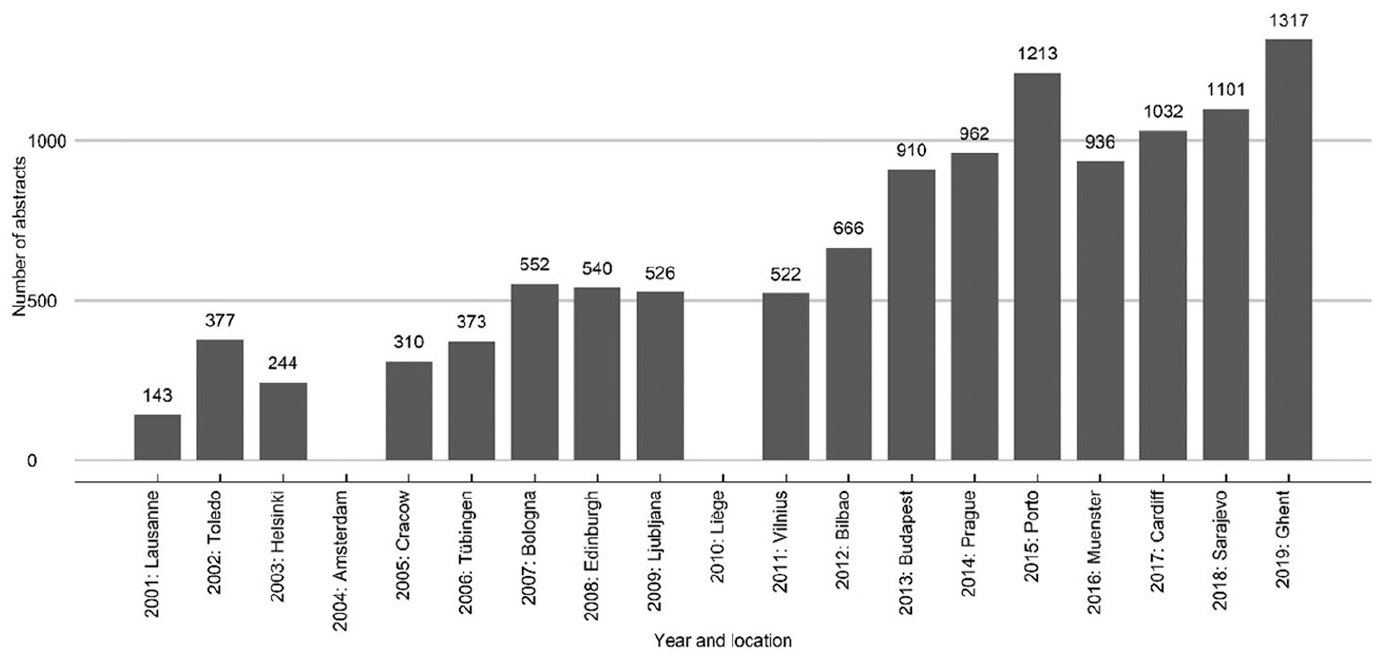
Annual number of abstracts per European Society of Criminology conference (n = 11,724).
Prior to analysis, the corpus was pre-processed. This involved replacing all uppercase letters with lowercase letters, and removing white spaces and punctuation marks from the abstracts. Common English-language stop-words such as ‘the’, ‘a’ and ‘it’ were removed from the abstracts because these words complicate the analysis without adding to the results. All words were then stemmed using Porter’s word stemming algorithm (Porter, 2001). Stemming reduces complexity without severe loss of information by replacing words with their word stem. For example, ‘criminology’, ‘criminologists’ and ‘criminologists’ were reduced to ‘criminolog’. Finally, words that occurred in less than 1 percent of the corpus or fewer than 117 abstracts were considered were removed.
Topic modelling
A reliable content analysis of a large text corpus must be automated to accommodate the corpus’s volume. Furthermore, it must be inductive to ensure that each element of the corpus is treated similarly (DiMaggio et al., 2013). This is essential to avoid bias due to the researchers’ position in their discipline and ensure that the outcome of the analysis is not guided by researchers’ assumptions with regard to themes in the corpus (Daenekindt and Huisman, 2020; DiMaggio et al., 2013). Topic modelling, the method used in this study, meets these requirements.
Topic models are a suite of text analysis methods designed for the automated extraction of latent thematic structures in large text corpora (Blei and Lafferty, 2009; Steyvers and Griffiths, 2014). Using a large collection of text documents as input, topic models produce sets of interpretable clusters of co-occurring words that are thematically associated, so-called topics. A topic is represented by a set of word probabilities. Combining the words with the highest probabilities in a topic closely relates to what humans consider a ‘theme’ (Mohr and Bogdanov, 2013). Topic modelling does not require predefined codes or categories of meaning like those required to hand-code a text. Instead, researchers specify a number of topics for the algorithm to find based on interpretability and analytic utility (Blei and Lafferty, 2009; Mohr and Bogdanov, 2013). In addition to the word probabilities associated to each topic, the model returns the prevalence of each topic. To be able to interpret the topics generated by the algorithm and to be able to distinguish meaningful topics from meaningless ones, researchers should have affinity with the phenomena under investigation (Seippel, 2018). In this way, this automated approach to text analysis results in high levels of substantive interpretability and allows researchers to analyse large collections of text by identifying central themes in the corpus (DiMaggio et al., 2013).
We estimate a Correlated Topic Model, which is an extension of Latent Dirichlet Allocation (LDA). Correlated Topic Models relax an assumption of LDA by allowing the occurrence of topics in documents to be correlated (Blei and Lafferty, 2007). In this study, we first estimated models with 10, 30, 50 and 100 topics. The first two authors then evaluated each of these outcomes in terms of their utility for the analysis. As criminologists active in European criminology, we believe that we know the field of European criminology sufficiently to recognize and assess the meaningfulness of a set of topics. Our selection for our final topic model was guided by three criteria. First, European criminology has been operating as a scientific field for at least 20 years with diverse geographical orientations and different scientific traditions and will therefore comprise a larger number of topics. Second, the chosen topic model should allow for reasonable diversity in topics but, third, it should also be narrow enough to enable the interpretation of the extracted topics. Based on this evaluation we have chosen a 50-topic model.
Within these 50 topics we identified the most and least prevalent topics in the corpus. We further studied the temporal dynamics and evolution of topics by means of a non-parametric trend analysis. The temporal trends allowed us to identify topics that are significantly more prevalent over time within European criminology, so-called ‘hot’ topics, and topics whose prominence within European criminology is decaying over time, so-called ‘cold’ topics. We use Kendal’s tau (p < .001) to identify significant changes in the trajectories of topics over time (see, for example, Giordan et al., 2018; Griffiths and Steyvers, 2004). This temporal trend analysis allows us to illustrate the direction of shifts and variations in the topics addressed at the annual conferences of the European Society of Criminology from 2001 to 2019. The identification of hot topics in science is an attractive application for topic modelling because it provides quantitative measures of the prevalence of particular kinds of research or approaches that may be useful for historical or other scientific or research policy purposes (Griffiths and Steyvers, 2004: 5232).
Results
Geographical dispersion and institutional affiliation of abstracts
The information on the authorship and affiliation of abstracts allowed us to characterize the top contributing countries and institutions to European criminology (based on first authorship). Figure 2 displays the top five contributing institutions and countries (by first authorship) respectively. One in five abstracts were first authored by a UK-based scholar. Belgian and German-based scholars are the second and third most prolific authors in our corpus, authoring 7.23 percent and 7.04 percent of all abstracts respectively. Dutch and Spanish scholars authored 5.61 percent and 4.57 percent of all abstracts respectively. Taken together, 46 percent of all abstracts are authored by scholars from one of the five countries displayed in Figure 2.
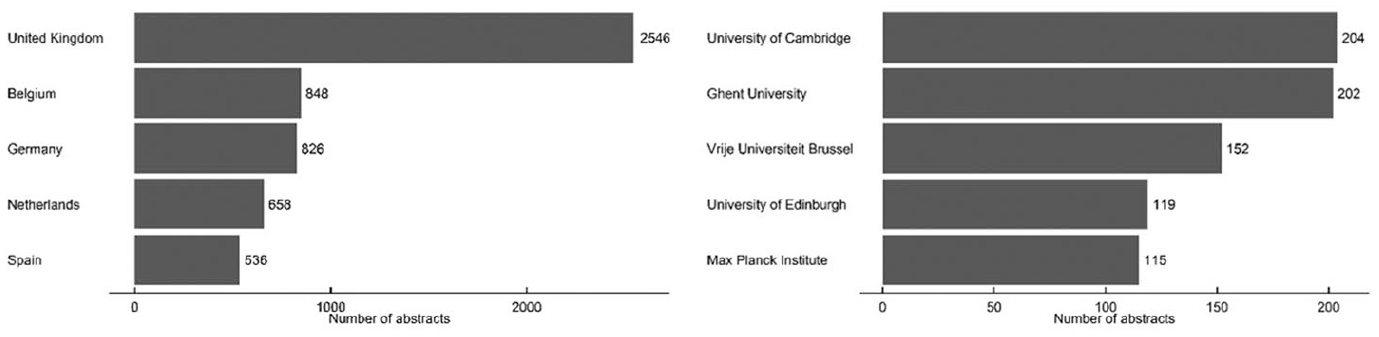
The top five contributing countries (left) and institutions (right) (n = 11,724).
There is substantially more variation in the distribution of institutional affiliation across abstracts. The top five contributing institutions account for just 6.76 percent of all abstracts. University of Cambridge affiliated scholars are most prolific and have authored 1.74 percent of all abstracts, albeit that the difference from scholars from Ghent University is trivial: 1.72 percent of all abstracts are authored by Ghent University scholars. Authors affiliated with the Free University of Brussels are responsible for 1.30 percent of all abstracts. University of Edinburgh and Max Planck Institute affiliated scholars are responsible for 1.02 percent and 0.98 percent of all abstracts respectively.
Overview of topics
The 50-model solution is presented in Table 1. 4 Each list in this table represents a topic and its associated five most probable words as well as its relative prevalence in the corpus and its trend test statistic. We interpreted the topics and labelled each using a combination of inductive reasoning, drawing on well-known research categories within criminology, and qualitative text analysis of the abstracts that the model identified as the most representative texts for each topic. The extracted topics vary considerably. Some represent general themes in criminology, such as prison research (topic 3), risk factors research (topic 40) and youth criminology (topic 41). Other topics are specific, such as restorative justice (topic 5), organized crime (topic 39) and self-control theory research (topic 48). Other topics represent methodological approaches to criminological research rather than specific themes, such as self-report research (topic 10), characterize thematic approaches within criminology, such as gender (topic 28), or capture the vocabulary specific to scientific communication of methods of original research at the annual conferences of the European Society of Criminology (topic 18). Some of the topics we identified extend the meaning of closely related topics such as spatiotemporal criminology (topic 19) and cities & neighbourhoods (topic 45), or sexual abuse (topic 20), domestic violence (topic 29) and sexual offending (topic 32).
Fifty-topic solution with topic description, relative prevalence and Kendall’s tau correlation coefficient.
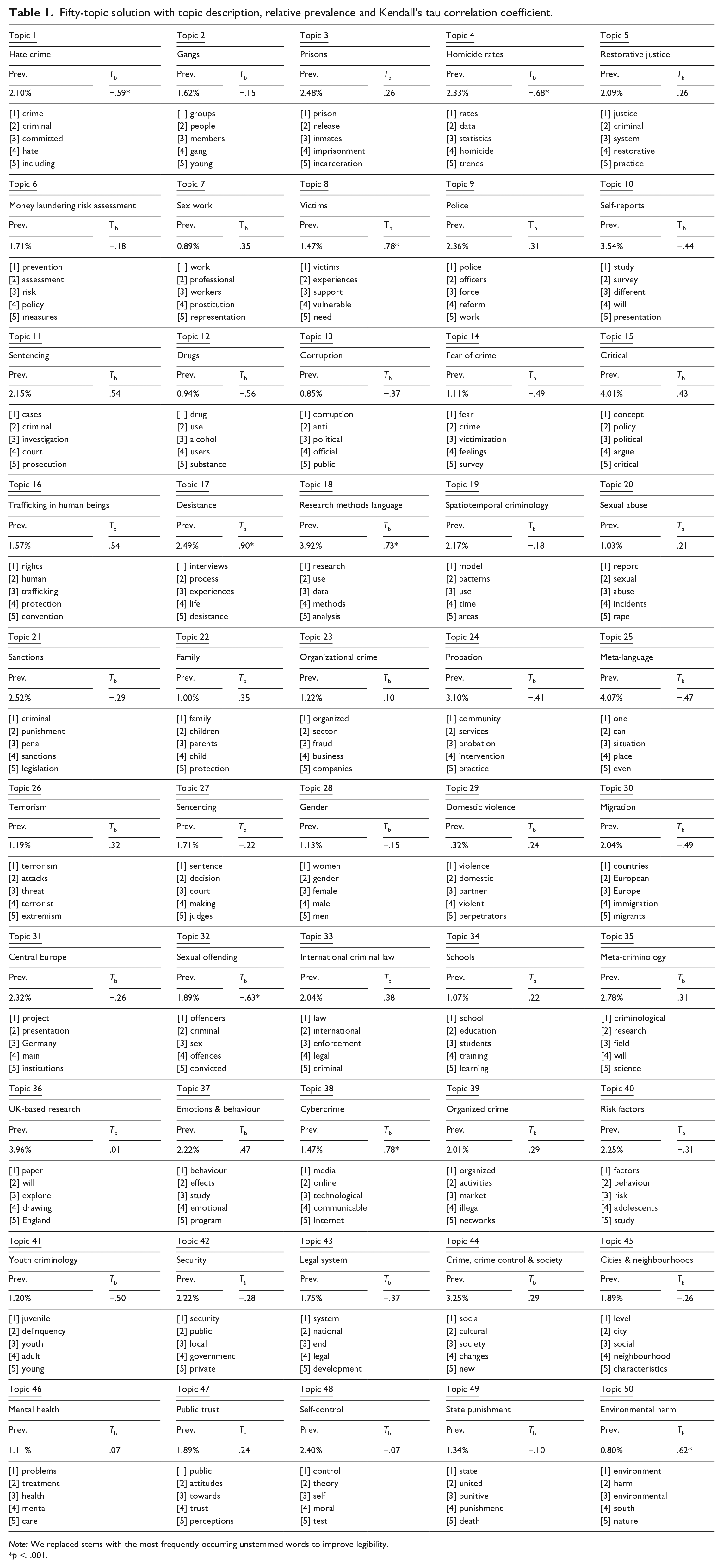
Note: We replaced stems with the most frequently occurring unstemmed words to improve legibility.
p
Influence of topics
Next, we assessed the relative prevalence of each topic within the corpus. Figure 3 displays the 10 most (left) and 10 least (right) prevalent topics. The most prevalent topics do not contain criminology-specific vocabulary, perhaps with the exception of the second most prevalent topic, which contains words that refer to the (critical) study of the reaction to and discourse of crime (topic 15). Instead, the most prevalent topics refer to specific research designs (topic 10) or to the scope of the data or study (topic 36), or represent meta-vocabulary (topics 18 and 25). Topic 25 (meta-language) is the most central topic in about 4 percent of all abstracts, closely followed by topics 36 (UK-based research) and 15 (critical), which each dominate in slightly under 4 percent of all abstracts. The fourth and fifth most influential topics in our corpus represent self-report research (topic 10) or capture the methodological vocabulary specific to original research abstracts (topic 18) and are similarly important. The least prevalent topics are of a different nature. Each topic can be linked to phenomena studied in criminology such as sexual abuse (topic 20), family (topic 22), corruption (topic 13), sex work (topic 7) and environmental harm (topic 50).
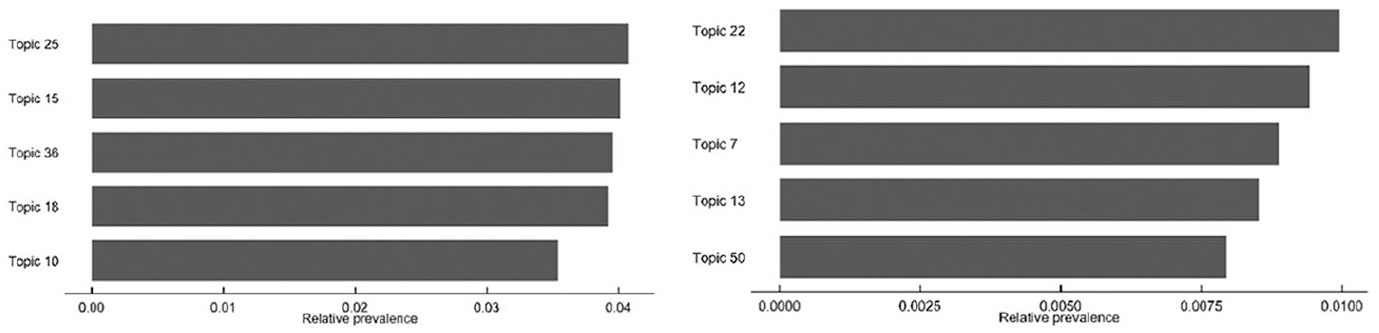
Overview of the five most (left) and five least (right) prevalent topics (n = 11,724).
Evolution of topics
We next turn our attention to major increases or decreases in topics within European criminology from 2001 to 2019. To do so, we assess the average relative prevalence of each topic for each year while accounting for increases in the volume of abstracts and the (dis)appearance of topics over time to identify the topics whose trajectories increased or decreased significantly. We illustrate hot and cold topics identified in this way by providing the abstract that is most representative of each of these topics.
Although it is reasonable to assume changes in the occurrence of themes within European criminology, the majority of topics in European criminology exhibit temporal stability. That is, we did not find significant shifts in their associated trajectories, suggesting that their relative importance has remained stable over time. Some topics, however, have significantly gained in importance while others have significantly lost influence over time.
We identified five topics for which the trajectories increased significantly over time, so-called hot topics in European criminology. Hot topics have been addressed significantly more within European criminology since 2013. All but one of these topics reflect theoretical developments in European criminology. The trajectories of hot topics are visualized in Figure 4.
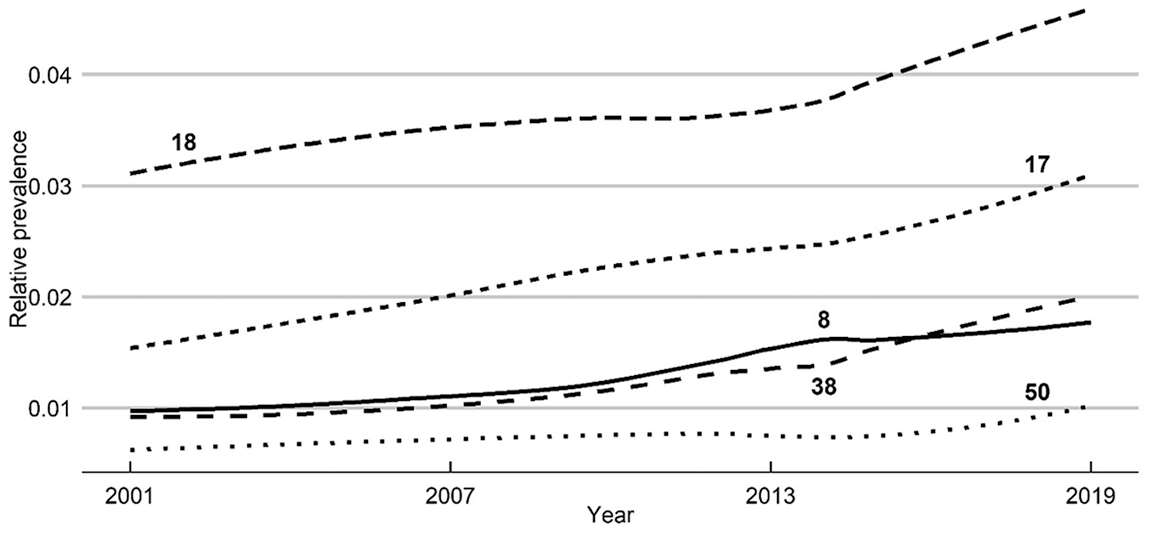
Trajectories of hot topics.
First, we see desistance (topic 17) increasingly being addressed in European criminology. For example, the abstract by Anthony Bottoms (University of Cambridge), Joanna Shapland (University of Sheffield), Deirdre Healy (University of Sheffield) and Grant Muir (University of Sheffield) entitled ‘Young adult recidivist male offenders and their struggles towards desistance’ and presented at the 2007 Bologna conference is most representative of this topic (Bottoms et al., 2007). It is estimated that topic 17 represents approximately 68.41 percent of the content of this abstract (see Appendix 1 in the online Supplemental Material). Second, European criminology increasingly engages with victims and acknowledges the importance of their involvement in various stages of the criminal justice system (topic 8). The presentation by Anna Meléndez (Universitat Autonama de Barcelona) entitled ‘When offenders meet their victims face to face. Changing perceptions during the mediation process? Results from research’ and delivered at the 2017 Cardiff conference represents this topic best (44.06 percent) (Meléndez, 2017) (see Appendix 2 in the online Supplemental Material). Third, cybercrime (topic 38) is being studied more and more over time. For example, 58.87 percent of the abstract entitled ‘The Internet of Things: A hacking wonderland’ by Tine Munk (Middlesex University) and presented at the 2017 Cardiff conference deals with this topic (Munk, 2017) (see Appendix 3 in the online Supplemental Material). Fourth, the debate on environmental harm and crime has emerged and resulted in the foundation of green criminology research within European criminology (topic 50). However, in general terms, interest in this topic is modest – it is the least prevalent topic in the entire corpus. This topic is most clearly illustrated by Robert White’s (University of Tasmania) presentation entitled ‘Studying environmental crime: The foundations of green criminology and beyond’ and delivered at the 2011 Vilnius conference (50.10 percent) (White, 2011) (see Appendix 4 in the online Supplemental Material).
Finally, we notice that in recent years abstracts increasingly follow standardized formats with a specific theoretical, methodological and meta-scientific vocabulary. This is clearly reflected in topic 18, which captures the methodological vocabulary increasingly used in abstracts reporting on original empirical research. For example, topic 18 represents an estimated 52.45 percent of the content of the abstract by Gunda Woessner (Max Planck Institute for Foreign and International Criminal Law) entitled ‘Measuring violence: An empirical approach to capture the phenomenology and nature of violence’ and presented at the 2019 Ghent conference (Woessner, 2019) (see Appendix 5 in the online Supplemental Material).
The three topics that exhibit significant decreasing trajectories over time – cold topics – indicate that homicide rates, hate crimes and sexual offending were gradually addressed less in European criminology (Figure 5). First, homicide rates as a topic was frequently addressed at annual conferences in the 2000s but interest in this topic disappeared from 2013 onwards and reached an all-time low in 2019 (topic 4). Nonetheless, a presentation delivered at the 2019 Ghent conference by Rannveig Thorisdottir (Reykjavik Metropolitan Police) and Jonas Orri Jonasson (Reykjavik Metropolitan Police) and entitled ‘The ‘Nordic Homicide from Past to Present’ project: Icelandic homicides in the 20th century’ represents this topic best (61.80 percent) (Thorisdottir and Jonasson, 2019) (see Appendix 6 in the online Supplemental Material). Second, interest in hate crimes declined over time (topic 1). This topic was regularly addressed in the early 2000s, but interest reached a low in the mid-2010s, although it gradually picked up again afterwards. Jenita Rauta (Police University College of Finland) and Jarmo Houtsonen (Police University College of Finland) authored the quintessential hate crime abstract entitled ‘The Finnish hate crime monitoring system’ and presented at the 2017 Cardiff conference (31.76 percent) (Rauta and Houtsonen, 2017) (see Appendix 7 in the online Supplemental Material). Finally, fewer abstracts covered sexual offending research (topic 32). Despite a peak of interest in sexual offending around 2005, interest dropped and reached a low in 2019. This cold topic is best represented by an abstract by Arjan Blokland (Netherlands Institute for the Study of Crime and Law Enforcement), Torbjorn Skardhamar (Statistics Norway), Anton van Wijk (Advice and Research Group Beke) and Christine Friestad (Ulleva University Hospital) entitled ‘Offending diversity in sex offenders: Comparing different types of sex offenders using Dutch and Norwegian police data’ and presented at the 2008 Edinburgh conference (63.26 percent) (Blokland et al., 2008) (see Appendix 8 in the online Supplemental Material).
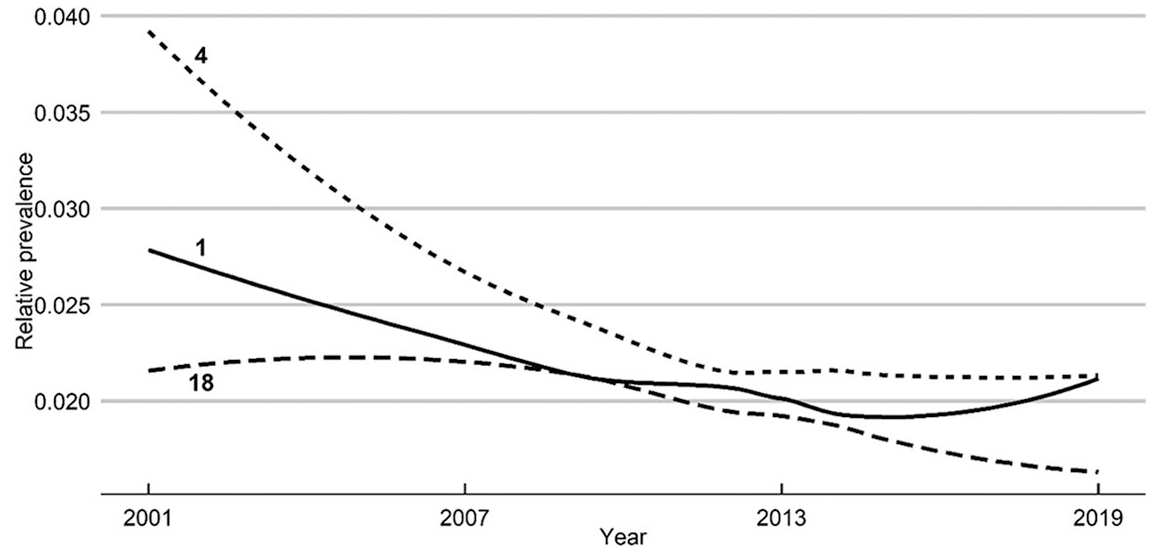
Trajectories of cold topics.
Discussion and conclusion
Applying topic modelling to determine the state of affairs of European criminology is a new approach to the debate on what European criminology is about. We applied topic modelling to analyse the content of 11,724 abstracts accepted for presentation at the annual conferences of the European Society of Criminology between 2001 and 2019, a period in which European criminology saw considerable growth and institutionalization, as evidenced by the steep increase in presentations at the annual conferences of the European Society of Criminology. We analysed the trends in the 50 topics that emerged from a text corpus representing the state of affairs of European criminology to explore changes in European criminological inquiry between 2001 and 2019.
We have answered our main question underpinning this study – What is European criminology? – in 50 topics. We determined that some topics are more influential than others, but we could not establish a clear dominance of one or more topics. Of the five most prevalent topics, we identified two abstract general topics that capture the vocabulary of ‘doing criminology’ (topic 25) and the methodological vocabulary specific to original research abstracts accepted for presentation at the annual conferences of the European Society of Criminology (topic 18). In fact, the most dominant topic in our corpus captures the meta-language and vocabulary of research in general without being specific to criminological research (topic 25). The content of three other most prevalent topics refer to specific study designs (topic 10), research approaches (topic 15) and a specific study context (topic 36). Combined, these five topics represent approximately one-fifth of the variation in the content of the abstracts we analysed. None of the five most influential topics we identified represents a specific approach or particular school of thought within criminology. The presence of a topic referring to the (qualitative) critical study of the reaction to crime in addition to a topic that represents (quantitative) self-report research could be indicative of the variation in research approaches in European criminology and suggests the absence of a theoretical or methodological domination in European criminology. However, this degree of variation is not reflected in terms of the national scope of studies, despite what some may have suggested earlier (Baars-Schuyt, 2001; Smith, 2014).
One of the most influential topics, UK-based research (topic 36), clearly represents a dominance of research specific to the UK and reliance on UK data. This should not entirely come as a surprise as we have established that, for one in five abstracts approved for presentation at the conferences of the European Society of Criminology, the first author is affiliated with a UK institution. However, there are two additional, more fundamental explanations for this result. First, language barriers – or lack thereof – might partially explain the dominance of UK-based research (Faraldo-Cabana, 2018). English is the academic lingua franca, also at the annual conferences of the European Society of Criminology. As native speakers, UK researchers have fewer language barriers to overcome. When participating in the conferences of the European Society of Criminology they can deliver their presentations in their mother tongue, unlike non-native speakers. Second, criminology as a scientific enterprise is dominated by Anglophone criminologists and its research agenda is set by ideas, theories and methods grounded in mainstream Anglo-American criminology (Faraldo-Cabana, 2018; Hebenton and Jou, 2005; Hebenton and Spencer, 1994). Criminological traditions and theoretical developments unique to lesser-represented societies garner minimal interest from mainstream Anglo-American criminology. Conversely, for a variety of reasons (see, inter alia, Faraldo-Cabana, 2018), international scholars and scholars from lesser-known criminological traditions are expected to engage maximally with literature produced in the mainstream Anglo-American criminological discourse, even though that literature might be of minimal relevance to the problem under study. The dominance of Anglo-American perspectives in criminology, in combination with how scientific excellence is being evaluated, pressures international scholars to constrain themselves to topics relevant for mainstream criminology (Faraldo-Cabana, 2018). However, the European Society of Criminology is aware of this dynamic and actively offers a counter-narrative to mainstream Anglo-American criminology by being a forum for all European researchers (Vander Beken, 2018). The European Journal of Criminology, for example, has been conspicuous as the only international criminology journal whose authors and editorial board are not dominated by researchers with an Anglo-American background (Faraldo-Cabana and Lamela, 2019).
Research pertinent to or focused on Central European countries also emerged as a topic from our analysis (topic 31). In the same vein, even though European criminology is argued to be a collaborative project that involves authors from diverse geographical orientations, our analysis clearly demonstrates that it is dominated by scholars based in just five countries, and UK-based authors alone are responsible for one in five abstract contributions. Topics representing distinctive research themes and phenomena studied within criminology, such as research into sex work (topic 7), corruption (topic 13), sexual abuse (topic 20), the family (topic 22) and environmental harm (topic 50), are among the five least influential within the corpus we considered.
Most of the topics within European criminology were evenly distributed between 2001 and 2019. This suggests that European criminology as a field exhibits a certain degree of stability. Although this could indicate that European criminology is a mature field, it could also suggest that European criminology has stagnated and that European criminologists have engaged minimally with emerging scientific and societal changes. Nevertheless, we identified just eight topics that showed a significant increase or decrease in their trajectories over time. Topics on the rise between 2001 and 2019 represent specific research themes such as victims (topic 8), desistance (topic 17), cybercrime (topic 38) and environmental harm (topic 50) or demonstrate the adoption of a methodological vocabulary that is specific to original research abstracts at the European Society of Criminology conferences (topic 18). Some of these hot topics at the annual conferences of the European Society of Criminology coincide with societal changes such as our increased concern for the climate crisis (topic 50) and the dominance of the Internet, social media and new technologies in our daily lives (topic 38). Other topics hint at a shift in the praxis of European criminology and suggest that original research is becoming more and more important in European criminology (topic 18). Researchers attending the annual conferences of the European Society of Criminology increasingly report on original research activities rather than presenting theoretical arguments or positions, and in their abstracts authors increasingly resort to writing about their methodology, data and analytical tools and techniques. However, this result could also be an artefact of our analysis of conference contributions and therefore a limitation of our approach. Conference settings might simply favour the presentation of original research instead of delivering theoretical arguments. As a result, in our representation of European criminology we might overemphasize the importance of original research in European criminology. Nevertheless, the overall influence of these trending topics in European criminology should not be overstated because their prevalence in the corpus remains limited.
Topics in which interest significantly declined between 2001 and 2019were hate crime (topic 1), homicide rates (topic 4) and sexual offending (topic 32). As a result, it seems that a substantive change in focus took place between 2001 and 2019within European criminology. The decline of homicide research as a topic in European criminology can perhaps be explained by a stronger homicide research tradition in US criminology embodied by a dedicated US-centred homicide research working group and specific conferences addressing homicide research (Block and Block, 1997; see also the composition of the editorial board of Homicide Studies). The decline of sexual offending in European criminology, however, is more difficult to explain because there are no clear indications to make us believe that this topic would be of lesser interest to European criminology, even though our analysis seems to suggest this. Perhaps attendance by those who engage in sexual offending research has declined owing to the emergence of specialized sexual offending conferences, such as the meetings of the International Association for the Treatment of Sexual Offenders and the international conferences on the Survivors of Rape. Alternatively, interest in sexual offending might extend beyond criminology, with other disciplines such as psychology, sociology and public health actively engaging with sexual offending research. If this is the case, this could illustrate the challenge for criminology in general and European criminology in particular that was identified by Bruinsma (2016). In his 2015 presidential address, Bruinsma (2016: 667) characterized European criminology as a fragmented field with many competing groups of scholars and schools of thought that are preoccupied with studying their distinct topic and whose members prefer to publish in specialty journals, attend specialized conferences and engage in discussions with peers within their expert working groups. Though specialization can be very efficient for the development of the activities within those schools of thought and is increasingly becoming important for advancing the careers of young scholars, it also runs the risk of muting the conversation within criminology as a whole. It could even lead us to challenge the added value of (European) criminology (conferences). If as a community we decide to specialize within our subdiscipline and focus exclusively on our specialty topic or engage only with research and researchers active in our preferred subdiscipline, we might look for peers active in those specific domains, regardless of whether these peers are or consider themselves criminologists. However, this is not a call to reconsider interdisciplinary research collaboration. Instead, it is an observation that a loss of conversation across subdisciplinary boundaries within criminology or exclusive scholarly engagement outside criminology runs the risk of criminologists losing command over their domain and criminologists becoming kings without a country (again) (Vander Beken, 2018, 2019).
Following up on the results of this study and those of similar studies (for example, Cohn and Iratzoqui, 2015; Farrington et al., 2019; Smith, 2014), we have identified five avenues for future research. First, it could be interesting to look into the topics addressed at the annual conferences of international criminological societies such as the International Society for Criminology, the Asian Criminological Society and the Stockholm Criminology Symposium, as well as nationally oriented societies such as the American Society of Criminology, the British Society of Criminology, the Spanish Society of Criminology, the Dutch Society of Criminology or the Australian and New Zealand (ANZAC) Society of Criminology, and to examine their state of affairs. Second, working from there it would be interesting to compare the differences and similarities of the topics addressed in the European Society of Criminology with those addressed in other criminological societies, forums or symposiums. A third option would be to go into further detail and study aspects not optimally covered in this study, such as why certain topics became hot or cold. A better understanding of these shifts and their underlying factors could be useful to further the development of European criminology. For example, the November 2015 Paris attacks and the March 2016 Brussels bombings could have spurred terror-related research. Fourth, building on Smith (2014), topic modelling could also be applied to study the European Journal of Criminology, complementing our analysis of European criminology. Finally, it would be interesting to apply topic modelling to criminology as a discipline and, for example, to study all abstracts linked to criminology and indexed in Web of Science or Google Scholar in order to establish the state of affairs in criminology research in general.
The annual conferences of the European Society of Criminology are the living memory of European criminology. As such, our analysis provides an insight into the variety of European criminology. Although European criminology is clearly broader than what is presented at the annual conferences of the European Society of Criminology, our analysis demonstrates where European criminology is coming from and where it might be heading to.
Supplemental Material
sj-pdf-1-euc-10.1177_14773708211007384 – Supplemental material for Two decades of European criminology: Exploring the conferences of the European Society of Criminology through topic modelling1
Supplemental material, sj-pdf-1-euc-10.1177_14773708211007384 for Two decades of European criminology: Exploring the conferences of the European Society of Criminology through topic modelling1 by Tom Vander Beken, Christophe Vandeviver and Stijn Daenekindt in European Journal of Criminology
Footnotes
Declaration of conflicting interests
The author(s) declared the following potential conflicts of interest with respect to the research, authorship, and/or publication of this article: Tom Vander Beken is past-president of the European Society of Criminology.
Funding
The author(s) disclosed receipt of the following financial support for the research, authorship, and/or publication of this article: Christophe Vandeviver’s contribution to this work was supported in part by the Research Foundation – Flanders (FWO) Postdoctoral Fellowship funding scheme (12CO619N to C.V.).

Supplemental material
Supplemental material for this article is available online.
Notes
References
Supplementary Material
Please find the following supplemental material available below.
For Open Access articles published under a Creative Commons License, all supplemental material carries the same license as the article it is associated with.
For non-Open Access articles published, all supplemental material carries a non-exclusive license, and permission requests for re-use of supplemental material or any part of supplemental material shall be sent directly to the copyright owner as specified in the copyright notice associated with the article.
