




Abstract
In recent years, many European countries have taken far-reaching measures to combat the criminal activities of outlaw motorcycle gangs (OMCGs). Meanwhile, empirical research into the ways OMCGs are involved in and influence the crimes of their members is largely lacking. This study presents the main findings of research based on police files of cases that were filed against members of Dutch OMCGs. We apply a criminological scenario approach to analyse to what extent and in which ways OMCGs are involved in the crimes of their members. The results show that OMCG membership particularly plays an indirect role in the criminal behaviour of OMCG members. Board members, for example, give permission for criminal acts, regulate mutual relationships between members, non-members and rival OMCGs during conflict situations, and forbid (criminal) behaviour of members that is harmful to the OMCG. OMCGs function as a pool of co-offenders and as a market for criminal enterprises. Members also use the violent reputation of OMCGs in specific criminal activities. OMCGs are less frequently directly involved in crimes. Direct involvement of OMCGs is most apparent in organized inter-gang violence and violence against their own members.
Introduction
Prior research has found that members of outlaw motorcycle gangs (OMCGs) are disproportionately involved in serious crimes, such as extortion, weapon- and drug- trafficking, and violence (Blokland, Van der Leest and Soudijn, 2017, 2019; Klement, 2016; Lauchs and Staines, 2019; Morgan et al., 2020). Fear of escalating inter-gang violence between OMCGs has further added to governments’ felt need to act, and indeed many European countries have taken legal measures to combat OMCG crime and violence (Cornils and Greve, 2004; Van Ruitenburg, 2016, 2020). These measures are primarily aimed at hampering the structural aspects of OMCGs, not at individual members. For example, permits for motor runs and events known to attract outlaw bikers are frequently denied or withdrawn, OMCG clubhouses are closed down, and nightlife venues, such as bars and restaurants, are urged to deny access to those wearing OMCG colours (Van Ruitenburg, 2016). Based on the assumption that OMCGs contribute to an environment that facilitates behaviour contravening public order, several European countries, such as the Netherlands and Germany, have successfully banned certain OMCGs or chapters of OMCGs via civil lawsuits (Koornstra et al., 2019). These bans result in OMCG members being unable to wear their club colours, organize OMCG events or attend ‘church meetings’ (that is, club meetings mandatory for full colour members) without making themselves liable to prosecution.
Although previous research suggests that OMCGs have a criminogenic effect on the behaviour of their members (Blokland, Van Hout, Van der Leest and Soudijn, 2017; Klement, 2016; Van Deuren et al., forthcoming), the exact nature of the relationship between OMCGs and their members’ crimes is still unclear. Therefore, a very relevant question for both science and public policy is to what extent the criminal activities of outlaw bikers are related to OMCGs and what role OMCGs actually play in the criminal activities of their members.
Von Lampe and Blokland (2020) distinguish three scenarios that may link OMCGs and the crimes of their members: the ‘bad apple’ scenario, the ‘club within a club’ scenario, and the ‘club as a criminal organization’ scenario. According to these scenarios, OMCGs can play various roles in the criminal behaviour of their members. The ‘bad apple’ scenario refers to autonomous individual members who engage in crime alone, with only a few other members or with non-members. The ‘club within a club’ scenario represents crimes in which multiple autonomous OMCG members are involved. The main difference between the ‘bad apple’ and the ‘club within a club’ scenario is that, in case of the latter, the mere number of members involved may lead to the erroneous conclusion that the OMCG itself – as an organizational entity – is involved. Yet, under the ‘club within a club’ scenario, decisions in the planning, commission and cover-up of crime are organized by the individuals involved, without making use of the club’s formal hierarchy. Finally, in the ‘club as a criminal organization’ scenario, the organization of crime does operate through the formal club structure, meaning that decisions involved in the crime process follow the club’s formal hierarchy and are taken via the appropriate organizational procedures, and that orders following from these decisions are seen as legitimate by those who receive them. Although Von Lampe and Blokland (2020) build their argument based on examples taken from the academic and popular literature on outlaw bikers, their contribution is primarily conceptual and in need of a more solid empirical foundation.
As the link between OMCGs and the criminal behaviour of members is still unclear, the aim of this study is to fill this knowledge gap and clarify the role of OMCGs in their members’ crimes. We do so by analysing 60 police files of criminal cases that were filed against members of Dutch OMCGs and applying the three analytically distinct scenarios of Von Lampe and Blokland (2020). After addressing previously proffered theoretical notions, such as different typologies of outlaw biker crime and Barker’s (2015) club–gang continuum, we elaborate upon the method that we have used and present the findings of our extensive police file research. We show to what extent and in which ways OMCGs play a role and are involved in the criminal behaviour of their members. Finally, in the last section of this article, we summarize the main conclusions and elaborate upon the theoretical and empirical implications of the current findings.
OMCGs as criminal organizations
Members of OMCGs are involved in various types of (serious) criminal behaviour. Quinn and Koch (2003) classify outlaw biker crime into four distinct categories: spontaneous expressive acts; planned expressive acts; short-term instrumental acts; and ongoing instrumental enterprises. Spontaneous expressive acts are (violent) crimes related to the outlaw biker subculture in which one or a few members are involved (for example, bar fights). Planned aggressive acts are violent actions directed at rival OMCGs. Short-term instrumental acts are illegal activities based on unique opportunities or the needs of specific members; they are committed by one or more members and are aimed at material gain (for example, motorcycle theft). Finally, ongoing instrumental enterprises refer to long-term planned criminal activities aimed at financial gain committed by members in consort. Ongoing instrumental enterprises are considered to be an indicator of organized crime (for example, the production of synthetic drugs).
The classification by Quinn and Koch (2003) combines various dimensions of outlaw biker crime: the degree of planning (from spontaneous to planned); the duration of crimes (from short-term to ongoing); the purpose of the crime (from expressive to instrumental), and the number of members involved in illegal activities. However, this classification seems to neglect crimes committed by members with non-members. Nonetheless, prior research shows that gang members also often perpetrate crimes with non-gang members (Klein and Maxson, 2006; Rostami and Mondani, 2017). In addition, the classification implicitly uses the number of OMCG members as an indicator of the extent to which OMCGs as organizational entities are involved in illegal activities. However, the involvement of multiple members, as we will explicate below, does not necessarily indicate that OMCGs play a significant role in criminal behaviour: multiple OMCG members may commit crime together, without any direct and coordinating role of the OMCG.
Lauchs et al. (2015) separate outlaw biker crime into barbarian culture offences and organized crime. Barbarian culture offences are crimes related to the outlaw biker subculture, such as assault and public order offences, whereas extortion and the production of synthetic drugs are examples of organized crime. Lauchs et al. (2015) propose an intermediate category of outlaw biker crime: crossover crimes. Crossover crimes can, depending on the circumstances, be categorized as either barbarian culture offences or organized crime. Violence, for example, can on the one hand result from nightlife skirmishes with bar patrons or door attendants (barbarian culture offence), but can also be part of an ongoing extortion (organized crime). In contrast to Quinn and Koch (2003), Lauchs et al. (2015) argue in so many words that the fact that multiple members engage in organized crime does not necessarily mean that the OMCG can be regarded as a criminal organization (Lauchs et al., 2015).
Barker (2015) notes that whether an OMCG can be classified as a criminal organization depends on to what extent members are involved in organized crime and to what extent the leaders of the OMCG are involved in the planning and execution of these crimes. Barker (2015) proposes a club–gang continuum, suggesting that, at one extreme, there are associations of individuals gathering out of a joint interest in motorcycling (clubs) whereas, at the other extreme, there are criminal organizations aimed at criminal profit (gangs). According to Barker (2015), an OMCG can be regarded as a criminal organization/gang when many members are involved in (organized) crime and when crime is coordinated by the leaders of the OMCG.
Barker’s club–gang perspective entails at least two problems regarding the crimes of outlaw bikers. First, the involvement of multiple members and leaders in crime does not necessarily imply that the OMCG as a collective entity has a direct role in the criminal behaviour of its members. Existing OMCG research indicates that numerous OMCG members and leaders oftentimes commit crime independently of the OMCG and its formal club structure (Lauchs and Gilbert, 2017; Liddick, 2008). Research by Morselli (2009) and Rostami and Mondani (2017), for instance, shows that (organized) crime of outlaw bikers can be committed by cliques operating relatively autonomously, without the supervision of local, let alone national, OMCG leaders. These findings contradict the view that OMCGs are criminal organizations with a clear formal club structure exerting control over members’ illegal activities. Second, the Barker (2015) continuum seems indirectly to suggest that OMCGs as ‘clubs’ do not play a significant role in the criminal behaviour of their members.
In sum, both Quinn and Koch (2003) and Barker (2015) take the number of OMCG members and leaders involved in crime as an indicator of the OMCG’s organizing role, leaving questions regarding the specific role(s) of OMCGs in the crimes of their members unanswered. Quinn and Koch (2003), Lauchs et al. (2015) and Barker (2015) all differentiate inter-gang violence from organized crime, despite the former having serious consequences for OMCG members, citizens and society writ large.
Role of gang membership in the criminal behaviour of members
Von Lampe and Blokland (2020) introduce three scenarios to examine the link between OMCGs and their members’ crimes (see Figure 1). In the ‘bad apple’ scenario, OMCG members commit crimes alone, with other members or with non-members, but OMCGs are not directly involved in criminal acts. An example of a ‘bad apple’ scenario is an OMCG member who commits theft for personal gain, independently of the OMCG. Although OMCGs do not directly engage in the crimes of a ‘bad apple’, individual members can benefit in numerous ways from their OMCG membership. Felson (2003) suggests that gangs function as offender convergence settings: places where co-offenders meet and interact with each other. By joining a gang, new criminal partnerships and opportunities may emerge. Furthermore, gang members can benefit from the symbolic value of a patch or gang symbol, also called ‘the power of the patch’. The power of the patch refers to the intimidating effect of wearing OMCG colours (Barker, 2011; Wolf, 1991). OMCG members can make use of the gangs’ violent reputation to intimidate victims, witnesses or other criminal groups, resulting in them being afraid or reluctant to report the criminal offences of OMCG members to authorities. Finally, gang members can count on mutual protection and support in the commission of crime. Regarding the Italian Mafia, Paoli (2003) refers to the ‘generalized exchange’ between gang members – the obligation of Mafiosi to support each other, financially and materially, at all times. This is in accordance with prior research by Firestone (1993), suggesting that the role of the Mafia lies mainly in protecting members’ criminal activities, instead of centrally coordinating crimes. Conversely, Mafiosi must relinquish part of the profit they make under protection (Firestone, 1993). Although membership of an OMCG does not by definition imply that OMCG leaders coordinate all criminal behaviour by individual OMCG members, there may still be various ways in which OMCG members benefit from gang membership: using the club as an offender convergence setting, making use of the power of the patch, or otherwise relying on the unconditional support of fellow members. Hence, even without directly orchestrating it, OMCGs may play an important indirect role in their members’ criminal behaviour.
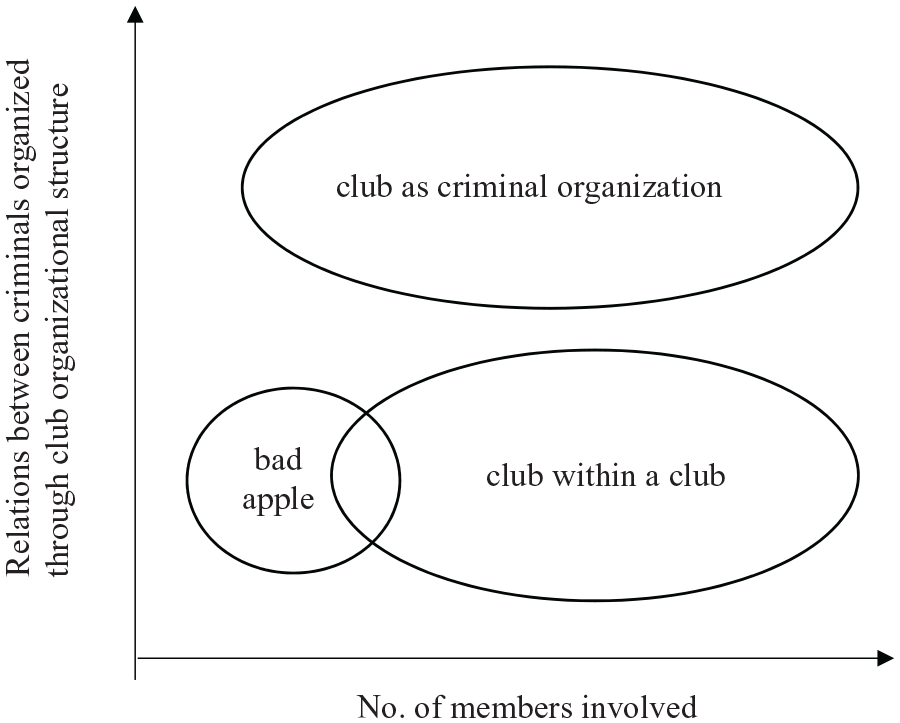
Three scenarios to examine the link between OMCGs and members’ crime.
The ‘club within a club’ scenario is only different from the ‘bad apple’ scenario in a numerical way and refers to crimes in which multiple OMCG members and/or leaders are involved, but the implementation of these crimes does not follow the club’s organizational lines. As with the ‘bad apple’ scenario, the ‘club within a club’ scenario refers to autonomous members who engage in criminal acts, without direct involvement of the OMCG. Since multiple members and leaders may engage in crime together, to the outside world these crimes may appear to be club business. Whether crimes can be attributed to the OMCG as an organizational entity, however, depends on the role of the formal club structure (Von Lampe and Blokland, 2020). Only when the interactions between those engaged in crime are structured along the club’s organizational lines, and this structuring is perceived as just by the parties involved, can crimes be attributed to the club. The indirect benefits of OMCG membership mentioned above also apply to the ‘club within a club’ scenario. For instance, in their analysis of published court rulings, Blokland and David (2016) mention a criminal case involving the threatening of a night club bouncer. When the bouncer refused entry to a group of Satudarah motorcycle club (MC) members, these members shouted that ‘no one refuses Satudarah’, a direct reference to the OMCG as a collective, and threatened the bouncer would be killed if he did not let them in. Although multiple members were involved in the incident, and the club name was used to bolster the threat made, there are no indications that the formal club structure was in any way used in its commission. Therefore, this example can be classified as a ‘club within a club’ scenario.
In the ‘club as a criminal organization’ scenario, the organization of crime runs parallel to the formal club structure of the OMCG, meaning that the formal club structure is used to plan, coordinate and execute criminal behaviour by members, who benefit from the advantages of OMCG membership. An important difference between the ‘club within a club’ and the ‘club as a criminal organization’ scenarios is that (criminal) orders arising from the formal club structure are considered legitimate by subordinates. The existing literature includes multiple examples of a ‘club as a criminal organization’ scenario. Thompson (2011), for instance, states that in the 1970s the leadership of the Pagans MC planned to formalize the sale of drugs. During a ‘church meeting’, members of the Pagans MC were forced to sell drugs and return the sum of money to the OMCG and its leaders. Another example of a ‘club as criminal organization’ scenario is documented for the Hells Angels South Carolina charter. These Hells Angels engaged in multiple criminal activities, such as money laundering, weapon trafficking and arson, which were coordinated by the OMCG’s leadership (Barker, 2015).
Summing up, the scenario approach is mostly concerned with the extent to which crime is organized along the club’s organizational lines, with the number of members involved important only for public perceptions. Two additional points regarding the scenario approach should be highlighted. First, the nature of the particular crime committed is not directly relevant to determine the applicable scenario. This may lead to a situation in which a criminal act is classified as a ‘club as a criminal organization’ scenario in the absence of ‘organized crime’, for example in the case of collective violence against a rival club coordinated by the OMCG’s leadership. Second, the three scenarios are not mutually exclusive. That is, the three scenarios can coexist simultaneously within the same OMCG and even within chapters of the same OMCG with regard to different types of crime. For instance, an individual member may be involved in cultivating marijuana (‘bad apple’), other members may together be involved in motorcycle theft (‘club within a club’), and at the same time the OMCG leadership may order the bombing of a rival club’s club house (‘club as criminal organization’). For a more detailed description of these three scenarios, we refer to Von Lampe and Blokland (2020).
Current focus
In this article, we examine to what extent and in which ways OMCGs play a role in the criminal behaviour of their members. We analyse 60 police files of cases that were filed against members of Dutch OMCGs to explore the relationship between OMCGs and members’ crimes. Police files include detailed information on individual suspects, partnerships and criminal activities. This level of detail allows us to distinguish the three analytically distinct scenarios when analysing the crimes committed by OMCG members as well as whether and how the OMCG played a role in these crimes.
Method
In 2012, the Dutch Minister of Security and Justice announced a multi-pronged, whole-of-government approach aimed at combating criminal OMCGs through all legal options available, including criminal, civil and administrative means (Van Ruitenburg, 2016, 2020). We studied the police files of cases that were filed against members of Dutch OMCGs since the start of this whole-of-government approach in 2012 up to 2018. After being granted permission by the Dutch Public Prosecution Office, we received a list consisting of 110 criminal cases in which members of OMCGs were allegedly involved. During the course of our study, we checked and cleaned this original list: some cases concerned only project proposals (without any concrete police action), some criminal case files mentioned could not be retrieved, and other criminal cases turned out not to involve OMCG members at all. After deleting irrelevant and missing case files, we ended up with 75 police files referring to criminal cases. Upon further inspection, we excluded police files that consisted only of procedural files (about investigation methods, without substantive case information) or referred only to police arrests (eight files) or led to a ‘policy dismissal’ (two files). Police files with an unclear link to an OMCG (five files) were also excluded from the analysis. Examples of an unclear link were files that referred to OMCGs only in general terms, such as ‘motor club’, but did not mention any specific OMCG. Applying the aforementioned criteria, we ended up with 60 police files in which at least one suspect was affiliated with a specifically mentioned OMCG for the remaining analysis. 1 Police files included transcripts of interrogations with suspects, victims and witnesses. We also had access to covert observation and wiretap information.
We chose to include in our analysis all closed police investigations that provided sufficient evidence for the public prosecutor to take the case to court, regardless of whether the court ruling on the case was still pending. Already back in the 1940s, Tappan (1947) argued that criminologists should use only court rulings, because only the courts had the authority to decide whether or not someone was guilty. Sutherland (1945), however, contended that criminal activities should be studied as close to the source as possible; otherwise, serious criminal activities, such as white-collar crime, could hardly be the subject of criminological study. In the Netherlands, the public prosecutor is in charge of the investigative tasks of the police and a deliberate decision is made whether or not a case is taken to court. To us therefore, following Sutherland, cases taken to court represent the optimal trade-off between topicality and solidity of evidence (Kleemans, 2014: 61–2). Waiting for a final judgment by the courts – as Tappan suggested – would result in a substantial time-lag between the criminal behaviour and the judicial decision and would mean banning the use of many of the available files for at least another five to ten years.
The protocol used to analyse the police files was previously successfully employed in the Dutch Organized Crime Monitor (see Kleemans, 2014). All police files were analysed by using an extensive checklist with topics such as size, composition, criminal activities and modus operandi of the criminal group. This topic list was, furthermore, augmented with topics particularly relevant for the population under study. Additional questions were, for example: Which suspects were OMCG members? What club functions did they have? Did this club function play a role in the criminal activities? What was the role of the OMCG in the criminal activities? To what extent did the criminal operation run parallel to (parts of) the formal club structure?
The aim of this study was to examine to what extent and in which ways OMCGs played a role in the crimes of their members. In the Results section, we describe in detail various cases showing the role and involvement of particular OMCGs in crime. For privacy reasons, we refer to specific leadership functions (president, vice-president, road captain, treasurer, secretary and sergeant at arms) as ‘board members’. 2 We also use different randomly generated pseudonyms in every case description – OMCG A, OMCG B, OMCG C, etc. – to refer to different OMCGs instead of using actual club names. In addition, references to specific geographical locations, for example street and place names, company names and names of bars and other landmarks, are not mentioned in the case descriptions. In some descriptions, we refer not to a specific criminal case but to ‘one of the studied police files’. In this way, we make sure that information cannot be traced back to specific individuals. The case descriptions and privacy measures taken were checked and approved by the Dutch Prosecution Office.
The 60 analysed case files were related to six OMCGs and three support clubs, 3 , and they contained 202 criminal charges, which involved crimes such as extortion, the production and trade of soft and hard drugs, and arson (see Figure 2). The case files could involve one member, multiple members and sometimes an entire chapter. In total, 291 unique suspects were involved in the 60 police files: 199 were members (68 percent), of whom 71 were board members (24 percent), and 92 were non-members (32 percent).
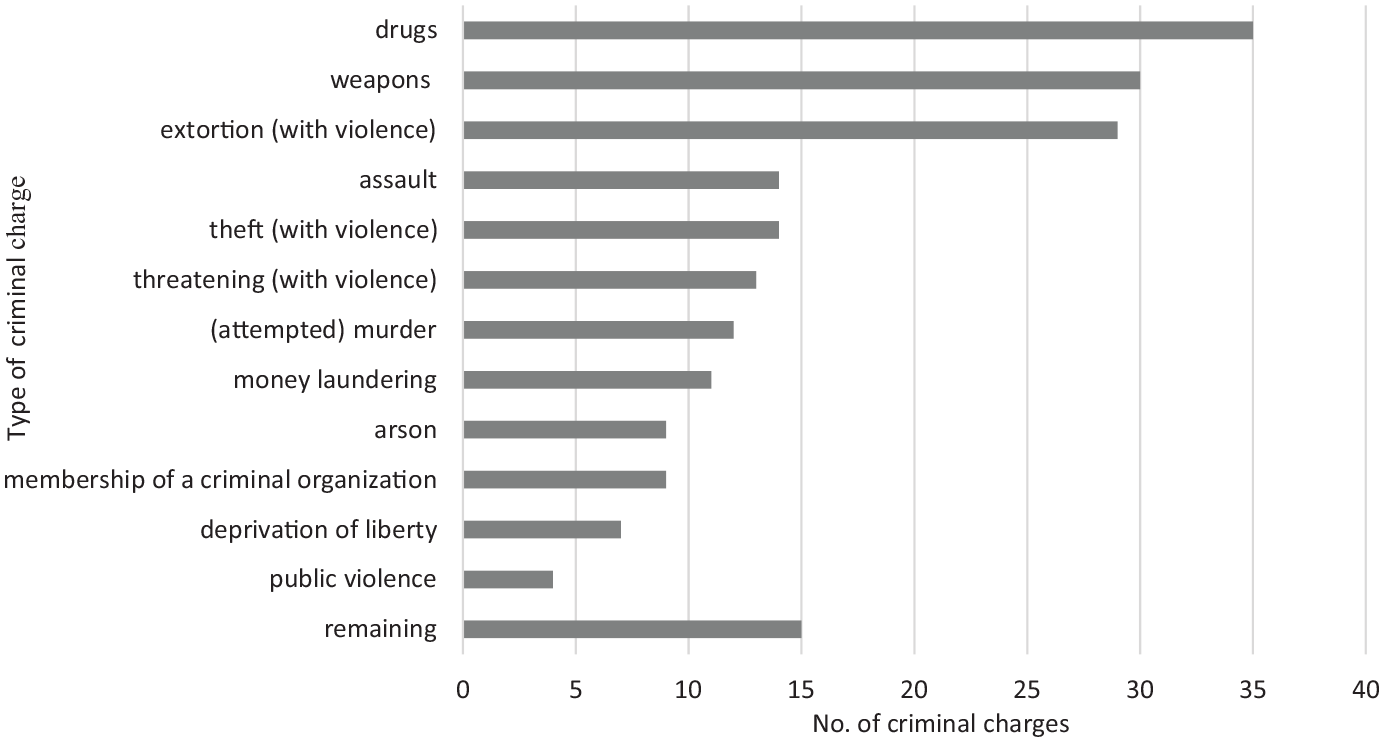
Summary of the criminal charges in the 60 analysed police files.
We classified each of the 202 criminal charges separately as one of the three scenarios (see Figure 3). To do this, we applied a number of criteria. First, it is important to note that there is no clear conceptual boundary between the ‘bad apple’ scenario and the ‘club within a club’ scenario, because this distinction is one of public perception. For the current analysis, we classified a criminal offence as a ‘bad apple’ scenario if an individual OMCG member committed the offence alone or together with non-members. The criminal offence moves to the ‘club within a club’ scenario if more than one OMCG member is involved in the criminal act. Second, we classified a criminal offence as a ‘club as criminal organization’ scenario if the organization of the criminal behaviour overlaps with the hierarchical organization of the OMCG. To do this, we looked specifically at the nature, tone and content of the interactions between members and board members, based on, for instance, wiretap information included in the case files. The horizontal bars in Figure 3 show the percentage distribution between the scenarios for each offence, whereas the data labels represent the absolute numbers per offence.
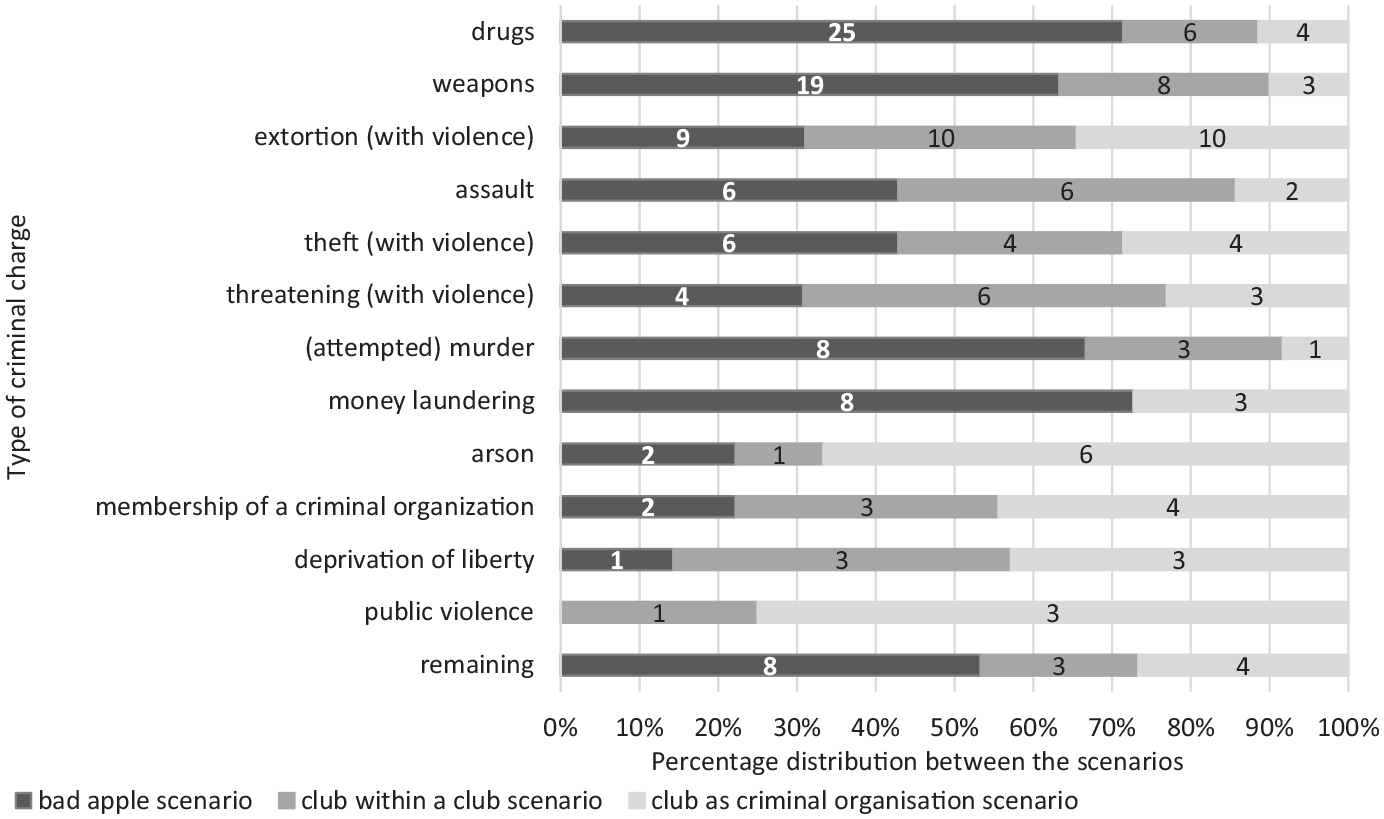
Criminal charges classified into one of the three criminological scenarios.
Furthermore, in Figure 4, we categorized the criminal charges by OMCG (1a, 2a, 3a, 4a, 5a, 6a) and their support clubs (2b, 2c, 3b) (white dots) while, at the same time, showing the percentage distribution of the occurrence of the three scenarios by OMCG and support club (vertical bars). Figure 4 shows that there is variation both in the level of criminal behaviour and in the occurrence of the three scenarios across different OMCGs and support clubs. The observed variation in crime is in line with prior research that distinguished various OMCGs and support clubs based on the registered criminal behaviour of their members (Blokland, Van der Leest and Soudijn, 2017, 2019) and research that differentiated between more criminal and less criminal OMCGs (Van Deuren et al., forthcoming).
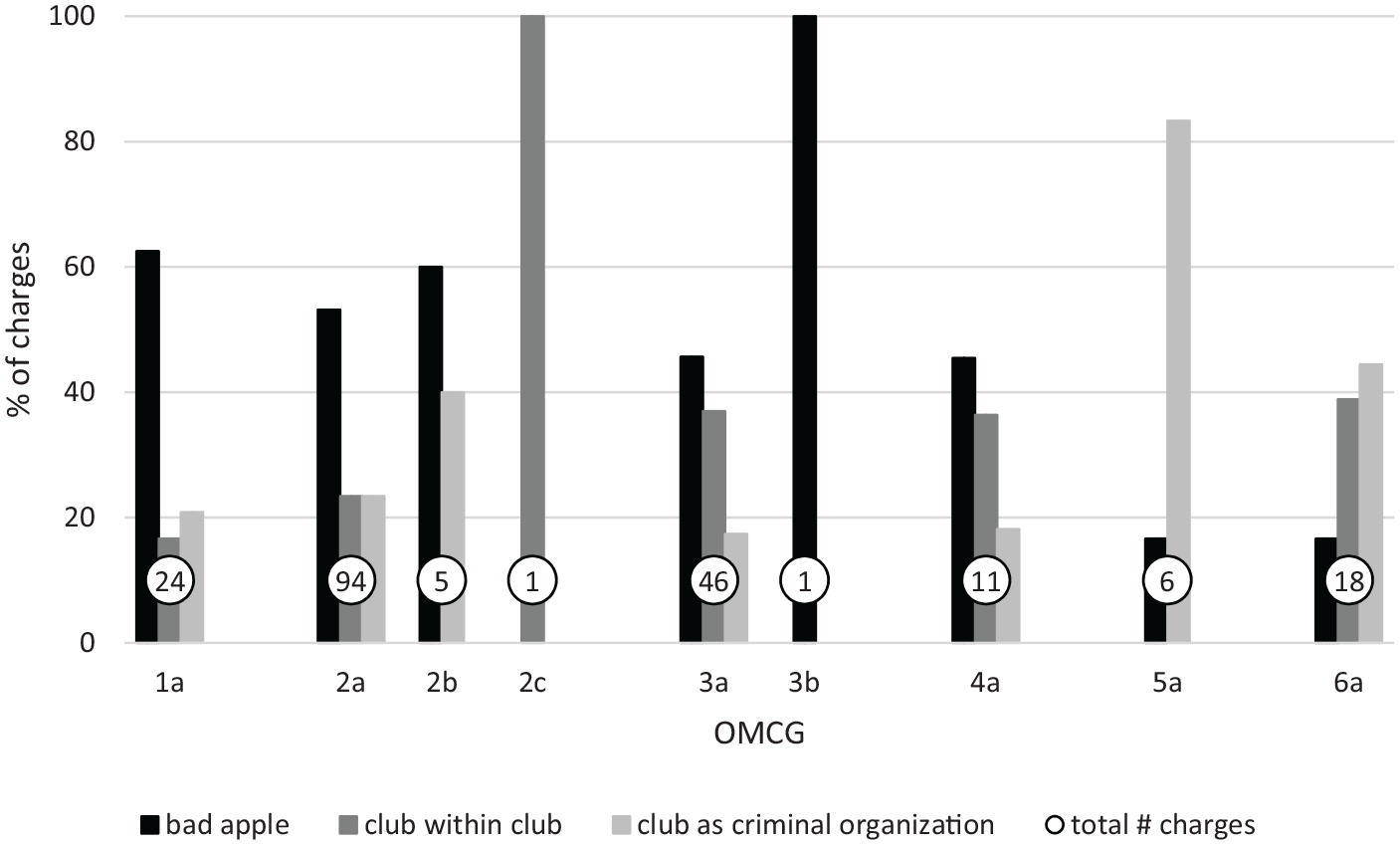
The criminal charges and the three criminological scenarios classified by OMCG and support club.
Results
‘Bad apple’ scenario
The ‘bad apple’ scenario refers to situations in which an OMCG member commits crime alone or with non-OMCG members. The ‘bad apple’ scenario is present in 98 (48 percent) of the criminal charges and 47 (78 percent) of the cases. Examples of this scenario are an attempted murder (case 2) and trade in hard drugs (case 7):
Board member A came into conflict with non-member B, because board member A was having an affair with non-member B’s wife. Non-member B, in response, vandalized the house of board member A several times. Consequently, board member A placed a hand grenade under non-member B’s car. (Case 2) Member C traded in narcotics. The police file shows that member C was selling drugs particularly to people who were not affiliated to the OMCG. Furthermore, wiretap information revealed no indication that member C was acting on behalf of the OMCG. (Case 7)
In both examples, an OMCG member perpetrated a crime without the involvement of the OMCG as an organizational entity.
The following cases, however, provide examples in which members, though acting as ‘bad apples’, still benefited from their OMCG membership (without direct involvement of the OMCG):
The police department received information about board member D’s involvement in an unlicensed prostitution business. According to the information, board member D was in charge of two women working as prostitutes. On board member D’s orders, these two women offered their services in OMCG clubhouses. The police file shows that these women did not exclusively offer their services to members of board member D’s Dutch chapter of the OMCG. They were also employed in a clubhouse of the same OMCG abroad. (Case 19)
This case shows that the OMCG functions as an offender convergence setting. Board member D used his OMCG network as a market for his illegal prostitution business, a clientele he could only reach through his OMCG membership. Case 10 shows that sometimes co-members are used not only as clients of illegal services, but also as co-offenders:
During their relationship, board member E’s ex-girlfriend lent board member E a large amount of money. He spent it on the purchase of a motorcycle and a car, his OMCG membership fees, and a photo camera. After ending the relationship, board member E, together with a full colour member of his chapter, embezzled these assets, sold them, or changed the ownership of the assets. As a reward for his help, the full colour member received fuel money. Board member E, furthermore, used his OMCG network to register the car in someone else’s name. This way, the ownership of the car was transferred to a car company owned by a contact of the OMCG. (Case 10)
In this case, the formal club structure was not used to enable crime; rather the OMCG was functioning as a pool of suitable co-offenders, used to help embezzle certain assets. Using OMCG members as co-offenders is another indication that OMCGs are functioning as offender convergence settings. Furthermore, members also make use of the power of the patch, particularly in extortion:
Board member F ran a debt collecting agency that third parties could hire. By means of his OMCG network, board member F came into contact with clients and received assignments. These assignments were carried out either by board member F himself or, sometimes, by other club members. Using violence and threats of violence, various non-members were extorted into paying large amounts of money. One of the cases mentioned in the police file involved non-member G being forced by board member F to sign an agreement that obliged non-member G to pay large amounts of money. To give impetus to his demands, board member F sent G photos of G’s house, and passed by G’s company several times, dressed in club colors.
5
(Case 37)
This case illustrates that members use the reputational value embodied in their OMCG colours to intimidate and extort payment from people to their own economic advantage. Taken together, these examples show that OMCG members, without the direct involvement of the OMCG as an organization, can still indirectly benefit from membership while engaging in criminal behaviour.
The formal club structure as regulator of mutual relationships in individual conflicts
Thus far, the cases referred to examples of individual OMCG members engaging in criminal behaviour without the involvement of the OMCG as an organizational entity, although these individual members indirectly benefit from their OMCG membership. The police files, however, reveal that OMCGs can also play a more ‘active’ role in the crimes of individual OMCG members: not in organizing and coordinating crime, but rather as regulator in mutual relationships between members, non-members and rival OMCGs during conflict situations:
Member H had a financial (drug) conflict with hangaround I. Both H and I were affiliated to the same OMCG, but belonged to different chapters. Hangaround I was responsible for member H’s cannabis operation during member H’s detention. Hangaround I sold cannabis to various consumers, but – according to member H – kept too much money for himself. During a club night, member H asked the OMCG permission to solve this conflict. During a subsequent – wiretapped – conversation, member H was recorded saying: ‘They told me that I am right and they allowed me to do it, but not whilst wearing my jacket.’ The day after member H gained this approval, he shot and injured hangaround I. After the incident, hangaround I claimed, member H was forced to leave the OMCG in so-called bad standing, because, after all, it is not allowed to hurt a brother. (Case 8)
The conflict that had arisen between the member and the hangaround was a private one in which the OMCG was not directly involved. Nevertheless, member H felt compelled to ask permission of the OMCG to confront hangaround I. When member H subsequently shot hangaround I, he was expelled from the OMCG in bad standing. In retrospect, although the OMCG gave member H permission to confront hangaround I, it seems that there were reasons for the OMCG not to approve the specific way in which this confrontation was eventually carried out. This case shows that OMCGs can also be involved in the ‘bad apple’ scenario by regulating individual conflicts at club level (permission to confront, bad standing) if those conflicts are perceived to potentially harm the OMCG as a whole. This finding also relates to the following case:
Member J and member K, both members of different OMCGs, had a financial conflict. Member J went to his co-members of OMCG A to ask advice on how to solve the conflict. Because of the good relationship between the two OMCGs, fellow club member L gave member J the advice to solve the conflict decently. While wearing their club colours, both club members J and L of OMCG A went to the house of member K of OMCG B to negotiate. Despite the attempted mediation, the conversation escalated, after which member L of OMCG A grabbed his weapon. Several shots were fired between members of OMCG A and OMCG B. According to members of OMCG A, the goal of the encounter was to solve the conflict. These members also stated that there are unwritten rules about not shooting at one another’s jacket. The police files show that, eventually, both OMCGs solved the conflict at the club level. By way of compensation, OMCG A paid a large amount of money to OMCG B. In addition, member L, who apparently was the first person to grab his weapon, was expelled from his OMCG in bad standing. (Case 51)
The aforementioned cases show that OMCGs, at the club level, may intervene in conflict situations involving individual members. By acting as regulator of mutual relationships, OMCGs attempt to resolve conflict situations, for instance by meting out institutionalized punishments (including bad standing) to individual members. This more active role of OMCGs is particularly related to personal conflicts that may potentially harm the OMCGs’ interests (including intra- or inter-club relations). These cases also indicate that being a member of an OMCG makes it rather difficult to solve conflicts individually. Private conflicts of individual members may soon turn into club business, particularly when multiple members are involved.
‘Club within a club’ scenario
The ‘club within a club’ scenario refers to situations in which multiple OMCG members commit a crime, but the organization of these members in committing this crime does not run parallel to the formal club structure. This implies that OMCGs are not directly involved in the crimes of members yet – similar to the ‘bad apple’ scenario – OMCG membership may still entail criminal benefits for members. The ‘club within a club’ scenario is present in 54 (27 percent) of the criminal charges and 23 (38 percent) of the studied cases. Cases 22 and 60 contain examples of a ‘club within a club’ scenario.
Board member K and board member N were opposed to a tattoo parlour being established in what they perceived as their territory. The two board members threatened the owner of the tattoo parlour by suggesting that the owner should either close the shop or settle a payment arrangement with the OMCG. Eventually, the tattoo parlour was set on fire by the two board members. (Case 22) The police started an investigation, because three members of an OMCG were the main suspects of being involved in the production of and trade in soft drugs. One of them, member O, was seen as leader of the drugs organization. The police found out that multiple other members and non-members were also part of the drugs organization, for instance by working as suppliers of member O or by cultivating hemp plants in their houses. (Case 60)
Because multiple members are involved, from the outside it may appear that the OMCGs commit these crimes as an organizational entity. In these two examples, however, members committed these criminal acts on their own behalf. Nevertheless, similar to the ‘bad apple’ scenario, even without directly coordinating any criminal act, the OMCG can play a role in the criminal behaviours of multiple members, as cases 35 and 45 show:
The police receive a report of an armed robbery. At the scene, they find OMCG member P with tape-tied wrists. Three members of the same OMCG are arrested. They state that the victim of the robbery kept the profits of a cannabis cultivation for himself. The three suspects, therefore, came up with the plan to take his motorcycle, and state that they had permission from the OMCG to take the assets. (Case 35) Non-member Q wanted to become a member of an OMCG. However, to become a full colour member, non-member Q first had to resolve an old conflict between himself and board member R. Yet, the conversation intended to solve the problem escalated in such a way that board member S, present during the conversation, shot and killed non-member Q. At first, all the suspects in the shooting remained silent about the incident. This changed, however, after board member T gave the members involved permission to talk to the police. Board member T stated that members were allowed to talk because, as a consequence of the incident, a lot of OMCG members, including himself, had got into trouble. (Case 45)
By giving permission to either commit certain criminal acts or talk to the judicial authorities, OMCGs exert control over members’ behaviour, indicating the indirect role of OMCGs in the criminal behaviour of their members. Moreover, case 45 stresses once again the difficulty for OMCG members to solve individual conflicts without involvement of the OMCG. Involvement of multiple OMCG members may easily give the appearance that the OMCG itself is part of the conflict. This pertains not only to ‘citizens’, but also to those within the outlaw biker milieu; the more OMCG members are involved, the harder it is for individual OMCG members to solve conflicts outside the OMCG. Eventually, the interests of the OMCG are more important than the personal interests of (a few) members.
‘Club as criminal organization’ scenario
In the ‘club as criminal organization’ scenario, the formal club structure is used in the planning, execution and settlement of criminal acts. The club as criminal organization is present in 50 (25 percent) of the criminal charges and 16 (27 percent) of the cases. In this scenario, (criminal) orders follow the hierarchical structure of the OMCG:
Board member U was involved in drug trading, together with three (non-OMCG) members of criminal group V. These three members were viewed as friends of the OMCG. Two sailboats were used to transport the drugs to other countries. Multiple OMCG members and partners of OMCG members were involved in the purchase of the sailboats. At the request of the OMCG’s board members, members and their partners transferred cash to a foundation in the name of the OMCG and this money was then used to buy the sailboats. (Case 54)
In this case, the formal club structure runs parallel to the structure of the criminal network, which is led by a board member. This board member directs subordinates to transfer money to a foundation. The formal club structure is, therefore, directly involved in the criminal behaviour of members by coordinating the investments in sailboats. Case 53 provides another example of the ‘club as criminal organization’ scenario:
Board member V was the leader of a criminal network involved in the import, production and export of synthetic drugs. Board member V, for instance, arranged all contacts with an East European criminal organization to purchase the basic chemical ingredients. Board member V gave orders to members and prospects of his chapter, making them actively involved in the import, production and export of synthetic drugs. For example, board member V directed subordinates of his chapter to pick up drug precursors at the East European organization. When a situation arose that rendered board member V temporarily unable to coordinate the criminal network, these tasks were taken over by his brother (W), who is also a board member of the chapter. Making use of his position within the OMCG, board member W went on to direct members in the criminal network and ensured that criminal contacts were maintained. (Case 53)
Here, the formal club structure plays a direct role in the import, production and export of synthetic drugs, because a board member coordinates the criminal network by directing subordinates. The formal club structure, furthermore, ensures the continuity of the criminal behaviour when board member V is temporarily replaced by board member W. This suggests that the organization involved in synthetic drug production does not rely on a specific person, but rather depends on the hierarchical position of the OMCG members involved. In the above case, subordinates are very aware of the fact that they are part of a criminal network. Conversely, there are also cases in which subordinates are instructed by board members to participate in criminal acts, while not being fully aware of their role in criminal activities:
Four affiliates of an OMCG – one board member and three members of a support club – are charged with attempting to extort payment from a café-owner. The four members demanded an amount of 65,000 euro from the café-owner. They repeatedly passed by the café-owner’s house and his café while wearing their club colours. In the process of the extortion, two support club members got clear directives and were told ‘not to ask too many questions’ about what was going on. The two support club members just had to do what they were told by the board member: they were instructed to pass by the café-owner’s house and to sit on the terrace of his café wearing their club colours. When interrogated, one of the support members stated that he and the other support member were not informed about the reasons why they were to sit on the terrace. (Case 42)
One may question whether, to speak in terms of an OMCG as a ‘criminal organization’ scenario, it is always necessary that members are fully aware of their role in criminal activities. Although members do not always seem to be (fully) aware that they are part of criminal activities, by acknowledging the formal club rules, such as ‘everyone is required to obey members higher in rank if tasks have to do with the interests or activities of the OMCG’, members may well be aware that there is a realistic risk of becoming involved in crime. However, police files do sometimes show a certain tension in the relationship between club obligations and participation in criminal activities by members:
Two members and a board member were involved in arms trafficking. Board member X urged member Y to transport arms to another chapter of the OMCG. The police files show that, in a conversation with member Y, board member X said: ‘Please do it man, I mean it is really urgent. I am. . . I am going to make it up to you.’ (Case 33)
The formal club structure is used to enable the criminal activity, but the board member seems to realize that this particular criminal order may not be seen as legitimate by the subordinate, particularly because the subordinate is exposed to a high risk of being arrested for a serious felony. He, therefore, seems to be aware that he has to somehow ‘make it up’ to the subordinate.
Violence between rival OMCGs
The police files show that the organization of inter-gang violence often occurs via the formal club structure, indicating that violence between OMCGs is often part of a ‘club as a criminal organization’ scenario. For example, the formal club structure is used to take subordinates to so-called patch overs, in which an existing OMCG or motor club is forced to become part of another OMCG:
Members of motor club M were pressured to join OMCG C. More than 30 members of OMCG C gathered in full colours in the clubhouse of motor club M. In an intimidating setting and surrounded by members of OMCG C, board members informed motor club M that the motor club was in the OMCG’s way. Consequently, board members of OMCG C proposed two alternatives: either members of motor club M join OMCG C or the clubhouse of motor club M will be burned down. (Case 55)
Though violence between OMCGs is usually not interpreted as ‘organized crime’, case files show that the formal club structure is used to plan and coordinate inter-gang violence:
In a wiretapped conversation, board member Z of OMCG D mentioned the following: ‘I’m going to close down this café, I will make sure of that in person.’ ‘No OMCG E member will enter this café.’ Members of OMCG D, dressed in club colours and under the direction of board member Z, subsequently assaulted and heavily abused three members of OMCG E. During the incident, board member Z claimed: ‘Holland is ours!’ (Case 58)
According to the police files, board members play an active role in organizing inter-gang violence. Directed by the formal club structure, OMCG members unite and organize themselves to act on behalf of the OMCG:
After OMCG G had opened a new chapter, members of OMCG F wanted to make clear that the territory was theirs. To do so, one evening five members of OMCG F provoked a large group of members of the rival OMCG G. To counteract this provocative act, members of OMCG G were mobilized through a ‘code red’ announcement. Members of OMCG G gathered with 70 persons in a restaurant, wearing their club colours, seeking confrontation with the rival OMCG F. (Case 59)
Violence against their own members (bad standings)
Violence by OMCG members does not only affect members of rival OMCGs or non-OMCG motor clubs. Directed by the formal club structure, OMCG members’ violence can also be targeted towards their own fellow members. This violence is part of so-called bad standings. A bad standing is viewed as the harshest punishment to be meted out by an OMCG. Bad standing are accompanied by physical violence, paying fines, turning in one’s motorcycle and other club belongings, such as the ex-member’s colours, and the removal of club-related tattoos. A member is forced to leave the OMCG in bad standing when he has broken club rules, when he has harmed club interests, or when he wants to leave the OMCG without an appropriate reason. Police files illustrate that the formal club structure is directly involved in orchestrating bad standings. One of the police files shows that members need to inform board members about possible bad standings of members who, for instance, have violated the club rules. After informing the board members, board members will provide further instructions about the sanctioning. Members who might have to leave the OMCG in bad standing appear before an internal court. Board members then decide whether a member indeed has to leave in bad standing and what precise consequences are part of the punishment. Multiple police files show that physical violence is related to bad standings (Cases 9, 14, 49, 57 and 59).
Member A was ‘sentenced’ to leave OMCG H in bad standing for the reason of refusing to behave according to the OMCG rules. Specifically, member A did not inform his board member about the criminal activities he was involved in. The bad standing verdict was pronounced in the clubhouse and the following measures were taken: member A was forced to hand in his motorcycle with the ownership papers, he had to pay the outstanding bill for the motorcycle, he was told to pay a fine amounting to 5500 euro, and he was forced to hand in his colours. During the meeting at which member A was sentenced, member A was assaulted by multiple OMCG members. (Case 57)
The police files show that board members have a coordinating and directing role during bad standings. Members are obliged to follow these orders and instructions of board members. This is in line with written club rules stating that ‘in case of important decisions, for example task/function changes and leaving the club, always get in contact with a board member’. The police files thus provide evidence that violent acts by OMCGs affect both rival OMCGs and their own members. The decisions to commit these violent acts follow the formal club structure and are made on behalf of the OMCGs as a collective organizational entity. These violent acts are, therefore, examples of the ‘club as a criminal organization’ scenario.
Conclusion
Members of OMCGs are disproportionately engaged in criminal behaviour (Blokland, Van der Leest and Soudijn, 2017, 2019; Klement, 2016; Lauchs and Staines, 2019; Morgan et al., 2020). Combined with the fear of escalating inter-gang violence between OMCGs, this prompted many European countries to take legal action to combat violence and crime of OMCGs. Nevertheless, research into how and to what extent OMCGs are involved and influence the crimes of members is scarce. To answer these questions, we studied 60 cases filed against members of Dutch OMCGs since 2012 up to 2018. We distinguished three scenarios to examine the relationship between OMCGs and the crimes of OMCG members: the ‘bad apple’ scenario, the ‘club within a club’ scenario and the ‘club as a criminal organization’ scenario (Von Lampe and Blokland, 2020). The results of our study provide evidence for all three analytically distinct scenarios. Of the 60 cases studied, 78 percent included charges that fall under the ‘bad apple’ scenario, while 38 percent and 27 percent, respectively, of the cases included charges that could be classified under the ‘club within a club’ and ‘club as a criminal organization’ scenarios. Of all 202 charges mentioned in these cases, 48 percent, 27 percent, and 25 percent, respectively, could be likewise categorized as falling under the ‘bad apple’, ‘club within a club’ or ‘club as a criminal organization’ scenarios.
We conclude that members of OMCGs are involved in – at times serious – crimes and crimes commonly regarded as ‘organized crime’. The mere fact that members are involved in organized crime, however, does not imply that the OMCG plays a direct and coordinating role in the criminal behaviour of its members. The results of our study suggest that, in many cases, individual and club relations fall under a ‘bad apple’ scenario or a ‘club within a club’ scenario. In these scenarios, members commit crimes on their own behalf, without direct involvement by the OMCG as an organizational entity. In line with prior research, the criminal structures of OMCG members oftentimes seem to operate relatively independently of the formal club structure (Lauchs and Gilbert, 2017; Liddick, 2008; Morselli, 2009). OMCG membership may, however, offer benefits to individual members when committing crimes; for instance, by OMCGs functioning as a pool of co-offenders and as a market for criminal enterprises (Felson, 2003), or by members making use of the intimidating effect of wearing club colours or what has been labelled ‘the power of the patch’ (Barker, 2011; Wolf, 1991). These indirect benefits offered by OMCG membership may increase the criminal opportunities of individual members.
Conversely, OMCG membership may also have a diminishing effect on the criminal opportunities of members. This study emphasizes that members may also be hampered in their opportunities to commit crime, because the interests of the OMCG as a collective prevail over the interests of individual members. For instance, in order to avoid getting into trouble with their OMCG, members ask permission from the OMCG before they participate in (certain types of) crime. In those cases, the OMCG may hinder, rather than facilitate, the criminal freedom of members, for example by restricting their criminal opportunities by demanding they do not wear the club colours when committing an offence. Another complicating factor of OMCG membership is that it appears to be difficult for members to solve personal and business conflicts outside their OMCG. OMCGs are particularly at risk if multiple members are involved in the conflict, since the engagement of multiple members may give the appearance that the OMCG as an organizational entity is involved. This includes perceptions by law enforcement as well as criminal adversaries.
The findings of the current study stress that OMCGs can play an active role in regulating mutual relationships between members, non-members and rival OMCGs during conflict situations – something that should be explored further in future qualitative research. A potential explanation for this finding in our police file research is that, since 2012, Dutch OMCGs have been the target of a whole-of-government approach. This approach is primarily aimed at the structural aspects of OMCGs, not at individual members. Consequently, OMCGs are affected through all kinds of restrictive policies and risk their very right to exist as an organization. OMCGs regulating members’ conflicts could provide a way to avoid negative attention resulting from individual conflicts inside and outside OMCGs. This potential explanation raises a second question that future research could focus on: are the regulating tasks and the diminishing effect on the criminal opportunities of members unique to Dutch OMCGs owing to the whole-of-government approach or does this also apply to other countries, where different policies are in effect?
The ‘club as a criminal organization’ scenario is most apparent in organized inter-gang violence and the use of violence against fellow members (arson is, in our police file research, often part of inter-gang rivalry or violence towards individual members). In both types of criminal behaviour, the organization of the crimes overlaps with the hierarchical organization of OMCGs, in such a way that the crimes are committed on behalf of the OMCG. This is particularly interesting, because the organized crime literature is subject to a continually recurring discussion on whether organized crime should be defined primarily in terms of the criminal groups involved (‘who’) or in terms of criminal activities with serious harm for society (‘what’) (for example, Paoli and Van der Beken, 2014). Traditionally, in the outlaw biker crime literature, organized inter-gang violence is not regarded as ‘organized crime’ (for example, Lauchs et al., 2015), presumably owing to the lack of continuity and profit making. The scenario approach, however, makes no differentiation between the types of criminal behaviour, but instead focuses on the structure of cooperation and the involvement of the formal club hierarchy. This may result in crimes falling under the ‘club as a criminal organization’ scenario that do not fit the typical types of crime often associated with common definitions of organized crime.
When crimes follow the formal organizational chain of command structure of OMCGs, there appears to be a limit to what OMCGs can expect from members in terms of participation in crime, as was illustrated by the board member in one of the cases promising ‘to make it right’ with the subordinate who was ordered to carry out the illegal activity. What is accepted as club business and what members knowingly accept as legitimate orders from the club leadership may differ between clubs, or even between chapters.
Although the police files provide a solid and sophisticated basis for our qualitative research, several limitations do apply. First, OMCGs and even chapters within the same OMCG are not homogeneous. They may vary in terms of the level and nature of criminal involvement (Blokland, Van der Leest and Soudijn, 2017; Morgan et al., 2020). Together with external environmental factors, such as OMCGs adapting their behaviour following the Dutch whole-of-government approach, this implies that the scope of the results should be limited to the analysed cases of the present study. A second limitation is that police files may be selective, both in terms of policy and police priorities and in terms of the construction of police files. We were, however, able to examine complete police files for multiple OMCGs and a wide range of criminal activities. Selectivity may also pertain to the three scenarios, as particularly the ‘club as a criminal organization’ scenario requires evidence of the club’s involvement in the crime, something that may be less apparent or overlooked during the police investigation. Here, the Dutch context and the policy emphasis on OMCGs as collective entities during the period under study may be considered an advantage. Other, more general, advantages for police file analysis in the Netherlands are that Dutch criminal law offers no space for plea-bargaining and that researchers can check the files themselves. Combined, these contextual features arguably mitigate bias towards the potential organizing role of the OMCG in its members’ crimes. Nevertheless, whereas qualitative statements made in this study are based on a wide range and variety of cases, any quantitative statements should be interpreted within the context of the cases analysed.
The current study enriches theoretical and empirical knowledge on the ways in which OMCGs are involved in the criminal behaviour of members. With the aforementioned caveats in mind, the results show that a direct and coordinating role of OMCGs in members’ crimes is frequently lacking. More often, the role of OMCGs is indirect by functioning as offender convergence settings or by members making use of the power of the patch. A coordinating role of OMCGs as an organizational entity is primarily found in inter-gang violence and violence towards fellow members, for instance during bad standing procedures. The current Dutch policy towards OMCGs does not target only individual members, but is particularly aimed at hindering OMCGs as a collective organizational entity. Because of the fundamental human rights involved, such as freedom of association, these policies are subject to heated political debate. The results of the study show, on the one hand, that any infringement of human rights may be justified by the indirect benefits of OMCG membership to individual members and the coordinating role of OMCGs in inter-gang violence and in violence against their own members. On the other hand, the direct and coordinating role of the formal OMCG club structure in the (organized) criminal behaviour of members may be present less often than is assumed by advocates of far-reaching policies targeting OMCGs.
Future research into criminal groups and/or organized crime groups could also apply the criminological scenario approach and examine the relationship between specific criminal structures and the crimes of their members. The distinction in scenarios is relevant not only for describing criminal groups set up solely for criminal purposes, but also for criminal structures that – similar to OMCGs – serve both criminal and social functions by providing members with a sense of belonging, mutual protection and a code of conduct (Von Lampe and Blokland, 2020). The scenario approach may, therefore, also be applied to traditional criminal groups, such as the Italian Mafia or Mafia-type organizations (Japanese Yakuza, Chinese triads, etc.), but also to more modern criminal organizations (see, for an overview, Reuter and Paoli, 2020).
In follow-up research, we plan to apply the criminological scenario approach to the judicial decisions in criminal and civil law cases in which individual OMCG members and OMCGs as organizations are involved. We will systematically compare and contrast empirical findings and judicial perspectives and considerations in these cases to contribute to a much more complex empirical-normative debate about OMCGs and their influence on the criminal behaviour of members.
