




Abstract
The use of criminal background checks (CBCs) – requests for information on previous convictions during the employment recruitment process – is growing worldwide. This article seeks to explain the proliferation in CBCs by examining whether novel legislation introducing mandatory requests for some jobs also leads to an increase in requests for CBCs for jobs outside the scope of the law. The present research makes use of survey data collected from individuals requesting criminal records certificates before and after the introduction of new CBC regulation in Spain – EU Directive 93/2011/EU – which established the obligation to request a criminal record certificate covering sexual crimes for jobs involving frequent contact with children. The analysis detects only a small and unsustained growth in non-mandatory checks following introduction of the new law. However, the results suggest that the danger of the new legislation lies in employers requesting certificates with a higher level of disclosure than is required for the positions on which checks were made mandatory by the new law. In addition, the growth in non-mandatory CBCs observed during this period seems to be related not to the new legislation but to the emergence of tech companies, raising alarm regarding the role of novel forms of policy mobility and the new collaborative economy in limiting the re-entry of individuals with criminal records to the labour market.
Introduction
Worldwide, employment recruiters are increasingly conducting criminal background checks (CBCs), seeking to gather information on previous criminal convictions held by applicants prior to the hiring decision (Denver et al., 2018; Larrauri, 2014). 1 This may have unfortunate consequences because, when CBCs are prevalent in the labour market, the chances of being hired are low for people with previous convictions (Bushway, 2004). This is because employers do not always base their hiring decisions on a rational risk assessment when they know that a job applicant has been convicted in the past (Rodríguez Menés and Rovira, 2019; Sugie et al., 2020). Thus, people with convictions often do not even bother pursuing certain employment opportunities because they assume that CBCs will be conducted and their qualifications will not be considered (Harding, 2003; Kurtovic and Rovira, 2017). A general exclusion of people with criminal records from job opportunities is a serious cause for concern because lack of employment is highly predictive of recidivism (Denver et al., 2017; Sampson and Laub, 1993).
In order to promote a fair system that balances the need for public protection against the reintegration of offenders, it is important to understand why CBCs are growing. Previous literature has indicated different technological, social and legal factors that have led to an increase in the use of CBCs (Corda, 2016; Larrauri and Jacobs, 2013; McAlinden, 2012; Thomas and Hebenton, 2013). This literature provided a basis for discussing the effectiveness of public policies directed at confronting the negative consequences of this growth, such as the ‘Ban-the-Box’ campaign and related legislation, expungement measures or privacy laws (Jacobs, 2015; Larrauri, 2014).
A particular concern reported in previous literature on the growth of CBCs is that new legislation that makes CBCs ‘mandatory’ for particular types of job (for example, those involving direct contact with children) may have the unintended consequence of producing an increase in requests for ‘non-mandatory’ CBCs for roles outside the scope of the new legislation (for example, positions involving financial responsibility or driving) (Backman, 2012; Jacobs and Blitsa, 2011). Two different theories have previously been put forward to explain the anticipated increase in non-mandatory CBCs. Firstly, after an increase in regulations introducing mandatory requests for specific job types, employers might feel legitimized in conducting also non-mandatory CBCs – in what has been called ‘function creep’ (Backman, 2012). Secondly, from the literature on the decision-making processes of employers requesting CBCs (Heydon and Naylor, 2018; Lageson et al., 2015), it can be inferred that, when a new law gives a broad definition of which types of job mandatory CBCs should be conducted for, employers may request CBCs for all jobs about which they are uncertain. This may lead them to request CBCs for jobs that fall outside the scope of the law. I refer to this second explanation as the ‘legal ambiguity effect’.
Building on this background, the research presented here tests whether novel legislation introducing mandatory requests for new types of job has in fact led to a growth in requests for CBCs for positions that fall outside the legislation. To preview my findings, based on a case study covering the introduction of new legislation in Spain, I do not find clear evidence for policy-driven growth in non-mandatory checks. Instead, the findings suggest that the unintended effect of the new law lies in employers requesting certificates with a higher level of disclosure than is legally required for positions where a CBC is newly mandatory. For instance, the new legislation made it compulsory, for the positions covered by the new law, to request a disclosure certificate limited to records relating to sexual crimes. However, this research attests that, for a relatively high number of these cases, employers are actually requesting the certificate that covers all types of criminal records. Furthermore, I also find evidence for an alternative explanation for the growth of CBCs that could be affecting countries worldwide: the growth in employment by major multinational technology corporations, such as Amazon, Cabify, Facebook and Uber. This transformation in the employment sector, more than the change in policy, appears to have contributed to the rise in the use of non-mandatory CBCs between 2014 and 2018 in Spain.
The article is divided into five parts. First, I dissect the main premises of the ‘function creep’ and the ‘legal ambiguity effect’ explanations for the growth in CBCs. Second, I define the case study: the transposition of European Union Directive 93/2011/EU into Spanish legislation, which established the obligation to request a certificate with records of sexual crimes for jobs involving frequent contact with children. The introduction of this legislation has been associated with the current growth in the use of CBCs in most European Union countries (Larrauri and Rovira, 2019). In the third section, I present the method used to establish whether non-mandatory CBCs increased in Spain after the introduction of legislation based on the Directive: the analysis of a survey on individuals requesting criminal record certificates two years before the law was introduced, two months after its implementation, and two years later. With these data, I classified whether this request was mandatory or not and I analyse the pattern of evolution for non-mandatory CBCs. The results are described in the fourth section, highlighting that most of the growth in the use of non-mandatory CBCs during the period appears to be linked to the emergence of new multinational tech companies. I also present evidence of employers requesting certificates with a higher level of disclosure than is legally required for the positions covered by the new legislation. The challenges related to these two key findings are considered in the final discussion.
The unintended effects of new legislation and the growth in criminal background checks
CBCs in the labour market are growing worldwide. In the US, requests for information on previous convictions have risen substantially since the mid-1970s (Bushway, 2004; Corda, 2018; Jacobs, 2015). A 2016 survey on a representative sample of US citizens showed that 71 percent of the respondents who had found a job in the previous year reported having been requested to provide proof of previous criminal convictions in the application stage, whereas this proportion decreased to 43 percent for interviewees reporting that their most recent job application was at least 10 years ago (Denver et al., 2018: 587). Less well known is that requests for information on criminal convictions have also increased in other Anglosphere countries, such as the UK (Henley, 2019; Thomas and Hebenton, 2013) and Australia (Heydon and Naylor, 2018). In addition, a more recent trend towards increased employment-related requests for CBCs has been documented in West European countries such as the Netherlands (Boone, 2011; Van’t Zand-Kurtovic, 2017), Sweden (Backman, 2012) and Spain (Larrauri and Rovira, 2019).
The expansion of CBCs has emerged in a context of technological change (Larrauri and Jacobs, 2013; McAlinden, 2012; Thomas and Hebenton, 2013). The computerization of criminal history databases and the spread of the Internet have reduced the monetary and time costs of conducting these checks (Corda, 2016, 2018; Jacobs, 2015). More recently, with the spread of the new digital economy and the use of Big Data techniques, a new ‘penal entrepreneurialism’ has emerged where privately run companies take the process of compiling and selling previously hard-to-access files outside state control, making it even easier to conduct CBCs in the US and Europe (Corda and Lageson, 2020).
In addition to technological facilitation, the growth in the use of CBCs has been fuelled by changes in societal values, which have made employers more willing to request information on previous convictions from job applicants (Holzer et al., 2007). These include increased public support for penal control measures aimed at the social exclusion of sexual offenders (McAlinden, 2012; Thomas and Hebenton, 2013) and increased public acceptance of a role for private actors in crime prevention (Denver et al., 2018; Garland, 2001).
In this context, there has been a process of policy mobility (McLeod, 2010; Newburn et al., 2018), through which the Anglosphere policy of requesting certificates of criminal records has been spread worldwide, particularly for jobs involving children (Jacobs and Blitsa, 2011). An important example of this trend is the European Directive 2011/93/EU of the European Parliament and of the Council on combating the sexual abuse and sexual exploitation of children and child pornography (hereinafter, the Directive). Article 10.2 of the Directive establishes the right of employers to be informed of criminal convictions for sexual crimes of all individuals applying for a position involving direct and regular contact with children (Jacobs and Blitsa, 2011). To date, almost all the member states of the EU have implemented this legislation, opting for some form of compulsory screening when recruiting employees working with children (Scherrer and van Ballegooij, 2017).
A frequent concern in the literature is that this kind of policy transfer process could lead to unintended consequences – effects that were not part of the purpose of the law when initially introduced (Backman, 2012; Thomas, 2007). In particular, alarms have been raised in European continental countries suggesting that the introduction of this new legislation, originally restricted to jobs involving children, could lead to more frequent requests for CBCs during the recruitment process for positions outside the limits of the new legislation, as is the case in the Anglosphere. For instance, referring to the introduction of the Directive to continental European countries, Jacobs and Blitsa (2011: 346) ask the following: ‘Once certain criminal convictions are accepted as proof of criminal propensity, won’t an (irresistible) logic lead to expanding the use of criminal background checks as in the US?’. In the next two subsections, I define the main assumptions behind each of the two theories that have been put forward to explain how new laws introducing mandatory checks for new positions may produce the unintended consequence of a growth in non-mandatory CBCs.
Function creep
The function creep thesis (Backman, 2012) asserts that, after new legislation introduces mandatory CBCs for new types of job, employers will feel legitimized in using CBCs as standard practice in their recruitment processes, including for positions that fall outside the scope of the new legislation.
This thesis is based on the premise that employers are ordinarily interested in knowing about previous convictions of applicants to assess the risk of recidivism (DeWitt et al., 2017) and the skills of job applicants (Rodríguez Menés and Rovira, 2019). However, under this explanation, employers conduct CBCs only when they believe they are legitimized to do so. For instance, previous research has indicated that continental European employers are reluctant to conduct CBCs unrestrictedly owing to concerns about the confidentiality of this information (Backman, 2011; Jacobs and Larrauri, 2012).
Based on these assumptions, this theory proceeds as follows: when new legislation extends mandatory CBCs for a new set of jobs, employers will get the message that privacy protections on this information are being reduced and they will also start to conduct CBCs for other positions. This expansion is frequently depicted as an incrementally accelerating process. For instance, Thomas (2007) describes how, after CBCs became the norm for jobs involving contact with children in the UK, calls were made in the media to extend this requirement to positions involving vulnerable adults. This explanation has also been put forward in analyses of the growth of criminal records checks in Sweden (Backman, 2012), but it is still unclear whether it can be generalized to other countries.
The legal ambiguity effect
The legal ambiguity explanation suggests that, when new legislation makes too broad a definition of the jobs that require CBCs, employers will carry out checks for all positions about which they are uncertain. In this context, some of these latter requests will be for positions outside the original scope of the law.
The main premises of this explanation can be derived from the works by Lageson et al. (2015), after whose article I coined the term ‘legal ambiguity’, and by Heydon and Naylor (2018). This explanation is based on the premise that employers conduct CBCs as a strategy to demonstrate that appropriate guidelines were followed during hiring, in order to protect themselves from potential ‘negligent hiring’ lawsuits in the future (Stoll and Bushway, 2008). In this context, when a new law is ambiguous as to which jobs require a CBC, employers will carry out checks for positions about which they are uncertain. This is because employers tend to give priority to dealing with risks for the company, such as the potential for future lawsuits, rather than supporting the re-entry to the labour market of persons with criminal records (Heydon and Naylor, 2018). Thus, when faced by uncertainty about whether a CBC is appropriate or not, employers would generally choose to request one.
Under the ‘legal ambiguity effect’, it can be assumed that, after the introduction of a new law, there will be a sudden increase in CBC requests, followed by a gradual decrease. Doubts among employers over the appropriateness of the CBC are likely to be higher just after the introduction of a new law. Then, over time, as their experience in dealing with the new laws grows, employers will resolve their confusion about which jobs require a CBC and they will conduct fewer CBCs. For instance, in their analysis of the introduction of Ban-the-Box legislation in the US, Lageson et al. (2015) showed that, over time, companies introduced formal hiring procedures that reduced uncertainty about which jobs required a CBC, leading to a reduction in the number of non-mandatory CBCs.
The implementation of Directive 93/2011/EU in Spain
‘Function creep’ and the ‘legal ambiguity effect’ both had the potential to come into play following the introduction of European Directive 93/2011/EU into Spanish law. This Directive was transposed in Spain through Law No. 26/2015, 2 which introduced three important innovations.
Firstly, it extended mandatory CBCs to all positions involving frequent contact with children. This generated a substantial increase in the number of positions for which employers must conduct mandatory CBCs in Spain. Previously, certificates of criminal records were required only for positions in the areas of security, justice, gambling, airports and finance, where explicit laws already obliged employers to request CBCs (Larrauri and Rovira, 2019).
Secondly, Law 26/2015 created uncertainty for employers because it failed to establish a precise definition of what ‘frequent’ contact means, giving employers discretion to determine to which positions this condition applied (Agencia Española de Protección de Datos, 2015). This was in contrast to the previous Spanish legislation, which clearly specified positions for which CBCs should be conducted (Jacobs and Larrauri, 2012).
Thirdly, the regulation created a new type of certificate, the Certificado de Delitos de Naturaleza Sexual (CDNS, Certificate of Sexual Offences), which must be presented for all positions covered by Law 26/2015 from 1 March 2016. The CDNS contains information only on convictions for crimes of a sexual nature. This certificate complements the pre-existing certificate of criminal records, which is called the Certificado de Antecedentes Penales (CAP, or Certificate of Criminal Records), which contains information on sentences for any type of crime, including sex offences, and which is still being used for CBCs in other professions. A similar transposition creating a specific certificate for sexual crimes was carried out by other European countries, including Austria and Finland (CPNI, 2018).
The transposition of the Directive in Spain through Law No. 26/2015 may have generated substantial unintended effects, leading not only to an increase in CBCs in mandatory positions, but also to an increase in non-mandatory CBCs. In Spain, individuals can obtain their own certificate without giving any reason, and no law explicitly prohibits employers from requesting a certificate from applicants as a condition for getting the job (Larrauri, 2011). Jacobs and Larrauri (2013) reported that these non-mandatory requests were a marginal activity in the past, since there was a general understanding that criminal records were confidential and, thus, CBCs should be conducted only for positions where they were expressly legally authorized. However, after the legislation was enacted in 2016, the number of requests for criminal record certificates almost tripled compared with previous years. This increase was a result not only of the new requests for a CDNS, but also of a growth in requests for CAP certificates: in 2017, there were 50.2 percent more CAP requests than in 2014. 3
Research description
Aims and hypotheses
The present research aims to test whether there was an increase in non-mandatory CBCs after the introduction of the Directive into Spanish law. Based on the ‘function creep’ and ‘legal ambiguity effect’ theories, it was expected that there would be an increase in the growth of non-mandatory CBCs after the introduction of this new legislation. Under the function creep explanation the assumption is that employers would expand their use of CBCs since they perceive that privacy protections are reduced after the massive expansion of roles that require a mandatory CBC. Similarly, under the legal ambiguity effect there is also an assumption of growth because employers would be initially unsure about what ‘frequent’ contact meant and so would be likely to carry out CBCs for any position about which they were uncertain, including positions outside the scope of the new law.
Fieldwork
To compare and characterize the pattern of growth in the number of non-mandatory CBCs before and after transposition of the Directive, I leverage data from three comparable surveys of individuals requesting a certificate of criminal records. The surveys were conducted in the same period (from 15 May to 15 June) in 2014, 2016 4 and 2018. These waves correspond to two years before the implementation of Law No. 26/2015, just after its introduction in 2016, 5 and two years following its introduction.
Official data on the reasons behind a request for criminal records exist only for the years 2017 and 2018, so the surveys enabled me to extend this study of CBCs to the period before the new law entered into force. The surveys also provided the ability to gather specific information relating to the jobs for which CBCs are conducted.
The individuals taking part in the survey were mostly applying for employment in the private sector because, under the current system, public employers are able to conduct CBCs directly by asking applicants for authorization to check information held in the Central Register of Criminal Records (61.2 percent of requests in Spain in 2016). 6 Private employers cannot directly access an individual’s criminal record and, instead, may ask applicants to provide their own copy of a criminal records certificate at the point of application or recruitment. 7 Data provided by the Ministry of Justice for 2016 stated that applicants acquired their criminal records certificates by post (22.4 percent), online (4.5 percent) or in person (68.0 percent), 8 the third option being the most preferred for employment reasons given its immediate nature. In this last case, to get a certificate, applicants need to go personally to the corresponding Ministry of Justice office in each of the Spanish regions (Comunidades Autonomas) to complete a form and show their ID. Thus, the results of my survey sample are not necessarily representative of all CBCs in Spain because they do not cover CBCs acquired via the post or online, or CBCs made directly by public bodies. However, they are suitable to study how requests for certificates of criminal records have changed over time for private employers, the only agents inclined to conduct non-mandatory checks.
The surveys were conducted in Barcelona, Spain, at the entrance to the office responsible for issuing certificates of criminal records for the region of Catalonia. The surveys covered all the different times the office was open during the week. I conducted the majority of the surveys together with a team of surveyors. 9 We interviewed everybody entering or leaving the office. Sometimes this was not possible if we were already surveying another individual. The surveys lasted, on average, less than one minute. Before commencing the main survey, we asked for the respondent’s consent to participate in the research and whether they had come to the office to request a criminal records certificate. Having confirmed both these points, we asked about their reason for requesting the certificate. If the response was ‘employment’, we then asked about the type of job and the sector the company belonged to. 10 We did not enquire about the contents of the certificate.
In each round I aimed to conduct at least 1000 surveys, conducting 1011 in 2014, 1089 in 2016 and 1310 in 2018, with oversampling due to the need to cover the different times that the office was open. Two-thirds or more of interviewees consented to take part in the survey in each round (66.7 percent in 2014, 71.5 percent in 2016 and 74.4 percent in 2018). Because the office also provided other official services (such as death certificates), I excluded from the analysis those people who went to the office for a reason other than a request for a criminal records certificate (between one-third and one-fifth of the individuals who agreed to take part in each round). The final sample comprises all individuals who went to request a CAP or CDNS certificate for whatever reason, and covered responses from 458 individuals for 2014, 605 for 2016 and 764 for 2018. 11
The timing and context of this survey make it particularly fitting for my analysis, which seeks to study the effect of a legal change. Previous studies on the increase in CBCs after the introduction of new regulations in other countries were conducted in the context of a media scandal (Backman, 2012; McAlinden, 2012). Therefore, it was difficult to determine the extent to which the observed increase was generated by the changes in the law alone, or by the changes in social attitudes produced by the scandals. In contrast, Law No. 26/2015 was introduced under Spain’s binding commitments to European Union rules, and thus was not enacted following a scandal in the media that also changed the attitudes of employers. 12 Therefore, there is more certainty that the observed effect is caused by the law itself or, as transpires in the following results, by structural changes in Spain’s economy, rather than by a transformation of social attitudes.
Coding strategy
I categorized the reasons behind the requests for certificates of criminal records into six mutually exclusive categories (see Table 1).
Analytical categories.
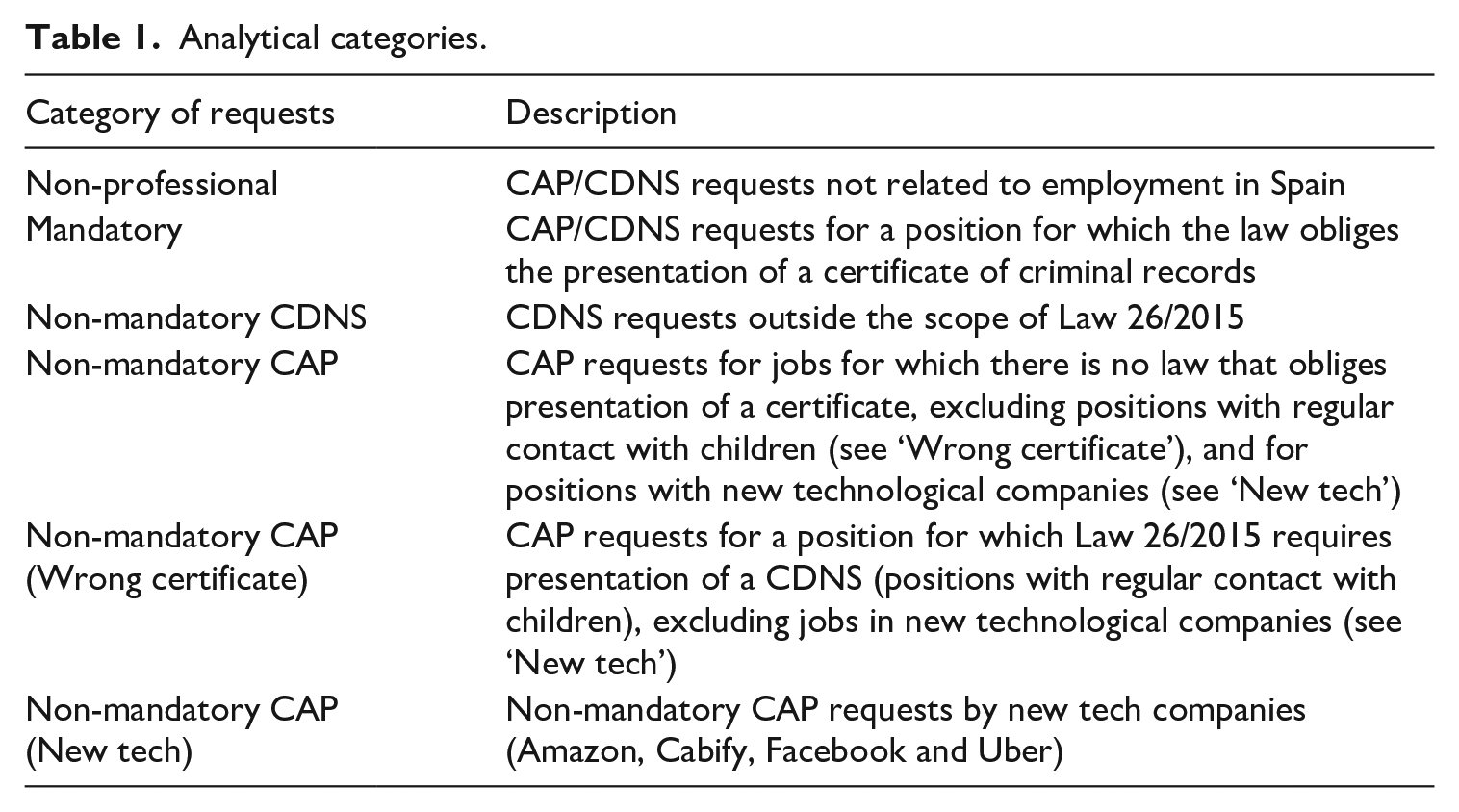
Specifically, ‘Non-professional’ requests included requests for certificates for visa requirements, to obtain a non-professional licence, such as a licence to own a dangerous dog, for volunteering, to request the expungement of criminal records, or for personal interest. I also included in this category requests for certificates to work in jobs outside Spain. I keep this category in the analysis because it acts as a baseline to observe if there has been a growth in non-mandatory checks since the introduction of the new law. To my knowledge, during this period, there were no legislative changes to laws requesting the presentation of certificates of criminal records for non-professional activities.
‘Mandatory’ requests included requests for certificates of criminal records for positions where the law makes this obligatory. The classification was conducted using information on the type of job and the business sector. For CAP requests, the categorization was based on a list of professions for which official regulations established the need to present a certificate. For the classification for the CDNS, I used the guidelines established by the Agencia Española de Protección de Datos (2015), which specify that this certificate should be requested only for jobs involving direct and regular contact with children as a normal part of the work. These jobs include paediatricians and schoolteachers, but also administrative staff in schools and hospitals. Following these rules, I did not include requests corresponding to professions that might have only sporadic and supervised contact with children, such as plumbers with occasional jobs in schools or sport centres.
Regarding non-mandatory checks, I classified as ‘Non-mandatory CDNS’ all those requests for the CDNS that were for positions falling outside the scope of Law 26/2015. Similarly, I initially classified as ‘Non-mandatory CAP’ those positions for which there was not a law that explicitly required the employer to conduct a CBC. However, two extra categories emerged from the richness of the data in the process of coding non-mandatory CAP requests. These two categories are described in detail below.
The first refers to requests for the ‘Wrong certificate’ (that is, CAP requests where only the CDNS is required): a large number of the non-mandatory CAP requests were for jobs involving frequent contact with children, for which applicants should actually have requested the CDNS. This could be an alternative type of ‘function creep’, by which employers feel legitimized to request the CAP, which contains much more information than the CDNS, but only for those professions for which the more limited CDNS certificate is required. Alternatively, these mistakes could be caused by misunderstanding of the process: employers could have misguidedly requested the pre-existent CAP because they were unaware of the creation of the CDNS, or, alternatively, applicants may have misunderstood the information given.
A second emergent category was requests by ‘new tech’ companies. During the coding process, I realized that a substantial proportion of non-mandatory CAP requests in 2018 were related to only four companies. In addition, all of these companies were significant actors in the new digital-based economy. Specifically, two tech companies, Uber and Cabify, were hiring drivers for a transport application. The third company, Amazon, was hiring dispatchers and logistics managers for a new logistics centre for their e-commerce website. The fourth company, Facebook, was recruiting community managers for a new supervisory centre for its online media site. In my view, these non-mandatory requests were outside the limits of the previously defined policy-driven explanations, since they were not policy-related but propelled by the entry into Spain of a new set of economic agents.
Results
Before the transposition of the Directive into Spanish legislation, employment-related non-mandatory CBCs in Spain were marginal. The results of the first round of surveys show that in 2014, two years before the introduction of the Directive, the majority of the in-person requests for certificates were for non-professional purposes (69.2 percent), such as for obtaining a visa or for the cancellation of criminal records. Of the employment-related requests (30.8 percent of the total), over two-thirds were for positions where the law required the presentation of a certificate, and less than one-third were for employment-related non-mandatory checks (10.1 percent of the total). This small number of non-mandatory checks agrees with the findings of previous research (see Larrauri and Jacobs, 2013).
After the transposition of the EU Directive there was an increase in the proportion of employment-related non-mandatory requests for criminal record certificates. Figure 1 shows that in 2016, two months after the implementation of the Directive, 45.3 percent of total requests were non-mandatory. The proportion of requests that were non-mandatory fell slightly in 2018 (32.3 percent), but still remained higher than in 2014.
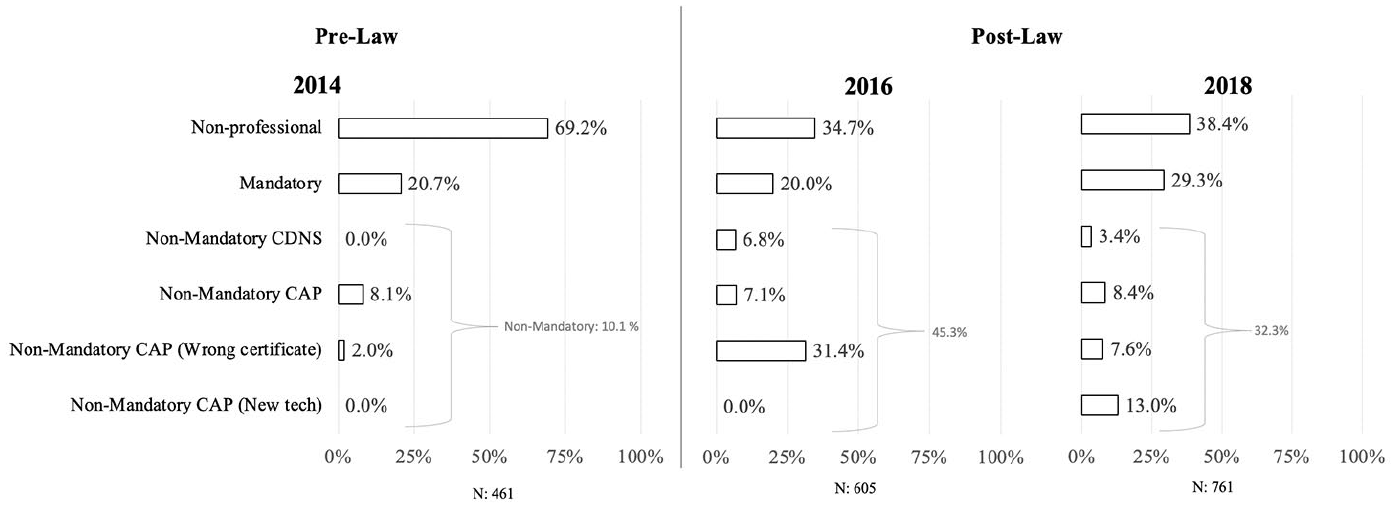
Percentage of requests by motivation and year.
‘Wrong certificate’ requests represented the most important factor driving the growth in non-mandatory requests in 2016. In this year, 31.4 percent of applicants’ requests for CAPs were for jobs where the CDNS was required. This percentage is much higher than that for similar requests two years before (2.0 percent). 13 The relative significance of this category fell in 2018, although it still remained substantial (7.6 percent). This result suggests that, in the short term, the main effects of the new legislation could be not increasing non-mandatory CBCs in new jobs but employers requesting a CBC with a higher level of disclosure than that required by the new law.
On the other hand, recruitment by new technological companies was the main factor behind the growth in non-mandatory CBCs in 2018, when 13.0 percent of the requests were from only four ‘new tech’ companies. I did not detect requests by applicants to any of these companies in the previous waves.
Overall, the analysis suggests modest and short-term support for a policy-driven increase in CBCs for positions for which there is no law that obliges the presentation of a certificate of criminal records, as hypothesized previously. If the effects of the two aforementioned factors are discounted, the increase in non-mandatory CBCs is small, growing from 8.1 percent in 2014 to 13.9 percent in 2016, and then declining, accounting for 11.8 percent of requests in 2018. This growth is mainly related to the upsurge in non-mandatory requests for a CDNS for jobs involving only infrequent contact with children, representing 6.8 percent of the requests in 2016 and 3.4 percent in 2018. In contrast, the proportion of non-mandatory requests for CAPs is almost the same in 2014 (8.1 percent), 2016 (7.1 percent) and 2018 (8.4 percent).
Discussion
Where new legislation might have been expected to open a Pandora’s Box of unfortunate consequences for applicants with criminal records, the analysis of surveys from people requesting certificates of criminal records in Spain shows that a more nuanced understanding is required. The most striking result of this research is the role that the new digital-led economy has played in the growth of non-mandatory CBCs. This finding indicates that, to understand the current increase in non-mandatory CBCs, it is necessary to look beyond explanations that focus only on the ways in which employers might respond to legislative change and consider how processes of policy mobility are influenced by non-state actors, particularly with the spread of the new ‘collaborative economy’.
Corda and Lageson (2020) noted an important trend towards privatization in the compilation and disclosure of judicial records outside the US. Interestingly, they found that these changes should not be understood as state driven but rather should be related to the interests of a new type of ‘penal entrepreneur’. These are private individuals without a clear policy rationale who are trying to make profits from new market opportunities produced by technological improvements in the penal arena. The results of the present research contribute to this area by showing how new tech companies are not only introducing changes to the processes by which criminal records information is compiled and disclosed, but also spreading the use of CBCs in the labour market. Global new tech companies appear to be exporting US recruitment practices to other regions of the world, and Spanish-based national companies such as Cabify seem to mimic (Grattet and Jenness, 2005) their policies.
These new practices may have emerged as a consequence of the development of the new ‘collaborative economy’. In this new business model, companies are not the direct providers of goods but provide a platform to configure ‘safe’ transactions between strangers, creating a system in which fraud or crimes are minimized. In order to create the environment for these safe interactions, these companies may need extra proof of trust in actors compared with that required in more traditional commercial exchanges, particularly for those companies that broker services involving physical interaction between strangers. For instance, Uber has enforced more stringent CBC regulations in the US since a scandal where the media revealed that some of their drivers had been accused of sexually assaulting or abusing their passengers (O’Brien et al., 2018). Thus, in this new ‘collaborative economy’, criminal record checks could be being used more than ever to allow participants to certify the requirement of ‘good moral character’ (see Pager, 2003).
Future research should further explore the impact of these US-based new tech companies on the expansion of CBCs. If the pattern of increased use of non-mandatory CBCs is confirmed, it would imply that individuals with a criminal record will be among the most disadvantaged groups in the current economic transformation to a digital-led economy, finding themselves even more excluded than in the past (see also Lageson and Maruna, 2018). This is particularly alarming since, if CBCs were applied only where risks are clear and in line with legal requirements, this economic transformation could potentially become an opportunity for people with criminal records. This is because many of the jobs ‘intermediated’ by these platforms, such as driving or cleaning, could be a particularly good fit for the members of social groups overrepresented in the criminal justice system, since the roles are typically low skilled and offer a great degree of flexibility (Sheppard, 2018).
Regarding policy mobility, the results of this study point towards the importance of including the practices of non-state agents in previously hidden areas to understand the ‘Americanization’ of current penal forms worldwide, such as the use of criminal records in recruitment practices by private companies. Previous research on US policy exports in the criminal justice system focused on largely symbolic policies conducted mainly by state actors, such as the integration of US criminal definitions and procedures (McLeod, 2010) or the introduction of private prisons, ‘three-strikes’ laws or ‘zero tolerance’ policing strategies in other countries (Jones and Newburn, 2007). However, more recent research suggests the need to widen the spectrum of analysis of policy-mobility processes to consider extra-jurisdictional developments mediated by non-governmental actors (Newburn et al., 2018; Stone, Porto de Oliveira and Pal, 2020). The results of the present research have provided evidence of the importance of having this broader view to study the policy mobility of penal forms worldwide.
In addition, these results could inform the development of public policies to tackle the excessive use of CBCs by employers. The results reveal that the introduction of the Directive in Spanish legislation led to an unexpected effect: employers requesting certificates with a higher level of disclosure than was required under the new law. These practices are concerning, whether they are part of an alternative formulation of the ‘function creep’ thesis or they are just mistakes, since they could increase the exclusion of people with criminal records from the labour market. For instance, in the Spanish context described, people with a conviction unrelated to a sexual offence would probably apply for jobs involving children if they perceived that the certificate being requested was the CDNS, because they would assume that, in this case, the employer would not have access to information on their previous records. However, they might well exclude themselves from applying for these positions if they thought the CAP was required, anticipating rejection from employers once they learnt of their previous offences (see Harding, 2003; Kurtovic and Rovira, 2017). This result could help encourage better definition of public policies aiming to ameliorate the negative effects of the growth in CBCs, such as ‘Ban-the-Box’ or expungement measures seen elsewhere (Jacobs, 2015; Larrauri, 2014). In particular, this result highlights potential problems arising from having different types of certificates with different levels of disclosure, a point that should be carefully considered during policy definition. A simple and consistent system for the use of mandatory and non-mandatory CBCs is needed to avoid the self-exclusion of people with criminal records from employment opportunities.
Finally, to contradict my initial hypothesis, the results suggest that new legislation on CBCs does not in itself automatically lead to a large increase in non-mandatory CBCs for positions outside the law, as might have been expected under ‘function creep’ (Backman, 2012) or the ‘legal ambiguity effect’ (Lageson et al., 2015; Heydon and Naylor, 2018). After discounting the effect of the new technology companies and requests for the wrong certificate, I could find only a small and unsustained growth in requests for non-mandatory CBCs after the transposition of Directive 93/2011/EU into Spanish law. 14 This result indicates that the effects of new legislation are probably context dependent, or, as has been considered regarding requests for the ‘Wrong certificate’, may take alternative forms to the ones defined previously.
Conclusion
This research is intended to contribute to the literature on the current growth in CBCs, particularly in relation to the increase in non-mandatory checks. In particular, using a case study of the transposition of European Directive 93/2011/EU into Spanish legislation in 2016, it tests whether there is an increase in non-mandatory CBCs after the introduction of a new law that extends mandatory CBCs to new positions. The analysis is based on a survey of individuals requesting a certificate of criminal records two years before the implementation of the law, two months after, and two years later. These data enable the pattern of expansion of non-mandatory requests to be presented and the reasons behind this explored.
The results did not indicate that the introduction of Directive 93/2011/UE led to a large increase in non-mandatory checks in Spain during the period of study. Indeed, the problem arising from this new legislation was mainly related to employers requesting certificates with a higher level of disclosure than that required by law. This unintended effect is concerning because these practices could increase the self-exclusion of people with criminal records from the labour market.
Nonetheless, the most striking result of the analysis suggests that the next Pandora’s Box of unintended CBC consequences could in fact be opened by the global expansion of the new tech economy. Indeed, most non-mandatory requests detected in 2018 were related to positions in companies such as Amazon, Cabify, Facebook and Uber. This finding flags the concerning possibility that people with criminal records might be among those most significantly disadvantaged by the current technological and economic transformations worldwide.
This result gives support to the recent literature maintaining the need to regulate the new tech economy to avoid the increase in collateral consequences (see also Corda and Lageson, 2020). Internal policies by specific companies could help avoid this exclusion. Notwithstanding private sector interventions, it is ultimately the responsibility of society to create an environment in which these new economic transformations do not increase discrimination against individuals who have had contact with the criminal justice system. It is the regulation of this new tech economy on which the re-entry into the labour market of individuals with criminal records most depends in the future.
Supplemental Material
sj-doc-1-euc-10.1177_1477370820977880 – Supplemental material for The next Pandora’s Box of criminal background checks
Supplemental material, sj-doc-1-euc-10.1177_1477370820977880 for The next Pandora’s Box of criminal background checks by Marti Rovira in European Journal of Criminology
Footnotes
Acknowledgements
I would like to thank Judit Martínez, Margarita Ferrer, Noelia Navarrete, Nicolás Rubio, Hector Tapia and Arnau García for their assistance during the fieldwork process. Dr David Kirk, Dr Alessandro Corda, Dr Andrew Henley and Dr Elena Larrauri suggested significant improvements to the manuscript. Peter Jackson and Nancy Gladstone helped with the translation.
Funding
The author(s) disclosed receipt of the following financial support for the research, authorship, and/or publication of this article: This research was conducted as part of the projects ‘Invisible stripes? A field experiment on the mark of a criminal record in the British labour market’ supported by the British Academy (Ref PF19\100020), ‘Ejecución y supervisión de la pena: Calidad de la intervención, legitimidad y reincidencia’ supported by the Spanish Ministry of Economy and Competitiveness and FEDER, UE (Grant DER2015-64403-P) and ‘Red de Excelencia EmpiriC: Desarrollo de un modelo criminológico y empírico de la política criminal’ supported by the Spanish Ministry of Science and Innovation (Ref. DER2017-90552-REDT).

Supplemental material
Supplemental material for this article is available online.
Notes
References
Supplementary Material
Please find the following supplemental material available below.
For Open Access articles published under a Creative Commons License, all supplemental material carries the same license as the article it is associated with.
For non-Open Access articles published, all supplemental material carries a non-exclusive license, and permission requests for re-use of supplemental material or any part of supplemental material shall be sent directly to the copyright owner as specified in the copyright notice associated with the article.
