



Abstract
In 2010 Korin Lebov published her article ‘Human trafficking in Scotland’, a state-of-the-field piece that reported on the nature and extent of human trafficking and the challenges in tackling this issue. Several important developments have occurred in the period since, including new enforcement measures, the first prosecutions and convictions for human trafficking in Scottish courts, the establishment of a dedicated policing unit within Scotland’s new police service to tackle such crimes, the passage of specific human trafficking legislation through the Scottish Parliament, and, as a direct result of this legislation, the publication of a bespoke strategy by the Scottish Government to take action against human trafficking and support victims. This article draws upon the findings of a qualitative research study exploring the community impact of organized crime in Scotland and, in doing so, refracts advances in both public awareness of human trafficking and the policing response to this issue through the analytical prism of ‘invisible crimes’. Ultimately, it traces the path of human trafficking from a peripheral and largely ‘invisible’ phenomenon to becoming a core issue of concern in Scotland’s policing and community safety landscape.
Introduction
A decade ago in the European Journal of Criminology, in a detailed account of human trafficking in Scotland, Korin Lebov (2010) acknowledged the absence of robust empirical research on this issue in this jurisdiction. This paucity of research was lamented previously, with the charity Amnesty International remarking in 2008: There has been little research into trafficking in the UK [United Kingdom] as a whole and to Scotland in particular. (Amnesty International, 2008: 5)
1
This lack of attention reflects that, until around 2009, there was an established perception that ‘Scotland did not have a human trafficking problem’ (Muqit, 2011: 122). 2 Based on research from 2007/8, Lebov sought to address this lacuna by providing a detailed national picture of this form of criminal activity, examining the challenges for both policing and victim care (Lebov, 2010). Several significant developments have occurred in Scotland since Lebov’s research was undertaken and her work published. In 2011, the nation recorded its first prosecution and conviction for human trafficking (BBC News, 2011), and in that same year the Equality and Human Rights Commission published the findings and recommendations of its inquiry into human trafficking in Scotland (Equality and Human Rights Commission, 2011). In 2013, the National Human Trafficking Unit (NHTU) was created as part of Police Scotland, the nation’s new single police force (Donnelly, 2013: 92), replacing the patchwork arrangements present under the previous policing model (Laird, 2017: 111). The NHTU works closely with the also recently established National Lead Prosecutor for Human Trafficking of the Crown Office and Procurator Fiscal Service, who has responsibility for decisions concerning the prosecution of alleged traffickers and the non-prosecution of alleged victims, and local lead prosecutors based throughout Scotland (Scottish Government, 2018a: 24). In 2015, the Scottish Parliament passed the Human Trafficking and Exploitation (Scotland) Act, which introduced a single offence for all forms of trafficking and gave courts new powers to prevent and punish human trafficking. In 2017, the Scottish Government published its trafficking and exploitation strategy, with three principal themes: to identify victims and support them to safety and recovery; to identify perpetrators and disrupt their activity; and to address the conditions that foster trafficking and exploitation. This strategy considered human trafficking and exploitation as ‘complex and hidden crimes’ (Scottish Government, 2017a: 4). These developments collectively indicate a comprehensive transformation in the decade since Lebov’s state-of-the-field assessment of human trafficking in Scotland. 3
In the periods both before and since Lebov’s assessment, human trafficking in Scotland has been frequently considered by many in this field to be a ‘hidden’ or an ‘invisible’ crime. Analysing such claims, this article refracts recent developments in the field of human trafficking in Scotland through the prism of ‘invisible crimes’ (Davies et al., 2014), focusing particularly on two categories that contribute to the relative visibility of crimes: knowledge and control. Uniquely, this article draws upon the findings of a qualitative research study exploring the community impact of organized crime in Scotland; a study that highlighted the flexible, mobile and hidden networks of vulnerability and exploitation that underpin human trafficking (Fraser et al., 2018). In doing so, this article will not only update and refresh Lebov’s assessment, contributing further to empirical research on this still under-explored topic, but also demonstrate the value of applying the concept of ‘invisible crimes’ to contemporary issues relating to serious organized crimes. As a relatively small European nation seeking to tackle what in many respects remains an international problem, Scotland presents an illustrative case study for an exploration of the relative visibility of human trafficking. Certainly, whilst the illicit market for the trafficking of people operates across the UK and beyond with little recognition of jurisdictional or organizational borders, it is important to recognize the local contexts within which such activity takes place. Considered as such, the Scottish context should not be wholly or uncritically subsumed into any discussion of any ‘British’ or ‘UK’ response to such issues (see Aliverti, 2020; Gadd and Broad, 2018), but instead subject to robust and rigorous analysis on its own terms, as linked to, but also in several ways distinct from, these wider structures and responses. 4 The contribution and contention of this article is thus two-fold: firstly, that the concept of invisible crimes can be applied and developed to usefully assess the relative visibility of human trafficking across time; secondly, that in applying such an analysis to two key variables of invisible crimes – knowledge and control – in the Scottish context one can trace the path of human trafficking from featuring as only a peripheral concern to becoming a core issue of concern in Scotland’s policing and community safety landscape. The analytical insights from this Scottish case study will have important implications for nations beyond Scotland that seek to respond to human trafficking, particularly given the complex, transnational nature of this form of serious organized crime.
Research methods
It has been contended that the invisible nature of human trafficking – its clandestine nature and its ‘hidden populations’ – presents unique methodological challenges for empirical research on this subject, which ultimately seeks to ‘describe the unobserved’ or the ‘clandestine’ in order for it to be ‘unmasked’ (see Decker, 2015; Fedina and DeForge, 2017; Pourmokharti, 2015; Raphael, 2017; Tyldum and Brunovskis, 2005). Reflecting upon the issues and problems of researching human trafficking, Andrea Di Nicola (2012) recognized that the knowledge achieved through research develops slowly and that research in this field had generally ‘languished’: The knowledge achieved through research seems to be weak or piecemeal; and policies, as a consequence, are sometimes based more on emotions, political or dogmatic bias than on strong substantiated research work. Yet the value of research on human trafficking is self-evident. (Di Nicola, 2012: 49)
Rooting human trafficking research in empirical data is thus important to the process of producing analysis that has impact in the fields of policy and practice. As Ronald Weitzer has asserted: High-quality microlevel empirical studies can provide a superior, evidence-based foundation for the development of official policies regarding human trafficking. (Weitzer, 2014: 21)
Securing access to relevant participants for a study on human trafficking in Scotland was certainly challenging, but given that the research did not seek to engage with victims or perpetrators of human trafficking – instead engaging practitioners, responders and interested parties in the public sector, representatives of third sector organizations, and members of communities in Scotland who may be affected by this issue – identifying participants and achieving access was perhaps less difficult than it otherwise might have been, for both pragmatic and ethical reasons. Although empirical studies of the day-to-day realities of human trafficking are clearly important, critical social and criminological research on cultures and practice is also crucial. This is particularly the case given the ways in which human trafficking laws and interventions, and the discourses that surround such efforts (particularly around dominant narratives such as ‘invisibility’ and ‘modern slavery’), complicate efforts to define, address and engage with the vulnerable populations affected by this crime.
As an empirical study this article draws upon the data and findings of an 18-month qualitative research project conducted in 2017 and 2018 on the community impact of organized crime in Scotland (see Fraser et al., 2018). The research design of this project was ambitious and multi-staged: moving from the ‘stage one’ mapping of communities in Scotland with enduring experiences of organized crime using both expert interviews and police intelligence data, before progressing to ‘stage two’ case study fieldwork that foregrounded the voices of those affected by organized crime across four specifically selected sites. Across both stages this study engaged with the perspectives of 122 participants, deploying a range of methods to collect primary data, including qualitative interviews, focus groups and observations in community settings. A third stage of fieldwork, to deepen these emerging insights, engaged with a further 26 individuals, 12 of whom had lived experience of organized crime and 14 of whom worked in the public sector or the third sector and had an interest in, and experiences of, responding to the challenge of human trafficking in Scotland. This article is primarily based upon the analysis of the semi-structured interviews with these 14 public sector and third sector practitioners. Where necessary, however, this analysis is supplemented by primary data from the larger organized crime project, alongside the analysis of documentation from a range of government bodies, criminal justice agencies and relevant third sector organizations. 5
In the reporting of data this article provides pseudonyms for all research participants, and other identifying details are redacted where required and appropriate to do so to preserve anonymity. Participants for this study were identified and selected using non-probability sampling procedures, primarily involving an initial convenience sample to facilitate ‘expert interviews’ in stage one, and using snowball sampling as the study progressed to identify further participants as larger networks emerged. 6 Given that the overarching research project adopted an ethnographic approach to understanding community experiences of organized crime, themes emerged from ‘sensitising concepts’ (Willis, 2000) that could be initially applied, and further refined, in relation to the subject matter. For example, an initial sensitising concept in relation to organized crime, but particularly to human trafficking, was ‘invisibility’. This led to an engagement with further literature on this concept that provided additional themes with which to code data as the analysis developed. This thematic analysis of data was facilitated through the use of NVivo qualitative data analysis software. Before presenting the findings and analysis, however, it is necessary to further explore the common description of human trafficking as an invisible crime, locating such descriptions within a more critical conceptual framework.
Human trafficking and the discourse of invisibility
For the purposes of this article, and reflecting the focus of the overarching research project from which the data are sourced, human trafficking is considered as a form of organized crime. 7 We recognize that this position can be contested and that there remain important questions about the nature of organized crime and the involvement of organized criminals in human trafficking networks (see Jesperson, 2019). What is perhaps less contentious is that human trafficking is routinely considered by the media, academics, charities and organizations in the third sector and, importantly, the range of state actors, agencies and institutions responsible for responding to it as a ‘hidden’ or ‘invisible’ crime. This has particularly been the case in the United States (see Clause and Lawler, 2013; Hepburn and Simon, 2010; McGaha and Evans, 2009; Marcus and Curtis, 2014; Walt, 2017), but such constructions have been evident elsewhere, including in Scotland. For example, even before the publication of Lebov’s work in 2010, a report on human trafficking in Scotland was illustratively titled A Hidden Trade: Trafficking Research in Scotland 2005/6 (Arthur and Morran, 2006). A 2011 study into the nature and extent of child trafficking in Scotland remarked upon this as a ‘covert and hidden’ form of activity, thus raising particular problems because affected children are ‘invisible’ to statutory agencies (Scotland’s Commissioner for Children and Young People, 2011). A leaflet created by Police Scotland in 2013 also considered human trafficking to be a ‘hidden crime’ and provided a list of indicators to establish whether or not a person is a potential victim of trafficking (Police Scotland, 2013). Further evidencing this proclivity to consider human trafficking in Scotland as concealed or clandestine, a 2013 consultation in advance of legislation later passed in 2015 contended that effectively uncovering the ‘invisible crime’ of human trafficking was essential to understanding such activities and recognizing their implications (Marra, 2013: 27).
The proclivity to understand human trafficking in Scotland as invisible or otherwise hidden has been apparent more even recently. From an academic perspective, Kirsty Thomson (2017: 76), in her overview of how states respond to victims and survivors of human trafficking, acknowledged that whilst the issue of human trafficking in Scotland has increasingly come into the purview of the Scottish Government, the precise extent of the issue remains unknown owing to its ‘complex and hidden nature’, a phrase replicated in the Government’s subsequent strategy. A senior police officer in Edinburgh also recently remarked to the media upon the challenges of estimating the extent of human trafficking as one of the city’s ‘biggest hidden crimes’ (Edinburgh Evening News, 2016), and similar sentiments have been repeatedly expressed by police officers from the NHTU (see Police Scotland, 2016; Scottish Government, 2017b). In fact, the most recent awareness-raising materials published by the Scottish Government (2018b) and Police Scotland (2018) have noted how human trafficking in Scotland is ‘hidden in plain sight’. Such discourse surrounding human trafficking reflects, in part, the elusive nature of organized crime as a broader phenomenon, with those involved ‘difficult to see’ owing to their proactive attempts to evade surveillance and remain clandestine in their activities (Sheptycki, 2017). Nevertheless, other factors, such as links to migration, victim misrecognition and under-reporting, may also compound the invisibility of human trafficking. Irrespective of recent developments and progress in the field, the ‘discourse of invisibility’ concerning human trafficking continues to form a key part of how practitioners, policymakers and other interested parties in Scotland discuss, and frame, the referent subject. Yet despite the widespread and sustained use of the language of invisibility in understanding human trafficking in Scotland and beyond, this particular crime has not been studied using the conceptual framework of ‘invisible crimes’.
Assessing the relative visibility of human trafficking in Scotland
This section will consider human trafficking and responses to human trafficking in Scotland, refracting recent developments in awareness raising and policing through the prism of the invisible crimes framework. This framework was first properly conceptualized by Davies, Francis and Jupp in their 1999 edited volume Invisible Crimes: Their Victims and Their Regulation. In their introductory remarks, Davies et al. (1999: 5) took the opportunity to describe the seven features across which the invisibility of crimes can be assessed:
(i) no knowledge: little evidence or public knowledge that a crime has been committed;
(ii) no statistics: official statistics fail to classify the crime;
(iii) no theory: criminologists and others neglect to explain the crime, its existence and its causes;
(iv) no research: such crimes are not the object of social research, either in their causes or in their control;
(v) no control: there are no formal systematic mechanisms for the control of such crimes;
(vi) no politics: such crimes do not appear as a significant part of the public political agenda;
(vii) no panic!: such crimes are not constituted as moral panics and their perpetrators are not portrayed as folk devils.
Revisiting and elaborating upon the template provided in Invisible Crimes, Davies, Francis and Wyatt’s 2014 work Invisible Crimes and Social Harms reconstructed and re-presented these seven features, while expanding the analysis to examine why these features are present (Davies et al., 2014: 7). In constructing this framework they recognized the potential for interaction and mutual reinforcement between the listed features, and that not all acts or events will exhibit all of the features listed. Instead, the invisibility of a criminal act or event depends on three variables: whether the template fits; the degree to which it fits; and the power of the interactivity between the features (Davies et al., 1999: 6). Importantly, Davies et al. (2014: 12–13) consider that power structures in a society can have a significant effect on the visibility of a crime by actively suppressing or opening one or more of the seven features. The sources of this power are the moral and ethical, the institutional and organizational, and the systemic. They also propose that the relative visibility of crimes is affected by socio-legal, historical, political and spatial or global contexts. The seven key features outlined in Invisible Crimes: Their Victims and Their Regulation and updated in Invisible Crimes and Social Harms thus provide a powerful basis from which to assess the relative visibility of particular crimes, including human trafficking. The reflexive thematic analysis (Braun et al., 2019) of the data that informs this article highlighted two significant, and inter-related, themes of relevance to the invisible crimes framework: ‘knowledge’ and ‘control’.
Knowledge
In the invisible crimes framework a crime is invisible when there is little evidence or public knowledge that it has been committed. Deanna Davy (2016: 491) has highlighted the ‘hidden populations’ in human trafficking networks, incorporating victims and offenders, as one of the most critical barriers to understanding the nature and extent of human trafficking. In a recent study in the UK, Dando et al. (2016) acknowledged the requirement for strategically targeted public knowledge exchange on the subject of human trafficking in order to increase comprehension of the crime and its effects. The lack of awareness and knowledge of human trafficking – amongst the public, in public sector agencies, and even in policing – was frequently remarked upon throughout the research process. Mike, who worked for a local authority (council), commented: In terms of public perception, most members of the public couldn’t tell you what human trafficking is. [They] [c]onfuse it with people smuggling. . . and when people do think they know what people trafficking is they always think it’s [limited to] sexual exploitation. They don’t imagine it’s the guy in the car wash washing their motor, or the woman doing their nails in the nail bar, or the guy selling DVDs in pubs. So public awareness of human trafficking, or how to spot the signs of human trafficking, isnae [is not] great. (Mike, local authority)
Similar sentiments were acknowledged by Rebecca, a police officer who worked on the police response to human trafficking. Rebecca talked of how human trafficking was considered by some to happen in communities ‘elsewhere’: I think there is a lack of awareness out there [in the public] and they think ‘that doesn’t happen in Scotland’. I mean just speaking to my own family and neighbours that know that I work in this area they ask me about it and say ‘oh, not here though’, and I am like ‘mmm’. (Rebecca, police officer, west of Scotland)
The 2011 Inquiry into Human Trafficking in Scotland lamented the lack of national campaigns on human trafficking north of the border, arguing that raising public awareness on this issue is essential to avoid complacency and to educate communities on the indicators and locations; empowering communities as the ‘new front-line’ and the ‘eyes and ears’ against human trafficking (Equality and Human Rights Commission, 2011: 61). As Farrell and Pfeffer (2014: 50) note in the context of policing human trafficking in the United States, when police and communities do not understand what human trafficking is they do not prioritize its identification, investigation or enforcement. Addressing this ‘invisibility’ through awareness raising has thus become a key site of activity across the UK, including in Scotland.
In the period since 2011, however, efforts to raise awareness of human trafficking and to increase knowledge and understanding amongst practitioners and the wider public have become an increasingly significant part of the response to human trafficking in Scotland. The police service has been central to efforts to increase knowledge of human trafficking as it affects Scotland’s communities, undertaking targeted awareness-raising campaigns and initiatives both within and beyond policing. Recent inputs have been delivered by police officers to airport staff and associated personnel – including baggage handlers, check-in staff, taxi marshals and hotel staff – to highlight the indicative signs that might identify potential victims of human trafficking and offer practical guidance on appropriate channels to raise concerns (Police Scotland, 2019). Nick, a police officer based in the west of Scotland but who had responsibility to respond to this issue across Scotland, discussed his efforts to raise awareness and knowledge of human trafficking amongst statutory public agencies: I am doing presentations to DWP [Department of Work and Pensions], NHS [National Health Service], dentists. [Names colleague] is doing inputs at Tulliallan [the Scottish Police College] to intel [intelligence training] courses. So these things are crucial to raising awareness and understanding as to what exploitation is. . . it’s only when you are involved in this arena that you realize how wide it is. (Nick, police officer, west of Scotland)
On a similar theme, a police officer with responsibility for awareness raising at a local level responded: We have done [delivered awareness-raising inputs to] council bin workers, electricians, joiners, that sort of thing, they are more [frequently] into addresses which police and others wouldn’t normally get in to and they are seeing signs of what they think is human trafficking and we have put in place the means for them to highlight it to the police and make us aware of it, be it through intelligence or a direct report. (Craig, police officer, east of Scotland)
Despite such efforts to increase awareness, there remain some significant gaps to be filled, particularly at the community level, to increase knowledge and understanding of the various forms of human trafficking. For example, a participant from a third sector organization was sceptical of the frequency with which those who pay for the services of sex workers had raised concerns about potential human trafficking incidents to the police or relevant partner agencies: No, [punters] don’t care. Our experience is that [some] punters have helped the woman flee, but they have done the bare minimum. The one thing they have in common is that they have all still had sex with her. They then phone up, very rarely, but we have had punters call up to say ‘I’ve got concerns about a wee lassie’. . . Women aren’t chained up in a room, they’ve got their make up on, so it potentially could be very difficult for a punter to identify [she has been trafficked], although on some of the review sites what they [punters] have said [is] ‘oh she was miserable, clearly didn’t want to be here, wouldn’t recommend her’. You are kind of going [exasperated gesture] and what have you done [about it]? (Aisling, third sector organization)
Similar dynamics of invisibility and coercive control were at play in other forms of human trafficking. For example, a police officer noted how this contributes to the perceived ‘invisibility’ of human trafficking to the public in the context of labour exploitation: Human trafficking [in Scotland] is invisible because people think they are there because they want to be. People working in a nail bar, they are there because [they want to be], and they will see them coming and going and they will say ‘oh that’s fine, they can come and go as they want’, but they don’t realize the debt bondage behind it and that’s all part of the invisible force or coercion that they are subjected to. (Rebecca, police officer, west of Scotland)
In such contexts of limited knowledge, awareness-raising efforts have become a pivotal first step in increasing the visibility of human trafficking in Scotland, particularly given that, since human trafficking is ‘largely a clandestine phenomenon’ and its community impact remains ‘hidden’, the subsequent prioritization of an effective response is inhibited (Farrell, 2012: 186).
The research also indicated that, even within the police service, there was recognition of circumscribed knowledge and awareness of human trafficking as it affects Scotland. Understandings of ‘organized crime’, of which human trafficking is a particular form, were instead routinely dominated by more traditional and well-established criminal enterprises and networks, mostly related to illicit drugs markets. For Mary: You forget that serious organized crime isn’t just drugs. You totally, I think, it [drugs] seems to be a bigger priority because people think it affects their community more. Because human trafficking, that’s a big secret! You’d never notice that like in your street or anything like that, you’d just never know! But you always know if there is [drug] dealing. (Mary, police officer, west of Scotland)
In such contexts, human trafficking was less well known, and much less visible, in comparison. Awareness raising, therefore, continues to focus on a diverse range of communities, including those within policing and law enforcement. Indeed, officers from the NHTU have been active in briefing their police colleagues; for example, providing targeted inputs to officers undertaking intelligence training courses at the Scottish Police College, in order to increase knowledge and raise awareness of human trafficking as an issue that has a direct impact upon Scotland’s communities. Another officer, Kevin, remarked that the aim of such approaches is to ‘get it [human trafficking] into bread and butter policing’, ensuring that every police officer has the same level of confidence in dealing with a human trafficking incident as they would with a road traffic incident.
The focus on raising the awareness of both the public and the police is understandable given that the forms of exploitation that arise from human trafficking tend to be both ‘hidden from agencies and unseen by the public’ (Equality and Human Rights Commission, 2011: 46). Importantly, however, awareness raising in policing represents only one aspect of the response to human trafficking in Scotland, which also must increasingly move beyond awareness raising and towards elements of control within a policing paradigm, including intelligence-led enforcement activities. Harold, a police officer, noted the requirement not only to improve knowledge and awareness but also to further develop more traditional policing approaches: I guess it’s one of the main strategies we’ve got, to try and increase the awareness and identify potential victims of trafficking. Number two on the strategy list is for the police to take responsibility to try and enforce that and identify the people who are behind that, the perpetrators, so that’s when it comes down to us. (Harold, police officer, east of Scotland)
Fundamentally, efforts to increase awareness were undertaken on the basis that success here would, in turn, lead to more effective policing and law enforcement. For Rebecca, a police officer, awareness raising was a first step on a longer journey in tackling human trafficking in Scotland: I think short-term goals: increased awareness, increased intelligence. Increasing intelligence will allow us to develop more jobs so it will allow us to develop more operations and hopefully then lead in to successful investigations, possibly more Joint Investigation Teams with more countries, engaging more with Europol and Eurojust. And I suppose more convictions. I think for me my long-term goal would be more successful convictions. (Rebecca, police officer, west of Scotland)
The development of more investigations into human trafficking in Scotland, enmeshed in transnational policing and justice arrangements and potentially leading to an increase in prosecutions and convictions for human trafficking offences, presents a challenge to representations of human trafficking in Scotland as an ‘invisible crime’.
Control
Despite extant proclamations of its hidden nature, if human trafficking is truly considered to be invisible in Scotland there would have to be no formal or systematic mechanisms in place for its control. Developments in the decade since Lebov’s initial assessment of human trafficking in Scotland render any such claim now unsustainable: there has emerged in the period since, and there exists today, a significant policing and law enforcement capability to respond to suspected cases of human trafficking in Scotland. The creation in 2013 of Police Scotland resulted in the concomitant introduction of the NHTU within Scotland’s new national police force. Based at the new Scottish Crime Campus, a bespoke facility that co-locates multiple agencies in an effort to tackle organized crime and terrorism through increased partnership working (see Atkinson et al., 2018), the NHTU represents perhaps the most significant recent development in the control of human trafficking in Scotland. This partnership ethos in tackling human trafficking finds support in the extant literature. Van der Watt and Van der Westhuizen (2017), for example, have remarked that the ‘transient and subversive’ nature of human trafficking as organized crime and the large number of actors with an interest in preventing, detecting, investigating or prosecuting such crimes contribute to the multidimensional complexities associated with the criminal justice response. Nevertheless, the NHTU has emerged as a central node within this developing network of control in Scotland.
The roots of the NHTU lie in the previous model of Scottish policing, which broadly comprised eight regional police forces of varying sizes and the Scottish Crime and Drug Enforcement Agency (SCDEA), a national unit for tackling organized crime.
8
A research participant recounted the emergence of the NHTU from this structure: In 2010 the SCDEA SICU, the Scottish Intelligence Coordination Unit, was established at Livingston, [and] within the remit of the intelligence function within there, among other things, was human trafficking; but looking at it [human trafficking] from an intelligence, intelligence-gathering point of view, but also from an educational point of view because of a lack of knowledge pretty much right through the forces, both in the public and in the police itself. (Kevin, police officer, west of Scotland)
The SICU worked collaboratively with the eight forces, and particularly with the Vice and Anti-Trafficking Unit (VATU) of Strathclyde Police (a regional force that was subsumed into Police Scotland in 2013). The VATU had, in comparison with the intelligence-gathering functions of SICU, a greater focus on public protection and victim care. From its early antecedents, and as in effect a merger of the pre-existing SICU and VATU, the NHTU has thus been imbued with a multifaceted role in tackling human trafficking: as an enforcement and intelligence unit with a ‘crime control’ remit, and as an awareness-raising entity with responsibility for increasing knowledge and visibility of human trafficking and its victims. These roles, of course, are not mutually exclusive; and the previous section clearly indicated that at least some of the rationale for awareness raising has been to increase the breadth and depth of police intelligence, with the ultimate aim of enhancing enforcement activity. In his overview of responding to the victims of human trafficking in Scotland, Jim Laird commented that the establishment of the NHTU offers the promise of improved practices (Laird, 2017: 104) and a more consistent approach for the recovery of victims and the prosecution of criminals involved in human trafficking (Laird, 2017: 111). The value of intelligence from a policing perspective, both within and beyond the NHTU, was recognized during research as vital to the effective control of human trafficking in Scotland.
To assist the NHTU, each of the 13 local policing divisions of Police Scotland has an individual officer – known colloquially as a human trafficking ‘champion’ – who takes responsibility for raising divisional awareness of human trafficking through, for example, the local implementation of national campaigns and acting as a source of advice and guidance on suspected incidents of human trafficking for both the police and partner agencies. An officer from the NHTU remarked upon the valuable contribution provided by divisional ‘champions’ and reflected upon how these officers across the divisions of Police Scotland had become gradually enmeshed in a deeper network, and set of associated practices, across Scotland that facilitates a clearer focus on national strategic objectives: There is now a champions structure to spread information from single points of contact across divisions. . . we rely on divisional champions, even although it is their ‘side role’ if you like . . . and the meetings of champions have now evolved into focusing on action area 2 of the Scottish Government strategy, and you’ve got your divisional champions there, partner agencies, Crown Office, and all the partners. . . We chair it, and that gets people around the table who are involved in human trafficking but also it’s a networking opportunity. (Nick, police officer, west of Scotland)
Nick continued that divisional champions with an awareness and experience of human trafficking are important for enforcement efforts or ‘to get someone on a front sheet’ of an arrest warrant. Yet he elaborated that, although arrest and conviction may be considered as the optimal outcome for a human trafficking investigation, there was a recognition that other outcomes, such as disruption or further intelligence gathering, are currently more common. Somewhat irrespective of the nature of a particular outcome, the effective control of human trafficking – from an increasing intelligence dividend as a result of awareness raising, and towards enforcement, prosecution and conviction – relies on multi-agency collaboration and partnership working beyond the police (see Dandurand, 2017: 324–6).
Partnership working to tackle human trafficking in Scotland is embedded both in local practice and, reflecting the oftentimes cross-border nature of the crime itself, in transnational policing arrangements. The recent establishment of a ‘Human Trafficking Threat Desk’ at the Scottish Crime Campus – a development that brings together experts from Police Scotland, the National Crime Agency, the British Transport Police and the Home Office in an effort to safeguarded those at risk of harm and to identify those who commit, facilitate and profit from the exploitation (Scottish Police Authority, 2017: 9) – illustrates the local developments in Scotland to facilitate cooperation and collaboration in the control of human trafficking. The importance of routine partnership working between the police and other agencies was highlighted on multiple occasions in research. Certainly, the advent of the NHTU has resulted in deeper partnership working with agencies beyond Police Scotland. For one police officer, jointly coordinated endeavours with partners were understood to be essential to achieving positive results, particularly given the capabilities of other public sector agencies: It [disruption through partnership working] happens on the big days of action that we’ve got, where nationally we pull together all the partners. It is quite well-organized, everyone parades here usually first of all, then you’ve got all the partners on board and they will all have the same objectives but underlying that we’ve all got different roles to play in that, so you’ll have HMRC [Her Majesty’s Revenue and Customs], immigration, Border Agency, council workers, licencing, Trading Standards et cetera, so it’s looking at ways to try and disrupt. . . you could easily argue that the UK Borders Agency dealing with issues at ports, and certainly Home Office Immigration dealing with individuals who are in-country, have more of a day-to-day role in dealing with this type of thing than we do, and dealing with potential victims of human trafficking coming across the circumstances. They are doing far more visits to catering industries, restaurants, construction sites, nail bars. That’s kind of their daily churn, whereas for us it’s not. (Harold, police officer, east of Scotland)
Another police officer, Kevin, concurred, stating that the UK Visas and Immigration have a ‘central role’ in tackling human trafficking, supported by Police Scotland. A police officer, Rebecca, also reflected upon recent improvements in partnership working between Police Scotland and the National Crime Agency as a result of political commitments and increased funding at the UK level. A local authority worker further remarked upon the importance of partnership working in the control of human trafficking, owing to the intersection of this issue with other forms of organized crime: Some of the joint operations involve DWP, Revenue and Customs [HMRC] because you’ll find the exploitation goes beyond just the people being exploited . . . and into things like benefit fraud and all sorts of ‘dodgies’ [criminal scams] such as money transfers and credit card fraud. (Mike, local authority)
Positive relationships between Police Scotland and partners in the third sector have also been developed in efforts to tackle human trafficking. As a participant from a third sector organization noted: Police Scotland’s National Human Trafficking Unit we have a good relationship with in particular. . . we work very closely with them and we go to them for advice [when there are concerns that trafficked women may be at risk of harm]. (Aisling, third sector organization)
Maintaining such positive relationships with third sector organizations is particularly important in terms of identifying and safeguarding victims of human trafficking.
Research participants considered recent developments in transnational policing arrangements to be vital to enhancing the policing and law enforcement response to human trafficking. For example, the embedding of Romanian officers within Scottish policing (see Scottish Government, 2018a: 19) was considered by several officers as a positive development, enhancing the policing response across a range of areas: from acting as a single point of enquiry between Scottish and Romanian policing, to intelligence development work and the recruitment of informants. Nick reflected on the ways in which the control of human trafficking in Scotland was linked to transnational policing arrangements: At the [Scottish Crime] Campus just now there will be joint investigations with . . . other national forces [in other countries]. Our Romanian officers are with us just now. The Romanian link to Scotland is obvious . . . for perpetrators but also as victims. . . The use of Europol, which is probably my point, the use of Europol and Eurojust for Joint Investigations Teams [JITs] . . . most of the JITs are coming from HT [human trafficking] . . . and that immediate response whereby you’ve got officers in another country who can react for you, because they are aware of their operation and how it links in to back in Scotland. . . by just the pure nature of the types of investigations we have there is going to be links here [in Scotland] and intelligence links to other countries, and getting us together with their police force streamlines intelligence sharing and evidence sharing. That may change with Brexit, because we won’t be a full part of Europol, which is a nonsense. (Nick, police officer, west of Scotland)
Another police officer, Kevin, reflected upon the increased efficiencies in working through Europol and Eurojust, including ‘linking with colleagues in other parts of the world’ to make connections between investigations and to share intelligence, as well as developing joint investigations. Kevin continued that such arrangements made working with Europol, for example, ‘full of value’. These transnational policing arrangements, alongside developments at the UK, Scottish and local levels, have resulted in a comprehensive set of structures and practices to respond to the challenge of human trafficking as it affects Scotland. At a minimum, therefore, the claim that there are no formal or systematic mechanisms for the control of human trafficking – a requirement for any claim of invisibility in accordance with the invisible crimes framework – cannot be sustained.
Discussion: Further developing the ‘invisible crimes’ framework
This article has, to this point, used the template provided in Invisible Crimes: Their Victims and Their Regulation and updated in Invisible Crimes and Social Harms to assess the relative visibility of human trafficking. On the basis of the current conceptualization, it is clear from the preceding discussion that human trafficking in Scotland can no longer be considered, conceptually at least, to be a truly ‘invisible crime’ given the extensive developments in both knowledge of the crime and its control, through both awareness-raising efforts and policing and law enforcement responses. However, in straightforwardly refracting both knowledge and control of human trafficking through the lens of ‘invisible crimes’, there is a risk not only of underestimating the extent to which these features are clearly linked, but also of reifying a binary, and static, distinction between the visible and the invisible. As such, developing a deeper and more dynamic appreciation of invisible crimes is critical to understanding variation across its seven conceptual features, including an appreciation of their complexity, their inter-relatedness, and their change over time.
The limitations of the binary conceptualization of invisible crimes in its current form – as either visible or invisible – can be addressed by introducing an intermediate ‘liminal’ category in a revised matrix. As proof of concept, and drawing upon the preceding analysis, Table 1 introduces this liminal category to the variables of knowledge and control.
Expanded crime visibility matrix.
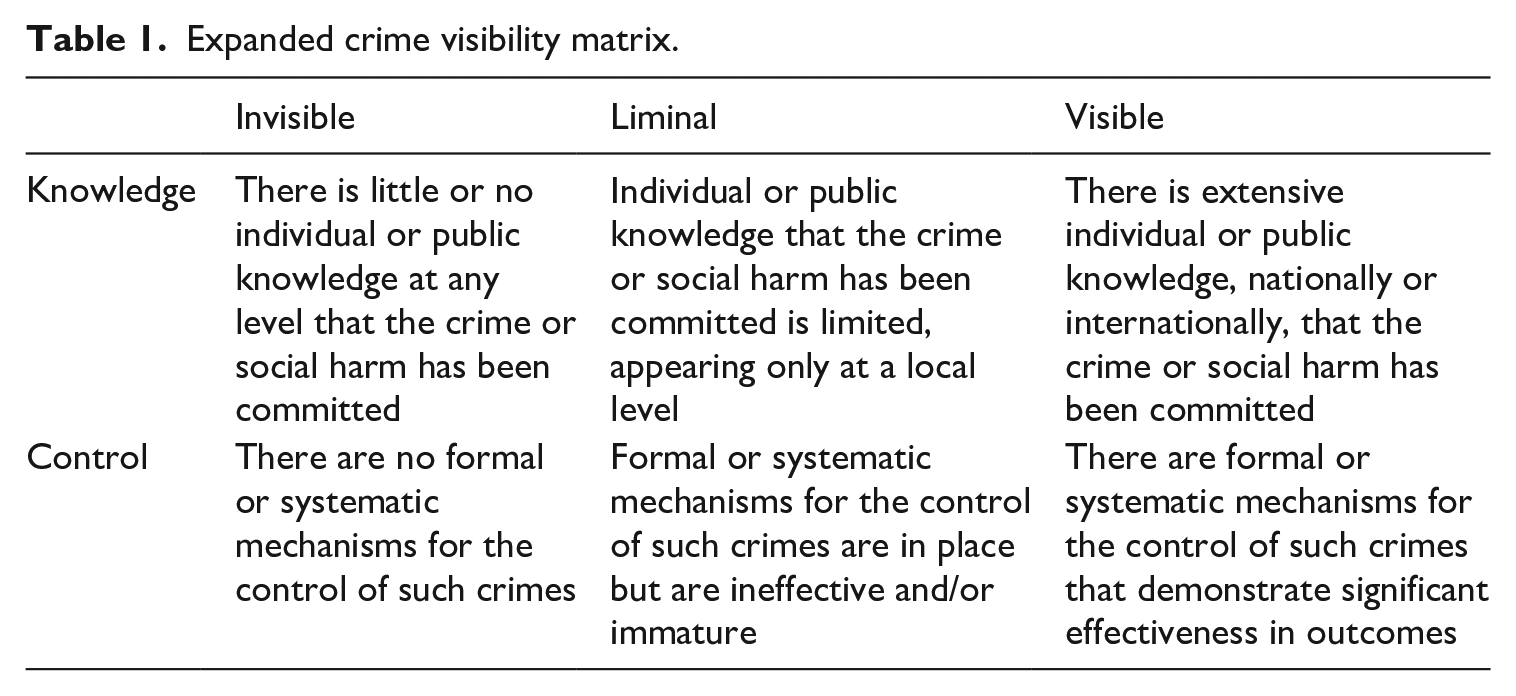
The development of this ternary matrix opens the possibilities of assessing the degree of visibility of human trafficking and of understanding the array of factors that underpin the conditions of relative (in)visibility. Factoring human trafficking in Scotland into the crime visibility matrix provides a developed picture of this crime, as well as the responses to it and the consequences of it, in Scotland. It also opens the possibility of tracking the relative changes in (in)visibility over time.
In assessing the relative visibility of human trafficking in Scotland it is apparent that this crime takes multiple forms – incorporating sexual exploitation, forced labour, domestic servitude, organ harvesting and child exploitation – with a widespread geographical footprint and an impact in a diverse range of communities. This position was acknowledged by respondents: Human trafficking is such a wide area of criminality, you’ve got sexual exploitation, labour exploitation, child traffickers, it’s massive. It’s a massive problem. It’s not just one single entity. . . I know you probably revert to sexual exploitation, but in fact [considering] the day of action on the fishing industry, there’s trafficking [for labour exploitation purposes] there. . . but the fishing industry is not just boats, it’s the food chain and the subcontractors and processing factories. (Nick, police officer, west of Scotland) Organ donation. Forced marriage. Domestic servitude is one hardly anyone ever picks up on. Labour exploitation [too]. (Mike, local authority)
As a point of caution, therefore, and as an area for possible future scholarship, it should be recognized that forms of human trafficking are likely to vary individually in relation to their own relative (in)visibility, both in Scotland and beyond. Aisling, a third sector representative, indicated the variance in visibility between forms of human trafficking in suggesting: Domestic servitude is still one of the most hidden forms of trafficking in Scotland. (Aisling, third sector organization)
This invisibility, although concerning, is understandable given that the available literature has noted that the persistent and established focus on trafficking for sexual exploitation has left both domestic trafficking and other forms of exploitation ‘largely overlooked’ (Cockbain and Brayley-Morris, 2018: 129–30). The relative visibility of trafficking for sexual exploitation, in comparison to other forms of human trafficking, is problematic. Carolina Villacampa and Núria Torres (2017: 405) have argued, for example, that training received by criminal justice professionals is both partial and pointed towards trafficking for sexual exploitation. They contend that: This results in only partial knowledge of trafficking, which some of these professionals identify directly with prostitution, and helps to render the victims of other forms of trafficking, especially the form discussed here, invisible. (Villacampa and Torres, 2017: 405)
Such sentiments are reflected in other discussions of human trafficking, with Pearce et al. (2013: 70) arguing that the preoccupation with trafficking of girls and young women, which is likely influenced by professional practice and experiences, both reflects gendered assumptions within the discourse on vulnerability and may be to the detriment of other aspects of human trafficking, even within sexual exploitation itself. There is a danger that by focusing on one particular form of human trafficking, other forms may be neglected, and thus rendered as invisible, even when they are occurring simultaneously (Burke, 2013: 6).
Similarly, just as relative visibility may vary between particular forms of human trafficking, so such visibility may also vary geographically. For example, a legal professional reflected upon his experience of prosecuting human trafficking cases in the north of Scotland, an area characterized by its rurality and generally smaller, close-knit communities when compared with the more densely populated urban areas in the central belt. Within such communities, human trafficking was considered to be more challenging to ‘hide’: In terms of human trafficking, there was a number of cases that were prosecuted [in the north], more than [other areas of Scotland], but maybe we were just better at discovering it. Maybe it’s that visibility thing, people standing out. (Lewis, legal professional)
In further developing the ‘invisible crimes’ framework, therefore, it is important to recognize the limitations of this approach when applied to a complex, multifaceted crime such as human trafficking, which has an extensive and variable geographical footprint and disproportionate impacts across different types of communities. An appreciation of the variance of visibility may be important to future practice as policing and other partners seek to increase knowledge of human trafficking with a view to more effective control.
Conclusion
Recognizing that the complexities of human trafficking and exploitation transcend the nation state, scholars have argued that both global and local socio-political understandings and critical accounts of human trafficking are required to successfully tackle this issue (Rigby and Malloch, 2017: 25). This article contributes directly to the ‘local’ level by providing an account of the relative (in)visibility of human trafficking in Scotland. In refracting recent developments through the prism of ‘invisible crimes’, the analysis has focused on the categories of knowledge and control. It has highlighted the increasing efforts to raise awareness of human trafficking amongst practitioners, other professionals and the wider public. Despite such efforts to increase awareness, there remain some significant gaps to be filled, particularly at the community level, to increase knowledge and understanding of the various forms of human trafficking. Yet it also must be acknowledged that awareness raising has resulted in some success, particularly in the development of a more comprehensive police intelligence picture of human trafficking networks and victims. The value of an increased knowledge of human trafficking is therefore compounded because it contributes to the more effective control of this crime through intelligence-led policing operations. Challenges remain here too, not least in deepening partnership working and increasing the frequency of visible criminal justice outcomes, including successful prosecutions.
The principal lessons learned from the Scottish experience are that awareness raising is a vital initial endeavour in any strategy to tackle human trafficking and that, although this can be ‘police led’, it requires the input of multiple agencies and stakeholders across society, working in partnership to ensure that such efforts are effectively coordinated and evaluated. This is particularly required given the complex nature of human trafficking and the relatively simplistic way that it has hitherto been framed in terms of its relatively (in)visibility. A more nuanced understanding of human trafficking and its different forms and varied impacts is vital therein, and awareness raising should continue in that regard. Moreover, however, a broader lesson learned from the analysis concerned how agencies must increasingly move beyond awareness raising and towards elements of control within a policing paradigm, including intelligence-led enforcement activities. This will undoubtedly involve difficult decisions in terms of the prioritization of policing issues and the allocation of resources in an increasingly demanding, but oftentimes under-resourced, landscape. Any efforts to effectively tackle human trafficking in the future will require both specialist resources and strong leadership. It is likely, given the transnational and globally networked nature of human trafficking, that such lessons of the Scottish experience will resonate with other nations and jurisdictions in Europe and beyond. Nevertheless, there remain important limitations of this article that must be acknowledged. The clearest limitations lie in the focus on the Scottish context and the non-probability sampling strategy, both of which limit the generalizability of the findings.
In its analysis, this article demonstrated the value of refracting data from empirical research through the framework of invisible crimes. In doing so it has also reflected upon the limitations of this approach and the requirement for further conceptual devolvement. In particular, it has been argued that the binary distinction in invisible crimes – between the visible and the invisible – is overly rudimental in assessing the relative visibility of complex and dynamic crimes such as human trafficking. The introduction of an intermediary ‘liminal’ category represents a positive change in developing this framework. The analysis in this article has also noted the requirement to consider the multifaceted nature of crimes such as human trafficking when assessing relative (in)visibility. It highlights, for example, that whilst knowledge and control of human trafficking for sexual purposes may be becoming increasingly visible, other forms of human trafficking, such as domestic servitude, remain still hidden in comparison. Ultimately, however, in considering human trafficking in its totality, this article has traced its path from a peripheral concern to becoming a core issue in Scotland’s policing and community safety landscape.
Footnotes
Funding
The author(s) disclosed receipt of the following financial support for the research, authorship, and/or publication of this article: This project was originally supported by a separate research grant awarded by Justice Analytical Services Division, Scottish Government (ref: 276721).
