



Abstract
Emerging research advocates prison-based peer support programmes not only for the recipients of support but also for those providing it. Such programmes are founded on principles such as reciprocity, shared problem-solving and empathy. Accordingly, there have been recent claims that such structures may engender a magnified impact in carceral settings characterized by deprivation and adversity. Specifically, it has been argued that peer supporters garner opportunities to enact prosocial behaviours and consequently energize desistance narratives while serving time. However, as intrigue and optimism around this untapped resource grow, so too does the need to explore any hindrances that might halt progressive developments. This article presents data from qualitative interviews held with incarcerated peer supporters in the UK. Transcripts of the institutional challenges that participants faced when undertaking their roles were thematically analysed, and suggestions for practitioners are offered. The article calls for professionals and policy makers to further explore the redemptive potential of prison-based peer support.
Introduction
A review of the literature most commonly depicts peer support as a variation of social and emotional support that rests on the core tenets of mutual reciprocity, shared problem-solving and empathy (Dennis, 2003; DeVilly et al., 2005; Solomon, 2004). A widely agreed upon definition of peer support has been offered by Mead, Hilton, and Curtis (2001: 135), who have delineated it as ‘a system of giving and receiving help that is founded on key principles of respect, shared responsibility, and mutual agreement of what is helpful’. It is also broadly accepted that peer supporters must have some joint interest, investment or prior experience in the context that frames the support being provided (Gartner and Riessman, 1982; Solomon, 2004). It has been suggested that mutual closeness to whatever personal challenge is being faced is what makes peer support especially unique and valuable for the involved parties (Gartner and Riessman, 1982). These characteristics illuminate why peer support has been increasingly called upon in health contexts in recent years, and why it may have somewhat of a magnified effect in the prison context. This latter assertion has been the focus of recent research exploring the potential redemptive properties of peer-helping.
It has been acknowledged that the implications of peer-helping in prison transcend the benefits for the recipient (Boothby, 2011; Jaffe, 2012). Indeed, being the help-giver in prison seems to provide a chance for residents to ‘do good’, ‘give back’ and consequently create healthier practical and narrative identities (see, for example, Boothby, 2011; Perrin and Blagden, 2014; Perrin et al., 2018). Through what have been termed ‘active citizenship’ roles (Edgar et al., 2011), residents earn the opportunity to continually enact prosocial attitudes and behaviours and energize cognitive shifts that are underpinned by generativity and redemption plots (Maruna, 2001; McAdams, 2006). These agentic inputs were invaluable for incarcerated peer supporters in a study conducted by Perrin and Blagden (2014), and a follow-up in 2017 (Perrin et al., 2018). The former study reviewed the impact of the Samaritans’ ‘Listener Scheme’ (Samaritans is a UK charity focused on helping individuals with suicidal thoughts). The scheme is composed of resident volunteers who are trained by the Samaritans to listen to fellow residents’ feelings of distress and despair (Jaffe, 2012). Employing a phenomenological approach, Perrin and Blagden (2014) found that Listener volunteers were able to reframe their prison experience to a large extent. Participants reported that upholding such a meaningful role in prison afforded them a sense of purpose, enabled them to build trust with prison officers, instilled a sense of perspective and self-control, and allowed them to feel like they were ‘making good’ on the harm they had caused prior to entering prison. Perrin et al. (2018) conducted a follow-up study exploring a wider range of peer support roles and found that such roles appear to equip residents with enhanced confidence and self-esteem, an increased sense of relatedness to others, and a constructive use of time.
Many of these outputs have clear implications for desistance and represent empirically supported protective factors (De Vries Robbé et al., 2015; Farrington et al., 2012). Indeed, research has found that social relationships, self-narrative changes, having purpose, receiving social support and being believed in are important for ceasing further offending (Göbbels et al., 2012; Maruna et al., 2004). At the very least, being a peer supporter while serving time appears to afford residents a sense of hope and a modicum of reassurance that their life is not over (Perrin and Blagden, 2014, 2016). These findings are contributing to a wave of optimism surrounding active citizenship in prison (Edgar et al., 2011; Snow, 2002; Snow and Biggar, 2006); the role of altruism in treatment contexts (Ward and Durrant, 2013); and the potential for peer support to assimilate into other promising rehabilitation and resettlement initiatives such as Good Lives Plans (Ward and Brown, 2004), Circles of Support and Accountability (Wilson et al., 2009), and therapeutic community interventions (Perrin Frost and Ware, 2018).
However, caution must be exercised before there can be full investment in peer support as a stimulating component in efforts to rehabilitate populations who have offended. There must be some effort to elucidate the potential risks and harms involved in ‘being’ a peer supporter in prison and, to date, efforts to do so are virtually non-existent. Jaffe (2012), in exploring the prison Listener Scheme, commented on the high visibility of residents who take on active citizenship roles, and cautioned that this could leave such individuals particularly vulnerable. Indeed, such roles may be viewed as violations of the ‘inmate code’ (see Trammell, 2009). Furthermore, although much research attests to peer support roles as interpersonally beneficial for volunteers, Jaffe (2012) reminds us not to ignore the possibility that the role may be burdensome. Although markers of subjective wellbeing (enhanced self-confidence, improved emotional regulation, increased perception of social support) have been tethered to the enaction of peer support (Perrin and Blagden, 2014), there exists the possibility of these outputs inverting. In situations where recipients of support do not improve or appear ‘helped’, aiding individuals could experience diminished self-confidence or burnout. Although these concerns may seem trivial within the context of the gains to be harvested, it is imperative to assemble the views of the experts (the peer supporters themselves) regarding the risks involved in prison-based peer support work. As such, this article explores the attitudes that residents have regarding the status of peer support in prisons, its shortcomings, and any wider institutional problems that may obstruct the redemptive properties of an exciting and resident-led resource.
Participants
Interviews were conducted at two UK category B male prisons and lasted for an average of one hour. A total of 19 peer supporters were contacted to take part in the study, with 4 declining owing to work or education commitments conflicting with interview dates. The final sample size for this study therefore was 15, which is considered more than satisfactory for studies employing thematic analysis (Braun and Clarke, 2006). Recruitment was facilitated by the Safer Custody departments at both sites. Participants were required to possess six months or more peer support experience, to be active in their roles, and to have served a total of two years in prison. These criteria were set to ensure rich explorations of the dynamics of peer support and its position within carceral settings. No benefits were offered in exchange for participation, which was purely voluntary. Demographic information is presented in Table 1.
Participant information.
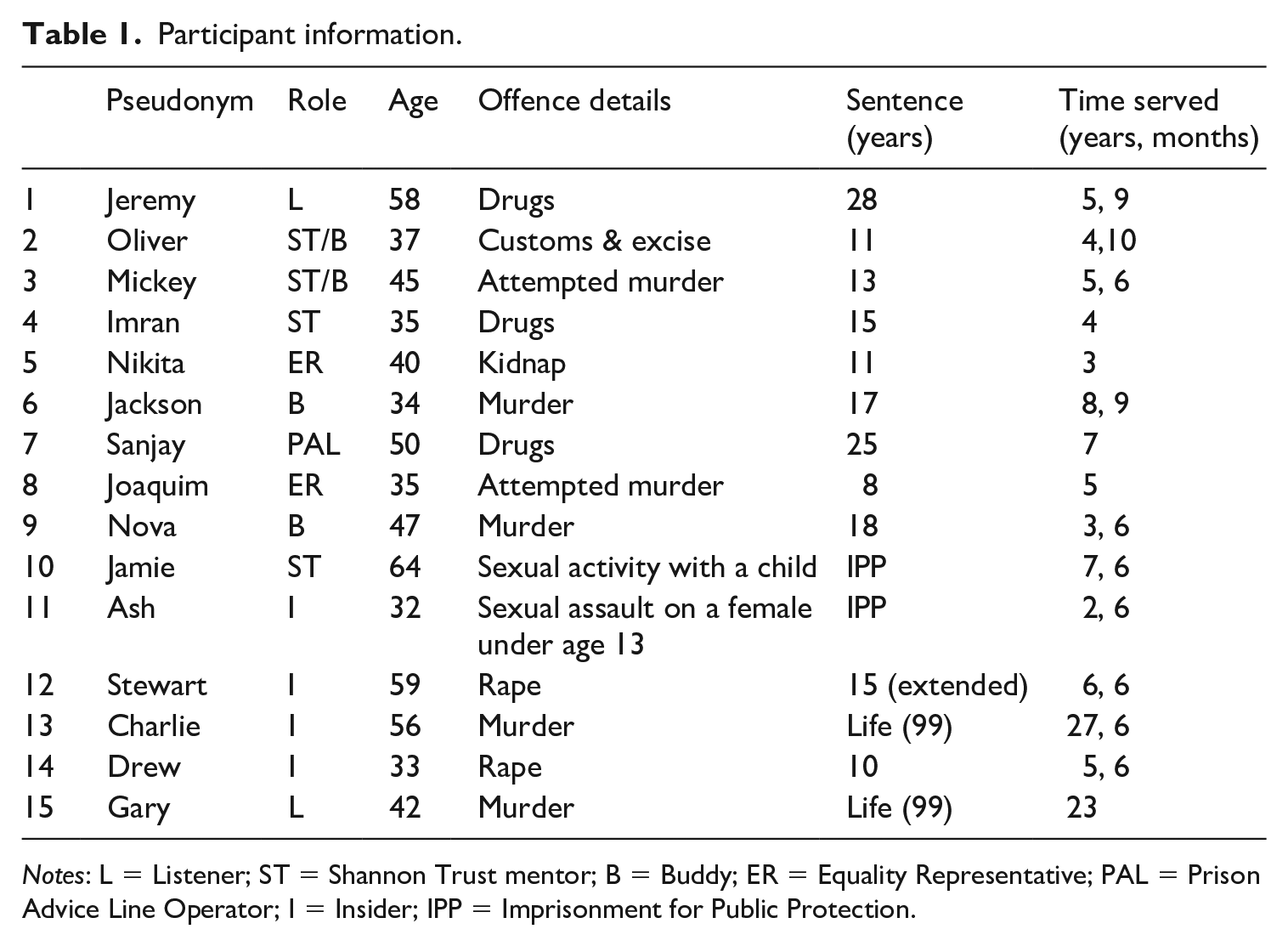
Notes: L = Listener; ST = Shannon Trust mentor; B = Buddy; ER = Equality Representative; PAL = Prison Advice Line Operator; I = Insider; IPP = Imprisonment for Public Protection.
Data collection
Semi-structured interviews, recorded using a password protected Dictaphone and later transcribed, were utilized in data collection. The interview schedule took the following format:
Introductory questions – participants were asked their thoughts about key terms such as ‘peer support’, ‘rehabilitation’ and ‘imprisonment’, and to describe their peer support work.
Views and attitudes regarding the broader notion of peer support – participants were asked what they think peer support is, how it works and why it might be useful in the context of prison.
The potential utility of peer support in prison – thoughts regarding how peer support can shape experiences of prison were explored.
The problems with peer support – participants were asked to describe any problems they felt peer support brought to the prison or that prohibited peer support from working as well as it could.
Implications and suggestions for policy and practice – suggestions for how peer support could be better integrated into the structure of prison were sought.
Analysis and discussion
Thematic analysis (Braun and Clarke, 2006) was adopted for analysis of the transcripts in this study. Transcript coding and analysis revealed five subordinate themes that underscored a central superordinate theme relating to ‘stumbling blocks’ (challenges to overcome). These themes are presented in Table 2.
Thematic analysis results.
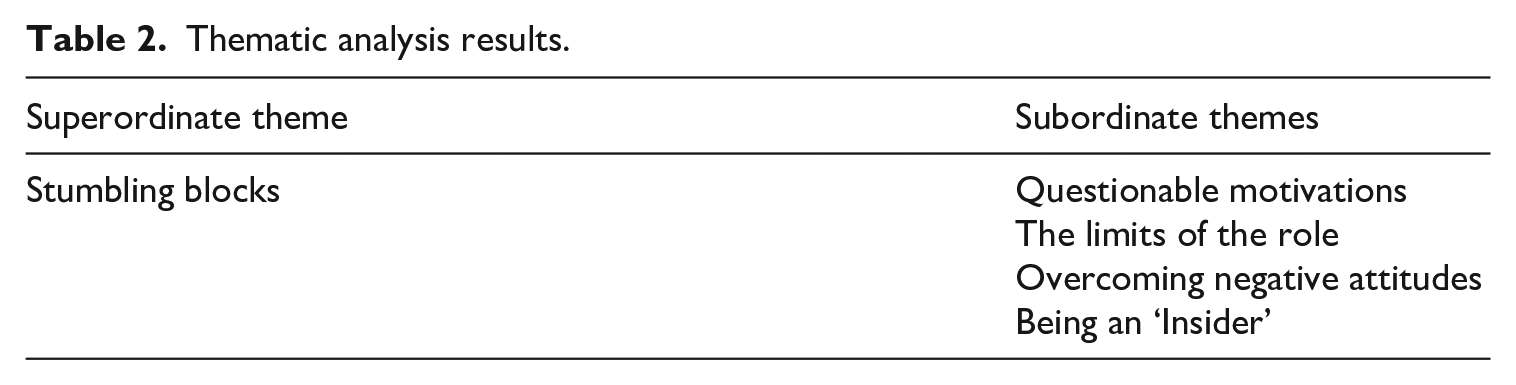
Superordinate theme: Stumbling blocks
Although all the participants spoke positively about their involvement with peer support schemes, some also articulated frustrations and barriers that they continually had to overcome. These hindrances largely emanated from the need to balance a socially sensitive role (in terms of prison dynamics) and the need to address negative attitudes from both residents and staff. Despite participants voicing these concerns, there was a valiant sense of optimism across the data and this appeared to stem from a shared mission that residents would look after each other and that this was ultimately the way forward. As such, the label ‘stumbling blocks’ is used here to illuminate the solution-focused viewpoint that participants conveyed.
Questionable motivations
There was concern from some participants that peer support programmes could be open to misuse by certain residents. Most peer-led interventions operate on a voluntary basis, or pay a very small amount often for long hours. Nevertheless, there is commonly a set of privileges associated with upholding such roles, and there is a risk that these could be exploited by those who volunteer ‘for the wrong reasons’.
I know some people do it for the wrong reasons, erm, you know the, IEP [Incentives and Earned Privileges] levels and things, they’re kinda badly thought out. And if you can only get your IEP doing this, then people will do it just for that. There has to be, for peer-mentoring, an environment where you feel you can make a difference doing it. And I don’t think that’s done by rewarding somebody. Those perks should be there for everyone anyway, and then they’re there, they don’t have to get them. This’d mean the right people get the right mentoring jobs. Another thing as well, the Listeners don’t get paid. The Buddies – they pay you. So why do you wanna be a Buddy? ‘Well I’m gonna get 20 quid a week.’ Why do you wanna be a Listener? Well because I wanna help somebody. There’s a big difference. I just liked being able to help people. My wife suffers from mental illness, so I know a lot about mental illness and so I’ve got empathy with it because I’ve been there, I’ve dealt with it, I’ve lived with it, know it. If I can help someone, it’s down on my record that . . . if it weren’t for my intervention with a certain resident, he would’ve taken his own life cos he was very bad, and he was segregated . . . and just to interact with him as a human being.
As Mickey and Jeremy describe, there is variation in terms of how peer supporters are compensated for their work, but all are arguably incentivized in some way. Listeners, Insiders, Helping Hands volunteers and Shannon Trust mentors are not paid directly, but usually (depending on the prison regime) operate within the ‘red band’ zone of privileges, meaning they are eligible to be placed on enhanced wings and are trusted to move around the prison (NOMS and MoJ, 2011). Conversely, Buddies, Equality Representatives and Prison Advice Line Operators are paid a variable but very small rate (access to specific figures was not granted). As Prison Service Order 4460 indicates, pay rates for work in prisons generally average £9.60 per week, but can be as low as £4.00 (HM Prison Service, 2020). This has not changed in at least two decades. This is for conventional 32-hour week jobs such as cleaning, canteen duties or packaging services. Peer support roles (if they are paid at all) are often compensated at a lower rate.
Although Jeremy exaggerates the pay rate for a Buddy (and in fact any peer support role), he raises the important point that paying peer supporters may obscure motivations for joining. Jeremy goes on to describe his own motivations, emphasizing the importance of the human nature of peer support work and how this should be the primary driver for such an undertaking. Jeremy does, however, discuss how his good work will go down on his record, indicating that there is some self-serving element to his work (as perhaps there should be). This illuminates how complex the issue of incentivizing peer support roles is: What constitutes an incentive? How can true altruism be assessed? Is it even necessary that any degree of egocentric motivation be stripped from peer support roles? Despite these apprehensions, the use of privileges could conceivably encourage more superficial motivations for becoming a peer supporter. This constitutes a risk to the quality of provision across otherwise productive programmes of support. Still, any system in prison that offers inmates a level of privileges is susceptible to some degree of exploitation, and, although this is not a justification to become cynical about resident behaviour, it is a dynamic that should not be ignored. Along with the concern over financial motives, some other self-serving gains were considered by participants.
I think a lot of mentors use the roles to gain like paroles and stuff, especially the longer . . . lifers or whatever, because when you’re in prison it’s hard to prove that you’re a rehabilitated character. You have to show you’re rehabilitated. And a lot of mentors use their role as a demonstration that they’ve changed, they’re helping other residents, and they’re helping the community. A lot of them do it in a cynical way really if you see what I mean. They do it to, you know, to tick the box but deep in their hearts I don’t think they really give a damn.
Sanjay articulates the risks of a ‘tick box’ approach (simply trying to evidence change) to the structure of peer support. Plausibly, it could lead to the employment of disingenuous or unempathetic individuals, rather than those who truly want to make a difference in the prison. Dissociating the genuinely compassionate from the ‘gamers’ in this regard represents a difficult challenge for prison staff, and perhaps peer support programmes will always be vulnerable to this form of individualism. However, Sanjay’s concerns could be inverted in at least two ways: (1) it is not necessary harmful for residents to want to engage in peer support to prove that they are ‘rehabilitated characters’ – this at least shows that there is some investment in change and an understanding of the negative behaviours to be addressed and the positive ones to be achieved; (2) there is also the possibility that residents may initially be drawn towards peer support roles ‘for the wrong reasons’ and subsequently enjoy the same personally rewarding experiences that others do. Spinelli (2007) has observed this phenomenon in the context of therapy, arguing that whether the client is observably engaged and motivated by genuine drivers is not necessarily important. Rather, ‘the very entry into a therapeutic relationship . . . permits the client to entertain and “try out” possibilities of being that provide a temporary means by which the worldview is reconfigured’ (Spinelli, 2007: 87).
The limits of the role
There are many peer-led schemes that operate in UK prisons, and, as such, providing the appropriate type and level of support can be a convoluted endeavour. Relatedly, participants expressed concern over continual organizational confusion and procedural complication.
Knowing where the boundaries are . . . so whether that’s a boundary for emotional support, where we pass on to the Listeners, or where it comes into equality or something else. Although somebody can be getting bullied or in a sense abused by name calling . . . it could be a racial thing, which is us in a sense because it’s anti-social behaviour. But it’s also a racial issue . . . so it’s about knowing where the boundaries are and knowing which programme deals with what.
Stewart describes how there can be difficulties in establishing the true nature of a resident’s issue, which in turn makes it difficult to point them in the right direction or help them in the most effective way. Many of the support schemes available to residents naturally overlap in terms of service provision. Participants expressed how this could often result in organizational complications, such as time-consuming paperwork being sent around the prison for weeks, while someone requires immediate help. This appeared to be a recurring hindrance.
Some of them, they have proper problems, you know, losing jobs or problems with officers . . . basically, I told these to my boss and, nothing happened. I sent maybe 20 problems, and nothing happened, and people are coming to us, and I look like an idiot. I try to be a man of my word you know and then people come and say ‘I tried to sort it out with you and nothing happened’. Maybe it takes time but, I can become angry, I don’t want to be a like a small child asking every time.
Here, Nikita describes how his role can sometimes see him locked in a ‘no win’ position. This is borne out of his attempts to meet the needs of residents while also working under the constraints of prison procedure. It takes time for Nikita’s efforts to be actioned, which ultimately leads to the peers he’s trying to help questioning his level of support. This threatens a core aspect of Nikita’s self in a sense – his promise to always keep his word. It is of course unfeasible to think that prison staff can always prioritize the work of peer supporters, and there are procedures to be followed for the sake of safety and security. Nevertheless, Nikita articulates simply wanting a more upfront and honest approach from staff, which would involve simply being kept informed of processes and the reasons underpinning any delays. It is important that the positive influence Nikita wishes to have is encouraged, and that he is not dissuaded from making such contributions and left feeling deflated and ‘angry’. It is therefore advisable that staff, wherever possible, seek to resolve any potential grievances early by providing as much support as feasible.
The Buddy role is needed in prison, but we need more support from the prison itself, because at the moment we’re supposed to have meetings as Buddies every month, and the last meeting was, I dunno, six to eight months ago? I don’t even remember . . . because the officer who was supposed to be dealing with us has to do some job elsewhere, and when you have two different things you’re not very good at any of them. You need to dedicate your time to one job properly.
Oliver’s comments highlight the need for peer support to be more formally recognized in prisons and structured in a way that ensures a level of quality in the service provided both by staff to peer supporters and by peer supporters to recipient peers. The Buddy role addresses a severe problem in prisons. In addressing bullying, it attempts to support the vast numbers of residents who will experience anxiety and distress as a product of being verbally or physically abused and left feeling hopeless. Despite its importance and unique ability to reach residents in need (who often choose not to turn to staff through fear of violating the ‘inmate code’ – Cordilia, 1983; Trammell, 2009), the Buddy programme does not have a dedicated overseer fully committed to its regulation. This oversight results in meetings being routinely cancelled and the Buddy programme dissipating.
There are dynamics of power at play here. Peer supporters in prisons represent in-groups characterized by a number of shared goals and intentions. It is this feature of peer-led programmes that many participants cherish and enjoy (see Perrin and Blagden, 2014). The denial of a critical ‘in-group ritual’ (Kádár and Bax, 2013) by staff members could serve to engulf prisoners and staff further in their traditionally divergent roles (Crewe, 2011; Sparks and Bottoms, 1995). Indeed, there is a body of research that reports on the problematic relationships between prisoners and staff. Such relationships have often been typified as conflictual, unconstructive and defined by a struggle for power (Hemmens and Marquart, 2000; Morris et al., 2012). Such experiences can result in prisoners feeling unhuman and can bring about what has been termed the ‘Golem effect’, via which low expectation in individuals produces low outcomes (Maruna et al., 2009). However, in previous qualitative studies investigating peer support in prisons (see Perrin et al., 2018; Perrin Frost and Ware, 2018), participants reported being able to earn trust from prison staff, which engendered a cognitive shift from ‘hopeless and bad’ to ‘helpful and good’ (Maruna et al., 2004). In turn, this process aids the breaking down of the power differential and resultant conflict between prisoners and officers. Staff must therefore encourage the formation and maintenance of prosocial prison in-groups so that this effect can be realized and harnessed, rather than undermined and wasted. Again, it may be a stretch to recommend increased resources for peer support programmes, given the already depleted levels of staffing across UK prisons, but it is feasible for them to be reviewed and better structured. Simple measures (organizing consistent meetings) could go a long way to ensuring that peers fully benefit from the services available to them, and peer supporters do not become jaded as a result of feeling underappreciated.
Whereas most participants outlined regulatory frustrations, there were more nuanced concerns that related to how staff construed the confidential nature of much peer support work.
Sometimes they’d walk away with me and say, ‘Well, what was his problem then?’ So I’d say, ‘Well, you know when you had your briefing today, what did you all say?’ And they’d say, ‘Well we can’t tell you that!’ I’d say, ‘Exactly, you should know better than to ask me those questions.’ I mean I’d not get directly into trouble but, certain officers changed . . . like when I wanted to go somewhere or something, they’d make life hard for me, thinking, ‘you’re not gonna help us, why would we help you?’ Samaritans wanted to hold some training to teach the officers how it operates but it was blocked.
The extract above depicts a troublesome power dynamic that stems from staff requesting access to Listeners’ interactions with fellow residents. Listeners were conceived and are regulated by Samaritans. As such, prison Listeners are bound by the same policies and regulations as Listeners ‘on the outside’. Of these policies, the confidentiality of the caller’s interaction is most crucial. In fact, Listeners who break this code of conduct are highly likely to have their role terminated by Samaritans with the full support of the prison’s Safer Custody Department. In essence, without confidentiality, the Listener scheme, founded on principles of reciprocity and of peer-to-peer problem-solving, would collapse. Despite this, Jeremy describes how some staff appear to let curiosity get the better of them – they ask about his interactions with callers. When Jeremy responds as he should, telling staff that he cannot disclose any such information, he experiences some informal sanctioning. This finding is especially disheartening in the light of previous studies that report how supporters’ relationships with prison staff often improve as a consequence of the trust they are able to build from ‘doing good’ (Perrin and Blagden, 2014; Perrin Frost and Ware, 2018). Indeed, widespread research has described the entrenched challenge of overcoming prisoner and staff conflict (Crewe, 2011, 2012; Liebling et al., 2010) and peer support can play a mediating role here, so long as all parties observe the regulations surrounding peer-led programmes.
Overcoming negative attitudes
When asked if there were any problems with being a peer supporter, some participants highlighted the occasional negative attitude they could be on the receiving end of. These came from both residents and staff. Attitudes from the former were characterized by a cynical view that residents who become peer supporters must have an ulterior motive and should not be trusted, whereas attitudes from staff emanated from a lack of respect for the confidentiality of the interactions between peers.
I suppose you’re gonna have the people that doubt you because obviously they’re not sure what you’re here for, they don’t quite understand, and they’ve heard bad rumours. Sometimes you just get called grasses because sometimes we can’t keep our information confidential, which is a very grey area because some guys wanna come talk to you and they wanna try and keep it private but it’s just impossible because sometimes something has to be done . . . especially on the bullying side. So, there’s gonna be doubters but also ones who say ‘He did me a really good deed the other day, I really felt good, it stopped me from doing something stupid.’ There’s always gonna be that battle.
Drew discusses how his particular role places him in a quandary as a consequence of an inability to guarantee the confidentiality of the interactions he has with those he supports. Unlike Listeners, who are bound by Samaritans policy to keep all interactions confidential, Insiders occupy a blurrier middle ground – they are responsible for supporting victims of bullying and making sure action is taken. This can be awkward because some residents may simply want to offload their anxieties about a bullying situation but may not wish to raise the issue formally through fear of reprisals or being identified as a ‘snitch’ (Akerstrom, 1989; Garland and Wilson, 2013; Marquart and Roebuck, 1985). Additionally, Insiders who are seen to be interacting between residents and prison staff are likely to be targeted themselves as ‘grasses’. Herein lies the vulnerability tethered to the ‘high visibility’ of peer support roles (Jaffe, 2012). These problems are not necessarily unique to Insiders but appeared much more difficult to overcome.
Listeners in this study also reported being labelled as grasses every so often (though far less) but, in contrast to Insiders, they are able to quickly quell resident scepticism by assuring them that their interactions are confidential – they can even highlight official Samaritan policy to emphasize this (Jaffe, 2012). The fact that Drew cannot fall back on this same strategy leaves him (and several other Insiders) with the defeatist supposition that there’s always ‘gonna be the doubters’. Drew finished on a positive note however, trading off the negative attitudes for the positive ones stemming from those he supports and who get a lot from it. This optimism in a situation of potentially great anxiety and negativity was common across the transcripts, but especially amongst Insiders.
Well . . . the prisoners, a lot of them take us as grasses . . . I’ve had it where people have said ‘Oh, you’re just a grass’ and I’ve had to, not put them in their place but, kind of explain. I use the scenario that . . . if there’s someone being bullied, and I don’t help them, and they take their life that night . . . how am I gonna feel the next day knowing that I could have done something? Once I explain that, they sit down and go . . . ‘Yeah, I see where you’re coming from’, unless you get the real hard-nuts who say ‘Well I don’t really care’ . . . so a lot of it is about educating them about what we do.
Stewart describes how he finds himself in the same dilemma as Drew – a Catch 22 enforced by the requirement to balance the perceptions that residents may have of him with the duty of care he has to the people being bullied. This dilemma is emblematic of the inmate code. Paterline and Petersen (1999) have summarized the inmate code as a collection of attitudes, beliefs and behaviours that serve as a survival mechanism for residents. Sykes and Messinger (1960: 5–11) offered a number of discernible codes of conduct that are observable in the prison setting. Of these, ‘don’t interfere with inmate interests’, ‘don’t exploit inmates’, and ‘don’t weaken’ are particularly useful in explaining the difficult scenario in which peer supporters can find themselves. In upholding Insider roles, residents may be perceived as inmate code deviators, because they actively seek to interfere with inmates’ interests (whether the goal is to provide help and support or to report individuals who are bullying others). Insiders may also be seen to be exploiting inmates. They may be viewed as mere intelligence gatherers who will use the information they gather for their own gain (that is, developing favourable relationships with prison staff or receiving IEPs). Finally, Insiders, and perhaps all peer supporters, may be viewed as ‘weak’ as a result of taking on a role that ultimately defies the directive ‘to always sit in opposition to the directives and the authority of the institution’ (Sykes and Messinger, 1960; Crewe, 2005).
As well as governing the everyday attitudes and behaviours of residents, the inmate code is said to be especially important in defining relationships between residents and prison officers. The two groups are expected not to mix beyond the level of basic and necessary interaction (Paterline and Petersen, 1999). If they do, suspicion, distrust and eventually abuse and violence can result. These dynamics are also theoretically aligned to social identity principles and the mechanisms an in-group may use to define its parameters and codes of conduct (Reicher et al., 2005). It is possible that upholding a peer support role, especially that of an Insider, places individuals in a tense situation that could see them victimized. Staff should be aware of this precariousness and how to minimize risk for peer supporters.
Being an ‘Insider’
There is clear crossover between this theme and the two that preceded it. However, this theme explicitly explores the Insider role (one that most UK prisons support) because it appeared especially prone to conflict. It was explained that this was due to its equidistance between two groups, residents and prison staff, and the level of mediation required between the two. This feature is somewhat different from those of other roles, which are carried out with greater independence. The lack of this independence appeared to expose participants to a greater risk of being viewed as ‘grasses’. To this end, some participants talked about changing the title of the scheme, given its innate synonymity with ‘informant’ or ‘spy’.
I mean the difficulties come if . . . the guy who’s coming to see you is actually complaining about a member of staff (and that does happen), and then you’ve got an issue because your first port of call when someone comes to see you is staff. But if it’s about a member of staff, you’ve got another issue there.
Within the confines of the inmate code, Charlie is placing himself at great risk by accumulating information from residents regarding staff, and then possibly having to go and report this to those same staff members. Depending on how staff members action such scenarios (ideally, strategically and with great sensitivity), Charlie could feasibly be deemed an informant by residents. Given the fierce social identity dynamics ingrained within the ‘prison walls’ (Fleisher and Decker, 2001), Charlie, as with other Insiders, runs the risk of being socially ostracized, or worse, by fellow residents.
How do the residents see you as an Insider? Some think you’re a grass – they think of ‘Insider’ as ‘informer’. The thing is, with the Listeners, it’s stated that everything is confidential. With the Insiders it’s stated that it isn’t confidential . . . but that you’ll only talk to people who need to know, but people don’t hear that bit. They just think you’re gonna go and tell whoever, so it’s difficult.
Charlie’s extract offers some explanation as to the aetiology of the Insider/informer concern. As alluded to in the previous subthemes, reassuring recipients of support that their ‘stories’ are kept confidential appears to be key in suppressing any suspicions that peer supporters are informants who are not to be trusted. The objective of the Insiders scheme fills a void in that it seeks to stop residents being bullied by identifying such cases and reporting them to staff who have the authority to enact some form of control. As such, it is difficult to imagine Insiders operating effectively without the flexibility in terms of confidentiality. It may be, therefore, that the only clear solution is to ensure that the objectives of the Insiders scheme and the channels through which Insiders operate are clearly and consistently expressed by the prison. It may also be worth considering renaming the scheme, because of the stigma attachable to the term ‘Insider’.
Concluding comments
Relying on the accounts of the residents themselves, this research aimed to portray the resident perspective on how to optimize the utility of peer support across the present corrective landscape. This article conveys an array of challenges and hindrances that need to be addressed for the betterment of peer support’s contribution in correctional contexts. A significant feature of the collective participant response was one of positivity and optimism: participants alluded to an abundance of benefits associated with peer support roles and viewed challenges as workable and fleeting. This spirit of hopefulness corroborated previous findings (see Boothby, 2011; Davies, 1994; Perrin and Blagden, 2014; Perrin et al., 2018) and informed the thematic tag ‘stumbling blocks’ in that obstacles were viewed as insignificant and movable.
Nevertheless, some important and potentially destructive issues surrounding the delivery of peer support in prisons were discussed. The motivations underlying residents’ decisions to become peer supporters should be explored to ensure the credibility of their intentions to genuinely help. The analysis in this article noted that, although having the ‘wrong motivations’ initially need not necessarily be a concern (as per Spinelli’s, 2007, unconscious therapeutic alliance notion), there should be some protocol in place to filter out residents who may seek to abuse and damage peer support schemes. Motivation was also connected to the issue of whether (or how) to incentivize peer support. Many participants felt that peer supporters should not be paid for their work, and that it should be as close to conceptions of altruism as possible. No great concern was expressed by participants regarding the current approach for incentivizing peer-led roles, which is mostly to offer movement to an enhanced wing (an offer that many participants did not accept). Nevertheless, incentivizing peer support remains an issue that the prison service should take a stance on.
The other stumbling blocks that participants referred to related largely to how their roles were perceived in the prison. There were some concerns that fellow residents could view peer supporters as ‘grasses’ or ‘snitches’, owing to the fact they often need to play an intermediary role between residents and staff. This potential risk was connected to the notion of the inmate code (Cordilia, 1983; Paterline and Petersen, 1999; Trammell, 2009) and points to the need for prison staff to be trained on the roles of peer supporters and how they should be managed in the prison environment. Staff themselves also need to be aware of their impact on the functioning of peer supporters. Many participants described ways in which staff could (consciously or otherwise) undermine their work. The most concerning finding in this regard was that prison officers may be reactive to a perceived power reversal (peer supporters being given too much autonomy or credit). This threatens to limit the constructive utility of peer support, and staff should therefore be made aware of the beneficial impact of peer-helping in terms of offender change. As it stands, with the limited research available, many staff are possibly unaware of the influence peer support appears to inject into the prison environment. This research offers a level of understanding in this regard.
The findings from this article will it is hoped aid further research and help to construct policy and practice around peer support in prisons. Including residents directly in the formulation of these implications is an important contribution of this study. It is hoped that this feature of the research has represented a chance for convicted individuals to inform some of their own directives. Indeed, ‘continued bypassing of the resident’s perspective can serve only to harden the apparent resentment and contempt for a criminal justice system predicated on brass-bound policy ideals’ (Juliani, 1981: 122). As well as illuminating the important implications surrounding the utility of peer support in prison, it is hoped that this article, more generally, has demonstrated the value of listening to the resident voice.
