



Abstract
This article presents findings from a qualitative research project into organized crime, policing and security across five major seaports (‘Portvilles’): Genoa (Italy); Melbourne (Australia); Montreal (Canada); New York (USA); and Liverpool (UK). Through content analysis of confidential judicial files, the article will construct the offenders’ scenarios and options for importing drugs in Portville. Through also interviews with law enforcement agencies, police forces and security staff in these seaports, the article presents the policing and security struggles to disrupt importations. The main finding is that importation roles and security techniques change constantly and quickly, as in a game of Pac-Man. Security and policing in seaports lead to the dilution and fragmentation of drug importation, and only distribution tends to remain organized in Portville. In this chaotic environment, it is the rules of trade that affect the success of drug importations the most, rather than the failures of effective security and policing.
Introduction
Cross-border drug trafficking has been the object of several studies (Hughes et al., 2019; Zaitch, 2005) and it does not seem that the phenomenon has been decreasing in recent years (UNODC, 2019). Drug trafficking is a package-crime comprising various activities, which have often been studied as market-based offences (Beare and Naylor, 1999). Much like a legal market, drug trafficking involves multilateral exchanges of goods across a number of actors and intermediaries – producers, brokers, importers, distributers and consumers. Even though illicit drugs are indeed commodities that are dependent on the economic rules of their own market, actors are often located in different countries: different socio-political contexts will affect the success or failure of the whole package-crime.
Depending on the type of drug, different drug shipment methods are employed: cars, trucks, airplanes, SUVs, yachts and small/personal vessels, and also commercial boats, including containers in large cargo ships, into main ports. Different smugglers will have their preferred methods of trafficking. However, it is obvious that the world container traffic has immensely changed the nature of legal commerce, as much as it has illegal traffic through seaports (Nordstrom, 2007). Even though air transport now covers a large portion of international shipping, sea shipping still remains a very effective way to move large amounts of cargo across borders (Hummel, 2007).
Ports are unique environments, universes of processes and meanings, border zones, transit areas, ontologically always in flux, cores of their cities’, regions’ and nations’ economic and political processes and investments (Brewer, 2014; Eski, 2016). The flow of commodities and services, between and across national jurisdictions through the main seaports, inevitably leaves some unregulated areas, because it is impossible to completely control and regulate sea waters.
Understanding the social and economic underpinnings of organized crime in the form of drug trafficking across borders has been a priority for the international community for the past two decades, especially since the 2000 United Nations Convention against Transnational Organised Crime was signed in Palermo, Italy, and after 9/11 (Sergi, 2017). Indeed, securing borders is a challenge of today’s world concerned with the safety of citizens as well as the security of infrastructure within national boundaries. The landscape of maritime security, too, has changed drastically, together with all the other security threats after 9/11 (Eski and Carpenter, 2013). To this end, the International Maritime Organization (IMO) in 2002 approved the International Ship and Port Facility Security (ISPS) Code by adding Chapter XI.2 (Special measures to enhance maritime security) to the International Convention for the Safety of Life at Sea (SOLAS) of 1974. The ISPS in 2019 applies to 165 SOLAS members accounting for over 99 percent of world tonnage, 1 thus creating an appearance of harmonization of security policies across states. The Code contains a mandatory Part A outlining detailed requirements related to maritime and port security, which SOLAS contracting governments, port authorities and shipping companies must adhere to; Part B of the Code provides a series of recommendatory guidelines on how to meet the requirements of Part A. 2 As indicated, ports are gateways and marine borders, and therefore they are crucial spaces in any strategic effort to secure transit, entry into and exit out of states. For this reason, maritime security has been developing along the lines of policing of other security threats, including terrorism and organized crime, especially illicit trafficking (Brewer, 2014; Zhang and Roe, 2019).
Research notes
This article will present some of the findings of a larger research project into organized crime, policing and security carried out across five major ports: Genoa (Italy); Melbourne (Australia); Montreal (Canada); New York (USA) and Liverpool (UK). All of these cities will be called ‘Portville’ in this article, to indicate the applicability of some of the findings to all locations. The existence of convergences across these ports does not exclude the persistence of important divergences as well. These divergences will need to be explained too, by referring to the relationship between the space of the port and its surrounding areas, which is likely to influence policing as well as urban developments. The main research questions that this article is exploring are:
What are the mechanisms, aims and known strategies for importing drugs into, or through, the ports?
What are the reactions, tactical choices and perceptions of law enforcement and security authorities on the vulnerabilities of ports to organized crime, with specific attention to drug importation?
Data primarily included juridical data collected through national databases (portals such as Westlaw UK, ItalCass, Pacer, Austlii, Canlii) as well as investigative files shared (and often anonymized) with me by different authorities interviewed in the course of this project. Press releases and official policy documents have been gathered and also have guided the collection of case law for specific/additional cases. For each port, interviews and focus groups (for a total of over 50 meetings) have been arranged with port authorities in their security teams, police forces in their port units (such as Trident Task Force in Victoria, Australia, or the Guardia di Finanza in Genoa port or the Port Police in Liverpool), regional, state and federal police units for organized crime (as applicable, such as the Royal Canadian Mounted Police Port Enforcement Team and Border Integrity for Quebec, the City of Montreal Police, Merseyside Police, and the Direzione Investigativa Antimafia) and Port Facility Security Officers working at the ports and terminal containers (private companies), border forces (for example, the Agenzia delle Dogane, the Australian Border Force and the UK Border Force) and other waterfront control agents (such as the Waterfront Commission for New York Harbour). Even considering the differences across states and jurisdictions, Portville usually has the authorities listed in Table 1 with various mandates/functions over the port.
The authorities and institutions presiding over the port in Portville.
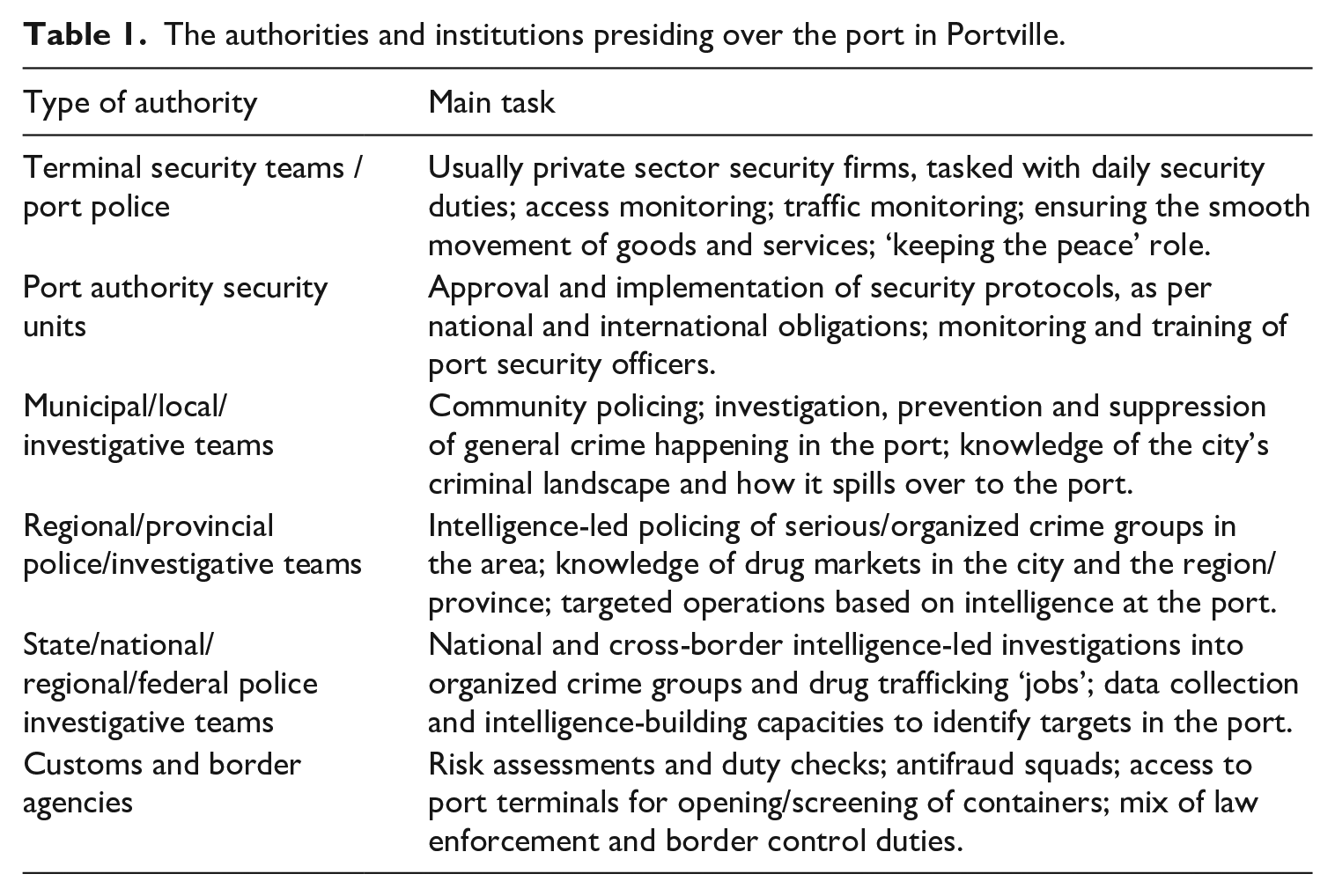
Interviews have covered security plans inside the port terminals/authorities; national and international regulations for access and monitoring of the port; perceptions of illegal activities in the ports; assessments of risks and vulnerabilities; and perceptions of efficiency in responses. Some of these forces have shared some of their (often confidential, thus anonymized) protocols to detect and investigate vulnerabilities and organized crime or importation at the port. These cannot be directly quoted due to confidentiality restrictions.
Much of what was discussed with interviewees does not relate to this article. This article should instead be considered as an attempt to understand how drug importers’ choices respond and adapt to the implementation of security procedures in and around the ports, and how this might affect options for the illicit drug trade. As indicated, some authorities have requested that certain data, including parts of interviews/focus groups, be kept confidential. For this reason, the analysis in this article will present likely scenarios rather than case studies; it will refer to Portville, rather than specific areas, to avoid direct attributions; it will engage in an analytical and policy-oriented exercise, rather than a reporting one. The main aim is to show similarities and convergences that I have been able to observe throughout the analysis of data in the different ports, enough to build likely scenarios that are generalizable precisely because they are the amalgamation of various sources of data. This is true both for the description of offenders’ strategies – largely based on the analysis of investigative files and judicial case law, including wiretap transcripts – and for policing and security responses – mostly based on the interviews and focus groups.
To facilitate understanding, findings will be presented in a confrontational perspective: on one side the offenders’ scenarios and choices to import drugs in Portville; on the other side the reactions, perceptions and struggles of law enforcement to disrupt importations.
The main findings of this article are: (a) illicit trafficking is limited by licit trading routes in and out of ports; (b) although drug importation is often a disorganized and opportunistic activity, distribution in Portville is often a ‘closed game’, thus more organized and difficult for newcomers to exploit; (c) increasing security measures displace certain activities but also create further opportunities for offending; and (d) the unpredictability of control activities and less formal compliance requirements over ports might yield extra knowledge of, and impact upon, drug importation mechanisms for law enforcement. Mainly, this article argues that major seaports act as breakwaters for drug importation: they create obstacles and force importers to adapt and modify their behaviours; they support the dilution and fragmentation of this type of criminality. In this sense, the game between importers and police forces is a game of Pac-Man, where new obstacles or facilitators emerge suddenly, roles change, directions change, in a cat-and-mouse game that requires adaptability and flexibility on both sides. In this chaotic environment, it is the rules of trade that affect the success of drug importations the most, rather than the failures of effective security and policing.
Organized crime and drug trafficking on the waterfront
Throughout the literature on organized crime, ports are virtually always mentioned as key entry points for drugs and other illegal goods, but also as areas of influence of more sophisticated groups, who aim at governing spaces and not just profiting from them, such as mafia-type groups exercising labour racketeering in the port workers’ unions (Calderoni, 2012; Eski, 2011; Hughes et al., 2019; Jacobs, 2006, 2011; Jacobs and Peters, 2003; Sergi, 2019). The term ‘organized crime’ comprises a number of different illegal activities, including trafficking and smuggling – of drugs, weapons, human beings, counterfeit products, protected wildlife, waste, stolen goods – but also laundering money through investments in the legal economy, that is, in construction companies or other services that, for example, can also be needed in port environments. Organized crime refers both to mafia-type groups, which are also concerned with power-seeking and governance establishment (Sergi, 2017; Varese, 2011), as much as to profit-making groups’ activities that act as facilitator on the docks too. For the purposes of this research, organized crime will mostly refer to serious criminality, by different types of networked actors, involving the provision and distribution of illicit goods, such as trafficking and importation of drugs, tobacco and counterfeit goods. When it comes to ports, drug trafficking is the type of organized crime that has been, directly or often indirectly, mostly investigated by academia, including scholars of organized crime, policing and network analysis (Brewer, 2014; Eski, 2016, 2019; Madsen, 2018).
One of the first studies on the manifestations and mechanisms of drug trafficking at the global and local level within ports is an ethnographic investigation into Colombian traffickers in the Netherlands in the late 1990s by Zaitch (2002b). He argued that traffickers welcomed the revolution occurring in cargo shipments through containers, because it greatly increased the volume of goods shipped worldwide and made certain ports into essentially ‘super-ports’, with large amounts of traffic and therefore a dispersal of risks in the process. This book showed how prominent access to cocaine in Colombia corresponded to a proliferation of small, decentralized and informal groups, which are more flexible than was/is commonly believed. The figures of ‘brokers’ managing transactions and moving across different networks are the key players, especially for the business of importation to another country, such as the Netherlands. One thing that emerged clearly from Zaitch’s (2002a) research is that increasing volumes of traffic through containers in large ports, paired with the fragmentation and disorganized nature of trafficking units and networks from source countries, reduce the risks of detection at the destination port. More traffic, essentially, means less risk because of the decreased probability of random border checks (Zaitch, 2002a; see also Smith, 2017). This concept has been confirmed up to the present day by research into Mexican cartels (Payan, 2016).
To a certain extent, this is also confirmed by economic analyses of transnational trafficking that have focused on the fundamental inequality among participants in the trade, and between source and destination countries. Drug trafficking, especially of cocaine, is characterized by economies of scale, in which production costs are negligible when compared with retail prices (Reuter, 1983; Reuter and Greenfield, 2001; Reuter and Kleiman, 1986). There is, indeed, a difference between the drivers and the gains of drug traffickers and those of drug importers, which arguably is mirrored in the policing efforts in source and destination countries. It has been argued that organized crime, and especially drug trafficking, is indeed disorganized because it is the liberal market, rather than just individuals’ skills and choices, that determines survival and failures (Reuter, 1983).
In the present day, Western states consider the disruption of drug trafficking to be paramount for border integrity, in addition to the harm drugs might cause to public health and public order (Andreas, 2003). Policing the waterfront is another one of those fields that has been securitized, within the counter-terrorism and counter-insurgence agendas (Eski and Carpenter, 2013). A border is considered secure if drugs cannot get through or are confiscated when they arrive. However, free trade might both undermine as well as enhance the drug interdiction capabilities of a state (Bartilow and Eom, 2009). Indeed, a security paradox has emerged in the realm of serious criminality (Di Ronco and Sergi, 2019). On the one hand, security becomes synonymous with control and prevention, but, on the other, the more attempts are made at control, the more the security risks emerge: non-compliance with the demands of security becomes almost like a criminal act. The port security zone is no different (Eski, 2019). On one side, maritime security demands the collection of more and more data to control the vulnerabilities emerging from port employees, from customs officers and from traders (Côté-Boucher, 2016; Eski, 2019). On the other side, such demands can become new opportunities for deviance (Clarke and Brown, 2003). In addition, expectations of smooth and fast trading have essentially put under pressure demands for the swiftness of security responses (Brewer, 2014; Cowen, 2007; Eski, 2016). Indeed, maritime security is often still perceived as a cost and not as a resource for traders. Private actors or firms deliver security on the front line of the docks, while their employers, the private companies owning the terminal spaces, are aiming to boost their productivity (Eski, 2019).
The environment of a port is naturally a border zone: on one side there are open waters, on the other side the port also intersects with urban life and the economy of the cities and regions in the hinterland. Whereas border integrity is concerned with global and cross-border issues such as drug trafficking and importation, at the local level criminality at the port includes other activities, more or less serious and more or less linked to forms of organized criminality: these could include the movement and management of drugs before distribution once they reach the port (Zaitch, 2002a); cargo theft and theft from containers (Ekwall, 2009); labour racketeering and protection rackets run by organized crime groups willing to maintain exclusivity, control and a degree of order and governance over the port’s criminal activities (Demeri, 2012; Jacobs, 2014). The diversification of criminal activities in the port – more or less linked to organized crime or having illicit trafficking as the end game – ranges from local to global and calls for a diversification of policing techniques and authorities. Various institutions have their eyes on ports, from port police forces to city police agencies, from security firms to federal/national institutions. The security and policing landscape of ports is therefore built on multi-agency cooperation as the natural answer to the challenging task that is policing the waterfront (Brewer, 2014; Eski, 2016).
Looking for doors: The chaotic game of drug importation into seaports
In order to complete a drug importation – a ‘job’ – ‘you need a door’. This is what authorities at different levels have repeated at every stage of this research and it also mirrors the language that importers used in wiretapped conversations. Across judicial cases and narratives shared by security and law enforcement agencies in the various ports visited, drug importation – the ‘job’ – through the port in ‘Portville’ might occur in one of the scenarios described below. Because of the nature of these scenarios – which are reconstructions based on different cases – and the confidentiality of some of the data, I cannot provide direct quotes in this section. However, as much as is applicable, the scenarios will use language and examples directly found in the cases. There is a certain degree of correspondence between the judicial cases, police narratives (which often form judicial cases) and offenders’ language as emerging from surveillance and wiretapped conversations also included in the judicial data. However, it is essential to remember that certain judicial narratives are constructed with the specific aim of prevailing over adversarial narratives in trials. An analysis based on such narratives must, therefore, acknowledge this limitation and always consider that this might very well be a partial account of reality.
The names of these scenarios (‘pizza delivery’ and ‘pizza pick-up’) were inspired by a conversation with a federal police officer in Canada while he was explaining the different techniques employed in two cases we were discussing. I am grateful to him because these names perfectly encapsulate the language of the judicial documents and wiretaps in the various cases gathered.
Sam is based in Portville and wants to import cocaine or methamphetamines or hashish (the main drugs shipped through seaports; UNODC, 2019). S/he makes initial contacts in Portville who can help with the distribution and selling of the drugs as long as s/he manages to import them. Each Portville will be organized differently in terms of who, and where in town, arranges distribution and selling.
Before the job
Before the job, the main issues are (a) to secure a contact in the source country or with a broker in another country who will source the drugs, and (b) to finance the job.
The pizza delivery option
(a) Sam resorts to a broker, Joey, in Portville who is able to offer a whole service, from trafficking in the source country to delivery. Much like a pizza delivery, Sam has to wait for it and agree payment methods.
(b) Sam does roughly know that the broker will liaise with a Mexican cartel which is sourcing the cocaine from Colombian producers or with an Australian broker who will source methamphetamines from Myanmar through Thailand.
(c) Sam relinquishes control over the importation – the drugs will go through transit countries depending on the trafficking routes for the commodity chosen. S/he needs to later arrange for distribution, after transport and storage have been taken care of.
(d) This option will cost Sam more, but will reduce his/her risk of being caught.
(e) Depending on Sam’s background, reputation and access to cash, payment might be either deferred to completion of delivery or split in two halves, before and after completion, to cover for the possibility of ‘losing’ the shipment in transit or due to police or custom detection.
The pizza pick-up option
(a) Sam has his/her own contact either with a broker in Mexico (or Cambodia or Australia) or directly with producers and traffickers in Colombia (or in Thailand or Myanmar) and reaches an agreement over a certain amount of cocaine to be shipped to Portville. In this case, Sam orders the pizza and has to arrange pick-up him/herself.
(b) Sam’s first problem is to arrange the shipment of the commodity and secure safe transactions with one or both of his/her suppliers through source and/or transit countries.
(c) Sam’s second problem is to finance the operation, thus making sure s/he has enough seed money or a clear plan of payment on demand after distribution.
(d) Sam needs to be ready for the delivery (or deliveries) and arrange distribution upon arrival, including the transport and storage of the narcotics outside the port.
(e) This option might cost less than the previous one because money is to be paid to the traffickers and the brokers. However, it includes arranging various other tasks and actively participating in the delivery.
(f) Depending on Sam’s access to cash, his/her own networks and reputation, and his/her own ability to connect with a good high-level distribution network, the job will be more or less successful.
During the job
During the job the main issues are about the logistics of transport.
The pizza delivery option
(a) Sam does not necessarily know how Joey is going to import the narcotics s/he has bought.
(b) Joey has knowledge of the details of the shipment(s), the container(s) number and the arrival date(s) of the ship at Terminal X.
(c) Joey needs to make sure that the drugs hidden in the container(s) make it safely outside the port. Joey has a couple of options:
(i) Paying a ‘user fee’ to another network/individual who can offer logistical and/or human support on the docks. These networks/individuals are usually known in the underworld circles in Portville – they can offer manpower, protection against theft and/or vehicles as needed. This option allows for a more integrated relationship with the city’s underworld, which has benefits (protection and success of the job, especially in the case of further jobs) as well as disadvantages (payment for extra services and possibilities of retaliation over turf/business/commodity protection).
(ii) Arranging for legitimate transport – that is, by concealing the shipment of drugs within a cargo ordered by a legitimate company. This involves using freight forwarders, willingly or unwillingly aware of the content of the container(s) they will be transporting out of the port to a given location for storage/stocking.
The pizza pick-up option
(a) Sam will receive a call/text/message that 150 kg of cocaine (the first part of a larger order or the whole delivery) is arriving at Terminal X in Portville on the Carolina Star ship, in container AB1234567 on the 1st of June, next Friday. S/he will receive instructions on where/how to find the drugs within the container.
(b) Sam has probably already contacted someone s/he knows at the port – or someone who knows someone at the port – in order to understand what is needed to either open the container at the port or take the container out of the port.
(i) If the drugs can be accessed by opening the container in what is known as ‘the ‘rip-off’ method, 3 Sam’s best bet would be to outsource the work on the docks to a network of individuals who are known in Portville as able to provide logistical and human support. They can, for example, force the seal and replace it after taking the narcotics. By paying a ‘user fee’ to them, the job will be completed during a specific shift (of a port employee/worker), so that an extra set of eyes can also protect the container when the ship docks, depending on how easily/quickly/safely the container can be moved by the insider in the terminal. This will make sure (a) there are no thefts, and (b) the authorities are not checking the container.
(ii) If the first option is not available, then Sam might want to arrange directly for freight forwarders – through a shipping company’s contract – to get the container (seemingly) legally out of the port. This option might be cheaper and safer in the short run, but it also requires an assessment of the risks of the legal businesses employed alerting taxation and anti-corruption authorities.
After the job
After the job, the main issue is to arrange distribution.
The pizza delivery option
(a) Joey will need to deliver the drugs to Sam, so that payment can be completed to him/herself and to the traffickers, depending on the initial deal. Delivery is likely to happen outside of the port, in a storage facility where the container / the drugs have been moved by trucks or another vehicle.
(b) Sam will arrange for a delivery suitable to his/her high-level distribution network, if s/he is not in charge of distribution him/herself.
The pizza pick-up option
(a) Sam needs to complete the job by arranging the high-level distribution once the drugs are out of the port, to then pay traffickers/brokers and the user fees for the port – which might vary depending on what ‘service’ s/he used.
(b) Before final delivery to distributors, Sam (and the facilitators at the port) might decide to wait before transporting the container outside the port to be sure that police or customs do not have any lead on, or are not monitoring, the container; thus ‘extra eyes’ (and extra money) might be needed on the docks.
(c) This last passage might also require extra bribery, that is, of customs or police agents or port employees.
Other variables
It is highly likely that distribution networks in Portville might end up handling drugs arriving not from the main port in the city but through others doors, including other ports, more or less close to the city. Once an importer buys from a trafficker, the shipment might not necessarily be on demand, but it might arrive in an apparently disorderly way, at a different space, time and quantity, per single shipment. If I buy 500 kg of cocaine I might receive two cargos of 250 kg each at two dates over the next three months. Shipments might also use different doors, depending on variables in the source country too. There might be the possibility to place the narcotics in a container on a boat that takes a certain route. The boat might also have characteristics whereby it can dock only in specific deep waters. In this case the ‘door’ might indeed be another port or a specific terminal in the same port that has the right requirements. For example, as interviewees have indicated, this the case between the port of Vado Ligure close to Genoa, or the terminal PSA Genova Prà in Genoa, compared with others in Genoa, or the port of Halifax compared with the port of Montreal. Indeed, a safer (that is, less patrolled) journey by sea – with a less controlled route – might justify using another port, even one that is far away.
A trafficker or an importer might prefer to use a port in another region/province or even another state and then transport the drugs by car for five days or a week if the door in the other port is safer than any other door to the port to Portville, as was the case in an importation organized by a group in Montreal that repeatedly used the port of Vancouver instead because it was considered less risky for them. By looking at cases in Genoa and New York City – and the importations in the cities that do not arrive in the port – we can suggest that this might become relevant also when looking beyond the Portvilles of this article. The nature of the trade into a certain port might yield increased use of certain routes; but the geographical surroundings of the port will influence the way the port is policed: the risks of the latter might neutralize the benefits of the former.
The key skill to importation, therefore, is not in the ability to organize scripts, but rather the opposite, in the ability to improvise, to adapt, to find new or alternative doors, to strengthen the existing doors while, obviously, trusting the right people for the job (Zaitch, 2005).
Policing of drug importation at the port: Vulnerabilities, displacement and breakwaters
Portville is a complex environment to police. In most cases, even if the port sits within the city’s limits, there will be special units/forces to handle the port territory. With the exception of Liverpool, which is private, the port is usually public land, and might be either federal or national – seldom municipal – and private actors usually lease the land or manage it (landlord ports).
There are numerous institutional eyes tasked with policing drug importations and distribution in Portville, as revealed before, but their interaction is often the result of competing agendas and overlapping strategies, across local, national and (when available) federal interests (Brewer, 2014).
Borders or urban areas?
One of the main challenges of policing, preventing and disrupting drug importation through the port is the ambivalent nature of its territory. For a local port police, the port is a neighbourhood, a section of the urban space: What we do here is neighbourhood policing at its best. Like alarms going off, someone misses their wallet, traffic is congested and we keep it moving. We have a high-visibility patrolling schedule, which acts as deterrent for anything out of the order in this area.
Conversely, for state/federal police units with a specific mandate to prevent drugs coming through the port, the waterfront is a border zone: We handle matters of national security and our presence at the port is very important, because we are dealing with inbound and outbound containers, it’s a matter of controlling what gets in and what gets out . . . Drug trafficking and drug importation, these are forcing the borders. It’s not just about us, it’s about our allies outside too.
In investigations to disrupt organized crime and the importation of drugs into Portville, the port is both a transit and a target; it is seen as both territory where business affairs are arranged and criminal equilibriums are maintained as well as a ‘door’ to be exploited for new ventures and occasions. It has been argued, by an analyst in a city police force in Portville, that: The port moves slower than the city, the criminal equilibrium in the port is more static, things move less quickly, which seems counterintuitive if you think about it. It might be because . . . sure, the port is an entry point for drugs, a door – one of the doors to Portville – but also a gated territory in its own right.
Risk assessments and targets
In Portville, the indicative number of containers that are routinely checked in the port accounts for 2–5 percent of the overall traffic, notwithstanding the attempt to improve scanning requirements and policies (Nguyen, 2012). Before importations reach the port, border forces and state/federal law enforcement agencies rely on risk assessment and intelligence-led policing to balance policing duties of confiscation and seizures against the smooth running of trade and mobility. According to a Border Agency officer: In ports, in airports, there are choices to make: facilitation vs border protection. And guess what overrides the other? No one likes to wait at the border, passengers or ships. People complain about increased security, it slows things down . . . Very good intelligence then becomes crucial, but it’s very often very detached from the field. The more security you want, the more risks you are going to miss.
From the side of state/federal police forces or border agencies, therefore, relying on good risk assessments suits a subtler approach to security, which supports trade and productivity rather than becoming an added cost or a burden. There is often a status quo, a threshold that customs agencies in Portville do not cross; eventually ‘it might be best to confiscate less drugs, as confiscating too much makes it look like we are not protecting the borders, confiscating too little looks like we are letting stuff go through’, explains a border agent.
Risk assessment models process intelligence tips, whenever such information does not lead to a specific action at the port. Vulnerabilities identified for organized crime to exploit in the port are usually based on consequence/probability matrixes where risk is the product of matching likelihood (from rare to almost certain) and consequences (from very low to very high). Information is rated according to ratings based on analysis of issues, control mechanisms and mitigating strategies to reduce the risk already in place.
Intelligence-led policing is not just a prerogative and a technique of high policing agencies; city police forces on the ground also collect information, process it and make judgements on it, especially in relation to organized crime (CENTREX, 2007). Targets in drug importation might vary when considering analyses from police forces and investigators at different levels of authority in Portville. Importations can be arranged by anyone at any stage: in this sense they are unsystematic and spontaneous. Distribution networks and ‘doors’ are socially embedded in the fabric of Portville and the surrounding areas. Indeed, although importation benefits from opportunities outside of Portville as well, different groups (that is, mafia groups, Hells Angels, street gangs) control distribution in the city, either by areas of influence or by commodity. When distribution is less controlled and reaches out beyond the city’s limits, police observe internal fights or feuds between groups, which usually lead to immediate repressive responses. Obviously, if importation is mostly unsystematic and distribution is mostly controlled, access to and management of ‘doors’ represent the most obvious vulnerabilities, and thus challenges for policing and security institutions.
Main challenges and vulnerabilities
Because there is no way to stop drugs from coming in, policing agencies’ most problematic task is to understand that when a ‘door’ is closed another one will open, much like a system of communicating vessels. The main challenges and vulnerabilities have to do, on the one hand, with the human factor, and, on the other hand, with the clogging of security mechanisms.
A peculiarity of Portville is the existence, at specific historical moments, of a clear nexus between the port workers and organized crime, for what used to be ‘old days’ scenarios of dockers opening the cargos, stealing and/or running labour racketeering at the port (Leloup, 2019). There are historical investigations in Melbourne on the Federated Ship Painters and Dockers Union in the 1980s, and New York City and Montreal have seen stories of the involvement of organized crime and mafia-type criminality with the International Longshoremen’s Association or the Checkers Union. Portville’s reputation always seems to be linked to port dockers with a bad reputation. But, today, the challenge is not that port workers might steal or might facilitate drug importation in person and within port premises, but the opposite: the fear is that whoever works at the port knows the system enough to circumvent it. The challenge is double-sided: on one side there is an attempt to control individual access (including employees), for example by issuing (and revoking) ID cards on the basis of (often intrusive) clearance plans by port authorities or Home Affairs or Transport ministries; on the other side, it has become obvious that employees’ involvement in the overall job of drug importation has become rarer, also because of such controls. The challenge, or rather the vulnerability, lies in understanding where and if these contributions still exist. It is, indeed, ‘not a matter of your job but a matter of what function you have in the port’, as a city police officer commented. A security manager in the port authority comments: I am not saying that drugs don’t arrive any more with the help of insiders, of course we are only humans and people can have different motivations. What we can say is that, with all the obstacles in place, the monitoring, the ID checks, the advance information we have on every person and every vehicle, whoever, in a function of supporting organized crime outside the port, claims ‘control’ over the docks, what is it exactly that they can do? They can keep an eye on the container? Yes. They can secure it from inspection? To a certain extent. What they can do, realistically, is to sell information on how we work, they sell their knowledge of the port economy and how to use the supply chain, not to bring things in the port, but to actually get them out. The problem is to get things out as if they were not illegal, you see?
The challenge of monitoring access therefore is paired with the vulnerability of learning about the port economy, which remains quite obscure for people outside the field and therefore becomes valuable information to be sold. Indeed, that corruption and the traffic of information remain the main challenge and vulnerability for policing and security agencies in Portville is confirmed by the attempts of some authorities to investigate and gather intelligence on companies, as well as individuals, for redacting a list of ‘trusted insiders’ who pass what essentially is an integrity and legality set of tests. This is considered the elephant in the room, in as much as every authority in Portville knows that the problem with the importation of drugs in the port is finalized not in the port but through the port and therefore outside it. It becomes, therefore, a matter of corruption of officers at the border, or other port authority employees in as much as their ‘function’ is helpful to gain an advantage of what matters in the importation: getting a knowledge advantage and evading controls. Notwithstanding the growing levels of automation of port shipment handling and the increasing dependence of port terminals on technologically advanced machinery, this is not going to change that easily. Indeed, the possibilities for hijacking technology and selling information also lead to increased investments in cyber security protocols by port terminals.
Very often, border, police and security forces in the port undertake both law enforcement and customs duties (Côté-Boucher, 2016). This discretion in power could be exploited together with individual vulnerabilities. However – and this translates into another challenge – increased controls to spot individual responsibility (maybe owing to financial hardship of officers) are not necessarily helping to improve officers’ and agents’ morale or faith in their own institution. Finally, having a ‘door’ through the port can essentially mean finding someone with a useful function, corruptible for a myriad of different reasons, as much as it can mean learning from these individuals how to use the supply chain to ‘fake’ legitimate trade and pass unnoticed through the port system/economy.
Pac-Man in Portville: Implications and conclusion
Increasing securitization of ports is unlikely to have effects on the drug markets beyond those of displacement, as already advanced by critiques of the application of situational crime prevention techniques for organized crime disruption (Von Lampe, 2011). The growing mobility of goods, which brings into question the neo-liberal turn of cultures of capital (Bartilow and Eom, 2009), the clear push towards free trade and the subservient politics of transnational governance and security to the needs of consumerism (Eski, 2019) are drivers of the drugs market; as such they need to be addressed further in assessing the effects of securitization of policing of ports in the fight against the trafficking and importation of drugs. Eventually, the rules of trade and the need to obey the neo-liberal turn of cultures of capital are what affect the success of drug importation the most, and not the failures of security.
Indeed, the relationship between offenders and law enforcement authorities for complex criminal scenarios has been at times defined as a ‘cat-and-mouse game’ (Ryder, 2008; Braithwaite, 2002), to indicate the constant struggle of the police to pursue offenders and the ability of offenders to escape capture. More than cat-and-mouse, however, policing and securing the port against drug importation has become a game of Pac-Mac: not only are the two ‘factions’ running from one another, but obstacles appear where there were none before, forcing detours and the reversing of roles of who chases whom, and there is a constant readjusting to new realities even within familiar ‘walls’. Mechanisms assumed to generate preventive effects in organized complex crime, attempting to create deterrent effects with the presence of others, do not seem to work in all circumstances: mixed effects and displacement can be expected (Vijlbrief, 2012).
This is because every security system and policing method in place becomes surmountable at the very moment it loses its novelty and becomes habit. ‘Habit’, a Port Facility Security Officer of a Portville terminal reminds us, ‘is enemy of security’. This is perfectly encapsulated by a border/customs Officer: Sometimes things can even happen under your nose, you might watch someone taking out drugs, or anything, from a container, with the police or us watching, and you don’t even notice. As they [offenders] know how we operate, they know how to slip away. Truth is we are too predictable. They know the way we operate.
This is also the opinion of all terminal security officers, one of whom notes that: The moment you invest in new technology, new systems, new organizational tactics, you have some results in curbing misbehaviours. But it doesn’t last, then all becomes habit, people learn how to get around anything.
This is also linked to the fact that it is not just the security landscape but also the area of terminals and the gated port environment that are built with a design that is meant to enforce situational crime prevention (Bullock et al., 2010). Building obstacles, creating access points and monitoring movements might not solve the whole crime typology (that is, organized crime and drug importation). Nevertheless, it might deter offenders enough to have diffused beneficial effects on the targeted problem (less drug importation through the port) and to displace other activities instead (new ways to import drugs).
The predictability of crime prevention and suppression techniques works against their intended purposes in the long run. In Portville, drug importation through the port – until recently clearly favouring containers and large quantities of drugs arriving through cargo shipments – has been displaced thanks to increased security at the port. The ‘job’ is now showing a growing trend towards diffusion, dilution and fragmentation of shipments. Still coming from the water, smaller vessels, boats, submarines and yachts are now the preferred means, because they can dock more often and at smaller (and less patrolled) ports or be intercepted (by criminal associates) in open waters. This type of dilution and fragmentation is more difficult to predict, in contrast to the main seaports’ cargo paths, where – as said – the illegal must still travel along the legal routes.
The predictability of security, policing and customs controls, as much as the scripted nature of maritime trades, and the drive to increase the flows, moved drug importation outside of the port. Not only do importers through the port now use the supply chain to ensure drugs exit the port premises seemingly legally, but organized crime governance at the port has been reconfigured from what used to be ‘criminal/mafia power’ on the docks. Indeed, it has become a ‘user’ service, providing protection, logistics support and specialist knowledge of maritime trades and protocols. This, however, does not mean that the old logics of power by organized crime in the port have died: indeed, as said, organized crime in the port moves slower than in Portville because the port is ‘protected’, ‘gated’: things inside change, but newcomers cannot enter, as old practices tend to crystallize.
In today’s drug trade into Portville – where virtually everyone can import but very few are autonomous in distribution – the port acts as both a ‘door’ and a ‘breakwater’: it changes the way drugs get in but also changes the flux and the stream of importations. The complicated security field of the port demands compliance and convergence and punishes defiance and nonconformity: the question remains, can you really force changes in criminal behaviour by increasing compliance activities? Although it is unquestionable that crime on the waterfront has been deeply changed by security scrutiny, the nature, volume and rationale for drug importation have not changed.
Becoming more unpredictable in the face of compliance and allowing a higher degree of uncertainty in gated areas might lead to a perceived loss of control, but eventually it might yield more order. Unpredictability and uncertainty mirror criminal markets more than their opposite: this will allow police, customs and law enforcement in Portville to see, touch and maybe gain an advantage in understanding how the door of the port actually works for illegal trafficking. It might reduce the fragmentation and dilution of the drug market for importation, as much as it might also reduce the quest to find new and alternative doors, including those in the legal economy and supply chain of trade through the port.
