



Abstract
Precarious housing and criminal behaviour are both important elements in processes of marginalization and cumulative disadvantage. It is well known that housing eviction primarily affects the weakest groups in society. In this article we ask if housing eviction has an independent effect on subsequent criminality and if the effect varies across different types of crime (utilitarian, violent and drug crime). Using propensity score matching on administrative register data covering all housing evictions in Sweden 2009, linked with crime registers and registers containing other relevant background information, we find that eviction increases the conviction rates for all analysed crime types, utilitarian crime in particular.
It could be claimed that theories of social exclusion, cumulative disadvantage, marginalization, and so on, are all attempts to conceptualize the expression ‘when it rains, it pours’. We know from studies in these areas of research that resource deficiencies in one social arena increase the risk of resource deficiencies in other arenas, and that prior experiences of disadvantage tend to foster new ones. This phenomenon has been described using formulations such as ‘one period of failure breeds another’ or ‘vicious circles’, and the ‘cumulative disadvantage’ concept is of course intended to capture the very nature of such processes.
A precarious housing situation and criminal behaviour are both important elements in processes of marginalization and cumulative disadvantage. It is well known that eviction predominantly affects the weakest groups in society, viewed in economic as well as social and health-related terms (Von Otter et al., 2017). It is also well known that these groups are overrepresented in registered crime (Bäckman and Nilsson, 2011). However, less is known specifically about the link between housing evictions and criminality among those who have experienced an eviction.
In the wake of the 2008 financial crisis and the 2010 Eurozone crisis, both the US and Europe experienced a boom in evictions and foreclosures, which in this instance affected not only poor households but also the ‘middle class’. This development has led housing exclusion researchers to, in addition to homelessness, start paying attention to the causes and consequences of housing evictions. However, despite a fair amount of existing research that has focused on the link between homelessness and criminality, the corresponding link between housing evictions and criminality has, until recently, been ignored.
One recent study reported strong evidence suggesting that being evicted has an independent effect on the risk of subsequent criminal convictions in Sweden (Alm, 2018). An eviction event increased the risk of a criminal conviction at the individual level by 54 per cent (Alm, 2018: 270–1). 1 The study concludes with a discussion about how, depending on the type of crime, we might expect to find divergent patterns of criminality in the period following an eviction. This issue can help us to further scrutinize the nature of the relationship between housing precariousness and criminality.
Picking up on the above, the aim of the present study is to shed light on the mechanisms that lie behind the relationship between evictions and crime by exploring how housing evictions are related to various crime types. Improving our understanding of this issue is important not only in itself, but also in relation to crime prevention and social policies aimed at improving the situation of those threatened by eviction. We do this by distinguishing between (1) utilitarian crimes such as theft and fraud, (2) drug offences (which may or may not be utilitarian) and (3) violent crimes. Our hypotheses on the relationships between eviction and different types of crimes are guided by sociological and criminological theory, primarily in terms of classic and general strain theory, and a resource perspective.
The empirical analyses are based on the Dynamics of Evictions in Sweden (DEVS) database, which includes longitudinal information on evictions and criminal convictions (see Von Otter et al., 2017). The DEVS database contains information on all evictions carried out in Sweden during the period 2009–12 (N = 8450). Data on criminal convictions are available for the years 1990–2013.
The article continues with a short introduction to the issue of evictions in Sweden, followed by a review of previous research and a presentation of the study’s theoretical framework. There then follows a description of the DEVS database and the operationalizations of the variables, and a discussion of the study’s analytical strategy. The results are then presented, and the article concludes with a summary and discussion.
Evictions in Sweden
Each year, approximately 3000 households are evicted in Sweden (Von Otter et al., 2017). However, since many tenants are likely to leave their homes before the actual eviction event, this figure is likely to be an underestimation of the number of households that are formally or informally forced out of their homes in a given year (Von Otter et al., 2017). Tenure rights are strong in Sweden and a landlord needs to obtain legal permission to evict a tenant. The majority of evictions in Sweden, as well as in other Western countries, are officially due to rent arrears – 90–95 percent. Repeated delays in rental payments and nuisance are the most common causes among the remaining 5–10 per cent of cases (see Von Otter et al., 2017, for a detailed review of the eviction process in Sweden).
In Sweden, as in most other countries, the knowledge of what happens to individuals following eviction is limited. Without doubt, there is a link between housing evictions and homelessness (Crane and Warnes, 1999). However, the strength of this relationship is far from clear (for British studies, see Anderson et al., 1993; Drake et al., 1981; Digby, 1976; Iqbal, 1998; Randall and Brown, 1993; for Sweden, see Nilsson and Flyghed 2004a, 2004b, 2007). The chances of becoming re-established in the rental market following an eviction are also largely unknown, but, as suggested by Eriksson et al. (2010), these chances are likely to vary over time, predominantly in relation to the supply of rental apartments. In the largest cities in Sweden, and in Stockholm in particular, the supply of rental apartments has decreased significantly in recent years, indicating that individuals with an eviction record face diminished chances of becoming re-established in the rental market.
Who are the evictees?
Men are more often evicted than women. The mean age of evictees is around 40, and individuals living in single households are evicted more often than individuals living in other types of household. Immigrants are overrepresented among evictees. In addition, a large proportion of evictees suffer from economic hardship and health problems: many have received means-tested social assistance (Kahlmeter et al., 2018), and a considerably larger proportion than in the population as a whole have experienced psychiatric inpatient treatment (Von Otter et al., 2017).
As far as the eviction process is concerned, only a small minority of those who receive a first notice of termination of the rental contract from the landlord will experience the process proceeding all the way to an eviction being carried out (Eriksson et al., 2010; Von Otter et al., 2017). There may be a number of explanations as to why the process is interrupted but, at the group level, differential treatment on the part of the local social welfare services (for example, Somerville, 1998; Von Otter et al., 2017) may be one contributing factor. More specifically, whereas the proportion of men and single households without children increases over the course of the eviction process, the proportion of women and households with children decreases (Von Otter et al., 2017).
Precarious housing and criminal offending: Previous research and theoretical framework
Alm (2018) used the DEVS database to analyse criminal convictions before and after eviction, for all individuals evicted from their homes in Sweden in 2009–10. Using a matching approach, the results indicate that the differences in criminal convictions between the population of evictees and a control group from the reference population prior to eviction can be explained by the much lower levels of resources in the evicted group. However, the results also show that the evictees face a significantly higher risk of criminal conviction than the members of the control group from the time of eviction through to the end of the follow-up (two–three years). Thus, the results support the hypothesis that eviction causes criminal offending. The differences were somewhat smaller at the end of the period, however. No gender differences were found with respect to these patterns.
A significantly higher risk of criminal offending among evictees prior to the threat of eviction has also been found by Eriksson et al. (2010), Stenberg (1990) and Stenberg, Carroll and Kåreholt (1995), all drawing on Swedish data. With respect to criminal offending in response to eviction, however, research is more scarce and we know of only one previous study (besides Alm, 2018), also from Sweden. Flyghed (2000) found an elevated risk of criminal offending following the execution of an eviction, albeit only among women. Among men, the risk of criminal offending instead decreased following the eviction. One potential explanation for this finding is that these men may become more difficult for the police to find after having been evicted. The data related to evictions in 1993, to which information on convictions covering a period of four years and three months both prior to and after the eviction event had been linked. Controlling for the severity of the criminal acts, and thus, indirectly, for imprisonment, did not affect these somewhat surprising results.
Thus although research on criminal offending in relation to eviction is scarce, the association between precarious housing in general and criminal offending has been more thoroughly investigated. There are quite a number of studies analysing criminality among so-called street youth (Baron, 2006, 2008, 2011; Cheng et al., 2013; Heerde et al., 2013; Markowitz, 2011). And, although there are of course many differences between this group and the evictees, they also have things in common. One robust finding from studies of street youth is that they tend to suffer from extreme resource deficits, often in several different respects. Another recurrent finding is that the young homeless not only commit more crimes but also are the victims of crime to a much greater extent than the general population (Baron, 2011). Both Baron (2008) and McCarthy and Hagan (1993) have argued that many of the classic criminological theories can be applied in studies of the link between criminal offending and homelessness – of which social control theory, classic strain theory, labelling theory and general strain theory (GST) are perhaps the most well known.
Alm (2018) applied a resource perspective (for example, Bäckman and Nilsson, 2011), with links to classic strain theory and GST, to explain the relationship between eviction and criminality. Briefly stated, it was argued that resource deficiencies could explain both the higher levels of (some types of) criminal offending prior to eviction, and the increasing levels of (these types of) offending that resulted from eviction, whereas GST would primarily be able to explain increased levels of (some types of) criminal offending as a consequence of eviction. We will elaborate on this below and discuss what eviction-related consequences might be expected in relation to levels of utilitarian crime, violent crime and drug-related crime, respectively.
A resource perspective views individuals as active agents whose resources and opportunities to make use of them determine the range of choices available, and thereby the life chances of those individuals (Erikson and Åberg, 1987). That the sum of an individual’s resources may be important for a range of different life outcomes is both intuitively reasonable and well established in the research (Bäckman and Nilsson, 2011). However, since it is virtually impossible to capture all the resources that are crucial to individuals’ life chances in a single measure, it is common to refer to a number of different welfare components, which together provide a summative measure of individuals’ resources. These components include, for example, health, education, employment, economic resources and social relationships (Erikson and Åberg, 1987). Resources tend to be positively related to one another, so that individuals with a large amount of resources in one area also tend to have large amounts of resources in other areas.
Since it is easier to agree about what constitutes bad living conditions than good ones, researchers employing a resource perspective usually focus on identifying resource deficiencies, or disadvantages, rather than advantages (Erikson and Åberg, 1987). As is the case with resource availability, resource deficiencies in one area tend to be linked to deficiencies in other areas as well. Hence, resource deficiencies across a range of different welfare components are often used as a global indicator of welfare problems and as restricting the opportunity space available to individuals to themselves form a (good) life. The resource perspective, such as it has often been employed in social research, thus makes the same prediction with respect to the accumulation of resource deficiencies as cumulative disadvantage theory. However, in contrast to a pure resource perspective, cumulative disadvantage theory is inherently dynamic in character. It places a greater emphasis on the way in which one period of failure tends to follow another over time. The focus on life events, often labelled as positive or negative turning points (Laub and Sampson, 2003), is one example of how time is ascribed particular importance in research guided by cumulative disadvantage theory. The inherent dynamics of cumulative disadvantage theory have also enabled researchers in this field to explain why sometimes-expected negative consequences of a given event, say imprisonment, fail to materialize. For example, Hannon (2003) claims that accumulated disadvantage may reach a point of saturation where adding further misery will have very limited implications (see also Ramakers et al., 2015).
Not only may resource deficiencies thus increase the risk of eviction (see Alm, 2018; Maeseele et al., 2014), but the eviction event may also in itself represent a negative turning point implying a dramatic loss of resources. Acknowledging this, criminality in the wake of eviction may be seen as ‘a conditional survival strategy’ (Snow et al., 1989, cited in McCarthy and Hagan, 1993: 408) in a severely exposed life situation, when all alternative courses of action are blocked. As expressed by Hagan and McCarthy (1998: 104), ‘Hunger causes theft’. In a similar manner, Markowitz (2011) uses the term ‘survival crimes’ (for example, petty theft and trespassing) when discussing typical criminal offending among the homeless. In sum, a resource perspective could be used to explain both the higher levels of utilitarian offending among the evictees that are already found prior to eviction, and an increase in such criminal offending following eviction.
However, previous research has shown a tendency not only for utilitarian crimes but also for violent crimes to be more common among the homeless than in the rest of the population (Baron, 2011; Cronley et al., 2015; Heerde et al., 2013; Markowitz, 2006, 2011), something that is more difficult to understand on the basis of a resource perspective. In a similar vein, according to some proponents of classic strain theory, the predictions of the theory are valid only for crimes that involve an economic incentive (see Farnworth and Leiber, 1989). Hence, in order to understand the tendency for violent crimes also to be related to homelessness, and perhaps also eviction, we need other theoretical tools. Agnew’s revision of strain theory (1985, 1992, 2005) implied a broadened focus of sources of strain, making the theory applicable to a larger part of the variation in criminal offending than was typically the case in studies that apply a classic strain theoretical perspective. As noted by, for example, Broidy (2001), the key to this was a focus on social psychological, rather than social structural, factors as governing who becomes an offender. In addition to the source of strain defined by Merton, that is a failure to achieve positively valued goals, Agnew (1992) suggests two others: the removal of positively valued stimuli and the presence of negative stimuli. Agnew also offers a more thorough discussion than Merton of the emotions of frustration and anger caused by a stressor (for example, eviction), and not only of their consequences – that is, the offending per se. This development allows for an understanding of why only some, and not all, of the individuals who experience strain will commit crime. According to Agnew, the extent to which individuals react with anger, as opposed to other feelings (together with the extent to which they have knowledge of legitimate coping strategies), will determine whether or not they will commit a crime in order to reduce strain (see Broidy, 2001). Thus, by emphasizing the emotional reactions to strain, and their variation with respect to, for example, gender (men tend to react with anger, women with depression), Agnew elucidates a potential link between strain and violent crime (Agnew, 2006; Giordano et al., 2008): violent crime may be understood as an illegitimate coping strategy aimed at reducing strain, particularly among those individuals who tend to react to strain with anger (instead of, for example, depression).
Drug offences are more difficult to handle theoretically because they vary in kind and can be both utilitarian (selling drugs) and non-utilitarian (drug use, criminalized in Sweden since the late 1980s). In 2011, 58 percent of all drug-related convictions in Sweden concerned own use, and 32 percent possession (which may be for own use or for selling; Hvitfeldt, 2012). In this study we are not able to distinguish between different forms of drug offences, but from the available statistics it seems reasonable to assume that a majority of the convictions relate to own use and are thus non-utilitarian in nature. According to Agnew (2006), intensified drug use could, by a logic similar to an increase in violent behaviour, be one possible response to the frustration and stress caused by a significant worsening of one’s life situation, such as being evicted from one’s home. As for utilitarian drug-related crimes, an increase in response to eviction could be explained by the resource perspective. It should be remembered, however, that individuals selling drugs at the street level and drug-abusing individuals are in many cases the same persons, since selling drugs is a common way of financing one’s own use.
To summarize, an increase in utilitarian crimes as a response to eviction can be understood within the framework of a resource perspective. In order to understand the effect of eviction on violent crimes, GST and its emphasis on the frustration caused by a dramatic deteriorations in one’s life situation, such as an eviction event, is suggested as a more appropriate framework. Following from this, the incentive to commit petty theft and other utilitarian types of crime can be expected to persist as long as the living conditions of those affected by eviction have not improved, whereas violent crimes potentially peak earlier in the process, as a direct consequence of the frustration brought about by the traumatic experience of being evicted.
Thus, we hypothesize higher levels of all three of the crime types in focus following an eviction event. However, we also expect a sustained effect of eviction on utilitarian offences, and a more immediate and passing effect on violent offences. The expected effect on drug offences among the evictees is less obvious, but, considering the fact that most convicted drug offenders are convicted of crimes related to their own use (Hvitfeldt, 2012), we would, on the basis of GST, expect a pattern more similar to that of violent offences than that of utilitarian crimes.
Data, operationalizations and analytical strategy
Data
The data employed in the analysis come from the DEVS database (see Kahlmeter et al., 2017). This database contains information on all cases in Sweden in which an eviction was initiated between January 2009 and August 2012 (n = 120,000), including all cases from the Swedish Enforcement Agency from January 2009 to March 2012 (n = 28,000). Of these, around 8000 individuals were finally evicted. In addition to this, for the younger individuals threatened by eviction (age up to 30), information from registers was also collected for their parents. Further, the DEVS database includes a 10 percent representative sample of the Swedish adult population (age 16+) in 2012 (n = 770,000) excluding the population in the Enforcement Agency register. Finally, for all individuals (both in the Enforcement Agency registers and in the reference population) information on household members is also included. In total, the DEVS database consists of some 3,200,000 individuals.
However, to ensure a reasonably long follow-up period this study uses information on individuals evicted in 2009 only (N = 2443). 2 As a comparison we use the 10 percent representative sample (the information on other household members is not employed). When including only individuals for whom we have information on all variables included in the analysis, and who were Swedish residents, who were alive during the whole follow-up period and who were not evicted in 2010–12, the number of observations amounts to 677,018. 3
In an analysis of the effect of evictions on subsequent means-tested social assistance take-up, Kahlmeter (2016) has shown that it does not matter for the results whether one uses registration with the Enforcement Agency (serious threat of eviction) or evictions actually carried out as the measure of exposure. Since an eviction actually carried out constitutes a more distinct event, Kahlmeter (2016) chose this as the exposure measure in her analysis, a procedure that we follow in the present study.
Operationalizations
Eviction
Information in the data from the Enforcement Agency indicates whether or not an eviction was carried out in each of the cases in which one was applied for. The number of cases in the data in which an eviction was carried out during 2009 was 2443. The data do not include information on the date on which the eviction was carried out, but rather only the date on which the application for eviction was registered. We use the date of registration plus one month as a proxy for the date of eviction.
Criminal convictions
The data on convictions are drawn from the National Conviction Register (NCR) at the Swedish National Council for Crime Prevention, which contains information on offences that have resulted in a conviction. The NCR data cover the period from January 1990 to December 2013 and contain annual information on the number of criminal convictions. Since some time usually elapses from criminal offence to conviction and registration in the register, this study only uses data until December 2012. Our inclusion of only those individuals evicted in 2009 implies a follow-up period of three years. 4 We distinguish between three types of conviction, coded to indicate annual prevalence (no conviction = 0; conviction = 1): Utilitarian crimes include theft, petty theft, fraud and robbery; 5 Violent crimes include homicide, assault, threat and sexual offences; and Drug crimes include selling, possession, using and smuggling narcotic drugs.
In the selection model we include a range of variables, whose aim is to reflect aspects of the resource components discussed above. Table 1 summarizes the content and operationalizations of these variables.
Content and coding of control/ matching variables.
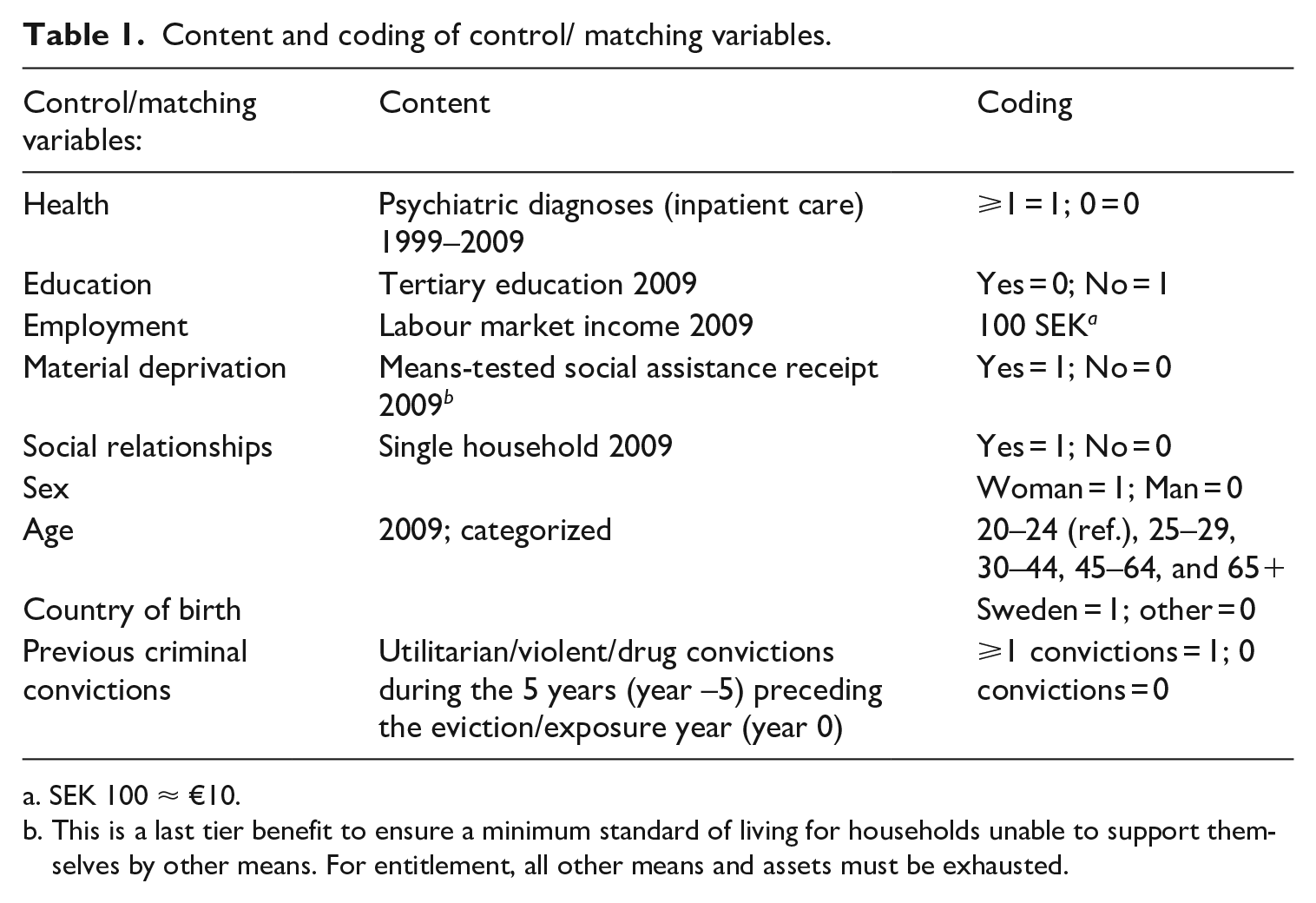
SEK 100 ≈ €10.
This is a last tier benefit to ensure a minimum standard of living for households unable to support themselves by other means. For entitlement, all other means and assets must be exhausted.
Analytical strategy
The first empirical section presents a number of time series of criminal convictions from five years prior to eviction (2004) until three years after eviction (2012) for those evicted in 2009 and for the reference population.
In the second empirical section we employ a counterfactual approach, where the key question is what would have happened to a group exposed to some event or treatment – in our case, housing eviction – had they not been exposed. As this counterfactual is unobservable we need a methodological tool that can estimate this hypothetical outcome. The ideal approach in this situation is to randomly assign subjects to an experiment group and a control group. This is rarely an option with observational data, for both practical and ethical reasons. Instead we employ a framework in which we borrow the language of experimental designs and which allows us to correctly compare the outcomes in a treatment group with those of a control group, conditional on a number of assumptions that need to be appropriately scrutinized (see below). The family of counterfactual tools for observational data include a range of approaches; in this study we have chosen to use propensity score matching (PSM; Rosenbaum and Rubin, 1983) to try to isolate the effect of eviction on the three types of criminal offending. The first step in PSM is to run a logit model to estimate the probability of treatment exposure (housing eviction) conditional on a number of background factors, which we would expect to predict both the treatment and the outcome. As discussed above, we would expect both criminality and precarious housing to be part and parcel of processes of marginalization and cumulative disadvantage. Since we are interested in isolating the effect of eviction on crime, we need also to control for the effects of being involved in such a marginalization process, beyond those we are able to measure via the inclusion of predictors of eviction and crime in the selection model. Thus, to further improve our ability to isolate the effect of eviction, our PSM analyses have been restricted to those with no criminal convictions during the period 2004–9. This reduces the number of treatment cases (that is, evictions carried out in 2009) in the PSM analyses to 1606.
In the second step of our analysis, the individual predicted probabilities for treatment, as generated by the logit model, are used as propensity scores. These are then used to match the treated individuals to controls with a similar propensity for treatment, but who were not treated. The observed difference in outcome between the treated individuals and the controls after matching can be interpreted as the treatment effect of the treated (ATT). This interpretation holds if both the assumption of covariate balance and the conditional independence assumption (CIA) hold. The covariate balance assumption can be checked by inspecting balance tables that display the standardized difference between the outcome means for the treated individuals and the controls after matching. A standardized bias of less than 10 percent is considered to be being balanced (Austin, 2011). However, for continuous variables and categorical variables constructed on the basis of an underlying continuous variable, comparing means may not suffice as a balance test (Austin, 2009). For balance to have been achieved in these cases, we need balance not only in the means but for the whole distribution. This can be checked by inspecting quantile–quantile plots (Austin, 2009). The CIA implies that there is no selection on unobservables. How to check whether this assumption holds is less obvious, but techniques to assess its validity have been suggested (for example, Rosenbaum, 2002; Ichino et al., 2008). In this study we adopt the technique suggested by Ichino et al. (2008) and which has been implemented in Stata with the user-written module ‘sensatt’ (Nannicini, 2007). With this application we simulate a ‘killer confounder’ that drives the ATT to zero or even to the opposite sign. From this we can conclude how much additional selection, on top of that controlled away by the observed covariates, would be needed to reject the results indicated by the ATT. On this basis we can then assess the likelihood of the existence of such a variable or set of variables, given the covariates already included in the initial logit model. The results from the sensitivity analysis can be found in the online Appendix.
In the analysis we employ 1:5 nearest neighbour matching (with replacement), which means that each individual in the treatment group is matched to the five nearest neighbours in the control group. 6
Results
Descriptive statistics for the population of evictees in 2009 in the analytical sample (those with no criminal convictions prior to 2010) and the reference population are shown in the balance table (Table A1 in the Appendix).
As expected, there are substantial differences between the population of evictees and the reference population with regard to all listed background factors: there are more men than women, and a larger proportion of the evictees lives in single households. The evictees are also younger than the reference population, have a lower level of education and are more likely to have been born outside of Sweden. Furthermore, the evictees have considerably lower income from work, a much larger proportion have received social assistance benefits, and a larger proportion have received a psychiatric diagnosis. In the multivariate analyses to follow, we match individuals from the two groups with similar background characteristics in an attempt to isolate the effect of eviction on criminal convictions. First, however, we investigate whether eviction covaries with utilitarian, violent and drug convictions, respectively, over time.
Figure 1 a–c shows the proportion of individuals with at least one criminal conviction of each of the three types each year (that is, the prevalence rates), during the five years prior to and the three years after eviction/exposure, for the population of evictees in 2009 and the reference population, respectively.
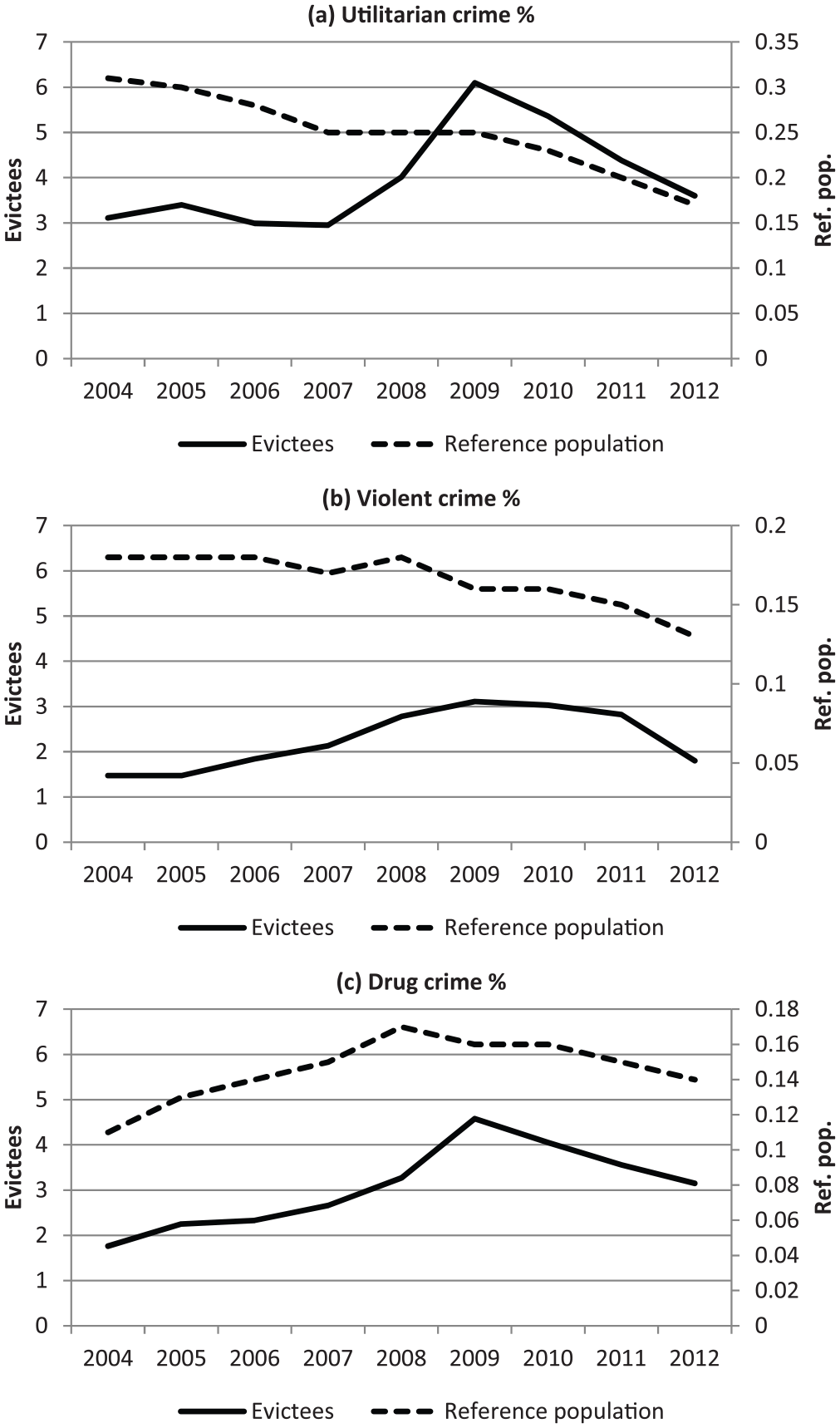
Prevalence rate (percent) for utilitarian (a), violent (b) and drug (c) crime among the evictees (primary y-axis) and the reference population (secondary y-axis), 2004–12.
Firstly, we note similar trends in the proportion convicted for all types of crime among the evictees, in the sense that the conviction risk increases up to the year of eviction, when it peaks. This could imply a process of cumulative disadvantage, whereby both the conviction risk and the eviction risk increase up to the time of eviction. The trends in the reference population are concealed by the scale of the x-axis. A closer inspection of these trends (not shown) reveals that for both utilitarian and violent crimes we observe a steady decline over the observation window, which is well in line with what we would expect in a population as it grows older. The fact that we do not find this pattern in the evictee population indicates that the convictions are likely to be linked to the eviction in one way or another. For drug crimes we instead observe a pattern that resembles that of the evictee population, with an initially increasing conviction rate, which turns into a decrease around the year 2009. We know from previous research that the age–crime curve for drug crime is much flatter and peaks later than for other types of ‘street crime’ (Bäckman et al., 2017). The pattern revealed for drug crime may well be an effect of this, with regard to both the evictee population and the reference population, and it is thus not so obvious that drug crime convictions are linked to the eviction event as it is in the case of utilitarian and violent crime.
Secondly, the graphs point to the substantial difference in crime rates between the population of evictees and the reference population both before and after eviction. As mentioned above, this is only to be expected since the population of evictees is drawn from groups with resource deficits in economic as well as social and health-related terms – groups that run a higher risk of committing criminal offences. Next, we perform PSM with a selection of only those with no prior convictions in an attempt to isolate the effect of eviction on criminal convictions.
Isolating the effect of eviction – PSM analysis
How much of the difference between the two groups can be accounted for by their different background characteristics and how much, if any, seems to be a consequence of eviction? As discussed above, we use PSM to answer this question. Based on probabilities from a logistic regression model, we matched the treated (evicted) individuals to a control group of non-treated (not evicted) individuals, for whom the treatment condition was predicted but who were not treated (evicted). The covariates included in the regression model are gender, age, country of birth, no post-upper secondary education, single household, experience of psychiatric diagnosis in the past decade, social assistance receipt in 2009, and income from work in 2009. Since the logistic regression model is merely a tool to produce propensity scores, the results from this analysis are not reported, but are available upon request. The outcomes in the PSM analyses are the differences (ATT) between the evicted and the matched control group in the proportions with at least one criminal conviction of each type in 2010–12, that is, the three years following the exposure year 2009. The results from the PSM analyses are reported in Figure 2 a–c below.
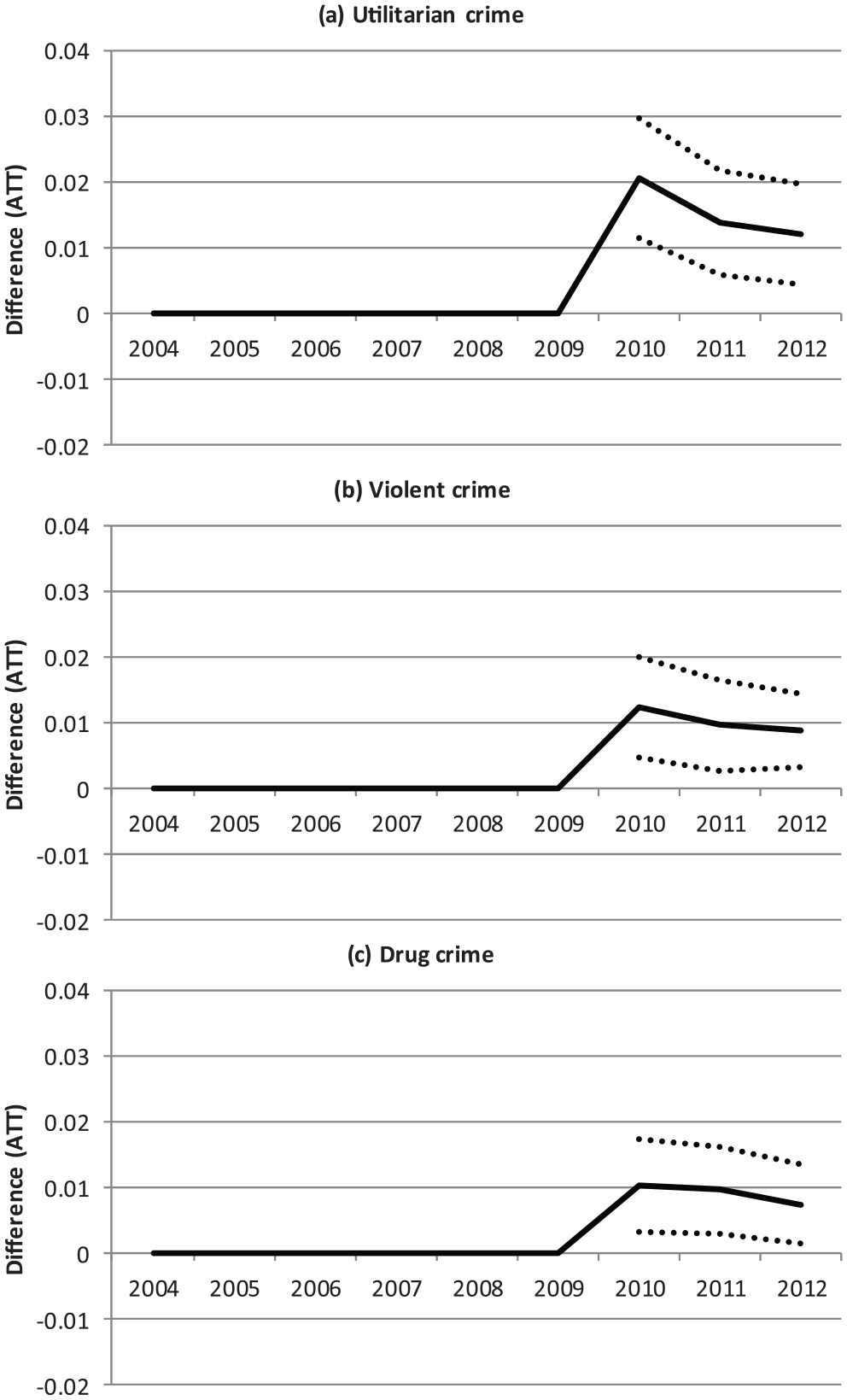
Difference (from year 1: ATT) between evicted and control group in conviction prevalence rates for utilitarian (a), violent (b) and drug (c) crime (solid lines), with 95% confidence intervals (dotted lines).
The graphs in Figure 2 a–c reveal elevated differences (ATT) during the years following eviction (for the years 2004–9, the difference is set to zero by the selection of only those with no previous convictions) for all three crime types. The ATTs are small in magnitude, but significant at all observation points. For utilitarian crime, we expected an immediate and sustained effect, whereas for violent crime we hypothesized an immediate effect, which would quickly decline. Obviously, this is not what we see in Figure 2. All three crime types follow approximately the same pattern: an initial increase in year 2010 that then, to a varying extent, declines slightly, but never reaches zero. The fact that the effect of drug crime resembles that of violent crime conforms to our expectations. On the other hand, this expectation was very much conditional on the hypothesis of a temporary effect on violent crime. It should also be emphasized that the differences in the prevalence of violent crime and drug crime between the evictees and the matched control group are substantially smaller overall than for utilitarian crime, particularly in year 2010. The implications of these observations are discussed further below.
The aim of matching is to make the treated and the controls equal in all relevant respects and to reveal the counterfactual pattern for the treated group (the evictees) had they not been ‘treated’. This means that the observed pattern for the matched control group of non-evictees should be interpreted as mirroring the evictees’ conviction prevalence rate had the event of eviction never happened. Technically, then, the difference between the groups (the ATT) represents the causal effect of eviction on the conviction rates for the three crime types.
However, this interpretation holds only if both the assumption of covariate balance and the CIA are not violated. The assumption of covariate balance prescribes that the values of the variables included in the regression model are balanced, namely, that they are reasonably equal between the treated individuals and the controls. The literature suggests that a standardized bias of below 10 percent indicates balance (Austin, 2011). Table A1 in the Appendix shows that the balance achieved is very good. In no case is there a percentage bias above 5 after matching. However, the table in the Appendix shows balance only with respect to means and this is not sufficient with respect to continuous variables. In these cases it is important to ensure that not only the means are balanced, but also the whole distribution (Austin, 2009). Although all included covariates, with the exception of labour market income, are operationalized as dummy variables, some of them have been constructed on the basis of underlying continuous measures. Besides labour market income, we have information about the underlying continuous variables indicating age and social assistance receipt. Thus, further balance checks of these factors were performed. Firstly, the variance ratio of the labour market income variable for the treated group and the matched controls is approximately equal to unity (1.05, see Table A1). For social assistance receipt and age, the variances are higher in the treatment group, which indicates a less good match. However, an inspection of so-called quantile–quantile plots (Austin, 2009) suggests that the distributions of these two variables are still well balanced (not shown, available upon request).
The CIA states that there must be no unobservables that can bias the results. Despite the many merits associated with using administrative register data – such as a large N, their longitudinal character and the absence of non-response – the number of available covariates is fairly limited. This increases the vulnerability to omitted variable bias. To check the potential influence of omitted factors, simulations using a technique for evaluating the likelihood of the existence of an omitted variable or a set of omitted variables that might explain away the observed effect of treatment (eviction) on the outcome, as suggested by Ichino et al. (2008), were used. Judging from these simulations, the results in all three analyses are robust. Simply put, the analysis simulates confounders, in the form of dummy variables, with various degrees of selection effects. The simulations suggest that it would take odds ratios of between 6 and 16 in logit regressions for each crime type and of between 16 and 36 for a dummy variable of this kind in a logit on eviction to drive the ATT to zero (see the online Appendix).
Thus, the simulation analyses indicate that the existence of an omitted variable (or set of variables) with the properties needed to drive the observed effects to zero is unlikely. It should be noted, however, that this test accounts only for the potential impact of categorical variables. It does not take into account properties of potential continuous confounders. 7 Another potential source of bias is the fact that some of the criminal acts analysed here result in a prison sentence. Although the vast majority of convictions in Sweden result in a fine, in around 10 percent of cases the offender is sentenced to prison. Although short sentences dominate, longer prison sentences also occur. Since imprisonment, and long-term incarceration in particular, significantly reduces the risk of committing crime, and since we lack information about the dates when prison sentences were served, we reran our analysis on a sample that excluded all individuals with at least one prison sentence of more than three months between 2007 and 2012. The results from this analysis (not shown; available upon request) were very similar to those from the analysis that included all individuals, which led us to retain the original analysis.
Summary and concluding discussion
The purpose of this study was to isolate the effect of eviction on three types of criminal conviction. Does the relationship between eviction and convictions tend to be general across different types of crimes or is it specific only to particular types of crime? The study distinguished between utilitarian crimes, violent crimes and drug offences (which may or may not be utilitarian). We used data from the Swedish Enforcement Agency on all individuals evicted in Sweden in 2009, in combination with register data on criminal convictions and other factors of relevance for eviction, such as education, income from work, social assistance receipt and psychiatric diagnoses. Propensity score matching was applied. In order to boost the comparability of the evictees and the control group we selected for analysis only those with no convictions five years prior to and during the year of eviction.
In summary, the results from the PSM analyses suggested that the event of eviction tends to further increase the risk of criminal conviction with respect to all three of the offence types examined in this study, that is, utilitarian crimes, drug offences and violent crimes. Although the general patterns revealed were fairly similar, we also found some differences in relation to the different types of criminal convictions: the increase in criminal convictions was somewhat smaller for violent crime and drug crime than for utilitarian crime. On the other hand, the ATT of utilitarian crime declined more steeply, and in the third follow-up year, 2012, the ATT was around 0.01 for all three crime types. In the theoretical section above we argued that, although an increase in utilitarian crimes as a response to eviction could be understood within the framework of a resource perspective, a more appropriate framework for understanding violent crime might be found in GST, with its emphasis on, for example, the frustration and anger that can follow a dramatic deterioration in one’s life situation, as in the case of an eviction event. On this basis, we hypothesized that the incentive to commit petty theft and other utilitarian types of crime can be expected to persist as long as the living conditions of those affected by eviction have not improved, whereas violent crime, and perhaps also drug crime, were predicted to increase immediately following eviction and to last for a shorter period of time. Obviously, the results presented in Figure 2 a–c do not corroborate these hypothesized patterns. Instead, the patterns identified are surprisingly similar, although the immediate effect of eviction on utilitarian crime is stronger than on the other two crime types. This observation suggests that, at least as far as these three crime types are concerned, the processes by which housing eviction fosters crime are general rather than specific for different crime types. It might, for example, be that the frustration evoked by an eviction, as suggested by GST, affects not only violent crime and drug crime but also utilitarian crime, and that the effect is sustained rather than transient.
However, there is always reason to consider alternative explanations. The fact that we have used conviction data means that the risk of being detected is an important factor, and, if evictees tend to increase the time they spend in public environments where the risk of detection is greater, then this might constitute part of the explanation of the elevated risk of conviction among evictees. Thus, it could be claimed that evictees experience increased risks of being officially processed as criminals as a result of a shift in the normal routines of life. The conviction rates for violent crime and drug crime are probably particularly sensitive to this potential bias. It is well known that domestic violence constitutes a large proportion of all violent crimes. If this behaviour is forced out into more public settings by an eviction, the number of convictions may increase without this necessarily implying an actual increase in the number of criminal acts. Likewise, as already mentioned, most drug crime convictions in Sweden are for own use, and, if evicted drug users are forced out of their homes and onto the street, this of course increases the likelihood of detection. Although these alternative explanations seem plausible for increased drug and violent crime conviction rates, they are less convincing as an explanation for the elevated levels of utilitarian crime. Utilitarian crime is not a crime type that is usually committed in the home environment (perhaps with the exception of online fraud). Here it is much more likely that the effect noted in our analyses reflects an actual increase in criminality as a result of eviction. To some extent this observation with respect to utilitarian crime also speaks against the shift of routines explanation when we discuss the other two conviction types. If this interpretation were to hold, we would expect to see no or a very small effect on utilitarian crime and a much larger effect on drug and violent crime. This is obviously not the case here.
The good balance achieved in the PSM analysis, and the sensitivity test, both indicate robust results and that it is unlikely that there are unobserved confounders with the capacity to drive the ATT to zero. We would nonetheless like to draw attention to some limitations with the present study. Firstly, we do not have access to data on individual housing histories. The availability of such information would have put us in an even better position to model selection into eviction. Although the sensitivity analyses indicate that a variable of this kind would need to account for an unreasonably high level of selection into both treatment and outcome, having been able to include this variable would have made the results even more reliable. Secondly, in analyses of criminal behaviour, omitted indicators of personality traits linked to antisocial behaviour are of particular importance. Such traits are also likely to predict housing eviction. However, Caliendo et al. (2014) showed that, although the influence of omitted indicators of personality traits in evaluations of labour market policies did have strong effects on both treatment and outcome, they did not impact on the effect of treatment on the outcome when labour market histories were included in the PSM. The extent to which these findings from labour economics are generalizable to the field of criminology may of course be disputed, but they do indicate that the omission of variables that we know to be important need not always mean that results are flawed.
Although some doubts may be raised about the magnitude of the effects found in the analyses above, the overall conclusion from this study must be that evictees, at least to some extent, increase their level of criminal activity in the wake of eviction. In addition, they score high on other indicators of social disadvantage. The accumulation of resource deficiencies is thus notable among the evictees, signifying that they constitute a marginalized group on the brink of social exclusion. Obviously, many evictees are also criminally active before the eviction event, and, as was shown in Figure 1, they seem to increase their level of criminal activity during the years preceding the eviction event. The design of this study was chosen to optimize our ability to isolate the effect of housing eviction on criminal convictions and for this reason we are not able to say anything detailed about the processes of social exclusion that lead to the eviction event. Nevertheless, it should be obvious to the reader that neither evictions nor criminal acts arise in a social vacuum. As was touched upon in the Introduction, structural changes in housing markets and deep financial turmoil in many parts of the Western world have put broader layers of the population at risk of losing their dwelling. These developments are not, however, prevalent in our data on evictions from rental housing in Sweden. On the contrary, we have shown that those under threat of eviction tend to score low on all the types of resources that we have been able to measure. Hence, the events and circumstances we have taken into account in our analyses are likely to be a result of processes of cumulative disadvantage in which one resource deficiency tends to foster further deficiencies in other areas. Although an eviction event appears to have an independent effect on subsequent criminality, we would argue that both housing precariousness and criminality must be seen as crucial elements of marginalization processes in the sense that they add weight to an already heavy burden. This suggests further that were we able to identify a group of evictees with higher levels of resources, we would expect a smaller effect on subsequent criminality, and on other forms of negative consequences too for that matter. One route for future research on this topic might therefore be to adopt a research design tailored for analyses of chains of events, such as sequence analysis. Such a study could potentially also answer the question ‘When it rains, does it always pour?’
Supplemental Material
Sensitivity_Alm_Backman – Supplemental material for ‘When it rains, it pours’: Housing evictions and criminal convictions in Sweden
Supplemental material, Sensitivity_Alm_Backman for ‘When it rains, it pours’: Housing evictions and criminal convictions in Sweden by Susanne Alm and Olof Bäckman in European Journal of Criminology
Footnotes
Acknowledgements
The authors appreciate comments on earlier versions of this manuscript by Anders Nilsson and three anonymous reviewers.
Funding
The author(s) disclosed receipt of the following financial support for the research, authorship, and/or publication of this article: This work was supported by the Swedish Research Council for Health, Working Life and Welfare [grant number 2013-0452].

Supplemental material
Supplemental material for this article is available online.
Notes
References
Supplementary Material
Please find the following supplemental material available below.
For Open Access articles published under a Creative Commons License, all supplemental material carries the same license as the article it is associated with.
For non-Open Access articles published, all supplemental material carries a non-exclusive license, and permission requests for re-use of supplemental material or any part of supplemental material shall be sent directly to the copyright owner as specified in the copyright notice associated with the article.
