



Abstract
This contribution offers a new theory of vigilante violence: vigilante rituals theory. We argue that vigilante violence originates from fear, righteous anger, and retaliatory punitive desire that stems from violations of moral imperatives, which are Durkheimian sacred values. We argue that morally outraged people transform their fear and anger into violent action through mobilization and bodily alignment in vigilante rituals. These rituals can restore the integrity of moral imperatives and generate the unity of the in-group. Further, we propose the following variable socio-legal conditions that affect the likelihood for vigilante rituals to occur: legal legitimacy, an exposure to violence, and authorities’ encouragement of (violent) self-help. We conclude by noting how the theory advances prevailing explanations and how it can be used in future empirical research.
Introduction
Why do civilians collectively take the law into their own hands and use violence to punish offenders? Why are thieves and robbers, when caught red-handed, more likely to face public punishment by civilians in some African and Asian countries? Why do some Hindus kill Muslim beef eaters in certain parts of India? And why do some people lynch (alleged) blasphemers in Pakistan? These questions relate to vigilante violence. So far, this phenomenon has been taken up in the domain of policing studies mainly. In this tradition of research, the reasoning is that, when people perceive the police and legal authorities to be legitimate and effective, they cooperate and obey the directives of the authorities (Jackson et al., 2013, 2014; Sunshine and Tyler, 2003; Tyler and Huo, 2002), but, when they regard them as illegitimate and ineffective, they tend to employ their own style of self-justice, including vigilante violence (Goldstein, 2003; Nivette, 2016; Tankebe, 2009; Tankebe and Asif, 2016). However, even when people perceive the police as legitimate and effective, they may turn to vigilante violence. For instance, people may not want to wait for legal proceedings but rather prefer to punish the offender themselves and exert social control (Black, 1983). Moreover, historical and contemporary incidents indicate that political and legal authorities have encouraged vigilante violence (Brundage, 1997; Colombijn, 2002; Handy, 2004). Hence, the question is what makes people susceptible to the idea of punishing offenders themselves aside from a mere lack of trust in police and legal institutions. This article attempts to develop a cultural explanation of vigilante violence. We suggest that people perceive some values – ‘moral imperatives’ – as essential to their group identity. Behavior that violates such moral imperatives arouses strong emotions, such as fear, righteous anger, and a desire for punitive action. We argue that these emotions are mobilized and transformed into collective violent action through vigilante rituals, in which participants restore the integrity of moral imperatives and reinforce the unity of the group by punishing offenders. These punishments often take the form of public performances, ranging from shaming, slapping, torturing, or lynching the offenders (see Buckser, 1992; Patterson, 1999; Young, 2005). We propose several socio-legal conditions that could affect the likelihood of such vigilante rituals to develop. Under these conditions, we argue, people are motivated and feel justified to engage in violent responses to encroachments on moral imperatives rather than leaving it to the police.
This article contributes to the existing literature in the following ways. First, whereas prevailing research has focused on police and legal legitimacy primarily to explain vigilante violence, we incorporate a more elaborated set of micro-sociological processes and socio-legal conditions to understand this phenomenon. Second, most earlier work discussed the relationship between culture and violence in particular contexts (for example, the southern region of the US – see Nisbett and Cohen, 1996), except for a few studies that accommodated culturally diverse vigilante practices (Pratten and Sen, 2007; Senechal de la Roche, 1996, 2001). However, we argue that the relationship between culture and vigilante violence should be seen as variable. Therefore, a theory is required that explains the conditions under which culture, more specifically the violation of moral imperatives, can bring about violent vigilante action. Third, we intend to follow up on Vaisey’s work (2009) on how culture both motivates and justifies actors’ choices of action as part of meaning making. We invoke the notion of vigilante rituals to conceptualize how people use culture to intensify and channel emotions, to mobilize participants, and to motivate and justify violent punishments.
In what follows we elaborate our working definition of vigilante violence, describe relevant theories on the relationship between culture and violence, and then explain our theoretical model in detail. Finally, we summarize our contribution and discuss how the theory can be used in empirical research.
Vigilante violence and moral imperatives
Prior studies of vigilante violence have provided valuable contributions by describing its forms, intensity, motivating sources, and purposes (Abrahams, 1987, 2003; Adinkrah, 2005; Brown, 1975; Harnischfeger, 2003; Johnston, 1996; Karmen, 2016; Rosenbaum and Sederberg, 1974; Senechal de la Roche, 1996). Abrahams (2003: 26) defines vigilantism as ‘an organized attempt by a group of “ordinary citizens” to enforce norms and maintain law and order on behalf of their communities, often by resort to violence’. Vigilante violence is also referred to as instant justice (Harnischfeger, 2003), spontaneous action (Adinkrah, 2005; Karmen, 2016), popular justice (Senechal de la Roche, 1996: 98), or self-help (Black, 1983; Tankebe, 2009), by voluntary private citizens (Johnston, 1996) enforcing local norms (Kloos, 2014; Baker, 2002), preserving social stability (Sederberg, 1978), and attaining social control (Black, 1983; Senechal de la Roche, 1996), by implying relevant cultural templates (Pratten and Sen, 2007).
To demarcate our domain of interest, we propose the following working definition, which follows these prior descriptions and adds new elements to it. We describe vigilante violence as rituals in which participants are mobilized to transform fear and righteous anger into purposive (premeditated or more or less immediate) reactive or preventive unlawful violent action to punish violations of moral imperatives to restore or uphold the moral community.
The new elements we introduce are as follows. First, we emphasize that vigilante violence is social interaction, which takes the form of rituals: repetitive patterns of action sequences, meanings, and purposes that are recognized by the participants. Vigilante rituals, as we will explain below, can transform fear and righteous anger into collective violent action, they generate feelings of group membership, and they restore the integrity of the moral imperative. We consider these rituals as a necessary but variable micro-sociological process that increases the likelihood for vigilante violence to occur. Note that such rituals could comprise both premeditated responses and immediate, more impulsive reactions. Prior literature on vigilantism has described the phenomenon as a planned and organized act of violence in public mostly (Abrahams, 2003; Johnston, 1996). However, little attention has been paid to how the mobilization of vigilantes works, whether it is premeditated or more immediate. As for rapid mobilization, this happens when a group of people immediately recognize a violation of a moral imperative and act upon it. For instance, yelling catchwords such as ‘thief, ‘thief!’ makes people start running to chase the offender immediately in some societies (for Indonesia, see Colombijn, 2002; for Ghana, see Adinkrah, 2005). In these cases, we argue, people have developed an alertness and an ability to mutually align rapidly, owing not only to a high prevalence of crimes in their neighborhood but also to a shared understanding that robbers and thieves must be punished on the spot.
The second new element in our definition of vigilante violence is moral imperatives. We propose that each group shares some core values that are seen as essential, eternal, and sacred – sacred in the Durkheimian sense of having extraordinary (non-profane) meaning and of being forbidden to be touched, manipulated, or changed (Durkheim, [1912] 1995: 35). These values are not sociological reifications, but they play a crucial role in the social identity of individuals: how people see themselves as members of a group and the value and emotional significance they attach to such belonging (Tajfel, 1981: 255). To belong to a moral community – a group that shares a set of moral imperatives – means to experience transcendence: being part of something larger than individual existence.
Our notion of moral imperatives partly aligns with the Kantian notion of categorical imperatives, which are values that make individuals feel they ought to act (Crisp, 2013). Applying this notion to vigilante responses, we propose that individuals feel obliged to react when they sense that such imperatives are violated – desecrated indeed. The ability to make moral judgements has a biological grounding and is not restricted to humans (De Waal, 2009). However, the specific form that moral imperatives take depends on culture, how people learn from each other over time. Therefore, moral imperatives are not universals; instead they vary between social groups and over time (Tavory, 2011). Furthermore, the intensity and the type of responses to violations of moral imperatives vary from group to group, or from culture to culture. Let us provide two examples of violations of moral imperatives in relation to vigilante violence to make this clear.
A first example is blasphemy. In many societies, violations of religious beliefs are felt as serious attacks against a community, which require retaliatory measures. Consider the lynching of Mishal Khan, a university student who was falsely accused of posting blasphemous material online at Abdul Wali Khan University, Mardan, Pakistan in April 2017. After the spread of rumors regarding blasphemy, students assembled in large crowds to hear public speeches about the misdeeds of Khan and the religious obligation to punish him. By yelling rhythmically together, the students created a shared mood of hate and the desire for revenge. After Khan was dragged out of his dormitory, they brutally beat him up and later shot him.
A second moral imperative that is often linked to vigilante violence concerns the sexual abuse of children. Child molestation is considered one of the most serious crimes in societies around the world. For instance, the abuse of Sarah Payne was followed by moral outrage in the UK, which paved the way for a ‘Sarah’s Law’. This law provided public availability of the identity of pedophiles through the Sex Offenders Register (for details, see Critcher, 2002). Such ‘community protection’ movements and subsequent enactment of laws have already taken place in the US and Canada (Petrunik, 2003; Simon, 2000). In both countries, it has been reported that anti-pedophile vigilante groups punish and sometimes kill suspected pedophiles (Broomfield, 2016; Krishnan, 2017).
The third new element in our working definition comprises the role that emotions play in vigilante violence, notably fear, righteous anger, and a desire for retaliation. Violations of moral imperatives arouse survival responses of fear and anger because they endanger the core of the social identity of individuals. The anger is righteous because, as Durkheim ([1893] 1997) argued, people feel that the offense encroaches on their ‘collective conscience’ or, in our terminology, their moral community. In the eyes of vigilantes, the offenders have not just hurt or caused damage to an individual fellow group member or symbol, but their acts are seen as an attack against the group as a whole. Therefore, their rage transcends their individual existence, which allows or even obliges them to retaliate on behalf of a community that shares the moral imperative. ‘Righteous slaughter’, as Katz (1988: chapter 2) notes, is, in the eyes of those who commit it, a form of ‘community service’ or ‘moral garbage collection’. The same holds for the vigilante punishment of offenders who violate moral imperatives. Vigilantes employ moral reasoning to justify their violent actions, which were initially aroused by emotions (Haidt, 2012).
The three new elements in our working definition of vigilante violence provide a conceptualization of how culture shapes violent behavior: encroachments on moral imperatives arouse fear and righteous anger, which is intensified, channeled, and transformed into violent action through vigilante rituals. Before we elaborate the theory in more detail, let us consider how prior work has conceptualized the link between culture and vigilante violence.
Prior work on culture and vigilante violence
Earlier studies that relate culture to violence have conceptualized the former concept mainly as ‘culture-as-value’ (Swidler, 1986), or, according to Vaisey (2008), a ‘Socratic model of action’, whereby people use culture to categorize things as good or bad, right or wrong, desirable or undesirable, and so on, which then somehow translates into action. This view has been influential in sociology, ranging from Weber’s notion of value rational action to Parson’s voluntary theory of action, and it appears in many contemporary theories of violence too. In the ‘southern culture of violence’ tradition of research, for example, the culture-as-value model appears as an explanation of the relatively high rates of violence in southern states of the US (Ellison, 1991; Ellison, Burr, and McCall, 2003; Nisbett and Cohen, 1996). Two main narratives ground the relation between cultural values and violent behavior in this tradition. First, the idea that values about autonomy and the appropriateness of violent responses to protect autonomy were exported to the US South by Scottish-Irish migrants, comprising former herders who relied on violent self-help strategies against threats from bands of thieves and robbers (Fischer, 1989; Nisbett and Cohen, 1996). The second narrative is known as the ‘conservative Protestant thesis’ (Lee, 2006; Lee et al., 2007). The argument is that conservative Protestants are more likely to accept some forms of violence, such as self-defense against perceived attacks against personal honor or one’s family or property. As Lee (2006: 311) explains, this religion’s view of justified violent punishment is grounded on literalist interpretations of the Bible that cite the use of violence to resolve various types of disputes as well as the use of violence as justified retributions from God (Ellison, 1991; Ellison et al., 2003; Sowell, 2005). However, neither cultural explanation shows, in the here and now of a specific situation, how people decide to engage in violence as a line of action. There is still a wide gap between values of independence and notions about the appropriate uses of violence on the one hand and actual violent behavior on the other.
Ann Swidler (1986) developed an alternative conceptualization of the relationship between culture and behavior. She argued that culture provides people with a flexible set of lines of action (repertoires). Applied to violence, Lee and Ousey (2011) conducted a qualitative vignette study in the state of Louisiana, posing potentially threatening situations to the participants to understand how they would negotiate the situation. They found that violence was seen as a situationally viable response in specific situations only, and that these ideas were shared among diverse categories of people (males and females, blacks and whites, the young and the older). Culture provided them with various toolkits for action (including violence) and situational features such as police presence and reliability and the severity of the potential threat to the individuals and their family determined which line of action (violent or not) they deemed appropriate or effective. Although the notion of repertoires of action allows for a dynamic view of culture that offers more room for individuals to act, there remains a gap in the understanding of how repertoires move people into action.
In Fiske and Rai’s Virtuous Violence, culture appears as a set of ideal models of relationships (2015: xxii–xxiii, 1–2, 56). Most violence, they argue, stems from a moral motivation to regulate relationships according to these ideals. The predominant ideal model that plays out in vigilante violence is ‘communal sharing’, in which unity, the integrity of the in-group, is the central moral motivation (Fiske and Rai, 2015: 18–19). As we have argued above, violations of moral imperatives are perceived as attacks against the group’s integrity. In their discussion of the lynchings of blacks in the US South, Fiske and Rai (2015: 206–7) note that this form of vigilante violence aimed to realize not only the moral motive of unity but also that of hierarchy (the ideal model of ‘authority ranking’); the public torturing, killing, and mutilating of lower-class black males who were accused of sexually assaulting white females – accusations of rape were among the most frequent motivations and led to the most brutal forms of violence in the US South (Clarke, 1998; Hill, 2010) – not only aimed to restore the purity of white females and the concomitant integrity of the white in-group, but also served to maintain the hierarchy between whites and blacks. We will take up the role of maintaining hierarchy in vigilante violence later, when we discuss the collectivization of vigilante violence. Considering the role that culture plays, we conclude that, when the ideal model of ‘communal sharing’ is predominant, vigilante violence as a repertoire for action becomes more likely because violations of moral imperatives are experienced as attacks against the unity of a group (Fiske and Rai, 2015: 18). The threat arouses fear and anger. However, emotions are, in the words of Frijda (1987), ‘action tendencies’. So we need to conceptualize the process that transforms fear and righteous anger into violent vigilante action. Second, we need to provide an understanding of how violent vigilante action restores feelings of group unity (see Fiske and Rai, 2015). Let us follow Durkheim’s lead once again and consider the ritualistic qualities of vigilante violence in more detail.
Vigilante rituals
Tilly’s The Politics of Collective Violence (2003) is helpful to get closer to the situational processes at play in vigilante violent action. Tilly (2003: 15) distinguishes two dimensions of collective violence: the degree of coordination among violent actors and the salience of immediate damage. Vigilante violence is typically the result of a high degree of coordination and it produces often severe damage, which is however confined in time and space. Vigilante violent action can be perceived as ‘violent rituals’ in which ‘at least one well-defined and coordinated group follows a known interaction script entailing the infliction of damage on itself or on others as it competes for priority within a recognized arena’ (Tilly, 2003: 15). Thus, for vigilante violence to be recognized as a form of moral punishment by co-perpetrators, victims, and the public, vigilantes must follow a pre-given – ritualistic – set of action patterns as they prepare, perform, and complete the punishment. Tilly identifies three situational processes at work in violent rituals. First, he notes that they provide an ‘unusually sharp definition to the identities in play’, to the point of muting relationships that cross the identity boundaries that are activated in the rituals (Tilly, 2003: 84). Second, Tilly argues that violent rituals ‘incorporate all the relevant actors and social sites into a single connected set of performances’ (2003: 84). Third, he notes the process of ‘containment’: ‘the placement of a relatively impermeable perimeter around an actor, set of actors, place or other social site’ (Tilly, 2003: 85). We conclude that violent rituals generate Fiske and Rai’s in-group unity in three ways: they collapse social relationships into binary us–them distinctions, they align the actions of participants following a known interaction script, and they bring them together into a social event that is delimited in time and space.
But to understand how violent rituals attain such unitary powers, we need to get closer to the micro-sociological dynamics. In his analysis of religious rituals, Durkheim ([1912] 1995) noted that gatherings of people can bring about feelings of group unity. The bodily alignment processes that bring about such feelings are specified and systematized in Randall Collins’ (2004) interaction ritual theory. Collins (2004: 48) outlines four ingredients – we see them as stages in bodily alignment – that make up interaction rituals. The first is an assembly of bodily co-present people. In our case, this would mean that people should be around to notice or be alerted to the (alleged) violation of a moral imperative. The second ingredient is (the creation of) boundaries vis-à-vis outsiders; participants must develop a sense of who is part of the group whose moral imperative is encroached on. People can do this by clustering together in public space. When they create spatial-bodily arrangements, for example by forming a line or circular shape oriented towards the offenders of a moral imperative and those who accuse them, participants demarcate the space where the action will be performed. Participants in vigilante rituals thus differentiate between an onlooking, supportive audience and a set of individuals who are performing a public trial and punishment. Thus, the lynchings in the US South were often observed by a large crowd of supportive third parties (Clarke, 1998: 270; Fiske and Rai, 2015: 207; Patterson, 1999). At this point, participants have developed a mutual focus of attention, the third ingredient. The final, fourth ingredient of interaction rituals is the development of a shared mood. In our case, this means that feelings of fear and righteous anger are collectively shared and expressed. The bodily alignment processes that make up interaction rituals – most notably the reinforcing feedback between a focus of attention and the development of a shared mood – generate feelings of group membership and a willingness for taking action (Collins, 2004: 48; see, for empirical studies of how bodily alignment creates group feelings, Kühn et al., 2010; Páez et al., 2015). As indicated earlier, we consider vigilante rituals to be a necessary but variable condition for vigilante violence to occur. The intensity of the micro-sociological processes in them varies, and they may fail to produce the degree of bodily alignment required to transform anger and fear into violent action.
Figures 1 and 2 show bodily alignment in vigilante rituals that occurred in Pakistan. Figure 1 displays the mobilization of a group towards punitive action, and in Figure 2 the focus of the ritual was on the punishment of the offenders.
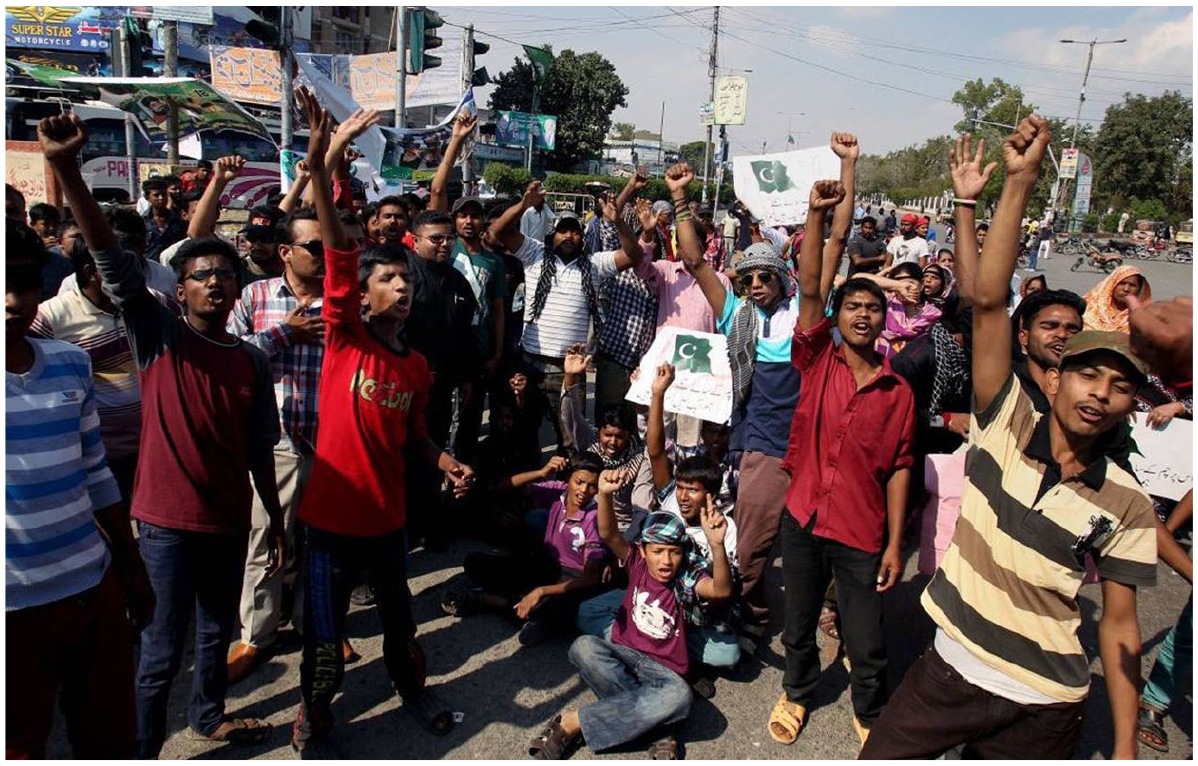
Bodily alignment in a vigilante ritual: Mobilization of a group.
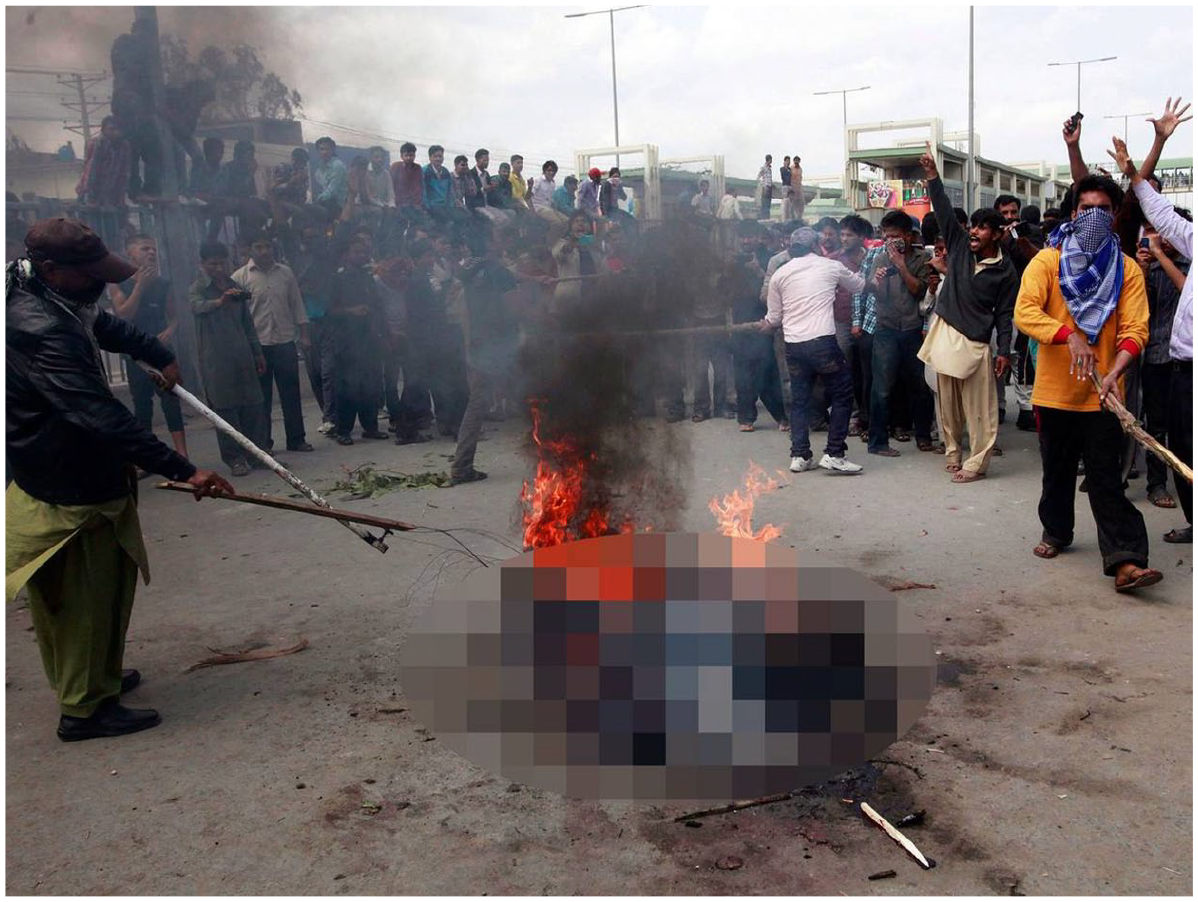
Bodily alignment in a vigilante ritual: Punishment of the offender.
The objects (of whatever kind) that had been the focus of collective attention during the interaction ritual can turn into symbols of group membership after the ritual. In the case of vigilante violence, they can take the form of storytelling after the fact, phone-recorded videos of a lynching or bodily remains that are left for public display. As Gould (1999, 2000) demonstrated for Corsican vendettas, violence evidences group strength and solidarity. The circulation of symbols of vigilante violence reminds people of the unity of the group and their collective power to protect moral imperatives.
Fiske and Rai provide an interesting argument as to why vigilante violence takes the form of rituals in which participants attain bodily alignment. They note that, in the communal sharing ideal model, people make their bodies ‘equivalent’ (Fiske and Rai, 2015: 253). They do so by clothing, insignia, and other manipulations of body surfaces and, most notably, by making rhythmic synchronous movements, which, as they note, ‘have strong bonding effects because participants experience their congruently moving bodies as merging into one’ (Fiske and Rai, 2015: 253; see also Kühn et al., 2010; Páez et al., 2015). Fiske and Rai (2015: 253) also predict that violence to realize moral motives (for example, creating unity or hierarchy) conforms with distinct ways of regulating relationships. Because bodily alignment is the predominant way of realizing the unity of the in-group, it can be expected that vigilante violence aims at the disruption and mutilation of the victim’s body, rather than just hurting or killing the victim (see Brundage, 1993, 1997; Clarke, 1998). The mutilation of body parts can be seen as markings, inscribed on the offenders’ bodies on behalf of the moral community. It also happens that the offenders’ dead bodies are displayed for some time, so that the community can witness that the moral order and the in-group unity have been restored (Raper, 1933). However, in empirical reality vigilante violence also appears in more restrained forms, for instance in punishment rituals where the public are invited to slap or hit an offender. We expect that the severity of vigilante violence is related to the importance of the moral imperative that is (allegedly) attacked.
Incidents of vigilante violence may involve just one ritual, for instance when bystanders halt, align their bodies to create a performance stage in public space, focus their attention, and encourage others to punish a robber caught red-handed. Studies of vigilante punishments that are related to property crimes such as theft, robbery, and burglary note that they are usually spontaneous and quick (Karmen, 2016 Silke, 2001). In other cases, vigilante violence involves subsequent series of rituals, in which crowds are mobilized for upcoming violent action. Such rallies often involve yelling and the shouting of slogans to attain bodily synchronization (see Figure 2 and the lynching of Mishal Khan in Pakistan described above).
Earlier work on vigilante violence pointed to its ritualistic qualities, and some studies explicitly perceive the lynchings of blacks by whites in the US South as rituals, although without noting that they generate group unity and restore the moral order. Young (2005: 639–40, 664) refers to lynchings as ‘pre-scripted performances or ritualistic practices’ because they were orchestrated (advertisements in local newspapers announced the date, time, location, and even the schedule of activities of the lynchings), spectacular social events that followed a more or less fixed program of cruelty, attracting large crowds of whites (see also Clarke, 1998: 270; Fiske and Rai, 2015: 207; Patterson, 1999
Buckser (1992: 18), in his ‘Lynching as ritual in the American South’, argues that lynchings were performed as ‘community recreations’ and ‘community retribution’ by whites. In Buckser’s (1992: 24) view, the ritual character of lynchings appears in the parallel judicial proceedings that were used by the lynchers, because ‘the victim was accused of a crime, hunted down, presented before witness, tried, made to confess, read a verdict, and ceremonially executed’. Finally, in his ‘Rituals of blood: Sacrificial murders in the postbellum South’, Patterson (1999: 126) perceives lynching as religious sacrificial rituals which were ‘full of drama and play’, often incited by the rhetoric of priest or ministers, frequently occurring on Sundays, and usually performed in public spaces. In line with Young, he notes that these rituals produced special objects – symbols of group unity: the stakes and other objects of torture became relics to be treasured and the site of the sacrifice became a shrine. Patterson, emphasizing the link between religion and vigilante rituals, brings us back to Durkheim ([1912] 1995) again, who argued that religious rituals produce the ideas (symbols) that the group forms of itself.
So far, we have arrived at a theoretical understanding of the micro-sociological processes that generate vigilante violence. However, the question remains of why people would engage in such violence collectively, as perpetrators and as encouraging audience. Senechal de la Roche (2001) elaborated the role of status hierarchy and relational distance to explain the conditions under which (vigilante) violence collectivizes. This happens when people take sides, which is, in the words of Black (1998: 127), ‘a joint function of the social closeness and superiority of one side and the social remoteness and inferiority of the other’, or, to put it succinctly, partisanship of third parties goes to the higher-status and more intimate party. In the US South, Afro-Americans of varying status were lynched but those who were of lower status and/or more relationally distant from the local community were more likely to be victims (see Brundage, 1993, 1997). In contrast, lower-status Afro-Americans sometimes escaped lynching when they received protection from high-status whites who were relationally close to the alleged offender (Wright, 1996). Senechal de la Roche (2001: 131) concluded: ‘it was not the case that any black who offended a white was in danger of being lynched. The likelihood of a lynching depended on who offended whom – especially the degree of intimacy between the alleged offender and victim and the social status of each.’ Applied to vigilante violence more generally, this would mean that people are more likely to unite against alleged offenders of moral imperatives when the latter are of lower social status and when they are relationally distant from them.
Finally, although it might be possible in sporadic cases that an outraged and motivated individual commits vigilante violence alone, we think that such individual actions are socially informed and require the moral support of an outraged group, which can take an imagined, virtual form too, in the mind of the individual vigilante.
Socio-legal conditions that shape the development of vigilante violence
The first condition that shapes the likelihood for vigilante rituals to develop concerns legal legitimacy. A tradition of research demonstrates that when people perceive authorities as illegitimate, they can pose a challenge to the legal system by resorting to an alternate system of redress and grievances, that is, self-help, which can take the form of vigilante violence (Abrahams, 1998; Adinkrah, 2005; Baker; 2002; Goldstein, 2003; Silke, 2001; Tankebe, 2009). Thus, the relationship between vigilante violence and legal legitimacy has been studied in various countries including Nigeria (Baker, 2002; Harnischfeger, 2003; Smith, 2004), Ghana (Adinkrah, 2005; Tankebe, 2009), Pakistan (Tankebe and Asif, 2016), Bolivia (Goldstein, 2003), the Netherlands (Haas et al., 2014), Brazil (Benevidez and Ferreira, 1991), South Africa (Buur and Jensen, 2004), Tanzania (Abrahams, 1987), Guatemala (Handy, 2004), the United Kingdom (Silke, 2001), Israel (Weisburd, 1988), Indonesia (Colombijn, 2002, 2018; Kloos, 2014), Latin America (Nivette, 2016), and the United States (Garland, 2005; Hill, 2010; Kil et al., 2009; Tucker, 1985). Tyler (1990) was the first who initiated a debate on the relationship between legal legitimacy (police and courts) and citizens’ cooperation with the legal authorities. He operationalized legitimacy as (a) people’s general sense of obligation to obey the law, and (b) their support for legal authorities (that is, police and courts). Alternatively, Bottoms and Tankebe (2012) viewed legal legitimacy as a multidimensional concept including lawfulness, procedural justice, and effectiveness. Later studies attempted to find correlations between components of legal legitimacy and public support for vigilante violence in one or the other way. Tankebe (2009) used household survey data collected from Accra, Ghana, and revealed that the perception of police trustworthiness was the main indicator of public support for vigilantism. In another study, Tankebe and Asif (2016) found that police illegality (corruption) and procedural justice partially predicted support for vigilantism in a household survey in Lahore, Pakistan. Haas et al. (2014) demonstrated that diffused confidence in the police was related to public support for vigilantism in the Netherlands. Jackson et al. (2013), in their analysis of Londoners’ survey data, showed that people’s lack of a sense of obligation to obey the police explained their willingness to use violence to settle disputes. Nivette’s (2016) analysis of survey data from 18 Latin American countries showed that perceived police criminality and institutional ineffectiveness were related to support for vigilante violence. Further, Anderson (1999) found that ineffective state intervention was related to approval of vigilantism in an ethnographic study of deprived inner-city neighborhoods in the US. Goldstein (2003) in his ethnographic study in Bolivia, explored how police bribery was a likely cause of public mistrust in the police, which consequently made individuals more prone to have recourse to public lynching. Finally, in Nigeria, police lack of responsiveness to violent robberies encouraged the vigilante Bakassi Boys to engage in self-help crime control (Harnischfeger, 2003; Smith, 2004). Given the ample evidence produced by earlier work we conclude that when people perceive the legal institutions corrupt, ineffective and procedurally unjust, they are more likely to consider vigilante violence as a possible line of action. While prevailing research tends to treat legal legitimacy as more or less fixed, it should be noted that perceptions of legitimacy can change during the course of an event. Thus Stott et al. (2016) show that, after the police shooting of Mark Duggan in Tottenham, the situational illegitimacy of the police increased the protesters’ likelihood to engage in violent riots. Finally, most of the studies we reviewed above analyze attitudes towards vigilante violence, which is different than actual violent behavior.
The second condition that affects the likelihood for righteous anger to turn into vigilante violence is related to people’s experience with violence. Here, we assume that, if people live in a social environment in which they are exposed to the use of violence as an appropriate way of managing conflicts or disciplining subordinates (such as children), they are probably also more likely to resort to violence to punish offenders against moral imperatives. This is because violent behavior is in part socially learned behavior (Steenkamp, 2005). Prior work suggests that vigilante violence appears more often in societies with higher rates of violence. This seems true for regions such as the southern states of the US (Brundage, 1993; Whitfield, 1991; Wright, 1996), in African countries such as South Africa, Nigeria and, Tanzania (Abrahams, 1987; Baker, 2002; Buur and Jensen, 2004; Harnischfeger, 2003; Smith, 2004), in Latin American countries, for example Bolivia and Brazil (Benevides and Ferreira, 1991; Goldstein, 2003; Nivette, 2016), in Southeast Asian countries, for example Indonesia (Colombijn, 2002, 2018; Kloos, 2014; Welsh, 2008), and in South Asian countries, for example India and Pakistan (Berenschot, 2011; Tankebe and Asif, 2016).
The third socio-legal condition is the degree to which authorities encourage the use of violence against perceived offenders, which may make civilians feel fearless and unaccountable, rendering vigilante violence as an appropriate line of action more likely. In this way, authorities not only provide cover to vigilantes but also justify and legitimize their acts of violence. For instance, there is historical evidence that ministers and police actively facilitated lynchings in the south of the US (for example, for detail see Whitfield, 1991). In Georgia, from 1900 to 1914, the authorities handed over 63 percent of the offenders to the victims for revenge (Brundage, 1993). Authorities even attended the lynching as onlookers (Raper, 1933; Wright, 1996). However, the support and encouragement of authorities is not just a matter of the past. There are contemporary instances of authorities neglecting to prosecute vigilantes, and even forms of active encouragement to engage in vigilante violence (see, for recent examples in India, Berenschot, 2011; Biswas, 2017; Taseer, 2017; in Indonesia, Colombijn, 2002). In some countries, such as Indonesia, legal codes included clauses that allowed the killing of thieves under certain conditions (De Gelder, 1886; Louwes, 1921, cited in Colombijn, 2002: 317). An Indonesian criminologist noted that ‘[The Soeharto government] taught us that the only way to solve problems is with violence. It is difficult to undo this’ (Aditjondro, 2001, cited in Colombijn, 2018: 60). Welsh (2008) concluded that mob vigilante violence takes place either when authorities legitimize the violence, or when they are unable to take any action against vigilantes, or when they themselves mobilize vigilante groups.
These three conditions – legal legitimacy, people’s experience with violence, and authorities’ encouragement – are shaped by long-term and wider-scale social processes. To understand this, we introduce Elias’s ([1939] 2000) theory of the civilizing process. Elias uses the notion of the civilizing process as an analytical term to capture how the interrelated developments of state formation and widening chains of interdependencies force individuals to control their impulses in more encompassing and differentiated ways. State formation primarily entails the monopolization of violence at the political and administrative centers of expanding territories. As a result of this development, political struggles between local leaders moved to the center and became increasingly regulated; rather than the use of physical force, diplomacy, courtesy, and political savvy at the court became the dominant means to settle political conflicts. Over a long period of time, the social constraints that inhibit the spontaneous acting upon violent impulses tended to become internalized. Self-restraint, mainly in the form of (the fear) of shame that became connected to uncontrolled, impulsive behavior, gained more importance and spread across society as a marker of distinction. This development was reinforced by extending networks of interdependencies in vast pacified territories: people were now increasingly forced to control their impulses because their actions had greater impact on an increasing number of other people, which they needed to take into account.
Following Elias, unfolding civilizing processes reduce the likelihood of vigilante violence. First of all, the theory predicts that people would be more inclined to control their anger and repress violent impulses when they are confronted with violations of moral imperatives. Relatedly, their repugnance considering violence facilitates their acceptance of the execution of physical force by state authorities. Second, the concentration of the legitimate means to use violence in the hands of the central state not only increases the effectiveness of police and legal authorities, which in turn yields greater legal legitimacy, but also renders civil society more peaceful, so that violence becomes less common as a means to settle conflicts between civilians. Also, and perhaps most importantly, the monopolization of violence by the central state reduces authorities’ support for vigilante self-help because this undermines their power to handle internal social conflicts. In fact, authorities’ support of vigilante self-help probably indicates fragmentation rather than consolidation at the political center.
We can now integrate the various socio-legal conditions with our micro-sociological understanding of how violations of moral imperatives are conducive to violent action through vigilante rituals. Our conceptual argument is summarized in Figure 3.
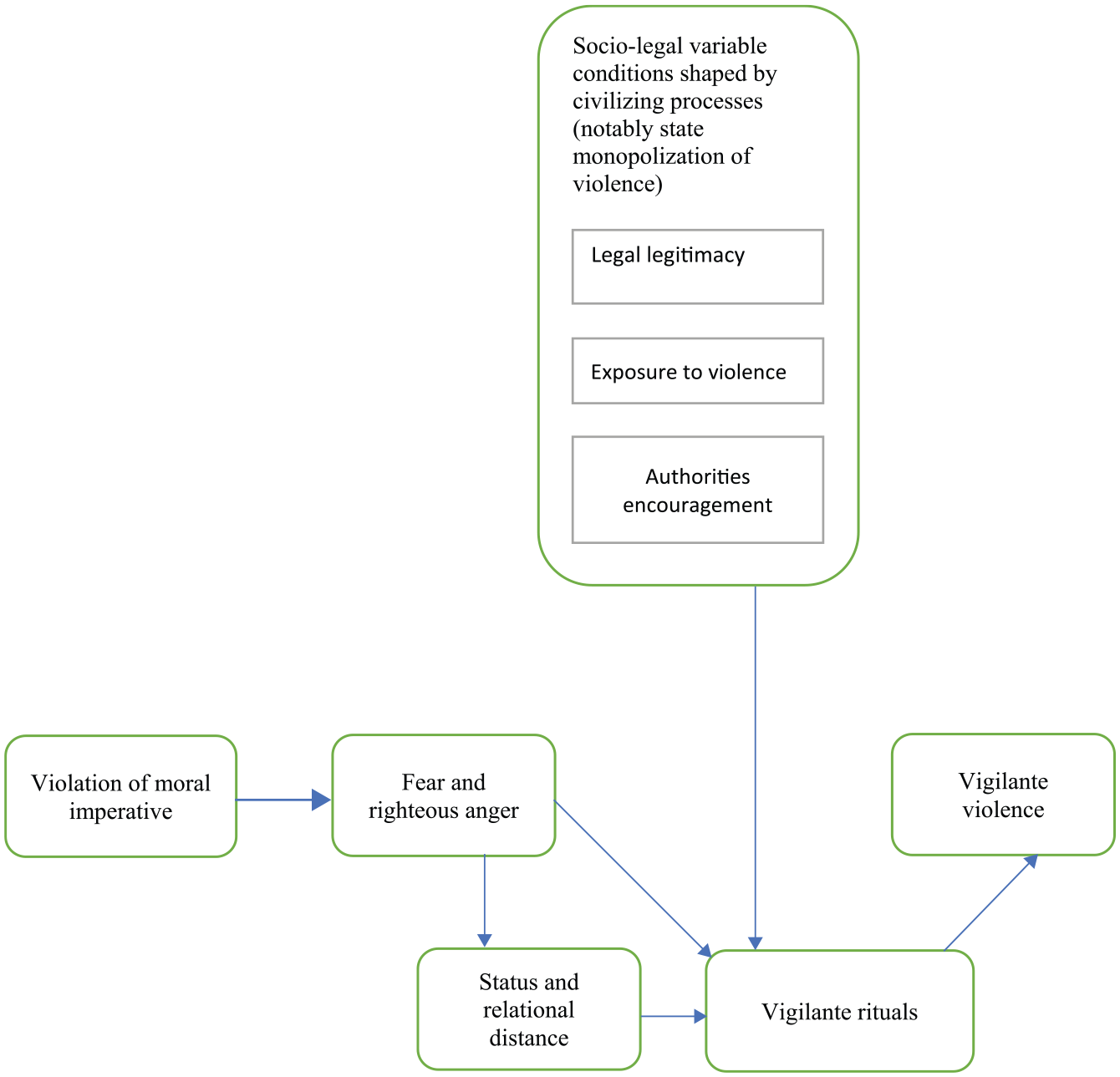
Conceptual model of the theory.
Ultimately, our theoretical contribution aims to guide empirical research. Let us therefore derive a series of research questions from the theory. A first set of questions can be asked about the micro-sociology of vigilante rituals. For instance: What kind of violations of moral imperatives arouse righteous anger and fear in the members of a moral community? How do moral imperatives develop through the generations? How do vigilante rituals develop over time? What forms do vigilante rituals take and are these forms related to the type of moral imperative at stake? What are the conditions under which vigilante rituals do not produce the degree of bodily alignment required for vigilante violence to occur? And to what extent are differences in the form of vigilante rituals related to the type and severity of the violent action? On the other hand, it can be asked how and under what conditions participants intervene in the course of the ritual. Furthermore, what are the relationships between the time sequence of a series of vigilante rituals, the number of participants involved, the coordination of bodily alignment, and the type and severity of violent punishment? Another set of questions is related to how status and relational distances are activated in vigilante rituals: What is the relationship between the form and severity of vigilante rituals on the one hand and the relational and status distance between the offenders of moral imperatives and the perpetrators of vigilante violence on the other? A third set of questions zooms out and considers socio-legal conditions: In what ways do participants use forms of violence that are culturally specific (for example, the practice of vigilante kneecapping in Northern Ireland or that of ‘necklacing’ in parts of Africa, in which a burning car tire is hung around the neck of alleged robbers)? To what extent are ‘violence experts’ involved in vigilante rituals? And under which conditions, how and to what extent are vigilante rituals arranged by political or other ideological entrepreneurs to show their power to mobilize a crowd?
In addition to these research questions, the following series of hypotheses can be formulated:
Similar hypotheses can be formulated about the attitudes of people towards vigilante violence:
Conclusion and discussion
Vigilante rituals theory, as we call it, outlines how culture can bring about violent vigilante action under varying social-legal conditions. In our view, it offers a more advanced conceptualization of the relationship between culture and violence and provides a more comprehensive understanding than the one-dimensional explanations that have been predominant in previous research. Also, the theory appreciates that vigilante violence is mostly a collective effort, whereas the prevailing approach is to focus on individuals’ attitudes towards the phenomenon. Earlier studies that did take the collective nature of vigilante violence into account focused on the notion of partisanship primarily, if not exclusively. Furthermore, vigilante rituals theory directs researchers’ attention to the micro-sociological processes at play, in which emotions, notably fear and anger, are transformed into violent vigilante action that restores the integrity of the moral imperative and the unity of the group. So far, the question as to how culture or attitudes translate into vigilante violent action has not been taken up in earlier work.
A final note about how vigilante rituals theory speaks to policies that aim to reduce vigilante violence. It is hard to influence socio-legal conditions and even harder to change processes of state formation, because such large-scale developments mostly unfold in unintended and unplanned ways. It is also hard to change the ways in which people perceive moral imperatives without changing the broader social conditions. Interventions are probably most effective when they focus on the specific situations in which culture becomes a line of action. In our theory, this happens when people are mobilized to channel their anger and fear into focused retaliatory desire. It is our hope that vigilante rituals theory encourages scholars to conduct empirical research into the situational dynamics of these dangerous moments in connection to investigating the socio-legal conditions that shape these moments. Any research attempt that contributes to reduce the harm that is inflicted by vigilante violence across the world is worth it.
Footnotes
Funding
The author(s) disclosed receipt of the following financial support for the research, authorship, and/or publication of this article: The work presented in this paper is funded by a scientific grant awarded to Muhammad Asif by FDP of Bahauddin Zakariya University Multan, Pakistan and by European Research Council, Consolidator Grant number 683133, awarded to Don Weenink