



Abstract
Alternatives to criminalization for the simple possession of illicit drugs are increasingly of interest to policy makers. But there is no existing theoretically based, empirically tested framework that can inform development and evaluation. This article presents a realist programme theory of such alternatives. It bases this on a realist review, which followed the Realist and Meta-narrative Evidence Syntheses: Evolving Standards (RAMESES). It describes the systematic process of searching the literature in English on nine relevant countries (Australia, Czech Republic, Denmark, Germany, Jamaica, Netherland, Portugal, the UK, the USA) for information on alternative measures in three categories: depenalization; diversion; and decriminalization. It shows how these measures – in theory and in practice – combine with pre-existing social conditions and institutional contexts to trigger mechanisms across three causal pathways (normative; criminal justice; and health and social services). It shows how some posited causal processes are more empirically supported than others. Alternative measures can reduce harms imposed by criminal justice processes without increasing drug use or related health and crime harms, but this depends on specific combinations of contexts, mechanisms and outcomes.
Introduction
The international consensus on how to deal with illicit drug use is fractured (Bewley-Taylor, 2012; McLean, 2018). The idea that simple drug possession (with no intent or attempt to supply) should be dealt with through criminalization can no longer be taken for granted. Publics and policy makers across many countries are looking for alternative approaches. This search is likely to be further spurred by a recent call by the coordinating body of the United Nations (UN) for all member states to ‘promote alternatives to conviction and punishment in appropriate cases, including the decriminalization of drug possession for personal use’ (UN CEBC, 2019: 14). However, in spite of the growing body of literature on alternatives to criminalization, there are no theoretically informed, empirically tested frameworks for publics and policy makers to use in developing such alternatives.
The causes of this gap are multiple. First, extant research into alternatives to criminalization has tended to focus on specific models of reform, such as the Portuguese decriminalization of the use and possession of all illicit drugs (Hughes and Stevens, 2010) or US decriminalization of cannabis possession (Pacula et al., 2005). Although producing insight into the pros and cons of these specific models (such as the public health gains of the Portuguese approach), this leaves unanswered whether and how the specificities of mechanisms or context shape the outcomes of reform. Second, there is now a large body of work on the contexts of reforms. Here we note the excellent work of Colson and Bergeron (2017) and colleagues, outlining the multiple factors that can shape when and how drug law reform can occur (including the role of drug trends, legal systems, political machinations and advocacy coalitions). But this work is seldom connected to analysis of the mechanisms or outcomes of reforms. A third and final challenge is that outcome-based research has tended to focus on one main indicator: the prevalence of drug use. There are a number of reports providing comparisons in drug use prevalence between jurisdictions that have or have not ‘decriminalized’ drugs or ‘liberalized’ drug policy (Cecho et al., 2017; Hughes et al., 2018; Kotlaja and Carson, 2018; Maloff, 1981; Rogeberg and Stevens, 2016; Simons-Morton et al., 2010; Stevens, 2016, 2019; Vuolo, 2013). Although these studies concur that liberalization of drug use is not associated with large increases in drug consumption, there has been less focus on other outcomes and the ways in which specific mechanisms and contexts combine to produce positive or negative results. The disparate body of research and the absence of a comprehensive theoretical framework are increasingly problematic, owing to both the recent UN call for alternatives to criminalization, as well as the contradictory results experienced in some contexts. For example, some implementations of alternatives have had very little positive impact (Beletsky et al., 2016), and others may have adverse effects, such as ‘net-widening’ and ‘mesh-thinning’ by bringing more people into contact with the criminal justice system and imposing more control on them than if the alternative did not exist (Cohen, 1985). A notable example is the 280 percent increase in people being processed by the courts after the introduction of the cannabis expiation scheme in South Australia (Ali et al., 1998).
This article aims to fill this gap by producing the first comprehensive theory of alternatives to criminalization for dealing with simple possession that takes into account the context, mechanisms and outcomes of reforms and that can thus be used to guide academic research and policy deliberations about how to maximize the benefits and minimize the likelihood of adverse unintended effects. We do this using a realist review of literature published in English. Our scope is limited to measures dealing with possession rather than the production and supply of illicit drugs. Such ‘legalization’ is conceptually, legally and practically distinct from measures to address possession (Babor et al., 2018). The International Narcotics Control Board has made it clear, for example, that decriminalization of possession can occur within the current framework of the UN drug conventions, whereas legalization contravenes it (INCB, 2019).
In this article, we focus on alternatives to criminalization for dealing with simple possession of illicit drugs (that is, the substances listed in the schedules of the 1961 Single Convention on Narcotic Drugs and its successor conventions). In the absence of an internationally agreed framework for classification of such alternative measures, we can describe these alternatives under three broad categories of depenalization, diversion and decriminalization. We define depenalization as reduction of the use of existing criminal sanctions. This is a de facto intervention because it does not require changes to legislation. One such example is the Dutch gedoogbeleid policy of tolerating possession for personal use. We define diversion as de facto initiatives or de jure legislation that direct people away from criminal sanctions and towards educative, therapeutic or social services, an example being Law Enforcement Assisted Diversion (LEAD) schemes in the USA. Decriminalization is the de jure removal of criminal sanctions for the possession of drugs for personal use. These sanctions may be replaced by civil penalties (for example, fines for ‘infractions’, as in the Czech Republic and some US states), by measures that divert people towards health or social support (as in Portugal), or by no sanction at all (as in Germany). Excluded from our definitions are post-conviction or post-sentence diversion measures – such as US drug courts (Nolan, 2002) and California’s proposition 36 (Inciardi, 2004) – as well as measures that reduce sentence severity. These measures retain the imposition of a criminal conviction, so they are not alternatives to criminalization.
Policies on drugs are often highly complex, with multiple components and consequences. Realist analysis is suitable for examining such programmes that are ‘large, complicated and messy’. It examines the ‘web of causal processes which, in combination, generate the outcomes’ (Shearn et al., 2017: 4). A programme theory makes explicit this process of generative causation. It is ‘an abstracted description and/or diagram that lays out what a program (or family of programs or intervention) comprises and how it is expected to work’ (Wong et al., 2013: 24).
Owing to the broad range of complexities involved, some way of focusing the programme theory is required. One way of doing this, according to Wong et al. (2013), is to focus on questions and outcomes that are of most relevance to the end users of the research. In this case, we achieved this by carrying out the research for a working group convened by the Irish government to consider alternatives for dealing with simple drug possession. This became a ‘stakeholder group’ (Wong, 2018: 134) for the review. Our discussions with this group focused the review on the following questions: How can alternative measures for dealing with simple drug possession (a) avoid giving people who use drugs a conviction and criminal record for drug possession in a way that: (b) avoids increasing the health harms of drug use; (c) does not increase the scale and violence of organized criminal involvement in drug supply; (d) maintains the possibility to intervene in public drug use; (e) diverts people who need it into treatment (without swamping the treatment system with people who do not need treatment); and (f) is cost-effective?
The fact that we carried out the review for the Irish government increases the likelihood that it will be of use to policy makers who face similar challenges. We aimed to increase the contribution of the review to the wider scientific community by following the RAMESES standards (Wong et al., 2013). These provide a standardized protocol for maximizing the ability of realist reviews to contribute to knowledge. Before describing how we carried out the review, we should note the importance of ontological assumptions, as well as explicit research questions, in the creation of a realist programme theory (Cruickshank, 2003). Here, we adopt the critical realist ontology of Archer (1995). This suggests a cyclical, ‘morphogenetic’ process of the reproduction and adaptation of social structure, culture, agency and action. Alternatives to criminalization operate through combinations of contexts and mechanisms within the structural and cultural conditions of social systems, which they go on to affect through their implementation and outcomes.
Methods
Realist review is appropriate for synthesizing policy-relevant information on interventions that are complex, can involve several components and are applied in varying contexts, and where restrictive research designs – such as randomized controlled trials (RCTs) – are rare. This review combines information from a variety of sources, including quantitative and qualitative research.
Using RAMESES and other work by Pawson (2002, 2006), Saul et al. (2013) described 10 stages in the process of realist review, the tenth of which is dissemination (partly achieved by this article). Here we describe how we performed the first nine stages.
1. Development of the project scope. The initial project scope was developed in discussions with the Irish government, which sought to gain knowledge on the advantages and disadvantages of the alternatives for dealing with simple possession of drugs from the experience of other jurisdictions, as well as reviews of the extant literature surrounding alternative responses.
2. Development of specific research questions. Early in the project, we read relevant policy documents and engaged in telephone discussions with members of the stakeholder group. These discussions focused our review on the questions described above. These informed our selection of relevant countries. We selected countries for the review on the basis that they had implemented alternatives to criminalization for drug possession and were considered likely – from our initial scan of the literature – to produce sufficient literature in English on the process and effects of alternative measures. This led to the exclusion of alternative measures in Spain and Italy. The countries selected were: Australia, Czech Republic, Denmark, Germany, Jamaica, the Netherlands, Portugal, the USA and the UK.
3. Identification of how the findings and recommendations will be used. Findings were initially used to inform Irish government considerations of policy in this area, and now can also inform the wider body of policy makers and researchers in the field. Whereas our report to the Irish government (Hughes, Stevens, Hulme and Cassidy, 2019) focused on the practical advantages and disadvantages of various alternatives, this article focuses on the development of a programme theory that can be applied across them. We apply this more general programme theory to specific types of alternatives in a separate article (Stevens, Hughes, Hulme and Cassidy, in preparation).
4. Development of search terms. Based on the specific research questions and selected country cases, we specified the terms to be used in a systematic search of the literature, as follows: – [country OR state] AND (drug OR cannabis OR marijuana OR heroin OR cocaine) AND – (decriminali* OR depenal* OR liberal* OR diversion OR warning OR expiation OR civil OR infringement OR law OR policy) AND (possess* OR use) AND (evaluat* OR effect* OR impact*) NOT – NOT (pharma* OR medic* ).
1
These search terms were deliberately designed to be over-inclusive. Many documents were subsequently excluded for lack of relevance.
5. Identification of articles and documents for inclusion in the review. In June 2018, we used these terms in searching three bibliographic databases (Web of Science, Scopus, Criminal Justice Abstract) and two grey literature bibliographies – one held by the International Society for the Study of Drug Policy and the other being the drug law reform bibliography at UNSW’s Drug Policy Modelling Program. We extended the search through forward citations in Google Scholar for any other articles or documents that cited the selected documents identified in the bibliographic and grey literature searches. Finally, we consulted country-specific experts to identify relevant documents not identified through our other search processes. The period covered by the search includes the modern era of drug control, dating back to the 1961 UN Single Convention.
6. Quality review. Wong (2018: 144) suggests that ‘rather than spend time rating the “quality” of the collected data’ on hierarchical scales, realist reviewers should ‘instead focus on finding sufficient relevant data to build a plausible programme theory underpinned by arguments that have coherence’. Such data should be ‘trustworthy’, in that they are empirically based, sceptically treated and corroborated from multiple sources. So our sixth step involved initial assessment of the identified documents to select all those that were likely to produce information that was relevant to the specific research questions. Figure 1 shows the process of document identification and selection, according to the PRISMA format (Liberati et al., 2009). The full list of documents included in the review is available as an online Appendix. 2
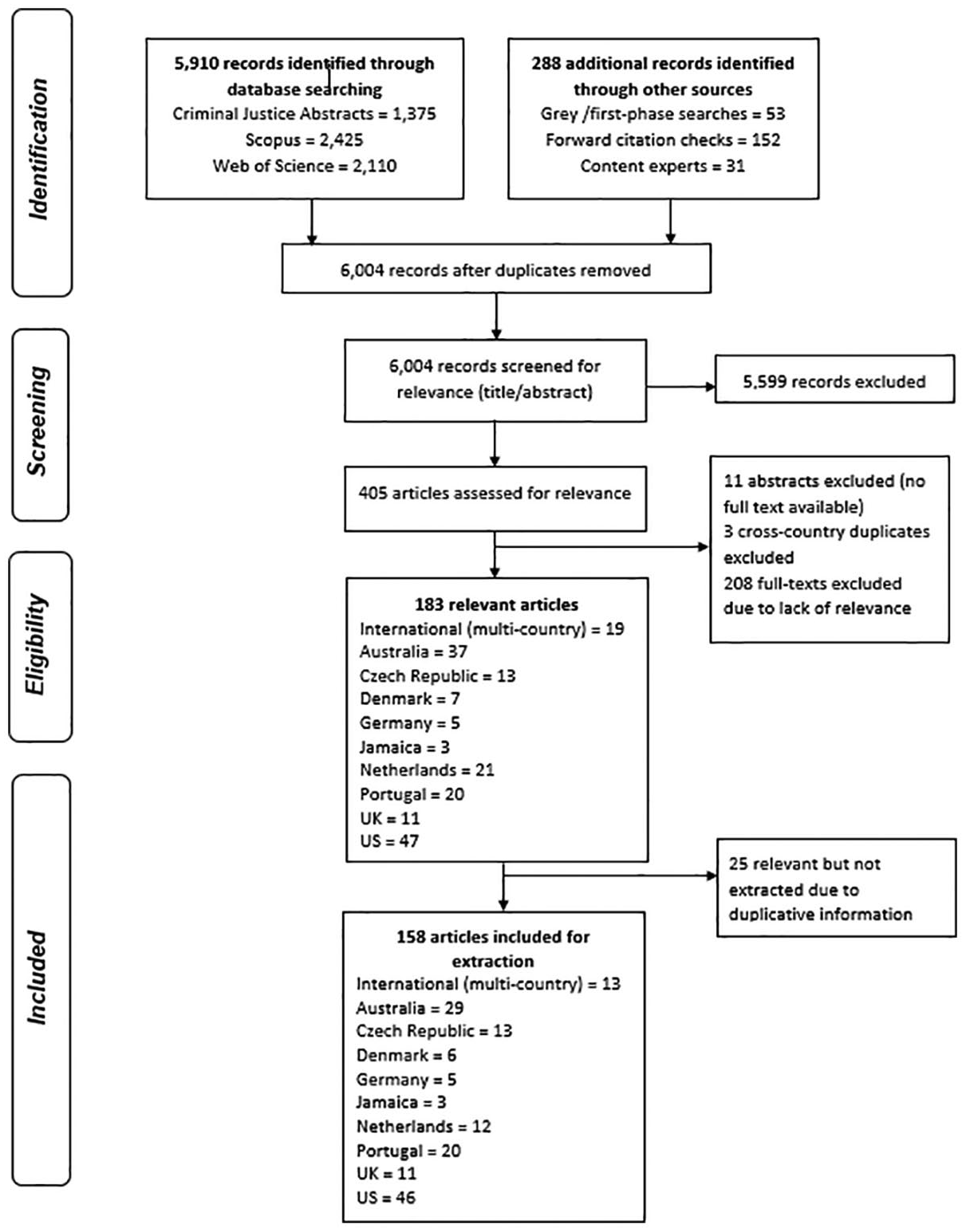
Results of identification of documents on alternatives for dealing with simple drug possession.
7. Extraction of data from the literature. Data were extracted from the selected documents into an extraction template spreadsheet. This became the basis for data synthesis and analysis, with referral back to original and related documents where necessary. In order to meet Wong’s (2018) suggestion to provide as much as possible of the data that have been used to inform the programme theory, the completed data extraction spreadsheet is available online at http://doi.org/10.22024/UniKent/01.01.66.
8. Validation of findings with content experts. We validated emerging findings through discussion with the stakeholder group and external experts. The inclusion of these additional perspectives meant that the review benefitted from experts’ substantive knowledge of the reviewed jurisdictions, as well as our own.
9. Synthesis of the findings in a final report. Here we present the programme theory that we developed in synthesizing the extracted data. Our iterative synthesis of the information we gathered involved comparing repeatedly across documents, jurisdictions and examples of alternatives to criminalization to identify contexts, mechanisms and outcomes and their inter-relationships. The results of a realist review are presented in the form of a programme theory (Wong et al., 2013), as described below.
Programme theory
In our synthesis, we found the contexts, mechanisms and outcomes that are included in Figure 2, and italicized and described in more detail below. These are inevitably selections from a wider range of potential contexts and mechanisms that may be involved in alternative measures. We decided to include in our programme theory those that were most widely present in the documents we reviewed and most directly related to the research questions listed in the introduction. Alongside the programme theory, we provide selected country-specific examples of each of its components, but note that these examples are indicative rather than exhaustive illustrations.
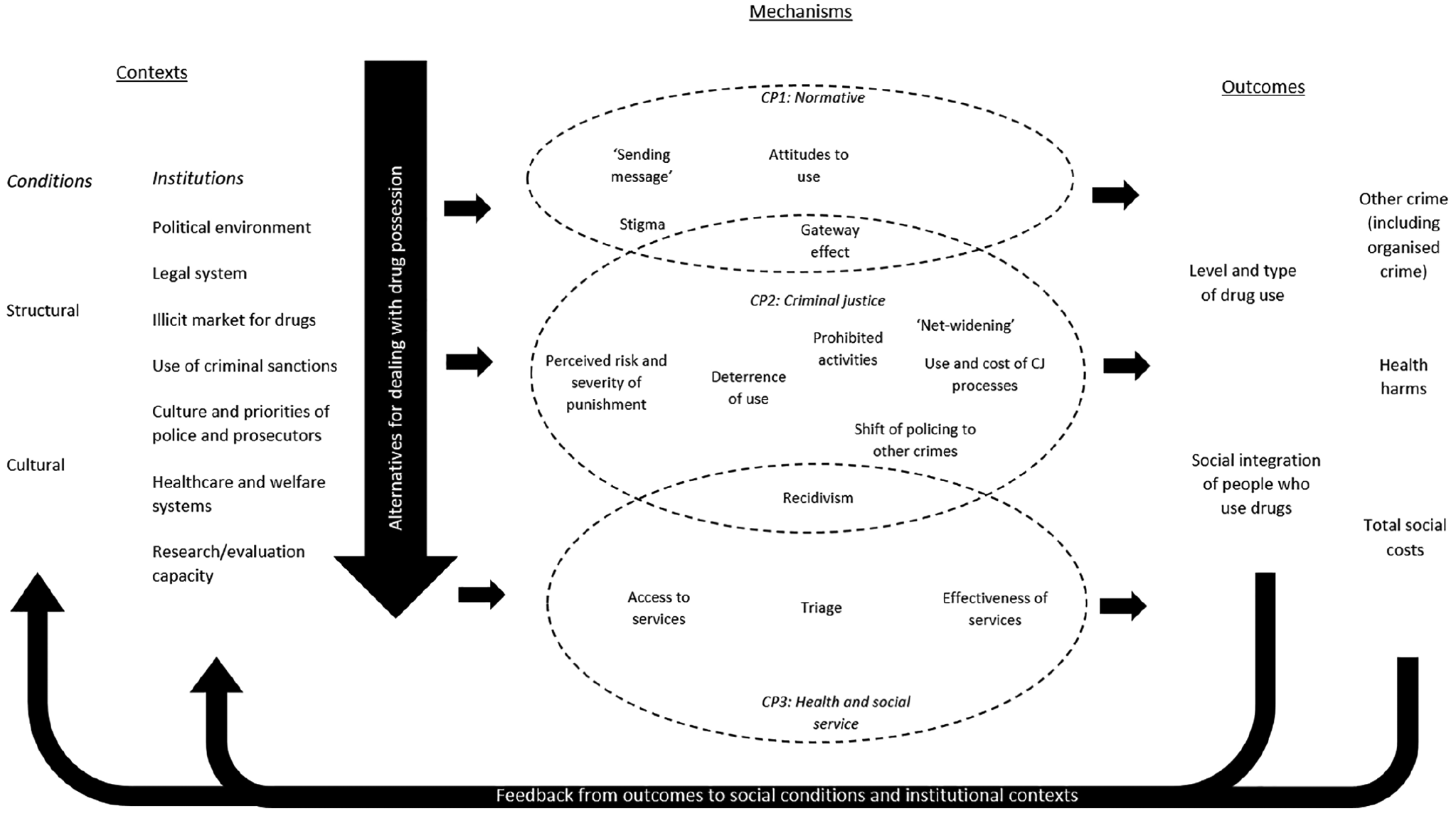
Programme theory of the contexts, mechanisms and outcomes of alternative measures for dealing with drugs possession.
Contexts
Contexts are more rarely addressed directly in the published literature on alternative measures than are mechanisms and outcomes (exceptions include the studies collected by Colson and Bergeron, 2017). Contexts are features of systems which enable or disable causal mechanisms (Pawson and Tilley, 1998; Westhorp, 2018). The adoption of a critical realist ontology directs our attention towards the ‘material and ideational conditions’ (Archer, 1995: 199) of the social systems in which alternatives to criminalization operate. Following Archer, we can divide these conditions into two analytically separate but mutually influencing categories: structural and cultural properties. The first of these conditions relates to the ‘political economy of drug policy’ (Stevens, 2010). The distribution of power and resources in a society will determine who controls whose consumption. The second highlights the cultural role of morality in shaping policies and their effects (Zampini, 2018). For example, Ireland’s current consideration of alternative measures to criminalization follows a broader process of social liberalization, which has included referendum votes to legalize gay marriage (in 2015) and abortion (in 2018). Cultural values shape the nature of policy reform.
These social conditions will also influence the form and effects of institutional contexts. At the institutional level, the political environment and legal system are obviously important contexts for the development and implementation of alternatives. One example of the influence of cultural properties on political and legal contexts is provided by the differential implementation of decriminalization in different parts of Germany. Possession of small amounts of drugs was decriminalized by a ruling of the German federal constitutional court in 1994 (Holzer, 2017). However, it was left to the länder to decide what weight limits to set. The southernmost länder – which tend to be more morally conservative – retained very low limits (for example, 6 grams of cannabis), whereas others adopted higher limits (between 10 and 30 grams) (Bollinger, 2004).
The jurisdiction’s legal system is also a very important context for alternative measures. Some forms of decriminalization (for example, that adopted by Portugal in 2001) require there to be a system of administrative law so that new non-criminal sanctions can be established. In Portugal, this includes options to suspend licences (for example, to drive or possess firearms) (Quintas and Fonseca, 2002). In other jurisdictions with a more limited system of administrative law (for example, Czech Republic, Jamaica and several US states) civil penalties are limited to the use of fines, akin to citations for motoring ‘infractions’. Some systems of decriminalization – as evidenced by Germany – require no new offences be established, and other alternatives do not involve legal changes (depenalization and de facto diversion), as has been adopted in the UK and Australia (sometimes alongside de jure reforms in the latter case).
The scale and nature of the illicit market for drugs has important implications for the development and effects of control policies (Caulkins and Kleiman, 2018). One theory suggests that the extent and social distribution of drug use plays a part in causing alternative measures to be adopted. Lempert (1974) argued that as the prevalence of illicit drug use rises – especially when this occurs among people of ‘high social status’ – so ‘moral dissonance’ between prohibition and its widespread ignoring grows. Criminalization comes to be considered as obsolete and so is abandoned.
Alternative measures are often introduced as a response to a combination of high levels of drug use with high levels of use of criminal sanctions. In many cases, the wish to spend less of the resources of the criminal justice system on low-level drug offences was an explicitly stated motivation for introducing alternative measures. This was evident, for example, in descriptions of reforms in Nebraska (Suggs, 1981), the UK (Shiner, 2015), and South Australia (Ali et al., 1998). The Czech Republic was an exception as its decriminalization (of all illicit drugs) was introduced at a time when drug use and sanctions remained low. The policy here was part of a broader democratic shift in the post-communist era to limit the role of the criminal justice system (Zábranský, 2004).
The culture and priorities of the police and prosecutors provide an important context for these alternatives because they will affect implementation. For example, since 1999 all Australian states and territories have adopted diversion (de facto or de jure), with broad support from police services (Hughes and Ritter, 2008). Conversely, in the USA, police have often not used alternative measures to reduce the use of sanctions. Several states that have formally decriminalized possession of small amounts of cannabis have higher rates of arrest for cannabis offences than others that have not, because police retain considerable autonomy in the decision to arrest, with Nevada and New York providing notable examples (Logan, 2014; Pacula et al., 2005). In both Seattle and Albany, some police officers were reluctant to divert offenders through LEAD programmes owing to their view that this constituted ‘enabling’ of addiction (Collins et al., 2015; Worden and McLean, 2018). If the culture of the police is resistant to the use of alternatives, this can be addressed by training and incentives, or by shifting from de facto reforms to de jure alternatives that reduce the opportunities for discretion in police decision-making (Arredondo et al., 2017; Hughes et al., 2019).
Interactions between contexts can also affect how causal mechanisms operate. For example, Goetz and Mitchell (2006) observed that the effectiveness of diversion through the Baltimore Substance Abuse System in the USA was hampered by arguments between police and health agencies over funding, leading to only four people entering the scheme during its first year. Conversely, a number of reforms (for example, the Australian Illicit Drug Diversion Initiative and the Portuguese decriminalization) have been coupled with new money for treatment, harm reduction or social services, which has facilitated smoother implementation (Hughes and Ritter, 2008; Quintas and Arana, 2017). This shows that the outcomes of diversion will depend on relationships between policing systems and other agencies, as well as the capacity of healthcare and welfare systems to provide effective treatment and to support social integration.
The final context we note is research and evaluation capacity, both to feed into the design of reforms and to ensure that any problems with implementation are identified and rectified. The Czech Republic provides an interesting example of the difference research can make. It introduced decriminalization in 1990, but then shifted to a more restrictive version – with criminal penalties for possession of ‘greater than small’ amounts – in 1999 (Belackova and Štefunková, 2018). A government-funded external evaluation of the new reform concluded that the new law met none of the objectives (reducing use, reducing availability, reducing social costs), and that it led to many perverse impacts (Zábranský et al., 2001). This contributed towards the return of a less restrictive reform. Australian governments have also invested in research into alternatives to criminalization, leading to the identification and rectification of some implementation issues. This also aided policy transfer and expansion (Ali et al, 1998; Hughes et al., 2019). Research evidence is often ignored (Monaghan and Boaz, 2018), but the capacity to fund and learn from it is a contextual factor that can aid effective policy development (Hyshka, 2009).
Mechanisms
Mechanisms are triggered by the interaction of interventions with contexts. They form part of what Pawson and Tilley (1998: 161) describe as ‘causal pathways’. Each pathway may involve multiple mechanisms. Different forms of alternative to criminalization and different implementations of each type may trigger different combinations of mechanisms. In our synthesis of the findings of the reviewed literature, many mechanisms were mentioned. As noted above, we selected those that we include in Figure 2 by focusing on those that were most commonly present in the reviewed documents and most directly related to the research questions laid out in our introduction. In listing the included mechanisms, we noticed that they could be associated with three categories, according to the underlying type of mechanism that they expressed. So we grouped them into the three overlapping sets as causal pathways at the heart of our programme theory in Figure 2. These three groupings enable us to strike a balance between complexity and comprehensibility. They are the normative (CP1), criminal justice (CP2) and health and social service (CP3) causal pathways. We found evidence of these mechanisms in arguments presented in the literature both for and against alternative measures.
Normative causal mechanisms operate through attitudes and beliefs about the values of drugs and the people who use them. They are similar to the mechanisms invoked by situated action theory (Wikström and Sampson, 2006) and later developments of control theory (Gottfredson, 2011), which argue that rule-breaking is partly explained by what people believe it is right to do in a given situation. A common argument in the field – at least among politicians and the media – is that criminalization and its alternatives ‘send a message’, especially to young people. This was a prominent debating point in the decision of the Danish government to repenalize drug possession in 2004, reversing the depenalization of 1969 (Houborg, 2010, 2017). It was argued that relaxing penalties for possession increased drug use by sending the message that it was safe and acceptable, and so undermined social controls (even though trends in drug use were in line with those in other European countries).
This is related to the concept of stigma, defined by Goffman (1963: 4) as an attribute that is seen as ‘deeply discrediting’. If drug use is stigmatized, this may reduce people’s willingness to take drugs; alternative measures might increase drug use by reducing such stigma (McKeganey, 2010). But another effect of stigma may be to discourage people who use drugs from entering treatment, because doing so means taking on the stigmatized identity of a drug user (Radcliffe and Stevens, 2008). The first of these is a directly normative causal mechanism. The second combines normative processes with the health and social service causal pathway. For example, an intended outcome of the Portuguese decriminalization of drug possession was to reduce the role of stigma in keeping people away from treatment services and impeding social reintegration (Hughes and Stevens, 2010).
Both ‘sending messages’ and stigma will affect potential users’ attitudes towards the safety and acceptability of drug use. Cuskey et al. (1978) found increases in favourable attitudes to cannabis following decriminalization in Oregon and California in the USA. They suggested that this might lead to greater use not only of cannabis, but also of other drugs. In Western Australia, however, decriminalization through the cannabis infringement notice scheme did not reverse a national trend towards seeing cannabis as more harmful (Fetherston and Lenton, 2007). And, back in the USA, Johnston et al. (1981) did not find that decriminalization in several states led to lower disapproval or perception of risk of cannabis use.
Cuskey et al.’s (1978) suggestion posits the gateway effect – a highly controversial mechanism in the field of drug policy. The gateway theory suggests that use of one drug causally increases the use of other drugs (Degenhardt et al., 2010). This theory was used by Kelly and Rasul (2014) in their study of the temporary depenalization of cannabis in Lambeth (a borough of London) in 2001/2. They did not directly observe an increase in the use of cannabis or other drugs. But they assumed that the reduction in deterrence of cannabis use led to an increase in the use of cannabis and so of more harmful substances, leading to the increase in hospital admissions from use of these drugs that they did observe. Such an increase was not seen in Denmark prior to the repenalization of drug possession. There was an increase in reports of ‘experimental’ (for example, ‘ever tried’) use of cannabis there. But levels of recent (‘last month’) cannabis use, of use of other drugs, and of drug-related harms were stable or falling (EMCDDA, 2004).
The gateway effect is related to both normative and criminal justice causal pathways. A commonly posited causal mechanism in drug policy, as used by Kelly and Rasul (2014), is that reducing deterrence increases drug use. Deterrence theory suggests that its effects rely on perceptions of the certainty and severity of punishment (Kleiman, 2009). These rest on the ability of police to catch a substantial proportion of people who use drugs, which has been shown to be near impossible in practice (Hughes et al., 2017; Nguyen and Reuter, 2012). Deterrence also relies on people’s knowledge of the penalties in force, which is often far from perfect (Ipsos MORI, 2002; Johnston et al., 1981; MacCoun, et al., 2009; Pacula et al., 2005; Younger-Coleman et al., 2017). For example, MacCoun et al. (2009) found that perceptions of the penalties applied did not vary substantially between US states that did or did not formally decriminalize cannabis possession. In Jamaica, awareness of decriminalization was found to be particularly low among the group that is usually of most concern in drug policy – young people (Younger-Coleman et al., 2017).
Some governments, including Ireland, are concerned that reducing penalties for drug possession may encourage prohibited activities – such as the public use of drugs – which may corrode respect for the law and ‘send a message’ about the acceptability of drug use. Many jurisdictions, however, retain the ability to prohibit activities related to drug use, even while reducing or removing penalties for simple possession. Vermont and other US states still prohibit the public use of cannabis. Indeed, the continued prohibition of having cannabis ‘open to public view’ in New York is what enabled the police there to make large numbers of arrests for low-level drug offences, despite decriminalization of possession itself (Levine, 2009).
Another important mechanism operates through the use and cost of criminal justice processes. Concern about the harms imposed by these processes are a primary stated motivation for the development of alternative measures. Criminal justice processes impose harm directly. Stops, searches, arrests, charges, convictions, and sentences (be they fines, community penalties or imprisonments) all represent restrictions on liberty that people would rather avoid. They can also lead to lasting damage to future prospects, as suggested by the secondary deviance, labelling and ‘negotiated order’ perspectives (Lemert, 1951; Matza, 1964; McAra and McVie, 2012). They require the spending of resources, including the time of police, courts, probation services and prisons. So reducing the use of these processes for drug possession can reduce the harms and costs of the criminal justice system. It can also be used to shift policing to other forms of crime. This was, for example, an explicit aim of the Lambeth cannabis warning scheme in London (Adda et al., 2014) and of the Portuguese decriminalization (Quintas and Arana, 2017).
However, some reforms can lead to more rather than fewer criminal justice processes or to more demanding sanctions than would have otherwise been applied. ‘Net-widening’ (Cohen, 1985) can occur when the reduction in time and inconvenience for police officers in making and processing an arrest incentivizes them to use more of the less burdensome process (May et al., 2007). This has been observed with several forms of alternative measure. In England and Wales, the use of warnings climbed rapidly above the former number of arrests for cannabis possession both during the Lambeth scheme and after warnings went national in 2004 (Adda et al., 2014; Shiner, 2015). Following the introduction of the South Australia Cannabis Expiation Notice Scheme, there was a 2.5-fold increase in recorded expiable cannabis offences in the nine years to 1996. This also led to more people being imprisoned for failure to pay their expiation fee (Christie and Ali, 2000). Such issues were lessened after they were identified through research and evaluation. Warnings fell in England after 2008/9 when they stopped being counted towards central police targets for ‘offences brought to justice’ (Shiner, 2015).
Criminal justice processes may also reduce drug and other crimes if they lead to a reduction in recidivism. The criminal justice causal pathway includes mechanisms – such as deterrence, net-widening and the reduction of damage to job prospects through reduced criminalization – that may either increase or decrease reoffending. This may also be reduced through the health and social service causal pathways, because reduced offending is a common effect of successful drug treatment (Baboret al., 2018). The causal mechanism of reducing recidivism therefore appears in both the criminal justice and the health/social service causal pathways.
It is often argued that drug use is primarily a health and social issue, so increasing access to treatment and social services will lead to better outcomes than criminal justice sanctions. This may be facilitated by alternative measures that explicitly include diversion to services. It may also be increased by other measures that reduce the stigma associated with drug use, while relying on voluntary service access outside of the criminal justice system.
Some jurisdictions have developed processes for triage: assessing and selecting those people who need referral to treatment. The Portuguese ‘committees for the dissuasion of addiction’ offer a quintessential example. They include lawyers, psychologists and social workers who assess people referred to them by the police and refer those who are deemed dependent to treatment centres (Quintas and Fonseca, 2002). Analyses show the majority are deemed not to be dependent. ‘Provisional suspension of proceedings’ with no sanction or referral to treatment was used for 59 –68 percent of cases in the period 2001 to 2009, with 18–31 percent involving suspension with referrals to treatment (Hughes and Stevens, 2010).
An important mechanism in the health and social service causal pathway is the effectiveness of the services accessed. For example, some forms of drug treatment are more effective than others in reducing crime and improving health. The evidence base for opioid substitution therapy (OST) in reducing drug-related deaths is stronger than that for abstinence-based approaches, especially detoxification alone (ACMD, 2016). In some places (for example, the Netherlands, Germany, the UK, Portugal), possession offenders with opioid problems who are diverted to treatment from criminal justice processes are much more likely to enter OST than in others (for example, several states of the USA, where access to OST is more limited). The attractiveness of services is also important, which is where some of the newer approaches that provide social support (for example, employment assistance) in addition to or instead of treatment may have more appeal, particularly to young people who use cannabis (Collins et al., 2015; Lammy, 2017).
As this section has shown, there is a complex array of mechanisms that can be triggered by alternative measures. Some of them directly affect each other within causal pathways (for example, access to effective services may reduce problematic drug use) whereas others reach across the causal pathways we have identified (for example, normative stigma is affected by criminal justice processes and may affect service access). They all interact with the contexts in which they operate, leading to a range of potential outcomes.
Outcomes
Core outcomes from alternatives to criminalization are illustrated in Figure 2. Others that were mentioned in the literature included driving under the influence of drugs, the over-policing of ethnic minorities, police corruption and police legitimacy. Here we have focused on the outcomes that were most relevant to the policy questions agreed with our stakeholder group and that were most frequently mentioned in the documents we reviewed.
Outcomes could theoretically be improved or worsened by alternative measures to criminalization, depending on specific combinations of contexts and mechanisms. Some phenomena could be considered as both mechanism and outcome. Improving social integration and reducing levels of drug use may be outcomes in their own right. But they are also social processes that go on to influence other outcomes.
As outlined earlier, a key concern of policy makers has been the impacts of reforms on the levels of drug use, particularly whether there is more use after reform. In the review we see some mixed results, but note significant methodological challenges. For example, even when it is possible to compare drug use prevalence before and after reform, observed changes are difficult to interpret. The usual lack of adequate comparator cases makes it very difficult to identify causes of these trends (for an overview of such issues, see Hughes and Stevens, 2012, and Kilmer et al., 2015). The validity of observed changes may, for example, be reduced by shifts in willingness to report drug use in surveys; this may be expected to rise as a consequence of the possible reduction in stigma that is noted in Figure 2.
The evidence that does exist on the effects of alternative measures on levels of drug use has been summarized by MacCoun et al. (2009) as ‘fairly weak and inconsistent’. This quote directly applies to decriminalization in US states, but can also be applied elsewhere. In Europe, no consistent effect on levels of cannabis use has been observed following reductions or increases in penalties for possession (Hughes et al., 2018). The increase in cannabis use that Kelly and Rasul (2014) assumed in their study of hospital admissions in Lambeth did not occur when depenalization was extended across England and Wales through the national implementation of the cannabis warning scheme in 2004 (Braakmann and Jones, 2014; Shiner, 2015). Indeed, there was a reduction in hospital admissions for cannabis psychosis (Hamilton et al., 2014).
In Portugal, youthful cannabis trends following decriminalization were similar to those observed in Poland, which increased penalties rather than reducing them (Krajewski, 2013). Heroin use reportedly fell (Hughes and Stevens, 2010). Increases in cannabis use in the Netherlands did not immediately follow the depenalization of possession in 1976, but came after the commercialization of sale through ‘coffee shops’ (MacCoun, 2011). In the Czech Republic, trends in the use of cannabis, opioids and amphetamines show little relationship with the various changes that have been made to decriminalization since it began in 1990 (Zeman et al., 2017). Studies in Australia (Cameron and Williams, 2001; Damrongplasit et al., 2010; Donnelly et al., 1995, 2000; Hales et al., 2004; McGeorge and Aitken, 1997; Shanahan, Hughes and McSweeney, 2017) and the USA (Grucza et al., 2018; Johnston et al., 1981; Miech et al., 2015; Miron, 2002; Pacula et al., 2003; Single et al., 2000) have given a mixed picture. A few found increases in cannabis use, but many did not.
Pacula et al. (2003, 2005) argued that US studies were generally not robust and had significant problems in making comparisons between states, because some of the states that decriminalized in the 1970s retained the use of criminal penalties and imprisonment, blurring the distinction between criminalization and decriminalization. Also relevant was citizens’ imperfect knowledge of the laws in force, as discussed above. Study of some recent decriminalizations – which occurred between 2008 and 2014 – did not find an increase in youthful cannabis use (Grucza et al., 2018). Overall, the findings on the impact of alternative measures on the level of illicit drug use suggest that the causal mechanisms that are often posited to increase consumption (for example, ‘sending a message’, reducing stigma and reducing deterrence) do not consistently have this effect in the contexts covered by this review. The findings thus broadly support those cited on this outcome in our introduction.
Social integration is an outcome that includes the harms that often motivate concern over criminalization; that is, the harms done by criminal convictions and records in limiting employment prospects, in restricting opportunities to travel internationally and to secure accommodation (Bretteville-Jensen et al., 2017). European studies tend to show that alternatives to criminalization do indeed reduce the use of arrests. In Portugal, not only arrests but also imprisonments fell, leading to a reduction in prison overcrowding (Hughes and Stevens, 2010), despite the fact that prison sentences were imposed on a small proportion of possession offenders before decriminalization (Laqueur, 2014). In the USA, results were more mixed. However, the more recent decriminalizations studied by Grucza et al. (2018) reduced drug-related arrests by at least 50 percent in Massachusetts, Connecticut, Rhode Island and Vermont. In Maryland, arrests fell by a quarter. Moreover, studies of the shift in Denmark from depenalization to penalization showed a significant increase in criminal justice processing of drug law offenders (Møller, 2010).
Whereas criminal justice processes may harm social integration, alternative measures may prevent these harms from occurring. Hales et al. (2004) studied the ‘social functioning’ (including housing, employment and social support) of people who entered the de jure Queensland Illicit Drug Diversion Initiative. They found it to be stable. People who entered the South Australia cannabis expiation notice decriminalization scheme showed better outcomes in terms of employment, accommodation and relationships than those who received criminal convictions (Lenton et al., 2000). Shanahan et al.’s (2017) survey of people dealt with through decriminalization with civil penalties or de facto police diversion for cannabis use/possession across eight states/territories of Australia produced similar findings, although it should be noted that those who were charged rather than diverted or given a warning were more criminally active at baseline.
Reductions in problematic drug use and increased social integration can affect levels of offending and so of other crimes. For example, research in Seattle has shown a 58 percent reduction in recidivism among LEAD participants, when compared with a similar group that went through the traditional criminal justice process (Collins et al., 2015). Payne et al. (2008) showed similar reductions in recidivism of between 53 percent and 63 percent from police drug diversion in Australia. The RCT of the Turning Point programme in the West Midlands of England found 68 percent fewer subsequent court cases for all crimes among programme participants than those who were randomized to be prosecuted in the usual way (Lammy, 2017).
Some of the available evidence suggests that alternative measures can be effective in reducing other crimes by diverting police attention to them. Adda et al. (2014) tested this directly in the case of Lambeth. They found that the introduction of cannabis warnings was associated with a decrease in the recorded levels of robbery, burglary, theft and handling of stolen goods, fraud, forgery and criminal damage. Such reductions in other crimes were not found in studies of depenalization in California (Deangelo et al., 2018; Ross and Walker, 2017), but this may have been due to the lack of overall impact of this programme in actually reducing arrests for cannabis possession (Deangelo et al., 2018). Across the USA, Huber et al. (2016) found an association between state-level decriminalization and higher recorded rates of burglary and robbery. But this study suffered from the problems identified by Pacula et al. (2003, 2005) and Logan (2014). It included states – such as Nevada and New York – that did not have lower arrest rates for cannabis offences in the ‘decriminalized’ group. Maier et al. (2017) found no significant differences in recorded rates of any crime between states that had or had not decriminalized cannabis possession.
Since alternatives for possession do not affect drug supply, their effect on the presence of organized crime in illicit drug markets may be limited. The mechanism that Huber et al. (2016) postulated for the increase they observed in robbery and burglary was that these are crimes related to the cannabis market. They speculated – but did not demonstrate – that reducing penalties for cannabis possession increases demand. In the absence of a legalized market, they suggested – but again did not directly observe – an increase in cannabis price, and so an increase in crimes committed to pay for it. This posited causal chain should increase the scale, profitability and violence related to organized crime, because increased profitability would increase the incentives of organized crime groups to use violence to control markets that are not legally regulated – Goldstein’s (1985) ‘systemic’ violence. However, neither Huber et al. (2016) nor Maier et al. (2017) observe an increase in homicide in decriminalized US states. A previous study found a reduction in violence in states that decriminalized cannabis in the 1970s (Newman and Newman, 2015).
Increasing the murder rate has been an accusation made specifically against the Portuguese model of decriminalization (Pinto Coelho, 2010). Homicides did increase in the few years immediately after the decriminalization of possession in Portugal, but had returned towards their 2001 level by 2011 (Laqueur, 2014). There was also an increase in the weight of some drugs seized by the authorities in this period, even though the number of seizures fell (Hughes and Stevens, 2010). This is consistent with the stated intention of the Portuguese policy to shift law enforcement from low-level possession to higher levels of the market (involving smaller numbers of larger seizures). It may exemplify the ‘criminogenic’ impact of disrupting organized crime groups, as offenders compete violently to replace arrested high-level suppliers (Bowling, 2010). Contrary to Huber et al.’s postulate, some prices for illicit drugs in Portugal fell after decriminalization (Félix and Portugal, 2017; Laqueur, 2014).
Several alternative measures show reductions in drug-related health harms. Portugal provides the clearest example, with substantial reductions in drug-related deaths, HIV and viral hepatitis infections after 2001 (Félix et al., 2017; Gesaworld, 2013). It should be noted that some of these reductions began before 2001, and Portugal adopted a type of alternative that combined the posited de-stigmatizing effects of decriminalization with the service access effects of diversion. It also deliberately expanded health service, social integration initiatives, and welfare support alongside the legislative reform. The Netherlands has also succeeded, with a combination of measures that include depenalization for cannabis and de facto diversion for other illicit drugs, in limiting health harms related to illicit drugs. It has relatively low levels of problematic drug use, drug injecting, drug-related HIV and mortality (Grund and Breeksema, 2017; Van Ooyen-Houben and Kleemans, 2015). Germany and the Czech Republic also show relatively low rates of drug-related deaths and HIV infections following decriminalization, again in a context of relatively high coverage of health and social services.
Social integration, the costs and harms of criminal justice processes, other crimes, organized crime and health harms will all have an influence on the total social costs of drug use and policy. Gonçalves et al. (2015) found a reduction in total social cost following decriminalization in Portugal, despite the increased expenditure on the drug treatment services to which some people were diverted. These increased treatment costs were mostly cancelled out by reductions in the costs of dealing with viral hepatitis and HIV and substantial reductions in drug-related court cases and imprisonments, with less lost income and productivity due to such incarceration. In the Czech Republic, Zábranský et al. (2001) found that the change to a more restrictive form of decriminalization in 1999 significantly increased the costs of responding to illicit drugs.
The RCT of the Turning Point diversion scheme showed that the average cost of a case diverted to a therapeutic intervention was 45 percent lower than that of cases prosecuted as normal, taking into account the costs of the interventions and court processing (Slothower et al., 2017). Shanahan et al. (2017) found the costs of Australian cannabis cautioning to be 47 percent lower than the costs of arrests. Other researchers have also found cannabis decriminalization with civil penalties in South Australia and de facto police diversion for cannabis in New South Wales to be substantially less costly than arrest (Ali et al., 1998; Baker and Goh, 2004).
The evidence reviewed here suggests that alternative measures in several contexts have tended to reduce the costs of criminal justice processes and have not consistently increased levels of drug use or related harms. So it is reasonable to suggest that they tend to reduce the overall social costs of illicit drugs and drug policy. But these effects, as we have shown, do not happen automatically in every application of depenalization, diversion or decriminalization. Rather, they depend on the way in which differently designed measures interact with pre-existing contexts to trigger causal mechanisms.
In line with Archer’s morphogenetic approach, the outcomes then go on to influence the conditions and institutional context in which these and other measures operate in future, in a complex, dynamic system. Reducing the harms and costs of criminalization frees up resources to spend on more effective forms of social integration, as appears to have happened in Portugal. In the USA, decriminalizations of cannabis possession in the 1970s and more recent legalizations of medical marijuana were accompanied by changing attitudes towards cannabis among the general population (Schwadel and Ellison, 2017). These normative mechanisms have gone on to affect the cultural conditions and political environments in which cannabis supply is now being legalized for non-medical use in several states, superseding some decriminalizations.
Limitations
Even more than for most realist studies, the findings presented here must be considered provisional. This is due to limitations in the quality of the data and the nature of the research designs they are based on. Some researchers have noted the general weakness of, for example, data on the prevalence of drug use (Kilmer et al., 2015). Other researchers have noted the inconsistent quality and general lack of rigour in studies of the effects and costs of alternative measures for drug possession and of the social costs of drug policy (Bretteville-Jensen et al., 2017; Pacula et al., 2005). These are complex programmes, which are often not amenable to standard approaches for increasing internal validity, such as RCTs. Policy makers have rarely funded such studies even where they could be run. Most of the studies in the field are observational in nature, leaving them open to the bias and confounding that often affect such research designs (Grimes and Schulz, 2002).
Another limitation is the restriction of our document search to the English language. There is much information published in other languages that would be very helpful in building and refining programme theory on alternative measures. We hope realist studies in other languages will be carried out and synthesized with this programme theory.
Finally, we note that framings of research questions and methods are political processes (Law, 2004; Monaghan and Boaz, 2018). This is exemplified by the focusing of our research questions leading to the exclusion of mechanisms and outcomes to do with ethnic disproportionality in drug policing from the provisional programme theory we present in this article. Others, with different frames and focuses, may wish to include such mechanisms and outcomes in their considerations.
This article presents the first realist review of alternatives to criminalization for simple drug possession. It deliberately focused on a select number of countries that could provide useful, policy-focused information on contexts, mechanisms and outcomes. In so doing it mitigates some of the limitations of previous research, such as their focus on only outcomes, or on one country, or on one type of reform.
Conclusion
The relative strength of this article is that it has adopted a theoretically informed and methodologically systematic approach to producing policy-relevant information on alternative measures. It also contributes to the field of ‘realist criminology’ (Matthews, 2014) and to the growing number of realist reviews (Berg and Nanavati, 2016). We have gone beyond existing reviews by providing a programme theory of alternative measures for dealing with simple drug possession. This ‘web of causal processes’ is illustrated in Figure 2. It can be summarized as follows. The structural and cultural properties of social systems influence the institutional contexts in which alternative measures operate. The implementation of alternative measures in these contexts triggers mechanisms in three causal pathways (normative, criminal justice, and health and social services). These alternatives work through complex combinations of contexts and mechanisms to produce differing outcomes. These outcomes then go on to affect the conditions and institutional contexts within which measures in response to drug possession operate.
In relation to the research questions listed in our introduction ((a)–(f)), not all the theorized mechanisms are supported by the evidence we reviewed. We do not find strong evidence that reducing punishments for drug possession consistently increases drug use. Other theorized mechanisms are more strongly supported. Many implementations of alternative measures have reduced arrests and convictions for low-level drug offences. In doing so, they have reduced the harms and costs incurred by the criminal justice system (question (a)). There is little evidence that they increase health harms related to drug use (question (b)), partly owing to the lack of a consistent effect in increasing the prevalence of drug use. We find little evidence that these alternative measures increase the scale or violence of organized crime (question (c)). Because they do not directly affect illicit drug supply, it is unlikely that they do much to reduce such harms. They can be combined with measures that retain the possibility of intervening in public drug use (question (d)) or that divert people who need it to treatment, while applying triage to avoid sending people into treatment if they do not need it (question (e)). Some alternative measures in some contexts (for example, those that divert people to effective treatment or social services) can reduce health and crime harms. So, overall, it is possible – but not inevitable – for alternative measures to reduce the social costs related to illicit drug use (question (f)).
This review also suggests lessons about the contexts in which policy makers are likely to see better outcomes from reform. They include careful design of the choice of reform, achieving awareness and support from the public, police and prosecutors for reform, simultaneous investment in treatment and social services, and funding and use of research and evaluation. We recommend that policy makers and researchers use and refine the provisional programme theory we provide in designing and evaluating alternatives to criminalization for dealing with drug possession.
Footnotes
Acknowledgements
We would like to thank the members of the working group for the project for their advice and support. We would also like to thank country experts who provided advice, including Rosalie Liccaro Pacula, Bernd Werse, Vendula Belackova, Maria Moreira, Vibeke Asmussen Frank and Esben Houborg. Errors remain the responsibility of the authors.
Funding
The author(s) disclosed receipt of the following financial support for the research, authorship, and/or publication of this article: The review on which this article is based was supported by the Department of Justice and Equality and Department of Health of the Republic of Ireland. The work of Caitlin Hughes and Shann Hulme was supported by the National Drug and Alcohol Research Centre at the University of New South Wales, which is supported by funding from the Australian Government under the Substance Misuse Prevention and Service Improvements Grants Fund.
