



Abstract
Hate crime research has increased, but there are very few studies examining hate crime offenders. It is, therefore, difficult to determine to what extent those who perpetrate this offence might be different from those who have not committed hate crime. This study is the first to provide an account of the demographics and criminal histories of those serving time in prison for committing a hate crime. It is based on a large complete population of offenders in the UK. Hate crime offenders released from prison were found to have prolific criminal careers, having committed a wide range and large number of different types of offences. When compared with those who committed a general (non-hate) violent offence, violent hate crime offenders were significantly older and were considerably more prolific in their previous offending. Violent hate crime appeared quantitatively, as opposed to qualitatively, different from violent non-hate crime, but this was less clearly true when those who had committed public order hate crime were compared with other public order offenders. Interventions to reduce the later offending of violent hate crime offenders should be based on the effective interventions that exist for violent offenders, but should take into account knowledge about the surprisingly prolific criminal careers of hate crime offenders.
Introduction
Although the perpetration of hate crime is potentially as old as history, research demonstrating the pervasiveness of this pernicious form of criminal offending appears to have begun in the US in the late 1980s. Finn and McNeil (1987) conducted an exploratory review of the criminal justice responses to bias crimes, 1 funded by the National Institute of Justice, and this was followed by the influential work of Herek (1989), who studied the prevalence of hate crime victimization against lesbian and gay men in the US. In both research contributions the prevalence of hate crime was much higher than anticipated.
In the UK, academic research on hate crime commenced somewhat later, with relatively limited contributions before 2000. This was despite the fact that there were very high-profile hate crime offences perpetrated in the 1990s in England, including the racist murder of the Black teenager Stephen Lawrence, and the racist and homophobic nail bomb campaign in London by David Copland in 1999. It is noteworthy that the subsequent police investigation into the murder of Stephen Lawrence was itself so discriminatory that a later review of the police response to this horrible offence resulted in the Metropolitan Police being labelled ‘institutionally racist’ (Macpherson, 1999).
Although the most appropriate definition of hate crime is still the subject of much academic debate, in England and Wales the criminal justice system does have an agreed working definition. This is: ‘any criminal offence which is perceived, by the victim or any other person, to be motivated by hostility or prejudice’ (College of Policing, 2014). Of the nine official protected characteristics that were introduced by the Equality Act 2010, 2 there are five that form the official ‘strands’ of hate crime and are recorded by the police. These are offences against people based on their ethnicity, religion, disability, sexual orientation or transgender status. Therefore, in England and Wales it is illegal to discriminate based on age, but an offence directed at someone because of their age would not be officially recorded as a hate crime.
There is no single piece of ‘hate crime’ legislation in England and Wales, but the Crime and Disorder Act 1998 introduced racially and religiously aggravated offences, including those for assault, criminal damage, harassment, stalking and public order offences. In addition, as part of the Criminal Justice Act 2003, new sentencing provisions were introduced for those convicted of hate-related offences. These allowed for enhanced penalties, such as longer prison sentences, for those found guilty with evidence of hostility towards the victim based on the victim’s (presumed) ethnicity, religion, disability or sexual orientation or if the victim was (presumed) transgender.
There has been an exponential increase in the amount of research produced about hate crime, but this has tended to focus on fairly restricted areas. One aspect that has garnered considerable research is the amount of ‘hidden’ hate crime, or the hate crime that does not come to the attention of police (for example, Crime Survey of England and Wales, 2015; James, 2015). For example, in England and Wales in 2014/15 there were 52,528 hate crime offences reported to police, but the nationally representative Crime Survey of England and Wales estimates the number of hate crimes to be in the range of 222,000 (Crime Survey of England and Wales, 2015). 3
Other areas of hate crime that have attracted considerable research include how best to define hate crime (for example, Hall, 2013), which groups should be considered as victims of hate crime (for example, Garland, 2010; James, 2015), the profound impact of hate crime on victims and communities (for example, Perry, 2001), and the criminal justice responses to hate crime and how these could, and should, be improved to avoid secondary victimization (Chakraborti et al., 2014). There has also been interest in how wider political movements, such as the UK’s vote to leave the EU (Brexit) and the election of Donald Trump as US President may cause or in fact are causing changes in the prevalence of hate crime (for example, Levin, 2017; Metropolitan Police, 2017).
Hall (2015) provides a useful overview of a number of sociological and criminological theoretical approaches that have been used to explain the perpetration of hate crime. These include suggesting that hate crime could be viewed through the lens of Mertonian strain theory, in which hate crime offences are a response to perceived threats (for example, competition for jobs, or other legitimate means to achieve societal goals) by minority groups. Cohen’s (1955) subcultural theory could also be used to explain group-oriented hate such as neo-Nazi groups. That is, hate groups form as a result of the ‘status frustration’ of failing to measure up to middle-class societal standards by forming delinquent groups that reject middle-class goals and develop their own approaches to creating status, such as targeting specific minorities. Others (for example, Iganski, 2008) have suggested that any theory that attempts to explain hate crime must account for the fact that hate crime seems to be typically committed by ‘ordinary people’ in the course of everyday interactions and is not commonly committed by hateful bigots who seek out victims.
Hate crime research in both the US and the UK, however, has been considerably and noticeably deficient in the empirical study of those who perpetrate hate crime. There have been in-depth investigations of cohesive organizations that perpetrate hate (for example, Hamm, 1993), and those groups that may have an orientation towards hate, such as the English Defence League (Treadwell and Garland, 2011). However, the study of the ‘average’ hate crime perpetrator has been quite limited. With very few exceptions (reviewed below), research on hate crime offenders has been predominantly based on practitioners’ views (for example, Iganski, 2012) and the recollections and perceptions of victims (for example, Chakraborti et al., 2014; Mason, 2005; Sibbitt, 1997).
Previous research on hate crime offenders
McDevitt, Levin and Bennett (2002) conducted seminal research on hate crime perpetrators using 169 police case files of known suspects or those arrested for hate crime. 4 Based on these records, and on interviews with the investigating officers, the authors attempted to infer offence motivation and identify ‘typologies’ of hate crime perpetrators. For example, 66 percent of the perpetrators were classified as ‘thrill’ offenders, who tended to be young and committed hate crime impulsively while in groups. The next most prevalent category (25 percent) was ‘defensive’ offenders, who committed their offence to ‘protect’ their turf (for example, neighbourhood) from perceived outsiders. Unfortunately, this study did not present the basic demographic or criminal history characteristics of hate crime offenders (HCOs), which would have been useful for providing a descriptive account of who typically perpetrates which ‘type’ of hate crime.
Other research on HCOs has provided limited descriptive information. For example, the Crown Prosecution Service in England and Wales (2011) examined the basic characteristics of over 15,000 hate crime defendants. They found that most offenders were male and White British, with 50 percent being aged between 25 and 59 and another 27 percent between 18 and 24. Also, Mason (2005) examined victim reports to police in a random sample of 20 racially motivated incidents and 20 homophobic-related incidents. Unfortunately, key features of the perpetrator were often not available, with the gender of the perpetrator missing in half of the cases and age and ethnicity missing in three-quarters of the cases.
Iganski and Smith (2011) used anonymized police data from Lancashire, London and Northern Ireland to examine the demographic and socioeconomic characteristics of those accused of hate crime. The results of this investigation suggested that HCOs were predominantly male and of White racial background, with offenders generally being under 30. In addition, many of those accused of hate crime were unemployed (between 25 and 60 percent). The finding that most racially motivated offenders were male and White was also reported in a study of youth (age 10 and 17) serving sentences for racially motivated offending in England and Wales (Wilcox et al., 2010).
The records of 58 HCOs convicted in Los Angeles were reviewed by Dunbar (2003). This was the entire population of those convicted for hate crimes between 1995 and 1997 in Los Angeles. Of these offenders, over 91 percent were men, and their average age was 24.5 (SD = 8.1, range 16–44). The ethnicity of the HCOs was generally representative of the Los Angeles area (over 43 percent Latino, 33 percent European White, 15.5 percent African American, 3.4 percent Asian Pacific). Almost half of the HCOs were convicted for physical assault, with robbery/extortion being the next most prevalent offence (about 25 percent), followed by property offences (17 percent). Almost all of the victims (80 percent) were targeted because of their race. When rated on a measure of hate motivation based on four variables (a history of hate-motivated aggression, membership in a hate group or gang at the time of commission of the index crime, articulated hate speech during the commission of the crime, the presence of hate iconography such as literature, art, music, body tattoos or neo-Nazi garb at the time of the crime), 74 percent of those convicted for hate crime did not evidence hate motivation. Most hate offences were committed in groups.
Dunbar, Quinones and Crevecoeur (2005) investigated the criminal histories of a group of 204 HCOs in the US who had been identified and apprehended by the police. The results suggested that most HCOs were males (87 percent) with an average age of about 33. Slightly less than half of the arrestees were of Euro-White ethnicity, with those of Latino (26 per cent and African American race (15 percent) being the next most prevalent ethnic groups. A total of 16 percent of this sample were adjudged to be members of hate-oriented criminal gangs or groups, but how this categorization was made was not clear. Slightly less than half of the offenders (45 percent) had previous misdemeanour convictions and 36 percent had prior felony convictions. Information about the number and types of previous offences was not available, but an ordinal assessment of the severity of their previous offences suggested that many of these HCOs had committed both violent and non-violent offences previously. When separated into the target of the hate (race, sexual orientation or religion), the results suggested that HCOs who targeted individuals because of their race had more extensive criminal histories than those who targeted individuals because of their religion.
Although comparatively a valiant effort of descriptive research on HCOs, it is generally not appropriate to combine male and female offenders into a single group, because the characteristics of male and female offenders tend to be so markedly different from one another (for example, Hedderman and Jolliffe, 2015; Jolliffe, 2013). For example, a key result of Dunbar et al. (2005) was that those who targeted individuals because of race were more criminal than those who target individuals because of religion. However, this result could be confounded by the fact that males and females were included together in a single ‘offender’ category. That is, if males, who are generally more criminal, were more inclined to target victims based on race, and females, who are generally less criminal, were more likely to target victims based on religion, this would be a gender difference that created the perception of a difference in HCO motivation. 5
Hate crime perpetration was also investigated in a large-scale nationally representative self-report study of 4855 Finnish adolescents (51 percent male) aged 15–16. In this study, hate crime offending in the previous 12 months was based on two items: ‘Have you ever assaulted anyone?’ and ‘Have you bullied someone either in school or on the way to school?’ A positive response to either of these triggered follow-up questions about whether the act was motivated by the victim speaking a foreign language, the colour of their skin, their religion, ethnicity or political opinions. The prevalence of hate-motivated assault and bullying was 2.3 percent, with more males reporting such offences (4.0 percent) than females (0.7 percent). Using multinomial regression to compare three groups (those who did not report assault/bullying, those who reported assault/bullying, those who reported hate-related assault/bullying. Näsi et al. (2016) found that those who reported a hate-related offence were different from those who did not report assault/bullying, but similar to those who reported non-hate-related assault/bullying. The parents of those who reported both hate and non-hate assault/bullying were more likely than those who did not to drink more often, have poor parental supervision, have low self-control and be male. The only variable that appeared to differentiate hate from non-hate offenders was that the parents of HCOs were reported to fight more often.
There have been other studies of HCOs (for example, Chakraborti et al., 2014; Godinet and Stotzer, 2017; Roberts et al., 2013), but these were based on victims’ accounts and so are somewhat limited in the extent to which they can provide information about non-observable (for example, criminal history) or even observable (for example, age, ethnicity) features of HCOs.
It is essential to develop a better understanding of the characteristics of those who commit hate crime and to determine how far they are similar to or different from those who do not commit hate offences. It could be that HCOs possess unique demographic or criminal history profiles and are in some way ‘different’ from offenders who do not commit hate crime offences. Alternatively, those who commit hate crime may be very similar in relevant demographic and criminal history background characteristics to those who commit other types of offences. Although there is currently limited evidence on these two possibilities, the evidence from wider criminology might suggest the latter.
It is over 30 years since the National Academy of Sciences published the seminal work Criminal Careers and Career Criminals (Blumstein et al., 1986). The voluminous knowledge generated by this paradigm is far beyond the scope of this article (see DeLisi and Piquero, 2011), but criminal career research has had much to say about offender ‘types’, including violent offenders (Farrington, 1991), intimate partner violent offenders (Hilton and Eke, 2016) and life-course persistent offenders (Jolliffe et al., 2017). Importantly, translating criminal career research for the purposes of studying HCOs, in their review of knowledge that has been generated by criminal career research about offender ‘types’ and offending specialization, DeLisi and Piquero (2011: 291) state: ‘A main conclusion is that the preponderance of offenders, and by preponderance we mean virtually all offenders, are generalists.’
This does not mean that there is not utility in examining the criminal careers of HCOs, even if they are found to be ‘generalist’ offenders. For example, using the Cambridge Study in Delinquent Development, a prospective longitudinal study of 411 boys followed up from age 8, Farrington (1991, 1998) found that young men who committed violence did so almost at random in the course of extensive criminal careers, and that the risk factors for violent offending were similar to those for frequent offending. In some way the commission of a violent offence and frequent non-violent offending could be seen as proxies for one another. It could be that the commission of a hate crime is indicative of a prolific criminal career.
Developing a better understanding of HCOs is also of practical importance. As mentioned, the limited available evidence suggests that HCOs might be quite ‘ordinary’ (for example, Iganski, 2008). If true, then the most efficacious approach to reducing reoffending amongst HCOs would be to utilize the extensive knowledge of successful offender rehabilitation that has developed using high-quality evaluations over the last 30 years (Lipsey, 2009). These approaches utilize a core set of principles and approaches that have demonstrable effectiveness for reducing reoffending (for example, Jolliffe and Farrington, 2007; Weisburd et al., 2016).
If HCOs are qualitatively different from ‘typical’ offenders, then specialist interventions to address hate crime and hate crime motivation may be needed. Despite the limited evidence to suggest that HCOs are specialists in hate crime (for example, Iganski, 2008), there is a veritable industry in developing and delivering interventions for HCOs (as reviewed by Iganski, 2012). These include interventions for HCOs being released from prison (for example, Lukas and Korn, 2012) and for HCOs serving sentences in the community (for example, Dixon and Court, 2015; Palmer and Smith, 2010), amongst others.
Unfortunately, these hate crime interventions have not been robustly evaluated, nor do they appear to incorporate an understanding of the extensive knowledge around ‘what works’ to reduce reoffending (for example, Lipsey, 2009). This is particularly problematic because, in the absence of high-quality evaluations, the impact of the hate crime interventions is unknown. These interventions could be beneficial, have no impact, or, like many well-intentioned interventions, be toxic and increase later hate crime (McCord, 2003).
Current study
It is clear that much more research on those who perpetrate hate crime is needed, particularly in the UK. This study makes use of administrative records to provide a descriptive picture of adult males who were found guilty and served time in prison for committing a hate crime. A significant limitation of much of the previous research on hate crime perpetrators is that it has used arrests, police records or defendants as perpetrators, but with each of these measures there is a possibility that the perpetrator was innocent and therefore not a true HCO. The study of those convicted and imprisoned for hate crime does not negate this possibility, but it does minimize this risk substantially. The research questions that guided this research were:
What are the demographic and criminal history features of those released from prison after serving time for a hate crime offence?
How far are those who were released after committing hate crimes similar to or different from others who had not committed a hate crime offence?
Data and method
The data for this study come from the Police National Computer database (PNC), which is the national database for offences and convictions held and updated by the police in the UK. These data are commonly made available for the purposes of evaluation or academic study by the Ministry of Justice, which has oversight of prisons, courts, probation and attendance centres in England and Wales. An overview of what PNC data comprise, and how they are typically used in research, is provided by Sutherland (2013). Briefly, the extracts of the PNC provided to researchers contain basic demographic information about the offender (for example, age at index offence, race, nationality, region where offence occurred) and criminal history information such as the age at first offence and the number and the type of previous offences. In addition, information about the length of sentence was also available. The present study is based on a complete population of male offenders aged 18 and over who were released from short-term incarceration in England and Wales. Short-term prison sentences are those in which the individual was sentenced to prison for up to one year for their current offence. 6
The main benefit of these data is that they are the first to systematically compare HCOs with other types of offenders. The main limitation of these data is that they captures the behaviour of only a very specific type of HCO, those who committed an offence of a certain severity that resulted in a short prison sentence. Those who committed a hate crime offence that was not reported to the police or recorded by the police, who were not convicted or were convicted but received a lesser (for example, community) or more serious (for example, incarceration for greater than a year) sanction are not included. This is, therefore, a unique sample of HCOs and one that is highly unlikely to be representative of all those who commit hate crime, especially considering the disproportionately low level at which hate crimes are reported to the police and the low clearance rate of hate crime offences (for example, Home Office, 2018).
Results
During 1 year for which the data were available a total of 51,271 adult male offenders were released from short-term prison, and information about their index offence was available in 47,775 cases. Of these, 355 or 0.7 percent had an index offence indicative of hate crime. 7 These are called hate crime offenders (HCOs). The Ministry of Justice in the UK separates offending into 21 categories for the purposes of analyses, and all of the hate crime offences could be classified into four of these. These included serious violence (n = 6/355, 1.7 percent, for example, racially or religiously motivated grievous bodily harm), violence (n = 287/355, 80.8 percent, for example, racially or religiously aggravated common assault), public order (n = 45/355, 12.7 percent, for example, racially or religiously aggravated harassment, alarm or distress), and criminal damage (n = 17/355, 4.8 percent, racially or religiously aggravated other criminal damage).
Demographic characteristics of hate crime offenders
Ethnicity and nationality
Over 86 percent of HCOs were of White ethnicity; 6.8 percent were Black, and 5.4 percent were Asian. A smaller proportion (1.7 percent) were of Mixed ethnicity or Other (0.3 percent). Over 93 percent of HCOs were UK nationals. Three HCOs were Irish nationals, and there were two of each from Jamaica, Poland and Iran. An additional 13 nationalities were represented.
Age
Figure 1 shows the proportion of the HCOs who were in each age category at the time of their index offence. The age range of HCOs was from 18 to 77, with an average age of 33.6 (SD = 11.7).
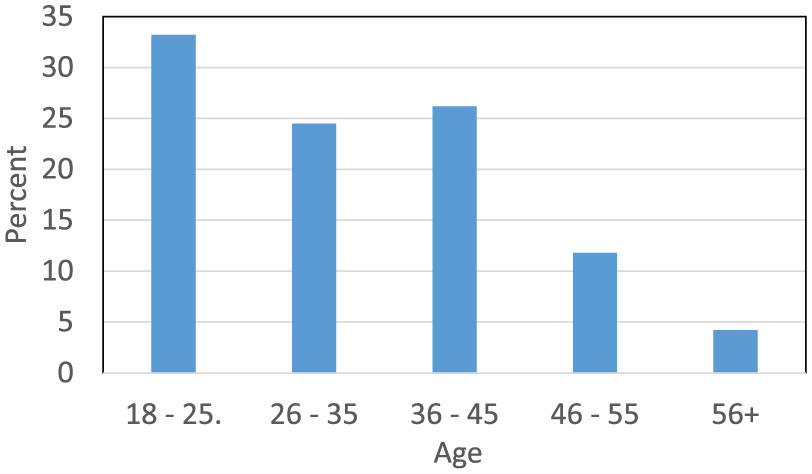
Distribution of the age of hate crime offenders.
Region
England is separated into nine geographical regions; Wales is a separate region. A total of 28.5 percent of HCO offenders committed their offences in London; the North West (16.6 percent), West Midlands (12.4 percent) and South East (10.4 percent) were the only areas that had greater than 10 percent of the hate crime offences.
Criminal history characteristics of hate crime offenders
Number and type of previous offences
A total of 347 out of the 355 (97.7 percent) HCOs had previous offences. Table 1 shows the prevalence (that is, the proportion of offenders who committed a specified offence) and the frequency, or number of offences per offender, for the 21 standard offences in England and Wales. For example, 12.4 percent (44/355) of the HCOs had previously committed serious violence. Furthermore, these 44 offenders had committed 56 previous offences of serious violence, or 1.3 serious violent offences per serious violent offender. Almost all (87 percent) HCOs had previously committed serious or less serious violence, and those who had committed violence had committed violence about six times. The next most prevalent offences were public order, criminal damage and other theft. Overall, HCOs had committed over 14,500 offences, for an average of 42 per previous offences per HCO.
Prevalence and frequency of offending by hate crime offenders.
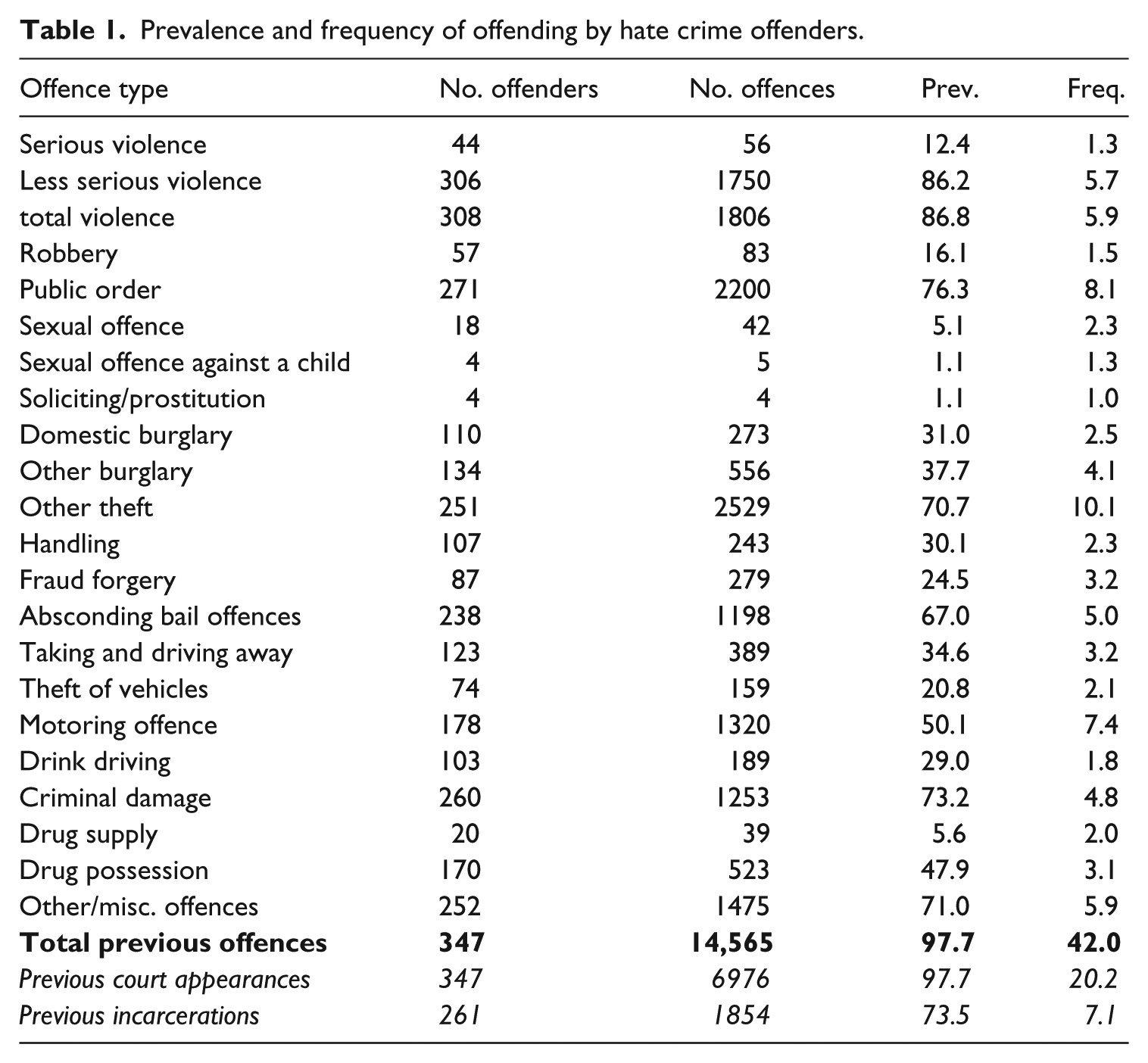
The bottom of Table 1 shows the prevalence and frequency of the previous experiences of court and incarcerations for HCOs. Almost all HCOs had been to court previously (97.7 percent), with an average of more than 20 times per previous offender. Over 70 percent of HCOs had previously been incarcerated and they had served an average of seven previous custodial sentences.
Age at first offence
A considerable amount of criminological evidence suggests that an early age of onset is associated with a long and prolific criminal career (for example, Moffitt, 1993). The average age of the first police recorded offence for HCOs was 18.2 (SD = 7.8) with a range from age 10 to 61.
Criminal career duration
The average criminal career duration, or the difference between the age of first and last offence, was 5625.5 days (SD = 4005.0), or 15.4 years, with a range from 51 days to over 23,000 days (about 62 years).
Versatility
The number of different types of previous offences (out of 21) were added up for each HCO offender to develop a picture of the versatility of their previous offending. For the 347 HCOs who had previous offences, the average was 8 different types of previous offences (SD = 3.6) with a range from 1 to 16 offences.
Sentence length and time served
The average sentence length was 147.7 days (median = 140, SD = 77.9) and the average time served was 56.0 days (median = 49, SD = 43.2). Therefore, the average HCO served slightly more than 38 percent of their sentence.
Offender Group Reconviction Score
The Offender Group Reconviction Score (OGRS) is a static risk assessment device that predicts the probability of reoffending (from 0 to 100) one year after release. This actuarial estimate is based on the offender’s gender, age at index offence and a measure of their speed of accruing convictions across their criminal career (Howard et al., 2009). The average HCO had an OGRS score of 50.2 (SD = 20.2), suggesting that these individuals had about a 50 percent chance of reoffending over the next 12 months.
Description of hate crime offenders with no previous offences
There were only eight HCOs (2.3 percent) who did not have previous criminal justice involvement. Of these eight, all but one was of White ethnicity (one was of Asian ethnicity), and all but one were of British nationality (one was of Pakistani nationality). The average age of these first-time offenders was 40 (median = 42; SD = 14.7), with a range from 23 to 60. Three of the offences took place in London, three in the West Midlands and two in Yorkshire and Humberside. Four of the index offences were for serious violence and four were for less serious violence.
Comparison with non-HCOs
The overall picture suggested that HCOs released from prison had extensive criminal histories, which was similar to findings in other hate crime perpetrator research (for example, Dunbar et al., 2005). However, this prolific criminal history may be typical of all those subject to short-term incarceration, and not necessarily a unique attribute of HCOs. In order to explore to what extent HCOs might be similar to, or different from, non-HCOs, HCOs were matched with non-HCOs on the index offence that resulted in their incarceration. The numbers of HCOs were sufficient to match violent HCOs (VHCO; n = 287) and public order HCOs (POHCO; n = 45) separately.
Violent hate crime offenders versus violent offenders
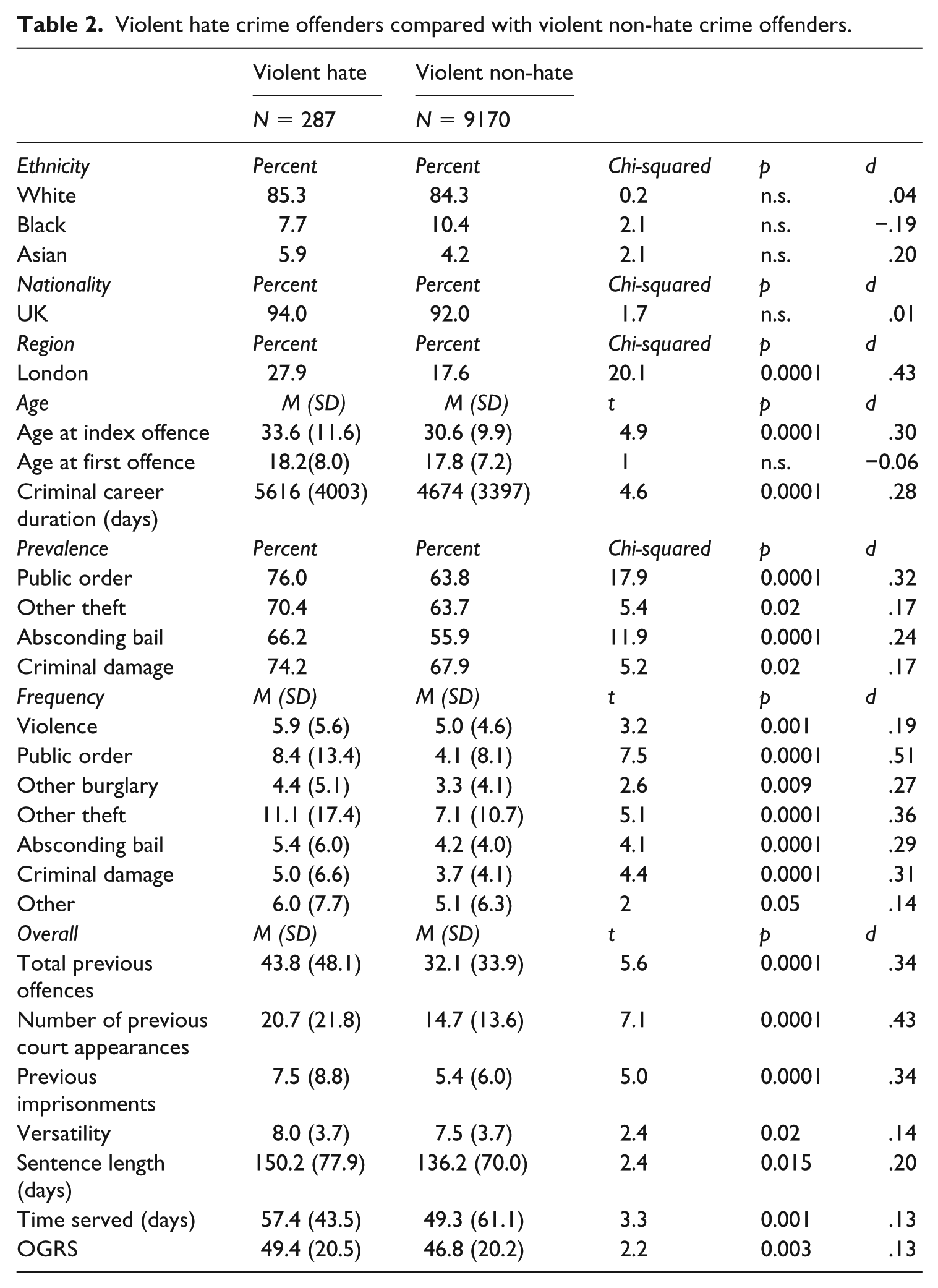
Table 2 shows the results for the 287 VHCOs released after a index violent offence, compared with the 9170 offenders released after committing a non-hate-related index violent offence. For example, 85.3 percent of the VHCOs were of White ethnicity, compared with 84.3 percent of those who were released after a non-hate violent index offence (VOs). This difference was not statistically significant (chi-squared = 0.2), and the small effect size (d = .04) also suggests limited difference between the two groups in White ethnicity. However, the results for those of Black and Asian ethnicity, although non-significant, had effect sizes (d = −.19 for Black and d = .20 for Asian) that are indicative of potential differences of note.
Violent hate crime offenders compared with violent non-hate crime offenders.
A number of methods of interpreting the magnitude of effect sizes have been proposed. A widely used convention is that proposed by Cohen (1988). An effect size less than about .20 is considered small, while an effect size around .50 is considered medium and an effect size greater than about .80 is considered large. These criteria are probably too conservative. For example, the effect size d is approximately twice the absolute difference in proportions in a 2 x 2 table. Thus, if 50 percent of HCOs had a specific characteristic (for example, early age of the first offence), compared with 20 percent of non-HCOs, d would be considered medium (.60).
There was no evidence that VHCOs differed from VOs in nationality (over 90 percent UK) or age at first offence (about 18, see Table 2). However, VHCOs were much more likely to come from London and to be significantly older than VOs. Also, the criminal career duration (the time between the age at first offence and the index offence) was significantly longer for VHCOs compared with VOs, as a result of the significantly later age at the index offence.
VHCOs were more likely to have committed several types of offences (for example, public order, other theft, absconding bail and criminal damage) compared with VOs, and they had also committed a significantly greater number of offences of certain types (for example, violence, public order, other burglary, other theft). There were no instances where the prevalence or frequency of offending were greater for VOs compared with VHCOs.
VHCOs also appeared more extreme on the summary criminal justice involvement variables. For example, VHCOs had significantly more previous offences, court appearances, and incarcerations, and were also significantly more versatile in their previous offending. Interestingly, the results of the OGRS suggested that VHCOs were at a significantly higher risk of reoffending compared to VOs, although the effect size was not large (d = .13, or about a 7 percent absolute difference).
There was also evidence that VHCOs received significantly longer sentences and served significantly longer in prison for their index offence, compared with VOs. This could indicate that the enhanced penalties introduced as part of the Criminal Justice Act 2003 for hate crime were being utilized. However, the sentencing guidelines in England and Wales suggest that a number of factors will be considered in setting a criminal penalty, including the age of the offender, the seriousness of the offence, the criminal record of the individual and whether the individual pleaded guilty or not (Sentencing Council, 2015). This makes it difficult to determine whether the longer sentences of the VHCOs were a result of their significantly older age, their more prolific criminal history or the fact that they had been found guilty of a hate crime. 8
In order to investigate influences on sentencing, a multiple regression was used to predict sentence length controlling for age, number of previous offences and whether the violent offence was a hate offence or not. Using a stepwise regression, the results indicated that age (F change = 74.0, p < .0001), previous number of offences (F change = 14.3, p < .0001) and a violent hate offence (F change = 12.4, p < .0001) all predicted longer sentences, suggesting that enhanced penalties for violent hate crime were being used.
Public order hate crime offenders versus public order offenders
Table 3 shows the results for the 45 HCOs released after a public order index versus index public order (POHCO), compared with the 1885 offenders released after committing non-hate-related index public order offences (POs).
Public order hate crime offenders compared with public order non-hate crime offenders.
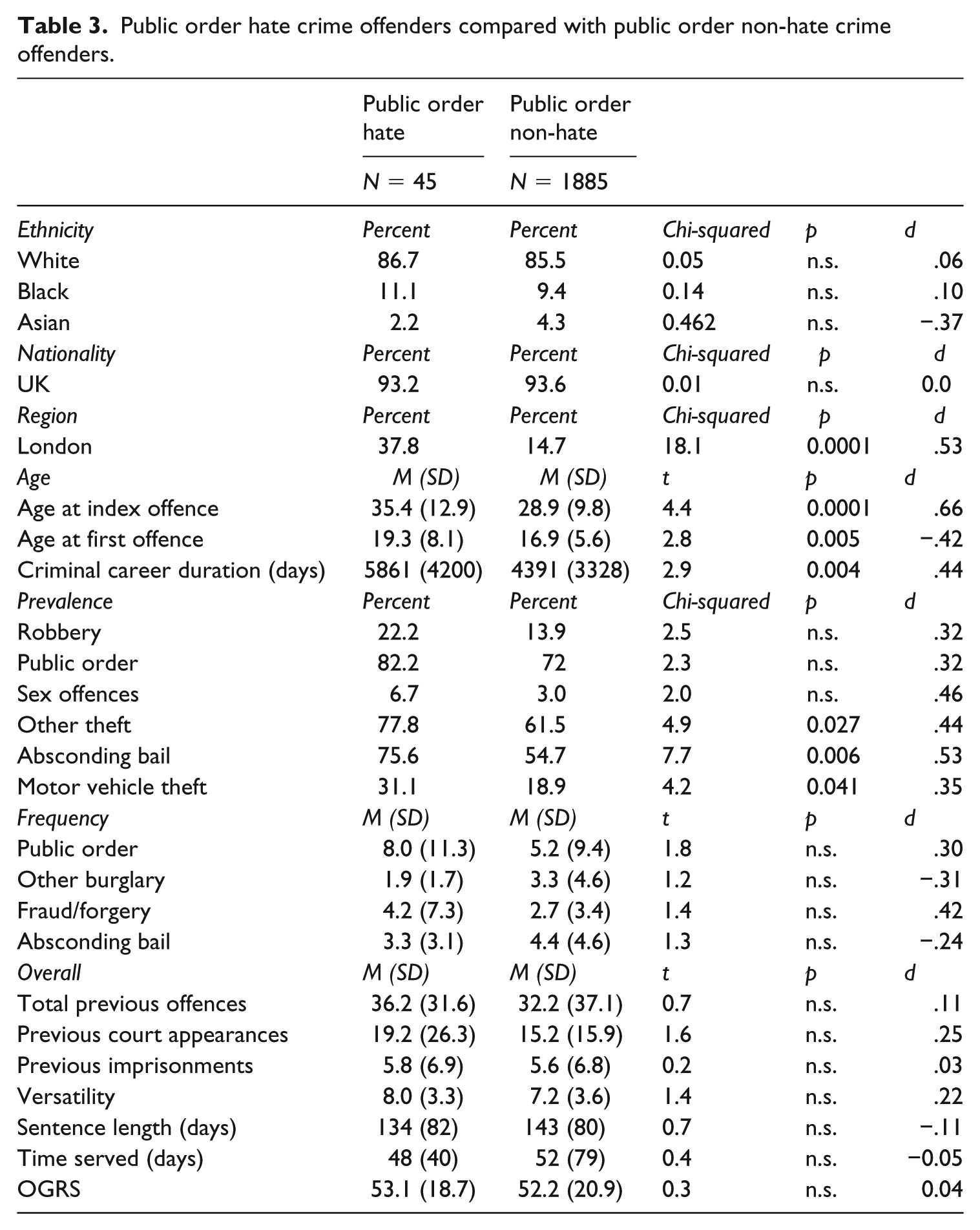
Similar to the comparison between VHCOs and VOs, there was no difference between POHCOs and POs in nationality, and an equal proportion of both groups were of White ethnicity (about 86 percent) and Black ethnicity (about 10 percent). Based on the effect size (d = −.37, or about a 19 percent absolute difference) there was an indication that those of Asian ethnicity may be less likely to be POHCOs compared with POs, but this difference was not statistically significant, probably because of the small numbers in this analysis. POHCOs were significantly more likely to come from London, were significantly older and had longer durations of criminal careers. Interestingly, POs had significantly earlier ages of onset than POHCOs.
Although not statistically significant, the effect sizes suggested that POHCOs might be more likely to have previously committed robbery, public order and sex offences compared with POs. These differences were statistically significant for other theft, absconding bail offences and motor vehicle theft. There were no statistically significant differences between the two groups in the frequency of previous offending, but, again, the effect sizes suggested potentially important differences, with POHCOs committing public order and fraud/forgery more often, and POs committing other burglary and absconding bail offences more often.
POHCOs had committed a similar number of previous offences to PO offenders and had a similar number of previous imprisonments. There was no evidence that POHCO offenders had been sentenced to longer in prison, nor had they served longer in prison. The effect sizes of d = .25 and d = .22 (or absolute differences in the range of 11–13 percent) suggested that POHCOs may have been somewhat more likely to have had more previous court appearances and to have been somewhat more versatile in their offending. The OGRS score, or the summary measure of risk of future reoffending, was similar for the two groups.
Discussion
Wider research suggests that hate crime is increasing substantially, and yet relatively little is known about the people who perpetrate these offences or how best to reduce the likelihood of their future offending. This research offers a unique perspective on the population of HCOs released after serving a short-term prison sentence in England and Wales for a hate crime offence. It is based on a large complete population of offenders in England and Wales and is the first study to systematically compare HCOs with other types of offenders.
The results suggested that HCOs made up a relatively small proportion of those sentenced to short-term incarceration (0.7 percent), and that these offenders had committed four different types of index hate crimes: serious violence, less serious violence, public order and criminal damage. These individuals were predominantly, but not exclusively, White and almost all were UK nationals.
Before committing the hate crime offence that resulted in their short-term incarceration, HCOs had extensive criminal careers, with 98 percent having committed previous offences and close to three-quarters having previously served time in prison. The typical hate crime offender had committed an average of 42 previous offences, been to court 20 times and been to prison 7 times. The range and versatility of the previous offending and criminal justice experience of HCOs suggests that the typical HCO is unlikely to be a specialist who commits only hate-motivated crime. This fits well with the extensive knowledge generated by the criminal career approach about the versatility of offending (for example, DeLisi and Piquero, 2011), as well as practitioner-based hate crime research (Iganski, 2012).
When matched on the index offence (violent or public order), HCOs were found to be older and, as a result, to have longer criminal career durations than non-HCOs. This could be an age-related finding, in that older people, many of whom may have experienced less cultural diversity in their upbringing, may be more likely to commit a hate crime. However, hate crime could also be an offence that arises later in a prolific criminal career. Just as previous longitudinal research has shown that shoplifting is typically committed before burglary, which in turn is typically committed before robbery (Le Blanc and Fréchette, 1989), violent hate crime could arise at a later point in a criminal career, after, for example, violent offending. Alternatively, it could be that hate crime is an offence committed by chance in a relatively long and prolific criminal career.
This research also showed that violent hate crime resulted in a longer sentence (controlling for age and number of previous offences), in line with the enhanced sentencing provisions of the Criminal Justice Act 2003. In addition, the number with hate criminal damage was very small (n = 17) but, when matched with those who had non-hate criminal damage (n = 909), those with hate criminal damage also received significantly longer sentences (M = 164.0, SD = 71.6, compared with M = 82.2, SD = 61.7, p < .0001), and these two groups did not differ in age or number of previous offences. However, those with public order hate crime offences were not punished more harshly (Table 3). Future research should explore why public order hate crime offences, many of which can be quite serious (for example, aggravated harassment), were not worthy of increased penalties.
Future research should also explore why most hate crime offences appeared to take place in London. This finding is congruent with seminal theories developed to explain inter-ethnic aggression such as the racial threat theory. This theory argues that majority group members perceive the relative size of minority populations as threatening and as a result take action, such as hate offences, to reassert their dominant status (for example, Blalock, 1967; Perry, 2001). London, being one of the most diverse cities in the world (with only 44.1 percent White British in the 2011 Census; Office of National Statistics, 2012), may therefore provide fertile ground for the perception of so-called racial threat.
Alternative interpretations of the finding that there was increased incidence of hate crime in London include that the relatively high ethnic mix simply provides the greatest opportunity for hate crime, or that London, being a large metropolitan city, has high levels of crime, and therefore levels of hate crime are also high. In addition, and keeping in mind the select population under study, it could be that London has particularly effective policing and prosecution of hate crime.
This research has limitations that need to be considered. The use of those released from prison for a hate crime increases confidence that these individuals did commit a hate crime and that the offence was serious enough to warrant incarceration. Critically, however, these offenders are very unlikely to be representative of all those who commit hate crime, because these data miss those at the other levels of the crime funnel, from the commission of an offence to incarceration. For example, it is well known that many hate-related offences are not reported to the police (for example, Chakraborti et al., 2014), let alone result in an offender being apprehended or convicted. In addition, these data missed those who received community orders for hate offences and also those who committed more serious hate offences and were sentenced to longer terms of incarceration. These limitations should be considered when reflecting on the generalizability of these results to all HCOs, most of whom may go undetected. Future research should explore whether there are differences in important demographic or criminal history features between those who commit hate offences, those who are arrested for hate crime, those who are convicted of hate crime, etc., all the way through the crime funnel (see Farrington et al., 2004).
Unfortunately, the data did not allow for a proper exploration of specialization in hate crime offending. This is because the details of previous offences were recorded only into the 21 Home Office codes and previous hate crime offending could not be identified. This could mean that some specialization in hate crime offending does exist but, given the range of previous offences, this seems rather unlikely. The data also did not allow for an exploration of the specific details of the offence. Certain types of HCOs may be more likely to target victims because of certain protected characteristics, or may commit their offences in groups or with certain types of co-offenders.
The quantitative approach used here also limits the ability to provide insight into the various findings. For example, the results showed that the largest proportion of HCOs came from London, but this could be because of more aggressive arrest and prosecutorial practices in London or because the multi-ethnic and multi-national make-up of London provided more opportunities for hate crime to take place. Future mixed-method approaches are clearly needed.
Conclusion
The commission of a hate crime has wide-reaching implications (for example, Perry, 2001), and much more high-quality research into the perpetrators of these offences and the details of these offences is needed. Ideally, prospective longitudinal community studies, starting in childhood, should be conducted in which children and their families are interviewed at regular intervals about important individual (for example, impulsivity, empathy, school success), family (for example, parental supervision, parental antisocial behaviour) and social (for example, neighbourhood deprivation) factors associated with offending and antisocial behaviour. Information about the perpetration of hate crime, as well as other types of offending, could then be collected by self-reports and through searching official records. This would allow for an investigation of the factors associated with hate crime, including crimes not coming to police attention, and it would provide essential insight into the development of HCOs and the commission of hate crime offences.
Furthermore, high-quality evaluation approaches such as randomized controlled trials and quasi-experiments are needed to evaluate the impact of programmes for HCOs on later offending. Currently, there is no robust evidence about ‘what works’ with HCOs. This is particularly problematic given the prolific criminal careers identified, particularly for violent HCOs, in this research. Until specific programmes for HCOs are properly evaluated, HCO programmes should be based on programmes for general violent offenders (for example, Jolliffe and Farrington, 2007).
