



Abstract
In recent years immigration control has seen an increase in the implementation of risk assessment technology. According to proponents, such technologies would lead to more objective decision-making compared with the discretionary decisions made by street-level bureaucrats. However, because empirical research on risk assessment technology is limited, it is not quite clear how risk assessment technology in migration control impacts the decision-making process and to what extent it does make the decision-making process more objective. This article aims to shine a light on this issue by making use of a case study of Amigo-boras, a smart camera system used by the Royal Netherlands Marechaussee (RNM) for migration control purposes. Qualitative data show that Dutch immigration officers are still able to exercise discretion in the execution of their tasks, placing doubt on claims to objectivity. This finding is confirmed in quantitative data based on a US case study. Although quantitative data on the decision-making process would be able to show if these doubts were justified, the RNM has no such data on the outcomes and selection process using Amigo-boras. This information gap raises new issues regarding the objectivity of the selection process and the individual accountability of RNM officers.
Risk assessment and migration control
Since the abolition of border control as a result of the Schengen Agreement, European countries have been facing a dilemma. On the one hand, the open borders give the opportunity of free travel and trade, resulting in great economic benefits. On the other hand, open borders create risks regarding migration and crime, because not only will tourists and the transportation industry be able to benefit from the lack of border control, but so will criminals and irregular migrants. Immigration is increasingly framed as a security issue because immigrants are presumed to bring risks of terrorism, cross-border crime and illegal immigration (Barker, 2012; Bosworth and Guild, 2008; Dekkers et al., 2016; Provine and Doty, 2011; Van der Woude et al., 2014), a development also referred to as ‘crimmigration’ (Stumpf, 2006, 2011; Van der Woude et al., 2014). Schengen member states have thus been searching for ways to balance economic benefits and border security measures, by trying to distinguish bona fide travellers from dangerous criminal immigrants (Aas, 2011; Koulish, 2013). Because the legal possibilities for physical border control using walls and border guards to tackle this issue are limited owing to the Schengen Border Code, a solution to this issue is often sought in information technology. The EU has seen an upsurge in border technologies aimed at controlling migration and border mobility (Broeders and Hampshire, 2013; Kenk et al., 2013) by differentiating between wanted and unwanted immigrants using actuarial and risk assessment methods (Haddal, 2010; Harris, 2012; Rosenblum, 2012).
A country that has been receiving an increasing amount of attention in this regard is the Netherlands. Since August 2012, the Royal Netherlands Marechaussee (RNM), which is responsible for migration control in the Netherlands, has been using a smart camera system called Amigo-boras. The system is used during migration checks called the Mobile Security Monitor (MSM), aimed at combatting irregular migration, identity fraud and human smuggling. Amigo-boras is used, amongst other things, to detect vehicles that carry a high risk related to those offences using automated risk profiling. Since the introduction of Amigo-boras other countries have been watching the system with great interest. Sweden, Denmark (Sveriges Radio, 2017), Belgium (NOS, 2016, 2017) and, according to sources within the RNM, Germany have expressed interest in developing or are developing smart camera systems similar to Amigo-boras.
Such systems are not implemented without reason, of course. Research has indicated that policy-makers have much faith in technology to address complex social issues (Broeders and Hampshire, 2013; Hayes and Vermeulen, 2012; Kearon, 2013; Kemshall, 2003; Meijer, 2011; Muller, 2004; Nye, 2004; Wilson and Weber, 2008) and the wide array of border technologies shows that migration is no exception. The development towards technology-assisted decision-making is often praised by policy-makers for its efficiency, its effectiveness and – more importantly in the context of this article – its alleged objectivity. It would have many benefits over traditional human decision-making by immigration officers. The technology and actuarial methods used to separate high-risk from low-risk individuals are viewed as objective: computers do not have opinions and biases to which humans are prone, they would be able to pinpoint high-risk individuals making migration controls effective, and, because fewer resources are wasted on checking low-risk individuals, they would increase the efficiency of migration controls.
The academic literature on decision-making does give reason to question how realistic the imagined scenario of technology-assisted decision-making is. As Lipsky ([1980] 2010) writes in his classic work on decision-making in public services, street-level bureaucrats are difficult to manage and they value their ability to make discretionary decisions. Implementing information technology to (partially) replace their ability to make decisions as they see fit could therefore meet resistance. Empirical studies in various disciplines and professional settings have shown that this can be the case (Broadhurst et al., 2010; Fitzgibbon et al., 2010; Kemshall, 2011; Lynch, 1998; Oleson et al., 2011; Schneider et al., 1996). Of course, if the individuals who are supposed to use the information technology do not actually do so, this has implications for the objectivity of decisions and, by extension, the broader goals regarding migration and security for which the technology was introduced.
The above leads to the question: ‘To what extent does the use of risk assessment tools such as Amigo-boras increase the objectivity of decisions that would otherwise be taken by street-level bureaucrats?’ This question will be answered by using a case study of Amigo-boras. Observations, interviews and quantitative data will be used to see how Amigo-boras is used to make decisions during MSM checks. To further reflect on the results of the Amigo-boras case study, insights from other risk assessment technologies – in particular a US case study of a comparable system – will be used.
Discretion, human agency and technology
For a long time human input was seen as a crucial factor for decision-making (Lipsky, 2010). The real world can be complex and many situations need careful consideration and the weighing of possibilities by human beings because ‘the nature of service provision calls for human judgement that cannot be programmed and for which machines cannot substitute’ (Lipsky, 2010: 161). Decision-makers therefore need to be able to exercise discretion to solve the issues without being completely bound by rules, regulation and rigid protocols. Discretionary decision-making allows for the nuance and efficiency needed to solve the complex situations professionals face on a daily basis (Lipsky, 2010; Spader, 1984). Now that risk assessment technology is widely available, opponents fear that technology is taking the place of individual professionals in the decision-making process. In the words of Hannah-Moffat et al.: ‘Risk technologies are often characterized as having supplanted much of practitioners’ discretionary decision making with structured, quantitatively derived decision-making templates’ (2009: 391). The rigid procedures and formats that can come with the use of risk assessment technology possibly prohibit or limit human influence on the decision-making process (Buffat, 2015), comparable to Weber’s ‘iron cage’ analogy in the context of bureaucracy. The concept of the iron cage entails ‘an ever increasing focus on rationality, technical superiority, and efficiency [which] can imprison people in an iron cage of rationality’ (Maguire, 2014: 70). The striving for rationality and efficiency within organizations would result in a plethora of rules and regulations, which would act as a cage for the individual worker, restricting individual expression and the ability to influence work processes. The increased use of risk assessment tools could have a similar effect by replacing human decision-making with automated decision-making. This could result in what Bovens and Zouridis (2002) call a system-level bureaucracy where technology has the decisive power, disabling any form of human influence on the decision-making process.
Although the critics of risk assessment technology stress the need for discretionary decision-making, one should keep in mind that room to manoeuvre also comes with a downside: subjectivity. Whereas on the one hand discretionary freedom is praised, it is also the case that individuals making decisions may be biased or make improper use of their powers, which can lead to unfair judgements or even discrimination (Lipsky, 2010; Spader, 1984). As Cheliotis (2006) points out, this potential downside was one of the reasons for developing risk assessment technologies in the first place: to prevent racism, sexism and other forms of discrimination that can be part of discretionary decisions made by humans. The use of statistical models and actuarial methods, which are at the core of risk assessment technology, would result in fair and objective decision-making without the potential negative side effects of subjectivity. Risk assessment technologies are therefore often presented as objective (Broeders and Hampshire, 2013; Dekkers et al., 2016; Kemshall, 2003; Lyon and Haggerty, 2012; Muller, 2004; Rose, 1998; Wilson and Weber, 2008).
However, a factor that is often left out of this perspective is that risk assessment technologies do not operate within a vacuum (Ballucci, 2008; Cheliotis, 2006). They are part of an organization and wider social environment that consist of many individuals who all have particular tasks, but also ideas and views on how to perform those tasks (Hupe and Hill, 2007; Lipsky, 2010; Rose, 1998; Selznick, 1948; Tyler et al., 2007). People’s own beliefs may conflict with official policy or rules can be ambiguous, causing workers to follow the rules less strictly or to interpret them in a way that was not intended (Hupe and Hill, 2007; Tyler et al., 2007). With this in mind, these individuals can influence how policy, and by extension risk assessment technology, is applied in practice. As Cheliotis (2006) states, the Weberian idea of bureaucracy would overestimate the ability to suppress personal thought and influence and underestimate human agency. For Ballucci (2008), the element of human agency is therefore reason to question whether the development towards risk-based thinking and the introduction of risk technology have actually been able to change institutional practices.
The above shows that the issue of risk technology versus human decision-making is a complex one. In the literature there are different and often contradictory views on how technology affects decision-making, making it difficult to derive concrete expectations for the Dutch case study central to this article. In an exploratory way, this article aims to prove the importance of empirical insights into the use of risk technology in practice, because it can add the nuance to the theory on risk that Ballucci (2008) calls for, as well as offering a better understanding of the implementation and impact of risk assessment technology.
Method and data
This article will employ two case studies to study the role of technology in discretionary decision-making processes in migration control: one from the Netherlands and one from the USA. Although these countries differ in various ways, both are making progressively more use of risk technology in migration control, and the discourse on migration for both countries shows an increasing overlap of crime and migration, ergo crimmigration. The first case study is that of Amigo-boras. For this, researchers observed the officers of the RNM on ride-alongs in the period October 2013 to March 2015 during MSM checks on highways near the borders with Belgium and Germany. Researchers went on 57 tours with the officers at 7 different locations. The observers recorded a total of 800 hours of observation. The MSM checks varied in size, ranging from 4 to 30 officers present, all of whom could be approached by the researchers.
During the MSM checks, researchers observed vehicles selected by RNM officers and an observation form was used to write down the observable characteristics of the vehicle, the occupants and events during the check, as well as whether or not the check was a result of an Amigo-boras hit. When a vehicle was cleared and allowed to continue, researchers used a new form for the next vehicle that was stopped. This resulted in a total of 330 completed observation forms. In addition to the observations, there was also time for conversations with the border patrol officers present at the MSM checks. Although there was no specific topic list or a structured approach for these conversations, they would often be about what was happening during the checks, the use of Amigo-boras or the work of the border patrol officers in general. Valuable information from these conversations was recorded in field notes. After the shifts, these field notes were written down in a more detailed manner. These field notes were later systematically analysed using Atlas-ti. More qualitative data were collected through focus groups. These group conversations were organized after a year of ride-alongs. The aim of the focus groups was to get feedback on the preliminary results and to gather more in-depth information on specific subjects. A topic list was used during the focus groups. In total, 13 focus groups were organized at 7 different locations, resulting in 25 hours of conversation. On average, 8 officers took part in the focus groups, ranging from 6 to 12 officers. To supplement the street-level perspectives, interviews at a policy level were conducted between August and November 2015 as well, with a total of 18 interviews. The respondents had different positions ranging from staff-level employees of the RNM, policy-makers of the RNM, and administrators working at the Ministry of Security and Justice and the Ministry of Defense. A topic list was used for these interviews containing a wide range of topics related to MSM checks, including the use of Amigo-boras. The transcripts of the focus groups and interviews were analysed in Atlas-ti. In addition to this more qualitative data, the RNM also provided quantitative data on MSM checks and the use of Amigo-boras. These data contain, amongst other things, information on when and where the Amigo-boras system was used and which profiles were used during the checks. This information was analysed using SPSS.
The second case is that of the Risk Classification Assessment (RCA) used by the United States Immigration and Customs Enforcement (US ICE). The RCA case will be used to further reflect on the results of the Amigo-boras case and will be discussed in more detail in the ‘Accountability’ section.
Immigration control with smart cameras
The RNM is responsible for combatting irregular immigration and cross-border crime in the Netherlands. One of the ways it does this is through the MSM mobile migration checks. These checks consist of temporary checkpoints on highways near the border. There are, however, limitations to MSM checks owing to national and international rules and regulations. According to the Schengen Border Code, not every vehicle that crosses the border can be stopped. Officers of the RNM therefore have to make a selection. In addition, the Dutch Aliens Act imposes time restrictions on the MSM, meaning that checks can last only 6 hours each day on a single highway, with a maximum of 90 hours a month for each of the highways. In order to deal with these limitations and to make the MSM as effective and efficient as possible, the RNM has developed a smart camera system called Amigo-boras (Dekkers and Van der Woude, 2016; Dekkers et al., 2016). The system was installed on 15 highways crossing the borders with Germany or Belgium and several SUVs have been equipped with a mobile version of the system.
Although the system has multiple functions – traffic data collection, vehicle selection based on risk profiles and an alerting system for specific vehicles – this article will focus only on the vehicle selection part of the system using risk profiles. Before the introduction of Amigo-boras in August 2011, the selection of vehicles during MSM checks was entirely up to the discretion of the RNM officers. Based on their own experience, officers could select vehicles that they considered worth checking. With the introduction of Amigo-boras this practice has changed, because the system can now assist in selecting vehicles for immigration checks when they enter Dutch territory. In other words, the decision to stop a vehicle is no longer just up to the individual officer, but can also be triggered by the Amigo-boras system. Which vehicles are flagged by the system as potentially of interest is decided based on a risk profile. In practice this means that the system takes a picture of the front of the vehicle – the occupants are not visible in this picture – and analyses the picture. If the vehicle in the picture fits a risk profile, the system will send a signal to an RNM officer behind a computer, called the director. The director makes a first assessment of the selected vehicle to see if it is indeed a match to a risk profile – which is displayed on screen – and, if so, will send information to an RNM officer near the border who can stop the vehicle in question. The current research will focus only on the role of the officer stopping the vehicle in relation to Amigo-boras and not the role of the director.
Amigo-boras hits and individual assessment
Before getting to how the Amigo-boras influences the decision-making practices of the RNM officers, a short description of how the system was initially presented is necessary. The goal of Amigo-boras is to ‘implement an intelligent technology concept which enables the RNM to act pro-actively, efficiently, effectively and intelligence led in border surveillance’ (Koninklijke Marechaussee, 2008). According to documentation on Amigo-boras, one of the ways the system would accomplish this is by making use of advanced profiling.
1
The risk profiles used by the system would consist of multiple factors such as vehicle characteristics, traffic patterns and licence plates (Koninklijke Marechaussee, 2009). According to the Ministry of Security and Justice, the advanced profiling capabilities of Amigo-boras would enable a more accurate selection process and fewer unnecessary MSM checks of those who cross the border with the proper documentation,
2
which should result in combatting irregular migration and irregular stays in a more effective and efficient manner.
3
In addition, the documentation indicates that Amigo-boras should result in a more objective selection process:
The system assists the selection process of MSM checks and makes them faster and more objective, making Amigo-boras an effective addition to what now happens based on the professional experience of RNM officers.
4
The official documentation does not give much more information than that, however. How the goals of a more efficient, effective and objective selection process are to be achieved in practice and how improvements are measured are not substantiated. The interviews and observations with the RNM will therefore have to be used to get a better insight into the workings of the system.
Whereas the documentation emphasizes the importance of the objectivity of the selection process using Amigo-boras, the interviews and fieldwork give a different, more modulated perspective. Respondents underlined that the system is designed to support the decision-making process, not to replace human assessment and decision-making. As one respondent explained:
It is not the camera that makes the selection, it’s the camera that gives an indication. Like, ‘heads up …, take a look at that.’ In the end it is always the officer who will make the selection.
A vehicle selected by Amigo-boras therefore does not have to be stopped by the RNM officers. When an officer does not think that a vehicle flagged by Amigo-boras is indeed worth checking, he or she can decide to let the vehicle pass by without a check. Likewise, if an officer thinks that a vehicle that is not flagged by Amigo-boras is worth checking, he or she can still decide to stop the vehicle. According to staff employees of the RNM, the selection process while using Amigo-boras is therefore a combination of automated risk profiling and officer-based profiling, as a result of which the officers still enjoy a fair amount of discretion by design.
However, the ride-alongs with the border patrol showed that the intended combination of automated risk technology and personal assessment as described by the interviewed RNM policy officials was not as balanced in practice. The main issue was that, according to street-level officers, the selection criteria of Amigo-boras were far too general. Whereas the documentation of Amigo-boras presented its profiling capabilities as advanced, the fieldwork and interviews showed that this may have been an overstatement, because not every factor listed in the documentation on Amigo-boras was used in practice. In fact, the profiles were described by the majority of both officers and staff-level employees as being solely based on licence plates. In the interviews and focus groups, respondents stated:
Profiles, well, if you look at how that’s going with Amigo-boras, well, that’s all based on the country of origin of the vehicles. With Amigo-boras you can filter the interesting licence plates. But you can’t use all kinds of profiles and such.
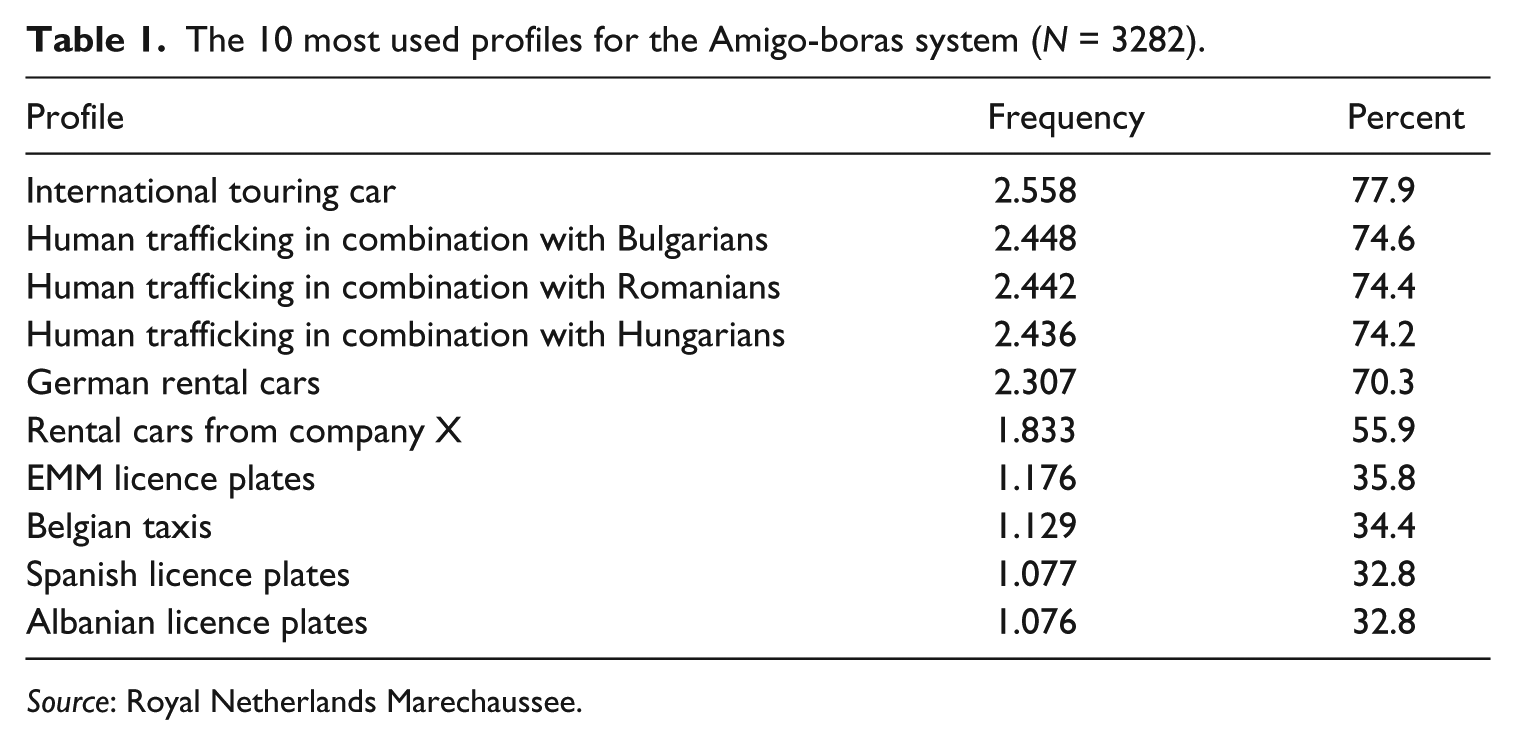
The licence plate was the primary factor in the selection process for Amigo-boas and could contain several pieces of information that could be linked to a risk profile. Mentioned most often during the fieldwork and interviews was the ability to obtain the country of origin of the vehicle from the licence plate. This was an important piece of information because the RNM tended to focus on specific nationalities during MSM checks owing to an association between certain nationalities and certain forms of immigration offences or crime (see also Dekkers, 2018; Van der Woude et al., 2016). This is supported by the quantitative data made available by the RNM. These show that the profiles used in conjunction with Amigo-boras are primarily aimed at vehicles from certain countries, which is seen as an indicator of the nationality of the individuals in the car. Table 1 shows the names of the profiles used the most during MSM checks, the majority of which are linked to specific countries. Although the quantitative data themselves do not give any insight into the precise variables of each profile during the ride-alongs with the RNM, researchers were present at briefings before MSM checks. During some of these briefings the profiles used by Amigo-boras were discussed and displayed on a screen in the briefing room. Although the profiles consisted of multiple factors, including country of origin of the vehicle, type of vehicle and information on the occupant such as age brackets, gender and number of people in the vehicle, only the country of origin of the vehicle was detectible by Amigo-boras. The other factors, although part of the profile, were to be observed by the officers.
The 10 most used profiles for the Amigo-boras system (N = 3282).
Source: Royal Netherlands Marechaussee.
However, the licence plate could be used for more than just determining the country of origin of the vehicle. Officers explained that, since certain countries use area codes in their licence plates, they could use these ‘clues’ to search for vehicles from specific regions that were connected with illegal activities. Since some countries also use specific letter combinations for rental cars or taxis, this information could also be used both by the officers as well as by the Amigo-boras system.
Although officers agreed that the licence plate was an important starting point for vehicle selection, using only the licence plate to derive the country of origin was not considered to be very useful by the officers to select vehicles in the context of migration control.
And profiles, well, looking at how that works with Amigo-boras, that’s all the nationality
5
of the vehicle. Yeah, who’s in it, in the vehicle, the system doesn’t see that. The system isn’t allowed to see that. But it doesn’t help, you can’t do anything else with the system. It can only recognize a Dutch licence plate, a Hungarian licence plate, but it doesn’t see a difference if the same vehicle passes by ten times or if it’s a truck. It’s only the nationality, based on the licence plate.
According to the officers, profiling in the context of the MSM included a lot more factors: the characteristics of the vehicle, the characteristics of the occupants and their behaviour were all part of the selection process (see also Dekkers, 2018; Dekkers and Van der Woude, 2016). Officers indicated that, without these additional factors, finding irregular migrants in the cross-border traffic would not be very efficient or effective. As a result, officers valued their own expertise and profiling capabilities over the Amigo-boras system. This was explained during the focus groups:
Why would you build a system to do something a person can do, and even better!? I think a system like that will kind of work some day, but I think it will never be as good as doing it yourself.
Variations on the statements above were often heard during both the focus group interviews and the fieldwork. In the eyes of the RNM officers, the technology was not able to do what they did, thus making the Amigo-boras system redundant. Some officers were of the opinion that technology should not even be part of the selection process. That task was meant to be done by people, not machines, as an officer expressed during the fieldwork:
But the MSM, that is, you are looking for people, it’s people’s work. So it should be done by people. That’s how I see it.
The ambivalence of RNM officers regarding the usefulness of the Amigo-boras system resulted in three scenarios observed during the ride-alongs. First, officers would select vehicles not flagged by Amigo-boras purely based on their personal assessment. This was true for the majority of cases during the fieldwork. Out of the 330 observation forms filled out during the fieldwork, only 10 were due to an Amigo-boras hit. It should be noted that Amigo-boras was not used during all observations, but even for the MSM checks where Amigo-boras was used the number of hits was low. Second, officers would let vehicles flagged by Amigo-boras go because, based on their personal assessment, they were not seen as vehicles of interest at all. Officers stated this was a regular occurrence, because Amigo-boras would flag vehicles of families going on vacation or elderly people who were not worth checking. Third, officers would stop vehicles that were flagged by Amigo-boras. With regard to this last category, officers often stated during the fieldwork that these vehicles would also have been selected without Amigo-boras. As an officers summed up during a focus group:
To be honest, at the moment Amigo-boras is redundant, because if the vehicle would be of interest the officer would have spotted it anyway.
Accountability
Although the above seems to indicate that Amigo-boras has a limited influence on the decisions made by Dutch border patrol officers, the RNM should be able to monitor to what extent the system is actually used in the decision-making process. Since one of the main selling points of Amigo-boras, and of risk assessment tools in general, is objectivity, it would make sense to monitor the outcomes of the system and how the information it produces is used. This would not only enable the RNM to assess the impact of the system on the decision-making process, but would also enhance accountability. As defined by Hupe and Hill (2007: 286), accountability is ‘a social relationship in which an actor feels an obligation to explain and to justify his conduct to some significant other’. By explaining which actions were taken and why, the significant other will be able to see and decide if those actions were rightfully taken, which plays an important role in creating and maintaining support and trust (Goldsmith, 2005). This is especially imperative for organizations that are able to undertake coercive measures that can have a great impact on the lives of citizens or migrants and therefore need to be taken carefully and responsibly. The riots and protests owing to police misconduct in Paris in 2005, London in 2011, Ferguson in 2014 and Baltimore in 2015 are examples of what lack of accountability can result in. For the RNM this means that it should be able to explain to the general public, its significant other, how and why decisions regarding MSM checks (a coercive measure) are taken in order for the general public to decide if the RNM uses its coercive powers responsibly and deserves support. A factor that adds complexity to this issue is that MSM checks are initiated based on a discretionary decision by RNM officers. As Lipsky (2010) points out, street-level decision-makers are hard to manage and individual accountability is difficult to achieve. This is particularly true for police organizations such as the RNM, where discretionary decision-making is seen as an important part of the organizational culture (Gundhus, 2017). Yet, in the ongoing professionalization of police organizations, an attempt is made to gain control over officers’ discretionary decisions through bureaucratic and managerial means (Cockcroft, 2015). Automating part of the workflow or using information technology are often seen as a (partial) solution to this problem, because it would enhance accountability by giving insight into the decision-making process of street-level bureaucrats (Ballucci, 2008; Buffat, 2015). Therefore, quantitative data on Amigo-boras could enhance the accountability of the RNM by making the decision-making process more transparent and by showing to what extent it adds to the objectivity of the decisions made by RNM officers. Considering the scepticism that accompanied introduction of the system (NRC, 2011; Privacy First, 2015; Telegraaf, 2016), the RNM could use its quantitative data to show the added value of Amigo-boras and improve public support and the perceived legitimacy of the system.
Oddly enough, the RNM claims to have no such data. This was explained by the fact that the system is stand-alone and is not connected to any other databases. Amigo-boras records when which vehicles were flagged and only that. If the flagged vehicle was actually stopped is not recorded. The outcome of the check is recorded in a different and unconnected database. Therefore, if the RNM wanted to know if a vehicle was selected by Amigo-boras or an officer, it would have to manually find a match in two databases. As this is time- and resource-consuming work, the RNM has not taken up this chore, meaning there are no quantitative data available on whether the system has any impact on the decision-making of border patrol officers and whether the system has successfully identified vehicles related to irregular migration and cross-border crime. This, of course, raises the question of how the RNM is ever going to be able to evaluate the performance of Amigo-boras. Although the system was implemented to make the MSM checks more objective, effective and efficient, seeing if this is actually true becomes very difficult if there are no data on any of the processes and outcomes. How is it possible to back up the claim that Amigo-boras will contribute to the combatting of irregular migration by flagging high-risk vehicles and letting low-risk vehicles pass if it is unknown which flagged vehicles are actually stopped and what the outcomes of the MSM checks are? In addition, how is it possible to hold officers accountable for their selection practices if it is unknown if vehicles were selected by Amigo-boras or an officer? One would expect such a fundamental feature to be in the interests of the RNM and therefore to be part of the system design. The absence could imply the system was designed by individuals with a lack of expertise on the subject, a lack of effort to implement such a feature or being left out on purpose. Whatever the reasons may be, this crucial lack of information suggests that accountability was not a high priority when designing the system.
The Amigo-boras case study will therefore not be able to give a complete insight into the workings of decision-making using risk assessment technology in migration control. However, other sources could prove to be helpful in filling this gap and show why it is important to study the actual impact of such systems with accountability in mind. For this we turn to a different risk assessment tool in migration control called the RCA, which is used by the US ICE. The RCA generates recommendations on whether or not an alien in ICE custody is to be released from custody or to be detained. In the case of the latter, the RCA can make a bond recommendation and it recommends the security level necessary for the detention, called the custody classification levels (US ICE, 2012a; for more on the RCA, see Noferi and Koulish, 2014). In this article we will focus only on the decision to detain or not. Although the RCA seems like a different system compared with Amigo-boras, it has more in common than one would expect at first glance. Both operate in the context of migration control, use risk assessment methods and give recommendations that migration officers can use for decision-making. They therefore serve the same fundamental purpose and use similar methods. However, unlike the case of Amigo-boras, ICE does collect data on the RCA assessment and the following decision made by the officer, giving further insight into the extent to which the system is used in the decision-making process. These data were acquired through Freedom of Information (FOIA) requests by one of the authors (see also Noferi and Koulish, 2014), resulting in a data set containing 585 individual risk assessments based on RCA Detailed Summary reports. All individuals in the data set were processed by ICE in the period March–July 2013. The data, however, are not national data and contain only subjects from the Baltimore area. The results presented below are therefore not representative of the USA as a whole.
The RCA’s recommendation to detain or not is based on two factors: risk of flight and risk to public safety. Both factors consist of several variables, such as home security and community support for risk of flight and criminal history and ties to gangs for risk to public safety. Based on these variables, a person could score low, medium or high for risk of flight or risk to public safety. When a person scores low on both factors, the RCA will recommend release and scoring high on at least one of the two factors will result in a recommendation to detain. The RCA will not make a concrete recommendation in all cases, however, because in the case of a combination of two mediums or a medium and a low the system will defer to the supervisor. As emphasized by ICE documentation, the RCA output should be considered a recommendation and ‘ICE personnel maintain the ability to exercise discretion and document all decisions’ (US ICE, 2012b). If an ICE officer disagrees with the RCA risk assessment, he or she can choose not to follow the recommendation and decide differently. In the light of objective and uniform decision-making using risk assessment technology, this is an important step in the process and requires further investigation.
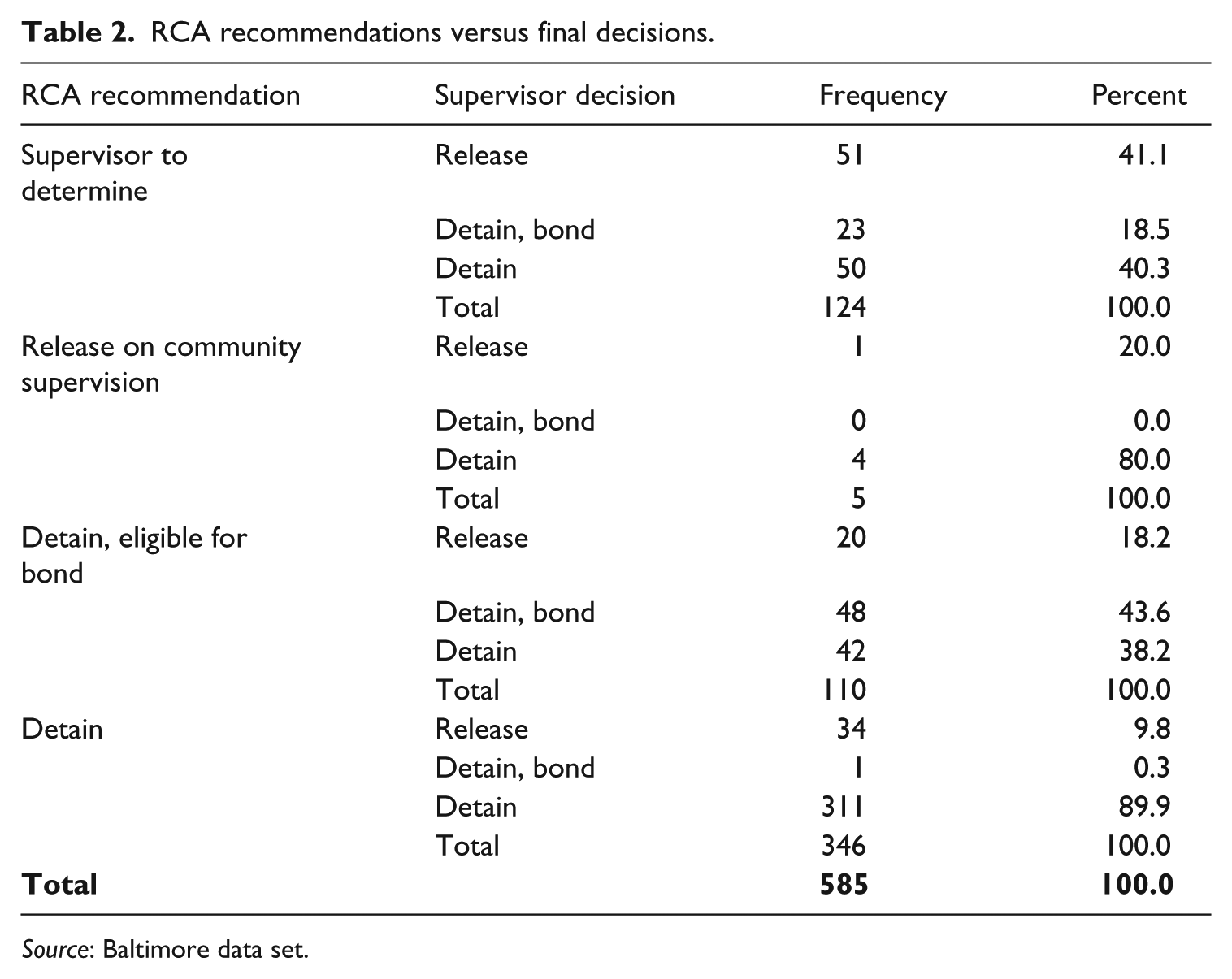
The risk assessment data were analysed to see what the recommendation of the RCA was and what decision was subsequently made by ICE officers (displayed in Table 2). The analysis shows that ICE officers, in cases where the recommendation was not to defer to the supervisor, deviate from the RCA recommendations in a substantial proportion of cases: 21.9 percent. There are also cases for which the RCA was not able to make a recommendation and deferred to the supervisor instead. With 21.2 percent of total cases in the data set, this again is a sizeable portion. If we add up the cases where the an ICE officer decided not to follow the RCA recommendation and the cases where the RCA deferred to the supervisor, a total of 43.1 percent of the decisions to detain or not were not based on a RCA recommendation.
RCA recommendations versus final decisions.
Source: Baltimore data set.
The RCA results are therefore more in line with various studies that indicate that the actual impact of risk assessment technology is limited in practice (Broadhurst et al., 2010; Fitzgibbon et al., 2010; Kemshall, 2011; Lynch, 1998; Oleson et al., 2011; Schneider et al., 1996) than with the idea of a risk tool as a means to objective decision-making.
Now the question remains: what can we learn from these insights for the Amigo-boras case study? Although it was expected that Amigo-boras would have a limited influence on the decision-making process of RNM officers based on the qualitative data, the lack of quantitative data on the decision-making process made it difficult to draw a definitive conclusion. The RCA data show why it is important to have such data available. Similar to RNM officers using Amigo-boras, ICE officers still have significant room for discretionary decision-making, as the recommendations can be put aside if the officer chooses to do so and in some cases the RCA is not able to give a recommendation. Based on the analysis of the RCA data set, both scenarios occur regularly, indicating that the risk assessment technology in question has a limited impact on the actual decision-making. Considering the similarity to the workings of the RCA and what can be learned from the qualitative data on Amigo-boras, this is a solid basis for doubts about the claim that Amigo-boras makes the selection process of RNM officers during MSM checks more objective. At the same time, the absence of the ability to relate outcomes of vehicle stops to Amigo-boras data makes it difficult for the RNM to hold individual officers accountable for their actions. Because it is difficult to establish whether their actions were the result of a discretionary decision or an automated risk assessment, potential wrongful selection practices could be brushed aside by saying the officer’ actions were based on Amigo-boras. In that sense, not only does Amigo-boras most likely have little effect on the objectivity of the decision-making process, the lack of insight into how the system impacts decision-making also enables blame for improper action to be shifted from the officer to the technology, in effect decreasing the accountability of individual officers.
Conclusion and discussion
This article aims to contribute to the literature on discretion and risk assessment tools by exploring a case study of the Amigo-boras camera system and finding an answer to the question ‘To what extent does the use of risk assessment tools such as Amigo-boras increase the objectivity of decisions that would otherwise be taken by street-level bureaucrats?’ The interviews and observation indicate that Amigo-boras had a limited influence on the decision-making process and RNM officers had ample room to exercise discretion. Officers still had full control over which vehicles were stopped for MSM checks and could freely use or ignore information supplied by Amigo-boras. This gives a solid reason to doubt the system’s ability to make the selection process more objective, but the lack of quantitative data on the outcomes of the system prohibits concrete conclusions. What can be said is that the idea of an iron cage of risk assessment technology, or a system-level bureaucracy (Bovens and Zouridis, 2002) where technology has all the decisive power, does not seem present in the case of Amigo-boras. Its design also shows that this was the way the system was intended to work and RNM officers were intentionally given the ability to exercise discretion in the vehicle selection process. Although the ability to exercise discretion is not problematic in itself, it does become an issue when the system is presented under the banner of so-called objective technology. Like most risk assessment technologies, Amigo-boras is said to be based on scientific methods and to improve the objectivity of the decision-making process (Côté-Boucher, 2016; Hannah-Moffat, 2013). As Hart et al. (2007) point out, the use of discretion in conjunction with risk technology is sometimes presented as pragmatic and even-handed, but it defeats the purpose of the technology. What purpose would an objective risk assessment serve if decision-makers can overturn it without restraint?
At the same time, the Amigo-boras case study shows the importance of the ability to exercise such discretion because fully relying on risk assessment technologies comes with its own risks. The profiles of the Amigo-boras system are primarily based on the country of origin of the vehicle, making them everything but refined. It can even be argued that, although risk assessment technology was amongst other things developed to prevent biased decision-making by humans (Cheliotis, 2006), Amigo-boras seems to be doing exactly what it was supposed to prevent: biased decision-making. The profiles used by Amigo-boras label entire nations as high risk, equating specific nationalities with irregular migration or cross-border crime. Not only does this lead to ethical and possible legal issues regarding discrimination, but, since one of the goals of Amigo-boras was to make the selection process more effective and efficient, labelling entire nationalities as high risk seems counterproductive to that end.
This leads to the following issue: if Amigo-boras does not make the vehicle selection process more objective and the accuracy of the risk assessments can be questioned, could there be other reasons to introduce such risk assessment technologies? Crimmigration can be a possible answer to this. Because immigrants are increasingly seen as a high-risk demographic, measures are taken to protect society from the perceived dangers. As Kemshall (2003) remarks, an important aspect of the risk society is to play it safe – better safe than sorry. The broad sweeping risk profiles as seen in the Amigo-boras are in the spirit of such overly cautious and punitive measures because they target large groups of immigrants based on nationalities that are perceived as high risk (see, for more, Brouwer et al., 2017; Dekkers, 2018). In this light, risk assessment technologies such as Amigo-boras could become tools to suppress unwanted immigrant populations, using a combination of Fitzgibbon’s (2007) notion of pre-emptive criminalization and Lyon’s (2003, 2007) concept of social sorting and showing worrying signs of institutional racism. This becomes even more problematic because risk tools boast of the ‘objectivity effect’, as Rose (1998) calls it, giving seemingly scientific validation to such views (Byrne and Marx, 2011).
These far-reaching downsides demonstrate why accountability is – or should be – such an important aspect of risk assessment technology. As Chan notes, ‘technology most certainly has the capability to improve efficiency and enhance accountability, but whether this capability is realized in practice is not a forgone conclusion’ (2001: 141). Politicians and policy-makers may have high expectations of technology (Kearon, 2013; Nye, 2004), but the Amigo-boras case study shows that high expectations should not turn into blind faith. Keeping track of how technology impacts decision-making and what the outcomes are should therefore be standard procedure for any risk assessment technology to make sure it serves the purpose it is said to serve. If not, risk assessment technology could be nothing more than a veneer of technology or a ‘canopy of science’ (Brown and Brudney, 2012; Darroch and Mazerolle, 2012; Innes et al., 2005) for the decision-making process, being little more than a symbolic gesture masking or even exacerbating biases in discretionary decision-making by street-level bureaucrats.
Footnotes
Funding
The author(s) disclosed receipt of the following financial support for the research, authorship, and/or publication of this article: This publication has been sponsored by the Leiden University Fund / Van Beuningen.