



Abstract
To limit energy costs and environmental impacts related to road lighting, luminance-based designing is the best solution to provide the right amount of light on the surfaces to be lit. But this exercise requires knowledge of the reflection properties of the road surface, which are generally unknown. Therefore, the design is often done in terms of illuminance, and luminance is estimated using the standard r-tables provided by the CIE 50 years ago. This review article presents the current state of knowledge on the reflection properties of road surfaces and the external factors (age, traffic, climatic conditions) that may influence them for road lighting applications. These factors are closely connected, and they were not addressed in isolation. However, this article illustrates the evolving and dynamic nature of the reflection properties of road surfaces over time. To characterise a road surface in a state representative of most of its life, it is preferable to wait 2 years after application, especially for bituminous roads with no initial surface treatment. Furthermore, spatial heterogeneity could be considered by taking measurements in the centre track and in the wheel track.
1. Introduction
At a time when energy prices are rising and local authorities’ resources are limited, lighting is still necessary to ensure the safety of road and city users. Its objectives have evolved with changes in mobility, and it has become essential to take account of climate imperatives and limit light pollution. These challenges are forcing us to reconsider the way in which road lighting systems are designed. New technologies and the smart city offer enormous potential, but it is up to us to use them intelligently to balance our safety needs with those of the other inhabitants of our planet. What our eyes perceive – luminance – obviously depends on the light emitted by street lamps, but just as much on the way this light is reflected by road surfaces, known as road photometry. In this context, the reflection properties of road surfaces play a fundamental role in optimising the energy consumption of street lighting installations and reducing light pollution.
As the optical properties of roads are very rarely measured in practice, the CIE proposes several classification systems,1–3 based on measurements conducted more than 50 years ago. For each system, standard r-tables are associated, which are supposed to represent the reflection properties of road surfaces in the form of tabulated values. These standard tables are still used worldwide since the optical characteristics of a road surface are generally unknown. It has been shown that failure to take account of the actual light reflection characteristics of existing pavements can lead to poor lighting4–6 and often to non-compliance 7 with the specifications of standard EN 13201 8 and ANSI/IES RP-8-25. 9 There is a large international consensus on the need to revise the standard CIE r-tables, because they are no more representative of nowadays large range of pavement types.4,6,10–20
In-depth knowledge of the reflection properties of road surfaces and their impact on lighting performance is therefore essential. It should also be borne in mind that these properties change over time depending on the materials used, road traffic and environmental conditions, including especially climate impact. The CIE 030.21 and CIE 0662 reports recommend that the reflection properties of a road surface should be characterised at least 1 year after it has been laid, to ensure that this characterisation is representative over time. However, this recommendation was not included in the CIE 144 report. 3 It is worth asking how representative the 1-year measurement is over the life of a pavement.12,14,20
This article reviews what is known about the reflection properties of road surfaces and the factors likely to influence them for street lighting applications. The issue is complex because these properties depend on both internal factors linked to the composition and application of road surfaces and external factors such as the effect of the age of the surface, traffic or the impact of the climatic conditions to which it is exposed. The influence of internal factors is discussed in the first article, 21 while this second focuses on the effect of external factors. External factors such as age, traffic and climatic conditions are highly interdependent and difficult to study in isolation. To this can be added the spatial heterogeneity of the road and the variability of its modified surface condition in the presence of dirt, deterioration or moisture (water or snow). Transient effects such as the impact of point-source dirt and the state of wetness will not be studied as they are, by nature, reversible. The challenge is to be able to understand the reflection properties of road surfaces to optimise a street lighting installation.
In the first part, this article reminds the basics of the optical characteristics of road surfaces and presents the methodology of this review. The second part focuses on traffic effects and climatic conditions, while the third one focuses on age and climatic conditions. In the fourth part, the combined effects of age, traffic and climatic conditions are investigated. The conclusion summarises this literature review and outlines the prospects for research into how the reflection properties of surfaces and their living nature can be better taken into account in road lighting practices.
2. Road surface photometry and its external factors of influence
2.1 Basics of road surface photometry
The optical properties of road surfaces are described by the luminance coefficient q, defined as the quotient of the luminance L of a surface element in a given observation direction and the illuminance E on the same surface element from directional incident illumination:

In road lighting, this coefficient is measured for a conventional observation angle of α = 1°, 3 which corresponds to the perception of a road illuminated at a distance of approximately 90 m by drivers of motorised vehicles. The directional incident illumination is defined by the deviation angle β and the angle of incidence ε, as represented in Figure 1. Since the luminance is measured according to the human photopic spectrum, the road reflection properties are usually called photometric characteristics.
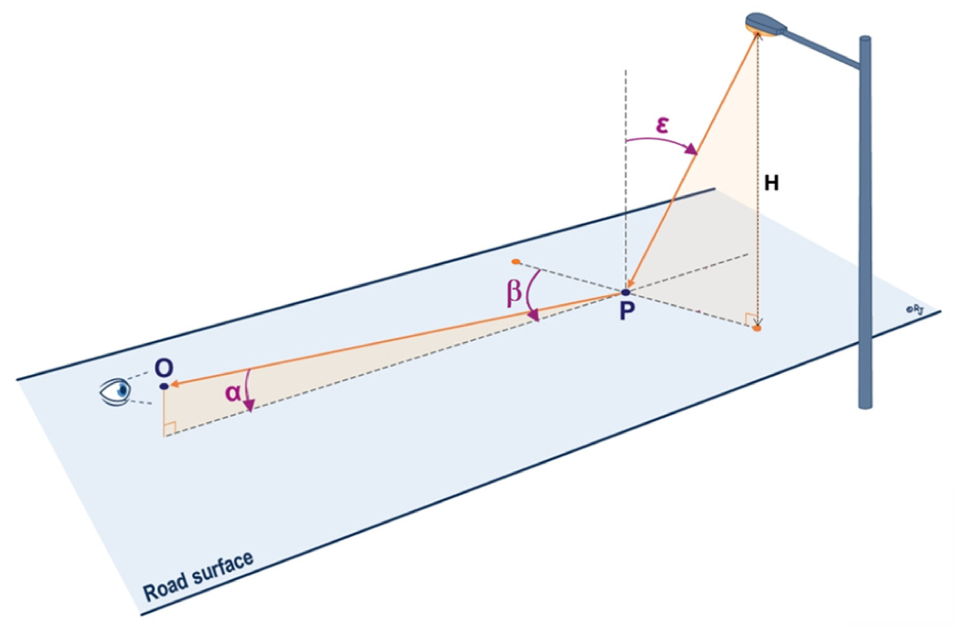
The photometric characteristics of the road surface depend on the angles of observation α, and the lighting angles of azimuth β and incidence ε. P is the observed point, and H is the height of the luminaire
The reduced luminance coefficient r in sr−1 is defined by the CIE,2,3 according to Equation (2).

To enable dimensioning calculations, the CIE also specified angular combinations of the deviation angle β (between 0° and 180°) and the angle of incidence ε (between 0° and 85.2°). The amount of light reflected for these 396 combinations defines an r-table.2,3 Several indicators are calculated to represent globally the photometry of road surfaces.
The specularity factor S1 reflects the specular character (mirror effect) of the pavement. It is the ratio of the reduced luminance coefficients, r(β, ε), measured at β = 0° and tan ε = 2, and at β = 0° and tan ε = 0, where β is the deviation angle of lighting, and ε is the deviation angle of observation.

Q0 is the average of the luminance coefficients, q, over the specified solid angle, Ω0, considering all measured lighting directions.3,22 It represents the total amount of light reflected by the illuminated surface and is expressed in sr−1(or cd.m−2.lx−1.

with
Q0 increases proportionally to the percentage of the received light that is reflected. It is also called lightness, but we will not use this denomination in this article because a dark pavement with a high specularity could have a higher Q0 than a cement diffuse pavement that is visually lighter.
The CIE defined several classification systems based on the specularity coefficient S1 because it was shown that the lighting uniformity is linked to the specularity factor.6,14,23,24 For each class, standard r-tables are also defined.2,3 With these tables, it is possible to conduct lighting design without measuring the actual reflection properties of road surfaces.
The reflection indicatrix (also known as the photometric solid) is a representation of the spherical coordinates of the r-table projected onto the X0Z plane, where X is the traffic axis, and Z is the normal to the road plane. In Figure 2, the reflection indicatrix of the standard r-table R3 is represented. The overall volume of the solid reflects its total reflectivity Q0, and the elongation towards the right reflects the specularity S1, corresponding to the brightness of the surface in the direction ε≈63°.
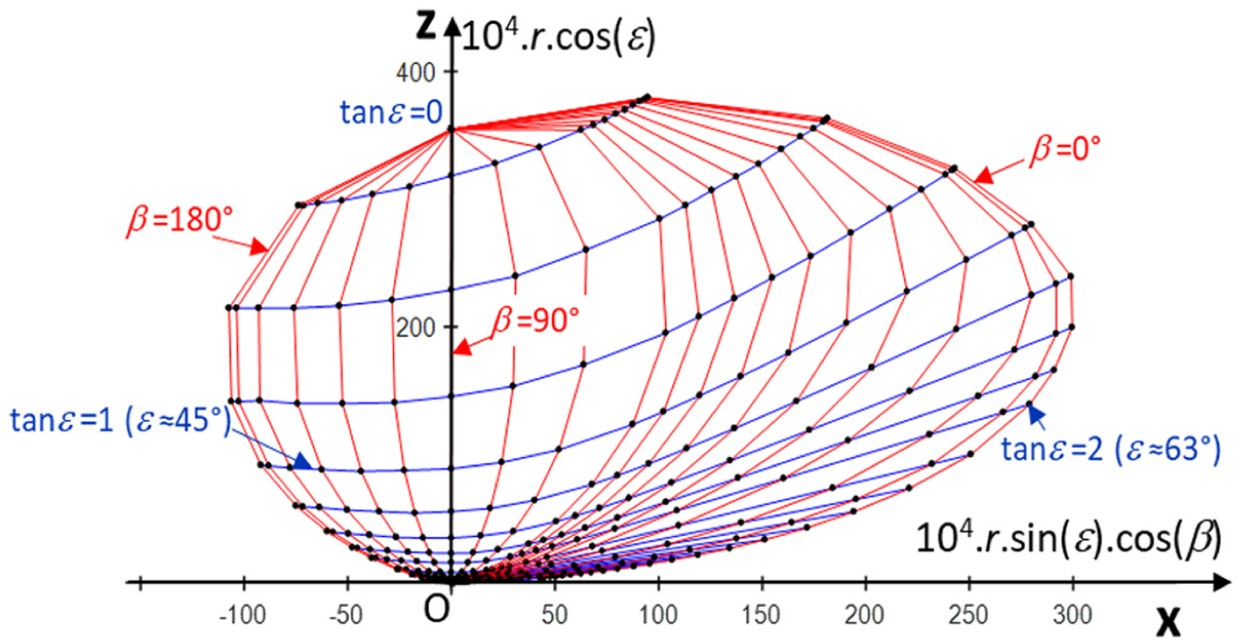
Representation of the standard r-table R3 in a 2D projection, known as a reflection indicatrix and also called a photometric solid. The circulation axis corresponds to X, with X axis values equal to 104r sin ε cos β, and Z to the road surface normal, with Z-axis values equal to 104r cos ε
2.2 Article organisation and methodology of analysis
This paper contains 75 references. Among them, we will focus particularly on the 35 papers that studied the impact of external factors influencing the reflection properties of road surfaces, thus excluding standards and methodological papers that do not contain data relevant to our review. Figure 3 shows the distribution (number of articles) of the 35 papers analysed in this review, considering the type of document, year of publication and geographical origin.
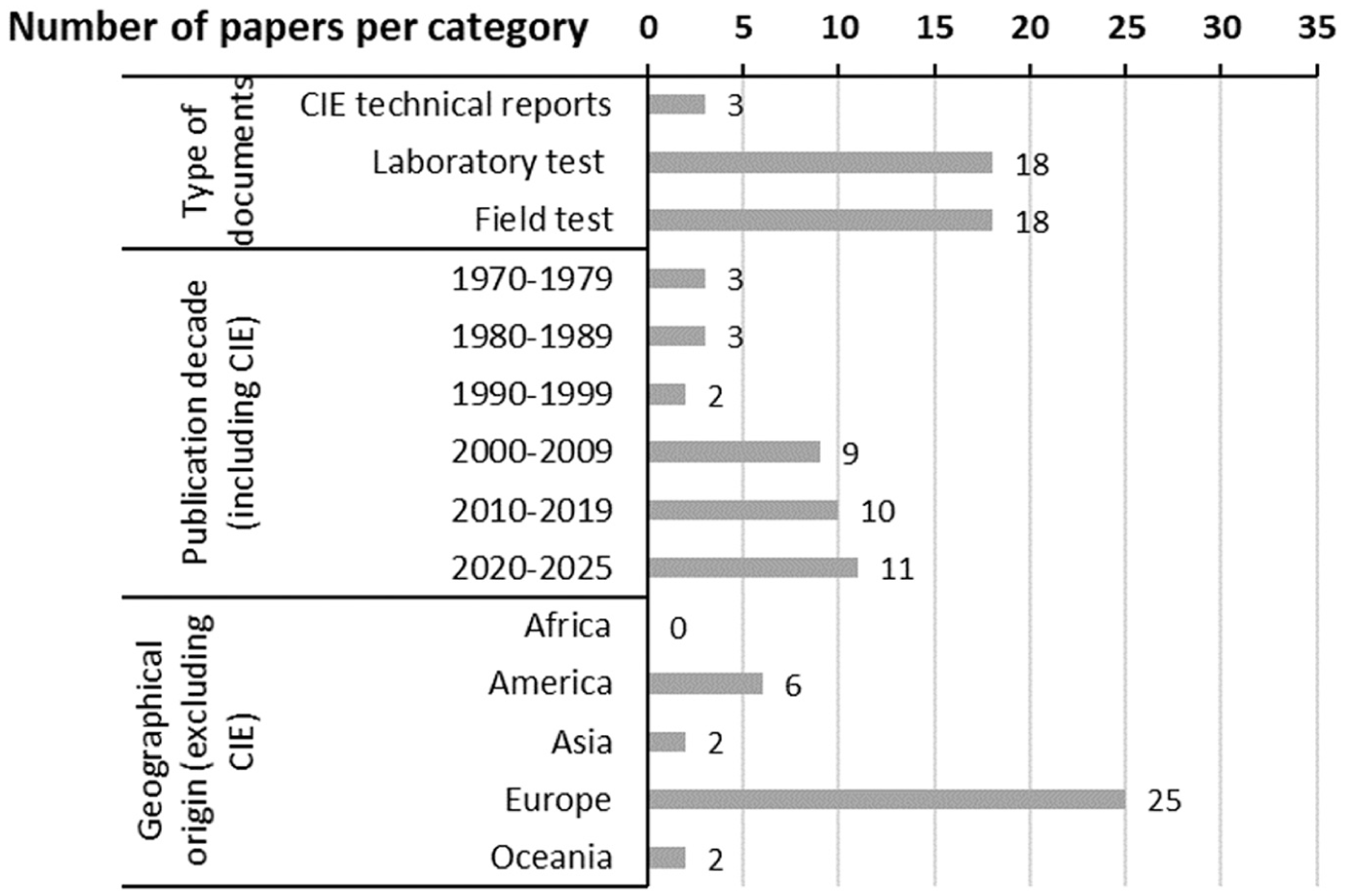
Distribution of the analysed articles according to document types, decade of publication and geographical origin. One paper 14 presents laboratory tests and field tests
Note that they are three related CIE technical reports, with one cancelled 1 and two still in application.2,3 The results of the research studies come from laboratory and field measurements. Their temporal distribution seems to show that most of the work was conducted after the 2000s, since the published work mainly dates from recent years. Earlier studies are either internal and unpublished, or inaccessible, or research that led to the establishment of the CIE technical reports, which constitute the reference but do not always allow for the traceability of conclusions. The geographical origin of the articles shows that 78% of studies on the subject were conducted in Europe.
The external factors investigated in this review are age, traffic and climatic conditions. The so-called age effect generally combines all these factors and depends on the type of road. Knowing the impact of traffic is important, however, because road wear will not be the same depending on the number and type of vehicles it is subjected to, particularly the number of heavy goods vehicles. Similarly, knowing the influence of climatic conditions is useful because, in an urban environment, many lit areas have little or no vehicle traffic. The external factors considered are schematically represented in Figure 4. As the light reflection properties of road surfaces also depend heavily on the composition and application of the road surface (internal factors), they are also presented in Figure 4 and analysed in detail in the Part 1 of this review. 21 In practice, the names used for bituminous mixtures (BMs) and surface coatings (SCs) may differ between studies and countries, which complicates the analysis. A summary is provided in Table A1, indicating both the standard terminology25–35 and the names used in the articles synthesised here.
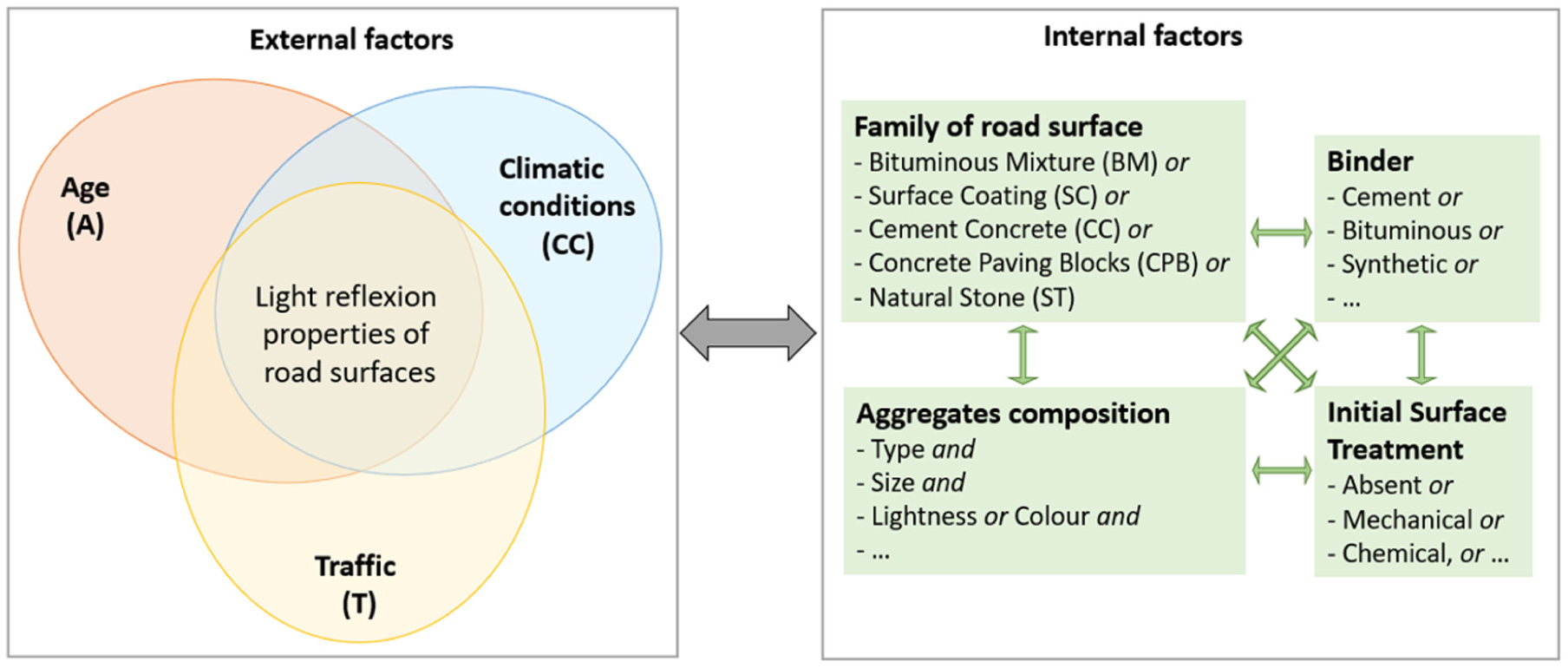
Schematic representation of external and internal factors influencing the reflection properties of road surfaces and their interrelationships. The figure also indicates the acronyms used in the rest of the paper
For the selected papers presenting results, the general distribution is provided in Figure 5 for the different external factors (alone and in combination), followed by the type of analysis performed and the nature of roads studied.
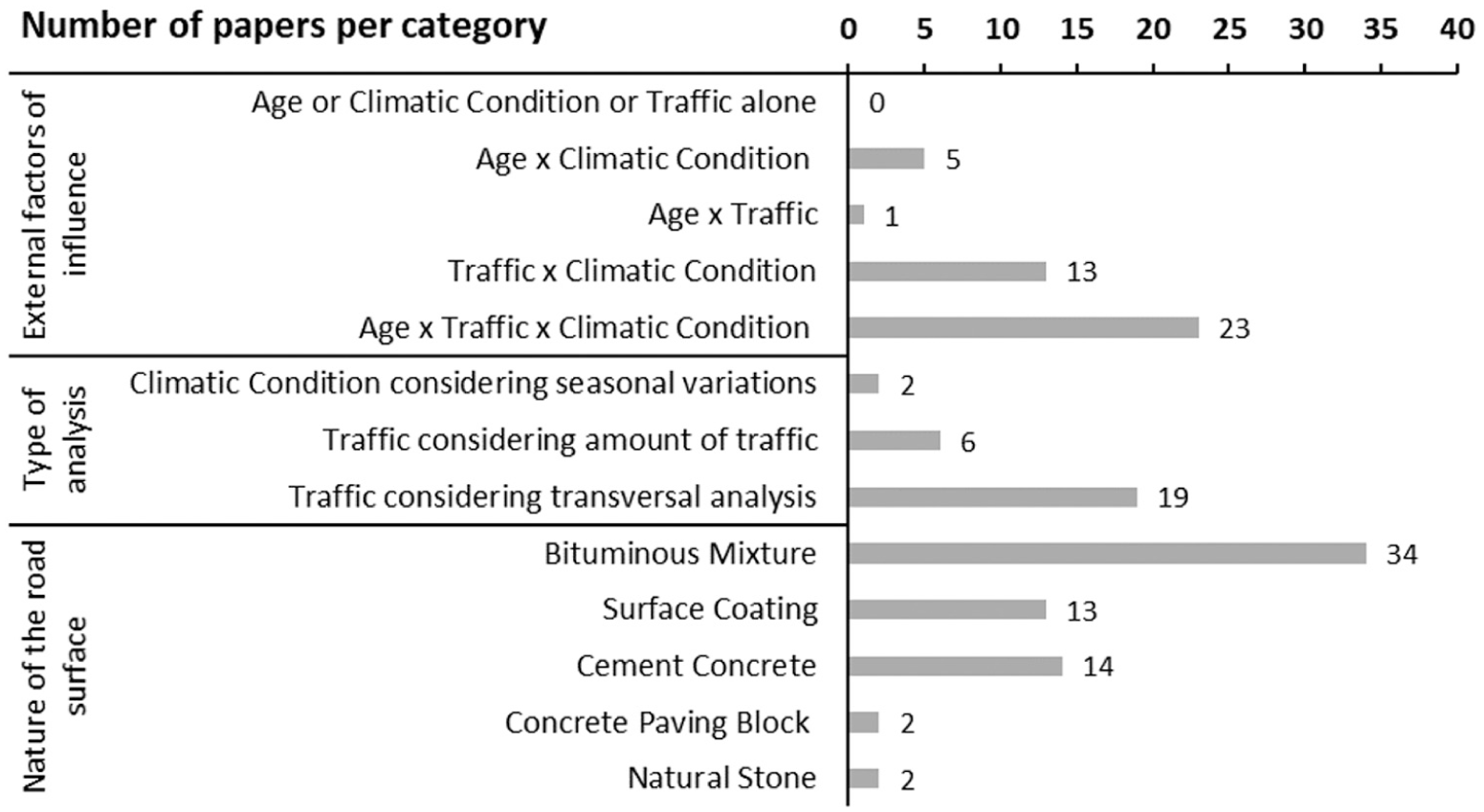
General distribution of the selected articles according to the external factors of influence, the type of analysis and the different road natures
It can be noted that none of the external factor was studied alone. Most studies consider either traffic or climatic conditions and the majority combine age, traffic and climatic conditions. Age is not taken into account when the studied surface is considered to be stabilised. Generally, the impact of traffic is considered with the transversal positioning of measurements on the road, distinguishing between the wheel track (where vehicle tyres pass) and the centre track. In the non-trafficked side of the carriageway, it could be considered that there is mainly an impact of the climatic conditions. With regard to the nature of roads studied, it is obvious that the vast majority of research have focused solely on bituminous mixtures. This result is quite logical, as these are the most common types of roads. Cement concrete and surface coating have also been studied, unlike concrete paving blocks and natural stones, were studied very little, even though they are very popular in urban areas.
In the studies that have investigated the reflection properties of road surface, it is important to consider the type of measurements carried out (laboratory or field test) 36 and their representativeness: number of measurements, used method (random selection, temporal following).
The external factors studied, the experimental setup with the corresponding measured quantity, the method used and the nature of road surface considered (with its internal factors) are presented in Table 1 for the laboratory studies and in Table 2 for field studies.
References of the different studies conducted with laboratory gonioreflectometer measuring the r-table at 1°, Q0 and S1
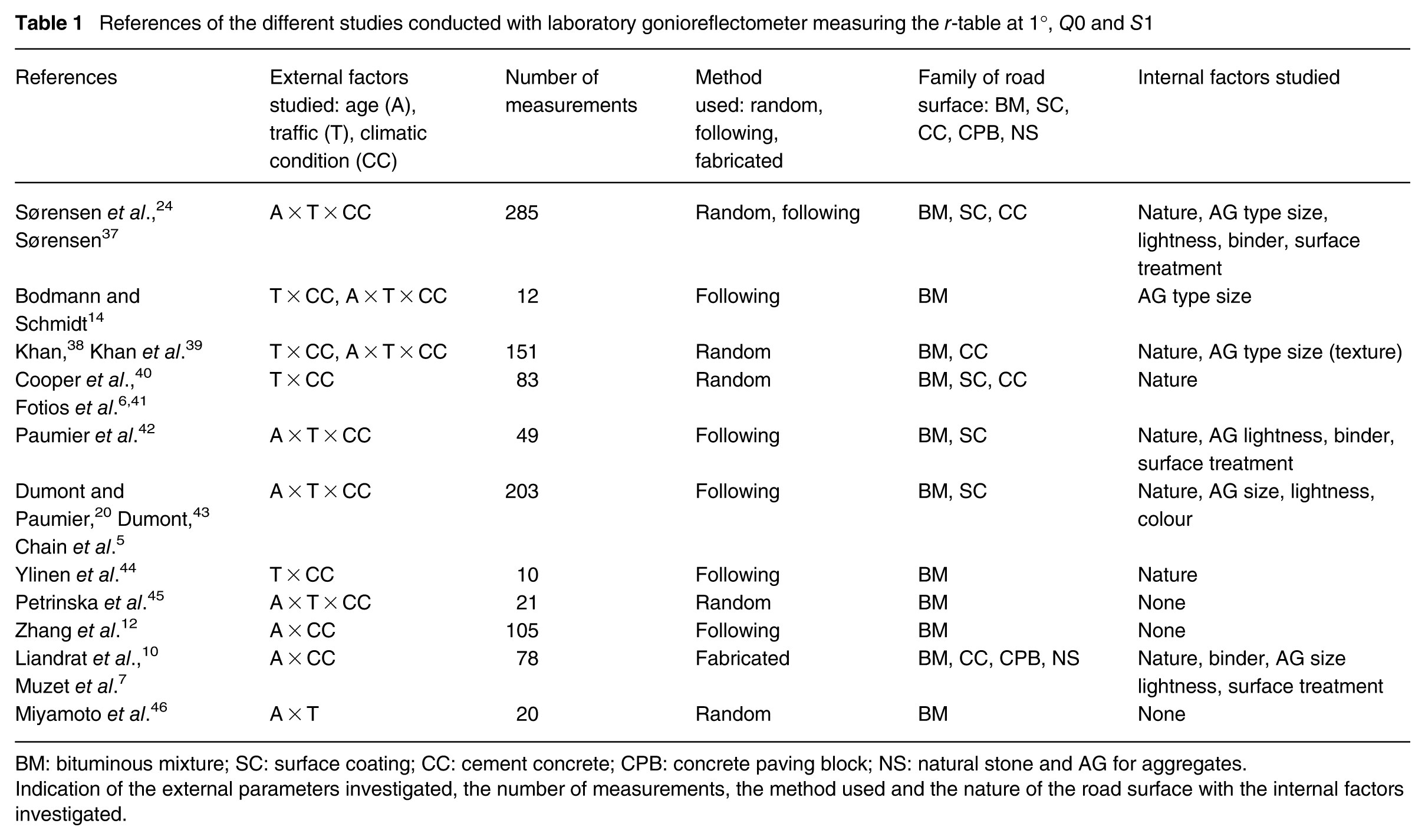
BM: bituminous mixture; SC: surface coating; CC: cement concrete; CPB: concrete paving block; NS: natural stone and AG for aggregates.
Indication of the external parameters investigated, the number of measurements, the method used and the nature of the road surface with the internal factors investigated.
References of the different field studies with indication of the external parameter investigated, the experimental setup and the measured quantity
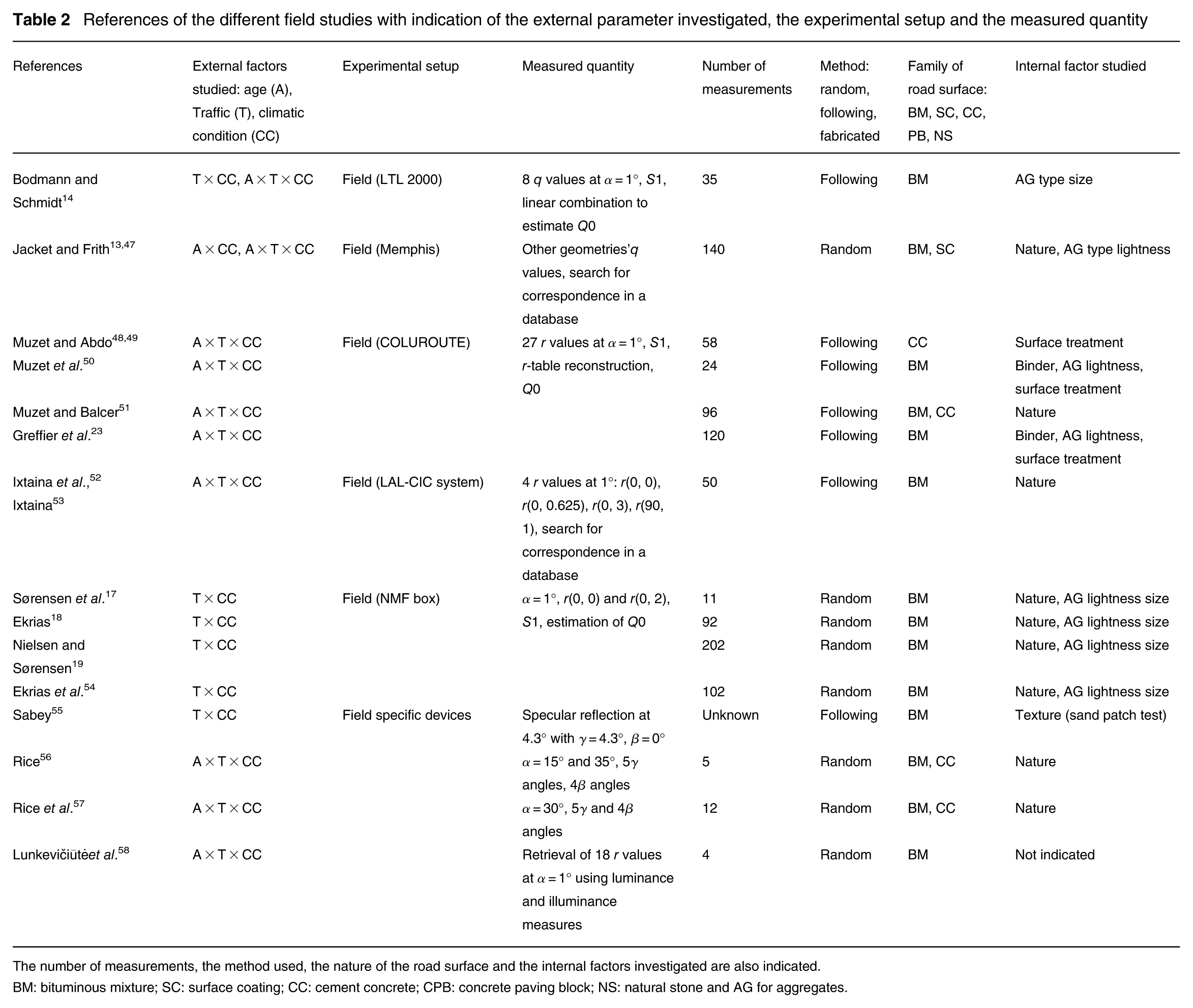
The number of measurements, the method used, the nature of the road surface and the internal factors investigated are also indicated.
BM: bituminous mixture; SC: surface coating; CC: cement concrete; CPB: concrete paving block; NS: natural stone and AG for aggregates.
In laboratory studies, r-tables at 1° were systematically measured. In field studies, measurements are more partial and not always in the geometry of 1°. Tables 1 and 2 also show that 67% of laboratory studies were conducted prior to 2010 and that 83% of field measurements were taken between 2010 and 2025. Methodologically, some countries have favoured temporal following of road surfaces, while others have carried out random measurements to study the effects of age. When measurements are carried out in the laboratory using extracted samples, it is possible to measure the entire r-table. On the other hand, it is assumed that extracting a road sample by coring has not altered its optical properties and that the core sample(s) taken are representative of the entire length of the road. With transportable devices that carry out measurements in the field, it is possible to carry out more measurements, in different locations and in a non-destructive way. It is thus possible to revisit experimental sites on a regular basis to look at the external factors of change. However, as shown in a review, 36 these devices do not measure the entire r-table and reconstitute it by modelling and/or estimate the global parameters Q0 and S1 directly.
In an attempt to present these various external influencing factors and their interactions in a didactic manner, this article is organised as follows. In the Part 3, the impact of traffic and climatic condition is studied, in particular in the so-called stabilised state of the road surface (i.e. for an age of more than 2 years), by comparing measurements taken on a non-trafficked side, in the wheel track and in the centre track. In Part 4, the combination of age and climatic conditions will be studied independently of traffic. Finally, in the fifth and last part, the combined impact of age, traffic and climatic conditions will be presented. As all the effects of these external factors are highly dependent on the composition of the pavement, in most parts of this chapter, they will be described either chronologically or according to the road nature and composition.
3. Impact of traffic and climatic conditions
3.1 The complexity of measuring the impact of traffic
Mechanical wear and tear on a road is highly dependent on the amount of traffic to which it is subjected, particularly the number of heavy goods vehicles. The difficulty is that on circulated roads, the effect of traffic and climatic conditions is logically always combined. It is therefore complex to isolate the impact of traffic alone on the reflection properties of the road surface, particularly during the first 2 years after its application. Fatigue rides, such as the one at Gustave Eiffel University, 59 simulate very heavy traffic and enable the durability of pavement structures to be tested over a short period of time. The one at BASt 60 can be used to test the durability of road markings. To our knowledge, this type of structure has never been used to study the impact of traffic alone on the reflection properties of a pavement. In the current state of knowledge, it is therefore not possible to present information on the impact of traffic considered in isolation.
Nevertheless, it is possible to look at the impact of traffic by assuming that the road is stabilised in terms of climatic conditions. By considering pavements that are 2 years old or more, the road has been subjected to sunshine and bad weather, and it is assumed that it has reached a certain stability according to this external factor of evolution. To do this, two approaches are proposed in the literature: comparing roads with different traffic levels or looking at the impact of traffic in the transversal axis, in relation to the wheel tracks and areas with less or no traffic.
3.2 Influence of the traffic levels
Few studies have compared different traffic levels (Figure 5). In Ylinen et al., 44 and Sorensen database, 37 the average daily traffic is indicated, while it is the cumulative traffic in Miyamoto et al. 46 and Khan. 38 Khan’s analysis38,39 showed an increase in Q0 and S1 with traffic levels on porous asphalt and medium coarse asphalt (MCA) and no effect on cement concrete. Ekrias 18 indicates whether measurements are performed on roads (extra-urban area) or on streets (urban area). The nature of road surface used on streets shows greater dispersion in the values of Q0 and S1 than that used on roads. The results also show that the average value of Q0 for streets is slightly lower than that of roads. By contrast, the average value of S1 is significantly higher for streets than for roads. In the other studies,37,44 it is difficult to conclude because the road formulation differs, as its composition is adapted to the traffic. Concerning the measurements conducted in New Zealand, Jackett 13 writes, ‘the factors of surface age and traffic volume were not found to be related to the variables S1 and Q0 in any statistically significant way’.
3.3 Comparison between the different transversal tracks on the road
As shown in Figure 5, many articles have studied the influence of traffic with an investigation on the effect of the transversal positioning of measurement points on the road surface. A visual difference is sometimes observed, as shown in Figure 6. The results obtained are grouped chronologically and then summarised by road type.
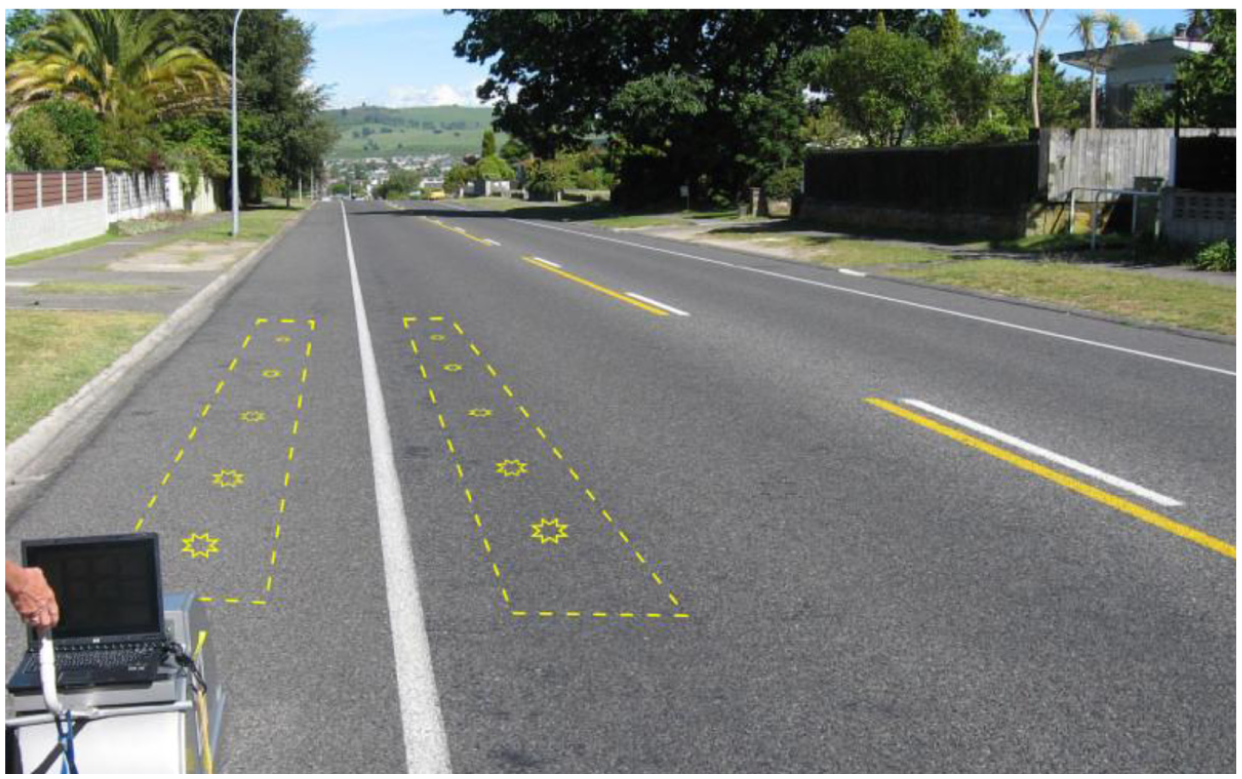
A picture representing field measurements conducted on the wheel track and on the non-circulated edge
In Bodmann’s study, 14 field measurements were carried out on two asphalt streets said to be optically stabilised (because they were more than 3 years old), both in the centre track and on the right- and left-hand wheel tracks. For one of the streets, there was no significant difference between the two treads for either Q0 or S1, while the centre track had a lower Q0 and higher S1 than the wheel track. For the other street, no systematic difference was observed according to transversal location.
In Canada,38,39 for cement concrete or bituminous mixtures, Q0 and S1 are more important in the wheel track.
In the study carried out in England by Cooper et al. 40 and also exploited by Fotios et al.,6,41 classic and innovative English pavements were studied with core extractions near side (edge), on a wheel track, and on the centre track (called oil lane in their papers). There were three classic bituminous mixtures, three innovative asphalt concrete for thin layer (ACTL), one surface dressing (SD) and two cement concretes with different finishes. Measurements of r-table were carried out in the laboratory to study the effect of lateral positioning for these different formulations. The results obtained in this study are presented in Figure 7. For Q0, measurements on the wheel track are generally higher than those on the edge and centre track. The exceptions are the commercial ACTL ‘thin SafePave’ where positioning has no effect on Q0 and ‘HITEX’, where Q0 is slightly lower in the wheel track. Finally, the deactivated concrete has a higher Q0 on the edge. With regard to the specularity factor S1, the results are more variable, with higher specularity in the centre track for hot rolled asphalt, stone mastic asphalt (SMA), and ‘SafePave’ ACTL, and less marked differences for surface dressing and deactivated cement concrete. Specularity is higher in the wheel track for porous asphalt, the ACTL ‘Ultra-mince’ and the brushed cement concrete. On the other hand, specularity in the non-trafficked edge is always less than or equal to the other two areas studied.
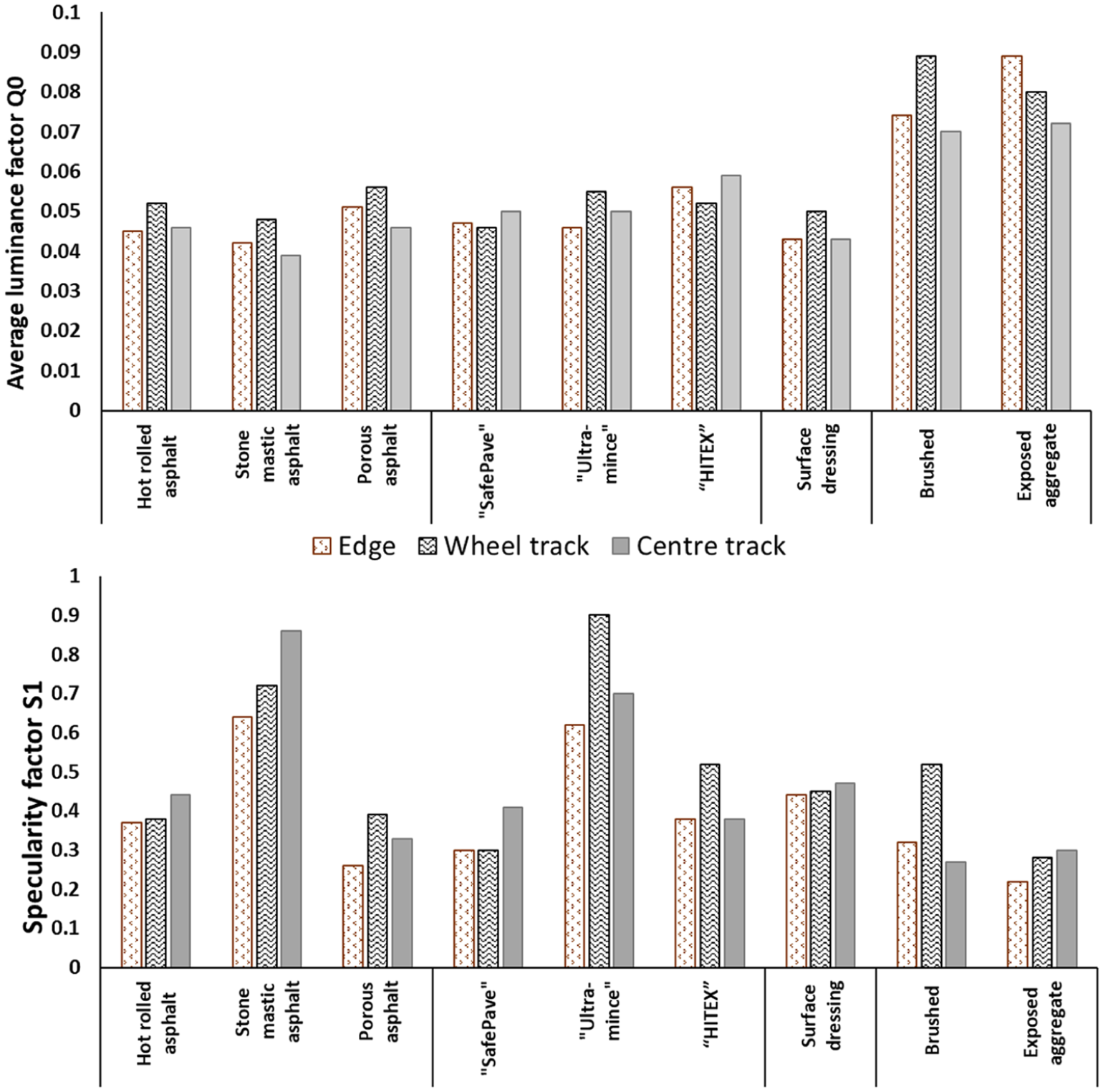
Impact of transversal positioning (edge, wheel track and centre track) as a function of road type for Q0 (top) and S1 (down)
A huge campaign of field measurements was conducted across New Zealand13,47 with the Memphis portable device, 61 conducting measurements on 140 places, mostly on asphalt concrete (AC; 49 sites) and chip seal surfaces (which is a type of surface dressing; 55 sites). The difference in this study is that the centre track is not measured, but only the wheel track and edge, as illustrated in Figure 6. The authors conclude, ‘Both Q0 and S1 increase with traffic wear in somewhat similar proportions because Q0 and S1 are lower on the edge compared to the wheel track’.
In Finland, 44 core samples were extracted from the wheel track and centre track of seven stabilised bituminous mixtures at least 2 years old. For the three soft asphalts (lightly trafficked roads), there was no systematic effect for Q0 and S1. For the two SMAs, Q0 is slightly superior in the wheel track, and there is no difference for S1. However, for the two asphalt concretes, Q0 is higher on the wheel track, and S1 is lower.
In the experimental campaigns carried out in Scandinavian countries between 2017 and 2023 using the portable device developed by Corell and Sorensen, 16 the results obtained differed from country to country. In general, three measurements were carried out in the wheel track and three in the centre track. In Denmark, 17 no difference was observed between the six SMA on which the influence of lateral positioning was studied. In Finland, 18 measurements were carried out on 17 roads and 29 streets with 23 AC and 14 SMA. The author concludes that on the wheel track, Q0 is slightly higher and S1 slightly lower than for measurements carried out on the centre track. Figure 8 shows his results as a boxplot with Q0 on the left and S1 on the right. In fact, Q0 can be considered slightly higher in the centre track, for both AC and SMA. For S1, it is slightly higher in the wheel track for asphalt concrete. In Sweden, 19 whatever the nature of the road (asphalt concrete ABT, medium course asphalt ABS, asphalt concrete for thin layer ABT) and the colour of the aggregates, Q0 is on average slightly higher in the wheel track (see Figure B1). For S1, the difference is not very marked, but in general, the specularity is lower on the wheel track. Finally, in Norway, 54 where measurements were taken on 51 roads consisting mainly of AC, MCA (asphalt gravel concrete, AGC) and SMA, the road surface on the wheel track generally has a higher Q0 value and a slightly higher S1 than on the centre track (see Figure B2). In the Nordic countries, these effects could be explained by the use of studded tyres during the winter season, which leads to a coarsening of the surface, the loss of small aggregates and the wear of the bitumen.
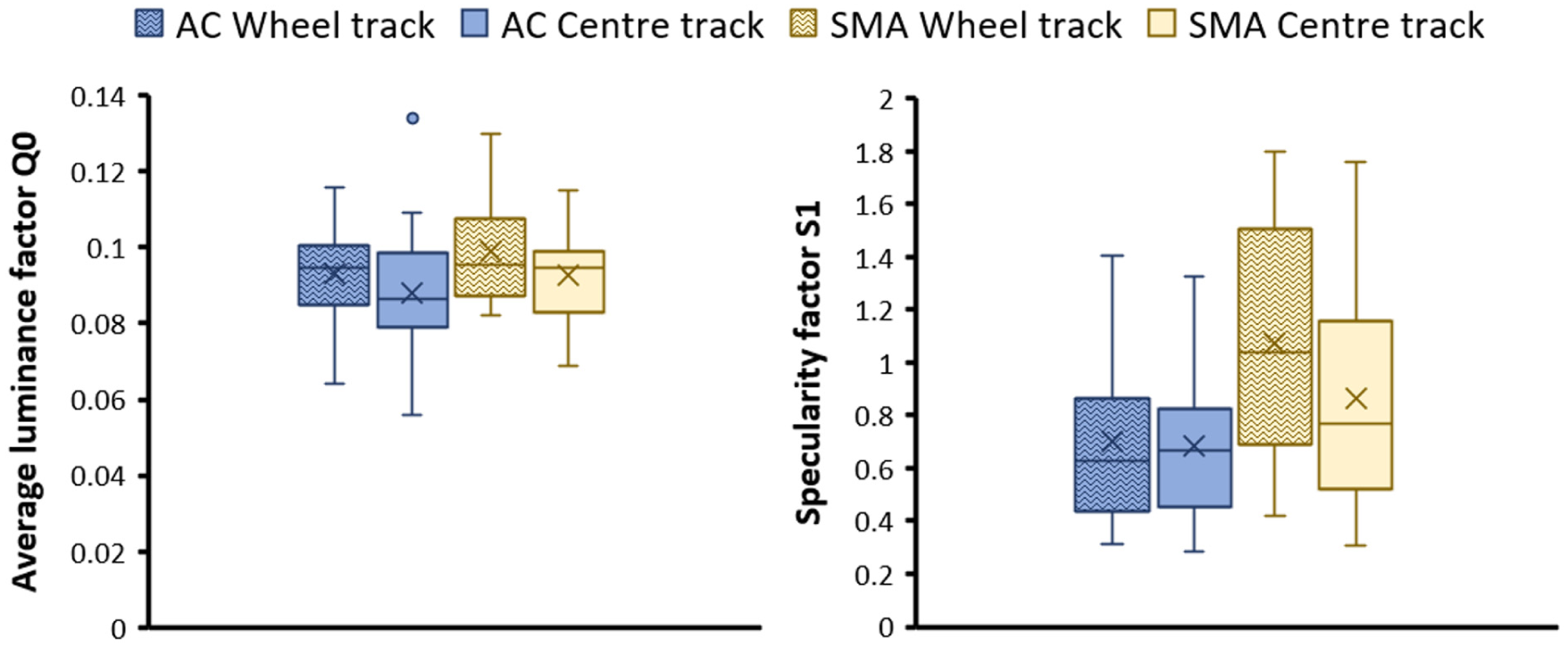
Representation of the measurements conducted for 23 asphalt concretes and 14 SMA in Finland. The results are represented by a boxplot for Q0 on the left and S1 on the right, with the consideration of the transversal localisation (wheel or centre track)
In France, the impact of lateral positioning was studied on site after 2.5 years to 3 years of traffic for a brushed cement concrete 49 and four different formulations of ACTL 0/10 mm, 50 using the COLUROUTE portable measurement device. 62 For the ACTL, there was a classic raw section, two initially treated sections with water jet scrubbing (one classic and one with light aggregates), and a Lumiroute® section composed of light aggregates and a synthetic binder with TiO2 addition. Whether for the brushed cement concrete or for the four ACTL, the wheel track has a higher Q0 and is more specular than the centre track (see Figure B3).
In a recent study conducted in China, 12 the photometry of five urban AC roads was measured with a gonioreflectometer on samples extracted on the edge, wheel and centre track. The results obtained for roads of 3 to 8 years old show that Q0 is higher on the wheel track compared to the centre track, while the lowest is on the edge. For the specularity S1, the roads are more diffuse on the edge, but there is no clear effect between the centre and wheel track.
3.4 Conclusion of the impact of traffic
In conclusion, if we consider that the effect of traffic is reflected by a difference between the side of the road (edge) and the wheel track, there is a consensus between all the studies.6,12,13 With the exception of deactivated concrete, for all pavements over 2 years old, the surfacing on the edge is systematically more diffuse and darker than that on the wheel track.
On the other hand, if we look at the difference between measurements taken in the centre and on the wheel track, the trends are less systematic and depend on both the type of road surface and its finishing as synthetised in Table 3.
Synthesis of the impact of traffic for the different studies that carried out measurements both on the wheel track and on the centre track, presented for the different families, nature of road surface and countries
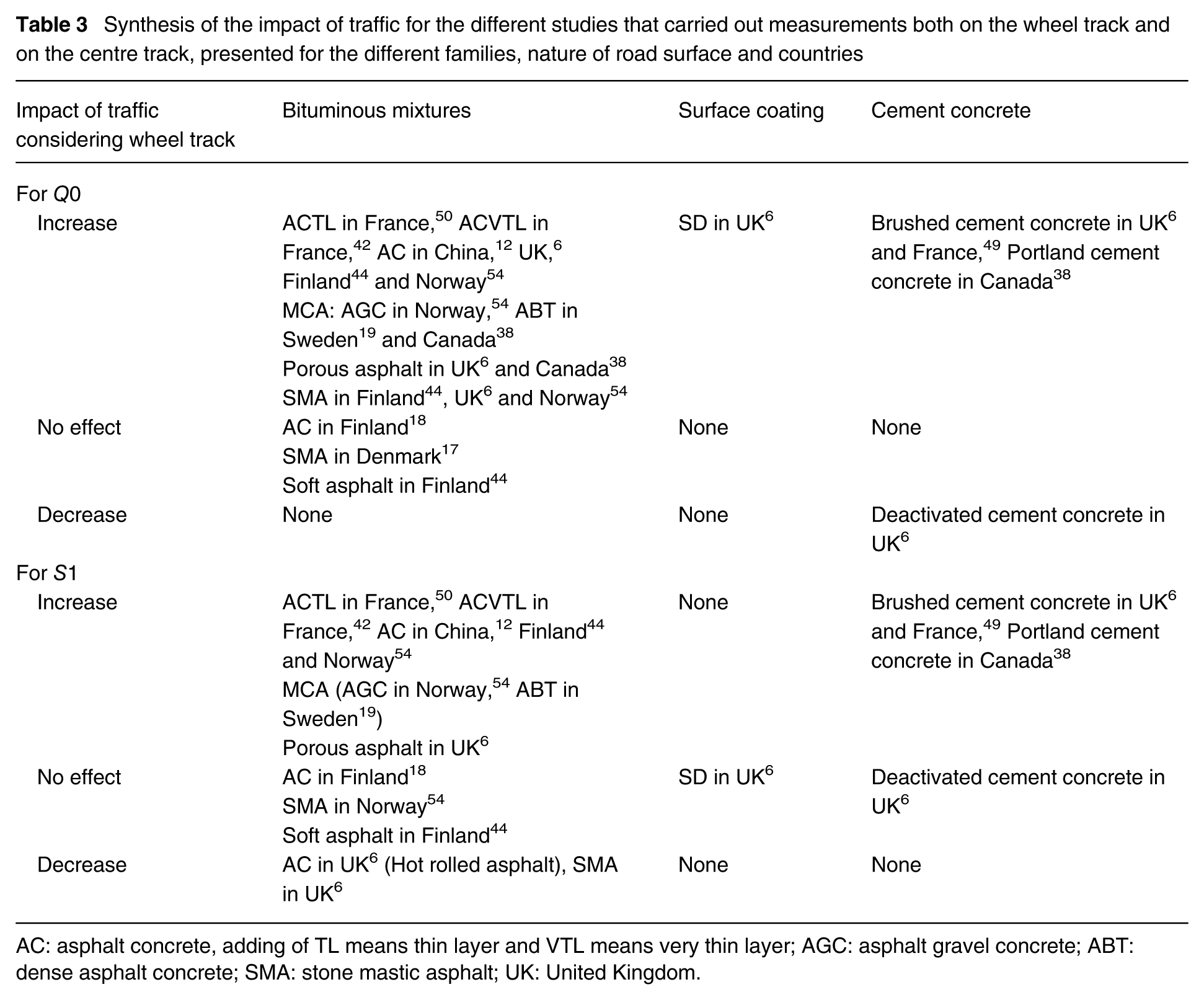
AC: asphalt concrete, adding of TL means thin layer and VTL means very thin layer; AGC: asphalt gravel concrete; ABT: dense asphalt concrete; SMA: stone mastic asphalt; UK: United Kingdom.
As the impact of lateral positioning on traffic lanes (wheel or centre track) differs depending on both the composition of the pavement and the studies, it is difficult to generalise about systematic behaviour. This is why, if one wishes to characterise the optical properties of a trafficked pavement, it is recommended to systematically carry out measurements in both the centre and the wheel track, which is already a common practice with portable devices.17–19,49,50,54 In the article that studied the influence of pavement heterogeneity on lighting design conducted by Greffier et al., 23 it was confirmed that carrying out six measurements, three in the wheel track and three in the centre track, made it possible to be representative of the pavement in place. So it could become a standard practice, both for measurements conducted with portable devices and in the case of laboratory measurements done on road cores.
4. Age and climatic conditions
Knowing the impact of environmental conditions, particularly the climatic conditions, involves studying seasonal fluctuations on a stabilised pavement or looking at roads that have little or no traffic. In the current context of increasing use of active modes of transport (walking, cycling, scootering), areas dedicated to this type of user are becoming more and more common in towns and cities.
4.1 Impact of seasonal fluctuations
Very few studies have investigated the impact of seasonal fluctuations on the light reflection properties of road surfaces. In the seventies in the United Kingdom, 55 it was demonstrated using a very specific field device (see Table 2) that a specular luminance factor could vary by a factor of at least five to one on any surface at different times of the year. However, the bituminous binder compositions and properties were different at that time and could melt in summer. The CIE 66 technical report 2 states that little is known about the magnitude of seasonal variation on lighting characteristics, while the CIE 144 technical report 3 says nothing about this.
After 1984, the most significant study was carried out in Germany on five streets in Karlsruhe using conventional asphalt concretes considered to be stabilised (because over 3 years old). 14 Measurements were carried out with the LTL200 transportable device every 2 months to 4 months for 38 months and did not reveal any marked variation linked to the seasonal nature of the measurements, either for Q0 or S1. However, for some of the streets, Q0 tended to increase in summer and decrease in winter. This effect was also observed during an extremely hot summer in 1982, which probably resulted in a transition smoothing of the road surface due to the melting of the binder.
To our knowledge, no studies have investigated this impact since then.
4.2 Ageing effect on non-circulated pavements
From our point of view, we cannot consider that the centre track of a road corresponds to a road that is not impacted by traffic wear. In fact, although they are subject to less systematic wheel traffic than the treads, they are still subject to wheel traffic depending on the lateral positioning of vehicles or during overtaking manoeuvres. In England, the authors refer to the centre lane as the ‘oil lane’, but no explanation is provided.6,40 This is why, in our review, non-trafficked roads are roads not subject to vehicle traffic, such as cycle paths, sidewalk or urban places. When photometric characterisations have been carried out on the edges of circulated roads, we also consider that they are representative of roads without traffic. According to this approach, there are very few studies in which the effect of age on non-trafficked pavements has been investigated.
In China, Zhang et al. 12 studied the evolution of the photometric properties of five urban asphalt concretes over 8 years between 2012 and 2022, systematically extracting samples from the roadside. While Q0 remained stable over the 8 years, S1 specularity fell over the first 3 years and then stabilised.
The French group ‘Pavements and Lighting’ produced a representative panel of conventional and innovative urban pavements which was exposed to climatic conditions (sun, rainfall, etc.) for 30 months.7,10 This panel included different materials: asphalt concretes (with either bituminous or synthetic binder), mastic asphalts, cast-in-place and precast cement concrete and natural stones, most of them composed of light aggregates. The reflection properties of these samples were characterised by Cerema’s laboratory gonioreflectometer 23 both in the initial state and after 30 months. In Figure 9, the results of the measurements are represented by the pavement family in the form of arrows in the S1, Q0 plane. The origin of the arrow is the initial measurement, and the head of the arrow is the measurement after 30 months.
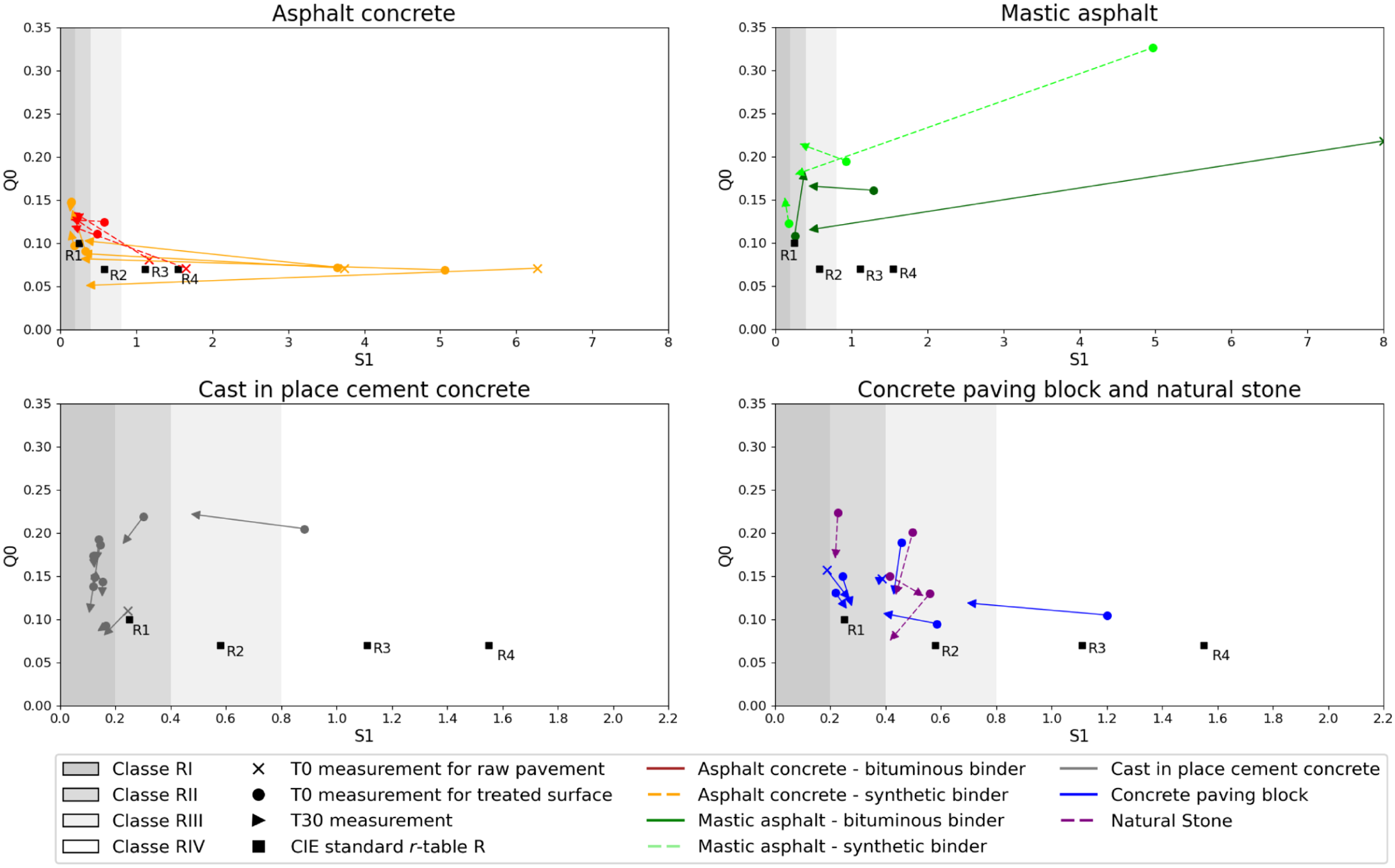
Representation of the ‘Pavements and Lighting group’ average luminance factor Q0 as a function of specularity S1 for all the pavements (according to Liandrat et al. 10 ). T0 is the origin of the arrow, and T30 measurement corresponds to the arrowheads. The CIE standard r-tables (resp. class boundaries) in the R classification are also presented in black squares (resp. shaded areas). The S1 scale is different between the two top and bottom graphs
A wide range of behaviour is observed depending on the type of pavement, but overall, the arrows point to the left, which means that for the majority of road surfaces, exposure to the climatic conditions results in a drop in specularity. This decline is particularly marked for raw asphalt concrete and mastic asphalt, and less pronounced when the asphalt has received an initial surface treatment or for the other types of pavements. After 30 months, the vast majority of surfaces have low to very low specularity, averaging 0.26 with a standard deviation of 0.14. Some pictures and representations of initial and stabilised reflection indicatrix are given for different urban pavements in Muzet et al. 7
The evolution over time of the average luminance coefficient Q0 also differs according to the pavement surface material. With the exception of the initially highly specular surfaces, for the asphalt concrete and mastic asphalt samples, the average luminance coefficient increased between T0 and T30. A general explanation could be that ageing with climatic conditions has a kind of tarnishing effect on these samples, slightly lightening their surface, particularly due to the use of light aggregates. On the contrary, the luminance coefficient of the cement concrete almost systematically decreased slightly. As the surface of these samples was quite light to begin with, ageing seems to darken them slightly, which is rather confirmed visually and by colorimetric measurements. 63
4.3 Conclusion on age and climatic conditions
Concerning the impact of seasonal fluctuations on the reflection properties of pavements, the CIE 066 report 2 states that ‘little is known about the magnitude of this effect on lighting characteristics but it is probably wise to avoid sampling a surface of unusual weather’. Since 1990, no studies have examined this impact. However, it seems reasonable to avoid extreme conditions such as very hot temperatures (because some bituminous binders can melt, which can alter the appearance of the road), both core sampling and field measurement.
Concerning the ageing effect on non-trafficked pavements, there is a consensus between all the studies concerning specularity6,7,10,12,13 with always a rather diffuse behaviour. Exposure to climatic conditions leads to a drop in specularity, particularly for bituminous mixtures. With regard to the average luminance coefficient Q0, it generally increases for bituminous mixtures with a conventional bituminous binder and tends to decrease for initially light surfaces such as cement concretes (poured or precast) or bituminous mixtures with a synthetic binder.
5. Combined effects of age, traffic and climatic conditions
This combined influence of traffic and climatic conditions has been extensively studied, and it has been shown that the changes are highly dependent on both the type of road and its initial treatment, so the results of the literature will be presented successively for the different types of road composition.
5.1 Bituminous mixture with no initial surface treatment
For roads composed of bituminous mixtures with no initial surface treatment, the specularity is higher for new pavement and strongly decreases with time and traffic, especially in the first year.14,43,45,50 Figure 10 illustrates this effect on eight ACVTL followed during their first years. They had either 0/6 mm or 0/10 granular size and were composed of aggregates of different colours.
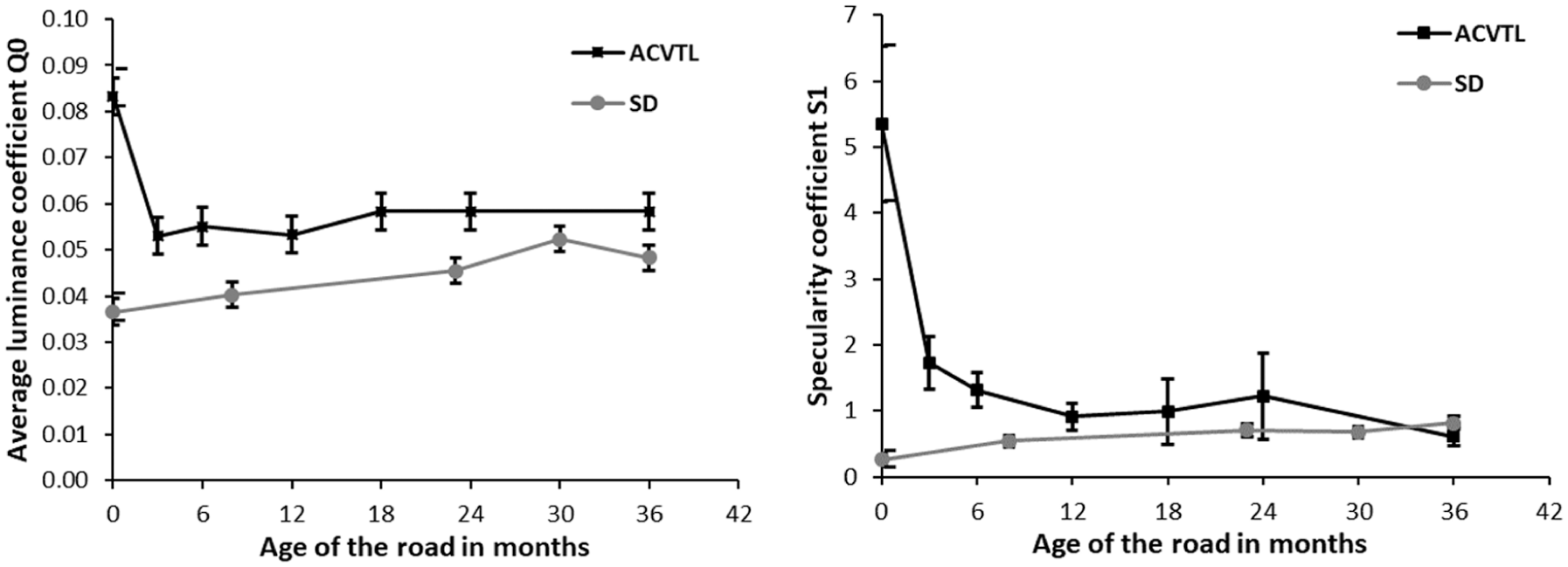
Average impact of time (in months) on Q0 and specularity S1 for eight types of asphalt concrete for very thin layer (ACVTL in black) and for three types of surface dressing (SD in grey). The error bars correspond to the standard deviations.
In a recent study in Japan, 46 20 porous asphalt concretes of different ages (from 0 to 8 years old) were extracted from expressway tunnels. The specularity is important for new pavements, and after 1 year, it is minimal for 4-year roads (around 0.40 and 0.50) and could be higher (around 0.60 and 0.90) for some of the older extracted samples. According to this experimental result, the authors consider that S1 remains stable after 1 year.
In Germany, 14 five old streets (more than 5 years old) were followed during about 3 years, and there was still an average reduction of 3.5% for Q0 and 12.6% for S1.
In Canada,38,39 porous asphalt and medium course asphalt were followed between 1 year and 8 years, and an increase in Q0 and S1 was observed. It is possible that this different phenomenon is due to climatic conditions with the abrasive effect of studded tyres, as observed in Norway on wheel tracks. 54
In France, Dumont and Paumier, 20 Dumont 43 extracted pavement cores during 3 years on different types of roads. Figure 11 shows the evolution of r-tables over time for a 0/6 mm ACVTL with dark aggregates and a surface dressing. In both cases, the binder is bitumen and the aggregates are grey. These representations clearly show the sharp drop in initial specularity for ACVTL and the slight regular increase in specularity and Q0 for surface dressing.
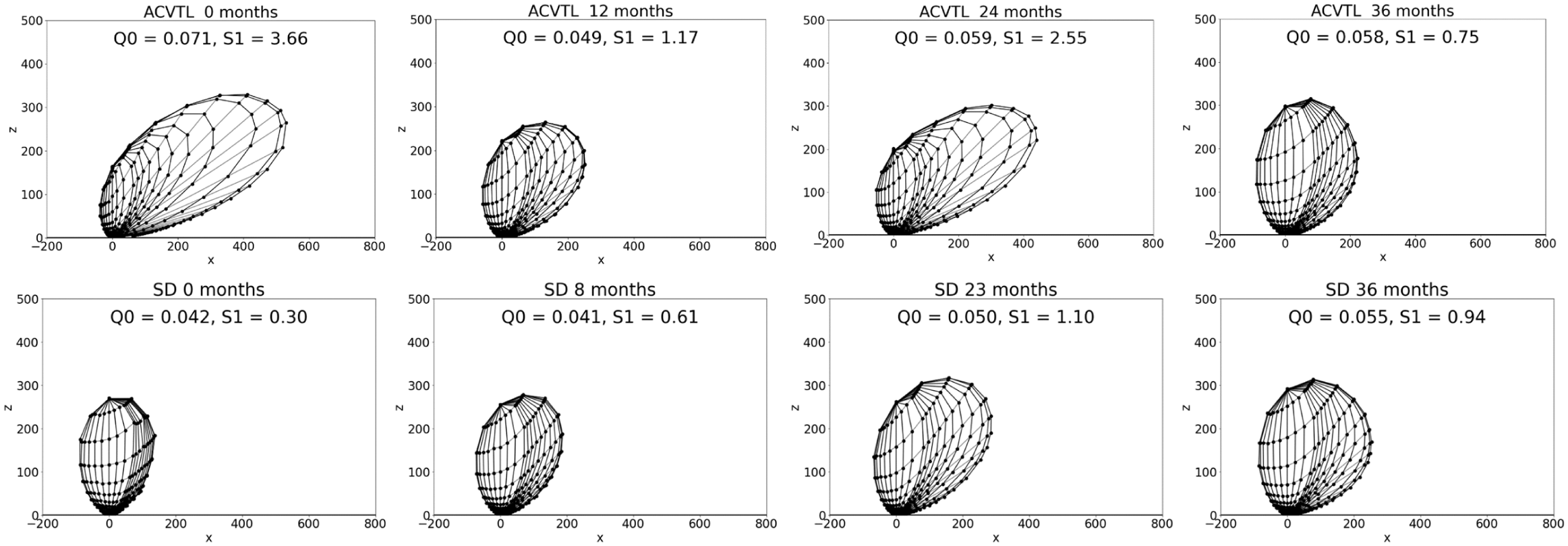
Representation of several reflection indicatrix with
In New Zealand, 13 a decrease of S1 is observed for asphalt concrete surfaces during 1.5 year, while there is an increase for surface dressing roads.
A study on an asphalt urban carriageway in Lithuania 58 showed that the reduced luminance factor of the old street is lower than the recent one, but no S1 measurements were taken.
In the recent measurements 51 conducted in France after 10 years of circulation (see Figure 12) on several 0/10 mm ACTL, the specularity did not change significantly compared to measurements after 3 years. 50 Q0 remained stable for the classical ACTL but slightly decreased for the lighter pavements, probably due to the presence of more dirt.
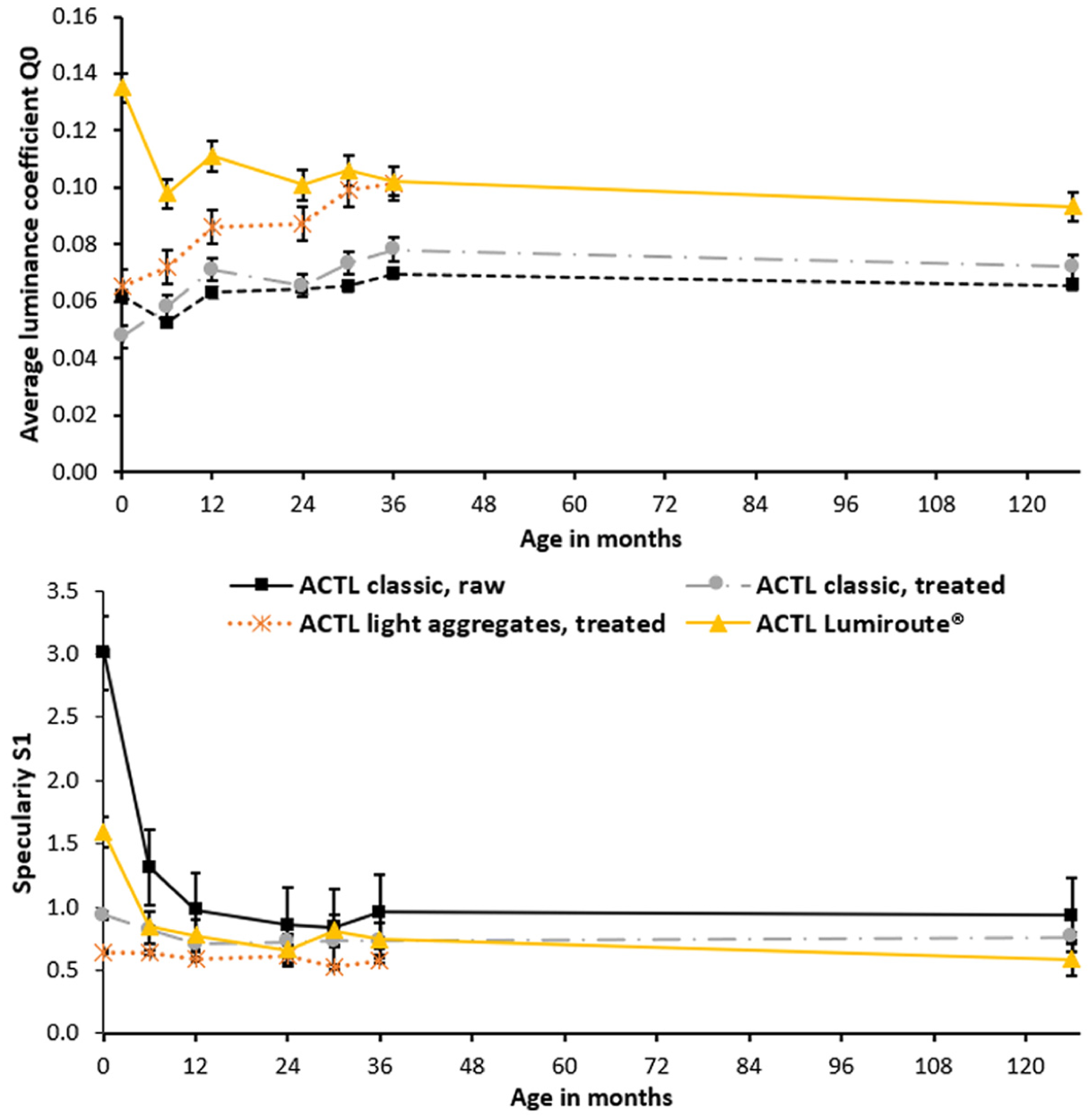
Average values of the photometric characteristics of four ACTL sections measured on-site during 11 years with the COLUROUTE device. There is a classic raw section, two initially treated sections with water jet scrubbing, one classic and one with light aggregates. Lumiroute is a section composed of light aggregates, a synthetic binder with TiO2 addition. Evolution over time of average values of Q0 (up) and S1 specularity (down). The error bars correspond to standard deviations of the eight measured values
In Argentina,52,53 the photometric characteristics of several porous asphalts installed on highways were followed with the LAL-CIC field device. 64 The initial specularity was high at about 1.63 to 1.74 and remained so after 1 year, while Q0 was stable. Between 2.5 years and 7 years, a steady state was achieved with a slight increase in Q0 and only a moderate decrease of S1, remaining between 1.13 and 1.27.
All these studies confirm that 1 year of ageing is not always sufficient to stabilise the reflection properties of certain types of road surfaces, especially raw bituminous mixtures.
5.2 Bituminous mixture with initial surface treatment and surface dressing
When there is an initial surface treatment, like shot blasting, sand blasting or water jet scrubbing,50,65,66 the initial specularity is significantly lower because the initial treatment removes the bituminous binder and makes the aggregate material visible since the beginning. It was also shown that the evolution of the road surface reflection properties is less important with such initial treatment, 50 especially concerning specularity (see Figure 12).
For surface dressing, a maintenance treatment consisting of one application of binder followed by one or two layers of aggregates, the specularity increases with time and traffic.13,20 This evolution, illustrated, for example, in Figures 10 and 11, is caused by the shift and progressive immersion of the aggregates in the binder due to traffic. In the case of projection of white aggregates of calcinate silex, 42 there is also a significant increase in Q0 with time (from 0.056 initially to 0.090 after 4 years).
5.3 Cement concrete roads
The photometry of cast-in-place cement concrete was monitored for 3 years on the entrance road to a cement mixing plant, where two surface finishes had been implemented: deactivated concrete and brushed concrete. 48 Core samples were extracted between 0 years and 3 years, and r-table measurements were taken using Cerema’s laboratory gonioreflectometer. 23 The photometric solids of the corresponding r-tables are shown in Figure 13 at 0 months, 3 months, 6 months and 36 months. It is likely that the increase in specularity observed at 36 months on the deactivated concrete is due to the polishing of the aggregates resulting from the important traffic of heavy goods vehicles at this concrete plant.
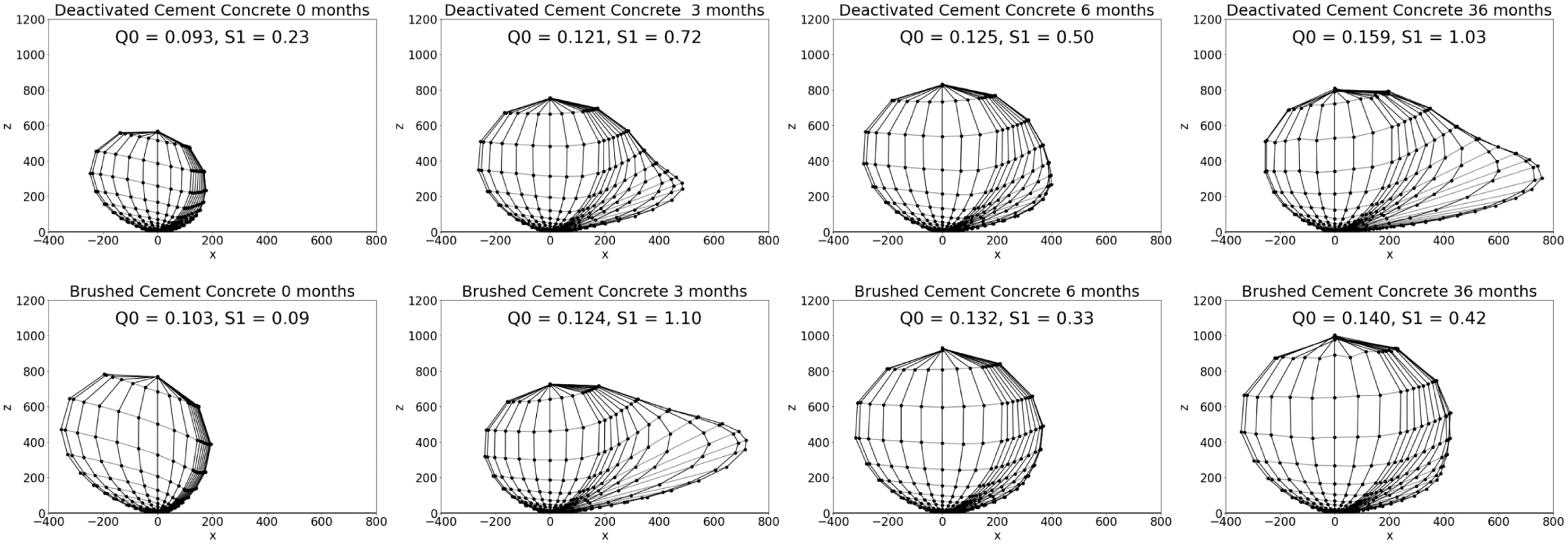
Representation of several reflection indicatrix with
The evolution of the photometry over time of brushed cement concrete laid in a French motorway tunnel was measured over 30 months using the COLUROUTE device. 49 Figure 14 shows the evolution over time of both Q0 on the left and S1 on the right. These figures show that the evolution of these parameters is less marked than for raw asphalt concrete, notably due to a lower initial specularity. However, Q0 tends to fall, probably due to soiling in the tunnel.
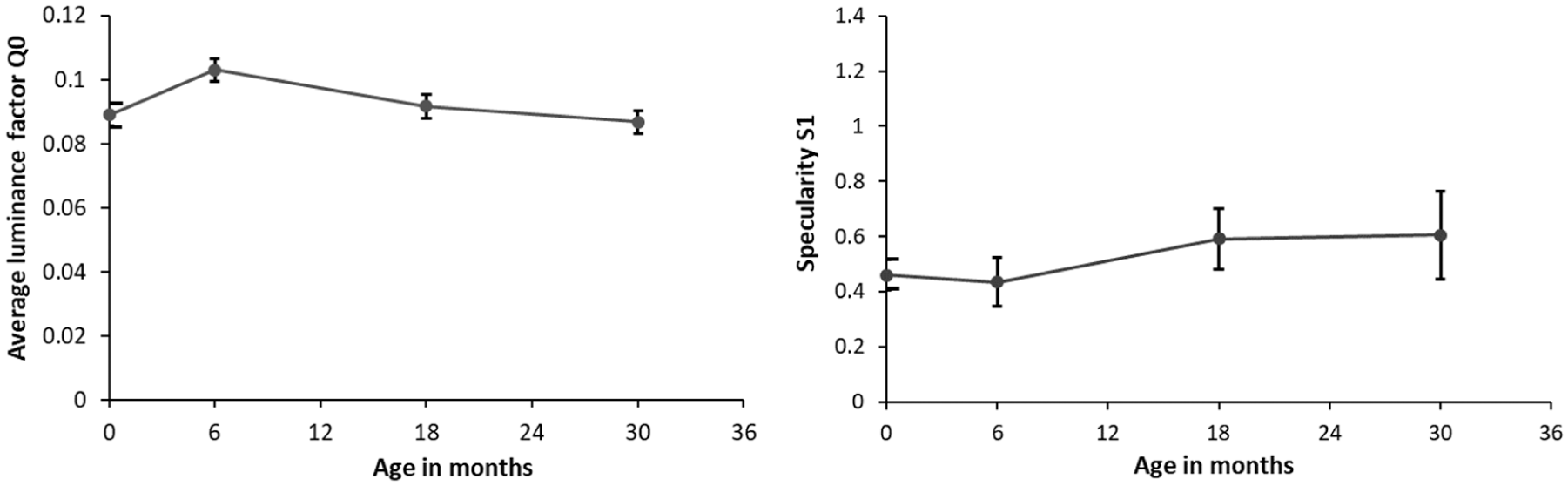
The photometric measurements of a brushed cement concrete done with the COLUROUTE portable device during 30 months, with Q0 on the left and S1 on the right. The dots correspond to the mean of the three to six measurements and the error bars to the corresponding error deviations
Samples of cement concrete were extracted from Canadian roads aged between 3 and 18 years old.38,39Q0 remains quite stable with time, while there is a slight increase in S1, as observed in the measurement conducted in the French tunnel.
Rice also studied the effect of age on concrete pavements 57 using a portable retroreflectometer, 56 whose measurement conditions differ significantly from CIE recommendations because the observation angle is 30° instead of the conventional 1°. Nevertheless, he showed that even with this geometry, the reflection properties of cement concrete change with age. He observed both a decrease in r values over time and a stabilisation between 4 years and 16 years. He also found that this stabilisation was not achieved after 18 months.
5.4 Conclusion on the combined effects of age, traffic and climatic conditions
To conclude, when a single characterisation of the reflection properties of a pavement is done, the recommendations of CIE 0662 to conduct a measurement at least 1 year after road opening are not always sufficient. The condition of the road surface to be measured must reach a level of optical stability representative of most of its service life. In fact, due to its exposure to traffic and environmental conditions, particularly the climatic conditions, the reflection properties of pavement change very quickly in the first months, especially for raw pavements with bituminous binder. This specularity is really significant at a young age but fades fairly quickly under the effect of traffic and its exposure to climatic conditions. The use of an initial surface treatment (shot blasting or water jet scrubbing) is useful to strip the surface bitumen film to stabilise the S1 value. It reduces the amount of variations with time, and especially the initial specularity.
Nevertheless, as shown in Figures 9 to 11, there are still some evolutions between 1 and 2 years, especially for bituminous roads with no initial treatment. Some light pavements also become darker with time due to the impact of dirt (oil and dust, for example). Thus, if the constraints of road managers allow it, particularly in the context of the acceptance of new construction sites, carrying out this characterisation after 2 years is the most appropriate minimum duration.
6. Conclusions and perspectives
6.1 Key learnings
The literature review presented in this article examined the influence of factors external to the road surface, such as the effect of traffic and/or climatic conditions (that involve meteorological conditions, pollution, etc.), on the evolution of its reflection properties over time. As these factors all contribute simultaneously once the pavement has been laid, it is very difficult to isolate their individual influence. Studies, therefore, tend to group these factors around the age of the road surface, even if it can be considered that after 2 years, only the effect of traffic continues to manifest itself. The main trends observed are listed hereafter.
For the effect of traffic and climatic conditions, stabilised road surfaces are considered. Under the effect of traffic, a road surface becomes spatially heterogeneous, with wheel tracks where vehicles pass and centre tracks where they do not pass or pass much less. The edges of the road can also be considered interesting because they are not trafficked. As these different tracks are subject to the same climatic conditions, the effect of traffic can be considered as predominant in the comparative analyses. Although it is difficult to obtain systematic trends, Q0 and S1 may evolve differently depending on the tracks and the nature of the road surface. Therefore, to take account of this spatial heterogeneity in the characterisation of a road surface, a minimum of three measurements in the centre track and three measurements in the wheel track are required.
The studies in which it can be accepted that only the effect of the climatic conditions is present show that non-trafficked road surfaces become more diffuse as they age, whatever their type and composition.
The effect of age was investigated according to the nature of the road surface. Changes over time depend very much on the composition of the surface and any initial surface treatment. For all raw bituminous mixtures, the specularity factor S1 is very high initially, then falls rapidly as a result of erosion of the bitumen film and matification. The initial surface treatments carried out on bituminous mixtures, therefore, enable the stabilised state to be reached more quickly by stripping the bitumen film. In the case of cast-in-place concrete, changes remain moderate, and the trend seems to be the same for precast cement concretes and natural stones. For surface dressing, S1 tends to increase slightly over time due to the sinking of the aggregates under the action of traffic, which makes the bitumen more apparent. Overall, for the vast majority of formulations using light-coloured aggregates, the average luminance coefficient Q0 tends to increase, except for surfaces that are initially very light-coloured (certain types of concrete, synthetic asphalt with white pigments, etc.), probably due to an increase in dirtiness with time. Even if the evolution in reflection properties is generally more pronounced in the first few months, some road surfaces take 2 to 3 years to reach a stabilised state.
According to this review, the recommendations of CIE 0662 to conduct a measurement at least 1 year after road opening are not sufficient because there are still some evolutions after 1 year, especially for bituminous roads with no initial treatment. Thus, if the constraints of road managers allow it, particularly in the context of the acceptance of new construction sites, carrying out this characterisation after 2 years seems the most appropriate minimum duration.
6.2 Discussion and perspectives
As discussed in this article, reflection properties of road surfaces are, in practice, dynamic data that initially depend on their nature, formulation, and the techniques associated with their application. Our review in Part 1, 21 which focused on internal factors, summarises current knowledge on the link between road surface composition and its ability to reflect light when optically stabilised. However, as Part 2 shows, these reflection properties evolve over time depending on traffic and/or climatic conditions, especially during the first 2 years. These aspects are fundamental to the design and optimisation of road lighting installations. Indeed, it is the luminance reflected by road surfaces that provides visibility for road users.
Luminance-based design allows lighting to be optimised according to the existing road surface, which often results in energy savings while ensuring user safety. However, the CIE’s standard r-tables are still used, even though they are no longer representative of actual road surfaces. The ongoing work of CIE TC 4-50 should provide an initial palliative solution to this problem, as it plans to update these standard r-tables to better reflect developments in road manufacturing since the 1970s. Nevertheless, these tables will remain standards, which will certainly be better suited, but will probably not consider changes in light reflection properties over time.
It is therefore necessary to conduct research on modelling this temporal evolution. Certain trends could be systematised according to the nature of the road surface and the type or colour of the aggregates, such as the sharp decrease in specularity for bituminous mixtures in the first few months. If this model were associated with a predictive approach to reflection properties based on formulation, these evolution models could then be integrated into the lighting design process. First attempts were conducted recently to predict the ageing of ACVTL and SD road surfaces 67 and to predict reflection properties at the aggregate stage.68,69 To develop robust models capable of characterising the evolution of different natures of road surface for different external factors, a large number of measurements are required. Obtaining a high number of measurements on a wide variety of road surfaces remains a technical challenge today. Laboratory measurements are destructive and are therefore only carried out on a limited number of samples. Measurements taken directly in the field using portable devices are easier, but there are no commercial versions available. Furthermore, whether in the laboratory or in the field, the spatial heterogeneity of road surfaces must be taken into account, and at least six measurements must be carried out. The use of Imaging Luminance Measurement Device (ILMD) could be a way to overcome this obstacle. A luminance image can be used to characterise the entire road surface and thus simultaneously integrate the centre track and the wheel tracks. If, in addition to these luminance measurements, the characteristics of the luminaires (photometry and installation geometry) are known, it is possible to estimate luminance coefficients70–72 or even the entire r-table.73–75 Although these new techniques are still at the proof-of-concept stage, they show great promise for facilitating access to the actual reflection properties of road surfaces. On this basis, future work aimed at reducing the environmental footprint of road lighting installations could be launched.
Footnotes
Appendix A: Compilation of the standard terminology and used names
Appendix B: Figures representing the effect on the transversal positioning for Q 0 and S 1
Declaration of conflicting interests
The authors declared no potential conflicts of interest with respect to the research, authorship, and/or publication of this article.
Funding
The authors disclosed receipt of the following financial support for the research, authorship, and/or publication of this article: This research was in part funded by the French National Research Agency under the REFLECTIVITY project: ANR-22-CE22-0006.
