



Abstract
This mixed-methods research used participatory photography with an online questionnaire to collect data on autistic people’s response to lighting systems in the everyday built environment. It was designed to be accessible to autistic participants and accommodate the needs of this autistic researcher. Four main themes were identified, opening opportunities for future lighting improvements to better meet the needs of the wider community: (1) lighting systems (layout, lamp shapes and types, number of lamps), (2) technical factors (flicker, noise, brightness, colour temperature), (3) reactions-to-lighting (both positive and negative) and (4) use of descriptive language. While the strong dislike of linear-grid lights was expected, the extent of the dislike towards lighting systems in Library/Community spaces and medical buildings, particularly waiting rooms, was concerning. As these are spaces likely to be used by autistic people, lighting improvements are urgently required. As a result of the direct participation, the rich data expand the understanding of autistic people’s perception of everyday indoor electric lighting systems. The research has identified avenues for future research to create more accessible indoor environments for autistic and neurotypical people, or in brief, all users.
1. Introduction
Autism is a neurodevelopmental condition that affects social and communication skills, as well as creating patterns of restricted and repetitive behaviour. 1 The estimated prevalence of autism in New Zealand is 3%, based on childhood diagnosis data from the New Zealand Health Survey, 2 which aligns with other recent international prevalence estimates in similar high-income countries.3,4 Long-term outcomes for autistic people are poor, with rates of paid employment as low as 29% 5 and increased premature mortality. 6
Differences in sensory processing compared to neurotypical people now form part of the diagnostic criteria for Autism Spectrum Disorder (ASD). 1 Despite there being extensive research into both the differences in sensory processing in autistic people, and the effects of the indoor environment on the general population, systematic research that bridges these two areas remains limited. The aim of this research is to advance understanding of how to improve the indoor built environment for autistic people by better understanding effects they experience, with a focus on electric lighting.
Note that the term autistic people is used throughout this paper as identity-first language is generally preferred by autistic individuals,7,8 including the primary author as an autistic researcher.
2. Background
Assessments for sensory processing differences usually test across various domains (auditory, visual, tactile, olfactory, etc.). Differences in sensory processing ability are observed in up to 90% of autistic people at all ages, independent of intellectual ability.9,10
2.1 Previous ASD lighting research
A number of large-scale reviews of vision-based research11–13 have found differences in visual processing in autistic people across most aspects of visual perception. Similar to other areas of sensory processing, autistic people have a heterogeneous profile of visual perception, and may perform better than controls in some areas such as static spatial tasks, and worse in other areas such as dynamic processing. 11 Parmar et al. 14 found that visual hypersensitivities to characteristics including light, motion, patterns and particular colours had significant negative effects on the participants’ personal well-being and daily life.
In an earlier survey-based study, 15 it was found autistic respondents (n = 83) reported significantly higher discomfort, distress and avoidance across their homes, workplaces and indoor public spaces than neurotypical respondents (n = 134). Glare and Electric Light were both factors that had large differences between autistic respondents and neurotypical people. Critically, while Electric Light as a factor was rated negatively by autistic respondents, the research did not provide information about the lighting system, layout or lamp types. It was also not possible to attribute issues with glare and electric light to specific building types. This follow-up research looked at these issues.
2.2 Lighting issues
Three main issues are highlighted in research looking at autism and electric lighting:
Fluorescent lighting
Flicker
Bright light
These are often discussed in relation to each other. For example, in focus groups in multiple studies, autistic adults reported problems with bright light, particularly electric light, and flicker from fluorescent lighting.14,16 Participants reported discomfort and physical reactions to visual stimuli, particularly headaches in response to electric lighting. 16 These issues were also highlighted in another, wider questionnaire-based study of 270 people by the same authors. 17 While flicker is generally referenced in conjunction with fluorescent lighting, in this study it is considered as a separate issue as it can occur in other types of electric lighting, including newer technology LEDs.
Guidelines for autism-friendly design often include provision for lighting design, primarily reduction of glare and avoidance of fluorescent lights due to flicker and ‘hum’.18–20 However, there is limited research-based evidence for this, with most design guidelines primarily based on anecdotal evidence. 21 The guidelines are highly specific and are primarily used for design of specialist schools or residential centres for autistic children with very high support needs.22,23 Further evidence is emerging in the context of young adults in higher education settings,24,25 and adults in workplaces,26,27 with the above issues continuing to be noted.
2.2.1 Fluorescent Lighting
Two experimental studies from the 1970s and 1980s observed an increase in repetitive behaviours in institutionalised autistic children under fluorescent compared to incandescent lighting.28,29 However, while they are the only ones commonly referenced in publications that mention or discuss lighting design for autism, they have not been repeated even though lighting technology has changed.12,23,30,31 Some modern ‘white’ LED lighting uses phosphor conversion technology to create ‘white’ light, similar to fluorescent lighting 32 but colour mixing (e.g. discrete red, green, blue) or a hybrid combination can also be used.
More recently, autistic children’s preferences for alternatives to fluorescent lighting in classrooms are found in studies comparing fluorescents to incandescent lighting, 33 to halogen lamps 34 and to LEDs.35,36 Often such studies implement a lighting change in conjunction with another change (e.g. acoustic) making it difficult to assess the individual impacts and benefits. 37
2.2.2 Flicker
Despite the link between flicker and fluorescent lighting made in autism-based research, there is little discussion of the impact of flicker on autistic people from other types of lighting. While LEDs are solid-state lighting, the drivers that convert from AC to DC can potentially create flicker. Good quality drivers for autistic people are mentioned in some places, but only in more technical lighting literature,31,38 not autism design guidelines. Even in recent studies, there is an assumption that LEDs are not susceptible to flicker due to not using ballasts, but there is no consideration of the potential impact of drivers. 36 Flicker can particularly be a problem when LEDs are used in conjunction with dimmers.39,40 Despite this, in autism design guidelines, the installation of dimmers is often specifically recommended to allow for flexibility alongside the avoidance of fluorescent lighting.18,20,41,42
2.2.3 Brightness
Perception of brightness is a complex issue, as it is a subjective attribute. While there is a basic relationship between brightness and luminance, there are many other factors that affect brightness, 31 including the colour spectrum (due to the spectral sensitivity of the human eye), the spatial light distribution43,44 and reflectivity of surfaces.
Sensitivity to light (photosensitivity) is widely recognised as an issue for autistic people.12,45 It is regularly referenced in sensory assessments used by occupational therapists and diagnosis teams to evaluate differences in sensory processing. For example, the widely used Sensory Profile lists both Is bothered by bright lights after others have adapted to the light and Covers eyes or squints to protect eyes from light as scoring items. 46 Unusually sensitive to light is used in Minshew and Hobson’s Sensory Sensitivity Questionnaire. 10 Photosensitivity is not limited to electric lighting, with sensory assessments using both artificial and natural light situations as examples.
2.3 Participatory photography
Participatory photography is becoming an increasingly popular method to engage autistic people in research.47,48 Some studies report on an initial pilot of participatory photography as an evaluation of the method for use with autistic people.49,50 Most studies using participatory photography with autistic participants use children and students, focusing on school experiences,51,52 wellbeing49,53 or physical activity.54,55 There are also a number of studies working with young autistic adults, particularly around the transition to adulthood.50,56,57
Participatory photography has also been used to evaluate various aspects of the built environment, such as mobility barriers,58,59 walking behaviour60,61 and neighbourhood perception.62,63 Most of these studies were at a neighbourhood scale, rather than an individual building or specific environment. Many precedents of participatory photography as an evaluation of the built environment are with seniors,59,61 or adults across the lifespan.58,60,64,66
The one example found of the use of participatory photography to specifically explore indoor lighting was Gerhardsson et al.46,64 They assessed the use of residential lighting in Sweden, reporting on purchasing behaviours and lighting characteristics in one paper, 64 and residents’ use of their home lighting in another, 66 but the dataset was the same for both papers. While participants in the study took photographs of the lamps in their homes as prompts for discussion and reflection in interviews, these were not included as analysis material.
3. Method
To be able to suggest how to improve the electric lighting environment for autistic people, we must first identify what lighting systems currently are and are not working, and where they are used. Additionally, to understand the range of experiences of autistic people, identifying what is working is of equal interest to what is not working.
Research in the area of lighting is typically quantitative and often experimental, focusing on objective and measurable qualities such as working plane illuminance, colour temperature, glare index, etc. 31 However, this looks to answer a specific, defined question, not providing an exploratory approach. While qualitative research is uncommon in lighting research, there are those who assert that it has advantages in exploring complex issues involving human views and behaviour, and allowing researchers to address difficult questions that otherwise go unanswered. 65 Examples of research into perception of lighting using qualitative methods are emerging.66–68
This project explores autistic people’s perceptions of everyday electric lighting systems using a participatory photography method.
3.1 Research method
For this study, a photo diary method is employed that uses aspects of different precedents outlined above. Participants were asked to take photographs over a two-week period of time,55,58,59,61 using their own devices,49,57,60 and to describe/rate their photograph when submitted.55,57,61
Participatory photography methods are typically considered qualitative methods, as they deal with images and contextual interview/text data. This study used Likert rating scales alongside the photograph submission to provide quantitative data. 69
The photo diary method followed the following approach:
Invitations of interest were emailed to potential participants through national organisations (Autism New Zealand, Altogether Autism and YES Disability) and posted in local autistic adult social media groups of which the principal researcher was a member.
Interested participants either emailed the researcher directly or provided their email address using an invitation link.
Researcher provided participants with information sheet and consent form.
After the consent form was returned, participants were provided with a photo diary, instructions and demographics survey link.
After confirmation of participant understanding, any questions were answered by email, and upon completion of the demographics survey, the photograph return link was provided.
Two-week photo return period.
Collation of data and initial data analysis to inform follow-up questions.
Follow-up with participants.
Full analysis of both initial and follow-up data.
Over the course of two weeks, participants were asked to take photographs of indoor electric lighting and submit through an online questionnaire. For each photograph, the participant provided an open-ended text description of their thoughts about the lighting, rated their like/dislike, answered location questions and what type of lighting they thought that it was. A follow-up round asked the participant for any needed clarification and/or context. All participants also reviewed their photographs during the follow-up and gave permission for use in publication.
The survey was carried out under the VUW Human Ethics Committee (HEC) approval number: 27804 dated 14 July 2019. Written informed consent to participate was obtained from participants prior to commencement of the survey.
3.2 Data analysis plan
As a fully integrated convergent mixed-methods approach, both qualitative and quantitative analyses were used. However, because of the emphasis on qualitative data, the overarching data analysis process followed the thematic analysis guidelines outlined by Braun and Clark. 70
The data collected were broadly coded in two different ways:
Variables that could be visibly evaluated by researcher in the photograph and accompanying questionnaire data.
Sub-themes and issues identified from comments.
In the first broad type of coded data, for each of the variables identified, mutually exclusive and exhaustive values were defined. 71 These include variables that were directly reported by participants (location, type of lamp), and variables that were visually evaluated by the researcher (size of space, number of lamps, layout). The second broad type of coded data includes sub-themes and issues identified in the photograph questionnaire comments, as well as responses in the follow-up section.
3.3 Recruitment
The sampling method used was homogenous and purposive, due to the clear inclusion and exclusion criteria listed below. 72 At the time of the survey, participants must have:
been on the autism spectrum, either with a professional diagnosis or suspected
had access to a smartphone or digital camera
had access to the internet to allow for the return of photographs
been located in New Zealand to allow for intended post-study physical site visits (these were prevented by COVID-19 restrictions)
been over the age of 16 years
Participants with a serious or complex intellectual disability that affected their ability to give informed consent and/or to follow project instructions were excluded. The ability to reliably communicate verbally was not an inclusion/exclusion criterion; the only requirement was the ability to use written communication. Reported autism diagnosis was validated using the Autism Quotient instrument. 73
Thirteen people completed a photo diary, with eleven completing a follow-up after the initial submission. While photographs were collected in late 2019, follow-up occurred in early 2020 when COVID-19 lockdowns were beginning to affect New Zealand. All participants were located throughout New Zealand, with four from the South Island and seven from the North Island. All participants lived in urban settings.
4. Results
A total of 136 photographs were submitted by participants (median = 10 photographs per participant, min = 6, max = 17). Three photographs were excluded from analysis for not meeting the instruction criteria, leaving 133 photographs of indoor electric lighting. The language used by participants has been retained, including spelling errors or (apparently) incorrect words.
The data analysis process identified four overarching, distinct themes. These themes at times overlap, for example, warm lighting can be technical as a measurable colour temperature or emotive as descriptive language.
4.1 Theme 1: Attributes of photographed lighting systems
Participants were asked to specify each photograph’s location. These locations were summarised to ensure anonymity and grouped according to similar type (Figure 1). All participants submitted at least one photograph of within their own residence. Otherwise, there was a range of different locations submitted by different participants (median = 5, min = 2, max = 7). There were no obvious location patterns in the participant photographs.
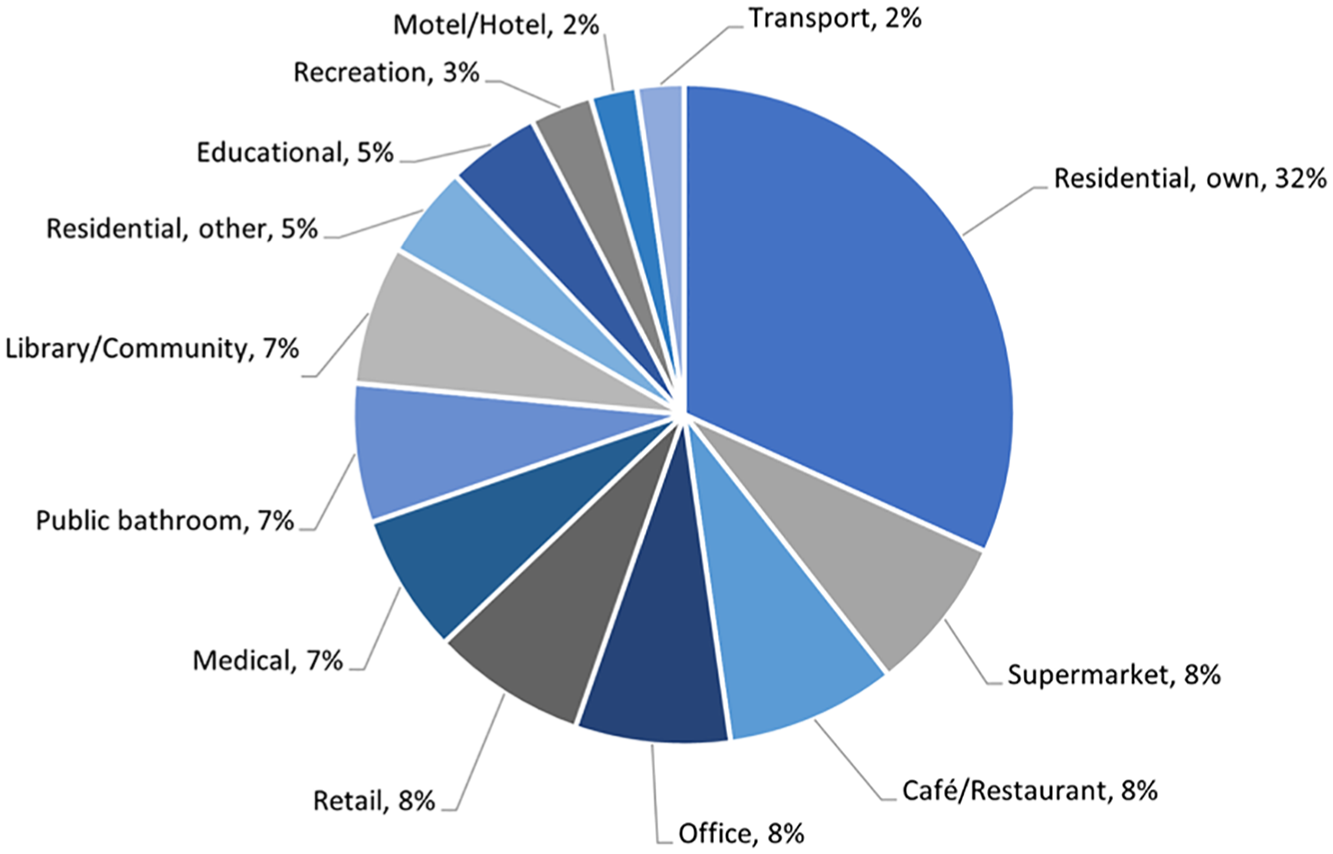
Proportion of buildings in photographs (n = 133)
Approximately half of all photographs were of lighting that participants disliked, a quarter neutral and a quarter liked. Of all participants, eight out of the thirteen submitted more than half of their photos as of lighting that they disliked, including one participant who only submitted lighting that they disliked. Four participants submitted no photographs of lighting that they liked a lot.
Participants generally disliked the lighting in large and medium sized spaces, with small spaces receiving a higher proportion of liked lighting. Discomfort caused by lighting was highest in large spaces and lowest in small spaces. Small spaces predominantly had a single light fitting, while large spaces often had multiple light fittings of the same type arranged in a regular pattern. Participants most commonly submitted photographs of bulb-shaped and linear lamps, providing fewer examples of downlights or other-shaped lamps.
Participants were asked to identify the type of lamps in their photographs, selecting from the options of fluorescent, Compact Fluorescent Lamp (CFL), incandescent, LED, halogen, mixed or I don’t know. A substantial minority (42%) were categorised as I don’t know. Participants were generally more confident in identifying the lamps in their own homes. They often noted that they assumed lighting was fluorescent based on shape or flicker issues.
Disliked lighting was primarily associated with (self-reported) fluorescent lamps, causing various levels of discomfort. Participants reported mixed responses for lamps of unknown type. Liked lighting was more common for incandescent, LED and halogen lamps, with LED lamps receiving the highest likability. Validating participants’ assessments by visiting locations and identifying lamp types was not feasible, in part due to COVID-19 controls.
Participants often assumed that linear-shaped lighting laid out in an array was fluorescent, especially in locations like supermarkets. Out of 34 submitted photographs of such lighting, two-thirds were reported as fluorescent, while a few were reported as LED and some as unknown. These lighting arrangements were predominantly found in medium and large spaces. The majority of participants disliked this type of lighting, with only a few who liked it.
However, linear lighting was disliked regardless of layout, though there were only four photographs of linear lighting not laid out in an array. Comparatively, for all other lighting shapes, an array layout was marginally more disliked than other layouts, but other layouts were much more liked (Figure 2).
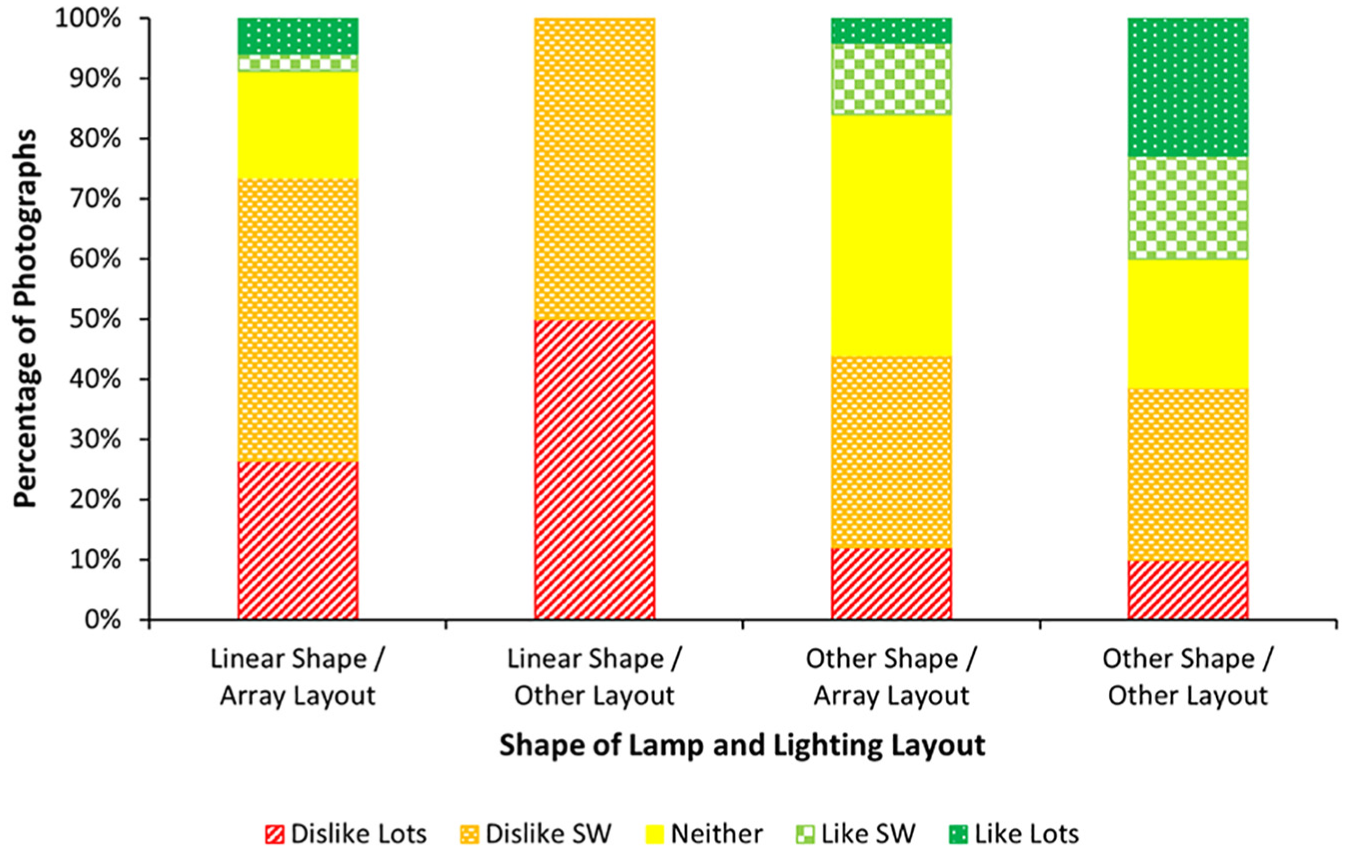
Shape of lamp and lighting layout – analysis of like/dislike
The photographs also helped identify issues relating to specific spaces. Lighting in people’s own residences was generally more liked than other locations, perhaps again due to control. On the contrary, as found in other research, retail and supermarket lighting was problematic. What was concerning was the strong dislike to lighting systems in Library/Community spaces and medical buildings – particularly the latter given that most photographs were in waiting rooms, and not treatment areas where bright task lighting would be considered essential.
4.2 Theme 2: Technical factors
These were a set of 18 factors coded from the photograph comments and then quantified in the follow-up. They include qualities of the lighting that are more objective or measurable and potentially able to be included in future lighting design guides, such as flicker, noise, glare and different colours of light. Participants were asked to select the factors that they considered problematic or liked, rate the frequency of the problems and rank them. More participants identified factors as problems than liked them. Some factors were selected as both problems and liked by certain participants, indicating mixed responses. As participants chose which factors to answer about, not all factors have responses from all participants.
The technical factors can be classified into three broad groups, outlined in Table 1. These have been ordered by group, then by the number of participants that selected it within the group (strength of response):
Analysis of technical factors
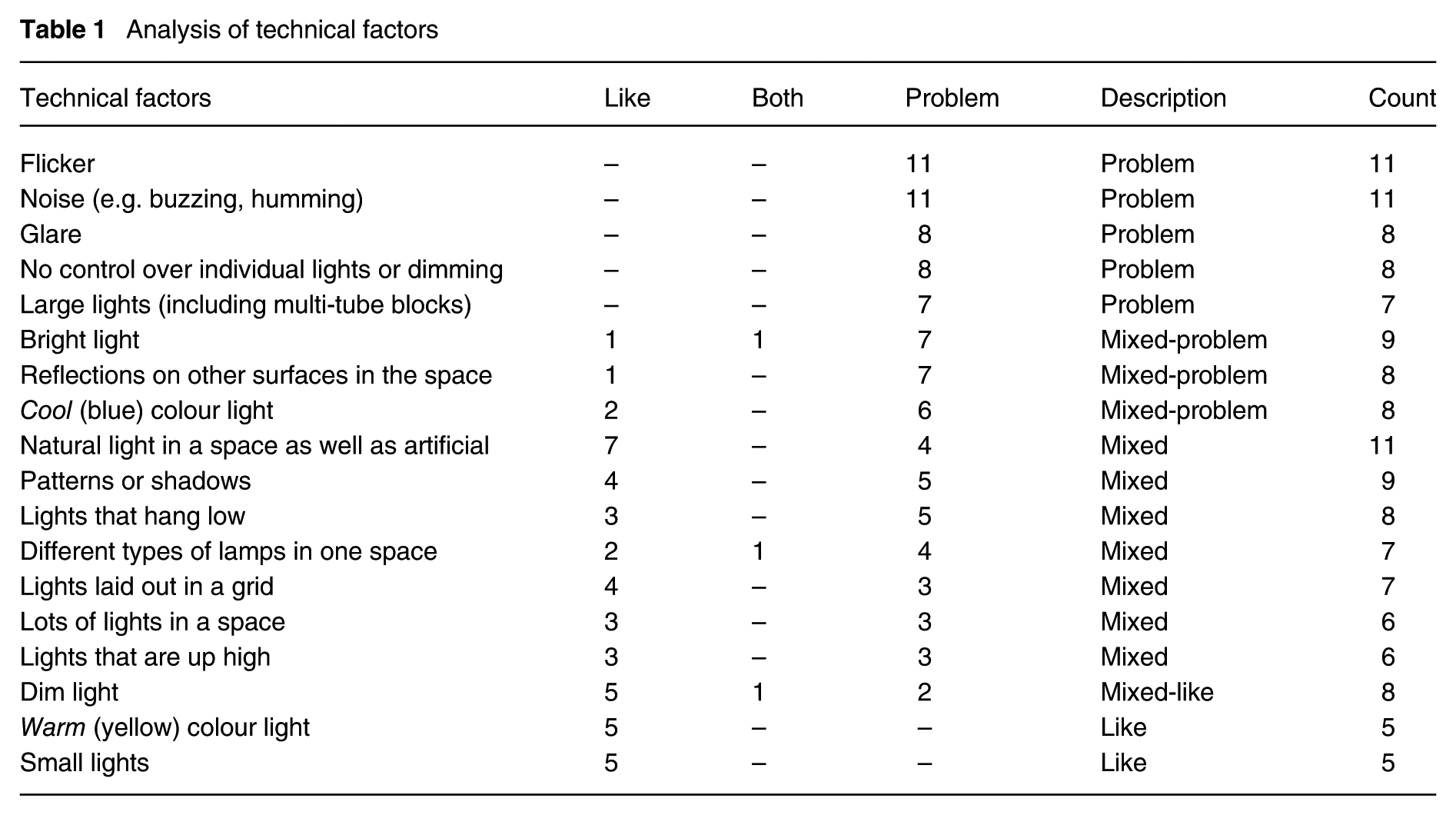
Factors that were Problems, including those that were totally selected as a problem, and those that were Mixed-problems with at least one person selected liking it but the majority selecting it as a problem.
Factors that were Mixed, where multiple different people selected a factor as a problem and others as something they liked.
Factors that were Liked, including those that were totally selected as liked, and those that were Mixed-liked with at least one person selected it as a problem, but the majority selected it as liked.
Flicker was unanimously identified as a problem by all participants, reporting it in 13 photographs, mainly attributed to fluorescent lighting. Light fittings and faulty or broken lamps were identified as potential causes in a few cases. Where identified, LED lighting was rarely associated with flicker.
Noise was also unanimously identified as a problem by all participants, although photographic examples were understandably limited. Six photographs showcased noise issues, primarily in residential settings. Participants often associated noise with flickering lights, particularly ones they reported as fluorescent. The noise was described as a hum or buzz, and was often only audible to the participant.
Glare was seen as a problem by most (8 out of 11) participants. Glare was often associated with bright lights, while some participants mentioned a reduction in glare when there was a diffuser or cover over the lamp.
Lack of control over individual lights or dimming was also a problem. In having control over the lighting, or lack thereof, there seemed to be two distinct options – the ability to turn individual lights on and off (not multiple lights linked to the same switch), and the ability to dim lights. While for some participants there was overlap between these, others showed a preference for one over the other. Reflections on other surfaces in the space were disliked, especially when the lighting was bright and surfaces were glossy, or when they interfered with tasks like using computer screens. Gender differences were observed with responses for cool-coloured lighting, with male and gender-diverse participants expressing more opinions about cool-coloured light, but the sample size limits analysis.
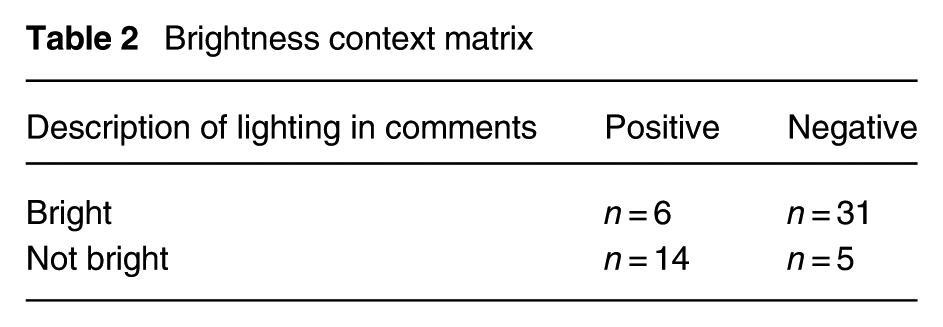
Over 40% of comments mentioned brightness in their submitted photos. This factor can be conceptualised as a four-way matrix as shown in Table 2 with respondents considering the lights in their photograph as too bright or not too bright, and either positive (pleasant) or negative (unpleasant): negative bright (lights that were too bright), negative not bright (not bright enough), positive bright and positive not bright (not too bright). While most participants associated bright light with negativity, a few viewed it positively, particularly in task-oriented situations. Negative brightness was more prevalent in larger spaces and linear-shaped lamps. When participants mentioned brightness as not too bright, they generally liked the lighting. Overall, the perception of brightness varied among participants, with some finding it positive for specific tasks, while others disliked it, particularly when it was excessively bright or glaring.
Brightness context matrix
Participants had mixed opinions about both natural light and electric light in a space. Some participants liked the combination, while others found it problematic. Negative experiences with the combination of natural and electric lighting were associated with discomfort and sensory issues, particularly with fluorescent lighting. Positive experiences were noted as the electric lighting being less intense and caused little discomfort. Opinions on patterns or shadows were also mixed, with some participants liking them and others finding them problematic. Lights that hang low were a source of concern for some participants due to the potential for physical discomfort, for example, knocking heads on the light fitting, rather than a characteristic of the light itself.
The presence of different types of lamps in one space generated mixed opinions, with some participants appreciating the variety and others finding it unpleasant. Lights laid out in a grid pattern were disliked by some participants, who reported brightness, headaches and motion-related visual distortions. The presence of many lights in one space was both liked and disliked by participants, depending on factors such as individual control and lighting purpose.
The preference for dim lighting was not strong among participants. Some participants liked it, finding it more pleasant and easy on the eyes, while others found it problematic as it made it difficult to see clearly. While some participants mentioned that they preferred lights that were not too bright, it did not necessarily mean they wanted dim lights. Warm-(yellow) coloured light was generally liked by participants, with many mentioning its relaxing and comfortable tone. Small lights were also favoured by some participants, either for their usefulness in task-based lighting or for the ambient light they provided. Overall, preferences for dim light, warm-coloured light and small lights varied among participants, with different participants prioritising these factors differently.
4.3 Theme 3: Reactions to lighting
When participants submitted their photographs, they often described physical or mental/emotional reactions to the lighting. Not every photograph submitted included a description of a reaction, but all participants reported at least one physical or mental/emotional reaction to lighting in at least one photograph.
All participants mentioned a negative reaction to the lighting in at least one photograph (median = 5, min = 1, max = 7). Six participants mentioned a moderated reaction to the lighting in at least one photograph (median = 2, min = 1, max = 4), where they noted a negative reaction to the lighting was typical or expected but was moderated by some other factor, or a reaction occurred only in certain circumstances. Five participants specifically noted the absence of any reactions to the lighting in at least one photograph (median = 2, min = 1, max = 2). Four participants mentioned a positive reaction to the lighting in at least one photograph (median = 2, min =1 , max = 4).
Participants’ like or dislike of the lighting generally corresponded to their reported reaction. For photographs where a positive reaction was mentioned, participants also reported liking the lighting, and vice versa. Participants’ discomfort level also corresponded with their reaction type, with no or low discomfort for positive, neutral or moderated reactions, and higher discomfort for negative reactions. The locations where participants mentioned reactions to lighting varied, with retail, Library/Community spaces and supermarkets having the highest proportion of reactions. Negative reactions were more prevalent for regular array lighting layouts, while positive reactions were more common for table lamp lights. Lamp shape and type also influenced participants’ reactions, with linear-shaped lamps and fluorescent lighting often receiving negative reactions.
Participants’ specific reactions to the photographed lighting encompassed a wide range of physical and mental/emotional responses. Negative reactions were more common and primarily manifested as physical discomfort, with eye-related issues the most prevalent. Some participants also experienced mental/emotional discomfort, such as anxiety or irritability. Positive reactions were predominantly related to mental/emotional wellbeing, with participants finding the lighting comforting and relaxing. Anxiety was the only reaction mentioned in both positive and negative contexts, either in relief of or as a cause of.
Six of the eleven participants who completed follow-up reported that they had previously avoided buildings due to lighting. Retail locations featured heavily when discussing specific avoidance locations, and three participants noted that they would make decisions around their shopping habits based upon lighting in some specific locations. One other participant who reported that they had not avoided buildings before due to lighting did note that they had previously left a job in an office due to getting headaches from a combination of the fluorescent lighting and high noise levels in the space.
4.4 Theme 4: Descriptive language
In their photo diaries, participants used distinct descriptive language, primarily adjectives, to express their perceptions and opinions of lighting in the photographs. The descriptive language was separate from the discussions about reactions or technical factors related to lighting. Participants each had their own individual set of descriptive words, which showed some similarities but also distinctions. Due to the small sample size, it was challenging to generalise or combine the various word usage patterns.
The most commonly used descriptive words for lighting across multiple participants were bright, not too bright, harsh, okay and good. Harsh was often associated with negative reactions, while okay and good were more generic terms. Some less common, but still shared, words included soft, fine, not too bad, warm, intense, direct and strong. These words represented a mix of neutral, negative and positive descriptions with both generic and specific qualities. Additionally, certain participants used particular words consistently across multiple photographs, such as one using glary to describe disliked lighting in six out of nine photographs. Similarly, unobtrusive was used three times by only a single participant to describe a neutral or positive quality of their photographed lighting.
Overall, participants tended to have more varied negative words for lighting compared to positive ones, with warm and soft being the common positive descriptors. Interestingly, different participants associated soft with different ends of the visible colour spectrum (warm vs. cool white).
Notably, participants would often describe lighting that they liked as the inverse of qualities that they disliked. The most common example of this is not too bright. Another common example was not harsh, while not too bad was another generic description used by multiple participants, and one participant described the lights in another photo as not sharp.
5. Discussion
Fluorescent lighting was problematic for autistic adults in this study, a finding aligning with anecdotal evidence and design guidelines.18,20,42,74 The perception was of fluorescent lighting being any linear lighting array in large spaces. However, LED lighting is commonly replacing fluorescent lighting in these environments due to its energy efficiency and longer lifespan. In New Zealand, new commercial and retail lighting systems are almost exclusively LED lighting, while the LED retrofitting of old systems is common.
Both fluorescent and LED make use of phosphor delivered light, so it is possible the spectral distribution may be an issue. If the problem with fluorescent lighting really is the method of light production using fluorescence with ballasts, then this should resolve as lights widely shift towards LEDs. But if the problem continues to be reported, as it is in this research, when it is known that many lights are not fluorescent suggests that there are other factors. Whether participants correctly identified lighting as fluorescent or not, linear-shaped lighting arranged in an array was problematic. Further investigation is required into why this particular shape and layout is problematic, and what options there may be for alternative lighting layouts.
Similarly, while fluorescent flicker is highlighted in literature that discusses autism and electric lighting, 17 these all come from studies in the period before the introduction of high frequency ballast,28,29 which should remove low frequency flicker, although not at the end of the bulb life. These do not take into account flicker in modern LED lighting. 38 Flicker was also reported as problematic by the autistic adults in this study, both in the photo diary submissions and particularly in the follow-up questionnaire, where it was the most definitive dislike across all technical factors – every participant selected it as a problem. While this study supports the existing evidence, it does not advance understanding of the actual issue. What is needed is a more technical, experimental approach to identify which parameters of flicker are causing problems for autistic people.
This study does expand the understanding of how autistic adults perceive and describe brightness in lighting systems. It challenges the notion that autistic individuals universally dislike bright lights. The typical legacy recommendation to avoid bright lighting appears simplistic. Autistic individuals may have different preferences and discomfort thresholds. Further investigation into lighting types suitable for task-based brightness and understanding the issue in context is needed. Additionally, some participants expressed a negative response to dim lighting, while others liked it. This is consistent with the findings of Nair et al., 42 who also found that while there was a very strong dislike for bright lighting by autistic children, the children also did not like dark lights or spaces and felt flustered in these conditions.
Research on the impact of the colour of light for autistic individuals is developing. Existing studies focus on the colour of surfaces (e.g. paint colour) rather than the colour temperature of light. 42 Preferences for warm-coloured lighting have been found in some autistic adults,14,75 while others, as assessed by parents and caregivers, find it to be less important. 76 Adjustable colour lighting, particularly circadian lighting, has shown positive effects on sleep and emotional state in homes of autistic children.75,77
Avoiding patterns or shadows is often advised in ‘autism-friendly design guidelines’, often due to them causing distraction. 19 But in their photo diaries, some participants submitted photographs that showed patterns or shadows cast by lights or lampshades that were seen as positive or interesting. In the follow-up, the response to patterns and shadows was very mixed. It may be that there are differences between the intended use of a space and these types of ‘interesting’ patterns. Most guidelines are for educational environments, where concentration and productivity are prioritised. Participants also provided photographs of positive patterns at home and in a medical waiting areas, locations where comfort and distraction can be useful.
The use of natural light in a space as well as electric lighting was the most polarising technical factor, with responses from all participants, where two-thirds liked it and one-third found it a problem. In other research, natural light has been found to be generally positive for autistic people,14,16,42 though some design guidelines note issues with distractions when autistic children are able to see out windows.
Participants did not generally make the distinction between sunlight (direct light from the sun) and daylight (indirect light from the sky) when discussing natural light. Sunlight is often associated with brightness and glare, which are known problems, and can often be mitigated with diffusing blinds or shades. But natural coloured light is often described as preferable, while lighting that is disliked such as fluorescent is often described as unnatural.14,16 The use of natural light in conjunction with electric lighting is a well-studied area for the typical population, 31 but there is little research that considers how this applies to the needs of autistic people.
Several technical factors related to lighting were identified, some of which were distinct (e.g. flicker, noise, glare), while others formed pairs of opposites (e.g. low-hanging and high-hanging lights, large and small lights, cool and warm colours). A limitation in the follow-up exercise was that a potential paired factor was missed – participants were provided the factor of No control over individual lights or dimming but were not provided a factor for having control. Anecdotal evidence suggests this would have been a liked factor. Another potential technical factor was the presence of reflectors or covers over lamps. Participants had mixed opinions on these in photograph comments, with a general dislike for egg-crate style reflectors and variable responses to frosted or opaque diffuser covers. Further research is needed in these areas.
Participatory photography is becoming increasingly commonly used with autistic people as a more accessible research method than traditional interviews.47,48 Similarly, it has been used as a way to evaluate the built environment, often at a neighbourhood scale,58,60,62,63 but has seen limited use in assessing lighting. However, for this study, it provided a novel means to explore perceptions of indoor lighting, in a minority population that have additional needs that can limit the use, or require adaption, of traditional research methods. Adaptions for this study included written communications, flexibility of the return period timing and reminder emails. Participants had the autonomy to choose what aspects of indoor lighting to photograph and provide feedback on, yielding a rich and participant-driven dataset.
6. Conclusion
The mixed-methods research was designed to be accessible to autistic participants, as well as to accommodate the needs of the principal autistic researcher. It deviated from the conventional participatory photography approach that relies on individual interviews or focus groups by using a follow-up, online questionnaire – an unorthodox yet necessary adaptation to accommodate the author and participants needs, and as it turned out to meet the needs of a post-COVID nation. This approach facilitated meaningful data collection and promoted inclusivity. In addition, by having both an autistic researcher and autistic participants, there was a reduction in power imbalance 47 and fewer communication issues as a result of the double-empathy problem that can occur with neurotypical people working with autistic people. 78
Although electric lighting had already been identified as important to autistic people, that research had not identified the specific reasons. This research identified four themes that underpin autistic people’s perception of lighting systems in the everyday built environment, opening opportunities for future improvements in lighting performance to meet the needs of the wider community.
Photographed Lighting Systems included respondent perceptions around lighting system layout, lamp shapes, lamp types and number of lamps. Particular problems were found with linear lighting systems laid out in an array – a layout conventionally recognised as fluorescent but increasingly using LED lamps. Conversely, participant-identified LED, incandescent or halogen lighting, as well as downlights or bulb-shaped lamps, were more liked than other lamp types or shapes. While few in number, tabletop lights were universally liked, most likely as a result of properties such as control over position and direction. Photographs also identified that lighting in people’s own residences was generally more liked, while retail and supermarket lighting was problematic – unsurprising given the objective of sales over comfort in these spaces, even with many retail spaces not using regular arrays for lighting layout.
Most concerning was the strong dislike to lighting systems in Library/Community spaces and medical buildings, particularly waiting rooms where comfort should be prioritised. As these are spaces most likely to be used by autistic people, lighting improvements are urgently required. Additionally, given the poor health outcomes for autistic people, ensuring sensory-friendly access to healthcare is critical.
Of the identified Technical Factors, eight were problems, seven that were mixed and three that were liked. The most common issues were flicker and noise, as found in other research. While this research has not advanced understanding of flicker, it has improved understanding of how autistic people perceive and describe brightness. Bright lighting is almost universally considered negative and recommended to avoid, but this research shows that it is not as simple as that, with perception of brightness considered on a four-way matrix that is heavily related to context and tasks. This research also furthers our understanding of the perception of colour temperature with autistic people showing a preference for warm-coloured light, as well as identifying a polarising perception of natural lighting being used in spaces alongside electric lighting.
Reactions to Lighting and Descriptive Language themes revealed more negative than positive reactions. Of interest were the moderated reactions, where participants noted a negative reaction to the lighting was typical or expected but was moderated by some other factor, or that a reaction occurred only in certain circumstances.
Issues identified for future research include how to improve lighting design in medical waiting areas, whether the issue with linear-grid lighting relates to the lamp type (e.g. fluorescent), the grid or some other issue, preferences for colour temperature and matching user language to that of technical terminology. Perhaps the most interesting challenge for the lighting profession is how to improve the positive aspects of lighting for users of the space.
This research has allowed autistic individuals to share their experiences directly without being required to explain through an intermediary (e.g. interview) or in a situation of potential discomfort (e.g. focus group). The autistic participants were able to self-select what they felt was important to them to submit as photographs, not just answer predetermined questions as is typical of quantitative or survey methods. As a result, rich data that expand the understanding of autistic people’s perception of everyday indoor electric lighting systems has been gathered. The study has identified many avenues for future research to create more accessible indoor environments for not only autistic but potentially also for neurotypical people.
Footnotes
Acknowledgements
The support of the thesis advisory committee – Dr Steve Lamb, Dr Kit Cuttle and Dr M Mostafa – is gratefully acknowledged.
Declaration of conflicting interests
The authors declared no potential conflicts of interest with respect to the research, authorship, and/or publication of this article.
Funding
The authors disclosed receipt of the following financial support for the research, authorship, and/or publication of this article: The first author received a BRANZ Scholarship to support this research. No other financial support has been received for the research, authorship and/or publication of this paper.
