



Abstract
Temporal light modulation and its potential adverse visual effects on human observers, collectively known as temporal light artefacts (TLAs), have been limited by the European Union Ecodesign regulation. Limitations on two key TLA metrics, flicker and stroboscopic effect, were introduced in September 2021. This study analyses the impact of this regulation on commercial LED lamps by measuring multiple different consumer-grade LED E27 retrofit lamps by several manufacturers before and after the regulation. The lamps purchased after the Ecodesign regulation seem to favour a certain type of LED driver that provides the best TLA behaviour of all lamp types. The regulation, with respect to TLA, has resulted in the replacement of ill-behaving lamp types in the market by newer lamps with better TLA characteristics.
1. Introduction
Temporal light modulation (TLM) is any measurable change of light level or spectral distribution of light over time which has been linked to adverse effects on human observers. These effects can vary in severity from mild disturbance to epileptic seizures.1–3 The suspected adverse health effects on humans include eye fatigue, dizziness, anxiety, panic attacks, disorientation, migraine and photosensitive seizures. 1 This is why the European Union (EU) Ecodesign regulation sets requirements for lighting equipment on the European market since September 2021. 4
The EU Ecodesign regulation sets restrictions for two temporal light artefact (TLA) metrics: flicker and stroboscopic effect.
4
TLAs are visible phenomena caused by the temporally modulated light sources. Flicker is defined as the perception of visual unsteadiness of a temporally fluctuating light stimulus by a static observer in a static environment.
2
Flicker can be observed as either temporal change in the luminous output of a light source or colour of the light, both caused by the fluctuation of the light source itself. The visibility of flicker is described with a metric called short-term flicker severity index
The stroboscopic effect describes a TLA by a static observer in a non-static environment. The observer perceives changes in the motion of a moving object, for example fingers which are moving close to the eye and are illuminated by a temporally modulated source.
2
The stroboscopic effect causes apparent changes in the movement speed or direction of objects, for example the so-called wagon-wheel effect. Similarly to flicker, the stroboscopic effect has a metric that describes its visibility. The metric is called stroboscopic visibility measure
In this work, we study the effect of the EU Ecodesign regulation on the commercial LED lamps by measuring a total of 80 different types of E27 base LED lamps purchased before and after the Ecodesign regulation was set in action. These lamps were characterized by the type of electronic design used to provide current to the LEDs, that is, their driver topology, and their TLA properties were determined with two different TLA meter implementations. The TLA behaviour of the lamps produced before and after the regulation was compared.
2. Measurement setup
Requirements for the measurement of flicker and stroboscopic effect have been given in IEC standards TR 61547-1 5 and IEC TR 63158. 6 Same equipment has been used for both metrics, as the measurement setup requirements are similar. The primary quantity of interest is the relative light waveform, which means that either illuminance or luminous flux can be measured. 3 We decided to use a luminous flux-based measurement setup as depicted in Figure 1.
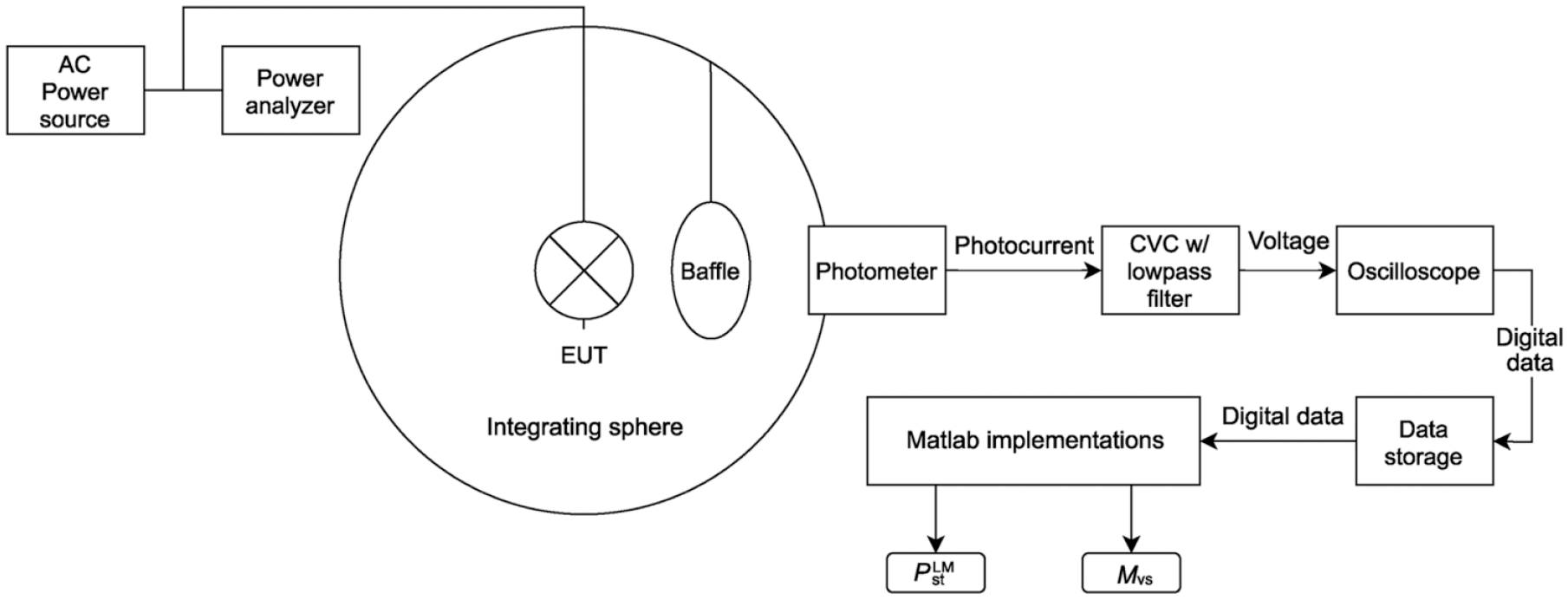
Schematic of the measurement setup used to measure TLA metrics
The lamp, EUT in Figure 1, is placed in an integrating sphere and connected to an AC power supply with a power analyser. The stability of the electrical power source is essential for the measurement of temporal modulation, as having variations in the input current will affect the lamp behaviour, which is also stated by CIE in TN 012.
3
IEC standards TR 61547-1
5
and TR 63158
6
have set tolerances for the input voltage and for the frequency of the signal. For both, the tolerance is
According to IEC standards,5,6 the light form of the EUT needs to be measured with a light sensor with an optical
The photocurrent is connected to a CVC that has two main purposes. Firstly, it utilizes transimpedance amplification to convert the photocurrent to voltage and to amplify the signal to a suitable level for data acquisition. The amplification of the transimpedance amplifier can be selected between
For the data acquisition, a Teledyne LeCroy HDO4054 oscilloscope was used. This oscilloscope has 12-bit vertical resolution and a 1.25 GHz maximum sampling rate. The oscilloscope converts the voltage signal to digitized data which holds two important parameters, the duration of the measurement

The digitized data from the oscilloscope were then collected and analysed in two different sets of MATLAB TLA software implementations, which convert the measured waveforms into TLA metrics. The first set includes the ones recommended in IEC standards.5,6 These can be found as MATLAB toolboxes for
3. Measurement procedure
The measured lamps were installed into a lamp holder inside the integrating sphere. They were let to stabilize with driving current on for at least 30 min before the measurement took place. The oscilloscope was adjusted to fit the light waveform within the 12-bit range of the vertical scale. Resolution of 12 bits is sufficient for TLA measurements according to IEC5,6 and Zong and Miller.
11
The data from the oscilloscope were downloaded to a computer. Both TLA implementations used to calculate
The input voltage and current of each lamp were stored from the power analyser with a sampling rate of 32 kHz. The measured waveforms were used to identify the driver topology of each lamp.
4. Measured artefacts
We measured 80 different types of commercial E27 retrofit LED lamps that varied in manufacturer, nominal power and nominal luminous flux. Sixty lamp types were purchased during or before 2016, well before the EU Ecodesign regulation started. The other 20 lamp types were purchased in December 2021. The new lamps were purchased anonymously from multiple different grocery stores, home appliance stores and hardware stores in Finland.
As LEDs need DC to function, a power supply is needed to convert the AC mains electricity to DC. This can be achieved in multiple different ways, but in commercial lamps four basic topologies are used as described by Xu et al. 12 and further by Drapela et al. 13 The four groups are defined with letters A to D as:
Type A: Full-wave rectifier with smoothing capacitor and DC–DC converter
Type B: Capacitive dropper circuit
Type C: Linear constant current regulation straight circuit
Type D: Switch-mode driver circuit
The driver topology used directly affects the input current waveform, thus by measuring that with a power analyser, the lamps can be classified into these four basic groups. Representative current waveforms for each topology can be seen in Figure 2, and their corresponding illuminance waveforms in Figure 3. The differences in the electrical waveforms between the driver types are related to the way each driver achieves the AC to DC conversion. For example, the apparent ‘noisiness’ of current in type D driver is due to an active power factor correction. 12
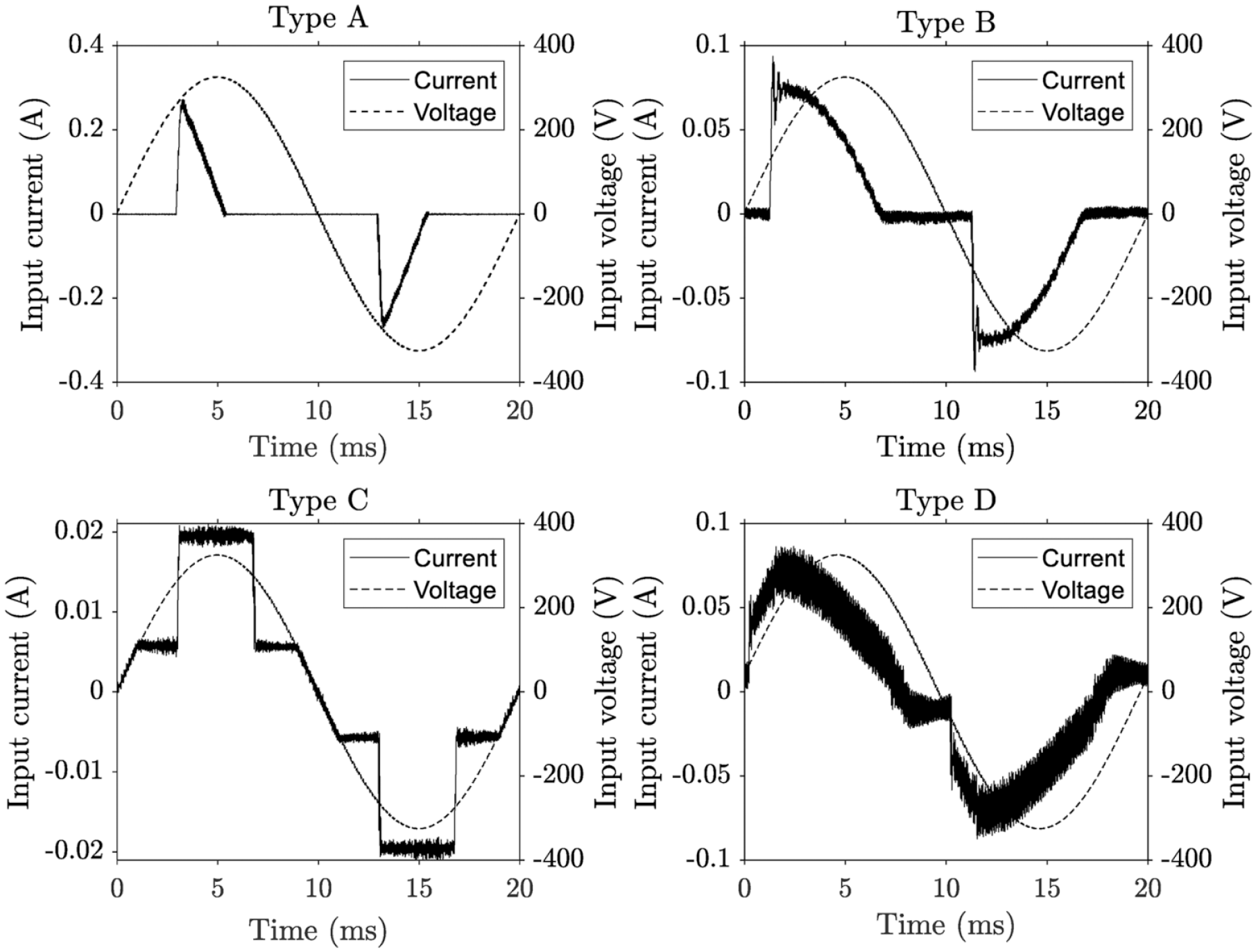
Input voltage and typical input current waveforms for LED driver topologies A to D as classified by Xu et al. 12
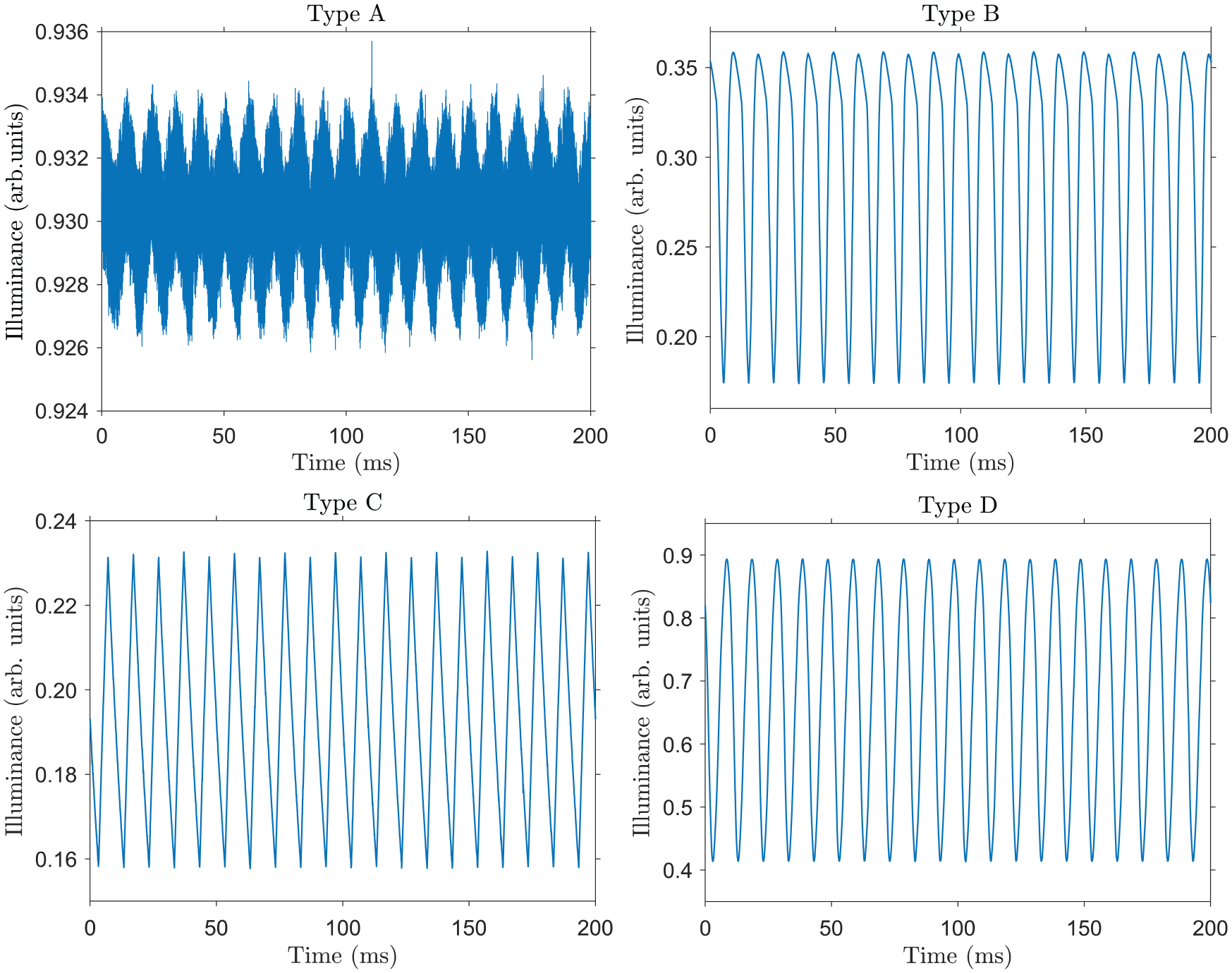
Measured illuminance waveforms for each driver topology A, B, C and D
5. Results
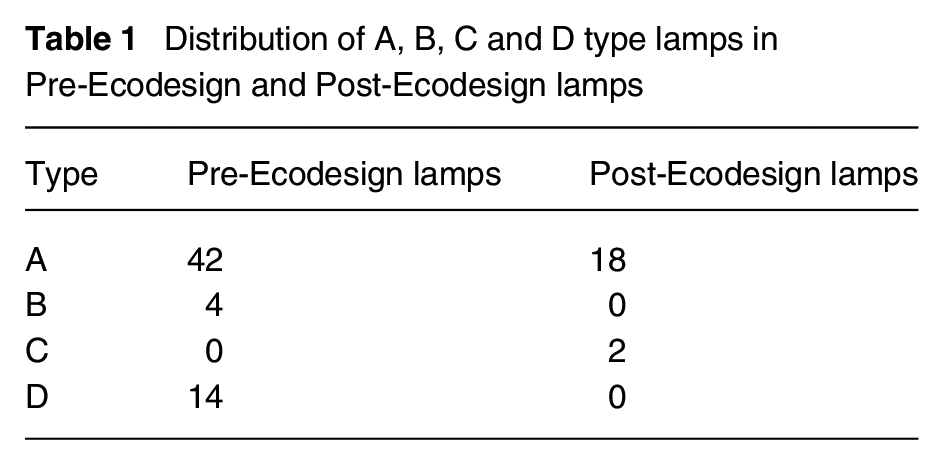
All the 80 lamp types measured were classified with respect to their power supply topologies. The distribution of these types can be seen in Table 1. In both lamp groups, type A lamps are clearly the most popular. With other lamp topologies, B and D types only appear in the old lamp types, whereas type C lamps are only found in the new lamps.
Distribution of A, B, C and D type lamps in Pre-Ecodesign and Post-Ecodesign lamps
The older 60 lamps had their nominal luminous flux values between 150 lm and 2452 lm, the nominal power levels were between 1 W and 20 W, and they were produced by 22 different manufacturers. The newer 20 lamps had nominal luminous flux values between 30 lm and 1521 lm, and nominal power levels ranging between 0.6 W and 14 W. They were from nine different manufacturers.
The differences in
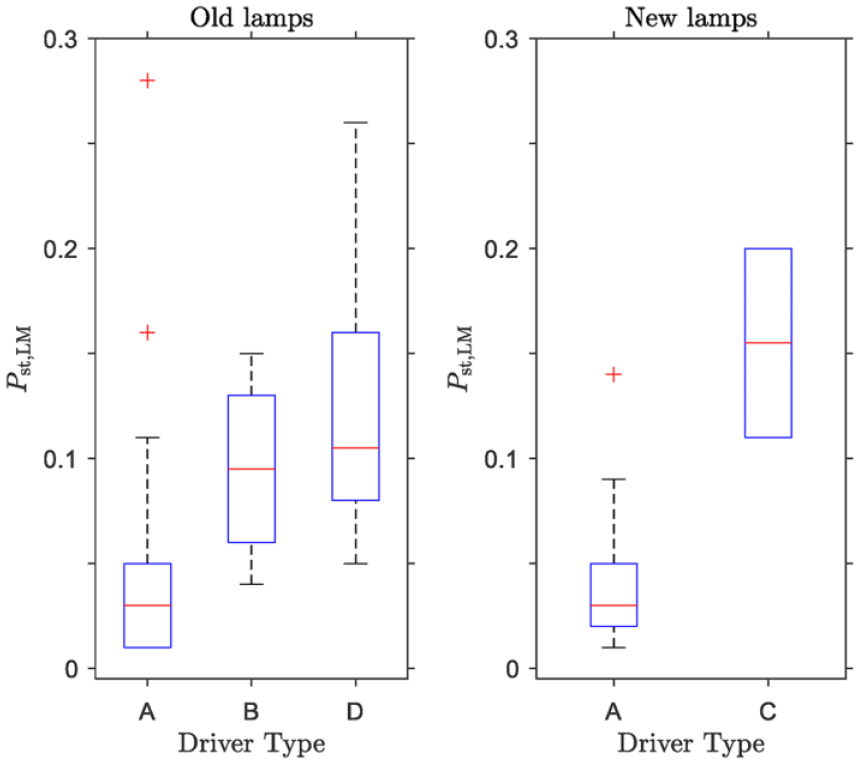
Difference in
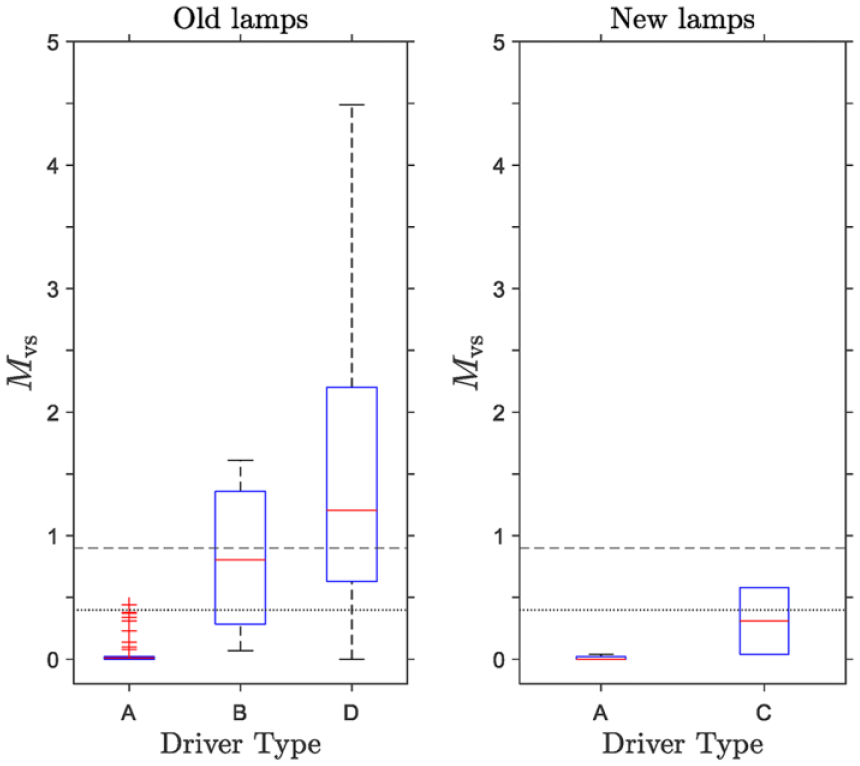
Difference in
As can be seen in Figure 4 for
More significant differences can be seen between the old and the new lamps when we compare
In the newer lamps, both lamp types show good
The TLA implementations by Mantela et al.9,10 for
Our measured
6. Conclusions
The TLA behaviour of LED lamps before and after the EU Ecodesign regulation was studied. The overall situation of the TLA artefacts in consumer-grade lamps has improved by manufacturers favouring the type A driver topology and bringing new type C lamps to the market. Manufacturers have also stopped producing B and D types of lamps that produce higher
The
Footnotes
Appendix
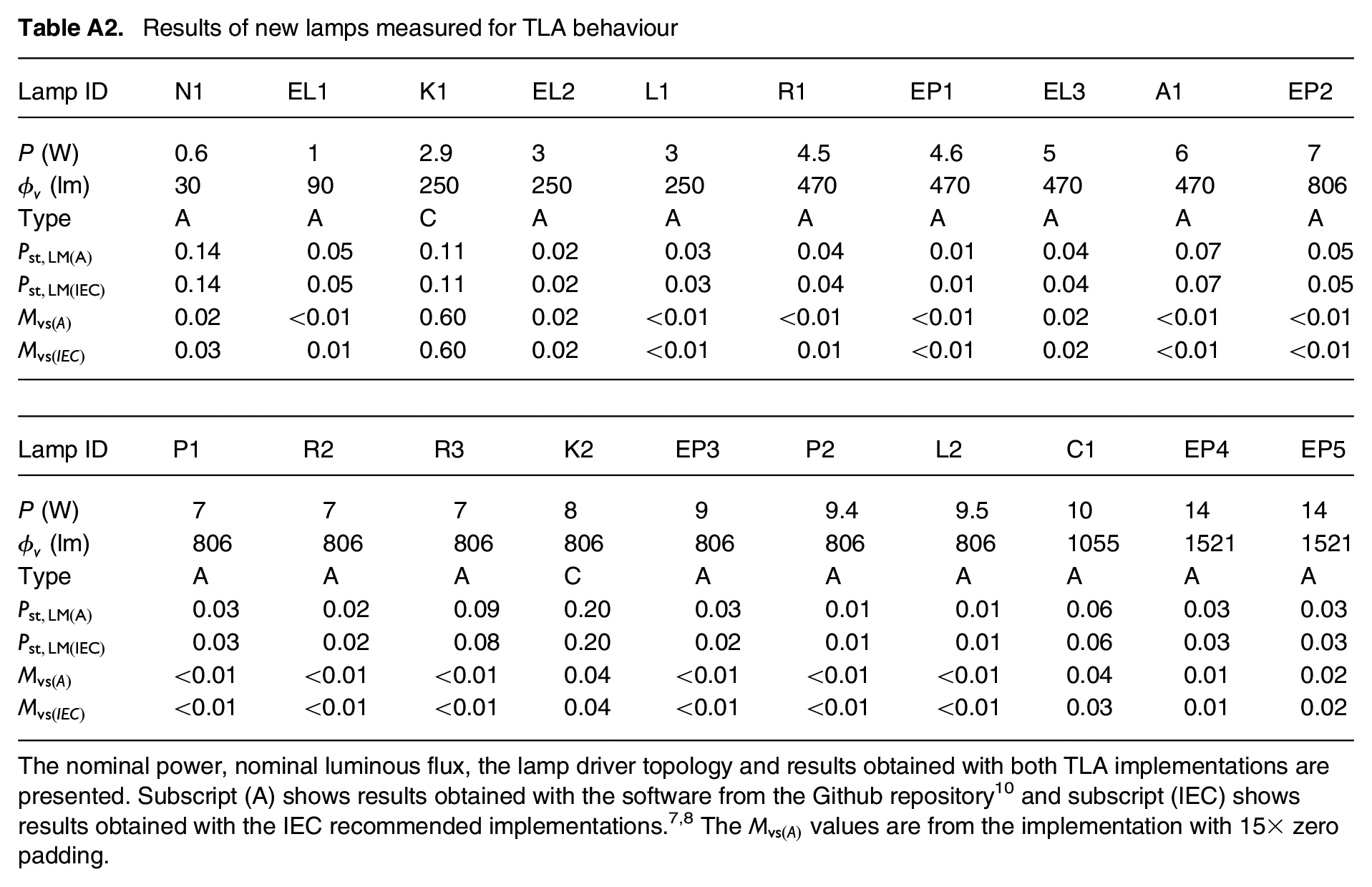
Results of new lamps measured for TLA behaviour
| Lamp ID | N1 | EL1 | K1 | EL2 | L1 | R1 | EP1 | EL3 | A1 | EP2 |
|---|---|---|---|---|---|---|---|---|---|---|
| P (W) | 0.6 | 1 | 2.9 | 3 | 3 | 4.5 | 4.6 | 5 | 6 | 7 |
| (lm) | 30 | 90 | 250 | 250 | 250 | 470 | 470 | 470 | 470 | 806 |
| Type | A | A | C | A | A | A | A | A | A | A |
| 0.14 | 0.05 | 0.11 | 0.02 | 0.03 | 0.04 | 0.01 | 0.04 | 0.07 | 0.05 | |
| 0.14 | 0.05 | 0.11 | 0.02 | 0.03 | 0.04 | 0.01 | 0.04 | 0.07 | 0.05 | |
| 0.02 | <0.01 | 0.60 | 0.02 | <0.01 | <0.01 | <0.01 | 0.02 | <0.01 | <0.01 | |
| 0.03 | 0.01 | 0.60 | 0.02 | <0.01 | 0.01 | <0.01 | 0.02 | <0.01 | <0.01 |
| Lamp ID | P1 | R2 | R3 | K2 | EP3 | P2 | L2 | C1 | EP4 | EP5 |
|---|---|---|---|---|---|---|---|---|---|---|
| P (W) | 7 | 7 | 7 | 8 | 9 | 9.4 | 9.5 | 10 | 14 | 14 |
| (lm) | 806 | 806 | 806 | 806 | 806 | 806 | 806 | 1055 | 1521 | 1521 |
| Type | A | A | A | C | A | A | A | A | A | A |
| 0.03 | 0.02 | 0.09 | 0.20 | 0.03 | 0.01 | 0.01 | 0.06 | 0.03 | 0.03 | |
| 0.03 | 0.02 | 0.08 | 0.20 | 0.02 | 0.01 | 0.01 | 0.06 | 0.03 | 0.03 | |
| <0.01 | <0.01 | <0.01 | 0.04 | <0.01 | <0.01 | <0.01 | 0.04 | 0.01 | 0.02 | |
| <0.01 | <0.01 | <0.01 | 0.04 | <0.01 | <0.01 | <0.01 | 0.03 | 0.01 | 0.02 |
The nominal power, nominal luminous flux, the lamp driver topology and results obtained with both TLA implementations are presented. Subscript (A) shows results obtained with the software from the Github repository
10
and subscript (IEC) shows results obtained with the IEC recommended implementations.7,8 The
Declaration of conflicting interests
The authors declared no potential conflicts of interest with respect to the research, authorship, and/or publication of this article.
Funding
The authors disclosed receipt of the following financial support for the research, authorship, and/or publication of this article: This work was carried out within the EMPIR programme project 20NRM01 MetTLM. This project 20NRM01 MetTLM has received funding from the EMPIR programme, co-financed by the participating states and the European Union’s Horizon 2020 research and innovation programme. The work is part of the Research Council of Finland Flagship Programme, Photonics Research and Innovation (PREIN), decision number 346529, Aalto University.
