



Abstract
Light affects many aspects of human physiology, through the non-image-forming (NIF) pathway. To account for this pathway, lighting design simulation tools need to combine several luminous and temporal factors to predict how architectural and lighting design decisions affect eye-level light exposure. Based on a systematic literature review, containing 55 journal and conference papers, the state-of-the-art towards implementing lighting beyond vision in computer simulation workflows for building design is presented. The review shows that, while interest in simulating the NIF effects of light on people is increasing, there is not a common method to perform these simulations. Gaps were identified in the currently available simulation workflows in relation to metrics, software and approaches for predicting NIF effects of light in the context of the building design.
1. Introduction
Light entering the eyes not only influences visual performance, but also affects many aspects of human physiology, through the non-image-forming (NIF) system. 1 The NIF responses include (but are not limited to) the regulation of the circadian system, the suppression of melatonin production, and acute alertness. 2 The photoreceptors that typically instigate these responses are the intrinsically photosensitive retinal ganglion cells (ipRGCs), which are sending signals to the central pacemaker of the human circadian rhythms. 3 The ipRGCs have a peak spectral sensitivity at the short wavelength bluish light at approximately 480 nm, 4 different to the known photoreceptors for vision (rods and three cone types). Moreover, the ipRGCs receive signals from rods and cones 5 and knowledge about the contribution of each photoreceptor to the NIF system is growing.6,7
The NIF responses to light are influenced by luminous and temporal factors, specifically light quantity, spectrum, directionality, timing, duration and previous light history (Figure 1).8,9 Light quantity was conventionally measured through illuminance derived for photopic vision. The effect of increased light quantity on people was quantified through dose-response curves, where dose is the amount of light at eye-level and response is often alertness, melatonin suppression or circadian phase shift.10,11 However, it is argued that photopic illuminance is not an appropriate metric for quantifying light considering its NIF effects 12 due to the differences in spectral sensitivities between the different photoreceptors. Therefore, new metrics have been introduced that account for the spectral sensitivity of the different photoreceptors. In regards to directionality (incidence of radiation to the retina), there are indications that melatonin suppression increases when light reaches the inferior (upper field of view) or the nasal (field of view from the nose side) retinal area.13,14 Timing implies that light given at different phases of the circadian clock can reduce or extend a person’s internal day. Increasing the duration of light exposure increases the biological effect, 15 although this relationship is non-linear, meaning that shorter duration light stimuli are more efficient per minute of exposure. 16 Light history means that the adaptation conditions before a bright light exposure influence the biological response. 17
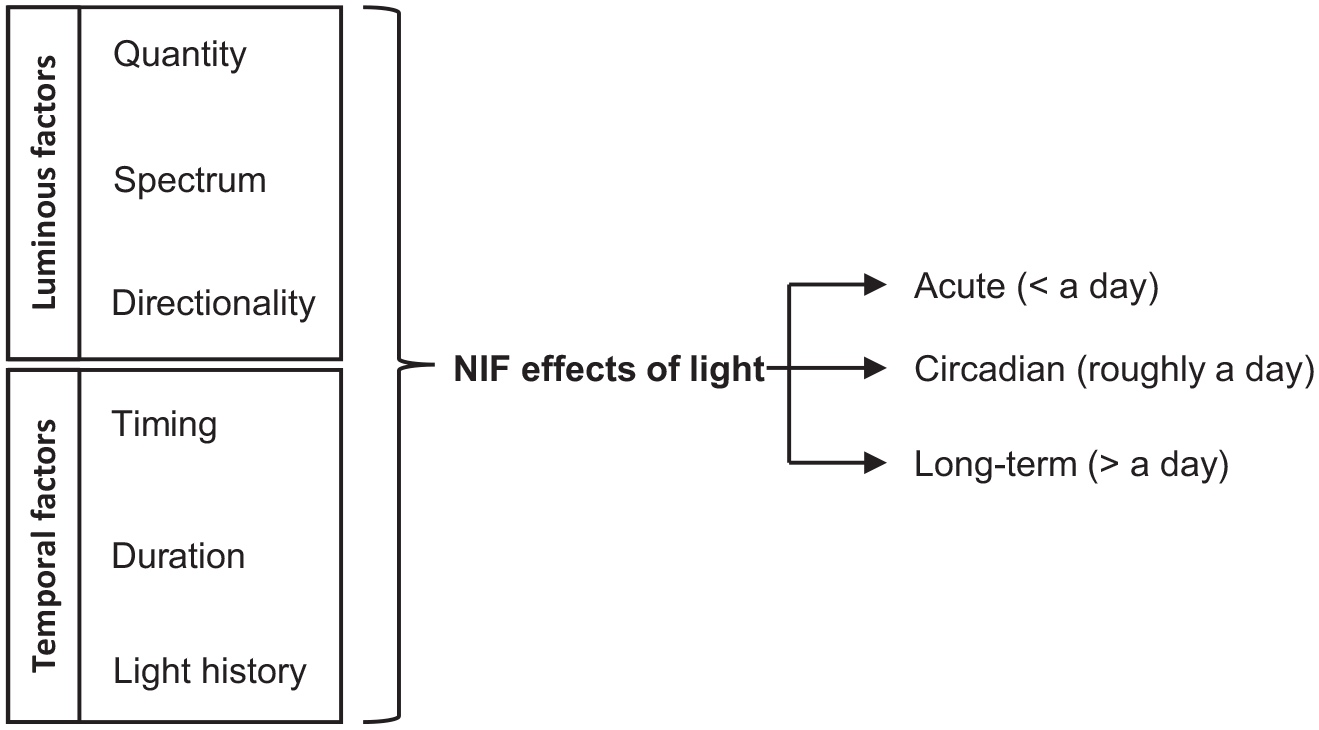
The six luminous and temporal NIF light factors and the types of responses to them. The approximate duration of the response is indicated in parenthesis. Acute responses happen immediately after the light exposure (e.g. melatonin suppression). Circadian responses happen with a frequency of roughly a day (e.g. sleep-wake cycle). Long-term responses happen due to circadian disturbances for a prolonged period of time (e.g. seasonal affective disorder). The figure combines information from Khademagha et al. 8 and Houser and Esposito 18
The light exposure experienced by a person is mostly defined by architectural daylighting and artificial light sources, since people spend the majority of their time indoors. 19 Living in urban environments is associated with decreased exposure to daylight and increased light levels at night, which delays the circadian clock. 20 While the main aim of building lighting design was previously to enhance visual performance, current knowledge from photobiology indicates that a new set of lighting criteria relevant for initiating NIF responses to light needs to be introduced. This adds complexity to architectural and lighting design projects and requires novel design tools.
Lighting simulation software is often used to assist decision-making in the architectural and lighting design process.21,22 In response to the knowledge of the NIF pathway, new simulation workflows have been proposed to predict light in buildings.23,24 These workflows should include the six above-mentioned luminous and temporal factors (Figure 1) that have been indicated as relevant for the NIF responses to light. When using lighting simulations to guide design decisions, it is recommended to consider both image-forming (IF) and NIF effects, a methodology now referred to by the International Commission on Illumination (CIE) as ‘integrative lighting’. 25 Daylight and electric light need to be considered separately as well as combined. This requires software that can model both light sources and can calculate eye-level light stimulus as an output.
The results of simulations need to provide useful information in the early and detailed phase of the architectural and lighting design practice. In the early design phase, it is important to take uncertainty into consideration in lighting simulations 26 and keep in mind that integrative lighting is a small piece of the puzzle which needs to be balanced with many other, sometimes contradicting, design criteria. In the detailed design phase, user behaviour might need to be considered as suggested by other studies. 27 Different workflows are applicable when zooming in to the detailed level of user behaviour or when zooming out to the level of building massing or urban design.
The aim of this paper is to identify the state-of-the-art in simulation workflows for daylighting and electric lighting design applicable for quantifying eye-level light stimulus for predicting NIF responses. Based on a systematic literature review, we present what are the gaps in the currently available simulation workflows in the context of building design.
2. Method
The literature review was conducted using four groups of keywords: ‘light’, ‘non-image-forming’, “simulation” and “building design”, and alternative terms for these (Table 1) in Web of Science, Scopus and Science Direct. The search was performed within the title, abstract and keywords and limited to publications after 2002, since this is approximately the time when ipRGCs were discovered.3,28 As alternatives to “non-image-forming”, the terms “non-visual”, “circadian” and the more general term “health” were used. These terms were selected based on the commonly used keywords in the publications about this topic that we were familiar with prior to conducting the literature review. Whereas “non-image-forming” and “non-visual” are often used interchangeably (as in CIE S 026 29 ), “circadian” refers to a sub-set of these responses (Figure 1). Since the terminology around this topic varies and in order to avoid missing papers due to incomplete keywords, all eligible publications were forward-traced (by identifying the articles that cite them after they have been published). In addition, four relevant review papers found through the initial search that investigated the connection between architecture and NIF effects of light8,30–32 were forward- and backward-traced (by searching their references). Eventually, 55 papers were included in the literature review (Figure 2). The final search was performed on 26th August 2022.
Keywords for the literature search in the databases Web of Science, Scopus and Science Direct
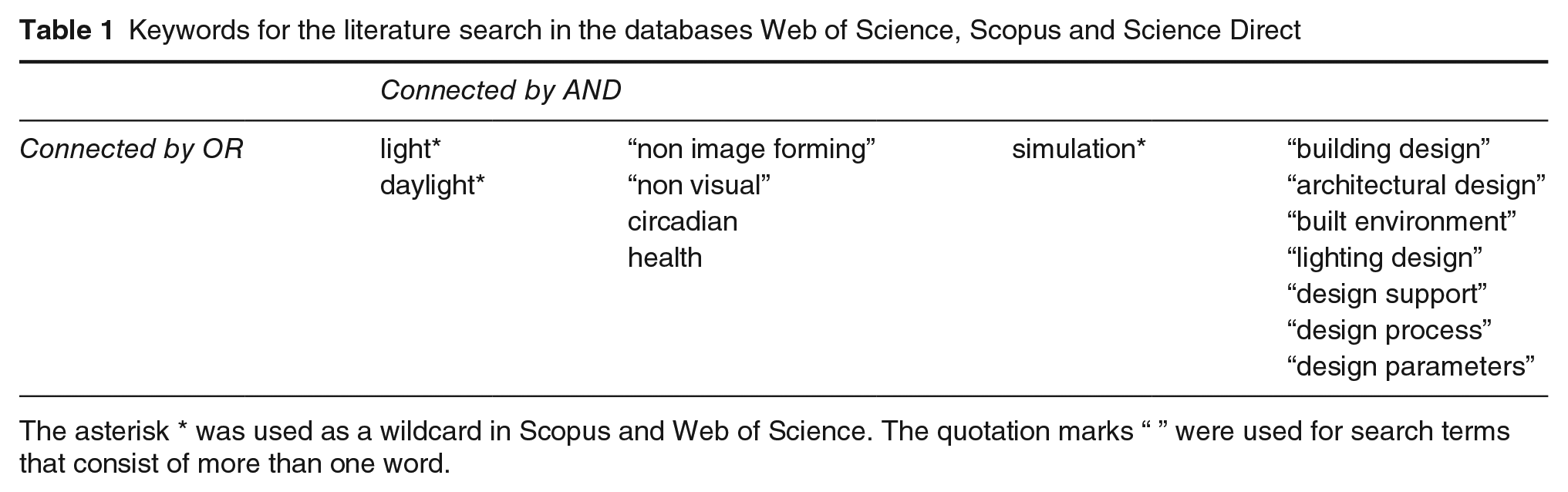
The asterisk * was used as a wildcard in Scopus and Web of Science. The quotation marks “ ” were used for search terms that consist of more than one word.
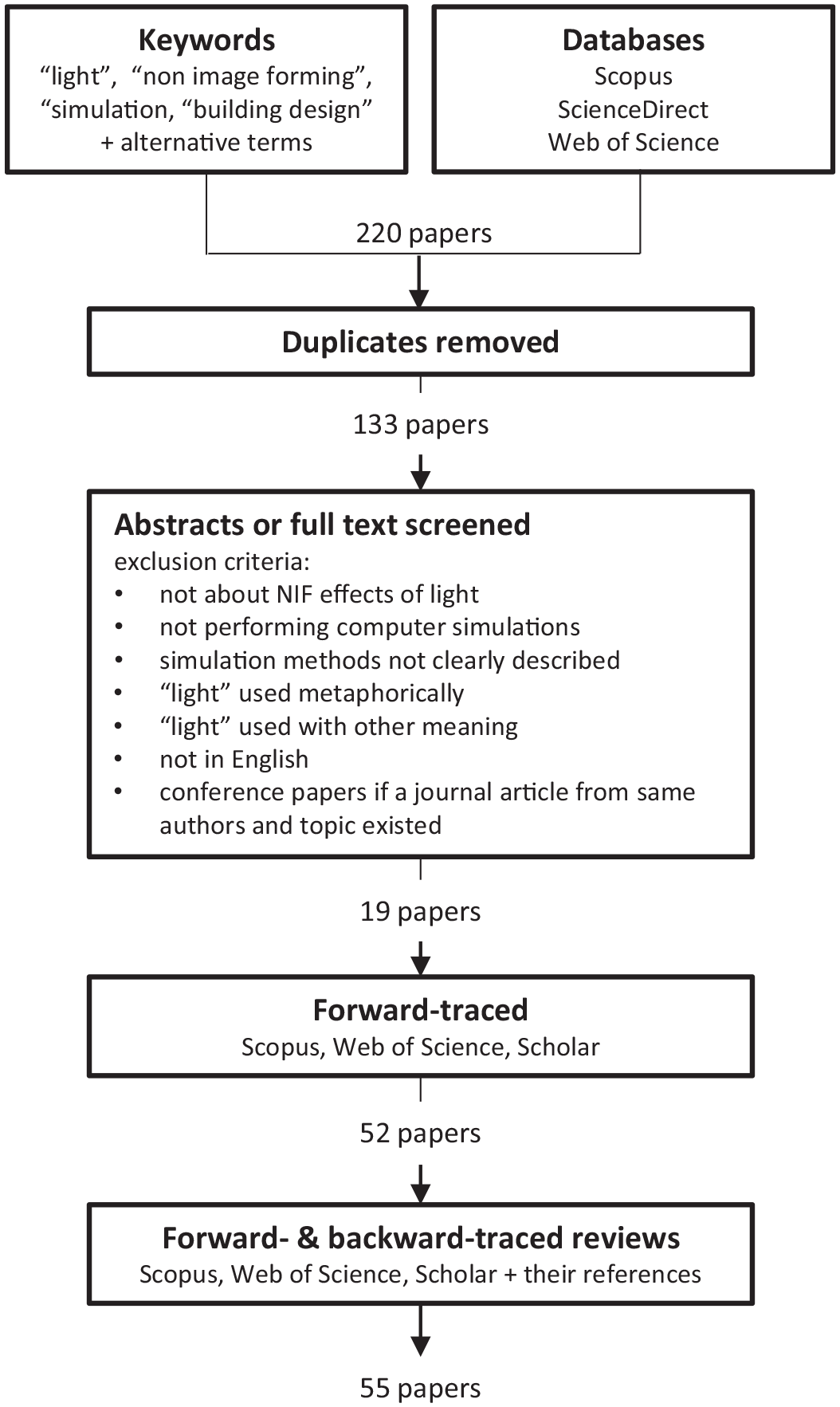
Search methodology. “Forward-traced” refers to identifying the articles that cite a paper after it has been published. “Backward-traced” refers to searching the references of an article
The following elements were extracted from each included publication:
if and how the previously described luminous and temporal factors were considered.
which software was used.
which type of light sources were simulated (electric light, daylight).
which metrics were used.
whether the workflow was suitable for simulating building massing models, rooms or users.
if IF effects of light (visual performance, comfort and/or interest) were also included.
3. Results
A summary of the analysed papers is presented in Table 2. Figure 3 shows the number of publications over the years.
Summary of simulation methods in the analysed papers. The inclusion (or not) of the luminous and temporal factors relevant for NIF effects is denoted with “Yes” (or “No”). Quantity of light is not presented as a separate column because it was included in all reviewed publications (although by different metrics)
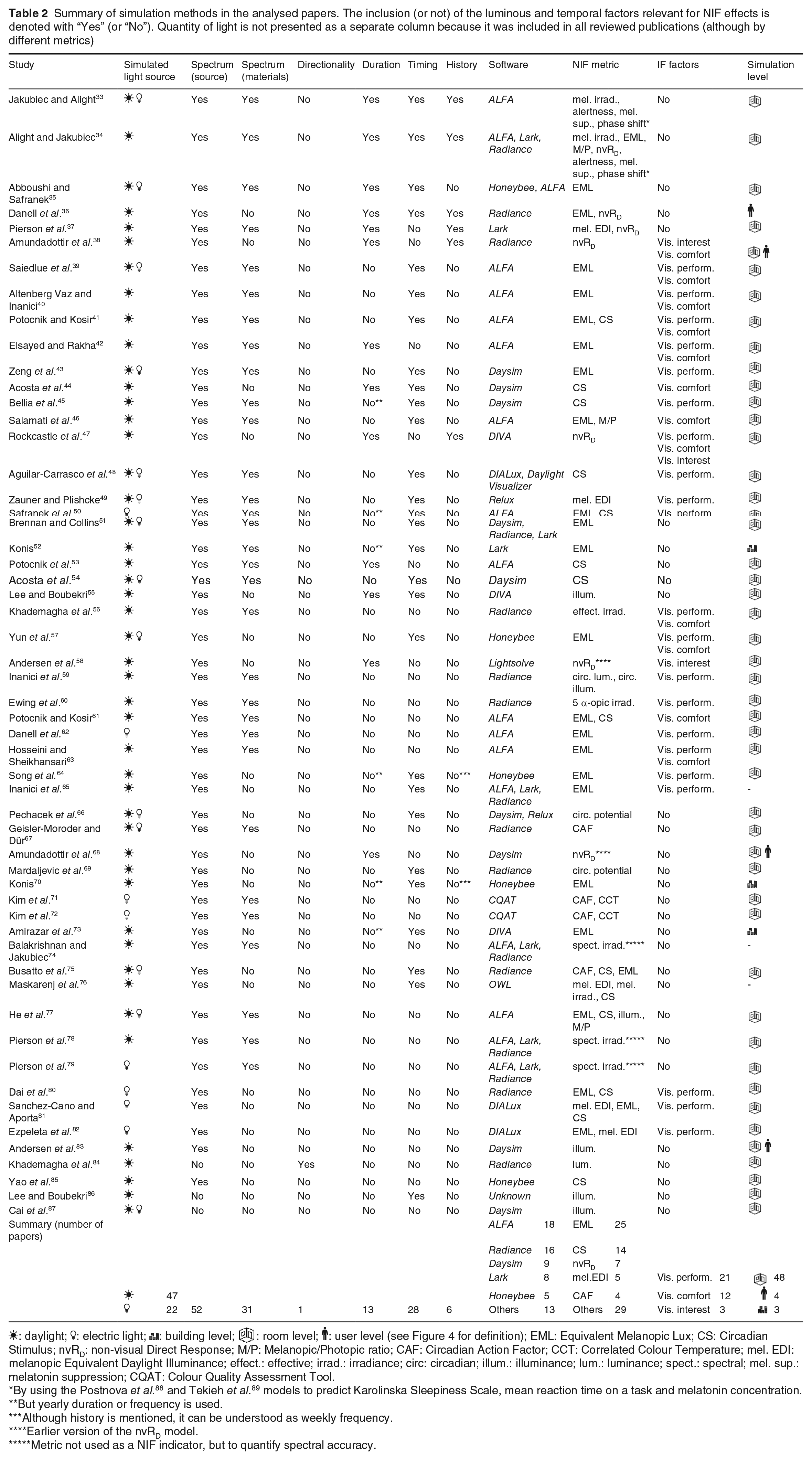
 : daylight;
  : electric light;
  : building level;
  : room level;
  : user level (see Figure 4 for definition); EML: Equivalent Melanopic Lux; CS: Circadian Stimulus; nvRD: non-visual Direct Response; M/P: Melanopic/Photopic ratio; CAF: Circadian Action Factor; CCT: Correlated Colour Temperature; mel. EDI: melanopic Equivalent Daylight Illuminance; effect.: effective; irrad.: irradiance; circ: circadian; illum.: illuminance; lum.: luminance; spect.: spectral; mel. sup.: melatonin suppression; CQAT: Colour Quality Assessment Tool.
By using the Postnova et al. 88 and Tekieh et al. 89 models to predict Karolinska Sleepiness Scale, mean reaction time on a task and melatonin concentration.
But yearly duration or frequency is used.
Although history is mentioned, it can be understood as weekly frequency.
Earlier version of the nvRD model.
Metric not used as a NIF indicator, but to quantify spectral accuracy.
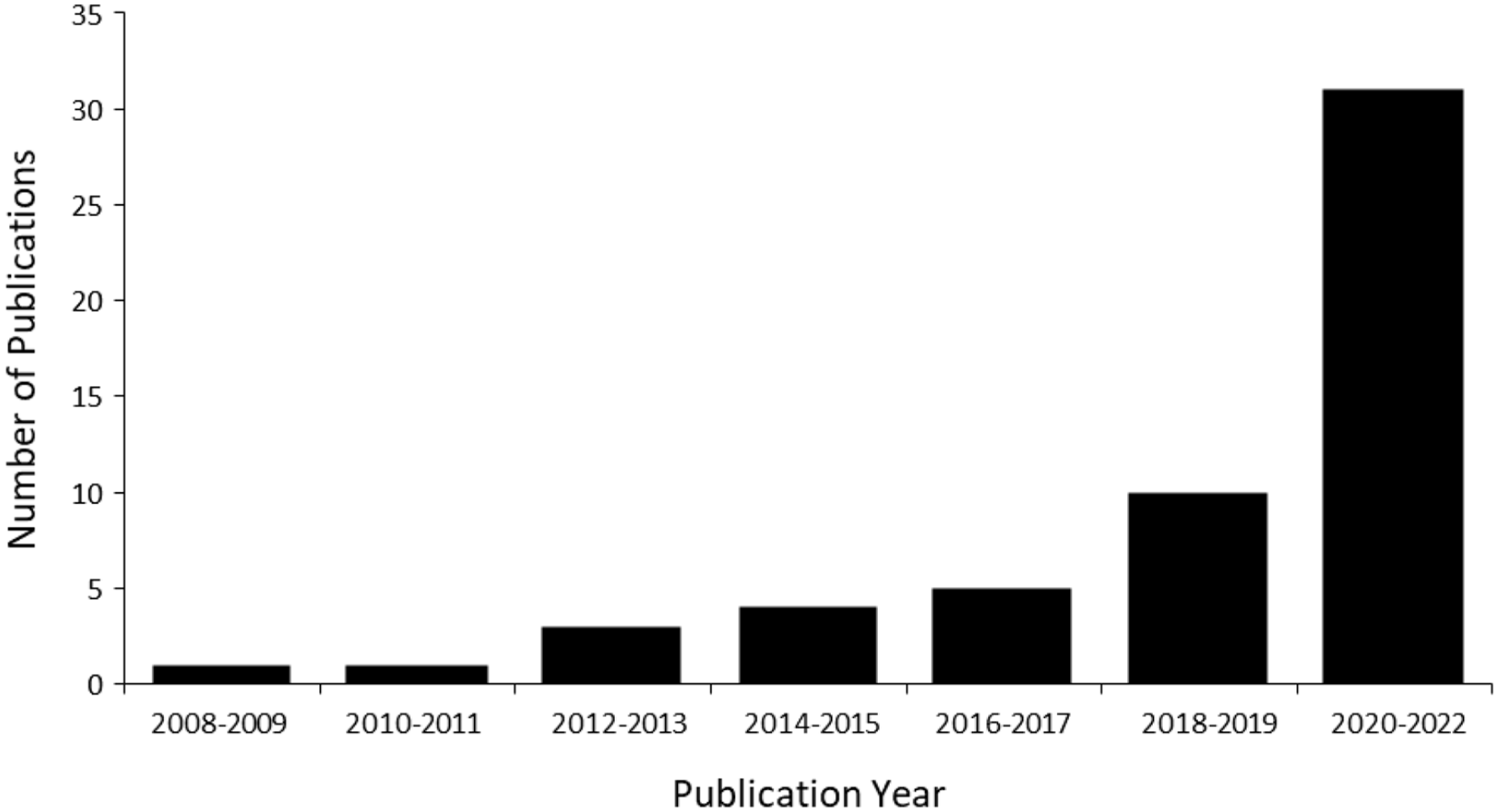
Number of publications in the topic of simulations of NIF effects of light in building design over the years
3.1 Luminous and temporal factors
Novel methodologies to simulate the effects of light on health and alertness were proposed. Pechacek et al. 66 combined light quantity, spectrum and timing in a preliminary simulation workflow to calculate a static “circadian potential” provided by daylight in a space. Andersen et al. 23 and Mardaljevic et al. 69 further developed that using photobiology knowledge about the time-dependent effect of light and they defined a lower and upper bound for the possibility that a given light dose will have an effect on people. They proposed to divide the day into three intervals: (1) early to mid-morning (06.00–10.00), when light advances the circadian phase, (2) mid-morning to early evening (10.00–18.00), when light can affect alertness, and (3) night-time (18.00–06.00), when light exposure that might trigger NIF responses is to be avoided. Amundadottir et al. 38 incorporated a dynamic mathematical model that additionally accounts for light duration and history to calculate the effect of a light exposure into a simulation framework. Their framework combined light quantity, spectrum, duration and history in a single model that aims to translate light stimulus to human response.
Geisler-Moroder and Dür 67 used the RGB channels from renderings with the Radiance software 90 to estimate the effect of light on the suppression of melatonin, therefore introducing low resolution (three channel) spectral information of sources and materials into simulations. Spectral information was also included by performing simulations of photometric quantities and post-processing the results based on the spectral power distribution (SPD) of the light source.35,36,38,44,47,66,68–70,73,75,80–83,85 This method disregards that the SPD that reaches the eye is modified by the spectral properties of materials, which might be a reasonable assumption in neutrally coloured spaces. For non-neutrally coloured spaces, a simplified approach was to multiply the SPD of the light sources with the spectral reflectance of the materials and use this to post-process photometric results.45,48,54 This approach, however, has not been validated against measurements yet. Instead of post-processing the results, a pre-processing method was proposed by Zauner and Plischke. 49 Their method consists of creating a “melanopic simulation model” where the luminous flux of the luminaires and the luminous reflectance of materials are modified to a melanopic equivalent. The simulation result is directly interpretable in terms of melanopic quantities. One benefit of this method is that it can be applied to conventional lighting simulation software.
The duration of light exposure was either considered statically, assuming that a fixed duration of exposure of a few hours a day (1–5 hours) is enough to stimulate the NIF system,42,44,55 or dynamically, considering that short duration light exposures are more effective than long ones, and intermittent light patterns are more effective than continuous per minute of exposure.32,36,38,47,58,68
In addition, the directionality of light being projected on the retina of the eye was investigated by Khademagha et al. 84 that used renderings to estimate the effect of room design parameters by applying masks corresponding to the upper and lower field of view.
3.2 Software
Since the conventional lighting simulation software simplifies the visible spectrum into a three-dimensional RGB colour space, new spectral simulation software has been developed to process the spectral properties of light sources and materials. Inanici et al. 59 implemented a methodology to increase the spectral resolution of Radiance simulations to more than three channels. They used an n-step algorithm that divides the visible spectrum in n wavebands, where increasing the n increases the spectral resolution.91,92 Since Radiance is a 3-channel (RGB) renderer, in order to implement, for example, a 9-step algorithm, three individual simulations need to be combined. Each of these three simulations accounts for a different part of the visible spectrum. The methodology by Inanici was translated into the Lark spectral lighting simulation tool. 93
Lark and ALFA 94 are two publicly available simulation tools that were developed for simulations of the NIF effects of light. Their innovation, in comparison to conventional simulation tools, is that the visible spectrum is divided into more than three channels (nine for Lark and 81 for ALFA) and they directly calculate metrics for quantifying NIF effects of light. Both tools can perform static point-in-time simulations. To expand their use to dynamic annual simulations, Jakubiec and Alight33,34 implemented a method that uses 56 simulation timesteps throughout the year to interpolate to annual results (Lightsolve method 95 ).
The version 2.0 of Lark 96 also offers annual simulation using the Daylight Coefficient method for dynamic daylighting simulations. 97 However, one limitation is that it assumes a constant SPD for the entire simulation period. This can be overcome only with the use of a model that calculates annual SPDs from available weather data. 65 The recently developed OWL tool 76 is a step towards overcoming this limitation. OWL can be used to estimate the SPD of the sky dome using available weather data as input. It implements spatially and spectrally resolved sky models 98 that use the luminance of different patches of the sky to calculate SPD. Lark and OWL are both developed for the Grasshopper for Rhino environment and can potentially be combined.
A few studies were performed to validate the accuracy of these tools. One study found that Lark calculates spectral irradiance with most errors within a ±20% range in a neutrally coloured space under daylight. 78 The authors noted a reproducibility error in ALFA, unresolved at the time of their study. It was also shown that under clear sky conditions ALFA tends to overestimate the irradiance, 99 even though the spectral characteristics are well represented. 74 For electric light simulations, the errors in spectral irradiance were larger than the ±20% range, with ALFA being more accurate due to the higher spectral resolution. 79 However, when the spectral irradiance was used to calculate relevant NIF metrics, these differences vanished and most errors of both tools were within the ±20% range. 99
Another in-house spectral simulation software for electric light was developed by Kim et al. 71 called Colour Quality Assessment Tool (CQAT), but it is limited to a simple geometry and diffuse materials.
3.3 Light sources
Out of the 55 papers, 33 studied only daylight, eight studied only electric light and 14 both daylight and electric light. Different methods to model the spectra of direct sunlight and diffuse skylight were adopted in the reviewed papers. Often, the assumption was made that the entire sky dome can be uniformly represented by a CIE standard illuminant (e.g. D65).44,67,68,85 Other approaches were to use standard illuminants based on the window orientation of the simulated space,48,64,66,83 differentiating between the spectrum of the direct and diffuse contribution, 70 or between overcast and clear sky conditions.48,69 Bellia et al. 45 modelled typical average SPDs for cities located in the north, centre and south of Europe based on the percentage of overcast skies in each location (close to D50 for northern locations, close to D65 for middle locations and more blue than D65 in southern locations).
In ALFA the spectrum of the sun and the sky is generated from the library libRadTran, 100 using a US mid-latitude (45°N) summer atmospheric profile. 74 In Lark, the sun is neutrally coloured and the sky is uniformly coloured by a user selected SPD. In OWL, as mentioned, the SPD is calculated from available weather data. For this calculation, the luminance of different patches of the skydome is converted to Correlated Colour Temperature (CCT) using a model. 98 The CCT of each patch is then converted to SPD using the CIE 015 standard 101 and is finally aggregated over the skydome. All three (ALFA, Lark and OWL) sky models have some limitations. A comparison of the ALFA-generated skies with measured data showed that ALFA did not show the wide variability in CCT that was observed in the measurements. 65 For Lark, the neutral sun assumption introduced errors in CCT calculation up to 41% when modelling clear skies (even though the error in NIF metrics was up to 17%). 65 In contrast, the luminance to CCT models of OWL correspond well with measured CCT under clear skies. 98 However, OWL applies these clear sky models for all sky types and does not discriminate between clear, intermediate and overcast skies.
3.4 Metrics
A variety of metrics was found in the literature to quantify the eye-level light stimulus (Table 2). The most used metrics were the Equivalent Melanopic Lux (EML) and the Circadian Stimulus (CS). EML was proposed by the building certification institute WELL 102 based on the ipRGC spectral sensitivity curves from Lucas et al. 103 CS was introduced by Rea et al. 104 based on a model for nocturnal melatonin suppression, and was later adopted by the Underwriters Laboratory (UL) design guideline 24 480. 105 Melanopic Equivalent Daylight Illuminance (EDI), one of the five α-opic EDI metrics recommended by the CIE, 29 was used in five of the publications. 81 Four (relatively older) publications used the Circadian Action Factor (CAF), a metric proposed by Gall and Bieske 106 as a ratio of circadian weighted and photometric quantities. Only photopic quantities (luminance, illuminance and annual metrics derived from these) were used in five publications.
A few papers used metrics that combine luminous and temporal factors to estimate a human response. Specifically, a dynamic metric called the “non-visual Direct Response” (nvRD) model that was developed by Amundadottir 24 was used in seven papers. The model takes as input a time series of eye-level light stimuli and translates it to a predicted human alerting response. The mathematical models of Postnova et al. 88 and Tekieh et al. 89 to predict alertness, phase shift and melatonin suppression were used in two papers.33,34 These models are based on the balance between homeostatic and circadian systems. The homeostatic system increases while a person is awake and the circadian system is defined by sleep history and dynamic light stimuli.
3.5 Modelling buildings, rooms and users
During early-stage daylight design, simulation workflows can go beyond modelling individual rooms, considering that parameters such as interior partitions or even specific materials might be unknown (here referred to as “building level”, Figure 4). The significance of using lighting simulations during this stage is clear, since decisions about the shape of the building and its relationship with the context largely affect the light that occupants will be exposed to, especially in dense urban contexts. 107 For this purpose, Konis 52 developed a workflow to compare alternative building form options during early-stage design. His method takes as input a building massing model, it automatically divides it into floors, and evaluates an annual NIF potential of the entire building using Lark. A percentage of “circadian effective” zone is calculated for the building, which is the area where daylight over the year is considered sufficient for circadian entrainment (when EML exceeds a threshold for a number of hours). 70 Additionally, he proposed annual climate-based NIF daylight metrics 70 and suggested a grade-based system to evaluate spaces based on these metrics. These building-level simulations are suitable for early-stage daylighting design, where the goal is not to prove compliance with a specific standard but rather to do relative comparisons of design options and acquire general guiding directions.
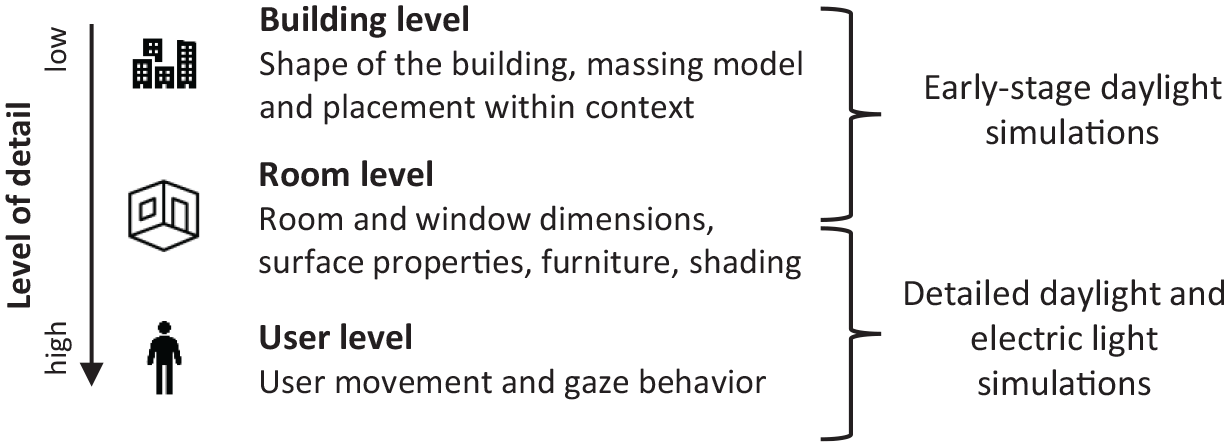
Building, room and user level simulation workflows. Building level is more suitable for early-stage architectural daylighting design, while room and user level apply better to detailed daylighting and electric lighting simulations
Modelling of individual rooms is usually a next step of the design process, when space dimensions, window typology, material properties, layouts and electric lighting are explored (here referred to as “room level”, Figure 4). Most of the publications focused on the room level of detail. For the highest level of detail, user-focused simulations that account for occupant movement within a space and gaze behaviour can be included (here referred to as “user level”, Figure 4). The default assumption in simulations is to model users by selecting a position in the room where they are likely sitting (e.g. a desk), a height from the floor to represent the eye-level (often 1.2 m for a sitting person) and one or multiple vectors to indicate their static view direction. However, since occupants do not always stay at their desks looking towards a fixed direction, models indicating occupants’ movement within a space are useful in order to investigate their eye-level light stimulus. Since the eye-level light exposure is essential for evaluating a space based on its potential to induce NIF effects, the user level of detail can be considered as a baseline.
These user behaviour aspects were included in four publications. Specifically, in two publications, occupants were assumed to move randomly between selected zones.68,83 In a paper that investigated light exposure in offices, 36 occupant behaviour profiles were defined based on their role in the office. The occupant profiles determined when and how much time a person would spend at their desk, in a meeting room, or in other spaces in the office. Gaze behaviour was included in a paper that proposed a human-centred approach to daylighting simulations, 108 applying a gaze responsive model that predicts eye movements based on luminance contrasts in the field-of-view. 109 Even though the user level approach presents practical difficulties, as it requires assumptions of how people move through a space, it needs further investigation to elaborate on the errors that arise from not considering it.
3.6 Integration of IF and NIF criteria
IF and NIF can to some extent be predicted with existing simulation software together or separately, and their combination was a topic of interest for almost half of the publications in this review. Andersen et al. 58 combined NIF potential with visual interest in an integrated simulation workflow. Amundadottir et al. 38 added glare considerations to that and demonstrated that NIF potential, visual interest and glare might be contradictory design goals. They indicated that a trade-off might be necessary depending on the space and occupant needs, for example by prioritizing visual comfort and NIF potential in spaces where occupants spend longer periods of time whereas visual interest in spaces where the duration of stay is shorter.
Rockcastle et al. 47 took that approach one step further and proposed a scoring method to balance visual, perceptual and NIF criteria. Their analysis demonstrated that evaluating a space based on horizontal illuminance could lead to different design decisions compared to designing based on eye-level light metrics (e.g. Daylight Glare Probability or nvRD), suggesting that horizontal and eye-level metrics should be considered together. Several studies explored the effect of building design parameters on IF and NIF criteria,39,40,41,44,46,49,56,61,63,80,81 showing that an integrated design approach is needed to find the right balance between both. This underlines the need for having standards and guidelines that include these different aspects together and suggest what the trade-offs should be for various design applications. Though the daylight standard EN 17037 110 includes considerations for daylight provision, sunlight exposure, glare and view, it notably leaves out recommendations for NIF effects. The revised lighting standard EN 12464-1 111 highlights the importance of daylight and the need for variation based on time of the day but does not provide concrete recommendations for NIF effects. Yet, the integration of all relevant criteria in industry standards might push the development of new simulation software that facilitates the incorporation in design practice.
4. Discussion
This review demonstrated that research interest in modelling the NIF effects of light on people within buildings is increasing (Figure 3). Studies focused on the development and validation of simulation workflows to investigate the circadian and acute responses to light. Some of the most recent studies used these workflows to investigate how the various design parameters affect the NIF responses and attempted to offer preliminary advice to designers. In this section we present the gaps in the available simulation workflows.
4.1 Gaps in metrics
In relation to metrics, a consensus is yet to be reached. The most commonly used metrics were EML and CS. CIE has defined five α-opic EDI metrics to describe light, based on the sensitivities of the five ocular photoreceptors and it is argued that melanopic EDI is a good predictor of circadian and acute light responses.112,113 Melanopic EDI can be calculated from EML with a simple multiplication factor (mel. EDI = 0.91 × EML). A recent publication by a consortium of 18 experts in the field of light and health recommends for healthy, daytime working adults, to provide a vertical melanopic EDI of minimal 250 lx at eye level during daytime. For the evening this should be less than 10 lx and less than 1 lx for sleeping environments. 114 It should be noted that the recommendations are based on data from mostly night-time laboratory studies.
Beyond the disputed nature of the metrics, a difficulty also lies in the fact that light quantities alone cannot comprehensively be used for the prediction of NIF responses because they do not include temporal dynamics. Human response metrics need to include luminous and temporal parameters together, since a single light quantity cannot predict the magnitude of a response without considerations for timing, duration and previous light history. The response metrics proposed by Amundadottir (nvRD), 24 Postnova et al. 88 and Tekieh et al. 89 are a step towards that direction, but their applicability under a variety of (day)light conditions needs to be tested. One study that compared the nvRD model with daytime alertness under daylight showed that there is a moderate correlation, but the model still has large prediction errors. 115 This means that recalibration of this model is necessary, especially as we learn more about the contribution of daylight to the various effects on people. 116
4.2 Gaps in software
The development of the ALFA, Lark and OWL software make spectrally resolved simulations more accessible, but they still have their limitations. All tools can perform static point-in-time simulations. Yet, dynamic simulations are necessary to enable the calculation of human response metrics that account for both luminous and temporal factors. The current tools can do that to some extent. Interpolating selected point-in-time results to get an annual result is possible using the Lightsolve method, but it is not directly implemented in ALFA, Lark or OWL. The Lark version 2.0 96 can directly perform dynamic simulations, but with the assumption of a constant yearly SPD.
This assumption of a constant SPD of a selected standard CIE illuminant was often made in the literature. Is it a reasonable simplification or is it important to dynamically vary the SPD of daylight? Inanici et al. 65 argue that we do not model annual sky luminance based on an average, so we should not model the sky spectrum based on an average as well. Indeed, Diakite-Kortlever and Knoop 98 tested the accuracy of using the CIE D65 illuminant to predict melanopic content outdoors. They found that it can represent sky SPD reasonably well under overcast sky conditions, but for clear skies it underestimates the melanopic content. They claim that for clear skies spectral information of each patch of the sky dome is needed for accurate daylight simulations. In contrast, Pierson et al. 99 found that the assumption of a constant D65 was reasonably accurate in simulating melanopic EDI indoors in a variety of sky conditions (clear, hazy, overcast, rainy). They note that, in the conditions that they tested, accurately simulating quantity of light (irradiance) had a larger impact to the result than accurately simulating spectrum. It is though difficult to claim that this is generalizable for other locations and during all times of the day and year. We need further comparisons of simulations with measurements from different locations, especially indoors, to know how the varying sky colour affects the simulation accuracy in terms of both quantity and spectrum.
A different issue is that these software tools might be difficult to access due to lack of user-friendliness or cost. Lark and OWL require familiarity with Rhino, Grasshopper and possibly basic programming knowledge (if modifications to the basic code need to be made). ALFA is easier to use, since the only prerequisite is the ability to use Rhino; however, it is a commercial licensed software. In addition, since Rhino (which is also a commercial software) might not be the default CAD program for all lighting and architectural designers, the use of such plugins is restricted. Simulation methods with pre- or post-processing steps49,81 can also be used to calculate NIF metrics using freely available simpler tools (like DIALux 117 or Relux 118 ), but with limited spectral resolution and/or without accounting for the materials’ spectral reflectance. Moreover, the additional steps make the method more prone to user error.
4.3 Gaps in approaches for predicting NIF effects
In Table 2 one can see that none of the reviewed papers included all six relevant luminous and temporal parameters. This is probably because the exact relationship between light quantity, spectral composition, directionality, timing, duration, history and specific human responses still needs to be established, 2 which is an issue beyond simulation software and method. The two least frequently used factors relevant for NIF responses in lighting simulation studies are light history and directionality. Further research into these parameters should provide information on how to implement them in simulation studies.
Finally, a significant issue when aiming to predict the effects of light on people by using simulation, is that a real person’s complex behaviour in a space needs to be represented using a limited number of static positions and view directions. For the vast majority of the indoor simulation papers examined, the authors used a sensor in the vertical plane to model light received at the eye (with the exception of two papers by Lee and Boubekri55,86 that used light on a horizontal plane as a proxy for that received at the eye). Thus, it is reasonable to conclude that there is widespread acceptance amongst researchers that light prediction on the horizontal plane is not sufficient to predict the light dose received at peoples’ eyes. Nevertheless, in reality, gaze direction of building occupants in a static position (e.g. seated at a desk) will vary in both azimuth (i.e. compass direction) and altitude (i.e. directed above or below the horizon) to a degree that is difficult to characterize.119,120 Accordingly, the uncertainty in received light dose due to gaze behaviour is presently unknown. Furthermore, depending on their schedule and/or patterns of work, a person may spend considerable periods of the day not at their notional workstation. Simulation results do indeed support the hypothesis that the occupants’ view direction and their distance from window significantly affects the magnitude of the light dose they receive.40,41,84 This suggests that further investigations into how people move in spaces and change their view direction could provide more reliable input for simulations.
4. Conclusion
This paper presented a systematic literature review of 55 journal and conference papers, aiming to identify the state-of-the-art and the gaps in simulation workflows for predicting NIF effects of light. In the introduction of this paper, we presented the relevant factors for simulating eye-level light stimulus, needed for predicting NIF responses. In the results section, we identified which of these factors are already included in simulation workflows and what methods were applied. In the discussion section we distinguished gaps in relation to metrics, software and approaches for predicting NIF light effects.
There are still many uncertainties about the mechanism with which light affects the range of biological responses, but with increasing research on these we will be able to move from light metrics (e.g. melanopic EDI) to human response metrics (e.g. predicted alertness or melatonin suppression). Temporally dynamic simulations are needed for this to be possible in practice. These are partly implemented in the available spectral simulation software, but improvements are needed especially to the spectral sky and sun models. Nonetheless, it is not clear how detailed these models need to be to accurately predict the quantity and spectrum of light indoors.
It is also unknown if light quantities incident on static vertical vectors are a good predictor of the actual light dose that a person receives. People’s dynamic behaviour in indoor environments in relation to their light exposure requires further investigation. It is understandable that this adds complexities to the task of optimizing lighting to support human needs, but only by exploring these complexities we can break them down to simple design guidelines.
Footnotes
Acknowledgements
We would like to thank professor John Mardaljevic for reading the manuscript and providing his feedback.
Declaration of conflicting interests
The authors declared no potential conflicts of interest with respect to the research, authorship, and/or publication of this article.
Funding
The authors disclosed receipt of the following financial support for the research, authorship, and/or publication of this article: The authors received funding from the European Training Network LIGHTCAP (project number 860613) under the Marie Skłodowska-Curie actions framework H2020-MSCA-ITN-2019 for the research and publication of this article.
