




Abstract
The impact of street lighting on the visual tasks of pedestrians is well known, as are studies that have explored the relationship between street lighting and pedestrians’ feelings of safety. But there are other, less investigated, possible effects of light in mesopic situations. Research on street lighting for pedestrians has traditionally focused on visual performance (e.g., obstacle detection, face recognition) and people’s appraisals of the outdoor environment after dark. But the influence of concepts such as alertness and attentiveness on pedestrians’ experience and performance is not yet well researched even though this too can play an important role in pedestrians’ attention and safety. To remedy this, we are offering first a clarification of the relevant constructs – alertness, arousal and anxiety – and proposing a new theoretical framework. Possible benefits of using this conceptual framework are illustrated with an analysis of conclusions from a study conducted by Burtt. We make a case for more research on mechanisms underlying pedestrians’ attention and safety. Implications for future research, in particular the need for validating this framework, are discussed.
1. Introduction
Pedestrians’ attentiveness to their surroundings is important for their safety, both traffic and social. Traffic safety can be understood as the level of prevention against possible traffic collisions whereas social safety is concerned with dangers of becoming a victim of a crime. Street lighting plays an essential role in pedestrian safety, especially at night due to factors such as lower visibility or increased sleepiness. Research on street lighting for pedestrians has traditionally focused on visual performance effects, such as the effect of lighting on obstacle detection,1–3 facial expression recognition2–6 or on the role of light in the visual appraisal of the outdoor environment after dark.7,8 Similarly, research on pedestrians’ sense of safety, although increasingly concerned with uncovering the psychological mechanisms behind it, has focused predominantly on the prospect and identification of possible hiding places and entrapment. 9
It is, however, also worthwhile to consider the mechanisms influencing pedestrians’ experience and performance in nocturnal situations – such as alertness and attentiveness – and the role of lighting therein. To date, researchers distinguish between two pathways through which light affects human behaviour and its underlying mechanisms such as attention and alertness: the image forming (IF) – or visual – pathway, and the non-image forming (NIF) pathway (e.g., the effects of light on our biological clock and hence sleep-wake patterns). Although much consideration has gone out to NIF effects on alertness and attention,10–12 IF effects may also play a substantial role in whether and where attention is directed, 13 making this a complex, yet relevant topic for research.
Studies conducted in the past, that explored pedestrian safety and attention, either did not include light14–17 or concentrated on the impact of other factors, for instance smartphone use18,19 or traffic lights. 20 To our knowledge, only Burtt 21 focused on such a relationship between light and attention in night-time outdoor conditions, in a study performed and reported over a hundred years ago and not replicated since. His study centred in particular on the relation between uniformity of light and attention of pedestrians during night-time. According to Burtt, mere range of pedestrians’ sight is insufficient for safety if they are not also attentive to their surroundings and able to react to possible dangers. Therefore, to test pedestrians’ performance under different lighting conditions, he employed an auditory two-choice task (aTCT; measuring response time and accuracy), a short-term memory task and a motor coordination task in a field study with a subsequent controlled laboratory experiment. For the aTCT, participants walked along the street in the evening, holding two rods, one in each hand, with which they responded to the sounds of either a cowbell or a doorbell. Attention was measured through a short exposure test where participants watched an image with several interposed figures for a few seconds and then had to draw them down from memory afterwards. Last, the motor coordination task was a three-hole test, where participants were asked to insert a stylus repeatedly in the three holes as fast as possible.
In general, his findings show better performance on all three tasks under non-uniform lighting conditions (see Table 1). In Burtt’s explanation, these positive performance outcomes were caused by two factors. First, by changes in the intensity of illumination through which the pedestrians walked. Second, by the alternations between the illuminated areas under the lamps and the dark, unlit, regions in between them. This naturally raises the question why these lighting conditions, improper under modern day standards, should positively influence participants’ performance.
Results from Burtt’s study 21
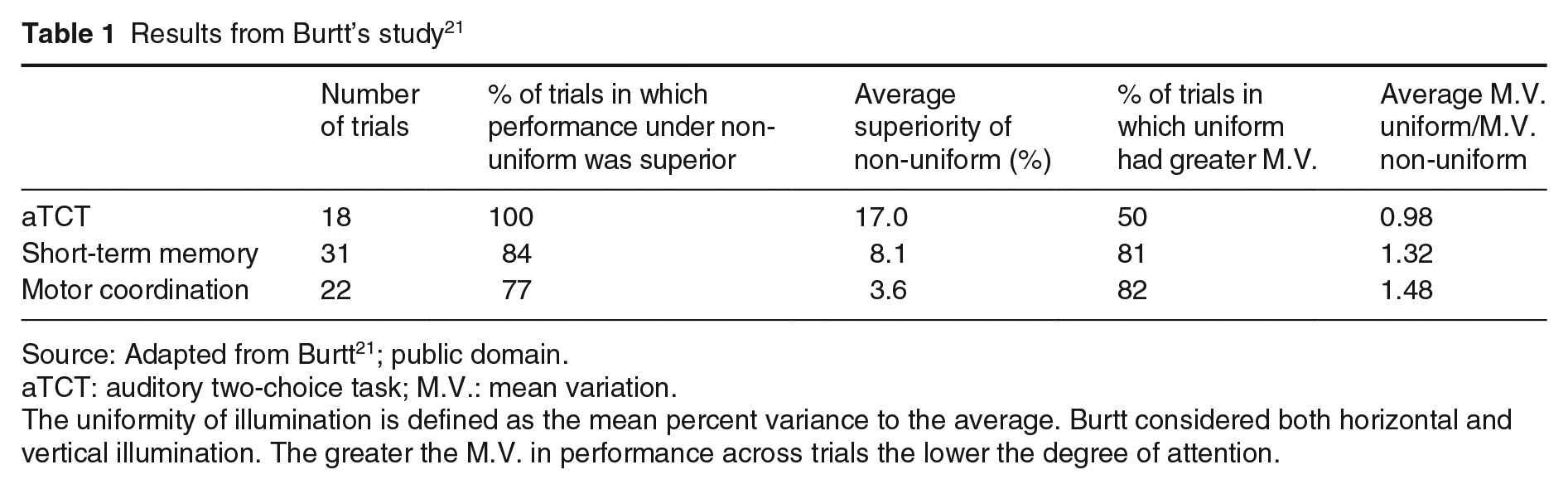
Source: Adapted from Burtt 21 ; public domain.
aTCT: auditory two-choice task; M.V.: mean variation.
The uniformity of illumination is defined as the mean percent variance to the average. Burtt considered both horizontal and vertical illumination. The greater the M.V. in performance across trials the lower the degree of attention.
Burtt’s study received little attention, despite asking relevant research questions. The results of the experiment indicate that there might be other psychological and potentially physiological mechanisms behind increased task performance which are possibly influenced by one or more of the multiple pathways of light. In conclusion, more research is needed to determine whether and how public lighting may impact psychological constructs such as alertness, arousal, anxiety and/or attention of pedestrians in mesopic conditions, and how these processes in turn relate to visual performance (i.e., surroundings awareness) and safety.
This requires that we first clarify and define the main theoretical concepts of alertness, arousal and anxiety and their possible relationships. The current paper reviews these complex and often ambiguously defined concepts and attempts to draft a theoretical framework for the context of outdoor conditions. The framework will not attempt to distinguish the possible influence of NIF and IF effects of lighting. The paper should hence be read as a conceptual guide to raise awareness and suggest a common understanding and vocabulary; a frame of reference for future research.
2. Defining the concepts
2.1. Attention
Attention is a multicomponent cognitive process that enables division of cognitive resources by the selection of which of the incoming information will be processed further.22–24 Light can impact attention; for instance, by highlighting a specific area in the environment the attention will be selectively steered towards it. Directing attention towards an incoming vehicle or not paying attention at a crosswalk will have an impact on pedestrians’ traffic safety. 25
2.2. Alertness
Alertness can be defined as a cognitive state of readiness and openness to respond to stimuli and to process incoming information.22,26–29 This readiness can be in various degrees; for example, general, enhanced or heightened. A person is very alert if they notice any minor changes in their environment and adjust their behaviour accordingly. Conversely, someone is not alert if they fail to notice and respond to something important happening in their surroundings. Therefore, a person’s attention is strongly, although not exclusively, influenced by their level of alertness.
Alertness is often understood, particularly in sleep research, as the opposite end to sleepiness on a sleep-wake continuum. But studies indicate that this is not necessarily the case and that daytime sleepiness and alertness, although in general negatively correlated, are distinct central nervous system phenomena with different neural pathways and neurochemical mechanisms.22,28 Literature suggests that alertness, just like attention, might be a multidimensional construct, with two types of alertness already studied and described. Extrinsic, or phasic, alertness is a very fast change (in range of milliseconds) in the cognitive state as a response to external warning stimuli.22,27,29 Intrinsic, or non-phasic, alertness is a steadier (i.e., timescale of minutes to hours), internal, top-down process of controlling readiness to receive information without any preceding external stimuli.22,27 Sleepiness is presumed to negatively affect intrinsic alertness (e.g., slower response times). 22 For terminological clarity, we will use the term wakefulness for the earlier mentioned opposite pole to sleepiness in the remainder of this paper.
Alertness also needs to be distinguished from vigilance. As stated earlier, we understand alertness as a cognitive state of readiness to incoming stimuli. Vigilance, instead, is an ability to sustain attention to a task or source of information for a long period of time.23,30 Some researchers consider vigilance as a form of directed alertness. Vigilance, though, requires effort and is related to a specific event, whereas alertness is a state of more generalized openness to any incoming stimuli. 26 As some researchers advise caution with the use of the term ‘vigilance’ because of its ambiguous definitions, 23 we will equate vigilance, in the remainder of the paper, with sustained attention.
This interchangeable use of the two terms, alertness and vigilance, often happens in research on the effects of light on driving performance during night-time. A driver’s performance and (intrinsic) alertness might indeed be affected by increased sleepiness.31,32 The psychomotor vigilance task (PVT) is mostly used for evaluating such performance. The PVT, a monotonous reaction time task is based on simple responding to a randomly appearing stimulus for a long period of time without distractions.33,34 This indeed fits the definition of vigilance, sustained attention towards a specific task for a protracted time-period,23,30 and can be considered similar to the task of keeping the vehicle on the road and being cautious about possible traffic collisions. Arguably though, such experience and behaviour goals of a driver are different from those of a pedestrian walking home in the evening. Nightly urban environments can still offer a rich variety of distracting stimuli and potential real or imagined dangers.
Overall, increased alertness is associated with performance benefits. For example, performance in orienting response and sustained attention tasks is improved under higher levels of alertness. 26 An increase in alertness has been linked with enhanced processing speed of incoming stimuli (i.e., faster response time) and with greater efficiency of such processing (i.e., increased response accuracy).22,26 Alertness is also found to influence both spatial22,27 and selective attention. 35
2.3. Arousal
The concepts of attention, alertness and sleepiness cannot be discussed without also discussing the concept of arousal. Arousal is defined as a general state of both cognitive and physiological nature, whereas alertness is explicitly a cognitive state. 26 Physiological arousal is associated with activity of the autonomic nervous system, which manifests in various measures (e.g., increased heart rate, pupil dilation and galvanic skin response). 36 Parasuraman, Warm and See suggest that any increase or decrease in arousal leads to an accompanying increase or decrease in alertness. 30 On a similar note, Brown and Bowman indicate that a state of high alertness co-occurs with increased arousal. 26 Alertness, in particular the state of intrinsic alertness, seems to therefore be linked with both attention and arousal.
Thayer introduced a two-dimensional model of arousal.37,38 One, an energetic dimension, that the first dimension, an energetic arousal, ranges from feelings of vigour to drowsiness and is tied in with circadian rhythms and voluntary motor activity. This energy-sleep dimension has been reported to correlate with the sleep-wake cycle and could be understood as the sleepiness-wakefulness dimension of arousal. The second dimension, which is labelled tense arousal, ranges from stillness or placidity to subjective tension and presumes to mediate defensive emergency behaviour, including energy mobilization. It is also expected to be connected with various emotions and stress reactions, in particular with anxiety. To the best of our knowledge, very little investigation has been done to date on how these two dimensions of arousal are related to alertness and attention.39,40
2.4. Anxiety
According to the embodied predictive coding model, heightened arousal – in particular tense arousal – can be related to concepts of fear or anxiety. 41 Although sometimes used interchangeably, there are some differences between the two concepts. Fear is a more short-lived emotional reaction to an immediate and identifiable threat, whereas anxiety is more of a long-term and future-oriented state of readiness to expected or potential unspecified threats.42–44
The evolutionary function of anxiety is to detect and deal with threats.45,46 As such, anxiety is associated with increased arousal and physical readiness (i.e., the flight or fight response),37,42 but also with increased alertness (i.e., heightened cognitive readiness and maximal receptiveness),44,46 with threatening information being processed faster, and with ambiguous information more likely to be considered as threatening. 45 Anxiety thus facilitates stimuli-driven and reflexive attention,46,47 much like increased extrinsic alertness. This begs the question if alertness and anxiety are not in fact the same function of the organism, changing in their definition only by the context of the situation.
Anxiety is also linked with feelings of safety, which is another term with varying definitions. One way to understand subjective safety is as an absence of feelings of fear or anxiety. 48 Most fears addressed in research on public lighting (e.g., fear of crime, fear of falling) do not actually have any specific identifiable threat and are rather related to unspecified potential danger, and therefore, by definition, should be labelled anxiety. 49 Hence, we will understand perceived safety, for the purpose of this paper, as an absence of feelings of anxiety.
3. Theoretical framework
Above we have described three different concepts: alertness as a cognitive state of enhanced readiness and openness to stimuli, arousal as a more generalized and both physiological and cognitive state and anxiety as an emotional, future-oriented state of readiness to unspecified threat. From the previous discussion, it becomes clear that all three psychological constructs – alertness, arousal and anxiety – are interrelated and have their influence on one’s attention and, consequently, (perceptions of) social and traffic safety (see Figure 1). Given that increased arousal is conceptually related to both increased alertness and anxiety, and thus safety perceptions, we feel that it is justified to propose, for now, for arousal to be the central concept in our theoretical framework. Of the three concepts, arousal is also the only concept not tarnished by ubiquitous definitions and can be reliably measured and manipulated in an experimental setting.36,50–54
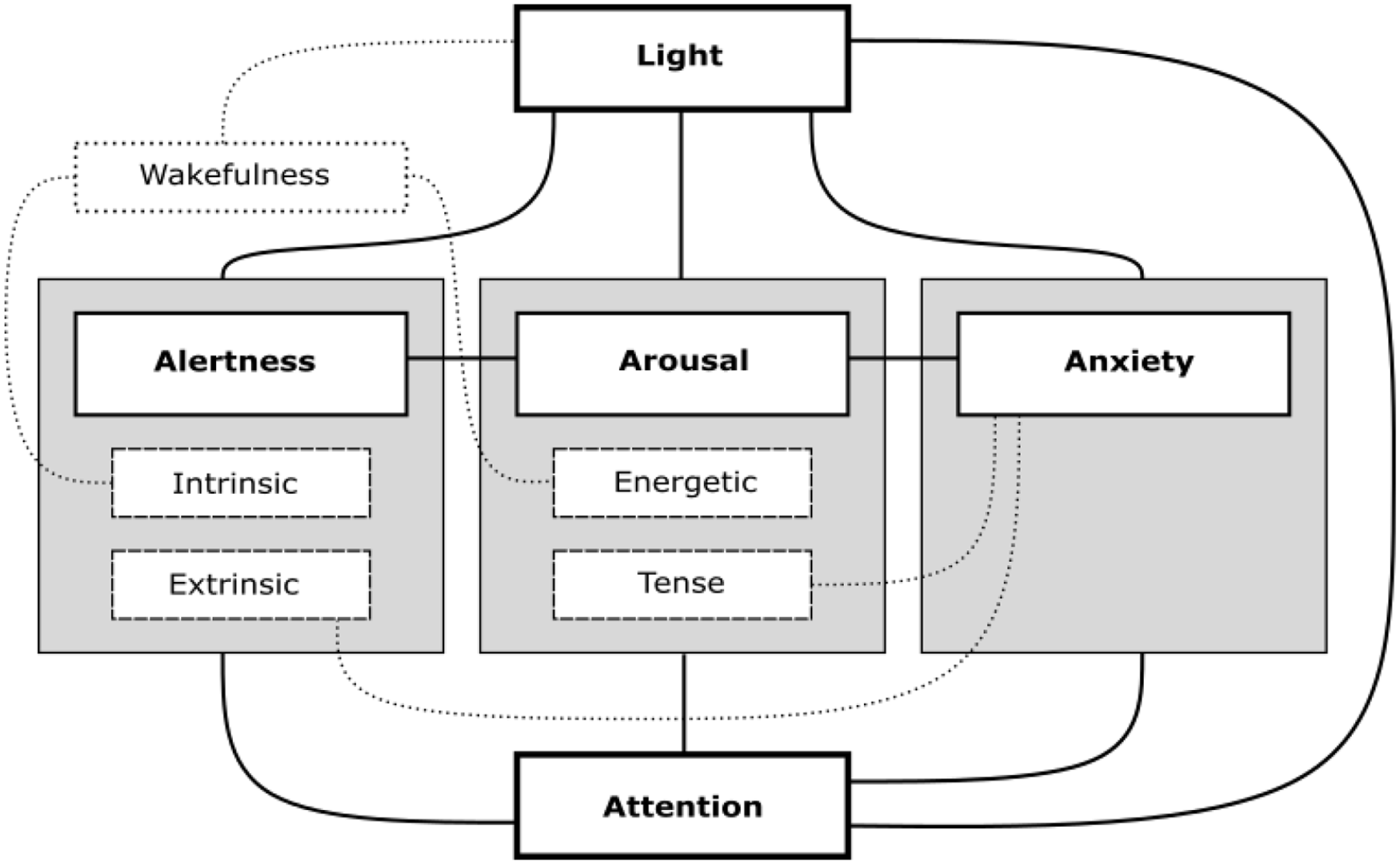
The triad framework. All of the three interrelated main concepts – alertness, arousal and anxiety – are related to attention, and all may be affected by lighting (shown by the black full lines). The light grey dotted lines connect related concepts
Arousal is often informally labelled as ‘positive’ – the optimal level of arousal – which may facilitate performance on a task, or ‘negative’ – heightened levels of arousal – which hinders task performance; the Yerkes–Dodson law.23,26 Unfortunately, such distinction usually approaches arousal only in the manner of its intensity and not its nature. Thus, to conclude that any arousal, not minding its dimension distinction,37,38 has solely positive or negative effects on performance would be a crude simplification. 39 An increase in tense arousal might indeed bear negative consequences for cognition, attention and perception as it gives rise to anxiety. However, anxiety might also produce focus and be understood as a benefit to these processes.45,46 Likewise, an increase in energetic arousal does not necessarily implicate optimal performance. Increased arousal can bring increased alertness but, as a side effect, cognitive performance may suffer from sympathetic nervous system activation. 26 Doubtlessly, more research on how the different dimensions of arousal influence one’s attention is warranted.
4. Revisiting Burtt in the light of our theoretical framework
Although the findings from the Burtt study 21 are hinting at an understudied important research theme – the mechanism behind the effects of light characteristics on pedestrians’ attention – they are not without limitations. In particular, not all the characteristics of the equipment used and all the conditions are clearly described. For example, Burtt does not state the sound levels of the two bells used in the aTCT nor the speed of walking of the participants. Moreover, Burtt gives as a possible explanation for his findings the factor of changing of the illuminated areas under the lamps and dark patches in between them but we have no indications of the measure of this darkness and the light contrast between these two potentially different areas.
Another issue with Burtt’s approach is that creating less uniform lighting conditions and more contrasting light and dark spots might lead to reduced pedestrians’ feelings of safety.55,56 According to research, subjective safety is positively influenced by perceived quantity of light in a space (i.e., spatial brightness) 57 which, generally, 58 increases with higher uniformity of light. 59 More light suggests greater visibility and range of sight; better visual performance. This gives more time to recognize a threat, to make appropriate response decisions and, also, a higher chance to be seen by others in case of needing help. 59 In addition, more dark spots can lead to lowered social safety due to increased concealment; the amount of potential hiding spots for offenders in given environment.8,48,60
Yet, again, safety should be understood as more than just being able to see one’s surroundings. A pedestrian should be alert and pay attention to their surroundings. Since alertness levels follow variations in arousal,26,30 effects of light that increase physiological arousal (e.g., higher illuminance increases heart rate) 61 might lead to increased alertness. At the same time, increased arousal might be interpreted, according to the embodied predictive coding model, 41 as a response to an incoming threat or danger and can lead to anxiety. In Pezzulo’s example, just the belief that a thief has entered a house can increase physiological arousal, which in turn empowers the feeling of unsafety. In a similar sense, dark spots might lead to negative ruminations (e.g., What might be lingering there in the dark?), which consequently lead to increased arousal and anxiety and, therefore, lowered feelings of safety.
Looking back at Burtt’s findings, 21 we might try to explain them by the effects of lighting via the proposed conceptual framework. Light characteristics, in this case the non-uniform lighting conditions and the dynamic change from the unlit region to an illuminated one, could have increased participant’s alertness and reduced their sleepiness via ipRGC-influenced light responses and therefore lead to faster reaction times and overall better performance. But with the limited information on light levels at the eye during or prior to the study, it is impossible to judge the likeliness of this mechanism. Another explanation for the findings of Burtt is that the greater contrast between the lit areas and the dark regions might have increased participants’ tense arousal dimension and their anxiety. If we look at the concept of anxiety from the proposed evolutionary perspective, we might see it as a benefit to our attention, comparable with the extrinsic alertness. Therefore, participants performed better under the non-uniform conditions because the dark areas increased their anxiety, which led to heightened cognitive readiness and faster processing of danger-related incoming stimuli.
As we can see, one could reach alternative explanations of Burtt’s findings by applying the proposed theoretical lens. A combination of the two abovementioned interpretations may also be possible. We could argue that perhaps the changes in illumination and the contrast created by alternative bright and dark regions could have led to an increase in the participants’ arousal which might have then benefitted their attention – measured through the speed and accuracy of their responses. But we are still in the dark about the nature of such arousal. The areas in the shadow might have increased the tense arousal dimension and/or the lit areas might have promoted alertness. We will need a better understanding of the influence of different dimensions of arousal and whether these results were mediated through increases in alertness, anxiety or both. What is clear, however, is that the proposed framework provides a theoretical lens through which existing research findings can be (re)interpreted and new hypothesis be developed.
5. Summary
In this paper, we pointed out several unresolved points in the research on urban street lighting. Psychological constructs such as alertness, vigilance and/or anxiety are not considered, at the moment, in pedestrian lighting research. These concepts are prone to mixed use and to being loosely defined. For instance, to confuse matters, a state of abnormally heightened or extreme alertness towards a specific stimulus in highly anxious individuals is often referred to as hypervigilance in the literature.62,63 More importantly, we do not yet understand the psychological mechanisms behind these concepts, specifically how the two dimensions of arousal might differentially affect an individual’s safety perception.
Our line of thinking in this paper was inspired by the ideas from Burtt’s study. 21 Unfortunately, no replication of this experiment, or its parts, has been done to our knowledge. We proposed a theoretical framework that might offer a direction for explaining conclusions of Burtt’s research. Also, we have stressed the possible influence of the interaction between the three main constructs on individual’s attention and sense of safety, which implies a demand for greater experimental control. Hence, we will need to establish the sensitivity of the possible metrics, to test the links and correlations between the constructs and their measures properly, and to come up with methods able to separate the influence of each construct from the others. Using a virtual reality (VR) environment, for example, would seem a suitable approach as it offers greater control over the experimental environment and can be considered a sufficient alternative to a field study.64–66 However, VR brings another set of challenges such as how to have accurate representation of light in VR or how light in VR may affect NIF pathways. Interestingly though, VR could allow for the testing of effects of dark outdoor conditions at systematically varied circadian phases.
Our proposed conceptual triad provides a novel perspective, more firmly grounded in existing psychological theories and concepts, on what subjective feelings of safety entail. It brings new insights and hypotheses that can explain the well-established relation between urban lighting and safety feelings that go beyond the obvious: more lighting is better. 55 A logical focus of a prospective project, beside empirically demonstrating the proposed relations between the concepts, should be on exploring how this new conceptual framework can inform the development of urban lighting recommendations. We can propose just a few possible questions that future research might try to tackle: What is the relation between visual performance tasks, such as face recognition, and subjective safety as understood within the proposed triad? What would be an alternative procedure for establishing lighting recommendations in an objective visual performance-based way? What should, according to this triad, a survey instrument for assessing perceived personal safety look like? What is the role of the IF and NIF pathways within the theoretical framework? Or could this framework possibly lead to research unveiling the interactions between the two pathways? Does this framework sufficiently allow for the inclusion of already established urban lighting effects?
To conclude, pedestrian lighting research has focused predominantly on visual performance. In doing so, it has neglected concepts also related to attention and safety including alertness, arousal and anxiety. A focus on such concepts through both IF and NIF pathways may boost understanding of both the visual performance of pedestrians (i.e., higher traffic safety) as well as their perceptions of social safety. Arousal particularly seems to be a promising concept to explore. It creates much wider openings for future research since it could be stimulated through many properties of the environment, not just lighting. This could mean exciting opportunities for the fields of architecture and urban design.
Footnotes
Declaration of conflicting interests
The authors declared no potential conflicts of interest with respect to the research, authorship and/or publication of this article.
Funding
The authors disclosed receipt of the following financial support for the research, authorship and/or publication of this article: This research was performed within the European Training Network LIGHTCAP (project number 860613) supported by the Marie Skłodowska-Curie actions framework H2020-MSCA-ITN-2019. The funders had no role in decision to publish, or preparation of the manuscript.
