



Abstract
Previous studies have suggested mixed results about the effect of road lighting on crime. One potential explanation is that the effect of lighting, if any, varies with the type of crime. This was tested through analysis of the effect of change in ambient light level on crimes recorded in 11 cities in the USA for the 10-year period 2010–2019. The results suggest that ambient light level had a consistent effect on robbery, with darkness leading to an increase in robbery, but did not suggest a significant effect for other types of crime.
1. Introduction
An assumed benefit of road lighting in subsidiary roads is a reduction in crime after dark.1,2 After dark, when daylight no longer provides illumination, visual function is impaired. Road lighting mitigates this impairment and enables people to see more clearly at greater distances: it enables the law-abiding to take action against crime, either assertive, preventive or avoidance, and exposes the criminal to greater public scrutiny. 3 Road lighting also serves to reduce the sense of anonymity brought by darkness, which otherwise promotes dishonest activity.4,5 In addition to visual effects, the installation of new or improved road lighting might reduce crime by increased community pride signalled by community investment in the area. 6 Road lighting, however, brings unwanted consequences such as light pollution, energy use and ecological impact, and hence its installation and use must be of overall benefit.
A meta-analysis of studies investigating road lighting and crime in the UK and USA found an overall decrease in crime after improvements to the lighting. 6 Those improvements were either an increase in illuminance or installation of lighting in a previously unlit street. A more recent study 7 using data for crimes recorded in England and Wales investigated the effect of reductions in road lighting, either dimming or switching off the road lighting for some parts of the night: it was concluded that such reductions did not have a significant effect on crime rates. Those reductions in lighting were implemented to reduce the unwanted consequences of road lighting, in particular to reduce energy consumption. While it is a convenient finding for those setting road lighting policy to conclude that energy can be saved without detriment to crime, that conclusion does not concur with the meta-analysis: if more lighting reduces crime, then reduced lighting is expected to increase crime.
One explanation for the different findings is that they represent different geographic areas, and in different areas, there may be different approaches to road lighting and policing and different socio-economic demographics. The meta-analysis by Welsh and Farrington 6 included 13 studies: while they concluded that crime reduced by 21% in test areas relative to that in the control areas, this included three studies where crime increased after improvements to road lighting, although not to a degree which reached statistical significance.
We consider here an additional explanation for the different findings – the type of crime. This explanation would be relevant if the effects of changes in light differ for different types of crime. Road lighting after dark increases the visibility of offenders to witnesses and potential victims, it increases the visibility of potential targets (victims and/or property) to offenders, and it decreases the perceived anonymity associated with darkness. Davies and Farrington 8 investigated the effect on crime of a part-night lighting strategy (road lighting was switched off between 23:30 and 05:30), a similar situation to that included by Steinbach et al., 7 and found different results for the four types of crime they considered: part-night lighting was associated with increases in burglary and vehicle crime, a decrease in violence (which included sexual offences and robbery), but no significant effect on criminal damage.
The effect of light on crime has also been studied through changes in ambient light level, taking advantage of the shift in daylight following from the bi-annual daylight saving time (DST) clock changes. Doleac and Sanders 9 investigated four types of crime in low-density and rural areas of the USA and found that light was associated with a significant decrease in robbery but not for rape, aggravated assault or murder. For crime in two metropolitan areas in Chile, Domínguez and Asahi 10 found a significant decrease in robbery when it was light but did not find a significant effect for other types of crime.
Two studies by the current authors investigating crime in six cities in the USA found a significant increase in robbery after dark, but did not reveal significant effects for other types of crime.11,12 Those two studies each included data for three USA cities, a different set in each case, and the findings were mixed. For example, while one study 12 suggested an increase in prostitution after dark, the other study 11 revealed a decrease.
The effect of light on crime revealed in previous studies varies with location and with type of crime. In this research note, we report analysis of crime data for 11 cities in the USA, with that analysis broken down by each type of crime. This extends previous studies11,12 by considering crime data for the six individual cities, rather than these being aggregated in groups of three, and by including also the data for the five remaining cities available in the data source.
2. Method
The source of data and method of analysis are identical to that reported in previous work 11 and are therefore described here only briefly. We used data drawn from the Crime Open Database (CODE) 13 for 11 cities for a 10-year period from 2010 to 2019. The CODE database was used because this includes for each crime event the geographic coordinates (longitude and latitude), date and time, and the offence category. Five cities (Kansas City, Los Angeles, Memphis, New York and Tucson) were added to the six (Austin, Chicago, Louisville, San Francisco, Seattle and St Louis) included in previous analyses.11,12 Although the CODE database also reports crime data from six other cities in the USA, these were excluded either for not offering a complete record over the 10-year period (Boston, Mesa, Nashville and Virginia Beach) or because the precise time of crimes was not recorded (Detroit and Fort Worth).
Within CODE, crimes are categorized into 1 of 32 types: arson, assault, bad cheques (‘checks’ in the original), burglary/breaking and entering, bribery, counterfeiting/forgery, curfew/loitering, destruction/vandalism of property, disorderly conduct, driving under the influence, drug offences, drunkenness, embezzlement, extortion/blackmail, family offences, fraud, gambling, homicide, human trafficking, kidnap/abduction, larceny/theft, liquor law violation, motor vehicle theft, peeping tom, pornography, prostitution, robbery, sex offences, stolen property, trespass of real property, weapon law offences and all other offences. Comparing cities recorded within the same database means that crime types are consistent. The data were filtered for crimes that occurred the week before and the week after the Spring and Autumn clock changes.
Ambient light level was defined according to solar altitude: daylight was characterized by a solar altitude of >0° and darkness by a solar altitude of ⩽ −6°. 14 Civil twilight (solar altitudes between 0° and −6°) were therefore excluded. Solar altitude at the time of each crime was calculated following the National Oceanic and Atmospheric Administration. 15 The solar altitude was also calculated for the exact same time for the paired week (i.e. if the crime took place on Monday the week before the clock change, then solar altitude was calculated also for 7 days after, Monday the week after the clock change, at the exact same time). To clearly isolate the effect of ambient light level, 16 a crime occurring after dark (solar altitude ⩽ −6°) was included in this analysis only if that same time of day would be characterized as daylight (solar altitude >0°) in the paired week. These case crimes occurred within periods of approximately 30 minutes duration in the morning and evening.
The effect of ambient light level on crime was determined using an odds ratio (OR) and 95% confidence interval (95%CI) as defined by Equations (1) and (2). To account for influences on crime other than ambient light level (such as weather), the OR also includes crime data for two control periods, having the same classification of ambient light level (daylight or darkness) before and after the clock change. The daylight control period started and finished 2 hours before the case window, and the dark control period started and finished 2 hours after the case window. For each city, crime counts were established separately for each of the case and control periods.
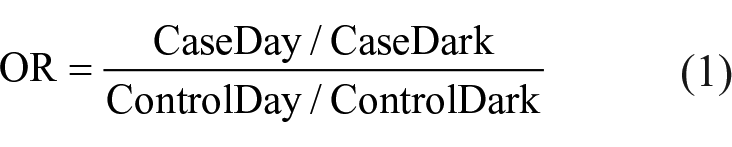

CaseDark: the number of crimes in the case period when this was in darkness.
CaseDay: the number crimes in the case period when this was in daylight.
ControlDark: the number of crimes in the control periods on days when case crimes would be in darkness.
ControlDay: the number of crimes in the control periods on days when case crimes would be in daylight.
Some types of crime type were removed when there were too few instances (fewer than five crimes in a particular cell of the OR analysis) as small samples are likely to distort the magnitude and direction of the OR, and by enlarging the 95%CI are likely to hide significant effects. A minimum sample of 5 was chosen as this is a requirement of the chi-square test 17 as used to test the difference of ORs from unity. The crime types omitted from all cities were bad cheques, bribery, embezzlement, extortion/blackmail, stolen property, human trafficking, kidnap/abduction, gambling, peeping tom and pornography. The category ‘all other offences’ was also omitted as there was no explanation as to what crimes were included. For a specific city, further crime types were excluded where the sample was small.
3. Results
Table 1 shows the ORs and 95%CIs for all types of crime combined in each city. The ORs range from 0.94 to 1.08, where an OR greater than 1.0 indicates an increase in crime after dark, and an OR less than 1.0 indicates a decrease in crime after dark. In only one city (Chicago), the effect of ambient light level on overall crime suggested to be statistically significant, and in this case, it is an increase in crime after dark.
Odds ratios and 95%CIs for overall crime in individual cities
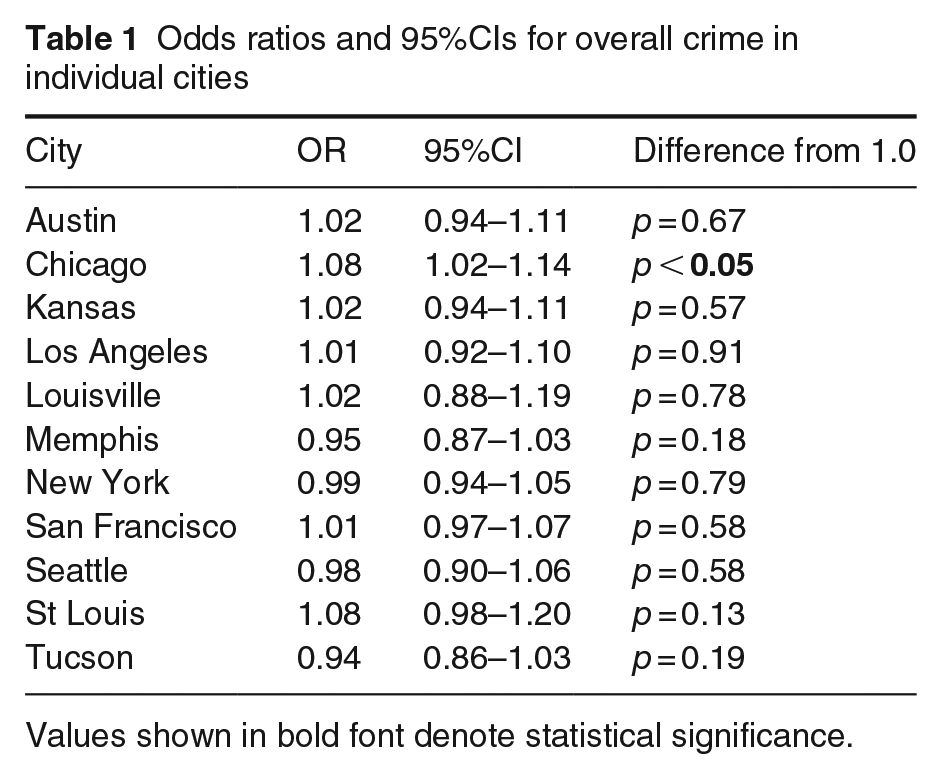
Values shown in bold font denote statistical significance.
The method used in the current analysis precisely distinguishes between events occurring in daylight and darkness, but this is done at the expense of smaller samples. As shown in previous work, 11 the resulting increase in the 95%CI may hide significant effects. We, therefore, interpret the findings according to effect size rather than statistical significance, and we note where the ORs indicate an effect, which reaches at least a small increase (OR ⩾ 1.22) or decrease (OR ⩽ 0.82) 18 after dark. Effect size provides information as to whether an effect is of substantive significance, and has the advantage that, unlike statistical significance, it is independent of sample size. 19 For crime overall, each of the 11 cities examined (Table 1) fails to reveal even a small effect of ambient light level on overall crime numbers.
Table 2 shows the ORs for each type of crime using data from all 11 cities combined. For robbery and sex offenses, these ORs suggest significant increase and decrease, respectively, after dark, and in each case, the ORs suggest at least a small effect size. For family offences, the OR suggests a small decrease after dark, but that is not suggested to be statistically significant. For all other crime types, the ORs do not suggest an effect of ambient light level.
Odds ratios and 95%CIs for different types of crime for all 11 cities combined
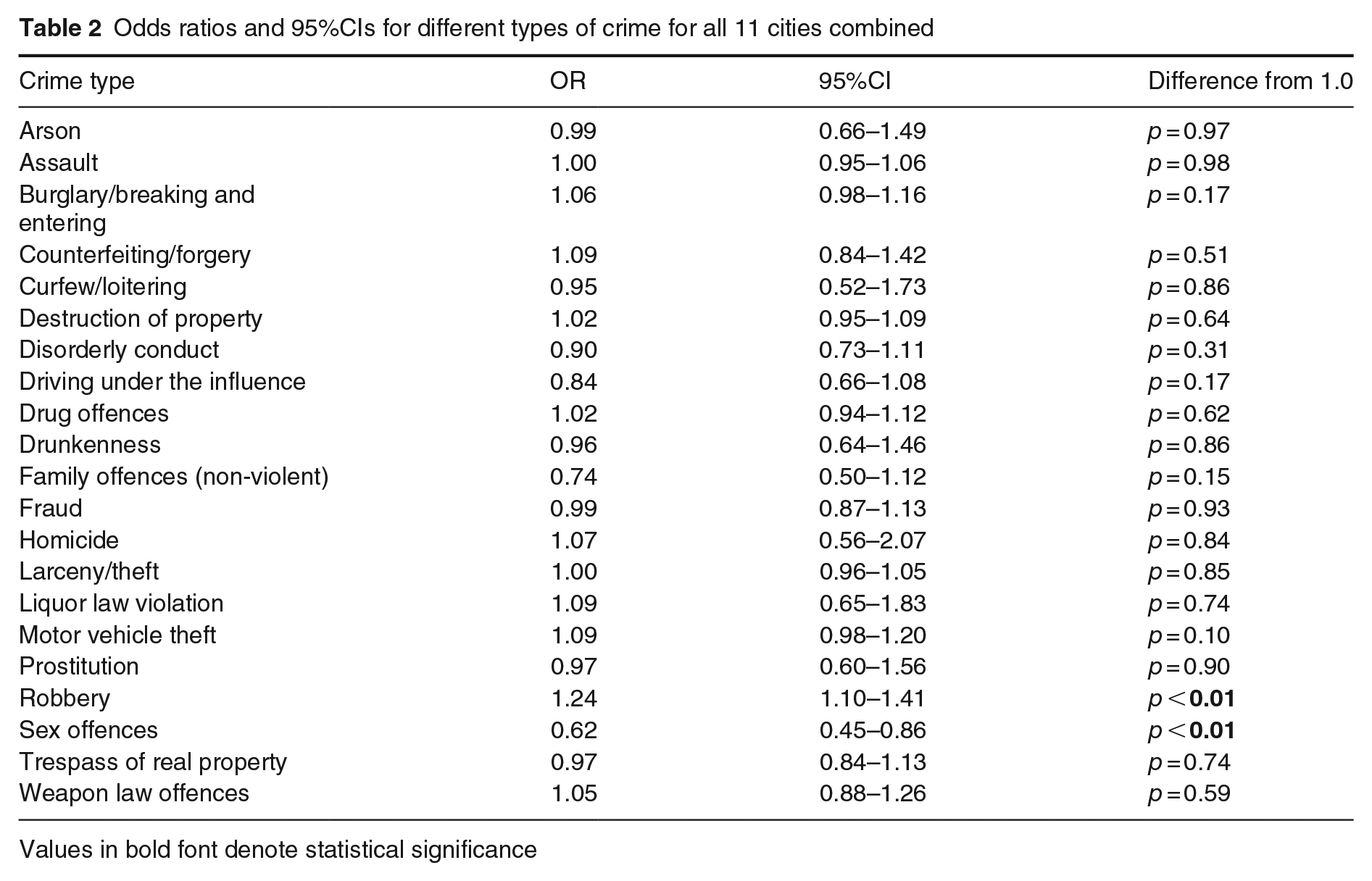
Values in bold font denote statistical significance
Results of the effect of ambient light level on individual types of crime are shown separately for each of the 11 cities in Supplemental Tables S1 to S11.
For only one type of crime, robbery, do the data suggest a consistent effect of ambient light level, with the results from 10 cities indicating a small increase after dark. In just the one remaining city, the OR suggests a negligible effect. This agrees with Doleac and Sanders 9 and Domínguez and Asahi. 10
For arson and disorderly conduct, the data from each of the two cities also suggest a small increase after dark; however, the remaining cities for each crime type (one for arson, and three for disorderly conduct) suggest instead a decrease in crime after dark, albeit a decrease, which did not reach the threshold for a small effect size. A decrease in crime after dark sufficient to reach a small effect size was found for driving under the influence and family offences (two cities each), liquor law violation (one city) and sex offences (three cities). However, the remaining data, from an equal or greater number of cities, suggest a negligible effect. Thus, for arson, disorderly conduct, driving under the influence, family offences, liquor law violation and sex offences, this analysis does not suggest a consistent substantively significant effect of ambient light level.
For two types of crime, assault and larceny/theft, the data from all 11 cities consistently reveal a negligible effect of ambient light level (other than for one city, which suggests a small decrease in assault after dark).
For each of the remaining nine types of crime (burglary/breaking and entering, destruction of property, drug offences, drunkenness, motor vehicle theft, trespass of real property, weapon law offences, curfew/loitering and prostitution) the results are mixed, with the ORs suggesting at least one city with a small increase and another city with a small decrease in crime after dark for each type of crime.
For the three types of property stealing identified in CODE as different types of crime, the current analysis reveals different effects of ambient light level: a small increase in robbery after dark, but a negligible effect for larceny/theft, while for burglary/breaking and entering the mixed results suggest no overall effect. Robbery is an interpersonal crime, in which a criminal takes (or attempts to take) property directly from another person, where force may be used or threatened. 20 Burglary happens when the criminal intentionally enters a building (or other place) without the consent of the owner with intent to steal, and theft, the broadest category, is stealing, which does not necessarily involve either unlawfully entering a building or using (or threatening) force upon the victim. 20 Robbery therefore differs from these other types of stealing; in that, it requires the criminal to get close to the victim before initiating the act. The close proximity means that in light conditions, the victim is better able to detect the approaching criminal before the event, with the possibility to take avoiding action, and better able to see details which may aid subsequent identification of the criminal. Since visual detection and acuity are enhanced in light rather than dark conditions, an increase in ambient light level has the potential to reduce robbery. On the other hand, larceny/theft and burglary/breaking and entering do not necessarily involve close proximity with the victim, giving less potential for light to support detection and identification, and hence there is negligible effect of ambient light level.
Two types of crime included in this analysis (counterfeiting/forgery and fraud) are predominantly indoor crimes, and perpetrated over a long period rather than being near-instantaneous, and are therefore unlikely to be affected by a change in ambient light level. They were therefore retained as a control: if the analysis revealed a statistically or substantively significant effect for these types of crime it would indicate a possible error. For only one city, each was ambient light level suggested to have statistically significant effect on fraud (Supplemental Table S10) and a near statistically significant effect on counterfeiting/forgery (Supplemental Table S5). In 8 of the 10 cities for which sufficient data were available to analyze fraud, the OR suggested a negligible effect size, and similarly for three of the five cites with data for counterfeiting/forgery, the effect size was negligible. Overall, the data do not suggest an effect of ambient light level for those types of crime considered to be indoor crimes and for which an effect would not be expected.
In summary, for only one type of crime, robbery, do the data tend to consistently reveal an effect of ambient light level on crime. In this case, the impact is for an increase in robbery after dark, which suggests that the installation of road lighting would offer some mitigation. For the other types of crime for which sufficient data were available in this analysis, the results do not suggest the potential for mitigation by the installation of road lighting, with the ORs suggesting either no effect, or mixed results, across different cities.
The ORs are also shown in Figure 1. For the different types of crime, the numbers of cities for which there were sufficient data to enable analysis ranged from 2 to 11. For arson, counterfeiting/forgery, curfew/loitering, disorderly conduct, drunkenness, family offences, liquor law violation, prostitution and sex offences, there were five or fewer cities in each case. With too few cities, interpretation of the trend becomes less robust, and hence Figure 1 includes only those crime types with at least 10 cities.
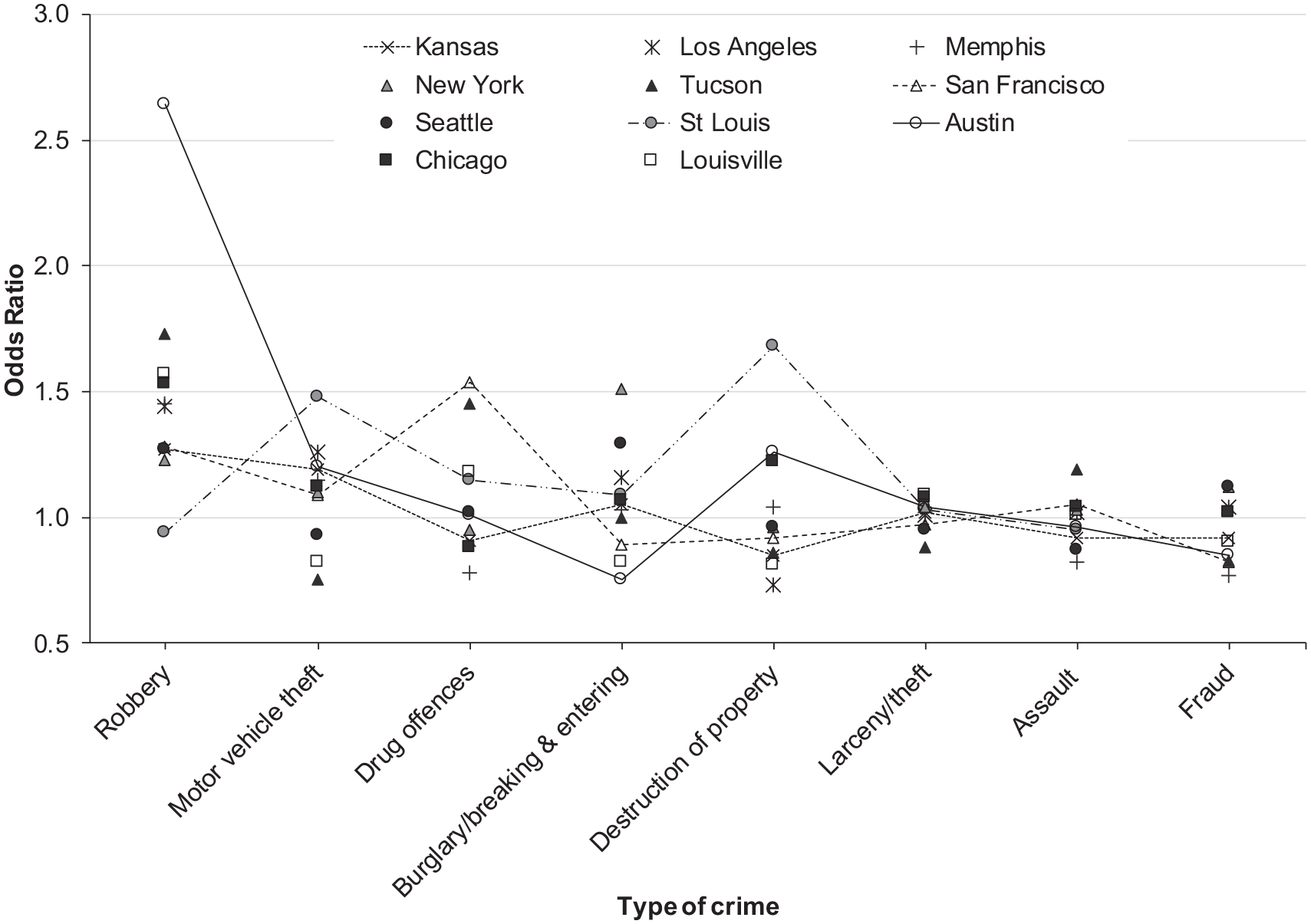
Odds ratios for the effect of ambient light level on different types of crime in 11 cities of the USA. An OR of greater than 1.0 indicates a type of crime that increased in darkness compared with daylight for the same time of day. The crime types shown are those where there were sufficient data for analyses in 10 or 11 cities and are arranged in order of descending average OR. The thresholds for a small effect size are OR ⩾ 1.22 (increase after dark) and (OR ⩽ 0.82) (decrease after dark). 18 The data points for four cities, chosen arbitrarily, are connected to illustrate the variation in OR with crime type and location
4. Conclusion
An analysis of crime data from 11 cities in the USA was conducted to determine the influence of ambient light level. It was confirmed that the effect of light varies with the type of crime and with location. Change in ambient light level had a consistent effect only on robbery, with darkness leading to an increase in robbery. For all other types of crime, the results suggested either no effect or mixed findings. In terms of overall crime rates, a significant effect of ambient light level was found only for Chicago (Table 1), and in that location, the OR for robbery (1.53) departed further from 1.0 than did the ORs for any other type of crime in that city (0.53–1.22).
A cost-benefit analysis conducted to establish the merits of the installation of road lighting should therefore consider only a reduction in robbery but not assume a reduction in other types of crime.
Further research might consider four limitations of the current work. Firstly, this analysis took advantage of the biannual daylight-saving clock change to investigate the effect on crime of a change in light level. Using this approach means that any effect revealed must be attributed to a change in visibility and does not reveal the effect, if any, of community pride as might be found when making changes to road lighting. 6 However, if community pride has a significant effect on crime reduction, there may be better means of doing so than road lighting, particularly if they do not consume energy nor contribute to sky glow and detrimental impact on the natural environment. Also associated with this method of analysis is that the crimes being examined occurred at specific times of day, the case and control periods: this may misrepresent the estimate of the effect of light on crime for crimes, which are more or less likely to occur outside of these periods. Secondly, for the period defined in this analysis as darkness, there will have been variations in levels of illumination at each crime location according to the presence and characteristics of outdoor lighting. In further work, this can be examined by plotting the ORs against illuminance (or other characteristic) as used in previous work to show how changes in road brightness affect cycling rates. 21 By omitting civil twilight, as done in this analysis, the difference between daylight and darkness will be greater than any variation in illuminance from road lighting, whether that change is the installation of lighting of different characteristics, or a change in lighting at a given location part-way through the data collection period. Thirdly, there is a reduction in travel by walking and cycling after dark, 22 and this may reduce exposure for some types of crime such as robbery. Finally, the USA covers a wide range of climatic zones 23 and variations in climatic conditions that may affect crime rates. 24
Supplemental Material
sj-pdf-1-lrt-10.1177_14771535221100671 – Supplemental material for Research note: Variation of the effect of ambient light level on crime frequency with type of crime and location
Supplemental material, sj-pdf-1-lrt-10.1177_14771535221100671 for Research note: Variation of the effect of ambient light level on crime frequency with type of crime and location by S Fotios, CJ Robbins and S Farrall in Lighting Research & Technology
Footnotes
Declaration of conflicting interests
The authors declared no potential conflicts of interest with respect to the research, authorship, and/or publication of this article.
Funding
The authors disclosed receipt of the following financial support for the research, authorship, and/or publication of this article: This work was supported by the Engineering and Physical Sciences Research Council (EPSRC), grant reference EP/S004009/1.

Supplemental material
Supplemental material for this article is available online.
References
Supplementary Material
Please find the following supplemental material available below.
For Open Access articles published under a Creative Commons License, all supplemental material carries the same license as the article it is associated with.
For non-Open Access articles published, all supplemental material carries a non-exclusive license, and permission requests for re-use of supplemental material or any part of supplemental material shall be sent directly to the copyright owner as specified in the copyright notice associated with the article.
