



Abstract
This study concerns road lighting for pedestrians. Many experiments have been conducted to determine how changes in lighting affect the ability to make interpersonal evaluations, usually considering variations in light level or light spectrum. Here, we consider an alternative approach, predicting performance using an existing model, Relative Visual Performance. The results show that face evaluation ability is affected by adaptation luminance, pavement surface reflectance, observer age, and skin tone of the observed person. Previous experimental studies have tended to use young test participants to evaluate Caucasian or Asian faces: if the situation instead involved an elderly person evaluating a face of South African skin tone, then the current analysis predicts that for optimal performance the light level would need to be doubled.
1. Introduction
Enhancing the ability to conduct interpersonal evaluations after dark is one of the reasons for installing road lighting in subsidiary roads.1–5 Research exploring the effect of changes in lighting on interpersonal evaluations has tended to follow one of two approaches: Facial Identity Recognition (FIR) or Facial Emotion Recognition (FER). FIR was the task originally employed, primarily to explore whether or not changes in spectral power distribution (SPD) of lighting have an effect, with mixed results as to whether it did6–8 or did not9,10 suggest a statistically significant effect. It was subsequently suggested that FER would be a more representative task.11,12 FER is measured according to the ability to discriminate between facial expressions; it is therefore not influenced by familiarity with the target and is more relevant for the evaluation of intent. Several studies have investigated the effect of changes in SPD on FER, and these do not suggest that SPD has a significant effect.13–15 While data from these studies were considered in a discussion of design recommendations for pedestrian lighting, the conclusion was that the ‘Data do not reveal an optimum illuminance or luminance’. 16
Experimental features of previous experimental studies investigating interpersonal evaluations: observer age, characteristic of target faces and test distance
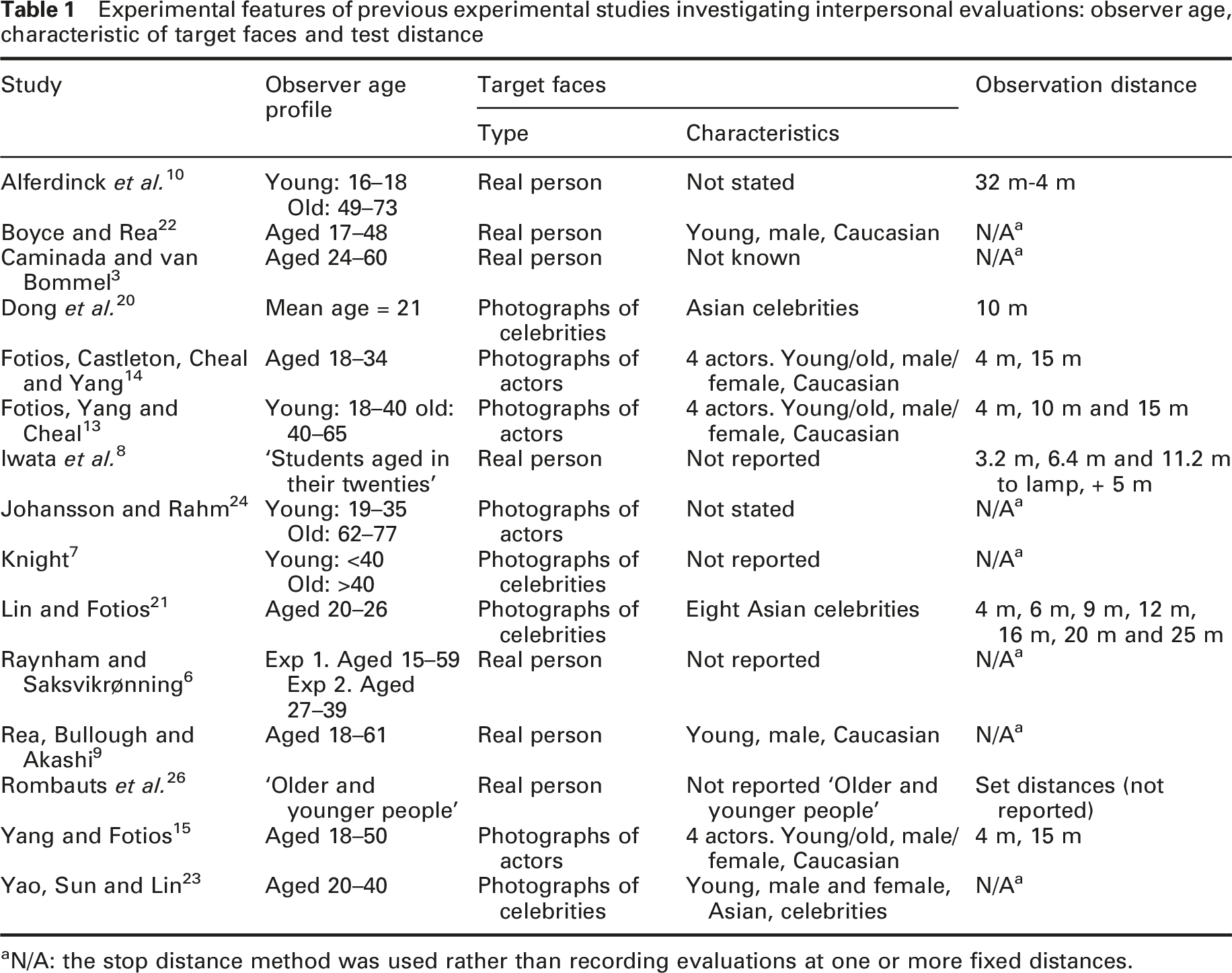
aN/A: the stop distance method was used rather than recording evaluations at one or more fixed distances.
Increasing age is associated with impaired visual acuity, for near and distant targets, reduced contrast sensitivity and reduced ability to discriminate colours: this impairment tends to start from the age of about 60 years.18,19 Age profiles in past studies can be allocated into one of three groups: only young observers, which therefore exclude the elderly8,14,20,21; a broad range of ages, which better represents society, but does not enable any effect of age to be revealed3,6,9,15,22,23; and separated older and younger age groups, which allow the effect of an age difference to be tested.7,10,13,24 Definitions of younger and older observers are not consistent between these studies and inclusion of observers aged 60 years or more is rare. Of those studies using broad ranges, the upper limit is less than 60 except for two studies having upper limits of 60 or 61,3,9 but clearly even these samples are weighted to those aged less than 60 years. Of those studies using distinct older and younger age groups, a similar problem exists, with older groups defined as 49–73, 10 40–65 13 and >40, 7 hence diluting any effect of age. These data have the potential to reveal the impact of age-related visual impairment from the age of about 40 years (suggested to be significant for the evaluation of facial expression 13 ), but if 60 years is the more critical threshold then these data are insufficient. Only the elderly group of Johansson and Rahm 24 (aged 62–77 years) distinguished between people aged older or younger than 60, and their data suggested a significant effect of age for facial expression recognition in only one of the three lighting conditions examined.
Characteristics of a face are revealed by contrast, and facial contrast varies with skin tone. 25 Previous FIR and FER studies have used Caucasian faces9,13–15,22 and Asian faces20,21,23, but in many cases, such details of the observed face are not reported.3,6–8,10,26 What does not appear to have been included is an evaluation of faces of darker skin tone, and this is important if the lesser facial contrast of darker skin tones leads to impaired facial evaluations.
The interpersonal distance at which a face is evaluated affects the size subtended by that face to the observer and this may be important because visual performance is affected by task size, with an increase in task performance as task size increases. 27 Two approaches have been used in past studies regarding target size. Some studies have used a stop distance procedure, whereby the observer walks toward the target (or vice versa) and stops at the point at which the required recognition criterion is met: the remaining distance is used to characterise effectiveness of the lighting.3,6,7,9,22–24 A limitation of the stop-distance approach is that the distance at which the evaluation is made may not be the same as the distance at which such an evaluation is desired in a natural setting.
Eye tracking data suggest 15 m is the typical distance at which pedestrians evaluate other people.4,28,29 Previous work 3 suggested 4 m to be a critical distance for interpersonal evaluations, this being the minimum public distance proposed by Hall, 30 this suggested to be the minimum distance at which an alert subject would be able to take evasive or defensive action if threatened. An ideal distance for interpersonal evaluation was suggested to be 10 m, the transition point between the close and far phases of Hall’s public zone. 3 Therefore, other studies have conducted evaluations at one or more fixed distances, and these have tended to include, or bracket, this range of interpersonal distances.
This study explored a different approach to investigate the effect of changes in lighting on interpersonal evaluations – prediction using a model of visual performance which uses details of the task, the observer and the luminous environment to predict performance. The model used is Relative Visual Performance (RVP), 31 specifically the model labelled RVPRT as described in the appendix of that paper.
Relative visual performance has been used in previous studies investigating the benefits of road lighting, for example, the visibility to drivers of road hazards and the visibility of pedestrians on pedestrian crossings.32,33 It was developed to characterise how changes in adaptation luminance and the size and contrast of the target affect the visual component of task performance using simple visual targets: the data included the speed and accuracy for checking parallel columns of 25 digit numbers and reaction time to detection of small, on-axis targets.34,35 Visual recognition of identity or expression requires an interpretation of the shapes (or changes in shape) of facial features, such as the mouth, the eyes and the eyebrows (see, for example, Figure 1 in Etcoff and Magee 36 ), which may be considered as a set of simple visual targets. A higher value of RVP means that facial features can be discriminated more quickly and/or more accurately. Using RVP does not require consideration of how the task is configured, that is, whether FIR or FER.
2. Method
The independent variables used in RVP are observer age, adaptation luminance, target size and the luminances of the target and its background.
To consider the effect of visual impairment with age, two observer ages were used, 25 and 65 years, a difference expected to reveal a significant effect of age.
Adaptation luminance is defined by Rea and Ouellette as ‘the unweighted, average luminance of the entire captured image’. 31 Assuming that the field of view is represented by the entire image, here we estimated adaptation luminance as the road surface luminance, part of the typical visual field of a pedestrian; this is the approach recommended by CIE in the determination of the adaptation coefficient in the mesopic photometry system. 37 For pedestrian situations such as subsidiary roads, illuminance on the horizontal plane at the road surface is used as the measure of light level. In CIE 115:2010 illuminances of the P-class range in six steps from 2.0 lx to 15 lx. 2 The basis of these illuminances is uncertain 5 so it would be worth considering the benefit of higher illuminances. For the current analysis that range was therefore extended to include also 20 lx, the highest illuminance recommended in CIE 115:1995, 38 and 200 lx and 2000 lx, to show the effect, if any, of further increases in illuminance.
The determination of road surface luminance for a given illuminance requires knowledge of the diffuse reflectance. 2 Here, for an unknown surface reflectance, we first assume a diffuse reflectance of 0.2. 2 To explore further the implication of this choice we also consider reflectances of 0.1 and 0.3.
Luminances of the target and its background are used in RVP only to calculate contrast. For the current analysis, we instead used facial contrast: the contrast of the lips, eyebrows and eyes against the skin immediately surrounding these features.25,39 Facial contrast is determined separately for these three facial features: for the current analysis we used the mean average of those individual contrasts. Note that while others report facial contrast as a Michelson contrast, here we use Weber contrast as is required to determine RVP. We used the young female faces from Porcheron et al. 25 Facial contrast varies with skin type and hence we used the Caucasian and South African faces, which correspond approximately to types II and VI of the Fitzpatrick Scale. 40 The facial contrasts of these faces are 0.314 (Caucasian face) and 0.138 (South African face).
Task size was characterised using the area of the inner features of the face. The key dimensions are the mean face length (menton-sellion length) of 113.4 mm and the mean face width (bizygomatic breadth) of 135.1 mm. 41 The sample for these measurements included broad ranges of age (18–66 years) and ethnicity (‘white, African American, Hispanic and other’). Data for males and females are reported separately: here we used females. The area of the face was assumed to be rectangular. Three interpersonal distances were used to establish the solid angle subtended by the face, 4 m, 10 m and 15 m, leading to solid angles of 0.00096 sr, 0.00015 sr and 0.000068 sr, respectively.
Relative visual performance was first estimated for the Caucasian and South African faces, for the nine horizontal illuminances used to estimate adaptation luminance, when located at all three interpersonal distances, assuming a young observer and a pavement surface of diffuse reflectance 0.2. These were then repeated for an older observer and for lower and higher pavement surface reflectances. Compared with observation of the Caucasian face by a young observer at a distance of 4 m, it was expected that RVP would decrease for observation of the South African face, for the older observer, at a greater distance and for the lower pavement surface reflectance.
3. Results
Figure 1 shows RVP for observation of the Caucasian and South African faces by a young observer, for all three interpersonal distances and a diffuse road surface reflectance of 0.2. RVP is plotted against horizontal illuminance rather than the subsequently derived adaptation luminance, as horizontal illuminance is the value relevant to practical application. Relative visual performance plotted against horizontal illuminance for Caucasian and South African faces viewed at distances of 4 m, 10 m and 15 m. In each case the observer is young and the pavement surface reflectance is 0.2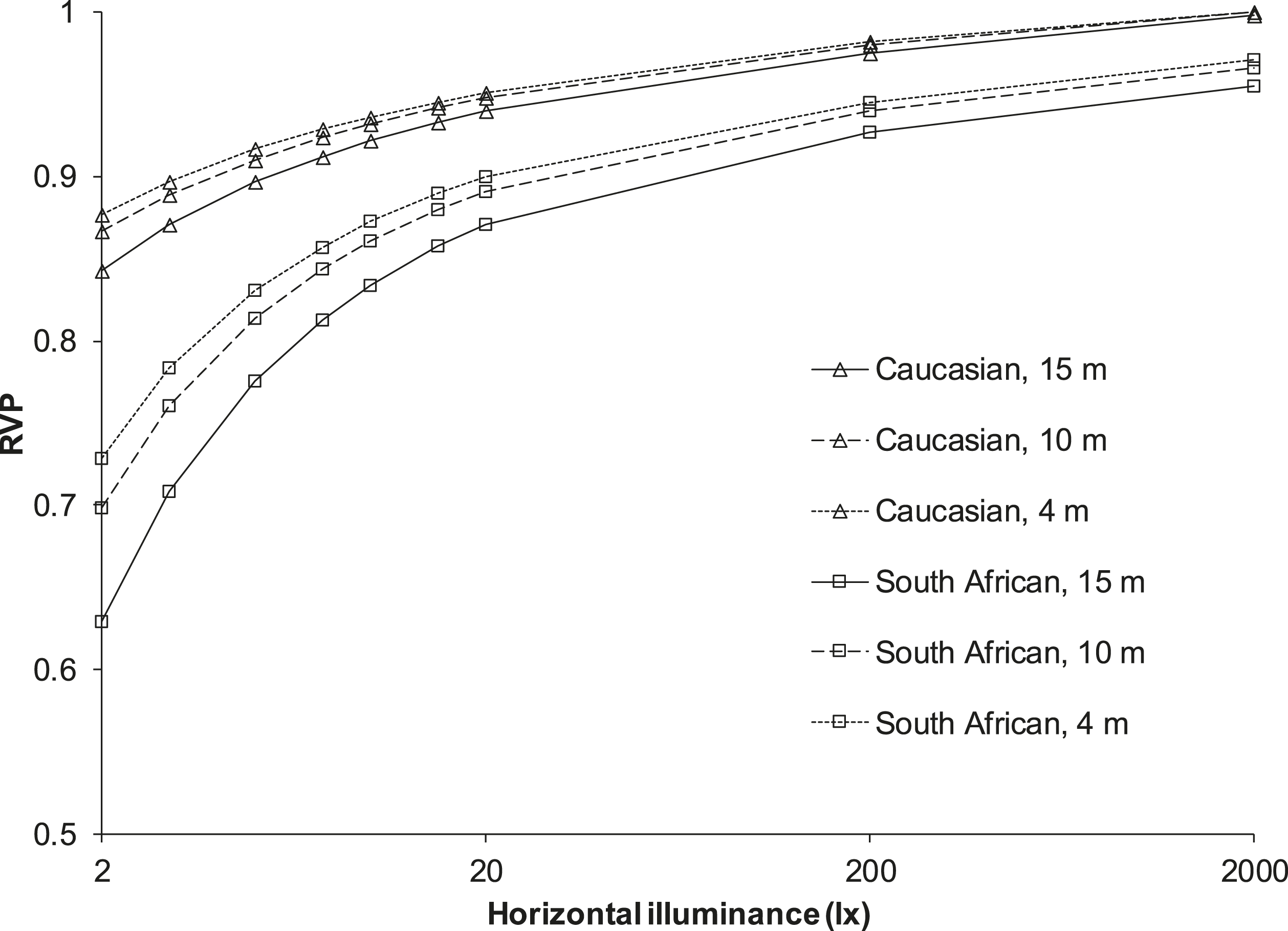
For the Caucasian face these results suggest there is little effect of interpersonal distance: targets at a distance of 15 m have a lower RVP than those at 10 m and 4 m, but the differences are small. The effect of interpersonal distance is greater for observation of the South African face than for the Caucasian face.
Figure 1 shows a large effect of skin tone, with a lower RVP for observation of the South African face than for the Caucasian face at the same illuminance and distance. For Caucasian faces, RVP increases with increasing illuminance, from 0.87 at 2.0 lx to 0.95 at 20 lx and approaching 1.0 at 2000 lx. For South African faces RVP increases from about 0.7 at 2.0 lx to about 0.89 at 20 lx, and reaching about 0.95 at 2000 lx.
The range of 2.0–20 lx is typical of that for pedestrian lighting. A South African face requires 20 lx to enable the same level of RVP as does a Caucasian face at about 3 lx. In other words, it is easier to discriminate details of a Caucasian face than a South African face at the average road surface illuminances typical of pedestrian lighting.
To consider the effect of observer age, Figure 2 shows RVP plotted against illuminance for young and elderly observers, for a pavement surface reflectance of 0.2, and for interpersonal distances of 4 m, 10 m and 15 m. For elderly observers, as with young observers, the effect on RVP of changes in interpersonal distance is small relative to the differences due to skin tone. Relative visual performance plotted against horizontal illuminance for Caucasian and South African faces, for interpersonal distances of 4 m, 10 m and 15 m, and for young (25 years) and elderly (65 years) observers. In each case the pavement surface reflectance is 0.2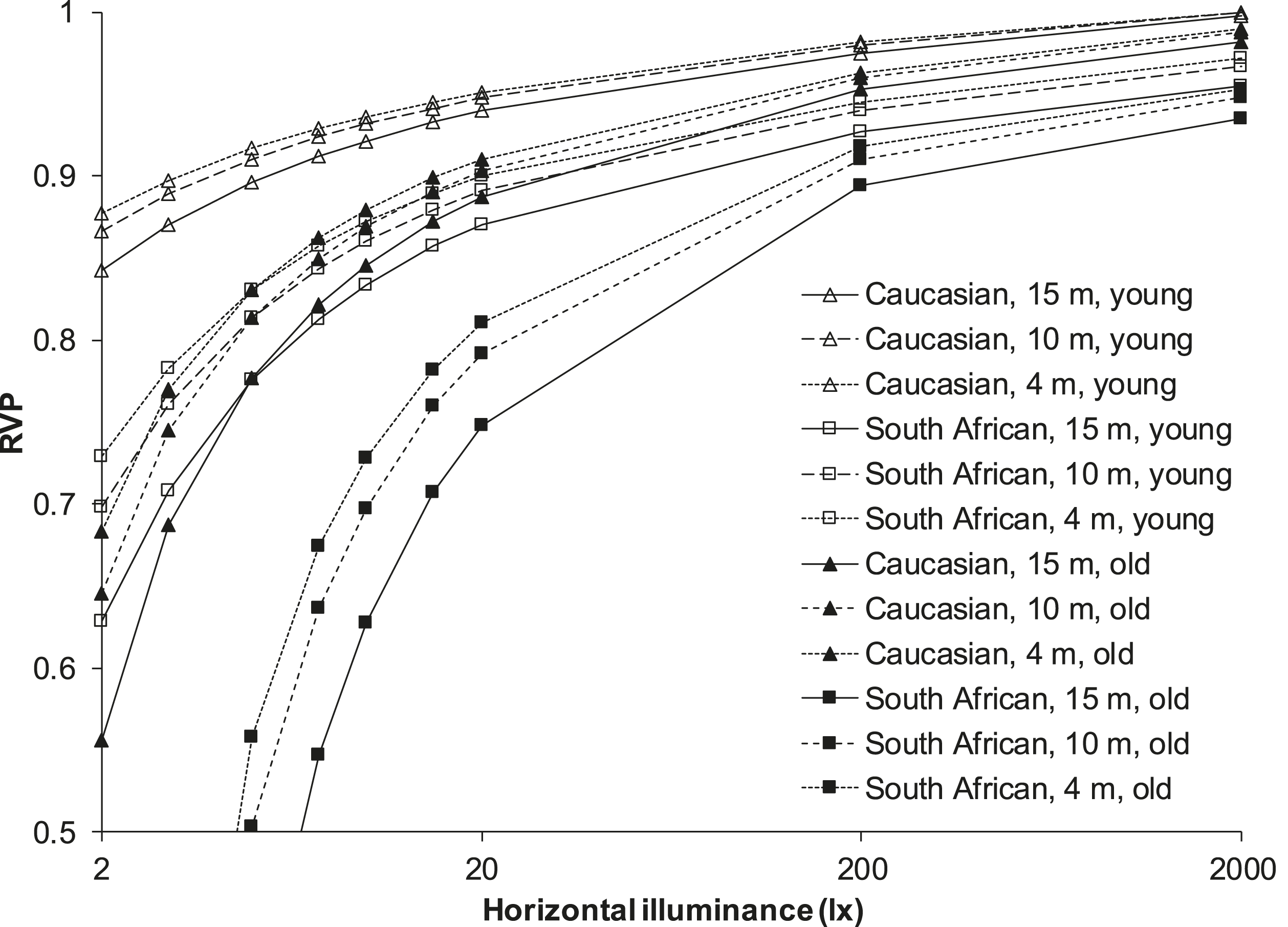
For both the Caucasian and South African faces, RVP is lower for the elderly observer than for the young observer. Compared with observation by a young person of a Caucasian face, the reductions in RVP associated with older age and darker skin tone are of similar magnitude. Or, in other words, for a given illuminance, RVP for observation of a Caucasian face by the elderly observer is similar to that for observation of a South African face by the young observer. As is therefore expected, the lowest RVP is that for observation of a South African face by an elderly observer.
Figure 3 illustrates the effect of changes in pavement surface reflectance. To demonstrate the extreme effects, this is plotted for Caucasian faces observed by a younger observer and South African faces observed by an older person, and in each case the comparison is shown for only the 10 m interpersonal distance. It can be seen that the change in pavement surface has a smaller effect on the easier visual situation (younger observer and Caucasian face) than on the more difficult visual situation (older observer and South African face). Relative visual performance plotted against horizontal illuminance for Caucasian faces observed by a young person (25 years) and South African faces observed by an older person (65 years), for pavement surface reflectances of 0.1, 0.2 and 0.3. In each case the interpersonal distance is 10 m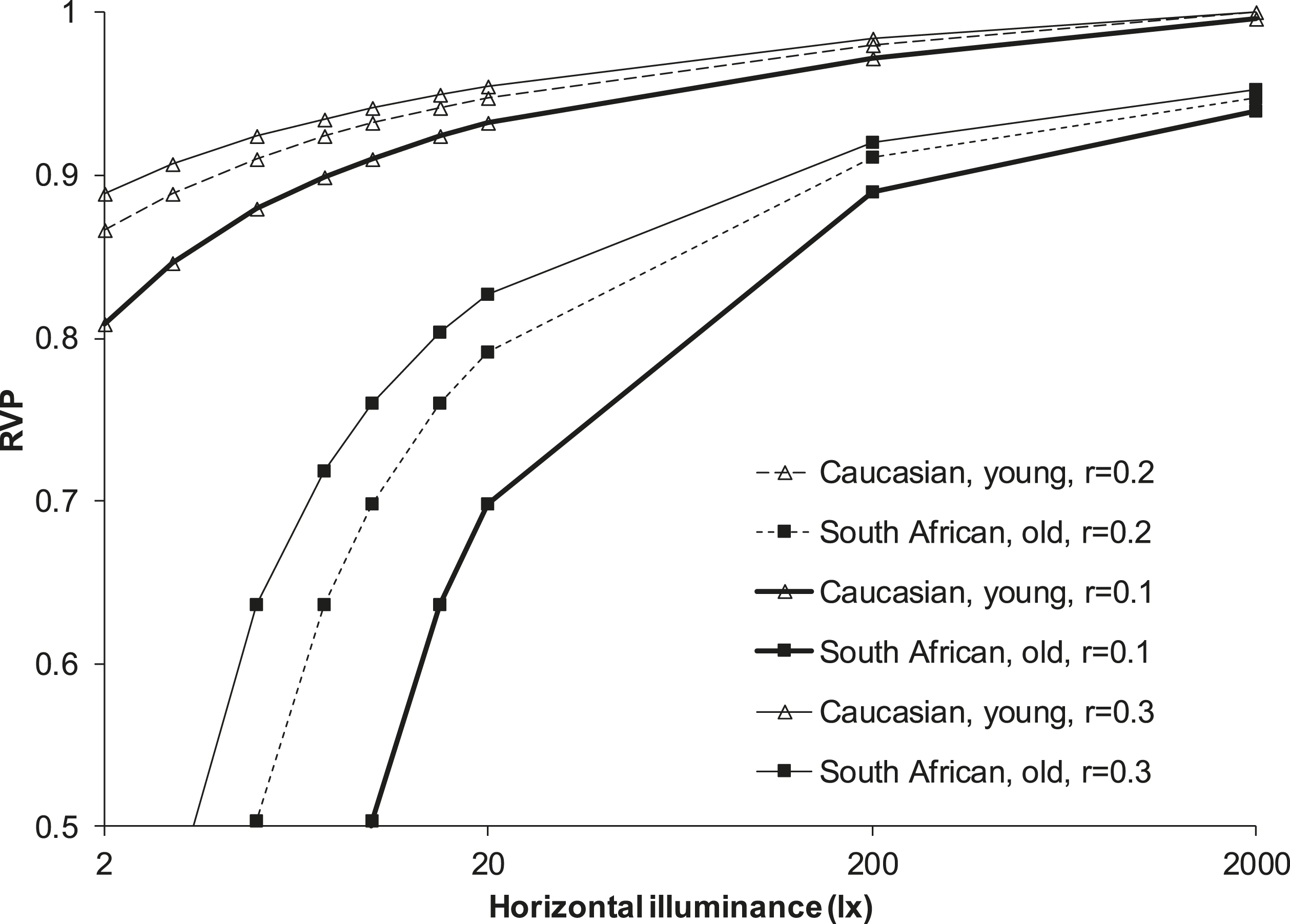
If facial evaluations were the only consideration for road lighting then there would be some benefit in increasing road surface reflectance. For the elderly observer of the South African face, the increase in pavement reflectance from 0.2 to 0.3 would permit a reduction in illuminance by approximately one step of the P-class (e.g. a reduction from 7.5 lx to 5 lx) for the same RVP. For the younger person observing a Caucasian face, the RVP remains above that for observation of the South African face by an older person regardless of the illuminance (within 2 to 20 lx) or pavement surface reflectance.
4. Discussion
Predictions of visual performance using the RVP model indicate that interpersonal evaluations made using the face as the information source are influenced by the age of the observer, skin tone of the observed person, pavement illuminance and pavement surface reflectance. Specifically, RVP decreases for older observers, for darker skin tones, for lower illuminances and lower pavement surface reflectances. The highest level of RVP is found for observation of a Caucasian face by a young person. In this situation, the effect of pavement surface reflectance is small. The lowest level of RVP is found for observation of a South African face by an elderly person, and here there are larger effects of pavement surface reflectance.
The next question is whether the data reveal an optimal light level. This would be the illuminance above which further increase in illuminance brings a diminishing increase in RVP, but below which further decrease leads to a more rapid reduction in RVP. To interpret the optimal illuminance Figure 4 shows RVP plotted against illuminance for the situations suggested above to be relatively easy, moderate and difficult. Relative visual performance plotted against horizontal illuminance for four combinations of observer age and observed skin tone. In each case the pavement surface reflectance is 0.2 and the interpersonal distance is 10 m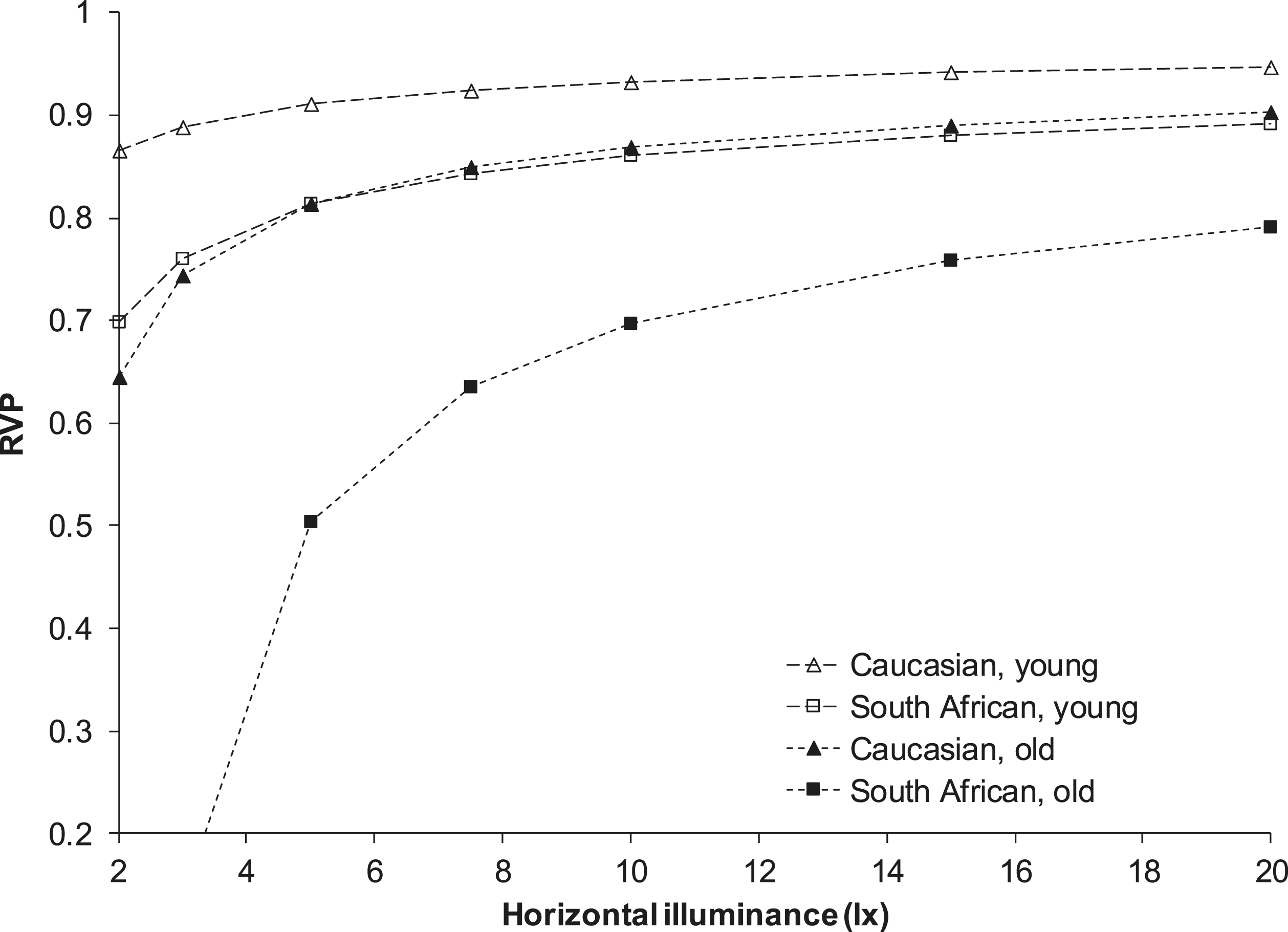
For young observers of a Caucasian face, the increase in RVP with illuminance is small: it could be argued that a horizontal illuminance of 2 lx (class P6) is sufficient and any further increase is of little further benefit. For an elderly person observing a Caucasian face, and also for a young person observing a South African face, then the optimal illuminance lies around 7.5 lx (class P3). However, for an elderly person observing a South African face, then the optimal illuminance is around 15 lx (class P1). Note that these are not suggested to be precise values, but are estimates by eye from Figure 4 to guide discussion and the design of further experimental work. There are alternative approaches to identifying the optimal illuminance which may prove to be more objective. One is segmented regression in which the illuminance data range would be broken into two or more segments and each segment characterised by separate linear functions. 42 A second approach would be to define a minimum rate of change of RVP per unit lux.
Consider next the illuminances suggested to be optimal or sufficient for other pedestrian tasks. CIE 236:2019 16 concluded from the then-available data that horizontal illuminances of 1.0 lx (minimum) and 4 lx (mean) are sufficient for obstacle detection and reassurance, respectively. Lighting class P3 (mean illuminance 7.5 lx, minimum illuminance 1.5 lx) 2 would therefore be sufficient for the suggested needs of obstacle detection and reassurance, and the needs of interpersonal evaluation other than observation by the elderly of South African faces.
Other studies report their findings using vertical illuminances. For example, Boyce and Rea 22 concluded that a vertical illuminance in the range 4–10 lx would usually ensure a high level of detection and recognition of intruders; data from Edwards and Gibbons 43 suggested a minimum vertical illuminance of 6 lx to support being seen by drivers. Note however two issues with considering these data. First, there is no general relationship between horizontal and vertical illuminances, as this depends on light source optics and the installation geometry. Second, these values exceed the highest vertical illuminance (5 lx) currently included in the P-class. 2
There are several limitations to this analysis. It was conducted using the facial contrasts of models representing Caucasian and South African faces, both being young females. This range, therefore, excluded skin tones identified as type I of the Fitzpatrick Scale, 40 labelled as ‘ivory’, and excluded variations in facial contrast between individuals such as that of gender (females tend to have higher facial contrast than males 39 ). However, resulting differences in RVP are expected to be small compared with those found when comparing Caucasian (type II) with South African (type VI). 40 For the two faces used in the current analysis, the average facial contrast of the Caucasian face (0.314) was higher than that of the South African face (0.138). Their mouths were closed: if instead the teeth were on display this would be a higher contrast for the South African face and may alter the average facial contrast.
As suggested informally by an author of previous work, 39 the current analysis was conducted using the average facial contrast of the eyes, eyebrows and mouth, and also for the size of the inner face rather than for the size and contrast of each facial feature individually. While this could be done, it would be beneficial to first better understand the relative importance of each feature for interpersonal evaluations. It may also be interesting to consider the facial feature having the least contrast with its surround rather than the average contrast of all three features.
The RVP model was established using tasks designed to focus on the visual component of task performance, such as numerical verification and detection of simple targets,34,35 and performance of these tasks was a participant’s sole focus during trials. Facial evaluations, whether of identity or emotion, demand a greater degree of cognitive attention 44 and, furthermore, when carried out in natural situations performance may be impaired by distraction 45 or by multi-tasking 46 ; these are likely to reduce the level of visual performance and reduce the impact of changes in those variables which directly affect vision. Further work is required to investigate their significance.
The current analysis did not account for variations in the spatial distribution of light. As a pedestrian walks from one lamp post to another the shadows on their face will change, and hence also the contrast between facial features, and also whether the pedestrian is essentially front lit or back lit. Similarly, the current analysis did not consider differences in lamp optics nor the height and spacing of light sources. Undoubtedly, these variations matter, and could be included within a more extensive analysis. We suggest two approaches for doing so. First, to consider extreme variations of these parameters to better understand their relative importance. Second, to identify typical situations, and use those to estimate the optimal illuminance that would be sufficient for typical situations.
Clearly, one question to consider is whether horizontal illuminance should be increased from about 7.5 lx, which appears to be sufficient for young observers, to about 15 lx, which improves the ability of elderly people to evaluate South African faces. Proposals for an increase in light levels must of course give consideration to the costs and consequences of road lighting, such as the energy cost, the contribution to sky glow, and the potential for detrimental impact on the natural environment. An increase in illuminance brings the risk of greater disability from glare which is of increasing detriment as the eye ages 47 and may counter the benefit to the elderly of higher illuminance. Note further when discussing illuminances that we have assumed here that the adaptation luminance required by RVP is suitably estimated from road surface luminance. 37 This might be a reasonable estimate for the pedestrian walking along a residential road with few sources of bright light other than the road lighting, and in particular when travel gaze 48 means they are looking predominantly towards the footpath. In situations such as roads lined by shops where there are further sources of bright light, and where the pedestrian tends to look around rather than towards the road surface, then road surface luminance may underestimate their adaptation level. For such cases, RVP associated with different levels of adaptation can be interpolated from Figures 1–3. It may also be interesting to consider alternative approaches to estimating adaptation luminance such as that for drivers approaching a road tunnel. 49
In this work, we used RVP to predict the impact of various parameters on visual performance when carrying out a specific type of visual task. To verify these predictions they should next be tested by experiment: Fotios and Johansson 12 offer some guidance as to how such an experiment might be designed.
5. Conclusion
The model of RVP was used to predict performance of a face-based interpersonal evaluation that might be carried out by a pedestrian. The results show that such an evaluation is affected by adaptation luminance, pavement surface reflectance, observer age, and skin tone of the observed person.
For a young observer to evaluate a face of either Caucasian or South African skin tone, or for an elderly observer to evaluate a face of Caucasian skin tone, then a road surface illuminance of about 7.5 lx is suggested to be optimal. However, this would need to be increased to 15 lx to reach an optimal level for the elderly person to evaluate a face of South African skin tone. The decision to make such an increase would need to consider the needs of inclusive design and unwanted consequences such as increases in sky glow, energy consumption and impact on the natural environment.
Footnotes
Declaration of conflicting interests
The authors declared no potential conflicts of interest with respect to the research, authorship, and/or publication of this article.
Funding
The authors received no financial support for the research, authorship, and/or publication of this article.
