




Abstract
Electric light in buildings may provide some health benefits; however, for most people these benefits are likely to be small. It is possible for electric lighting to cause health problems, if there is too little light or there is glare, but for the most part there is good guidance available and these problems can be avoided. The quality of the lit environment can have a psychological impact and this may in turn impact well-being. A starting point for this is perceived adequacy of illumination. Related lighting metrics are examined and a hypothetical explanation is suggested.
1. Introduction
To provide the electric lighting necessary to support human health, we must first understand what aspects of health we can support and what sort of level of proof is necessary before a health claim can be made. The two main ways of collecting evidence for a health benefit are double blind trials and large epidemiological studies. In the area of lighting, both these methods are difficult and have yet to be used, so it is going to be very hard to claim a health benefit for lighting in a rigorous way. However, we all know that good lighting in a room can make you feel better, but this is a feeling and so this should be considered to be an improvement in well-being rather than a direct health benefit.
Looking at the problem the other way round, we know that bad lighting can cause problems. This may be due to fact that insufficient light is provided for a given task and this results in eyestrain. It is also possible for inappropriate lighting to cause glare. Many of the problems associated with lighting and glare are hard to predict as people have very different thresholds for glare. Bargary et al. 1 exploited these different glare thresholds to investigate the way the brain process glare and found that there were neurological differences between people who were more susceptible to glare and those who were less susceptible. This neurological diversity makes things more complex as it is possible that no single lighting installation can solve all of the problems for the population that uses it. To make matter more complex still it has been argued by Wilkins 2 that aspects of the spatial configuration of modern built environments and the light sources they contain may require more complex visual processing and thus lead to problems such as migraine in some people. Fortunately, the lighting community has been considering the problems of visual performance and glare for the best part of 100 years, and while the understanding of the issues is not complete, there is guidance available that if followed will stop most of the possible problems in this area.
There are two possible routes by which a lit environment can improve people’s well-being. The first way is that light may cause physiological changes to a person, perhaps changing hormone levels or adjusting the body clock. The other route to improve wellbeing is via a psychological impact: if a room is adequately illuminated then people are likely to prefer the environment and thus be happier. These two different impacts have both been researched over a number of years, by people with very different scientific backgrounds; however, the nature of all of the processes involved is not well understood particularly for the psychological approach. It is also possible that both physiological and psychological impacts have a common route cause.
1.1 Physiological impact
In terms of lighting practice, a good starting point when considering the possible impact of light is the soon to be published ISO/DTR 21783 3 ; it discusses the potential benefits and hazards associated with light. The document is being developed by a joint working group of International Standards Organization (ISO) and Commission Internationale de l’Eclairage (CIE) (ISO/TC 274/JWG 4) with the topic of ‘Integrative Lighting’. The benefits and hazards are categorised according to how much evidence there is to support them, the categories used are well-established, moderate evidence and insufficient evidence.
In the category of well-established hazards, the ISO document suggests that light levels should be kept below the limits published by the International Commission on Non-Ionizing Radiation Protection (ICNIRP). 4 It also suggests that many aspects of night work and the associated lighting can cause disruption to sleep and could be a factor in other health problems.
In the category of well-established benefits, the standard suggests that a strong daily-light/dark pattern can synchronise and support the human circadian system. In the moderate evidence category, it suggests that light has a role in sleep quality and hence performance on subsequent days. Is also suggests that lighting, in some circumstances, can increase cognitive performance and reduce sleepiness. Finally it suggests that lighting might benefit some individuals with medical conditions such as dementia.
The ISO standard gives limited further information on each of the possible benefits and hazards associated with light and references other sources of further information. What it does not do is provide recommendations for lighting strategies that can provide a given benefit. This implies that the working group (ISO/TC 274/JWG 4) developing the document were unable to arrive at a consensus as to what lighting conditions are likely to deliver any of the possible benefits.
Given that the ISO working group is formed of experts in this area, the failure to find an agreed set of recommendations is a strong indication that there is not sufficient evidence from repeated lighting trials or working practice that well-being benefits from lighting can be created by a particular set of lighting conditions. There are two possible explanations for this, either that the benefits cannot be created in a reproducible way or that there has not been enough research carried out to demonstrate that the benefits can be generated in a reliable way. Given that there has been a reasonable amount of research in area, the ISO document has 63 references, and that represents a small fraction of the literature, then it must be assumed that either the impact of light is small, or that there is a fundamental misunderstanding in the way light has been characterised in the research so far.
Given that at this stage there is still some uncertainty in the lighting necessary to deliver a physiological benefit, it is not possible to make any useful recommendations for electric lighting. In a well-designed building that meets the minimum requirement for daylight in EN 17037 5 less than half of the light is likely to come from electric sources and many people will also receive a significant dose of light during time they spend outside the building. Thus, in the midst of the uncertainty in what lighting to provide to maximise user benefit, it is clear that as things are at present the role of electric lighting is small.
1.2 Psychological impact
There has been a lot of research into the psychological impact of lighting and people’s preference for lighting. Flynn et al., 6 Loe et al. 7 and Veitch et al. 8 together with many other researchers have looked into this area. While this area of research has generated a series of interesting insights into what people like, it has not generated a reliable recipe for lighting that people will like and enjoy.
An alternative approach has come implicitly from Cuttle. 9 He has developed the concept of perceived adequacy of illumination (PAI); this is a much lower target to aim for than providing lighting that people will like and enjoy. However, Cuttle suggested a metric, mean room surface exitance (MRSE) that was claimed to correlate with PAI. The relationship between PAI and MRSE has since been tested. Duff et al. 10 tested MRSE against user perception of illumination adequacy in simple 6-plane rooms lit with electric lighting, and confirmed that MRSE was a good predictor of PAI. Guan 11 investigated the role of daylight in establishing PAI. However, in his studies he found problems in finding meaningful values of MRSE in complex and large spaces. This problem was solved by Raynham et al. 12 who developed a new metric, mean indirect cubic illuminance (MICI). It has been shown that MRSE is equal to average MICI in 6-plane rooms so it is convenient to assume that MICI and MRSE are similarly related to PAI. Guan 11 compared MICI to perceptions of daylight adequacy in actual buildings and in a controlled experiment, and his finding was that there is a strong correlation between MICI and PAI.
As well the work deriving from Cuttle’s ideas other research has found the importance of ambient light. For example, Goven et al. 13 reported on the importance of wall illuminance in schools. So there is converging evidence that indirect light is important to our perception of space. Moreover, it seems that that this perception of ambient light in the environment is absolute, for example in Duff’s and Guan’s experiments there is no order bias and in Guan's experiment people seem to respond according to the light available at the time of response, even if light available had previously changed.
The ambient illumination of a space seems to provide important cues about the adequacy of illumination. Thus, applying a metric that requires a certain amount of ambient light could ensure that room was not perceived as too dark or gloomy. This is not going to ensure that lighting will make people happy, but at least it may stop cases where the room would depress people.
It is clear from the research that the absolute amount of ambient light is very highly correlated to the subjective impression of a space, this leads to the very obvious question, why?
2. The role of retinal illuminance
The retina is the key element in our eyes that absorbs the electromagnetic radiation falling onto it and generates signals that are sent to the brain. It is normal to think about the stimulus reaching the retina in terms of retinal illuminance. Retinal illuminance is defined 14 as the product of the luminance in a specified direction and the apparent area of the pupil (natural or artificial) seen from that direction and it has the unit of Trolands. It is also necessary to consider how the retina responds to this stimulus.
The response of the retina in many situations appears to be a function of the logarithm of the incident radiation. This has been shown by a number of researchers starting with Hecht et al. 15 and while there is a lot more complexity in anything associated with perception this logarithmic response may be a good starting point for developing ideas about illumination adequacy. So we have a situation where retinal response may be proportional to the logarithm of retinal illuminance and we need to sum the total response across the whole retina.
It is possible to speculate that the perception of illuminance adequacy should be in some way correlated to the sum of the retinal response to light. For a given pupil size then the retinal illuminance is proportional to the luminance of a part of the field of view. So if we could consider the visual field to be made up of a series of patches of size Ω sr and of luminance L cdm−2, given the possible role of retinal illuminance then it is possible to propose that the net response from the whole retina R is likely to be given by equation (1)

There are good arguments against equation (1). Firstly, pupil size may change with changing average luminance and so retinal illuminance does not directly follow luminance. Working out the expected pupil size is complex, and therefore Watson and Yellot
16
present the work of several researchers in the area and the results are summarised in Figure 1. Pupil diameter variation with luminance for a field diameter of 60° and an observer age of 30 years. The dashed line is the unified formula for pupil size proposed by Watson and Yellotl.
16
The shaded area covers the range of pupil diameters given by other formulae (taken from Figure 16 of Watson and Yellot
16
)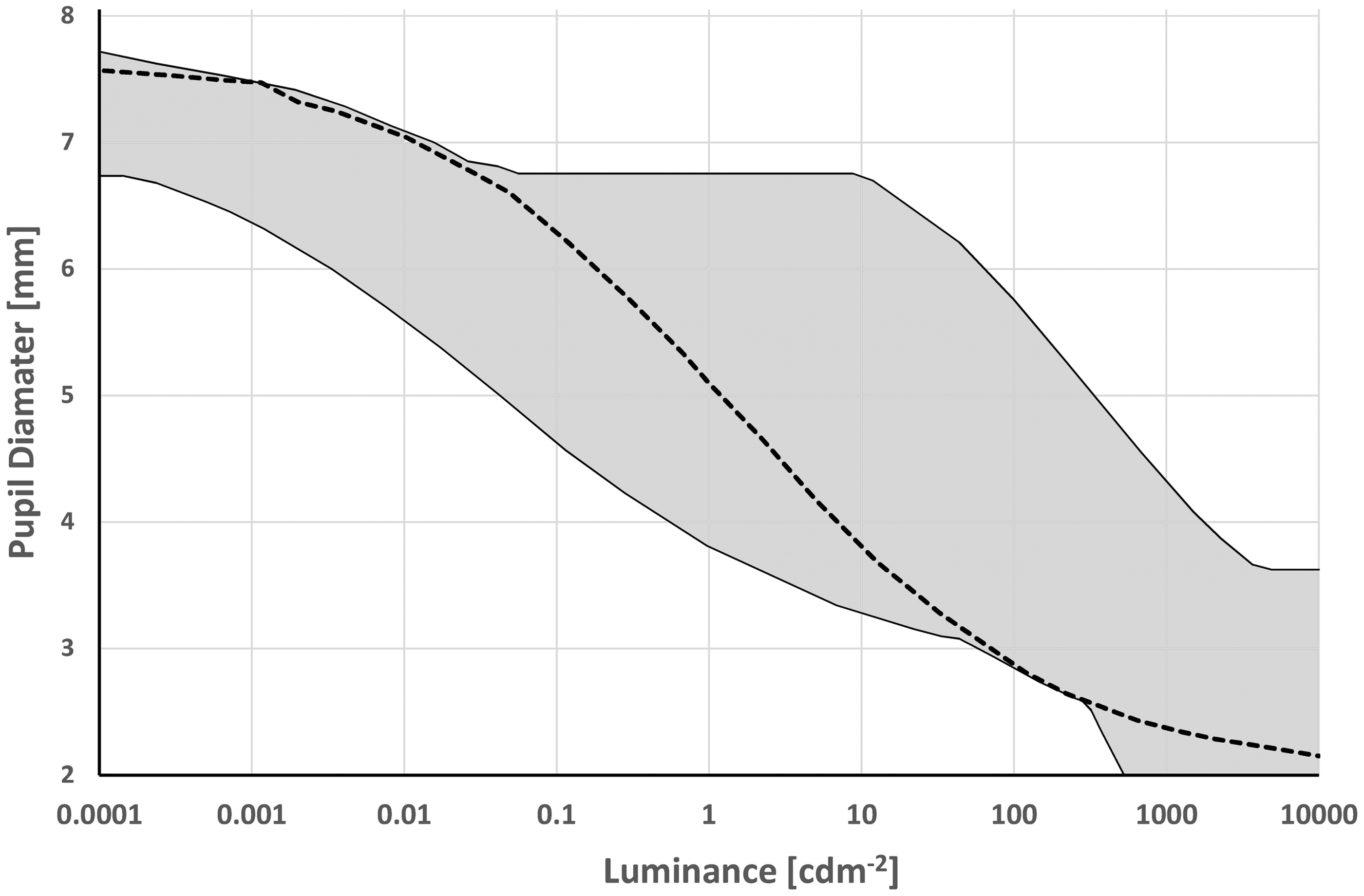
For perception of indoor illuminance, the concern is for luminances in the range 10 to 100 cdm−2. Using the proposed unified formula for pupil size suggests pupil diameters of 3.8 mm at 10 cdm−2 and 2.9 mm at 100 cdm−2. This change in pupil size suggests that the retinal illuminances will range from 113 to 660 T.
The other problem with equation (1) is that it does not consider the cosine of the angle between the point of regard and the luminous patches. It may make sense to consider the cosine here if the observer has a fixed point of view; however, if someone is spending some time in a room then they are likely to look around and so some form of averaging is likely to take place. However, it is quite possible that some form of spatial bias does occur, for example people do not look at the ceiling as much as they look at walls.
So it is clear that equation (1) is not correct in detail; however, it may be a useful starting point in understanding why ambient light drives the perception of illuminance adequacy. It is also important to point out that the formula proposed is very different in nature to the existing concepts of MRSE and MICI which are supported by experimental evidence; however, in the next section a thought experiment is carried out to explore the relationship between the results of formula 1 and MRSE.
3. A thought experiment
To examine the consequences of applying equation (1) consider what happens in a simple room that is lit by a single source as illustrated by Figure 2. The room is a 3-m cube and it is possible to adjust the reflectance of the room surfaces. In the centre of the room is a light source, the room and light source can be seen by a person standing in the centre of one of the walls, they have an eye height of 1.5 m. The source has a diameter of 52 mm and thus subtends an angle of 2° at the observer’s eye. To show more clearly the impact of the proposed formula, the output of the source is adjusted so that the total illuminance at the observer’s eye is always 500 lux. In the calculations it was assumed that the illuminance on the room surfaces was uniform. The results of the calculations are given in Table 1. Room for the thought experiment, A is the light source and B is the location of the observer’s eye Results of calculations of source luminous flux, mean room surface exitance (MRSE) and retinal response (ΣΩLog(L)) for a constant 500 lx at the observer’s eye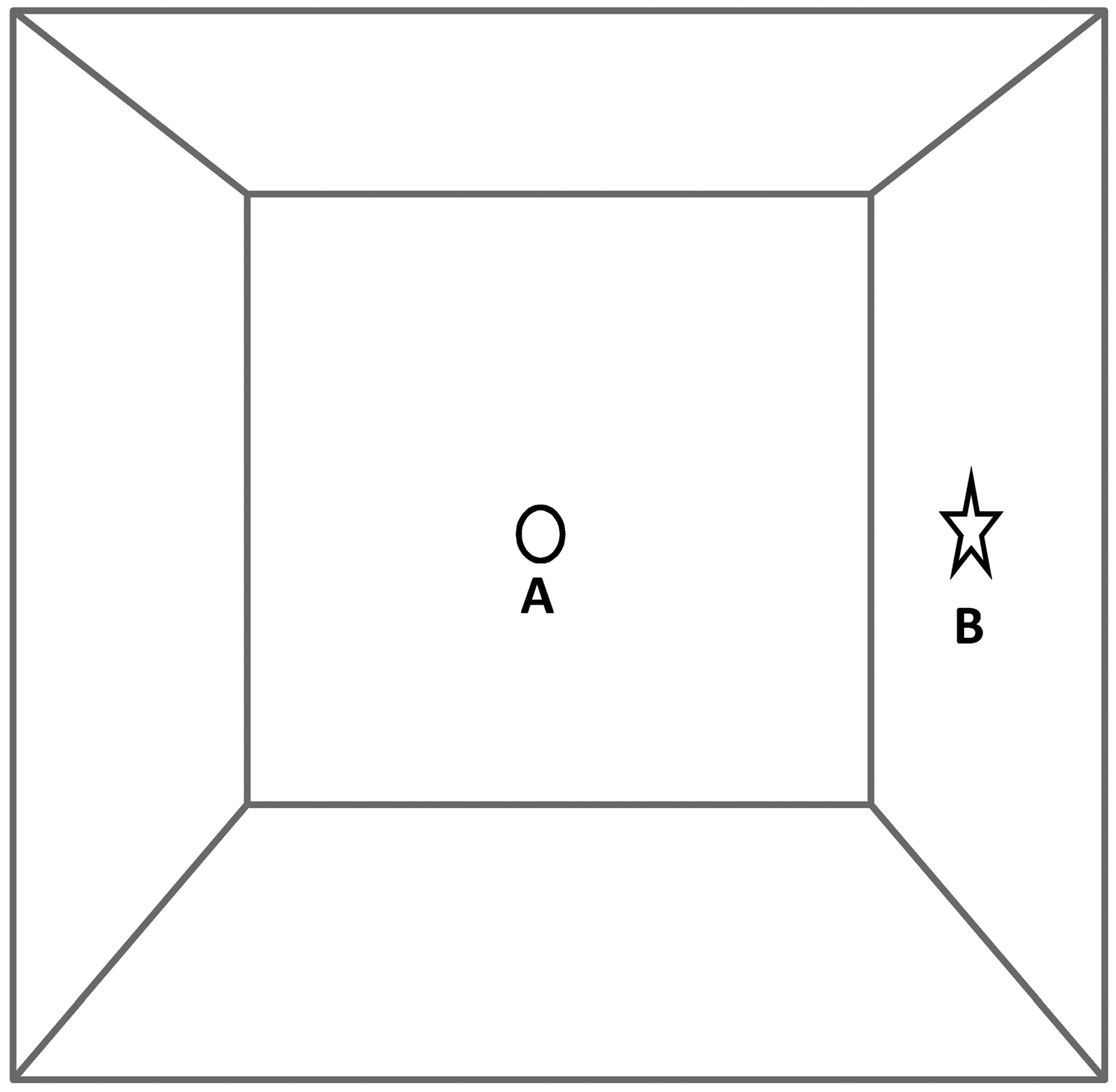
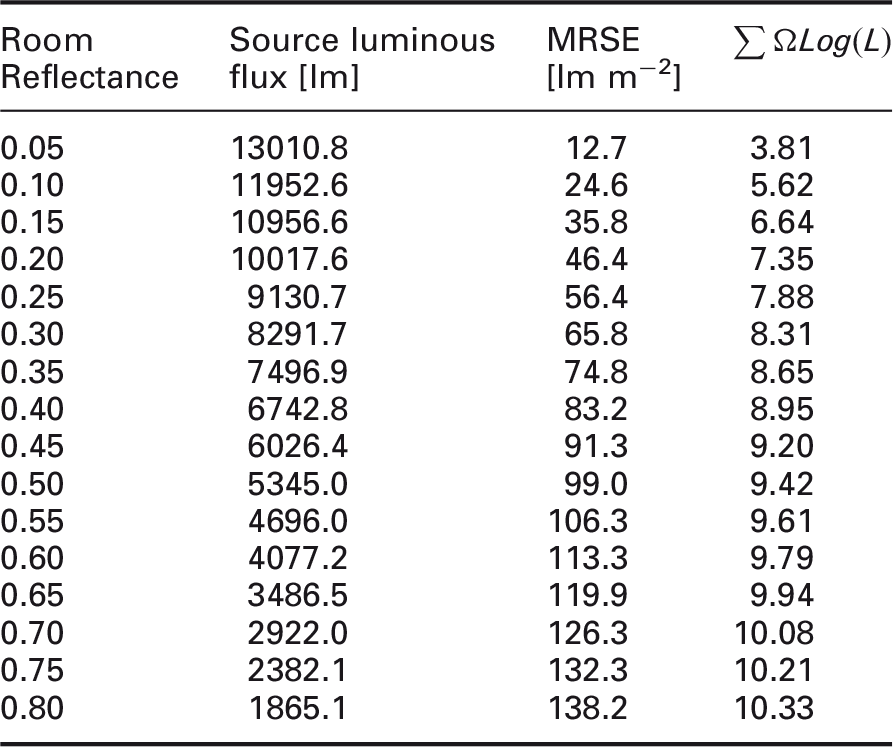
The results show some obvious things, such as the required luminous flux drops as the room reflectance increases; also the proposed equation (1) metric appears to get larger as the MRSE increases. Looking at the original calculations, it was clear that the direct light from the source to the eye had very little impact on the proposed new metric, and this is demonstrated by Figure 3, which shows the correlation of the new metric with the logarithm of MRSE. Plot of log mean room surface exitance (MRSE) versus retinal response (Σ Ω Log(L))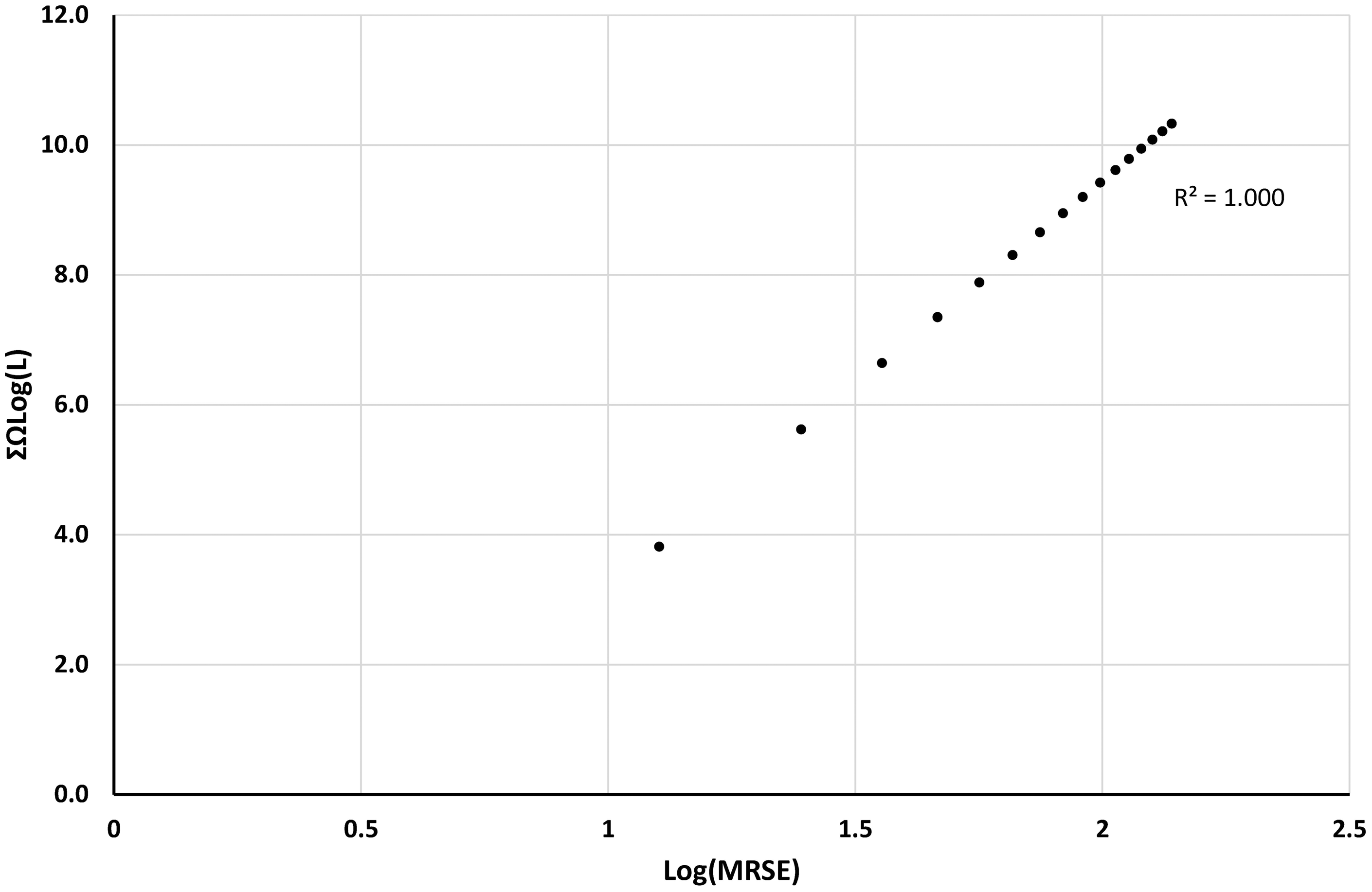
4. Discussion
The idea that a simple metric such as MRSE correlates very strongly with perception of adequacy of illumination is at first sight quite amazing; nevertheless, Guan’s data 11 found correlations in excess of 0.7 and p values below 10−9. Guan’s findings are similar to those of Duff et al. 10 One way of explaining this relationship is by assuming that the response is somehow driven by a logarithmic response to the luminance in the field of view. The other surprising point is the response seems to be absolute. This absolute nature of the response is complex as relative responses to light also happen; this can be seen in buildings where the lighting has been manipulated by the architect to give the impression of a light space when you enter. This approach was employed by Basil Spence 17 in the Swiss Cottage Library and other buildings, where the entrance to the building is through a relatively dark space with low ceiling height and you progress to a lighter part of the building with increased ceiling height. On entry the feeling is of how light the space is. However, after about 15 minutes in the space people’s perceptions change, there is a tendency to assess the space differently.
The use of the proposed formula may provide a reliable way to assess likely PAI. One of the problems encountered by Guan 11 was resolving what was direct and what was indirect light. When considering daylight it is hard to draw the line, for example which of the following sources of light should be included in the indirect component, the sky apart from the sun, external ground and buildings, the surfaces of a light well or the surfaces of an atrium.
Given that the formulation of equation (1) is a simple reflection of the way retina responds to irradiance at its surface, then it is possible to make the suggestion that a similar response may happen when considering radiation that leads to circadian entrainment. The use of corneal irradiance (radiation density received at the front of the eye) to predict the extent of any non-image forming effect of light is often used as simple way to describe the impact of radiation on people. However, there is no direct experimental evidence to support the concept and the idea has already been questioned by Broszio et al. 18 The ideas developed in this paper may call the use of corneal irradiance further into question as logically the arguments put forward in this paper could equally apply when discussing circadian entrainment.
5. Conclusion
Providing light in a building to promote the well-being of its users is an important objective in any lighting design. Where possible in a well-designed building, natural light should provide most of the illumination. Thus, electric lighting only has a role in promoting well-being in areas that do not have sufficient daylight or when buildings are being used at night.
To promote well-being, the lighting should at least do no harm. There should be no hazardous optical radiation, and the lighting should make visual tasks easy by ensuring sufficient light and freedom from problems associated with glare. Moreover, the building should be judged to be adequately illuminated. It is possible that in some buildings, in some circumstances, the electric lighting may contribute to things like circadian entrainment, but this is likely to be only when the people under the lighting have reduced access to daylight for some reason.
In studying the perception of adequacy of illumination, it has become clear that ambient illumination is important and metrics such as MRSE have been shown to be strongly correlated with PAI. This relationship between PAI and MRSE can be used as a first justification for a hypothesis that links the judgement of illumination to the logarithm of retinal illuminance.
