



Abstract
While UK governments have recently sought to increase cycling activity, it remains a minority interest. One reason for this is the perceived danger of cycling on roads filled with traffic. There is statistical evidence to support this perception; for equal exposure, cyclists are more likely to be seriously injured than either drivers or pedestrians. Lighting has a role to play in reducing the hazards of cycling by enhancing the visibility and conspicuity of cyclists. Unfortunately, it is not at all clear that the current lighting regulations and recommendations for cycling and cyclists are the best that can be achieved or are even adequate for these purposes. A number of actions are suggested that should enable lighting’s contribution to the safety of cyclists to be realized.
1. Cycling in the UK
If you believe the publicity, over the last decade cycling has become much more popular in the UK. However, statistics from the 2013 road traffic survey 1 suggest that this is an overstatement. Cycling is still very much a minority activity. The percentage of people in the 2013 survey who cycled less than once a year is 65%. At the other extreme, the percentage who cycle three or more times a week is 8%. This percentage of regular cycle users has been stable since 2003. Where there has been a slight change since 2003 is in the percentage who cycle occasionally; the number who cycle once or twice a week has increased from 6% to 8% and those who cycle less than once a week but more than once or twice a month has increased from 3% to 5%. Where a more dramatic change has occurred is in the number of miles covered by those who do cycle. From 2003 to 2012, this has increased from 39 to 55 miles per person per year. 2
Clearly, there has been an increase in activity among cycling enthusiasts, so it is worth considering why this has occurred. One reason is that cycling has been actively promoted by UK governments as an alternative to driving as a means of improving public health through increased physical activity as well as having consequential benefits in terms of reduced road congestion, lower emissions from vehicles and less fuel use. In 2005, the cycling towns programme was launched with the aim of increasing the number of everyday cycling trips. 3 The scheme saw an increase in cycling over three years of 27%, averaged across the demonstration towns, showing that specific and targeted measures can increase cycling. In 2014, the UK Government announced an additional £214 million investment in cycling, £114 m being allocated for eight cycling cities and £100 m for improvement of the strategic road network, this within an overall investment in cycling by the UK government of £700 million. 4 This investment, the associated development of cycle tracks and lanes and the surrounding publicity has brought some return. In London, the number of people who cycle to work has doubled between 2001 and 2011. In Brighton, the number cycling to work has increased by 109% over the same period. In Bristol, the increase was 94%, in Manchester it was 83%, in Newcastle 81% and in Sheffield 80%. Unfortunately, such increases have not occurred everywhere. In 202 out of 348 local authorities in England and Wales, the number of working residents cycling to work declined between 2001 and 2011.
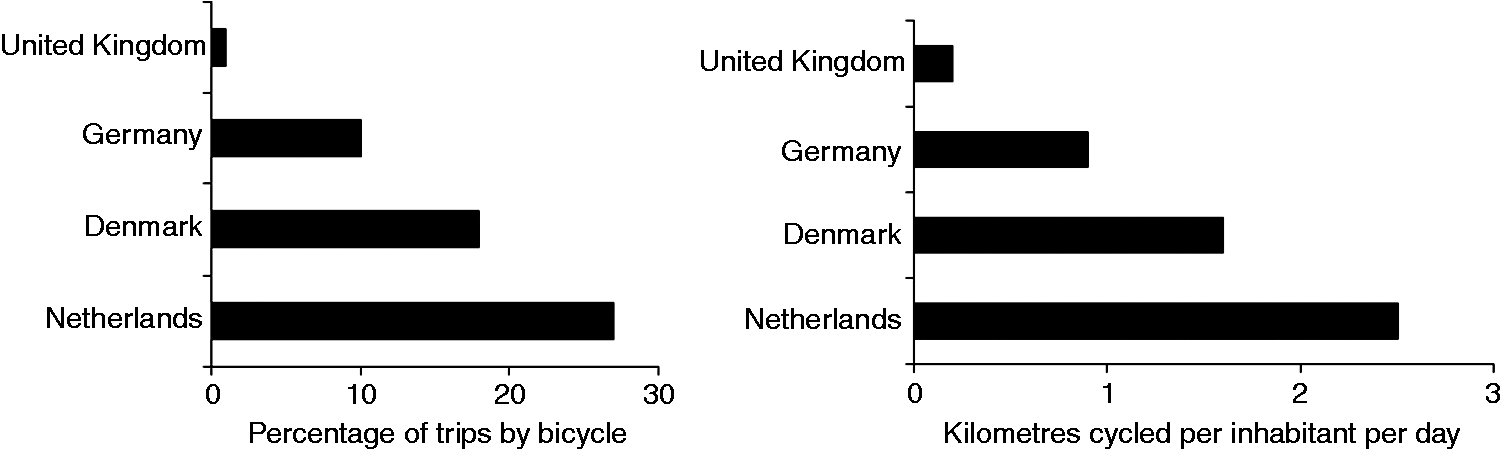
The frequency of cycling in the UK lags a long way behind other European countries such as the Netherlands, Germany and Denmark.
5
Figure 1 shows the percentage of trips made by bicycle in four European countries and the number of kilometres cycled per day per inhabitant in the same countries.
Cycling behaviour in four European countries. (left) Percentage of trips made by bicycle; (right) kilometres cycled per day per inhabitant
5
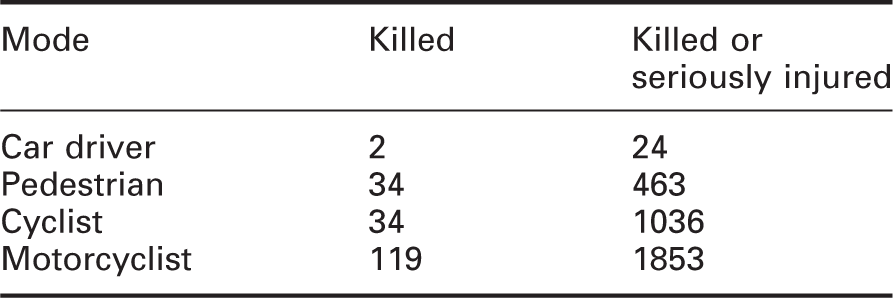
Number of cyclists killed, seriously injured and slightly injured in the UK from 2005 to 2013 7

Casualty rate per billion vehicle miles in the United Kingdom in 2013 7
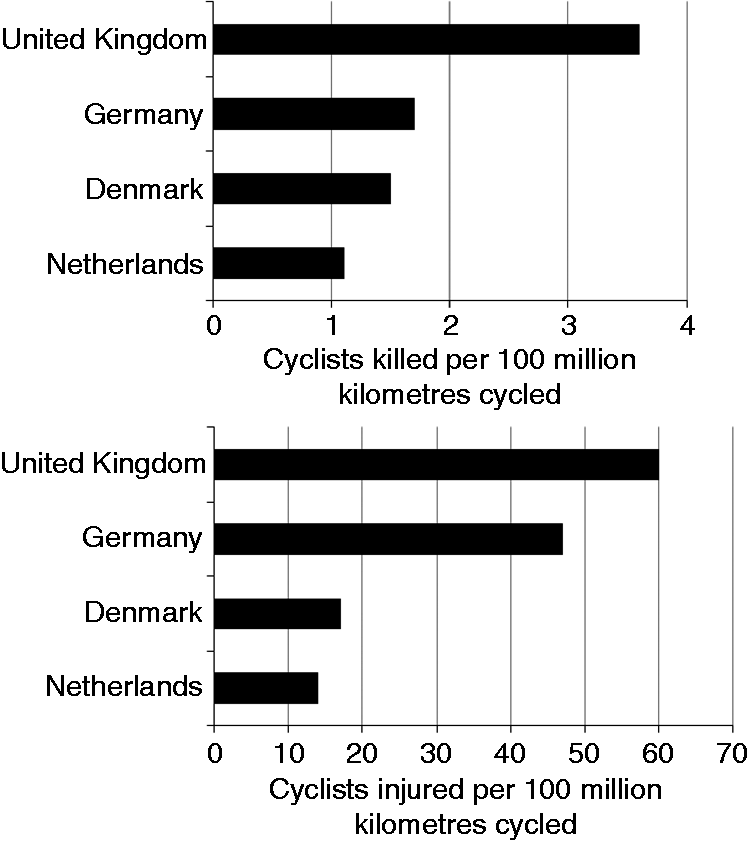
International comparisons also support the view that the perception of how safe cycling is impacts the use of cycling as a regular means of transport. Figure 2 shows the number of fatalities and injuries per 100 million kilometres cycled for the UK compared with the Netherlands, Germany and Denmark for 2007. Of the four countries considered, you are more at risk of being killed or injured on a bicycle on UK roads than in the other three countries where bicycle use is more common.
Fatalities (top) and injuries (bottom) per 100 million kilometres cycled in four European countries
5
There are a number of plausible reasons for this. 5 First and foremost is the fact that in German, Dutch and Danish cities, there has been deliberate policy over several decades to provide separate cycling facilities in the form of cycle paths and dedicated cycle lanes, particularly where traffic density is high and at junctions. This has been supported by extensive traffic calming measures in residential areas, by careful integration with public transport and by making driving in the centre of cities slow, expensive and inconvenient. These measures can all be assumed to have a beneficial effect on cyclist’s safety by reducing the competition for road space between cyclists and drivers and, where competition does occur, by reducing impact speeds. But one aspect of cyclist’s safety that has not been considered is lighting, both lighting to see by and lighting to be seen by. This review is concerned with the role of both forms of lighting in the safety of cyclists by day and night.
2. Lighting and cyclist fatalities and injuries
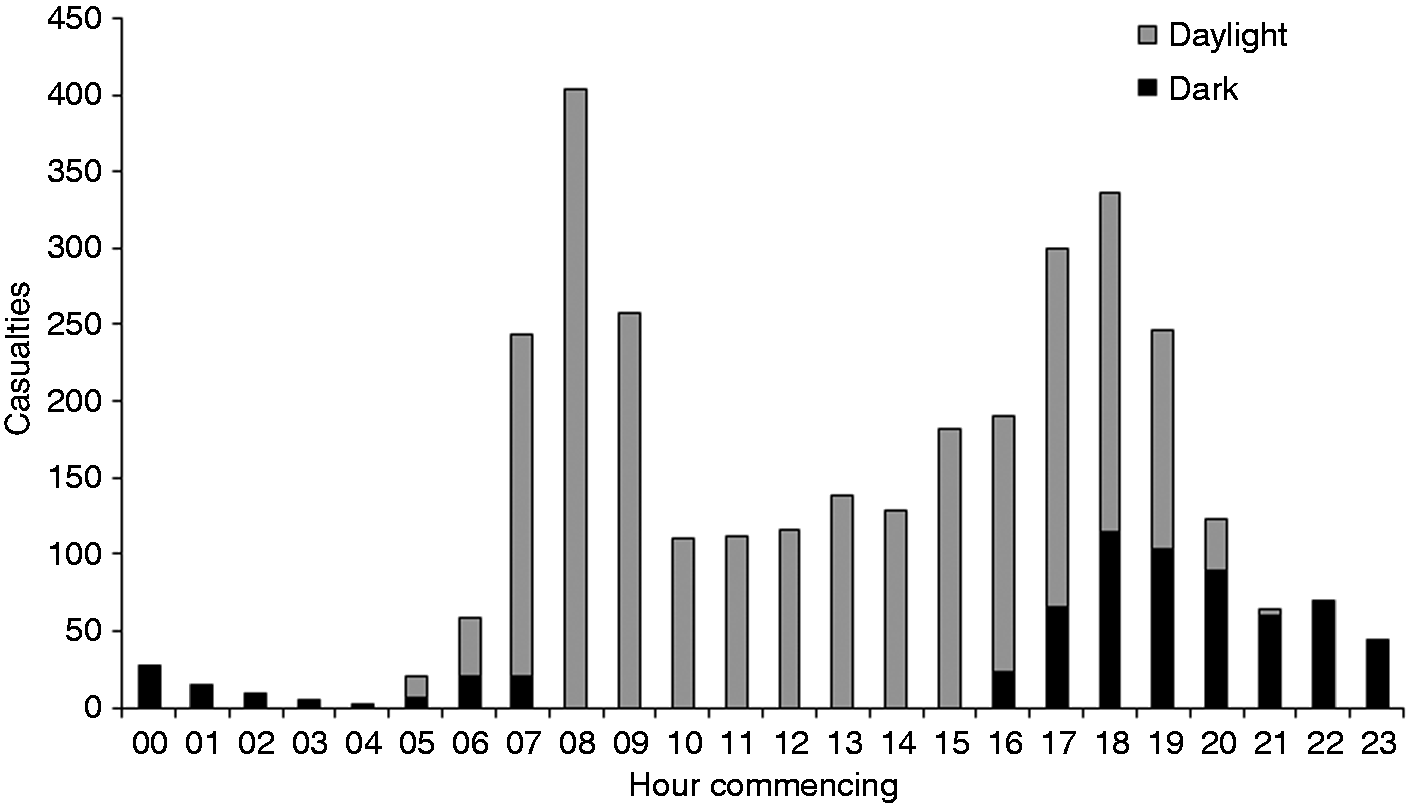
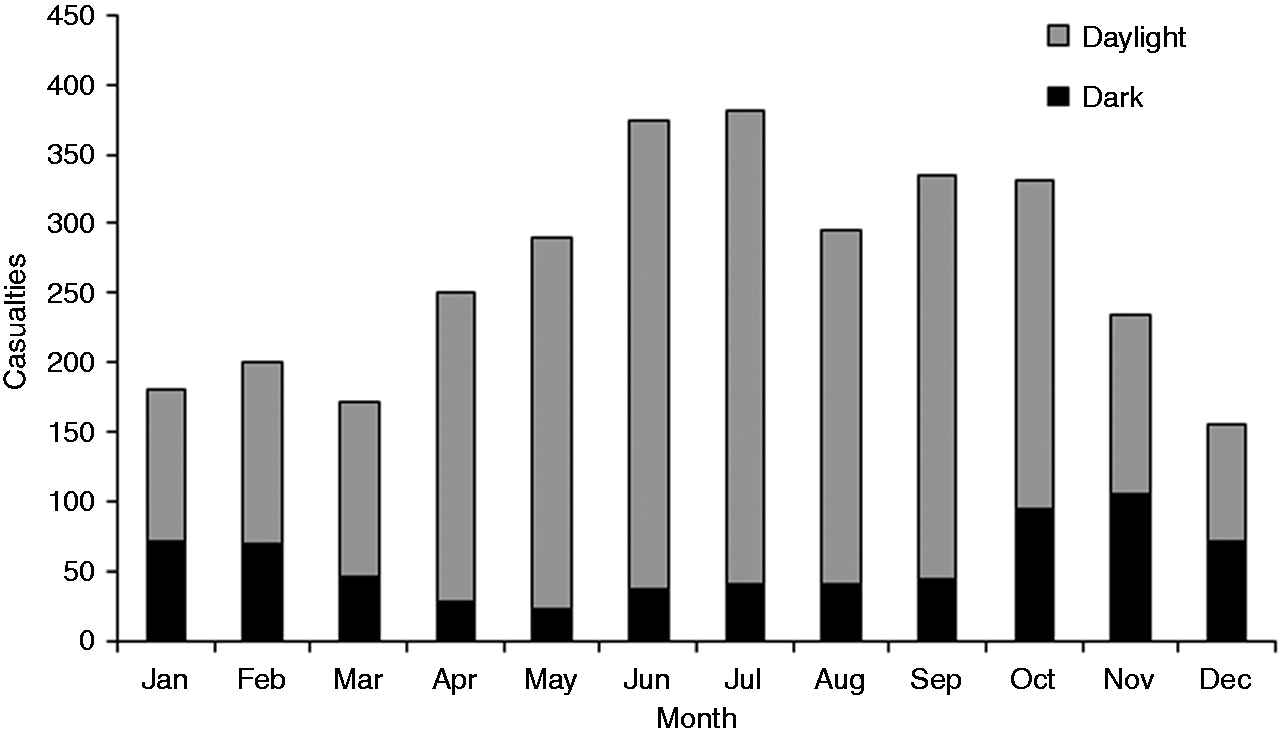
The involvement of lighting in cyclist casualties can be considered along several different dimensions. One is whether the accidents happen by day or night. Figure 3 shows data from Greater London in 2008 by the hour and Figure 4 shows similar data by the month.
8
From Figure 3, it is clear that the majority of casualties occur during daylight, but there is still a significant minority that occur after dark. From Figure 4, it is clear that as the number of hours of daylight reduce, the number of casualties occurring after dark increases. These patterns are related in that they are consistent with the times at which traffic densities are likely to be at a maximum, during the morning and evening rush hours, and for the months in which these rush hours occur in darkness. Interestingly, a similar pattern is also evident in a study of the number of pedestrian fatalities and serious injuries occurring in the four weeks before and after the change from daylight saving time when the clocks go back.
9
On average for the years 2000–2007, there were 10% more collisions killing or injuring a pedestrian in the four weeks following the clocks going back than in the four weeks before the clocks changed.
Cyclist casualties by time of day and light condition in Greater London, 2008
8
Cyclist casualties by month and light condition in Greater London, 2008
8
Of course, these data are from Greater London where road lighting is ubiquitous. Another dimension on which the role of lighting can be considered is between urban and rural roads. Urban roads will usually be lit; rural roads will not. The majority of cyclist casualties occur on urban roads (60%). This should not be surprising, given that 68% of bicycle traffic is on urban roads. 10 However, rural roads have a higher accident rate than urban roads for equal exposure (7.3 vs. 2.6 fatalities per billion vehicle miles), although it is suggested that under-reporting of less serious accidents in urban areas may also contribute to this difference. 7 Further, higher driving speeds on rural roads are likely to result in more serious injuries to cyclists. Interestingly, the most common cause of death or serious injury to cyclists on rural roads at night is being rear ended by a motor vehicle. 11 In this situation, the driver will be relying on his vehicle headlights to make whatever is ahead visible. Unfortunately, studies have shown that driving at more than about 30 mph on low beam headlamps on an unlit road is largely an act of faith based on the belief that there is nothing occupying the road ahead. 12 This all suggests that lighting has a role to play in improving the safety of cyclists on rural roads. That role is unlikely to involve extending road lighting to rural areas for both financial and environmental reasons. It is much more likely to involve better lighting for both bicycles and motor vehicles and the application of passive infrared technology to motor vehicles.
Percentage of different vehicle types in the UK and their involvement in deaths serious injuries and all injuries of cyclists 7

Note: HGV: heavy goods vehicle; LGV: light goods vehicle.
But that is not the whole story. While collisions between cyclists and HGVs get a lot of publicity because they are often fatal, the fact remains that cars are much more frequently involved in cyclists’ deaths and serious injuries than any other vehicle type (Table 3). Further, a significant proportion of fatal and serious accidents occur as a result of both the cyclist and the other vehicle ‘going ahead’. This suggests another problem that is unlikely to be solved by lighting, failing to give the cyclist sufficient room. Knowles et al. 11 found that motorists passing too close was a factor in 19% of fatal collisions with cyclists. Walker et al. 13 sought to capture the range of overtaking proximities that might realistically be seen on a bicycle commute during peak traffic hours in outer London. They found that the mean passing proximity was 1.18 m (standard deviation = 0.3 m, range = 0.02–2.74 m) with 1–2% of overtakes coming within 0.5 m of the cyclist. Whether this was due to a failure to see the cyclists or pressure on space from other traffic is not known. Whatever the cause, close passing can be hazardous for cyclists because their balance can be affected by side winds.
Another common contributory factor involved in fatal or serious injury collisions is the cyclist entering the road from the pavement. Knowles et al. 11 found this to be a factor in 20% of serious collisions.
While there are undoubtedly aspects of cyclist/driver collisions that do not involve lighting, when the major reported contributory factor to such collisions is considered a possible role for lighting is evident. This is ‘failed to look properly’. The driver is reported to have ‘failed to look properly’ in 57% of serious collisions as has the cyclist in 46%. 11 Whether this means the driver or cyclist failed to look at all or looked but failed to see is not clear.
Given that people looked but failed to see, why is that so? At night, this may be a simple matter of visibility. On an unlit road, a cyclist without bicycle lights and wearing dark clothing will be almost invisible until illuminated by vehicle headlights by which time it may be too late for the driver to avoid a collision, but during the day all cyclists will be visible to drivers. In daytime, the problem is not one of visibility but rather conspicuity. Conspicuity is the degree to which an object is capable of attracting the attention of an observer by its physical properties against a given background. 14 There are two elements to conspicuity; visual conspicuity which is a bottom-up process in human perception and cognitive conspicuity which is a top-down processes linked to the fact that an observer’s focus of attention is strongly influenced by expectations, objectives and knowledge. This is evident in the work of Summala et al. 15 who investigated the visual scanning behaviour of drivers approaching a junction in Finland. They found that vehicle drivers tended to look mostly towards on-coming vehicles, or the location where on-coming vehicles were expected to be found. This was interpreted as a visual scanning strategy developed by drivers, which favours detecting conflicting motor vehicles but ignores cyclists; a tendency to concentrate on detection of more frequent and major dangers, ignoring visual information on less frequent dangers. While, with experience, drivers can be expected to learn what is important in the traffic environment and where it is located, for cyclists the immediate priority should be increase visual conspicuity by making the bicycle stand out from other vehicles on the road.
Finally, it is worth mentioning that according to hospital statistics, 16% of cyclists killed or seriously injured have not been in collision with another vehicle at all. 11 The most common alleged cause of these is loss of control (67% for fatalities and 44% for serious injuries) although to what extent this involves rider error, cycle failure or road surface faults such as potholes or road debris, is not known. To the extent that road surface faults or debris are involved, an improvement in bicycle lighting to make the road ahead more visible over a greater distance would be useful.
3. Lighting for cycling
From the above, it is evident the lighting equipment required on bicycles should have a role in making the road ahead visible to the cyclist and in making the cyclist visually conspicuous to other road users by day and night.
3.1. Bicycle lighting
The Road Vehicles Lighting Regulations Act 1989 (amended 2009) outlines the lighting equipment for bicycles to be ridden legally at night. 16 During the hours of darkness clean, working and visible lights and reflectors are required on pedal cycles when in use. Hours of darkness are defined as from half an hour after sunset to half an hour before sunrise. Lamps and reflectors are not required when a bicycle is used in daytime. The lamps and reflectors require for the use of a bicycle during the hours of darkness are: 17
White front lamp Red rear lamp Red rear reflector Amber pedal reflectors, front and rear.
Front lamps must be white in colour, mounted up to 1500 mm above ground level and should conform to BS 6102/3. 18 Rear lamps must be red and also conform to BS 6102/3. Rear reflectors must be red, mounted between 250 and 900 mm above ground level and conform to BS 6102/2. 19 Pedal reflectors must be amber and also conform to BS 6102/2.
In 2005, the Road Vehicles Lighting Regulations were amended so as to allow the use of flashing lights on bicycles at night, both front and rear, provided white light was used to the front and red light to the rear and the flash rate was between 1 and 4 Hz. More recently, the Pedal Bicycles (Safety) Regulations 2010 have been introduced. These ensure that new pedal cycles are sold with additional reflectors, above what is required by the Road Vehicles Lighting Regulations: White or yellow reflectors on both sides of each wheel or tyre and a white wide-angle front reflector. 20
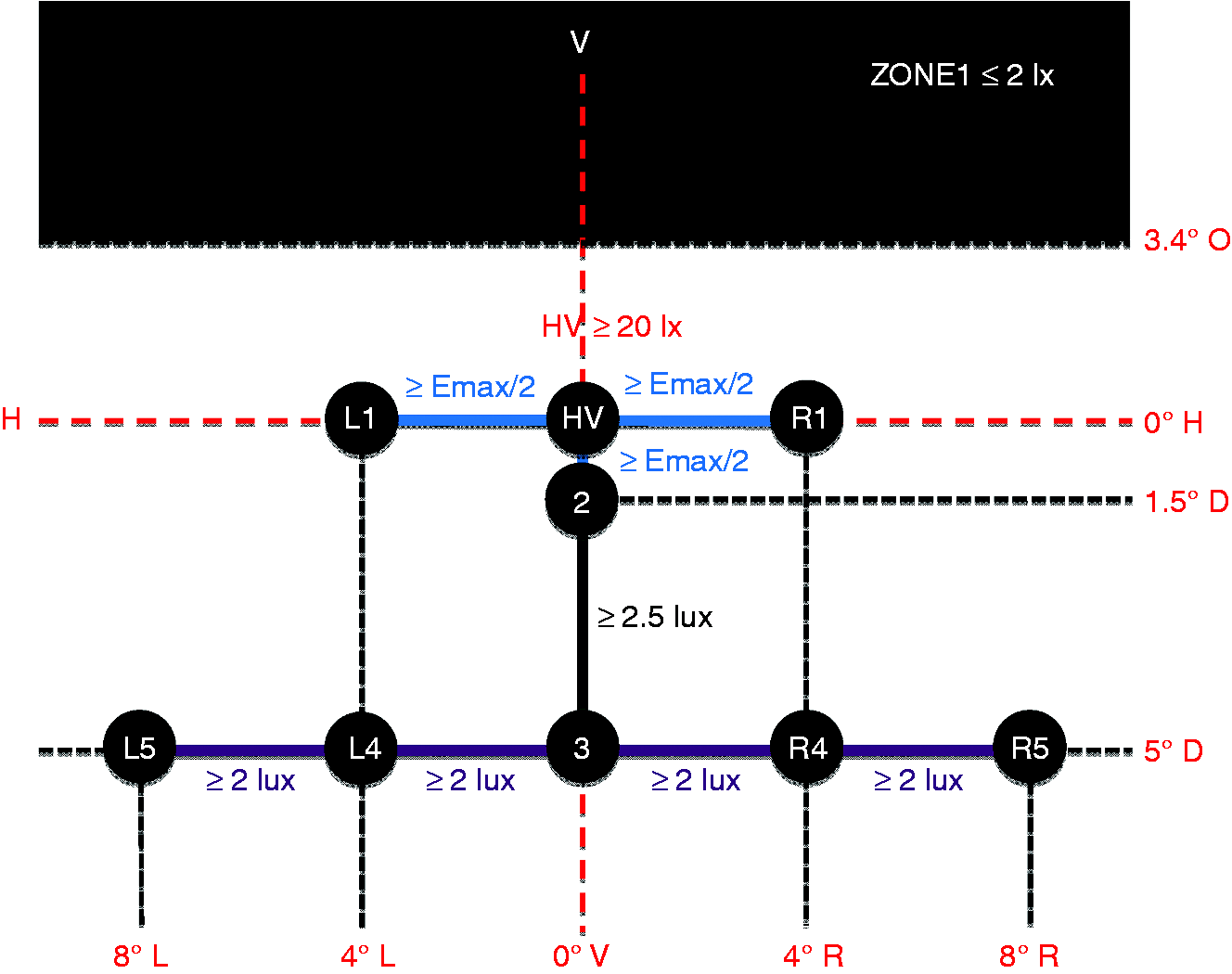
Although British Standards have been referred to above, they are little used by bicycle lighting equipment manufacturers. An European Union (EU) directive means that products tested to the requirements of other EU countries can also be used in the UK, provided they give an equivalent level of safety. Germany is one of the biggest markets for bicycle sales and as a result the German K-mark requirements are widely used by manufacturers of bicycle lighting equipment. In these, the front lamp must meet specific illuminance distribution criteria. Figure 5 shows the required illuminance pattern. The HV point in Figure 5 is the intersection of a line straight ahead from the lamp with a vertical plane 10 m from the lamp. The illuminance at this point should be larger than 20 lux. Zone 1 is a dark region, where the illuminance must be less than 2 lux. The minimum illuminances at other locations are given in Figure 5. This distribution is designed to provide adequate visibility ahead of the bicycle while limiting glare for others on the roadway. It has been used as a target for the design of a bicycle head lamp,
21
but the effectiveness of doing so, in terms of improved cyclist vision or safety, has yet to be evaluated.
The geometry and the illuminances required by the K-mark regulation (after Cai et al
21
)
3.2. Lighting of roads
The majority of urban roads that cyclists use will have been lit so as to provide adequate lighting for drivers. The road lighting recommendations used in the UK22,23 identify three distinct situations; traffic routes where vehicles are dominant, conflict areas where streams of vehicles intersect with each other or with pedestrians and cyclists and residential roads where the lighting is primarily intended for pedestrians and cyclists. Traffic routes are divided into different classes depending on the road type, average daily traffic flow, speed limits, the frequency of conflict areas, any parking restrictions and the presence of pedestrians. For traffic routes, the photometric conditions required are specified as minimum maintained average road surface luminance and overall and longitudinal luminance uniformity. The overall luminance uniformity is the ratio of the lowest to the average road surface luminance. The longitudinal luminance uniformity is the ratio of the lowest to the highest luminance found at test points on a line along the centre of a single lane. The recommended average road surface luminances cover a range of 0.3–2.0 cd/m2. The overall luminance uniformities and the longitudinal luminance uniformities cover ranges of 0.35–0.40 and 0.40–0.70, respectively. As for disability glare, this is limited by the use of a maximum percentage threshold increment. The maximum allowed threshold increment ranges from 10% to 15%, the lower value being recommended for roads with high traffic densities and speeds.
For conflict areas, the recommended photometric conditions are expressed as illuminances because, unlike traffic routes, there are many different viewing directions. The range of minimum maintained mean illuminances recommended is 7.5–50 lx, the actual value chosen depending on the complexity of the conflict area, the traffic density and the speed limit. For residential roads, the recommended photometric conditions are again expressed as illuminances. The recommended minimum maintained mean illuminances cover a range of 2–15 lx and the minimum maintained point illuminances cover a range of 0.6–5 lx. The actual values chosen depend on the traffic density, the crime rate and the environmental zone, this last consideration being related to the amount of ambient lighting in the area.
Within specific guidance for lighting cycle tracks and footpaths in BS5489, 23 the main document that a local authority will refer to if a cycle track is to be illuminated, there is a recommendation to refer for further guidance to ILE TR23. 24 ILE TR23, Lighting of Cycle Tracks, recommends light levels from the 1992 issue of BS5489, 25 these being three classes with average illuminances of 3.5 lux, 6.0 lux and 10 lux. Of these it is suggested that while 3.5 lux is suitable for cycle tracks, increasing this to 6.0 lux would enhance the feeling of security and encourage greater use by cyclists: the higher level should be used selectively (i.e. not assumed to be a common recommendation).
Sustrans, 26 a UK organisation promoting cycling infrastructure, suggests that recommended levels are up to 5 lux maintained average and 1 lux minimum maintained, and that lower levels of lighting can be provided in normal risk areas. IESNA DG-527 recommends an average horizontal illuminance of 5 lux for walkways and cycle paths, with a uniformity (average to minimum) of 0.1.
The Department for Transport’s Local Transport Note 2/08: Cycle Infrastructure Design;
28
Section 7 Cycle Lanes does not consider lighting but Section 8 Off-road Cycle Routes has a short section on lighting design pointing out that:
Cyclists using two-way cycle tracks alongside unlit carriageways may be blinded or dazzled by the lights of oncoming vehicles (including rural roads) and drivers may be confused when seeing cycle lights approaching on their nearside. Locating the track as far away as possible from the carriageway edge, or by providing with-flow cycle tracks alongside both sides of the carriageway can mitigate these issues. Cycle routes across large quiet parks or along canal towpaths may not be well used outside peak commuting times after dark, even if lighting is provided, with an on-road alternative lit route suggested as mitigation. It is not expected that routes outside built up areas used primarily for recreation would normally need to be lit except where there were road safety concerns, such as at crossings or where the track is directly alongside the carriageway.
For technical information, readers are again referred to ILE TR2324 as they are in subsequent publications. 29 Unfortunately, this document has recently been described as largely out of date 26 in part because it refers to the 1992 issue of BS5489 which has been superseded by the 2003 and 2013 issues.
4. Effectiveness of lighting for cycling
While there are legal requirements for the use of lighting on bicycles and technical standards applicable to the relevant lighting equipment, it is difficult to determine if the latter are adequate. This is because the legal requirements are rarely enforced and, as a result, a significant number of cyclists ride with no lighting or with partial lighting. Observations made in Oxford on a central street without any cycle lane, at dusk, in the rush hour, showed that of the 392 cyclists observed only 163 (42%) had both front and rear lamps lit. A slightly higher percentage had either front or rear lamps lit (49% front lamp alone, 50% rear lamp alone), but this means 50% of cyclists were riding in traffic, at dusk, without any lighting at all. 30 More recently, O’Boyle 31 has reported two separate road observation studies carried out in London, in fine weather, in the same week in March. One survey was done on a minor road, at dusk, at the weekend. The other was carried out on a major road, at dusk, on a working day, in the evening rush hour. The percentage of cyclists riding with both front and rear lamps lit was 25% on the minor road and 58% on the major road.
Similar results have been found in other countries. Observations in Lund, Sweden, found that only 28% of 896 cyclists used front and rear lights and 39% had no lights. 32 Follow-up interviews with 100 cyclists seeking explanations for the low frequency of light use revealed that 82% thought the function of a bicycle lamp was to be seen in the dark, and since Lund has good road lighting, only a rear light is needed.
The problem this underuse of the required bicycle lighting poses for understanding the effectiveness of such lighting is to what extent the absence of lighting on a bicycle increases the risk of death or serious injury. Hoque 33 provides some reassurance that lighting does matter. He examined fatal cycling accidents in the state of Victoria in Australia with an emphasis on night-time accidents. Data were analysed from the period 1981 to 1984 during which 1440 of the 29 400 accidents involved cyclists. At night-time, cyclists being killed in accidents involving motorists coming from behind were the predominant problem, with about 80% of all night-time fatalities attributed to this direction of approach, compared with 30% in daytime. Hoque found that approximately 61% of cyclists involved in fatal accidents at night did not have any lights on their bicycle. 33 As for road lighting, Hoque also found that unlit streets had a greater proportion of night-time fatal accidents involving cyclists.
These findings are what one would hope for given the predicted importance of visibility and visual conspicuity. They also indicate that having some bicycle lights or some road lighting is better for reducing cyclist fatalities than having no bicycle lights or no road lighting, but they do not tell us what the best form of bicycle lighting or road lighting might be. However, these data are more than 30 years old and cyclist behaviour can change a lot over such a period as is shown by the growth in the use of helmets by cyclists. Ideally, a review of the latest accident statistics for cyclists should be carried out, but that would only be worthwhile if the relevant databases have sufficient detail on lighting conditions recorded, which may not be the case. This may be why, despite detailed analyses of the effects of road lighting on vehicle accidents,34,35 few studies have assessed the effects of road lighting and bicycle lights on safety. 36
5. The future
The above review has shown that cyclists are at some risk on the roads, both day and night. There are several reasons for this, but there can be little doubt that lighting has a role to play in reducing this risk. Specifically, the objective of future actions relating to lighting for cycling should be to reduce the number of cyclist fatalities and serious injuries in the UK by using lighting to increase the visibility and conspicuity of cyclists, by both day and night.
These actions can take several different forms and require responses by several different bodies. They are:
Enforce the existing legal requirements for lighting of bicycles after dark much more rigorously. This could be done quickly and would have the effect of increasing the proportion of bicycles lit at night. Further, experience in trying to use persuasion rather than enforcement as a means of increasing the use of lights at night by cyclists has not been encouraging.
37
Extend the legal requirements for the lighting of bicycles after dark to daytime. This will increase the conspicuity of cyclists during the day. Motorcyclists are already encouraged to use their headlights during the day. Wells et al.
38
have shown that motorcyclists who use headlamps by day have a 27% lower risk of being killed or injured than those that do not. Further, since 2011, all new cars in the European Union have to be equipped with daytime running lights. It is time the same principle was applied to bicycles. Revise data collection requirements for accidents involving bicycles to include details of lighting conditions, both the lighting of the bicycle as well as ambient and road lighting. This is essential for the future analysis of the effectiveness of different forms of lighting. It will be many years before sufficient data are collected to make statistically reliable analysis possible, but unless all the relevant data is collected, analysis is impossible. Conduct research on the effectiveness of different types of bicycle lighting on visibility and conspicuity. There are many forms such research could take.
One form is a field trial of a new technology. For example, Madsen et al. 39 examined the benefits of permanent running bicycle lights in a study in Denmark. These lights were permanently fixed to bicycles, thus avoiding the possibility of forgetting to use lights, and were powered by magnets fitted to bicycle spokes to avoid battery problems. Accident rates (self-reported via the internet) were monitored over a 12-month period, these being accidents involving personal injury to the cyclist. The experimental group comprised 1592 cyclists for whom the lights were fitted for free in advance of the survey period. The control group comprised 1714 cyclists for whom the lights were fitted after the monitoring period. The safety effect of the lights was analysed by comparing incident rates. The accident rate was significantly lower among the experimental group using permanent running bicycle lights, a reduction of 41% for accidents involving personal injury. The difference was significant for accidents in daylight, but was not suggested to be a significant reduction for accidents at night-time. The authors suggest that this is because cyclists did not tend to use their conventional bicycle lights in daytime, and that both groups were equally good at remembering to use conventional lights at night-time.
Another form would be to study cyclists’ visual behaviour in different lighting conditions by measuring what they look at using eye-tracking technology. This was recently done for pedestrians, using a dual task to identify fixations at critical moments 40 and to estimate the distance and duration for which pedestrians desire to carry out these fixations. 41 So far, eye-tracking studies used to record cyclists’ visual behaviour have tended to use artificial settings such as watching a video 42 and artificial, straight lanes marked out in a gymnasium. 43 For pedestrians, natural settings and videos lead to different gaze allocation 44 and the same is expected for cyclists. One study 45 has used eye tracking to investigate gaze in a natural setting, but did not employ a dual task or similar to reveal critical fixations from all gaze fixations.
Yet another form would be a laboratory study. For example, Fotios and Cheal 46 have examined the ability of pedestrians to detect a raised pavement block off-axis under different amounts of light of different spectra. A similar approach could be used to study the ability of cyclists to detect road surface defects while using different forms of bicycle front lighting. 47
Internet-based research is another possibility. Gershon and Shinar 48 investigated the use of a novel helmet-mounted blinking light system for motorcyclists. The aim was to provide a unique visual signal to enhance attention and search conspicuity, defined as the ability to detect a motorcyclist when an observer’s attention is not specifically drawn to it and the ability to detect a motorcyclist while actively searching for one, respectively. Video clips were used in daytime and dusk scenarios on three types of road and at two distances (60 m and 140 m) with riders wearing a black suit, a white suit, a reflective vest, and reflective vest with the novel lighting system. The blinking light system was found to have no effect in daylight, but at dusk the additional lighting increased conspicuity to observers regardless of whether or not they had been alerted to the presence of motorcyclists.
There are also simpler forms of experiment suitable for those who want to have greater control of their experiment than is possible on the internet. For example, Rößger et al.
14
reported that for motorcycles the predominant cause of accidents was the inability of the other vehicle driver to adequately see the motorcyclist. Linear light sources were placed along the forks (vertical) and between the rear-view mirrors (horizontal) of the motorcycle to present a T configuration, a distinctive arrangement even at distance and similar to an abstract picture of a motorcycle seen from the front. Fifty-two test participants were shown 40 photographs of a road junction, of which nine included a motorcyclist, and within these nine were variations in lighting configuration, for example headlamp only or headlamp plus T lights. The task was to identify what vehicles to pay attention to when planning to pull out into or cross the road. The T configuration led to faster identification.
Explore the potential of different forms of bicycle lighting to enhance conspicuity by day and night. There are many different approaches possible using different combinations of the amount, spectrum and distribution of light together with temporal and spatial changes. One example is evident in the work of Wood et al.
49
who found that, in the dark, drivers responded to the cyclists wearing knee and ankle retroreflectors at significantly longer distances than cyclists who wore a fluorescent vest alone or black clothing only. Attaching retroreflectors to knees and ankles would produce a moving light spot. It would also be useful to compare the effectiveness of lighting on cyclist’s conspicuity with the effectiveness of alternative methods such as retroreflectors and high-visibility clothing. Review the current UK recommendations for the lighting of cycle tracks and cycle lanes on roads. Comparisons should be made with the equivalent recommendations used in countries with long experience of building cycle tracks and marking cycle lanes such as the Netherlands. Conduct an economic appraisal of the costs and benefits of different approaches to reducing cyclist fatalities and serious injuries. It is clear that the most effective way to minimize cyclist fatalities and serious injuries would be to construct an extensive network of cycle tracks separate from the roads used by vehicles, but this would also be the most expensive and take the most time. The relative costs, benefits and time scale of using lighting instead are worthy of study.
6. Conclusions
Over the last decade, UK governments have sought to increase cycling activity, but it remains a minority interest. One reason for this is the perceived danger of cycling on roads filled with traffic. There are a number of ways to reduce this danger, some expensive and long term, others inexpensive and short term. Constructing cycle tracks that separate cyclists from other traffic is an expensive and long-term option. Improving the lighting of bicycles and of cycle tracks and cycle lanes is an inexpensive and short term option. The lighting of bicycles and of cycle tracks and cycle lanes needs to be developed so as to enhance the visibility and conspicuity of cyclists, by both day and night. This development is necessary because it is not at all clear that the current lighting regulations and recommendations are the best that can be achieved or are even adequate. Research into the visibility provided by bicycle lighting and the conspicuity of cyclists using different forms of bicycle lighting, by day and night, on lit and unlit roads, is needed if lighting’s contribution to the safety of cyclists is to be realized.
Footnotes
Acknowledgement
We would like to acknowledge a significant contribution to the drafting of this article from Peter Boyce.
Declaration of conflicting interests
The author(s) declared no potential conflicts of interest with respect to the research, authorship, and/or publication of this article.
Funding
The author(s) received no financial support for the research, authorship, and/or publication of this article.