




Abstract
After dark, road lighting should enhance the visual component of pedestrians’ interpersonal judgements such as evaluating the intent of others. Investigation of lighting effects requires better understanding of the nature of this task as expressed by the typical distance at which the judgement is made (and hence visual size) and the duration of observation, which in past studies have been arbitrary. Better understanding will help with interpretation of the significance of lighting characteristics such as illuminance and light spectrum. Conclusions of comfort distance in past studies are not consistent and hence this article presents new data determined using eye-tracking. We propose that further work on interpersonal judgements should examine the effects of lighting at a distance of 15 m with an observation duration of 500 ms.
1. Introduction
In residential roads it is normal to provide lighting that focuses more, but not exclusively, on the needs of pedestrians compared to those of drivers. 1 One visual task of pedestrians is making interpersonal judgements – evaluations about the intent of other pedestrians in time to make an appropriate response, e.g. whether another person is likely to be friendly, indifferent or aggressive.2,3 This paper contributes to discussion of how to use lighting to aid interpersonal judgements, in particular the influence of illuminance and spectral power distribution (SPD).
Past studies associated with interpersonal judgements have tended to target primarily facial recognition and a review of these reveals mixed results regarding the effects of SPD.4,5 In two studies in which statistical analysis did not suggest SPD to be a significant factor, mean recognition distances ranged from 12 m6 to 24.9 m. 7 In three studies reporting an effect of SPD, mean recognition distances were in the range of 5.40–8.45 m.8–10 As to whether design should account for SPD, these data suggest that distance matters, although there are other differences (the former group of studies used a matching task, the latter group used an identification task). Recent investigation suggested that SPD matters when the task is difficult, and this difficulty is a factor of the procedure (e.g. whether the target face is familiar) and the observation duration in addition to the target distance. 11
As for the effect of illuminance, there is evidence that interpersonal distance (and hence apparent size) affects illuminances required for recognition of identity12,13 and recognition of the emotion conveyed by facial expression and body posture 14 ; higher illuminances enable recognition when the approaching pedestrian is further away but recognition reaches a plateau where further increase in illuminance has negligible effect.
One limitation of past studies is that while they have reported the distances at which recognition could be made, they have not identified the distances at which such judgements are desirable. It may be that the recognition distances reported in past studies are somewhat arbitrary. Consider for example a study in which the test participant commenced walking toward the target from a distance of 25 m, with continuous observation of the target: the mean recognition distance was 12 m. 6 Rather than 12 m representing recognition distance, it may be the case that 13 m is the distance required to make this decision, and that the recognition distance would instead have been 5 m or 20 m had the test participant commenced walking from 18 m or 33 m, respectively. A better understanding of the distances at which interpersonal judgements are desirable is necessary to inform interpretation of appropriate lighting design characteristics and whether or not SPD is expected to have significant effect.
One approach to establishing this distance is to examine personal space, the area surrounding a person into which it is preferred that intruders do not come, as maintaining this space allows people to operate at acceptable levels of stress. 15 The distance sought from others is larger for those individuals with whom we do not expect to interact.15,16 It was necessary for Caminada and van Bommel13,17 to estimate this distance when they established their foundation for the requirements of lighting in residential areas. They proposed pedestrians’ visual needs including facial recognition, obstacle detection, visual orientation, pleasantness and comfort. For facial recognition they suggested a requirement to recognise the face of an approaching pedestrian at a distance of 4 m as the criterion for ‘an overall minimum lighting value’. This was apparently rounded from the minimum public distance proposed by Hall, 18 a distance of 3.7 m (12 feet), suggested to be the minimum distance at which an alert subject would be able to take evasive or defensive action if threatened. An ideal facial recognition distance was suggested to be 10 m, the transition point between the close and far phases of Hall’s public zone. 13
These distances would be considered by others to be too short. When Luymes and Tamminga 19 discuss public safety and urban planning they suggest that where pathways are intended for night use, lighting should be provided to a level which will allow a user to recognise another person’s face at a distance of 25 m. Their source for this is an unpublished report from The Metropolitan Toronto Action Committee on Violence Against Women and Children (METRAC) – Womens’ Safety Audit Guide (1989): We could not find that report on the METRAC website or elsewhere and more recent publications that are available from the METRAC website (Community Safety Audits and Campus Safety) do not mention facial recognition. Dravitzki et al. 20 concluded ‘the literature indicates that lighting for pedestrians should be high enough for facial recognition at 15 metres, because this is considered a reasonable distance at which to make eye contact with someone you are about to pass.’ They refer to two sources for this. One is a 2002 guide from the government of South Australia which does not appear to be available. Their second source is a book by Oc and Tiesdell; we assume this is a reference to the chapter by Townshend 21 who suggested that once interpersonal distance is reduced below 15 m, the space in which we have time to react to avoid trouble, or simply an undesirable situation, becomes reduced beyond comfortable levels (see below). Finally, a text discussing environmental planning for safe communities suggests that lighting in public spaces must be adequate to have a good look at another person while he or she is still a reasonable distance away; this distance is suggested to be ‘not more than 12 to 15 meters’ but the author did not provide supporting evidence. 22
A second limitation of past experiments of lighting and interpersonal judgements is that they have tended to instruct continuous observation of the target person during trials. This is an unrealistic proxy for real-world interpersonal behaviour because there is a common tendency to avoid looking directly at unfamiliar others.23,24 Looking at another person, in particular if eye-contact is made, can be perceived as a threat if the person is unknown: ‘most people find it unpleasant and threatening to be stared at by a stranger … ’. 25
Evaluation of optimum lighting characteristics for interpersonal judgements would be aided by better understanding of the typical distance and duration of such judgements. Hence the aim of this paper is to explore evidence of the distance and duration at which it might be comfortable to make decisions regarding the intent of other pedestrians. These data would then be used to inform the design of experimental work investigating lighting and interpersonal judgements.
2. Categorisation of interpersonal space
Caminada and van Bommel13,17 referred to Hall 18 to establish their critical distances for interpersonal judgements. In Hall’s discussion of proxemics, man’s use of space, following observations of animals and people in natural situations he defined four interpersonal distances: intimate, personal, social and public. Hall set the border between personal and social distance at 4 feet (1.2 m) with the definition that nobody touches or expects to touch another person; the border between social and public distance was set at 12 feet (3.7 m) the distance at which Hall alleged an alert subject could take evasive or defensive action if threatened.
Hall briefly describes one experiment carried out to define interpersonal distances. It followed observation of the shifts in voice that occur with distance, e.g. whispering at close distances and shouting when far away. Hall and a colleague talked to one another at different distances, and ‘If both of us agreed that a vocal shift had occurred we would then measure the distance and note down a general description.’ This test led to definition of eight interpersonal distances, but ‘Further observations of human beings in social situations convinced me that these eight distances were overly complex. Four were sufficient’ although each of the four distances was sub-divided into close and far phases. Such an informal experiment does not provide robust evidence. Definitions of the four distances were compiled from observations and interviews; the interviewees comprised middle class, healthy adults, mainly natives of Northeast USA and a high percentage were professionals, business people or intellectuals, which does not represent a broad cross section of global society.
Hall’s apparent aim was to relate the interplay of the senses to interpersonal distances. It does not appear that he intended for the findings to be interpreted as evidence for marking critical distances. His evidence appears to be largely anecdotal and Hall himself acknowledges that it provides only a first approximation. Thus we conclude that Hall’s data do not alone provide convincing evidence that 4 m is a critical distance for facial recognition or other interpersonal judgements.
Interpersonal distances were also categorised by Cutting and Vishton. 26 They suggest three zones: personal space, which extends to a distance of 2 m; action space, which extends from 2 m to 30 m; and vista space which extends beyond 30 m. Personal space is that space within arm’s reach and slightly beyond, within which other people are allowed to enter only in situations of intimacy or public necessity. Action space is the circular region just beyond personal space and is a space of an individual’s public action: we can talk within it without too much difficulty and if need be we could toss something to a compatriot or throw a projectile at an object or animal. The border between personal space and Vista space was set at 30 m because ‘the utility of disparity and motion perspective decline to our effective threshold value of 10% at about 30 m’.
Caminada and van Bommel adopted the minimum public distance described by Hall when setting their requirement that it should be possible to recognise an approaching pedestrian at a distance of 4 m. If the work of Cutting and Vishton had been available to Caminada and van Bommel then maybe they would have set their critical distance at a value approaching 30 m, the border between their action and vista spaces, rather than the border between Hall’s social and public zones. The two approaches to categorising personal space are not consistent. Therefore, further evidence was sought from studies attempting to directly measure interpersonal distance.
3. Studies of interpersonal distance
Hall’s work did not specifically address interpersonal judgements at low light levels and this raises a further question as to whether it is a suitable basis for road lighting. Two studies27,28 investigated the distance sought before the presence of another pedestrian became uncomfortable using stop-distance procedures. In a stop-distance procedure for measuring comfort, the test participant and/or the experimenter walk towards one another and the test participant stops walking (or otherwise indicates) at the point where the presence of the other person becomes uncomfortable. The stop-distance procedure has been regarded as an attractive technique for measuring personal space since it places the subjects in a real situation. 29 It may however provide an unrepresentative level of comfort if carried out in a laboratory where test participants are not subject to the same types of discomfort and fear as they might experience on real streets.
Adams and Zuckerman 27 examined interpersonal distance for comfort at low (1.5 lx) and high (600 lx) light levels using a stop-distance procedure. The mean comfortable distance was greater under low illuminance (1.17 m) than under high illuminance (0.53 m), indicating a preference for greater separation from unknown people at night-time than at daytime.. Fujiyama et al. 28 also used a stop-distance procedure to investigate comfortable distances under five illuminances, ranging from 0.67 lx to 627 lx. Ten stationary participants were asked to say ‘stop’ when they felt uncomfortable about an unfamiliar person walking towards them. The results are reported only graphically and without error bars or similar to indicate variance. Mean comfort distances lie in the region of 4.0–5.2 m, with a slight trend to a decrease at higher light levels. Fujiyama et al. report only a few sample statistical analyses. Comfort distances at 0.67 lx, 2.8 lx and 5.5 lx were significantly longer (p < 0.05) than that at 627 lx, but they did not find a significant difference between comfort distances at 12.3 lx and 627 lx.
The results from Fujiyama et al. suggest comfortable interpersonal distances that are longer (4.0–5.2 m) than do the results from Adams and Zuckerman (0.53–1.2 m). Both studies were carried out in interior spaces. One difference between them is the size of the test environment: Adams and Zuckerman used the smaller room, of approximate area 30 m2 (dimensions: 5.18 m × 6.1 m) while Fujiyama et al. used a larger room (80 m2). Thus, there may be a range bias: Adams and Zuckerman used a smaller room which resulted in their estimate of comfort distance being shorter.
Past experiments of interpersonal distances required for comfort or collision avoidance between pedestrians
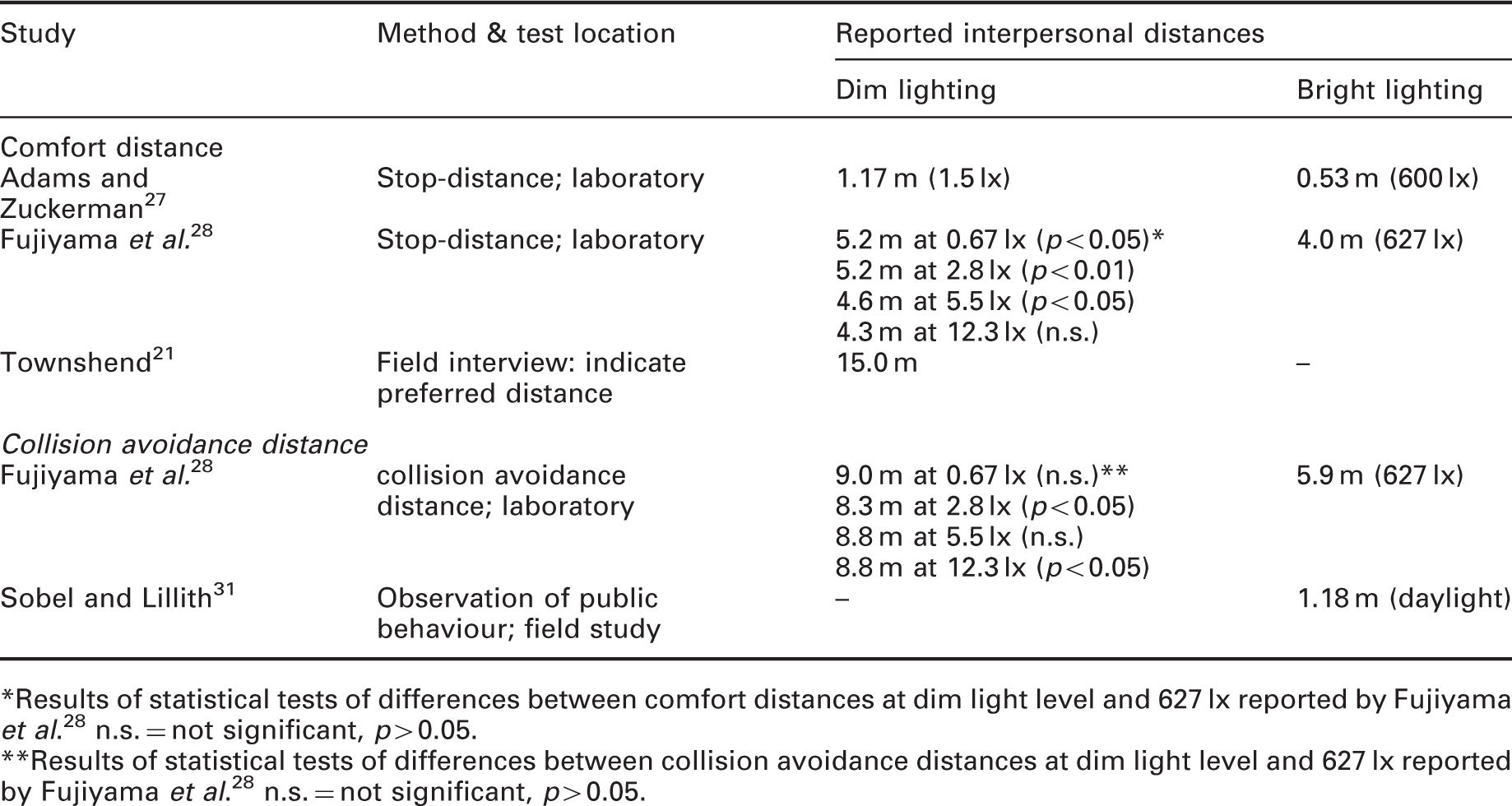
Results of statistical tests of differences between comfort distances at dim light level and 627 lx reported by Fujiyama et al. 28 n.s. = not significant, p > 0.05.
Results of statistical tests of differences between collision avoidance distances at dim light level and 627 lx reported by Fujiyama et al. 28 n.s. = not significant, p > 0.05.
Further concerns about laboratory studies arise from the fact that test participants know they are being observed which may affect their behaviour 16 and that the level of reassurance 30 does not reflect that experienced in outdoor locations – it is unlikely that confederate pedestrians in the experiments will be considered as threatening, and will thus be allowed to come closer for a given level of comfort. 16 These concerns are addressed in field studies. Sobel and Lillith 31 observed the movements of unaware members of the public in a shopping street. Colleagues would walk toward approaching members of the public without changing their direction while observers noted the distance at which members of the public took collision avoiding action. The average avoidance distance was only 1.18 m, surprisingly short. In this study we do not know how crowded the pavement was and how far ahead of the target it was that the colleague appeared; both would affect the avoidance distance.
Townshend’s 21 proposal of a minimum comfort distance of 15 m was determined using an after-dark field study in which he asked members of the public to estimate the distance at which they would be comfortable about an approaching person or group of people. This is a greater distance than reported by others, perhaps because Townshend sought an estimate by perception, not by actual behaviour.
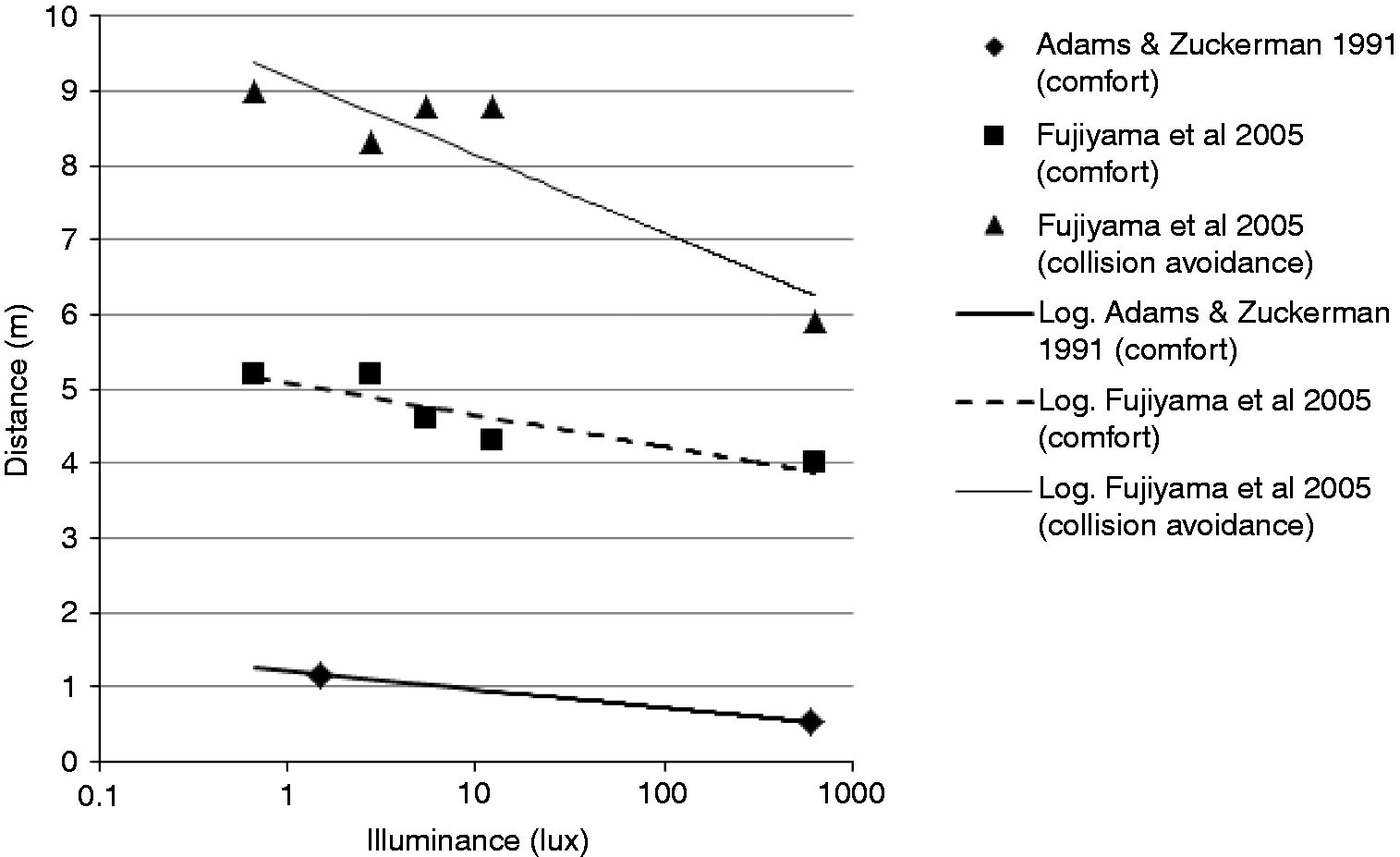
Table 1 summarises past studies of desirable inter-personal distances for comfort and collision avoidance. Figure 1 shows interpersonal distances plotted against illuminance, from the studies by Adams and Zuckerman
27
and Fujiyama et al.,
28
these having reported trials at more than one illuminance. Within each data set there is an apparent linear relationship between preferred distance and illuminance (r2 is approximately 0.8 for both the comfort and collision avoidance distances reported by Fujiyama et al.). However, the three data sets do not appear to be associated; the collision avoidance distances reported by Fujiyama et al.
28
using stop distance are greater than their comfort distances at all illuminances, and these in turn are greater than the comfort distances reported by Adams and Zuckerman.
27
Neither Table 1 nor Figure 1 suggest conclusive evidence of a desirable minimum distance for making interpersonal judgements regarding intent. One reason is that different methods have been used and there is often a low correlation between dependent measures of personal space: different techniques measure different aspects of behavioural responses to violation of personal space.
15
4. Evidence from eye-tracking
4.1. Past studies
An alternative approach to establishing critical interpersonal distances is to note when test participants visually fixate on other pedestrians in real situations. Eye-tracking apparatus allows the visual fixations of a test participant to be recorded: if a pedestrian enters their visual field, eye-tracking will enable assessment of whether and when that pedestrian was fixated. There is reason to have some confidence that distribution of gaze and cognitive process are related32,33 to the extent that a study investigating pedestrians’ fixations in a virtual environment found that specific tasks could be predicted from fixation data. 34 Clearly there are caveats associated with the interpretation of distance and duration from eye-tracking data. Eye-tracking identifies the objects fixated by the fovea, as needed to provide the information required for completing behavioural goals 35 but it does not identify the type of information sought. The pedestrian may have been detected at a further distance using peripheral vision, and this would not be apparent from the eye-tracking data. The fixation distance is also a function of the local geography and the approaching pedestrian’s ability to enter the field of view: entering from a side street 5 m ahead could lead to a lower estimate of fixation distance than a pedestrian approaching from a long, straight path.
Two studies used eye-tracking to record fixations on other pedestrians in laboratory settings. Kitazawa and Fujiyama 36 had test participants walk repeatedly forward and back across a 15.6 m long x 3.6 m wide platform alongside up to three target pedestrians: Jovancevic-Misic and Hayhoe 32 had test participants and five target pedestrians walk 48 laps around an oval track. In these studies, the repeated exposure to the same target pedestrians may have led to a learning effect and thus to a misleading understanding of interpersonal fixations. Evidence for this can be found in the fixation durations reported by Jovancevic-Misic and Hayhoe. 32 Their target pedestrians were instructed to follow one of three behaviours: safe (no collisions), rogue (veering towards a potential collision with the test participant) or a risky path (equally safe and rogue). For the first 12 laps, all pedestrians were fixated for approximately 500 ms, but with continued laps the duration of fixation on safe target pedestrians reduced while that for rogue pedestrians increased, these being approximately 200 ms and 900 ms, respectively, for the last four laps.
There are further reasons as to why laboratory studies do not present an appropriate record of natural fixation behaviour: It is unlikely the target pedestrians were perceived as threatening; in such small environments their locations were well known to the test participant and did not appear unexpectedly; and the limited size of the test spaces adds a ceiling to the maximum fixation distance. Although walking is relatively simple, it entails a variety of subtasks (maintaining a heading, keeping track of one’s surroundings and footing, avoiding potential collisions) 37 and on real outdoor pavements these might demand more attention than in the laboratory. Furthermore, the lighting conditions were not described.27,28,32,36
Therefore, it was considered that eye-tracking data gained using laboratory trials do not provide appropriate data for characterising the distance and duration of interpersonal judgements with unknown pedestrians in real situations after dark. Fortunately, two studies have reported eye-tracking recorded in outdoor settings, these offering the benefit of an ecologically valid setting.
Foulsham et al.
38
reported visual fixations from a study in which 14 test participants walked a 5–10 minute outdoor walk to a café in daytime. Gazes toward the 133 pedestrians encountered during these trials tended to occur when they first appeared in the field of view, typically while they were still ‘several metres away’ (Foulsham et al. do not report precise distances). As shown in Figure 2, at approximately 4 s after first appearing in the field of view, the cumulative probability reaches a plateau of being fixated of ≥0.7. Of discrete gazes toward an approaching pedestrian, 26% were in the first 3 s in which they appeared and only 4% were in the last 3 s prior to passing. These data suggest a tendency to look at people soon after they appear in the field of view and hence when they are further away.
The cumulative probability of a pedestrian being fixated at least once plotted against the time after that pedestrian first entered the field of view (from Foulsham et al.
38
). Note: graph redrawn using data supplied by Foulsham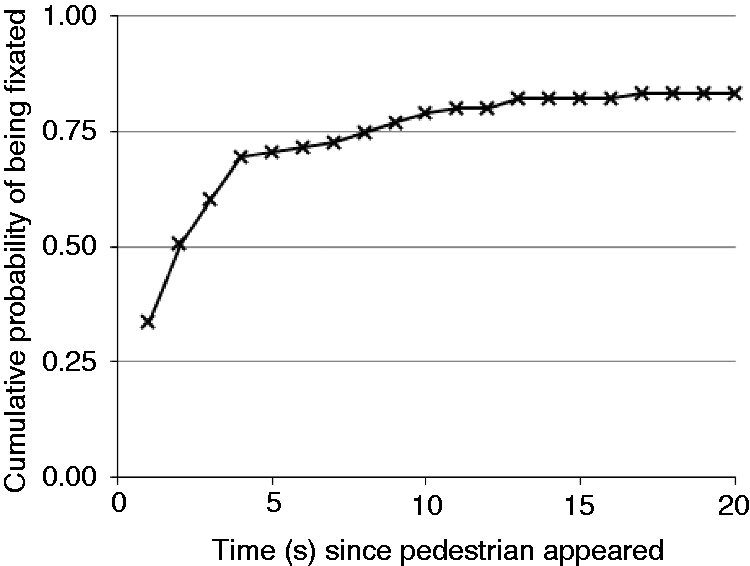
Foulsham et al. carried out their study in daytime: Subsequently Davoudian and Raynham 39 used eye-tracking to record pedestrians’ fixations after dark and this was done with 15 test participants while walking along three different residential routes. In these trials 55 pedestrians were encountered. Distances at which the first fixation occurred were estimated from the video record using the number of parked cars as a guide, these being residential roads, and this was possible for 54 of the 55 pedestrians. Distances at which fixations occurred ranged from 10 m to over 50 m, with a median of 20 m (These data were not reported in Davoudian and Raynham 39 but were provided subsequently by personal communication).
4.2. New data
4.2.1. Method
Further data were sought by new analysis of the eye-tracking study reported by Fotios et al.40,41 These data are of interest because of the larger sample of test participants (n = 40), each of whom carried out the experiment in daytime and after dark, by the much larger number of target pedestrians who were encountered (1538) and by the fact that the test participants were occupied with a simultaneous dual task (responding to an acoustic signal) while walking so as to occupy attentional resources.
Participants were asked to walk a route of approximately 900 m circumnavigating the University of Sheffield campus while wearing the iView X HED eye-tracking apparatus (SensoMotoric Instruments) for which gaze position accuracy is reported by the manufacturer to be typically between 0.5° and 1.0°. The forward-view and pupil-view cameras were calibrated by observation of standard targets immediately before each trial of the experiment began to ensure an accurate eye-track was achieved, and eye-track position was checked at the end of the trial before the participant removed the equipment to verify it was still accurate.
Each participant carried out the walk twice, once in daylight and once after dark, these took place between 08:00 and 16:00 hours, and between 17:00 and 20:00 hours, respectively. Orders of the light condition (daylight or after dark) and route direction (clockwise or anti-clockwise) were counterbalanced. Forty participants took part in the experiment (53% male; 58% in the 18–29 age group, 35% in the 30–49 age group and 7% in the 50+ age group). Participants were screened for having normal or corrected-to-normal vision using a Landolt ring acuity test. Forty percent of participants wore their normal glasses or contact lenses. Following recommended precautions to establish an accurate eye-track, 42 the angle of the eye camera was adjusted to avoid reflections and the brightness and contrast settings within the eye-tracking system were optimised to ensure the pupil and corneal reflex were recognised.
The video record of eye-tracking shows the scene facing the test participants with a cross-hair superimposed to show the point of fixation. Review of these videos was carried out to determine two characteristics of fixation upon other pedestrians, the distance at which they were fixated and the duration of fixation. Distances were estimated according to the relative size of reference objects in the field of view, for example the length of paving slabs. The duration of observation was established by counting the number of frames for which the fixation cursor remained on a specific target: each frame of the video represents 40 ms.
Video records were reviewed for all 40 test participants, for both daytime and after dark trials, and for two of the four sections (difficult and unfamiliar) of the route used by Fotios et al. 40 The difficult section was a route of approximately 270 m, characterised as such due to a relatively high number of obstacles on the pavement, such as litter bins and lamp posts, relatively uneven and poor pavement surfaces, features that required greater attention such as steps and a road crossing, and a high number of other pedestrians. The unfamiliar section was a route of approximately 320 m situated in a residential neighbourhood outside the University campus. It was anticipated most participants would be unfamiliar with this area and this was confirmed by ratings of familiarity taken at the end of the experiment. The pathway surface was generally good but included changing gradients, there were some parts without road lighting, and there was a low number of other pedestrians. In both sections the road lighting comprised a mix of low pressure sodium and high pressure sodium lighting.
Within these records, 1538 pedestrians were visible, of whom 1128 (73.3%) were fixated at least once. The mean number of fixations (per target pedestrian) was 1.75 (std dev 0.895: median = 2, inter-quartile range = 1–2) meaning that there was a tendency to look at other pedestrians more than once. The current analysis includes all fixations on other pedestrians: With further resources it would be interesting to separate the first and subsequent fixations.
In some cases, target pedestrians were fixated for a relatively long time, e.g. >1000 ms, in which time the distance between the observer and target may have changed if one or other was moving. In the current analysis we measured distance as that of the first fixation. Fixation was assumed if the gaze position remained on the same location of the target person for at least 80 ms (two frames), a standard assumption used by others. 43 Gazes positioned on target pedestrians for only one fixation were ignored and assumed to be saccades.
4.2.2. Results
Figure 3 shows the distances at which the 1128 pedestrians were fixated, these being the median distances across the 40 test participants for each of the four combinations of route section and day or after dark (i.e. a distribution of n = 160). For those pedestrians fixated more than once by a test participant, each fixation distance was recorded, this being a total of 1683 fixations. Note that in 25 of the 160 cases, the data do not exhibit any encounters with pedestrians due to either incomplete fixation records or that the test participant did not encounter any other pedestrians. Note also that these data are collated in 2 m bins and labels for these bins along the abscissa are the maximum distance for that bin. For example, the bin labelled ‘8’ represents the upper limit of the bin collating fixations occurring at distances greater than 6 m but equal to or less than 8 m.
Median frequencies of distances at which each visible person was fixated, as averaged across 40 test participants for daytime and after-dark trials in two route sections. Note: the x-axis label of ‘8’ (for example) represents the upper limit of distance, i.e. a bin 6 < x ≤ 8 m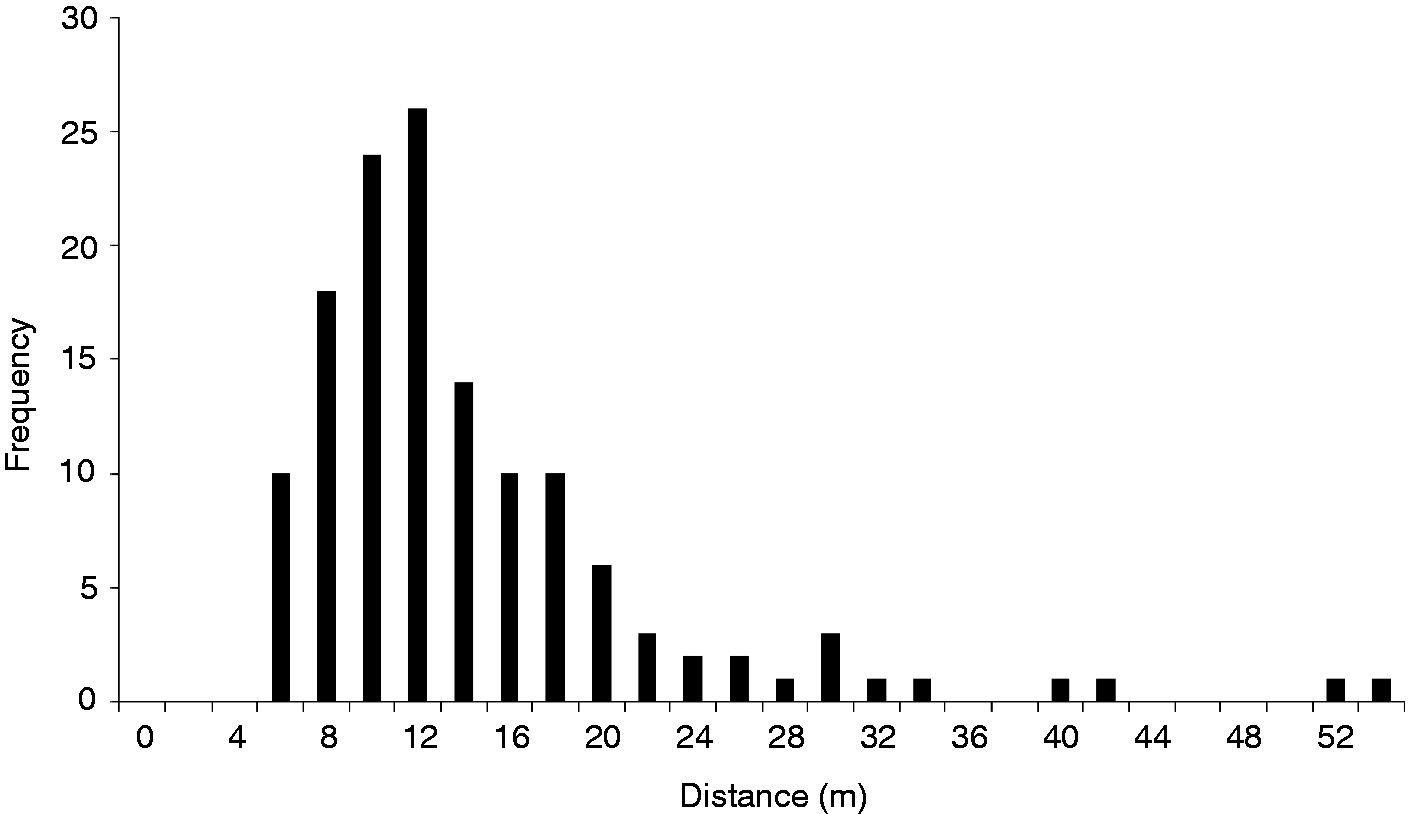
Fixation distances averaged across test participants

Median fixation distances were shorter after dark (8.9 m) than during daytime (13.0 m). This may reflect a desire to fixate upon others at shorter distances after dark, or alternatively it may be that this is because the lower light level after dark, and hence lower visibility of a pedestrian’s features, does not make fixation at greater distances worthwhile. It is also possible that after dark pedestrians at distances above 11.0 m were not sufficiently visible, either for detection with peripheral vision or inspection with foveal vision.
These data comprise two routes (difficult and unfamiliar), each walked in daytime and after dark by 40 test participants. According to the Friedman test the difference between these four conditions is statistically significant (χ2 = 23.5, p < 0.001). Comparison of individual route pairs using the Wilcoxon test suggests significant differences between day and after dark, and between the two route sections (p < 0.01).
While the data in Figure 3 show the typical distances at which test participants fixated on other pedestrians for all four conditions, Figure 4 shows the distances at which each of the target pedestrians were fixated for two conditions, the unfamiliar route in daytime and the difficult route after dark. Note that in daytime and after dark, fewer pedestrians were encountered in the unfamiliar section than in the difficult section. As noted above, fixation distance is also a function of the local geography and approaching pedestrians may have entered the field of view at a shorter distance than desirable, contributing to the skew towards shorter distances exhibited in Figure 4.
Frequency distribution of the distances at which each of the target pedestrians were fixated along the unfamiliar route in daytime and the difficult route after dark. Note: the x-axis label of ‘8’ (for example) represents the upper limit of distance, i.e. a bin 6 < x ≤ 8 m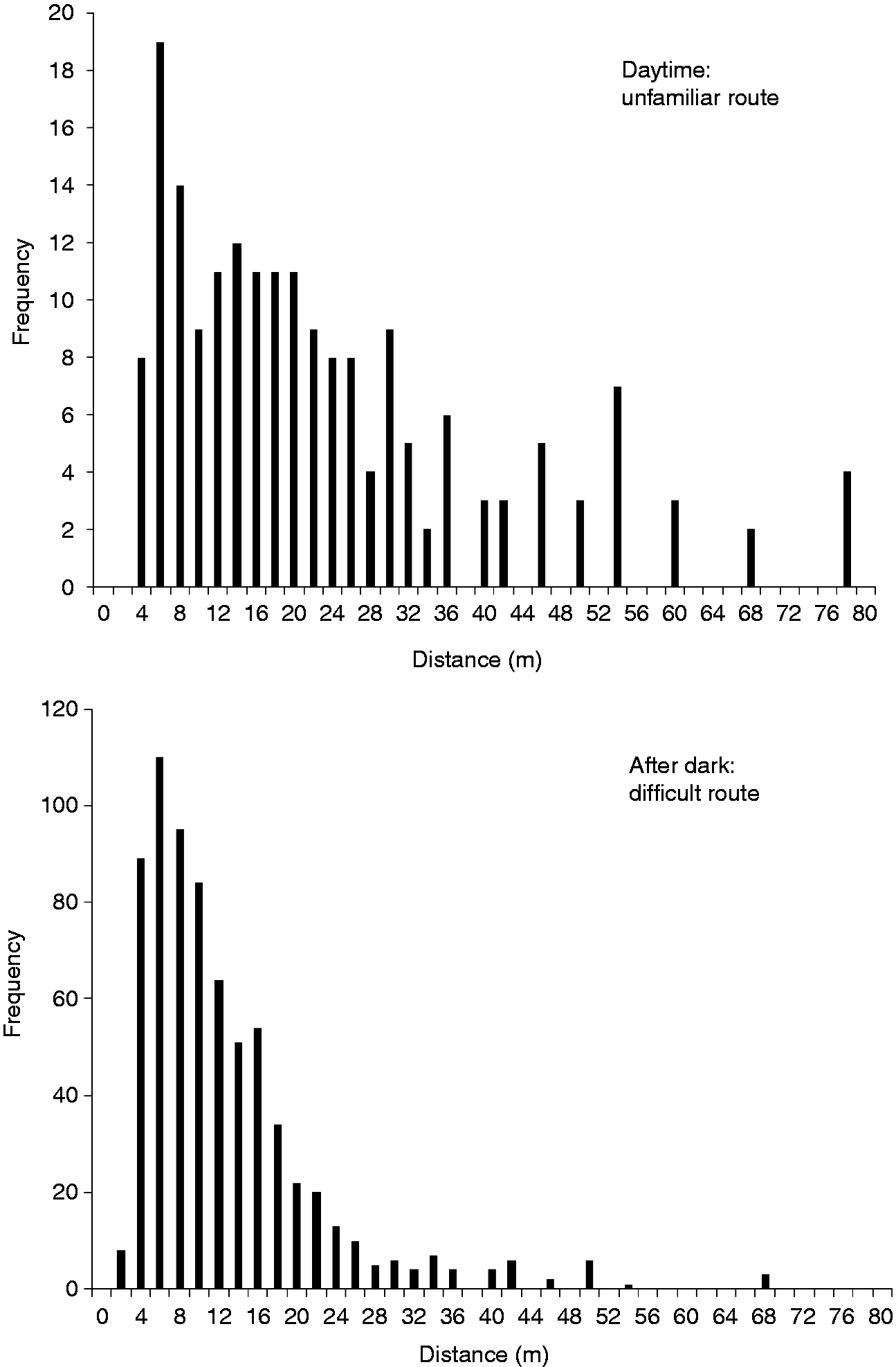
For 5 of the 40 test participants, these being chosen at random, the durations of their fixations on other pedestrians were measured from the video records, for the unfamiliar and difficult route sections. When an approaching pedestrian was fixated more than once, the durations of observation were averaged. The five test participants fixated on a total of 177 pedestrians (100 at daytime, 77 after dark) (Figure 5). The observation durations tend to be found in the range of 160–720 ms with extreme values of up to 4000 ms.
Distribution of durations of fixations on pedestrians. Note: the x-axis uses bin intervals of 80 ms. Thus the ‘320’ bin (for example) represents the upper limit of the duration bin 240 < x ≤ 320 ms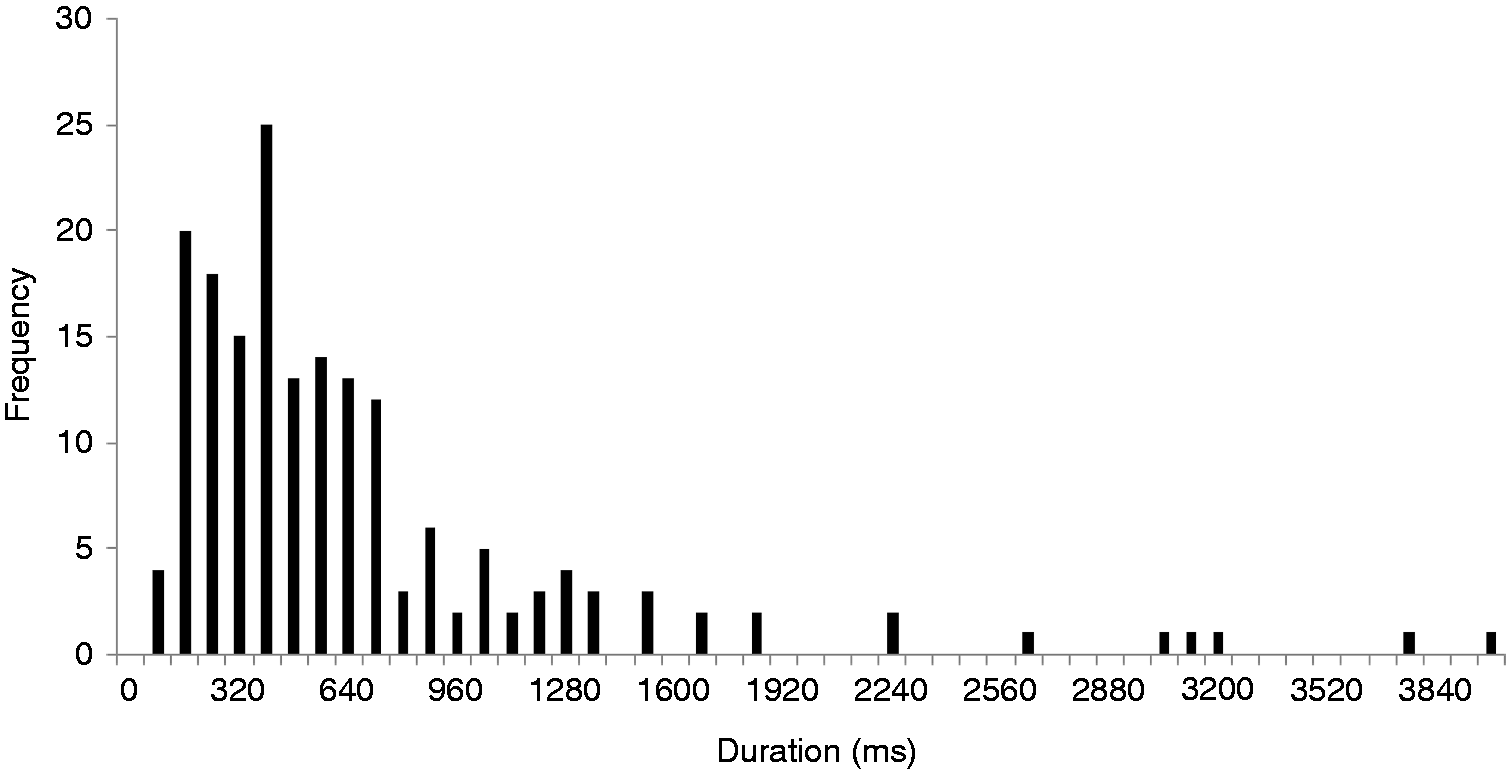
Duration of fixation upon other pedestrians estimated from the eye-tracking records of five test participants

In the eye-tracking study 40 the test participants had unlimited time to fixate on target pedestrians but only did so for brief periods. In past studies of interpersonal judgements permitting unlimited observation duration it may be that they also fixated the targets for a brief portion of the overall period; the data available do not report the overall duration nor the proportion for which fixation actually occurred. The obedience of test participants to follow instructions is well known 45 and we suspect this would lead to continuous fixation on the target, in particular in a stop-distance procedure where the task is to keep looking at the target to the point of recognition certainty and then stop. In further studies of interpersonal judgements it would be interesting to record the duration and pattern of visual fixations.
5. Discussion
Before discussion of the distance at which people choose to observe others, consider the distance at which it should be possible to correctly identify a person, this giving an upper limit as to the distance at which an effect of lighting on interpersonal judgements is likely to be found. Detail about a target is discerned using foveal fixation, and for this part of the retina the smallest detail that can be resolved with normal vision is that which subtends 1 minute of arc at the eye. Using this as a basis, and assuming the nose (typical width 10 mm) to be a critical feature for perception of the individual, Moughtin 46 noted that the face becomes featureless as 35 m. Similarly he suggested the threshold distance for discerning body gesture to be 135 m. Loftus and Harley 47 carried out experiments to investigate the ability to recognise celebrities, using size and blurring of photographs to simulate variations in interpersonal distance. Their data suggest that recognition performance remains at a plateau of maximum performance (approximately 90%) for distances up to approximately 8 m, reducing to 75% at 10 m and 25% at 23 m.
The difference between ability to see and desirability to see was expressed by Townshend 21 who suggested that while we can normally identify people in daylight at distances of up to 22 m, once this distance is reduced below 15 m the space in which pedestrians have time to react to avoid an undesirable situation becomes reduced beyond comfortable levels. The former distance (22 m) was apparently derived again from Maertens’ visual acuity approach; the latter distance (15 m) was as determined by Townshend 21 in a field study carried out after dark in which test participants were asked to estimate the distance at which they would be comfortable about an approaching person or group of people.
While laboratory studies27,28 have attempted to measure interpersonal distance for comfort or to avoid collision it appears that these may suffer from range bias, with smaller laboratory spaces leading to smaller estimates of desirable interpersonal distance, and thus we suggest such data are not suitable for establishing the minimum interpersonal distance for outdoor lighting. Laboratory studies of fixation may induce an incorrect estimate of distance due to familiarity with the target pedestrians’ identity and behaviour.
We propose that 15 m is an interpersonal distance at which it would be appropriate to investigate the effects of lighting on interpersonal judgements. It is a shorter distance than that at which recognition judgements are no longer possible and falls within the zone of action space (2–30 m) of Cutting and Vishton. 26 It is longer than the distances (4 m and 10 m) adopted by Caminda and van Bommel13,17 but agrees better with opinion from design guidance texts which propose there should be an ability to have a good look at other people at distances from 12 m to 25 m,19,20,22 and agrees with Townshend’s finding of the preferred comfort distance after dark. 21
To interpret data from eye-tracking we note the possibility that these data underestimate the desirable distance due to people appearing in the field of view at distances shorter than desirable, that the median measure of fixation is shorter than desired for half of the cases, and also the evidence from Foulsham et al. 38 for the desire to fixate on people soon after they appear in the field of view. Therefore, the upper quartile may be a better measure of desirable interpersonal distance. It should also be noted that we do not know if the tendency for shorter fixation distances after dark indicates a desire for shorter distance or a limitation of vision not to permit fixation at longer distances. In the current data, the upper quartiles were 15.3 m for daytime trials and 10.3 m for after dark trials. These estimates are lower than the median after-dark fixation distance of 20 m determined from an independent eye-tracking study. 39
We do not suggest that 15 m is an accurate estimate of interpersonal distance for making interpersonal judgements. In part this is because it is unlikely that there is a universal optimum distance: Past studies suggesting distances between strangers to be random 48 and there are differences between cultures, for example it is known that people from North America and Northern Europe have larger zones of personal space than those from the Mediterranean. 15 Analyses of the current data suggest that fixation distance varies with different routes. We propose that 15 m is a better-founded estimate than that used by Caminada and van Bommel with the aim that this prompts further discussion. One issue associated with using a fixed distance to examine lighting effects is that it precludes use of the stop-distance procedure as used in many past studies of facial recognition.6–11
As to the duration of continuous fixations, the eye-tracking records suggest a median fixation duration on other pedestrians of approximately 480 ms, which for simplicity we round to 500 ms. Further evidence that 500 ms is a typical duration of observation is found in the study by Jovancevic-Misic and Hayhoe. 32 The first of their 48 laps of the oval laboratory path best simulated real situations, i.e. before learning of the behaviour patterns of target pedestrians had been gained, and for these laps the fixation duration was also approximately 500 ms.
This paper has focused on the distance and duration of interpersonal judgements but has not discriminated between fixation on different parts of the body, in particular between face and body. Both are associated with judgements of approachability 49 and intention,50,51 but fixations on these elements may be to extract different sorts of information and may be desirable at different distances and require different durations. Further work is required to investigate the reasons for fixating on others when we do.
Although it is clear what point gaze is directed to, the inference about what is being processed is not so easily accessible: Gaze location does not uniquely specify the information being extracted. 34 The current eye-tracking data suggest a tendency to fixate on other pedestrians more than once and information for different evaluations may have been sought on these separate fixations. 37 It may be that, following detection with peripheral vision, the first fixation seeks mainly to confirm the location and travel direction of a person and the second, closer, observation is used to gain finer detail to aid judgement of intent. Further data are required to determine what data are drawn during these successive observations. For example, if the first fixation is used to note the location and movement of a person, then the location of fixation on the body may not be critical, but that subsequent fixations in order to interpret likely behaviour may tend to be on the face. Further analyses of why we look when we do would enable the estimates of distance and duration to be improved.
Finally, note that this paper has considered evidence from studies of interpersonal comfort and eye-tracking in natural settings. An alternative approach would be to record an implicit physiological measure such as galvanic skin response. 52
6. Conclusion
The aim of this paper was to investigate the typical interpersonal distances and durations of fixations on other pedestrians after dark, thus to inform the design of experiments investigating road lighting and interpersonal judgements such as the intent and/or identity of other pedestrians. Since recognition ability varies with size 14 and significance of the effect of SPD is dependent on task difficulty, 11 then this knowledge better informs interpretation of data to establish optimum design criteria. In this paper the video records of an eye-tracking study carried out outdoors after dark were used alongside a literature review to provide new evidence.
Caminada and van Bommel proposed a requirement to recognise the face of an approaching pedestrian at a minimum distance of 4 m and past studies have tended to examine facial recognition using unlimited duration of observation. We propose that experiments seeking to examine the effect of lighting on interpersonal judgements should instead use an interpersonal distance of 15 m and restrict observation duration to 500 ms, these values better representing pedestrian behaviour in natural situations after dark.
Footnotes
Funding
This work was carried out with support from Engineering and Physical Sciences Research Council (EP/H050817) as part of the MERLIN project.
Acknowledgement
We would like to thank Navaz Davoudian of University College London for supplying further data from the Davoudian and Raynham eye-tracking study.