



Abstract
This paper reports a proposed new system for specifying illuminances and lamp types for equal visual effects at mesopic illuminances, developed within the mesopic lighting panel of the Institution of Lighting Professionals in the UK. This study is applied in residential streets and thus the visual tasks considered are those relevant for pedestrians. It is proposed that the benchmark lamp for residential streets in the UK is the low-pressure sodium lamp; if other types of lamps are used, and these have a CIE General Colour Rendering Index of Ra ≥ 60, then the average illuminance can be reduced by an amount that is determined using the new CIE system for mesopic photometry and is dependent on the scotopic/photopic ratio of the lamp.
1. Introduction
This paper presents proposed guidance for residential roads in the UK, which has been developed to aid in the selection of lamp type and illuminance in a way that takes account of the changes in the spectral luminous efficiency of the average human observer in the mesopic region. This article is therefore a discussion of lamp spectrum effects and it does not address other parameters such as the spatial distribution of light. The guidance was developed through the Institution of Lighting Professionals (ILP) and applies the CIE system for mesopic photometry. 1 The ILP is a UK professional body for lighting engineers and was formerly known as the Institution of Lighting Engineers (ILE).
1.1. Background
Minimum average illuminances for subsidiary roads as specified in BS EN 13201-2: 2003 2
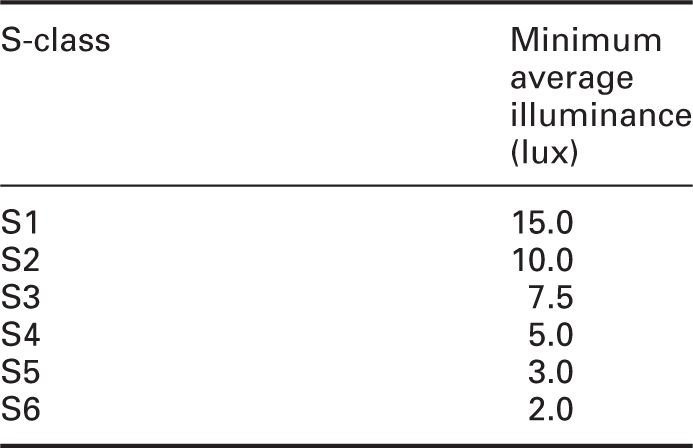
Since 2003, BS5489-1:2003 3 has recommended that designers of lighting for subsidiary roads in the UK are able to make a trade-off between illuminance and lamp type, this being a reduction on one class of the S-series when using lamps of CIE General Colour Rendering Index (CRI) Ra ≥ 60. It can be seen in Table 1 that the intervals between adjacent classes of the S-series are not equal, and thus the reduction of one S-class means a reduction in illuminance of between 25% and 40% depending on the initial S-class. This approach was used in order to provide lighting designers with a range of design options using different lamp types, with the potential for a reduction in energy consumed by the lighting. 5
Lighting in residential roads is needed not only to provide a road which is safe for people to use, but also to ensure that it is perceived to be safe. Perceived safety is influenced by factors such as a general feeling of safety, which may result from a brightly lit street, and a perceived ability to recognise the faces and expressions of other road users. The factors contributing to safe movement include the ability to detect obstacles on the pavement which may otherwise be a trip hazard, and the ability to make judgements regarding the intent and/or identity of other people at a distance sufficient to take avoiding action if necessary. There is some evidence to suggest that visual task performance (such as the ability to avoid obstacles or to recognise faces) is enhanced under lamps providing a relatively broad spectral power distribution (SPD). Thus although the general CRI would not be expected to relate directly to task performance, it appears to have been used in BS5489-1 as a simple criterion by which to discriminate between relatively narrow-band lamps, such as low-pressure sodium (LPS) and high-pressure sodium (HPS) lamps, and lamps providing lighting with a broader SPD, such as metal halide (MH) lamps. Lamps in this last category have collectively become known as ‘White Light’.
In recent years, two independent themes of research have developed to the point at which we are far better able to understand the effects of lamp SPD on pedestrian lighting. One theme is the development of a system of mesopic photometry to characterise the spectral sensitivity of the eye. Research carried out by the European MOVE consortium 6 and the US Lighting Research Centre 7 culminated, through CIE Technical Committee TC1-58 (Visual Performance in the Mesopic Range), in the CIE recommended system for mesopic photometry. 1 The second theme is applied research of typical pedestrian tasks under light sources of different SPD, including studies of brightness, obstacle detection and facial recognition.8–10
This evidence has been reviewed through the mesopic vision committee of the ILP, of which the authors are members, and CIE TC4-48 (White Light on Road Lighting Phase 1). Recommendations from the ILP are expected to revise the guidance presented in BS5489-1. The ILP committee has proposed a new system for allowing a reduction in illuminance according to lamp type. The reduction in illuminance is characterised using the CIE mesopic system, 1 but this reduction is only applied when using lamps of Ra ≥ 60.
The decision by the ILP committee to employ the CIE mesopic system to characterise parameters such as brightness, for which it was not intended, reflects the consideration given to practical utility: The use of an internationally agreed system is clearly preferable whenever possible. The results of an extensive set of brightness judgements 8 were predicted slightly better by, for example, the Sagawa 11 model than by the CIE mesopic system. However, it was considered that the level of agreement between the mesopic luminances calculated using the CIE system and the experimental brightness judgements was sufficiently close for practical purposes, particularly bearing in mind the many other uncertainties in the design and installation of road lighting. A reason for retaining the threshold value of CRI is that this correlates with judgements of the preferred appearance of coloured surfaces and human skin, and may therefore be a suitable proxy for judgements of acceptability.
This paper starts by reviewing the background to selection of illuminances and lamp selection criteria in BS5489-1:2003 and BS EN 13201-2:2003 to show that there is little evidence to support these, and hence no need for any new proposal to perpetuate them.
1.2. Illuminance levels
For exterior illumination, BS5489-3:1992 12 specified minimum average illuminances of 3.5 lux, 6.0 lux and 10.0 lux for subsidiary streets, according to the level of crime risk and the vehicular and public use of the area, and these apply to the road, the footways, and, for a shared surface, they apply to the road and any other adjoining area frequented by the public. These illuminances were based on the study reported by Simons et al. 13 which comprised two field surveys of road lighting in residential areas. In the first survey (London), 13 observers rated their satisfaction with the lighting in 12 streets using a rating scale, and this was followed by a second survey (Milton Keynes) of 12 streets by 20 observers. In both cases, the average horizontal illuminances ranged from about 1.0 lux to 12.0 lux. A nine-point rating scale was used, with points labelled very poor (1), poor (3), adequate (5), good (7) and very good (9). The items rated included overall impression and levels of lighting on the road and footpath. The results suggest that higher illuminances lead to higher ratings of overall impression. Horizontal illuminances of 10.0 lux, 5.0 lux and 2.5 lux were proposed, as these corresponded to ratings of good (7), adequate (5) and poor-to-adequate (4), respectively.
These results are not surprising. When observers are asked to make judgements about a range of sensory stimuli, they tend to rate the stimuli against each other rather than against a consistent reference stimulus – this is clearly seen in the brightness judgements of Teller et al. 14 and the loudness judgements discussed by Poulton. 15 Therefore, when rating lighting ranging in illuminance from 1.0 lux to 12.0 lux, it is not surprising to see lighting of 1.0 lux being rated near the bottom end of the scale and lighting of 12.0 lux being rated near the top of the scale. If a different range of illuminances had been surveyed, say 0.5–5.0 lux, or 5.0–50.0 lux, then it would be expected that different illuminances would correspond to ratings of good, adequate, and poor-to-adequate, and thus a different set of average horizontal illuminances would have been proposed.
The 2003 revision of BS5489-1 suggested use of the S-series of lighting classes from BS EN 13201-2:2003, which offered an expanded range of minimum average illuminances, 2.0–15.0 lux, with an irregular interval between each class. The S-classes were chosen to accommodate the illuminances used in EU member states; the authors are not aware of a further visual basis for their definition.
The guidance for selection between the six S-classes in BS5489-1:2003 is based on little more than a ranking according to convenient categories of crime rate, environmental zone and traffic flow. Importantly, it is not based on the need for defined minimum illuminance levels for specific tasks. Thus, while it is true that, for example, areas of high crime rate may benefit from lighting at reasonably high illuminance levels, the simple ranking approach used in BS5489-1:2003 does not allow for the fact that the illuminance provided by the lower S-classes (e.g. class S4 or S5) may already be sufficient to meet the demands of crime prevention.
Thus, the average horizontal illuminances stated in BS EN 13201 should not be taken as having any great visual significance. The aim of the ILP mesopic vision committee was to maintain an equivalent level of lighting benefits while allowing a trade-off between lamp spectrum and illuminance level; it did not consider whether the illuminances specified in BS EN 13201 were well chosen.
1.3. Illuminance reduction for lamps with Ra ≥ 60
BS5489-3:1992 12 identified that LPS and HPS lamps were the preferred sources for residential street lighting because of their high luminous efficacy and long working life. The decision in BS5489-1:2003 to allow a reduction in average illuminance when using light sources of better colour quality than LPS and HPS was made following a recommendation from an ILE Technical Committee, and this appears to have been based on anecdotal evidence from a series of trial installations. 5 The reduction of illuminance by one class of the S-series appears to have been based on an arbitrary decision to keep to the six classes of the S-series. The restriction to allow this reduction only when using lamps of Ra ≥ 60 also appears to have been a decision of convenience, giving a simple means of discriminating between HPS and LPS lamps on the one hand and lamps of broader SPD on the other such as MH and compact fluorescent (CFL), rather than being based on visual performance data. Indeed, correspondence from one member of the British Standards Institution Road Lighting Committee suggests that at one point it was proposed to use Ra ≥ 80 as the threshold. The somewhat arbitrary nature of these decisions is confirmed by tests at mesopic and photopic levels that have shown that CRI is not a good correlate for brightness,8,16 which is one of the critical visual criteria for determining lighting needs for lighting in residential roads.
Evidence in Section 2 of this paper suggests that an illuminance reduction of one step may be excessive and that the use of Ra ≥ 60 alone is an inappropriate method for specifying when a reduction is permitted. Lighting installations in subsidiary streets since 2003 that have adopted this illuminance reduction may, however, result in lighting that is entirely satisfactory and therefore some may question an attempt to revise the methodology. One possible answer to this is that subsidiary roads in the UK are generally overlit, with illuminance levels higher than they need to be, and as a result illuminance levels are still acceptable even if reduced by one S-class. Compare, for example, the criteria used in the UK with that for Australia and New Zealand and for Japan. The S-series of average illuminances used in the UK ranges from 2.0 lux to 15.0 lux, whereas for local roads in Australia and New Zealand average illuminances in the P categories extend across a range of 0.5–7.0 lux17,18 and in Japan, the recommendations for residential roads provide for average illuminances of 3.0–5.0 lux horizontally on the pavement.19,20
1.4. Mesopic photometry
Human vision is a hugely complicated process and the spectral luminous efficiency of the eye is influenced by a large number of factors. These factors include the size and location of the stimulus in the visual field, the ambient light level and spectrum, the stimulus contrast and spectrum, and the speed of response required by the task being conducted. Changing any of these parameters will change the efficiency of the visual system and the ability to perform the requisite task.6,7 This complexity means that it is not possible to define a single spectral luminous efficiency function that will apply for all tasks and environmental conditions, or to devise a measurement system that will provide a complete prediction of visual performance for all situations. Instead, lighting standards and specifications are based on a small number of internationally agreed spectral luminous efficiency functions that, while they do not describe the details of human visual performance, nevertheless provide a measurement framework for quantifying ‘light’ in a way that correlates with human vision. The photopic spectral luminous efficiency function, V(λ), applies at ‘high’ light levels (daylight, lit interiors, etc.), where human vision is dominated by the activity of cones in the retina, the rods are relatively inactive, and colour discrimination and the ability to resolve detail in the visual field are both good. At ‘low’ levels (e.g. moonlight), only the rods are active, visual acuity is poor, and it is not possible to distinguish colours; in this condition, the scotopic spectral luminous efficiency function, V′(λ), applies (Figure 1). In the intermediate, so-called mesopic region, the eye’s sensitivity changes rapidly depending on the characteristics (luminance and SPD) of the lighting used, shifting towards the ‘blue’ as the light level decreases.
The CIE photopic and scotopic spectral luminous efficiency functions, V (λ) and V ′(λ)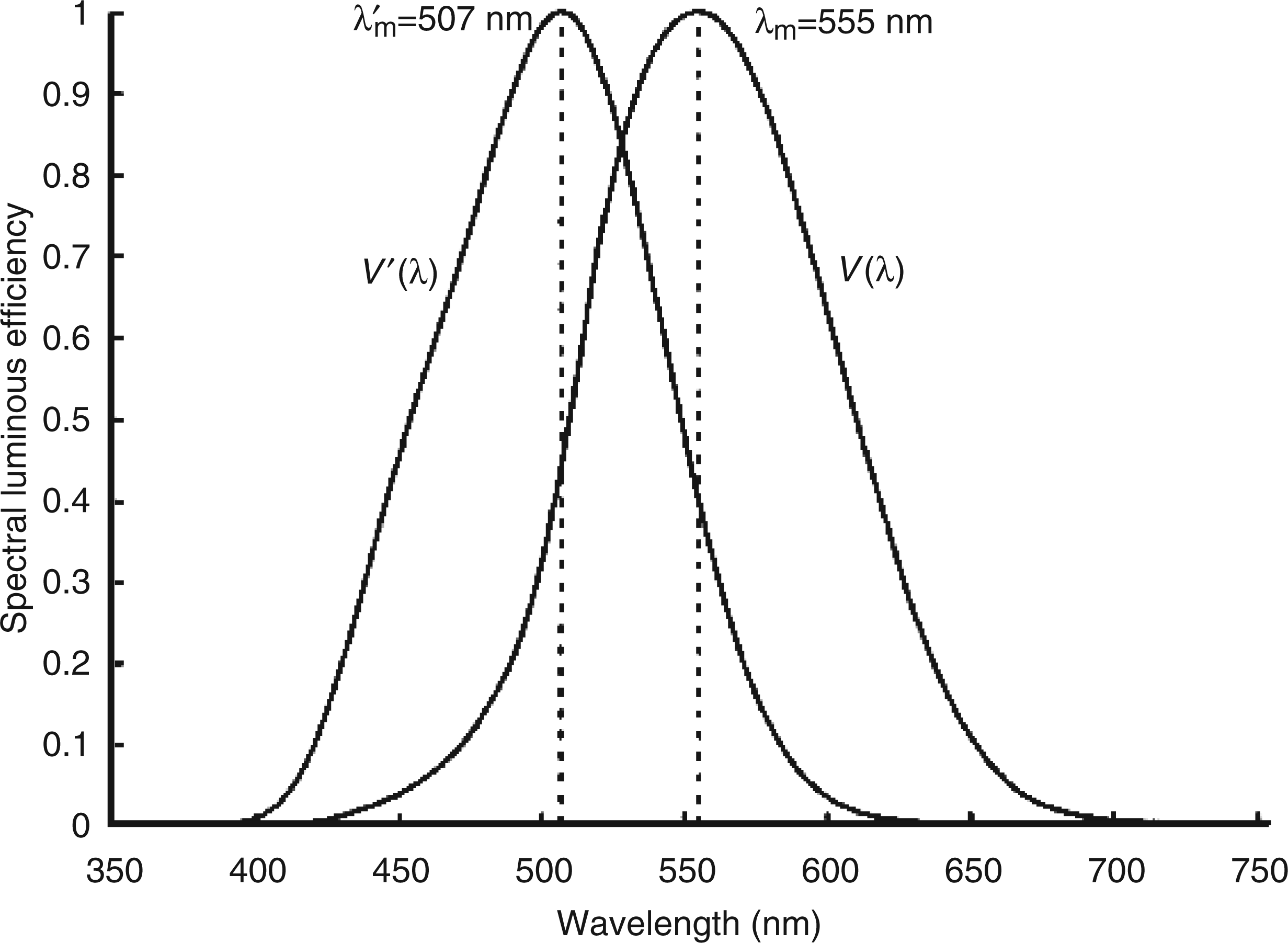
The mesopic region covers an approximate range of luminance from a few hundredths or less of a candela per square metre (cd m−2) to at least several candela per square metre, and encompasses the levels found in road and street lighting, emergency lighting, lighting for security, crime-prevention purposes, etc. Because the response of the eye varies in this region according to the amount of light reaching the retina, it is not possible to define a single mesopic spectral luminous efficiency function. However, the CIE 1 has recently published a recommended system for mesopic photometry that applies across the whole of the mesopic region. This maintains the V(λ) and V′(λ) functions at the upper and lower limits of the mesopic region, respectively, and provides a gradual transition between these functions for intermediate light levels.
In practice, the system can be applied through the use of look up tables that provide corresponding values of mesopic luminance for specified values of photopic luminance for lamps with different spectral characteristics. The spectral properties of the lamp considered are characterised by the so-called S/P ratio, which is the ratio between the output of the lamp evaluated using the scotopic spectral luminous efficiency function and that using the photopic spectral luminous efficiency function: This information is available from the lamp manufacturer and is higher for lamps with a higher concentration of ‘blue’ light.
The CIE system for mesopic photometry was developed on the basis of a large number of psychophysical investigations and provides a meaningful correlation with visual performance for a wide range of tasks. However, it does not correlate well with visual performance in situations where colour contributions are significant (e.g. when the chromatic saturation is especially high or the lighting has a very narrow SPD, both of which are indicated by very high or very low S/P ratios). It is important to note, however, that for such situations, the V(λ) function is a similar poor predictor of performance in the photopic region, but this disadvantage is strongly outweighed by the advantages of a simple, easily applied system of measurement, and as a result V(λ) has been successfully used for measurements at high light levels for nearly a century. The decision to use the CIE mesopic system in these new ILP guidelines is based on similar concerns of practical utility.
2. Lighting for pedestrians
The S-series of lighting classes is applied to subsidiary streets. These are streets where the lighting is primarily designed to meet the needs of pedestrians and cyclists rather than drivers of motor vehicles. Three primary requirements of lighting for pedestrians are to improve brightness (perceived safety), to aid the detection of pavement obstacles, and to enable the intent and/or identity of other pedestrians and cyclists to be judged. In addition, the appearance of the lighting needs to be acceptable to users. As discussed below, there is evidence that these four requirements are affected by the SPD of the lighting and there is some ability to predict these effects.
2.1. Brightness
In residential areas, there is a need for areas to appear brightly lit, since people link spatial brightness with safety. Empirical data 21 show that lighting makes an important contribution to making a place feel safe and the higher the perception of brightness, the greater the feeling of safety. 22 The results from both laboratory experiments8,23 and field surveys10,24,25 suggest that under mesopic conditions lamp SPD affects perceived brightness, and thus that it is possible to choose an appropriate SPD that enables a required level of brightness to be maintained but at a reduced illuminance.
Recently, an experiment has been carried out with the specific intention of providing data with which to test predictions of brightness using a range of lamp characteristics and tentative models of visual function at mesopic levels. 8 This experiment used five different types of lamp, all of which are intended for road lighting applications, and these were carefully selected in order to test the brightness predictions of the different models that were evaluated in the study. These lamps were two types of MH lamp, a compact fluorescent lamp, a standard HPS lamp and a two-colour LED. The lamps were compared using a matching task in side-by-side booths with a reference illuminance of 5.0 lux.
The metrics of lamp spectral characteristics examined were CIE General CRI (Ra), correlated colour temperature (CCT), gamut area index, S/P ratio and the ratio of the short wavelength sensitive (SWS) cones to the photopic observer (SWS/P ratio). Of these, the S/P ratio offered the highest correlation with the observed illuminance ratios at equal brightness. Three of the mesopic vision models evaluated were developed on the basis of brightness-matching experiments in the mesopic region, i.e. they were specifically intended as mesopic brightness models. The other model
1
was based on visual performance for other types of task, i.e. it would not be expected to provide a particularly good correlation with perceived brightness. The results of the study suggest that the CIE-recommended system for mesopic photometry
1
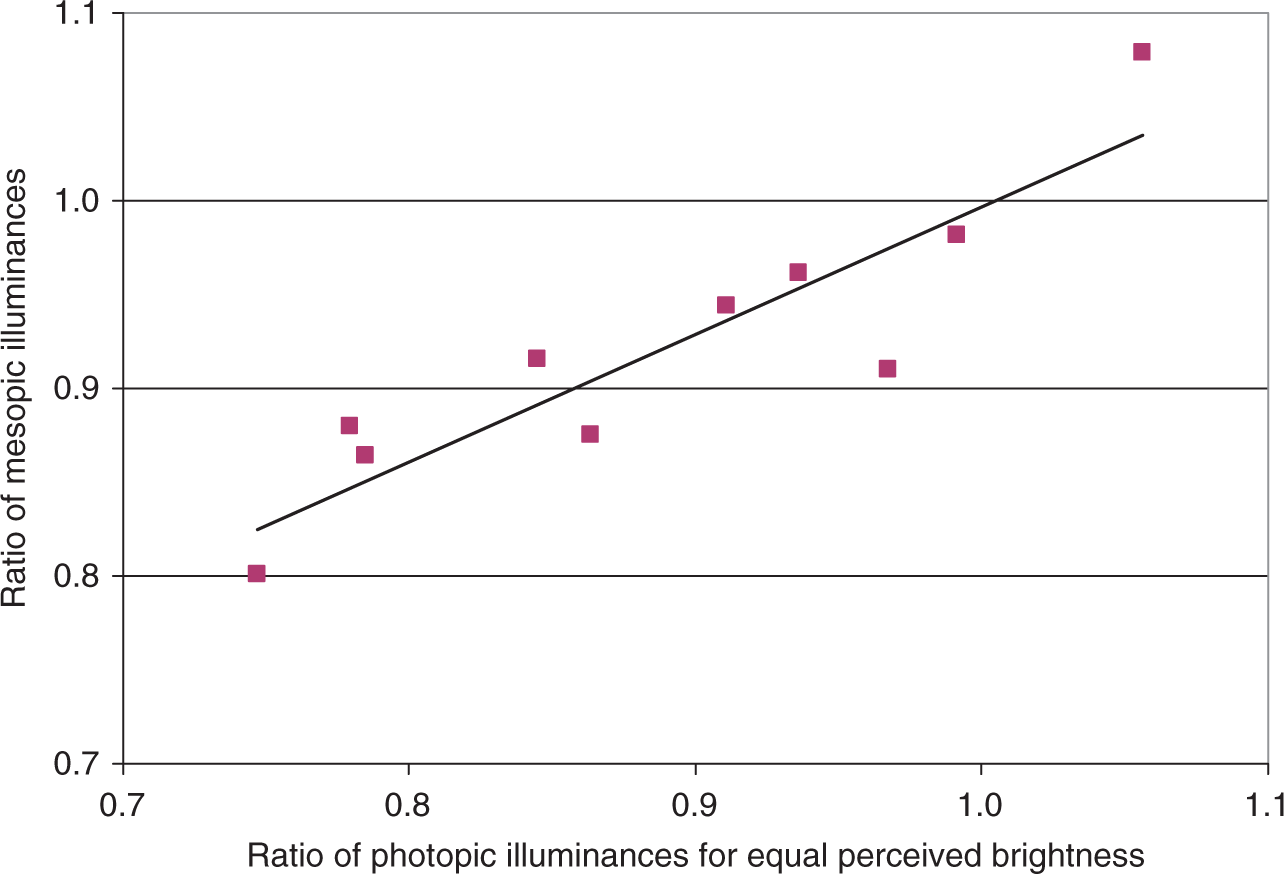
gives an acceptable prediction (R2 = 0.86) of the brightness data.
8
While the three brightness models examined in the study were able to provide slightly higher correlation (R2 up to 0.92), this increase in predictive power was considered to be outweighed by the practical utility of using an agreed international system which is known to predict visual performance for a range of tasks of relevance to road users. Figure 2 shows the correlation between ratios of measured photopic illuminance at equal perceived brightness and illuminance ratios for the same lamps evaluated using the CIE system of mesopic photometry for the 10 possible pairs of the five lamps used by Fotios and Cheal.
8
Correlation between measured photopic illuminance ratio for different types of lamp at equal perceived brightness and mesopic illuminance ratio for the same lamps evaluated using the CIE system of mesopic photometry for measurements in a visual comparison booth with a surface reflectance of 0.2
8
2.2. Acceptability
In addition to providing lighting that appears bright, and that enables visual tasks to be carried out, it is desirable that the appearance of the lighting is acceptable to users. Schanda 26 suggested that colour appearance of the human complexion may be a key consideration in determining the acceptance of a light source. Kanaya et al. 27 suggested that the appearance of human skin is the tool used in real situations by naïve observers to determine the acceptability of an illumination.
Fotios and Cheal 28 sought preference judgements alongside their brightness matching task to give a measure of acceptability of the lighting. Preference was judged by appraisal of three items: preferred skin appearance, while the test participant had one hand placed into each booth; preferred appearance of colours on the Macbeth Colour Checker Chart; and preferred appearance of the whole interior environment of the booths (observed without the presence of hands or the colour chart). These preference judgements were recorded on two occasions, first at equal illuminance, with both booths set to the reference illuminance (5.0 lux) and second at equal brightness, this being the final setting of the four brightness matches set by each test subject.
The CIE general CRI gave the best prediction of preference judgements, for all three target items and at both equal illuminance and at equal brightness. Gamut area, a measure of colour discrimination, also gave a good prediction of preference judgements, but was poorer than was Ra for judgements of preferred skin appearance. The S/P ratio, CCT and all the mesopic vision models, including the CIE mesopic system, gave poor predictions of preference judgements.
2.3. Obstacle detection
An obstacle is an approaching object or irregularity on the pavement surface that may cause a pedestrian to trip, or is not noticed in time to avoid collision, i.e. a potential safety hazard. Street lighting should enhance obstacle detection as a countermeasure to trip hazards and collisions.
The detection capability of the eye is mainly determined by contrast sensitivity. 29 Consider threshold luminance contrast under MH and HPS lamps at mesopic levels: if the task extends beyond the fovea, then it has been shown that SPD does affect threshold contrast, with MH lamps having a significantly lower relative luminance contrast threshold than HPS (and LPS) lamps. 30 Visual space is mapped using peripheral vision. 31 For peripheral tasks, there is evidence that lamp SPD does affect visual performance, with lighting of higher S/P ratio (i.e. higher rod stimulation) providing improved detection probability and reaction time.30,32–38
In a recent study, a novel apparatus was built with which to measure detection of pavement obstacles under different light sources and illuminances.
9
The results confirmed that obstacle detection increased with increasing illuminance and with higher S/P ratio (Figure 3). While further evidence of lamp spectrum effects on obstacle detection are desirable, for example to investigate the ‘knee’ in the detection curve in Figure 3 and the effects of age, there is nevertheless sufficient evidence to suggest that the detection of pavement obstacles increases when using lighting of higher S/P ratio.
Mean obstacle height for the 50% detection probability plotted against illuminance to show obstacle detection ability of older and younger observers under different illuminances for one HPS lamp (SON) and two types of MH lamp (CPO and CDO).
9
The primary (left-hand) y-axis shows the heights of obstacles in the test apparatus. The secondary (right hand) y-axis shows the approximate height (mm) for real obstacle assuming a standard eye height of 1.5 m above the floor. The lamp S/P ratios (measured within the test apparatus) were 0.6 (SON), 1.2 (CPO) and 1.8 (CDO). Measured data points for each combination of light source and observer age are linked by straight lines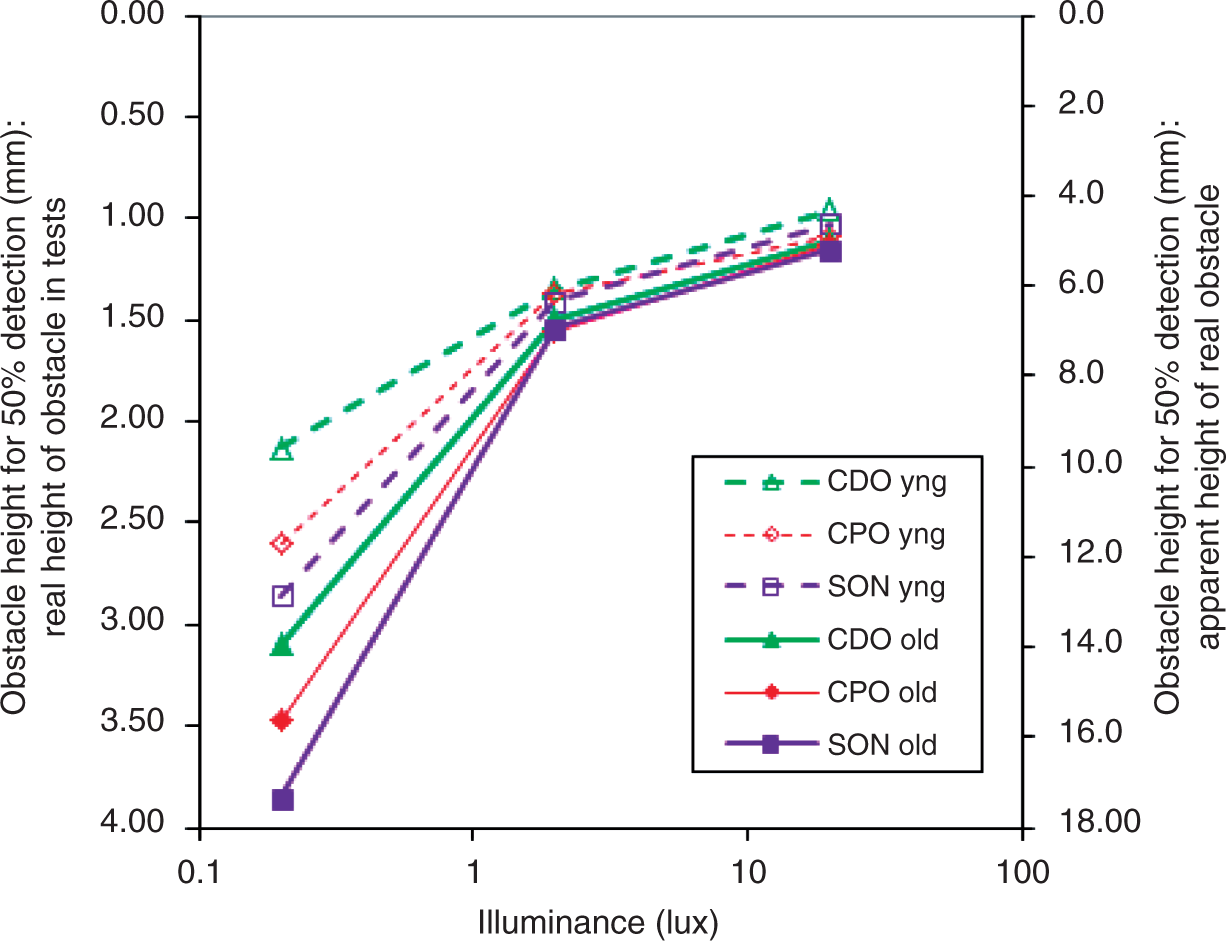
The obstacle detection study also highlighted the disadvantage of reducing illuminance levels by a whole S-class step, as currently allowed by BS5489-1. Even if the recommendations were changed so that the more meaningful metric of S/P ratio, rather than Ra, was used as the criterion for specifying when the illuminance reduction was permitted, the results 39 of obstacle detection tests suggest a minimum S/P ratio of 1.8 is required in order to achieve adequate visual performance at the reduced illuminance, which is higher than that of many lamps including those promoted for road lighting applications.
2.4. Recognition of facial expression
It is desirable for a pedestrian or cyclist to be able to recognise the intent of other road users at a sufficient distance for avoiding action to be taken, if necessary. While the intent (i.e. whether threatening or not) of another road user is judged by their facial expression and other bodily clues, investigations of this task have frequently been broadened to facial recognition. Experiments published in the lighting literature do not enable a definitive conclusion as to whether light source SPD affects the ability to recognise faces. Of six studies in the lighting domain, three do not suggest an effect of lamp SPD on facial recognition10,40,41 while others suggest a significant effect.42–44
These studies have tended to measure recognition of well-known faces or recognition of a target face from a set of reference faces. Both approaches may be inappropriate. We generally identify familiar faces with little effort, despite possibly large variations of lighting – familiarity with a face permits identification even from very low-quality images. 45 Thus, recognition of photographs of well-known faces may not be a sufficiently demanding task to discriminate between light sources because they can be too easily recognised. In contrast, our ability to remember, or even to match, unfamiliar faces is rather poor. 45 Even under good conditions, with no memory load on subjects and no requirement to make a decision quickly, the task of identifying a target from a small set of possible faces has an error rate of 20–30% and attempts to test recognition in the field have indicated real-life performance to be even worse. 45
Furthermore, identification through face recognition may not be the essential task. What pedestrians would like to be able to do is to gain an impression of the intent of other road users, i.e. is it safe, or not safe, to walk closely by an approaching person? Facial expressions provide perhaps the most effective means of communicating emotion46,47 and thus measuring the effect of lighting on recognition of facial expression may be more appropriate. This may be through classification, as either friendly or not friendly, of the seven fundamental expressions that are universally recognised; happiness, sadness, fear, anger, disgust, surprise, and possibly neutral or contempt.46,48 To counter these, and other, suspected problems with the procedures previously used for investigating the effect of lighting on facial recognition, the question of methodology has been raised. 49
Despite such potential sources of variance, three studies do reveal a trend for lamp SPD to affect facial recognition, and this suggests there may be an underlying chromatic contribution. Support for this comes from the study of Yip and Sinha 50 who examined recognition of celebrities using photographs that had been blurred to degrade shape cues. For images with 1.5 and 2.0 cycles of Gaussian blur between the eyes, there was a significant difference in recognition ability between full colour and grey-scale versions of the photographs, with the full colour version providing the greater recognition performance; however, for images with 3.0 and 4.0 cycles of blur there was no difference between the colour and grey-scale images. The chromatic contribution to recognition is thus stronger when shape information is degraded. The visual system for face recognition appears to encode information such as edge-based information, shading and pigmentation. 51 Yip and Sinha 50 suggest that colour cues may facilitate image segmentation (i.e. edge definition) rather than providing precise hue-related diagnostic cues to identity. The nature of this visual path for a chromatic contribution is confirmed in a study where reversing the hue of pixels in photographs of a face (i.e. 180° rotation of the colour wheel) did not affect recognition. 51 Such segmentation may be enhanced using light sources which enhance the discrimination between different colours, such as those with a large colour gamut, 52 and this provides a first metric for predicting the expected effect of lamp SPD on recognition.
Another desirable benefit from street lighting for pedestrians is an improvement to the rate and probability of detection of other pedestrians. It is expected that lighting of higher S/P ratio would improve the detection of pedestrians in peripheral vision and there is some evidence for this. Eloholma et al. 53 compared on-axis and off-axis (15°) visibility under HPS and MH lamps. In a long underground tunnel, observers were required to indicate at what distance they could just detect a pedestrian walking towards them. It was found that SPD did not affect the task when performed with foveal or off-axis vision at either photopic luminance studied (0.1 and 1.5 cd m−2). In a second test series, using only one trained observer, performance was improved under the MH lamps compared with the HPS lamps with off-axis (20°) viewing: the pedestrian could be identified at a lower photopic luminance under MH lamps (∼0.0025 cd m−2) than under HPS (∼0.0035 cd m−2).
Thus, experimental evidence to date suggests that the detection and recognition of other pedestrians can be improved through the use of lighting of higher S/P ratio and gamut area. In the new ILP proposal, in order to avoid complication arising from the use of too many metrics, it is assumed that Ra gives satisfactory utility for gamut area.
3. Specification of illuminance reduction
3.1. Existing method of specification
Guidance for lighting in subsidiary streets in BS5489-1:2003 allows the illuminance of street lighting to be reduced by one class of the S-series when using lighting of general CRI Ra ≥ 60. There are three problems with this approach. First, Ra does not give sufficient information about the effects of lighting on brightness and obstacle detection, so a reduction in illuminance may be detrimental to these tasks despite an increase in Ra. The illuminance reduction needs to consider also the S/P ratio of the lamp. Second, a one-step reduction in the S-series provides an irregular reduction in illuminance, ranging from 25% to 40% depending on the initial class. This may be excessive for some tasks, i.e. the improvement in performance through using lighting with ‘better’ SPD does not offset the reduction in performance due to reduced illuminance. This could be alleviated by reducing the illuminance by an amount proportional to the lamp properties rather than reducing by one full step of the S-series. Finally, it cannot be applied to class S6.
3.2. Proposed new method of specification
Evidence from the experimental studies described above suggests the following:
Brightness can be satisfactorily predicted using the CIE system of mesopic photometry, with lamps of higher S/P ratio appearing brighter (Section 2.1). Acceptability can be predicted using CIE general CRI, Ra, with lamps of higher Ra leading to preferred appearance (Section 2.2). Obstacle detection can be predicted using the CIE system of mesopic photometry, with lamps of higher S/P increasing the detection probability of pavement obstacles (Section 2.3). Facial recognition: It is suggested that higher Ra and higher S/P ratio will increase the ability to detect other people and then recognise their intent, but this remains to be confirmed (Section 2.4).
A method is proposed to account for these effects when determining design illuminance, having first chosen the S-class according to crime rate, environmental zone and traffic flow and assuming that the benchmark lamp for this is the LPS lamp. The proposed system allows a reduction in illuminance, specified using the CIE system of mesopic photometry, but only when using lamps of Ra ≥ 60.
Proposed specification of (photopic) illuminances in the S-series
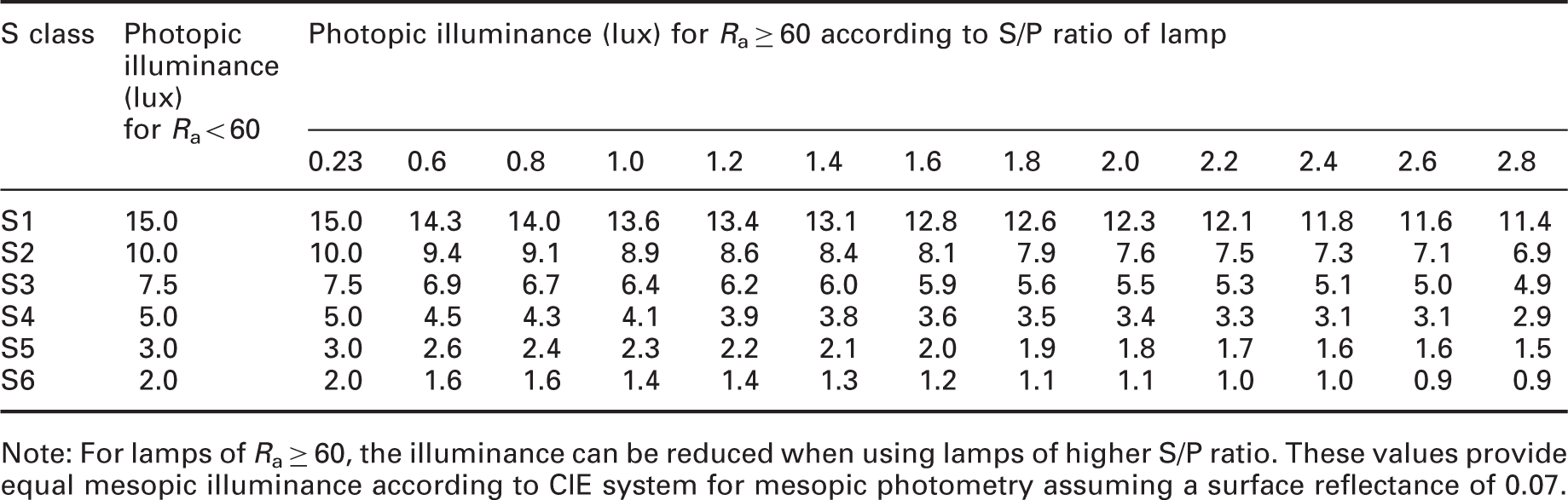
Note: For lamps of Ra ≥ 60, the illuminance can be reduced when using lamps of higher S/P ratio. These values provide equal mesopic illuminance according to CIE system for mesopic photometry assuming a surface reflectance of 0.07.
For example, assume that according to the road and traffic conditions, it is determined that class S3 is appropriate, for which the standard photopic illuminance is 7.5 lux. If LPS lamps (S/P ∼ 0.23, Ra ∼ 0) or HPS lamps (S/P ∼ 0.6, Ra ∼ 20) were to be used the design illuminance would remain at 7.5 lux; the low Ra values for these lamps do not allow the illuminance reduction to be considered. However, if warm white MH lamps (S/P ∼ 1.2, Ra ∼ 80) were to be used, the illuminance could be reduced to 6.2 lux.
The threshold value of Ra ≥ 60 is a first estimate from recent judgements of preferred appearance. 28 When comparing lighting of equal brightness, these data suggest that Ra = 30 is not acceptable and that Ra = 71 is acceptable, but there was insufficient evidence to determine the threshold between these two values. The existing threshold of Ra ≥ 60 is therefore proposed until further evidence is available. It is well known that the general CRI has many limitations and work is ongoing through CIE TC 1-69: Colour Rendering of White Light Sources to develop a better method. It may eventually be necessary to include a minimum value for a new colour rendering metric, in addition to Ra, but this is not possible at present.
The advantages of a proportional reduction compared with the previous step reduction are as follows.
It accounts for both subjective and objective effects of lighting, i.e. brightness (safety), preference, detection of pavement obstacles and (to be confirmed) facial recognition. The proportional illuminance reduction avoids the need to establish a threshold value for S/P ratio, although it still requires a threshold value for Ra. It avoids the problem of irregular steps of illuminance in the S-classes. It characterises the relative effects of two lamps, and would thus still be relevant if the base illuminances were changed. It offers greater flexibility for designers in terms of choice of lamps and maintained illuminance and thus potential energy savings.
3.3. Choice of benchmark lamp
Table 2 was developed with the assumption that LPS lamps provide the benchmark for UK road lighting, i.e. that if an S-class were chosen according to crime rate and environmental zone then LPS lamps would provide satisfactory lighting. Justification for this decision was found from the 1992 version of BS5489-3 12 which stated that HPS and LPS were the preferred light sources, with no distinction made between these; furthermore, the survey of road lighting carried out by Simons et al. 13 that led to the average illuminances in BS5489-3:1992 examined roads using LPS, HPS and mercury vapour (MBF) lamps. This is not a recommendation that it is ‘good’ to use LPS lamps, but instead it is recognition that the specified illuminances have not been adjusted over time as new light sources have been introduced. The LPS benchmark provides the greatest potential for energy savings and is justified on the basis that specified levels in road lighting standards have not been revised, since the introduction of other lamps into road lighting design. Those countries in which the recommended illuminances were originally based on a different type of lamp will need a different table.
4. Discussion
This paper reports a proposed new system for specifying illuminances and lamp types for equal visual effects at mesopic illuminances. Under this proposal, lamps of higher S/P ratio enable a lower (photopic) illuminance to be used, but this reduction is only applied when using lamps of high colour rendering index (Ra ≥ 60). These criteria were established following a review of the visual tasks considered to be relevant for pedestrians.
While this proposal presents a significant improvement on the previous approach, being based on much stronger evidence of the underlying visual effects, there are a number of issues that require further work. The use of the CIE system of mesopic photometry requires assumption of a surface reflection in order to convert between luminance (on which the system is based) and illuminance, for which Table 2 assumes a reflectance of 0.07. Clearly, different locations in different streets may exhibit different reflectance characteristics and thus guidance is required as to how to deal with this. It is expected that the benefits of high S/P ratio lighting will reduce with increasing age of the observer (Figure 3): further discussion is needed to determine when, where and how to account for observer age in street lighting design. Finally, the proposed system requires that lamp manufacturers report the S/P ratio of their lamps and that this is accommodated in design software: This requirement has not yet been implemented.
Footnotes
Acknowledgement
This proposal was developed along with members of the ILP Mesopic Lighting Panel: Mike Elwell, Colin Fish, Brian Healy, Nigel Parry and Anthony Smith.
References
Supplementary Material
Please find the following supplemental material available below.
For Open Access articles published under a Creative Commons License, all supplemental material carries the same license as the article it is associated with.
For non-Open Access articles published, all supplemental material carries a non-exclusive license, and permission requests for re-use of supplemental material or any part of supplemental material shall be sent directly to the copyright owner as specified in the copyright notice associated with the article.
