




Abstract
Improved cookstoves aimed at reducing exposure to indoor air pollution have had a lasting presence in development and health discussions. Through this article we contribute to current debates in the field by reflecting on our experiences during a cookstove participatory project in two ‘non-notified’ communities, or ‘slums,’ in Bangalore, India. We interrogate the alignment between some of the central tenets and methods of participation and the lived experiences of participating communities. The current predominant recommendations focus on developing and implementing cookstoves tailored for user needs. Yet, the project implementation entered a space of uncertainty where the priorities and needs of participants were diverse and changing. While urban infrastructures related to housing and work security, drainage systems, access to health care, and aspects of governance, citizenship and rights, may seem to fall outside the scope of ICS projects, our experiences show how inescapably they shape participatory processes and technologies. We highlight the need to take a closer look at how we can include these broader and changing priorities and needs in our methodologies and reflect on how we can better respond and align them with the ways in which people live.
Keywords
“The larger world gets into the story not because I want to write about politics, but because I want to write about people” – Salman Rushdie
Introduction
Tackling indoor air pollution (IAP) caused by cooking with biomass fuels is a domain largely governed by technology-oriented discourses in global health. Discussions on how to reduce exposure to IAP generally revolve around the development and implementation of improved cookstoves (ICS) or transition to clean fuel technologies (see, e.g., ‘The 2017 Progress Report’ by United Nations-hosted Global Alliance for Clean Cookstoves, 2018). The role of ICSs is a long standing one, and it is marked by different discursive framings with regards to technologies, rationalizations for interventions, conceptualization of experts and of targeted groups (Figure 1). Currently, implementers highlight the need to respond to context specificities and involve end users by way of participatory methods. And we commend the concerns attached to this discourse. However, our experiences with a participatory ICSs project press us to pay attention to the ways in which the current participation discourse unravels in practice and what it may entail to align it with the lived experience of participants in their urban milieu. A historical overview of ICS approaches.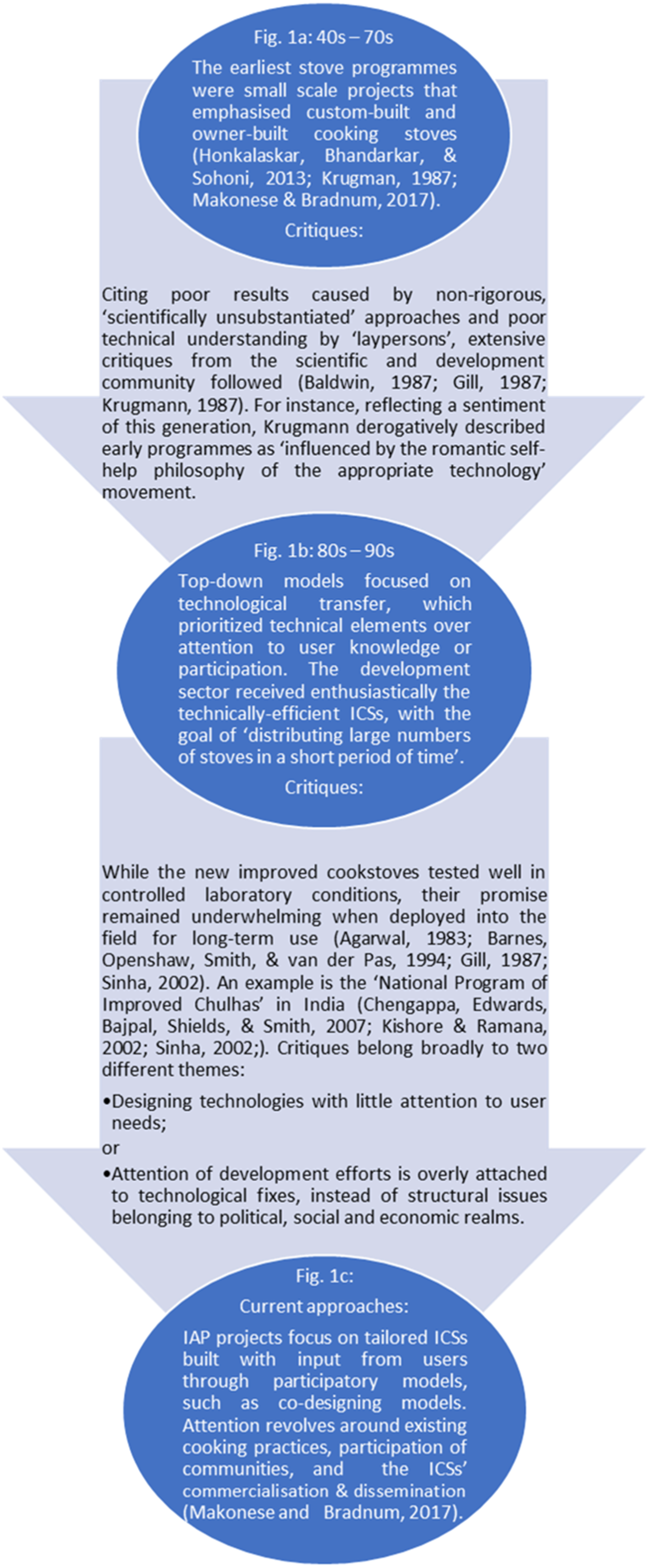
The role of those affected by IAP and of participatory knowledge in creating and implementing ICSs has changed over time (Figure 1). Users have had different configurations, spanning roles such as builders of ICSs in the earlier programmes (Figure 1(a)), passive recipients of standardised technology in the 80s and 90s (Figure 1(b)), or, more recently, users who can inform and participate in the design of ICS technologies (Figure 1(c)).
The 80s and 90s technically driven construction of ICSs with a top-down implementation, which failed to work in the field, received critiques heavily underpinned by participatory methodologies. The concerns raised in literature run broadly 1 along two different, and often competing, themes (Figure 1(c)). The first theme argues that the top-down approaches included insufficient participatory knowledge in the design and implementation of ICSs (Agarwal, 1983). These approaches framed technologies and their intended users in a dichotomous manner, whereby ‘science-backed’ technologies that are ‘perfectly well working’ and have obvious benefits, are misinterpreted or misused by adopters who are oblivious to their benefits (Irwin & Wynne, 1996; Leach & Scoones, 2006). Instead, critics emphasised the plurality of knowledge and democratization of expertise, including that of users, regarding technology and science making (Leach & Scoones, 2006; Sesan, 2014).
In the second theme, more critical forms of participation argue the need to shift attention away from a sole focus on technology, and towards political, social and economic forms of marginalization (Fine, 2007; Navarro, 2009; Mohan & Stokke, 2000), as well as the multi-faceted ways in which people lead their lives (Leach & Scoones, 2006). They dispute the notion that health is simply a biomedical matter that can be addressed in an isolated and formulaic manner by introducing a new technological solution. Ultimately, they aim to problematize what and whose is considered ‘relevant knowledge’ by questioning where knowledge resides: for them, participation is a methodology where ‘those who have been most systematically excluded, oppressed, or denied, carry specifically revealing wisdom about the history, structure, consequences and the fracture points in unjust social arrangements’ (Fine, 2007, p. 215). The consequent position is that change should be built around the wisdom and lived experience of those systematically excluded. In the case of urban communities, then, participation is a process through which they are actively involved in urban forms of governance, rather than simply a tool to address (health) concerns through technological innovations.
The two themes are often seen as antithetic and are placed in contention. The proponents of the second, critical theme, hoped to steer the health and development sector towards a more democratic, inclusive and structurally oriented development process, facilitated by critical and comprehensive forms of participation. However, they argue, the ‘development elites’ co-opted and assimilated their concerns into the first theme of participatory design to technologies (White, 1996). They argue that this form of depoliticized participation became a tool to re-impose an image of development focused on pre-set technologies and agendas, where ‘interventions become cheerful and sanitized advertisements for what usually end up being domesticated versions of participatory action research’ (Anderson, 2017, p. 428). For concerned participatory action researchers, these advertisements became ‘our discipline’s discursive fictions that aggrandize what are too often, in the end, cute, small, self-contained efforts’ (Glenzer & Divecha, 2020). Indeed, critics point out, one of the pillars which now legitimises and facilitates discourses maintaining that technologies should be the prime movers of development efforts, is that well-being and development is a question of designing and implementing technologies that are sensitive to, and incorporate users’ needs (Cooke & Kothari, 2001; Mosse, 2003). ‘User needs’ and the associated ‘participation’ were added alongside ‘international standards’ and ‘protocols for testing’ to the legitimising toolkit of these approaches in a move that very well reflects what Cooke and Khotari (2001) provocatively pointed at in ‘Participation: The New Tyranny?.’
Currently, participation in the IAP field has been embraced as the predominant recommended approach, and it appears to lean towards the first theme (Figure 1(c)). It focuses on including local knowledge, cultural practices, cooking needs and resources alongside technical efficiency in order to increase the acceptability and long-term use of ICSs, as well as a preference towards market-oriented approaches (Sesan, 2014; Honkalaskar et al., 2013; Global Alliance for Clean Cookstoves, 2018). As Makonese and Bradnum (2017) summarised: ‘It is now widely acknowledged that the following aspects are critical for the success of every cookstove programme: (i) participation of communities; (ii) determination of user needs; (iii) study of existing practices; (iv) mimicking field results in the laboratory – ‘bringing the kitchen to the lab’; (v) commercialisation and dissemination’ (referring to Honkalaskar et al., 2013)’ (p. 13). Under this widely accepted model, participation of communities and user knowledge are central for, but are also limited to, designing cookstoves fit for their context of implementation. This narrative illustrates White’s (1996) point on the assimilation of ‘participation’ by current development efforts: both critical participation and ‘lay knowledge,’ instead of being rejected in what might become a public debate, were included in technocratic development efforts, and in so doing, lost most of their transformative potential.
In this article, instead of siding in advance with ‘co-opted’ forms of participation or its critics, we will look at the micro-processes and practice of doing participatory design in an ICS project in Bangalore, the capital of the state of Karnataka, India, all the while attending to concerns towards ‘transformations’ for sustainability (Bradbury et al., 2019). Pursuant to the notion that participatory methods are introduced and interact in complex ways in the field, in this article we will shift our focus from investigating ‘technology within context,’ where narratives depict the creation of depoliticised technologies fit for user needs, to investigating ‘participation within context,’ where we look at how participation methods, and the actors they mobilise, work in practice within the urban spaces in which they are employed. It is indeed necessary to bring the participation model in the spotlight, not only in relation to developing ICSs, but scrutinise its position and translation, or alignment, with the ground realities and broad milieu of non-notified urban slums. 2 This is particularly relevant as the methods and principles upheld by the ICSs project of this study correspond to the current paradigm, or what is advocated as ‘good practice,’ in IAP reduction efforts. Thus, by interrogating the alignment between some of the central tenets and methods of participatory models and the lived experiences of participants, we aim to inform our own progress and involvement in the project, and furthermore, contribute to the debates on the role of participation in development efforts in general, and IAP reduction efforts in particular. To that end, we find it helpful to think alongside the following research question: ‘How does participation, as employed in IAP tackling efforts, unravel in practice, and what does it entail to align it with the urban, lived experiences of participants?.’
In we formed a multidisciplinary team of researchers with backgrounds in biomedical sciences, medical technology, anthropology, and science and technology studies (STS). Institutionally, we are located in The Netherlands. During the project we established collaborations and worked in Bengaluru (Bangalore) with multiple local and international actors. For the direct development of the ICS technology, we worked alongside the users, designers and engineers, translators, a cement manufacturer, and a community NGO representative with a long-standing involvement in the two communities who acted as a gatekeeper and facilitator. All these stakeholders were based in Bengaluru. We provide more detailed accounts in Ghergu et al. (2021). As our presence and priorities developed during the project, we established more relationships in the urban space of Bangalore, from civil society NGOs focusing on citizenship rights or access to health care, to research institutes and private hospitals in Bangalore. We will reflect on some of these interactions in this paper. The funding of the project was initially provided through a small budget of the university-based NGO ‘Health in Slums,’ and later it was secured through an NWO funding application (Dutch Research Council).
We initiated Project Exhale in 2014, in the backdrop of a re-evaluation of the IAP threat by the scientific global health community. Only months before the project commenced, the WHO had published a report proclaiming IAP as the largest environmental health risk globally, causing 4.3 million deaths annually, 88% of which occur in low- and middle-income countries (WHO, 2014). The report identified the smoke produced by cooking with wood, coconut shells and other biomass fuels on open fires or traditional stoves (or chulhas in India) as the main cause of IAP. While IAP is traditionally a risk associated with living in rural areas, the demographical changes in India highlighted a new avenue where research could contribute to tailoring solutions to IAP: urban slums. We started with a short ethnographic study in which we explored IAP and cooking practices in non-notified communities in Bengaluru (Bangalore). We recommended an approach based on user knowledge and context sensitivity when developing ICSs, as well as highlighted the need to respond to the socio-political uncertainties and vulnerabilities that pervade non-notified urban slums (Ghergu et al., 2016). As the problem definition crystalized within the institutional and financial scaffoldings of the project, which demanded specific deadlines and a clear intervention-outcome focus, the initiative stirred towards a model reflecting the current predominant IAP approaches which prioritise designing ICSs through community participation.
Bangalore, the city where we conducted Project Exhale, is an example of the rapid urbanising process in India, with its population skyrocketing to over 10 million people in 2017, when we stopped the part of the project we discuss in this article – a population doubling the number recorded at the turn of the millennium (The World Population Review, 2017). Its economic growth rate, among the highest in the country, is accompanied by high poverty standing at 32.6%, which compares poorly to urban India as a whole, and is characterised by a proliferation of urban slums and an increase in disparity of income across urban populations (Rajani & Goswami, 2010; RoyChowdhury, 2011). A large part of the population increase is attributed to migration: of professionals seeking employment in the sprawling IT sector and multinational companies, on the one hand, and of low-income populations driven by lack of opportunities and support in the rural areas of Karnataka and neighbouring states, on the other hand. As the monetary value of land in Bengaluru (Bangalore) is increasing at a fast pace, many of the latter settle in slums where they generally adopt, and adapt, traditional cooking methods.
Methods
The two communities where we implemented Project Exhale are relatively small, comprising approximately 80 and 100 families, and are situated in Peenya and Sumanahalli areas respectively, within approximately 12 km of the city centre. They embody the heterogeneity that pervades non-notified slums in the city, with differences in housing layouts and infrastructure, legal status, and access to amenities, among others (Ghergu et al., 2016).
The participatory methods relied on community-based initiatives such as prioritization workshops and interviews, as well as co-creation activities where designers, researchers and future users worked together to design ICSs, such as organising a community laboratory, photovoice activities and cooking trials (for a more detailed account see Ghergu et al. (2021)). Through these activities we started adjusting the traditional chulhas that participants already used, rather than begin with an entirely new technology. These methods were underscored by principles of the co-designing model in the development of technology (Sanders & Stappers, 2008; Szebeko & Tan, 2010; for an account of its history see Ghergu et al. (2021)). The co-designing model is well aligned with the current recommended participatory approaches of ICS programmes (Makonese & Bradnum, 2017). In addition to participation in technology design, we sought to establish community ownership over project processes, including aspects of accountability, and production and distribution of ICSs based on a market-oriented approach. Figure 2 provides a breakdown of the main participation principles that we aimed to uphold. Principles for PAR in Exhale.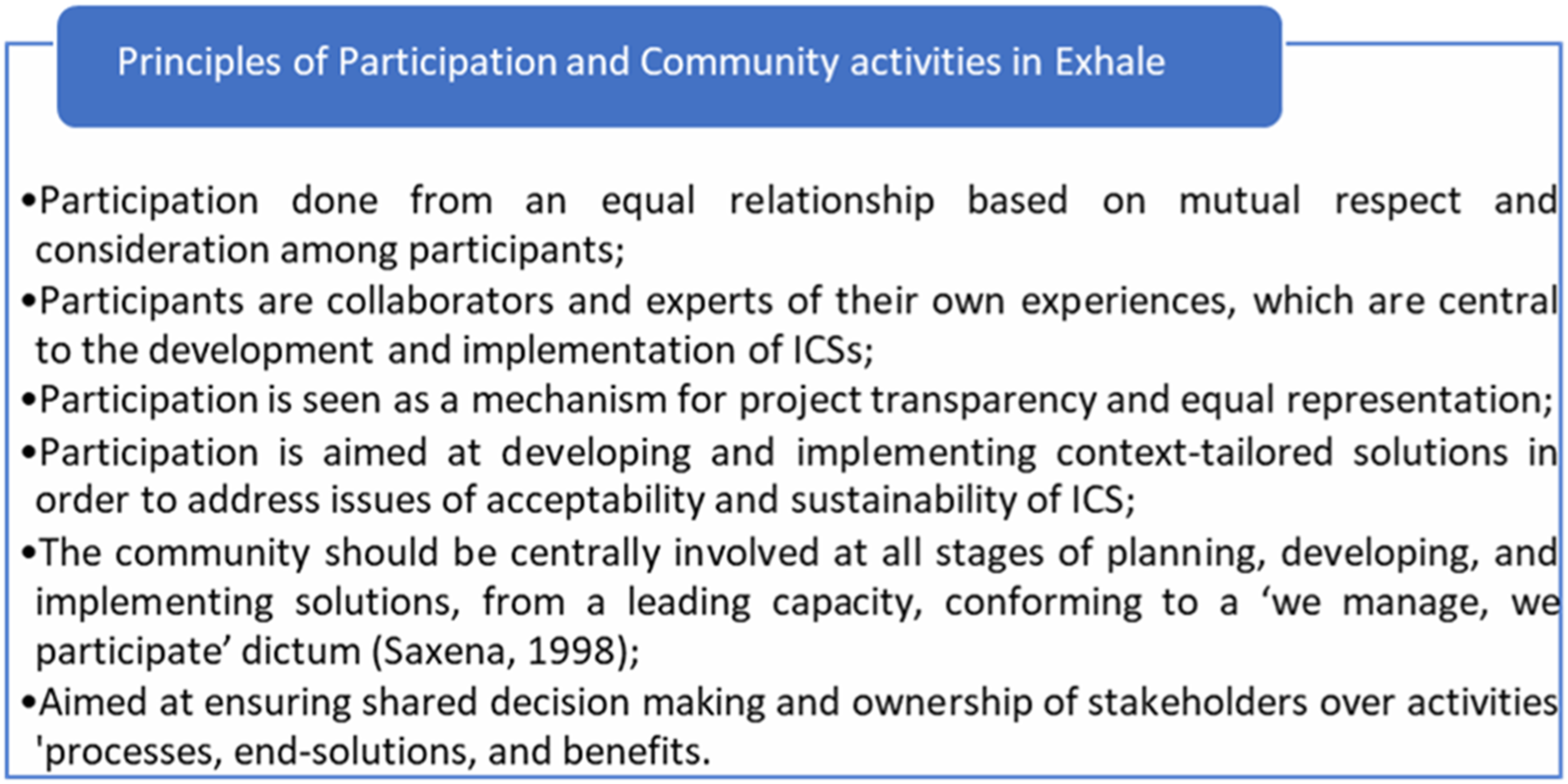
In order to explore how the principles of participation worked in practice, and how they aligned with ground realities, we draw from our experiences from the implementation of Project Exhale in 2015–2017. Throughout the project, we employed a cyclical approach consisting of iterations of observing, reflecting, planning and acting steps (Kemmis et al., 2014). These activities were action-oriented, employed to facilitate participation and knowledge sharing, with the aim to search for avenues for a sustainable implementation of the project and construction of ICSs. We can divide the overall development of the project in four main stages. The first stage consisted of contacting different stakeholders, including the slum communities. In the second stage we explored cooking-related aspects, prioritized people’s needs in relation to cooking and tried to collectively decide upon ways to achieve them. The third stage consisted of co-designing activities aimed at developing the ICS, and the fourth stage, consisted of finalizing the stove and implementing it at community level. Every stage was composed of multiple iterative cycles, and in practice the stages were non-linear with overlaps, repetitions, delays and skipping steps, contingent on needs and dynamism of the work.
In this study we direct our attention towards elements unveiled during our exposure, as entailed by the participatory model, to the daily lives and realities of living in non-notified communities, and the (mis)alignments between the model and these realities. We drew the data from observations, community forums, interviews, and informal discussions with the end-users as well as outside actors such as NGO and civil society representatives, and other private and public entities. While we employed methods such as semi-structured interviews and community forums to explore aspects related to IAP/ICS (Ghergu et al., 2021), in some instances our work divagated towards aspects that were deemed important by communities but fell outside the scope of Exhale. Instead of renegading as irrelevant, we will bring such initially unsought-after data to the forefront and reflect upon it. We pay specific attention to ‘moments of breakdown,’ as they may allow us to imagine different possibilities for our PAR approaches (Treacy, 2022).
In addition to participatory research literature, we draw from STS literature, which attends to the social contexts and work practices that make up sociotechnical arrangements and their knowledge claims (Engel et al., 2014). In doing this we localize as well as problematize our methods and presence as researchers in the project ensemble, rather than rely on the legitimacy conferred by epidemiological relevance and participatory methods of the intervention. Part of the problematization is an engagement with the often-unexplored enactments of power and silences. More specifically, try to account for the ways in which representations of communities and health-improving technologies in research and development projects are contingent on relations of power left unchallenged by technocratic forms of participation (Hickey & Mohan, 2004). To do this, we ‘reflect on the actual power relationships that are emerging in our AR’ (Friedman, et al., 2018) by showing how our participatory methods are done in practice, rather than only relying on rhetoric. We also draw from urban studies literature (Björkman, 2014), which helps us expand our analysis beyond the immediate spaces of our interactions in workshops, people’s homes, door frames and community alleyways, and ground them in the governance and urban spatiality within which people live and work. We recorded data in a rigorous manner and analysed it thematically.
Results
In this section we start by mobilizing two cases from our work in Peenya and Sumanahalli. While such cases would often be left out of studies focused on technology use and discrete health issues, we chose them to illustrate the complexities within which we employed participatory principles and methods. The cases are not meant to (impossibly) provide a full picture of the two communities, but rather they offer glimpses into the complexities that came to play a role in the project, and which mattered for its actors. By making visible how participation in context and in practice looks like through these cases, we were compelled to reflect on the ways in which we arrived at project priorities through participatory methods. We will follow up the two cases with detailing some of the microprocesses, practice, and negotiations done to create priorities within Exhale.
Case: The ‘dry wood initiative’ in Sumanahalli
In our quest for context tailored action we found that, as compared to the community in Peenya which acquired most of its biomass fuel from a nearby wood factory, an important source of fuel in Sumanahalli was gathering wood branches, coconut shells and tree bark from a forest area in the vicinity of the slum. This meant that during the monsoon period, the quality of fuel available in Sumanahalli decreased substantially, as the damp wood and coconut shells produced less energy and released more smoke when cooking. The housing structures allowed leakage of water and humidity through the walls and rooftops, thus further undermining people’s efforts to dry the wood by storing it in their homes. To address this Sumanahalli-specific issue, we planned a community forum in which we hoped to discuss with residents about possible ways to increase access to dry biomass fuel. Perhaps we could collaborate to build sheds to store wood for drying, or search for external sources of dry wood that could be tapped into.
Disease outbreak and other priorities
As we approached the community during the preliminary visit to raise awareness about ‘The dry wood initiative’ and enlist participants for the community forum, we observed that many people were ailing, confined to their homes with symptoms characteristic to dengue fever, chikungunya and malaria. For Exhale, this meant that we could not proceed with the community forums. However, for the many sick residents, it also entailed facing health emergencies with limited access to care, which also prevented them from working for a prolonged period. Without the support systems available to those employed in the formal sector, the situation posed a real and urgent threat for day-to-day incomes: “Sometimes he gets a full day’s job, sometimes a few hours. If he is well, he goes to work. If not, he does not. It’s like that.”
We decided to seek ways to address the disease outbreak, not only because it was preventing us from continuing co-designing activities, but also to assume our role in a relationship with the community based on equal standing and mutual consideration. Indeed, people expressed frustration and disappointment with the fact that they were involved in a lengthy collaborative relationship, where they contributed with time and expertise, yet, where they witnessed limited results by way of reciprocal benefits. The main consideration conveyed during these discussions was that they were still very vulnerable and facing risks unrelated to cooking, while at the same time we were proposing they engage in activities related to creating more efficient ICSs. For them, the priority of working in Exhale was reduced in the face of insecure day-to-day wages, transient housing arrangements, health crises and others. As a workshop participants put it, ‘forget about stoves’ and focus on electricity or diseases outbreaks. While people did see certain benefits of changing their cooking arrangements, as expressed during prioritisation workshops, other emergencies and priorities diminished, or shifted at times, their incentives and possibilities to participate and gain ownership in Exhale. For instance, during a community meeting in Sumanahalli, a participant described the changes that occurred in lighting infrastructure over the years, in relation to different stakeholders. Starting from having no lighting in the beginning, then moving to kerosene lamps, followed then by solar panels bought through an NGO around 4–5 years back, but which were subsequently not able to have maintenance for when the NGO withdrew its activities. Most recently the local councillor installed outdoors lamps around 6 months back.
‘Quick fix’ health camp and urban relationships
While trying to respond to some of people’s more urgent concerns we explored the possibility of conducting health camps. Over the course of Project Exhale, we helped organise four camps during as many monsoon seasons. Organising the first health camp in Sumanahalli entailed an exploration of possible partners, public and private, with which to collaborate. Unfortunately, by the time we identified a private hospital that could send a mobile medical unit in the slum, collected the required community demographics data and finalised the arrangements for the camp and its funding, the monsoon season was already subsiding. Due to the budget flexibility of Project Exhale, we were able to support the costs of the health camp and the required medicines and nutritional supplements. However, it was clear that this was merely a provisional solution, unsustainable for long-term, recurring risks to health. In fact, during the following monsoon season in Sumanahalli, the budget arrangements within Exhale had changed, and the costs for a health camp were not justifiable to the funding agency, as it did not consider these costs directly related to the project’s objectives to reduce IAP exposure. Fortunately, at that moment, the gap in access to health care was filled by a different organisation which specialised in conducting regular health camps in non-notified slums in the area. In Peenya too, after two years of being part of Project Exhale in Bengaluru (Bangalore), we were able to reach out to a growing network of partners and connect the community with an organisation that had the means to conduct fully funded health camps for the foreseeable future. While this was an improvement in people’s access to health care, it did not address long-term access to care, or other related factors contributing to ill health. The first health camp experience revealed that the residents of the community lacked documentation which would allow them to access Below Poverty Line (BPL) benefits which include, among other things, free or subsidised health care access. Furthermore, as they did not possess housing or land documentation, they were at risk of eviction or relocation, which would deter them from accessing the health camps set in the vicinity of Peenya or Sumanahalli. Rather than isolate these moments as discrete barriers to project implementation, we could place them within relations and infrastructures that made-up communities. Inter-related elements emerged, which allowed and worsened, disease outbreaks in the community, and shaped in important ways participation processes within the project.
Infrastructure
The main monsoon season occurs in Bengaluru (Bangalore) between the months April and September. During this period, the incidence of mosquito-borne diseases is expected to increase, as high levels of rainfall can provide a favourable environment for a thriving mosquito population. In Sumanahalli, the increase of the mosquito population was further exacerbated by the slum’s position at the base of a downhill area, which directed the flowing waters from the surroundings towards the community. In the absence of an effective drainage system to remove or redirect the water to a nearby canal, we observed numerous ponds of stagnated water clogging the unpaved, now muddy, pathways. Some of the earliest inhabitants in the area told us that the local authorities used to oversee maintaining the drainage system. However, with changes in local governance, the issue became ignored by local authorities and the drainage was not maintained and entirely defective. Similarly, aspects of community mobilisation proved to be equally important. During subsequent visits, we found that ultimately the community organised to deal with the urgent issue of flooding, by raising a community fund to clean and repair the drainage. In a similar vein, during the planning for the health camp in Sumanahalli, a respondent discussed one of the main ‘issues to be tackled is drinking water. (They) get water from (nearby) notified slum. After that community has taken their share, leftover comes to them’. These networks are developed over time – a woman told us that she has ‘been here for 26 years, with grandchildren in the local governmental school, […] and my sons live in the (notified) slum adjacent to Sumanahalli.’
Case one highlights how the project entered a space of comings together of ecology, governance, history, materiality, and the ways in which people live, mobilise and respond to the risks that emerge at these intersections. By focusing only on the ‘formal’ activities of the project, such as prioritization and co-designing workshops, based on formulaic participatory models, we can misalign our projects with, and obscure, more nuanced ways in which communities exert agency, come together, and (inter)act within the city networks.
Case: Peenya laboratory
In Peenya, our efforts to develop a community-based ICS project were also cumbered by poor drainage and infrastructure. Part of our work aimed at developing a context-sensitive ICS included creating community-owned spaces for collaborating, sharing knowledge and co-designing. One such space was a ‘laboratory’ set up in one of the vacated houses in the slum. There, we installed ICS prototypes which could be used and tested by people at their convenience. We were well into the co-designing process, with the laboratory running for a few months, when the workshops were discontinued, following a particularly rainy day which flooded the laboratory and the ICS prototypes. A nearby canal, in the absence of maintenance and a waste removal system, was clogged with debris and garbage and was unable to contain the heavy precipitations, overflowing into the more marginalised, transient area of the slum, where the laboratory was installed. This was not an isolated incident: advancing into the monsoon season, the laboratory and neighbouring houses were regularly under a level of water sometimes reaching as high as a meter and a half. The floods continued for more than 2 months, and while Exhale had to suspend its participatory laboratory activities, the community itself faced threats from mosquitoes and polluted water from the canal, which was also used for defecation in the absence of a sanitary system. Water entered homes, rendering entire families vulnerable to disease and numerous sleepless nights. We learnt that during floods many families relied on networks within their locality to find shelter, such as workplaces and unused factory buildings. Faced with such emergencies, they were less available or willing to participate in Exhale activities. Looking for a quick solution proved unsuccessful, as upon speaking with local constructors, we learnt that the floods could not be tackled at house level, but by cleaning, repairing and maintaining the canal, which entailed a larger-scale intervention.
Transience
The elements illustrated so far, spanning poor infrastructure, sanitation, work security, diseases, health care access, and the ways in which the two communities interact with other actors, from industrial stakeholders of Peenya to local NGOs and authorities, are further rooted in the transient character of the communities, and their criminalisation and labelling by local authorities as non-notified slums. Living was pervaded by a sense of insecurity of housing and work. Despite some families living there for as long as over 10 years, they saw their current circumstances as provisional, transient. Respondents were constantly mindful of having to relocate in the foreseeable future. The more favoured scenario was moving to different areas in subsidized housing provided by the local government, although doing so carried its own risks, such as lack of work availability and increased travel and living costs. Other causes of moving were searching for work, or forced evictions by local authorities: ‘If they’ll keep us, they’ll keep us, otherwise we’ll have to move somewhere else.’ Transience affected project processes in very visible ways, such as difficulties to establish long-term collaborations and following-up with participants.
The demolition of a third of the slum in Peenya, including the laboratory, was a blatant example, and a materialization of people’s sense of insecurity and precarity. It also highlighted how different parts of the community had different histories and relations with other city actors which shaped the ways in which people lived. Its histories include an episode when the settlement burned down, and was subsequently re-built through efforts by the community and local authorities, an NGO, and a cement company from the neighbourhood which also employed workers from the community. The infrastructure and organisation of the settlement carried this history, as more standardised concrete housing aligned in rows replaced the initial heterogenous housing and pathways. A later episode involved enlisting people for relocation in a ‘rehabilitated settlement,’ secured through the community’s involvement and negotiations with the same NGO, a local Member of the Legislative Assembly, and the Karnataka Slum Development Board. Accordingly, until they were provided with alternative options for housing, ‘the enlisted’ were granted a certain level of security against evictions. At the time of Exhale, the community consisted of those enlisted as well as people who had missed the ‘cut-off’ point for enlistment and therefore had a very different experience of housing precarity. And since the private landowner was making appeals to the local government to vacate the land, approximately a third of the community were evicted and the houses demolished to avoid re-inhabitation. A shop owner who lived in Peenya discussed with us these complex relationships within the community. She described how the more precarious residents were also ‘contacts of old residents, […], and that they will want to continue living together’. The eviction came with uncertainty, as some will ‘move to empty houses elsewhere or will put up sheds on construction sites’ while others ‘the first row, facing the school, no money – nowhere to go. Trying to construct houses in the other half of the slum to accommodate them.’ This exemplifies how we entered a network of different actors, with different agendas, interacting in, and shaping, a space broadly categorised as ‘non-notified.’ The demolition of houses also destroyed the community lab, which was a common space used for participatory activities and was created alongside the participants, a physical representation of the effort they and other stakeholders put in the project. Moreover, as one third of the community was evicted with barely a night’s notice, including participants in Exhale activities, their ties and relationships built within the project were discontinued.
Making and negotiating project priorities
The cases above aimed to highlight the alignment, or lack thereof, between the participatory model and the context of its implementation. An important part was aligning the ‘needs of the project’ with ‘the needs of participants.’ Despite participants’ emergencies, needs, and priorities emerging in an unpredictable, heterogeneous manner, we were engaged in a process of establishing with participants what we hoped to be well-consolidated and uniform project priorities. It is useful to pay closer attention to the micro-processes through which priorities in Exhale became, at least in rhetoric, cemented as commonly held priorities. Prioritization workshops were often referred to as an important moment when we established community needs collaboratively. During the workshops, we used ‘visual cards,’ among other tools. The images on the cards depicted possible priorities for the project and ICS, such as smoke, costs, cleanliness, and comfort, and came primarily from community photo voice activities. During the workshop, participants used them to discuss and hierarchize their needs – dealing with floods or housing security were certainly not on any of the cards. The assertion that communities were involved in creating the cards needs to give way to a closer analysis of the process of creating them. First, in setting up the photo voice activities we asked participants to photograph cooking-related aspects such as smoke or cooking habits, which, by then, we had already made visible during our long-term presence in the community and discussed during semi-structured interviews and which provided participants with a strong indication of what we regarded as important. As one participant mentioned, she remembered she ‘first saw us watching someone making roti in one house.’ Second, given the high volume of photos received, we had to ‘filter out’ the irrelevant from the relevant (i.e. cooking related images). Thus, the process of ‘focusing’ on specific priorities was one continuously in the making, rather than being confined to the prioritization stage of the project. During the workshops, some participants did argue that we should focus instead on electricity or other issues that they found important. However, while we acknowledged their comments, these diverging priorities ultimately disappeared from the ‘final’ lists, a result which may have very well deterred people from further expressing other concerns. Consequently, the final lists were ‘just right’: they were slightly different for each of the two communities, indicating a tailoring of the project to their particular needs, yet stable and ‘workable’ for the specificities of a participation model centred around an ‘apolitical,’ technology-oriented solution. The technology itself and its priorities, as well as the participatory methodology, operated within the institutional workings of our university-based organisation. For instance, they played an important role in securing further funding for an RCT project. As someone from the team mentioned, this RCT study is ‘building upon the results that we have obtained’, where the finalization of the ‘co-creation process and the ease of use by slum dwellers’ is followed up directly by a longitudinal RCT. Put in this light, the process might seem manipulative or ill intended, yet this is a retrospective reflection upon a very dynamic and internalized process within which we were engaged and that appeared to be suitable. We argue that such approaches are more common than not, and it is their gradual embeddedness in norms, literature, models, ideas, institutional workings and regulations, that facilitate them.
Throughout the project, priorities and actions were further negotiated, in light of the many unforeseeable events that came up, as well as the unintended consequences of our presence in the field. The uncertainty, in the form of many crises and alternative priorities of communities, often resulted in changing project timelines, plans and activities, such as delays or organising health camps or establish other collaborations to address emerging matters of concern. Among some of the other initiatives, the ones that ‘made it furthest’ were attempts to address electricity needs by teaming up with a local organisation, as well as an initiative to organise a (mostly local) multi-stakeholder, wider-ranging collaboration, aimed at addressing community needs in a more comprehensive manner. As a project leader verbalised it, ‘build a local network to tackle local issues, […] join forces, choose specific areas and start working.’ The electricity initiative was eventually left unrealized due to the project’s inability to redirect temporal and financial resources towards it. Equally, the wider-ranging initiative was difficult to lead to completion. During a conference organised by our university-based NGO in 2016 to establish such a wide-ranging collaboration, a representative of the Institute of Public Health in Bangalore, discussed the challenges of such alliances: ‘a similar initiative a few years ago fell apart in a year, because of prior priorities and prior engagements (of the different partners).’ This 2016 wide-ranging initiative was equally difficult to sustain, but ultimately it proved to have helped by way of establishing a platform for knowledge sharing and smaller scale collaborations. The unintended consequences of the project were as difficult to address as the unforeseeable events. They expand beyond the physical and temporal dimensions of the project, and possibly alter relations in the field and the networks that make up the communities. In a few cases they were more readily visible, such as the realization, at which we arrived after beginning ICS installations, that the housing material we were altering for the installations was not cement only, but asbestos, leading to another sudden interruption of the project. Thus, in our attempts to reduce exposure to air pollution we unintendedly exposed communities and fieldworkers to a different hazardous substance, before ceasing activities in order to look for ways to address this. Following the demolition of the community laboratory by local authorities, we took the project and the finalization of the ICS outside the community space, into a ‘safe’ laboratory, and other unintended consequences or unforeseeable events in the community could not travel into this study.
Discussion
Problematic implementation, doubtful sustainability
In this study we set to explore ‘participation within context,’ where we looked at how participatory methods, and the actors they mobilise, work in practice. We aimed to explore the project’s alignment, within the ground realities and broad milieu of non-notified urban slums, accompanied by the research question ‘How does participation, as employed in IAP tackling efforts, unravel in practice, and what does it entail to align it with the urban, lived experiences of participants?.’
The co-designing model helped us ‘develop a user-centered technological solution acceptable for the community’ as explored in a previous publication (Ghergu et al. 2021), thus addressing some of the concerns regarding the acceptability and usability of ICSs emphasized in much of the IAP literature. However, throughout the project implementation, we experienced multiple moments of breakdown when crises posed challenges to, and highlighted limitations of, participation as employed in Exhale’s co-designing model. Participants’ lived experiences included floods, disease outspreads, limited access to healthcare, irregular and precarious income, and demolitions and evictions. These phenomena impacted project activities directly, as they relied on safe spaces for collaboration, long-term follow-up with participants, and continuity and presence in the community. Beyond impairing the implementation of activities, they had profound effects on the nature of collaboration within the project. They made it difficult to build rapport with communities, nurture equal standing of actors within the project, and develop community ownership over project processes and outputs. Participation became limited, fragmented and disincentivized, often alienated from the realities of the community. We failed to escape the irony identified by Kirsch (1999) in that adopting research methodologies seeking greater intimacy and increased collaboration among researchers and participants, researchers ‘may inadvertently reintroduce some of the ethical dilemmas they sought to avoid: potential disappointment, alienation, and exploitation of participants’ (p. 26). The answer, we argue, is not going back to non-participation but to move IAP approaches towards participatory models that can better respond to the challenges and uncertainty that may arise in the field. As Dona (2007) points out, ‘most criticisms of ‘participatory research’ are vocalized with the aim of improving, not discarding participation’ (p. 217).
The long-term presence and exposure of the approach to communities’ realities also revealed some of the in-context elements that could drastically reduce the long-term use of even technological solutions that are viable in terms of cooking practices and needs, fuels used, and types of cooking spaces. Over time, participatory activities, perhaps the most notable being the community lab, acted as mirrors reflecting threats to project sustainability: seasonal floods could damage and impede the use of ICSs, overnight demolitions could destroy them or lead to radical changes in living conditions whereby the ICSs would not be suitable for use anymore, and short-noticed evictions would make long term access and use difficult.
Widening the scope
In a few instances, project flexibility allowed us to address some of the emerging crises. We were, for instance, able to provide relief during disease outbreaks by providing medicines and connecting communities with organisations that can conduct health camps. This smoothened participation in Exhale to a limited extent and improved our standing with the community. Limited, because the efforts were not only slow, as they depended heavily on building networks with other actors outside the sphere of IAP, but they were generally ad hoc responses to crises, which failed to tackle and consider structural processes underlying these incidents. By focusing solely on the manifestation of crises, we committed the same fallacy as, to employ Tierney’s critique, much of the classical disaster research did in separating disaster events from their larger societal timeline and from their social, cultural, political, economic and environmental milieus (as cited by Marlowe et al., 2014; also a topic addressed in Fortun et al., 2017). During Exhale, such an example were mosquito- and water-borne diseases outbreaks encountered during the ‘Dry wood initiative.’ In the absence of adequate drainage systems and housing structures, monsoon rains flooded the communities and people’s homes. Such poor infrastructure is often associated with the transient living of groups classified as non-recognised slums by city governing authorities (Nolan et al., 2017; Subbaraman et al., 2012). Poor control mechanisms contributed to an increasing mosquito population, while lack of sanitary and waste removal systems provided a fecund environment for the spread of diseases through the medium of water. Limited access to health care and social support schemes contributed to people’s difficulties to combat diseases. This, in turn, made it difficult for them to provide for their families for extended periods of time, as most rely on a day-to-day income, with no regulated financial safety nets.
These examples are by no means an attempt at providing an exhaustive list but are merely aimed at providing an impression of the interplays between elements at local, national and global networks that contribute to shaping health outcomes, and more generally, lived experience in non-notified slums. Such networks include interactions of communities within urban spaces (Das & Walton, 2015), various patterns of rule and relations of governance (Björkman, 2014), and processes of urbanisation influenced by a neo-liberalising India (Rajani & Goswami, 2010). Bhan (2016) and Bjorkman (2014) provide compelling arguments that dispel notions of slums’ informality as a self-evident state of being that simply exists out there - outside of urban planning or legality. Rather, they argue, such categorizations are produced and reproduced through historical, economic and politically laden processes, such as the creation and implementation of urban plans (e.g. ‘The Revised Master Plan, 2015’ released by the Bangalore Development Authority, 2007), which engage multiple actors and manifest heterogeneously in their production of city spaces. While these aspects may seem well outside the scope of ICS projects, our experiences show how inescapably these elements are part of people’s lives, and consequently, shape participation processes and technological artefacts. When projects ‘enter’ communities, with their envisioned technologies and participatory processes, they unavoidably enter broader, complex networks within which communities are engaged. The demolition and evacuation of part of the slum, illustrated in the Peenya laboratory case, bore heavily upon participation in Exhale, and is an example of such interactions. The event revealed group dynamics and divides within the community, between families who moved in the slum before and after the cut-off date, and engaged networks comprising civil society, the private landowner, and local authorities. For Exhale it entailed, on the one hand, that many project participants were evicted overnight, debilitating long-term collaboration, as well as losing an important space of co-creation in the community. On the other hand, the protection from evictions for the rest of inhabitants conferred a level of certainty that project implementation will continue, albeit with only part of the initial community. We could observe how the project priorities and use of technology worked only for some people and only at times, as infrastructures and networks within the community allowed or denied spaces for the project. One clear dilemma is that in the process of creating a narrative about ‘developing a stove fit for use and based on people’s needs,’ we constructed a unitary vision of a ‘stove-using community’ which failed to grasp its heterogeneity and multiplicity.
A closer look at misalignments
In the introduction of this article, we offered a brief account of various framings that IAP projects have historically taken. A running concern of these framings is related to ideas about whose and what knowledge counts. We suggested that the current dominant view in IAP projects proposes participation as an approach to overcome past limitations of interventions that relied solely on technical experts’ knowledge. However, by referring to critiques to the ways in which participation is carried out in practice, we have set out to problematize and analyse participation in context, rather than looking only at its showcased outcomes (i.e. stoves).
We can start by geographically and temporally expanding our gaze, from our interactions with the two communities (i.e. cooking interviews and prioritization workshops), to the broader institutional ecologies and infrastructures making up the project. An increasing epidemiological interest in the IAP issue consolidated by timely WHO reports, narrow interpretations of health risks and solutions mediated by technical participatory models, timelines, employment contracts, project funding, and publications, among other things, constituted the goals and temporal boundaries within which the project would work. In looking at how these boundaries were enacted in practice, we can mobilize Bogner’s work (2012). Bogner noted how ‘invited participation’ for public engagement in debates on technology is mediated by ‘participation experts’ in what he called ‘participation as a lab experiment.’ By paying attention to micro processes, he observed how participation is approached as laboratory work: variables are controlled, hypotheses are tested, and deviations such as participants’ alternative views are circumvented. Thus, he points to participation’s ‘methodologically controlled design,’ as well as its ‘isolation from political and life-world contexts.’
In Exhale’s collaboration, the problems of interest (e.g. related to IAP) were often implicitly enforced through methods employed in the field such as questions addressed during ‘cooking interviews’ and prioritization workshops. These participatory activities allowed us to broaden the problem definition, from a focus on exposure to air pollutants, to considerations of fuel availability, discomfort, house cleanliness, space limitations and others (Ghergu et al. 2021). In other words, we attended to the predominant recommendations in current IAP and ICS approaches. However, ‘prioritization workshops,’ while they were meant to allow participants to set project priorities, only permitted community priorities to become ‘relevant’ if they fit within the pre-defined boundaries set by the project and its wider network. Concomitantly, these methods served to marginalize other concerns that the community might have had. In the everyday reality of people living in these communities, the boundaries of the participatory model served to disconnect elements that are, in actuality, inseparable. As seen, the results were twofold: a problematic implementation and doubtful sustainability. In this regard, Freire’s warning against those who enter communities with answers rather than questions is not only as relevant now as it was in 1970 (in Anderson, 2017), but it merits revisiting. Warnings, and their accompanying scrutiny, need to be extended onto those who come bearing questions too. The ‘imagining of different futures’ or of ‘alternative visions of development’ becomes shallow when outside implementers are the ones controlling the images (i.e. visual cards) and the questions. Paradoxically, the actors’ engagement in an unequal power relationship was perpetuated by the very boundaries of the participatory, co-designing model. This tension turns the vision of equal participation espoused by the project into a well-intended but empty notion at best, and a self-legitimizing tool with potential harmful, unintended consequences at worst.
While Exhale enforced boundaries onto the field in ways resembling Bogner’s reflections (2012), we also exposed our ‘methodologically controlled design’ of participation, which served to ‘isolate aspects that are in actuality inseparable,’ to the actual life-world contexts of participants. In this process, the participatory model persistently aimed to enforce its framework, and time and time again our attempts were upset by the fact that the context is inherently complex, and broader considerations transgressed the boundaries of the project. Floods, evictions, and disease outspreads invaded the boundaries of Exhale in a physical and forceful manner. Many activities were conducted within the slum spaces, and were contingent on the social, physical and political infrastructures of communities. As we noted earlier, in this process the laboratory (and other activities) took on the quality of ‘mirroring society,’ if only for a short time. Thus, misalignments became visible at the intersection between the methodologically controlled design of the participatory model and the complexities and uncertainty of participants’ worlds. In this sense, the demolition of the lab by local authorities was a powerful indication for the feasibility of controlled participation and the sustainability of the technological intervention: control remained only in narrative when our lab was destroyed.
These moments of ‘upsetting,’ or breakdown, provided an opportunity to re-assess and re-negotiate the boundaries of whose and what was considered relevant knowledge in the project. Participants would point out to more pressing needs, and we would explore other possibilities for action. These moments of visible misalignments opened spaces for ‘second guessing’ the justification of the project (Stirling, 2008). Along the same lines, Williams (2004) argues that the critics of co-opted participation often fail to recognise that ‘any configuration of power opens up their own particular spaces and moments of resistance’ (p.94). However, it was difficult to make use of moments of ‘second guessing’ as levers to move the project towards the emergent needs and priorities of participants. The boundaries and project logic were entangled institutionally and infrastructurally with aspects such as the timeline of the project, the earmarking of funding, project and institutional-ingrained ideas about relevant knowledge, resources made available, contractual and accountability arrangements between multiple stakeholders, including the university, funding-related actors, designers, researchers and the community ‘gatekeeper,’ were all embedded in the participatory model and its decision-making processes and activities.
Working within these pre-set and deeply entangled boundaries led to labelling factors that fell outside the purview of Exhale as inconsequential, or as barriers to participation in cases when they ‘intruded’ upon the activities of the project. Thus, they were disregarded, avoided, or dealt with swiftly in order to return to the topic of interest-building user-friendly ICSs. Ultimately the ‘methodologically controlled design’ prevailed, and instead of further pursuing the potential of the lab to act as mirror of society and steer the project accordingly, we withdrew in a ‘safer’ lab, outside of the community space to finalize the ICS in a timely and controlled manner. This decision appeared justified as the rational, natural way to continue the project, as by the time of the demolition we had already gathered ‘enough’ knowledge to build an acceptable, user-friendly ICS. There seems to be a clear contradiction between seeing these aspects as barriers to participation and the view that participation can be a tool and process through which communities address issues that they have reason to remedy. In Coates’s (2015) view of the ‘conscious community,’ crises can be a catalyst through which participation becomes embedded in the cultural, spatial and social elements that create a ‘good local community.’ The paradox of participation in Exhale is that multiple factors such as flooding, insecurity, avoidable morbidity, which are seen as preventing participation from becoming an embedded part of the community, are the actual factors that could, and indeed should, reinforce participation in becoming a stabilised element within the community. And in some moments we saw this outside of Exhale, for instance when people mobilized to clean and repair the drainage system.
Such in-the-field misalignments are not limited to ICS projects in urban areas. Khandelwal et al. (2017) share their experiences from rural Rajasthan where ICS are hardly seen as what is needed by local women in the face of poor access to clean water, food or electricity: When IC(S) programs consult rural women, it is to secure their compliance or to ensure success of the intervention rather than to engage with them as agents who can speak on equal terms with elites […]. If donors are convinced that IC(S) are the solution, then organizations they fund to implement them will not ask whether women want them at all; nor will they build women’s abilities to demand, as citizens, improved health care or protection of environment. (p. 21)
These concerns related to ICSs implementation are good companions to warnings around loosing critical developmental reflexivity, where those engaged in action research ‘can unconsciously replicate the very structures they seek to transform (Riedy, et al., 2023). Even if we adopt in our analysis a pragmatic approach and a mitigation of expectations as recommended by Mosse (2003), we experienced the few known, and guessed at, the multiple unknown ways in which a solely technological project can go ‘Up in Smoke’ (title by Hanna et al., 2016), and rather than building stoves we might very well have burnt bridges with the participants we have worked with.
Conclusion and final food for thought
The current most common IAP approaches based on co-designing technologies run the risk of misalignment with the realities of their intended users, because they implicitly take for granted aspects of infrastructure, citizenship or governance, and ultimately limit participation and knowledge-making to aspects of cooking and technology ‘usability.’ In doing so, Exhale constructed a narrative whereby participatory research has led to an ICS which complies to a reasonable extent to the needs and wishes of participants, while obscuring other things that mattered. Our reflections here aim to problematize such clean versions of development, by looking at the micro-processes of participation and their construction of ‘needs/priorities,’ as well as place them visibly in the urban and global networks within which stakeholders, including ourselves and the participants, are part of. We drew from cases made by both proponents of ‘mainstreamed participation’ and their critics. We agree with Leal (2007) who advocates for a re-articulation of participation, to serve broader struggles. But at the same time, we do not want to deny the potential of participation to address aspects such as IAP, which remains a major source of ill health. ICSs may very well have a place in people’s lives, and we saw how for some parts of the communities, at times, sufficiently stable urban networks and infrastructures allowed stable needs and spaces for the technology as well. However, in showing the complexities and uncertainties within which we introduced project Exhale, as well as its unintended consequences, we argue that they need to become more actively part of the projects’ boundaries. Or more precisely, deciding the boundaries of whose or what knowledge is deemed relevant, needs to be an active part of participatory processes. By arguing for an expansion and malleability of the boundaries of participation, we prefer to avoid dichotomising between the critical and co-opted participation, or between political and technological models of participation. The political and technological are unavoidably already intertwined, and prioritizing the former, while manageable on paper and in narratives, will ultimately prove to be a disservice in practice.
Expanding the scope of participation is not only a matter of changing or broadening focus and practice in the field – it entails structural changes within the project itself. Similar to interventions’ initial design and implementation, processes of change within projects are subject to contingency, agency, and power (Stirling, 2008; Williams, 2004). In their undivided attention to technology making and distribution, participatory models often forego the fact that the ‘work activities of science and technology occur within organizations and under institutional constraints’ (Smith-Doerr, 2017, p. 696). Participation is entangled with norms, literatures, models, ideas, institutional workings and regulations, as well as timelines and resources. Yet these are rarely scrutinized or open for change, unlike participants’ behaviours and technologies. How would a participatory process that opens up some of these entanglements look like? By highlighting the misalignments between the participatory model and the realities of participants we start glimpsing at different possible directions for change. In 1998, Blackburn and Holland asked a very good question of participatory approaches: ‘Who changes?.’ We argue that if tackling IAP through participation remains isolated and isolating in its underlying assumptions about development, it risks continuing a path where the ICS sector draws increasing resources and support, while interventions keep running the risk of misalignment with people’s realities. As Subramanian (2015) was told in dialogues with a person from the ICS sector, ‘despite good intentions,’ ‘everybody makes money, but the problem does not get solved’ (as cited in Khandelwal et al., 2017, p. 22). We hope our experiences and their tying-in existing debates about participatory approaches can engage readers in discussing whether sole technology and behavioural changes for users are the ways to move forward.
Footnotes
Declaration of conflicting interests
The author(s) declared no potential conflicts of interest with respect to the research, authorship, and/or publication of this article.
Funding
The author(s) disclosed receipt of the following financial support for the research, authorship, and/or publication of this article: This work was supported by the Netherlands Organisation for Scientific Research/ Nederlandse Organisatie voor Wetenschappelijk Onderzoek (NWO-STW) (grant number 076-000051).
