




Abstract
Non-governmental organisations have several mechanisms in place to facilitate learning with and from communities they intend to serve, however these do not always realise authentic participation and meaningful programmatic adjustments. In a participatory research in Central-Eastern Uganda we investigated how the community believes collective learning with NGOs could best be shaped. In this paper we present findings as well as reflections on the learning spaces that emerged in the research and how one could assess whether collective learning is a transformative practice. We offer a conceptual framework NGO practitioners can use to enrich their collective learning toolkit as well as to track and trace small shifts and changes happening in learning trajectories in order to lobby for resources to allow collective learning to happen more authentically, through increased presence and informal interaction with communities.
Keywords
Introduction
I think you have also heard from the youths themselves, there hasn’t been any programme designed for youths that has succeeded. They come and call us to meetings, we dedicate our time, but in the end the programme does not succeed. (Faith, youth, community-NGO meeting)
Faith speaks in a community meeting attended by several non-governmental organisations (NGOs) that operate in her locality. In Uganda, where multidimensional poverty is experienced by forty-seven percent of the people (UNICEF, 2020), a large portion of the population relies on non-governmental or private services for livelihood development, health, or education. In 2019 the government reported around 14,000 NGOs were registered in Uganda (Niba, 2019).
That the number of NGOs operating in Uganda is large can be noticed in Faith’s village where, in 2018, we identified eighteen NGOs – largely unaware of each other – implementing a variety of development interventions. If there are so many NGOs injecting resources and support into a single locality, then why does a young person such as Faith still experience their efforts as a failure? To ensure their programming is relevant and effective, NGOs tend to adopt a variety of methods to facilitate learning processes involving the people they intend to serve (Chambers, 2010; Guijt, 2010; Ramalingam et al., 2014). However, research also shows that these learning processes are often constrained by competitive funding mechanisms promoting short-term targets and limited overheads, encouraging practitioners to act risk-adverse (Edwards, 1997; Ramalingam, 2013). Blaak (2021) highlights several ways in which NGO practitioners navigate these constraints and how they shape spaces for more participation of people affected by poverty. In this paper we shift the perspective from actors whose work it is to “get development interventions right” to the people who are meant to benefit from the NGOs’ services.
We present findings of a participatory research conducted in a village in central-eastern Uganda in 2018. In this study we investigated how members of this village experienced their relationship with NGOs that intended to tackle various poverty domains and how they thought collective learning could be more effectively shaped to ensure better alignment to their lived experiences and needs. From the community perspective we present recommendations for NGOs and using a field theoretical lens, we analyse our participatory research and identify what shifts we observed in social relations, meaning and actions. Finally, we reflect on how such conceptual frameworks can support NGOs in facilitating collective learning reflectively.
Viewing collective learning spatially to enhance agency
If collective learning and participatory approaches to development are accepted as good practice – then why so often do practitioners feel stuck in effectively executing these processes? Anyidoho (2010) and Cornwall (2002) portray collective learning as a delicate practice, and encourage facilitators to be mindful about the situated nature of learning, the role of power and heterogeneity of communities. However, simply addressing the skills set of development practitioners may not be sufficient. The field of development, with its funding mechanisms, relationships between NGOs, communities and funders, and meaning giving processes, does not always favour authentic learning with communities affected by poverty (Blaak, 2021; Ramalingam, 2013). For example, the pressures that came along with the accountability wave in the field of development incentivise a focus on pre-set theories of change and quick results (Guijt, 2010, Ramalingam, 2013). For practitioners in the field of development, the “way things work” at first glance may look unnegotiable. In our view, field theory (see Bourdieu, 1977, Lewin, 1939) offers changemakers conceptual tools for more authentic spaces for participatory development approaches.
First, by analysing how fields are shaped, actors in the field of development are not left powerless but they can – through their actions and interactions - contribute to new relationships, meanings and even shift capital and power dynamics. Though abstract at first, in her participatory action research Marit and NGO practitioners experienced that field theoretical concepts such as social fields, rules of the game, power dynamics and agency offer a sense of power of the situation – opening up new possibilities amidst complex situations (Blaak, 2021). This field theoretical perspective positions collective learning as a possible force to reconfigure the field and push perceived limits to action. In this paper, we conceptualise collective learning as spaces wherein actors come together to collaboratively analyse information and through interaction revise beliefs, assumptions, meaning and action strategies (inspired by Lipshitz et al., 2007). Collective learning spaces, thus, can form fields too with alternative (power) relationships, meaning giving processes and capital distribution. And as such collective learning can cause change and reconfigure elements of the field (Cornwall, 2002, Friedman, 2011). Friedman (2011) differentiates six pathways of change as a result of learning, ranging from pathways that reproduce or transform the status quo Four of these leave the field in tact - differentiation, knowing one’s place, migration and emigration – and help people find their way in existing fields (see Friedman, 2011 for a detailed description). Two trajectories create new fields. One is forming enclaves: a temporary or localised field with new governing rules emerges within an existing field. The other is transformation: reconfiguring an entire field.
Besides offering a sense of power and agency to change the field, field theory also offers a vocabulary that helps capture learning outcomes that are usually “missed out” in monitoring and evaluation frameworks used by NGOs. To locate various results and to identify who benefits from these results and in what manner we use the cycles of value creation of Wenger et al., (2011). The cycle of immediate value draws attention to the value inherent to participating – such as having fun or meeting people. Secondly, there is potential value in form of knowledge that could facilitate change in future. Third is applied value, leading to change in practice connected to the fourth – realised value referring to improvements in performance. And lastly reframing value whereby participants redefine success. Together, these concepts help evaluate learning for its influence on the status quo.
Third, by viewing collective learning spatially, several dimensions surface that help characterise the learning spaces itself and how these emerge over time. Cornwall (2002) for example suggests two dimensions: the temporal dimension and location of impetus. The first refers to the duration of a space; is it a one-time event or is it institutionalised and recurring? The second dimension describes who sets the agenda; it can be those in positions of power extending an invitation to participate or it can be a grassroots effort. Lipshitz et al., (2007) introduce multiple characteristics of organisational learning mechanisms (OLMs) that could also be used to describe collective learning spaces. For example, OLMs can be formal or informal; some are spontaneously emerging and others are intentionally designed. They also differentiate OLMs are embedded in primary work processes from those that stand on their own. Lastly, they characterise OLMs through the participants; be it internal or external actors. Cornwall (2002) argues that by being aware and intentional about these dimensions we can more effectively strengthen participatory spaces. Before we explore the utility of these conceptual tools for NGO practitioners and other actors in the field of development, we describe our research methodology and share perspectives of the community members on how spaces for collective learning should be shaped.
Methodology
This paper presents a sub-study of Marit’s PhD research on organisational learning in education NGOs. Sophia participated in this research as an NGO representative and Jacques as research supervisor. Using a Participatory Action Research (PAR) approach, Marit facilitated cycles of action and reflection with an NGO working in Central-Eastern Uganda. Reflecting on their practice, the NGO team realised some of their collective learning efforts were ineffective and asked themselves: “how do community actors prefer to be engaged throughout the project cycle?” When Marit and the NGO team reflected on how to investigate this further, two dilemmas related to authentic participation of community members emerged. First, earlier in the research, the NGO team had problematised not receiving critical feedback from community actors – they felt their direct involvement would hinder gathering authentic views. Secondly, PAR as an approach seeks to solve problems of concern to participants; yet in this case an NGO raised the issue not the community. To overcome these dilemmas, the NGO team and Marit opted to conduct this as a separate sub-study of the PAR. She recruited three research assistants and widened the research to inquire about all NGOs not just the case-study NGO. Most importantly, through the initial research activities Marit and assistants investigated whether the problem identified by the NGO mattered to the community and provided opportunity for participants to shape the research. The NGO identified a village in which their programme was implemented and that they felt was representative in terms of the level of collaboration with the community members. Before the sub-study, Marit had never interacted with the community members nor did the research assistants.
Overview of research activities and participants.
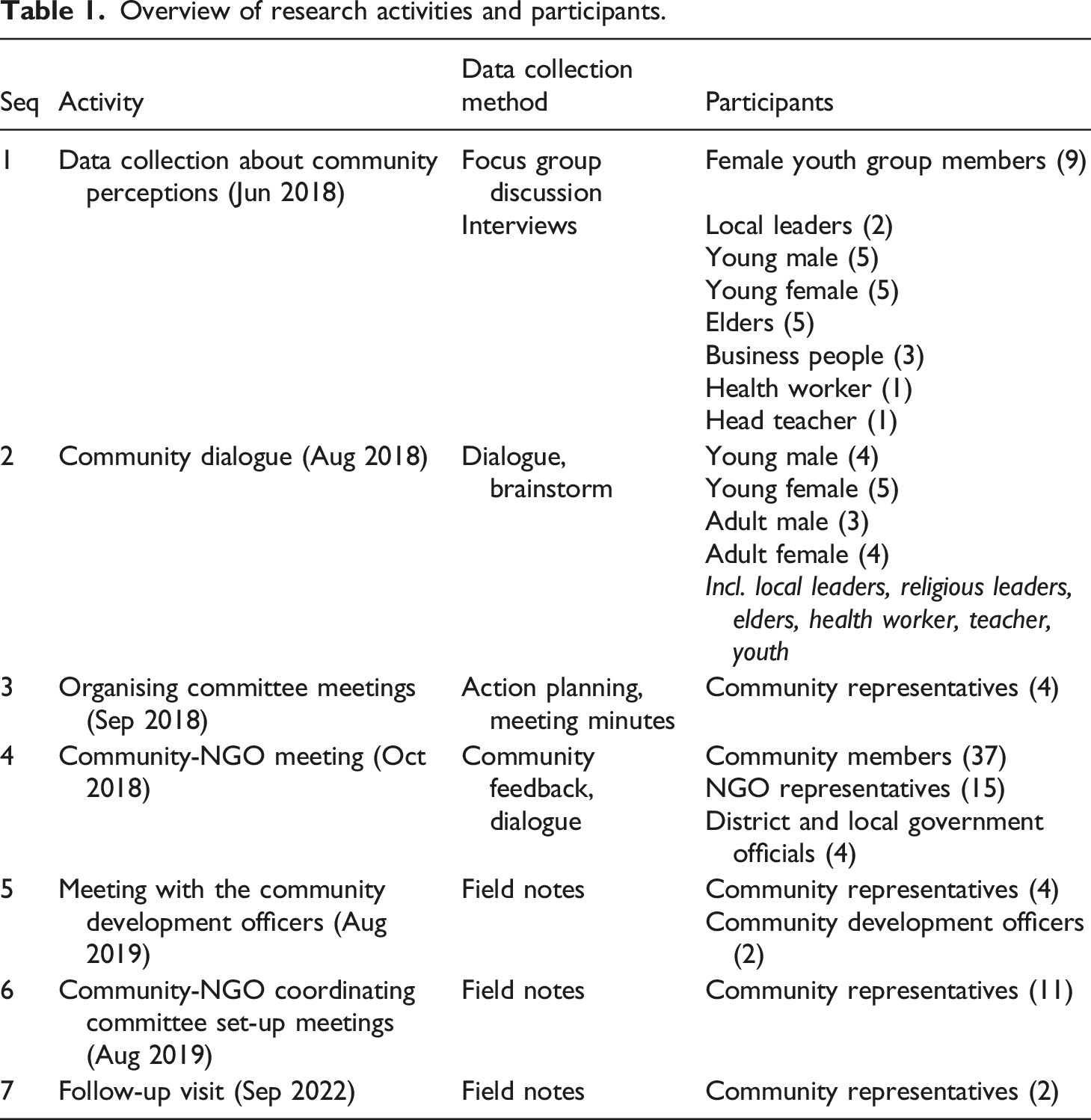
During a community dialogue, preliminary insights from interviews and FGDs - analysed by the research assistants and PhD student - were presented for feedback. Based on a proposal from participants in this feedback meeting, a community-NGO meeting was organised to present recommendations to NGOs operating in the village. After these events, the local leader started an initiative to continue collaboration efforts between NGOs and the community, one of the research assistants observed meetings of this newly established community-NGO coordinating committee and conducted short phone calls with elected members to find out why the initiative did not take off. In September 2019 Marit brought the district community development officer to meet with the local leader and discuss the initiative. In addition, she interviewed members of the case study NGO to gather their reflections on the community-NGO meeting held in 2018. In September 2022, Marit and Sophia visited two active research participants in the village to discuss the contents of this article and to find out what had happened with the ideas generated in the research since.
All recorded interviews and meetings were transcribed and translated. In preparation of this manuscript, Marit analysed these transcripts using ATLAS.ti guided by the theoretical framework presented earlier as well as emerging issues (Hennink et al., 2011). Six code groups emerged: youth development status quo; actors; relationship aspects; perceptions of NGOs; positionality and agency; and space dimensions. Analysis further occurred during conversations between the co-authors and discussions with the research participants in the various meetings.
Ethical considerations
To enable informed consent, research objectives and the possibility to opt out were explained in the local language. Some members opted out or preferred to remain off-record. Prior to the study, approval was sought from the district government as well as village leadership. The overall PhD research was cleared by the Uganda National Council of Science and Technology. The research assistants signed a statement committing to ethical data collection and management procedures. In line with the promised data protection, only Marit accessed interview and dialogue transcripts. Sophia only accessed the transcript of the community-NGO meeting in which she participated. The data were pseudonymised and the names included in this paper are aliases.
Findings
Setting the scene
Participants stressed similar development issues mentioned in Uganda’s national discourse: unemployment, early school leaving, lack of skilling opportunities and early pregnancy. We discovered how individuals were engaging with these development issues and we learned about youth aspirations and choices, and the influence of gender, religion, industrial development or role models. Several initiatives to address these issues were mentioned by participants. For example, youth groups running income generating activities, local artisans offering apprenticeships or youth receiving counselling from local leaders or parents - especially from mothers. There is also “parliament”: an informal space where boys and girls meet separately to discuss issues of interest. In addition, through the interviews and dialogues, eighteen NGOs were identified cumulatively many of them supporting youth. Participants knew about several NGO programmes including: constructing houses; health education; vocational skills training; savings and credit; and education support.
Community members mentioned several issues about the way NGOs run programmes for and with them. Some noted a mismatch between needs and programmes; youth would like more support in accessing market opportunities and talent development in sports. Family planning on the other hand, some mentioned, is less relevant to them. Members also noted that NGOs tend to work with the same people and exclude others. This was associated with community gatekeepers who influence who is selected to participate. The problem is, most organisations when they come, they select the leaders in the community and they fail to deliver to us here. (Joseph, youth, interview 7)
Several participants mentioned that NGOs made unfulfilled promises; sometimes these were “briefcase” 1 organisations that solicit money for inexistent programmes. Overall, the first stage of this research helped to consolidate scattered information about the various initiatives for youth development and identify areas of overlap and misalignment. This collectively created knowledge acted as a trigger for the research process to become a joint journey.
Establishing a mutual agenda
The interviews and FGD showed traces of dependent agency; it seemed that some participants adopted a vocabulary aimed at accessing resources of interest to them (Anderson & Patterson, 2017). In six interviews, participants articulated support requests directed at the researcher. Marit had stayed away from the interviews to avoid being associated with NGOs as a white person. Still, despite efforts of the research assistants to build rapport and seek an informal atmosphere, the interviews seem to have mimicked conversations that NGOs conduct in communities. The logic of research apparently looks like the logic of NGOs. However, the learning trajectory became more collective during the validation dialogue. At this point, the relationship between the participants and the researchers had strengthened and during mobilisation, members were positively surprised about the team’s return. This time, the methodology explicitly aimed at collaboratively giving meaning to the findings and identifying next steps. To open up a conversational space, the research assistants facilitated the dialogue in the local language. This led to a lively conversation with members confirming, nuancing or contrasting findings (though young women participated visibly less in the conversation). During the dialogue community members discovered the extent and implications of the problems surrounding community-NGO collaboration. My thinking tells me that the problem has been there but as these people [refers to researchers] have given us chance to talk about it. (Bagamba, adult, community dialogue)
At the end of the meeting, participants brainstormed recommendations for NGOs, themselves as a community and the government. Strong recommendations for NGOs included: engage youth from the start and give them leadership in projects; clarify the organisation’s agenda; include multiple community stakeholders; facilitate continuous touch-points and feedback loops; and connect with existing initiatives for youth development. Participants of the dialogue also noted that they as community members could more proactively support NGOs in search of coordination. They recommended that the government should regulate the work of NGOs and demand accountability. When the researcher asked what participants wanted to do with their insights, they unanimously answered that the NGOs should come for a meeting so they could share their feedback face-to-face. The best idea that would work well if there is a chance to call all NGOs […] and we talk to them face-to-face. It could help better than just report about findings. (Reverend, adult, community dialogue)
To operationalise this idea, four representatives were elected to form an organising committee –ensuring equal representation of male/female and adult/youth. During a planning meeting with Marit, the committee suggested that youth should receive the majority of speaking time and that their main recommendation as organisers was to form a “community-NGO coordinating committee” that could act as a focal point for NGOs. So far, research activities enabled participating community members and the research team to form a mutual agenda, operationalised by organising a meeting to share feedback with all NGOs operating in the community.
Turning the tables on community-NGO relations
Considering NGOs are usually in the driver’s seat, we could not be sure whether the NGOs would honour the community’s invite. Sixteen NGOs were successfully traced through the internet and district officer and eventually eight NGOs and an NGO network joined the meeting. In addition, a large number of adults and youths from the community was represented including various local leaders. Whilst this was a diverse audience, one of the youths underlined that we cannot speak of full representation. We don’t even make 100 [participants] but it’s like we are representing a whole parish or a full sub-county. Many people are out there in the communities that would have loved to be helped but when they are not aware of the ongoing programmes. […] If you had organised ‘motor-drives’ […] or maybe put up a communal event like football match, many of the youths would be here by now. (Balondemu, youth, community-NGO meeting)
Four years later, in the follow-up meeting with Sophia and Marit the youth representative of the organising committee remembered how difficult it was to mobilise young people to attend the meeting in 2018. To convince fellow youth to come, he did not emphasise this being a research as that could be associated with criminal investigations. Instead, he emphasised that something like a project or other benefits could emerge out of the meeting.
A fellow PhD student from the region facilitated the meeting. He is well-versed with the languages of local government, NGOs and the community – an important ingredient for establishing conversational space (Angucia et al., 2010). A research assistant provided real-time translations to enable participation. The room was set-up in a semi-circle, creating a physical sense of equality. However, an impromptu high table was created by a local leader, putting selected senior people in front. After general introductions, youth were invited to share their feedback. In the second half of the meeting, NGOs and leaders were asked to respond. To characterise the learning space that emerged we present three situations; two that display a clash of logics and one that presents synergy.
Situation 1 – Unfilled promises or unfulfilled requirements?
The first situation illustrates how the logic of youth does not always correspond with the logic of NGOs. Patricia shared how she supported an NGO in mobilising fellow teen mothers to start a project. She felt swindled by the local volunteer; the group had collected money for registration but never received start-up capital as promised. A head teacher supported her point by noting that the NGO volunteer was inexperienced. There was an NGO that came; […] they even gave me power to lead. […] So, when it came, I collected the teen young mothers below eighteen years. When we began, they requested for money from us - I understand ‘for registration’- each of us paid. […] and it reached a time and they left. […]. So, it’s from that point that I say, for us that they always make to run up and down, how do we benefit from? As the community contact persons keep on eating [using] up the money, they send to us. (Patricia, youth, community-NGO meeting)
In response, a representative from the NGO explained that the volunteer was recommended by the community and therefore the NGO could not be fully held responsible for his actions. In addition, she explained the group did not receive capital because they did not meet the requirements in time despite the volunteer’s instructions. He told them to register at the sub-county because they give you money after you have registered; they did not. They were asked for a business plan; which business do you want and how are you going to run it? They did not do it. […] They never did any of those. So, what they did, [the volunteer] got another group [to fund]. (Agnes, NGO practitioner, community-NGO meeting)
Agnes’ final statement was that ultimately teenage mothers in the community did benefit, albeit a different group. Both parties had an explanation about what happened that made sense given their positionality. The facilitator responded to this incidence stating this was a miscommunication, explicitly underlining that the meeting was not meant as a tribunal. As an external observer, Marit had hoped for people to engage in inquiry to find out how such a miscommunication could have emerged rather than justifying their (in)actions. However, she was also curious to observe what would emerge from such frictions in this unique space where the community set the agenda and thus, she did not intervene. For Sophia this moment was uncomfortable too, she experienced key assumptions and beliefs she and the team held were being tested. In a reflection interview with the case study NGO, one of the members noted that NGO representatives in the meeting may have been trying to save face for the government officials who could choose to discontinue their programmes.
Situation 2 – Why are youth not benefiting from the NGO programmes?
A second situation illustrates various conflicting perspectives on who carries responsibility to ensure young people benefit from the development interventions of NGOs. Several people shared sentiments in line with that of Faith; NGO programmes are not relevant or fail to reach those who need them most. They waste our time, like an NGO [name]; they used to pick us from school to go and participate in their programmes, for outreaches. They could tell our parents that they would pay for us school fees and later on they fail to do what they have promised. […] To people like us, those things hurt so much. (Hasifa, youth, community-NGO meeting)
When given their turn, NGOs provided several responses to the feedback. In her field notes, Marit categorised these remarks as: justifying, clarifying or defending their approach; calling for coordination; requesting youth to participate more actively; or promising to report to the headquarters. Joseph for example invited youth to actively find out what his NGO offers. But I also encourage the youth, to really look out for the friends that are working with [our NGO] in the community and ask them: “what is that exactly you are offering and how can we be part?” (Joseph, NGO practitioner, community-NGO meeting)
William stressed that programmes fail because of various challenges faced by youth and calls on NGOs to dig into the root causes of the problems. The youths have frustrated us […] We sponsor, they drop out with no clear reason. […] The girls have done so much to get themselves pregnant, as they abandon money invested in them. So, my request to other NGOs, we should address the cause. (William, NGO practitioner, community-NGO meeting)
Overall, NGO participants seemed to engage more in advocacy – stating reasons why programmes were not successfully serving youth. This provided insight into hindrances NGOs faced when trying to engage youth, and perhaps a disconnect between the youth represented in the meeting and those participating in programmes, but did not contribute to an inquiry into causes or solutions. With only a letter introducing the purpose of the meeting, the NGOs did come quite “blank” into the meeting. Something that could have been circumvented perhaps with a preparation call, guiding NGOs on the purpose of the meeting. At the same time, the “lack” of preparation also simulates the way in which communities are point-blank exposed to communications about NGO programmes – allowing us to observe an interesting and realistic dynamic. In response to the call for improved collaboration from both the youth and NGOs, one of the organisers introduced the idea of the “community-NGO coordinating committee” (though not very elaborately), constituting of community representatives who would keep track of emerging needs and initiatives in the communities and guide NGOs on who they can best work with. If you want these programmes to move, like we equally do, we are requesting that let there be collaboration between NGOs and community members […] So that there can be a committee to coordinate. […] Coming to the community when people don’t know you, what will be your destination? (Bagamba, adult, community-NGO meeting)
At this point, no one responded to this suggestion. Instead, what emerged was a back-and-forth between NGOs and the local government about gaps in regulation and coordination with youth watching on the side-line. I would like to encourage all of the local leaders: […] you need to take an interest in all the programmes that are running, an active interest. Because quite often organisations come to bring a new programme completely unaware that there were other programmes doing exactly the same thing […] (Margareth, NGO practitioner, community-NGO meeting)
Situation 3 – A small synergy
Whereas the second situation illustrated the conversation straying away from the youth’s needs and preferences, at some point a small synergy did emerge. Fatuma, a young woman, expressed that instead of family planning she would like to learn how to make sanitary pads.
Two NGO representatives guided Fatuma on where she may be able to learn this skill as this is something they trained (head) teachers in. This event revealed how coming together could lead to resourceful solutions, simply by knowing who is doing what. Several NGO practitioners appreciated this meeting for providing a platform for everyone to learn what NGOs are doing in this locality – leaving some longing for more. And in my view, it’s not also about finding the culprits […] but to appreciate that there will always be gaps. But then the question is; spaces like this don’t need to be events but it should be a process where we come and talk about these things and see, how can we move forward. (Joseph, NGO practitioner, community-NGO meeting)
The spin-off
As Joseph underlined, community-NGO collaboration is a continuous process. And yet, the research activities formed merely a sub-study of a PhD study that had a limited timeline. Marit and the organising committee brainstormed ways to “close” the research and appreciate people’s participation. This resulted in a football tournament in 2019, where boys’ and girls’ teams competed to win a goat sponsored by the PhD student. At the time of the game, the local leader who was part of the organising committee had acted on his idea of forming a “community-NGO coordinating committee” and he mobilised representatives of villages part of his parish. In 2019, this committee met a few times but the structure “died out”. Our research project displayed some similar shortcomings as NGO projects and we were constrained in how much follow-up we could facilitate.
To our slight surprise, several years later in 2022, the local leader informed us that the idea of the coordinating committee has been absorbed in a new governance structure: the local leaders’ association. The association has the role of advising NGOs what support is most needed and where, received its own office space and has started building up a database of NGOs currently operating in the area. The research participants also highlighted that two of the NGOs that attended the meeting in 2018 are now more actively following up their programmes. Despite there now being a structural body enabling more continuous learning between NGOs and the community (through their leaders), both representatives expressed lingering personal expectations to see more tangible results of the research “something we could point at, that project was done by Marit”. This brief follow-up conversation revealed that the community members are keen to turn the tables and become the coordinators of which interventions are prioritised for whom and at the same time continue to enact their dependent agency to solicit additional forms of support within the development frameworks NGOs (or researchers) offer.
Discussion: Taking stock
Summary of the collective learning trajectory in the study
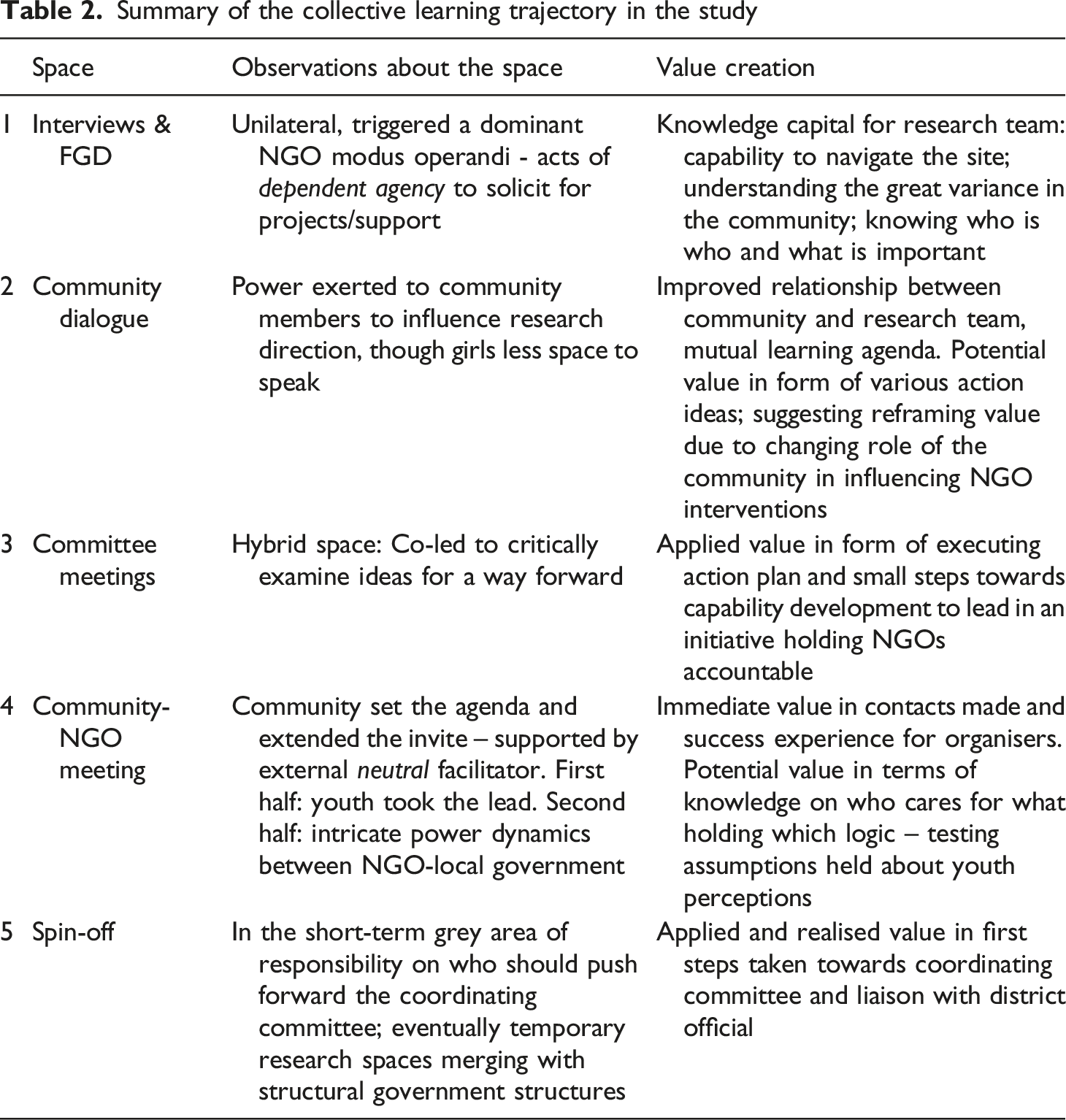
Though we have not followed up with all participants of this research trajectory, from our perspective we recognise layers of immediate, potential and reframing value (Wenger et al., 2011). In 2018-2019 we felt some disappointment that insights did not lead to application and realised value. But in 2022, we discovered that ideas fronted in the meeting did actually materialise. This illustrates that indeed the layers of value of Wenger et al., (2011) may progress over time, even though there is no way of attributing changes directly to the research activities. Perhaps this is what makes it difficult for NGO practitioners to make a case for more time and resources for collective learning. What does it lead to? And how do you evaluate if the spaces “paid off”?
We view the community-NGO meeting as an enclave (Friedman, 2011): it brought together actors who do not normally meet in one space; the agenda was set by people who usually do not set the agenda; and the rules of the game changed prioritising the views of youth. Such enclaves cannot be orchestrated, it emerged as relationships strengthened and spaces to provide meaning were opened. By minimising the use of dominant operating norms, we witnessed interesting clashes of logic as well as synergies that revealed a lot about assumptions held and perceptions about the other. To some extent the community dialogue can be seen as an enclave as well. Though mimicking a more conventional research validation setting – this space did allow synthesis of knowledge and creation of new meaning about the work of NGOs and their role in collaboration. And after four years, we have seen bigger changes in structures, decision making and knowledge of what support is needed where – transformation of the wider field is happening.
The research spaces illustrate that - even though temporary - enclaves can result in reframing value as shared definitions of success emerge and relationships change). We too have reframed our definition of success; we appreciate the emergent nature of learning and learned to accept change as a series of smaller shifts in the way we relate and understand each other. Power has revealed itself as a multi-directional force – something that can be extended to another and something that is not absolute. By untangling hidden encumbrances in the field of youth development we revealed why it is difficult to understand each other and what it might take to achieve a concerted effort between actors. And we have also learned that – even when value is created – not everyone will always be satisfied with the results of activities aimed at social change, yet this does not make these activities less important. These insights have changed how we have approached learning in the professional spaces we found ourselves in after the research. Sophia chaired the learning team in her organisation and adopted an organic approach to organisational learning to ensure the agency embeds learning in its DNA as a string of habits, experiences and exchanges rather than formally organised, singular learning events. As an experienced curriculum and education designer, Marit had trained her mind to intentionally shape learning experiences, as if predicting a journey to a known destination. Through this research she has been able to unfreeze this habit and opt for less interventionist approaches where necessary.
While emphasising that collective learning requires a contextualised approach, we do want to share a few insights that could help practitioners in strengthening collective learning. We recognise that there are various practical limits to engage in collective learning – sometimes only allowing short and low-cost interactions within a project period. We hope that the pointers below help to facilitate collective learning amidst these tensions. (1) Invest time and be present – In this research, we noted significant shifts in how the spaces for learning transformed over time. And yet, NGO practitioners are often pressured to show results and value for money, constraining how much time and money they can dedicate to community interactions that do not lead to tangible results by common indicators of development or poverty reduction. The case study NGO for example shared that they have budget for two “sensitisation visits”. It is likely that with these two visits, those involved remain stuck in the dominant dependent agency logic. Being present and having more interactions greatly benefits the mutuality of learning but this also requires a new way of planning, resource mobilisation and “valuing”. We need new frameworks and indicators to trace less-tangible shifts such as immediate, potential and reframing value which increase the visibility of the markers for transformative social change and hopefully build a case for additional funding and time for such interactions. Practitioners can also be creative in how they plan their interactions in the various localities – a quick WhatsApp check-in or passing by on your way to another destination can result in meaningful learning spaces and relationships. (2) Work towards project independent partnerships – As demonstrated during our 2022 debrief meeting, change is not restricted to a coincidental project timeframe. Far after the research had ended, change occurred, far beyond the sphere of influence of the research team. The local leader who fronted the idea of an NGO-community coordinating committee had possibly already thought of this before the research and he executed it far after, with people who were never part of the study activities. Practitioners are often on project-bound contracts making it impossible to follow-up beyond the time frame. Partnerships could potentially overcome project boundaries and this is where NGO practitioners can play a brokering role. Partnerships could be boundary crossing involving academia, NGOs, communities and their leaders, governance structures etcetera. (3) Adding to the value of learning – In this study we used field theoretical lenses to understand social change and spaces for learning. We were able to identify how spaces changed over time and what value these spaces generated and for whom. Practitioners and researchers too might find the layers of value of Wenger et al., (2011) useful in tracking and tracing change. One additional layer of value we may propose in addition is that of “boundary crossing value”. This layer refers to creating new fields with alternative norms, where new relationships are being brokered between actors beyond time and locality. This layer of value is key in moving from an enclave to lasting transformation of the field. An example of boundary crossing value in this study was how the local leader found new connections with the district officer who later on played an important role in embedding the NGO-community coordinating committee in governance structures. Another example are the new insights and relationships gained from the NGO-community meeting where NGOs who had not known about each other’s’ presence learned what others were doing in the same village. We invite other researchers to explore this lens further in other situations of collective learning and social change.
Conclusion
Collective learning is often described as the panacea for development programming towards best fit solutions to complex problems such as multidimensional poverty. However, juggling high and diverse expectations from different parties, NGO practitioners have to realise an act of defiance to facilitate collective learning that creates a critical understanding of the problems at hand and new opportunities and conditions for change. Through our experience in Central-Eastern Uganda we illustrate how field theory can make social change visible – including smaller shifts and changes which could potentially help in choosing learning promoting actions and interactions as well as lobby for more resources and times for NGOs to dedicate towards this. We encourage other development practitioners, researchers and changemakers to start small whilst dreaming big and keeping an eye out for boundary crossing value to help change stick and grow beyond projects.
Footnotes
Acknowledgments
We are grateful for the active participation, honest and critical input from the members of the village, case study NGO and youth volunteers who participated in this PAR. We wish to thank the anonymous reviewers as well as the editors for their constructive feedback. A special thank you to two members of the organising committee in the village who offered comments and additional insight into the revision process of this manuscript.
Declaration of conflicting interests
The author(s) declared no potential conflicts of interest with respect to the research, authorship, and/or publication of this article.
Funding
The author(s) received no financial support for the research, authorship, and/or publication of this article.
